L
L
e
e
a
a
r
r
n
n
e
e
r
r
G
G
u
u
i
i
d
d
e
e
P
P
r
r
i
i
m
m
a
a
r
r
y
y
A
A
g
g
r
r
i
i
c
c
u
u
l
l
t
t
u
u
r
r
e
e
S
S
y
y
s
s
t
t
e
e
m
m
f
f
o
o
r
r
f
f
o
o
o
o
d
d
s
s
a
a
f
f
e
e
t
t
y
y
a
a
n
n
d
d
q
q
u
u
a
a
l
l
i
i
t
t
y
y
m
m
a
a
n
n
a
a
g
g
e
e
m
m
e
e
n
n
t
t
My name: . . . Company: . . . Commodity: . . . Date: . . .The availability of this product is due to the financial support of the National Department of Agriculture and the AgriSETA. Terms and conditions apply.
Version: 01 Version Date: July 2006
B
B
e
e
f
f
o
o
r
r
e
e
w
w
e
e
s
s
t
t
a
a
r
r
t
t
…
…
Dear Learner - This Learner Guide contains all the information to acquire all the knowledge and skills leading tothe unit standard:
Title: Use language and communication in occupational learning programmes
US No: 8979 NQF Level: 3 Credits: 5
The full unit standard will be handed to you by your facilitator. Please read the unit standard at your own time. Whilst reading the unit standard, make a note of your questions and aspects that you do not understand, and discuss it with your facilitator.
This unit standard is one of the building blocks in the qualifications listed below. Please mark the qualification you are currently doing:
Title ID Number NQF Level Credits Mark
National Certificate in Animal Production 48979 4 120 National Certificate in Plant Production 49009 4 120
This Learner Guide contains all the information, and more, as well as the activities that you will be expected to do during the course of your study. Please keep the activities that you have completed and include it in your Portfolio of Evidence. Your PoE will be required during your final assessment.
W
W
h
h
a
a
t
t
i
i
s
s
a
a
s
s
s
s
e
e
s
s
s
s
m
m
e
e
n
n
t
t
a
a
l
l
l
l
a
a
b
b
o
o
u
u
t
t
?
?
You will be assessed during the course of your study. This is called formative assessment. You will also be assessed on completion of this unit standard. This is called summative assessment. Before your assessment, your assessor will discuss the unit standard with you.
Assessment takes place at different intervals of the learning process and includes various activities. Some activities will be done before the commencement of the program whilst others will be done during programme delivery and other after completion of the program.
The assessment experience should be user friendly, transparent and fair. Should you feel that you have been treated unfairly, you have the right to appeal. Please ask your facilitator about the appeals process and make your own notes.
Are you enrolled in a: Y N
Learnership? Skills Program? Short Course?
Please mark the learning program you are enrolled in:
Your facilitator should explain the above concepts to you.
Version: 01 Version Date: July 2006
Your activities must be handed in from time to time on request of the facilitator for the following purposes:
The activities that follow are designed to help you gain the skills, knowledge and attitudes that you need in order to become competent in this learning module.
It is important that you complete all the activities, as directed in the learner guide and at the time indicated by the facilitator.
It is important that you ask questions and participate as much as possible in order to play an active roll in reaching competence.
When you have completed all the activities hand this in to the assessor who will mark it and guide you in areas where additional learning might be required.
You should not move on to the next step in the assessment process until this step is completed, marked and you have received feedback from the assessor. Sources of information to complete these activities should be identified by your facilitator.
Please note that all completed activities, tasks and other items on which you were assessed must be kept in good order as it becomes part of your
Portfolio of Evidence for final assessment.
E
Version: 01 Version Date: July 2006
H
H
o
o
w
w
t
t
o
o
u
u
s
s
e
e
t
t
h
h
i
i
s
s
g
g
u
u
i
i
d
d
e
e
…
…
Throughout this guide, you will come across certain re-occurring “boxes”. These boxes each represent a certain aspect of the learning process, containing
information, which would help you with the identification and understanding of these aspects. The following is a list of these boxes and what they represent:
M
My
y
N
No
ot
te
es
s
…
…
You can use this box to jot down questions you might have, words that you do not understand, instructions given by the facilitator or explanations given by the facilitator or any other remarks that will help you to understand the work better.
. . . .. . . . . . .. . . . . . .. . . . . . .. . . . . . . . . .. . .
What does it mean? Each learning field is characterized by unique terms and
definitions – it is important to know and use these terms and definitions correctly. These terms and definitions are highlighted throughout the guide in this manner.
You will be requested to complete activities, which could be group activities, or individual activities. Please remember to complete the activities, as the facilitator will assess it and these will become part of your portfolio of evidence. Activities, whether group or individual activities, will be described in this box.
Examples of certain concepts or principles to help you contextualise them easier, will be shown in this box.
The following box indicates a summary of concepts that we have covered, and offers you an opportunity to ask questions to your facilitator if you are still feeling unsure of the concepts listed.
Version: 01 Version Date: July 2006
W
W
h
h
a
a
t
t
a
a
r
r
e
e
w
w
e
e
g
g
o
o
i
i
n
n
g
g
t
t
o
o
l
l
e
e
a
a
r
r
n
n
?
?
What will I be able to do? ...……….………… 6
Learning outcomes ……… 6
What do I need to know?...…..……… 7
Revision ………...………. 8
Session 1 Manage a traceability system ...…………... 11
Session 2 Good manufacturing practices in the agricultural food chain... 23
Session 3 Non-Conformances and the effect thereof on quality of the product...………. 51
Session 4 Conduct Internal Audits...……… 56
Session 5 Maintain Standard Operational Procedures... 68
Am I ready for my test? ...……... 74
Checklist for practical assessment ...……... 75
Paperwork to be done ...……... 76
Bibliography ...……... 77
Terms and conditions ………..……….. 78
Acknowledgements ...……... 79 SAQA Unit Standards
Version: 01 Version Date: July 2006
W
W
h
h
a
a
t
t
w
w
i
i
l
l
l
l
I
I
b
b
e
e
a
a
b
b
l
l
e
e
t
t
o
o
d
d
o
o
?
?
When you have achieved this unit standard, you will be able to:
Implement a management system related to food safety, production practices, as well demonstrate environmental and social awareness within the agricultural supply chain. Learners will gain an understanding of sustainable agricultural practices as applied in orchard farming. This unit standard focuses on the application of food safety principles in primary agriculture.
Be fully competent in food safety practices whereby providing the environment for the application of quality practices and thus strengthen agricultural practices in general. They will be able to participate in, undertake and plan farming practices with knowledge of their environment. This unit standard will instil a culture of maintenance and care for both the environment as well as towards farming infrastructure and operations.
L
L
e
e
a
a
r
r
n
n
i
i
n
n
g
g
O
O
u
u
t
t
c
c
o
o
m
m
e
e
s
s
At the end of this learning module, you must is able to demonstrate a basic knowledge and understanding of:
Principles of regulatory and legal aspects with reference to the specific agricultural enterprise.
A basic understanding of food-borne illnesses.
A basic knowledge of the Impact of food safety and quality in trade.
A thorough understanding of contamination risks and preventative measures. Contamination risks.
Contamination preventative measures.
A basic understanding of risk factors related to food safety. Be familiar with the principles of food safety and quality.
Basic principles of environmental and conservation management. Basic principles of waste and pollution management.
Basic principles of natural resource management.
Local legislation such as Occupational Health and Safety, Health and Welfare, A basic understanding of procedures of internal audits, traceability, and management skills.
Version: 01 Version Date: July 2006
W
W
h
h
a
a
t
t
d
d
o
o
I
I
n
n
e
e
e
e
d
d
t
t
o
o
k
k
n
n
o
o
w
w
?
?
It is expected of the learner attempting this unit standard to demonstrate competence against the unit standard:
NQF3: Literacy and Numeracy
2: 116125, Apply crop protection effectively and responsibly
3: 116240, Explain store inputs categories, labelling and storage methods 3: 116271, Monitor and supervise a food safety and quality management system in the agricultural supply chain
M
My
y
N
No
ot
te
es
s
…
…
. . . . . . . . . . . . . . . . . . . . . . . . . . . . . . . . . . . . . . . . . . . . . . . . . . . . . . . . . . . . . . . . . . . . . .Version: 01 Version Date: July 2006
Revision of Level 3
H Heeaalltthh,, SSoocciiaall aanndd EEnnvviirroonnmmeennttaall IIssssuueess RReellaatteedd ttoo tthhee AAggrriiccuullttuurraall E EnnvviirroonnmmeennttFood safety is an essential public health function according to a resolution that was adopted by the World Health Organisation.
Food-borne diseases are a major threat to public health and affect the social and economical well-being of societies.
Global trends in food consumption mean that food is consumed far from where it is produced, and that food from a single source is consumed by a great number of people.
The Codex Alimentarius Commission establishes international food standards to protect the health of consumers, and to ensure fair practices in the food trade, on which member countries base their food safety legislation and regulations. In South Africa, the Agricultural Products Act (APS) prescribes food safety standards.
Regulations for specific commodities are based on and empowered by the APS, and standards and requirement checklists are in turn based on the regulations. The PPECB is an assignee of the DoA, and conducts, amongst others, quality assurance inspections in terms of food safety regulations, and food safety audits.
EurepGAP prescribes a set of food safety and quality standards for all products that are exported to the European Union and the United Kingdom.
Communicable diseases are of importance in plant production because is impacts on worker health and productivity.
Workers that contract diseases that are infectious must be removed from the workplace until they no longer pose a danger to the health of other workers. The environmental impact and sustainability of food production is usually addressed on an industry level through Improvement Programmes, Crop and Fruit Quality Management Research, Disease Management Research, and Integrated Pest Management Research.
The most significant contribution that individual growers can make to
sustainability and minimising environmental impact is by applying Integrated Crop Production (ICP) principles.
Awareness amongst workers with regard to food safety issues are created through skills development, workshops and road shows by commodity
organisations, awareness campaigns, incentives and disciplinary enforcement by employers, warning signs, and inspections.
Checklists are handy as a guideline for the information that should be disseminated to workers.
Recordkeeping enables traceability, which should allow one to trace a fruit from where the consumer buys it back to the tree it grew on in the orchard, with details of all the processes that it was subjected to in between.
Version: 01 Version Date: July 2006
N
Noonn--CCoonnffoorrmmaannccee aanndd FFoooodd SSafafeettyy
Everyone involved in the production process has a responsibility towards food safety and must be aware of what is required to ensure that food is safe for human consumption.
Non-conformance must be reported immediately and the reporting must be escalated until appropriate action is taken.
The seven principles of HACCP is a good general approach to food safety monitoring.
Periodic reports and checklists must be developed for each critical control point that is identified with the specific aim to detect compliance and non-conformance as soon as it occurs.
Informal reporting relies on every person having a thorough understanding of the requirements and principles of food safety and on a tiered verbal reporting
system that normally follows the chain of command.
The response in case of non-conformance must include steps to immediately correct the problem, to isolate the area in which the problem occurred, to determine the impact of the problem and take steps to rectify the situation, to determine the cause of the problem, and to ensure that the problem does not recur.
T
Trraacceeaabbiilliittyy
Traceability depends on the completeness of the recordkeeping systems throughout the supply chain.
ISO develops voluntary international standards for products and services and defines traceability as the ability to trace the history, application, or location of that which is under consideration.
The purpose of traceability is to allow one to determine the point at which deviations or non-conformance occurred if it is found that the safety of the product has been compromised.
Traceability if a legislative requirement.
The most basic penalty for non-compliance is that no produce will be accepted, shipped or sold if it does not comply with the minimum standards for traceability.
R
Reeccoorrdd kkeeeeppiinngg
Recordkeeping is essential for complying with a major food safety requirement, being traceability.
Checklists are available to ensure that the correct records are kept.
Quality management systems that are commonly used are ISO, EurepGAP and HACCP.
ISO reflects international consensus on the standards that are required by governments, business and society.
Version: 01 Version Date: July 2006
EurepGAP aims to develop widely accepted standards and procedures for the global certification of Good Agricultural Practices (GAP).
HACCP is a commonsense approach designed to identify and control food safety hazards, and monitor the controls established.
I
Inntteerrnnaall AAuuddiittss
Internal audits aim to monitor and probe the integrity of any quality management system continuously.
There are no specific rules for internal audits, but it is closely related to the type of quality management system that is in place.
Regardless of the size of the entity or the approach to internal audits, there are key elements that must be included in all internal audit systems.
Conducting an internal audit mostly includes measuring and monitoring, evaluation, and reporting.
I
Immpplleemmeennttiinngg FFoooodd SSaaffeettyy aanndd QQuuaalliittyy PPrriinncciipplleess
Observing sanitation standard operating procedures eliminate the risk of food contamination.
Maximum residue levels are prescribed by legislation, but also by importing country’s standards.
A document indicating maximum residue levels and pre-harvest intervals is developed by the Citrus Growers Association.
HACCP provides a handy tool for implementing food safety principles.
Hazard analysis involves identifying all possible hazards to food safety at every point.
Critical control points are identified as points at which control can be applied. Critical operational limits are established for each critical control point. Critical control points are monitored and operations are measured against operational limits.
Procedures for corrective action are developed in case of a loss of control. Records are kept of all operations at critical control points.
The soundness, effectiveness, and implementation of the system are verified. Recordkeeping is essential for traceability and effective management.
The types of records that must be kept are prescribed by legislation and standards authorities.
Version: 01 Version Date: July 2006
S
Se
es
ss
si
io
on
n
1
1
M
M
a
a
n
n
a
a
g
g
e
e
a
a
t
t
r
r
a
a
c
c
e
e
a
a
b
b
i
i
l
l
i
i
t
t
y
y
s
s
y
y
s
s
t
t
e
e
m
m
After completing this session, you should be able to:
SO 1: Manage a traceability system demonstrating operational efficiency in the agricultural supply chain.
In this session we explore the following concepts:
Traceability Record Keeping
1
1
.
.
1
1
I
I
n
n
t
t
r
r
o
o
d
d
u
u
c
c
t
t
i
i
o
o
n
n
Traceability is the ability to trace and follow a food product or any substance intended to be, or expected to be incorporated into, a food product through all stages of production, packing, processing, handling and distribution. Traceability refers to the completeness of the information about every step in a process chain. Traceability is one of the most important corner stones of food safety
implementation. In this chapter, we will briefly revise certain concepts and checklists that were discussed in detail at previous levels, before looking at how traceability is implemented in the pre-harvest production environment along with the recordkeeping systems that are essential for traceability.
1
1
.
.
2
2
T
T
h
h
e
e
p
p
u
u
r
r
p
p
o
o
s
s
e
e
o
o
f
f
T
T
r
r
a
a
c
c
e
e
a
a
b
b
i
i
l
l
i
i
t
t
y
y
Consumer protection is and essential aspect in the agricultural production environment. Traceability allows the grower to provide proof of the origin of all fresh produce, and therefore presents a measure of protection for the grower and the consumer. For grain production, traceability is problematic because it gets mixed but less critical because it is normally cooked and not consumed in a fresh form like fruit.
It is critical that all employees in the supply chain understands the importance of food safety and the related traceability of it. Traceability serves the following purposes:
Version: 01 Version Date: July 2006
• Security – It is a legal requirement that any defective product that presents
a risk to the consumer must be able to be recalled immediately. Traceability allows this by ensuring that the origins of the product can be determined.
• Investigation – If a product is found to be defective, at least two things
have gone wrong. Firstly, the product itself was not produced, handled or packed in the prescribed manner, and secondly, the product may already have passed through quality control points where the defect should have been detected. Traceability allows for the necessary investigation to determine where these deviations occurred.
• Production Management – Traceability can lead to a greater
understanding of the company's capabilities, making it possible to meet production targets in a shorter time and at a lower cost. Traceability can also be a starting point for the statistical methods of process control (SPC).
• Stimulus for Technical Progress – There is always a risk that a production
unit that is profitable and that is meeting its objectives may become
complacent. Implementing traceability systems forces management to assess the use of technology within the organisation and the skills levels of the employees.
• Consumer Information – Traceability allows the producer to collect information about consumers and their spending habits, which allows him to better define and understand his target market.
1
1
.
.
3
3
T
T
r
r
a
a
c
c
e
e
a
a
b
b
i
i
l
l
i
i
t
t
y
y
i
i
n
n
t
t
h
h
e
e
s
s
u
u
p
p
p
p
l
l
y
y
C
C
h
h
a
a
i
i
n
n
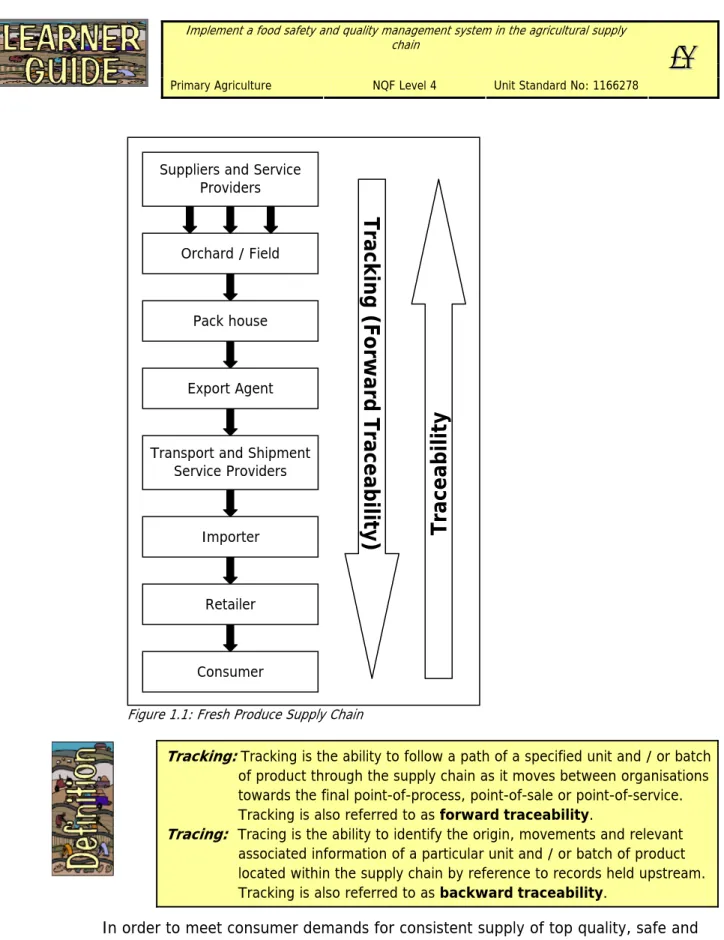
Supply chains exist in production, manufacturing and service organisations, and they are principally concerned with the flow of products and information between supply chain member organisations. Supply chains are concerned with processes such as the procurement of products (sourcing), their transformation into finished product (production and packing), and distribution of that product to consumers. An agricultural supply chain is a series of distinct activities that take place in order to take the product from field or orchard to market. The demand chain is the supply chain in reverse, seen from the consumer’s point of view. The following diagram show a supply chain where exporting is part of it:
Version: 01 Version Date: July 2006
Figure 1.1: Fresh Produce Supply Chain
Tracking: Tracking is the ability to follow a path of a specified unit and / or batch of product through the supply chain as it moves between organisations towards the final point-of-process, point-of-sale or point-of-service. Tracking is also referred to as forward traceability.
Tracing: Tracing is the ability to identify the origin, movements and relevant associated information of a particular unit and / or batch of product located within the supply chain by reference to records held upstream. Tracking is also referred to as backward traceability.
In order to meet consumer demands for consistent supply of top quality, safe and nutritious foods, the design and implementation of full backward and forward traceable supply chains from farm to end-user has become an important part of the overall food quality assurance system.
Farmers, post-harvest handling operators, marketers, researchers and policy makers need a sound understanding of the concepts and implications of supply chain traceability to assist in developing and implementing appropriate
Orchard / Field
Pack house
Export Agent
Importer
Retailer Suppliers and Service
Providers
Consumer Transport and Shipment
Service Providers
Tracking (Forward Traceability)
Traceabilit
Version: 01 Version Date: July 2006
technological interventions to meet consumer demands for traceable agricultural supply chains.
In line with the supply chain, traceability represents the ability to identify the farm where it was grown and sources of input materials, and the ability to conduct full backward and forward tracking to determine the specific location and life history in the supply chain by means of records.
1
1
.
.
4
4
E
E
l
l
e
e
m
m
e
e
n
n
t
t
s
s
o
o
f
f
T
T
r
r
a
a
c
c
e
e
a
a
b
b
i
i
l
l
i
i
t
t
y
y
Traceability adds value to the overall quality management system by providing the communication linkage for identifying, verifying and isolating sources of non-compliance to agreed standards and customer expectations.
On previous levels we examined traceability in its obvious and simplistic form, but it is important to remember that traceability have many different elements. Some of these elements are directly related to the Good Agricultural Practices (GAP) that is discussed in detail in Chapter 2 of this guide.
There are six important elements of traceability, which in combination constitute an integrated agricultural and food supply chain traceability system. They are:
P
Prroodduucctt TTrraacceeaabbiilliittyy
Product traceability determines the physical location of a product at any stage in the supply chain to facilitate logistics and inventory management, product recall and dissemination of information to consumers and other stakeholders.
P
Prroocceessss ttrraacceeaabbiilliittyy
Process traceability ascertains the type and sequence of activities that affect the product during the growing and post-harvest operations, meaning what happened to it, where and when. These include interactions between the product and physical, mechanical, chemical, environmental and atmospheric factors and the absence or presence of contaminants.
G
Geenneettiicc TTrraacceeaabbiilliittyy
Genetic traceability determines the genetic constitution of the product, which relates in terms of food production to the plant material that was used in the orchard.
I
Innppuutt TTrraacceeaabbiilliittyy
Input traceability determines the type and supplier of inputs such as fertiliser, chemical sprays, irrigation water, and the presence of additives and chemicals used for the preservation of the product.
Version: 01 Version Date: July 2006
D
Diisseeaassee aanndd ppeesstt TTrraacceeaabbililiittyy
Disease and pest traceability traces the epidemiology of pests and biotic hazards such as bacteria, viruses and other pathogens that may contaminate food.
M
Meeaassuurreemmeenntt TTrraacceeaabbiilliittyy
Measurement traceability relates individual measurement results through an unbroken chain of calibrations to accepted reference standards. To achieve this, measuring and test equipment and measurement standards are calibrated utilising a reference standard whose calibration is certified as being traceable to a national or international standard.
The other aspect of measurement traceability relates to the property of the measurements, including data and calculations, generated throughout the supply chain and their relationship to the requirements for quality. By focusing on the quality of measurements, rather than on a property of an instrument, it is possible to assure that the measurements are indeed adequate for the intended use. To achieve this, each measured data must specify the
environmental, operator, and geospatial and temporal factors, which are not related to the instrument but impact on the quality of the data.
1
1
.
.
5
5
R
R
e
e
c
c
o
o
r
r
d
d
k
k
e
e
e
e
p
p
i
i
n
n
g
g
f
f
o
o
r
r
T
T
r
r
a
a
c
c
e
e
a
a
b
b
i
i
l
l
i
i
t
t
y
y
As we have already seen, traceability is the ability to trace and follow a food product from the orchard to the basket, or back from the basket to the field or orchard. It is logical that effective recordkeeping is the cornerstone of traceability and the implementation of a traceability system.
We also already know that traceability and supporting records for fresh produce are essential components of all quality management systems (QMS).
Checklists and compliance criteria have been developed to be used as an aid and self-assessment tool for food business operators (FBO's) in implementing the food safety system. The same checklists are used by PPECB auditors to verify that the system is in place.
In the table below, the checklists and compliance criteria that have to be completed by law in order to ensure effective traceability are set out.
Note that checklist and compliance criteria for SA GAP and on-farm pack houses have now been consolidated, therefore making it equally applicable to primary growers and secondary processors and packaging establishments.
Version: 01 Version Date: July 2006
Operation Checklists and Compliance Criteria
On-Farm Pack
houses •• SAGAP – On-Farm Pack house – Checklist – October 2006 SAGAP – On-Farm Pack house – Compliance criteria - October 2006
Off-Farm Pack
houses •• Off-Farm Pack houses – Checklist – September 2006 Off-farm Pack houses – Compliance Criteria – September 2006
Processing Plants • Processing Plants – Checklist – January 2006
• Processing Plants – Compliance Criteria – October 2005
SA GAP • GAP – Compliance Criteria – June 2006
Cold Stores • Cold Storage – Checklist – September 2006
• Cold Storage – Compliance Criteria – September 2006
Container Depots • Container Depots – Checklist – September 2006
• Container Depots – Compliance Criteria – September 2006
Transporters • Road Transporters – Checklist – September 2006
• Road Transporters – Compliance Criteria – September 2006
Table 1.1: Traceability Checklists and Compliance Criteria
Please complete Activity 1:
Design a road-show for co-workers
• What is traceability?
• What is the purpose of traceability for the industry that you are involved in?
• How do producers execute traceability?
• How can the operational efficiency of traceability be ensured and supported?
• How does recordkeeping support the efficiency of traceability?
• Which records are kept to ensure traceability?
• How can a fruit producer show evidence of compliance with traceability systems?
Records can be kept manually, by filling the check lists and forms in by hand, or electronically, by recording the information on a computer. Electronic systems have the benefit of also processing the data and additional information can as a result be extracted from these programs.
Computer programs can, for example, deliver graphs and comparisons about the progress of the producer in terms of the quality of his produce. Electronic data can often be used when comparisons are drawn over a period of time. Although manual data can supply the same information, it is a lot more complicated to extract the required information without the assistance of electronic equipment and software.
The records that must be kept in accordance with the requirements of legislations and various food safety accreditation systems serve as evidence of compliance with traceability recommendations because specific information with dates and
signatures of responsible parties are found on these documents if they have been filled in correctly.
Version: 01 Version Date: July 2006
All workers that are responsible for traceability records must therefore be trained in:
• How to complete the forms and checklists correctly.
• How, where, when and for how long, to report on and file forms and checklists.
• The accountability and responsibility in terms of traceability and the law related to the completion of (or failure to complete) these forms and checklists.
Records must be kept for a specified period in a central, accessible place, under the care of a person appointed for this task. The records must meet standard criteria of tracking and tracing, in order words it should be kept in a systematic and chronological way, by date, batch number, geographical reference point, and delivery or dispatch reference.
1
1
.
.
6
6
I
I
m
m
p
p
l
l
e
e
m
m
e
e
n
n
t
t
i
i
n
n
g
g
a
a
R
R
e
e
c
c
o
o
r
r
d
d
k
k
e
e
e
e
p
p
i
i
n
n
g
g
T
T
r
r
a
a
c
c
e
e
a
a
b
b
i
i
l
l
i
i
t
t
y
y
S
S
y
y
s
s
t
t
e
e
m
m
Traceability systems are implemented in most cases as part of the food safety and quality management system. Traceability is in fact a major requirement for such a system.
HACCP (Hazard Analysis Critical Control Point system) principles are often used as the basis for designing and implementing a quality management system. Even is the HACCP system itself is not used as such, the same basic principles should be applied. At previous levels we discussed the principles of HACCP in detail. As a reminder, they are:
• Hazard analysis
• Identification of critical control points
• Establishing critical limits
• Monitoring critical control points
• Establishing procedures for corrective action
• Recordkeeping
• Verification
HACCP provides for the risk, or hazard, assessment that has to be done prior to implementation of a quality control system, and for the ongoing management of identified risks.
ISO 22000 is a commercial food safety management standard that makes use of the HACCP principles and methodology to develop a HACCP plan. A HACCP plan is
Version: 01 Version Date: July 2006
a document that describes how an organisation plans to manage and control its food safety hazards, and contains at least the following information:
• Identified critical control points (CCP’s)
• Hazards that must be controlled at each CCP
• Control measures for each CCP
• Critical limits to be applied at each CCP
• Procedures for monitoring CCP’s
• Procedures for remedial action when limits are exceeded
ISO 22000 provides for combining the HACCP plan with prerequisite programs
(PRP’s) and operational prerequisite programs (OPRP’s) into a single integrated food safety management strategy.
Prerequisite programs (PRPs) are the conditions that must be established
throughout the food chain and the activities and practices required to establish and maintain a hygienic environment. PRPs must be suitable and capable of providing food that is safe for human consumption. PRPs are also referred to as good hygienic practices, good agricultural practices, good production practices, good manufacturing practices, good distribution practices, and good trading practices. Operational prerequisite programs (OPRPs) are prerequisite programs (PRPs) that are essential. They are essential because a hazard analysis has shown that they are necessary in order to control specific food safety hazards. OPRPs are used to reduce the likelihood that products will be exposed to hazards, that they will be contaminated, and that hazards will proliferate. OPRPs are also used to reduce the likelihood that the processing environment will be exposed to hazards.
M
My
y
N
No
ot
te
e
s
s
…
…
. . . . . . . . . . . . . . . . . . . . . . . . . . . . . . . . . . . . .Version: 01 Version Date: July 2006
Please complete Activity 2 and 3:
2. Group discussion & conclusion
Obtain an example of a recording system from a farm in your area and discuss it critically in your group. If you were the manager of a fruit farm, how will you prove that you comply with traceability standards?
3. Workplace Research
Conduct workplace research to obtain information about implementing a recordkeeping system that will meet all the requirements of traceability – i.e. give a complete list of all the documented records with physical examples attached for each step listed below.
a. Conduct a food safety hazard analysis. b. Identify your critical control points (CCPs).
c. Establish critical limits for each critical control point. d. Develop procedures to monitor critical control points. e. Design corrective actions to handle critical limit violations. f. Create a food safety record keeping system.
Version: 01 Version Date: July 2006
Now draw up a suggested HACCP plan for your farm according to the criteria listed below, and include a summary of information for the following information flow in your workplace:
Risk Assessment
Identify Hazards to food Safety
Characterise these Hazards
Conduct an exposure assessment
Characterise the risk
Risk Management Weigh up policy alternatives for the protection of consumer health
Weigh up policy alternatives for the promotion of fair trade practices
Select the appropriate
prevention and control options
Risk
Communication
Identify the role-players in risk communication and to whom risk management findings must be communicated
Version: 01 Version Date: July 2006
Criteria for HACCP plan
a. Critical control points (CCPs)
b. Hazards that will be controlled at each CCP
c. Control measures that will be used at each CCP
d. Critical limits that will be applied at each CCP
e. Procedures that will be used to monitor CCPs
f. Actions that will be taken when limits are violated
Give an overview of which Prerequisite programmes are in use?
Version: 01 Version Date: July 2006
Concept (SO 1) I understand this concept Questions that I still would like to ask
The purpose of a traceability system is explained.
Practices, which will support
operational efficiency of a traceability system are identified.
The record keeping which supports a traceability system is explained. Evidence of traceability records provided.
M
My
y
N
No
ot
t
es
e
s
…
…
. . . . . . . . . . . . . . . . . . . . . . . . . . . . . . . . . . . . . . . . . . . . . . . . . . . . . . . . . .Version: 01 Version Date: July 2006
S
Se
es
ss
si
io
on
n
2
2
I
I
m
m
p
p
l
l
e
e
m
m
e
e
n
n
t
t
a
a
r
r
e
e
c
c
o
o
r
r
d
d
s
s
y
y
s
s
t
t
e
e
m
m
o
o
n
n
t
t
h
h
e
e
f
f
a
a
r
r
m
m
After completing this session, you should be able to:
SO 2: Manage and maintain good agricultural practices (GAP) associated with good manufacturing practices (GMP), good health practices (GHP), good social practices (GSP) and good
environmental practices (GEP).
In this session we explore the following concepts:
Good practices in Agriculture
2
2
.
.
1
1
I
I
n
n
t
t
r
r
o
o
d
d
u
u
c
c
t
t
i
i
o
o
n
n
‘Good practices’ is a term that has come into use in recent years to describe the good way to do or manage things. This is often put in place of strict regulations where producers are encouraged to comply to Good Practices through education and incentives. Self monitoring then becomes an important tool in the Good
Practices System. Guidelines for Good Practices have been developed for just about every activity in every field, from good trading practices to good marketing
practices to good fund raising practices.
Good practice guidelines aims to improve the manner in which a variety of business conduct themselves, by integrating for instance good social practices with good agricultural practices.
The management and maintenance of GAP are closely linked with recordkeeping and the concepts and process flow associated with traceability, and should be targeted for internal monitoring, internal audits, and inspections by external auditors and inspectors.
Version: 01 Version Date: July 2006
2
2
.
.
2
2
G
G
o
o
o
o
d
d
P
P
r
r
a
a
c
c
t
t
i
i
c
c
e
e
s
s
i
i
n
n
t
t
h
h
e
e
A
A
g
g
r
r
i
i
c
c
u
u
l
l
t
t
u
u
r
r
a
a
l
l
S
S
u
u
p
p
p
p
l
l
y
y
C
C
h
h
a
a
i
i
n
n
In agriculture, good practice guidelines have been developed for the entire supply chain, and they include:
• Good Agricultural Practices (GAP)
• Good Manufacturing Practices (GMP)
• Good Health Practices (GHP)
• Good Social Practices (GSP)
• Good Environmental Practices (GEP)
Good practice guidelines are interactive and integrated, meaning that the requirements of good social practices, good health practices and good
environmental practices are included and integrated with good agricultural practices and good manufacturing practices. In crop production and processing, GAP and GMP principles are the therefore generally applied, as this provides for other good practices as well.
G
Goooodd AAggrriiccuullttuurraall PPrraaccttiicceess ((GGAAPP))
Good agricultural practices are a collection of principles and basic environmental and operational conditions that are necessary for the production of safe,
wholesome fruit and vegetables. The term includes practices used in growing, harvesting, sorting, packing and storage operations. GAP principles also aim to ensure the sustainability of agricultural production.
G
Goooodd MMaannuuffaaccttuurriinngg PPrraaccttiicceess ((GGMMPP))
Good manufacturing practices are guidelines that manufacturers use to ensure the quality, consistency and safety of products and processes. GMP is often used simultaneously with GAP and includes practices used in sorting, packing, storage and transportation operations.
G
Goooodd HHeeaalltthh PPrraaccttiicceess ((GGHHPP))
Good health practices are guidelines that help reduce the risk of being implicated in the spread of food-borne illnesses through poor personnel hygiene. The scope of these practices is relevant to staff and worker health and hygiene.
G
Goooodd SSoocciiaall PPrraaccttiicceess ((GGSSPP))
Good social practices address a wide range of environmental issues and are not only applicable to agriculture. These issues include:
Version: 01 Version Date: July 2006
• Third bullet – Not bold – Like thisEconomically Disadvantaged
Producers – Good social practices prescribe a strategy for poverty
alleviation and sustainable development. Its purpose is to create
opportunities for producers who have been economically disadvantaged or marginalised by the conventional trading system.
• Transparency and Accountability – Good social practices encourages
transparent management and commercial relations to deal fairly and respectfully with trading partners.
• Capacity Building – Good social practices is a means to develop
producers’ independence. Fair trade relationships provide continuity, during which producers and their marketing organisations can improve their
management skills and their access to new markets.
• Payment of a Fair Price – A fair price in the regional or local context is
one that has been agreed through dialogue and participation. It covers not only the costs of production but enables production which is socially just and environmentally sound. It provides fair pay to the producers and takes into account the principle of equal pay for equal work by women and men.
• Gender Equity – Good social practices means that women’s work is
properly valued and rewarded. Women are paid for their contribution to the production process and are empowered in their organisations.
• Working Conditions – Good social practices means a safe and healthy
working environment for producers and workers. The participation of children, if any, does not adversely affect their well-being, security, educational requirements and need for play, and conforms to the UN Convention on the Rights of the Child as well as the laws and norms in the local context.
• Environment – Good social practices actively encourages better
environmental practices and the application of responsible methods of production.
G
Goooodd EEnnvviirroonnmmeennttaall PPrraaccttiicceess ((GGEEPP))
Good environmental practices address the following aspects:
• The environmental hazard posed by the product, its production, its use and ultimate disposal
• Substitution by less polluting activities or substances
• The scale of use
• The potential environmental benefit or penalty of substitute materials or activities
• Advances and changes in scientific knowledge and understanding
• Time limits for implementation
Version: 01 Version Date: July 2006
• The precautionary principle, i.e. taking preventive measures when there is reason to assume that substances or energy introduced, directly or
indirectly, into the natural environment may create hazards to human health, harm living resources and ecosystems, damage amenities or interfere with other legitimate uses of nature even when there is no conclusive evidence of a causal relationship between inputs and their effects.
Please complete Activity 4.
Give examples
Give at least two examples related to the following concepts, from perspective of the workplace or organisation where you are currently employed
Good Agricultural Practices (GAP) Good Manufacturing Practices (GMP) Good Health Practices (GHP)
Good Social Practices (GSP)
Good Environmental Practices (GEP)
2
2
.
.
3
3
T
T
h
h
e
e
p
p
r
r
i
i
n
n
c
c
i
i
p
p
l
l
e
e
s
s
o
o
f
f
G
G
o
o
o
o
d
d
A
A
g
g
r
r
i
i
c
c
u
u
l
l
t
t
u
u
r
r
a
a
l
l
P
P
r
r
a
a
c
c
t
t
i
i
c
c
e
e
s
s
GAPs may be applied to a wide range of farming systems and at different scales. They are applied through sustainable agricultural methods, such as integrated pest management, integrated fertilisation management and conservation. They rely on four principles:
• Economically and efficiently produce sufficient, safe and nutritious food
• Sustain and enhance natural resources
• Maintain viable farming enterprises and contribute to sustainable livelihoods
• Meet cultural and social demands of society
The key areas of concern when implementing a GAP program are:
• Prior land use
• Adjacent land use
• Water quality and water use practices
• Soil fertility management
• Wildlife, pest, and vermin control
• Worker hygiene and sanitary facilities
Version: 01 Version Date: July 2006
Please complete Activity 5.
Explain in your own words
Explain in your own words what the purpose of Good Agricultural Practice is and how it might be of value to a commercial fruit grower to adhere to and report on their
implementation thereof.
2
2
.
.
4
4
G
G
u
u
i
i
d
d
e
e
l
l
i
i
n
n
e
e
s
s
f
f
o
o
r
r
G
G
o
o
o
o
d
d
A
A
g
g
r
r
i
i
c
c
u
u
l
l
t
t
u
u
r
r
a
a
l
l
P
P
r
r
a
a
c
c
t
t
i
i
c
c
e
e
s
s
The following is a summary of the areas for which GAP guidelines have been developed.
Land Use and Soil
• Cultivated land information
• Current or prior use of adjacent land Water Sources and Irrigation Practices
• Potential contamination associated with water sources
• Hazards introduced by irrigation practices
• Chemigation
• Agricultural water microbiological testing procedures
Implementation of Soil and Water Conservation Principles – Organic Fertilisers
• Management of organic fertilisers
• Hazards associated with animal manure and treatments to reduce the risks
• Hazards Associated with manure treatment and storage location
• Precautions for the application of organic fertilisers
• Keeping complete records of organic fertiliser preparation and use
Implementation of Soil and Water Conservation Principles – Inorganic Fertilisers
Version: 01 Version Date: July 2006
Animal Exclusion from Production Areas
• Methods for keeping animals out of production areas
• Cleaning surrounding areas
• Animals and water Pest Control
• Pest Control in fresh produce operations
• Common pest control procedures
• Pesticides • Pesticide handling • Pesticide application • Pesticide storage • Pesticide residues • Pesticide disposal
• Training and documentation Worker Health and Safety
• Relationship between worker health and hygiene
• Health programs
• Worker hygiene training program
• Drinking water
• Worker hygiene practices and sanitation facilities
• Hand washing and hand-washing facilities
• Basic requirements for and placement of sanitary field stations Safety Hazards Associated with Harvesting
• Physical damage caused by mechanical and / or manual harvesting methods
• In-field packaging operations
Safety Hazards Associated with Post-Harvest treatments and handling
• Post-harvest water quality
Version: 01 Version Date: July 2006
2
2
.
.
5
5
M
M
a
a
n
n
a
a
g
g
i
i
n
n
g
g
g
g
o
o
o
o
d
d
A
A
g
g
r
r
i
i
c
c
u
u
l
l
t
t
u
u
r
r
a
a
l
l
P
P
r
r
a
a
c
c
t
t
i
i
c
c
e
e
s
s
L
Laanndd uussee aanndd SSooiill
Agricultural land and land that has been used for activities other than agriculture can be contaminated with pathogenic organisms or toxic chemical substances. Obtaining a history of the prior use of the land is important because it helps identify these potential hazards. In addition, the failure of prior users to follow Good Agricultural Practices can offer risks of contamination to produce grown on the soil.
It is important to obtain information about the previous use of the land where agricultural production is taking place. This can be done through interviews with prior owners, a review of municipal permits, or from other sources. This
background information can help in the identification of situations that can increase the risk for fresh produce contamination.
Cultivated Land Information
Information that should be obtained about the history of the land includes if the land is being used or has been used for:
• Animal feeding or domestic animal production
• Barns or other housing of farm animals
• Garbage or toxic waste disposal, sanitary waste management
• Mining activities, or oil or gas extraction
Other information that should be obtained includes:
• If the land has experienced any serious flooding
• If the land has been treated in an uncontrolled manner with organic or inorganic fertilisers and / or pesticides.
Prior use of the land for animal feeding or domestic animal production can greatly increase the risk of contamination of fruit and vegetables with
pathogens commonly found in the intestinal tract of animals. The potential for contamination from this source is related to the time that has passed since the land was used for animal feeding or production. The risk of contamination will also be influenced by conditions such as atmospheric temperature, sunlight and relative humidity.
The presence of barns or farm animals a short distance from the cultivation site increases the risk of product contamination. An assessment of the location of the animals and their facilities and an evaluation of drainage systems and water currents flowing near these areas will help determine the potential for
Version: 01 Version Date: July 2006
barriers or channels to divert water which may carry contaminants from the animals.
When the land has been used for garbage disposal or as a waste management site, it may contain decomposing organic matter and faecal material.
Depending on the garbage contents, soil microbial loads can be extremely high and the soil may also contain harmful chemicals or toxic contaminants.
Land that has been used for mining or petroleum extractions can be
contaminated with heavy metals or hydrocarbons. Even if the contamination is located on a small portion of the land, factors such as rainfall and subterranean water flow should be evaluated. Analysis of toxic substances in the soil and a review of the environmental compliance of the extraction operation are recommended when the ground history indicates a high risk for chemical hazards.
Heavy flooding can increase the sources of contamination. Water runoff can introduce pathogens and chemical contaminants from remote areas. Dead animals and standing water that remains after the floodwater have receded can lead to significant bacterial hazards. Individual assessment of each flooding situation is necessary, along with a review of the time that has passed since the flood and other conditions that can mitigate or reduce the risks. When there is concern about the safety of the site, microbiological analyses after the flooding has occurred may assist in identifying contamination.
Even if the investigation of the prior use of the land indicates that it has been used solely for agricultural production, prior production practices should be reviewed. Improper use of organic fertilisers may result in microbiological contamination of the soil, while inorganic fertiliser and / or pesticides used improperly can cause serious chemical hazards. Chemical compounds should have been used according to label recommendations and the products should be registered for use on the specific crop.
Current or Prior Use of Adjacent Land
The land owner or operator should research both the present and prior use of adjacent lands to identify potential sources of contamination and precautions that need to be taken to prevent contamination of fresh produce in the orchards.
Contamination from areas away from the actual growing area can reach
produce through a variety of means including water, wind, workers, vehicles, or equipment moving from one area to another.
W
Waatteerr SSoouurrcceess aanndd IIrrrriiggaattiioonn PPrraaccttiicceess
During agricultural production of fruits and vegetables, water is used for numerous activities in the field, including pesticide and fertiliser applications and irrigation. Other water uses during produce handling include cooling, washing, waxing and the movement of fruit. In addition to activities where water comes in direct contact
Version: 01 Version Date: July 2006
with produce, field and pack house workers use water for drinking and hand washing.
Water used in agricultural activities can be contaminated with pathogenic bacteria that may cause severe health problems to consumers. It can be a source of and vehicle for a number of biological hazards. Such micro-organisms are associated with gastrointestinal diseases that, in severe cases, can cause death.
Poor quality water may be a direct source of contamination and also an important vehicle for spreading micro-organisms in the production field. The severity of the hazard resulting from poor quality water will depend on the type and number of micro organisms in the water and their capacity to survive on the produce. In addition to the quality of the water, other factors that can increase the risk of contamination of produce by water include the stage of development and type of crop, the time between the contact of the produce with the water and harvest, and other water and produce handling practices. Fruits and vegetables with large surface areas, such as leafy vegetables, or those where the surface structure allows pathogens to adhere easily, are at a greater risk of contamination from water. This risk can be further increased when the contact with contaminated water takes place near harvest time or during post harvest handling.
Potential Contamination Associated with Water Sources
Among the most common sources of agricultural water are surface rivers, streams, and open canals. Other sources include reservoirs such as swamps, lakes, tanks, ground water from boreholes and, occasionally, public water systems.
Surface and reservoir sources vary considerably in their microbial content. Microbial loads of surface water range from several thousand organisms per millilitre after a rainfall to a relatively low number after auto-purification, a normally occurring process in smooth waters.
Surface waters can be exposed to temporary or intermittent contamination. This contamination can come from raw human and animal wastes, sewage water discharges, and water coming from adjacent areas dedicated to animal production or other contamination. Surface water generally flows some distances before it reaches the crop. It is important to identify upstream sources of contamination to this flow. Elimination of this contamination may involve modification of the water’s route or the introduction of intervention methods, such as filters.
Water destined for agricultural production can easily become contaminated with human and / or animal faeces. It is important to keep animals and children out of the orchards and to provide field workers with properly constructed and maintained restrooms or mobile sanitary units. Water contamination with human faecal material also can occur if wells and water systems are not
Version: 01 Version Date: July 2006
properly developed, if septic systems fail or have deficiencies in their design, and from discharges that come from sewage treatment plants.
Wildlife, including insects, rodents, reptiles, and birds, can carry diseases. Since these are found even in the most pristine environments, absolute protection of water is difficult and minimisation of potential contamination by wildlife should be the goal.
It is generally believed that ground water is less likely than surface water to be contaminated with pathogens since ground water generally loses much of its bacterial and organic content after filtration though rock and clay layers. The bacterial content of ground water may vary from a few to a few hundred organisms per millilitre. However, under certain conditions, such as with shallow, old, or improperly constructed wells, the potential for contamination of ground water by surface water is a great risk.
Hazards Introduced by Irrigation Practices
Irrigation is the controlled application of water to the land or field with the purpose of providing the moisture levels required for the appropriate
development of the plant. Irrigation plays a major role in achieving cultivable lands, especially in arid and semi-arid regions.
The hazards associated with irrigation practices are influenced by:
• Water source and quality
• Amount of water applied
• Irrigation program
• Irrigation method
• Soil drainage properties
• Pre-harvest interval
The closer to harvest irrigation occurs, the greater the chance for survival of pathogens and for the presence of residual chemicals on the produce. Irrigation methods, such as drip irrigation, where the contact between water and plant is minimised, are generally less likely to cause fresh produce contamination, however, the use of good quality water is still important.
Chemigation
Chemigation refers to the application of chemicals, such as fertilisers or pesticides, through the irrigation system. In crop production, fertilisers are often applied in this way, and this is referred to as fertigation.
When chemigation systems are not properly designed, they can result in serious ground water contamination, increasing the risk of chemical contamination of fresh produce. Safety equipment is available that can prevent back-flow and subsequent groundwater contamination. This equipment is relatively
Version: 01 Version Date: July 2006
In the case of fertilisers, it important to know the plant toxicity of the specific fertiliser and to pay close attention to calculated and recommended dosage rates and schedules of application.
Additional safeguards against contamination during chemigation include training and certification of applicators and water analysis at the source and at locations near the water source. In addition, it is important to identify the runoff
direction if runoff takes place.
In the case of fertilisers, it important to know the plant toxicity of the specific fertiliser and to pay close attention to calculated and recommended dosage rates and schedules of application.
Agricultural Water Microbiological Testing Procedures
Microbiological analyses are generally performed as indicators of contamination, especially for the verification of cleaning programs for tanks, wells, or when contamination from a specific source or event is suspected. They are time-consuming and are used to track safety trends, not for daily monitoring activities, and are generally used to verify that the appropriate preventive measures are in place.
Proper records of water microbiological quality are an important good
agricultural practice. It is important to document the frequency and results of each water test since changes in results may identify problems.
Testing for specific pathogenic bacteria in water may be inappropriate. They could be present in very small amounts and thus not detected. Furthermore, microbiological characteristics of water can vary considerably depending on such factors as the water source, season, and sampling time. Since waterborne disease is usually the result of faecal contamination of water supplies, it is more efficient to determine if faecal contamination is present than to actually look for the presence of pathogens.
I
Immpplleemmeennttaattiioonn ooff SSooiill aanndd WWaatteerr CCoonnsseerrvvaattiioonn PPrriinncciipplleess –– OOrrggaanniicc F
Feerrttiilliissererss
Good agricultural practices prescribe the use of soil and water conservation practices, such as channel construction, drain control structures, diversion tanks and vegetative barriers and so on, which act as physical barriers in the event of a contaminated water runoff.
A very important aspect of soil and water conservation is the management of fertilisers that are applied to the soil.
Animal manure and solid biological waste may provide safe, effective fertiliser when properly treated. If the treatment is inadequate, or if no treatment is used, the risk of contamination of fruit and vegetables with pathogenic micro-organisms is