Western Kentucky University
TopSCHOLAR®
Honors College Capstone Experience/Thesis
Projects Honors College at WKU
9-1-2016
A Targeted Approach? A Study of NGO Roles and
Practices in Promoting Economic Development
Emma Shoaf
Western Kentucky University, [email protected]
Follow this and additional works at:http://digitalcommons.wku.edu/stu_hon_theses
Part of theGrowth and Development Commons,International Relations Commons, and the
Near and Middle Eastern Studies Commons
This Thesis is brought to you for free and open access by TopSCHOLAR®. It has been accepted for inclusion in Honors College Capstone Experience/ Thesis Projects by an authorized administrator of TopSCHOLAR®. For more information, please contact [email protected].
Recommended Citation
Shoaf, Emma, "A Targeted Approach? A Study of NGO Roles and Practices in Promoting Economic Development" (2016).Honors College Capstone Experience/Thesis Projects.Paper 665.
A TARGETED APPROACH? A STUDY OF NGO ROLES AND PRACTICES IN PROMOTING ECONOMIC DEVELOPMENT
A Capstone Experience/Thesis Project
Presented in Partial Fulfillment of the Requirements for The Degree Bachelor of Arts with
Honors College Graduate Distinction at Western Kentucky University
By:
Emma Caroline Shoaf *****
Western Kentucky University 2016
CE/T Committee:
Approved By Professor Soleiman Kiasatpour, Advisor
Professor Inmaculada Pertusa ______________________
Advisor
Copyright by Emma Caroline Shoaf
ii ABSTRACT
In recent years, Non-Governmental Organizations (NGOs) have become key actors promoting economic development. Despite their rapid rise, there are still
significant gaps in the development sphere regarding what NGOs do in specific contexts. This research evaluates how NGOs promote economic development among Palestinian refugees in Lebanon to give context to general trends within development literature. Through an in-depth case study of the NGO Cives Mundi and their recent development project Tatreez–focused on promoting economic empowerment among Palestinian
refugee women through the formation of a weaving co-op–this study seeks to evaluate key advantages and disadvantages to NGO work in specific contexts to explain the
variation in NGO strategies for promoting economic development. Through analyzing the reaction and adaptation of the NGO Cives Mundi to the changing environment within their areas of intervention, this research will analyze how NGOs react to their
environment and how their experience fits in with generalizations made within existing development frameworks.
Keywords: Economic Development, NGOs, International Relations, Foreign Aid, Empowerment, Participation
iii
ACKNOWLEDGEMENTS
This project would not have been possible without support from countless people. First and foremost, I would like to thank my CE/T committee. Thank you to Dr. Inma Pertusa for being my go-to person overseas this summer and for always being
understanding and encouraging. Dr. Kiasatpour, thank you for being a constant source of wisdom. You have been a wealth of information and your feedback and guidance has been one of my biggest aids not only through this project, but throughout my time at WKU.
This project would also not have been possible without the cooperation of Cives Mundi. I would particularly like to thank Ana Gómez who not only served as a key source for my research, but also a mentor throughout my internship this summer. Thank you for going out of your way to ensure that I got the most out of my experience working with Cives Mundi and for being the encouraging role model I needed throughout my research.
I would also like to thank the Honors College, the Office of Scholar
Development, and the Student Government Association at WKU. Without your financial support I would not have been able to travel to Spain to conduct research and complete an internship with Cives Mundi.
Lastly, I would like to thank my family and friends. Thank you for your
continuing support, as well as your patience. It has been a long, bumpy road, and I could not have done it without your love and encouragement.
VITA
December 15, 1993 ...Born, Lexington, Kentucky 2012... Paul Laurence Dunbar High School, Lexington, Kentucky 2014...KIIS Study Abroad Program, Segovia, Spain 2015……….. Project Intern with NGO Cives Mundi, Soria, Spain 2016...CIS Study Abroad Program, Buenos Aires, Argentina
FIELDS OF STUDY
Major Fields: International Affairs & Spanish Minor Field: International Business
vi TABLE OF CONTENTS Page Abstract ...ii Acknowledgments... iii Vita ...v
List of Tables ... vii
List of Acronyms ...viii
Chapters: 1. Introduction ...1
2. Literature Review & Practical Analysis ...5
3. Methodology and Limitations ... 26
4. Secondary Analysis: NGOs Promoting Economic Development Among Palestinian Refugees in Lebanon ... 31
5. Case Study: Cives Mundi and Tatreez – An Experience Promoting Economic Empowerment Among Palestinian Refugee Women ... 57
6. Conclusions & Analysis of Results in Context ... 84
vii
LIST OF TABLES
Tables & Charts Page
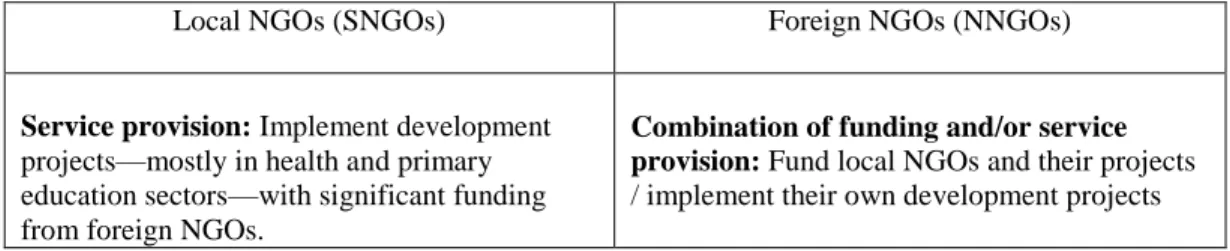
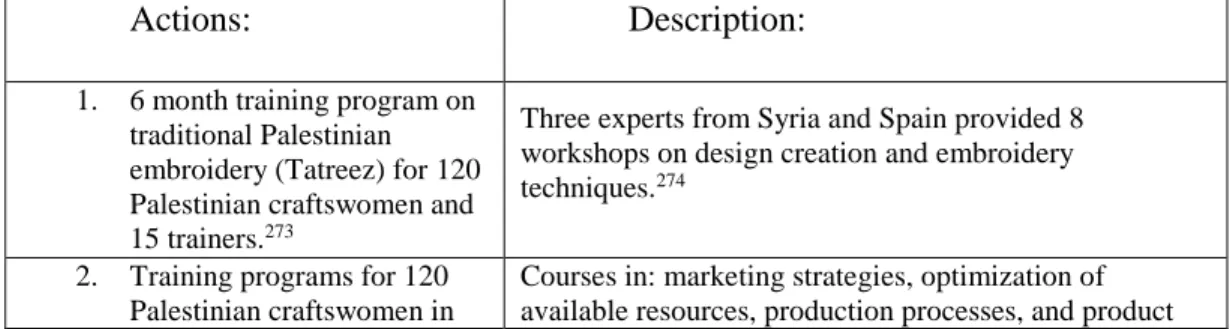
2.1 Summary of Development Frameworks ... ……6 4.1 Timeline of Palestinian Refugees in Lebanon ... .32-33 4.2 Local vs. Foreign NGO Roles ... …..41 4.3 NGO Services in Lebanese Refugee Camps ... …..42 5.1 Tatreez Project Summary ... .65-66 5.2 Impact of the Syrian Crisis on NGO Intervention Targeting Palestinian
Refugees ... .72-73 6.1 NGOs Working with Palestinian Refugees in Lebanon in the Context of
viii
LIST OF ACRONYMS
NGO Non-governmental organization
NNGO Northern non-governmental organization SNGO Southern non-governmental organization PLO Palestinian liberation organization
PRL Palestinian refugees from Lebanon
PRS Palestinian refugees from Syria
UN The United Nations
UNDP The United Nations Development Program
UNRWA The United Nations Relief and Works Agency Agency for Palestinian Refugees in the Near East
1 CHAPTER 1
INTRODUCTION
In what is largely seen as a new era of bottom up growth, many analysts characterize NGOs as the “magic bullets,” or rather the most effective and efficient actors, for solving development issues.1 In response to these shifts in development priorities, NGOs are leading what is termed a “quiet revolution” in international
development.2 This revolution—revealed through their rapid growth in number, size, and scope—points to the importance of their role in international development;3 what lacks clarity is the nature of these roles and how they function in practice. This study seeks to contextualize and evaluate general trends in the development sphere regarding the roles of NGOs in promoting economic development in order to assess how NGOs promote economic development in particular contexts. Through an analysis of key advantages and barriers to NGO functions in these roles, this study will investigate why NGOs pursue particular strategies and explore how these strategies change in response to shifting
1 Michael Edwards & David Hulme. Beyond the Magic Bullet: NGO Performance and Accountability in the Post Cold-War World (London: Earthscan and West Hartford: Kumarian Press, 1995), 3.
2 Eric Werker & Faisal Z. Ahmed. “What Do Nongovernmental Organizations Do?” Journal of Economic Perspectives 22, no. 2 (Spring 2008): 74; Lester M. Salamon. “The Global Associational Revolution: The Rise of Third Sector on the World Scene.” Institute for Policy Study, Johns Hopkins University (Baltimore, 1993), 1, quoted in William F. Fisher. “Doing Good? The Politics and Antipolitics of NGO Practices.” Annual Review of Anthropology 26 (1997): 440.
3 David Lewis & Nazneen Kanji, NGOs and Development (New York and Abington: Routledge, 2009). 14.
2
environments. This study will take an in-depth look at the NGO sector in Lebanon, specifically focusing on the operations of the NGO Cives Mundi and their initiatives to promote economic development among Palestinian refugees. More specifically, this research will evaluate their response to the changing contexts within their areas of intervention as they work within Palestinian refugee camps in Lebanon. Through a detailed analysis of this case and a comparison with the general findings regarding development initiatives within Lebanon, this study will give insight into how NGOs promote economic development in practice and why they employ the strategies they do.
NGOs themselves are an extremely diverse group of organizations. They vary in function, size, structure, and goals, and operate in diverse contexts. For this study, NGOs are defined as: “private organizations that are self-governing and not-for-profit that pursue humanitarian rather than commercial objectives" whose activities claim to “relieve suffering, promote the interests of the poor, protect the environment, provide basic social services, or undertake community development.” Within this definition, NGOs can be segmented further based upon geography: Northern vs. Southern NGOs, where Northern NGOs originate from developed countries and Southern NGOs from developing countries, and also by function4: advocacy vs. service provision (note: many NGOs engage in both). This study will focus on Northern NGOs operating in Global South, specifically to promote economic development through both advocacy and service provision.
4 Werker & Ahmed, “What Do Nongovernmental Organizations Do?” 74; The World Bank, “Working with NGOs: A Practical Guide to Operational Collaboration Between the World Bank and Non-governmental Organizations,” Operations Policy Department, Washington D.C., 1995.
3
What constitutes “economic development” also varies broadly in definition and is commonly, albeit inaccurately, used synonymously with economic growth. This study differentiates between economic growth, measured as an increase in aggregate economic output, and economic development, defined as “activities that expand capacities to realize the potential of individuals, firms or communities who contribute to the advancement of society through the responsible production of goods and services.”5 Based upon this definition, economic development should result in greater prosperity and higher quality of life for individuals.6 In his international work, Amartya Sen identifies economic development as the support of freedom and autonomy, which allows for increased
economic participation and social mobility to permit individuals to develop the capacities to engage, contribute, and benefit from the economy.7 These outcomes require effective institutions “grounded in norms of openness, tolerance for risk, appreciation for diversity, and confidence in the realization of mutual gain for the public and the private sector.”8 This study will focus on evaluating the roles of NGOs in promoting this definition of economic development. Existing development analysis recognizes the diversity of NGO roles in economic development as they shift within different contexts.9
In the following section, I provide a literature review analyzing the what was been said in development literature regarding NGOs and their roles in economic development. Following the literature review, I will apply the conventional wisdom regarding NGOs
5 Maryann Feldman, Theodora Hadjimichael, Tom Kemeny & Lauren Lanahan.
“Economic Development: A Definition and Model for Investment.” Environment and Planning C: Government and Policy (2014): 20.
6 Ibid., 21.
7 Amartya Sen. Commodities and Capabilities (Oxford: Oxford University Press, 1999), quoted in Ibid., 4-5.
8 Ibid., 12. 9 Ibid., 2.
4
and economic development to a secondary study where I evaluate NGOs working to promote economic development among Palestinian refugees living in Lebanon. I will utilize my more general findings from this secondary analysis to do an in-depth case study of the NGO Cives Mundi and their development project Tatreez—which aims to
economically empower Palestinian refugee women living within refugee camps in Lebanon. This study will identify and evaluate advantages and disadvantages to NGO work in this context and analyze the reaction and adaptation of the NGO Cives Mundi to their environment.
While the following literature review analyses the conventional wisdom regarding NGOs and their roles in promoting economic development, this wisdom also asserts that generalizing about the NGO sector is inherently problematic. Development analysts argue that it is necessary to consider the "changing local, regional, national, and
international processes and connections which both potentially support or suppress NGO work."10 The following literature review does evaluate generalizations regarding NGOs and their roles in economic development, however these theoretical limitations must be taken into consideration.
5 CHAPTER 2
LITERATURE REVIEW
Within development studies, there is a distinct divide between critics regarding the roles of NGOs in promoting economic development. Mohan and Stokke identify these viewpoints as being the ‘new left’ and the ‘new right’ or ‘revisionist neo-liberalism’ and ‘post-Marxism.’11 Arturo Escobar makes the same distinction between critics, but categorizes the two groups as supporters of ‘alternative development’ and ‘alternatives to development.’12 As I continue to discuss these two viewpoints, I will categorize these two sets of critics as supporters of 'alternative development' and 'alternatives to development.'
11 Giles Mohan & Kristian Stokke. “Participatory Development and Empowerment: The Dangers of Localism,” Third World Quarterly 21, no. 2 (Apr., 2000): 247.
12 Arturo Escobar. Encountering development: The making and unmaking of the Third World. (Princeton: Princeton University Press, 1995), quoted in Diana Mitlin, Sam Hickey & Anthony Bebbington. “Reclaiming development? NGOs and the challenge of alternatives.” Global Poverty Research Group. (2006): 8.
6
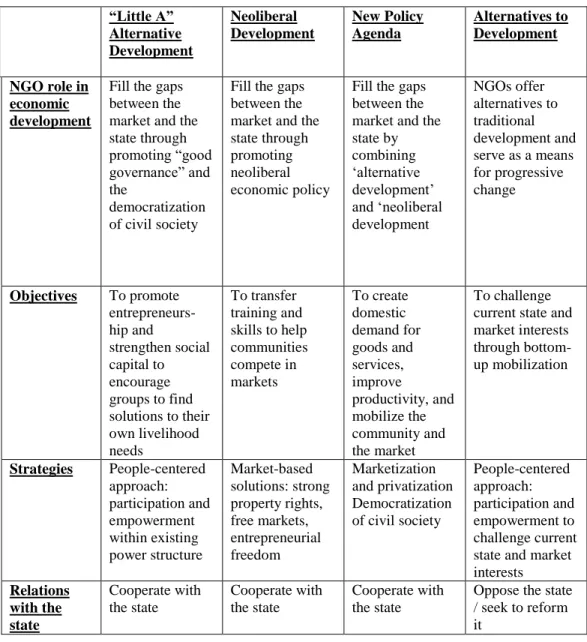
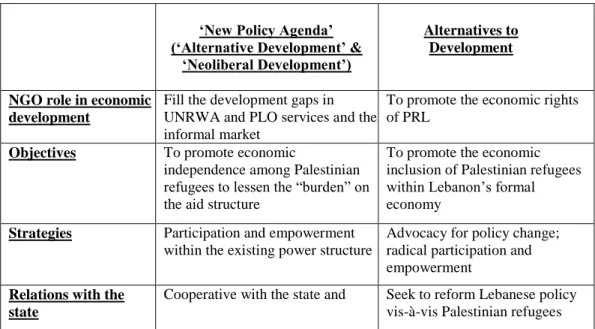
Table 2.1: SUMMARY OF DEVELOPMENT FRAMEWORKS
“Little A” Alternative Development Neoliberal Development New Policy Agenda Alternatives to Development NGO role in economic development
Fill the gaps between the market and the state through promoting “good governance” and the democratization of civil society
Fill the gaps between the market and the state through promoting neoliberal economic policy
Fill the gaps between the market and the state by combining ‘alternative development’ and ‘neoliberal development NGOs offer alternatives to traditional development and serve as a means for progressive change Objectives To promote entrepreneurs-hip and strengthen social capital to encourage groups to find solutions to their own livelihood needs To transfer training and skills to help communities compete in markets To create domestic demand for goods and services, improve productivity, and mobilize the community and the market To challenge current state and market interests through bottom-up mobilization Strategies People-centered approach: participation and empowerment within existing power structure Market-based solutions: strong property rights, free markets, entrepreneurial freedom Marketization and privatization Democratization of civil society People-centered approach: participation and empowerment to challenge current state and market interests Relations with the state Cooperate with the state Cooperate with the state Cooperate with the state
Oppose the state / seek to reform it
NOTE: While I list ‘little A alternative development,’ ‘neoliberal development,’ and the ‘new policy agenda’ as three separate development frameworks, all three fall within the larger ‘alternative development.’ When I discuss ‘alternative development’ vs. ‘alternatives to development,’ I am discussing all three of these development frameworks simultaneously. In order to prevent confusion, I will refer to the specific ‘alternative development’ framework as ‘little A alternative development’ and the larger—which encompasses all three of the development frameworks—simply as ‘alternative development.’
7 ALTERNATIVE DEVELOPMENT
The 'little A alternative development' framework with the larger ‘asserts that NGOs should work within existing development channels and serve to fill gaps between the market and the state by promoting democratization and the growth of a robust civil society.13 This set of analysts identify NGOs as “critical safety nets” which mitigate the weaknesses in the development process.14 NGOs should seek to provide alternative routes to development primarily through the contribution of new ideas and programs, which make services more relevant to the poor and more subject to democratic influences.15 NGOs are key actors in promoting the “progressive development agenda” by bringing ideas about participation, empowerment, gender, and environment to economic development, allowing NGOs to dually promote economic value creation alongside social welfare.16 In this way, NGOs can pursue objectives the government has previously ignored or is unable to fill and be a viable alternative in development assistance
provision.17 These NGO alternatives primarily exist to target those who do not benefit from traditional development or are marginalized by the existing system.
More specifically, supporters of 'little A alternative development' view NGOs as providing an attractive “people-centered” approach to development. They assert that NGOs hold a comparative advantage in fostering local participation as they have better
13 Fisher, “Doing Good? The Politics and Antipolitics of NGO Practices,” 444. 14 Hildy Teegen, Jonathan P. Doh & Sushil Vachani. “The Importance of Nongovernmental Organizations (NGOs) in Global Governance and Value Creation: An
International Business Research Agenda.” The Journal of International Business Studies 35, no. 6 (Nov. 2004): 468.
15 John Clark. “Democratizing Development: NGOs and the State,” Development in Practice 2, no., 3 (Oct., 1992): 152.
16 Lewis & Kanji, NGOs and Development, 17.
17 Hedayat Allah Nikkhah & Ma’rof Bin Redzuan. “The Role of NGOs in Promoting Empowerment for Sustainable Community Development.” Journal of Human Ecology 30, no. 2 (2010): 85.
8
connections and presence at the grassroots level.18 This 'people-centered development', or rather 'participatory development' views people themselves as being experts on their problems and that they should be actively involved in forming solutions.19 Active involvement within the ‘alternative development’ sphere is largely achieved through the promotion of entrepreneurship and the strengthening of social capital among vulnerable groups to encourage them to find their own solutions to their livelihood needs.20
NEOLIBERAL DEVELOPMENT POLICY
Within the larger 'alternative development’, 'neoliberal development policy’ is a variant which places NGOs within the context of neoliberal growth—a development context of shrinking states and expanding markets.21 As countries develop, strides in economic growth are met with widening gaps between the market and the state, which neoliberals see as leaving a larger space for NGO intervention. Within neoliberal development, NGOs are identified as being “everything governments are not.”22 Their role is to fill these widening gaps in development by promoting privatization and democratic governance reform.23
Neoliberals view NGOs as the ideal actors for solving policy issues through market-based solutions.24 As identified by 'alternative development' critics, neoliberals also see NGOs as ideal actors for promoting economic development alongside social
18 Werker & Ahmed, NGOs and Development, 80. 19 Lewis & Kanji, NGOs and Development, 40.
20 Sangeeta Kamat. “The Privatization of Public Interest: Theorizing NGO Discourse in a Neoliberal Era.” Review of International Political Economy 11, no.1 (Feb, 2004): 169.
21 Ibid., 156.
22 Fisher, “Doing Good? The Politics and Antipolitics of NGO Practices,” 444. 23 Lewis & Kanji, NGOs and Development, 41.
9
justice. Neoliberals assert that NGOs can advance human well-being through enforcing strong property rights, free markets, and free trade and liberating entrepreneurial freedom and skills.25 NGOs do this through the transfer of training and skills to help communities and individuals compete in markets, the provision of welfare services by those
marginalized by the market, and the democratization and growth of civil society.26 In practice, NGOs may promote micro-level income-generating activities such as
microcredit programs or vocational training to promote small business development, as a means of providing services where the market and state cannot.27
Similar to ‘little A alternative development,’ ‘neoliberal development’ also employs ‘participatory development.’ However, Mohan & Stokke clarify that this revised neoliberal position represents a ‘top-down’ strategy where empowerment can be pursued within the “existing social order [and] without any significant negative effects upon the power of the powerful.” Working within the existing power structure is a general trend within these “neoliberal” development initiatives, as they are pursued through
collaboration of NGOs and state agencies.28
NEW POLICY AGENDA
The ‘New Policy Agenda’ combines ‘little A alternative development’ and ‘neoliberal frameworks.’29 This framework takes the “good governance” aspect of ‘little A alternative development’—primarily ideas about participation and empowerment—and
25 Ibid.
26 Fisher, “Doing Good? The Politics and Antipolitics of NGO Practices,” 444. 27 John Cameron. “Development Economics, the New Institutional Economics and NGOs.” Third World Quarterly 21, no. 4, NGO Futures Beyond Aid (Aug., 2000): 627.
28 Mohan & Stokke, “Participatory Development and Empowerment: The Dangers of Localism,” 248.
10
combines them with neoliberal economic policy prescriptions. The New Policy Agenda is comprised of two principal strategies: the marketization and privatization influenced by neoliberal ideals, and the democratization of civil society influenced by the ‘little A alternative development’ paradigm.30
The first strategy—targeting economic markets and the private sector—places NGOs in the role of “efficient and cost-effective service providers” particularly of social welfare.31 Supporters of the New Policy Agenda see NGOs as the most efficient actors for “achieving economic growth, producing goods, and providing services for the
poor.”32 The second strategy—the promotion of “good governance”—places NGOs in an advocacy role, which aims to support civil society and promote communication and participation among beneficiaries. Through encouraging good governance, NGOs are simultaneously promoting democracy, which many argue is a prerequisite for a healthy economy.33
As with both ‘little A alternative development’ and neoliberal discourses, gaps in development are a driving force in the rise of NGOs within the New Policy Agenda. Within environments where the state and the public sector are unable or unwilling to deliver adequate development, NGOs are ideal actors to step in and fill the void.34 In these contexts, NGO intervention should ideally complement government strategies— specifically in regards to poverty alleviation and economic development initiatives
30 Kamat, “The Privatization of Public Interest: Theorizing NGO Discourse in a Neoliberal Era,” 170.
31 Michael Edwards & David Hulme. “Too Close for Comfort? The Impact of Official Aid on Nongovernmental Organizations.” World Development 24, no. 6 (1996): 1.
32 Ibid. 33 Ibid.
34 S. Akbar Zaidi. “NGO Failure and the Need to Bring Back the State.” Journal of International Development 11, no. 2 (Mar/Apr., 1999):261.
11
among the poor. Intervention should aim to create domestic demand for goods and services, improve productivity, and mobilize the community and the market.35 As NGOs shoulder greater responsibilities of sustainable development, particularly among the most vulnerable and hard to reach within developing countries, they become more crucial actors in state operations.
While NGOs may be ideal actors to pursue these agendas, their close alignment with the state and the market has the potential to be problematic. Stephen Commins hypothesizes that NGOs are in danger of cloaking government inactions or indifference to human suffering or that they simply may not possess the capacity to fill these
increasing gaps in development.36 Similarly, Edwards and Hulme reject the idea that NGOs are the “panacea for the ills that afflict underdeveloped countries,” asserting that this places “high and unfair expectations” on the NGO sector.37 These critiques present two troubling issues: First is that NGOs may simply lack the capacity to fill growing gaps in development within particular countries, or their solutions may not be sustainable in the long-term. The fragmentation of the NGO sector, NGO dependence on outside funding, and their vulnerability to changing contexts, all hinder the sustainability of large-scale service provision.38 Second, even if NGOs can fill development gaps, their ability to do so may result in the inaction of traditional development actors. Especially in countries where the gaps in development are exceptionally wide—whether that be
35 GOM. “Policy Framework for Poverty Alleviation Program,” Longwe PAP
Coordinating Unit, Ministry of Economic Planning and Development (1995), quoted in, Fletcher Tembo. “The Multi-Image Development NGO: An Agent of the New Imperialism?” Development in Practice 13, no. 5 (Nov., 2003): 530.
36 Stephen Commins. “NGOs: ladles in the global soup kitchen?” Development in Practice 9, no. 5 (Nov., 1999): 620.
37 Edwards & Hulme, Beyond the Magic Bullet: NGO Performance and Accountability in the Post Cold-War World, 3.
38 Edwards & Hulme, “Too Close for Comfort? The Impact of Official Aid on Nongovernmental Organizations,” 4.
12
through state inaction or inability to intervene—traditional development actors may become increasingly dependent upon the NGO sector and become even less active in development promotion.
ALTERNATIVES TO DEVELOPMENT
Critics of 'alternative development,' and with it ‘little A alternative development,’ ‘neoliberal development’ and the ‘New Policy Agenda,’ view the current development paradigm as “fundamentally flawed” in that it creates a space “in which only certain things [can] be said.”39 These radical critics claim that empowerment “requires a structural transformation of economic and political relations towards a radically democratized society,” and therefore seek alternatives to existing development paradigms.40 They are skeptical of democratization and see neoliberal top-down approaches as propping up existing power structures. These critics reject development and fear that NGOs are at risk of becoming “attachments to the machine of
development.41 Supporters of 'alternatives to development’ also argue that the closeness of NGOs to the mainstream undermines their comparative advantage as development agents.42 These critics support NGO expansion based upon their ability to offer a different institutional form than the state.43 Therefore, instead of filling the gap between the market and the state, NGOs should serve as “vehicles for progressive change.”44
39 Fisher, “Doing Good? The Politics and Antipolitics of NGO Practices,” 445. 40 Ibid.
41 Ibid., 446.
42 Edwards & Hulme, “Too Close for Comfort? The Impact of Official Aid on Nongovernmental Organizations,” 3.
43 Zaidi, “NGO Failure and the Need to Bring Back the State,” 263. 44 Lewis & Kanji, NGOs and Development, 3.
13
Similar to supporters of ‘alternative development,’ those advocating ‘alternatives to development’ also stress the role of NGOs in promoting ‘participation’ and
‘empowerment,’ but with very different agendas. 45 Mohan & Stokke emphasize that this form of empowerment and participation seeks to challenge current state and market interests through bottom-up mobilization.46 Unlike the objectives of the three ‘alternative development’ frameworks, supporters of ‘alternatives to development’ view NGOs as being capable of constructing a civil society able to transform existing power
relationships and challenging the state and society.47 So while both of these discourses look to “civil society, participation, and ordinary people for their development vision,” their definitions of what constitutes true economic development differ widely.48
WHY NGOS MATTER
NGO ADVANTAGES AND FUNCTIONS
NGOs hold distinct advantages in promoting economic development. Streeten identifies the advantages of NGOs as: their ability to reach and mobilize the poor, to empower people to improve their quality of life and strengthen local institutions, to carry out projects at lower costs and more efficiently than government, and to promote
45 Ibid.
46 Mohan & Stokke, “Participatory Development and Empowerment: The Dangers of Localism,” 249.
47 Fisher, “Doing Good? The Politics and Antipolitics of NGO Practices,” 445. 48 R. Peets & M. Watts. “Liberation ecology: development, sustainability, and
environment in an age of market triumphalism.” Liberation Ecologies: Environment, Development and Social Movements (London: Routledge, 1996): 1-45, quoted in Mohan & Stokke,
14
sustainable development.49 The World Bank identifies similar NGO advantages, in that NGOs strengths lie in their ability to reach poor communities and remotes areas, promote local participation, operate at low cost, identify local needs, build on local resources, and introduce new technologies.50
All of these advantages display how NGOs are operationally situated to reach the most vulnerable in society—those excluded from mainstream economic development. Through employing participatory development strategies at the local level, NGOs are ideal actors for targeting those which existing services cannot. In this way, NGOs possess a comparative advantage in addressing the needs of the poor and vulnerable in society over governments.51 As efficient and cost-effective service providers, NGOs are well situated to create programs for the poor, especially the formation of entrepreneurial civil societies to promote sustainable development.52
Advantages in targeting the most vulnerable in society hold true when considering NGOs as both ‘alternatives to development’ and ‘alternative development.’ Within ‘alternative development,’ as countries continually shift towards market economies, NGOs can focus on reaching the segments of society that might not be profitable for firms and private investors.53 Especially when working with marginalized groups: women, refugees, and minorities, NGOs can provide economic opportunities to groups investors find unprofitable. These advantages are increasingly driving NGOs to enter into
49 P. Streeten. “Non-governmental Organizations and Development.” Annals of the America Academy of Political and Social Science, 554 (1997): 193-210.
50 World Bank, Key Issues and Themes / NGO Capacity Building of Southern NGOs – The Experience of the World Bank (1998), quoted in Kamat, “The Privatization of the Public Interest,” 169.
51 Zaidi, “NGO Failure and the Need to Bring Back the State,” 262. 52 Kamat, “The Privatization of the Public Interest,” 164.
15
profit-oriented businesses such as printing, garments, private universities, and consultancy services.54 NGOs promoting ‘alternatives to development’ support marginalized segments of society by providing alternatives outside the market. These critics see NGOs as being witnesses to the “devastation wrought by privatization and marketization” and seek to provide alternatives for those on the losing end of economic development.55
The adaptability of the NGO sector also gives them the advantage in working with a variety of international actors. Many development analysts identify NGOs as existing within a web of relationships.56 Their flexible nature has helped them to forge innovative and complex relationships with one another, government agencies, social movements, international development agencies, and transnational issue networks.57 Cameron describes NGOs as moving “in the triangular space between civil society, the state, and markets.58 Similarly, Fisher views NGOs as connected with local, regional, national, and international levels.59 These webs of relationships place NGOs in an intermediary role for both funding and the transfer of ideas.
Recognizing that NGOs provide an alternative and more flexible funding channel, funding is increasingly being directed through NGOs.60 The idea that NGOs work in
54 Jude L. Fernando & Alan W. Heston. “NGOs between States, Markets, and Civil Society.” Annals of the American Academy of Political and Social Science 554, The Role of NGOs: Charity and Empowerment (Nov., 1007): 14.
55 Kamat, “The Privatization of the Public Interest,” 167.
56 Fisher, “Doing Good? The Politics and Antipolitics of NGO Practices,” 450. 57 Ibid., 441.
58 Cameron, “Development Economics, the New Institutional Economics and NGOs,” 632.
59 Fisher, “Doing Good? The Politics and Antipolitics of NGO Practices,” 450. 60 Lewis & Kanji, NGOs and Development, 16; Hildy Teegen, Jonathan P. Doh and Sushil Vachani. “The Importance of Nongovernmental Organizations (NGOs) in Global Governance and Value Creation: An International Business Research Agenda.” The Journal of International Business Studies 35, no. 6 (Nov. 2004): 469.
16
conjunction with the state and the market is supported more by the ‘alternative development’ approach, especially because a significant amount of these funds come from state governments and private corporations. However, NGOs existing as
‘alternatives to development’ are closely linked with civil society and existing social movements.
Connections and links to funding also result in partnerships. In his paper on the changing relationships between development NGOs and development policy, David Lewis discusses the shifts from NGOs implementing their own development projects to a partnership approach. He specifically analyzes NNGOs (Northern NGOs) as they form linkages with SNGOs to fund and work alongside them. These shifts place NNGOs in an intermediary position acting as the go-between between industrialized countries,
communities, and NGOs in the south. This emerging power structure within development policy characterizes SNGOs as needing “nurturing and support,” which NNGOs provide through training and funding.61 This partnership is an NGO strategy occurring within both categories of development frameworks—‘alternatives to development’ and ‘alternative development,’—as these linkages are based upon mutual goals of northern and southern NGOs.
CHALLENGES
The increasing importance of NGOs in development—largely a symptom of the recognition of their development advantages—does not come without challenges. Fisher claims that heavy praise of the NGO sector is placing unrealistic expectations on NGOs,
61 David Lewis. “Development Policy and Development NGOs: The Changing Relationship.” Social Policy and Administration 32, no. 5 (Dec., 1998): 1-4.
17
which they very well may be unable to meet.62 The idea that NGOs are “magic bullets” that will “mysteriously but effectively find their target” may be too idealistic as it fails to account for the multitude of factors affecting NGO operations.63
A key factor this idealistic viewpoint fails to account for is that NGOs are victims of context. While NGOs possess distinct advantages in operating at the local level, this study argues that they are not immune to the social, economic, and political forces at the national and international levels. These forces can pose conflicting power relations and social inequalities, and pose significant barriers to NGO operations.64
NGOS AND THE STATE
The viewpoint that NGOs operate separately from the state is especially problematic. While many NGOs do not work directly with the state, the perceived separation of NGOs from government fails to consider that NGOs must exist within the national policy environment. The relationship the NGO sector develops with a state will vary significantly country to country and differ based upon the objectives the NGO is pursuing and the laws and regulations that accompany their work.65 So as victims of their context, NGOs must choose how best to react to the environment created by the state government.
In his analysis of NGOs and their relationship with the state, John Clark wrote:
“NGOs can oppose the state, complement it, or reform it—but they cannot ignore it.”66
62 Fisher, “Doing Good? The Politics and Antipolitics of NGO Practices,” 443. 63 Ibid.
64 Mohan & Stokke, “Participatory Development and Empowerment: The Dangers of Localism,” 249.
65 Fernando & Heston, “NGOs between States, Markets, and Civil Society,” 11. 66 Clark, “Democratizing Development: NGOs and the State,” 152.
18
Supporters of the larger 'alternative development' argue that NGOs should complement the state by filling the gaps in government services.67 They claim that collaborating with the state to align their objectives with those of the government can help advance NGO intervention and give NGOs a greater chance of achieving impact.68 In these roles, NGOs rise out of gaps in development: either the failure of state-led approaches or the unwillingness of the state to address underdevelopment.69
Within this field of thought, cooperation with the state exists on two distinct levels: First is the idea that NGOs should seek to improve government services. Whaites argues that NGOs should include state capacity building as a key component of their projects.70 Because NGOs possess direct connections to beneficiaries, they are the ideal actors to make government services more relevant to the vulnerable portions of society.71
The second level of cooperation is more of a tolerance between the state and NGOs rather than a collaboration. Clark identifies this as a “friendly coexistence” between NGOs and governments when NGOs solely require the freedom to pursue their development operations and are not seeking to influence wider areas of development planning.72 Because these projects do not pose a challenge to state operations, the state will not pose additional barriers to these NGOs.73 Even if these initiatives do not openly complement state operations, the mere fact that the NGO is not working counter to the
67 Ibid.
68 Edwards & Hulme. “Scaling up NGO Impact on Development: Learning from Experience.” Development in Practice 2, no. 2 (Jun., 1992): 79.
69 Lewis, “Development Policy and Development NGOs: The Changing Relationship,” 8. 70 W. Whaites. “NGOs, Civil Society and the State.” Development in Practice 8, no. 3 (1998): 343-353.
71 Clark, “Democratising Development: NGOs and the State,” 152. 72 Ibid, 151.
19
government will leave the NGO untouched from government barriers.74 While this hands-off relationship can function under particular circumstances, the inaction of government can also pose issues in areas with poor infrastructure and few resources.75
Tensions arise between the state and NGO sector when the development theory of an NGO is different from that of the government, which is often the case with NGOs stressing people’s participation, empowerment, and democracy.76 While supporters of NGOs as ‘alternatives to development’ view NGO-led state opposition as a key role of NGO initiatives—as they argue that the advantages of NGOs lie in their ability to offer a different institutional form than the state—the barriers presented when pursuing these objectives is pushing many NGOs to change their strategies for relating to the state.77
NGOs are increasingly pursuing interventions that do not actively oppose the state. These development initiatives often promote participation and empowerment within existing state power structures and seek to promote economic development to take
pressure off of existing state services. Projects of this nature seek to improve the standard of living for the most vulnerable in society—many times groups which existing services do not reach. While many argue that the inability to restructure existing power systems is a core weakness of NGO operations, Clark argues that it displays their capacity for political analysis, self-awareness, and persuasiveness.78 Based upon this argument, NGOs
74 Ibid.
75 Edwards & Hulme, “Scaling up NGO Impact on Development: Learning from Experience,” 78.
76 Clark, “Democratising Development: NGOs and the State,” 151. 77 Ibid., 152.
20
are aware of their inability to provide solutions to national problems, and seek to work where they have the advantage.79
In the following chapters, I will apply Clark and Whaites’ generalizations regarding NGOs and their relationship with the state to test their relevance in practice. Through both my secondary analysis of NGOs working with Palestinian refugees in Lebanon and my case study of Cives Mundi and their experience working with the Lebanese central government throughout their intervention I will examine the validity of Clark and Whaites’ arguments and address their shortcomings.
DONOR PRESSURE
Both ‘alternative development’ and ‘alternatives to development’ recognize that NGOs adapt to donor pressure. Very few NGOs are self-funded and therefore cannot pursue their projects without outside support.80 The dependence upon donor money and the desire of NGOs to satisfy donors’ demands results in NGO expansion that many view as almost entirely “donor-driven.”81
Donor power is rooted within a sector environment where money is scarce and NGOs are plentiful. These conditions create rising competition amongst NGOs for funding resources—not only against one another, but against private-sector development firms as well.82 The increased competition for resources gives donors the power to choose which types of projects they want to support. On the one hand, donor power can be positive. Through funding allocation, donors can ensure the most competitive projects get
79 Ibid.
80 Zaidi, “NGO Failure and the Need to Bring Back the State,” 263. 81 Ibid.
21
the money.83 Their funding calls can specify particular added-value elements such as replicability, scaling-up, gender benchmarks, and environmental requirements to be included within development projects. Donor control can also increase the transparency of NGO projects, as they can set the standards for audits and external investigations. On the other hand, donor power can be a tool for funders to pursue their own objectives. The close collaboration between NGOs and governments becomes particularly contentious when considering that national governments are often the largest financial contributor to NGOs, deepening their influence over NGO intervention.84
With Northern NGOs, particularly, national governments from the North are channeling money through NNGOs to provide development aid in the south. In these situations, NNGOs find themselves caught between “one country’s concern and the problems of people in another.”85 Critics of ‘alternative development’ argue that this relationship forces NNGOs to pursue the agenda of the state and market rather than that of the poor. NNGOs, then, are simply “operating in the shadows of the neo-liberal agenda” motivated by the influx of money to fill the gap where the state is absent.86 This radical viewpoint sees NNGOs as slowly converting into public service contractors as they become increasingly professionalized and depoliticized.87
The argument that NGOs are becoming increasingly depoliticized is well
supported within development literature. The core rationale behind this shift is that NGOs are less willing to pursue objectives conflicting with their funders and home governments
83 Ibid. 84 Ibid., 78.
85 Lewis, “Development Policy and Development NGOs: The Changing Relationship” 8. 86 Tembo, “The Multi-Image Development NGO: An Agent of the New Imperialism?” 527.
87 Edwards & Hulme, “Scaling up NGO Impact on Development: Learning from Experience,” 87.
22
(though they are frequently one and the same).88 Their vulnerability as beneficiaries of outside funding and support is a key driver pushing NGOs to change their goals.89 The result is an NGO sector that is shying away from social mobilization towards the provision of services and development initiatives.90
ADDRESSING ROOT CAUSES OF PROBLEMS
The trend that NGOs are shifting their objectives to align with states and donors is supported by the claim that NGOs do not address the root causes of problems.91 Within these environments, NGOs actively campaigning for political change and the
strengthened rights of beneficiaries may threaten their established interests and risk losing their financial and political support.92 For this reason, NGOs are as likely to maintain the status quo as to change it, causing them to address symptoms of
underdevelopment rather than root causes.93 This is a key critique from radicals or the ‘alternatives to development’ perspective,’ who see NGOs promoting ‘alternative development’ as supporting an existing power structure that is keeping marginalized populations from being independent.94
Another key factor disabling NGOs from addressing the root causes of underdevelopment is simply their capacity. The majority of NGOs are small, and the NGOs sector is incredibly fragmented; while these traits provide many advantages to
88 John Clark. “NGOs and Politics in the Developing World.” International Development 20 (Swansea, Wales: Center for Development Studies, 1996), quoted in Fisher, “Doing Good? The Politics and Antipolitics of NGO Practices,” 454.
89 Zaidi, “NGO Failure and the Need to Bring Back the State,” 264.
90 Fisher, “Doing Good? The Politics and Antipolitics of NGO Practices,” 454.
91 Teegen, Doh & Vachani, “The Importance of Nongovernmental Organizations (NGOs) in Global Governance and Value Creation: An International Business Research Agenda,” 472.
92 Lewis & Kanji, NGOs and Development, 30.
93 Fisher, “Doing Good? The Politics and Antipolitics of NGO Practices,” 453. 94 Kamat, “The Privatization of the Public Interest,” 168.
23
local development initiatives, they also result in micro-successes that can rarely be scaled-up enough to affect the macro-level or be powerful enough to completely restructure oppressive power systems. For example, an NGO project providing
professional training to 100 vulnerable individuals may impact the economy surrounding community, but will most likely have no affect on a macro-economic scale. Therefore, while NGOs may successfully promote economic development within a community, they are rarely able to restructure larger power systems and resource allocation methods which may be hindering development within a state or for a particular group.95
NEED FOR FURTHER RESEARCH
Despite being the “favored child of official development agencies,” NGOs may not be the “new panacea to cure all the ills that have befallen the development process” as previously thought.96 As the challenges facing the NGO sector continue to weigh against its distinct advantages, it is becoming clearer that the operational impact of NGOs in promoting economic development may be less than previously claimed.97
However, these assertions do not hold true for all NGOs. The roles of the NGO sector are constantly redefined as contexts and objectives continue to shift.98 The fragmentation of the NGO sector, displayed through the wide differentiation of organizational structure, strategies, objectives, and areas of intervention, make
generalizations regarding NGO roles in development inherently problematic. While the
95 Warren Nyamugasira. “NGOs and Advocacy: how well are the poor represented?” Development and Advocacy (OXFAM, 2002): 7.
96 Edwards & Hulme, “Too Close for Comfort? The Impact of Official Aid on Nongovernmental Organizations,” 3.
97 Commins. “NGOs: ladles in the global soup kitchen?” 620.
24
preceding analysis of the conventional wisdom regarding these roles and their outcomes can provide key insights regarding general trends in the NGO sector, these observations do not hold true across the board to all development NGOs.99 In order to assess how NGOs promote economic development in practice, analyzing what is happening within specific organizations and places is imperative and is what I aim to do in the remaining sections of this study.100
Current empirical studies regarding the NGO sector are typically placed within the ‘development studies’ research agenda, which is an interdisciplinary field employing a wide range of research methodologies.101 Quantitative studies, such as Salamon and Anheier’s “Study of the Third Sector,” aim to measure the “relative size and scope of the sector” to draw conclusions regarding the nature of NGOs and the implications of their intervention.102 The findings of these studies further reveal the claimed diversity of the NGO sector and the implications of the varying roles NGOs play in development.103 The weaknesses of these studies—the fact that they do not provide insight into how NGO diversity functions in practice and within particular organizations and environments—is supplemented by smaller, qualitative studies. These qualitative studies largely utilize ethnographic work or case study research to contextualize theoretical arguments through detailed descriptions.104 For example, Maxine Wesgrau’s ethnography of NGOs in northern India aims to understand the NGO sector within a specific time and place.105
99 Tembo, “The Multi-Image Development NGO: An Agent of the New Imperialism?” 532).
100 Fisher, “Doing Good? The Politics and Antipolitics of NGO Practices,” 441. 101 Lewis & Kanji, NGOs and Development, 3.
102 Ibid. 103 Ibid. 104 Ibid.
25
The contextual nature of these studies does not aid in the generalizability of the NGO sector, but rather exposes the oversimplification of universal theories regarding NGOs as previously discussed. 106
William Fisher claims that development literature is “based more on faith than fact,” and that detailed studies of what is happening within specific organizations and places which “unpack literature” will provide key insights into the practical functions of the NGO sector. 107 Similarly, Edwards and Hulme claim that sharing ideas and
experiences from practical experience is much more useful than reaching artificial
agreements. 108 Based upon the objective of utilizing this research for the practical benefit of the NGO sector, my study of NGOs promoting economic development among
Palestinian refugees living in Lebanon will provide a better understanding of the practical functions of NGOs within specific places at specific times. This study looks to link generalizations with practical experiences in order to critically examine the viability of development literature as I apply them to NGOs promoting economic development among Palestinians refugees in Lebanon. I will investigate how a lack of understanding of how NGOs operate in specific contexts causes international development to miss the target and places NGOs in development roles they ate unable to fill. Through my practical application of development literature, I will provide evidence to the core argument of this study: that NGOs are unable to fill development gaps when contexts of intervention are not conducive to their operations.
York: University Press, 1997), quoted in, Ibid.
106 Fisher, “Doing Good? The Politics and Antipolotics of NGO Practices,” 449. 107 Ibid., 441.
108 Edwards & Hulme, “Scaling up NGO Impact on Development: Learning from Experience,” 78.
26 CHAPTER 3:
METHODOLOGY AND LIMITATIONS
Existing development frameworks do not provide adequate analyses regarding how NGOs promote economic development in practice. In order to analyze how NGOs promote economic development within specific contexts, and how these contexts impact the NGO strategies, this study investigates NGO operations promoting economic
development among Palestinian refugees in Lebanon.
In this study, the context of intervention—the geographical environment, donor context, and relations with the state—serves as the independent variable. I argue that the interplay of these factors directly impacts NGO intervention—the dependent variable. This study will analyze how a specific context of intervention impacts NGO development projects and results in distinct advantages and challenges.
In this study, I will apply the generalizations I analyze throughout the preceding literature review to a descriptive, exploratory case study of the development NGO Cives Mundi and their intervention aimed towards promoting economic independence among Palestinian refugees within Lebanese refugee camps. I will be analyzing Cives Mundi’s most recent development project Tatreez— focused on promoting economic
empowerment among Palestinian refugee women through the formation of a weaving co-op—to evaluate the experience of Cives Mundi throughout their intervention.
27
In order to avoid shortcomings of single case study methodology—most commonly that one case is not enough to draw sound empirical findings—I will also evaluate secondary data regarding NGOs promoting economic development among Palestinian refugees in Lebanon. This will reduce response bias both from interviewees,
Cives Mundi’s reports, and my own observations.109 This chapter will assess the NGO sector in Lebanon to evaluate the existing information regarding NGOs promoting
economic development among Palestinian refugees in Lebanon and how this environment is conducive or harmful to NGO development initiatives. In this section, I will identify the key advantages of and barriers to NGO projects targeting Palestinian refugees in Lebanon and analyze how these environments impact NGO strategies.
I will apply my findings from the secondary analysis to an exploratory case study of the development NGO Cives Mundi and their project Tatreez. Conducting a practical analysis of a specific project and area of implementation will provide practical insights to NGO functions in reaction to their environment.
I am using single case study methodology because this research surrounds an extreme, unique case, which I think has something special to reveal regarding how NGOs choose to respond to their environment. Studies of this nature are useful for investigating dynamic, experiential and complex processes and areas—especially to examine how organizations adapt to fast-changing and fluid environments.110 Through evaluating the experience of Cives Mundi and their responses to their shifting environment, this study
109 Tiia Vissak, “Recommendations for Using Case Study Method in International Business Research,” The Qualitative Report 15, no. 2 (March 2010): 380.
110 Vissak, “Recommendations for Using Case Study Method in International Business Research,” 372.
28
will provide insight as to why NGOs function and strategize in particular ways.111 I will draw these conclusions by identifying key advantages and barriers Cives Mundi
experiences throughout their intervention and examining how the organization adapts their strategies in response to the changing environment. The study will combine holistic case study methodology—examining the case as one unit by focusing on issues of Cives Mundi’s organizational culture and strategy, and an embedded case study design— exploring individual sub units such as: roles, locations, and meetings within the context of the development project Tatreez.
In her article Using Case Studies in Research, featured in Management Research News, Jennifer Rowley of Manchester Metropolitan University claims that these
methodologies allow researchersto paint an overall organizational picture, which is what I aim to do through my case study.112 Combining these two case study methodologies will ensure that my study is not taking a superficial view of the case. Delving deeper into a single case will also allow the study to develop a high level of “conceptual validity,” which Alexander George and Andrew Bennett identify as a key strength of case study research. In their book, Case Studies and Theory Development in the Social Sciences, George & Bennett support one of the primary claims of my study: that conclusions from one country may be completely different from conclusions from another, so direct
comparisons may be of little use. Single case study research, however, is advantageous in making “contextualized comparisons” by searching for similarities and discrepancies across contexts. In other words, case study research can evaluate a phenomenon in its
111 See note 113.
112 Jennifer Rowley, “Using Case Studies in Research,” Management Research News 25, no. 1 (2002): 22.
29
context and expand on existing frameworks by combining generalizations with practical insights.113 As I am evaluating my case study within the context of my secondary analysis and my broad literature review, this research will add to existing development
frameworks and critically test their validity in the context of Lebanon. Through this methodology, my study aims to develop a “higher level of validity over a smaller number of cases” in order to address the important role contextual factors play in NGO
intervention.114 Because this case is so unique, using multiple case study methodology to directly compare experiences would also pose challenges in terms of data availability and hinder the depth of the case study.
The case study of Cives Mundi and Tatreez will use multiple data sources: interviews with Cives Mundi’s project manager and the project technician for the Lebanon section, internal narrative reports, strategies and proposals, a documentary detailing the project and its outcomes, external evaluation recommendations from the EU, and direct observations from working within Cives Mundi’s headquarter office.
The final section will place the case study in the context of existing literature. This section will use the preceding development frameworks as a template to compare the results of the case study in order to contextualize the trends I reveal throughout my primary observations.115
As a whole, this study is limited in terms of both generalizability and replicability. However, this research does not seek to better understand these development frameworks
113 Robert Yin, Case Study Research Design and Methods (London: Sage, 1994) quoted in Vissak, “Recommendations for Using the Case Study Methods in International Business Research,” 371; Rowley, “Using Case Studies in Research,” 18.
114 Alexander L George & Andrew Bennett, Case Studies and Theory Development in the Social Sciences (MIT Press, 2005), 19.
30
by artificially replicating previous studies to add to existing generalizations; this study seeks to evaluate these frameworks in a particular context to analyze how Cives Mundi is promoting economic development and why they are employing their particular strategies. This methodology is also appropriate as this study evaluates an extreme, unique case that will critically test existing development frameworks.116
In terms of future research, this study can also serve as a preliminary or pilot to multiple case studies, or as a foundation for future statistical studies. As Palestinian refugees continue to reside in Lebanon, additional research regarding NGO intervention could give more insight in regards to effective strategies for NGO adaptation.
116 Ibid.
31 CHAPTER 4:
SECONDARY ANALYSIS: NGOS PROMOTING ECONOMIC DEVELOPMENT AMONG PALESTINIAN REFUGEES IN LEBANON
INTRODUCTION
In order to develop a reference point to validate the results of my single case study methodology, this section will evaluate secondary data regarding NGOs promoting economic development among Palestinian refugees in Lebanon. In this chapter, I will cover a brief historical overview of the economic state of Palestinian refugees in Lebanon, assess the roles of NGOs promoting economic development among these groups. I will use this foundation to evaluate how this environment is conducive or harmful to NGO development initiatives by identifying key advantages and barriers to NGO projects targeting Palestinian refugees.
32 HISTORICAL OVERVIEW
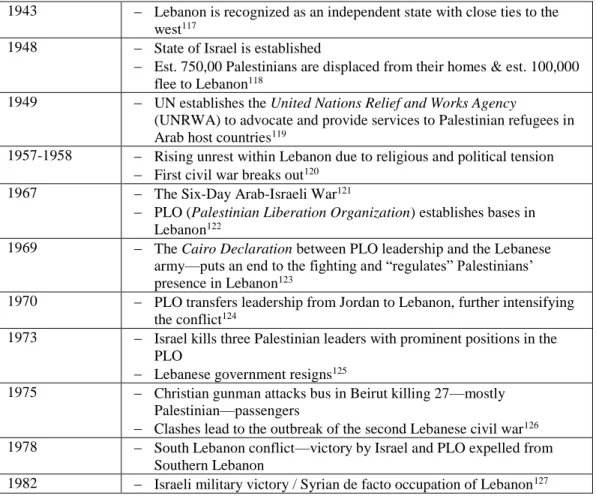
Table 4.1: TIMELINE OF PALESTINIAN REFUGEES IN LEBANON 1943 Lebanon is recognized as an independent state with close ties to the
west117
1948 State of Israel is established
Est. 750,00 Palestinians are displaced from their homes & est. 100,000 flee to Lebanon118
1949 UN establishes the United Nations Relief and Works Agency
(UNRWA) to advocate and provide services to Palestinian refugees in Arab host countries119
1957-1958 Rising unrest within Lebanon due to religious and political tension First civil war breaks out120
1967 The Six-Day Arab-Israeli War121
PLO (Palestinian Liberation Organization) establishes bases in Lebanon122
1969 The Cairo Declaration between PLO leadership and the Lebanese army—puts an end to the fighting and “regulates” Palestinians’ presence in Lebanon123
1970 PLO transfers leadership from Jordan to Lebanon, further intensifying the conflict124
1973 Israel kills three Palestinian leaders with prominent positions in the PLO
Lebanese government resigns125
1975 Christian gunman attacks bus in Beirut killing 27—mostly Palestinian—passengers
Clashes lead to the outbreak of the second Lebanese civil war126 1978 South Lebanon conflict—victory by Israel and PLO expelled from
Southern Lebanon
1982 Israeli military victory / Syrian de facto occupation of Lebanon127
117 “Timeline of Lebanon’s History,” Al Arabiya News, (October 18, 2007).
http://www.alarabiya.net/articles/2007/10/18/40501.html.
118 Dawn Chatty, “No Refuge: Palestinians in Lebanon – Introduction,” Oxford University Refugee Studies Center, working paper series no. 64 (June 2010): 3.
119 Ibid.
120 “Timeline of Lebanon’s History,” Al Arabiya News, (October 18, 2007). 121 Ibid.
122 Al Jazeera and Agencies, “Did the PLO die in Lebanon,” Al Jazeera Media Network, (July 28, 2009).
http://www.aljazeera.com/programmes/plohistoryofrevolution/2009/07/200972855032594820.htm l.
123 International Crisis Group, “Nurturing Instability: Lebanon’s Palestinian Refugee Camps,” 4.
124 Ibid., 5. 125 See note 120.
126 “Lebanon Profile – Timeline,” BBC, (April 29, 2015).
33
PLO “expulsion” from Lebanon—remains active in Lebanon, but is severely weakened128
Shrinking PLO services, rising role of NGOs129 1989-1990 The Taif Accords end the Lebanese civil war130 1991 The Lebanese army defeats the PLO131
1991-present Oslo Accords between the PLO and Israeli government
The Lebanese state excludes Palestinian refugee camps from postwar rebuilding strategies
The Weakened state of the PLO in Lebanon creates results in the rising role of NGOs to supplement UNRWA service provision132
PALESTINIAN REFUGEES IN LEBANON:
ONGOING TENSION AND RESTRICTIVE POLICY
The long-term presence of the Palestinian refugee population, the role of the PLO in the Lebanese civil war, and the view that these refugee groups place a “burden” on the Lebanese state and the economy has resulted in exclusive, restrictive policies vis-à-vis Palestinian refugees in Lebanon.
The Lebanese state views Palestinian refugees as “temporary guests” who are the responsibility of the international community. This impermanent status grants Palestinian refugees the right to reside temporarily in Lebanon, but no other economic, social, or legal rights.133
127 Rongxing Guo, Territorial Disputes and Conflict Management: The Art of Avoiding War (Routledge, August 17, 2011), 71.
128 Al Jazeera and Agencies, “Timeline: Palestinians Since 1915,” Al Jazeera Media Network, (February 1, 2009).
http://www.aljazeera.com/focus/arabunity/2008/02/20085251908164329.html.
129 Aziza Khalidi, “Managing Adversity: Palestinian Refugee Women in Lebanon,” Association Najdeh (July 18, 2011): 14.
130 “Lebanon Profile – Timeline,” BBC. 131 Ibid.
132 See note 129.
34
On an international policy level, Lebanon has not ratified the Geneva Convention of 1951 nor the 1967 Protocol related to the Status of Refugees.134 At the national level, Palestinian refugees within Lebanon do not have the right to own or inherit property, the right to primary or secondary education, or the right to utilize public health or social security services.135 This “restrictive and exclusive” approach towards the Palestinian refugee population denies them access to the legal, economic, and social system.136
From an economic standpoint, Lebanese restrictions on Palestinian refugees hinder their opportunities for economic development. First, Lebanese policy severely limits Palestinian participation in the labor force. While Palestinian refugees in Jordan and Syria have the right to work, Palestinian refugees in Lebanon only recently gained the right to work in restricted careers and are excluded completely from professions such as law and medicine.137
In the past, Lebanese labor law was based on the principles of reciprocity and the requirement to obtain a work permit. The principle of reciprocity—which stated that Lebanon would treat foreign workers with the same benefits Lebanese citizens received in their country of origin—did not account for the statelessness of Palestinians. This principle denied work permits or social security benefits to Palestinians, because they lacked a state, which could provide those rights to foreign Lebanese workers.138
134 Delphine Torres Tailfer, “Women and Economic Power in Lebanon: The Legal framework and challenges to women’s economic empowerment,” Collective for Research and Training Development (Seminar, National Knowledge-Sharing Seminar, Beirut, 2010): 25.
135 ANERA Report 3
136 Suleiman Jaber, “Marginalised Community: The Case of Palestinian Refugees in Lebanon,” Development Research Center on Migration, Globalisation, and Poverty, April 2006: 3.
137 Nada Al-Nashif & Samir El-Khoury, “Palestinian Employment in Lebanon: Facts and Challenges,” 21; Khalili, “A Landscape of uncertainty: Palestiniana in Lebanon,” 34.
138 Al-Nashif & El-Khoury, “Palestinian Employment in Lebanon: Facts and Challenges,” 21.