FINANCIAL SERVICES
NETWORKS ARE EMERGING
23During the past few years, we have witnessed a trend toward financial services companies building coopera-tive networks to offer their customers a broader range of financial services. These networks, however, are complex, sometimes containing many companies with loose ties to each other. This complexity presents sig-nificant obstacles to implementing effective joint CRM within the network.
Financial services networks have emerged because of three trends:
1 Jack Rockart is the accepting Senior Editor for this article.
2 In this article, the term “knowledge” includes both implicit knowl-edge in the heads of people as well as explicit knowledge in the form of documents or data. The term “information” denotes only explicit knowledge, which can be stored in databases.
3 An earlier version of this article was presented at The Tenth Americas
Conference on Information Systems (AMCIS 2004) in New York City.
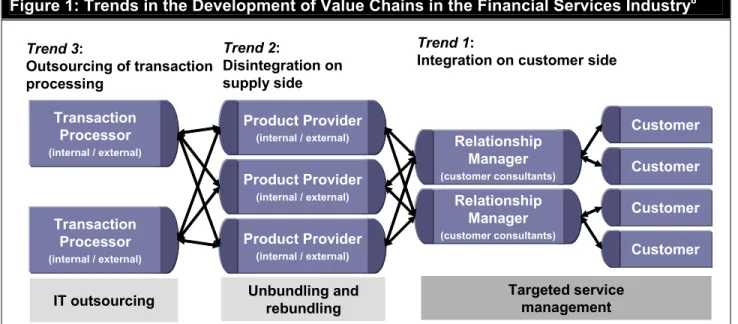
First, many customers, especially high-value custom-ers, increasingly demand comprehensive coverage of their financial requirements. Consequently, financial services companies must support every single cus-tomer requirement, ranging from account management to life insurance to granting home loans. In short, they need to provide ‘one-stop finance.’ This requirement has led to increasing consolidation in the industry. Many banks and insurance companies have merged or jointly distribute their products to offer such a broad range of services. Specialized companies, called rela-tionship managers, often handle the integration of the different financial services; see Figure 14. A relation-ship manager employs customer consultants to advise customers (consumers or corporate clients)5 and sell
4 Lehmann, A. P., “Financial Services – Veränderungen von Märkten, Leistungen und Unternehmen [Change of Markets, Services, and En-terprises],“ in Belz, C. and Bieger, T. (Eds.), Dienstleistungskompetenz und innovative Geschäftsmodelle [Service Competency and Innovative Business Models], St. Gallen: Thexis, 2000, pp. 22-35.
5 The term “customer” always denotes end customers of a financial services network, which can be either consumers or corporate clients.
C
USTOMER
R
ELATIONSHIP
M
AN-AGEMENT IN
B
USINESS
N
ETWORKS
:
L
ESSONS FROM THE
F
INANCIAL
S
ERVICES
I
NDUSTRY IN
G
ERMANY
AND
S
WITZERLAND
1
Executive Summary
Malte Geib, University of St. Gallen Lutz M. Kolbe, University of St. Gallen Walter Brenner University of St. GallenRecent consolidation in the financial services industry and the decision by many financial services executives to focus on their core competencies have led to these firms forming business networks. These networks face numerous challenges ensuring that their member companies serve their customers well, and in an integrated manner, using Customer Relationship Management (CRM) systems. This article describes our analysis of six financial services companies in different financial services networks – one of which illustrates best practice. The six main challenges these networks faced were: creating a joint strategy; rationalizing their distributed core competencies; integrating their CRM processes of marketing, sales, and service; being able to exchange knowledge2 about customers; adhering to data
privacy laws; and integrating their CRM systems.
Based on our observations of these financial services networks, we recommend five steps for creating successful joint CRM in a business network: (1) Define integrated CRM processes, (2) establish a joint customer data model, (3) establish a central customer database for customer master data, (4) link distributed CRM and transaction systems to the central customer database, and (5) integrate customer-oriented systems via views (portals).3
the network’s products. The consultant serves as the distribution intermediary between these end customers and the product providers. Relationship managers fo-cus on providing fo-customers with financial products and services targeted to their specific needs.
Second, new and aggressive market entrants6 have forced financial services companies to focus on their core competencies7 to remain competitive. As a result, while mergers are occurring, the industry is also de-constructing, with specialized companies or business divisions (product providers) focusing on delivering specific products and services. This deconstruction of the financial value chain is similar to what is occur-ring in other industries, such as the automotive indus-try, which has decreased its formerly high vertical integration through outsourcing and cooperation.8 Third, financial services companies increasingly out-source their transaction processing to external transac-tion processors to focus on their core competencies.9 The transaction processors can achieve economies of scale and offer more competitive prices than an indi-vidual financial services company because they handle
6 Knights, D., Murray, F. and Willmott, H., “Networking As Knowl-edge Work: A Study of Strategic Interorganizational Development in the Financial Services Industry,” Journal of Management Studies, Vol. 30, No. 6, 1993, pp. 975-995.
7 Prahalad, C. K. and Hamel, G., “The Core Competence of the Corpo-ration,” Harvard Business Review, Vol. 68, No. 3 (May-June), 1990, pp. 79-91.
8 Lehmann, A. P., “Financial Services – Veränderungen von Märkten, Leistungen und Unternehmen [Change of Markets, Services, and En-terprises],“ in Belz, C. and Bieger, T. (Eds.), Dienstleistungskompetenz und innovative Geschäftsmodelle [Service Competency and Innovative Business Models], St. Gallen: Thexis, 2000, pp. 22-35.
9 “Banking on the technology cycle,” The Economist, September 4, 2003.
transactions of several product providers or relation-ship managers.
While each member of a financial services network can focus on delivering a specific product or service, the entire network is meant to meet every financial need of its customers (consumers or corporate cli-ents),10 such as buying a home, building a tract of houses, or investing an inheritance. Satisfying such a wide diversity generally requires financial as well as non-financial services. For example, buying a home may require finding an appropriate house, securing the home loan, and purchasing household insurance, to name just three needed services. The ultimate objec-tive of a financial services network is to support cus-tomers in every step, providing a true ‘one-stop’ ex-perience.
Figure 1 is the framework used in this article to ana-lyze CRM in financial services networks, to determine the roles the different companies play. All the compa-nies we studied took some combination of the three roles noted in Figure 1 – transaction processor, prod-uct provider, or relationship manager.
Two Types of Networks
Two different types of financial services networks are forming: The first, and most common, is a ‘universal bank’ with different and legally independent divisions operating under a holding company. We call this type an ‘intra-organizational network.’
10 Österle, H., “Enterprise in the Information Age,” in Österle, H., Fleisch, E. and Alt, R. (Eds.), Business Networking: Shaping Collabo-ration Between Enterprises, Berlin et al.: Springer, 2001, pp. 17-54.
Figure 1: Trends in the Development of Value Chains in the Financial Services Industry8
Trend 2:
Disintegration on supply side
Trend 1:
Integration on customer side
Unbundling and rebundling Targeted service management Trend 3: Outsourcing of transaction processing IT outsourcing Transaction Processor (internal / external) Transaction Processor (internal / external) Transaction Processor (internal / external) Transaction Processor (internal / external) Product Provider (internal / external) Product Provider (internal / external) Product Provider (internal / external) Product Provider (internal / external) Product Provider (internal / external) Product Provider (internal / external) Relationship Manager (customer consultants) Relationship Manager (customer consultants) Customer Customer Customer Customer Customer Customer Customer Customer Relationship Manager (customer consultants) Relationship Manager (customer consultants)
The second type consists of financial services alli-ances that include several independent companies co-operating without central control, but with individual collaborative arrangements binding them. We call this type an ‘inter-organizational network.’ One of the ob-jectives of our study was to discover the differences and similarities between the CRM initiatives in these two types of networks, to develop appropriate recom-mendations for each.
CRM IN THE FINANCIAL
SERVICES INDUSTRY
Customer Relationship Management emerged as a response to decreasing customer loyalty in various industries. In financial services, the three intercon-nected reasons for decreasing customer loyalty have been:11
• New technological opportunities: The intan-gible nature of financial services makes them ideal for distribution through electronic chan-nels, such as the Internet. Consequently, competitors can more easily enter these mar-kets.
• Increasing competition by new market en-trants: Supported by new opportunities from technology and deregulation, the financial services market is being transformed into an increasingly heterogeneous marketplace. Non-banks and near-banks (such as telecom-munication providers and financial consultan-cies) pose an especially growing threat to es-tablished players.
• Customers’ changing behavior: Financial ser-vices customers are becoming more self-confident, better informed about products and services, and increasingly demanding of addi-tional services.
CRM has been seen as a means to retain customers by nurturing customer relationships.12 Shaw and Reed13
11 Körner, V. and Zimmermann, H.-D., “Management of Customer Relationship in Business Media – The Case of the Financial Industry,”
Proceedings of the 33rd Hawaii International Conference on System Sciences, Maui, Hawaii, 2000; Krishnan, M. S., Ramaswamy, V., Meyer, M. C., and Damien, P., “Customer Satisfaction for Financial Services: The Role of Products, Services, and Information Technol-ogy,” Management Science, Vol. 45, No. 9, 1999, pp. 1194-1209; Walter, G., “Customer Relationship Management bei Banken [Cus-tomer Relationship Management in Banks],” Banking and Information Technology, No. 4, 2000, pp. 10.
12 Payne, A. and Ryals, L., “Customer Relationship Management in Financial Services: Towards Information-enabled Relationship Market-ing,” Journal of Strategic Marketing, Vol. 9, No. 1, 2001, pp. 3-27; Peppard, J., “Customer Relationship Management (CRM) in Financial Services,” European Management Journal, Vol. 18, No. 3, 2000, pp. 312-327.
13 Shaw, R. and Reed, D., “Measuring and Valuing Customer
Relation-define CRM as an interactive approach that achieves an optimum balance between company investments and the satisfaction of customer needs in order to gen-erate maximum profits. Using CRM for this purpose entails:
1. Acquiring and continually updating the firm’s knowledge on a customer’s needs, motivations, and behavior over the lifetime of the relationship 2. Applying knowledge about customers to
continu-ally improve business performance by learning from successes and failures
3. Integrating marketing, sales, and service activities to achieve a common goal
4. Implementing appropriate systems to acquire and share information about customers, and to measure CRM effectiveness.
Financial Services Networks Are
Struggling to Perfect Their Joint CRM
Systems
Today, most financial services companies apply the concept of CRM, that is, manage their relationships with their customers. CRM is supposed to positively impact the cost-revenue ratio by giving companies a way to both know their customers’ expectations and to identify high-value customers, to focus on them. However, networked companies face several difficul-ties in implementing effective CRM systems. For one, every member in the network usually has its own sys-tems for managing contracts, processing payments, and managing customers. These differences need to be reconciled for the companies to work jointly. Two, each system contains only part of the firm’s informa-tion about each customer. To collaborate, the compa-nies must combine these pieces of information to cre-ate a more complete picture of each customer. Even large, well-known, centrally managed companies face this challenge. According to The Economist, “many CRM systems used by financial conglomerates cannot even tell whether a banking customer also has, say, a mortgage or a stock broking account with its various subsidiaries.”14 A an example, the customer consult-ants in one network we studied had to work with more than 30 operational CRM systems,15 each giving
ac-cess to a just piece of customer information.
ships: How to Develop the Measures That Drive Profitable CRM Strategies,” London: Business Intelligence, 1999, pp. 4.
14 “Banking on the technology cycle,” The Economist, September 4, 2003.
15 CRM systems are usually classified into operational, analytical, and collaborative. Operational CRM systems improve the efficiency of CRM business processes and comprise solutions for sales force
auto-For the consultants to see a complete picture of each customer, they had to integrate the data from the 30 systems manually. This effort made the analysis ex-tremely time-consuming and, in some cases, impossi-ble.
KEY CRM CHALLENGES IN
FINANCIAL SERVICES
NETWORKS
From April 2003 to April 2004, we analyzed six Swiss and German financial services companies in financial
mation, marketing automation, and call center/customer interaction center management. Analytical CRM systems manage and evaluate knowledge about customers for a better understanding of each customer and his or her behavior. Data warehousing and data mining solutions are typical systems in this area. Collaborative CRM systems manage and synchronize customer interaction points and communication chan-nels (e.g. telephone, e-mail, and Web).
services networks (Figure 2). Three are intra-organizational, three are inter-organizational. We studied their annual reports, organizational charts, and system charts and interviewed key individuals in each, asking them:
1. How do you cooperate with the other companies in your financial services network?
2. How do you cooperate in product development and in the CRM processes of marketing, sales and ser-vice?
3. What are the key challenges in CRM cooperation? How are you addressing them?
4. How is CRM cooperation supported by informa-tion systems?
Two of the companies are product providers, two are primarily relationship managers, and two are large universal banks that handle both roles, product pro-vider and relationship manager (see Figure 1). By ana-Figure 2: Overview of Case Sites
Network Type Intra-organizational Network Inter-organizational Network Purpose Best Practice Description of Key Challenges
Company MLP AG UBS Global
Asset Man-agement (UBS GAM)
“Universal
Bank” (UB) “HomeLoan Bank” (HLB) “Investment Bank” (IB) Lucerne Can-tonal Bank (LCB)
Description Independent fi-nancial services provider offering a full range of third-party financial services, com-plemented by own services Business unit of UBS, a Swiss universal bank Swiss universal bank with legally independent busi-ness units (bank-ing & insurance)
German home loan bank in a cooperative finan-cial alliance with other product providers and banks (as dis-tributors)
German fund managing com-pany in a coop-erative financial alliance with other product providers and banks (as distributors)
Independent Swiss cantonal bank cooperating with other can-tonal banks and product providers
Value chain po-sition
Relationship man-ager (and product provider)
Product pro-vider and rela-tionship man-ager
Product provider and relationship manager
Product provider Product provider Relationship man-ager (and product provider) Business seg-ments Private banking, asset manage-ment, insurance Asset man-agement Corporate/ retail/ private banking, insurance
Home loan fund-ing
Investment funds, asset manage-ment
Retail and private banking, asset management Total assets
under mgmt.
€ 3.5 billion € 340 billion € 640 billion € 30 billion € 100 billion € 11 billion Employees ca. 1,800 (and
2,700 consult-ants)
ca. 3,000 ca. 75,000 ca. 3,000 ca. 2,000 ca. 1,000
Customers ca. 560,000 con-sumers
ca. 1,000 cor-porate clients
ca. 3 million con-sumers and cor-porate clients
ca. 6 million con-sumers
ca. 4 million con-sumers and cor-porate clients
ca. 590,000 con-sumers and cor-porate clients Analyzed rela-tionships Cooperation be-tween relationship managers and product providers Cooperation with other UBS business units focusing on institutional investors
Cooperation be-tween banking & insurance busi-ness units
Cooperation with other product providers and banks within the alliance
Cooperation with other product providers and banks within the alliance
Cooperation with other cantonal banks and prod-uct providers
lyzing them by their roles, we gained a more complete picture of the challenges each role has encountered. Two of the case sites (UBS Global Asset Management and “Universal Bank”16) are large, well established
companies that pursue intra-organizational CRM ini-tiatives in the form of a holding company. Three of the other four cases (“HomeLoan Bank,” “Investment Bank,” and Lucerne Cantonal Bank) have imple-mented CRM as part of an inter-organizational finan-cial network of essentially independent companies. We used these five cases to analyze and understand the most important challenges in implementing CRM in a networked organization. The sixth case (MLP AG) is discussed in more detail later. Founded some thirty years ago as a holding company, and therefore an intra-organizational network, MLP AG is, in our opinion, an example of ‘best practice.’
Our analyses revealed that the initial conditions for CRM in an intra-organizational setting (universal banks) differed from the conditions in an inter-organizational setting (financial services alliances) in two major ways.
1. The universal banks exhibited a higher degree of central management and standardization, whereas the alliances were managed more decentrally. 2. Data privacy played a far greater role in the
alli-ances than in the universal banks.
The privacy protection laws in Europe are much stricter than in the U.S., so networks have difficulty exchanging customer data. Customer data is essen-tially bound to the company that collects it and can be used only for the stated purposes. Customers own their data. Thus, companies either have to include a very broad declaration of data sharing in their ‘general terms and conditions’ when signing their first contract with the customer or obtain explicit permission to use data for each new purpose (including providing it to another company in a network). However, special pri-vacy laws prevent banks from sharing any customer data without a court order – even with customer per-mission. Therefore, partners can share data with banks, but banks cannot share data with partners. As a result, it is easier for intra-organizational net-works to share data because it does not cross legal borders and the purpose is often subject to broad in-terpretation within an organization (although occa-sionally challenged by customer advocacy groups). On the other hand, the only way inter-organizational networks can usually share data is by making explicit agreements with customers or by making the data
16 Some of the company names had to be changed due to non-disclosure agreements. We put these names in double quotes.
anonymous, which admittedly delivers inferior analy-sis results (but is better than nothing).
To delve in more depth into the CRM challenges of financial services networks, we first discuss one intra-organizational network (UBS Global Asset Manage-ment), then two companies in an inter-organizational network (HomeLoanBank and InvestmentBank), fol-lowed by the key challenges faced by both types of networks, and finally, the best practice case (MLP AG).
CRM Challenges in an
Intra-organizational Network: UBS Global
Asset Management
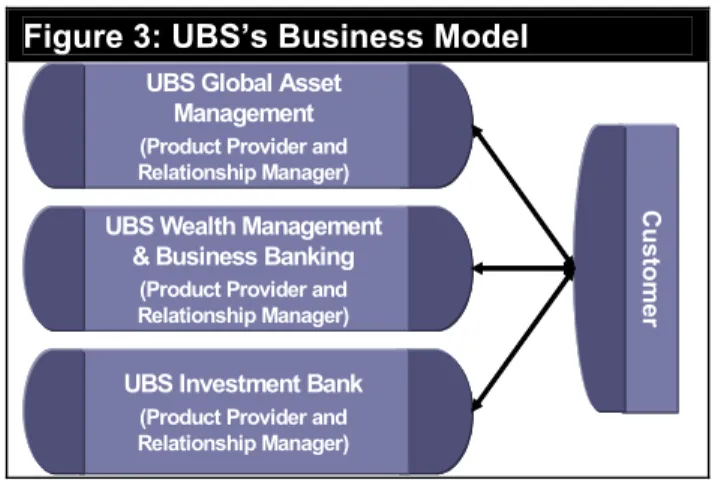
UBS Global Asset Management is a division of UBS Group, one of the world’s largest financial services enterprises. UBS Group is a universal bank that offers customers a complete range of financial services in three strategic business divisions: UBS Global Asset Management (GAM, responsible for asset manage-ment), UBS Wealth Management & Business Banking (WM&BB, responsible for retail banking, private banking, and business banking), and UBS Investment Bank (IB, responsible for investment banking). As Figure 3 shows, all three business divisions act as both product provider and relationship manager. This means that each division develops and manages prod-ucts – the task of the product provider – and advises customers and sells products – the task of the relation-ship manager. This dual role is typical for universal bank divisions, most of which are product-oriented.
Figure 3: UBS’s Business Model UBS Global Asset
Management
(Product Provider and Relationship Manager)
UBS Global Asset Management
(Product Provider and Relationship Manager)
Custom
er
Custom
er
UBS Wealth Management & Business Banking
(Product Provider and Relationship Manager)
UBS Wealth Management & Business Banking
(Product Provider and Relationship Manager)
UBS Investment Bank
(Product Provider and Relationship Manager)
UBS Investment Bank
(Product Provider and Relationship Manager)
Collaboration Challenges: Time to
Coordinate, and More
Because all three divisions consult and deal with cor-porate clients, the divisions have to cope with over-lapping businesses. For example, a company’s pension fund may be a GAM customer, while at the same time, the company’s treasury department is a WM&BB cus-tomer. The three divisions also collaborate to provide services, especially in marketing, sales, and after-sales
service, but also in service innovation and service production. The goal of cooperation is to use all the divisions’ current resources to serve customers in the most effective and efficient ways. Collaboration thus includes using all three divisions’ knowledge of cur-rent and prospective customers, to tap their full finan-cial potential.
The UBS Corporate Center coordinates the three divi-sions. One challenge the center faces is coordinating the overlapping service-production processes. For ex-ample, GAM and BB offer similar services (asset al-location, packaging, etc.). Clear competencies and responsibilities are necessary to avoid duplicate work, to use resources efficiently, and to answer the ques-tion, “Who is responsible for this customer’s perma-nent care?”
In marketing, the three collaborate in market research by undertaking it together and by jointly defining their strategic direction for market development. GAM and BB also collaborate in market segmentation and carry out sales processes of many services together.
The sales process can be divided into four phases: initiation, consulting, offer, and closing. In the initia-tion phase, cooperainitia-tion among the three divisions is especially important in determining the available knowledge about a current or prospective customer. In contrast, the division offering a specific product can complete its own consulting, offer, and closing sales phases without needing to depend on cooperation with the other divisions.
The divisions collaborate in initiation by first compil-ing a list of sales opportunities (leads) by region, cus-tomer segment, and attractiveness of the specific ser-vices to each. The divisions collect further information on these customers (e.g., financial statements, primary bank contact, and contacts to competitors), and then prioritize the leads. Existing business relationships
with high-priority customers are then identified. All this knowledge, which has been generated through multiple customer contacts (e.g. call reports, e-mails, interviews with key account managers and customer consultants), is collected on each relationship. In the initiation phase, knowledge on customers is also ex-changed via telephone or at informal and impromptu meetings among the divisions’ sales staffs.
The main current challenge to collaboration is the great deal of time required. Also, the sales staff need to know one another to effectively exchange customer knowledge across the divisions. Business opportuni-ties for up-selling and cross-selling may therefore not be recognized because there is no transparency on ‘who knows what on a customer’ across the three di-visions.
A second challenge is unclear responsibilities. For instance, who is responsible for generating the list of prioritized leads or processing this ‘lead management’ list?
A third challenge is coordinating customer contacts. Each division handles its own complaint management and reporting (on the financial performance of cus-tomer services) in its after-sales service group. As a result, customers can receive multiple performance reports and may have to deal with a different contact person for each service they receive.
Information Systems Challenge
:
Fragmented Systems Landscape
We observed that an information systems infrastruc-ture can contribute to some of the above-mentioned collaboration challenges when the infrastructure does not support certain processes. For example, the action systems in each division record customer trans-actions and can therefore provide information on a Figure 4: HomeLoanBank’s and InvestmentBank’s Business Model
Other Product Providers Other Product Providers Other Product Providers Other Product Providers HomeLoanBank (Product Provider) HomeLoanBank (Product Provider) InvestmentBank (Product Provider) InvestmentBank (Product Provider) Other Product Providers Other Product Providers Bank
(Relationship Manager)Bank (Relationship Manager) Customer Customer Customer Customer Customer Customer Customer Customer Other Banks (Relationship Managers) Other Banks (Relationship Managers)
More than 1000 small and medium banks More than 10 product
customer’s business with UBS. The challenge is that these systems are not integrated.
Additionally, the divisions operate seven different CRM systems to communicate with their customers. These systems store customer information collected by customer consultants in face-to-face meetings and telephone conversations – such information as finan-cial goals, organizational structure of corporate cli-ents, and sales opportunities. Corporate clicli-ents, for example, prefer personal contact and consulting rather than electronic information exchange. Therefore, e-mail and the Internet play only a secondary role in dealings with these ‘high-value customers.’
So neither the divisions’ transaction systems nor their seven CRM systems are integrated with one another. The sheer multitude of CRM, transaction, and cus-tomer data-collection systems form a huge barrier to compiling an integrated picture of a customer. In turn, this barrier sometimes prevents customer consultants from gathering all the relevant business knowledge – especially for the sales and service processes – in the needed time frame.
Coordinated CRM faces slightly different challenges in a network of loosely connected financial services firms.
CRM Challenges in an
Inter-organizational Network:
HomeLoanBank and InvestmentBank
HomeLoanBank and InvestmentBank are product providers in an inter-organizational financial services network. As shown in Figure 4, this network consists of several product providers and more than 1000 small and medium-sized independent banks acting as the relationship managers for the network. These banks jointly own two large central banks, which, in turn, hold a majority of shares in two data processing cen-ters and most of the product providers. The data proc-essing centers, and several small IT services provid-ers, act as the transaction processors (not shown in Figure 4).
Cooperation among HomeLoanBank, Investment-Bank, the other product providers, and the relationship managers in this alliance focuses on mutual needs and composite products. No strategic guidelines provide goals for the network as a whole. Rather, each com-pany has its own financial and operational goals. This structure differs greatly from the intra-organizational networks, like UBS, where the corporate center largely controls cooperation and sets the strategic guidelines.
This inter-organizational network focuses on coopera-tion in sales, with the relacoopera-tionship managers
distribut-ing the products of the product providers. However, the participating companies also have joint initiatives in marketing, service, and product development. HomeLoanBank and InvestmentBank, for instance, offer a composite product of a home loan and an in-vestment plan. This product lets customers profit from the government’s pension and retirement program.
Collaboration Challenges: Strategy and
Data Privacy.
The two main collaboration challenges center around the lack of a joint strategy and the limitations imposed by data privacy laws.
In this network, the companies are not centrally con-trolled. Thus, coordination occurs decentrally without long-term strategic goals for the network as a whole. In addition, some tasks are duplicated because compe-tencies are distributed among the participating compa-nies, leading to overlaps in market research, develop-ment of a customer typology, and lead managedevelop-ment. Cooperation is endemic to this network and all inter-organizational networks, because each member must cooperate with others to acquire the competencies it lacks to offer a broad range of services to customers. Thus, the relationship managers and product providers naturally collaborate in product development, market-ing, sales, and service.
In marketing, they jointly create commercials, score customers, and perform direct marketing. For exam-ple, HomeLoanBank cooperates with relationship managers in customer scoring. In sales, the relation-ship managers and product providers cooperate by mutually referring customers to one another: The rela-tionship managers’ sales consultants sell the product providers’ products to their customers; HomeLoan-Bank’s field sales force sells both the relationship managers’ products (bank products) as well as other providers’ products.
On the other hand, cooperation in service processes is less intensive. Generally, each product provider is responsible for after-sales service of its own products. Therefore, customers using services from several pro-viders must deal with several contact persons. How-ever, performance monitoring is an exception: Cus-tomers can obtain a single performance report on all their products from their specific relationship manager (bank). To achieve this consolidation, the product providers transfer product performance data to the relationship managers.
Due to the overlaps among the companies, this inter-organizational network has established a few simple rules to resolve conflicts. The most important rule is that the relationship managers have ‘primary access’ to the customers, which means the relationship
man-agers can decide whether they want to approach a cus-tomer directly or pass this right to a product provider, such as HomeLoanBank’s field sales force. Detailed commission policies also control the referral of cus-tomers among the network members.
Data privacy laws are the second major challenge in an inter-organizational network. To comply with these stiff European laws, this network uses a trusted third party to consolidate customer data from HomeLoan-Bank and the relationship managers, using names and addresses to match customer records. The third party then makes this consolidated customer data anony-mous and sends it to HomeLoanBank’s data mining competency center, which develops a prognosis model to identify likely customers of specific HomeLoan-Bank products. The relationship managers and sales staff use this model for direct marketing and consult-ing.
In marketing, sales, and service, the data privacy laws also present cooperation challenges by allowing only the relationship managers to have access to all the customer information in the financial services net-work. This restriction means that product providers, like HomeLoanBank, only have customer information related to their own products, which is an incomplete picture of all their customers.
Information Systems Challenge:
Fragmented Systems Landscape.
Product providers share their customer information with the relationship managers in two ways: through the transaction processors and via their own opera-tional CRM system.
First, they deliver the 50 most important variables (e.g., products held, investments, products’ durations) to the transaction processors. These transaction proc-essors integrate the customer information from the different product providers and relationship managers to provide integrated, basic customer information to the customer consultant responsible for the specific customer. Because the member companies do not use a single, unique customer identification number, this integration results in partial matches of customer names and addresses. When a match is inaccurate, the integrated information is incorrect.
Each product provider also shares its customer infor-mation with relationship managers by giving them access to its operational CRM system, thereby provid-ing the customer consultants with customer informa-tion related to specific products, including customer transactions and correspondence with the product pro-vider. Because each CRM system has its own data pool and user interface, customer consultants have to deal with up to 30 different CRM systems in this
net-work. Transferring data between systems is mostly impossible. Therefore, the customer consultants can-not gather all the relevant business knowledge – espe-cially for sales and service – on a customer within an adequate period of time.
Summary of CRM Challenges in a
Financial Service Network
Six key challenges to creating effective and efficient CRM in a financial services network emerged from our analysis of the five companies:
1. Joint Strategy: To leverage a network’s resources, the members need a joint strategy. Intra-organizational networks address this challenge automatically: their central office creates the strat-egy. Intra-organizational networks, on the other hand, do not. The members need to address this challenge directly.
2. Distribution of Core Competencies: Overlapping competencies can lead to the same tasks being un-necessarily performed in the different business di-visions or cooperating companies. This situation can lead to redundant systems, and other problems. Although sheer size may be a barrier to increased efficiency in some large companies, each division or company should focus on a few core competen-cies so that the network as a whole can exploit the advantages of disintegration (trend 2, Figure 1). 3. Process Integration in Marketing, Sales, and
Ser-vice: It is not always clear who is responsible for which process. Especially in service management, customers have to deal with different contact per-sons for each product they own. To integrate cus-tomer service (trend 1, Figure 1) and to promote the concept of relationship manager, networks must create a single point-of-contact for custom-ers.
4. Customer Knowledge Exchange: Often, customer consultants need to know each other before they will exchange information about customers with each other. But personal contact is time-consuming. Yet without the combined knowledge, business opportunities can be missed. To reduce task redundancy and to support collaborative CRM processes, network members need to share cus-tomer knowledge while simultaneously complying with data privacy laws.
5. Data Privacy: Data privacy laws sometimes hinder organizations from sharing customer data with each other. This challenge is greater in inter- than intra-organizational networks.
6. Systems Integration: The networks we analyzed had non-integrated transaction and CRM systems.
The great number of autonomous systems prevents companies from having an integrated view of a customer. Customer data (from transaction systems and data warehouses) needs to be integrated with operational CRM systems to create such an inte-grated view of customers.17
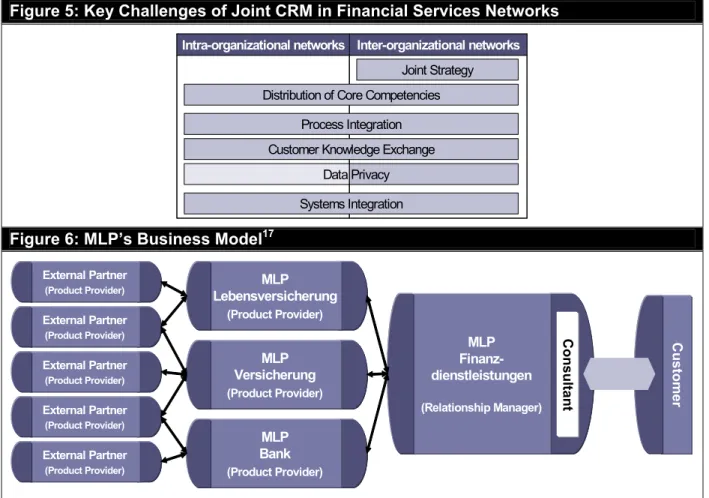
Due to companies’ independence and legal sover-eignty, the two most worrisome challenges for inter-organizational networks are creating a joint strategy and being able to share data within the bounds of the strict data privacy laws. Figure 5 graphically high-lights these differences between the two types of net-works. The shaded areas represent the challenges. With the key challenges uncovered, we now describe how one best practice network addressed them and designed its CRM processes and systems. MLP uses state-of-the-art technology and application architec-ture to address the challenges, and, in contrast to the other case studies, has integrated its processes and systems.
17 Some MLP, The MLP group, www.mlp-ag.com, 21.07.2004.
LEARNING FROM THE BEST: THE
CASE OF MLP
MLP is an independent financial services provider that focuses on its relationship manager role. In contrast to large universal banks, which focus on selling their own products, MLP focuses on selling the products of third-party providers. MLP complements these prod-ucts with its own prodprod-ucts only when no suitable product is available on the market, to offer a tailor-made solution to clients. Since its founding in 1971, it has targeted its advisory services to university gradu-ates and consumers with sophisticated requirements in three areas: pension provision, asset management, and risk management. With its approximately 2,800 finan-cial consultants and an extensive service offering, MLP is able to guide its 560,000 customers in six European countries through every aspect of personal financial management.18
Focusing on Core Competencies
The MLP Group is comprised of a holding company and five subsidiary companies. As a publicly listed
18 Some MLP, The MLP group, www.mlp-ag.com, 21.07.2004.
Figure 5: Key Challenges of Joint CRM in Financial Services Networks Inter-organizational networks Intra-organizational networks Inter-organizational networks Intra-organizational networks
Distribution of Core Competencies Joint Strategy
Customer Knowledge Exchange Process Integration
Systems Integration Data Privacy
Figure 6: MLP’s Business Model17
MLP Lebensversicherung (Product Provider) MLP Lebensversicherung (Product Provider) CustomerCustomer MLP Finanz-dienstleistungen (Relationship Manager) MLP Finanz-dienstleistungen (Relationship Manager) Consult an t MLP Versicherung (Product Provider) MLP Versicherung (Product Provider) MLP Bank (Product Provider) MLP Bank (Product Provider) External Partner (Product Provider) External Partner (Product Provider) External Partner (Product Provider) External Partner (Product Provider) External Partner (Product Provider) External Partner (Product Provider) External Partner (Product Provider) External Partner (Product Provider) External Partner (Product Provider) External Partner (Product Provider)
holding company, MLP AG defines the goals and co-ordinates the business strategies within the group. Figure 6 shows MLP’s business model, with three major product provider divisions and one relationship manager division.1920
The first listed provider, MLP Lebensversicherung AG, produces endowment policies, life insurance poli-cies, occupational disability polipoli-cies, and annuities. It also coordinates MLP operations in this field, acting as a 'general contractor' to the life insurance compa-nies involved. The second provider is MLP Versi-cherung AG, the service center for non-life insurance. MLP Bank AG, the third provider, performs the role of ‘general contractor’ for MLP Group’s investment and financing products. It coordinates the combination of product modules from different banks and invest-ment companies and acts as a custodian.
MLP Finanzdienstleistungen AG, the relationship manager division, is the core company in MLP Group. It is responsible for customer consulting and devel-opment of tailored solutions using the best products and components (modules) in the financial market. Not shown in Figure 6 is MLP Login GmbH, the IT service provider for the MLP group. It is responsible for technical development and operation of the Inter-net platform and customer consulting systems.
Collaboration Solution:
Integrated
Col-laborative CRM Processes
19 Stockmann, C., “Private Financial Engineering: Vorraussetzung integrierter Finanzdienstleistungen [Private Financial Engineering: Prerequisite of Integrated Financial Services],” Banking and Informa-tion Technology, No. 4, 2003, pp. 37-43.
20 Stockmann, C., “Private Financial Engineering: Vorraussetzung integrierter Finanzdienstleistungen [Private Financial Engineering: Prerequisite of Integrated Financial Services],” Banking and Informa-tion Technology, No. 4, 2003, pp. 37-43.
In the product development process, the MLP product providers develop products that complement external providers’ products. MLP Finanzdienstleistungen AG, the relationship manager, can then bundle the resulting banking, life insurance, and non-life insurance prod-ucts with external partners’ prodprod-ucts to provide inte-grated solutions that can be tailored to a customer’s needs.
MLP’s offer management process is centralized in MLP Finanzdienstleistungen AG, with MLP customer consultants advising customers. Depending on a cus-tomer’s needs, the consultant can offer only partners’ products, only MLP products, or a combination of both. The customer consultant is the customer’s single point-of-contact, handling complaint management and service management for the customer. Each consultant is also responsible for acquiring additional customers in the lead management process. MLP Finanzdien-stleistungen AG’s central campaign management ac-tivities support its customer consultants in this role. After a contract has been signed by a customer, though, contract management is decentralized; it is handled by each respective provider.
Systems Solution: Modular, Yet Highly
Integrated, Application Landscape
The MLP business model is made possible by a modu-lar, but highly integrated, application landscape. IT’s strategic objective is to enable the MLP product pro-viders to distribute the management and processing of products and contracts among one another, while, at the same time, allowing the customer consultants (and the customers themselves) to obtain an integrated view of customer information (needs, products, activi-Figure 7: MLP Application Architecture20
Cu sto m er Finance Pilot Co ns ul ta n t MLP Finanzdienstleistungen AG (Financial Services) Broker Pilot
(Customer Master Data, Financial Goals, Contract IDs)
Consulting Application Contracting Application MLP Lebensversicherung (Life Insurance) Broker Platform External Partner External Partner MLP Versicherung (Non-life Insurance) Broker Platform MLP Bank (Wealth Management) Broker Platform Face-to-face contact Telephone Mail / Fax Email WWW
ties).21,22 Figure 7 illustrates MLP’s application archi-tecture. 23
Consulting and contracting applications. The consult-ing process begins with ‘fact findconsult-ing.’ Usconsult-ing different consulting applications, a customer consultant enters a customer’s master data and works with the customer to discover the financial goals. Typical consulting ap- plications are modules for liquidity planning, asset management, risk management, and loan manage-ment. All customer data gathered in the consulting process are transferred into a central customer data-base (Broker Pilot) so that customer consultants can always draw upon the customer data already in the customer database.
At the end of the fact-finding consulting process, about 80% of a customer’s data is available to fill out the contract. The customer consultant enters any miss-ing data into a contractmiss-ing application, while the con-tracting application obtains all the other data from the Broker Pilot database. For some commodity products (e.g. car insurance), customers can use the specific contracting application on-line, to fill out and submit a contract themselves, via the Internet.
After all the needed customer data has been entered, the contracting application sends it to the Broker Plat-form of an MLP product provider that offers the spe-cific product.
21 Mehlau, J. I., “State-of-the-Art Report: IT-Architekturen für Finanzdienstleister [IT Architectures for Financial Services Provid-ers],” Banking and Information Technology, Vol. 3, No. 2, 2001, pp. 41-58.
22 Stockmann, C., “Die IT-Strukturen bei MLP [The IT Structures at MLP],” in Moormann, J. and Fischer, T. (Eds.), Handbuch Informa-tionstechnologie in Banken [Handbook Information Technology in Banks], Gabler, 2004.
23 Stockmann, C., “Private Financial Engineering: Vorraussetzung integrierter Finanzdienstleistungen [Private Financial Engineering: Prerequisite of Integrated Financial Services],” Banking and Informa-tion Technology, No. 4, 2003, pp. 37-43.
Broker platforms. The broker platforms are used to create and manage contracts. In contrast to normal brokers, who have no influence on the data processing after the initial transfer of a contract to an external product provider, the MLP product providers process accounts, deposits, and contracts – even for the prod-ucts of third-party providers – on their own broker platform. They therefore store all the customer and contract data on their own system. This capability is a prerequisite for MLP achieving an integrated view of customers to consult them comprehensively. The bro-ker platforms have interfaces to the external product providers’ transaction systems. Figure 8 shows the broker platform of one MLP product provider, MLP Bank.
Broker Pilot. The Broker Pilot is the central database for customers’ master data. Master data comprises names, addresses, personal information, and financial goals of customers. Contract data, on the other hand, comprises data on contracts (product, investment, du-ration, etc.). Contract data is stored in the respective broker platforms. Each contract is identified by a unique contract identification number (ID). The IDs of contracts that a customer holds are also stored in the Broker Pilot, to make the connection to his contract data.
The Broker Pilot serves as a data source for consulting and contracting applications, as well as for the Fi-nance Pilot. It is also the data source for analytical CRM systems that analyze unusual customer activities and customer potential for new consulting outlets. Finance Pilot. The Finance Pilot is a Web-based portal system that integrates all customer data from different systems (Broker Pilot and broker platforms) to achieve an integrated view of a customer. Both cus-tomer consultants and cuscus-tomers themselves can use Finance Pilot. It also offers functions for electronic banking and brokerage. Because MLP has all its cus-Figure 8: Broker Platform of MLP Bank23
Stock Exchange Stock Exchange Credit Card Company Credit Card Company Central State Bank Central State Bank MLP Bank Broker Platform Asset Mgmt. Data Warehouse Account Management / Payment Processing Brokerage Credit Card Contracting Application Other Systems Finance Pilot
tomer data and contract data available to its own sys-tems, and can integrate this information by using the unique Customer ID in all systems, it was possible for the company to develop Finance Pilot.
With this state-of-the-art architecture, MLP can serve as a ‘best practice’ example for financial services net-works that face the challenges of taking a joint CRM approach.
FIVE STEPS TOWARD
SUCCESSFUL JOINT CRM IN
BUSINESS NETWORKS
The five previous cases (not including MLP) show that the key challenges in creating a joint CRM ap-proach center around collaboration and information systems challenges. At the CRM system level, no sub-stantial differences exist between what an effective intra- or inter-organizational CRM needs. The most important difference is that data privacy challenges are more important and problematic in inter-organizational CRM initiatives.
Insights from case studies and literature in other in-dustries reveal that the challenges discussed in this article are not limited to financial services but are relevant to all conglomerates that offer a wide range of products and strive to exchange and share customer information to optimize the overall relationship with their customers. The challenges apply to serving con-sumers and corporate clients alike.
Integrating systems with allies on the supply-side has been widely covered for years, but not until recently have companies started to assess the value of systems integration on the demand-side.
MLP shows how process integration and modular-yet-integrated customer information systems can address these challenges. From this case, we distilled five steps for managing customer relationships in business networks. We are well aware that these steps may re-quire organizations to make major changes in the way they operate. Ingrained organizational practices, or-ganization size, and other factors can make some steps
difficult to implement, as do data privacy laws. How-ever, we believe that networked organizations should work toward these goals. The case of MLP proves that it can be done.
The five steps build on each other. The first focuses on integrating business processes; the others focus on systems.
Step 1: Define Integrated CRM
Processes
This step addresses the need to integrate processes first. Before systems can be integrated, companies need to clarify how their joint CRM processes in mar-keting, sales, and service (e.g., the customer counsel-ing process) should be handled. Process responsibili-ties should be clear and divided among the companies in the network. If possible, give each customer a clearly specified contact person for every process, rather than a different contact for each product. To achieve this single point-of-contact, networked com-panies must integrate the CRM processes that involve multiple products, e.g., customer counseling or per-formance reporting. Once integrated CRM processes are defined, the companies can then define the neces-sary information systems infrastructure to support these processes.
Step 2: Establish a Joint Customer Data
Model
This step mainly addresses the challenge of exchang-ing customer information. To exchange and integrate customer information among networked companies, these companies need a means to merge the different customer data. While many financial services net-works work with a matching algorithm based on names and addresses, this approach should only be temporary because it is not reliable. A joint customer data model and a unique customer ID for each cus-tomer, usable in all applications, should be the goal. Using this data model, the customer master data, con-tract data, and transaction-related data stored in differ-ent systems can be integrated more easily. Of course, Figure 9: Five Steps Towards Successful CRM in Financial Services Networks
2. Establish joint customer data model 3. Establish central customer database (master data) 4. Link CRM systems to central database 5. Integrate systems via views (portals) 1. Define integrated CRM processes
implementing a single unique customer ID for use in different companies is a major undertaking.
Step 3: Establish a Central Customer
Database for Customer Master Data
This step also addresses the customer-knowledge-exchange challenge. As MLP and its Broker Pilot da-tabase illustrate, a central basic customer master data-base should have links to contracts, transactions, and other customer data. With this architecture, the rela-tionship manager can maintain this database, because this network members needs the data most, to interact with customers. But this member must also have ac-quired the necessary legal rights in terms of the data privacy laws to store this data. A transaction processor member, which should be provided with the appropri-ate legal rights, could also maintain the database as an intermediary between several product providers and relationship managers. Special attention must be paid to distributing appropriate access rights so that every employee only has access to relevant customer data, and no other.
Step 4: Link Distributed CRM and
Transaction Systems to the Central
Customer Database
This step addresses the need for systems integration. To ensure flexibility and short time-to-market delivery of new products, CRM systems and systems, for ex-ample, should be modular and dispersed, not mono-lithic. Nevertheless, data and processes should be in-tegrated. These systems should work with a ‘federated data model,’ meaning the systems should store cus-tomer master data in a single jointly used database and store non-master data in databases associated with each relevant system. To ensure data consistency and integration among data stored by the network mem-bers, all customer-oriented systems need to be linked to the central customer database.
Step 5: Integrate Customer-oriented
Systems Via Views (Portals)
This step also addresses the challenge of integrating systems, and, as the final step, depends on the previ-ous steps. To ensure collaborative CRM processes (Step 1), it is not sufficient to only integrate the data. The functions in the systems need to be integrated as well, so that, for example, customer consultants have all the relevant functions and data to complete a col-laborative process. Functional integration can be achieved either with monolithic systems (combined CRM and ERP systems, comprising all the relevant functions) or using portal technology. Portals, such as the MLP Finance Pilot, integrate different operational systems and data sources, while, at the same time,
retaining the flexibility of modular and distributed systems. And, both customers and customer consult-ants can use the portal.
While these five steps are sequential, data privacy needs to be addressed in each one of them because violations of the regulatory restrictions may lead to customer dissatisfaction and even legal consequences, not to mention risk to a firm’s reputation. Therefore, depending on the local market, the first step in pursu-ing CRM in a network of companies (especially an inter-organizational network) should be careful evaluation of the impact of data privacy laws. Re-evaluation should then take place at each subsequent step.
Figure 9 summarizes the five steps for successful cus-tomer relationship management in financial services networks.
We are aware that legacy information systems infra-structures and cost pressures increase the difficulty of migrating to such an architecture. Clearly, a stepwise ‘think big – start small’ approach is appropriate in such cases. Nevertheless, it is necessary to address the mentioned challenges to create a truly networked op-eration and, more importantly, to meet increasingly demanding future customers.
ABOUT THE AUTHORS
Malte Geib
Since 2001, Malte Geib ([email protected]) has been a researcher and Ph.D. student at the Institute of Information Management, University of St. Gallen, Switzerland. His research focuses on customer rela-tionship management and customer knowledge trans-fer in networked enterprises, especially in the financial services industry. In 2005, he is a visiting researcher at the Center for Digital Strategies, Tuck School of Business at Dartmouth College, USA. He earned his master’s degree in information management from the University of Muenster, Germany. He has also studied at the Queensland University of Technology in Bris-bane, Australia. He has worked as a software engineer for IBM Germany and as a consultant for several Swiss and German companies, including Deutsche Telekom AG, Credit Suisse, and PostFinance.
Lutz M. Kolbe
Since July 2002, Lutz Kolbe ([email protected]) has been head of Competence Center Customer Man-agement (CC CM) and teaches at AACSB-accredited University of St. Gallen, Switzerland. His research interests are customer relationship management, secu-rity management, and advanced technologies in the residential environment.
After having worked as a financial consultant, Lutz studied information management at Brunswick Tech-nical University, Germany, where he received a mas-ter’s degree. He went on to working on his dissertation at Freiberg Technical University, Germany, and the University of Rhode Island, USA. He received his Ph.D. in 1997. After that he worked at Deutsche Bank in Frankfurt and New York, where he became manag-ing director in 2001.
Walter Brenner
Walter Brenner ([email protected]) is a profes-sor of information systems at the University of St. Gallen and managing director of the Institute of In-formation Management. After earning his graduate degree, his doctorate degree and his venia legendi from the University of St. Gallen, he worked for sev-eral years for Alusuisse-Lonza AG, based in Basel, Switzerland, as the head of application development and other positions. From 1993 until 1999, he was a professor for business administration and information management at the TU Bergakademie Freiberg, Ger-many and subsequently professor for information management and business administration at the Uni-versity of Essen, Germany. His research focuses on integrated information management, customer rela-tionship management, and innovative technologies.