The Open Access Publication Server of the ZBW – Leibniz Information Centre for Economics
Nutzungsbedingungen:
Die ZBW räumt Ihnen als Nutzerin/Nutzer das unentgeltliche, räumlich unbeschränkte und zeitlich auf die Dauer des Schutzrechts beschränkte einfache Recht ein, das ausgewählte Werk im Rahmen der unter
→ http://www.econstor.eu/dspace/Nutzungsbedingungen nachzulesenden vollständigen Nutzungsbedingungen zu vervielfältigen, mit denen die Nutzerin/der Nutzer sich durch die erste Nutzung einverstanden erklärt.
Terms of use:
The ZBW grants you, the user, the non-exclusive right to use the selected work free of charge, territorially unrestricted and within the time limit of the term of the property rights according to the terms specified at
→ http://www.econstor.eu/dspace/Nutzungsbedingungen By the first use of the selected work the user agrees and declares to comply with these terms of use.
zbw
Leibniz-Informationszentrum WirtschaftSalojärvi, Hanna; Sainio, Liisa-Maija
Article
CRM technology and KAM performance: The
mediating effect of key account-related knowledge
jbm - Journal of Business Market ManagementProvided in Cooperation with:
jbm - Journal of Business Market Management
Suggested Citation: Salojärvi, Hanna; Sainio, Liisa-Maija (2015) : CRM technology and KAM performance: The mediating effect of key account-related knowledge, jbm - Journal of Business Market Management, ISSN 1864-0761, Vol. 8, Iss. 1, pp. 435-454, http://nbn-resolving.de/ urn:nbn:de:0114-jbm-v8i1.1050
This Version is available at: http://hdl.handle.net/10419/111079
Published online: 06.04.2015 --- © jbm 2015
--- H. Salojärvi (C)
Lappeenranta University of Technology, School of Business, Finland e-mail: [email protected]
L. Sainio
Lappeenranta University of Technology, School of Business, Finland e-mail: [email protected]
CRM Technology and KAM Performance: The Mediating Effect
of Key Account-Related Knowledge
Hanna Salojärvi
·
Liisa-Maija Sainio
Abstract: This paper examines the effect of customer relationship management (CRM) technology investment and key account-related knowledge on suppliers’ key account management (KAM) performance. The findings are based on survey data gathered from large Finnish industrial suppliers and subjected to factor analysis and hierarchical linear regression. The results show that CRM technology is positively related to key account-related knowledge. In addition, the results show that the effect of CRM technology investment on KAM performance is fully mediated by key account-related knowledge. The study contributes to previous literature on the consequences of CRM technology investments in shedding light on the importance of the nature of the knowledge acquired. The implementation of CRM technology is not enough as it is the key account-related knowledge that has a stronger effect on the ability of the supplier to manage its strategically most important customers.
Keywords: Customer knowledge · CRM · Customer Relationship · Key Account Management
Introduction
Customer knowledge has attracted increasing scholarly interest during the last decade. Such knowledge can be exploited to meet customers’ growing demands for tailored solutions (Campbell, 2003) and to develop cooperative long-term relationships with them (Jayachandran et al., 2005). The ability of a firm to generate knowledge about its quality customers, to track its customer history, and to understand customer needs and problems has been identified as one of the key components of customer-relating capability in firms that continuously outperform their competitors (Day, 2003).
The generation of quality customer-related knowledge is particularly important in business markets, in which customer relationships are more complex and extensive in nature than in relationships in consumer markets (Stein et al., 2013). In accordance with the Pareto principle, a very small number of customers (20/80) already generate a relatively large share of total sales and profits in business markets (Piercy and Lane, 2006), thus forcing suppliers to allocate a large proportion of their selling efforts and resources at the level of single customers (Bowman and Narayandas, 2004). It has been argued that suppliers who truly understand the components of their value proposition to these powerful customers, often referred to as key accounts, do not need to worry about customer power and decreasing margins to the same extent as less knowledgeable suppliers (Lane and Piercy, 2004; Ryals and Holt, 2007). It appears therefore, that strategically important key accounts should be managed as strategic investments from the side of the supplier, thus requiring in-depth and organization wide knowledge of the current state of the key account relationship as well as knowledge regarding the future potential of the key account.
It has been suggested that one way to facilitate the generation of customer knowledge is to invest in CRM technology (e.g., Chen et al., 2009; Salojärvi et al., 2013). However, findings on the performance outcomes are still conflicting (Chang et al., 2010). Although some studies report that such investments support performance (e.g. Mithas et al., 2005; Richard et al., 2007), others fail to find evidence of positive performance outcomes (e.g. Avlonitis et al., 2005, Hendricks et al., 2007). In fact, it has been reported in several studies that many firms fail to meet the goals of their CRM implementation, or to fully utilise the systems (e.g., Campbell, 2003; Khodakarami and Chan, 2014; Reinartz et al., 2004; Rigby et al., 2002), especially in business-to-business environments (Stein et al., 2013). In addition, the link between the CRM activities of the supplier and customer-relationship performance in general still remains largely under-studied (Bowman and Narayandas, 2004). In particular, empirical studies on the organisational factors leading to successful KAM remain limited (Davies and Ryals, 2014).
Given the research gaps identified above, this paper has the following objectives. First, the study aims at increasing our understanding on the effect of CRM technology investment on KAM performance. While performance consequences of CRM technologies has been an area of substantial research in the marketing stream of research during the past decade (e.g. Avlonitis and Panagopoulos, 2005; Chang et al., 2010; Mithas et al., 2005), a little is still known on the role of CRM technology as a
facilitator of key account management. By using empirical cross-industrial survey data collected from large industrial firms in Finland, this study contributes to prior literature by examining the effect of CRM technology to the management of complex, strategically important key account relationships in a B2B setting. Second, by drawing on the prior literature on customer knowledge management and key account management the study examines the role of key account-related knowledge as a mediating variable in the relationship between CRM technology investment and KAM performance. Although the importance of customer knowledge has been recognized for example in the previous literature on customer knowledge management (e.g. Campbell, 2003; Gibbert et al. 2002, Salomann et al., 2005), solution selling (e.g. Naudé et al., 2009), business networks (Henneberg et al., 2009a; Mouzas et al., 2008) and also in the KAM context (e.g. Salojärvi et al., 2010; Salojärvi and Sainio, 2010; Shi et al., 2005), empirical studies on the performance consequences of customer-related knowledge remain sparse. Thus, this study contributes to previous key account management literature by providing empirical evidence for the importance of strategic, key account-related business knowledge and network insight (see e.g. Henneberg et al., 2009a; Mouzas et al., 2008) generated from the key account. The findings of the study also contribute by implying that there is a need to develop a deep insight into the key accounts and key account’s business in order to be able to provide solutions and services that create joint value. Based on our findings we note that CRM technology has an important supportive role in this process as it provides a centralized platform for all key account-related information easily accessible organization-wide.
The article continues as follows. The theoretical background is discussed, and the hypotheses devised in the next section. The data-collection procedure and the measures used are then described, and the results are presented. Finally, conclusions are drawn and suggestions for future research are given.
Literature review
Key account management as a research context
The origins of KAM can be traced back to US industrial markets in the 1960s when firms started to expand geographically, and at the same time expected coordinated service and channels from their suppliers (Gosselin and Bauwen, 2006). In response, previously territory-based sales organisations were forced to re-design and coordinate their processes in order to meet buyer demand for price reductions and improvements in quality and service (Brehmer and Rehme, 2008; Gosselin and Bauwen, 2006). Since its introduction in its early forms, KAM has become one of the most significant sources of change in modern sales and marketing organisations (Homburg et al., 2000). Rapid change in the business environment, the refinement of processes, the tendency among customers to centralise their purchasing processes and rationalise the supplier base, market consolidation, and increasing customer power and competition have all driven supplier firms to implement KAM programmes at an increasing rate (McDonald et al., 2003; Piercy and Lane, 2006; Wengler et al., 2006).
Homburg (2000, p. 463) refers to KAM as a management concept that involves “thedesignation of special personnel and /or performance of special activities directed at an organization's most important customers”. Thus, the aim in the organisation is to engage in special activities directed at its most important customers, and thereby to develop and enhance relationships with them (Homburg, 2000). These special activities, or the added value provided by the supplier, include customer-specific organisational structures such as the designation of key account managers and/or management teams to coordinate the relationship (e.g., Arnett et al, 2005; Homburg et al., 2002, Moon and Armstrong, 1994), coordinated communication with the customer, tailored offerings, and consistent products, services and terms of trade worldwide (Abbrat and Kelly, 2002; Montgomery and Yip, 2000). These additional activities can be regarded as relationship specific investments from the side of the supplier (Ivens and Pardo, 2008), thereby involving dependency and risks and consequently increasing the need for sharp managerial attention.
The need for specific managerial attention and internal coordination is also driven by the complexity of KAM in that even in single key account relationships there may be multiple contact points between the supplier and the account, extending across functional (and geographical) borders (Homburg et al., 2002; Birkinshaw et al., 2000; Ivens and Pardo, 2008). The high number of actors involved (Cannon and Narayandas, 2000; Ivens and Pardo, 2008) makes knowledge flows between the supplier and the key account typically much more extensive than in non-key account relationships (e.g. Birkinshaw et al., 2001; Nätti, 2005). In addition, the extensive scope of key account relationships easily leads to intra-organizational fragmentation of key account-related knowledge, which may result in multiple selling efforts and contradictory service offerings from the perspective of the key account (e.g., Cespedes, 1992; Nätti and Ojasalo, 2008). Moreover, fragmented knowledge also hampers the calculation of customer profitability organisation-wide, thus making it difficult for the supplier firm to build an appropriate value proposition for the key account (Ryals and Holt, 2007) and monitor the stage and strategic importance of the relationship (Salojärvi and Sainio, 2010).
It is suggested in previous literature that one way of coordinating managerial actions related to customer relationships is to invest in a CRM system that facilitates the management of customer-specific knowledge (e.g., Day, 2003; Khodakarami and Chan, 2014; Chen et al., 2009; Mithas et al., 2005; Salojärvi et al., 2010; Salojärvi et al., 2013). Investment in such a system supports the development of customer-specific memory in the organisation. This, in turn, facilitates personal interaction with the customer in enabling consistent and customer-specific quality service at every contact point in a cost-efficient manner (e.g., Garrido-Moreno et al., 2014; Sin et al., 2005; Day, 2003). The outcome is a longitudinal perspective on the nature of the customer relationship, including factors such as the development of the value proposition, the nature of relational bonds, and the specific features of the negotiation and decision-making processes (Stein et al., 2013). In general, the system facilitates the automation of many operative tasks such as customer-contact follow-up and future prospects
(Chen and Popovich, 2003), as well as the production of descriptive and predictive customer analytics based on cumulated customer information (Payne and Frow, 2005). Furthermore, CRM systems facilitate the efficient collection of customer data from multiple sources, and afford opportunities for more frequent customer interaction (Jayachandran et al., 2004; Mithas et al., 2005). In addition, by facilitating the storage of large amounts of key account-related knowledge for further use, CRM system provides a basis on which to understand the nature and stage of the relationship between the firm and its customers (Stein et al., 2013). As such, it also determines the previous knowledge that fosters the acquisition of new knowledge (see Cohen and Levinthal, 1990) needed for example in the continuous, up-to-date development of key account plans (Marcos-Cuevas et al., 2014). In general, detailed customer analytics is of particular importance in key account management where relationship-specific investments easily lead to dependency and risks from the view of the supplier (see e.g. Ivens and Pardo, 2008).
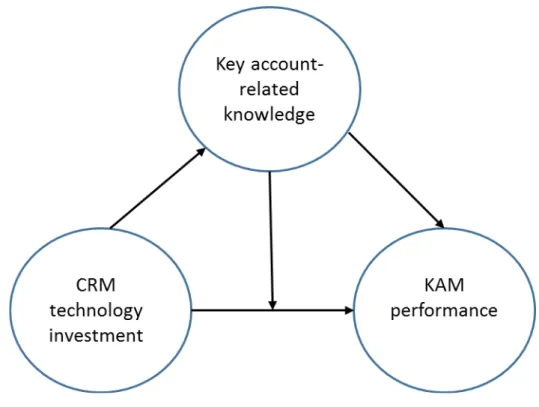
Positive performance outcomes of CRM technology are reported in several studies. Mithas et al., (2005) found a positive effect of CRM technology on customer satisfaction, whereas Richard et al. (2007) note on the basis of their qualitative study that CRM technology has a positive influence on the performance of business-to-business relationships. Ahearne et al. (2007), on the other hand, discovered a positive effect on the performance of salespeople given that active CRM leads to enhanced knowledge among them, which in turn leads to improvements in sales-related behaviour and efficiency. With a view to building on these findings, it is proposed that CRM technology also leads to positive performance outcomes in the management of extensive and complex key account relationships as it facilitates the coordination and analysing of key account-related information thereby making the relationship easier to manage. We therefore posit the following two hypotheses:
H1: CRM technology investment has a positive effect on suppliers’ key account-related knowledge
H2: CRM technology investment has a positive effect on suppliers’ KAM performance
The role of customer-specific knowledge in key account management
The shift from transaction-based marketing to relational philosophy (e.g., Grönroos, 1997; Morgan and Hunt, 1994) and customer relationship management has driven researchers to focus on the specific features of customer knowledge and its management in organisations (e.g., García-Murillo and Annabi, 2002; Gebert et al., 2003; Gibbert et al., 2002). Scholars researching the management of customer knowledge emphasise the importance of generating knowledge directly from the customer, meaning knowledge residing in the mind of an individual (e.g., García-Murillo and Annabi, 2002; Gebert et al., 2003; Gibbert et al., 2002; Jayachandran et al., 2005; Rowley, 2002; Salomann et al., 2005; Tzokas and Saren, 2004). Knowledge acquired directly from the customer is considered more strategic in nature than
traditional knowledge about customer needs, and includes knowledge about markets, the competitive environment in the customer’s business, and end-user needs and preferences, for example. Moreover, knowledge gained directly from the customer through interaction constitutes the relationship-specific tacit knowledge that is needed in future dealings (Ballantyne, 2004). It lays the foundation for the development of relational capabilities that according to Smirnova et al. (2011b) facilitate customized solutions to the customer thereby leading to increase in firm performance. Such an ability to acquire customer-related business knowledge directly from the customer and thus, go beyond the direct customer needs could be regarded as of outmost importance in business-to-business markets where the suppliers’ offerings tend to be based on “derived demand” (Henneberg et al., 2009a). Key account-related knowledge also facilitates identifying the sources of value for the customer (both current and future). Such insight is necessary to be able to identify a match between the supplier’s and key account’s value strategies and thereby to further develop the relationship to the right direction (Henneberg et al., 2009b; Pardo et al., 2006).
Several researchers also note the importance of customer knowledge in the coordination of key account relationships (e.g., Abratt and Kelly, 2002; Nätti and Palo, 2012; Millman & Wilson, 1999; Salojärvi et al., 2010; Salojärvi et al., 2013). These relationships are cooperative and collaborative in nature, thus involving considerable knowledge flows and cross-functional collaboration both within the supplier organisation and with the key account (Kothandaraman & Wilson, 2000; Nätti and Palo, 2012). In addition, the ability of the salespeople to know their customers and generate knowledge about their strengths, weaknesses, opportunities, threats and strategies (Weitz and Bradford, 1990) is becoming ever more important in the rapidly changing markets of today. Key accounts increasingly expect suppliers to be able to act as trusted business advisors to their end customers (Piercy, 2010). Moreover, customer knowledge is needed in the planning and tailoring of key account offerings (Salojärvi et al., 2010). Thus, from the view of the supplier, knowledge ‘from the customer’ is highly valuable as it can encourage proactivity in finding new opportunities for creating customer value. Indeed, the better the supplier knows its customer and understands the customer’s business, the better it is able to create customer value that is difficult for competitors to imitate. Furthermore, knowledge directly from the customer is helpful in evaluating the future direction and potential of the key account relationship, as well as in observing the performance of suppliers’ KAM practices internally.
Srinivasan and Lilien (1999), for example, found empirical support for the positive performance outcomes of customer knowledge: they discovered that customer knowledge management had a positive effect on business performance on the firm level. In their study in the Russian context Smirnova et al. (2011a) found that deep customer understanding gained along with customer orientation had a positive effect on cross-functional collaboration between marketing and purchasing, which in turn positively affected business performance. Mithas et al. (2005), on the other hand, discovered that customer knowledge mediated the effect of CRM systems on customer satisfaction. In line with the above, we posit the following hypotheses:
H3: Key account-related knowledge has a positive effect on suppliers’ KAM performance
H4: Key account-related knowledge mediates the effect of CRM technology on suppliers’ KAM performance
Fig. 1: Conceptual model
Data collection
A structured questionnaire was used to collect the data. Finnish industrial firms with over 200 employees were defined as the population of interest. Large firms were chosen as the population of interest because the need for internal coordination of knowledge flows is often more apparent in large firms than small firms. Within these limits, a total of 361 firms were identified from the Amadeus database. Of these, 171 were considered eligible when first contacted by phone. The eligibility was determined based on two criteria. It was ascertained first that the firm had business-to-business sales in Finland, and second that it had identified its key account customers. Higher level managers (such as sales directors) were first contacted to confirm the eligibility concerning the above mentioned criteria. These managers were then asked to recommend the most knowledgeable respondents responsible for the management of the strategically important key account customers. Thirteen firms refused to participate in the study. A key-informant approach was used to collect the data. The respondents were mainly key account managers, sales managers or others in corresponding positions responsible for the management of a strategically important customer
relationship. They were asked to respond from the perspective of the most important key account relationship in terms of annual sales volume. A total of 395 questionnaires were mailed to the 158 firms that agreed to take part in the study. We received 169 responses from 97 firms, meaning an effective response rate of 56.7 per cent (97/171) on the company level, and 42.8 per cent (169/395) in terms of the total number of questionnaires sent out and returned. Multiple responses from single firms were not considered a problem as the respondents represented different business units and answered the questionnaire from the perspective of different key account relationships. The early and late responses were compared according to the recommendations given by Armstrong and Overton (1977) in order to assess the possibility of non-response bias, and Harman’s one-factor test (Podsakoff and Organ, 1986) was run to check for common method variance. Neither seemed to be a problem.
Measures
Because no previously validated measures of customer-related knowledge were found, a new measure was generated based on the literature and on discussions with firm representatives. The respondents were asked in the final survey to evaluate the extent to which they acquired certain types of key account-related knowledge (knowledge from the customer including business plans and marketing strategies, for example). A seven-point Likert scale ranging from “1=not at all to 7=very much” was used in the evaluation. Factor analysis was used to create the summated scale. CRM technology was measured on two items adapted from Reinartz, Krafft and Hoyer (2004), complemented with one item developed following the pre-interviews with managers. Supplier KAM performance was measured on a 10-point Likert scale assessing the management of the key account relationships during the previous three years (1=very poor, 10=very good).
The levels of a supplier’s acquisition of customer knowledge and ability to perform in the management of the key account relationship may be affected by external factors such as the dynamism of the key account and the length of the relationship (measured in years). These factors were therefore controlled for in the study. The dynamism of the key account was measured on six items assessing rapidness of change in the relevant industry. Table I shows the rotated factor loadings and the Cronbach’s alpha values of all the summated scales.
Tab. 1: The factor loadings of the variables
Key account-related knowledge (α=.899) Loadings
Competitive situation in the key account’s field of business Marketing strategies of the customer
.814 .767
Business plans of the customer .769
Mergers and acquisitions in the key account’s field of business Planned strategic moves of the key account
.714 .711
Technological development in the key account’s field of business .669 CRM technology investment (α=.84)
We have invested in technology to acquire and manage ‘real time’ customer-related information
.863
We have a dedicated CRM technology in place for analyzing customer information
.858
Our CRM technology does not meet our needs (R) .753 Key account dynamism (α=.823)
In key account’s field of business knowledge and know-how go quickly out of date
.733
It is very difficult to forecast where the technology will be in the next 2-3 years in the key account’s industry
.740
In recent years, a large number of new product ideas have been made possible through technological breakthroughs in the key account’s industry
.771
The key account tends to look for new products all the time .669
The ability to react quickly is crucial in our key account’s field of business
.649
Technological development is very rapid in the key account’s field of business
.800
Results
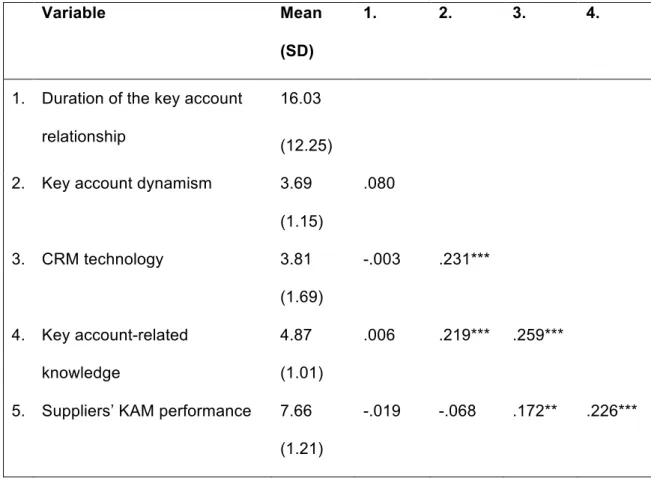
Table II gives the means, standard deviations and correlations among the variables used in the study.
Tab. 2: Means, standard deviations and correlations.
**p<0.05, ***p<0.01
Hierarchical regression analysis was used to examine the relationships between the independent and dependent variables. The values of the variable inflation factor (VIF) scores were checked to assess the possible risk of multicollinearity. They were well below the cut-off value of 10 suggested by Hair et al. (1998), hence multicollinearity was not considered a problem in the study. Tables III and IV present the results of the hierarchical regression analyses. The control variables were entered in the first step, and the hypothesized independent variables in the second in order to see the change in the main effects. The proposed mediating effect (Table IV) was tested following the recommendations of Baron and Kenny (1986).
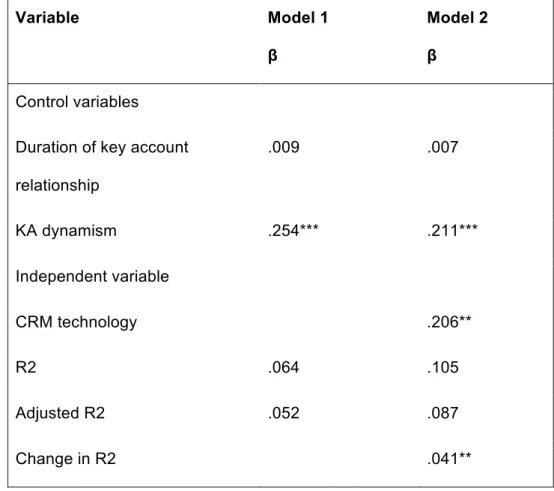
The results show, first (Table III), a positive effect of the control variable key account dynamism on the supplier’s key account-related knowledge (β=.254, p<0.01 in Model 1 and β=.211, p<0.01 in Model 2). This indicates that the more rapid the change in the key account’s business and business environment, the more knowledge from the key account is generated by the supplier. Moreover, the findings support H1 stating that CRM technology has a positive effect on the supplier’s key account-related knowledge (β =.206, p<0.05).
Variable Mean
(SD)
1. 2. 3. 4.
1. Duration of the key account relationship
16.03 (12.25) 2. Key account dynamism 3.69
(1.15) .080 3. CRM technology 3.81 (1.69) -.003 .231*** 4. Key account-related knowledge 4.87 (1.01) .006 .219*** .259***
5. Suppliers’ KAM performance 7.66 (1.21)
Tab. 3. The results of the linear regression analyses of key account-related knowledge Variable Model 1 β Model 2 β Control variables Duration of key account relationship .009 .007 KA dynamism .254*** .211*** Independent variable CRM technology .206** R2 .064 .105 Adjusted R2 .052 .087 Change in R2 .041** **p<0.05, ***p<0.01 (two-tailed)
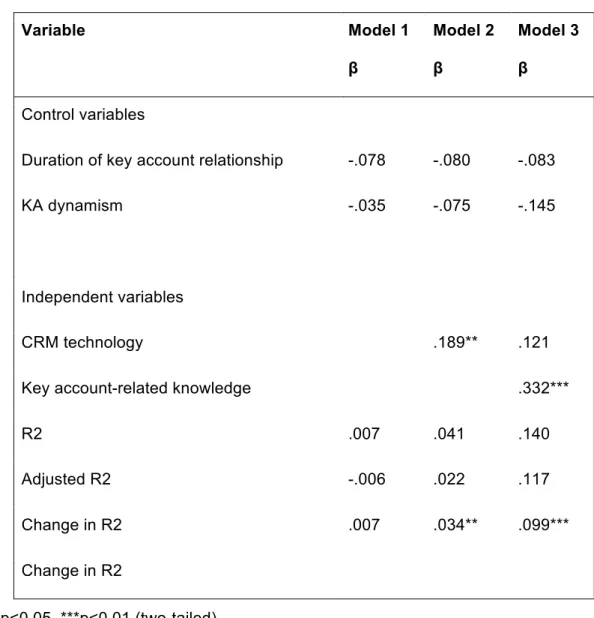
The effects of the independent variables on suppliers’ KAM performance were examined in the second phase of the analysis. As shown in Table IV, the control variables ‘duration of the key account relationship’ and ‘dynamism of the key account’ were not significantly related. On the other hand, a statistically significant association between CRM technology and suppliers’ KAM performance was found in Model 2 (β =.189, p<0.05), thereby supporting H2. However, the positive effect of CRM technology became statistically insignificant once the proposed mediating variable ‘key account-related knowledge acquisition’ was added in model 3. According to Baron and Kenny (1986), the predictive power of a previously significant explanatory variable should decrease significantly for partial mediation and become insignificant for full mediation. Thus, in support of H3 and H4 the findings show that key account-related knowledge has a positive effect on suppliers’ KAM performance (β=.332, p<0.01), and that it fully mediates the effect of CRM technology.
Tab. 4. The results of the linear regression analyses of suppliers’ KAM performance (mediation included)
Variable Model 1 β Model 2 β Model 3 β Control variables
Duration of key account relationship -.078 -.080 -.083
KA dynamism -.035 -.075 -.145
Independent variables
CRM technology .189** .121
Key account-related knowledge .332***
R2 .007 .041 .140
Adjusted R2 -.006 .022 .117
Change in R2 .007 .034** .099***
Change in R2
**p<0.05, ***p<0.01 (two-tailed)
Discussion and implications
The aim in this paper was to explore the effect of CRM technology and key account-related knowledge acquisition on suppliers’ KAM performance. The findings of the study contribute to previous research in many ways. First, they enhance understanding of the concept of customer-related knowledge. The importance of customer knowledge is widely acknowledged in the literature (e.g., García-Murillo and Annabi, 2002; Gibbert et al., 2002), but little research has been conducted on the contents of the customer knowledge firms tend to acquire, or on whether different types of knowledge can help them to be more competitive. As such, these results could be regarded as an interesting avenue for future research. Second, most literature on key account management is conceptual in nature and thus lacks contributions that build on empirical data. This study provides empirical support for
previous propositions concerning the importance of key account-related knowledge in the coordination of key account relationships (e.g., Nätti and Palo, 2012; Millman and Wilson, 1999). As such, the findings imply that the ability to generate key account-related knowledge could be considered a dimension of a KAM orientation, as Tzempelikos and Gounaris (2013) propose.
Our results attest to the positive effect of investment in CRM systems. However, in line with previous findings reported by Mithas et al. (2005), the effect of CRM technology on suppliers’ KAM performance was mediated by key account-related knowledge. Several implications arise from this finding. First, the positive relationship between CRM technology investment and key account-related knowledge acquisition implies that CRM technology provides a basis for understanding the nature and stage of key account relationship (see e.g. Stein et al., 2013). By facilitating the storing of key account-related information in one place, it is easier for the key account managers to analyze the relationship, keep key account plans up-to-date and identify further needs for knowledge acquisition. This finding is in line with Cohen and Levinthal (1990) who argued that prior knowledge facilitates in acquiring new knowledge. The measure we used in the study directly reflects the strategic nature of the knowledge, which covers customer-related business knowledge and not only knowledge about customer preferences and customer needs. Although considerable knowledge flows are typical of collaborative key account relationships, the findings show that suppliers with better access to knowledge from the key accounts succeed better in their KAM practices than those who do not manage to acquire that type of strategic key account-related knowledge to the same extent. Thus, by knowing what to search for and how, they are able to combine their direct and partly tacit customer knowledge with the more clever, creative and strategic usage of CRM technology. Furthermore, the findings imply that firms with deep knowledge of their key accounts are able to provide services through which customers could create value for themselves. Firms knowing their customers and the markets in which they operate can behave in a proactive manner and recognize new windows of opportunity arising in the network. If they can sense developments in the markets in advance they are able to act as strategic suppliers capable of helping their customers to succeed in their own markets. As a result, being capable of acting as value-creating suppliers they are able to retain their customers and thereby to increase their profitability. As such, our findings are in line for example with Naudé et al. (2009) and Mouzas et al. (2008) who argued that managers having the absorptive capacity to assimilate the knowledge held by others are the ones who are able to mobilize the different parties in the network (in our case the key accounts). Finally, the positive association between key account-related knowledge and suppliers’ KAM performance implies that firms with an understanding of the customer’s business are more capable of making informed decisions and thereby successfully manage the key account relationships.
Limitations and suggestions for future research
There are some limitations to be considered in this study. First, the nature of the cross-sectional data and the lack of a solid theoretical basis mean that any causal
relationships between the variables should be interpreted with caution. Second, the subjective measure used for assessing suppliers’ KAM performance and the key-informant technique used in collecting the data could be considered further limitations. Future studies could therefore incorporate performance data from the customer side, and use supplier-customer dyads as the unit of analysis. Moreover, as this study was focused only on one specific driver of key account-related knowledge acquisition, namely CRM system investment, future studies could aim at identifying other variables that drive the development of key account-related knowledge in organizations. One possible direction could be to examine the effect of different kind of organizational KAM structures and designs on the accumulation of key account-related knowledge and KAM performance. Finally, future studies could also examine in more detail the use of CRM technology and the role of its various features in the management of key account customers. Also the role of salespeople and their skills and motivation for using the CRM systems in best and most efficient way still deserves future research.
References
Abratt, Russell and Phillip Michael Kelly (2002), “Customer-supplier Partnerships – Perceptions of a Successful Key Account Management Program,” Industrial Marketing Management, 31 (5), 467-476.
Ahearne, Michael, Douglas E. Hughes, and Niels Schillewaert (2007), “Why Sales Reps Should Welcome Information Technology: Measuring the Impact of CRM-based IT on Sales Effectiveness,” International Journal of Research in Marketing, 24 (4), 336-349.
Armstrong, J. Scott., and Terry S. Overton (1977) “Estimating Non-response in Mailed Surveys,” Journal of Marketing Research, 14 (3), 396-402.
Arnett, Dennis, B., Barry A. Macy, and James B. Wilcox (2005), “The Role of Core Selling Teams in Supplier-buyer Relationships,” Journal of Personal Selling & Sales Management, 25 (1), 27-42.
Avlonitis, George J., and Nikolaos G. Panagopoulos (2005), ”Antecedents and Consequences of CRM Technology Acceptance in the Sales Force,” Industrial Marketing Management, 34 (4), 355-368.
Ballantyne, David (2004), “Dialogue and its Role in the Development of Relationship Specific Knowledge,” Journal of Business & Industrial Marketing, 19 (2), 114-123. Baron, Reuben M., and David A. Kenny (1986), “The Moderator-mediator Variable
Distinction in Social Psychology Research – Conceptual, Strategic and Statistical Considerations,” Journal of Personality and Social Psychology, 51 (6), 1173-1182.
Birkinshaw, Julian, Omar Toulan, and David Arnold (2000), “Global Account Management: Linking External Demands with Internal Abilities,” In The Flexible Firm: Capability Management in Network Organizations, Julian Birkinshaw and Peter Hagström, eds. New York, Oxford University Press Inc.
___, ___, ___ (2001), “Global Account Management in Multinational Corporations: Theory and Evidence,” Journal of International Business Studies, 32 (2), 231-248. Bowman, Douglas, and Das Narayandas (2004), “Linking Customer Management
Effort to Customer Profitability in Business Markets,” Journal of Marketing Research, 41 (4), 433-447.
Brehmer, Per-Olof, and Jakob Rehme (2008), “Proactive and Reactive: Drivers for Key Account Management Programmes,” European Journal of Marketing, 43 (7/8), 961-984.
Campbell, Alexandra J. (2003), “Creating Customer Knowledge Competence: Managing Customer Relationships Management Programs Strategically,“ Industrial Marketing Management, 32 (5), 375-383.
Cannon, Joseph P. and Narakesari Narayandas (2000), “Relationship Marketing and Key Account Management,” in Handbook of Relationship Marketing, Jagdish N. Sheth and Atul Parvatiyar, eds. California, Sage Publications, 407-429.
Cespedes, Frank V. (1992),”Sales Coordination: An Exploratory Study,” Journal of Personal Selling and Sales Management, 12 (3), 13-29.
Chang, Woojung, Jeong Eun Park, and Seoil Chaiy (2010), “How Does CRM Technology Transform Into Organizational Performance? A Mediating Role of Marketing Capability,” Journal of Business Research, 63 (8), 849-855.
Chen, Injazz. J., and Karen Popovich (2003), “Understanding Customer Relationship Management (CRM): People, Process and Technology,“ Business Process Management Journal, 9 (5), 672-688.
Chen, Ja-Shen., H.J. Rebecca Yen, Eldon Y. Li, and Russell K. H. Ching (2009), “Measuring CRM Effectiveness: Construct Development, Validation and Application of a Process-oriented Model,” Total Quality Management, 20 (3), 283-299.
Cohen, Wesley M., and Daniel A. Levinthal (1990), “Absorptive Capacity: A New Perspective on Learning and Innovation,” Administrative Science Quarterly, 35 (1), 128-152.
Davies, Iain A., and Lynette J. Ryals (2014), “The Effectiveness of Key Account Management Practices,“ Industrial Marketing Management, 43 (7), 1182-1194. Day, George S. (2003), “Selectively Pursuing More of Your Customer’s Business,” MIT
Sloan Management Review, 44 (3), 42-49.
García-Murillo, Martha, and Hala Annabi (2002), ”Customer Knowledge Management,” Journal of the Operational Research Society, 53 (8), 875-884.
Gebert, Henning, Malte Geib, Lutz Kolbe, and Walter Brenner (2003), “Knowledge-enabled Customer Relationship Management: Integrating Customer Relationship Management and Knowledge Management Concepts,” Journal of Knowledge Management, 7 (5), 107-123.
Gibbert, Michael, Marius Leibold, and Gilbert Probst (2002), “Five Styles of Customer Knowledge Management, and How Smart Companies Use them to Create Value,” European Management Journal, 20 (5), 459-469.
Gosselin, Derrick Philippe, and Guy André Bauwen (2006), “Strategic Account Management: Customer Value Through Customer Alignment,” Journal of Business & Industrial Marketing, 21 (6), 376-385.
Grönroos, Christian (1997), “From Marketing Mix to Relationship Marketing- Towards a Paradigm Shift in Marketing,” Management Decision, 35 (4), 322-339.
Hair, Joseph F., Rolph E. Anderson, Ronald L. Tatham, and William C. Black (1998). Multivariate data analysis. 5th edition. New Jersey, Prentice Hall.
Hendricks, Kevin B., Vinod R. Singhal, and Jeff K. Stratman (2007), “The Impact of Enterprise Systems on Corporate Performance: A Study of ERP, SCM, and CRM System Implementations,” Journal of Operations Management, 25 (1), 65-82. Henneberg, Stephan, C., Stefanos Mouzas, and Peter Naudé (2009a), “Going Beyond
Customers – A Business Segmentation Approach Using Network Pictures to Identify Network Segments, “Journal of Business Market Management, 3 (2), 91-113.
___, Catherine Pardo, Stefanos Mouzas, and Peter Naudé (2009b), “Value Dimensions and Relationship Postures in Dyadic ‘Key Relationship Programmes’, “Journal of Marketing Management, 25 (5-6), 535-550.
Homburg, Christian, John. P Workman Jr., and Ove Jensen (2000),”Fundamental Changes in Marketing Organization: The Movement Toward a Customer-focused Organization Structure,” Journal of the Academy of the Marketing Science, 28 (4), 459-478.
___, ___, and ___ (2002), “A Configurational Perspective on Key Account Management,” Journal of Marketing, 66 (2), 38-60.
Ivens, Björn Sven, and Catherine Pardo (2008), “Key Account Management in Business Markets: An Empirical Test of Common Assumptions,” Journal of Business & Industrial Marketing, 23 (5), 301-310.
Jayachandran, Satish, Kelly Hewett, and Peter Kaufman (2004), “Customer Response Capability in a Sense-and-Response Era: The Role of Customer Knowledge Process,” Academy of Marketing Science, 32 (3), 219-233.
___, Subhash Sharma, Peter Kaufman, and Pushkala Raman (2005), “The Role of Relational Information Processes and Technology Use in Customer Relationship Management, “Journal of Marketing, 69 (4), 177-192.
Khodakarami, Farnoosh, Yolande E. Chan (2014), “Exploring the Role of Customer Relationship Management (CRM) Systems in Knowledge Creation,” Information & Management, 51 (1), 27-42.
Kothandaraman, Prabakar, and David T. Wilson (2000), “Implementing Relationship Strategy,” Industrial Marketing Management, 29 (4), 339-349.
Lane, Nikala, and Nigel Piercy (2004), “Strategic Customer Management: Designing a Profitable Future for Your Sales Organization,” European Management Journal, 22 (6), 659-668.
Marcos-Cuevas, Javier, Satu Nätti, Teea Palo and Lynette J. Ryals (2014), ”Implementing Key Account Management: Intraorganizational Practices and Associated Dilemmas,” Industrial Marketing Management, 43 (7), 1216-1224. McDonald, Malcolm, Beth Rogers, and Diana Woodburn (2003). Key customers- how
to manage them profitably. UK, Butterworth Heinemann.
Mithas, Sunil, M. S. Krishnan, and Claes Fornell (2005), “Why do Customer Relationship Management Applications Affect Customer Satisfaction?,” Journal of Marketing, 69 (4), 201-209.
Montgomery, David B., and George S. Yip (2000), “The Challenge of Global Customer Manager,” Marketing Management, 9 (4), 22-29.
Moon, Mark A., and Gary M. Armstrong (1994), “Selling Teams: A Conceptual Framework and Research Agenda.” The Journal of Personal Selling & Sales Management, 14 (1), 17-30.
Morgan, Robert M., and Shelby D. Hunt (1994), “The Commitment-Trust Theory of Relationship Marketing,” Journal of Marketing, 58 (3), 20-38.
Mouzas, Stefanos, Stephan Henneberg and Peter Naudé (2008), “Developing Network Insight,” Industrial Marketing Management, 37 (2), 167-180.
Naudé, Peter, Stephan C. Henneberg, Stefanos Mouzas, Carla Ramos, Andrew Graves and Valerie Crute (2009), “Seeking for Solutions Within a Project Setting,” Journal of Business Market Management, 3 (3), 151-170.
Nätti, Satu (2005), “Customer-related Knowledge Utilization in the Collaborative Relationships of Professional Service Organizations,” doctoral dissertation, Acta Universitatis Ouluensis Oeconomica, University of Oulu, Finland
Nätti, Satu, and Jukka Ojasalo (2008), ”Loose Coupling as an Inhibitor of Internal Knowledge Transfer: Findings from an Empirical Study in B-t-B Professional Services,” Journal of Business & Industrial Marketing, 23 (3), 213-223.
___, and Teea Palo (2012),”Key Account Management in Business-to-Business Expert Organisations: An Exploratory Study on the Implementation Process,” The Service Industries Journal, 32 (1), 1837-1852.
Pardo, Catherine, Stephan C. Henneberg, Stefanos Mouzas and Peter Naudé (2006), “Unpicking the Meaning of Value in Key Account Management,” European Journal of Marketing, 40 (11/12), 1360-1374.
Payne, Adrian, and Pennie Frow (2005), “A Strategic Framework for Customer Relationship Management,” Journal of Marketing, 69 (4), 167-176.
Piercy, Nigel, and Nikala Lane (2006), “The Underlying Vulnerabilities in Key Account Management Strategies,” European Management Journal, 24 (2/3), 151-162. Podsakoff, Philip M., and Dennis W. Organ (1986),” Self Reports in Organizational
Research: Problems and Prospects,” Journal of Management, 12 (4), 531-544. Reinartz, Werner, Manfred Krafft, and Wayne D. Hoyer (2004), “The Customer
Relationship Management Process: Its Measurement and Impact on Performance,” Journal of Marketing Research, 41 (3), 293-305.
Richard, James E., Peter C. Thirkell, and Sid L. Huff (2007), “An Examination of Customer Relationship Management (CRM) Technology Adoption and its Impact on Business-to-Business Customer Relationships,” Total Quality Management & Business Excellence, 18 (8), 927-945.
Rigby, Darrell K., Fred F. Reichheld, and Phil Schefter (2002), “Avoid the Four Perils of CRM,” Harvard Business Review, 80 (2), 5-11.
Rowley, Jennifer E. (2002), “Reflections on Customer Knowledge Management in E-Business,” Qualitative market research: An International Journal, 5 (4), 268-280. Ryals, Lynette J., and Sue Holt (2007), “Creating and Capturing Value in KAM
Relationships,” Journal of Strategic Marketing, 15 (5), 403-420.
Salojärvi, Hanna, and Liisa-Maija Sainio (2010), ”Customer Knowledge Processing and Key Account Performance,” European Business Review, 22 (3), 339-352. ___, Sami Saarenketo, and Kaisu Puumalainen (2013),”How Customer Knowledge
Dissemination Links to KAM?,” Journal of Business & Industrial Marketing, 28 (5), 383-395.
___, Liisa-Maija Sainio, and Anssi Tarkiainen (2010), “Organizational Factors Enhancing Customer Knowledge Utilization in the Management of Key Account Relationships,” Industrial Marketing Management, 32 (8), 1395-1402.
Salomann, Harald, Malte Dous, Lutz Kolbe, and Walter Brenner (2005), “Rejuvenating Customer Management: How to Make Knowledge for, from and about Customers Work,” European Management Journal, 23 (4), 392-403.
Sin, Leo Y.M., Alan C. B. Tse, and Frederick H.K. Yim (2005),” CRM: Conceptualization, and Scale Development,” European Journal of Marketing, 39 (11/12), 1264-1290.
Smirnova, Maria, Stephan C. Henneberg, Bahar Ashnai, Peter Naude and Stefanos Mouzas (2011a), “Understanding the Role of Marketing-Purchasing Collaboration in Industrial Markets: The Case of Russia, “Industrial Marketing Management, 40 (1), 54-64.
___, Peter Naudé, Stephan C. Henneberg, Stefanos Mouzas and Sergei P. Kouchtch (2011b), “The Impact of Market Orientation on the Development of Relational Capabilities and Performance Outcomes: The Case of Russian Industrial Firms”, Industrial Marketing Management, 40 (1), 44-53.
Srinivasan, Raji, and Gary L. Lilien (1999), “Leveraging Customer Information for Competitive Advantage,” Report 17-1999, Institute for the Study of Business Markets, Pennsylvania State University, USA.
Stein, Alex D., Michael F. Smith, and Richard A. Lancioni (2013), “The Development and Diffusion of Customer Relationship Management (CRM) Intelligence in Business-to-Business Environment,” Industrial Marketing Management, 42 (6), 855-861.
Tzempelikos, Nektarios, and Spiros Gounaris (2013), “Approaching Key Account Management from a Long-term Perspective,” Journal of Strategic Marketing, 21 (2), 179-198.
Tzokas, Nikolaos, and Michael Saren (2004), “Competitive Advantage, Knowledge and Relationship Marketing: Where, What and How?,” Journal of Business & Industrial Marketing, 19 (2), 124-135.
Weitz, Barton A., and Kevin D. Bradford (1999), “Personal Selling and Sales Management: A Relationship Marketing Perspective,” Journal of the Academy of Marketing Science, 26 (2), 241-254.
Wengler, Stefan, Michael Ehret, and Samy Saab (2006), “Implementation of Key Account Management: Who, Why, and How?: An Exploratory Study on the Current Implementation of Key Account Management Programs,” Industrial Marketing Management, 35 (1), 103-112.