AGILE CONSTRUCTION PROJECT MANAGEMENT
R.L. Owen, L. Koskela
The Research Institute of the Built & Human Environment, The University of Salford, Greater Manchester, M5 4WT
E-mail: [email protected]
ABSTRACT: Project management in the information systems industry has had a poor record of delivering value and has consequently seized upon the recent evolutional of agile project management. What is meant by agile project management, from whence it originated and whether it has further applicability are not widely understood. The construction industry also has a less than perfect project management record and might benefit from the adoption of agile project management. An extended literature review has established that agile project management does indeed offer significant improvements and that the construction industry might also potentially benefit. In order to resolve to an agile theory, the underlying rationales for agile have been explored, leading to the identification of further promising research
Keywords – Agile Construction, Information Systems, Project Management.
1 INTRODUCTION
Agile thinking, production and project management has evolved since 1990 as a response to the gains made in Japanese industries since their restructuring after the Second World War. It has made significant headway in the information systems industry; however, impartial academic studies as to its advantages are sparse. In order to investigate the potential for an underlying theory of ‘agile’, it is first necessary to understand its underlying rationale, and to then assess the possibility of engaging any strengths in other domains.
This paper describes initial research into ‘agile’ and identifies promising areas for further research.
2 THE EVOLUTION OF AGILE PROJECT MANAGEMENT
Agile project management has its foundations in the management science of Deming but perhaps harks back to pre-industrial revolution times, before decomposition and management-as-planning took a hold. The real progress today lies in the domain of information systems; however, it may be possible to migrate the core attributes to other domains, including construction.
2.1 Agile Manufacturing
Iterative and incremental development methodologies were first defined by Shewart in the 1930s and then expanded upon by Deming in Japan (1982), focusing on causes of deviation and acting on those causes. Indeed, the Plan-Do-Check-Act (PDCA) cycle is still being used in Toyota product development (Liker, 2004) and conforms to the scientific experimentation model of control. However, in the field of information systems, anarchic ad-hoc code and fix developments of the 1960s led on to the welcome embrace of Royce’s sequential (or waterfall) development method in
1970 (Royce, 1970). Unfortunately, the iterative aspects of Royce’s paper were largely ignored or misapplied; rigid adherence to early definition and fixing of system and software requirements resulted in errors being propagated and compounded throughout projects, leading to widespread failures in delivered value. Several voices (notably Gilb’s and Boehm’s) were raised against such an approach to information systems development in the 80s and early 90s. (Futrell et al., 2002)
The work of Imai, Nonaka and Takeuchi (1986) was a catalyst to the establishment in 1990 of a US Department of Defense and National Science Foundation funded study at Lehigh University to investigate the competitive environment of 2005 and beyond. This study was a response to greater efficiencies achieved by Japanese industries, and led on to the development of an Agile Forum for manufacturing in 1992.
2.2 Agile Project Management
Coincidentally, in 1990 DeGrace and Stahl analysed the Waterfall model used in information systems development and found it wanting (DeGrace and Stahl, 1990); in Japan the Waterfall model was reduced to four overlapping phases (as in Sashimi).
Sutherland (2001) merged Scrum reactive methodology with his earlier work with other agile processes in 1993 and spread its use to a number of corporations. In 2001 the term ‘Agile’ was adopted as an umbrella term for advanced software development methodologies which were largely rooted in the early 1990’s. The Agile Movement became particularly active within the information systems industry from early 2003. The use of Scrum for software development project management was then popularised through Schwaber and Beedle’s book (Schwaber and Beedle, 2002).
2.3 What is Agile?
Whilst some continued to eschew the information systems waterfall method, it was not until 2001 that a ‘Manifesto for Agile Software Development’ (Beck and et al, 2001a) evolved through the efforts of leaders in the field and the term Agile became synonymous with a variety of existing information systems development methodologies, under the auspices of the Agile Alliance. The ‘Manifesto’ (which must be reproduced in full) states:
‘We are uncovering better ways of developing software by doing it and helping others do it. Through this work we have come to value:
• Individuals and interactions over processes and tools • Working software over comprehensive documentation • Customer collaboration over contract negotiation • Responding to change over following a plan
That is, while there is value in the items on the right, we value the items on the left more.’
The Manifesto, together with its underlying ‘Principles’ (Beck and et al, 2001b) depict a substantial concentration on the early and regular delivery of value, and the use of changes as opportunities to enhance that value. Working practices focus on frequent, sustainable iterative deliveries by facilitated multi-functional, self-organising intercommunicative teams. Scrum and other agile methodologies add to those overall foci by prescribing numbers for the optimum team size (typically 5 to 20) and iteration periods (typically around 30 days, although varying widely).
The Agile Project Leadership Network (APLN) has a wider focus than just software and focuses on: value, customer, teams, individuals, context and uncertainty. The APLN Declaration of Interdependence (Anderson and et al, 2005) for agile and adaptive management states that, based on the experience of the authors, the following interrelated strategies deliver highly successful results:
• ‘We increase return on investment by making continuous flow of value our focus.
• We deliver reliable results by engaging customers in frequent interactions and shared ownership.
• We expect uncertainty and manage for it through iterations, anticipation, and adaptation.
• We unleash creativity and innovation by recognizing that individuals are the ultimate source of value, and creating an environment where they can make a difference.
• We boost performance through group accountability for results and shared responsibility for team effectiveness.
• We improve effectiveness and reliability through situationally specific strategies, processes and practices.’
Whilst not unique, the functional engagement of customers is more explicit here. The value of individuals in value generation remains a common theme. Agility itself is defined by one of its originators (Dove), as follows:
‘The Ability of an Organization to Adapt Proficiently (Thrive) in a Continuously Changing, Unpredictable Business Environment. (Dove, 1996)
Agile systems are ones that can respond to both reactive needs and proactive opportunities - when these are unpredictable, uncertain, and likely to change.’ (Dove, 2005)
Dove considers that agility consists of practices and processes for knowledge management, value propositioning and response ability and sees these practices and processes as positioning an enterprise to cope with change. Indeed, dictionary definitions of agility generally include words such as quick, quick-witted and nimble.
Whilst some see agility as a state of mind, others focus on methodologies; those who implement ‘agile’ frequently confuse it with ‘lean’. In terms of manufacturing, lean and agile are different, as pointed out below (Sanchez and Nagi, 2001):
‘Lean manufacturing’ developed as ‘a response to competitive pressures with limited resources. Agile manufacturing, on the other hand, is a response to complexity brought about by constant change. Lean is a collection of operational techniques focused on productive use of resources. Agility is an overall strategy focused on thriving in an unpredictable environment. …… Flexible manufacturing systems (offer) reactive adaptation, while’ agile manufacturing systems offer ‘proactive adaptation’.
To amalgamate the common themes of the various individuals, teams and initiatives set out above; to be agile an enterprise or project must be structured appropriately to proactively and quickly adapt to change, seizing such opportunities to enhance value outcomes.
In terms of methodologies, these should depend upon the specifics of the project but common themes should include the use of empowered, multi-disciplinary, small teams to iteratively, incrementally and continuously develop value through the transformation of emergent and evolving requirements, products or processes which involve, and provide early enhanced value for stakeholder(s). Excessive discrete
planning or documentation should be seen as waste, indeed it is the recombining of ‘thinking’ (planning) and ‘doing’ (following the plan) which leads to agility.
3 AGILE BENEFITS
It is important to verify that agile processes do actually lead to worthwhile improvements, compared with traditional processes. Seven sets of comparative studies consolidated by Boehm and Turner (2004) illustrate the trend for a reduction in the effort required to fulfil a project, averaging around 50%. Further data concerning the impact of agile development practices is shown in Table 1. These figures were obtained from an EC-funded pan-European initiative to identify methods for process improvements. The improvement in organizational skills of 79% resulting from the adoption of DSDM agile practices is particularly noteworthy.
Table 1. DSDM in Process Improvement - Outcomes
Objective ImprovementTarget Improvement Actual Improve on-time delivery and customer satisfaction 20% 23% Increase process predictability; higher maturity level 10% 40% Improve organisational skills of both management
and development personnel 20% 79%
(Source: (Stapleton and Consortium, 2003), p.191)
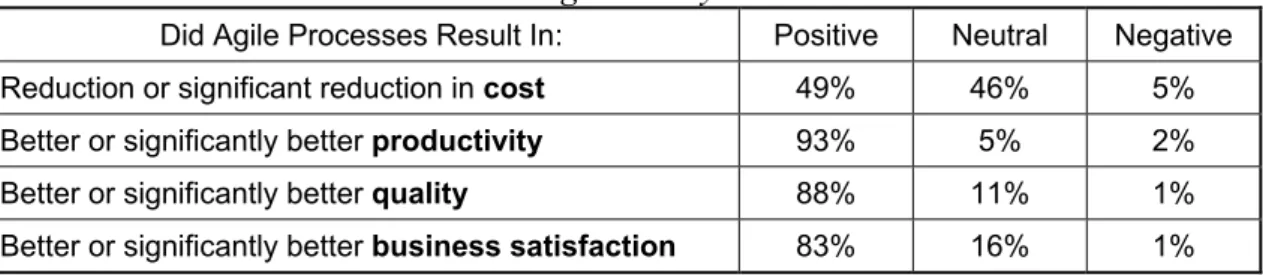
The final evidence offered, in Table 2, is the result of an online survey of 131 companies and their perceptions of the improvements which agile processes offer. A large majority of respondents reported improvements or significant improvements in productivity, quality and business satisfaction. Just under half of respondents reported reductions in costs (cost reduction is a secondary effect of agility as the primary focus is on value or, in this context, quality-improvement).
Table 2. Agile Survey Results
Did Agile Processes Result In: Positive Neutral Negative Reduction or significant reduction in cost 49% 46% 5% Better or significantly better productivity 93% 5% 2%
Better or significantly better quality 88% 11% 1%
Better or significantly better business satisfaction 83% 16% 1%
(Source: (Shine, 2003))
Having established that agile techniques offer significant improvements in the delivery of projects, we then have to establish why such improvements occur. The evidence in Table 2 of significant improvements in organisational skills provides a starting point. DSDM, Scrum and other agile processes and methods all emphasise the advantages of communication flows within small teams. Communication is improved through the use of simultaneous broadband paths instead of discrete cascaded messaging; information is consequently rendered more immediate and better targeted. Teams are facilitated to achieve their goal(s) by their manager but otherwise left to organise their own work. It could therefore be argued that the organisational
skills improvements have been realised through the decomposition of organisation from command and control to consensus management.
4 UNDERLYING RATIONALES FOR AGILE
In order to examine why agile project management offers such an advantage, it is necessary to examine the core aspects of its nature. Whilst further research is
essential, an initial appraisal shows the key questions to be:
Emergent requirements – to what degree do they occur and how can they be dealt with?
Motivational aspects – how do individuals respond to agile methodologies? Complex systems, network theory & human dynamics – how does the structure of work affect outcomes?
Feedback & organizational learning – how can this be maximised within the temporary organizational structures of the West?
Metaphysical underpinnings – how would a theory of agile fit within current theories of production and management, and their metaphysical underpinnings?
4.1 Coping With Emergent Requirements
Most projects are, to some extent, volatile and subject to unforeseeable chaotic inputs and emergent requirements. Project managers are expected to do their best to ensure that these changes can be mitigated and that the project can ‘run to plan’. Where agile thinking differs, is that change is recognised as inevitable and therefore embraced as an opportunity for enhancing customer-perceived value. This is particularly important in the case of information systems as they are so difficult to visualise:
‘We can not completely specify an interactive system.’ - Wegner’s Lemma (Wegner, 1995)
‘For a new software system, the requirements will not be completely known until after the users have used it.’ - Humphrey’s Requirements Uncertainty Principle (Humphrey, 1995)
‘Uncertainty is inherent and inevitable in software development processes and products.’ - Ziv’s Uncertainty Principle (Ziv and Richardson, 1997)
In the case of construction, research shows that, as late as the start of construction, significant uncertainty remains as to what is to be constructed (Howell et al., 1993). Indeed, other sources point to the nugatory nature of excessive front-end design and/or planning:
‘We find a weak relationship (p = 0.0781) between the completeness of the detailed design specification and a lower defect rate.’ (MacCormack et al., 2003)
‘The definition and dissemination of initial objectives was not significantly related to the success or failure of a project.’ (Baker et al., 1986)
‘Successful projects were able, over their lifetime, to resolve the initial uncertainty associated with their technical and commercial goals and objectives.’
(Baker et al., 1986)
If change if so inevitable and over-specification nugatory, why do we try so hard to plan to the last detail and then to follow that plan at all costs? There are many published answers to those questions but a common theme is that we can better understand complexity through decomposition, thus minimising risk, controlling
scope, and enabling measurement of progress. However, agile thinking recognises that changes throughout the project force scope control to be an ongoing task: project scope should only be defined as far as we are currently truly able to comprehend and prioritise it from the perspectives of value realisation and risk mitigation. We can then use project team (including the customer) learning for control and feedback. Thus we are compelled to treat the project as a process and not as a serious of pre-scoped milestones/ gateways.
Agile methodologies commonly control scope through the use of value prioritisation techniques, such as YAGNI (You Aren’t Going to Need It) or MoSCoW (Must have, Should have, Could have, Want but won’t get this time). Temporal control of projects is necessary because of budgetary implications and knock-on effects - Scrum and some other methodologies, such as Dynamic Systems Development Method (DSDM) use the concept of timeboxes (regular incremental deliveries) which are often rigidly enforced.
The emphasis therefore changes from delivery to a specification within a timescale and budget, to delivering emergent value within similar constraints. Many argue that such agile thinking should be restricted to small, low consequence projects. However, larger projects have been tackled, for instance with up to 800 developers within a ‘scrum of scrum’s. (Schwaber and Beedle, 2004) The following diagram illustrates the relative shifts between traditional and agile projects.
Figure 1: Changing from Traditional to Agile Project Management
Whilst this illustration can easily be mapped to any design or product development process, its application to production scenarios requires caution. For example, construction resources are unlikely to remain fixed if scope is changed.
4.2 Motivational Aspects
Another area of ongoing research concerns the motivational impact of agile processes. On initial review, methodologies such as Scrum and eXtreme Programming (XP) have common themes of limiting the outcome requirements of the team, whether in terms of scope, time or both. Further positive motivational effects of agile processes appear to include the rapid nature of the feedback mechanism, and the supportive nature of interference-free project management. Thus, at a personal level,
Fixed Vary Resources Scope Time Resources Time Scope Process Process Traditional/ Waterfall
it may be possible to more easily envision and achieve tasks, and to gain positive feedback.
In view of the stress on small, facilitated and empowered teams, McGregor’s theory Y, participative management style is obviously more relevant to agile than theory X, authoritarian (McGregor, 1960). Ouchi’s theory Z (Ouchi, 1981) attempts to merge the best of theory Y with modern Japanese management, adding a large amount of freedom and trust of workers. However, it also assumes that workers have strong loyalty and an interest in team-working and the organisation. Therefore, although theory Z management would prove a natural management fit with agile techniques such as Scrum, it fails to cross the cultural divide inherent in many western enterprises.
Whilst it seems probable that definition and facilitation of closer motivational horizons contributes to agile project success, further research is required on the relative efficiency of the different mechanisms employed. However, the following section on human dynamics seems to have a bearing on the effectiveness of such work organisation.
4.3 Complex Systems, Network Theory & Human Dynamics
The approach of organizing (as opposed to management-as-planning) takes the idea of human activity as inherently situated (Johnston and Brennan, 1996) and thus, planning should focus on structuring the environment to contribute to purposeful acting. In the language/action perspective, described by Winograd and Flores (1986), action is triggered by explicit commitments (promises) resulting from two-way communication. The scientific experimentation model of control, presented by Shewhart and Deming (1939), focuses on finding causes of deviations and acting on those causes. The scientific experimentation model thus adds the aspect of learning to that of control.
However, Ashby’s Law of Requisite Variety (Ashby, 1956) shows that complex systems cannot be controlled through a centralised system: only variety can master variety, reducing disturbances and promoting harmonious order. Complex Adaptive Systems (CAS) developments build upon Ashby’s ground breaking work, together with observations of the natural world, to provide us with an understanding of pattern emergence and the need for guidance frameworks, rather than rigid adherence to rules or plans. The very nature of the frameworks of CAS are being explored within network theory.
The overall behaviour of a complex system, which we ultimately need to understand and quantify, is as much rooted in its architecture as it is in the nature of the dynamical processes taking place on these networks. We are, however, at the threshold of unravelling the characteristics of these dynamical processes. (Barabasi, 2005b)
The Barabisi model of human dynamics leads us towards an evolving understanding of the nature of human decision making in terms of task prioritization and may eventually help explain why restricted task choice can lead to enhanced human efficiency (Vazquez, 2005). Barabisi raises the intriguing possibility that animals also use some evolutionarily encoded priority-based queuing mechanisms to decide between competing tasks. (Barabasi, 2005a) Human activity does not follow Poisson distribution but is of a burst nature, followed by a heavy tail; this behaviour is
that can be modelled as a priority queuing system (Vazquez, 2005). In summary, Barabisi’s research may explain why short time periods (such as Scrum Sprints) enhance task efficiency; however, the implications for agile understanding require further research in conjunction with motivational science.
4.4 Feedback & Organizational Learning
An area for future research concerns the nature and efficacy of feedback and organizational learning inherent in any iterative and incremental development process. Whilst the Toyota Production and Product Development Systems stress the importance of both organisational learning and individual training, the nature of the construction industry and its fragmentary and temporary employment patterns (particularly in the UK) mitigate against their effective employment with substantial industry change. Of particular interest is the extent to which value is added through the customer’s own learning.
4.5 Metaphysical Underpinnings
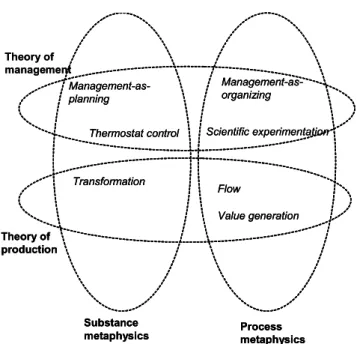
Agile project management can be seen as ‘management as organising’ (Johnston and Brennan, 1996), indeed, an agile project manager is very much seen as a facilitator who enables small, self-organising multi-disciplinary teams to decide for themselves how they satisfy their value goals. Feedback loops in agile project management are used as a lens to focus and re-focus the required value delivery (they do not fulfil a thermostat model (Koskela and Howell, 2002) in terms of flow control). Whilst a ‘theory of agility’ to sit alongside general theories of production and management is yet to fully emerge, it is also necessary to understand the deeper foundations, namely the metaphysical commitments underlying our approaches (Koskela & Kagioglou 2005). Since the pre-Socratic period of philosophy, there have been two basic views on the metaphysical (or ontological) question: What is there in the world? One holds that there are things, that is, atemporal entities in the world. The other insists that there are processes, that is, intrinsically temporal phenomena. These metaphysical assumptions tend to strongly influence how the subject of the inquiry or action is conceptualized. The thing-oriented view seems to lead to analytical decomposition, the requirement or assumption of certainty and an ahistorical approach. The process-oriented view is related to a holistic orientation, acknowledgement of uncertainty and to a historical and contextual approach. The theories discussed may be classified according to their metaphysical choices. Generally, the traditional approach is characterized by a substance (or thing) based ontology, whereas the new approaches subscribe to process ontology. However, the ontological choices affect the practical procedures not only through the mediation of theories, but also directly. A project is, of course a process and fits neatly in the area of process metaphysics in the following diagram, however, agile thinking and processes cover both management and production theories. Only once an underlying theory of ‘agile’ has been resolved can we add this to such a diagrammatic summation of knowledge.
Figure 2: Metaphysical assumptions divide theories of production and project
5 THE APPLICABILITY OF AGILE PROJECT MANAGEMENT TO
CONSTRUCTION
As Scrum can be considered as a ‘management tool’ (Boehm and Turner, 2004), it can be easily used beyond information systems (its origins lie in Japanese manufacturing product development). Similarly, DSDM has been used in organisational development and infrastructure projects and even in construction (Stapleton and Consortium, 2003). However, these ad hoc uses are not widespread and barriers to wider adoption within the construction industry remain.
It has been stated that the prevalent theory of construction is a hindrance to innovation (Koskela and Vrijhoef, 2000), thus calling into question whether agile project management could be adopted in this domain. Also, the scale of any potential improvements in value delivery within the construction industry and resulting economic, utility, environmental and aesthetic benefits remains the target of further research. Current construction industry structures, developed partially to ensure contractual risk avoidance (at least in the UK) appear to be incompatible with Japanese collaborative trust and corporate and individual learning models. There thus seem to be barriers to the employment of agile project management methodologies and thought processes, in view of their inherent requirement for trust and appropriate risk apportionment (i.e., from a value maximisation, rather than a(n apparent) financial risk management perspective). However, the similarities of the two industries suggest that agile would offer enhance project values, should adoption prove feasible.
5.1 Information Systems & Construction Industries - Differences & Similarities
Both the information systems and construction industries use essentially a design and product development process, with limited, tailored re-use of designs and
Theory of management
Theory of production
Substance
metaphysics Processmetaphysics Transformation Flow Value generation Management-as-planning Management-as-organizing
Thermostat control Scientific experimentation Theory of
management
Theory of production
Substance
metaphysics Processmetaphysics Transformation Flow Value generation Management-as-planning Management-as-organizing
Thermostat control Scientific experimentation
Theory of production
Substance
metaphysics Processmetaphysics Transformation Flow Value generation Management-as-planning Management-as-organizing
components. Whilst there is some productionisation within construction (e.g. build to print) and information systems industries, this is atypical. In both domains value is only truly realised during use, although it is generally easier for an ‘outsider’ to envision the functional constraints and opportunities of a building than those of an information system.
One of the common areas between the two domains is the need for requirements definition. In construction briefing must be seen as a process not an event (Barrett et al., 1999) and there are tentative moves towards dynamic briefing throughout the project (Othman et al., 2004), a particular need for which is seen in the internationalisation of construction projects (London et al., 2005).
Whilst the need has therefore been recognised for what is essentially an emergent agile value development process, progress in its use has not reached the levels of use discussed for information systems projects. Although it has been reported that approximately one third of information systems organisations still use waterfall methods (Laplante and Neill, 2004), another survey reported that over 95% of respondents would continue to use or would adopt agile processes in 2003 (Shine, 2003).
6 CONCLUSIONS
Agile thinking has a sound basis in both project management and manufacturing in Japan and is currently yielding improved value delivery in the information systems industry. Although a common view of agility is not extant, the core attributes can be clearly stated. The structuring of an enterprise or project to enable it to proactively respond to change and to welcome the opportunity that such change affords to increase value delivery may well be challenging. However, there are many apocryphal stories of successful improvements due to the adoption of agile and even some metrics.
Whilst agile project management in information systems has obvious parallels with the design phase of construction, there are considerable differences in the respective production phases which must be further explored as the underlying rationales for why agile works are better understood. These underlying rationales include the manner with which agile deals with emerging requirements, how individuals are better motivationally organised to produce value, how the structure of work affects outcomes and the manner in which it supports organizational (including customer) learning. Bearing in mind agile’s emphasis on ‘the individual over process’, the field of human dynamics bears further research.
Projects tend to be complex by their nature and it is necessary for humans to manage that complexity in a manner that will deliver the required end result with some degree of certainty. It may be that, by decomposing customer-recognisable value rather than the fragmentary components of a project we maintain greater mental awareness of the process, rather than devoting our efforts to produce some‘thing’ of immediate import. However, further research is necessary to validate such a hypothesis. A theory of agile has yet to be resolved; however it must fit within current theories of production and management, and their underpinnings.
7 REFERENCES
Anderson, D. & Et Al (2005) Declaration of Interdependence. Agile Project Leadership Network.
Ashby, W. R. (1956) An Introduction to Cybernetics, London, Chapman & Hall and University Paperbacks.
Baker, N. R., Green, S. G. & Bean, A. S. (1986) Why R & D Projects Succeed or Fail.
Research Management, 1986, 29-34.
Barabasi, A.-L. (2005a) The Origin of Bursts and Heavy Tails in Human Dynamics.
Nature Physics. Nature Publishing Group.
Barabasi, A.-L. (2005b) Taming Complexity. Nature Physics. Nature Publishing Group.
Barrett, P., Stanley, C. & NetlibrarY, I. (1999) Better Construction Briefing, Malden, Mass, Blackwell Science.
Beck, K. & Et Al (2001a) Manifesto for Agile Software Development. Agile Alliance. Beck, K. & Et Al (2001b) Principles Behind the Agile Manifesto. Agile Alliance. Boehm, B. W. & Turner, R. (2004) Balancing Agility and Discipline : A Guide For
The Perplexed, Boston ; London, Addison-Wesley.
Degrace, P. & Stahl, L. H. (1990) Wicked Problems, Righteous Solutions : A Catalogue Of Modern Software Engineering Paradigms, Englewood Cliffs, N.J, Yourdon Press.
Deming, W. E. (1982) Out Of The Crisis, Cambridge, MA. ; London, MIT Press. Dove, R. (1996) Best Agile Practice Reference Base - 1994: Challenge Models and
Benchmarks. Bethlehem, PA, parshift.com.
Dove, R. (2005) Agile Enterprise Cornerstones: Knowledge, Values & Response Ability. IFIP 8.6. Atlanta, GA.
Futrell, R. T., Shafer, D. F. & Shafer, L. (2002) Quality Software Project Management, Upper Saddle River, NJ, Prentice Hall PTR.
Howell, G. A., Laufer, A. & Ballard, G. (1993) Uncertainty and Project Objectives.
Project Appraisal, 8, 37-43.
Humphrey, W. S. (1995) A Discipline for Software Engineering, Addison-Wesley. Johnston, R. B. & Brennan, M. (1996) Planning or Organizing: the Implications of Theories of Activity for Management of Operations. Omega International Journal of Managment Science, 24, pp 367-384.
Koskela, L. & Howell, G. A. (2002) The Underlying Theory of Management is Obsolete. PMI Research Conference. PMI.
Koskela, L. & Vrijhoef, R. (2000) The Prevalent Theory of Construction is a Hindrance for Innovation. IGLC-6. Brighton, UK.
Laplante, P. A. & Neill, C. J. (2004) "The Demise of the Waterfall Model is Imminent" and Other Urban Myths. Game Development, 1.
Liker, J. K. (2004) The Toyota Way : 14 Management Principles From The World's Greatest Manufacturer, New York ; London, McGraw-Hill.
London, K., Chen, J. & Bavinton, N. (2005) Adopting Reflexive Capability in International Briefing. Facilities.
Maccormack, A., Kemerer, C. F., Cusumano, M. & Crandall, B. (2003) Exploring Tradeoffs Between Productivity and Quality in the Selection of Software Development Practices. IEEE Software, 75-85.
Othman, A. A. E., Hassan, T. M. & Pasquire, C. L. (2004) Drivers for Dynamic Brief Development in Construction. Engineering, Construction and Architectural Management, 11, 248-258.
Ouchi, W. G. (1981) Theory Z : How American Business Can Meet the Japanese Challenge, Reading, Mass., Addison-Wesley.
Royce, D. W. W. (1970) Managing the Development of Large Software Systems.
Proceedings, IEEE WESCON, 1-9.
Sanchez, L. M. & Nagi, R. (2001) A Review of Agile Manufacturing Systems.
International Journal of Production Research, 39, 3561 - 3600.
Schwaber, K. & Beedle, M. (2002) Agile Software Development With Scrum, Upper Saddle River, NJ, Prentice Hall.
Schwaber, K. & Beedle, M. (2004) Agile Project Management with Scrum, Redmond, Wash., Microsoft Press.
Shewhart, W. A. & Deming, W. E. (1939) Statistical Method From the Viewpoint of Quality Control. Washington, The Graduate School, The Department of Agriculture.
Shine (2003) Shine Technologies Agile Methodologies Survey Results. Shine Technologies Pty Ltd.
Stapleton, J. & Consortium, D. (2003) DSDM : Business Focused Development,
Reading, Mass. ; Harlow, Addison-Wesley.
Sutherland, J. (2001) Agile Can Scale: Inventing and Reinventing SCRUM in Five Companies. Cutter IT Journal, 14, 5-11.
Takeuchi, H. & Nonaka, I. (1986) The New New Product Development Game.
Harvard Business Review, 137-146.
Vazquez, A. (2005) Exact Results for the Barabasi Model of Human Dynamics.
Physical Review Letters. The American Physical Society.
Wegner, P. (1995) Interactive Foundations of Object-Based Programming. IEEE Computer, 28, 70-72.
Ziv, H. & Richardson, D. (1997) The Uncertainty Principle in Software Engineering.
ICSE'97, 19th International Conference on Software Engineering. Boston, MA, USA, IEEE.