Analyzing the Impact of Structural Change
in Iranian Agricultural Credit System
Saeed Yazdani
*Abstract
Replacement of the traditional interest based credit system with an Islamic credit system was one of the fundamental changes in Iran since 1979. The Islamic credit system, offers the prospect of risk sharing between the borrower and the lender. Small farmers are likely to be risk averse and they are reluctant to go heavily into debt in order to finance invest-ments in new technology and capital intensive methods of production which they perceive to be risky. Farmer's decision making behaviour with regard to risk under the Islamic and interest based credit systems are explored with the aid of a simple conceptual model. Analysis of attitudinal data suggests that the majority of small farmers prefer credit pro-vided under the Islamic credit system. Farmers' preferences for taking out loans from an Islamic credit system were found to be related to a number of factors. Risk sharing and religious acceptability of the profit and loss sharing loans over the interest based loans were two significant reasons.
Keywords:Islamic credit System, Iran, Agriculture, risk sharing
Introduction
The adoption of the Islamic credit system and the socio-economic impact of this inno-vation on the agricultural sector is a development of considerable potential interest to economists in Iran.
Following the 1979 Iranian revolution, two fundamental changes were made towards introducing an Islamic financial system consistent with the beliefs of the new government (Central Bank of Iran, 1985/6). The first step was to nationalise all the private banks, and
the second step was to replace the traditional interest-based credit system with an Islamic credit system. The introduction of the Islamic credit system has considerable potential sig-nificance. One of the fundamental principles of Islam is the prohibition of interest on bor-rowed money (Reba). This principle is the main feature that differentiates interest-based
credit from Islamic credit systems. Pre-determined interest is treated as an offence against morals and has also been condemned by other religious and non-religious groups over his-tory including the Catholic Church, the Jews in the Old Testament, and by Greek and Ro-man philosophers (Taylor & Evans 1987, Anwar 1987). The general argument for
prohibit-ing fixed interest payments has been given in Siddiqi 1983. However the detail description of the Islamic credit system is not the purpose of this paper. There are several literatures explaining the system in details ( Siddiqi 1983, Khan, W. 1985, Sadr 1980, Anwar1987, Haque 1983). This paper mainly emphasised on evaluation of agricultural loans granted by
the Islamic credit system.
*
The author is an Associate Professor, The Department of Agricultural Economics, University of Tehran.
Agricultural producers are subject to severe production and market risks, which are re-flected in wide fluctuations in output and incomes. The consequences of adverse outcomes is generally increased where farmers make use of credit under traditional/conventional western style borrowing arrangements as the borrower is solely responsible for any losses which occur. This aspect of credit is encapsulated in the concept of increased risk associ-ated with increasing capital gearing (Barnard and Nix 1979). The combined effect of
capi-tal gearing in magnifying production and market risks is likely to act as a powerful deter-rent to the adoption of new technology where this can only be financed through borrowing.
Anwar, M. (1987) summarised the findings of many development economists who con-cluded that risk is a crucial factor influencing small farmer’s investment decisions. In par-ticular it was argued that poor small farmers who operate close to the subsistence level are likely to be risk averse and extremely reluctant to go heavily into debt in order to finance investment in capital intensive inputs or adopt new technology, despite the very high ex-pected returns that these investments promise.
It is argued that if the riskiness of these investments could be reduced it is probable that one of the major barriers to their adoption will be reduced and credit uptake levels will be increased. In another words, if risk averse individuals can reduce or shift the whole or a part of the risk to a third party they may be less reluctant to engage in risky investments. Efficient devices for risk management would allow a farmer to take substantial levels of risk without being in danger of losing all his productive assets in the event of enterprise failure (Binswanger 1978). Risk to the producers can be reduced either through technical
means within the production system (e.g. diversification in cropping) or alternatively by sharing the risk with a third party (e.g. through insurance, future markets, price stabilisa-tion, Islamic credit system, etc). The Islamic credit system which is an alternative mecha-nism for reducing risk offers the prospect of lifting part of the risk off the farmers' shoul-ders through the provision of profit and loss sharing loans. In this way such loans not only totally avoid the magnification of risk associated with debt financed investment under a western style interest based credit system, but they also carry a share of the production risk. Therefore it is reasonable to conclude that the introduction of the Islamic credit sys-tem should result in wider credit use to finance productive investment in agriculture. The purpose of this paper is to use the empirical evidence to evaluate the Islamic credit system as it currently operates in Iran. The first part of this paper provides an explanation of dif-ferent type of loans under the Islamic credit system. The second part explores the risk shar-ing potential of the Islamic credit system. Farmer's decision makshar-ing behaviour with regard to risk under the Islamic and interest based credit systems is explored with the aid of a simple conceptual model suggested by the author. The model examines the interaction be-tween debt financed investment in new technology and the magnification/reduction in in-come variability resulting from interest based and Islamic credit systems. The model pro-vides a theoretical basis to support the proposition that profit and loss sharing loans avail-able under the Islamic credit system should operate in a way which would enavail-able risk averse farmers to contemplate investments in new technology which they would be reluc-tant to adopt using interest based credit.
The investigation reports in next section on progress made in adopting the Islamic credit system and examine farmers' attitudes towards the new system and the extent to which they have altered their borrowing behaviour since it was introduced. In particular the hy-pothesis that "the distribution of credit under the Islamic credit system will shift towards
risk averse farmers and is likely to result in greater productive (capital) investment" will be tested.
Finally, the distribution of credit under the new credit system through the Agricultural Bank (the main specialised source of agricultural credit in Iran), is examined. Considera-tion will also be given to the practical problems associated with the operaConsidera-tion of the Is-lamic credit system.
Method and Material
Data for analysis were collected from three sources; i)A farm level survey of 200 farm-ers drawn from two states in Iran ii)a survey of 30 Agricultural Bank branches in those two states and iii)national level data from the Agricultural Bank itself in year 2002/3.
The method which was used to examine the structural change in credit system was a de-scriptive analyzes. Farmers’ attitudes towards current credit system and trend on loans consumption were examined.
Under the Islamic credit system there are two ways of granting credit facilities; inter-est-free loans, and profit and loss sharing loans (Sidiqi 1985, Khan, S. 1987, Ahmed 1977).
The interest free loan scheme is available to finance small scale enterprises. There are no interest charges, but the financial institutions are allowed to charge a very small percent as an administration cost for each loan. These loans are granted to borrowers whose in-comes are below the poverty line and who have social commitments such as school fees, medical expenses, or who have suffered a set-back due to unexpected events (i.e. sickness, crop failure, flood, drought, etc) and in cases where a high social priority is attached to a particular type of enterprise (Central Bank of Iran).
The second method of granting fund is Profit and Loss Sharing Loans (PLS). Financial institutions are permitted by Islamic laws to grant credit based on profit and loss sharing loans granted for productive purposes (Khan, M. 1986, Khan, S. 1987). Under PLS interest
is replaced by a proportion of the profit gained from the investment funded by the loan. The income of credit institutions is derived directly from the actual profits realised from the projects financed and risk is redistributed to financial market participants who are more willing to bear it. The lender's share depends directly on the level of profit made by the project, so that the consequences of a change in outcome are shared between the lender and borrower (Scharf 1982 , El Gousi 1982).
The essential features of the profit and loss sharing loans are; 1- all capital is risk capital, return of the principal is not guaranteed.
2- Capital is not entitled to any fixed or predetermined rate of return therefore may not get a return even if the principal is repaid. Both parties contribute by providing capital for a specified project (permitted under Islamic law) and period of time with the intention of making a profit which they share between them (Siddiqi 1983, Khan, W. 1985, Sadr 1980, Anwar 1987).
In a profit and loss sharing loan under the Islamic credit system interest is replaced by a proportion of profit gained from the investment made by the borrowed capital. The Islamic financial institutions are permitted by Islamic laws to grant credit based on profit and loss sharing for productive purposes (Khan, M. 1986). The income of credit institutions is
system is sharing the actual outcome of the investment with users of funds, the system is called the Profit and Loss sharing credit system (PLS). The Profit and Loss sharing credit
system redistributes the risk between financial market and participants who are more will-ing to bear it. The lender's share under PLS arrangement depends directly on the level of profit made by the project, so that the consequences of a change in outcome are shared between the lender and borrower (Scharf 1982, El Gousi 1982).Under PLS the shares of
the lender and borrower are determined as set out in equation (1) and (2) respectively:
L = R. a (1)
B = R (1 – a) (2)
Where, L is lender's receipt B is the borrower's receipt,
R is the total profit or loss from the project,
a is the proportion of the lender’s share of the total profit, (1-a) is the borrower's share from the total profit or loss.
Both, L and B vary and are a function of R and a.
The important characteristics of a profit and loss sharing loan is that it both shares the borrower's business risks (due to uncertainty in yield and prices) and avoids the financial risk associated with servicing debt. This is in contrast to conventional western-style inter-est-bearing credit where the borrower carries all the business risk and where that exposure is amplified by borrowing and the commitment to pay interest. In consequence, small risk-averse farmers may be more prepared to make use of profit-and-loss-sharing loans to fi-nance the increased resources needed for the adoption of new technology.
Results and Discussion
Attitudes towards the Agricultural Credit System
As it was noticed, a major change in the credit system following the 1979 revolution was the abandonment of interest based credit in favour of interest-free and profit and loss sharing loans. In this part of the study farmers attitudes about two type of credit systems were analysed. The results from the survey suggest that the majority of farmers (77 per-cent) with small holdings prefer profit and loss sharing loans over the interest-based loans as table 1 shows. In contrast, the majority of large farmers (68 percent) prefer interest based loans.
The contrasting attitudes of large and small farmers are potentially of great significance because it suggests that the attributes of different credit systems may influence the level of borrowing by different size groups of farmers to different extend. This clearly warranted further investigation. The size difference is likely to reflect levels of income. When atti-tudes towards the credit system were analyzed in terms of level of income it was found that as the financial position of farmers improves profit and loss sharing loans starts to lose their attraction. This result may reflect an increasing ability to bear risk as income in-creases, and as a consequence the reduction in risk aversion could encourage farmers to shift their preference from the profit and loss sharing loans to interest based loans. Table 2 provides the relevant data in terms of income level.
Table 1. Farmers' Attitudes Towards Types of Loans
Farm Size (jirib )
0-20 20-60 Above 60 Over all Preferred Loan
Number % Number % Number % Number % Profit and Loss sharing Loans 77 69 39 57 6 32 122 61 Interest based loans 35 31 30 43 13 68 78 39
Total 112 100 69 100 19 100 200 100
Source: Study Survey. Chi-square (2) = 7.644** significant at 5 percent level. # = 0.1 hectare. Table 2. Farmers' Attitudes towards Type of Loans by Income Level
Income Level
Low Medium High Total
Preferred System
Number % Number % Number % Number % Profit and Loss sharing loans 69 70 45 58 8 30 122 61 Interest Based loans 26 31 33 42 19 70 78 39
Total 95 100 78 100 27 100 200 100
Source: Study Survey. Chi-square = 8.66** significant at 5 percent level.
Reasons for Preferring Profit and Loss Sharing Loans
Farmers were asked to identify their reasons for preferring the profit and loss sharing credit system over interest based systems. Risk sharing and religious factors are the main reasons given by farmers preferring the profit and loss sharing loans (table 3).
Table 3. Reasons given for Preferring Profit and Loss Sharing Loans (by Income Level)
Income Level
Low Medium High Total
Reasons
Number % Number % Number % Number %
Risk sharing 33 48 18 40 2 25 53 43
Better advice 10 14 8 18 1 13 19 16
Follows Islamic Law 24 35 14 31 3 38 41 34
Easy to get 2 3 4 9 1 12 7 6
Others - - 1 2 1 12 2 1
Total 69 100 45 100 8 100 122 100
Source: Study Survey
It is possibly significant that as income increases risk sharing becomes a relatively less important reason for preferring profit and loss sharing loans over interest based credit loans. The religious reason, mentioned by 34 percent of all farmers who prefer profit and loss sharing loans, was of equal importance among all size groups. In other words religious reasons appear to be independent of income level.
Although small farmers appear both to prefer and are willing to borrow from the Is-lamic credit system this does not necessarily mean that they will be successful in obtaining the credit they require. Further analysis was undertaken to investigate whether more
pro-ductive investment was undertaken under the Islamic system and whether small farmers in practice were also able to obtain more credit from the Islamic credit system. Data on the lending activities of the Agricultural Bank from both official statistics at the national level and from the survey of Agricultural Bank branches in the study areas were analyzed. The results are presented in the next two sections.
Changes in Use of Loans
Under the Islamic credit system it is intended that funds are for productive purposes rather than for consumption. Changes in the pattern of agricultural credit are also to be ex-pected from a government that has strongly stated its backing for the rural poor and at-tacked previous governments for their neglect of the rural sector. Hence one would expect that with the introduction of the new credit system, the direction of funds would move to-wards financing productive (capital) investment.
Table 4. Distribution of Credit by the Agricultural Bank in 1975/6 to 2002/3 (Million Rials)
Year Total Amount of Loans Expenditure Current Investment Capital
1975|/6 35,290 19,363 (55%) 15,927 (45%) 1976/7 42,355 23,004 (54%) 19,351 (46%) 1977/8 51,757 27,187 (53%) 24,570 (47%) 1978/9 42,150 19,566 (46%) 22,584 (54%) 1979/80 96,479 44,014 (46%) 52,465 (54%) 1980/1 123,530 61,272 (50%) 62,258 (50%) 1981/2 148,378 73,954 (50%) 74,424 (50%) 1982/3 183,855 88,053 (49%) 95,802 (51%) 1983/4 220,771 104,924 (48%) 115,847 (52%) 1984/5 155,767 45,157 (29%) 110,610 (71%) 1985/6 200,073 42,602 (21%) 157,471 (79%) 1986/7 201,942 44,217 (22%) 157,725 (78%) 1987/88 279,913 67,202 (24%) 212,711 (76%) 1988/9 382,629 164,530(43%) 218,098 (57%) 1989/90 444,288 137,284 (31%) 267,017 (60%) 1990/1 626,401 238,658 (38%) 387,742 (62%) 1991/2 956,940 164,500(27%) 792,440 (74%) 1992/3 1,076,457 417,665(32%) 658,791 (68%) 1993/4 1,752,106 473,068(27%) 1,279,038 (73%) 1994/5 2,363,700 679,700(29%) 1,684,000 (71%) 1995/6 3,361,902 873,900 (26%) 2,488,002 (74%) 1996/7 3,695,188 976,329 (26%) 2,718,859 (74%) 1997/8 5,288,243 1,107,837 (21%) 4,180,406 (79%) 1998/9 6,791,048 1,142,500 (21%) 5,648,548 (79%) 1999/2000 8,055,100 1,945,000 (24%) 6,110,000 (76%) 2000/1 10,663,981 2,191,000 (21%) 8,472,981 (79%) 2001/2 16,881,146 3,491,000 (21%) 13,390,146 (79%) 2002/3 22,607,647 5,730,200 (25%) 16,877,447 (75%)
Source; Agricultural Bank Reports.
Current expenditure= Mozarebeh & Gharzolhasaneh 1 $ = 9000 Rials
Tables 4 and 5 show a significant shift in loans from funding current expenses to capital investment. As table 4 indicates about 75 percent of total loans from the Agricultural Bank went to fund investment on capital items such as machinery, irrigation, agricultural build-ing and livestock in 2002/3.
Comparison of data concerning the use of credit in years 1983/4 (the introduction of PLS) and afterwards in table 4 suggests a significant shift in credit use from current expen-diture to productive purposes (capital investment). For example the proportion of credit funded for capital expenditure has increased from 52% in 1983/4 to 71% in 1984/5 and 75% in 2002/3.
An attempt was also made to compare the finding of national level data with the farm level data. A similar pattern emerged in the case of data from the farm level survey and the institutional survey data reported in table 5 which indicate there is a bias in the direction of funds towards capital intensive investments.
Due to the availability of farm level data only for years 1978/9 and 2002/3, the direction of credit use was compared between these two years.
The figures in table 5 indicate that between 46 to 69 percent of credit funded current expenditure in 1978/9 (when the interest based credit system was in operation) whereas by 2002/3 (under the Islamic credit system) this proportion had fallen to under 30 percent. These findings appear to support the hypotheses that under the Islamic credit system more productive (capital) investment will be undertaken.
Table 5. Use of Credit Taken Up from the Agricultural Bank in 1977/8 & 2002/3
Current Expenses &
Non-Farm Investment Capital Investment In Agriculture Year
Farm Survey National Level Farm Survey National Level
1978/9 69% 46% 31% 45%
2002/3 29% 25% 71% 75%
Sources: Agricultural Bank Reports (1978/9& 2002/3) and Farm and Bank Surveys (2002/3).
The difference between figures reported by banks and farmers may reflect the effects of fungibility(Von Pischke and Adams 1980).
The above findings also seem to reduce the need for measures to be taken by the Agri-cultural Bank to constrain the fungibility property of finance by allocating loans in kind and specifying the ultimate use of loans.
Loans Distribution Pattern
Despite relaxing some of the constraints on the supply side, such as collateral, small farmers are still unable to satisfy their capital requirements. Analysis was carried out to examine the relationship between the amount of money advanced and farm size.
Analysis of farm survey data relating to formal credit institutions lending in the study area reveals interesting differences in the uptake of credit by size of farm. The proportion of funds advanced to small farmers (less than 20 jiribs) who constitute more than 56 per-cent of the survey sample was only 40 perper-cent of the total amount of loans. Whereas the funds borrowed by large farms was 16 percent of the total amount of loans, although this size group accounted for only 10 percent of farmers in the sample (table 6).
Between 1979/80 and 2002/3 there appears to have been little change in the distribution of credit between small and large farms despite the nationalisation and reorientation of the
Table 6. Loans Taken Up From Institutional Credit Sources in 1977/78 and 2002/3 by Size of Farm (, 000 Rials)
1979/80 2002/3
Farm Size Number % Number % Number % Number % Up to 20 jribs 46 41.0 3,811 38.7 43 38.4 33,282 40.5 20-60 " 43 62.3 4,169 42,4 38 55.1 36,024 43.7 Above 60 " 13 68.4 1,848 18.8 12 63.1 13,128 15.9
Total 102 9,828 93 82,434
Source: Survey (2002/3)
* Percentage of total farmers in each farm size group. ** Percentage of total amount lent.
credit institutions' lending policy in 1983/4 and the fact that small farmers prefer profit and loss sharing loans to interest based loans. In spite of small farmers' preferences and appar-ent willingness to borrow using the profit and loss sharing system, the proportion that have succeeded in obtaining credit is much less than that of large farmers who achieve a much higher loan uptake rate (table 7).
The findings reported in table 7 indicate that a large proportion of small farmers in the survey who preferred to get loans from PLS failed to do so. Discussions with farmers who participated in the survey revealed that small farmers were not able to meet the bank's terms for obtaining a loan. On the other hand large farmers who preferred to pay interest, rather than share profits, had no alternative but to make use of the Islamic credit system loans because of the non-availability of interest based loans.
Reason for Not Taking out Loans by Non-Borrowers
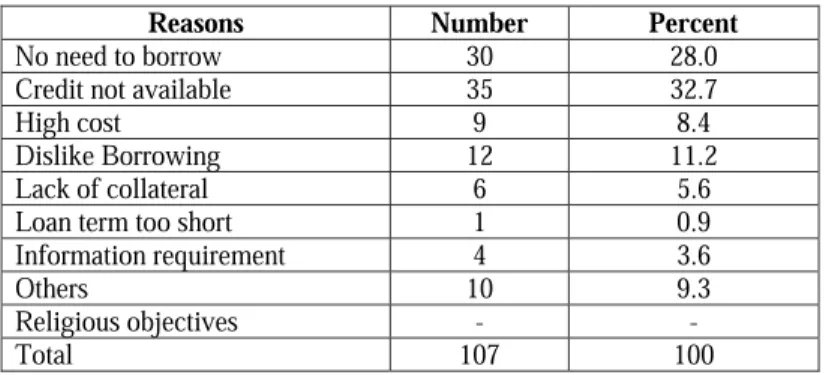
Further investigation was undertaken to try to find out why farmers who were non- bor-rowers had not taken up loans. Table 8 records the responses of 107 farmers who did not borrow. Whilst non-availability of credit was the most frequently recorded response, just under a quarter of non-borrowing farmers said they were unable to obtain the loans they required (i.e. high cost, lack of collateral, information requirement, others). It is relevant that almost half of the non-borrowing farmers were deterred from taking out loans for one reason or another.
Table 7. Comparison of Farmers Attitudinal Preferences and Actual Distribution of Loans Under the Institutional Islamic Credit System in 2002/3 by Farm Size (Farm Survey Data)
Attitudinal Preferences Actual Practices Farm Size All
Farmers Nos.Preferring PLS % Nos.of Borrowers %
0-20 jirib 112 76 68 43 38
20-60 jiribs 69 39 57 38 55
Above 60 jiribs 19 6 32 12 63
Total 200 122 93
It is possibly relevant to note that farmers no longer felt constrained to borrow on reli-gious grounds. This had previously been an important reason given for not borrowing prior to the introduction of the Islamic credit system.
Table 8. Reason for Not Taking out Loans by Non-Borrowers
Reasons Number Percent
No need to borrow 30 28.0
Credit not available 35 32.7
High cost 9 8.4
Dislike Borrowing 12 11.2
Lack of collateral 6 5.6
Loan term too short 1 0.9
Information requirement 4 3.6
Others 10 9.3
Religious objectives -
-Total 107 100
Conclusion
Review of the literature provides support for the view that risk and uncertainty pose par-ticular problems for small farmers operating at or just above the subsistence level. The fear of the consequences of a crop failure coupled with a debt repayment commitment may deter small farmers from borrowing and hence they remain locked into traditional produc-tion methods. Social and cultural factors may also operate to prevent some farmers from borrowing - in particular strict Muslims are reluctant to participate in interest based credit systems either as depositors or borrowers. The possibility that the Islamic credit system could act as a way of both reducing risk by sharing profits and losses with the lending in-stitutions was identified as potentially important in overcoming problems of increased risk associated with conventional interest based credit systems as well as being more accept-able on religious grounds.
The evidence reported in the paper suggests that the majority of small farmers prefer to borrow using a profit and loss sharing credit system rather than an interest based system, whereas larger farms and farmers with higher incomes prefer the interest based credit sys-tem. However in practice the large farmers appear to benefit most in terms of the number of loans and size of loan as compared to small farmers who constitute the largest propor-tion of the rural populapropor-tion in the study areas. Even though banks are not profit orientated the limited supply of funds means that some form of credit allocation between applicants is required. The results imply that institutions may be using size of farm as a criterion for distributing credit. The findings also suggest that in practice farmers have to go against their preferences. These findings do not support the hypothesis that under the Islamic credit system funds will shift towards small farmers. Although small farmers are more willing to borrow under the Islamic credit system, large farmers still receive a dispropor-tionate share of the funds available. A number of factors may account for this phenome-non:
1- Bankers wish to be promoted by demonstrating success in their operations to the au-thorities. Hence they may select better off investors who are more likely to be success-ful and generate greater profits than small farmers.
2- Lack of profitable investment opportunities for small farmers which will enable them to meet the bank's conditions and get acceptance for funds. As the Agricultural Bank usually only provides credit for production purposes, small farmers with fewer in-vestment opportunities often need to borrow for consumption purposes which can not be funded.
3- the excess demand of funds causes the lender to try to create a number of restrictions (e.g. Require unnecessary documentation) which raises the transaction costs for poten-tial borrowers. As a consequence, credit tends to end up in the hands of large farmers who are more likely to be able to afford to meet these higher costs.
References
Ahmed S.E.M. (1977). The Integration of Agricultural Credit and Marketing in the Gezira Scheme of the Sudan. Unpublished Ph.D. thesis, Wye College (London University).
Anwar, M. (1987). Modelling Interest-Free Economy; A study in Macro- economics and Develop-ment. International Institution of Islamic Thought, Washington, 119pp.
Barnard, C.S. & Nix, J. (1979). Farm Planning and Control. Second Edition, Cambridge
Univer-sity Press, 600pp.
Binswanger, H.P. (1978). "Risk Attitudes of Rural Households in Semi-Arid Tropical India". Re-view of Agriculture, 13(25): 49-62.
Central Bank of Iran, (1985/86). General Aspects of Banking without Interest, Tehran, 39pp.
Central Bank of Iran, (1986/7). Review of the Economics Changes after the Revolution, Tehran,
665pp.
El Gousi Abdelmoneim Mohamoud. (1982). Riba Islamic Law and Interest. PhD thesis, Temple
University, Philadelphia.
Haque, Z. (1983). "Riba, Interest and Profit". Pakistan Economists May 31, 13-30.
Khan, W. M. (1985). Towards an Interest-Free Islamic Economic System. The Islamic Foundation,
Leicester, 126pp.
Khan, M. S. (1986). "Islamic Interest Free Banking". I.M.F, 33(1): 1-27
Khan, S. R. (1987). Profit and Loss Sharing: An Islamic Experiment in Finance and Banking.
Ox-ford University Press, OxOx-ford, 175pp.
Sadr, M.B. (1980). Banke-Eslami. Entesharat-e-Alfath, Tehran 180pp.
Scharf, T. W.. (1982). "The Role of Islamic Banks in Economic Development". Journal of Finance and Industry, 55-73.
Schluter, M. G. G. (1974). The Interaction of Credit and Uncertainty in Determining Resource Al-location and Income on Small Farms, Surat District, India. Occasional Paper No.68,
Cor-nell University, New York, 76pp.
Schultz, W. T. (1964). Transforming Traditional Agriculture. The University of Chicago Press,
Chicago, 212pp.
Siddiqi Muhammad, N. (1983). Banking Without Interest. The Islamic Foundation, Leicester,
192pp.
Siddiqi Muhammad, N. (1985). Partnership and Profit Sharing in Islamic law. The Islamic
Foun-dation, Leicester, 111pp.
Taylor T. W. and Evans J. W. (1987). "Islamic Banking and the Prohibition of Usury in Western Economic Thought". National West Minister Bank, World Review, 15-27, November 1987.
Tinnermeir, R. (1973). "Technology, Profit, and Agricultural Credit". pp. 91-111, in A.I.D Spring Review of Small Farmer Credit. Vol. 19, edited and published by the Agency for
Interna-tional Development, Washington, D.C., 451pp.
Upton, M. (1987). African Farm Management. Cambridge University Press, Cambridge, 190pp.
Von Pischke, J. D. and Adams D. W. (1980). "Fungibility and the Design and Evaluation of Agri-cultural Credit Projects". American Journal of Agricultural Economics, 62(4) : 719-726.