Managing Near
Field
Communication
(NFC)
Payment Applications through Cloud Computing
A thesis submitted for the degree of Doctor of Philosophy
By
Pardis Pourghomi
Department of Information Systems and Computing,
Brunel University
i
ABSTRACT
The Near Field Communication (NFC) technology is a short-range radio communication channel which enables users to exchange data between devices. NFC provides a contactless technology for data transmission between smart phones, Personal Computers (PCs), Personal Digital Assistants (PDAs) and such devices. It enables the mobile phone to act as identification and a credit card for customers. However, the NFC chip can act as a reader as well as a card, and also be used to design symmetric protocols. Having several parties involved in NFC ecosystem and not having a common standard affects the security of this technology where all the parties are claiming to have access to client’s information (e.g. bank account details).
The dynamic relationships of the parties in an NFC transaction process make them partners in a way that sometimes they share their access permissions on the applications that are running in the service environment. These parties can only access their part of involvement as they are not fully aware of each other’s rights and access permissions. The lack of knowledge between involved parties makes the management and ownership of the NFC ecosystem very puzzling. To solve this issue, a security module that is called Secure Element (SE) is designed to be the base of the security for NFC. However, there are still some security issues with SE personalization, management, ownership and architecture that can be exploitable by attackers and delay the adaption of NFC payment technology.
Reorganizing and describing what is required for the success of this technology have motivated us to extend the current NFC ecosystem models to accelerate the development of this business area. One of the technologies that can be used to ensure secure NFC transactions is cloud computing which offers wide range advantages compared to the use of SE as a single entity in an NFC enabled mobile phone. We believe cloud computing can solve many issues in regards to NFC application management. Therefore, in the first contribution of part of this thesis we propose a new payment model called “NFC Cloud Wallet". This model demonstrates a reliable structure of an NFC ecosystem which satisfies the requirements of an NFC payment during the development process in a systematic, manageable, and effective way.
ii In the rest of this thesis, we design three transaction authentication protocols which execute over the cloud, GSM network and NFC channel respectively. Each of the proposed protocols is an extension of the initially proposed NFC Cloud Wallet model. However, we design each protocol based on a different payment scenario that improves the existing problems which have delayed the adoption of NFC payment technology. Furthermore, the proposed protocols are carefully designed and evaluated against multiple attack scenarios in order to indicate their utility and value from a security viewpoint.
iii
ACKNOWLEDGEMENT
I would not have been able to complete this thesis without the aid and support of the kind people around me. My sincere thanks would go to my supervisor Dr George Ghinea for all his support, time and guidance. This thesis would not be completed without the in-depth discussions and comments from him.
I owe my sincerest gratitude to my parents for their understanding and endless love at all times. They have given me their continuous support throughout, for which my mere expression of thanks does not suffice.
Last, but by no means least, I would also like to convey thanks to all my fellow colleagues, the academic and support staff in the Department of Information Systems and Computing at Brunel University. I am grateful to all of those with whom I have had the pleasure to work with during the course of my Ph.D.
iv
LIST OF PUBLICATIONS
The following papers have been published (or submitted for publication) as a direct result of the research discussed in this thesis:
Journals
1. Pourghomi, P., Saeed, Q. & Ghinea, G (2013) ‘A Proposed NFC Payment Application’, International Journal of Advanced Computer Science and Applications (IJACSA), Volume. 4 No. 8, pp. 173-181.
2. Pourghomi, P. and Ghinea, G (2013) ‘Cloud-based NFC Mobile Payments’, Journal of Internet Technology and Secured Transactions (JITST), Vol. 2, Issues 1/2/3/4, pp. 167-175. 3. Grønli, T. M., Pourghomi, P., Ghinea, G (2014) ‘Towards NFC Payments using a
Lightweight Architecture for the Web of Things’, Computing Journal, Springer 1-15.
4. Pourghomi, P. and Ghinea, G ‘Mobile Payments over GSM’, submitted to: Journal of Electronic Commerce Research (JECR), Springer.
Conferences
1. Pourghoumi, P. and Ghinea, G (2012) ‘Managing NFC Payments Applications through Cloud Computing’ in Proceedings of the 7th International Conference for Internet Technology and Secured Transactions (ICITST-2012), London, UK. IEEE, 2012, pp. 772– 777.
2. Pourghoumi, P. and Ghinea, G (2012) ‘Challenges of Managing Secure Elements within the NFC Ecosystem’ in Proceedings of the 7th International Conference for Internet Technology and Secured Transactions (ICITST-2012), London, UK. IEEE, 2012, pp. 720– 725.
v 3. Pourghomi, P. and Ghinea, G (2013) ‘Ecosystem Scenarios for Cloud-based NFC Payments’, in Proceedings of the 5th International Conference on Management of Emergent Digital EcoSystems (MEDES), Luxembourg. ACM, 2013, pp. 113-118.
4. Pourghomi, P., Saeed, Q. & Ghinea, G (Accepted) ‘Trusted Integration of Cloud-based NFC Transaction Players’, to appear in the 9th International Conference on Information Assurance and Security (IAS), Tunis, Tunisia. IEEE.
5. Saeed, M.Q., Pourghomi, P., Walter, C., & Ghinea, G (Accepted) ‘Mobile Payments over NFC and GSM’, to appear in the 8th International Conference on Mobile Ubiquitous Computing, Systems, Services and Technologies (UBICOMM), Rome, Italy. IARIA XPS Press.
vi
ABBREVIATIONS
AccID Account ID of the customer
AI Application Issuer
API Application Programming Interface
AppID Approval ID. Generated after credit approval
AuC Authentication Centre
B2B Business-to-business
Cr_app Credit Approved Message
Cr_req Credit Request Message
CLF Contactless Front-end
CRM Customer Relationship Management
DSR Design Science Research
EMV Europay, MasterCard and Visa
ETSI European Telecommunications Standard Institute
FI Financial Institution
GPS Global Positioning System
GSM Global System for Mobile Communications
GSMA Global System for Mobile Communications Association
HCI Host controller Interface
HLR Home Location Register
IaaS Infrastructure-as-a-Service
ICOM Issuer Centric Smart Card Ownership Model
ID Identification
IdP Identity Provider
vii
IS Information System
ISDN Integrated Services Digital Network
ISO International Organisation for Standardization
Ki SIM specific key. Stored at a secure location in SIM and at AuC
Kc Eki(R) using A8 algorithm
Kc1 H(Kc). Used for MAC calculation
Kc2 H(Kc1 ). Encryption key
Kp Shared key between MNO and shop POS terminal
Kpr (2nd protocol) Private key of MNO
Kpr (3rd protocol) Private key of MTD
Kpub (2nd protocol) Public key of MNO Kpub (3rd protocol) Public key of MTD
Ksig (2nd protocol) Signing key of MNO
Ksig (3rd protocol) Signing key of MTD
Kver (2nd protocol) Verification key of MNO Kver (3rd protocol) Verification key of MTD
K1 (2nd protocol) Encryption key generated by shop
K1 (3rd protocol) Encryption key generated by the SIM
K2 (2nd protocol) MAC key generated by shop
K2 (3rd protocol) MAC key generated by the SIM
K3 Encryption key generated by shop (the POS)
K4 MAC key generated by shop
LAI Local Area Identifier
MNO Mobile Network Operator
MO Mobile Operator
viii
MSC Mobile Switching Centre
MSISDN Mobile Station International ISDN Number
MTD Mobile Transaction Department
MVNO Mobile Virtual Network Operator
NFC Near Field Communication
NIST National Institute of Standards and Technology
OS Operating System
OTA Over-The-Air
PC Personal Computer
PG Payment Gateway
PI Payment Information
PIN Personal Identification Number
PDA Personal Digital Assistant
PaaS Platform-as-a-Service
POS Point Of Sale. Part of shop.
PKI Public Key Infrastructure
QR Quick Response
R Random Number (128 bits) generated by MNO
Rs Random number generated by SIM (128 bits)
RF Radio Frequency
RFID Radio Frequency Identification
SaaS Software-as-a-Service
SD Shopping Details
SE Secure Element
SEI Secure Element Issuer
ix
SEV Secure Element Vendor
SIM Subscriber Identity Module
SMC Secure Memory Card
SP Service Provider
SPA Secure Payment Application
SSO Single Sign-On
TC Transaction Counter
TI Transaction Information
TMm Transaction Message for mobile
TMs Transaction Message for shop
TMB Trusted Mobile Base
TMSI Temporary Mobile Subscriber Identity
TP Total Price
TRM Transaction Request Message
TSID Temporary Shop ID
TSa Approval Time Stamp
TSs Shop Time Stamp
TSt Transaction Time Stamp
TSM Trusted Service Manager
TSN Transaction Number
TSU User’s Time Stamp
TTP Trusted Third Party
UMTS Universal Mobile Telecommunications System
UCOM User Centric Smart Card Ownership Model
UICC Universal Integrated Circuit Card
x
xi
TABLE OF CONTENTS
Chapter 1 - Introduction ... 1
1.1 Payment and Ticketing ... 1
1.1.2 Smart Card Application Management ... 2
1.1.3 Challenges of NFC Transaction Operation ... 6
1.2 Research Motivations... 8
1.3 Research Aim and Objectives ... 9
1.4 Thesis Structure ... 10
Chapter 2 - Literature Review ... 12
2. Overview ... 12
2.1 Transaction Security Requirements ... 12
2.1.1 Confidentiality ... 12 2.1.2 Integrity ... 13 2.1.3 Non-repudiation ... 13 2.1.4 Authentication ... 14 2.1.5 Authorisation... 14 2.1.6 Availability ... 14 2.1.7 Privacy ... 15 2.2 E-payment ... 15
2.3 Cellular Phones for E- payments ... 19
2.4 NFC & NFC Ecosystem... 20
2.4.1 Security in NFC Ecosystem ... 24
2.4.2 Stakeholders ... 24
2.5 Secure Element (SE) ... 27
xii
2.5.2 Embedded Hardware ... 28
2.5.3 Secure Memory Card (SMC) ... 29
2.5.4 Universal Integrated Circuit Card (UICC) ... 30
2.6 SE Lifecycle ... 30
2.7 SE Management Issues ... 32
2.7.1 Traditional Card Issuance and Management... 33
2.7.2 Card Issuance – Complexity of the Mobile NFC Ecosystem ... 33
2.7.3 Need for Interoperability... 34
2.7.4 Service Distribution ... 34
2.8 Stakeholder Positions along the MFS Value Chain ... 35
2.8.1 SE Keys as Crucial Pivot ... 36
2.8.2 SE Issuance Process, Ownership and Personalization ... 37
2.9 Proposed Models ... 38
2.9.1 The StoLPaN-NFC Mobile Services Standards Consortium ... 38
2.9.2 GlobalPlatform SE Management Approaches ... 39
2.9.3 The Collaborative Model, f.ex. French Payez Mobile Project ... 39
2.9.4 The “Joint Venture” Model, f.ex. Barclays and Orange ... 40
2.9.5 The SP-driven Model, f.ex. Rabobank in the Netherlands ... 41
2.10 Cloud Computing ... 42
2.10.1 Cloud Key Characteristics ... 43
2.10.2 Cloud Service Models ... 44
2.10.3 Cloud Deployment Models ... 45
2.10.4 Cloud Security Issues ... 46
2.11 The Role of Cloud Computing within NFC Ecosystem ... 47
2.11.1 Fujitsu Cloud-based Data Transfer Service Project ... 49
2.11.2 Cloud-based NFC Payments in Austria ... 49
xiii
2.12 Related Work ... 54
2.13 Summary and Discussion ... 59
Chapter 3 - Research Design and Approach ... 61
3. Overview ... 61
3.1 Research ... 61
3.1.1 Research Perspectives ... 62
3.2 Design ... 63
3.3 Overview of Design Science Research ... 65
3.4 Design Science Research Methodology... 67
3.4.1 The Outputs of Design Science Research ... 69
3.4.2 Why Design Science Research?... 70
3.5 Developing Designed Cloud-based NFC Payment Scenarios Based on DSR ... 70
3.5.1DSR Iteration One: Library Research (Targets Objective 1)... 71
3.5.2 DSR Iteration Two: Initial Design Requirements (Ecosystem/Model design) ... 74
3.5.3 DSR Iteration Three: Protocol Design ... 75
3.5.4 DSR Iteration Four: Security Analysis and Validation (Targets Objective 4) ... 76
3.6 Summary ... 78
Chapter 4 - First NFC Transaction Authentication Protocol: Direct Communication between the MNO and Merchant ... 80
4. Overview ... 80
4.1 The Concept of Mobile Wallet ... 80
4.1.1 NFC Wallet ... 81
4.1.2 Cloud Wallet ... 82
4.2 Data Stored in Cloud ... 82
4.2.1 The Concept of NFC Cloud Wallet ... 84
xiv
4.3.1 Ecosystem Scenarios ... 88
4.3.2 Direct Link between the MNO and Merchant ... 89
4.4 GSM Authentication ... 90
4.5 The Proposed Protocol ... 91
4.5.1 Phase 1: Authentication ... 92
4.5.2 Phase 2: Keys Generation and PIN Verification... 94
4.5.3 Phase 3: Transaction ... 95
4.6 Protocol Analysis ... 96
4.6.1 Mutual Authentication ... 96
4.6.2 Encryption and MAC Keys ... 97
4.6.3 User Interaction ... 97
4.6.4 Disclosure of Relevant Information ... 98
4.6.5 Transaction Security ... 98
4.6.6 New Set of Keys for every Transaction ... 99
4.6.7 Non-repudiation of Transaction Messages ... 99
4.6.8 Securing Long Term Secret ... 99
4.7 Expert Review Evaluation ... 100
4.7.1 Scenario Evaluation ... 101
4.7.2 Protocol Evaluation ... 102
4.8 Summary ... 103
Chapter 5 - Second NFC Transaction Authentication Protocol: Merchant’s Authentication with Single MNO ... 104
5. Overview ... 104
5.1 Unlinked POS and MNO (Vendor trusts MNO)... 104
5.2 Proposed Model ... 105
5.2.1 Scenario Analysis... 108
xv
5.4 The Proposed Protocol ... 110
5.4.1 Phase 1: Authentication ... 110
5.4.2 Phase 2: Financial Approval ... 112
5.4.3 Phase 3: Transaction Execution ... 114
5.5 Protocol Analysis ... 115
5.5.1 Dishonest Customer ... 115
5.5.2 Dishonest Shop ... 117
5.5.3 Messages Security ... 118
5.6 Expert Review Evaluation ... 119
5.6.1 Scenario Evaluation ... 120
5.6.2 Protocol Evaluation ... 120
5.7 Summary ... 122
Chapter 6 - Third NFC Transaction Authentication Protocol: Merchant’s Authentication with Multiple MNOs ... 123
6. Overview ... 123
6.1 The Proposed Protocol ... 124
6.2 Protocol Analysis ... 129
6.2.1 Dishonest Customer ... 129
6.2.2 Dishonest Shop ... 132
6.2.3 Messages Security ... 132
6.3 Expert Review Evaluation ... 133
6.3.1 Scenario Evaluation ... 134
6.3.2 Protocol Evaluation ... 135
6.3 Summary ... 136
Chapter 7 - Conclusions and Future Work ... 137
xvi
7.1 Thesis Overview and Findings... 137
7.2 Research Contributions ... 140
7.2.1 NFC Cloud Wallet Model ... 140
7.2.2 First NFC Transaction Authentication Protocol: Direct Communication between the MNO and Merchant ... 141
7.2.3 Second NFC Transaction Authentication Protocol: Merchant’s Authentication with Single MNO ... 141
7.2.4 Third NFC Transaction Authentication Protocol: Merchant’s Authentication with Multiple MNOs ... 142
7.3 Research Limitations and Future Work ... 144
7.4 Summary ... 145
xvii LIST OF TABLES
Table 1: Key Functionalities of NFC Ecosystem ... 23
Table 2: SE Alternatives Evaluation ... 30
Table 3: Philosophical Assumptions of Research Approaches... 63
Table 4: The Outputs of Design Science Research ... 69
Table 5: DSR Iterations and Research Objectives ... 71
Table 6: DSR Iteration One (Library Research) ... 74
Table 7: DSR Iteration Two (Initial Design Requirements) ... 75
Table 8: DSR Iteration Three (Protocol Design) ... 76
Table 9: DSR Iteration Four (Security Analysis and Validation) ... 78
xviii LIST OF FIGURES
Figure 1: GlobalPlatform SIM Architecture ... 8
Figure 2: Money Flow in Credit/debit Card-based E-payment Systems ... 17
Figure 3: The Concept of NFC Mobile Phone ... 22
Figure 4: NFC Ecosystem - UICC as SE ... 23
Figure 5: Stakeholders Roles in an NFC Environment ... 27
Figure 6: SE Alternatives ... 29
Figure 7: Key Provisioning Process to Secure Elements ... 36
Figure 8: Conceptual Combination of Payment and SE Issuance Processes ... 37
Figure 9: The Lifecycle of a Mobile Ticket ... 51
Figure 10: GSM Authentication and Encryption ... 58
Figure 11: The Cycle of Design Science Research ... 66
Figure 12: The General Methodology of DSR ... 68
Figure 13: NFC Framework Classification ... 72
Figure 14: NFC Cloud Wallet ... 87
Figure 15: Direct communication between POS and MNO ... 89
Figure 16: Generation of Kc and S from R ... 91
Figure 17: The Proposed Protocol ... 93
Figure 18: POS and MNO Communicating through NFC Phone ... 105
Figure 19: The MNO Communicates with the Vendor through the NFC Phone ... 106
Figure 20: The Proposed Payment Protocol ... 111
Pardis Pourghomi 1
Chapter 1 - Introduction
With NFC/ISO 18092, also specified as NFCIP1 (near field communication and transmission protocol), two inductively joined devices functioning at 13.56 MHz can connect through a Radio Frequency (RF) interface and transmission protocol. This technology can be used as a short-range peer-to-peer communication technique that also allows active devices such as PDAs and mobile phones to perform as a reader or a passive token. In this case, these active devices can access Radio Frequency Identification (RFID) application (Mayes & Markantonakis, 2008).
The two entities defined by this standard are referred to as the target and the initiator, and handle two modes of communication: active and passive. The active communication mode provides a channel in which both target and initiator should generate RF field. The process begins with the modulation of the initiator’s carrier which should be performed by the initiator itself. Once the modulation is finished, the initiator switches off the carrier and waits for a response from the target. In order to start the communication, the target then switches on its carrier and transmits a response to the initiator.
The passive communication mode operates when the initiator modulates its own carrier and generates an RF field. In this mode, the target is not required to switch on its carrier; instead it acts as a reader while the initiator emulates a passive token (Mayes & Markantonakis, 2008).
1.1 Payment and Ticketing
The main drivers for the creation of the NFC standard have been payment and ticketing applications since the main business parties involved in this technology e.g. financial institutions and Mobile Network Operators (MNO) were interested to place payment and ticketing applications on NFC phones. Visa International’s research shows that 89 percent of
Pardis Pourghomi 2 people, who tried NFC transactions, prefer phone-based transactions rather than alternative payment methods (Mayes & Markantonakis, 2008). Accordingly, NFC-enabled devices can be used as electronic wallets; that mean that, with the use of payment, ticketing and other applications, people can use their mobile phone to pay for their day to day requirements. Eventually, this can replace debit, credit, loyalty and other countless cards that people carry every day.
Indeed, during the past decade, the concept of contactless card technology has increasingly been used in transport, ticketing and in retail. The technology helps people save time by just holding their contactless cards on a reader in a close proximity instead of having to insert the paper cards in and taking it out of some train entrance gates for example. With NFC technology, mobile phones can have additional functionality, such as acting as a contactless card to be used as an easy method of payment.
Successful development of NFC technology has recently started in some countries where companies offer several services based on contactless card technology and mobile phones. Primarily, NFC-enabled devices are being used in small payment circumstances such as parking meters and vending machines (Innovation Research and Technology, 2011). For example, people can check how much credit is left on their multi-use smart ticket without having to check the ticket machine every time. Thus, when all the NFC infrastructure, security, transaction handling are in place then NFC enabled devices can be used as a proper credit card with a certain amount of payment limit (e.g. £30). However, gathering the required assets in this technology has raised a few issues that are going to be explored in this thesis.
1.1.2 Smart Card Application Management
The applications of NFC technology such as telecom, transport, ID credentialing and banking have been on trial in 38 countries during the last few years (NFC World, 2013a).The Issuer Centric Smart Card Ownership Model (ICOM) (Akram, Markantonakis & Mayes, 2010a) as a traditional model of managing smart card applications has been used on these trials to manage the service applications. In this model, the card issuer, as a centralised authority, is responsible for issuing and controlling the smart cards. Thus, the card issuer has to authorise
Pardis Pourghomi 3 the application provider’s request to install their applications on the smart cards. The Trusted Service Manager (TSM) architecture provides an extension to the traditional ICOM model in which was deployed in the NFC service trials (GSM Association, 2007; Guaus et. al., 2008). The main purpose of having a TSM in the NFC service architecture is to manage the platform and to authorise the application installation requests from different application providers. Moreover, the TSM can also be responsible for card issuing.
An approach based on the citizen ownership architecture has also been introduced as an alternative to the smart card ownership model. As the term “ownership” implies, in this approach the customers are in a position to decide whether they would like to install or delete applications on their smart cards. However, this was the only authority that was given to customers, and therefore the platform management remains out of their control. The platform itself is responsible for ensuring its reliability and security, which makes it easier in terms of management for application providers since they have the choice not to rely on the trustworthiness of the customer (Akram, Markantonakis & Mayes, 2010b). This approach is named as User Centric Smart Card Ownership Model (UCOM) (Akram, Markantonakis & Mayes, 2010a), and provides an active, pervasive, accessible and open environment.
The Initial Drivers
A debate was prompted by researchers about different types of controls which should be in place to manage the smart cards. This was because the nature of a smart card is to provide security for stored information, and having multiple untrusted applications raises the concerns of both service providers and users. Pierre Girard (1999)stated three different approaches for managing applications in smart cards.
In the first approach, he suggested using a centralized controlling unit as the main and only party to manage smart card applications. This approach was widely developed before deployment of the multi-application smart cards concept, termed as ICOM. This architecture allows an organisation to obtain the smart card from the smart card manufacturer to issue it to different customers. The negotiation then takes place between the application provider and the smart card issuer to discuss the conditions of application installation on the smart card. If the smart card issuer does not authorise the application issuer, the application cannot be
Pardis Pourghomi 4 installed on the smart card. The weakness of this model is that customers do not have a choice to decide which applications to install on their smart cards.
In the second approach, Pierre Girard (1999) proposed an architecture in which a customer can play the role of a card issuer, just as in the first model. In this approach, a customer can obtain the smart card from the smart card issuer and then acquires an application (transport, loyalty, ticketing, etc.) from the application issuer to install on his smart card. Although this approach provided decision flexibility for customers, organizations did not consider this model as a serious approach since they cannot fully trust the customer. Moreover, they cannot assure the performance of the smart card platform since customers might have installed malicious applications on the platform.
Lastly, the third approach proposes a model as an extension to the ICOM model. This model, suggests having a certification authority for managing the multi-application environment. The reason which makes this approach an extension to ICOM is that its architecture allows a centralised authority to issue the smart card. However, the application providers cannot negotiate the conditions of application installation procedures with the card issuer, instead they should agree with the principal certification authority to be able to install the applications and perform under the control of the certification authority.
As M’Chirgui (2005) pointed out, the cooperative competition (coopetition) attitude of organizations towards the product and market improved the rapid spread of the smart card industry. The term coopetition refers to the cooperation of two companies towards establishing a market and then their competition to take a larger share than the other company.
Examples of coopetition in the smart card industry are EMV (EMV 4.2, 2008), GlobalPlatform (GlobalPlatform, 2006), and the Java Card (Java Card Platform Specification, 2009) specification. Nevertheless organisations did not follow the coopetition attitude with regards to deployment of multi-application smart cards due to various issues. Some of the issues which prevented organisations from following the coopetotion attitude towards managing multi-application smart cards are mentioned below (Akram, Markantonakis & Mayes, 2010a):
Pardis Pourghomi 5 1) Smart Card Control (Ownership)
2) Marketing Potential 3) Customer Loyalty
4) Customer Relationship Management 5) Potential Revenue Source
In the last few years, having to face the above issues in a multi-application smart card environment delayed the adoption of this initiative. However, since other technologies such as NFC, cloud, etc. have become hot topics in the industry, this concept is gaining momentum again.
Renewed Attention!
This section describes a few of the contributing factors which have revived the multi-application initiative in the smart card industry yet again.
One of the most important factors is the existence of NFC technology, which enables a mobile phone to emulate a contactless smart card (ISO/IEC 18092, 2004).This emulation enables the NFC phone to act as a contactless card payment on the current smart card infrastructure, such as contactless POS terminals (Mayes & Markantonakis, 2008). Consequently, merchants are not required to upgrade their smart card service POS infrastructure. The only difference is from a user perspective, since they now use an NFC-enabled device (phone, tablet, etc.) to perform the transaction. From the merchant’s perspective, the POS terminal is communicating with a contactless interface which is in the form of a NFC mobile device. Despite what has just been said, and although NFC is on trial in 38 countries (NFC World, 2013a), the wide practical deployment of NFC technology is still in the pipeline, however.
In addition to the NFC technology and its deployment issues, business dynamics have been significantly reshaped by a totally non-relevant area. The concept of “iPhone effect” was introduced to this business sector; this entails customers installing an application on a mobile device. Although this concept was possible with traditional smart card architectures, iPhone however made it easier for both service providers and customers to manage, navigate, search and install third party applications (Laugesen & Yuan, 2010). Additionally, installing an
Pardis Pourghomi 6 application on iPhone did not require any negotiation between the application developer and the mobile operator. Moreover, application developers pay a percentage to Apple after they have charged customers for their service. This has enabled Apple to remain in the sales loop and at last, mobile operators are able to offer data usage to clients and make financial profits from data price plans. With the rapid increase of multitude smart phone usage among younger customers, the smart card leading companies have to remain ambitious for introducing new services and control the platform to reduce their investments (i.e. purchasing of new smart cards).
According to the above discussions, the concept of mobile payment can be considered as one of the challenges that the traditional smart card industry has faced recently. For example, there are existing mobile payment applications such as the PayPal app, Starbucks app, etc. that are available to users for download onto their mobile phones, enabling them to make payments for different services. However, companies are still considering alternative payment methods to achieve security, profit and customer satisfaction.
Having new technologies such as cloud computing already developing in the market, we argue that the multi-application smart card model has become mature enough to be treated in the same way as other trustworthy business models. Nonetheless, the combination of several services in a single smart card remains as a natural next step in this business sector. Thus, the level of its success might still be open for debate. In the next section, we describe the challenges which have delayed the adoption of NFC transaction operation.
1.1.3 Challenges of NFC Transaction Operation
Having high security mechanisms as well as minimizing the chances of fraud in NFC payments have always been a major concern for both service providers and customers. In order to improve the security in NFC transactions, having a security controller stored within the NFC device is an essential requirement that can be designed in the form of a Secure Element (SE) (Mayes & Markantonakis, 2008). The key purpose of designing a SE is to provide an attack resistant microcontroller, similar to the chip that can be stored in a high quality smart card. Moreover, the payment application execution is supposed to be carried out
Pardis Pourghomi 7 in a secure area within the SE that also stores confidential transaction assets such as transaction information, keys, and transaction application code (Association.G, 2007).
The challenges of NFC transactions are mainly security issues with SE personalization, management, ownership and architecture that can be exploitable by attackers to delay the adaption of NFC within the society. Managing a mobile multi-application environment similar to NFC is very puzzling as there are many parties involved such as Service Providers (SP) and SE Issuers (SEI). Those parties are somehow partners as they have a dynamic relationship within the whole process and they also have limited control on their applications that are running in the service environment. They do not have full knowledge about each other and can only access their part of involvement, which makes the management and ownership of NFC challenging.
One of the main challenges of the new mobile NFC service environment is that current card issuance models cannot support the dynamic post issuance personalization process (Konidala et al., 2012). This is because service providers:
Have absolutely no control over the SEs on which their applications are stored, except for deciding whether or not to use them
Have no control over the applications stored in the same SE
May not know their client personally, or have the opportunity to contact the SE or the user physically
Therefore, there is a need for a common standard applicable to all ecosystem players in order to improve the interaction complexities they may have. Otherwise, isolated solutions will prevail and the technology will be incapable of serving the projected several hundred million users and thousands of service providers (Mayes & Markantonakis, 2008; Kadambi et al., 2009; Morese & Raval, 2008).
Global Platform’s Approach
As an independent and non-profit organization which is concerned with smart card development and management, GlobalPlatform introduces a new way of managing the security of each application within the SIM. They have defined a way which guarantees the security and isolation of each application. For instance, a bank can control/be in charge of its
Pardis Pourghomi 8 application while the transport operator controls its own mobile ticketing application. On top of that, the MNO will have full control of its mobile service subscription. GlobalPlatform also defines a new model which can be used to add and remove applications in the Subscriber Identity Module (SIM) at any time. The SIM is divided into different domains and each Service Provider (SP) has been given a security domain. Each SP has full control of its own domain and no other SP can access other domains. This security model is necessary for division of responsibilities, roles and accesses especially an NFC ecosystem which contains multiple SPs. Figure 1 illustrates the GlobalPlatform SIM architecture.
Figure 1: GlobalPlatform SIM Architecture (Gemalto, 2011)
1.2 Research Motivations
The SE as a single entity that acts as a controlling party is unable to carry out remote operations within the NFC ecosystem. The remote operations include installation and loading of new applications in an external party, creation of security domains for an external party, as well as activation and personalization of the applications that are loaded on the SE for an external party.
At present, many restrictions and unknown constrains have created problems for the operations of SPs and SEIs in the mobile NFC world. Those restrictions have presented a new approach for business cooperation in which collaboration is essential between unknown parties, and none of the parties are able to influence the service environment substantially. Therefore, a technical solution and a clear framework are required in order to define constant procedures for ecosystem players. These constant procedures improve the interaction of business partners, at the same time making the negotiation and description of each interaction
Pardis Pourghomi 9 unnecessary. It also provides easy management and deployment of applications for unknown business partners.
The NFC ecosystem will not succeed without having a clear framework as well as constant procedures. Technical standards and fundamental interoperability are essential to be achieved for industries working with NFC technology in order to establish a positive cooperation in the service environment. Indeed, lack of interoperability in the complex application level of the service environment (Mayes &Markantonakis, 2008) has resulted in the slow adoption of NFC technology within societies. Moreover, the current service applications do not provide a unique solution for the ecosystem. Therefore the service environment does not meet the right conditions (Guaus et. al., 2008). The current situation is that many independent business players are making decisions based on their own benefits which may not be acceptable to other business players. Our goal is to provide a concept for an NFC ecosystem that is technically feasible, is accepted by all parties involved and thus provides a business case for each player in this ecosystem.
1.3 Research Aim and Objectives
The previous section (1.2) has highlighted that there is a considerable number of issues that have delayed the adaption of NFC transactions due to not having a feasible ecosystem that is accepted by all involved parties. Accordingly, the main aim of this research is thus:
To explore the problems with existing NFC transaction ecosystem models, design three novel transaction authentication protocols based on our proposed transaction architectures, and to carry out detailed security analysis of the proposed protocols.
In fulfilling this aim, the following objectives are considered important to be achieved: Objective 1: To consider the existing NFC transaction models in order to understand the limitations which have been raised regarding the adoption of this technology.
Objective 2: To develop a payment model based on the results and limitations obtained from consideration of the existing models and to propose an ecosystem architecture and its respective authentication protocol so as to indicate the framework’s utility and value.
Pardis Pourghomi 10 Objective 3: To design and evaluate a novel secure NFC transaction authentication protocol based on our second developed model that proposes a trusted relationship between a single MNO and the merchant in the transaction architecture.
Objective 4: To design and evaluate a novel secure NFC transaction authentication protocol based on our third developed model which proposes a trusted relationship between multiple MNOs and the merchant in order to provide a complete transaction solution based on the second and third models.
1.4 Thesis Structure
The rest of this thesis is structured as follows:
Chapter 2 presents background information on electronic payments, NFC transactions security and its related specifications, as well as examining the role of cloud computing in NFC transactions. In addition, this chapter emphasizes the level of security and manageability in existing NFC payment models while discussing several approaches to evaluate the flexibility in popular NFC transaction ecosystems. Finally, the research challenges section points out the research gaps that this thesis intends to tackle.
Chapter 3 explains the methodology followed to conduct this research. The fundamentals of Design Science Research (DSR) are explained and then justified as an appropriate approach for this research. At the end, different stages of this research are indicated and then discussed in line with the DSR research cycle.
Chapter 4 describes the general idea of our proposed payment model, called NFC Cloud Wallet. This model is a novel cloud-based approach towards managing mobile payment ecosystem using NFC technology. Based on the mentioned model, it then proposes a transaction authentication protocol which provides a secure communication channel to the communication parties. Moreover, it considers the detailed execution of the protocol and justifies the security, validity, and reliability of the protocol by providing a detailed security analysis and expert evaluation of such protocol.
Pardis Pourghomi 11 Chapter 5 discusses the NFC transaction ecosystem scenario in which cloud computing plays an important role in the payment architecture and the merchant’s POS and MNO do not have a direct communication, as is the case with the first proposed protocol (chapter 4). In this scenario, the merchant’s POS and MNO have a trusted relationship and they only communicate through the NFC phone. This chapter also introduces a new insight towards NFC mobile payment frameworks and proposes a secure payment protocol accordingly which executes over the GSM network. In order to justify the security, validity and reliability of the proposed protocol, a detailed security analysis and expert evaluation of the protocol execution is provided and several attack scenarios are discussed.
Chapter 6 proposes a novel cloud-based NFC transaction authentication protocol, which follows the same assumptions as the second protocol, proposed in chapter 5. However, this protocol defines a new concept, which enables the merchant to authenticate with multiple MNOs rather than just one MNO, as is the case with the second proposed protocol in chapter 5. Furthermore, a detailed security analysis and expert evaluation of the protocol is provided to examine its reliability in different real-time attack scenarios.
Chapter 7 provides a summary of the research findings and outlines the research contributions to the knowledge. After all, the limitations of this research are discussed and directions for future research are proposed.
Pardis Pourghomi 12
Chapter 2 - Literature Review
2. Overview
In this chapter, the fundamentals of information security will be discussed and an overview of electronic payments will be described. This will be followed by a discussion of the role of cellular phones in electronic payments, which will be taken forward to discuss NFC and payment ecosystems in detail. Accordingly, we will start off by discussing the management issues within the SE architecture, considered to be one the essential components in the NFC payment technology. Having explained the surrounding issues in managing payment applications on the SE, we will add the concept of cloud computing into the discussion and describe its deployment models as well as its security issues. We then consider the importance of cloud computing in NFC payments and describe the ways in which the cloud is able to improve the management issues of the NFC payment ecosystem. Finally, we describe related work proposed by well-known industry stakeholders as well as Chen et al.’s protocol and highlight the existing research challenges, which have delayed the adoption of NFC payments.
2.1 Transaction Security Requirements
In order for a transaction to perform reliably there are a number of requirements that must be met to guarantee the security of information during data transmission in a communication channel. These requirements are confidentiality, integrity, non-repudiation, authentication, authorisation, availability, and privacy. They will now be explained in more detail.
2.1.1 Confidentiality
The concept of information security defines confidentiality as a set of rules which ensures that transmitting information amongst communicating parties are not available to a different
Pardis Pourghomi 13 party that aims to gain unauthorised access (O’Neill et al., 2003). These set of rules must meet this requirement when communicating parties need to exchange data in any networked systems and thus ensure that only the expected party is receiving the information. Meaning that security of transmitting information is guaranteed against eavesdroppers,as disclosure of data breaches the confidentiality of the transmitting information (Nakamur, Hada & Neyama, 2002; Geer, 2003). For example, when making online purchases, a customer should provide his credit card details in the merchant’s website. The merchant then sends this information to the transaction-processing network. In this case, confidentiality is achieved when data is transmitted in an encrypted format so no unauthorised party or individual can gain access to the transmitting information. One of the approaches that provide confidentiality between communicating parties is the use of a dedicated private line or a Virtual Private Network (VPN) (Rao et al., 2004).
2.1.2 Integrity
Integrity of information is achieved when accuracy and consistency of data is assured during its transmission. This means, transmitting information should not be modified or changed in an unauthorised manner during its transmission (Nakamur, Hada & Neyama, 2002; Geer, 2003). Since preventing unauthorised tampering of information in an un-trusted network (e.g. Internet) is impossible, it is essential to detect the tampering once it occurs. Having the knowledge to detect any data modifications during its transmission fulfils the integrity requirements. Digital signatures are one of the methods used in information security to satisfy the integrity requirements of information (O’Neill et al., 2003).
2.1.3 Non-repudiation
Non-repudiation of the message refers to ensuring the sender and the receiver of the message are the parties who are claiming to have sent and received the message. In this case, neither the sender nor the receiver can deny sending and receiving the message. The integrity and confidentiality of the message will be thrown into question when there is any doubt about the sender or the receiver of the message. Public Key Infrastructure (PKI) and digital signatures are the techniques that are used to ensure that non-repudiation requirements are met (Nakamur, Hada & Neyama, 2002; Geer, 2003).
Pardis Pourghomi 14
2.1.4 Authentication
Authentication is the act of identity establishment (Geer, 2003) to provide secure data accesses to those that have suitable proof of identity (Nakamur, Hada & Neyama, 2002). In other words, accessing information is only possible for parties who present suitable proof of identity. For example, when a person goes to a bank to withdrawn money, he introduces himself to the cashier by saying his full name (e.g. David Francis). He is in fact claiming to be David Francis. The cashier should verify his claim by asking for a photo Identification (ID) and checking the information against David’s claim. If the provided ID matches David’s claim, then the cashier authenticates David that he is who he is claiming to be. There are several methods available for authentication process such as PKI, smart cards, dongles, passwords, biometrics, etc. Having more than one type of authentication (two-factor authentication) provides stronger authentication. Each of the mentioned authentication methods follows the idea of having either a hardware-based or software-based authentication token that is in the possession of an entity and is authenticated.
2.1.5 Authorisation
After the authentication of an entity, its privileges should be determined and the particular resources/services that the entity is permitted and not permitted to access and perform (e.g. view, delete, run, read and write) should be decided. This determination of an authenticated entity’s privileges is called authorisation (Yang, 2002; Nakamur, Hada & Neyama, 2002; Geer, 2003). Having passed the authentication process and being authenticated does not necessarily mean that the entity is also authorised. The authorisation process is managed by an administrator that configures the policies and procedures for access controls to determine which resources and services are available for which authenticated users and under what conditions. Role-based access controls and simple file permissions in Windows and other Operating Systems (OS) are very common to use as an authorisation process (O’Neill et al., 2003).
2.1.6 Availability
The term availability in information systems entails that all resources and services that have a role in computing systems should be available when required. This means the computer
Pardis Pourghomi 15 systems, the communication channel and other participating resources must be functioning correctly. If not, the resources become useless and companies face financial crisis if the required resources are not available (O’Neill et al., 2003). Some businesses should provide high availability since their resources must remain available 24/7 to provide critical services to customers. This availability should remain active even in the case of hardware failure, system update or power failure.
2.1.7 Privacy
Data privacy can be considered as an additional mechanism to data confidentiality. While data confidentiality prevents eavesdroppers to gain unauthorised access to transmitting data, data privacy is concerned about the privacy rights of the subject of the data. This means that in data transmission, although strong encryption mechanisms are in place, there might be a back door available for intruders while data are being stored in a database. Data privacy assures that data is protected at all times (O’Neill et al., 2003).
This section described the core principles of information security that also plays an essential role in online payments. In the following section we will discuss the concept of electronic payments in order to better understand the key issues of this payment method. This will be followed by a consideration about the role of cellular phones in e-payments that is discussed in section 2.3.
2.2 E-payment
Electronic payment (e-payment) refers to the use of electronic means for making a payment from the payer (customer) to the payee (merchant). With e-payment systems the purpose of real payment scenarios is implemented in a virtual world. Due to the widespread use of Internet, e-payments have become very popular (Tsiakis & Sthephanides, 2005).
The e-payment system consists of at least four participating parties. They are payer, payee, an issuer and an acquirer. The issuer and the acquirer are considered as third parties in whom the issuer processes the payer’s transaction (e.g. customer’s bank) and the acquirer processes the payee’s transactions (e.g. merchant’s bank). “Cash-like” and “cheque-like” e-payments systems are two models of e-payment systems which have been identified by Asokan, Janson, Steiner and Waidner (1997). The “Cash-like” model is similar to the real cash payment
Pardis Pourghomi 16 scenario where both payer and payee exchange money directly and without the involvement of their banks. However, in the cheque-like model, both payer and payee do need to have an issuer (bank account) either in the same bank or in different banks. Therefore, their banks are involved in order to process their transaction.
In the “cash-like” model, when a person intends to make an online purchase, before making the online payment over the Internet, he withdraws the money from his bank account. Then when he makes the online payment, he uses the money that has been withdrawn previously and sends it to the payee. The payee’s acquirer then deposits and settles the money from the issuer (Asokan et al., 1997)
In the “cheque-like” model, the payee needs to have a bank account as well as a debit or a credit card in order to make online payments. A debit card can be described as an electronic readable card which stores the unique payment credentials of the payer and deposits the available money from the payer bank account. A credit card stores the same information, but when a payer decides to make a payment, he has to borrow the money from the issuer (credit company), which provided the credit card and should pay the money back to the same company later. The summary of the credit card e-payment system is as follows (Turban et al., 2004). After completion of the online payment form by the payer (customer), the page is transmitted to the payee (merchant). Then the acquirer receives the payer’s credit card information as well as the payee’s identification number. In order to approve the payer’s credit card information, the acquirer sends the information to the payer’s credit card issuer. Consequently, the payer’s credit card company responds back to the acquirer’s request stating whether or not the credit card information is approved. The card issuer then sends the result of this process all the way back to the payer (customer) to update him/her of his/her card statements. Figure 2 shows the money flow in the credit/debit card e-payment system. The payer’s credit card information can be entered in three different methods (Wright, 2002). Similar to the above mentioned method, the payer’s credit card information can be entered into the online form that is provided by the payee. In this case, the payee receives the payer’s credit card information and stores it in its database.
Pardis Pourghomi 17 Figure 2: Money Flow in Credit/debit Card-based E-payment Systems
(Asokan et al., 1997)
In this method, hackers may gain unauthorised access to the merchant’s database where the customers’ credentials are stored, as was the case in 2007, when attackers hacked into the “TK Maxx” database and stole the details of 45.7 million debit and credit cards (BBC News, 2007).
The second method of entering the payment card details is to complete the form that is provided by a payment service provider. The payment service provider’s role is to provide e-payment services for payees (merchants) and is not the merchant itself. PayPal is a good example of the e-payment service provider. In this method, the payer’s credentials are not available to payees and accordingly are not stored in the merchants’ database like in the first method.
Using a Secure Electronic Transaction (SET) is the third method that a payer can follow to enter his card details. This method facilitates the process where the payer’s card details are encrypted by its issuer’s public key. Then the encrypted card details are sent to the payee (merchant) who in turn sends it to the acquirer. Since the card details are encrypted, the
Pardis Pourghomi 18 merchant cannot read the information. Subsequently, the merchant cannot store those details in its database.
PayPal is an example of an e-payment system provider that has become very popular in recent years (PayPal, 2013; Kauffman et al., 2013).Users register with PayPal and provide an email address to be able to use the e-payment system. Either to pay or to receive money, both payers (customers) and payees (merchants) must have an account with PayPal. In order to send money, a payer should complete a form which requires his credit/debit card or his bank account details as well as the amount of the money which needs to be transferred. The payer is also required to provide the email address of the recipient in order to specify where the money is reaching to. The recipient receives the transferred amount as well as the confirmation email if it is a registered user of PayPal. In this case, the recipient should login to his account in order to find the money. However, if the recipient is not registered with PayPal, he will have to register and create an account in order to receive the money. Registered users of PayPal are able to withdraw money either by requesting PayPal to deposit the required amount into their bank accounts or by asking PayPal to send them a cheque. Users are also able to transfer the available money from their accounts to the accounts of other PayPal users (Jones, 2001; Guadamuz, 2003).
The payer’s credit/debit card details as well as their bank account information are not available to payees and PayPal is the only party who can view and process the payer’s credentials (PayPal, 2013). This method provides privacy protection for payers from distributed payees and encourages them to use such e-payment service.
The major concerns regarding the security of user credentials in e-payment systems are the communication channel which transfers the payment credentials as well as the database that stores the credentials (Hsieh, 2001; Wright, 2002). Indeed, security has always been the major concern of all involved parties in an e-payment system especially to customers. For this reason, some of the customers prefer to be unknown to merchants, which prevent merchants from building a record of their customers’ purchases.
Pardis Pourghomi 19
2.3 Cellular Phones for E- payments
This section discusses the idea of using cellular phones in e-payments. The discussion is based on identity attributes and describes the related work that has been developed in the mobile identity management industry.
The popularity of the Internet and other high-speed data networks in combination with the attractiveness of smart phones have increased the interest of companies to invest in the concept of mobile wallet (Mjolsnes & Rong, 2001; Boly et al., 1994). CWI Amsterdam was one of the first companies in Europe which carried out two distinct projects to combine digital cash and mobile telephones. The first project investigated mobile device authentication, while the other was based on Chaum’s online digital payment protocols (Chaum, 1985). The aim of both projects was to use Global System for Mobile Communication (GSM) (Rannenberg, 2004) to act as an electronic wallet for payers in order to connect to the bank and payee. Subsequently, this idea was extended to another scheme, which was part of the European CAFÉ e-commerce project (Boly et al., 1994). The goal of this extended work was to propose the concept of wallets with observers (Chaum, 1985) in order to enable credentials and off-line digital cash to be used in commercial settings.
Although the results of the European CAFÉ project were never implemented in combination with cellular networks, electronic wallet technology was developed as an outcome of this project. The developed electronic wallet technology had the potential to perform the transactions based on a short-range infrared link that could directly connect to wallets held by individuals as well as connecting to compliant cash registers. However, the transaction could also be performed over the Internet to other SPs. During the off-line transaction, an observer that is trusted by the credential issuer protects the credential issuer’s interests. The observer also uses the credentials on behalf of the issuer and controls copying of the credentials. An off-line transaction is carried out when the payer (credential holder) and the payee (credential verifier) are not connected to any supplementary services. In this scenario, the service is trusted by the payer. While the result of European CAFÉ project did not demonstrate the ability of electronic wallets to perform transactions in combination with GSM networks, it was a significant step towards improving the mobile wallet technology.
Pardis Pourghomi 20 Valista (Hennsey, 2003) is another company that follows the mobile wallet approach and introduces a new service which supports secure payments, user identity verification and personalization. Their system works based on a provider-centric model in which a hosted server such as Identity Provider (IdP) acts as a central database for storing customers’ wallet information and can be accessed from the user’s mobile device. Valista wallet service meets the requirements of main security standards such as Visa Mobile 3-D Secure and MasterCard’s Secure Payment Application (SPA). The fast acceptance of second generation mobile communication systems made an enormous influence on increasing the essence of mobile identity services which led to the rapid development of mobile commerce (m-commerce) services (Jendricke et al., 2002; Rannenberg, 2004). The two main factors that have a direct effect on the growth of m-commerce services are usability and trust. For this reason, several approaches have been proposed in order to enhance usability in mobile devices (Dix et al., 2000). On the other hand, confidentiality, integrity, user control and minimal disclosure of the sensitive data are the key issues in the perception of trust on mobile devices. GSM-based IdM (Rannenberg, 2004) is one of the approaches that use SIM and the GSM infrastructure as the fundamental platform. This approach has several benefits, however the number of managed identity attributes is very restricted since they are only related to the GSM infrastructure and the SIM hardware.
2.4 NFC & NFC Ecosystem
This section describes the functions of adding contact-less card features to mobile phones in order to produce an intelligent device that enables us to make payments with. The intelligent device is called an NFC mobile phone (Francis et al, 2010). We thus describe the roles of the parties involved in an NFC transaction so that the responsibilities of each party are clarified.
A. NFC Transmission Classification
Based on the ISO/IEC 18092 NFC IP-1 and ISO/IEC 14443 contactless smart card standards, in an NFC transmission, there are three different modes of operation namely read/write, peer-to-peer, and card emulation (NFC Forum, 2013; Desai & Shajan, 2012).
Pardis Pourghomi 21 The read/write mode enables the NFC device to read the NFC forum mandated tag types (i.e. a tag embedded in a smart poster). This mode of operation on the RF interface is supported by the ISO 14443 and FeliCa schemes.
According to the NFCIP-1 and LLCP standards, the peer-to-peer mode of operation enables two NFC devices to communicate directly for transferring information such as an SMS, contact numbers, etc. The NFCIP-1 that allows the initiator – target model, requires the target and the initiator to be defined before the communication initiates. The connection decision is made by the application that operates in the application layer only once the initial handshake is completed. In this mode, both the mobile device and the tag are in the active mode enabling data to be sent over a half-duplex channel which means when one device is transmitting data, the other waits until the transmission is finished and then starts to transmit data (Desai & Shajan, 2012).
The card emulation mode provides a similar kind of environment as a traditional smart card for the NFC device. Additionally, this approach eliminates the need for changing the current infrastructure.
B. Ecosystem
As defined by the Smart Card Alliance Mobile and NFC (2012), an NFC payment ecosystem consists of all the involved parties in the transaction process in order to provide the required services. This can be from a mobile device, merchant’s POS terminal, and mobile network operator to trusted service manager and acquirer that is responsible for clearing and settling payments.
When different functions of a mobile phone combine with the functions of contact-less cards, the results of this combination will have a greater significance than just the importance of adding two devices together. This significance defines the NFC-enabled mobile phone which can connect with another NFC-enabled device (i.e. PDA, tablets, etc.) in a short range
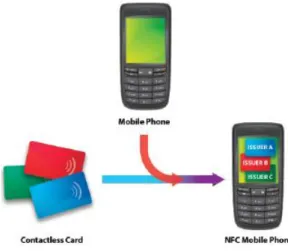
Pardis Pourghomi 22 communication channel (Hang et al., 2010). NFC technology enables users to benefit from new and countless services on a daily basis where they can pay for their food, buy a cinema ticket by scanning their phone on a movie poster and much more. This newly developed intelligent device is proposed as an all-in-one personal device that can be personalized and used in a highly interactive environment (Madlmayr et al., 2008). Figure 3 demonstrates the concept of the NFC mobile phone (NFC Forum, 2008).
Figure 3: The Concept of NFC Mobile Phone (NFC Forum, 2008)
The success of the NFC mobile ecosystem is based on the relationships between the involved parties, where those relationships have to be clearly defined (Kadambi et al., 2009). The present contactless ecosystem models functionalities can be extended by a well-defined NFC ecosystem which improves the number of functionalities that an involved party can provide. Table 1 describes the key functionalities of NFC ecosystem (NFC Forum, 2008).
Since several components are required in an NFC payment service, different business sectors are also needed to control their part of involvement within the NFC ecosystem. All business parties have realized that, in order to provide NFC payment services to consumers, all parties have to collaborate and it is not possible to provide the service only by a single firm. Although the standardization of NFC has been started from the technical point of view (Schamberger et al., 2013), the adoption of NFC has been slower than expected. Not having a clear structure and slow development of NFC ecosystem among participating industries are the main reasons for the slow take-off of this technology.
Pardis Pourghomi 23 Table 1: Key Functionalities of NFC Ecosystem
Key functionalities Description
Service provisioning
It provides authentication and remote user management due to network availability. Also users can subscribe and personalize their contactless cards
Mobile network provisioning
It offers user authentication and user care for data connectivity as well as ensuring that the network infrastructure is maintained to enable users to receive data connectivity service
Trusted Service Manager (TSM)
Delivers a communication platform between Service Providers (SPs) and NFC mobile phones where SPs provide multi-application management functionalities to NFC enabled mobile phone through this platform
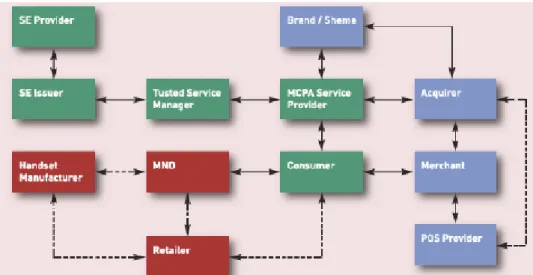
Additionally, a business model that could benefit all participants has not yet been sustained. Figure 4 illustrates the generic model for the NFC payment ecosystem that is proposed by the Mobey forum (2011) in which the SE issuer is the MNO. In some cases such as the Mobey forum’s model, one player can have more than one role. This makes the ecosystem more flexible in terms of manageability, control, ownership and personalization of NFC transactions.