Final Report:
The Environmental Distribution Channel
/carried out by Logistics Management, LiTH as part of a co-operative project between Ericsson and IMIE, Linköping University/
Authors: Maria Huge Brodin, Håkan Aronsson
Abstract
This report presents the results from an 18-months cooperative project between Ericsson and the division of Logistics Management, IMIE/LiTH (Oct 2001-March 2003). The question addressed in the project was: - Which structural properties of logistics systems drive the system’s performance in terms of emissions, costs and lead time/delivery service. Four explorative case studied were performed in order to identify and describe structural changes of logistics systems, and their implications for the system’s performance.
The most important driver for the goods owners to change their logistics structures is the strive to reduce costs, while the environmental and service dimensions should not suffer from the change. Effects through structural changes were decreased cost (through higher efficiency and modal shift of transports), decreased emissions, and maintained or improved delivery service.
In the structural changes studied, better information access was reached, and that facilitated the planning of efficient and effective logistics systems. The need for better information, enabling better planning and control, was stressed also in calculations of operative changes and their effects. Hence the information flow and –management proved to be a vital ingredient in reaching cost-effective, low-emission and customer focused logistics solutions.
Finally it was concluded, that the products and their properties set overall limits to the design, management and operation of any logistics system. Therefore it is vital to address the problem of effectiveness and efficiency of logistics systems already during the product design process.
Content
Executive Summary:
Background, Purpose and Project Plan Structural Changes
Planning and Operative Choices Demands on 3PLP
Conclusions
Appendices, presented in separate documents: Evaluation of alternative structures:
A1: Ericsson 1: Collection/supply of spare parts (previously distributed) A2: Ericsson 2: Distribution of spare parts (previously distributed) A3: Ericsson 3: Information Opportunities (previously distributed) A4: Ericsson 4: Mexico – preliminary version
Case studies:
B1: Evaluation of demands on 3PLP (previously distributed) B2: ICA
B3: IKEA
B4: ITT Flygt – in progress
B5: StoraEnso – preliminary version Research articles:
C1: Purchasing logistics with environmental criteria C2: Effective logistics vs. environmental impact
Background, Purpose and Project Plan
The background of the project is the emerging environmental awareness in general, and also an emerging environmental legislation, which implies that the environmental stress from all types of activities need to be monitored and calculated. The environmental stress from the transport sector – which is a major source of green-house-gases – is also the major
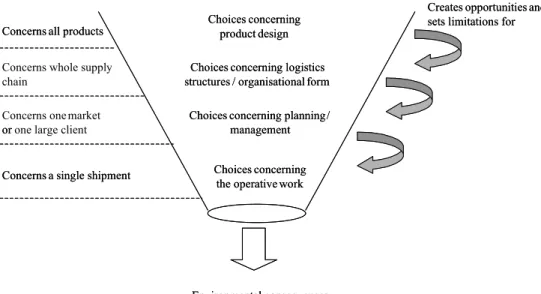
environmental direct stress from logistics systems. Previous research on logistics and its environmental consequences is focused on environmental stress from single shipments. This project aims at shifting the focus from single transports and shipments to structural changes of logistics systems, and their consequences. This new focus is based on the hypothesis that, although gains can be reached in changing logistics operations and tactics/planning, those gains ca be considerably higher if the changes concern structural issues. Structural decisions create opportunities for, but also sets the limitations for changes and choices on
tactic/planning and operative levels, and operative choices directly influence the level of emissions form logistics systems, see figure 1.
Environmental consequenses Choices concerning logistics structures / organisational form Choices concerning planning /
management
Choices concerning the operative work Choices concerning
product design
Creates opportunities and sets limitations for Concerns all products
Concerns whole supply chain
Concerns a single shipment Concerns one market or one large client
Environmental consequenses Choices concerning logistics structures / organisational form Choices concerning planning /
management
Choices concerning the operative work Choices concerning
product design
Creates opportunities and sets limitations for Concerns all products
Concerns a single shipment or
Figure 1: Linking decision to environmental consequences.
There is a decision hierarchy in figure 1. The logic is that from the beginning, when no decisions have been made there are a vast amount of possibilities. Step by step as decisions are made the possibilities are reduced. Once the product is designed f ex the weight and volume of the product is known. These data are then creating opportunities and limitations to how the overall logistics system is designed (questions concerning structure and
organization). An example of such a decision is concerning if there should be both central and regional storage of a product. Typical for these types of strategic decisions are that they concern the whole supply chain. One step down in the decision hierarchy are decisions primarily concerning planning and management. Typically it concerns one market or one large customer. There is not always a clear cut between strategic and tactic decisions, f ex one market might be distant enough so that it is not possible to service the market with only a central warehouse, an exception is made and the warehouse is established in that market. The decision has both strategic and tactic similarities, the scope of the change (one market) indicates that it is a tactical decision and the type of decision (structural) indicates that it is a strategic decision.
What remains at this stage is to make day-to-day decisions of how to handle the delivery of incoming orders and single shipments, which is called the operative level. Once the operative decisions are effectuated there will be an impact on the environment. Based on this view of how decisions are related to environmental outcome the purpose of the project was
formulated.
The overall purpose of this project was to:
• Increase the knowledge of how the choice of distribution structures affect environmental stress, costs and lead times
• Contribute to the reduction of environmental stress, costs and lead times for Ericsson’s distribution of their products as a result of increased knowledge.
The main research question addressed in the project was:
- Which structural properties of logistics systems drive the system’s performance in terms of emissions, costs and lead times /delivery service.
The project has focused on goods-owner initiatives on structural, planning and operative changes. The study has also included interviews with 3PLP-companies on their views of what demands goods-owners make today on environmental impact and how that will change in the future.
The research was carried out in the following main activities: - Literature review
- Case studies of real on-going structural changes (ICA, IKEA, ITT Flygt, Stora Enso) - Case studies regarding alternative transportation modes for selected routes (Ericsson) - Analysis and synthesis
The project has mainly been carried out by senior researchers (PhDs) within the division of Logistics Management, Department of Management and Economics, within IMIE.
Supplementary research efforts (literature- and data collection) was acquired from PhD candidates or students.
The project started in October 2001, and was finished during 2002. The final documentation was carried out during January through March 2003. The steering group has met and received part results at two occasions; June and October 2002. The project budget was 1 MSEK. The project steering group has been composed as follows:
From Ericsson: Lars Göran Bernau (project sponsor) Erik Hoving (until August 2002)
Anders Lindström
Per Samuelsson
From IMIE: Mats Abrahamsson
Project manager/IMIE: Håkan Aronsson (– February 2002) Maria Huge Brodin (March 2002 – )
Structural Changes
The structural changes of logistics systems described below are in different phases of
we have identified for changing logistics structures are presented. The structural changes we have studied are presented, and when appropriate illustrated with examples. Finally the effects of the changes are described. The cases are presented in B2-B5 and a more detailed analysis is conducted in C1-C3.
The most important driver for the goods owners to change their logistics structures is a strive for reducing costs (C2). All the investigated cases stated cost reduction as important for their new structures (see further B2, B3, B4, B5).
Reducing the company’s overall environmental stress through reducing emissions from transports was specifically stressed by two case-companies (B2, B3). Although the other companies did not specify environmental improvement as drivers for logistics changes, all companies studied represent overall and in general environmentally pro-active firms, why increased environmental stress was not acceptable in their new solutions.
Other drivers mentioned by the companies for changing their logistics structures were growth (B3), increase of profitability (B4), to achieve simplifications in the flows and their control (B4), increased flexibility (B5), to decrease the dependency on transport bottle-necks and monopoly transport providers (B5), and to support an increased assortment (B2).
The structural changes studied (C2) include decisions on:
• Localisation and dimensioning of warehouses (and production)
• Decrease the number of warehouses/distribution points; centralisation of the distribution
• Increases of fill rates through structural coordination – virtual central warehouses • Track- and trace to facilitate the management and control
The following illustrations include one or more of those structural changes. “ ICA has reduced the number of warehouses in their supply to the Swedish market. Through better control of the logistics system virtual central warehouses have been introduced. This implies that the localisation of the central warehouse for a specific product can be moved according to changing consumption patterns. It also means that the decision of whether a product should be centrally or locally stored can be changed due to seasonal changes. Low-season products are kept in central warehouses while high-season products are stored closer to the sales point. Another structural change is the reorganisation of supply to warehouses. Although a bulk delivery is transported to the central warehouse, part of can be re-loaded at a regional warehouse, should the transport to the central warehouse pass this on its route.” (B2)
“IKEA has changed their transport mode to the European central storage points from trucks/lorries to railway. The transports are planned on a fixed schedule. The system means a higher visibility, better tracking and tracing of the goods, which in turn enables a better planning of the logistics system. The average speed of the transport has
increased from 17 km/h to 65 km/h.” (B3)
“ITT Flygt has changed their logistics structures from regional sales-company warehouses to one central warehouse in Metz. Also the supply of add-on products
(for a full customer delivery) have been centralised, and the deliveries are consolidated in Metz.” (B4)
”Stora Enso has introduced a new system for transport to the European market; the Base Port system. The core in the new transport system to the European market is a new load carrier – the SECU – developed specifically for Stora Enso transports. The SECU circulate in a closed system, including system daily trains from 6 Swedish paper mills to Gothenburg; ship transport to Zeebrugge daily departure; system train transport to a number of local distribution centres in Europe. From the LDCs the products are distributed to customers on their call-offs. This systems has an
advantage, compared to previous logistics systems, that it is in thefull control of Stora Enso.” (B5)
Basically the changes on structural and planning level have two purposes; one is to reduce the number of facilities and thereby facilitating economies of scale in the warehouses and as a means to change the transport networks so that they can be more efficiently operated. The other change is to use information technology (for example track and trace systems) to increase the predictability and the ability to plan. By doing so more efficient planning operative choices can be made ensure f ex a higher fill rate in transports, which in turn has a positive environmental impact.
It is also typical that the changes are rather complex and include elements of change on
strategic and planning levels as well as on the operative level. This strengthens the assumption that was discussed in figure 1, that structural changes has to be followed by planning and operative changes to achieve an impact on the environment as well as cost and lead time. Effects of the structural changes have been identified, and are to some extent quantified. Effects have been recognised in all three dimensions costs, delivery service and
environmental stress (C2):
• Decreased emissions (20-50% where measured) • Decrease of the costs due to scale and scope effects
• Increased transport frequencies from production to central warehouses • Decreased delivery times to customer
• Higher delivery reliability • Better tracking and planning
Planning and operative
choices
This system level represents more of day-to-day decisions, and also some planning aspects. All structural changes have consequences on planning- and operative levels (see figure 1), why it is difficult to separate effects of structural changes especially from those of planning nature (C3). Rather planning opportunities and operative choices should be seen as
consequences of the structural choices made.
Today most changes in logistics system are made on the operational level. They include choice of fuel for transport, increasing fill rates on a vehicle given by the chosen transport mode.
On a planning level transport mode selection – in a previously given structure – as well as route planning are important activities carried out today. Common goals are to decrease the
number of deliveries and to increase the fill rates of transports in the given system. This can be accomplished through 3PLP who co-organise deliveries.
” ICA has been working on increasing the fill rates of transports. From manual picking-and-packing in cages (for a high fill rate) the initiative is changed to a higher level. The new trucks have been designed for carrying two floors of cages instead of one, which consequently increases the fill rate on single vehicles.” (B2) The measuring of environmental effects that 3PLP offer their customer also concerns
operative and planning levels; measuring emissions per delivery of a specific piece of goods. Some studies were performed on Ericsson-based cases, in which the effects of changing transport mode were analysed with respect to cost, transport time and emissions (A1, A2, A4). The transport routes analysed were mainly transatlantic (between Europe and America)
relations, although one included also European transports, and one included intra-American transports. All of these studies were based on real data for the present situation and calculations for the fictive situations.
The results from these studies – following single shipments – indicated clearly that:
• The costs were reduced when changing transport mode from air to trucks, from air to boat.
• The emissions were reduced
The effects on time were negative; the transport times definitely increased when changing to cheaper and more environmentally friendly transport modes. However, as is discussed in detail in the reports, the impact on the total logistics lead time, including planning and administration, was less significant, and in some cases even very small.
Should planning and administration be carried out more effectively and efficiently, the total impact on logistics lead time from modal change would be neutralised, and some of the concepts in logistics management supports such a re-engineering of the administrative processes (A3). In specific, a reduction of actors and a reduction in number of steps in information handling were suggested.
Demands on 3PLP
Today’s demands and requirements concern mainly technical solutions. The demands regarding information on the offered service are not actually demands, but rather inquiries about what the 3PLP can offer. Requirements from shippers regarding certification are becoming increasingly common.
The 3PLP foresee the following future demands (B1):
- Decreasing CO2 emissions through higher resource usage (efficiency), implying also
lower costs for fuel.
- The importance of environmental awareness will grow, and thereby the efforts will increase. The development pace of this depends on to what extent the customers demand these changes, and demand information from the 3PLP in their procurement of logistics and transport.
- Controlling transport providers through different environmental indices will increase. To be effective in this process, the shippers have to be more educated regarding environmental issues.
The interviews with 3PLP companies showed that to some extent 3PLP can support the environmental efforts by the goods-owners. In two areas they are even prepared for higher demands than customers set today; in calculation and measuring of environmental
consequences, and in controlling their transport providers on a general environmental level. However on a structural level the 3PLP’s initiatives are still to be seen (C1). This indicates that there is a potential for structural change among the 3PLP which would result in both reduced emissions and reduced costs. Competent goods-owners could help to drive the development in that direction. The interviews indicate that today very few goods-owners are active in driving this development and making structural demands on the 3PLP companies production.
The environmental work performed by 3PLP is mainly driven by legislation and customer demands, the latter are not strong, why pro-activity lacks in many dimensions (C1).
Conclusions
The structural solutions identified in the research to this point are under execution by large actors; with developed market structure and high volume flows. The companies are often recognised for developing new and effective and efficient solutions, also in areas outside that of logistics. In addition, they are known to be “environmentally good” companies. Although their logistics changes were not primarily driven by environmental arguments, they have measured or in other respect considered the environmental effects of their new structures. And in many of the projects environmental effects were one of the driving forces even though it was not the primary driving force
A main conclusion from studying ongoing structural changes as well as fictive
operative/tactical changes is, that while structural changes can have positive effects for costs, delivery service and emissions, operative/tactical changes does not always achieve the same result. For example changes in mode of transportation (air to road or vice versa) costs can be reduced and the environment can be spared, or the transport and logistics leadtime can be improved. It is not possible to achieve both. There are other types of changes that do achieve positive effects on all variables (cost, leadtime, emissions).
The need for better information, enabling better planning and control, was stressed in the calculations of operative changes and their effects. In the structural changes studied, better information access was reached, and that facilitated the planning of efficient and effective logistics systems.
There is a wide gap between what proactive companies in the case studies, who seek solutions on all different levels (structural down to operative), and the 3PLP in this research. The latter focus on operative and technical solutions, for now as well as for the future. Only higher demands from cunning/educated customers (=goods-owners) would put pressure on the 3PLP to improve their pro-activity regarding environmentally friendly logistics solutions, on a structural level. The study also indicates that there are potential cost savings in structural changes.