NAVAL
POSTGRADUATE
SCHOOL
MONTEREY, CALIFORNIA
THESIS
Approved for public release; distribution is unlimited U.S. MARITIME SECURITY:
SUSTAINABILITY CHALLENGES
by
Laura Jean Thompson September 2011
Thesis Advisor: Robert Bach
REPORT DOCUMENTATION PAGE Form Approved OMB No. 0704-0188 Public reporting burden for this collection of information is estimated to average 1 hour per response, including the time for reviewing instruction, searching existing data sources, gathering and maintaining the data needed, and completing and reviewing the collection of information. Send comments regarding this burden estimate or any other aspect of this collection of information, including suggestions for reducing this burden, to Washington headquarters Services, Directorate for Information Operations and Reports, 1215 Jefferson Davis Highway, Suite 1204, Arlington, VA 22202-4302, and to the Office of Management and Budget, Paperwork Reduction Project (0704-0188) Washington DC 20503.
1. AGENCY USE ONLY (Leave blank) 2. REPORT DATE
September 2011
3. REPORT TYPE AND DATES COVERED Master’s Thesis
4. TITLE AND SUBTITLE
U.S. Maritime Security: Sustainability Challenges 6. AUTHOR(S) Laura Jean Thompson
5. FUNDING NUMBERS
7. PERFORMING ORGANIZATION NAME(S) AND ADDRESS(ES) Naval Postgraduate School
Monterey, CA 93943-5000
8. PERFORMING ORGANIZATION
REPORT NUMBER
9. SPONSORING /MONITORING AGENCY NAME(S) AND ADDRESS(ES) N/A
10. SPONSORING/MONITORING AGENCY REPORT NUMBER
11. SUPPLEMENTARY NOTES The views expressed in this thesis are those of the author and do not reflect the official policy or position of the Department of Defense or the U.S. Government. IRB Protocol number N/A
12a. DISTRIBUTION / AVAILABILITY STATEMENT Approved for public release; distribution is unlimited
12b. DISTRIBUTION CODE A 13. ABSTRACT (maximum 200 words)
The U.S. maritime domain includes vast resources and enables transportation of goods and services across the globe. Similar to all critical infrastructures and key resources, the maritime domain can be exploited to cause harm to people and disrupt economic stability. The President’s National Strategy for Maritime Security and the U.S. maritime security framework is designed to deter, prevent and respond to a broad range of threats and exploitations. The U.S. maritime security system has evolved over the past decade and faces significant challenges including severe budget reductions, gaps between national guidance and specific roles and responsibilities assigned to federal agencies, and lack of interoperability among disparate logistic, training processes and operational command centers within the Department of Homeland Security (DHS).
Within the DHS, the United States Coast Guard and Customs and Border Protection execute the preponderance of maritime security missions. They struggle with aging air and marine assets and continuous interoperability challenges. The long-term solution includes a new alignment of air and marine resources and capabilities under one agency within the department, which will increase efficiency and reduce duplication of effort and costs, while maintaining a sustainable and layered maritime security posture in support of the President’s strategy.
15. NUMBER OF PAGES
67 14. SUBJECT TERMS Maritime Security, United States Coast Guard, Customs and Border
Protection, National Strategy for Maritime Security
16. PRICE CODE 17. SECURITY CLASSIFICATION OF REPORT Unclassified 18. SECURITY CLASSIFICATION OF THIS PAGE Unclassified 19. SECURITY CLASSIFICATION OF ABSTRACT Unclassified 20. LIMITATION OF ABSTRACT UU
NSN 7540-01-280-5500 Standard Form 298 (Rev. 2-89)
Approved for public release; distribution is unlimited
U.S. MARITIME SECURITY: SUSTAINABILITY CHALLENGES
Laura Jean Thompson
Commander, United States Coast Guard. Alameda, California B.S., United States Coast Guard Academy, 1993 M.B.A., Strayer University, Graduate School of Business, 2003
Submitted in partial fulfillment of the requirements for the degree of
MASTER OF ARTS IN SECURITY STUDIES (HOMELAND SECURITY AND DEFENSE)
from the
NAVAL POSTGRADUATE SCHOOL September 2011
Author: Laura Jean Thompson
Approved by: Robert Bach, PhD Thesis Advisor
Kathleen Kiernan, PhD Second Reader
Harold A. Trinkunas, PhD
ABSTRACT
The U.S. maritime domain includes vast resources and enables transportation of goods and services across the globe. Similar to all critical infrastructures and key resources, the maritime domain can be exploited to cause harm to people and disrupt economic stability. The President’s National Strategy for Maritime Security and the U.S. maritime security framework is designed to deter, prevent and respond to a broad range of threats and exploitations. The U.S. maritime security system has evolved over the past decade and faces significant challenges including severe budget reductions, gaps between national guidance and specific roles and responsibilities assigned to federal agencies, and lack of interoperability among disparate logistic, training processes and operational command centers within the Department of Homeland Security (DHS).
Within the DHS, the United States Coast Guard and Customs and Border Protection execute the preponderance of maritime security missions. They struggle with aging air and marine assets and continuous interoperability challenges. The long-term solution includes a new alignment of air and marine resources and capabilities under one agency within the department, which will increase efficiency and reduce duplication of effort and costs, while maintaining a sustainable and layered maritime security posture in support of the President’s strategy.
TABLE OF CONTENTS
I. A SUSTAINABLE MARITIME SECURITY SYSTEM? ...1
A. INTRODUCTION...1
1. Nature of the Maritime Threat...3
2. United States Maritime Security Framework and Players ...4
3. Lead Federal Agencies in Maritime Security...6
B. THE ROAD AHEAD...7
II. U.S. MARITIME SECURITY FRAMEWORK ...9
A. HOW THE U.S. MARITIME SECURITY FRAMEWORK EVOLVED...9
B. POST 9/11 MARITIME SECURITY INITIATIVES ...12
C. MARITIME SECURITY STAKEHOLDERS ...13
III. COMPLEXITIES AND WEAKNESSES IN THE MARITIME SECURITY SYSTEM ...19
A. BUDGETARY CHALLENGES ...19
B. FY12 DHS BUDGET AND COMPETING DEMANDS FOR SIMILAR RESOURCES ...20
C. LOGISTIC AND MAINTENANCE SUSTAINMENT ...22
D. MARITIME LAW ENFORCEMENT AUTHORITIES WITHIN THE DHS...23
E. MARITIME CAPABILITIES AND RESOURCES WITHIN THE DHS ...25
F. COAST GUARD AND CUSTOMS BORDER PROTECTION VESSEL AND AVIATION FACILITIES IN CLOSE PROXIMITY ...27
G. SUMMARY ...28
IV. RECOGNIZING/EMBRACING THE NEED FOR COLLABORATION...29
A. SENIOR GUIDANCE TEAM ...31
B. MARITIME OPERATIONS COORDINATION PLAN ...32
C. MARITIME OPERATIONAL THREAT RESPONSE ...32
D. INTERAGENCY OPERATIONAL CENTERS...33
E. AIR AND MARINE OPERATIONS CENTER...34
F. COASTWATCH ...35
G. SAN DIEGO MARITIME UNIFIED COMMAND ...35
H. JIATF SOUTH ...36
I. SUMMARY ...37
V. OPPORTUNITIES, CHANGE, AND CHALLENGES WITHIN DHS ...39
A. CG AND CBP MARITIME SUSTAINABILITY CONCERNS ...39
B. GAPS BETWEEN STRATEGIC GUIDANCE AND ROLES AND RESPONSIBILITIES ...40
C. DHS OPPORTUNITIES ...40
E. NEAR TERM ...42
F. LONG VIEW...43
LIST OF REFERENCES ...47
LIST OF FIGURES
Figure 1. Cabinet Level and Government Agencies with Roles and Responsibilities in the Maritime Domain...14 Figure 2. Key maritime security committees/boards established as a result of
National Strategy. ...15 Figure 3. Flow of information at the national level...16 Figure 4. The Maritime Transportation Security Act of 2002 established the
LIST OF ACRONYMS AND ABBREVIATIONS
AIS Automatic Identification System AMOC Air and Marine Operations Center AMSC Area Maritime Security Committees AMSP Area Maritime Security Plans
ATP-S Automated Targeting Passenger System AUF Airborne Use of Force
BUR Bottom-Up Review
CBP Customs and Border Protection
CG Coast Guard
CG ICC Coast Guard Intelligence Coordination Center CNO Chief of Naval Operations
CRS Congressional Research Service DHS Department of Homeland Security DNDO Domestic Nuclear Detection Office DOC Department of Commerce
DOE Department of Energy DOI Department of the Interior DOT Department of Transportation EEZ Exclusive Economic Zone FBI Federal Bureau of Investigation
FMSC Federal Maritime Security Coordinator
FY Fiscal Year
GAO Government Accountability Office HITRON Helicopter Interdiction Tactical Squadron HSC Homeland Security Council
ICE Immigration and Customs Enforcement IOC Interagency Operation Center
JHOC Joint Harbor Operation Center JIATF-S Joint Interagency Task Force-South
MARDEZ Maritime Defense Zone MDA Maritime Domain Awareness
MDA SHB Maritime Doman Awareness Stakeholders Board MOA Memorandum of Agreement
MOC Maritime Operations Coordination MOTR Maritime Operational Threat Response
MSIPC Maritime Security Interagency Policy Committee MSST Maritime Security and Safety Teams
MTSA Maritime Transportation Security Act MUC Maritime Unified Command
NCTC National Counterterrorism Center NMCO NationalMaritime Coordination Office NSC National Security Council
NSMS National Strategy for Maritime Security OAM Office of Air and Marine
ODNI Domestic Office of the Director of National Intelligence QHSR Quadrennial Homeland Security Review Report
RDD Radioactive Dispersal Device ReCoM Regional Coordinating Mechanism SGT Senior Guidance Team
UAS Unmanned Aircraft Systems USCG United States Coast Guard
USN U.S. Navy
WBIED Waterborne Improvised Explosive Devices WMD Weapon of Mass Destruction
ACKNOWLEDGMENTS
I want to thank Robert Bach, PhD, my thesis advisor, for his excellent advice and guidance in this endeavor. I am especially grateful for Dr. Bach’s leadership that inspired me to think critically about the status quo and seek answers without fear.
I want to thank Kathleen Kiernan, PhD, my second reader, for her mentorship and support, for being an exemplary role model for women in Law Enforcement, and for encouraging me to pursue my dreams.
I want to thank Professor Nadav Morag for guiding me through the initial stages of my research, problem statement, and thesis proposal.
I want to thank my partner, Jeanne, for her unwavering support throughout this process. Her strength and commitment to a balanced life, kept me healthy.
My family: Lynn, Steve, and Holly, for helping me keep things in perspective. My brother: Steve, for his love, patience and advice. He was my number one sounding board throughout this process.
Lieutenant Eric ‘Van’ VanVelzen—a Marine, a Coast Guard Officer, a friend, a USCG PACAREA colleague. Van provided steadfast support throughout this endeavor and stood the watch in my stead on many occasions.
Coast Guard Leadership: Dr. Joseph DiRenzo III, Captain Charley Diaz, Captain Arthur Snyder, Kent Thew, Robert Goetz, Commander Sean Ryan, Commander Charlene Downey, Commander Scott Henderson, and Commander Erica Mohr for their brilliant vision, and taking the time to exchange ideas and implement improvements throughout the Department of Homeland Security.
I.
A SUSTAINABLE MARITIME SECURITY SYSTEM?
A. INTRODUCTION
The September 11, 2001 attacks in the United States resulted in significant enhancements to existing maritime security documents and inspired the creation of new laws and strategy documents that addressed foreseeable threats and security concerns. Although many vulnerabilities and threats may have already existed, the 9/11 attacks set a new precedent for heightened awareness, security and defense posturing in the maritime domain. Post-9/11 national strategies and Congressional acts were designed to increase this nation’s ability to deter, prevent and respond to terrorist acts. Translating a strategic goal that states ‘prevent and disrupt terrorist attacks’ to actual executable tasks at the operational and tactical level requires an enormous amount of coordination between agencies and resources. The maritime domain, in particular, requires a sustainable and layered security posture (Papp, 2011b). Sustainability accounts for 24/7 operations, throughout the year, and includes the capacity to rotate resources in and out of operational missions for maintenance and recovery. A layered posture includes security forces that operate from the U.S. shoreline and critical ports and include capabilities in and beyond territorial waters and the Exclusive Economic Zone (EEZ), and extend to international ports. The current framework that supports maritime strategies is facing challenges that reduce its ability to provide a sustainable and layered security posture. The author examines the sources of these systemic pressures and identifies or proposes areas of reform to improve the effectiveness and efficiency of the maritime security system in the near and long-term future.
The focus is on the United States Coast Guard (USCG) and Customs and Border Protection (CBP). As both a component of the DHS, and as a long-time lead agency in the nation’s maritime security, the USCG faces severe challenges in sustaining a maritime security posture prepared to support the President’s Maritime Security Strategy and applicable laws. In responding to the Haiti earthquake, for example, 10 of the 12 Coast Guard (CG) cutters, which now average 40 years of age, suffered severe
breakdowns, and two had to leave their duty stations and return to homeport or dry dock for emergency repairs. The USCG also showed signs of system wide strain in responding to Hurricane Katrina and the explosion of Mobil Offshore Drilling Unit Deepwater Horizon (Papp, 2011a). Similarly, CBP, and more specifically, the CBP’s Office of Air and Marine (OAM) faces sustainability challenges including an aging fleet of aircraft, facilities in need of repair, and salary payments for personnel hired to fill critical mission vacancies (U.S. House of Representatives, 2010, p. 3).
Beyond its abilities to perform essential missions, since 9/11, the USCG has embraced an expanded set of responsibilities within maritime security and the maritime transportation system (Papp, 2011b). Subsequent chapters discuss these new roles and responsibilities. In the end, however, the author argues that these sustainability challenges, combined with expanded duties, require the USCG to forge a two-track strategic initiative for sustainability. One track aggressively bolsters efforts to improve core capabilities. The second embraces new collaborative efforts involving other Department of Homeland Security (DHS) components, especially CBP, to align better the way in which limited capabilities can contribute to achieving an expanding set of requirements. These collaborative efforts must include changes in allocation of resources, capabilities and finances. If these changes do not occur, the effectiveness and efficiency of the maritime security system as a whole will falter.
To begin, Chapter I is organized around three initial or background tasks. The first is to describe the persistent and changing nature of maritime threats against which the maritime security systems effectiveness must be evaluated. Second, the national strategies, Congressional acts and statutes that provide a framework for the maritime security system are reviewed. Finally, principle federal agencies responsible for supporting this maritime security framework are discussed.
1. Nature of the Maritime Threat
Terrorist attacks, such as the bombing of the USS Cole in 2001, the explosion onboard Superferry-14 in 2004, and the use of small boats for the 2008 Mumbai attacks, demonstrate terrorists’ capabilities of exploiting the maritime environment. The vulnerabilities in the maritime domain are vast, and require a multitude of prevention techniques and layers of security capabilities.
The United States National Strategy for Maritime Security (NSMS) categorizes maritime threats into nation threats, transnational criminal and piracy threats, environmental destruction, and illegal seaborne immigration (U.S. Department of Homeland Security, 2005a, p. iii). Persons or organizations that wish to harm or threaten the U.S. maritime infrastructure may use explosive laden suicide boats to attack high interest vessels or offshore oil platforms, or utilize underwater explosive delivery vehicles or mines to destroy or threaten a port facility. Maritime threats may be deployed in small or large vessels, and can originate from across the globe, or from a local U.S. port. Developing and executing a layered security strategy to mitigate all possible maritime threats is a daunting task.
At the same time, the U.S. maritime transportation system enables approximately 95% of U.S. overseas trade, which consisted of two billion tons and almost $800 billion of domestic and international freight each year. In addition to serving as a critical highway for the global highway, the maritime domain presents unique security challenges that encompass vast stretches of oceans, waterways and countless potential points of entry. The United States has the world’s largest EEZ, and over 95,000 miles of coastline, 10,000 miles of navigable waterways and 361 ports, including eight of the world’s 50 highest volume ports. In 2005, off shore activities contribute over $120 billion and two million jobs to American economic prosperity (U.S. Department of Homeland Security, 2008, p. 9). The maritime security system also protects and services more than 141 million U.S. residents who live within 50 miles of the coast (U.S. Coast Guard, 2006, p. 5).
Vessels can be used as Waterborne Improvised Explosive Devices (WBIED), as demonstrated by the attack on the USS Cole in October 2000, as well as conveyance for smuggling weapons of mass destruction (WMD), a radioactive dispersal device (RDD), or terrorists into the United States. Small vessels, characterized as vessels under 300 gross tons, in particular, are susceptible to these risks because many are not registered, or tracked utilizing the Automatic Identification System (AIS).
To counter these broad range of threats, the USCG utilizes all available recourses, and in 2010, CG forces conducted more than 2,400 security boardings of high interest vessels, 17,000 security boardings of small vessels, more than 4,400 escorts of high-capacity passenger vessels or high value U.S. naval vessels, and more than 850 escorts of vessels carrying certain dangerous cargoes (Papp, 2011b).
2. United States Maritime Security Framework and Players
As Congress rushed to establish a new security framework following the 9/11 attacks, The Homeland Security Act of 2002 (Homeland Security Act, 2002) moved the USCG into the newly created DHS. The purpose was to enhance the ability of various established agencies to work together and improve information sharing and joint operations. The USCG shared in the department’s overall goals, which included the following primary missions.
• Prevent terrorist attacks within the United States
• Reduce the vulnerability of the United States to terrorism at home
• Minimize the damage and assist in the recovery from terrorist attacks that occur
• Ensure that the overall economic security of the United States is not diminished by efforts, activities, and programs aimed at securing the homeland
the coordination of maritime security agencies to achieve a comprehensive maritime security program. This directive also established the Maritime Security Policy Coordinating Committee to coordinate interagency maritime security policy efforts. The term ‘maritime domain’ is introduced in this directive and is defined as: “All areas and things of, on, under, relating to, adjacent to, or bordering on a sea, ocean, or other navigable waterway, including all maritime-related activities, infrastructure, people, cargo, and vessels and other conveyances” (Homeland Security Presidential Directive 13, 2004).
The implementation of these directives resulted in the National Strategy for Maritime Security, and eight supporting plans.1
By Presidential and Congressional authority, the new DHS also took on the responsibilities and role of executing and implementing the key components of a sustainable maritime security posture. With the exception of the United States Navy and its parent agency the Department of Defense, the DHS contains the two largest maritime agencies in the United States. It also must pursue and balance a myriad of national priorities outside of the maritime security domain. Its vision and mission only hint at the breadth and scale of the department’s responsibilities.
DHS Vision: Preserving our freedoms, protecting America…we secure our homeland (U.S. Department of Homeland Security, 2011).
DHS Mission: The Department of Homeland Security will lead the unified national effort to secure America. We will prevent and deter terrorist attacks and protect against and respond to threats and hazards to the nation. We will ensure safe and secure borders, welcome lawful immigrants and visitors and promote the free-flow of commerce (U.S. Department of Homeland Security, 2011).
1 The National Strategy for Maritime Security includes eight supporting plans, which are listed in no
particular order: The National Plan to Achieve Maritime Domain Awareness, The Global Maritime Intelligence Integration Plan, The Maritime Operation Threat Response Plan, The International Outreach and Coordination Strategy, Maritime Transportation System Security Recommendations, The Maritime Transportation System Security Plan, The Maritime Commerce Security Plan, and The Domestic Outreach Plan.
In February 2010, the DHS attempted to thoroughly review and consolidate its missions and organization through launching its first Quadrennial Homeland Security Review Report (QHSR). Facing its fundamental challenge of integrating 22 agencies into one cabinet level department, while maintaining each component’s authorities as authorized by U.S. Code, the Quadrennial Homeland Security Review outlined five overarching missions, followed by supporting goals, to bring coherence and strategic direction to the entire enterprise. The DHS Bottom-Up Review, published six months later, attempted to align various department programs to each of these missions.
These efforts to establish a strategic mission for DHS and its components have resulted in various strengths and weaknesses. Many of these are the subject of discussion in the following chapters. Yet, from the outset, especially for the USCG and CBP, this continuous search for identifying and alignment of missions and priorities resulted in an expansion of maritime capabilities and repetitive attempts to lead federal, state and local maritime components towards better integration and interoperability in the maritime domain.
3. Lead Federal Agencies in Maritime Security
The two federal agencies that maintain the largest aviation and vessel maritime law enforcement capabilities are the USCG and CBP. As components of the DHS either moved there or were created through a merger of former independent agencies, both share a history of collaborative efforts to support of the National Maritime Security Strategy. In particular, following the 9/11 attacks, the Maritime Transportation Security Act of 2002, and the Safe Port Act 2006, sought to create within both the USCG and CBP robust maritime security strategies with extensive investments in assets, personnel, and training to support a national maritime security strategy (U.S. Department of Homeland Security, 2010c).
their weaknesses, which included, for example, a plan to screen containerized cargo and protect accessible port facilities. The MTSA of 2002 also directs the USCG to lead these efforts through Area Maritime Security Committees (AMSC) and the development of a Maritime Transportation Security Plan(s). The vulnerabilities presented in the MTSA, and the authorities and resources designed to address these vulnerabilities cross DOT and DHS jurisdictions. More specifically, U.S. ports, which handled 95% of U.S. overseas trade, at that time, require coordination between the USCG and CBP, as well as state, local, and private entities. The AMSC was designed to bring these stakeholders together and develop a coordinated and cohesive security plan. The roles and responsibilities of the USCG and CBP in support of MTSA, and their efforts to coordinate among the maritime stakeholders, are discussed in upcoming chapters.
B. THE ROAD AHEAD
This thesis reviews the Quadrennial Homeland Security Review, the Bottom-Up Review and the most current agency initiatives to continue to focus on maritime authorities, capabilities, and resources that exist within the department, specifically within the USCG and CBP, to meet mission requirements. The Government
Accountability Office (GAO) conducted a report in 2005 that highlighted, for instance, progress and shortcomings in addressing efforts to facilitate the coordination of air and marine assets of the USCG and CBP (Government Accountability Office, 2005). The report recommended that the DHS clarify the roles and responsibilities of the USCG and CBP in their homeland security missions and that senior leaders promote improved coordination. Many of their critical observations and suggestions remain true today.
The following chapters describe the critical elements of the maritime security framework, and its strengths and weaknesses. Chapter II describes how the current maritime security enterprise has evolved over time, and how post-9/11 Presidential directives and Congressional acts have influenced the operational effectiveness of key maritime security players. Chapter III analyzes the complexities and weaknesses in the maritime security posture, including budgetary issues, logistics, capabilities, authorities and resources that exist in the DHS. Chapter IV describes ongoing initiatives with in the
DHS and other maritime stakeholders designed to promote interoperability, further supporting the argument that the DHS requires necessary change to support long-term maritime security objectives. Chapter V presents a near-term and long-term recommendation for a sustained maritime security posture, as well as the challenges associated with these recommendations. The long-term solution includes a new alignment of air and marine resources and capabilities under one agency within the department to increase efficiency and reduce duplication of effort and costs, while maintaining a sustainable and layered maritime security posture in support of the President’s strategy.
Recent congressional testimonies from USCG Commandant and CBP Commissioner describe the challenges each agency faces as they struggle to support their operations. In 2006, both agency leaders signed a charter implementing a ‘Senior Guidance Team’ (SGT) designed to address logistics, interoperability and training issues that exist under the current construct.
These actions are valuable and evolving. The SGT represents the beginning of much needed reform of maritime efforts within the DHS. Nevertheless, this thesis argued that reform is required at the SGT level and higher to overcome serious tensions and weaknesses within the maritime security system. The USCG is facing severe difficulties in sustaining its maritime security posture. The USCG and CBP continue to struggle with interoperability in the maritime domain. The DHS budget cannot fully support two separate air and marine initiatives. These and other challenges demonstrate a gap between the national strategy and the roles and responsibilities of DHS’ primary maritime agencies and their capabilities.
The “one DHS” concept is also a cornerstone of the analysis that follows. In 2009, DHS Secretary Napolitano identified “unifying DHS” as one of the department’s top priorities (Testimony of Secretary Janet Napolitano, 2009). Seizing the opportunity to reform and realign the way the USCG and CBP work together to strengthen the nation’s
II.
U.S. MARITIME SECURITY FRAMEWORK
A. HOW THE U.S. MARITIME SECURITY FRAMEWORK EVOLVED
This chapter describes how the current maritime security enterprise has evolved over time, and how this change has influenced the operational effectiveness of key maritime security players. The previous chapter briefly introduced current Presidential directives and Congressional acts that represent the backbone of our maritime security framework. This chapter expands on those key documents to include a discussion on how key players, as well as federal agencies, and maritime stakeholders, interact under the current framework.
Safety, security, and defense, have always been important missions in the maritime domain. Federal maritime agencies, including the U.S. Navy and the U.S. Coast Guard began developing plans to combat terrorism as early as the 1980s, and continued through the 1990s during Operation Desert Storm. In 1984, the U.S. Navy (USN) and USCG established a plan for defense of U.S. territorial waters and U.S. ports under the Maritime Defense Zone (MARDEZ) plans. These zones were primarily designed to conduct port security, harbor defense and coastal warfare in the continental United States from known state actors. The Chief of Naval Operations (CNO) and Commandant of the Coast Guard signed the MARDEZ memoranda, that, when activated, would place the USCG Area Commanders under USN Fleet Commanders, as well as assign USN forces to the USCG Area Commanders for execution of assigned missions. Remarkably, despite this established framework, the MARDEZ concept was not utilized following the attacks on September 11. Consequently, this concept has been re-evaluated and revised. New Memorandum of Agreements (MOAs), signed by the Secretary of Defense and the Secretary of Homeland Security in 2004, designate USCG Area Commanders as
‘Defense Force Commanders’ of East or West Coast operations, depending on the location(s) of the event(s).2 Fortunately, is has not been necessary to activate these MOAs.
Meanwhile, during the years preceding the September 11 attacks, federal agencies, including the USCG, U.S. Customs Service, Border Patrol, and Immigration and Naturalization Service, maintained a law enforcement presence throughout the U.S. coastline, with various levels of capabilities to combat maritime incursions, such as illegal drug and human trafficking, and illegal immigration. The U.S. Customs Service monitored and enforced container shipping and customs regulations, and, of course, the USCG has always maintained a strong presence to enforce boating safety, environmental, and fisheries regulations. The years following Operation Desert Storm (1990s), the attack on the USS Cole (2000), and the September 11 attacks (2001), the U.S. Government continued to develop policies that accelerated the roles and responsibilities of federal agencies with maritime capabilities and authorities.
The Homeland Security Act of 2002, (Homeland Security Act, 2002), and the Maritime Transportation Act of 2002 (Maritime Transportation Security Act, 2002) are the first of these government enacted directives that influence today’s U.S. maritime security enterprise. These two laws were enacted on the same day, November 25,2002, and their influence on the maritime roles and responsibly of the USCG and CBP are discussed in this section.
As discussed in Chapter I, The Homeland Security Act of 2002 created the DHS, and brought the USCG, in addition to 21 other agencies under this new department. This act identified the primary missions of the DHS, as well as specified that the standing missions of the USCG would be preserved under their existing construct. For example, the USCG has 11 statutory missions as defined in 6 U.S. Code § 446 (U.S. Coast Guard,
2009). Upon transfer to the DHS, these 11 missions were preserved, and the Homeland Security Act of 2002 divided them into ‘homeland security’ missions and ‘non-homeland security missions’ (Homeland Security Act, 2002, §888).
• USCG Homeland Security Missions:
• Ports Waterways, and Coastal Security
• Drug Interdiction
• Migrant Interdiction
• Defense Readiness
• Other law Enforcement
• USCG Non-Homeland Security Missions
• Maritime Safety
• Search and Recue
• Aids to Navigation
• Living Marine Resources (Fisheries Law Enforcement)
• Marine Environmental Protection
• Ice Operations
Following the enactment of this act, the USCG maintained its fundamental roles as a leader in maritime safety, maritime security, and maritime stewardship. Additionally, the USCG entered the DHS with a robust fleet of aircraft, vessels, professional law enforcement officers, and most importantly, a broad range of authorities. The USCG’s Title 14 law enforcement and Title 10 defense authorities offer the DHS a full range of options when executing missions in the maritime domain. The next chapter discusses the USCG authorities and capabilities and their relationship with other agencies within the DHS.
Unlike the USCG, CBP was not a pre-existing federal agency; instead, CBP was created in 2003 to serve under the DHS, and absorbed personnel, missions, commitments, facilities and assets from the U.S. Customs Service, Border Patrol and the Immigration and Naturalization Service. The specific roles and missions that CBP performs today
have continued to evolve with national and departmental guidance. More specifically, the evolution of CBP’s maritime security missions and capabilities has paralleled the USCG’s as both agencies responded to national and DHS guidance.
B. POST 9/11 MARITIME SECURITY INITIATIVES
The MTSA of 2002 and Homeland Security Act of 2002 were enacted during the same congressional session, and together, fed significant maritime security initiatives in the DHS. MTSA amended the Merchant Marine Act of 1936, and further defines security programs for seaports and the maritime transportation system. MTSA directed increased responsibilities for both the USCG and U.S. Customs, and also established grants and funding for specific projects. For example, the USCG was directed to establish Maritime Security and Safety Teams (MSST) to enhance domestic maritime security capabilities. These teams would be responsible for protecting vessels, harbors, port facilities, cargo, and coordinate with other federal, state, and local law enforcement and emergency response agencies (Maritime Transportation Security Act, 2002, § 70106). By 2005, the USCG had established 12 MSSTs located at strategic ports throughout the nation. Currently, 11 MSSTs are in operation. Due to budget constraints in 2011, the MSST in Anchorage, Alaska was disassembled. Meanwhile, MTSA of 2002 directed CBP to develop a cargo security program that would screen and detect dangerous items from reaching the United States. In addition to enhancing container-screening capabilities at ports, CBP began expanding their air and small boat fleet, and in 2006, consolidated all air and marine assets under CBP’s Office of Air and Marine Branch. Due to increased visibility on threats and vulnerabilities in the maritime domain, weather real or conceptual, the USCG and CBP continued to build and employ robust, yet duplicative, capabilities to protect seaports and the maritime transportation system.
The National Maritime Security Strategy, published in 2005, also contributed to the expansion of federal, local, tribal and private maritime security interests. Unlike the
Related Population Centers and Critical Infrastructure” (The National Strategy for Maritime Security, 2005, p. 9). These plans do not specify which agency, or in what manner, an agency shall execute a particular mission. Consequently, the USCG and CBP responded by developing their individual strategies that captured the national and DHS guidance, and began parallel planning, purchasing and execution of maritime security missions.
Additionally, both the USCG and CBP have dutifully reported all maritime initiatives and expenditures to multiple congressional committees throughout the year, every year beginning in 2003. Nevertheless, the first GAO report that finally addressed effective collaboration of DHS air and marine resources was in 2005, followed by the establishment of a ‘Senior Guidance Team’ to evaluate opportunities for collaboration, and finally, the first DHS internal efficiency review began in 2009. The following chapters discuss the current status of these initiatives and USCG and CBP assets, capabilities, and duplicative efforts.
C. MARITIME SECURITY STAKEHOLDERS
While the USCG and CPB are the federal agencies with the largest air and marine resources and capabilities, many more federal, state, local and private entities comprise the current U.S. maritime security enterprise. The President’s National Strategy for Maritime Security acknowledges that the roles and responsibilities cross many departments.
Figure 1. Cabinet Level and Government Agencies with Roles and Responsibilities in the Maritime Domain.3
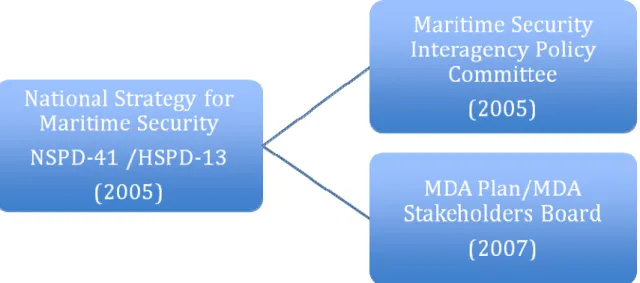
To facilitate collaboration among these federal entities, National Security Presidential Directive-41/Homeland Security Presidential Directive-13 established The Maritime Security Interagency Policy Committee. Also, as a result of one of the supporting plans, The National Plan to Achieve Maritime Domain Awareness, an additional committee, the MDA Stakeholders Board, was established.
Figure 2. Key maritime security committees/boards established as a result of National Strategy.
The Maritime Security Interagency Policy Committee is co-chaired by a National Security Council (NSC) and Homeland Security Council (HSC) representative, and membership includes cabinet-level departments, federal intelligence offices, and the Joint Chiefs of Staff (Homeland Security Presidential Directive-13, 2004). This committee is designed to coordinate analysis, review and development of all national guidance.
Two years later, in 2007, the National Maritime Doman Awareness Stakeholders Board (MDA SHB) was established. This board is lead by Executive Agents for MDA from DHS, Department of Defense (DoD), DOT and the Intelligence Community. National Maritime Domain Awareness Stakeholders Board (SHB) includes members from U.S. agencies with missions or responsibilities in the maritime domain. The National Concept of Operation established the committee for maritime domain awareness. This concept of operations was developed to execute the National Plan to Achieve Maritime Domain Awareness (MDA Plan), which is one of the supporting plans of National Strategy for Maritime Security and National Security Presidential Directive-41/Homeland Security Presidential Directive-13.
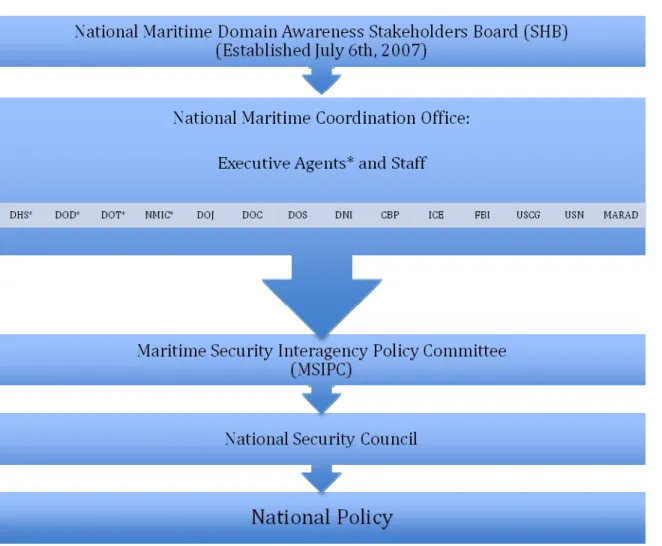
Figure 3 attempts to display the flow of information that exists at the national level. Utimatley, the framework should provide a coordinated and effective flow of recommendations that pertain to maritime issues that will result in updates to strategic-level guidance.
Figure 3. Flow of information at the national level.
Maritime Security policy recommendations flow from the SHB, through the National Maritime Coordination Office (NMCO), the Maritime Security Interagency Policy Committee (MSIPC) to the National Security Council for consideration and
The next essential pieces of U.S. maritime enterprise are the state and local maritime entities. Fortunately, these equities were recognized in 2002, immediately following the creation of the DHS. To include all local entities in domestic and port security planning, the Maritime Transportation Security Act of 2002 established the requirement for a National Maritime Security Committee and AMSC at designated ports.
Figure 4. The Maritime Transportation Security Act of 2002 established the requirement for a National Maritime Security Committee and AMSC.
The USCG Captain of the Port is designated the Federal Maritime Security Coordinator (FMSC) for a port, and leads quarterly area maritime security committees and oversees the development and regular review of the Area Maritime Security Plans (AMSP). To support the communications between committee members, the USCG maintains a website called “HOMEPORT,” which supports the sharing of sensitive information among federal, state, local and private maritime regulatory or security personnel. At the port operational level, this framework offers an excellent venue for information sharing, but participation is not enforced. Participation by local and private entities is driven by incentives that would benefit that company or agency. The USCG
and CBP are both members of the National and Area Committees; however; only the USCG is specifically designated by name in MTSA of 2002 as the agency responsible for the committee and plans.
The framework of the U.S. maritime security enterprise has evolved over time. The most significant changes to the U.S. federal framework occurred after 9/11 and the enactment of the Homeland Security Act of 2002 and the Maritime Transportation Security Act of 2002. Aside from the USN, which operates as a military service in the DoD, the USCG and CBP are the next two largest maritime agencies in the United States, and subsequently, both reside in the DHS. The national guidance adequately addresses all possible threats, and prioritizes national objectives to preserve this country’s safety and economic well-being. The shortfall exists in the DHS framework. The DHS has not adequately assigned roles and missions to its subordinate agencies. Although the DHS was restricted from altering USCG missions, no evidence exists to support a DHS initiative to minimize duplication of effort in the early stages of the department’s existence. Upon their transfer to the DHS, the USCG and CBP embraced the challenge of fulfilling all maritime security missions and objectives. Unfortunately, despite the established committees and multiple congressional oversight committees, the department itself did not regulate the growth of CBP or USCG maritime initiates. The next Chapter describes the challenges that DHS faces in terms of supporting the President’s strategy while balancing two agencies with duplicative capabilities and authorities.
III. COMPLEXITIES
AND
WEAKNESSES IN THE MARITIME
SECURITY SYSTEM
The U.S. maritime security system is built around strategic guidance and Congressional acts, as discussed in Chapter II, and involves multiple stakeholders and cooperation at multiple levels. DHS maritime security initiatives have grown to meet the demands of this guidance, but due to the complexity of integrating legacy agencies into a “one DHS,” and further challenged with a depressed economy, the maritime security system is left with major weaknesses. DHS’ leaders have recognized some of these weaknesses through its 2010 internal department reviews, specifically its QHSR and a Bottom-Up Review (BUR). Still, the reviews only touched the surface of the system’s problems. This chapter focuses on weaknesses that exist within the DHS, specifically, budgetary and logistics sustainment issues, duplicative capabilities and resources, and overlapping authorities.
While both of these reviews provided a clear outline of the department’s goals, objectives, and ongoing initiatives, they actually failed to acknowledge openly the true, underlying inefficiencies that influence the department’s ability to sustain a capable maritime security posture. For instance, very little was discussed about interoperability or the budgetary shortfalls needed to support programs that prevent terrorist attacks, such as the CBP’s Strategic Air and Maine Plan and the USCG’s fleet recapitalization requirements.
A. BUDGETARY CHALLENGES
The DHS Fiscal Year (FY) 12 Budget in Brief and the BUR illustrate the budgetary challenges the DHS is facing. For instance, the BUR identifies similar, but separately funded programs under CBP and USCG that support the same mission, “Securing and Managing our Borders.” Listed as “CBP Air and Marine “and “USCG Drug and Migrant Interdiction,” these activities are being developed separately, yet are ultimately designed to combat the similar maritime threats. While the BUR acknowledges the various programs, such as the CBP Strategic Air and Marine Plan, and the CG
HC-144A Maritime Patrol Aircraft and Fast Response Cutter-B Class programs, it does not address the fact that these programs will be developed under different and separate acquisition programs, and will be maintained under separate logistic processes. The internal review documents do not address the vast number of resources hours spent determining how to make these resources interoperable. The QHSR, BUR, and Budget in Brief also avoid discussing redundant acquisition programs, such as the CBP and USCG acquisition programs for Unmanned Aircraft Systems (UAS) (U.S. Department of Homeland Security, 2010c, Annex D, p. D–2).
B. FY12 DHS BUDGET AND COMPETING DEMANDS FOR SIMILAR
RESOURCES
The DHS FY12 Budget In Brief outlines the overall department budget request, in addition to a description of each agency and individual agency budget requests. The DHS FY12 budget request is $57.0 billion in total funding. DHS Secretary Napolitano’s testimony to Congress emphasized that the FY12 budget is designed to match the department’s comprehensive strategy to meet the nation’s homeland security needs. Further, her testimony referenced the QHSR and the Bottom-Up Review as the department’s efforts to align DHS programmatic activities and organizational structure to serve the department’s missions and goals better (Testimony of Secretary Janet Napolitano, 2011).
The following six missions are identified in the FY12 budget, which include a sixth mission not previously identified in the QHSR or Bottom-Up Review.
• Mission 1: Preventing Terrorism and Enhancing Security! • Mission 2: Securing and Managing Our Borders
• Mission 3: Enforcing and Administering Our Immigration Laws
• Mission 4: Safeguarding and Securing Cyberspace
The budget requests from the USCG, Customs and Border Protection, and Immigration and Customs Enforcement (ICE) contain requests for similar maritime capabilities, which may result in underfunding certain programs that may degrade the agency’s ability to execute the department’s missions, and ultimately, the President’s Maritime Security Strategy.
The redundancy and blurred roles and responsibility is also evident in Annex D of the BUR, which is supposed to list the ‘Alignment of Major DHS Programs to Homeland Security Missions.’ Within this Annex, CBP and USCG have redundant program activities and major acquisition and investments in the maritime border mission area. For example, under ‘programmatic activity’, CBP lists ‘Air and Marine’, while the USCG list includes ‘Drug Interdiction’ and ‘Migrant Interdictions’. Additionally, multiple aviation and small boat acquisition investments are listed in Appendix D for both CBP and USCG (U.S. Department of Homeland Security, 2010c, Appendix D). These same assets struggle with interoperability and continually attempt to resolve collaboration issues. The next chapter discusses these collaboration issues.
CBP Office of Air and Marine include budget requests for salaries and maintenance and procurement of air and marine resources. The missions executed by the CBP Office of Air and Marine closely resemble the missions executed by the USCG.
One of CBP’s FY2012 highlights is a request for $22 million dollars for the refurbishment and conversion of two Blackhawk helicopters. Additionally, CBP has proposed to reduce the air and marine acquisition program by $48.2 million, which will delay acquisitions of new and replacement platforms (U.S. Department of Homeland Security, 2011, p. 73).
Similarly, the USCG FY12 budget includes requests for recapitalization and sustainment of surface and air assets (U.S. Department of Homeland Security, 2011, p. 73). Program reductions include the decommissioning of one 378-ft High Endurance Cutter and three 179-ft patrol coastal vessels. The Commandant’s testimony further explains the status of aging fleet of USCG cutters and aircraft, and the deterioration of the
USCG’s ability to execute maritime security missions without adequate funding for replacement and sustainment of maritime resources. The Commandant, Admiral Papp, also describes the USCG’s overarching budget priorities.
• Rebuild the Coast Guard
• Sustain Front-line Operations
• Enhance Maritime Incident Prevention and Response
• Support Military Families
These budget priorities, especially the first two, emphasize the USCG’s need for maritime resources to insure sustainment of operations in the maritime domain.
Finally, taking a step back to the strategic level, the overarching maritime security framework, established by the policies and responsibilities outlined in the Homeland Security Act of 2002, and the Maritime Transportation Security Act of 2002, do not link to the budget process at the department level to ensuring adequate funding is available for agencies responsible for executing the new policies or requirements. This disconnect, combined with the depressed economic conditions in 2012, emphasize the need for smart spending in terms of maritime resources.
C. LOGISTIC AND MAINTENANCE SUSTAINMENT
Aviation training management systems, operations management systems, safety management systems, and law enforcement case managements systems are examples of interoperable systems within the DHS. The USCG and CBP utilize completely separate IT systems to manage and facilitate aviation logistic and maintenance reports, such as inventory control, maintenance man hours, contractor training, and asset operational status, to name a few. In 2010, CBP and the USCG were tasked with developing a joint strategy to achieve compatible or unified aviation information management systems (Customs and Border Protection Office of Air and Marine, 2010). The report signed by
infrastructure upgrades. Most importantly, he explained that an interoperable information system would only work if common operations are developed and common mission support processes are implemented.
Additional research is required in this area. This initiative is more mature than any other logistic initiates that exist within the DHS, and is presented in this thesis to demonstrate the complexity and importance of alignment between agencies in future acquisitions and planning.
The next section focuses on overlapping maritime authorities and capabilities that exist in the DHS. Unlike the previous sections that identified specific weaknesses, the following challenges offer opportunity because an abundance of capability exists within the DHS, and can be utilized more effectively. The DHS has an opportunity to identify, select, consolidate and enhance the best practices among its maritime agencies, while eliminating unnecessary practices, and ultimately, improving the DHS’ overall maritime security posture.
D. MARITIME LAW ENFORCEMENT AUTHORITIES WITHIN THE DHS
The law enforcement authorities granted to the USCG, CBP and ICE are listed under separate U.S. Codes, but in terms of the actual execution of a boarding at sea, their authorities are remarkably similar. For example, the authority to search, seize and arrest is granted to CG, CBP and ICE as follows.
• 14 U.S.C. § 89(a) authorizes the USCG to make inquiries, examinations, inspections, searches, seizures, and arrests upon the high seas and waters over which the United States has jurisdiction, for the prevention, detection, and suppression of violations of laws of the United States
• 19 U.S.C. §1581 authorizes CBP and ICE officers to board any vessel within customs waters and examine the manifest and other documents and papers, and examine, inspect, and search the vessel and every part thereof and any person, trunk, package, or cargo on board, and may stop any vessel and use all necessary force to compel compliance
• 19 U.S.C. §1589a 1589a and § 1595 authorizes CBP officers to make arrests with or without a warrant, and conduct searches and seizures
Recent operations in the Florida Straits illustrate the problems that arise under the current constructs. The USCG has specific tactics, techniques and procedures for interdicting vessels at sea, has been using a strict use of force policy, and will shoot the engines of a vessel to compel compliance if the vessel poses a threat to the United States. The USCG has developed standardized techniques and procedures under strict adherence to MTSA and other applicable laws. In 1998, the USCG began an Airborne Use of Force (AUF) program, and created the Helicopter Interdiction Tactical Squadron (HITRON), to conduct drug interdiction missions. During the summer of 2010, CBP also began using disabling fire from its helicopters; however, its techniques, tactics and procedures were not standard across the agency, or socialized with the USCG surface assets operating in the same area. Ultimately, in addition to collaboration among all maritime players, the DHS should have oversight of the development and implementation of tactics, techniques and procedures that support its missions.
Ultimately, the USCG, CBP and ICE share similar boarding authorities, and pending the President’s declaration of customs waters, each agency has the authority to board, search and seize a vessel, or vessels, or persons on the subject vessel that threaten U.S. national security. The overlap in boarding capabilities is only one example of a redundant authority. The USCG and CBP also maintain unique authorities that the other agency cannot duplicate or perform. For example, the MTSA of 2002 designated the USCG as the lead federal agency for the maritime transportations systems, and CBP is the lead federal agency for cargo and container security.
A unique authority the USCG maintains is Title 10 authority, which authorizes the use of USCG assets in the support of defense missions in the maritime domain. Additionally, when directed by the Secretary of Defense and the Secretary of Homeland Security, the USCG can operate under the USN in support of a Combatant Commander
for a defense mission, and vice versa, the USN may be directed to transfer forces to operate under the USCG Defense Force Commander during a maritime security incident.4
The DHS has all the authorities necessary to execute the missions and objectives in the President’s national strategies and supporting plans. The weakness in this particular topic is not the actual authorities, but rather the failure of the DHS to assign specific roles and responsibilities that would maximize each agency’s ability to exercise its authorities in support of the national strategy.
E. MARITIME CAPABILITIES AND RESOURCES WITHIN THE DHS
Similarly, the redundant capabilities and resources that exist between the USCG and CBP offer opportunity to the DHS; however, the duplication of effort, or inability to support a program due to competing budgets fully, illustrates a weakness.
The U.S. Government’s attention to maritime threats is evident in the myriad of strategy documents; however, in their current form, the President’s National Strategy for Maritime Security does not clearly articulate the capabilities required to respond to various threats. Subsequently, agencies within the DHS have developed their individual assessments to maritime threats and implemented acquisition strategies and operational and tactical capabilities deemed necessary to fulfill their role in executing National strategy objectives. Additionally, at the tactical level, significant overlap and potential for injury exists due to different tactics, techniques and procedures executed on scene. Also, since each agency within the department is allocating limited funding for individual programs, some resources are spread thin. Currently, the USCG and CBP operate in the same maritime areas and share similar authorities; however, they operate under separate command structures, utilize different equipment, and execute different tactics and procedures than one another (Government Accountability Office, 2005).
4The MOA between DoD and DHS for DoD Support to the USCG for Maritime Homeland Security establishes an operational construct for DoD support to maritime security missions under the authority and
control of DHS, when exercised through the USCG. Similarly, the MOA between the DoD and the DHS for the Inclusion of the USCG in Support of Maritime Homeland Defense establishes the construct for USCG support to DoD maritime homeland defense operations.
Following the attacks on 9/11 and the implementation of the Presidential and Congressional act discussed earlier, a significant amount of money was provided throughout the federal government to support of homeland security missions. Consequently, the USCG and CBP continued to enhance their respective maritime capabilities within their own acquisition framework and platform sustainment programs. A general synopsis of maritime assets of the CG and CBP are summarized below. These lists demonstrate the duplication that exists within the DSH. Duplication can offer ‘surge’ capability; however, the next section in this chapter discusses the interoperability challenges between the USCG and CBP, and the parallel planning and acquisition projects that have resulted in independent maritime programs designed to fulfill the some national objective.
• Basic List of United States Coast Guard Maritime Assets (U.S. Coast Guard, 2011)
• 48 Fixed Wing Aircraft
• 143 Rotary Wing Aircraft
• 95 Vessels 12’ to 64’ in length
• 189 Vessels 65’ or greater
• 2 Dive Lockers w/ 3 Dive Teams Each
• 18 Canine Explosive Detection Teams
• 11 Maritime Safety and Security Teams
• 18 Law Enforcement Detachment Teams
• 1 Maritime Security Response Team
• Basic List of United States Customs and Border Protection Maritime Assets (U.S. Customs and Border Protection, 2011b)
• 121 Fixed Wing Aircraft
• 6 Unmanned Aviation Systems (2 employed over the ocean) (U.S. Customs and Border Protection, 2011a)5
• 260 Watercraft
• 1,500 Canine Teams
The basic list of capabilities and resources maintained by the USCG and CBP highlight the areas of redundancy and duplication within the DHS. Despite adherence to the same national guidance, each agency has taken initiatives to enhance their maritime capabilities, develop independent doctrine and employ resources in support of national policies in the maritime domain. For example, due to the broadly assigned missions in the national strategy, (i.e., “…preventing hostile or illegal act with in the maritime domain) (The National Security Strategy, 2005, p. ii), USCG and CBP each identified the need for a maritime patrols using fixed wing assets. As a result of developing and implementing separate and uncoordinated plans, CBP has expanded its mission to include the need for far reaching maritime surveillance capabilities, in addition to their ongoing presence on the terrestrial border and airports of entry. Meanwhile, the USCG has continued to maintain its fleet of fixed wing assets, as well as develop and implement a plan to purchase and employ a new maritime patrol aircraft. Ultimately, both agencies employ aviation resources in the same operational areas. Additionally, these assets operate out of separate facilities, and report through separate operational centers for command and control cadre and operational tasking.
F. COAST GUARD AND CUSTOMS BORDER PROTECTION VESSEL AND AVIATION FACILITIES IN CLOSE PROXIMITY
The USCG and CBP maintain separate headquarter and operational facilities throughout the United States. Many of the small boat facilities and aviation facilities are in close proximity, and present opportunities for co-location and cost savings. For example, Coast Guard Air Station Borinquen and Customs Border Protection Office and
5 Within CBP, the bulk of aviation and marine assets that execute law enforcement in the maritime
domain fall under the OAM. As of a 2011 CBP fact sheet, this segment within CBP maintains 270 aircraft and 280 marine vessels, which operate from 80 locations throughout the United States. OAM‘s aviation fleet also includes UAS. OAM pioneered the employment of the Predator B UAS for six years, and recently launched a marine variant called the Guardian, which carries a broad-area sea-search radar with long range detection and tracking capabilities.
Air Marine Branch are in close proximity, and operate out of Rafael Hernandez Airport located in Aguadilla, Puerto Rico. Each agency maintains a separate operations center, aircraft hangar facilities, and maintenance processes. Similar situations are found in Sacramento, CA; San Diego, CA; Jacksonville, FL; Miami, FL; and Detroit, MI.
CG and CBP small boats are also located in close proximity throughout the United States, for example, in San Juan, Puerto Rico; Fort Lauderdale, FL; Gulfport, MS; and Panama City, FL, to name a few.
G. SUMMARY
The DHS internal review publications, including the QHSR and BUR, were written to identify areas of inefficiency and insure that programs within the department are aligned with the department’s mission and objectives. Fortunately, the weaknesses in the maritime security system predominately reside within the department. Theoretically, then the Secretary has ultimate discretion on agency priorities and funding allocations for specific programs. The weaknesses discussed in this chapter, namely, budgetary issues, logistics and duplicative authorities, capabilities, and resources, can be addressed and improved upon within the department itself.
The next chapter reviews multiple initiatives that senior and operational leaders have attempted to improve interoperability issues that exist among maritime stakeholders.
IV.
RECOGNIZING/EMBRACING THE NEED FOR
COLLABORATION
The Commandant of the USCG, Commissioner of CBP, and the Director of ICE, in their present and past organizational forms, have a history of collaborative efforts aimed to resolve issues surrounding their agency’s overlapping jurisdictions, authorities and capabilities in the maritime domain. Collaborative efforts date back to 1978, when the U.S. Customs Service and USCG signed an agreement to coordinate maritime enforcement activities (U.S. Department of Homeland Security, 2009). Most importantly, since their transition to the DHS, as individual agencies, and as partners, they have published statements and strategic documents aimed at increasing collaboration between the agencies. This section reviews key collaborative efforts, and evaluates their strengths and weaknesses in terms of their efficiency and effectiveness in executing the President’s and the DHS’ maritime strategy missions.
Currently, the most significant overlap in maritime capabilities exists between the USCG and CBP. Both of these agencies conduct additional missions that extend beyond maritime interception operations. For example, the UCSG enforces marine licensing and maritime environmental and fishery laws, while CBP enforces border security throughout the United States and its terrestrial borders. Each agency has distinct lines of operations in most areas. Yet, maritime interdiction capabilities and authorities are shared between the agencies, which result in duplication of patrols, parallel acquisition projects to purchase resources, lack of standardization among assets and communication networks, and separate lines of command and control.
Following the Homeland Security Act of 2002, the next major organizational change that influenced the nation’s ability to execute maritime security occurred in 2004, when all aviation and personnel within ICE were transferred to CBP under the a new branch called “The Office of Air and Marine Operations Customs and Border Protection,” which subsequently, consolidated all aviation and personnel under one
aviation program, called “CBP Air.” The goal of this reorganization was to enable CBP to collectively support and conduct border and homeland security mission more effectively.
Small initiatives were successfully enacted throughout the United States that addressed some of the gaps and redundancies that existed within the department. For example, in December 2004, the Commandant of the USCG and the Commissioner of CBP signed a MOA regarding the detention of high-risk crewmembers (U.S. Customs and Border Protection and U.S. Coast Guard, 2005). The intent of the MOA was to provide consistent, nationwide guidance with regard to preventing high-risk detain-on-board crewmembers from leaving their vessel and illegally entering the United States. This initiative was executed in Fernandina, Jacksonville and Port Canaveral port communities.
The GAO and the Congressional Research Service (CRS) have published a handful of reports that identify the need for coordination in the maritime domain. For example, the GAO published a report in August 2005 entitled, Border Security, Opportunities to Increase Coordination of Air and Marine Assets (Government Accountability Office, 2005). Additional evidence indicates that collaboration between USCG and CBP leadership significantly increased in 2005, and has continued through today. Collaborative efforts that began at specific ports, or had an East or West Coast focus group, eventually expanded to include efforts to collaborate across all functional areas that involved the maritime domain.
The Security and Accountability for Every Port Act of 2006 (SAFE Port Act), was followed by the enactment of 46 U.S.C. § 70107A, which directed the Secretary of Homeland Security to establish interagency operational centers for port security at all high-priority ports, not later than three years after the date of the enactment of the SAFE Port Act. This code validates the need for interagency coordination, and specifically
public and private sector stakeholders that would be adversely affected by a transportation security incident or transportation disruption (U.S. House of Representatives. Office of the Law Revision Counsel, 2010).
A. SENIOR GUIDANCE TEAM
In mid-2006, the Commandant of the USCG and the Commissioner of CBP signed a charter that established a UCBP and USCG Senior Guidance Team. The charter represents each agency’s commitment for “One team,” One-Fight” towards national security.6 Executive leaders from both organizations and ICE continue to meet quarterly and have established working groups in the following areas.7
• DHS Maritime Operations Coordination Working Group
• Joint Training Working Group
• Joint Logistics Working Group
• Interagency Operations Center Working Group
• Small Vessel Strategy Working Group
• Littoral Strategy Working Group
• Maritime Intelligence & Targeting Working Group
The Senior Guidance Team has directed a handful of initiatives that aim to increase operational effectiveness in the maritime domain. They have directed studies, such as the feasibility of co-locating air facilities that exist in close proximity. Most recently, the Senior Guidance Team published the DHS Maritime Operations Coordination Plan. This plan is designed to ensure operational coordination, planning, information sharing, intelligence integration, and response activities and facilitate the promulgation of the DHS Small Vessel Security Implementation Plan. The Maritime
6 The SGT Charter was signed by Commissioner Ralph Basham on June 15, 2006, and Commandant
Thad Allen on July 5, 2006. The charter included a list of workgroup topics; however, the actual working group committees were developed as the SGT has evolved.
7 The current list of workgroups have evolved since the original charter, which identified the following
initial workgroups: Planning and Preparedness, Policy and Standards, Joint Operations, Logistics & Maintenance, Training, Procurement and Acquisition, Command, Control, Communications, Computers and Information, and Intelligence.
Operations Coordination (MOC) plan is discussed below, and represents another attempt to implement the unfunded requirement set forth in the MTSA for the creation of IOCs, or Interagency Operations Centers.
B. MARITIME OPERATIONS COORDINATION PLAN
As a result of the Senior Guidance Team and the DHS Maritime Operations Coordination Group, the MOC plan was published in June 2011, and signed by USCG Commandant, Admiral Robert Papp, CBP Commissioner, Alan D. Bersin, and ICE Director, John Morton. The MOC plan is designed to establish “the Department of Homeland Security’s cross-component plan for maritime operational coordination, planning, information sharing intelligence integration and response activities for an efficient, effective, and coordinated Departmental response to threats against the United States” (U.S. Customs and Border Protection and U.S. Coast Guard, 2011). The MOC plan directs the establishment of regional coordination centers, referred to as “Regional Coordinating Mechanism” (ReCoM), at specified regions throughout the United States. The plan acknowledges the need for information sharing and synchronization of operations of federal, state and local entities in the maritime domain. The MOC plan was also developed with a focus on supporting the Small Vessel Security Strategy.8 The MOC plan aims to close gaps in maritime domain awareness utilizing existing authorities of each participant and existing command and control infrastructures, while balancing limited resources.
C. MARITIME OPERATIONAL THREAT RESPONSE
The MOTR (Maritime Operational Threat Response) process delineates the ‘lead federal agency’ for events that occur in the maritime environment that pose a threat to the U.S. national security. This process coordinates the government’s response, but it does not address capabilities—“Maritime Operational Threat Response Plan aims for