DigitalCommons@University of Nebraska - Lincoln
DigitalCommons@University of Nebraska - Lincoln
Management Department Faculty Publications
Management Department
2007
Development of a global measure of job embeddedness and
Development of a global measure of job embeddedness and
integration into a traditional model of voluntary turnover
integration into a traditional model of voluntary turnover
Craig Crossley
University of Nebraska, Lincoln, [email protected]
Rebecca J. Bennett
Louisiana Tech University, [email protected]
Steve M. Jex
Bowling Green State University, [email protected]
Jennifer L. Burnfield
Human Resources Research Organization, Alexandria, Virginia
Follow this and additional works at: https://digitalcommons.unl.edu/managementfacpub
Part of the Management Sciences and Quantitative Methods Commons
Crossley, Craig; Bennett, Rebecca J.; Jex, Steve M.; and Burnfield, Jennifer L., "Development of a global
measure of job embeddedness and integration into a traditional model of voluntary turnover" (2007).
Management Department Faculty Publications. 34.
https://digitalcommons.unl.edu/managementfacpub/34
This Article is brought to you for free and open access by the Management Department at
DigitalCommons@University of Nebraska - Lincoln. It has been accepted for inclusion in Management Department Faculty Publications by an authorized administrator of DigitalCommons@University of Nebraska - Lincoln.
For decades, research on employee turnover has focused on job dissatisfaction and perceived alternatives as catalysts for quitting one’s job. Indeed, March and Simon’s (1958) seminal work suggested that turnover is a function of the perceived ease of movement and the desirability of leaving one’s job. In the wake of this research, much of the theoretical landscape of voluntary turnover to date has been shaped by conceptual models posited in the 1970s and early 1980s by scholars such as Mobley (1977; Mobley, Horner, & Hollingsworth, 1978); Katzell, Korman, and Levine (1971); Muchinsky and Morrow (1980); Price (1977); and Steers and Mowday (1981).
One notable exception to this traditional paradigm is Lee and Mitchell’s (1994) unfolding model of voluntary turnover. This unique perspective on turnover posits alternative pathways to voluntary turnover that are not induced by job dissatisfac-tion. One important implication emerging from this research is that whereas quitting a job is often preceded by some degree of mental consideration (e.g., comparison with alternative jobs), re-maining with an organization may simply be the result of main-taining the status quo. On the basis of this notion, Lee, Mitchell, Sablynski, Burton, and Holtom (2004; Mitchell, Holtom, Lee, Sa-blynski, & Erez, 2001; Mitchell & Lee, 2001) argued that people can become stuck or “embedded” in their job as a result of vari-ous organizational and community-related forces. Job
embedded-ness has been defined as “the combined forces that keep a per
-son from leaving his or her job” (Yao, Lee, Mitchell, Burton, & Sablynski, 2004, p. 159) and includes factors such as marital sta-tus, community involvement, and job tenure.
Notwithstanding the important theoretical advances of job embeddedness, there exist several limitations of the original measure. Recognizing these concerns, Mitchell et al. (2001) en-couraged future research improving the measurement of
em-beddedness. Thus, the first aim of this study is to answer this
call for research and offer a global measure of job embedded-ness that addresses some of the shortcomings of the original composite measure. The second aim of this study is to inte-grate the recently developed job embeddedness construct with a traditional model of voluntary turnover and decades of prior research. Whereas recent research on job embeddedness has supported direct relations with turnover (Mitchell et al., 2001), the present study examines the interactive relationship be-tween job embeddedness and dissatisfaction.
Toward a Global Measure of Job Embeddedness Job embeddedness was posited as a construct composed of contextual and perceptual forces that bind people to the lo-cation, people, and issues at work (Yao et al., 2004). To date, this construct has been operationalized as a composite of two mid-level subfactors: on-the-job embeddedness and off-the-job embeddedness (Mitchell et al., 2001). Whereas on-the-job em-beddedness refers to how enmeshed a person is in the organi-zation where he or she works, off-the-job embeddedness relates to how entrenched a person is in his or her community. Each of these forms of embeddedness is represented by three underly-ing facets: links (formal or informal connections between a per-the final version published in per-the APA journal. It is not per-the copy of record.”
The authors thank Bruce Avolio, Robert Gibby, Brooks Holtom, Tom Lee, Marie Mitchell, Mary Uhl-Bien, and Brad West for their helpful comments and suggestions.
SubmittedMarch 25, 2006; revisedSeptember 18, 2006; accepted October 23, 2006.
Development of a global measure of job embeddedness and
integration into a traditional model of voluntary turnover
Craig D. Crossley,
Gallup Leadership Institute, College of Business Administration, University of Nebraska–LincolnRebecca J. Bennett,
Department of Management, Louisiana Tech UniversitySteve M. Jex,
Department of Psychology, Bowling Green State UniversityJennifer L. Burnfield,
Human Resources Research Organization, Alexandria, VirginiaCorresponding author — Craig D. Crossley, Gallup Leadership Institute, College of Business Administration, University of Nebraska–Lincoln, Lincoln, NE 68588; email [email protected]
Abstract
Recent research on job embeddedness has found that both on- and off-the-job forces can act to bind people to their jobs. The pres-ent study extended this line of research by examining how job embeddedness may be integrated into a traditional model of
volun-tary turnover. This study also developed and tested a global, reflective measure of job embeddedness that overcomes important
limitations and serves as a companion to the original composite measure. Results of this longitudinal study found that job embed-dedness predicted voluntary turnover beyond job attitudes and core variables from traditional models of turnover. Results also found that job embeddedness interacted with job satisfaction to predict voluntary turnover, suggesting that the job embeddedness construct extends beyond the unfolding model of turnover (T. R. Mitchell & T. W. Lee, 2001) it originated from.
son and institutions, locations, or other people), fit (employees’ compatibility or comfort with work and nonwork environ-ments), and sacrifice (cost of material or psychological benefits
that one may forfeit by leaving one’s job or community). The composite measure of job embeddedness (Mitchell et al., 2001) is formed when one adds together equally weighted facets, assuming that the whole is equal to the sum of its parts. In contrast, a global measure of embeddedness would assume that the whole is greater than the sum of its parts and assess overall impressions of attachment by asking general questions. This approach suggests that some sort of mental processing occurs and simply asks for the end product. During this pro-cess, respondents subjectively weigh various facets and may even incorporate additional relevant information that might have been omitted from facet-level scales.
Composite measures do not necessarily lead to the same results as global scales and may be inadequate for estimating summary evaluations, theoretically limiting such constructs in several ways (Ironson, Smith, Brannick, Gibson, & Paul, 1989). For instance, composites may omit some areas that may be im-portant to the individual or include some areas that may be
irrelevant, leading to construct deficiency or contamination,
respectively. Furthermore, combining scales in an additive fashion may ignore the unique importance that individuals place on different facets when forming a summary perception (Rice, Gentile, & McFarlin, 1991). Thus, a global measure of job embeddedness allows those employees whose job change does not require a move to place less weight on community-related aspects while allowing those who would have to leave the community to place a greater weight on these facets.
Aside from the theoretical limitations of the composite measure of job embeddedness, there are important practical and statistical considerations that warrant further attention. In terms of practical limitations, the personal nature of some items (e.g., marital status, home ownership) may be viewed as an invasion of privacy, provoking socially desirable respond-ing or the intentional skipprespond-ing of questions. Furthermore, the length of the measure (i.e., 40 items) may limit its use in or-ganizational surveys and may further lead to fatigue and ac-quiescent responding (Breaugh & Colihan, 1994). Because composite measures assume complete coverage of a construct domain, simply reducing scale length may jeopardize content validity (MacKenzie, Podsakoff, & Jarvis, 2005). A global mea-sure of embeddedness overcomes these limitations by asking general, noninvasive questions regarding how enmeshed peo-ple are in their job, regardless of personal reasons. Staying at a general level also allows the entire construct to be assessed with relatively few questions.
In terms of statistical limitations, the composite job
em-beddedness scale constitutes a mixed measure of reflective
and formative items. A reflective scale is composed of paral
-lel items to which responses are “caused” by the same under-lying latent construct. Conversely, a formative scale is com-posed of items that, when combined, constitute or cause the construct. For instance, being married or owning their home may cause people to be embedded in their job, whereas being embedded in their job does not cause people to get married or own a home. Additionally, owning a home and being married are not conceptually parallel or equivalent. Thus, use of causal indicators to create a formative measure of job embeddedness renders questionable the appropriateness of common
meth-ods for evaluating scale properties, such as coefficient alpha
and factor analysis, as well as latent variable analyses, such as structural equation modeling (MacKenzie et al., 2005). A sec-ond statistical limitation of the composite embeddedness mea-sure is the use of varying response formats, which can create statistical artifacts (Harvey, Billings, & Nilan, 1985). Finally, including both facets and their summative composite in the same model can lead to problems of singularity, an extreme case of multicollinearity, as higher level variables are redun-dant with lower level facets. A global assessment of job
em-beddedness constitutes a reflective construct that can be as
-sessed with items that use the same response format, enabling it to overcome these statistical limitations.
Construct Comparisons
Job embeddedness is distinct from similar constructs, such as job satisfaction and organizational commitment, in several
important ways. More specific distinctions are provided in Ta
-ble 1, but there are two essential differences worth noting here. First, whereas job satisfaction and organizational commitment focus on job-related factors, job embeddedness includes com-munity-related issues in addition to job-related issues. Thus, as much as half of the job embeddedness construct is not cov-ered by organization-focused constructs (Mitchell et al., 2001). A second critical distinction is based on Maertz and Campi-on’s (2004) content model of turnover, which suggests that people have different motives for staying or leaving. These motives include affective reasons (membership provides posi-tive emotions), calculaposi-tive reasons (expectancy of future value attainment), alternatives (whether one is capable of obtaining an alternative job), and normative reasons (desire to meet ex-pectations of family or friends), among others. According to this model, job satisfaction and the various forms of
commit-ment represent specific reasons for being attached. In con
-trast, job embeddedness represents a general attachment con-struct that assesses the extent to which people feel attached, regardless of why they feel that way, how much they like it, or whether they chose to be so attached. The distinction between job embeddedness and related constructs is of particular im-portance when one considers broad theories of job mobility, in which the reasons why people are attached are of less impor-tance than the extent to which they are attached.
Traditional Models of Turnover
Mobley (1977) proposed a multistage model of processes and intermediate linkages whereby dissatisfaction relates to voluntary turnover. The majority of research examining the voluntary turnover process has tested this model or a
modi-fied version of it (see Bannister & Griffeth, 1986). Although
models and measures have varied, results have tended to con-verge around the importance of dissatisfaction, perceived al-ternatives, intentions to search, and quit intentions as four core antecedents of voluntary turnover (Steel, 2002).
Lee and Mitchell (1994) posited that employees may not follow the rational decision path purported by Mobley and others (see Bannister & Griffeth, 1986; Mobley, 1977, Mobley et al., 1978), instead conserving mental resources by automat-ically screening alternatives, acting on prescripted behavior (e.g., “If that person ever becomes my boss, I will quit”), and
so on. These authors also introduced the notion of a shock or jarring event, such as receiving an unanticipated job offer, be-ing overlooked for a promotion, or experiencbe-ing a family is-sue such as a birth or death (Holtom, Mitchell, Lee, & Interrie-den, 2005). Shocks represent distinctly different concepts than dissatisfaction and are used to distinguish Lee and Mitchell’s model from traditional models of turnover.
Mitchell and Lee (2001) posited that job embeddedness pro-hibits turnover by absorbing shocks. Nevertheless, the limited research linking embeddedness to turnover has examined only main effects (Mitchell et al., 2001) and has not directly tested this buffering hypothesis. Furthermore, the persistence of dis-satisfaction in explaining voluntary turnover (e.g., 42%; Holtom et al., 2005) underscores the need for examining how job beddedness can be integrated into traditional models. Job em-beddedness may be viewed as a unique contextual factor that independently relates to turnover, beyond other core aspects of traditional models. This notion has received some empirical support (Mitchell et al., 2001) and is similar to Mossholder, Set-toon, and Henagan’s (2005) proposition that the absence of so-cial attachments may create a contextual force or tension that pushes employees from the organization. In an effort to repli-cate previous research and to further extend the scope of
out-comes to the constellation of core turnover variables specified in
traditional models, we propose the following hypotheses:
Hypothesis 1A: Job embeddedness will predict intention to search and intention to quit, beyond job satisfaction and perceived alternatives.
Hypothesis 1B: Job embeddedness will predict volun-tary turnover, beyond job satisfaction, perceived alter-natives, intention to search, and intention to quit.
The composite measure of job embeddedness contains both contextual (e.g., home ownership) and perceptual (e.g., felt similarity to coworkers) items and relates to what Lewin (1951) termed the psychological field, which includes both
recog-nized and unrecogrecog-nized forces that influence behavior. Con
-versely, a global measure of embeddedness integrates only those recognized factors that are important to forming an over-all impression of how embedded a person feels. Accordingly, a global measure of job embeddedness represents one’s
phe-nomenal field, reflecting the sum of all recognized forces bind
-ing one to one’s job.
Whereas traditional models of turnover are based on a se-ries of cognitive deliberations and discretionary behaviors, the
formation of intentions may be influenced to a greater extent
by perceived variables that may enter into rational thought
than by more contextual forces that might influence behavior
but not through rational thought. Also, because perceptions
are influenced by more than just objective conditions, they of
-Table 1. Distinctions Between Job Embeddedness and Related Constructs
Construct Definition Distinction from job embeddedness
Job satisfaction The extent to which people like (satisfaction) or Job embeddedness (a) represents factors outside of the workplace and dislike (dissatisfaction) their jobs (Spector, 1997). (b) is not always affective in nature.
Affective Commitment based on identification with, Job embeddedness (a) represents factors outside of the workplace,
commitment involvement in, and emotional attachment to (b) is notalways affective in nature, (c) is focused on the past (status the organization (Allen & Meyer, 1990). quo) as well asthe future, (d) is not limited to attachment based on
Includes (a) a strong acceptance of an identification with theorganization or acceptance of its goals, and
organization’s goals, (b) willingness to exert (e) does not address employees’ willingness to exert effort on substantial effort on behalf of the behalf of the organization.
organization, and (c) a strong desire to maintain membership in the organization (Mowday, Steers, & Porter, 1979).
Continuance Commitment based on the employee’s Job embeddedness (a) includes community-related factors not typically commitment recognition of the costs associated with included in continuance commitment (e.g., a safe community,
leaving the organization (Allen & Meyer, spouse’s employment, leisure activities, weather and climate), 1996). Includes side bets and perceived (b) includes both affective- and cognitive-based evaluations, (c) is alternatives. focused on the past (status quo) as well as the future, and (d) is not
limited to attachment based specifically on lack of options or forfeited
investments in the organization.
Normative Commitment based on a sense of obligation or Job embeddedness (a) represents factors outside of the workplace commitment that staying is the right and moral thing to and (b) is descriptive in nature and does not necessarily relate to
do. Posited to develop on the basis of how right or wrong it is to be so attached. socialization experiences in one’s early life,
including family-based and culturally based experiences (Allen & Meyer, 1996).
Intentions to Individuals’ own estimated probability Job embeddedness represents a present status quo based on inertia-like quit (subjective) that they are permanently leaving forces shaped from the past, whereas intentions to quit represent
the organization at some point in the near anticipated future behaviors. Intentions to quit are regarded as the future (Vandenberg & Nelson, 1999). Based culmination of the decision process regarding turnover and represent on mental consideration of (a) the behavior, a transitional link between thought processes and behavioral action (b) the target object toward which the (Mobley, 1977).
behavior is directed, (c) the situational context in which the behavior will be performed, and (d) the time at which the behavior is to occur (Fishbein & Ajzen, 1975).
ten account for incremental variance beyond more objective measures. For example, laboratory studies have found that the perception of control was a more powerful predictor of perfor-mance and coping than was objective control (Endler,
Macro-dimitris, & Kocovski, 2000). In a similar vein, perceived job fit
has been found to predict unique variance over objective job
fit (see Kristof, 1996).
On the basis of a growing body of research suggesting that
perceptions exert a greater influence on discretionary behav
-iors than do their more objective counterparts and also on the basis of the notion that global measures include synergies be-tween facets captured by subjective weightings to create a whole that is greater than the sum of the parts, global percep-tions of job embeddedness are expected to predict unique vari-ance in intention to search, intention to quit, and turnover be-yond composite job embeddedness.
Hypothesis 2: The global measure of job embeddedness will predict intention to search, intention to quit, and voluntary turnover over the composite measure.
Although the notion of job embeddedness stemmed from implications surrounding shocks and jarring events that lead some people to leave while others stay, embeddedness may
extend beyond the specific paths in the unfolding model (Lee
& Mitchell, 1994) that are provoked by shock-related events or information. Whereas festering job dissatisfaction is qualita-tively different than an abrupt shock, Mitchell and Lee (2001) used shocks versus dissatisfaction as a key factor in distin-guishing turnover paths. However, the buffering effect of em-beddedness need not be limited to shocks. Rather, job embed-dedness may also dissipate dissatisfaction in much the same way as it is posited to absorb shocks. Indeed, embeddedness
may defer the gradual buildup of dissatisfaction, deflecting
energy away from search-related efforts and intentions. How-ever, because of the highly cognitive and logical links that un-derlie the relation between dissatisfaction and intentions to search, this moderating effect is expected to occur at the per-ceptual level, among global impressions of embeddedness and
feelings of dissatisfaction. That is, how satisfied one feels and
how embedded one thinks oneself to be are posited to jointly affect the formation of job search intentions.
Hypothesis 3: Global job embeddedness will moderate the relation between job satisfaction and intentions to search, such that the negative relationship between job satisfaction and intention to search will be stronger un-der conditions of low embeddedness.
Method
Participants
Participants represented a cross-section of employees from a mid-sized organization in the midwestern United States that provides assisted living for older adults and disabled youths. We administered and collected three separate surveys dur-ing regularly scheduled meetdur-ings at two points in time, ap-proximately 1 month apart. On the basis of the conceptual closeness of turnover-related attitudes and intentions (Tett
& Meyer, 1993) and prior research detecting significant rela
-tions between attitudes and active job search behaviors over
relatively short time spans (e.g., 6 weeks; Crossley & Stanton, 2005), in the present study we used a 1-month span to sepa-rate attitudes and intentions. This short time span also helped reduce memory decay. In an effort to further reduce percept–
percept inflation (see Podsakoff, MacKenzie, Lee, & Podsakoff,
2003), we temporally separated the two surveys collected at
the first meeting (Time 1A and 1B) by a 15-min break to cre
-ate a cognitive interruption. Of the 616 employees of the orga-nization, 318 completed all parts of the survey and provided necessary information to link responses. Because this study fo-cuses on voluntary turnover, those individuals (n = 12) who left the organization because of other reasons (e.g., retirement, poor performance) were not included in analyses. From the re-maining sample of 306, 80% were female; ages ranged from 18 to 73 years (M = 42.2, SD = 13.78). Eighty-three percent of the
participants identified themselves as White or Caucasian, 13% identified as Black, 2% identified as Latino, and 2% identified
as other ethnicities. Tenure with the organization ranged from 1 month to 36 years (M = 5.6 years, SD = 6.77); 76% of partici-pants held line positions, 19% held managerial positions, and 5% held executive positions.
Measures
Composite job embeddedness (Time 1B). Composite job embed-dedness was measured with the 40-item measure developed by Mitchell et al. (2001). All facets except community and or-ganizational links used a 5-point response scale (5 = strongly agree). The Organization Fit subscale comprised 9 items, such
as “My coworkers are similar to me” ( = .87). Organizational
Links included 7 items, such as “How many coworkers are
highly dependent on you?” ( = .68). Organization Sacrifice was composed of 10 items, such as “I would sacrifice a lot if I
left this job” ( = .86). The 5-item Community Fit subscale in
-cluded items such as “The area where I live offers the leisure
activities that I like” ( = .86). Community links were assessed
with a 6-item subscale composed of items such as “Are you currently married?” “Do you own the home you live in?” and
“How many family members live nearby?” ( = .58). The Com
-munity Sacrifice subscale was composed of 3 items, such as “People respect me a lot in my community” ( = .70). Because
response options differed across items, all item responses were standardized before being combined into respective scales.
Global job embeddedness (Time 1B). We followed a number of guidelines in writing items for the global job embeddedness scale. First, using Hinkin’s (1995) deductive item-generation strategy, we obtained both published articles and works in progress from authors known to be studying job embedded-ness and thoroughly examined them for clear examples and
construct definitions from which reflective items could be de
-veloped. As a lengthy questionnaire can lead to careless re-sponding (Breaugh & Colihan, 1994), we gave consideration to developing a small number of items that would adequately capture the content domain. On the basis of these guidelines, we generated a list of items that we circulated among col-leagues for comments and revised accordingly. This process resulted in seven original items, reported in Table 2.
To provide an initial assessment of the factor structure and reliability, we distributed these items to a unique sample of 87 nurses and drug rehab counselors who worked in different or-ganizations than the major sample used to test hypotheses. As
no a priori multidimensional structure was hypothesized and in light of the modest sample size, we subjected items to ex-ploratory factor analysis using principal-factors extraction with oblique rotation. Results suggested a single-factor solu-tion that accounted for 51% of the total variance. Cronbach’s alpha for the scale was .88, and item–total correlations ranged from .60 to .75. On the basis of these results, we retained all items for use in the present study.
As with the pilot study, participants from the caregiving organization were asked to indicate their level of agreement with each item on a 5-point scale (5 = strongly agree). The factor structure of the global job embeddedness scale was assessed
in this sample via confirmatory factor analysis with maximum
likelihood estimation. This confirmatory factor analysis, χ2(14,
N = 306) = 79.95, p < .05, achieved good fit to the data, as as
-sessed by a comparative fit index (CFI) value of .94, a good
-ness-of-fit index (GFI) value of .93, and a standardized
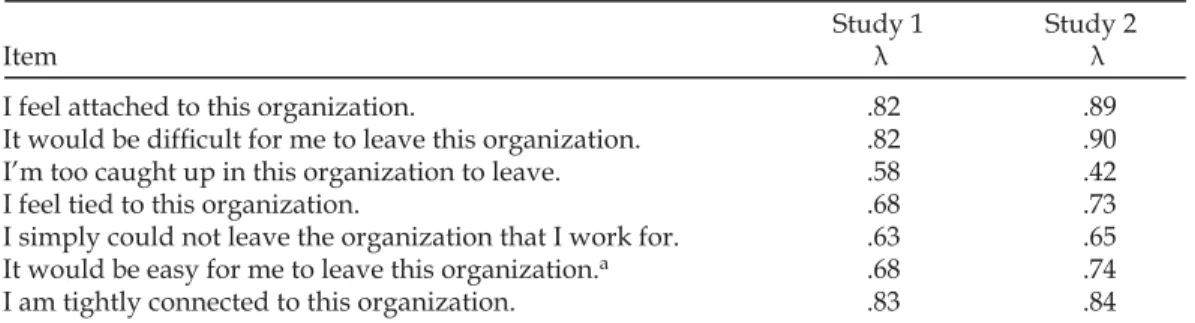
root-mean-square residual (SRMR) value of .04. The alpha internal consistency estimate for the scale was .89. Factor loadings are reported in Table 2.
Job satisfaction (Time 1A). Job satisfaction was measured with the eight-item Abridged Job in General Scale (Russell et al., 2004). Participants were asked to indicate whether adjectives and short phrases, such as “good” and “better than most,” de-scribed their job on a yes–no–? response format.
Job alternatives (Time 1A). Inasmuch as previous research has failed to converge on a single, commonly used measure of perceived job alternatives, the present study used the follow-ing three items based on Steel and Griffeth’s (1989) review of the job alternatives construct: “I know of several job alterna-tives that I could apply for,” “I have concrete alternative job
offers in hand,” and “It would be easy for me to find another
job that pays as well as my present job” (5 = strongly agree).
Job search intention (Time 2). Whereas previous research has typically assessed cognitive aspects of job search intentions, often at the same time as cognitive ratings of intentions to quit, the present study assessed behavioral manifestations of search intention via the six-item preparatory job search scale devel-oped by Blau (1994). Because search intentions are theoretically posited to occur after job dissatisfaction and before cognitive intentions to quit are formed, we adopted this measure to ad-dress preparatory job search actions that temporally spanned the 4 weeks between survey administrations. This provided an important methodological advance and was intended to re-duce spurious correlations that may occur when one simul-taneously assesses cognitive-based intentions to search and
cognitive-based intentions to quit. Participants were asked to indicate how much time they had spent on preparatory search activities, such as revising their resume, on a scale anchored at 1 = zero times and 5 = at least 10 times.
Intentions to quit (Time 2). Intentions to quit were assessed
with a five-item scale (Crossley, Grauer, Lin, & Stanton, 2002)
that was designed to avoid content overlap with measures of job search and job attitudes (Tett & Meyer, 1993). Participants responded on a 7-point scale (7 = strongly agree) to the follow-ing items: “I intend to leave this organization soon,” “I plan to leave this organization in the next little while,” “I will quit this organization as soon as possible,” “I do not plan on leav-ing this organization soon” (reverse scored), and “I may leave this organization before too long.”
Turnover (Time 3). Employee records provided data regard-ing whether participants remained with (n = 277) or had vol-untarily quit (n = 29) the organization 1 year after complet-ing the survey. To ensure that turnover was voluntary rather than the result of felt pressures to leave, we correlated turn-over with a four-item measure developed for this study (Time 1B; e.g., “I feel pressured into leaving this organization,” “My coworkers make me feel welcome and wanted here” [reverse scored]; 5 = strongly agree; = .69). The nonsignificant corre -lation (r = .07) suggested that those who left did not feel pres-sured to do so.
Control variables. In an effort to demonstrate discriminant validity of job embeddedness over organizational commit-ment, in the present study we measured (Time 1A) and sta-tistically controlled for empirical overlap between both affec-tive and continuance commitment and job embeddedness. We measured affective commitment using Meyer and Allen’s (1997) six-item scale composed of items such as “I would be happy to spend the rest of my career with this organization.” We measured continuance commitment with Meyer and Al-len’s six-item scale composed of items such as “One of the ma-jor reasons I continue working for this organization is that
leaving would require considerable personal sacrifice—an
-other organization might not match my overall benefits here”
(5 = strongly agree).
Results
Evidence of Construct Validity
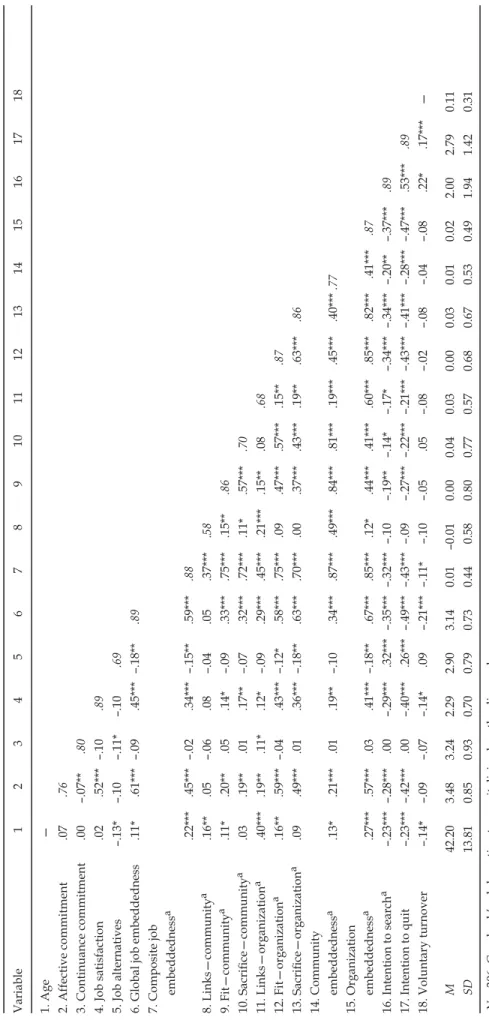
Table 3 displays descriptive statistics and intercorrelations between the study variables. Given that employees’ global per-Table 2. Factor Loadings of Global Job Embeddedness Items
Study 1 Study 2
Item λ λ
I feel attached to this organization. .82 .89
It would be difficult for me to leave this organization. .82 .90
I’m too caught up in this organization to leave. .58 .42
I feel tied to this organization. .68 .73
I simply could not leave the organization that I work for. .63 .65 It would be easy for me to leave this organization.a .68 .74
I am tightly connected to this organization. .83 .84
Study 1 reports factor weights from principal-axis exploratory factor analysis. Study 2 reports standardized
factor weights from confirmatory factor analysis via maximum-likelihood estimation.
Table 3.
Intercorrelations and Reliability Coefficients of Study Variables
Variable 1 2 3 4 5 6 7 8 9 10 11 12 13 14 15 16 17 18
1. Age — 2. Affective commitment
.07 .76 3. Continuance commitment .00 –.07** .80 4. Job satisfaction .02 .52*** –.10 .89 5. Job alternatives –.13* –.10 –.11* –.10 .69
6. Global job embeddedness
.11* .61*** –.09 .45*** –.18** .89
7. Composite job embeddedness
a .22*** .45*** –.02 .34*** –.15** .59*** .88 8. Links—community a .16** .05 –.06 .08 –.04 .05 .37*** .58 9. Fit—community a .11* .20** .05 .14* –.09 .33*** .75*** .15** .86 10. Sacrifice—community a .03 .19** .01 .17** –.07 .32*** .72*** .11* .57*** .70 11. Links—organization a .40*** .19** .11* .12* –.09 .29*** .45*** .21*** .15** .08 .68 12. Fit—organization a .16** .59*** –.04 .43*** –.12* .58*** .75*** .09 .47*** .57*** .15** .87 13. Sacrifice—organization a .09 .49*** .01 .36*** –.18** .63*** .70*** .00 .37*** .43*** .19** .63*** .86 14. Community embeddedness a .13* .21*** .01 .19** –.10 .34*** .87*** .49*** .84*** .81*** .19*** .45*** .40*** .77 15. Organization embeddedness a .27*** .57*** .03 .41*** –.18** .67*** .85*** .12* .44*** .41*** .60*** .85*** .82*** .41*** .87 16. Intention to search a –.23*** –.28*** .00 –.29*** .32*** –.35*** –.32*** –.10 –.19** –.14* –.17* –.34*** –.34*** –.20** –.37*** .89 17. Intention to quit –.23*** –.42*** .00 –.40*** .26*** –.49*** –.43*** –.09 –.27*** –.22*** –.21*** –.43*** –.41*** –.28*** –.47*** .53*** .89 18. Voluntary turnover –.14* –.09 –.07 –.14* .09 –.21*** –.11* –.10 –.05 .05 –.08 –.02 –.08 –.04 –.08 .22* .17*** — M 42.20 3.48 3.24 2.29 2.90 3.14 0.01 –0.01 0.00 0.04 0.03 0.00 0.03 0.01 0.02 2.00 2.79 0.11 SD 13.81 0.85 0.93 0.70 0.79 0.73 0.44 0.58 0.80 0.77 0.57 0.68 0.67 0.53 0.49 1.94 1.42 0.31 N =
306. Cronbach’s alpha estimates are italicized on the diagonal.
a Contain formative items; alpha is not particularly valid but provides some evidence of item relatedness within respective scales. * p <
.05 ; **
p <
.01 ; ***
p <
ceptions of being embedded are likely to be based on some, if not all, of the facets comprising the composite measure of job embeddedness, the pattern of moderate to strong correlations
between global job embeddedness and first-level organization
and community facets provides evidence of convergent valid-ity. The pattern of correlations between global embeddedness and community facets supports the notion that global
embed-dedness is based on reflections of community embedembed-dedness
and that although the global measure did not specifically as
-sess community-related issues, global reflections of embed
-dedness were, to some extent, based on community issues. Al-though global job embeddedness shared meaningful variance with community facets, the correlations were smaller than be-tween these facets and the composite measure, suggesting that community facets may be overweighted in the composite scale among some samples or that the whole is not equal to the sum of the parts. Consistent with prior conceptual arguments, global job embeddedness demonstrated stronger correlations with
specific community facets than did other forms of attachment
(i.e., job satisfaction, affective and continuance commitment, perceived alternatives, and intentions to quit), suggesting that embeddedness is a broader construct that incorporates commu-nity- and job-related issues. Beyond convergent relations with facet scales, the positive relations between global embeddedness and second-level facets of organization and community embed-dedness (rs =.67, .34, respectively) and the composite measure of job embeddedness (r = .59) offer additional evidence of
con-vergent validity. These findings suggest that people weigh or
-ganizational factors more heavily when assessing how attached they are to their organization. The sizable correlation with com-munity-related embeddedness provides additional support for the importance of nonwork factors in shaping employees’ per-ceptions of work attachment and supports notions of crossover effects. The strong correlation between global and composite embeddedness provides evidence that these measures converge on the same construct, but the correlation was not so large as to suggest complete overlap.
Although job embeddedness is not necessarily an affective construct, the positive correlations with job satisfaction (.45) and affective commitment (.61) and a negative relation with
perceived alternatives (−.18) are consistent with meta-analytic
findings regarding the affective underpinnings of job percep
-tions and attitudes (Thoresen, Kaplan, Barsky, Warren, & de Chermont, 2003), offering further evidence of convergent va-lidity. The positive correlations with satisfaction and affective commitment suggest that affect-related motives were among
the most common forms of attachment, consistent with find
-ings from Maertz and Campion (2004), but the correlations were not so large as to suggest that these measures were as-sessing the same construct. Continuance commitment was not
significantly related to either the composite or the global mea
-sure of embeddedness. Although meta-analytic findings have
failed to support consistent correlations between continuance commitment and other variables, such as turnover intentions
(correlations ranged from .00 to −.42; Allen & Meyer, 1996),
the absence of significant relations between continuance com
-mitment and job embeddedness in the present study contrasts
with previous findings (Mitchell et al., 2001). Notwithstanding
this somewhat peculiar finding, the overall pattern of correla
-tions with other variables provides support for convergent va-lidity and suggests that affective motives for attachment (e.g., job satisfaction, affective commitment) were strongly related
to how embedded people felt. Furthermore, the pattern and magnitude of correlations between global job embeddedness and Mitchell et al.’s (2001) facet and composite measures pro-vide strong epro-vidence of convergence between the original and global measures. In line with arguments forwarded by Ironson et al. (1989), the fact that third variables were more strongly related to global than to composite job embeddedness again suggests that the global whole is greater than the sum of the
composite parts. Although these findings together provide
substantial support for the global job embeddedness measure, hypothesis tests below place global job embeddedness within its nomological network of related variables and provide more rigorous tests of construct validity.
To provide evidence of discriminant validity, we subjected facet and global measures of job embeddedness, along with measures of job satisfaction, affective and continuance com-mitment, perceived job alternatives, and intentions to quit, to exploratory factor analysis. Because of the formative nature of the original job embeddedness measure and use of causal
indicators, a confirmatory factor analysis was inappropriate
(MacKenzie et al., 2005). Furthermore, given the rather low factor loadings of some items (less than .10) reported in pre-vious research (Mitchell et al., 2001), it is unlikely that a well
fitting confirmatory model would be attainable. A
principal-factors analysis with oblique rotation resulted in a 12-factor so-lution (eigenvalues > 1) that explained 54.3% of the total vari-ance. Items from each of the job embeddedness facets loaded on 6 factors that were predominately represented by items from the respective scales. In addition, items from the job sat-isfaction, affective and continuance commitment, perceived al-ternatives, and intention to quit scales generally loaded on 5 distinct factors, as expected. It is particularly noteworthy that the global job embeddedness items produced a unique factor that was distinct from all other measures. These results pro-vide initial epro-vidence of discriminant validity.
To provide further evidence of the distinction of job embed-dedness from organizational commitment and intentions to quit, we had 97 people (53% male; M age = 42.7, SD = 11.00) from a variety of occupations who had registered with the In-ternet surveying service Study Response (http://istprojects.syr. edu/~studyresponse/studyresponse/index.htm) complete a survey including the seven-item measure of job embeddedness, the six-item measures of affective and normative commitment, the eight-item measure of continuance commitment (Meyer &
Allen, 1997) and the five-item intention to quit scale. As seen in
Table 4, results from a principal-factors analysis found that the job embeddedness items loaded on a distinct factor. Further-more, the three forms of commitment largely loaded on sepa-rate factors, and intent to quit items also loaded on a unique fac-tor that was distinct from job embeddedness and commitment. That the job embeddedness factor accounted for the greatest
amount of variance generally confirms the notion that job em
-beddedness is a broader construct than specific motives of at
-tachment, such as calculative, affective, and normative reasons. Job embeddedness related positively to affective commitment (.74), continuance commitment (.25), and normative
commit-ment (.74) and negatively to intentions to quit (−.51, all ps < .05).
Although these correlations are strong enough to suggest con-vergence, results from the factor analysis and the fact that job
embeddedness predicted unique variance in quit intentions (β
= −.27, p < .05) over all three forms of commitment suggest that
Path Model and Test of Hypotheses
Because of the formative nature of the composite job em-beddedness scale, we tested the hypothesized model using path analysis via LISREL 8.5 (Jöreskog & Sörbom, 2001). Us-ing the guidelines offered by Anderson and GerbUs-ing (1988), we compared the hypothesized model and several
alterna-tive models prior to testing specific hypotheses. Analyses were conducted in the following four phases. In the first phase, a
traditional model of turnover was examined as a baseline. In the second phase, global and composite measures of job em-beddedness were included in the model, as outlined by study hypotheses and to assess convergent validity. In the third phase, control variables were entered into the model to en-sure that effects of job embeddedness were robust and to dem-onstrate discriminant and predictive validity over existing
attachment constructs. In the fourth phase, specific study hy
-potheses were examined in the ultimately best fitting model,
which was generated guided by theory, study hypotheses, and model comparisons.
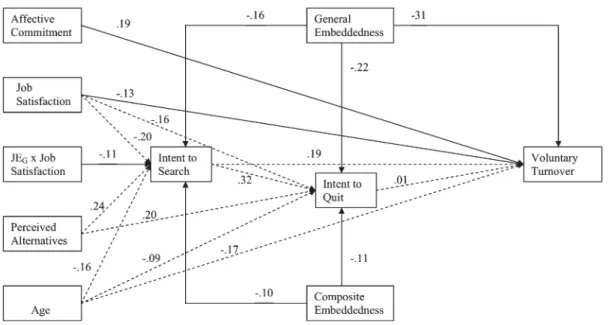
Phase 1. To ensure that a well fitting model was ultimately possible, we specified a traditional model of turnover on the
basis of Bannister and Griffeth’s (1986) and Sager, Griffeth, and Hom’s (1998) revised version of the Mobley et al. (1978) model. This traditional model (see Figure 1) demonstrated
good fit to the data, χ2(2, N = 306) = 5.96, p > .05
(root-mean-square error of approximation [RMSEA] = .08, SRMR = .03,
CFI = .98, adjusted goodness-of-fit index [AGFI] = .93), and
explained 21% of the variance in intention to search, 37% of the variance in intention to quit, and 15% of the variance in voluntary turnover.
Phase 2. In line with the study hypotheses, composite and global measures of job embeddedness were entered into the
model, and direct paths were specified between these mea
-sures and turnover-related variables. In line with the buffering
hypothesis, a path was also specified between the mean-cen
-tered interaction term of job satisfaction and global embed-dedness and subsequent intention to search. This
hypothe-sized model demonstrated a very good fit to the data, χ2(4, N =
306) = 6.80, p > .05 (RMSEA = .05, SRMR = .01, CFI = .99, AGFI = .94), and explained an additional 5% of the variance in intent to search, 6% in intent to quit, and 5% in voluntary turnover, over the variables included in the traditional model. These
findings provide initial support for the predictive validity and
practical utility of the job embeddedness measures.
Although the omnibus addition of these paths significantly
enhanced prediction of the model, some direct paths might have been unnecessary in conjunction with possible indirect ef-fects. Therefore, in accordance with common theory-trimming practices (Anderson & Gerbing, 1988; Mayer & Gavin, 2005), we independently tested each of the four direct links between global and composite job embeddedness, on the one hand, and subsequent intentions to quit and turnover, on the other, by removing each link in isolation and comparing each reduced model with the model containing all four paths. These results are summarized in Table 5 and suggest that the direct link be-tween composite embeddedness and turnover did not enhance the model. This link was therefore eliminated. All other paths were retained in a revised hypothesized model that
demon-strated improved model fit, χ2(5, N = 306) = 10.02, p > .05
(RM-SEA = .06, SRMR = .02, CFI = .99, AGFI = .93).
Phase 3. To provide a more rigorous test of the predictive validity of job embeddedness and in an effort to demonstrate further evidence of discriminant validity from existing job at-titude and turnover-related variables, we added control vari-ables to the model as follows. First, six direct paths between
affective and continuance commitment were specified to in
-tention to search, in-tention to quit, and voluntary turnover.
Next, two paths were specified between both job satisfac
-tion and perceived alternatives, on the one hand, and volun-tary turnover, on the other. This control model demonstrated
a good fit to the data, χ2(3, N = 306) = 8.50, p > .05 (RMSEA =
.08, SRMR = .02, CFI = .99, AGFI = .89), but did not enhance
prediction over the revised hypothesized model, χ2(2, N =
306) = 1.52, p > .05.
To systematically test and remove nonsignificant control
variables in favor of a more parsimonious and theoretically Table 4. Results of Exploratory Factor Analysis of Job
Embeddedness, Organizational Commitment, and Intentions to Quit
Factor
Item GJE CC ITQ NC RS AC AC1 .30 –.48 AC2 .38 –.33 AC3 .47 AC4 .32 .56 AC5 .60 AC6 .75 CC1 .71 CC2 .53 –.34 CC3 .74 CC4 .80 CC5 .68 CC6 .85 CC7 .54 CC8 .66 NC1 –.40 –.38 NC2 –.47 NC3 –.71 NC4 –.70 NC5 –.70 NC6 –.58 GJE1 .37 GJE2 .60 GJE3 .62 .42 GJE4 .76 GJE5 .68 GJE6 .71 GJE7 .62 ITQ1 .90 ITQ2 .72 ITQ3 .81 ITQ4 .91 ITQ5 .73 Eigen 12.1 4.0 2.5 1.3 0.8 0.7 Δσ 37.7 12.4 7.7 4.0 2.6 2.2
Values less than .30 are not displayed. GJE = global job embeddedness; CC = continuance commitment; ITQ = intent to quit; NC = normative commitment; RS = reverse-scored item factor; AC = affective commitment; Eigen = eigenvalue.
derived model, we compared this model with each of eight separate models that removed a single direct path in isolation. As seen in Table 5, only the two paths from control variables
to turnover significantly enhanced model fit. None of the pre
-viously significant paths between job embeddedness and turn
-over-related variables became nonsignificant in the presence of
control variables. These findings suggest that job embedded
-ness significantly predicted voluntary turnover over job sat
-Figure 1. Traditional and final models of voluntary turnover. Values represent standardized path weights. All values are
printed above respective paths, with the exception of the path from intent to search and intent to quit. Dashed lines
repre-sent paths in Mobley et al.’s (1978) original model of voluntary turnover, and solid lines reprerepre-sent the final model of volun -tary turnover. For all values greater than .08, p < .05; for values greater than .16, p < .01. JEG = global job embeddedness.
Table 5. Results of Structural Nested Model Comparisons
Model χ2 df RMSEA SRMR CFI AGFI Δχ2 (df)
MTR 5.96 2 .081 .025 .98 .93 MH 6.80 4 .048 .013 .99 .94
MH – JEComp → ITQ direct path 10.97 5 .063 .023 .99 .93 4.17 (1)a
MH – JEComp → TO direct path 10.02 5 .058 .024 .99 .93 3.22 (1)
MH – JEGen → ITQ direct path 20.45 5 .102 .029 .97 .87 13.65 (1)a
MH – JEGen → TO direct path 25.52 5 .117 .039 .96 .84 18.72 (1)a
MHR 10.02 5 .058 .024 .99 .93 3.22 (1) MC 8.50 3 .079 .016 .99 .89 MC – JS → TO direct path 13.28 4 .088 .023 .99 .87 4.78 (1)a MC – PA → TO direct path 8.53 4 .062 .016 .99 .92 0.03 (1) MC – AC → TO direct path 14.58 4 .094 .020 .99 .86 6.08 (1)a MC – CC → TO direct path 11.57 4 .080 .019 .99 .89 3.07 (1)
MC – AC → ITQ direct path 10.28 4 .073 .017 .99 .90 1.78 (1)
MC – CC → ITQ direct path 8.53 4 .062 .016 .99 .92 0.03 (1)
MC – AC → ITS direct path 8.79 4 .063 .017 .99 .91 0.29 (1)
MC – CC → ITS direct path 8.86 4 .064 .017 .99 .91 0.36 (1)
MF 10.31 6 .049 .019 .99 .94 1.81 (1)
The traditional model (MTR) is depicted by dashed lines in Figure 1. The hypothesized model (MH) consists of MTR plus three direct paths from composite job embeddedness (JEComp) to intention to search (ITS), intention to quit (ITQ), and turnover (TO); three direct paths from general job
embeddedness (JEGen) to ITS, ITQ, and TO; and a direct path from Job Satisfaction (JS) × JEGen to ITS. The revised hypothesized model (MHR) is composed of MH minus the direct path between composite job embeddedness and turnover. The control model (MC) is composed of MHR plus three direct paths from affective commitment (AC) to ITS, ITQ, and TO; three direct paths from continuance commitment (CC) to ITS, ITQ, and TO; and
two direct paths from perceived alternatives (PA) and JS to TO. The final model (MF) is composed of MH plus two direct paths from JS and from AC
to TO. RMSEA = root-mean-square error of approximation; SRMR = standardized root-mean-square residual; CFI = comparative fit index; AGFI = adjusted goodness-of-fit index.
isfaction, perceived alternatives, and organizational commit-ment, thereby providing additional evidence of discriminant and predictive validity. To examine hypotheses beyond these
control variables, we specified a final model (see Figure 1) that
incorporated the revised hypothesized model plus the two di-rect paths from satisfaction and affective commitment to
vol-untary turnover. This final model provided an excellent fit to
the data, χ2(6, N = 306) = 10.31, p > .05 (RMSEA = .05, SRMR =
.02, CFI = .99, AGFI = .94).
Test of Hypotheses
Hypotheses were tested in the final model, which included the hypothesized relations and significant control variables.
Hypothesis 1A suggested that job embeddedness would pre-dict intentions to search and to quit over job satisfaction and perceived alternatives. The global measure of embeddedness
predicted intent to search (β = −.16, p < .01) and intent to quit
(β = −.22, p < .01), whereas the composite measure predicted
intention to quit (β = −.11, p < .05). The composite measure of
job embeddedness did not predict intent to search (β = −.10, p
> .05) in the presence of the global measure and control vari-ables. Hypothesis 1B suggested that job embeddedness would predict turnover after job satisfaction, perceived alternatives, and intentions to search and to quit were controlled. This hy-pothesis was partially supported, as global job
embedded-ness had a significant and direct relation (β = −.31 p < .01) with
turnover after these variables were controlled. However, the
composite measure did not enhance model fit over these vari
-ables and was omitted from the model in earlier stages of test-ing. It is important to note that this model also controlled for the statistical overlap between global and composite measures of embeddedness and may provide an overly conservative test of this hypothesis. Together, the similar pattern and direction of relations between global and composite measures and sub-sequent turnover-related variables provides evidence of con-vergent validity.
Hypothesis 2 suggested that global job embeddedness would predict variance in intent to search, intent to quit, and turnover over the composite measure of job embeddedness.
Results confirmed this notion, as global job embeddedness predicted unique variance in intent to search (β = −.16), intent
to quit (β = −.22), and voluntary turnover (β = −.31, all ps <
.01) after composite job embeddedness and other antecedents and control variables were taken into account.
Hypothesis 3 suggested that global job embeddedness would interact with job satisfaction to predict intention to
search. Although the joint term predicted intent to search (β
= −.11, p < .05), the nature of this interaction was not as
orig-inally anticipated. Figure 2 displays the relationship between job satisfaction and intentions to search for participants who were one standard deviation above or below the mean on gen-eral job embeddedness. Analysis of the simple slopes in each
group indicated that job satisfaction was significantly and neg
-atively related to intent to search for employees with high job
embeddedness (β = −.39, p < .01), but there was a nonsignifi
-cant relationship between these variables for employees with
low job embeddedness (β = −.13). Whereas people who re
-ported low levels of job embeddedness engaged in more pre-paratory search activity than people with high embeddedness scores, as would generally be expected, the relation between satisfaction and search intention was negative rather than
neu-tral among highly embedded employees. This finding suggests
that job embeddedness does not prevent dissatisfied employ
-ees from intending to search for alternative employment. Rather, a lack of embeddedness was associated with greater search intentions regardless of satisfaction levels.
Discussion
In this study, we have developed a global measure of job embeddedness and integrated this construct into a tradi-tional model of turnover. We found that the global measure predicted unique variance in intentions to search, intentions to quit, and voluntary turnover, even after we controlled for empirical overlap in the composite measure of embeddedness and other core variables commonly used to explain turnover. Aside from direct relations between embeddedness and turn-over that support prior research (Lee et al., 2004; Mitchell et al.,
2001), the significant interaction with satisfaction contrasts ear
-lier conclusions by Mitchell et al. (2001) that “because job
em-beddedness correlates significantly with search behaviors…, it
can be inferred that highly embedded people search less” (p. 1117). Findings from the present study suggest that this
state-ment be qualified such that highly embedded and satisfied
people search less. Findings also suggest that job embedded-ness may prohibit decision processes that often precede voli-tional separation and can be meaningfully integrated into tra-ditional models of turnover.
Although these findings suggest that both composite and
global measures of embeddedness predict meaningful vari-ance in turnover, the choice of measures in subsequent re-search is best made in the context of the particular study. For instance, the more contextual nature of the composite measure
may help reduce concerns of percept–percept inflation in
self-report, cross-sectional studies. Conversely, the global measure is of greater utility when one is testing models of turnover us-ing latent variables or when survey length is a concern. Us-ing both scales together avoids issues of sUs-ingularity between facets and global embeddedness and allows an examination of the relative weight of each facet in overall impressions of embeddedness.
Practical Implications
Whereas global embeddedness proved useful in predict-ing intentions to search and quit as well as voluntary
turn-over, organizations may benefit from helping employees feel
Figure 2. The interaction of general job embeddedness and job
connected at work and at home. Related to community em-beddedness, work parties and informal get-togethers that pro-mote community attractions and leisure activities may help people bond to the community, thereby having an impact
be-yond the obvious social benefits. Organizations that offer flex
-ible scheduling and family friendly programs may further en-hance employee embeddedness by strengthening employees’ social bonds to others within the community. Beyond social exchange and organizational support, this may help explain
why companies with such benefits experience lower turnover.
One potential downside of job embeddedness that warrants consideration is that people who feel stuck in an unfavorable job may lose motivation, experience frustration, and even en-gage in counterproductive workplace behaviors.
Limitations and Future Research
There are several limitations to the present study that should be taken into consideration. One limitation is the reli-ance on a questionnaire study and convenience samples.
Al-though artificially inflated relationships due to percept–per
-cept and common method biases can often lead to invalid conclusions, common method bias inherent in self-report sur-veys actually provided a more conservative test of some study hypotheses, as job embeddedness was found to uniquely pre-dict voluntary turnover over job satisfaction, organizational commitment, behavioral intentions, and empirical overlap in these variables due to common method variance.
Further-more, the significant interaction between job satisfaction and
embeddedness in predicting intention to search helps mitigate
concerns of percept–percept inflation. Although convenience
samples were used to provide evidence of construct validity, the emergence of similar results across studies helps reduce concerns of limited generalizability. Nevertheless, we recog-nize that construct validity is never accomplished in a single study and that future research is needed to replicate results across other samples, organizations, work contexts, and study designs.
It is essential to recognize that although the longitudinal nature of the study offers support for the direction of relations among the study’s variables, assumptions of causality cannot be made because of the potential existence of common third variables, many of which we attempted to control. Another limitation is that results from this study are based on relatively subtle adjustment of Mobley et al.’s (1978) traditional model of
turnover and the specific measures used in previous research.
Adaptations to the model and measures were based on subse-quent research conducted in more recent years (e.g., Bannis-ter & Griffeth, 1986; Steel & Griffeth, 1989). Nevertheless, it is
difficult to distinguish the extent to which these differences
might have affected the study results. Finally, although
re-moval of nonsignificant paths is a common theory-trimming practice, this may lead to sample-specific findings. Although
we took caution to modify the model according to theory and
previous empirical findings, additional research is necessary before we can place full confidence in the final model derived
in this study.
Because global perceptions of job embeddedness are largely
subjective and may be influenced by people’s predispositions
and cognitive frames, future research may examine individual differences that relate to impressions of being embedded. For instance, trait negative affectivity is marked by a tendency to dwell on negative aspects of the self and world. People who
are high in this trait may underestimate the number of
alterna-tive jobs or their value to prospecalterna-tive employers, thereby influ
-encing the extent to which they feel stuck in their job. Another personality trait that may be relevant in the study of embed-dedness and turnover is a need for achievement. Along these lines, engineers, accountants, and middle managers with high need for achievement have been found to have higher mobil-ity rates (Hines, 1973). Perhaps high achievers are less likely to perceive themselves as embedded, or they may have a height-ened interest in searching for ways to advance outside of the organization.
Conclusion
This study offers initial evidence of the validity of a global measure of job embeddedness. This measure overcomes sev-eral limitations of the original composite scale and predicted additional variance in voluntary turnover beyond the com-posite measure of embeddedness and over core constructs
in-cluded in traditional models of turnover. Together, these find
-ings provide initial evidence of construct validity and highlight the importance of examining job embeddedness as a unique contributor to decision-making processes. Moreover, this mea-sure is useful for researchers interested in studying the role of general attachment in broader theories of job mobility.
References
Allen, N. J., & Meyer, J. P. (1990). The measurement and anteced-ents of affective, continuance, and normative commitment to the organization. Journal of Occupational Psychology, 63, 1–18. Allen, N. J., & Meyer, J. P. (1996). Affective, continuance, and
nor-mative commitment to the organization: An examination of construct validity. Journal of Vocational Behavior, 49, 252–276. Anderson, J. C., & Gerbing, D. W. (1988). Structural equation
mod-eling in practice: A review and recommended two-step ap-proach. Psychological Bulletin, 103, 411–423.
Bannister, B. D., & Griffeth, R. W. (1986). Applying a causal an-alytic framework to the Mobley, Horner, and Hollingsworth (1978) turnover model: A useful reexamination. Journal of Man-agement, 12, 433–443.
Blau, G. (1994). Testing a two-dimensional measure of job search behavior. Organizational Behavior and Human Decision Processes,
59, 288–312.
Breaugh, J. A., & Colihan, J. P. (1994). Measuring facets of job am-biguity: Construct validity evidence. Journal of Applied Psychol-ogy, 79, 191–202.
Crossley, C. D., Grauer, E., Lin, L. F., & Stanton, J. M. (2002, April).
Assessing the content validity of intention to quit scales. Paper pre-sented at the annual meeting of the Society for Industrial and Organizational Psychology, Toronto, Ontario, Canada. Crossley, C. D., & Stanton, J. M. (2005). Negative affect and job
search: Further examination of the reverse causation hypoth-esis. Journal of Vocational Behavior, 66, 549–560.
Endler, N. S., Macrodimitris, S. D., & Kocovski, N. L. (2000). Con-trollability in cognitive and interpersonal tasks: Is control good for you?Personality and Individual Differences, 29, 951–962. Fishbein, M., & Ajzen, I. (1975). Belief, attitude, intention, and
be-havior: An introduction to theory and research. Reading, MA: Addison-Wesley.