University of Nebraska - Lincoln
DigitalCommons@University of Nebraska - Lincoln
Library Philosophy and Practice (e-journal) Libraries at University of Nebraska-Lincoln
5-2018
User Engagement with Social Media, Implication
on the Library Usage: A Case of Selected Public
and Academic Libraries in Malaysia
Sharyna Shafawi
Basri Hassan
International Islamic University - Malaysia, [email protected]
Follow this and additional works at:https://digitalcommons.unl.edu/libphilprac
Part of theInformation Literacy Commons, and theScholarly Communication Commons Shafawi, Sharyna and Hassan, Basri, "User Engagement with Social Media, Implication on the Library Usage: A Case of Selected Public and Academic Libraries in Malaysia" (2018).Library Philosophy and Practice (e-journal). 1820.
1
University of Nebraska - Lincoln
DigitalCommons@University of Nebraska - Lincoln
Library Philosophy and Practice (e-journal) Libraries at University of Nebraska-Lincoln
May 2018
User Engagement with Social Media, Implication on the Library Usage: A Case
of Selected Public and Academic Libraries in Malaysia
Sharyna Shafawi
International Islamic University Malaysia, [email protected] Basri Hassan
International Islamic University Malaysia, [email protected]
ABSTRACT
The mainstream use of social media has impacted the library as it has been identified to be an efficient platform for libraries to foster networking and enhance engagement with their user community. The unique characteristics of social media with „high tech‟, „interactive‟ blend with the „human touch‟ give a valuable means for libraries to provide information resources and services beyond their physical walls. However, despite its widespread usage, an engagement rate on social media is still low among library users and evaluation of social media use is still elusive and scarce in the library literature. Prior studies have yet to reveal to what extent the presence of social media triggers users‟ awareness and influence their engagement. Subsequently, how it further impacts the actual library usage among end-users. Therefore, the present study attempts to investigate the factors that drive users‟ engagement with social media and further examine the relationship of users‟ engagement with social media and actual library use from both users and librarians‟ perspectives. A mixed method approach was employed, and the study population consists of selected State Public and Academic Libraries in Malaysia. The integration of DeLone
2
and McLean‟s Information Systems Success Model (ISSM), Perceived Interactivity (PI) and Consumer Online Engagement (COE) models were adapted to establish the direction of the research. A total of 334 respondents which consisted of library users; and 11 interview participants comprise of professional librarians. The statistical data was analysed using SPSS and SmartPLS, while thematic analysis was employed for the qualitative approach. The findings indicated that Information Quality, Perceived Interactivity, and Perceived Net Benefit have empirically proven to be significant predictors of users‟ engagement with social media. The study also revealed that two dimensions of online engagement (affective and behavioural) have a positive and statistically significant effect on actual library use; while cognitive engagement proves to be insignificant. The study is significant in providing libraries a holistic overview about determinants of social media engagement and offers guidelines on evaluation of library social media. It also explored the potential and gauges the prospective areas of improvement for harnessing the use of library resources and services in meeting users‟ ever-changing needs. Finally, the study proposed a framework for social media engagement evaluation for libraries which act as a benchmark to determine the best social media platforms to be adopted by libraries. Furthermore, the proposed criteria can be applied to increase users‟ awareness and greater users‟ engagement of library services.
Keywords: Social media engagement, Public Libraries, Academic Libraries, Social networking, Information Systems Success Model, Perceived Interactivity, Consumer Online Engagement, Library Use.
3
1) INTRODUCTION
Recent years, the adoption of social media is widespread across various organizations. This owes to the fact that social media has proven to be an effective platform for interactive communication, information distribution and dissemination, promotion and marketing of library collections, services and library events as well as for online customer service platform. The huge impact of social media application has enabled the information institutions especially libraries and resource centres to keep abreast with the new technology given its potential benefits and to reach out to library users and potential ones with minimal efforts. It is widely stated in literature that the adoption of social media is extensively implemented in businesses and commerce organizations especially for the purpose of marketing and rebranding a company‟s products and services (Xiang & Gretzel, 2010). As time changes, social media has become the trendsetter in multiple disciplines ranging from marketing, business, environment, health, politics, technology and entertainment to the education industry. In fact, libraries as non-profit organizations have embraced Web 2.0 technologies to facilitate the marketing efforts of library collection, information resources and services. It also considered as the easiest way to update library outreach programs, exhibitions and can be used as online customer services and interactive feedback platform. The convenient use of Web 2.0 environment allows libraries to utilize various social media channels such as Facebook, Twitter, MySpace, Blogs, Widgets, You Tube, Flickr, Instagram and etc. Social media has become an effective information dissemination tool which requires minimal effort in order to be utilized by libraries for marketing their informational resources and cultural efforts.
Despite the budget and resource constraints faced by libraries, coupled with the fact that there is abundance of information which is easily accessible on the internet, libraries need to strive to meet up with the expectation of their users in terms of providing their ever changing needs. Hence, libraries should optimize the power of social media in order to give room for interactive communication with the library users and public in an online environment. As stated in the
4
Ranganathan Law of Library Science, Library is a „growing organism‟ as the role of library in the new century is beyond the its concrete wall and physical building. Hence the library has to mobilize its role and function to keep growing by utilizing the latest technology in order to justify their presence and sustainability of library services among society. Furthermore, social media has the potential of improving the image of the library and improving the users‟ experience. Leveraging social media in library has brought about: 1) a continuous increase in library web site traffic and foot traffic to the physical library; 2) greater outreach of the promotion of reading and literacy awareness programs; 3) increased involvement of the users in library activities and 4) enhance the library community building.
Libraries have acknowledged the importance of social media technology in the effort to complement the way of libraries in increasing level of user engagement towards library and its services (Awang, 2013). In line with the rapid growth of digital resources; libraries today are embracing various social media technologies to better serve online experiences to their library community. Through these media, users can be constantly informed about the library programmes, the events that are occurring; the collections, facilities and services offered in the library. Consequently, users can be alerted and further react into necessary actions based on their interests and needs. As such through using Web 2.0 application or social media the library can be visited (virtually) at any time or at any place. Previous empirical studies have shown that social media tool has become a powerful platform for networking and engagement, information sharing and marketing channel for libraries to embark upon. In actual fact, with its reliability, the social media has become a significant tool for marketing which opens wide opportunities for companies and organization in reaching their target consumer efficiently. Besides, the adoption of social media in marketing can not only stand alone, rather it has the potential of complementing the traditional and conventional marketing. In order to accomplish the role of the library as information hub to the society as well as the with the ever challenging information needs and expectations of users,
5
librarians need to equip themselves by acquiring the necessary skills for applying new technology and applications to support and complement the traditional way of marketing the library.
2) STATEMENT OF PROBLEM
Prevalent use of social media has influenced libraries as an information provider to leverage its usage to keep abreast with the latest trends to improve their information services and the delivery system. Due to the substantial use of social media, the library has embraced this technology and its application to achieve specific objectives. However, the widespread adoption of social media tools in libraries, the extent of social media engagement and the behavioural outcomes that has impacted use of library resources and services remained unaddressed empirically in earlier studies. Beyond its presence in libraries, to what extent have social media tools potentially attracted user awareness, grabbed their attention and engagement and consequently influenced their attitude and behavioural outcomes towards use of library services are yet to be explored. It was clearly stated in the literature, library has embraced social media technologies for various purposes, and nonetheless library users are still lack of awareness about the availability and usefulness of the application. Some studies revealed that the adoption rate of web 2.0 in libraries is still not satisfying. Public and school libraries were reported been slow on their commitment with regard to social media use (Khalid & Richardson, 2011; Shi & Chan, 2011). Smeaton and Davis (2014) also stated that libraries have been quick in embracing social media technologies, however, there has been scarce exploration of how successful these social media application has met the library objectives and whether social media is being used to drive a participatory services and foster engagement among library users are remained unclear or yet been empirically addressed by prior study.
Furthermore, despites social media presence, how do libraries evaluate the success of their social media activities? How do they decide if a particular channel is working for the library and
6
worthy of investment? Empirical evidences which demonstrate the potential and actual impact of social media engagement in library setting are very scarce from previous studies. Moreover, very limited empirical investigation has been done on actual impact of social media use, viz-a-viz whether social media truly enhance overall user experience and would generate return on investment or return on engagement (Ajay, Lisa & Robert, 2015; Kim & Nitecki, 2014). Thus, drawing attention from previous literature has triggered the researcher to investigate social media phenomena especially in the library context by highlighting these issues: Are the library users aware of the existence of social media tools in libraries? If they are aware, do they engage in its use? If they do, what are their perceptions, attitudes and ultimately the behavioural outcomes towards library and its services? Do they gain benefit from the engagement in this new media? Addressing these issues is pertinent because the presence of the tools without engagement is worthless. Engagement in social media is considered as success indicator for social media implementation, nonetheless interactive participation is a major concern in the web 2.0 environment. Every technology adopted the assessment of its effectiveness or impact need to be investigated from both the receiver perspectives (user) and the provider perspectives (library) in order to monitor and track its performance whether it meet the objectives or vice versa. Thus, this study is imperative to fill the gap in the existing frameworks and empirical findings that are lacking on social media engagement with its subsequent impact on both perspectives (user and library) particularly in the Malaysian library context. Accordingly, this study attempts to add into existing literatures by exploring and finds suitable solutions in providing additional empirical evidence on factors of user engagement with social media and user behavioural outcomes in relation to the library use.
7
3) AIM OF THE STUDY
The ultimate aim of this study is to investigate the factors that contribute to the users‟ engagement with library sites and further examine the subsequent impact of user engagement with these media towards library usage.
.
4) RESEARCH OBJECTIVE
The study aims to address the following research objectives:
1. To investigate the factors that contribute to users engagement with library social media sites and further examine the explained relationship between the constructs;
2. To examine the relationship between users engagement with social media and actual library
use;
3. To elicit the librarian‟s opinions and perceptions of social media engagement in relation to the library usage;
5) SIGNIFICANCE OF THE STUDY
The study is significant in providing libraries a holistic overview about determinants of social media engagement and offers guidelines on evaluation of library social media. It also explored the potential and gauges the prospective areas of improvement for harnessing the use of library resources and services in meeting users‟ ever-changing needs. Finally, the study proposed a framework for social media engagement evaluation for libraries which act as a benchmark to determine the best social media platforms to be adopted by libraries. Furthermore, the measurement scale of users‟ engagement in social media as proposed may add into the body of literature which is relatively scarce in the library field. This scale can be replicated and used in further studies.
8
6) RESEARCH QUESTIONS
The study aims to answer the following research questions as stated below:
1. What are the factors that influence user to engage with social media channels provided in the library?
2. To what extent does users‟ engagement with social media influence actual library use? 3. What are the librarian‟s perceptions of users‟ engagement with social media channels in
relation to the library usage?
7) REVIEW OF LITERATURE
Social Media Adoption in Libraries
Extensive literatures were published on the social media application in the libraries. Previous studies revealed the importance and purpose of social media implementation is to connect with library users and to make library programs and services accessible (ALA, 2001); provides general university news and library events, announcement of new books (Linh, 2008); useful for education and research purposes (Chand, Suman & Nirmalendu, 2008); marketing the library resources and services and to interact with online users (Braziel, 2009; Hendrix and Zafron, 2009; Rogers, 2009; Blakeman and Brown, 2010). Similar attempt by Khan & Bhatti (2012) which reported that social media is important to capture the attention of online users and helps in distance learning and knowledge sharing. Li et al. (2012) further identified marketing of library resources as the most notable achievement of many libraries that have adopted social media. Furthermore, Palmer (2014) has reported that social network advertising is effective in promoting the library at minimal financial cost and its usage is substantial to complement their existing marketing efforts. Alkindi & Al-suqri (2013) further reported that most public libraries use Facebook as a place for marketing themselves and promotes their collections and services.
9
In relation to the benefits or impact of using social media, prior literatures found the libraries experiencing a gradual increase in library communities such as increase number of followers. Twitter was also found to have higher conversion (click through) rate than Facebook. Taylor and Francis (2014) highlighted that the social media has positive potential to increase engagement between users and library staff and an effective outreach tool which helps librarians to promote the work of their faculty and to connect with broader library community. It was seen as a tool for informal learning and has the potential of encouraging participation (Xie & Stevenson, 2014).
Users Engagement with Library Social Media
Previous studies have shown the positive impact of users‟ engagement with social media on harnessing library use and establish a networking with library community. Social media tools especially Facebook was found applicable in engaging to college students especially in libraries (Mack, Behler, Roberts & Rimland, 2007). Graham (2009) affirmed that Facebook had facilitated the development of professional relationships in and beyond libraries. O‟Dell (2010) further highlighted that social networking sites (SNS) provide an innovative and effective way of connecting users. Despite these results, Cuddy et al. (2010) believed that Twitter is a potential tool for libraries to engage with users and receive informal questions and feedback. This is also supported by Milstein (2009) highlighted that the libraries use Twitter to connect themselves with important information sources. Regardless of social media potential in enhancing users‟ relationship and connection with the library however, users‟ attitudes towards using SNS to encourage interaction for educational purposes are not very supportive as reported by several previous studies. On this note, Coyle and Vaughn (2008) claimed that students still believe that SNSs are used mainly for communicating with friends, and not suitable for educational purposes. Pempek, Yermolayeva and Calvert (2009) also stated that students do not use Facebook to contact
10
university personnel. Similarly, according to Chu and Johnson (2008) students were found to be uninterested to interact with faculty through SNSs.
It is important to note that, the rate of users‟ engagement with library social media sites still low. This is evident from the work of Jacobson (2011) which discovered there were only few users‟ responses on a number of libraries‟ fan pages, and libraries‟ Twitter accounts only have a few followers (Stuart, 2010). Chu (2009) further added that a low participation rate was found on use of Wiki in six of 21 academic libraries. It is important to note that, the libraries having difficulty in determining the patrons using the library‟s SNSs tool are among new library users or existing patrons (Sekyere, 2009). In view of this, the libraries should decide on their definition of social media success. Is the goal aims to attract new users into the library? or does it to keep users informed about library matters and engaged with libraries? Though the libraries can define and determine their measures of social media success, the usage rates are need to be monitored to determine whether the library meet its goals or vice versa. Therefore, the present study attempts to investigate the factors that contribute to the users‟ engagement with library sites and further investigates the relationship of users‟ engagement with social media on the library usage.
Research Model
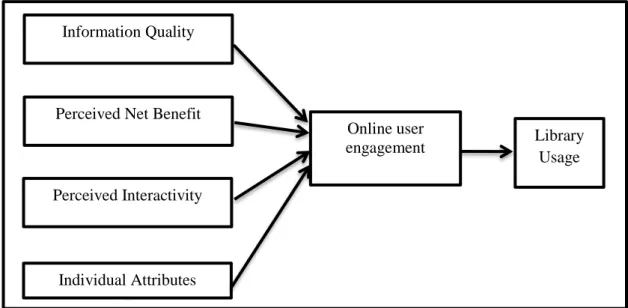
The study aims to explore the factors that motivate user engagement with social media and to test the proposed conceptual model on user engagement in social media channel that consequently has an impact on user perception and behavioural outcomes towards actual use of the library. The framework integrates theories and models from information system, communication and engagement model. Proposed components of user engagement in social media are lies on the four interrelated main constructs that consists of i) individual traits (competency, skills, interest, experience, preference) ii) information qualities factors (accuracy, relevance, trustworthy, timeliness, accessibility authoritative) iii) the perceived interactivity and iv) perceived net benefits
11
factors as presented in the Figure 1. The study further explores the dimensions of engagement which derived from cognitive, affective and behavioural in relation to its impact on library usage as an outcome of users‟ engagement with library social media.
Figure 1: Research Model
8) RESULTS AND DISCUSSIONS
Demographic Information
The demographic profile of respondents consists of gender, age, educational background, position and library membership. A total of 334 respondents comprising library users of selected public and academic libraries in Malaysia participated in the survey. Table 1 summarises the demographic information of the respondents in the study.
Information Quality Individual Attributes Perceived Interactivity Online user engagement Library Usage Perceived Net Benefit
12
Table 1 Demographic Profile of the Respondents
Variables Frequency (n) Percentage % Gender Male 73 21.9 Female 261 78.1
Age group Less than 20 years 125 37.5
21-30 years 170 51
31-40 years 25 7.5
41-50 years 11 3.3
More than 50 years 3 0.9
Educational background Primary 3 0.9 Secondary 73 21.9 Bachelor‟s Degree 169 50.6 Master Degree 39 11.7 PhD 8 2.4 Others 42 12.6 Designation Student 282 84.4 Academics 11 3.3 Public 25 7.5 Non-Academic Staff 11 3.3 Others 5 1.5
Library Membership Public Library 155 46.4
Academic Library 179 53.6
(n=334)
Table 1 presents the distribution of respondents according to their demographics profile. The sample comprised of 261 (78.1%) females and 73 (21.9%) males. Participants‟ ages ranged from 17 years to 50 above. Majority (51%) of the participants were of ages between 21 and 30 years and the lowest (0.9%) were those more than 50 years old. In total, 169 (50.6%) of the respondents were Bachelor Degree holders, followed by 73 (21.9%) who were secondary school, 12.6% from others. In terms of the respondents‟ educational background, 39 (11.7%) and 8 (2.4%) were Master and Phd holders respectively while 3 (0.9%) had primary education. In terms of the designation of respondents, 282 (84.4%) of respondents were students, followed by 25 (7.5%) were public, 11 (3.3%) were Academics and Non-Academic Staff respectively and 5 (1.5%) of them belong to the “others” category. In total, 179 (53.6%) of respondents were from Academic Libraries while 155 (46.4%) were from Public Libraries.
13
Background of Library Users on their Use of Social Media A) Preferred Social Media Channels
Table 2 Number of Respondents based on Types of Social Media Use
Type of Social Media Yes No
Facebook 235 (70.4%) 99 (29.6%) Twitter 151 (45.2%) 183 (54.8%) Blog 54 (16.2%) 280 (83.8%) You Tube 239 (71.6%) 95 (28.4%) Flickr 10 (3%) 324 (97%) Tumbler 17 (5.1%) 317 (94.9%) Pinterest 17 (5.1%) 317 (94.9%) RSS 0 (0%) 334 (100%)
Table 2 indicates majority of the respondents chose YouTube as their preferable social media tool (71.6%), followed by Facebook (70.4%), Twitter (45.2%), Blog (16.2%), Tumbler and Pinterest (both 5.1%), and Flickr (3%). However, none of the respondents used RSS as they were not familiar with it. It is interesting to note that the top-three popular social media channels used by the respondents are You Tube, Facebook and Twitter. Thus, it can be inferred from the result that users now move along with trends as they tend to like the lively and moving content rather than the static ones. As such, the live images, videos, live streaming contents are more attractive to users. Since almost a decade of its emergence in the World Wide Web and environment, the rapid transition from the Web 1.0 to web 2.0 and subsequently web 3.0 of recent is one of the fastest online applications to emerge in the milieu. The present study is consistent with previous empirical ones that revealed that social networking sites (SNS) is the utmost popular social media channels among teenagers and the usage among older groups keeps growing (Lim et al., 2014). Similarly,
14
Facebook and Twitter have been identified as the most implemented social media tools in libraries followed by RSS, publication of bulletins, blogs, or digital/virtual libraries (Buigues-Garcia & Gimenez-Chornet, 2012)
B) Duration of Social Media Use
Table 3 Number of Respondents based on Duration as a Social Media Users
Duration Frequency Percentage
Less than a year 3 0.9
1-3 years 49 14.7
4-7 years 162 48.5
More than 7 years 120 35.9
Total 334 100
From the table, it shows that majority of the respondents have adopted social media technologies from 4 – 7 years (48.5%) while the least number of respondents have used it for less than a year (0.9%). This result is in conformity with a previous study conducted by (Hargittai, 2007) where it was reported that 62.5% of respondents had social media for more than three years and (40.6%) respondents adopted more than five years as reported by Siddike, (2013).
C) Amount of Time Spent in Social Media
From the results obtained, it was found that majority of the respondents use the social media for 3 to 5 hours per day (42.8%) while those who use it for more than 10 hours per day are minimal (8.7%). This finding is in line with that of Tahir, Kalthom and Abdul Momen (2015) and Yin Lim et al. (2014) which revealed that most of the social media users spent more than 3 hours daily. Other studies also revealed a consistent finding as such Siti Ezaleila and Azizah (2011) reported that 37.5% spend more than two hours at each session. This is similar to a study by Larsen (2008) on users of social networking site in Denmark which showed that 30.9% of respondents spend more than two hours on the site. Studies by Bond and Raacke (2010) from the University of
15
Carolina also show that on the average, users spend at least two hours a day and check into their accounts four times a day.
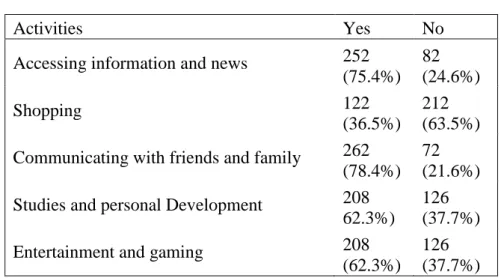
D) Activities engaged in social media
Table 4 Distribution of Activities Engaged by Users
Activities Yes No
Accessing information and news 252
(75.4%) 82 (24.6%) Shopping 122 (36.5%) 212 (63.5%)
Communicating with friends and family 262
(78.4%) 72 (21.6%)
Studies and personal Development 208
62.3%)
126 (37.7%)
Entertainment and gaming 208
(62.3%) 126 (37.7%)
From the results, it indicated (78.4%) of the respondents engaged with social media to “Communicating with friends and family”, (75.4%) “Accessing information and news”, while both activities “Studies and personal development” and “Entertainment and gaming” shared the same percentages (62.3%). Minority of the respondents (36.5%) engage with shopping activities via social media. The result is consistent with the previous study carried out by Siti Ezaleila and Azizah (2011), which indicated that engaging in games and quiz activities received a lower mean score among the respondents. On a similar note, these findings are almost congruent with research undertaken by Ellison, Steinfield and Lenhart (2009), Hargittai (2007) and Joinson (2008) which indicated majority of the respondent use and engage with social media for communicating with existing friends and others and sharing information with friends (Siddike, 2013).
16
Factors Influencing Users’ Engagement with Library Social Media Sites
Several predictors were examined such as individual attributes, information quality, perceived interactivity and perceived net benefits to be claimed as factor that influence users engagement towards these medium. The mean and standard deviation were calculated by using 6-point Likert type scale ranging from “1”- being “strongly disagree” to “6”- “strongly agree”. While the “0” scale indicated “neither agree nor disagree”. The results showed various reactions towards the factor of users‟ engagement with social media. The mean shows score from 4.564 to 4.192. The highest mean score is Individual Attributes (M=4.564, SD=1.019), followed by Information Quality (M=4.524, SD=1.025), Perceived Net Benefit (4.466, SD=1.230) and Perceived Interactivity (M=4.192, SD=1.238). This implies that all factors have been claimed and agreed by the respondents to be significant predictors of social media engagement as supported with the percentage of “agree” and “somewhat agree”.
Users’ Engagement with Library Social Media Channels
The factor “users engagement” with social media sites was measured on a 7-point Likert type scale ranging from 1- being “Never” to 7- being “Very Frequently” and 0- is Not Applicable. As presented in the Table 4.15 (Chapter 4), the statement about respondents‟ awareness of the existence of social media channels has the highest mean score (M= 4.1, SD=1.588) while the lowest mean score was observed for the statement about respondents re-tweet of library‟s twitter (M= 2.52, SD= 1.715). Findings also indicate that majority of the respondents 24.6% were “not sure” of their awareness of the existence of social media channels in the library and 26.3% of respondents were “not sure” of “paying attention to social media in the library”. Only 3.3% respondents indicated “very frequently” on the existence of social media channels in the library while 2.1% of them claimed that they “very frequently” pay attention to these media. The result is not surprising as it corroborates with previous study by Mumenthaler (2011) showed that the
17
majority of library users even the regular visitors of physical library were not aware of the library‟s presence on social media sites.
The result further indicates that majority of the users (24.9%) were “less frequently” engaged with library while (31.1%) of them “never communicate” with librarian through social media, indicating the highest score. For online behavioural activities, the users reacted differently to the use of social media channels as 18.3% of users chose “sometimes” and “less frequently” search for information through social media channels prior to using library resources and services. Also, majority of the respondents claimed that they “never “shared any information from the library to their personal account (35%) and “never” invited friends and family members to follow library (37.4%). For behavioural engagement reactions, most of the respondents (19.8%) claimed that they less frequently visit library, 23.1% never like the content posted, 19.2% never read the social media content, 47% never followed the library‟s twitter and re-tweet messages on the library‟s twitter, 36.2% never watched video from the library, 31.4% never downloaded the contents and 32% of them never recommended library to others. The result also revealed that very few library users engage with these media by liking, commenting, reading, sharing, following and watching social media content provided by library.
The study finding shows that users‟ engagement with library channels is quite low, though they know about its existence. This could be happened for several reasons such as lack of promotion about social media application and its usability to some extent leads to the unawareness among users towards these channels. Low interaction or uninteresting content posted on social media in eliciting users‟ responses contributing to the low engagement of users towards social media. Furthermore, insufficient information and publicity about the usability and usefulness of these media or perhaps users do not see the importance of using social media for academic purpose, and learning activities also contribute to the low engagement among users. This result is consistent with the study conducted by Shri, John and Sanjay (2011) which found that there was
18
lack of awareness on the availability and usefulness of these applications among library users though the library had made a number of provisions to adopt Library 2.0 technologies. In a similar vein, Ismail Abidin et al. (2013) revealed that the use of social media application for library services is minimal. It was found that teenagers generally are keen to use SNSs, however only (15.9%) of them indicated very small percentage use this service via the library website. The usage pattern is similar across various applications, though used in their daily lives for various other activities; however SNSs are not being used via the library website. Their study further reported that majority of the respondents were not very active users of Web 2.0 application on the library website. Several reasons were reported for non-use of these media as the users are not being aware of the availability and usefulness of these services. This is due to the insufficient publicity by the public library about the social media application and services. Furthermore, the reason could be due to the users perceived that the use of Web 2.0 in the library is not necessary thus showing lack of appreciation of the service among users. The librarians‟ failure to actively publicize the benefits of Library 2.0 services has led to this situation (Ismail Abidin, Kiran, & Abrizah, 2013).
Hence, library has to take many factors into consideration in terms of leveraging on social media technologies to ensure the greater reach and participation among users both in the online and offline environment.
Impact of Users’ Engagement with Social Media on the Library Usage
The impact of users‟ engagement with social media on actual library use was examined, as an outcome of users‟ active engagement with library social media sites. Using a 7-point Likert scale ranging 1- from 1- being “Never” to 7- being “Very Frequently” and 0- is “Not Applicable”, the respondents were asked to indicate their likelihood and actual behavioural outcomes in library related activities. The finding shows that the highest mean score was observed for the statement relating to respondents‟ use of online services (i.e: online databases, digital library, online literacy
19
classes etc.) after getting information from the library?” (Mean = 4.09, SD=1.84), while the lowest mean score was observed for the statement “communicate with librarian through social media platforms for any information needs” (M= 2.82, SD=1.744). There are variations in the frequency of actual library use. Result shows most of the respondents 22.8% “sometimes” visit the physical library, while 20.7% visit the official library websites after engaging with the library sites. Also, most of the respondents (20.4%) “sometimes” use the of physical library facilities and services, while 21.6% of them less frequently use the online services (i.e: online database, digital library, online literacy classes) after getting information through social media sites. The result also reported that majority (19.5%) “sometime” participate in the library‟s event after engaging with the library. Also, most of them “never” contacted the library through social media (29.3%). The result of the simple percentages of the other items include: “communicate with librarian” (33.2%), “borrowing books” (24.9%), “attend the library exhibitions” (21.3%) and “participate in the library user education workshops after engaging with library” (27.2%). Only few participants claimed they performed these activities in relation to library actual use.
It has been proven in previous study that the use of social media in libraries enhances efforts to promote inclusion and outreach (Dickson & Holley 2010). The present result shows that most of the libraries understudied have embraced social media technologies. Although the active engagement with social media channels to some extent motivate users to use the library resources and services or participate in any events or programmes, it is important to note that the result of the percentages of library use seems to be low. In view of this, Noorhidawati et al. ( 2015) claimed that, 61% of the respondents (librarian) indicated that the primary benefit of using social media is reaching out to library users. The opportunity of engaging users in an environment comfortable was also considered a significant advantage. It can be inferred from the result that, the use of social media is increasing among individuals and organizations. Therefore, the library has to explore its potential to be leveraged progressively in order to foster a good relationship with the library
20
community and most importantly, to obtain greater reach and active engagement of users about the library and its services. As noted by the interview participant:
“…Yes, for those who do not know, they become aware, because we don‟t only focus on posting the events, but the news, collections, we also post it. So, users out there aware about that. Also we have aerobics, we posted today we have aerobics, come to catch us in the library and enjoy. So people are very much aware about it, and in fact social media has its own followers. Sometimes, they keep waiting for the events.” Respondent 4, Female, PR Officer, Public Library)
“…And definitely, there is an increasing rate of likes; some might be interested in certain things while some un-follow. I saw the trends; they keep on liking overall about the library events organised.” (Respondent 4, Female, PR Officer, Public Library)
THE ASSESSMENT OF STRUCTURAL MODEL
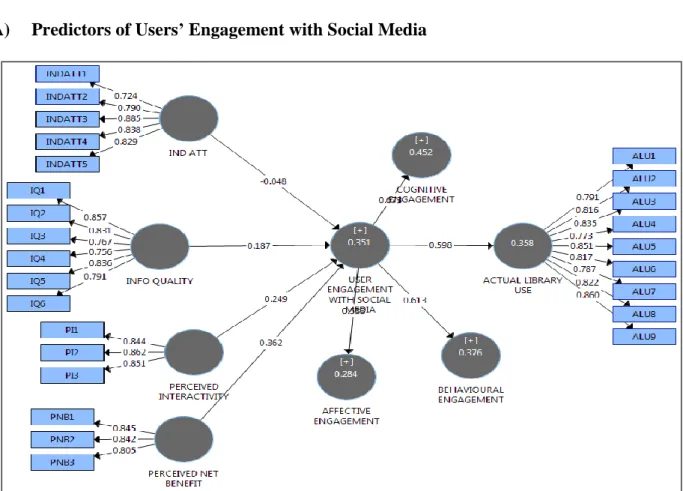
A) Predictors of Users’ Engagement with Social Media
Figure 2 Path Coefficient Result
In the context of this study, four predictors were examined to have influence on users‟ engagement with social media. Among these factors, only Individual Attributes (IV) revealed an insignificant
21
relationship with user engagement with social media (β= -0.048, t= 0.835, p>0.005). The Information Quality ((β=0.187, t=3.147, p< 0.01), Perceived Interactivity ((β= 0.249, t= 3.850, p< 0.01) and Perceived Net Benefit (ß=0.362, t= 5.711, p < 0.01) were found to be statistically significant and have positive relationships with user engagement with social media. In order to motivate users to engage actively with library, the contents to be posted should meet the information quality. The quality standards such as information relevance, accuracy, trustworthy, timeliness, authoritative, accessibility and interesting should be considered first in creating social media contents before posting online. In addition, the library has to keep update with the current trends and it should be aware of users‟ needs and demands in line with the new technological advancement and environmental changes. This is to ensure the sustainability and durability of library as important information service provider over the time and generations.
B) Impact of Users’ Engagement with Social Media on Library Use Table 5 Path Coefficient Result Original Sample (O) Sample Mean (M) Standard Deviation (STDEV) T Statistics (|O/STDEV|) P Values Affective Engagement
-> Actual Library Use 0.101 0.103 0.046 2.206 0.028
Behavioural
Engagement -> Actual Library Use
0.674 0.675 0.039 17.059 0.000
Cognitive Engagement
-> Actual Library Use 0.082 0.082 0.051 1.600 0.110
In this study, user engagement with social media was further tested to see its effect on actual library use. The result indicates that the relationship between user engagement with social media and actual library usage is positive. The finding indicated the path coefficient representing this hypothesis is greater than the 0.1 threshold (ß=0.598), and the observed t-statistic was found to be statistically significant, (t= 16.961, p<0.01). Thus, the hypothesis tested in view of this relationship
22
is being supported. It can be inferred that there is a direct positive and statistically significant relationship between users‟ engagement with library and actual use of the library. Therefore, it can be concluded that the more frequent users engage with social media sites, the more their actual use of the library resources and services is likely to be. This implies that the more users actively engage with library sites, the more they use the library resources and services or participate in the library events are also increase. Furthermore, the three dimensions of engagement were operationalized including cognitive, affective and behavioural aspects of engagement. The findings indicated cognitive engagement is not influence actual library use (β = 0.082) and not statistically significant at (t= 1.600, p> 0.01). However, a positive and statistically significant relationship was found between path of affective engagement and behavioural engagement on actual library use at (β= 0.101, t=2.206, p<0.05) and (β= 0.674, t=17.059, p<0.01) respectively. This implies that actual library use is significantly predicted by the affective and behavioural engagement with social media among library users under study.
The result is consistent with the qualitative findings regarding this relationship. Most of the respondents agreed with the fact that the extent of user engagement with social media has an impact on user awareness of the library collections, facilities and services. It also can alert users on any library‟s event updates, news and information posted through social media. Moreover, social media not only triggers user awareness, but its widespread usage in library subsequently motivates users to visit the library, use the library services (both physical and online) and participate in the library events. This is evidenced from the responses obtained via interviews with librarians and professionals in charge of the respective libraries under study.
“…..Yes, for those who are likers, followers, they can get the information faster, instead of reading email, or poster, because it‟s mobile, compared to reading email, you need to log in, so it‟s even faster, because on FB, they go directly to our timeline..”(Respondent 2, Male, Social Media Librarian, Academic Library)
From the interview analysis, it can be deduced that social media can trigger users‟ awareness about library information resources, services and activities among the likers, followers and viewers of
23
library as they tend to get information faster compared to the non – social media users. As noted by one of the respondents:
“…..the thing about social media is one, we create awareness or create the viral things, we can make awareness about the existence of the library, our services, and also other things that we can do more using it. (Respondent 3, Male, IT Officer, Public Library)
It can be concluded that most of the respondents expressed their consensus on the fact that engagement with social media in libraries could trigger users‟ awareness on all information about the library. This can be inferred from the above interview excerpt as the respondent claimed that viral marketing through social media channel has successfully created awareness among community since they are now aware of the existence of library and what the library do offer. The utilization of social media by libraries has undoubtedly increased people‟s awareness about libraries viz-a-viz their resources, services, and events. The purpose of adopting social media in library is to make people aware and know more about library existence, what libraries have to offer the community as well as the events libraries organize for their benefit. Hence, it is very significant for libraries to fully leverage on the social media channels not only to market themselves, but more importantly, to reach out to more people and attain a higher rate of engagement among community. This study has empirically supported the other literatures in different fields. Through the lenses of marketing literatures, a consensus was reached among marketers that online consumer engagement is crucial to the success of a company‟s social network site (Evans & McKee, 2010; Roberts, 2005; Solis, 2010; Swedowsky, 2009; Wong, 2009). As defined by Mollen and Wilson 2010), consumer engagement is “an outcome of repeated interactions that strengthen the emotional, psychological, or physical investment a customer has in a brand”. Meanwhile, other scholars view engagement as the simple act of participating in an online environment (Evans & McKee, 2010; Harden & Heyman, 2009; Solis, 2010). Although marketers are yet to agree upon a definition of engagement, the term is being recognized in the industry as a key factor in measuring
24
online marketing success. Further, an interesting image or comment may make someone like a page or follow a Twitter account, to get engagement that is truly beneficial to the library as the account must invite conversation (Cahill, 2009; Lankes et al., 2007). Gangi (2016) also affirmed that user engagement with various social media channels will in turn positively affect actual usage. Drawing attention from the result, a direct significant positive relationship exists between user engagement and actual library use. It can be concluded that, the more user engage with the library channels, the more likelihood they use the library resources and services, and increase participation in the library events. As such, increase in engagement with social media among library users, results in the behavioural outcome in relation to library actual use. Therefore, the library should keep on exploring new ways of engaging users as a way to promote library resources and learning support programs, by providing the best social media posts for getting the utmost responses from users. The showcase of library‟s exhibitions, programs and campaigns should be in the limelight along with series of lively video or visual streaming which are publicized through social media channel as a way of fostering the massive interaction and participation of library users in all library events. Social media is not only a way of finding out what gets the best response from the library users; it also does build a rapport, especially with distance learners.
9) RECOMMENDATIONS
Based on the findings, the following recommendations are made:
1. It was found that a positive relationship exists between information quality and user engagement with social media channels. It means that if the more quality contents posted on social media channels, thus a better increase in the user engagement with social media. Therefore, the libraries should invest more time in producing quality library content or
25
improve its content development so that user engagement with these channels can increase. This will go a long way in improving actual user engagement with the library. 2. A call for action for increasing and upgrading user engagement in both online and offline
environment as it also can be used to facilitate user engagement with library social media which in turn has an impact on the likelihood to use the library‟s resources and services or programmes in the library.
3. The libraries surveyed (in public and academic) and perhaps other types of libraries should increase and expand the use of other social media platforms that suit the library, as such, the libraries should not be rigid by using only one channel. Thus, there is a need for further exploration and adoption of other social media tools which are in trend and are mostly used by the people. This is to ensure that the libraries reach out to their clients easily in terms of informing them about their resources and services. It also keeps their clients engaged with the libraries‟ social media as long as their needs and expectations are met via these media.
4. The social media phenomenon is an integration of multiple aspects such as social, behavioural and technological. Thus, libraries should think thoroughly about what the important elements to be enhanced, which ones to be adopted or discontinued with regards to social media. Content is not enough without proper communication. Good and quality content should blend together with quality, efficient and interactive communication.
5. A special dedicated team is needed to design a good social media programme in the respective libraries. This is to ensure that the team focuses more on delivering the services.
6. Appropriate skills and hands-on training on the latest trend of technological application should be organised accordingly for librarians or staff in charge of social media in order
26
to upgrade their skills, experiences, and knowledge as to ensure they are up to date towards achieving the digital competency. As there are many social media tools and applications available with different features and benefits, the library should keep abreast with those technologies in order to reach out to users through using multiple delivery systems proactively. As such, the librarians in the 21st century should be equipped with hard and soft skills, in preparation to face the challenge of a variety of clients‟ needs and expectations now and in the future.
7. In view of the lack of awareness on the presence of social media channels in libraries as found in this study, both academic and public libraries should increase their promotion by introducing these facilities and services periodically to let people know about its existence and usefulness. Promotion in both print and online platforms should be run together continuously to boost the attention of users on the latest updates in the library. The libraries, for instance, should organize more online training or related information literacy workshops for their users, so as to inform them of these services and what they offer through the use of these media. Besides providing training about the new media, libraries can assist end users in creating well-informed decisions through awareness programmes or campaign. This can be carried out by having regular literacy classes, exhibitions, ICT campaigns about the new application and services available in the library.
8. Proper and strategic policy concerning social media process, content development and activities should be designed by libraries to monitor and track its performance in an efficient and systematic way.
9. Social media is rapidly evolving, thus the libraries should follow the trend by not only focusing on the one particular channel, as there are many social media platforms available and each has a feature and potential of engaging the clients. Therefore, the
27
libraries can maximize the opportunity of reaching out to many users by exploring and extending the use of other social media platforms such as You Tube, Snap chat, Wikis, Pinterest, and others.
10. There is a need for librarians to conduct research and explore the best practices and success stories of social media implementation in libraries. As we are now living in the borderless world and constant advancement in ICT, the libraries should be proactive and innovative in utilizing social media for reaching out to the audience. Rather than being stagnant behind its physical buildings, and waiting for people to come to the library, the library‟s role has changed; libraries now have to go to the communities to get closer to them. This effort is to ensure that the library is still relevant and much needed in the society. The sustainability and relevance of the library as an important knowledge hub and an authentic source of resources should be upheld so as to remain close to people‟s heart regardless of the massive information resource channels available on the World Wide Web.
11.Libraries can make use of their official home pages, or websites to relay and showcase the current information pertaining to social media channels and its application to their end-users. For example, libraries can produce and display the list of prominent social media available, the services offered, and what users can do with these channels.
12.The top management should be supportive and encourage their staff about significance use of social media adoption in their libraries. All departments in the library should cooperate and collaborate with one another to ensure that social media implementation is worth for the enhancement of library services. This to ensure the more productive works will be achieved.
13.More research has to be conducted and best practices of social media implementation in other libraries were reviewed, imitated and evaluated for benchmarking and upgrading
28
the social media services in order to find the best way to leverage potential and opportunity of social media to enhance libraries as relevant information sources to the society.
14.Librarians and information professionals should play an active role in online communities towards optimizing the available resources and services from social media. Librarians need to be well prepared for any changes and be adaptable to new social conditions, technological growths, and ever-changing needs of the clients across time and generations. Digital governance and competency among librarians were also being encouraged and imposed to better serve the society.
10. CONCLUSION
The prevalent use of social media technologies was found in Malaysian libraries; however the engagement rate among library users towards these media was quite low. The results indicate that few of library users engaged with social media through several activities such as liking, commenting, and reading, sharing, following and watching social media content provided by the library. Low engagement of social media maybe due to several reasons such as lack of promotion about social media existence and its significance use for academic purposes, passive interaction between librarians and users and uninteresting content posted on social media. Furthermore, insufficient information and publicity about the usefulness of these media and also the users may not realise the importance of using social media for an academic purpose, and learning activities.
Despites of these challenges, the users‟ responses towards library social media are slowly increasing and they have seen the potential of social media in meeting their information needs. In this regards, several factors were examined and the results found that the information quality, perceived interactivity and perceived net benefits were found to be an important predictor of users engagement with library social media. Better understanding and empirical evidence on factors of
29
social media engagement and its impact on library usage has achieved in this study. It should be noted that both information and communication factors play an important role in facilitating social media engagement among users. These elements should be considered seriously by the libraries so that social media would give valuable benefits to users and libraries.
Engagement is one of the key measures of social media success. The multidimensional construct of engagements (i.e: affective and behavioural) have shown a positive influence on actual library use. Strategic directions for libraries were highlighted in order to enhance the users‟ engagement in online environment. Thus, library as an information service provider should create public awareness of their collections, resources and services, and also branding their name via the power of social media marketing. This may help to elicit users‟ emotional attachment and influence their behaviour to engage in various activities within social media environment. Through engagement in library social media, the likelihood to use the library will increase.
In conclusion, to ensure the success of social media implementation in the library, it should be leveraged strategically, with a clear goal definition, proper management and using their knowledge to develop a service that remains relevant to the community. The library should take into account all the best practices of social media application in libraries and understand how to use them well in ensuring users‟ continuous engagement with the library social media consequently put them having a trust towards library as an important information services provider at present, and in the near future.
REFERENCES
Abdullah, N., Chu, S., Rajagopal, S., Tung, A., & Kwong-Man, Y. (2015). Exploring Libraries‟ Efforts in Inclusion and Outreach Activities Using Social Media. Libri, 65(1), 34– 47.doi:10.1515/libri-2014-0055
Aharony, N. (2012). Facebook use in libraries: an exploratory analysis. Aslib Proceedings, 64 (4), 358-372.
30
on hotel websites and the importance of social interactions and return on engagement. International Journal of Contemporary Hospitality Management, 27 (4), 670 – 689. http://dx.doi.org/10.1108/IJCHM-09-2013-0415
ALA. (2001). Libraries making good use of social media and Web 2.0 applications. Retrieved May 9, 2016, from
http://www.ala.org/news/mediapresscenter/americaslibraries/socialnetworking
Alreck, P.L. & Settle, R.B. (1995). The Survey Research Handbook. (2nd ed.). Irwin, Chicago, IL. Al-ammary, J. H., Al-sherooqi, A. K., & Al-sherooqi, H. K. (2014). The Acceptance of Social
Networking as a Learning Tools at University of Bahrain, 4(2).
https://doi.org/10.7763/IJIET.2014.V4.400
Alkindi, S. S., & Al-suqri, M. N. (2013). Social Networking Sites as Marketing and Outreach Tools of Library and Information Services. Global Journal of Human Social Science: Arts, Humanities & Psychology, 13(2).
Ariel, Y., & Avidar, R. (2015). Information, Interactivity and Social Media. Atlantic Journal of Communication, 23,19–30. https://doi.org/10.1080/15456870.2015.972404
Ayiah, E. M., & Kumah, C. H. (2011). Social Networking : a tool to use for effective service delivery to clients by African Libraries. World Library and Information Congress: 77th
IFLA general conference and assembly. In, 1–14. Retrieved from
http://uknowledge.uky.edu/gradschool_theses/155
Bagozzi, R.P., & Yi, Y. (1988). On the evaluation of structural equation models. Journal of Academy of Marketing Science, 16(1), 74-94
Banhawi, F., Ali, N. M., & Judi, H. M. (2016). Measuring user engagement attributes in social networking application. https://doi.org/10.1109/STAIR.2011.5995805
Benn, J., & Mcloughlin, D. (2013). Journal of Management and Marketing Research, 20, 1–10. https://doi.org/citeulike-article-id:126680
Bernoff, J. and Li, C. (2008). Harnessing the power of the oh-so-social web. MIT Sloan Management Review, 49 (3), 36-42.
Bhatti, S. A. K. and R. (2012). Application of social media in marketing of library and information services: A case study from Pakistan. Webology, 9 (1), 1–8. Retrieved Dec 9, 2015 from http://www.webology.org/2012/v9n1/a93.html
Bhattacherjee, A., & Sanford, C. (2006). Influence Processes for Information Technology Acceptance: An Elaboration Likelihood Model. MIS Quarterly, 30(4), 805-825.
Blackshaw, P. and Nazzaro, M. (2004). Consumer-Generated Media (CGM) 101: Word-of-mouth in the age of the Web fortified consumer, Retrieved Jun 22, 2017 from http://www.nielsenbuzzmetrics.com/whitepapers
Blakeman, K., & Brown, S. (2010). Social Media: Essential for Research, Marketing and Branding. Bulletin of the American Society for Information Science and Technology, Vol. 37.
31
Blanchard, O. (2011). Social Media ROI: Managing and Measuring Social Media Efforts in Your
Organisation. Pearson, Boston, MA.
Chen, D.Y.-T., Chu, S.K.-W. and Xu, S.Q. (2012). How do libraries use social networking sites to interact with users. Proceedings of the American Society for Information Science and Technology, 49 (1), 1-10.
Chu, S. K.-W and H. S. Du. (2013). Social Networking Tools for Academic Libraries. Journal of
Librarianship and Information Science, 45 (1), 64-75.
Chin, W. W. (1998). The partial least squares approach to structural equation
Di Gangi, P. M., & Wasko, M. M. (2016). Social Media Engagement Theory: Exploring the
Influence of User Engagement on Social Media Usage. Journal of Organizational and End
User Computing (JOEUC), 28(2), 53-73.
Hendrix, D., & Zafron, M.L. (2009). Use of Facebook in academic health sciences libraries. Journal of Medical Library Association, 97(1), 44-47.
Ismail Abidin, M., Kiran, K., & Abrizah, A. (2013). Adoption of Public Library 2.0: Librarians‟ and teens‟ perspective. Malaysian Journal of Library and Information Science, 18(3), 75– 90.
Li, L., Sun, T., Peng, W., & Li, T. (2012). Measuring engagement effectiveness in social media. In Proceedings of the SPIE (p. 83020F–83020F–9). https://doi.org/10.1117/12.910034
Mack, D., A. Behler, B. Roberts, and E. Rimland. (2007). Reaching Students with Facebook: Data and Best Practices. Electronic Journal of Academic and Special Librarianship, 8 (2), 4.
Mohd Ismail, A. & Kiran, K., (2012). Reaching out to the Web user practices by Malaysian public libraries. 4th International conference on libraries, information and society (ICOLIS 2012). 237-250
Mollen, A., & Wilson, H. (2010). Engagement, telepresence and interactivity in online consumer experience: Reconciling scholastic and managerial perspectives. Journal of Business Research, 63, 919-925
Palmer, S. (2014). The Journal of Academic Librarianship Characterizing University Library Use of Social Media : A Case Study of Twitter and Facebook from Australia. The Journal of Academic Librarianship, 40(6), 611–619. https://doi.org/10.1016/j.acalib.2014.08.007
Sachs, D. E., Eckel, E. J., & Langan, K. A. (2011). Striking a balance : effective use of Facebook in an academic library. Internet Reference Services Quarterly, 16(1-2), 35-54.
Wu, J., & Wang, Y. (2006). Measuring KMS Success: A re-specification of the DeLone and McLean‟s model. Information & Management, 43 (6), 728-739.
Xiang, Z., & Gretzel, U. (2010). Role of social media in online travel information search. Tourism Management, 31(2), 179–188. https://doi.org/10.1016/j.tourman.2009.02.016