1
Title Page
Methane Digesters
A Senior Project presented to
the Faculty of the Dairy Science Department California Polytechnic State University, San Luis Obispo
In Partial Fulfillment
of the Requirements for the Degree Bachelor of Science
by
Thomas Van Steyn December, 2010
2 Table of Contents
Table of Contents
Title Page ... 1 Table of Contents ... 2 Acknowledgements ... 4 List of Figures ... 5 List of Tables ... 6 Abstract ... 7 Introduction ... 8 Methane Gas ... 9History of methane digesters ... 9
Social and Green Problems ... 11
Laws affecting farmers ... 15
Regulatory requirements air and waste ... 18
Anaerobic Digestion ... 20
How they work ... 20
Alternative methane digesters ... 21
Temperature ... 26
3
Dangers Anaerobic Digestion ... 28
Components of biogas... 29
AgSTAR ... 30
Anaerobic Digester Operations ... 31
Cost of Anaerobic Digestion ... 32
Funding ... 34
Dairy Problems ... 35
Solutions ... 36
Fuel Cells ... 36
Natural gas pipeline ... 37
Conclusion ... 38
4
Acknowledgements
I would like to thank my family for all of the support I have had through my college career. Without their ongoing help and support I would not be where I am today.
5
List of Figures
Figures Page
Figure 1 Smog in Los Angeles (Ocean Color, 2010)... 18
Figure 2 The step by step process of basic methane digesters operating system. (Epa.gov, 2010) ... 21
Figure 3 Covered lagoons have a flexible cover where the methane is collected and it's piped into a combustion device. (Agstar, 2010) ... 21
Figure 4 This figure shows how the covered lagoon system works. (AgStar, 2010) ... 23
Figure 5 This figure shows the plug flow digester system. (AgSTAR, 2010)... 23
Figure 6 Shows a digesters process. (AgStar.gov, 2010) ... 24
Figure 7 This is an image of a complete mix digester. (AgStar. gov, 2010) ... 24
Figure 8 is an image of a mix digester system and its process. (Agstar, 2010) ... 25
Figure 9is an image that shows a fixed film digester. (AgStar.gov, 2010)... 26
Figure 10 is an image that shows a fixed film digester. (AgStar. gov, 2010)... 26
Figure 11 this figure from the AgSTAR website shows the number of operating digesters as of (July 2010) these digesters include dairy (126) swine (24) poultry (5) Beef (2). (Agstar.gov, 2010) ... 32
Figure 12 In this figure there is a comparing of three different types of methane digesters. (Forresst Steglin, 2010) ... 33
Figure 13 In this figure it shows how as the number of dairy cows per dairy increases the cost of digesters per cow also decreases. (Forresst Steglin, 2010) ... 34
6
List of Tables
Table page.
Table 1 his figure shows the high and low conflicts between farmers and residents in two
different counties. Alvin, Sonja, Maxwell, and Evan (2010) ... 12 Table 2 Gallup poll taken of 128 countries, which shows top 5 contributors of global warming, was taken between 2007 and 2008. Gallup(2009) ... 14 Table 3 The number of basin days that exceed the federal health standards for the south coast basin. aqmd.gov (2008)... 17 Table 4 This table provided by “extension.org” shows the health effects when dealing with hydrogen sulfide. (Extension.org, 2010) ... 30
7
Abstract
Anaerobic digestion has many different avenues for opportunity in use on farms. The objective of my senior project is to determine the economic viability of alternative methane digesters on a dairy. Currently the conversion of animal manure to biogas through the process of anaerobic digestion is widely used in Europe. In the U.S. anaerobic digesters have become increasingly in demand by environmental groups and dairymen. Digesters environmental impact involves the benefit by capturing the biogas that comes off animal manure. Methane, a green house gas, is the one with the most concern that is captured by methane digesters. The biogas is either injected into pipelines for energy, used to power motors for the production of electricity, or the excess biogas is flared as to control smell and release of methane into the environment. Main problems with methane digesters in California is making them cost effective and also when using generators to produce electricity meeting air quality control boards standards. The solution that is being looked into today to get around air quality standards is injecting the biogas directly into pipelines that deliver it to power companies that purchase the biogas. Being able to operate an efficient methane digester requires constant maintenance, large enough herd size to be economically feasible, and location near pipeline to be linked into the system.
8
Introduction
With the dairy industry in an uphill battle with the public on many of their different concerns the dairy industry is always looking for new solutions. Also in this volatile economic climate that California is facing today finding other areas for revenue can help the dairy industry bounce back from this decline. In past years economic digesters have picked up interest in California particularly. Dairymen having to face an economy that has been very volatile over the past 3 years interest in different avenues of revenue has risen. Also concerns that dairy cows are contributing methane gas to global warming federal and state governments have been trying to push for green renewable energy. With a lot of interest in protecting our climate from climate change there has been and possibly will be lots more pressure from environmental groups to control cows methane production. Through the process of anaerobic digestion there are different ways of dealing with the biogas that is captured. Flare is used to help control smell by burning the gas, using the gas to power generators for electricity, and also by injecting the biogas directly into pipelines. Though there are a lot of positives for having a methane digester there can also be a lot of problems with having them. In this review I am trying to find all of the pros and cons of these methane digesters.
9
Methane Gas
Methane gas is a gas containing molecules of methane that contain one atom of carbon and four atoms of hydrogen (CH4). Methane is actually one of the main components in natural gas which is used for cooking and heating in many places. Natural gas is a fossil fuel that was formed a long time ago by anaerobic decomposition of organic materials.
The types of anaerobic bacteria that were in this process back then are still around today. Anaerobic bacteria were found on earth as some of the earliest forms of life. These types of bacteria break down organic material in the absence of oxygen. These bacteria evolved on earth before the beginning of photosynthesis by plants that released oxygen into the air. Anaerobic decomposition occurs naturally in many different environments which include swamps, water logged soils (rice fields), deep bodies of water, the digestive tracts of termites, and large animals.
History of methane digesters
The history of anaerobic digestion goes back many years. According to P. Smith (1998), in the early 1800’s there were laboratory experiments that were made to produce methane from manure these were made by Humphrey Davy. The 1850’s sewage sludge digestion was in its early stages with treatment of sludge by using tanks to treat settled waste water. The first digestion plant was actually built in Bombay India in a leper colony. In 1895 a man named Donald Camerson built the first septic tank for the English city of Exeter and used the methane that the cities septic tank produced to power street lights near the treatment plant. During World War 2 there were reportedly 30 farm-scale biogas plants in Germany. Of these 30 it is reported
10
that only one of these still seems to be in use today. There are a large number of small scale anaerobic digesters still in operation throughout the world. With this small number the main use for these small scale digesters is cooking and for powering electric generators. Throughout the years that followed the process of anaerobic digestion went through further study and was improved.
The United States first methane digester was put in place because of the problem with urbanization into rural areas where farms are. The Mcabe Farm had a swine operation that was put into place around 1951-1953 in a rural site on the outskirts of town in Mt. Pleasant Iowa. With the town growing by 1970 the town was bordering the swine facility and Mcabe farms was forced to find an odor free way to handle the manure his hog farm was emitting. First the farm converted their anaerobic lagoon into an aerobic lagoon by adding an aerator to their system. However the buildup of the organic matter during the winter took 6-8 weeks to even out in the spring. During these 6-8 weeks the odor was very strong and did not help with the odor problem. The farm used chemicals and added them to the material in the spring which helped with the odor, but it did no eliminate the odor altogether. So the farm was forced to look for a new system to help with the odor problem and the farms waste. The farm used the help of the County
Extension service and other people and found an article about the anaerobic digestion of swine manure. With the promise of providing a gas that was said to be easily disposed of and help produce a stable sludge that would be able to be spread anywhere the Mcabe farm owner jumped on the idea. The farm put together its own anaerobic mix digester. It took two years to put together but with the project finished in May 1972, they put 6,000 gallons of sludge from the towns municipal waste plant with 2 hours of swine manure flowing into the digester they started the process. For the next couple of days they continued to add sludge from the farm to the
11
digester. On the fifth day of digestion the extra biogas tripped a relief valve showing that the digester worked for the farm.
With innovations such as the Mcabe farms’ methane digester, problems in today’s world may be reduced. Problems with urbanization into rural areas are still a big concern with many dairy operations in California. Also with climate change on the rise across the nation the
agriculture industry has to find new ways to deal with these problems. Methane digesters may be the solution to some of these problems however there are a lot of factors that can lead to
problems for dairies.
Social and Green Problems
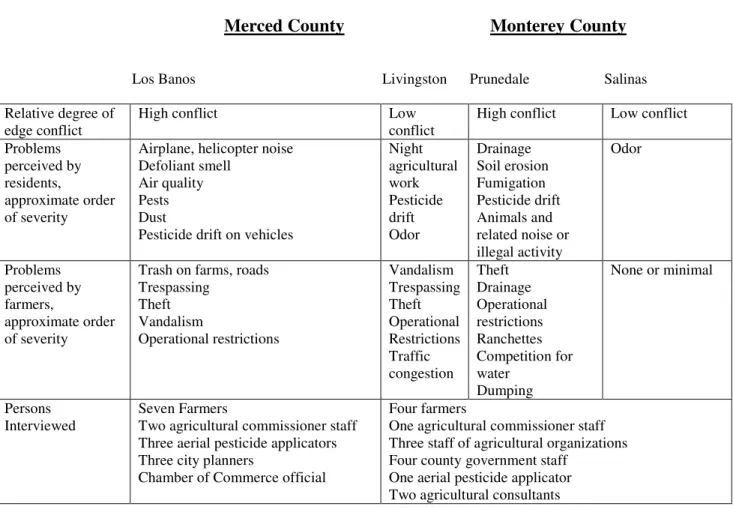
With California being one of the more liberal states in the country green energy, and environmentally conscious residents are beginning to voice their concerns about methane. According to the “Huffington Post” California’s unofficial population for the beginning of 2010 was, 39 million residents. From the year prior to this year it was estimated that there was an added 393,000 residents from 2009 to 2010. With these numbers going up with every year it is a guarantee that the agricultural community will have to deal with the encroaching residential population into rural areas. In an article in (Alvin, Sonja, Maxwell, and Evan 2010) a table was shown how the conflict between farmers and residents is reaching highs and lows in different communities. What it shows is in different counties how farmers and local residents have different problems with each other. We can see that problems with residents include air quality and smell.
12
Merced County Monterey County
Los Banos Livingston Prunedale Salinas
These types of conflicts are due to the fact that California is growing at an incredible rate. According to the article “California communities deal with conflict and adjustment at the urban-agricultural edge” the state of California is growing on average 350,000 new residents each year. Even though California is the leading agricultural state in the nation with about 2.5 million agricultural acres it seems that encroachment of the urban population is inevitable. The problem Relative degree of
edge conflict
High conflict Low
conflict
High conflict Low conflict Problems
perceived by residents,
approximate order of severity
Airplane, helicopter noise Defoliant smell
Air quality Pests Dust
Pesticide drift on vehicles
Night agricultural work Pesticide drift Odor Drainage Soil erosion Fumigation Pesticide drift Animals and related noise or illegal activity Odor Problems perceived by farmers, approximate order of severity
Trash on farms, roads Trespassing Theft Vandalism Operational restrictions Vandalism Trespassing Theft Operational Restrictions Traffic congestion Theft Drainage Operational restrictions Ranchettes Competition for water Dumping None or minimal Persons Interviewed Seven Farmers
Two agricultural commissioner staff Three aerial pesticide applicators Three city planners
Chamber of Commerce official
Four farmers
One agricultural commissioner staff Three staff of agricultural organizations Four county government staff
One aerial pesticide applicator Two agricultural consultants
Table 1 his figure shows the high and low conflicts between farmers and residents in two different counties. Alvin, Sonja, Maxwell, and Evan (2010)
13
with the city moving closer to agriculture is the complaints on both ends. As figure 1 illustrates urban populations complain about smell, noise, and dust to name a few. With this survey it shows the community and the farmer’s impacts on each other. While farmers are more worried about problems such as trespassing, theft, dumping, competition for water, and vandalism to name a few. The community and its members are more worried about air quality, dust, pests, odor, noise and pesticide drift. With both of these sides arguing with each other it seems either side is unwilling to give into either side. However on the farmers’ side it seems that traffic, vandalism, and trespassing are impeding on the farmer’s ability to produce products on his or her farm.
Another concern with the public is the environment and greenhouse gases. Climate change has been an ongoing concern in America and throughout the entire world.
14
Public Awareness and Opinion of Climate Change Among the top five emitters of greenhouse gases
Japan 99% 80% 19%
United States 97% 63% 35%
Russia 85% 39% 36%
China 62% 21% 38%
India 35% 29% 5%
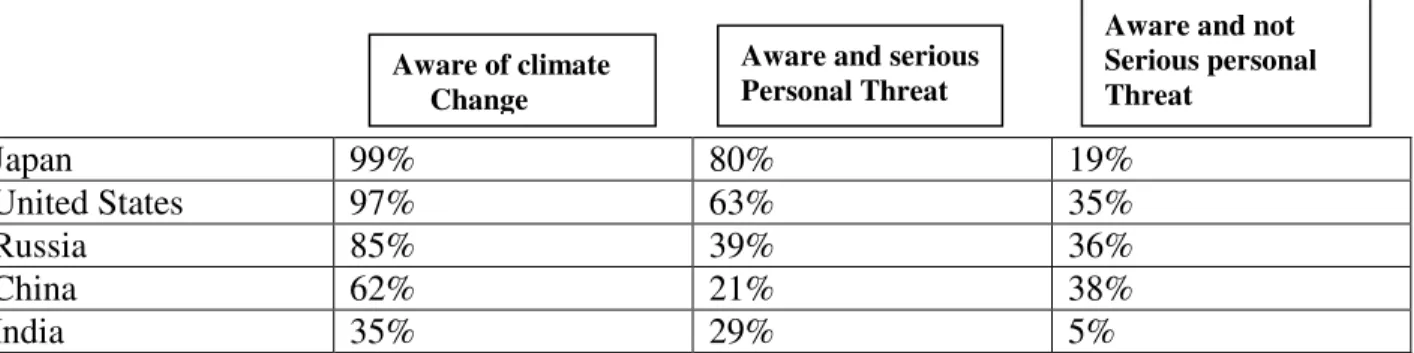
A Gallup poll taken between 2007 and 2008 polled different countries asking about their awareness of the issue and actual concern of the issue. In the United States sixty three percent of the people that were aware felt that it was of concern to them and their families. The percent of Americans concern relative to climate change is climbing due to media perception and more scientific data being available to the public. With this number climbing as talk of this issue continues to become more prevalent and the introduction of new legislation such as the climate change bill. It seems apparent that Americans are becoming more concerned with their climate. With greenhouse gases and climate change awareness on the rise, farmers and dairymen alike have to find new ways to handle their waste. Methane gas is a greenhouse gas that stays in the earth’s atmosphere anywhere from 9-15 years. Also methane gas is 20 times more potent than carbon dioxide epa.gov (2010). With all of this attention on greenhouse gases now it is no surprise that methane gas is a big concern as well. In the Monterey Bay Aquarium in an exhibit that tried to help with awareness about climate change a display was put up. In an article that was written by Anthony Watts he talks about the controversy with a cow that was put on display
Table 2 Gallup poll taken of 128 countries, which shows top 5 contributors of global warming, was taken between 2007 and 2008. Gallup (2009)
Aware of climate Change
Aware and not Serious personal Threat
Aware and serious Personal Threat
15
wearing a gas mask. This display represents the greenhouse gas emissions that cow’s produce and a sign on the display says how there should be less cows. The display was taken down after much public concern. With the public concerned with greenhouse gas emissions and the specific gas methane, dairy farmers need to be aware of their own dairies methane emissions.
With these issues on the minds of the American public; California dairymen are going to need to find new and innovative solutions to fix these problems. One of the ways dairymen are trying to remedy these problems is by looking into methane digestion.
Laws affecting farmers
There are many different laws that have been enacted throughout the years to help try to keep our air and environment clean. With all of these laws farmers and dairymen in particular need to know the different aspects and laws that can affect them. Factors such as tractor emissions and, in this study, cows in particular are being looked at more closely by different organizations.
The Clean Air Act (CAA) is a federal law that was established in 1970 that regulates air emissions from stationary and mobile sources (epa.gov, 2010). This law authorizes the EPA to establish National Ambient Air Quality Standards (NAAQS). These standards are supposed to be put in place to protect public health and welfare by regulating emissions of harmful and
hazardous air pollutants. According to the EPA’s website one of the goals of this act was to make and set goals in every state by NAAQS by 1975. The way they were to achieve these goals was by setting up state implementation plans (SIPs). These plans were to be applicable and
16
1990 because it needed to set new goals. This Act needed to set new goals or dates for meeting with NAAQS requirements, because the old goals in many areas of the country had not been met. Section 112 of the clean air act is geared towards addressing the emissions of hazardous air pollutants. In 1990 section 112 was revised to require issuance of technology based standards for major sources and certain area sources. The EPA’s website states,
“Major sources” are defined as a stationary source or group of stationary sources that emit or have the potential to emit 10 tons per year or more of a hazardous air
pollutant or 25 tons per year or more of a combination of hazardous air pollutants. An “area source” is any stationary source that is not a major source. (epa.gov, 2010)
With these new types of amendments to the clean air act, California in particular is under strict scrutiny by the air quality and control board. The air quality control board (Air resources board) was a board that was established in 1967. The board’s main goals are to obtain healthy air quality and to maintain that high standard. Also to put research into the causes and the solutions for air pollution. Since its formation they have been working with the public, private sector, and the government to establish and protect the public’s health regarding air pollution. The board’s members are appointed by the governor. There are eleven members in the air resources board. Five of the members are experts in the field including medicine, chemistry, physics,
meteorology, business, and law. Five of the other ones are elected officials who represent regional air pollution control agencies where one member is from Los Angeles, San Francisco bay area, San Diego, and the San Joaquin Valley, and one other member represents the other districts (arb.ca.gov, 2010). In table 3 we see numbers from the south coast basin where it shows days that have exceeded old and new federal health standards. With the old federal standards we can see how the days exceeding the old standards were pretty low compared to the new
17
standards. With the new standards increasing it is becoming harder for farmers to keep up with all of the new air quality standards.
Table 3 the number of basin days that exceed the federal health standards for the south coast basin. aqmd.gov (2008) Year Old federal standard (1-hour average > 0.12 ppm) 1997 Federal Standard (8 hour average > 0.08 ppm) 2008 Federal Standard (8 hour average >0.075 ppm) Health advisory (1-hour average 3 0.15 ppm) Stage 1 Episode (1-hour average 3 0.20 ppm) Basin Maximum 1 hour average (ppm) Basin Maximum 8-hour average (ppm) 2004 28 90 126 4 0 0.163 0.148 2005 30 84 117 11 0 0.182 0.145 2006 35 86 116 10 0 0.175 0.142 2007 18 79 108 5 0 0.171 0.137 2008 28 80 120 7 0 0.176 0.131
Table 3 gives us an image of how the days exceeding the air quality standards have been increasing with all of the increasing standards. Also in major cities where smog is a problem many air quality control boards are having strict regulations. This affects the dairy industry’s ability to adopt methane digestion technology because of the nitrogen oxide these generators are producing which is causing problems with air quality. Nitrogen oxide is a problem because it is a catalyst in the breakdown of the ozone which has very negative effects on our air quality.
Nitrogen oxide causes smog that we are able to see in cities and this is what air quality control boards are trying to cut down on.
18
Regulatory requirements air and waste
In California regulations and air requirements are very strict and have been proving to be very difficult to comply with for dairy farmers who have been interested in methane digesters. In the San
Joaquin and Sacramento air districts where air quality is already very poor, regulations on air quality are very strict. These regions have been classified by the U.S. EPA as “severe non-attainment” areas meaning that these regions have to impose strict regulations on nitrogen oxide emissions because of the already low air quality. When generators use biogas to turn methane into energy the generators release another gas, nitrogen oxide, which is the big problem air quality boards have to deal with. The air boards in the two regions of California have had to enforce very strict rules because of this issue.
Farmers and even environmentalists have complained that the air boards in these districts are too strict and need to compromise because they are not seeing the big picture. They argue that farmers are trying to find ways to become more environmentally conscious. However with the air boards being as strict as they are they are making it impossible to operate any methane digesters in an economically feasible sense. From an article by Anna Austin titled the “Methane Migraine” (2010) she stated that, “In 2009, six dairy digesters ceased operating as a result of regulatory and financial problems.” The air quality control boards however see it a different way. They feel that the technology to meet their requirements is out there and that these dairies that
Figure 1 Smog in Los Angeles (Ocean Color, 2010)
19
put in methane digesters should have consulted their local quality control boards before building anything. Also the board argues that if they were to loosen up the limitations of Nitrogen Oxide emissions on dairies then they would have to tighten up the limitations on other areas that would have negative impacts on the other areas but be catering to the dairies.
There are also complaints that the government is sending mixed signals to dairymen and it is causing these problems. In 2001 the California legislature passed SB5X(Around the capital, 2010), which provided 15 million dollars to help support the building of methane digesters which had electrical generation, ten million dollars of that money was specifically set aside for on farm dairy digesters (Methane Migraine, 2010). This program helped farms by taking almost 50 percent of the costs that the farmers did not have to pay. The bill gave incentives to farmers to put in these methane digesters. Now farmers are wondering why the state and local governments are not working together with these programs and instead are providing grant money for projects that are almost impossible to get permitted. The problem the air board says is that while the bill was being brought up and written no one asked the air boards about this bill.
Jorge Guzman who is the permitting program supervisor for the Sacramento Metropolitan Air Quality Management District said in Austin’s article that there was not enough
communication with air pollution control districts. Guzman says that there was not enough of this being done while the program was being developed. The grant that was developed was overseen by advisory groups from the California dairy industry, department of food and Ag; water resources control board, sustainable conservation, university of California, and the U.S. EPA Agstar program. The groups that were not included were the air pollution control agencies. Guzman said that his groups were not included or even aware of this advisory group. With all of this miscommunication it left Guzman and his air pollution control board unable to help with the
20
methane digesters when they do not meet the requirements. So even though government boards put together these grants for farmers to have a way of putting in these digesters the air board was not shown this and it did not meet their own requirements.
Anaerobic Digestion
Anaerobic digestion is the process used by methane digesters. With anaerobic digestion you are able to produce methane. The biogas produced in anaerobic digestion is fifty to eighty percent methane and twenty to fifty percent carbon dioxide. There are also other trace gases that are produced in this process which include hydrogen, carbon monoxide, nitrogen, oxygen and hydrogen sulfide. However with all of these gases methane is still the most produced in methane digestion (Climatescience.gov, 2006).
Anaerobic digestion is a three step process where different microorganisms are able to utilize the organic material. First a group of microorganisms convert the material to a form that the second group of bacteria utilizes to convert into organic acids. These organic acids are then used by the third group which produces methane (methanogenic). These anaerobic bacteria utilize the organic acids and complete the decomposition process.
How they work
Anaerobic digesters (methane digesters) are designed to capture the biogas methane and convert it into energy. On a dairy there are different types of methane digesters however the basic process is the same. The manure from the cows is collected and sent to manure handling. Once there it is put in the anaerobic digester and the anaerobic process commences. The biogas is captured by the system and carried out of the digester. The effluent from the anaerobic
21
that is carried through the system can then be used for heating, electricity generation, pipeline injection, and other.
Alternative methane digesters
There are four different types of anaerobic digesters (methane digesters) being used today. Each of these different types of methane
digesters has unique characteristics that help with the specific needs of the individual dairy the digesters are working for.
The first methane digester is called a covered anaerobic lagoon. Covered lagoons are large lagoons with a long holding time usually around 30 to 45 days. Usually these types of
Figure 3. \ Covered lagoons have a flexible cover where the methane is collected and it’s piped into a combustion device. (AgStar, 2010)
Figure 2 The step by step process of basic methane digesters operating system. (Epa.gov, 2010)
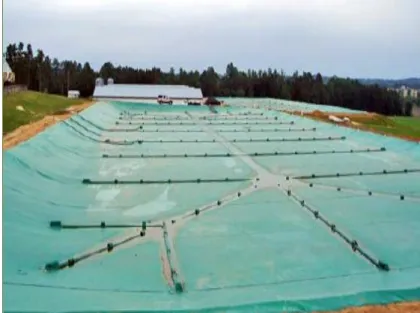
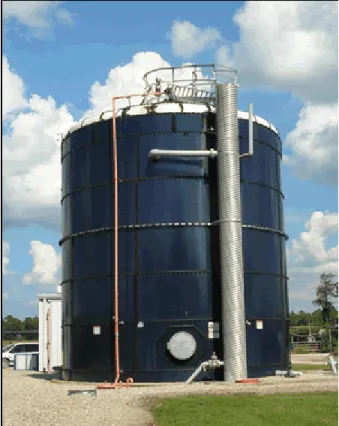
Figure 3 Covered lagoons have a flexible cover where the methane is collected and it's piped into a combustion device. (Agstar, 2010)
22
lagoons are used in dairies with flush systems that contain 0.5 to 2 percent solids. These lagoons are typically in the ground or lined, and covered with a flexible or floating cover. The covers are gas tight as not to let any of the methane out so it can be recovered by the system. This is not where manure is stored it is just a place for the manure and flush water to pass through.
Temperature around the covered lagoons is just the outside temperature with no external heating devices. For this reasons naturally hotter climates have more efficient covered lagoons that produce more methane because of the naturally elevated heat. Agstar.gov (2010).
In the covered lagoons the flush water (digester influent) is pumped into the first stage of the system the covered lagoon. This stage is where the biogas is produced and captured. The influent is left in this stage for typically 30-45 days. After this it is transferred into the second stage which is the more typical lagoon. The biogas is collected through the methane is then collected through the biogas pipe and stored for later purposes. In figure 3 we can see an image of the covered lagoon system. Figure 4 illustrates the covered lagoon system and how they work. The manure comes into the system and enters into cell one. Once in the first cell there is a cover that captures all of the biogas and is above the manure. The biogas is taken out of the system through the biogas pipe where it can be used to power a generator or injected into a natural gas pipeline.
23
Another form of a methane digester is the plug flow methane digester. These digesters are typically used on dairies that collect manure by scrapping the manure with no flush. In figure
6 there is an image of the plug flow digester system. Their length is usually a 5:1 ratio meaning that the digester is going to be five times as long as it is wide. It is an insulated tank that is usually made of concrete, fiberglass, or steel. Also it is covered with a gas tight cover to capture the methane that is produced in this
anaerobic digester. The digester can operate in mesophilic or thermophilic temperature ranges. It is filled with manure at 11-14 percent total solids and it has no system inside it to agitate or mix around the manure. The typical retention time of manure in these digesters ranges from 15 to 20 days.
Figure 4 this figure shows how the covered lagoon system works. (AgStar, 2010)
Figure 5 this figure shows the plug flow digester system. (AgSTAR, 2010)
Figure 5 This figure shows the plug flow digester system. (AgSTAR, 2010)
24 Figure 6 Shows a digesters process. (AgStar.gov, 2010)
Manure is pushed through the digester from one end to the other and flows through it. When new manure is added to the digester this is when the old manure is typically pushed out the other end. The methane is collected in the cover while the manure is slowly passing through the digester. Manure in this type of system is a lot thicker than the previous system.
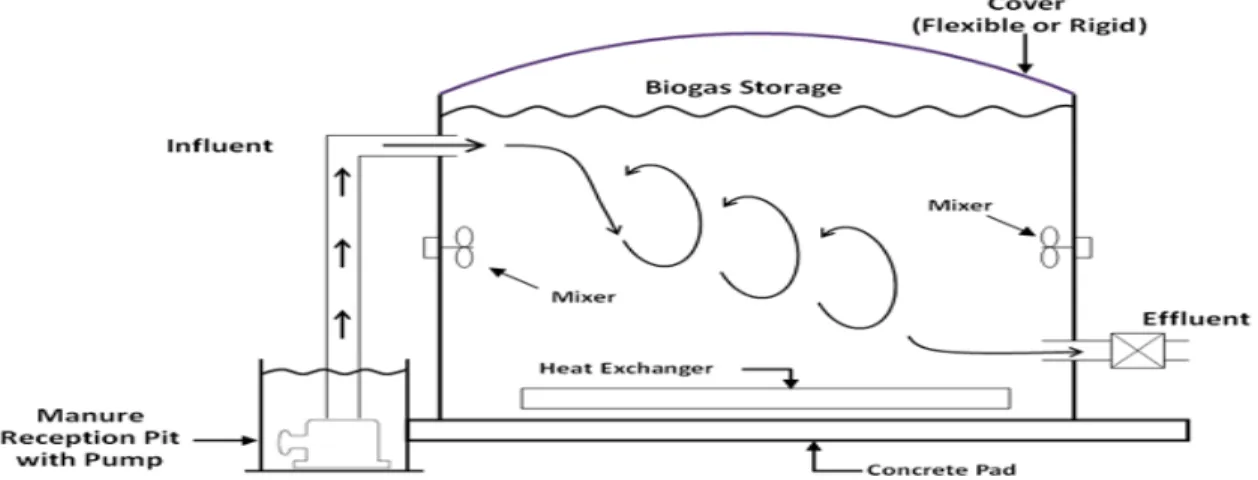
The third system is called the complete mix digester. In figure 8 we can see how the complete mix digester is used to create biogas. This system is an enclosed system that is above or below ground. These digesters are required to be kept at a constant heat range between the mesophilic and the thermophilic heat ranges. Usually they are made of concrete, fiberglass, or steel. To heat these digesters heating coils can
be used and hot water is pumped through these coils. These heating coils can be placed inside the digester. The contents in the digester can be mixed by a motor driven mixer that helps keep the contents mixing and helps to spread out the heat. This type of system of the complete mix
digester is best suited to process manure at 3-10 percent total solids. Holding time for the manure inside the digester is typically 10-20 days.
Figure 7 this is an image of a complete mix digester. (AgSTAR.gov, 2010)
Figure 7 This is an image of a complete mix digester. (AgStar. gov, 2010)
25
In the complete mix digester the manure is collected through the manure reception pit and pumped into the system. Once in the system it is mixed and kept at a constant heat level to maintain the anaerobic process. The methane is collected in the top of the tank while the rest of the manure after approximately 10-20 days in the digester is taken out.
There is also a fourth methane digester that is called a fixed film digester. With a fixed film digester you are able to effectively use with total solids at very low levels. These digesters would be useful on dairies with a constant flush system that use a lot of water. The fixed film digester is filled with a medium that has a very large surface area for microbial growth. The wastewater then passes through this system and the anaerobic microbes that are on the medium attach themselves to it. This creates a thin layer of film which is called bio film which is where the digesters name comes from. In this system when the wastewater is discharged the bacteria stay in the system attached to the medium. The bacteria are at work when the new wastewater is added. With this fast system and low amounts of total solids the retention times are a lot smaller because the wastewater is constantly moving. The retention times are around 3-5 days.
Figure 8 is and image of a mix digester system and its process. (AgStar, 2010) Figure 8 is an image of a mix digester system and its process. (Agstar, 2010)
26 When looking into what digester may suit your dairy operation you need to look into what digester’s process fits you dairy and the digester’s needs. Lots of factors should be considered such as average temperature in the area, dairy herd size, and what type of manure collection system your dairy has.
Temperature
Temperature for methane digesters and the anaerobic process is an important factor in the production of methane. Rapid change in the temperature in the process of anaerobic digestion
can upset the bacteria in the process resulting in the reduction of biogas produced. Anaerobic digestion is best when in the thermophilic temperature range (114-176 degrees Fahrenheit). This temperature is better for bacteria resulting in more complete decomposition of products.
However this system is harder to keep the right temperature and the microorganisms are more sensitive to temperature change. Operating systems that are in the mesophilic range (77 and 104 degrees Fahrenheit) are typically a lot better at temperature shifts in the system. However this type of system requires a much larger holding tank, because of the longer time it takes for the microorganisms to completely break down the material. Even though both types of temperature ranges work these anaerobic digesters need a constant temperature range.
Maintaining temperature ranges is a difficult task and there are different methods used to try to maintain a steady temperature for the microorganisms. In some cases digesters use the
Figure 9 in this image it shows a fixed film digester. (AgSTAR.gov, 2010)
Figure 9is an image that shows a fixed film digester. (AgStar.gov, 2010)
Figure 10 is an image that shows a fixed film digester. (AgStar. gov, 2010)
27
coolant that is produced from the engines that are powered by the methane, to reheat the digester itself to keep the methane digesters temperature levels at a constant temperature. With this type of system an anaerobic methane digester is able to use its own energy to keep the
microorganisms in the digesters happy. When the temperature is held at constant levels biogas productivity can be increased due to the better environments for microorganisms in the anaerobic digester. (Biogas.psu.edu, 2004)
PH Levels
As well as maintaining proper heat levels pH levels are also a very important part of the anaerobic digestion process. PH is the measure of the acidity of a solution. PH levels range from 1 to 14 while base levels are higher than 7 and acidic levels are lower than 7. In the anaerobic digester methane producing bacteria require pH levels between 6.8 to 8.5 according to
extension.org (2010). When these pH levels in the anaerobic digester get to low, or become too acidic the methane producing bacteria can be overwhelmed and even killed. When this happens the digester can have a souring which is very hard to reverse and basically makes the entire digester useless until it is restarted. Restarting an anaerobic digester is very costly and very hard. To do this you must open the digester and remove all of the material inside and then refill the digester and start the process over. Ways of helping to avoid this can be by adding bicarbonates that can help regulate the pH levels. However most digesters do not need bicarbonates to be added because pH levels are usually self regulating. Regulating and making sure the methane digester is at the right pH ranges needs to be closely monitored as to nor ruin an anaerobic digester.
28
Dangers Anaerobic Digestion
Although anaerobic digestion can be a very helpful process and tool to the dairy industry, there are still risks involved and problems that face methane digestion. The biogas that is
produced has several risks to it. The risks include explosions, asphyxiation, and hydrogen sulfide poisoning. With these risks included with methane digesters people that work with these
anaerobic digesters need to be careful. (Extension.org, 2010)
The first risk is explosion or fire due to biogas. The biogas which is composed of 60 percent methane which when mixed with oxygen can be potentially dangerous. Ways to avoid this problem are by not smoking or having any open flames near methane digesters. Also the generators or engines that are used to produce electricity from the biogas need to be safe as not to cause any sparks which may cause an explosion within the digester.
Asphyxiation is also a big concern when dealing with methane digesters. Going into places where manure is stored can be very dangerous. Even going into open places where manure is stored can still be a hazard as the biogas produced from the manure can push the oxygen out of the place causing people who are in there to have trouble breathing and possibly pass out.
Another risk is disease from handling manure which can contain bacteria, viruses, and parasites. With this risk the handling of animal manure needs to be proceeded with caution. One of the ways to prevent this is to wear gloves when handling this material and always wash your hands before and after handling this material.
29
Components of biogas
The components of biogas serve as their own risks when it comes to safety with methane digesters.
The first and biggest component of biogas is methane. Methane is lighter than air so in enclosed spaces it will be up in the top of these spaces. Methane is explosive at 5 to 15 percent concentrations. And even though methane is not a toxic gas it is still very dangerous because it displaces air. In confined spaces when methane displaces the air it can form an oxygen lacking environment. Extension.org (2010)
Another component of biogas is carbon dioxide which is heavier than air. Since this gas is heavier than air it will be towards the floor. However enough carbon dioxide displacing air can cause increased heart rate and respiration rate. Also with too much carbon dioxide death can incur due to the lack of oxygen.
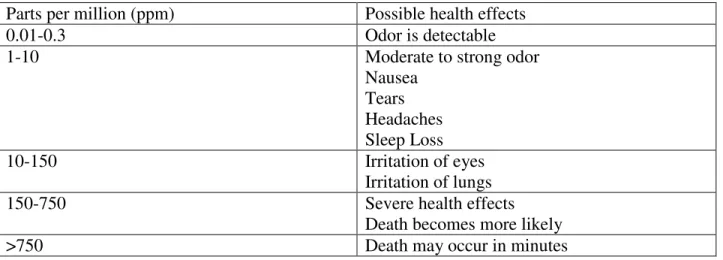
Hydrogen sulfide is also a part of the biogas and this gas is very toxic to humans. It is heavier than air so it usually resides on the floor. There are different reactions to this gas at its different levels. At very low levels a foul odor is produced that can lead to tears, headaches and sleep loss. At higher more dangerous levels it can destroy the sense of smell and lead to
respiratory paralysis. And when it gets much higher than that it can lead to fatal levels where death is very likely to occur.
30
Table 4 this table provided by “extension.org” shows the health effects when dealing with hydrogen sulfide. (Extension.org, 2010)
Parts per million (ppm) Possible health effects
0.01-0.3 Odor is detectable
1-10 Moderate to strong odor
Nausea Tears Headaches Sleep Loss 10-150 Irritation of eyes Irritation of lungs
150-750 Severe health effects
Death becomes more likely
>750 Death may occur in minutes
Another one of the biogases is ammonia. Ammonia is a gas that can irritate eyes and can also displace oxygen in the bloodstream.
All of these different types of biogases need to be closely monitored and precautions need to be made when handling animal manure and dealing with methane digesters. These types of problems with the gases can all be avoided with careful management of methane digesters and animal manure. The different types of precautions include gas sensors, walkthroughs to make sure systems are working properly and protective equipment for personnel. With preparations and precautions such as these safely handling the manure and anaerobic digesters can be done.
AgSTAR
With a lot of focus on green energy and more economically feasible ways for farms to operate there is an outreach program called AgSTAR. This program is designed to cut back on the emissions of methane from livestock and different types of waste management operations. The way that AgSTAR has been trying to do this is by promoting the use of biogas recovery
31
systems. This organization has help from the Environmental Protection Agency (EPA) the U.S. Department of Agriculture, and the U.S. Department of Energy.
On its website it helps with an array of different information and tools that are there to help producers by helping them evaluate possible involvement or implementation of these systems. Some of the ways they do this are by conducting farm digester extension events. They help with “How-To” projects, and they also help by collaborating with state and federal
renewable energy programs.
Anaerobic Digester Operations
Anaerobic digestion is widespread throughout the United States. According to
AgSTAR’s website there are an estimated 157 anaerobic digesters in the United States operating on commercial livestock farms. In California as of 2010 there are an estimated 15 operations. California is tied for third in the United States as for number of anaerobic digesters. California is behind Wisconsin and New York. Of all of these projects 135 of them generate electricity or thermal energy from the biogas captured. According to AgSTAR’s website the projects that produce electricity from the biogas produce about 351,000 megawatt-hours (MWh) annually. The boiler projects, pipeline injection, and the other energy projects produce 54,000 (MWh) additionally per year equivalent to the electricity produced. Other projects flare biogas that is captured to reduce odor and methane emissions.
With all of these different ways of converting the biogas electricity, transferring to pipelines or just controlling odor with flaring the total biogas that is combusted prevents the emission of 46,000 metric tons of methane annually. Also with the help of the combustion of
32
natural gas it helps to displace the use of fossil fuels for energy generation. This helps to reduce the additional emissions of greenhouse gases and other air pollutants.
Cost of Anaerobic Digestion
The cost of anaerobic digestion for dairy cattle’s manure varies between different systems, styles, livestock operation, and location. Finding information on as-built anaerobic digesters is hard to come across the website AgSTAR analyzed vendor quotes providing
estimates on capital costs. The way they did this was they analyzed the system capital cost data from 40 different dairy farms. Of the 40 different anaerobic digestion systems they included 13 complete mix digesters, 19 plug flow digesters, and 8 covered lagoons. Of the capital cost for each system there was the cost of the digester, engine and generator, engineering design, and installation. These costs are based on quotes from 2003-2009. Systems that were excluded were systems that use co-digestion. A factor that had variability in the reported costs of the digesters
Figure 11 this figure from the AgSTAR website shows the number of operating digesters as of (July 2010) these digesters include dairy (126) swine (24) poultry (5) Beef (2). (Agstar.gov, 2010)
33
was that not all of the reported costs were the same. In AgSTAR’s analysis they excluded costs of post digestion solid separation, hydrogen sulfide reduction systems, and utility charges which included line upgrades and interconnection equipment costs and fees. After these were excluded the remaining costs were put into September 2009 dollars. When all of these factors were taken into account and the variable costs were removed AgSTAR was able to find. AgSTAR.gov (2010)
Figure 12 In this figure there is a comparing of three different types of methane digesters. (Forresst Steglin, 2010)
#of Cows
In figure 12 you can see that in the graph as the number of cows increases the cost of capital increases as well. So the larger dairy operation you have the more input cost farmers have for the same system. However in Figure 13 we can see that as the number of cows per dairy increases at a same rate the cost per dairy cow also simultaneously decreases. With both of these figures it seems that the most economically feasible dairies that are able to sustain methane digesters are dairies with a large number of dairy cows.
$-$500,000.00 $1,000,000.00 $1,500,000.00 $2,000,000.00 $2,500,000.00 $3,000,000.00 500 1000 1500 2000 2500 3000 3500 4000 4500 Plug Flow Complete Mix Covered Lagoon C A P I T A L C O S T S D O L L A R
34
Figure 13 In this figure it shows how as the number of dairy cows per dairy increases the cost of digesters per cow also decreases. (Forresst Steglin, 2010)
# of cows
From the graphs we can see from capital costs and capital costs per cow it shows how the covered lagoon is relatively low to the other two types of digesters. Also across the U.S. the covered lagoon type of digester is also the most commonly used type of digester.
Funding
There are also many different types of funding done by the Federal and state governments that range from grants, bond, tax credit, loan guarantees, etc. All of these different types of loans have incentives for dairymen who are interested in providing renewable energy and different practices that help the environment. With regards to this paper the main objective of these funds can be geared towards methane digestion. There are 15 different types of US/Federal types of fund incentives and as of now there are 3 different incentives in California that offer money to farming operations that have an interest in energy conservation. (AgStar, 2010) With these
$-$500.00 $1,000.00 $1,500.00 $2,000.00 $2,500.00 500 1000 1500 2000 2500 3000 Plug Flow Complete Mix Covered Lagoon D O L L A R V A L U E
35
incentives that are geared towards farmers the general message is that the government is encouraging farming practices to move more towards green energy.
Dairy Problems
There are a lot of problems with methane digesters that everyone is figuring out. The methane digesters collect all of the methane from the manure in the anaerobic process. Methane is a greenhouse gas that is released into the air when it is not collected, and is 25 times more powerful than carbon dioxide. So when you think of collecting methane and using for renewable energy it sounds like a great idea. However the emissions from the methane digesters have been found to cause other problems. They found that the generators used to convert the methane into energy emit the gas Nitrogen Oxide. So covering the problem of emitting the greenhouse gas methane may be covered, but the problem of releasing Nitrogen Oxide into the air has now arose. Smog is regulated by a whole different type of agency then the one that regulates greenhouse gas emissions so the dairymen that are putting in these methane digesters are having problems keeping up with the very different agencies.
John Fiscalini is a dairyman in Modesto California who put millions of dollars into his methane digesters. Although he is collecting methane and trying to use the methane gas for energy he is running into problems with the air quality control board. In the San Joaquin valley where his dairy is they have one of the worst smog environments in the country. So regulations of harmful gas are strictly enforced. His generators that produce the sustainable energy from the anaerobic process produce the harmful gas Nitrogen Oxide. The problem with regulating this gas and regulating other emissions from natural gas generators is that the quality of methane gas emitted from the anaerobic process varies a lot. This causes a lot of problems because they are
36
not able to regulate the nitrogen oxide that comes off of the generators as much. What it has forced Fiscalini to do is to put a very expensive regulator on his digesters that has cost him upwards of 200,000 more dollars just to meet these requirements. With all of these requirements and regulations being put onto his dairy and his methane digesters it is making it very hard for him to have a cost effective system with his methane digesters. Fiscalini was required to put in filters on his equipment, but since all of these regulations and putting it in around 2008 he has spent more money in just maintenance fees and already having to replace the filters many times. "I wonder, sometimes, why I ever thought this was a good idea," Fiscalini said. (L.A. Times, 2010)
With all of these road bumps dairymen are facing it seems almost impossible for dairies to have sustainable systems when Nitrogen oxide is being created.
Solutions
There are a couple solutions however that are being looked into when it comes to methane digestion. Two of these solutions are fuel cells and injecting the biogas into natural pipelines that are owned by electric companies. With these two types of solutions it gives the process of anaerobic digestion a way to work without putting the problem of controlling the output of nitrogen oxide on the dairy farmers back.
Fuel Cells
Fuel cells are a way of producing electricity from the combination of hydrogen and oxygen (Fuelcells.org, 2000). With this technology they are able to produce electricity through the production of electricity in a clean way. The excess heat that comes off of the fuel cell can be used to heat water. Fuel cells also run very quietly which reduces noise pollution, and they are
37
also very efficient. This way of producing electricity can be very useful in the process of anaerobic digestion because of how clean the fuel cells run. According to fuelcells.org methane is a hydrogen rich compound that is why the fuel cells are able to use the methane that is
collected off of methane digesters and then put into the fuel cell to produce electricity. With this type of technology fuel cells are able to produce clean, and sustainable energy without producing nitrogen oxide compared to on farm generators.
Natural gas pipeline
Collection of methane in the process of anaerobic digestion can be utilized to produce electricity. However there are many problems with having clean energy and complying with the air quality control board’s standards when using generators on dairies to produce electricity. Another way to overcome this obstacle is by taking the biogas collected from the process and using a scrubber to clean the biogas then injecting it directly into a natural gas pipeline. When injecting the natural gas into the pipeline you can sell the natural gas to power companies that want to use the natural gas for the production of power. In California power companies are trying to use more renewable and clean energy because of programs such as the renewable energy program. This program tries to help increase the production of renewable energy in California. Anaerobic digestion is a perfect way to increase their renewable energy by using methane that is produced by dairy cows manure and capturing this energy and using it as a natural gas power source.
Bioenergy solutions is a company out of Bakersfield California that is trying to utilize the production of methane. They are trying to do this by putting in methane digesters on dairies and taking a percentage of the revenue these dairies make. They make the revenue by selling the biogas to the power companies after injecting it into the power companies’ natural gas pipeline.
38
Bioenergy began this by putting in a methane digester into a 5,000 cow dairy called vintage farms. After the methane is collected from the dairy the manure is scrubbed to remove corrosive materials to meet PG&E’s natural gas standards. The owner of Bioenergy solutions is David Alber’s who also owns vintage dairy as well. He is trying to put more of these digesters on other farms around his area due to the proximity of PG&E’s natural gas pipeline. (Pg&e.com, 2008)
This type of system is economically feasible on the vintage dairy because of its location and size. Not all dairies are able to utilize the pipeline as vintage dairy has because of its
closeness and size. Bioenergy solutions is trying to get more dairies to do this and on their website they want dairymen to contact them so they can do evaluations of their dairy operation and see if it is feasible for them to put in the digester.
Conclusion
Although there are many problems with methane digestion on dairies the need for renewable energy is still growing. With all of the different ways companies are trying to find to get clean renewable energy there is a push for these digesters. In the economy we have today it is hard for these digesters to be economically feasible for dairymen. The upfront costs for these digesters and the maintenance is very high and not a top priority for dairymen. However with the growing concern for global warming, the dairy industry is being scrutinized for its contributions with the greenhouse gas methane. Also with the problems of emissions of nitrogen oxide from on farm generators it seems the dairymen face only problems with these digesters. However
technologies such as fuel cells which help give off clean power and ideas such as injecting the biogas directly into the pipeline for power companies’ use there are more incentives for
39
and with more advancement in this technology it seems that methane digesters may eventually become economically viable for more dairy farmers in California.
40
References
Works Cited
AgEconSearch. 2010. Sustainable Economic, Marketing, Environmental and Financial Opportunities for Biogas Recovery Systems. Forrest Steglin.
http://ageconsearch.umn.edu/handle/93418 Accessed Nov. 12, 2010.
AgStar. 2010. Anaerobic Digestion. http://www.epa.gov/agstar/anaerobic/index.html Accessed Nov. 10, 2010.
AgStar. 2010. Fact Sheets. Anaerobic Digestion. http://www.epa.gov/agstar/anaerobic/fact.html Accessed Oct 25, 2010.
AgStar. 2010. Operating Anaerobic Digester Projects.
http://www.epa.gov/agstar/projects/index.html Accessed Nov. 7, 2010.
Air Quality Management District. 2008. Historic Ozone Air Quality Trends. http://www.aqmd.gov/smog/o3trend.html Accessed Nov 3, 2010.
Air Resources Board. 2010. California’s Clean Air Agency.
http://www.arb.ca.gov/html/brochure/arb.htm Accessed Nov 1, 2010.
All bioenergy. 2007. Bio Energy Solutions.
http://www.allbioenergy.com/index.php?option=com_content&task=blogcategory&id=2 2&Itemid=34 Accessed Nov. 18, 2010.
41
Around the Capital. 2010. California political news and opinion.
http://www.aroundthecapitol.com/billtrack/text.html?bvid=20095SB495CHP Accessed Nov 31, 2010.
Bakersfield Express. 2009. Manure Power. Dairies harness methane to create renewable energy. http://bakersfieldexpress.org/2009/11/11/manure-power-dairies-harness-methane-to-create-renewable-energy Accessed Nov. 8, 2010.
Biomass Magazine. 2009. Methane Migraine. Anna Austin.
http://biomassmagazine.com/articles/3377/methane-migraine Accessed Oct. 25, 2010. Capital Press. 2010. Bureaucracy stifles dreams of digesters.
http://www.capitalpress.com/newsletter/ws-digesters-081310 Accessed Oct. 23, 2010.
Chemistry. 2010. Chemistry glossary definition of pH.
http://chemistry.about.com/od/chemistryglossary/a/phdef.htm Accessed Nov 7, 2010.
Climate Science. 2006. Methane as a Greenhouse Gas.
http://www.climatescience.gov/infosheets/highlight1/default.htm Accessed Oct. 25, 2010.
Energy. 2010. California’s Renewable Energy Programs.
http://www.energy.ca.gov/renewables/index.html Accessed Nov.1, 2010.
Energy Savers. 2010. Methane and Anaerobic Bacteria. How Methane Digestion (Methane Recovery) Works.
http://www.energysavers.gov/your_workplace/farms_ranches/index.cfm/mytopic=30003 Accessed Oct 31, 2010.
Environmental Protection Agency. 2010. Summary of the Clean Air Act. http://www.epa.gov/lawsregs/laws/caa.html Accessed Nov. 2, 2010.
42
Extension. 2010. Animal Manure Management. http://www.extension.org/animal manure management Accessed Nov. 5, 2010.
Gallup. 2009. Top-Emitting Countries Differ on Climate Change Threat. Anita Pugliese. Julie Ray. http://www.gallup.com/poll/124595/Top-Emitting-Countries-Differ-Climate-Change-Threat.aspx Accessed Nov. 3, 2010.
Industrial Fuels and Power. 2008. Fuel cells come of Age.
http://www.ifandp.com/article/001839.html Accessed Nov 14, 2010.
LA Times. 2010. A Stink in Central California over converting cow manure to electricity. http://articles.latimes.com/2010/mar/01/business/la-fi-cow-power1-2010mar01/2 Accessed Oct 13, 2010.
Morse, D., J.C. Guthrie, and R. Mutters. 1996. Anaerobic Digester Survey of California Dairy Producers. J. Dairy Sci. 79.1: 149-153.
Ocean Color. 2010. Amateur Guide for Air Quality Testing.
http://disc.sci.gsfc.nasa.gov/oceancolor/additional/science-focus/locus/amateur_guide_for_air_quality_000.shtml Accessed Nov. 18, 2010. PG&E. 2008. First “Cow Power” Project.
http://www.pge.com/about/news/mediarelations/newsreleases/q1_2008/080304.shtml Accessed Nov. 5, 2010.
RcmDigesters. 2006. RCM Digesters. The Standard For Manure Digesters. http://www.rcmdigesters.com Accessed Oct. 25, 2010.
43
Sokolow, A., Hammond, S. V., Norton, M. V., and Schmidt, E. E. 2010. California Communities deal with conflict and adjustment at the urban agricultural edge. California Agriculture. 64(3):121-128.
Shih, Jhih-Shyang, Dallas Burtaw, Karen Palmer, and Juha Siikamaki. 2006. Air Emissions of Emonia and Methane from Livestock Operations. Resources for the Future. 6-11: 1-28.
Suscon. 2010. Conservation Highlights. The New Face of Green.
http://www.suscon.org/highlights/newFaceOfGreen.php Accessed Nov. 3, 2010.
University of California. 2010. Pollution regulations stymie dairy electricity generation. Jeannette E. Warnert. http://ucanr.org/blogs/anrnews/index.cfm?tagname=methane Accessed Nov. 3, 2010.
Watts Up With That. 2010. Climate idiocy at the Monterey Bay Aquarium.
http://wattsupwiththat.com/2010/05/01/climate-idiocy-at-the-monterey-bay-aquarium-a-cow-with-a-gas-mask Accessed Nov. 5, 2010.
Western Farm Press. 2006. Dan Bryant. Methane digester converts dairy manure to electricity. http://westernfarmpress.com/methane-digester-converts-dairy-manure-electricity Accessed Nov.5, 2010.
Western United Resource Development. 2010. Biomethane Fuel.