Power Saving Cloud Archive
Total Cost of Ownership (TCO) Comparison:
Power Saving Cloud Archive vs.
Scale-‐Out NAS, Tape, and ‘Storage-‐as-‐a-‐Service’
Cutting Edge Networked Storage
435 West Bradley Ave, Suite C
El Cajon, CA. 92020
800-257-1666
619-258-7800
Table of Contents:
Executive summary ... 4
Power Saving Cloud Archive Architecture ... 4
Power Requirements In The Data Center ... 5
Electricity and Power-related Infrastructure Costs in the Data Center ... 5
Cost of Electricity in the Data Center ... 6
Comparing Storage Solutions ... 8
PSCA vs. Scale-Out NAS, Enterprise Tape Libraries, and Storage-As-A-Service ... 8
Comparing PSCA To Isilon Scale-Out NAS ... 11
Comparing PSCA to Enterprise Tape Libraries ... 17
Comparing PSCA to Storage-As-A-Service ... 21
The race between data growth and IT infrastructure capacity ... 22
Data Storage Requirements Shifting Toward Unstructured Files & Longer Retention ... 23
Potential Incremental Power Cost Associated with Carbon Emissions Tax ... 23
Conclusion ... 23
Table of Figures:
Figure 1: Koomey's (August 2007) Power-‐related costs grow as power per server cost
grows
... 5
Figure 2: Chart derived from Koomey’s (August 2011) electricity use within the data center
... 6
Figure 3: 100TB TCO comparison with acquisition/capital cost amortized over 5 years
... 8
Figure 4: 250TB TCO comparison with acquisition/capital cost amortized over 5 years
... 9
Figure 5: 1PB TCO comparison with acquisition/capital cost amortized over 5 years
... 10
Figure 6: 100TB TCO comparison of the PSCA vs. Isilon IQ 36NL near-‐line storage archive
11
Figure 7: 250TB TCO comparison of the PSCA vs. Isilon IQ 72NL near-‐line storage archive
12
Figure 8: 1PB TCO comparison with acquisition/capital cost amortized over 5 years
... 13
Figure 9: 250TB yearly operating costs (power and power-‐related infrastructure) at
maximum load
... 14
Figure 10: 250TB yearly operating costs (power and power-‐related infrastructure) at
typical load
... 15
Figure 11
: Operating costs of the PSCA as a percentage of acquisition cost maximizing ROI
16
Figure 12
: 100TB TCO comparison of the PSCA vs. Spectra Logic Spectra T120 Tape Library
... 18
Figure 13
: 250TB TCO comparison of the PSCA vs. Spectra Logic Spectra T380 Tape Library
... 19
Figure 14
: 1PB TCO comparison of the PSCA vs. Spectra Logic Spectra T950 Tape Library
. 20
Figure 15
: TCO comparison of the PSCA vs. Amazon S3 Simple Storage Service
... 21
Figure 16
: The growth rate of things digital
... 22
Figure 17
:The growth rate of things digital
... 25
Figure 18
: Internet Connectivity vs. Time
... 26
Executive summary
For several years there has been a developing trend where IT departments have been asked to meet ever increasing user expectations while IT budgets have been placed under downward pressure.
Rising IT consumer expectations stem from the ever-‐increasing importance digital information plays in both professional and private lives. The implication is that ever-‐increasing quantities of IT storage infrastructure will be necessary to meet user expectations.
Power related costs comprise one third of the TCO for storage infrastructure when evaluated based on an open standards pricing model. The percentage of TCO for power related storage costs is increasing. The power requirement for storage within the data center is growing at nearly three times the rate of overall data center power requirements.
In the future data storage will require more IT infrastructure, consuming increasing amounts of power. 80% of data is now unstructured file based. The majority of this unstructured file-‐based data is "long tailed" in the nature.
As detailed in this whitepaper, the new Power Saving Cloud Archive (PSCA) architecture from Cutting Edge Networked Storage addresses these challenges. PSCA leverages multi-‐tiered archiving in combination with innovative power-‐saving hardware to deliver high-‐density, scalable storage that substantially reduces the TCO for data storage infrastructure.
The PSCA substantially decreases greenhouse gas emissions due to reduced energy consumption.
Power Saving Cloud Archive Architecture
The Power Saving Cloud Archive from Cutting Edge Network Storage provides a low-‐cost, high-‐
performance, robust ultra power efficient file server and archiving solution for the SMB, SME, and data center. The Power Saving Cloud Archive (PSCA) couples high-‐performance enterprise class storage servers using fast SAS and SSD drives and multiple 10 gigabit Ethernet network connections with high-‐ capacity RAID-‐6 protected storage. A back-‐end private network provides fast, reliable, and redundant file storage and archiving creating a multi-‐level storage architecture.
Using open standards server and storage components with Cutting Edge’s 5th generation EdgeWare NAS OS built on a 64-‐bit Linux base allows the PSCA to significantly reduce storage costs compared to scale-‐ out NAS, tape libraries, or storage-‐as-‐a-‐service. Open standards internal and external RAID systems, SAS/SATA/SSD disks, high-‐performance Intel processors, and multiple gigabit and/or 10 gigabit Ethernet ports allows the PSCA to leverage high-‐quality low-‐cost components. This open standards approach provides greater cost efficiencies and quicker technology refresh cycles when compared to expensive proprietary hardware or software.
The “magic” of the PSCA is the inclusion of the Long Term Storage Nodes (LTSN) for short-‐term or long-‐ term archiving of files as determined by user operational requirements. The user sets file retention as a share policy so files with known retention time requirements can be managed on a time-‐based policy from 1 day to indefinitely. LTSNs can be added as needed to expand the storage capacity of the Power Saving Cloud Archive on the fly. Each LTSN is a high-‐capacity self-‐contained storage appliance using high-‐quality low-‐cost open standards components. When active the LTSN power requirements are
similar to that of a low-‐power application server and are almost zero when in standby mode. The ability of an LTSN to power down when not in use and dynamically power on when needed in 30 seconds, creates power efficiency previously unknown in the storage industry.
Power Requirements In The Data Center
Electricity and Power-‐related Infrastructure Costs in the Data Center
Jonathan G. Koomey, Ph.D. stated in ASSESSING TRENDS OVER TIME IN PERFORMANCE, COSTS, AND ENERGY USE FOR SERVERS1, “Data centers are the heart of the global economy.”
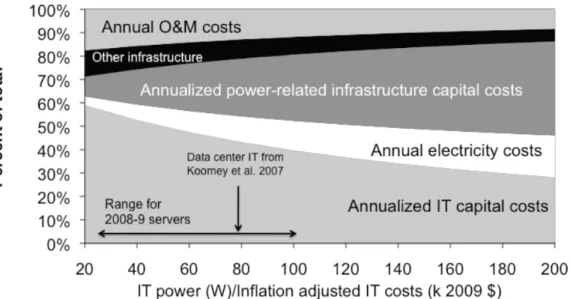
Koomey’s graph (Figure 1) from August 2007, demonstrated the continuing trend towards ever more power-‐intensive IT equipment in the datacenter. Koomey shows the importance of different data center cost components as a function of power use per thousand dollars of commodity server cost. Koomey notes, “…that as the power per server cost continues to increase, the indirect power-‐related
infrastructure costs will soon exceed the annualized direct cost of purchasing the IT equipment in the data center.” Koomey’s statement was based on commodity application servers but the trend applies to all IT infrastructures including storage.
Figure 1: Koomey's (August 2007) Power-‐related costs grow as power per server cost grows
The primary reason why Koomey’s 50% TCO power rule does not yet apply to storage is the excessive storage equipment acquisition costs when compared to commodity servers. Today’s storage may have a 200%-‐300% higher power consumption than commodity servers, however this is accompanied by a 500%-‐1000% increase in acquisition cost over that of commodity servers.
Although storage does not fit within the confines of Koomey’s argument regarding power and power-‐ related infrastructure costs exceeding the storage server acquisition cost, other ratios of the chart
1 ASSESSING TRENDS OVER TIME IN PERFORMANCE, COSTS, AND ENERGY USE FOR SERVERS
Jonathan G. Koomey*, Christian Belady†, Michael Patterson**, Anthony Santos**, Klaus-‐Dieter Lange††
* Lawrence Berkeley National Laboratory and Stanford University, †Microsoft Corporation, **Intel Corporation, ††Hewlett-‐Packard Corporation. Final report to Microsoft Corporation and Intel Corporation Released on the web: August 17, 2009
(Figure 1) are relevant in regards to the ratios of (cost of electricity: cost of power related infrastructure) and (cost of electricity: cost of other infrastructure). The cost of O&M (operations, labor, service, and maintenance) is considered a function of the IT equipment acquisition cost.
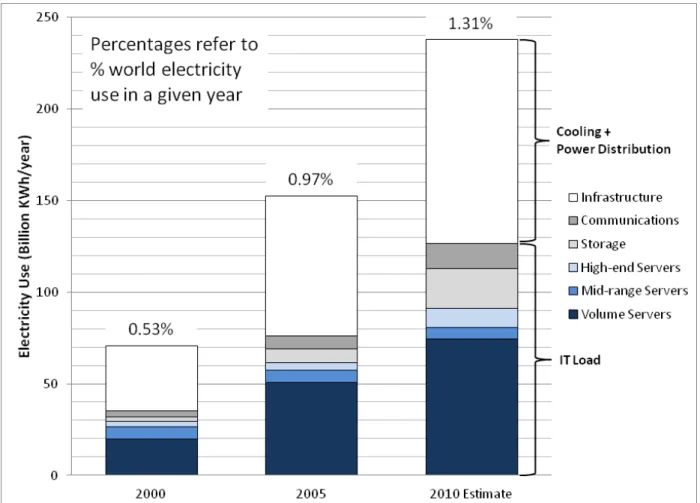
Koomey’s latest report GROWTH IN DATA CENTER ELECTRICITY USE 2005 TO 20102 shows that the electricity required to power data centers worldwide has increased 287% over the last decade (see Figure 2). Over that same period the electricity required to power storage systems in the data center has increased 770%. This indicates that the power requirement for storage within the data center is growing at nearly three times the rate of the data center power requirements. All indications are that increasing power requirements for storage will continue to outpace the total data center power
requirements.
Figure 2: Chart derived from Koomey’s (August 2011) electricity use within the data center
Cost of Electricity in the Data Center
3The average cost of electricity for major data center regions around the United States was used in determining the cost of electricity and power-‐related infrastructure for the products included in the
2
GROWTH IN DATA CENTER ELECTRICITY USE 2005 TO 2010
Jonathan G. Koomey, Ph.D., Consulting Professor, Stanford University. A report by Analytics Press, completed at the request of The New York Times http://www.analyticspress.com/datacenters.html
3 Taken from the U.S. Energy Information Administration, “Average Retail Price to Ultimate Customers by End
Total Cost of Ownership (TCO) comparison. These regions include New England (Connecticut, Maine, Massachusetts, New Hampshire, Rhode Island, and Vermont), New York, New Jersey, Maryland, District of Columbia, and California. The average cost of electricity for 2011 for the regions listed above is $0.136 per KWh, and ranges from $0.116 in Maryland to $0.151 in New York State. Cutting Edge has created a simple TCO calculator;
http://www.cuttedge.com/psca/TCOcalculator/
The appropriate power cost and other factors may be input into the TCO calculator to produce a customized storage TCO calculation.
Comparing Storage Solutions
PSCA vs. Scale-‐Out NAS, Enterprise Tape Libraries, and Storage-‐As-‐A-‐Service
This section will compare the PSCA total Cost of Ownership against EMC/Isilon Scale-‐Out NAS, Spectra Logic Tape Libraries, and Amazon S3 Simple Storage Service using 100TB, 250TB and 1PB capacities.
The 100TB Storage Capacity Comparison chart (Figure 3) shows the relative cost of hardware acquisition amortized over 5 years with an 8% interest rate plus yearly expenditures for power, infrastructure, and operations/maintenance costs. It assumes a salvage value of $0 at the end of the five year period. The Amazon S3 simple storage service is a “cloud-‐based” storage service with a monthly charge replacing the acquisition and support costs of the other solutions.
Figure 3: 100TB TCO comparison with acquisition/capital cost amortized over 5 years4
4 Cutting Edge PSCA solution includes a one PSCA NAS Server, two PSCA Network Switches for a redundant private network, and three
36TB (raw) Long Term Storage Nodes. PSCA power costs assume a 10% up time on the Long Term Storage Nodes.
Spectra Logic Tape solution includes a Spectra T120 library with eight half-‐height LTO-‐5 Fiber Channel tape drives. Spectra Logic power costs assume drives will be dedicated to writing no more than 10 hours a day and available for retrieval and maintenance at least 14 hours per day. Power requirements for the Spectra T120 tape library are taken from the Spectra T120 product brochure available from
http://www.spectralogic.com/index.cfm?fuseaction=home.displayFile&DocID=342.
The 250TB Storage Capacity Comparison chart (Figure 4) increases the compared storage capacity from 100TB to 250TB. The PSCA requires four additional 36TB (raw) LTSNs to reach 250TB. The Isilon IQ NL-‐ Series requires one additional cluster node and upgrading the cluster node capacities from 36TB (Isilon 36NL) to 72TB (Isilon 72NL). The Spectra Logic Tape Library must be switched out from the T120 to the T380, and includes four additional LTO-‐5 tape drives. Since Amazon S3 is a storage service it only requires additional capacity be rented.
Figure 4: 250TB TCO comparison with acquisition/capital cost amortized over 5 years
The 1PB Storage Capacity Comparison chart (Figure 5) increases the compared storage capacity from 250TB to 1PB. The PSCA requires twenty-‐one additional 36TB (raw) LTSNs to reach 1PB. The Isilon IQ NL-‐Series requires ten additional Isilon 72NL cluster nodes. The Spectra Logic Tape Library must be switched out again, this time from the T380 to the T950. Amazon S3 is again a storage service only requires additional capacity be rented.
Isilon IQ NL-‐Series includes four Isilon IQ 36NL 36TB (raw) cluster nodes. Isilon systems normally require at least one additional node over the minimum storage requirement for redundancy of the distributive file system. Power requirements for the Isilon IQ NL-‐Series systems are taken from the Isilon IQ NL-‐Series product brochure available from http://www.isilon.com/nl-‐series.
Amazon S3 Simple Storage Service cost is calculated using Amazon S3 “reduced redundancy storage” priced at the appropriate usage levels. Outbound data charges assume a 25% data retrieval rate per month.
Figure 5: 1PB TCO comparison with acquisition/capital cost amortized over 5 years
Comparing PSCA To Isilon Scale-‐Out NAS
When comparing the PSCA solution to the EMC/Isilon Scale-‐Out NAS we use Isilon’s IQ NL-‐Series to provide the best comparison by similar use cases. Isilon’s IQ NL-‐Series is identified by Isilon as a near-‐ line archive solution for a tiered environment. This provides the best comparison in capacity to the PSCA solution.
Comparing the 100TB capacity solutions (Figure 6) the PSCA is significantly less expensive based on a $ per GB comparison with the PSCA at $0.60 per GB compared to Isilon’s IQ 36NL solution priced at $1.87 per GB5. Isilon typically uses one extra node as a cluster for redundancy across the distributed file system. The IQ NL-‐Series data sheet reports typical power usage of 800 watts per node at 110V, therefore requiring four cluster nodes at 3200 watts to provide a redundant 100TB solution. The PSCA NAS Server and PSCA Private Network switches use 512 watts at 110V while each LTSN (3) uses 200 watts when active but only 3 watts when switched to the reduced power mode. The data from Figure 6 indicates the PSCA solution has significantly reduced acquisition costs as well as substantially lower power and operating costs.
Figure 6: 100TB TCO comparison of the PSCA vs. Isilon IQ 36NL near-‐line storage archive
Comparing the 250TB capacity solutions (Figure 7) the Isilon IQ NL-‐Series solution is upgraded from the 36NL to the 72NL to maximize Isilon’s storage density (GB per in³) within the solution. PSCA continues
5 While the PSCA pricing is based on Cutting Edge’s list price for a 100TB PSCA solution, Isilon IQ 36NL pricing was taken from the CDW-‐
to be significantly less expensive based on a $ per GB comparison with the PSCA $ per GB cost dropping $0.14 to $0.46 per GB compared to Isilon’s IQ 72NL solution priced at $1.35 per GB6. Isilon typically uses one extra node as a cluster for redundancy across the distributed file system. The IQ 72NL data sheet reports typical power usage of 800 watts per node at 110V, therefore requiring five cluster nodes at 4000 watts to provide a redundant 250TB solution. The PSCA NAS Server and PSCA Private Network switches use 512 watts at 110V while each LTSN (7) uses 200 watts when active but only 3 watts when switched to the reduced power mode. The data from Figure 7 indicates the PSCA solution has
significantly reduced acquisition costs as well as substantially lower power and operating costs.
Figure 7: 250TB TCO comparison of the PSCA vs. Isilon IQ 72NL near-‐line storage archive
Comparing the 1PB capacity solutions (Figure 8) the PSCA continues to be significantly less expensive based on a $ per GB comparison. The PSCA cost drops $0.08 to $0.38 per GB compared to Isilon’s IQ 72NL solution priced at $1.15 per GB7. Isilon typically uses one extra node as a cluster for redundancy across the distributed file system. The IQ 72NL data sheet reports typical power usage of 800 watts per node at 110V, therefore requiring fifteen cluster nodes at 12,000 watts to provide a redundant 1PB solution. The PSCA NAS Server and PSCA Private Network switches use 624 watts at 110V while each LTSN (28) uses 200 watts when active but only 3 watts when switched to the reduced power mode. The
6 While the PSCA pricing is based on Cutting Edge’s list price for a 250TB PSCA solution, Isilon IQ 72NL pricing was taken from the CDW-‐
G price list on-‐line.
7 While the PSCA pricing is based on Cutting Edge’s list price for a 1PB PSCA solution, Isilon IQ 72NL pricing was taken from the CDW-‐G
data from Figure 8 indicates the PSCA solutions have significantly reduced acquisition costs as well as substantially lower power and operating costs.
Figure 8: 1PB TCO comparison with acquisition/capital cost amortized over 5 years
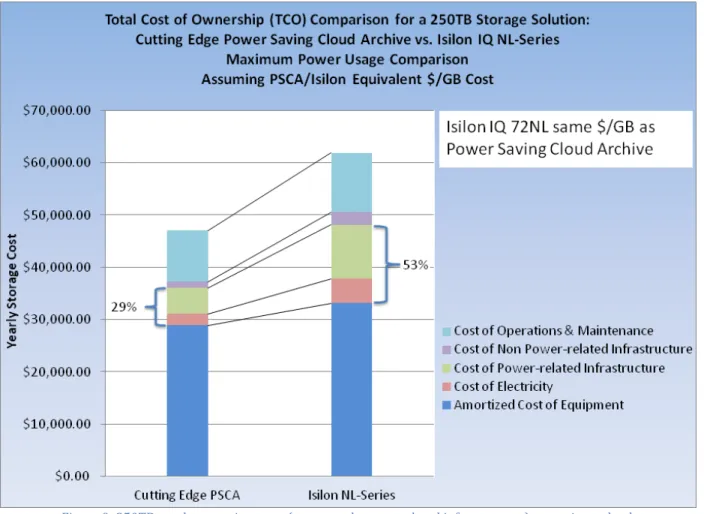
We next evaluated the operating costs of a 250TB PSCA solution compared to a 250 TB Isilon 72NL as a percentage of acquisition cost. The acquisition cost of the PSCA was used as the basis for the
comparison for consistency. As a baseline comparison we assumed that the PSCA solution would have 100% of the LTSNs powered on 100% of the time (Figure 9). Comparing the costs for power and power-‐ related infrastructure we see that the Isilon IQ 72NL system power-‐related operating costs were approximately 53% of the yearly amortized acquisition cost of the capital equipment while the PSCA solution’s power-‐related operating costs were only 29% of its yearly amortized acquisition cost of the capital equipment. Therefore, when both systems are running at maximum load the PSCA is nearly twice as power efficient as the Isilon IQ 72NL solution.
Figure 9: 250TB yearly operating costs (power and power-‐related infrastructure) at maximum load
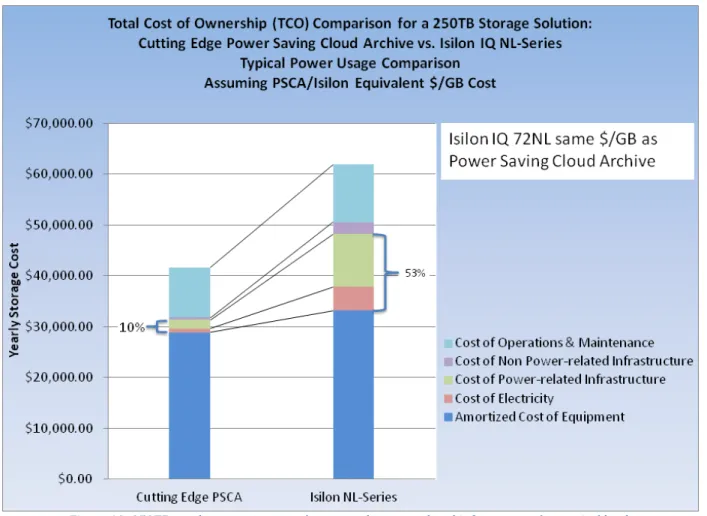
Comparing the operating costs at the typical LTSN 10% up-‐time level and similar $ per GB for the two solutions, the Isilon IQ 72NL system operating costs remained at 53% of the yearly amortized acquisition cost of the capital equipment while the PSCA solutions operating costs were reduced to 10% (Figure 10). Therefore, when both systems are running at typical load the PSCA is nearly five times as power efficient as the Isilon IQ 72NL solution.
Figure 10: 250TB yearly operating costs (power and power-‐related infrastructure) at typical load
The table below (Figure 11) shows how the Power Saving Cloud Archive can minimize Total Cost of Ownership while maximizing Return On Investment compared to the Isilon IQ NL-‐Series Scale-‐Out NAS. The table shows the acquisition cost of the capital equipment and the expected costs for power, power-‐ related infrastructure, other infrastructure, operations and maintenance for the PSCA and the Isilon IQ NL-‐Series archive solution at all three capacities discussed above.
The expected saving achieved with the 100TB PSCA in power, power-‐related infrastructure, and other infrastructure when compared to Scale-‐Out NAS is enough alone to pay for 71% of the acquisition cost of the capital equipment each year (see Figure 11). Even in environments where the PSCA will be on 24 hours a day the power efficiency of the PSCA design is still enough to pay for over half of the yearly acquisition cost.
Figure 11: Operating costs of the PSCA as a percentage of acquisition cost maximizing ROI8
8 The expected savings with the 100TB PSCA in power, power-related infrastructure, and other infrastructure is
calculated by subtracting the “Typical Power Operating Cost less O&M” of the PSCA (Column A: Row 11) from that of the IQ 36NL (Column B: Row 11), then dividing that sum (Column A: Row 13) by the “Annual
Acquisition/Capital Payments over 5 Years” for the PSCA (Column A: Row 1)
$13,947.99 – $2,528.56 = $11,419.43 $11,419.43 ÷ $16,112.36 = 71%
Column A B C D E F
PSCA IQ 36NL PSCA IQ 72NL PSCA IQ 72NL Row
Typical Power Cost per Year (USD) $ 679.39 $ 3,747.64 $ 785.72 $ 4,684.55 $ 1,475.16 $ 14,053.65 1
Annualized Power-related Infrastructure Capital Costs $ 1,501.81 $ 8,284.26 $ 1,736.85 $ 10,355.32 $ 2,970.97 $ 31,065.97 2
Other Non Power-related Infrastructure Costs $ 347.36 $ 1,916.09 $ 401.72 $ 2,395.11 $ 687.16 $ 7,185.33 3
Annual Operations & Maintenance (O&M) Costs $ 5,506.76 $ 17,332.47 $ 9,861.69 $ 33,211.36 $ 33,142.15 $ 99,634.07 4
Total Cost of Operations per Year $ 8,035.32 $ 31,280.46 $ 12,785.98 $ 50,646.34 $ 38,275.44 $ 151,939.02 5
Maximum Power Cost per Year $ 1,302.31 $ 3,747.64 $ 2,239.22 $ 4,684.55 $ 7,289.16 $ 14,053.65 6
Annualized Power-related Infrastructure Capital Costs $ 2,878.78 $ 8,284.26 $ 4,949.84 $ 10,355.32 $ 16,112.88 $ 31,065.97 7
Other Non Power-related Infrastructure Costs $ 665.84 $ 1,916.09 $ 1,144.86 $ 2,395.11 $ 3,726.79 $ 7,185.33 8
Annual Operations & Maintenance (O&M) Costs $ 5,506.76 $ 17,332.47 $ 9,861.69 $ 33,211.36 $ 33,142.15 $ 99,634.07 9
Total Cost of Operations per Year $ 10,353.69 $ 31,280.46 $ 18,195.61 $ 50,646.34 $ 60,270.98 $ 151,939.02 10
Typical Power Operating Costs less O&M $ 2,528.56 $ 13,947.99 $ 2,924.29 $ 17,434.98 $ 5,133.29 $ 52,304.95 11
Maximum Power Operating Costs less O&M $ 4,846.93 $ 13,947.99 $ 8,333.92 $ 17,434.98 $ 27,128.83 $ 52,304.95 12
Savings (Typical Power Use) of Operating Expenses Compared to Scale-Out NAS $ 11,419.43 $ - $ 14,510.69 $ - $ 47,171.66 $ - 13
Savings maximum Power Use) of Operating Expenses Compared to Scale-Out NAS $ 9,101.06 $ - $ 9,101.06 $ - $ 25,176.12 $ - 14
Annual Acquisition/Capital Payments over 5 Years $16,112.36 $50,713.53 $28,854.59 $97,173.97 $96,971.48 $291,521.92 15
Savings (Typical Power Use) of Operating Expenses as % Acquisition/Captial Cost 71% $ - 50% $ - 49% $ - 16
Savings Maximum Power Use) of Operating Expenses as % Acquisition/Captial Cost 56% $ - 32% $ - 26% $ - 17
250TB Archive 1PB Archive
Comparing PSCA to Enterprise Tape Libraries
When comparing the PSCA solution to Spectra Logic Enterprise Tape Libraries we use Spectra Logic’s Spectra-‐Series to provide the best comparison by similar use cases. Spectra Logic is recognized as a leader in the Enterprise Tape Library industry.
Comparing the 100TB capacity solutions (Figure 11) the PSCA is significantly less expensive based on a $ per GB comparison with the PSCA at $0.60 per GB compared to Spectra Logic’s T120 Tape Library solution priced at $1.39 per GB9. The Spectra Logic tape solution has been configured with the
maximum number of tape drives (eight LTO-‐5 tape drives) and native tape capacity of 1.5TB per LTO-‐5 tape cartridge in an attempt to create comparable solutions in both capacity and performance. Each LTO-‐5 tape drive is available in 6Gb SAS or 4Gb/8Gb Fibre Channel architectures, but the real maximum bandwidth per tape drive is approximately 140MB/s10. The PSCA solution has a minimum of two 10Gb Ethernet ports (theoretical maximum of 2500MB/s) for client bandwidth. The Spectra Logic T120 data sheet reports maximum power usage of 9.4 Amps at 120VAC which equates to approximately 1128 watts. Each LTO-‐5 tape drive consumes about 30 watts less when idle so the expected idle power consumption of the Spectra T120 is 885 watts. The PSCA acquisition cost is significantly less than the Spectra Logic T120. Because operation and maintenance costs are calculated based on acquisition cost the operating costs of the Spectra Logic T120 are substantially higher than the PSCA.
Tape-‐based systems are linear in nature. Tape libraries access files in a sequential manner allowing only one file to be accessed at a time per tape drive. Typically tape drives averages 60 seconds to access a file assuming the correct tape has already been loaded. If the requested file is not on the mounted tape, the tape drive must rewind to the end of the 846-‐meter long LTO-‐5 tape cartridge and the tape then is unloaded. A tape library can take up to 247 seconds to access a file. The calculation assumes the tape library must unload the tape to a tape caddy (such as the Spectra Logic Terapack), unload the caddy to a tape library cabinet using the library’s robotics, load the new tape caddy, load the new tape from the caddy, and finally wind to the end of the 846 meter LTO-‐5 tape cartridge. The linear nature of tape requires a high number of expensive tape drives to handle multiple file requests. The random access nature of the PSCA allows multiple clients to access files in a few seconds compared to what can take one client several minutes with a tape library.
9 $ Per GB pricing for both solutions is based on “list price” as a constant to maximize fairness in pricing. 10 LTO-‐5 tape drive performance taken from Wikipedia, http://en.wikipedia.org/wiki/Linear_Tape-‐Open.
Figure 12: 100TB TCO comparison of the PSCA vs. Spectra Logic Spectra T120 Tape Library
Comparing the 250TB capacity solutions (Figure 12), the PSCA is still significantly less expensive based on a $ per GB comparison with the PSCA at $0.46 per GB compared to Spectra Logic’s T380 Tape Library solution priced at $1.25 per GB. The Spectra Logic tape solution has been configured with the maximum number of tape drives (twelve LTO-‐5 tape drives) and native tape capacity of 1.5TB per LTO-‐5 tape cartridge in an attempt to create comparable solutions in both capacity and performance. Each LTO-‐5 tape drive is available in 6Gb SAS or 4Gb/8Gb Fibre Channel architectures, but the real maximum bandwidth per tape drive is approximately 140MB/s. The PSCA solution has a minimum of two 10Gb Ethernet ports (theoretical maximum of 2500MB/s) for client bandwidth. The Spectra Logic T380 data sheet reports maximum power usage of 13.6 Amps at 120VAC which equates to approximately 1632 watts. Each LTO-‐5 tape drive consumes about 30 watts less when idle so the expected idle power consumption of the Spectra T380 is 1136 watts. The PSCA acquisition cost is significantly less than the Spectra Logic T380. Because operation and maintenance costs are calculated based on acquisition cost, the operating costs of the Spectra Logic T380 are substantially higher than the PSCA.
Figure 13: 250TB TCO comparison of the PSCA vs. Spectra Logic Spectra T380 Tape Library
Comparing the 1PB capacity solutions (Figure 13) the acquisition cost of the PSCA and Spectra Logic solutions are more comparable; the PSCA at $0.38 per GB compared to Spectra Logic’s T950 Tape Library solution priced at $0.44 per GB. The Spectra Logic tape solution has been configured with twelve LTO-‐5 tape drives and native tape capacity of 1.5TB per LTO-‐5 tape cartridge in an attempt to create comparable solutions in both capacity and performance. The Spectra Logic T950 data sheet reports maximum power usage of 6.8 Amps at 240VAC which equates to approximately 1727 watts. Each LTO-‐5 tape drive consumes about 30 watts less when idle so the expected idle power consumption of the Spectra T950 is 1367 watts. The PSCA acquisition cost is still less than the Spectra Logic T950 while operating costs are similar.
Figure 14: 1PB TCO comparison of the PSCA vs. Spectra Logic Spectra T950 Tape Library
Comparing PSCA to Storage-‐As-‐A-‐Service
When comparing the PSCA solution to Amazon’s S3 Simple Storage Service (Figure 14) there are several factors to consider. Amazon’s S3 Storage-‐as-‐a-‐service model eliminates the requirement for the user to support power, power-‐related infrastructure, non power-‐related infrastructure, and operating and maintenance costs. These charges are replaced by a single monthly fee rolled into the cost of “renting” the storage space. Amazon charges the user a sliding fee based on the number of TB’s required to store the user’s files. There is no charge for copying files to the Amazon service. Amazon charges the user a similar sliding fee for retrieving files. The file retrieval charge is an additional 32% of the data storage cost for 100TB of storage, 30% of the storage cost for 250TB of storage, and 25% of the storage cost for 1PB of storage11 assuming 25% of the stored files are accessed each month. If the Amazon S3 account is cancelled the files are deleted.
Figure 15: TCO comparison of the PSCA vs. Amazon S3 Simple Storage Service
The race between data growth and IT infrastructure capacity
The following factors enable increased IT services for less cost in recent years: Increased processing power and capacity for a given IT infrastructure dollar Widespread adoption of virtualization technologies
Improvements in IT infrastructure/applications management Adoption of SaaS, cloud computing
Unfortunately data creation is accelerating. Both the quantity of devices and the amount of data (such as 8 megapixel cell phones) these devices generate are growing rapidly. The technologies needed to keep up with this growth are starting to strain under the load (see Figure 16). Hard drive data density, and office bandwidth have not kept up with data growth. Although Internet bandwidth speeds have kept pace with the rate of information growth Internet bandwidth started at such a low level that even today the average Internet bandwidth speed in the US of 5Mbps is only half of what office Ethernet bandwidth was in 1987.
If data growth continues at its current rate of 50% annually compared with 45% for the annual growth rate in hard disk drive density, after 10 years data will increase 58X compared with only 41X for hard drive storage density.
Description CAGR
Digital information 50%
CPU processing power 40%
3-‐1/2 inch hard drive data density 45% Public Internet bandwidth 50% Office Ethernet bandwidth 21% Average Internet speed, US, 8/2011 is 5Mbps
(See Appendix 1: Growth rate of things digital)
Figure 16: The growth rate of things digital
The trend of data growing faster than network bandwidth will have ramifications for cloud computing. The average office network speed is Gigabit Ethernet. While the average US Internet speed is 0.5% of this at 5Mbps. If most of the data traffic that is now running at the equivalent of 1000 miles an hour is rerouted to a road that only runs at 5 miles an hour what are the implications for the user experience? To carry the metaphor further what happens when the traffic increases much faster than roads are being built.
In order for the cloud to provide a quality experience for the IT consumer storage infrastructure will have to be located close to the data user to compensate for the relative lack of bandwidth compared to the increases in data being transferred.
Data Storage Requirements Shifting Toward Unstructured Files & Longer Retention
According to industry analysts such as IDC and Gartner, as much as 75-‐80 percent of data now being generated consists of unstructured file formats. Contributing to this trend are applications such as video surveillance, GIS systems, video-‐on-‐demand, medical imaging, and scientific computing & analysis, as well as the relentless worldwide explosion of user-‐generated information. Regulatory requirements mandate transactional, medical, and surveillance records are kept for increasingly longer periods. In the case of medical records, the current trend is for a lifelong accumulated record of all medical events for each individual. Surveillance video retention times are increasing but the archived video is rarely accessed unless there is an incident. Insurance companies are pushing for longer retention rates to guard against potential injury lawsuits that can arise years after an incident and require more years in litigation. As a result of these regulatory changes, more unstructured data is being generated and retained for much longer periods of time. The term “long-‐tail” data has been used to describe this type of data
Potential Incremental Power Cost Associated with Carbon Emissions Tax
According to information generated based off data from the EPA’s eGRID emission factors12, Electricity sources nationwide emit 1.306lbs CO2 per KWh. A 1PB Isilon Scale-‐Out NAS solution uses 12,000 Watts of electricity per hour, or 105,192KWh of electricity per year. This equates to 68.69 tons of CO2. A 1PB PSCA system typically uses 11,042KWh of electricity per year equating to 7.21 tons of CO2.
James Handley of Carbontax.org13 wrote in September 2011, "In May (2011), the deficit-‐hawkish Peterson Institute hosted a fiscal summit in Washington, at which four out of six leading think tanks, including the conservative American Enterprise Institute, suggested pricing carbon as a way to raise government revenue. (American Enterprise Institute) recommended a carbon tax starting at $20 per ton and growing by over 5 percent per year after that…. a more aggressive carbon tax proposed by Rep. John Larson (D – CT), rising each year by an average of $12.50 per ton of CO2.”
The Carbon Tax would be levied on both businesses and households and be based on the consumption of energy starting at $20.00 per ton of CO2 emissions. A 1PB Scale-‐Out NAS solution would cost an additional $1,373.80 per year. This is 10% of the cost to power the 1PB Scale-‐Out NAS solution for one year. The five year total for the carbon tax would be $15,456.26 at the more aggressive tax rate. A 1PB PSCA solution would cost an additional $144.20 per year. The five year total for the carbon tax would be $1,622.26 at the more aggressive tax rate.
Conclusion
When comparing the Total Cost of Ownership of the PSCA solution against Scale-‐out NAS, Tape, and cloud-‐based “storage as a service” we see that the PSCA solution provides significant savings in both acquisition costs and operating expenses resulting in a lower TCO. The PSCA demonstrated savings in
12 EPA’s eGRID emission factors can be accessed at
http://www.epa.gov/cleanenergy/documents/egridzips/eGRID2010V1_1_year07_SummaryTables.pdf
13
operating costs (power, power-‐infrastructure, and O&M) and lower acquisition costs providing a very favorable Return On Investment (ROI).
The reduction in operating expense (power and infrastructure) for the PSCA compared to scale-‐out NAS can off-‐set a significant percentage of the overall PSCA capital equipment acquisition cost.
In both file server and archive environments, the PSCA’s favorable Total Cost of Ownership and Return On Investment make the PSCA worth considering when evaluating new storage expenditures in the SMB, SME, and data center.
Appendix 1-‐ The growth rate of things digital
Description CAGR
Digital information (1) 50% CPU processing power (2) 40% 3-‐1/2 inch hard drive data density (3) 45% Public Internet bandwidth (4) 50% Office Ethernet bandwidth (5) 21% Average Internet speed, US, 8/2011 is 5Mbps (6)
Figure 17:The growth rate of things digital
1,The rate of growth in digital information makes meeting this challenge increasingly difficult. IEG (http:/gigaom.files.wordpress.com/.../2010-‐digital-‐universe-‐iview_5-‐4-‐10.pdf) released a study stating that the digital universe contained about 1.2 Zettabyte in 2010 this figure was expected to grow to 35 ZB by 2020 this is a 50% CAGR.
2-‐For decades processing power and hard drive data storage densities have approximately increased according to Moore's Law of doubling every two years (40% CAGR).
3-‐3 1/2 inch hard drive data densities have increased at a rate of 45% CAGR (1987, 20 MB 3 1/2 inch hard drive versus a 3 TB 3 1/2 inch hard drive in 2011).
4-‐Public Internet bandwidth has grown at a 50% CAGR or 57 X over 10 years.
5-‐Common office Ethernet networking bandwidth speeds have grown from 100Mbits/s in 1987 to 1000 Mbits/s (Gigabit Ethernet the dominant network speed for most offices in 2011). This is a 21% CAGR over 25 years. The office Ethernet bandwidth growth rate would be 35% CAGR if you use 10Gigbit as a standard in 2011.
6-‐The average Internet download speed August 2011 is 5Mbps.
(http://bits.blogs.nytimes.com/2011/09/20/america-‐land-‐of-‐the-‐slow/)
Figure 18: Internet Connectivity vs. Time Re:(4)