Working Paper
Institut für Makroökonomieund Konjunkturforschung
Macroeconomic Policy Institute
Ingo G. Bordon
1, Kai D. Schmid
2and Michael Schmidt
3Hypnosis Before Wake-up Call?
The Revival of Sovereign Credit Risk
Perception in the EMU-Crisis
August 2014
Abstract
This paper qualifies the view of pronounced overpricing of sovereign bonds for the so-called GIIPS countries during the financial crisis. We use annual
data for 21 OECD countries from 1980 to 2012. As opposed to related
studies, our data set allows us to contrast the pricing of macroeconomic fundamentals between three distinct phases: The period before the signing of the Maastricht treaty, the EMU-convergence era, and the financial crisis. In detail, we find: (i) Since the 1980s the role of public debt for the pricing of government bonds has changed twice: Firstly following the signing of the Maastricht treaty, and again with the wake-up call due to the onset of the financial crisis. (ii) Before the financial crisis EMU member countries had - de facto - been perceived as a homogenous group with regard to the role of public debt for sovereign risk pricing. (iii) With the reconsideration of country-specific fundamentals the role of public debt has not only been revived but its impact upon bond yield spreads has become comparable to the time before
the Maastricht treaty.
Keywords
EMU; GIIPS; Public Debt; Risk Perception; Sovereign Bond Yields
JEL classification E43, E44, E62
1 Ingo G. Bordon: German Development Institute (D.I.E.), Bonn. E-mail: [email protected];
2 Kai D. Schmid (Corresponding Autor): Macroeconomic Policy Institute (IMK), Düsseldorf. E-mail: [email protected];
138
Hypnosis Before Wake-up Call?
The Revival of Sovereign Credit Risk Perception in the EMU-Crisis∗
Ingo G. Bordon, Kai D. Schmid and Michael Schmidt†
August 2014
Abstract
This paper qualifies the view of pronounced overpricing of sovereign bonds for the so-called GIIPS countries during the financial crisis. We use annual data for 21 OECD countries from 1980 to 2012. As opposed to related studies, our data set allows us to contrast the pricing of macroeconomic fundamentals between three distinct phases: The period before the signing of the Maastricht treaty, the EMU-convergence era, and the financial crisis. In detail, we find: (i) Since the 1980s the role of public debt for the pricing of government bonds has changed twice: Firstly following the signing of the Maastricht treaty, and again with the wake-up call due to the onset of the financial crisis. (ii) Before the financial crisis EMU member countries had - de facto - been perceived as a homogenous group with regard to the role of public debt for sovereign risk pricing. (iii) With the reconsideration of country-specific fundamentals the role of public debt has not only been revived but its impact upon bond yield spreads has become comparable to the time before the Maastricht treaty.
Keywords: EMU; GIIPS; Public Debt; Risk Perception; Sovereign Bond Yields
JEL classification: E43, E44, E62
∗
We thank the participants of the 3rd ZEW Conference on Recent Developments in Macroeconomics 2012 and the participants of the DIW-FU-Berlin Macroeconometric Workshop 2012. Moreover, we are grateful to Hans Dewachter, Daniel Gros, Daniel Kienzler, Sabine Klinger, Fabian Lindner, Matthias Neuenkirch, Lukas Scheffknecht and Johannes Wohlfart for their helpful comments on an earlier version of this paper.
†
Ingo G. Bordon: German Development Institute (D.I.E.), Bonn. E-mail:
[email protected]; Kai D. Schmid: Macroeconomic Policy Institute (IMK), D¨usseldorf.
E-mail: [email protected]; Michael Schmidt: Graduate School of Economics, Finance,
and Management, Frankfurt. E-mail: [email protected]; Corresponding Author:
1
Introduction
In the face of the financial crisis many OECD countries have experienced large in-creases in government debt relative to GDP. At the same time there has been a sharp rise in long-term interest rates on government bonds. Therefore, at first glance, falling bond prices might result from investors’ consideration of rising sovereign credit risk. However, we argue that for some member countries of the European Monetary Union (EMU) in particular, the explanation of investors’ recent reactions to public debt im-balances is twofold: First, the deterioration of fiscal fundamentals since the beginning of the financial crisis has been taken into account. Second, financial markets have reconsidered the role of precisely these fiscal fundamentals for the pricing of govern-ment bonds. From a historical perspective this recent re-evaluation of sovereign debt seems unsurprising. It is rather the re-establishment of the temporarily neglected fiscal imbalances (as a central determinant of sovereign credit risk) than the aggravation of fiscal imbalances itself.
To give a first graphical illustration figure 1 presents the development of long-term interest rates and the debt to GDP ratios for a sample of 21 OECD countries, including 11 EMU member countries, between 1980 and 2012.
[ Figure 1: Long-term Interest Rates and Public Debt to GDP Ratios. Illustrations for Different Country Clusters. ]
For the ten OECD countries that are not part of the EMU (lower panels (v) and (vi)) we observe a trend of falling long-term interest rates. For the debt to GDP ratio within these countries we see a pronounced increase since the beginning of the financial crisis (2007/08). The latter also holds for EMU member countries (panel (iv)) and in particular for the GIIPS countries (panel (ii)). With the start of the convergence process (1993/94) in advance of the EMU initiation, long-term interest rates of designated euro member states had converged nearly perfectly - remaining roughly equal until 2008 before diverging again. The upper and centered panels in figure 1 exemplify the latter observations for the GIIPS countries as well as for six other EMU countries. Thereby, two important issues are underlined: First, the convergence and re-widening pattern of long-term interest rates that is often associated with the “Great Moderation”-period and with the effects of the recent financial and sovereign debt crises seems to be an EMU-specific feature that is even more pronounced for the GIIPS countries. Second, throughout the examined time span and irrespective of the regional cluster there is no stable relationship between long-term interest rates and the public debt to GDP ratio.
The observed convergence pattern of long-term interest rates has been explained in several ways: On the one hand, the decrease and narrowing of long-term interest rates within the GIIPS countries has been said to be due to an expected catching up of these
countries with regard to real production. In that vein, enhanced economic strength might have justified lower interest rates on sovereign bonds (Giavazzi and Spaventa (2010)). Thereby, the expectation of fiscal sustainability might have been triggered by the belief that real economic growth exceeds the growth of public debt (Sinn (2012)). On the other hand, the convergence has been discussed related to the meanwhile ques-tionable credibility of the so-called “no-bailout” statement reflecting rather joint and several accountability than country-specific default risks (Bernoth et al. (2012)). Be-sides this, exchange rate risk and the risk associated with expected inflation have taken a back seat with regard to the level of long-term interest rates since the beginning of
the EMU-convergence (Fr¨ommel and Kruse (2009)). Accordingly, a considerable part
of the convergence in long-term interest rates has been ascribed to declining inflation and exchange rate risks for some countries before the start of the EMU. Finally, it is argued that the ECB’s collateral policy might implicitly have promoted insufficient differentiation between credit risks in some EMU countries (Buiter and Sibert (2005)). Thereby, too low risk weights for bonds of periphery countries in regulation codes as well as the perception of high and low quality bonds as close substitutes might have stimulated the demand for sovereign bonds of periphery countries.
However, with the start of the financial crisis in the second half of 2007, this apparent, temporary disregard for country-specific macroeconomic performance, in particular of fiscal imbalances as we illustrate below, seems to have vanished (see
G¨artner et al. (2011) as well as Sinn (2012)). In this sense, the recent sharp increase
in long-term interest rates is usually associated with a shift in investors’ default risk perceptions (Arghyrou and Kontonikas (2012), De Grauwe (2011), IMF (2010), von Hagen et al. (2011)).
In what follows, we provide evidence that the role of public debt for the assessment of sovereign credit risk strongly depends on the regional cluster and that its significance has changed twice since the 1980s. We argue that in the course of the institutional changes associated with the EMU, long-term interest rates - and implicitly sovereign default risk perception - were significantly lower than the long-term interest rate levels
which would have been implied by fiscal fundamentals. Two crucial break points
framing the time span that starts with the EMU convergence period (1993/94) and lasts until the beginning of the financial crisis (2007/08) support this argument. These break points delimit the decline and re-emergence of the relevance of public debt in explaining sovereign default risk as a vital determinant of long-term interest rates.
Employing data for 21 OECD countries from 1980 to 2012 and accounting for re-gional clusters, our empirical approach is particularly suited to the analysis of the significance that public debt regained in determining long-term interest rates. As op-posed to similar studies, our data set allows us to contrast the pricing of macroeconomic fundamentals before the signing of the Maastricht treaty with the EMU-convergence era and the financial crisis. It therefore provides a much more transparent mapping of
the relevance of public debt for sovereign credit risk assessment for the countries under investigation and throughout the observation period. We exploit the panel structure of our data by testing the relevant hypotheses about changes in the role of country-specific macroeconomic fundamentals for the pricing of default risk.
The remainder of this paper is structured as follows: Section 2 summarizes related literature and highlights the relevance of our findings with regard to this branch of research. Section 3 briefly introduces the data. Section 4 explains our empirical strat-egy. Section 5 presents our estimation results, several robustness issues and discusses further implications. Section 6 concludes.
2
Contribution and Related Literature
Our analysis complements and specifies recent research on the changing dynamics of pricing public debt in the EMU such as Arghyrou and Kontonikas (2012), Attinasi et al. (2009), Aizenman et al. (2013), Beirne and Fratzscher (2013), Basurto et al. (2010),
De Grauwe and Ji (2013), G¨artner et al. (2011) and Haugh et al. (2009). These studies
share the insight that, with the beginning of the financial crisis, markets’ expectations have changed considerably and that investors have returned to country-specific pricing of macroeconomic fundamentals.
Arghyrou and Kontonikas (2012) apply monthly data for ten EMU countries from 1999:1-2010:4 and examine sovereign spreads against German bonds. The authors find that until the onset of the financial crisis markets had hardly priced macroeconomic fundamentals. However, the intensifying divergence of fundamentals within the EMU increased macroeconomic fragility and finally caused a change in market behavior. Attinasi et al. (2009) use daily data from end-July 2007 to end-March 2009 for ten EMU countries and explain bond spreads relative to Germany by expected fiscal infor-mation (the latter also calculated relative to Germany). The authors find increasing relevance of the fiscal deficit in shaping investors’ expectations during the financial crisis. Using sovereign credit default swap premia (CDS) for a panel of 50 countries from 2005 to 2010, Aizenman et al. (2013) show that fiscal space and other macroe-conomic determinants are both emacroe-conomically and statistically important for sovereign risk. For the GIIPS countries they find unpredicted low risk pricing as indicated by CDS in the tranquil period before the global financial crisis and unpredicted high risk pricing meanwhile. Matching these economies in terms of fiscal space (by debt to tax and deficits to tax ratios) with countries outside Europe and allowing for differences in fundamentals, sovereign credit risk for the eurozone periphery is found to be priced substantially higher. The authors suggest two possible explanations for their findings: On the one hand these economies might have “switched to a “pessimistic” self-fulfilling expectational equilibrium” from a contagious optimism fostered by the EMU conver-gence process. On the other hand the unpredicted high sovereign risk pricing might
be based on future rather than on current fundamentals. Thereby, monetary and ex-change rate constraints may induce an expected adjustment of fundamentals which is more challenging for the GIIPS economies than for the matching group of countries outside the EMU. Basurto et al. (2010) apply daily data from mid-2005 to early 2010 for 10 EMU countries and examine changes in the yield on a 10-year euro swap, as a
measure of euro area spreads relative to a common num´eraire. The authors observe
that in the course of the crisis the perception of country-specific risks has increased and that this partly stems from worsening fiscal fundamentals. Beirne and Fratzscher (2013) use monthly data from 2000:4-2011:8 for 31 countries and show that the rise of public bond yield and CDS spreads during the sovereign debt crisis has not only been caused by the worsening of macroeconomic fundamentals but also by increasing risk
perception of financial markets. G¨artner et al. (2011) use annual data for 26 OECD
countries between 1999 and 2010. They illustrate that with the onset of the financial crisis, for some EMU countries the role of macroeconomic fundamentals in explaining sovereign credit ratings has changed significantly and that risk premiums, measured by credit spreads for government bonds, are affected not only by the systematic part of credit ratings, but also by an arbitrary part (indicating expectations-led, cumulative pricing dynamics). Haugh et al. (2009) explain the yield on ten-year sovereign bonds of ten EMU members against Germany using quarterly data from December 2005 to June 2009. The authors find that differing fiscal policies exert a significant influence on bond yield spreads as well as a widening of the latter since mid-2007 in the EMU. In particular, the results for an interaction of fiscal variables with a proxy for general risk aversion highlight the re-evaluation in pricing behavior that sets in with the beginning of the financial crisis.
In addition to the above-mentioned aspects of the literature, our approach is also motivated by panel studies linking government bond yields and fiscal imbalances that do not solely cover time periods characterized by a single monetary policy stance - see, e.g., Silvia et al. (2007) as well as Bernoth et al. (2012). Silvia et al. (2007) explain the development of the nominal 10-year interest rate on government bonds of 16 OECD countries using yearly data for the samples 1960-2002 and 1975-2002. Explanatory variables comprise the 3-month T-bill rate, the inflation rate, the primary balance relative to GDP, public debt relative to GDP, interactions between debt levels and fiscal deficits as well as a set of macroeconomic control variables. The authors show that increasing public debt and a weakening of the fiscal balance lead to an increase in long-term interest rates. Bernoth et al. (2012) base their analysis on yearly data for 14 EU countries covering the time span from 1993-2005. The authors explain yield differentials between DM(Euro) and US-dollar denominated government bonds by the debt ratio, the deficit ratio, as well as the debt-service ratio - each measured as differences relative to the benchmark country (Germany, US). They find a significant
impact of public debt on yield spreads and document that average yield differentials for EMU member countries have declined since the start of the EMU.
The implications of our findings are most closely related to the study by De Grauwe and Ji (2013) who use quarterly data from 2000-2011 for EMU countries as well as for eight additional OECD countries for their econometric analyses. The authors explain changes in the long-term interest rate relative to German Bund yields through the use of the government debt to GDP ratio as a measure for sovereign default risk and the current account balance to GDP ratio as a proxy for net foreign debt. In addition, they consider changes in the Euro exchange rate for non-EMU countries. The authors argue that due to the consequences of the financial crisis recent long-term interest rate spreads against Germany for some EMU countries (Greece, Ireland, and Portugal) reflect an overpricing of sovereign credit risk. Moreover, they find that the sudden awakening of sovereign credit risk assessment does not hold for non-EMU countries. This finding lends support to the notion that government bond markets in a monetary union are more fragile and more susceptible to self-fulfilling liquidity crises (De Grauwe (2011)).
We contribute to this literature and expand its context by providing broad cross-country evidence for the pricing of sovereign debt for 21 OECD countries over the time span from 1980 to 2012. In particular, the fact that we consider data before 1999 allows us to contrast recent developments with historic time regime changes.
We argue that the longer time span (compared to the above mentioned literature) is not a mere expansion of the information set underlying the empirical analysis but rather essential in order to recognize and qualify the literature findings. It allows for a broader understanding in gauging the recent re-pricing of government bonds as a “fear bubble” or the time between the signing of the Maastricht treaty and the recent crisis as the build-up of a “risk bubble”.
Our baseline estimation technique follows Beirne and Fratzscher (2013) and De Grauwe and Ji (2013) who apply panel fixed effects regressions. In order to ensure high comparability of results for the pre-crisis and the crisis years, we use a similar set of covariates as these authors. Our model broadly reproduces their results for the period 2000-2012, implying robustness of our findings taken as a whole. In contrast to both Beirne and Fratzscher (2013) and De Grauwe and Ji (2013), the extensive dataset and the more general approach underlying our empirical analysis allow us to consider the relevance of institutional changes in the context of the EMU. Thereby, we utilize the panel structure of our data to test the hypotheses that govern the differences in the role of country-specific macroeconomic fundamentals for the pricing of default risk across country groups and over time. By doing so, two time regime breaks in the institutional context of the EMU are covered, i.e. we contrast investors’ assessment of sovereign credit risk for the time span before the Maastricht treaty, after the start of the financial crisis and in between. We provide evidence for the specific sovereign
risk assessment of three regional clusters: The so-called GIIPS countries (Greece, Ire-land, Italy, Portugal and Spain), six other EMU member countries, and ten non-EMU OECD countries.
Our results update, complement and qualify many findings of previous empirical studies along a number of lines: (i) We show that the relevance and changes in the relevance of public debt for sovereign default risk assessment have differed significantly between time regimes and regional clusters. (ii) Particular in GIIPS countries there has been a distinct decline and re-emergence pattern for the significance of the debt to GDP ratio in contributing to financial markets’ pricing of sovereign credit risk. (iii) Following the Maastricht treaty EMU member countries had been perceived as a nearly homogeneous group with regard to the impact of the debt to GDP ratio upon sovereign risk assessment. (iv) We illustrate that with the onset of the financial crisis the role of public debt for the pricing of government bonds has not only been revived but that the impact of the debt to GDP ratio upon public bond yield spreads is not significantly different from the time before the Maastricht treaty. (v) This suggests severe mispricing before the start of the financial crisis and qualifies the view of pronounced overpricing during the crisis.
Against this backdrop, the recent increase in the spreads of a large number of eurozone countries would rather reflect the bulged out end of a ”risk bubble” that has been building up in the wake of the Maastricht treaty as opposed to the widely claimed overpricing of sovereign risk - which would signify a “fear bubble” on the part of investors. Hence, we argue that the optimism which spread with the EMU convergence process involved a hypnotic effect around the perception of fundamentals in pricing sovereign credit risk. In accordance with the terminology of Giordano et al. (2013), the increased sensitivity for fundamentals with the onset of the financial crisis represents the wake-up call for leaving that state of hypnosis. Sovereign credit risk perception is revived to pre-Maastricht-treaty levels that are more closely guided by fundamentals rather than purely reflecting effects of contagion or “excessive” pricing.
3
Data
Given that the main thrust of our analysis is to compare risk pricing dynamics before the Maastricht treaty to the subsequent EMU-convergence period and thereafter, our analysis requires data from the 1980s onwards. Due to limited availability of higher frequencies, we use annual data from 1980 to 2012 from the OECD Economic Outlook
#90, the AMECO Database and the IMF World Economic Outlook Database.1 Our
sample covers the following 21 OECD countries: Australia (AUS), Austria (AUT),
1We receive similar estimation results for the period after 1999 as authors who use higher frequency
data (Beirne and Fratzscher (2013), De Grauwe and Ji (2013)), indicating the suitability of annual data for this analysis.
Belgium (BEL), Canada (CAN), Switzerland (CHE), Denmark (DNK), Spain (ESP), Finland (FIN), France (FRA), Germany (GER), Great-Britain (GBR), Greece (GRC), Ireland (IRL), Italy (ITA), Japan (JPN), the Netherlands (NLD), Norway (NOR), New Zealand (NZL), Portugal (PRT), Sweden (SWE) and the United States (USA).
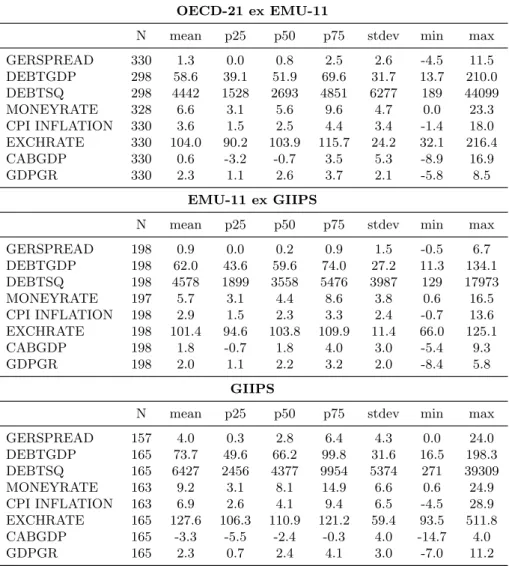
Following the standard applications established in the literature, we proxy sovereign credit risk by the spread between the ten-year yield of the German Bund and the respec-tive national long-term nominal interest rates. The main fiscal indicator is government debt relative to GDP. The set of macroeconomic control variables comprises the short-term nominal interest rate, the rate of consumer price inflation, annual growth of real GDP, the effective nominal exchange rate, and the current account balance relative to GDP. Our choice of control variables is in line with the relevant literature in this field (see section 2 and the references therein). In particular, we refer to the regressor sets used by Beirne and Fratzscher (2013) as well as De Grauwe and Ji (2013) since these studies are most closely related to our analysis. Table 1 in the appendix presents basic summary statistics for our main variables.
[ Table 1: Summary Statistics of Main Variables. ]
4
Empirical Strategy
Our empirical strategy comprises four steps: First, we introduce an empirical proxy for financial markets’ assessment of credit risk. Second, we classify appropriate time and regional subsamples with regard to the relevance of public debt for the sovereign credit risk measure in the context of the EMU. Third, we specify a valid estimation setup to explain changes in sovereign credit risk through the public debt to GDP ratio and a set of macroeconomic control variables. Fourth, based on our empirical model we set up testable hypotheses to evaluate the changes in financial markets’ pricing of sovereign credit risk.
4.1 Measuring Sovereign Credit Risk
We seek to quantify changes in sovereign risk perception as reflected by variations in long-term interest rates. As credit risk premiums are sensitive to the scale of fiscal im-balances, fiscal information is a central determinant of long-term interest on sovereign
bonds (see Haugh et al. (2009) and Fr¨ommel and Kruse (2009)). The underlying
the-oretical context suggests that the level of long-term interest rates does not only reflect the debtors’ default risk but also comprises the level of short-term interest rates (and expected short-term interest rates) as well as exchange rate risk, expected inflation and a liquidity premium. Therefore, the credit risk component represents the inverse like-lihood of full repayment - or, more precisely, the market assumption of the probability
of default and the resulting loss given default - depending on investors’ assessment of a country’s fiscal position and the sustainability of public debt.
In order to empirically examine the relevance of fiscal information for financial markets’ risk perception, we isolate credit risk as a component of the long-term interest rate. We use the long-term interest rate spread against German sovereign bonds that serve as benchmark assets. In order to obtain estimation results that are robust to changing monetary policy regimes as well as country-specific expectations of inflation and exchange rates, we consider national short-term nominal interest rates to capture individual monetary policy stances and the rates of inflation as right-hand-side control variables in our regressions. Moreover, we address the effect of national exchange rate risk upon long-term interest rates by including the effective nominal exchange rate as an additional explanatory variable.
Capturing the liquidity risk component within long-term interest rates is contro-versially discussed in the literature. One might consider bid-ask spreads reflecting trading costs in bond markets. Alternatively, liquidity risk might be approximated by the ratio of a country’s debt to the total debt issued in the respective currency (see Bernoth et al. (2012) with reference to Flemming (2003) and Gravelle (1999)). Since we cover data from 1980 onwards and also consider a number of non-EMU countries we are not able to apply the aforementioned liquidity proxies. Consequently, we do not explicitly control for liquidity effects. However, as government bond markets are usually large, we do not expect illiquidity to play a major role.
4.2 Regional Clusters and Time Regimes
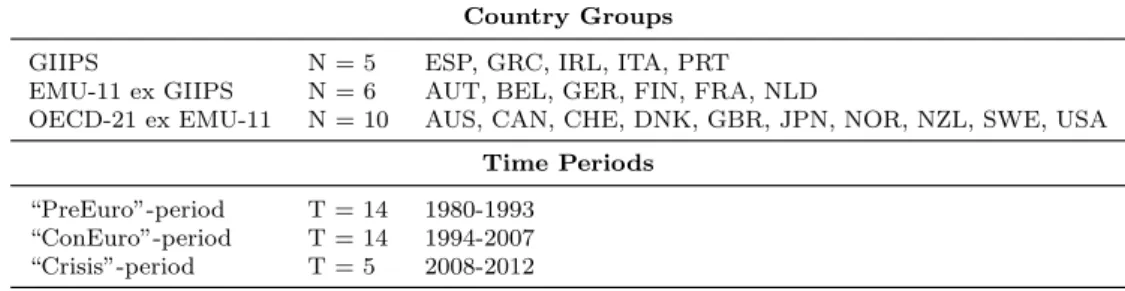
To examine how the effect of the public debt to GDP ratio on government bond spreads changes across “core EMU” countries, “periphery EMU” countries, and other OECD countries we distinguish between three country clusters in our sample: The five GIIPS countries, six core EMU countries, and ten further OECD countries. The composition of the respective country groups primarily aims at contrasting periphery EMU to core EMU countries. The consideration of the remaining OECD economies allows us to compare the changes in the pricing of sovereign risk within the monetary union to several stand-alone countries. The upper half of table 2 lists the members for each of the country groups.
[ Table 2: Country Groups and Time Periods. ]
Further, we aim at assessing whether the impact of the public debt to GDP ratio on government bond spreads has changed over time and whether such changes have featured systematic differences across country clusters. We therefore distinguish three time regimes in our sample: The period from 1980 until the onset of the convergence era (“PreEuro”-period), the subsequent period until the financial crisis
(“ConEuro”-period), and the “Crisis”-period itself. The lower half of table 2 summarizes these three phases.
The selection of these time periods is guided by the institutional changes due to the Maastricht treaty (which coincides with the beginning of the convergence of long-term interest rates) and by the severe macroeconomic consequences triggered by the financial crisis. The classification is in line with the above mentioned literature (see section 2) and is consistent with the historical track record of long-term interest rates
(see figure 1).2 To provide further insight, figure 2 illustrates the time period-specific
differences in the relationship between the public debt to GDP ratio and interest rates on government bonds for the GIIPS countries.
[ Figure 2: Regime-specific Sovereign Risk Perception Against Public Debt to GDP Ratio. Illustration for the GIIPS Country Cluster. ]
Here, the inflation-adjusted interest rate spreads (vertical axis) are contrasted with the debt to GDP ratios (horizontal axis) for each time regime. The respective years are reported for each observation. The slopes of the simple regression lines indicate
investors’ average adjustment of default risk perception vis-`a-vis changes in the debt
to GDP ratio. Except for Portugal we recognize a clear positive relationship in the “PreEuro”-period (1980-1993, panel (i)), while in the “ConEuro”-period (1994-2007, panel (ii)) except for Ireland, the positive slopes are no longer observed, indicating that there was no longer a clear market anticipation of credit risk based on debt sustainability issues. However, since the start of the financial crisis rising interest rate spreads have again been associated with increasing public debt to GDP ratios (“Crisis”-period, panel (iii)). In particular for Spain and Italy we observe a pronounced change when compared to the “ConEuro”-period. In the case of Greece and Portugal, from 2008 onwards the slopes of the simple regression lines are not just positive, but the relationship is even more pronounced as compared to the “PreEuro”-period, implying a pronounced re-assessment of fiscal soundness for the pricing of sovereign bonds.
According to G¨artner et al. (2011) and De Grauwe and Ji (2013) this tightening might
reflect a type of overpricing of sovereign default risk after the financial crisis that might even have led to a self-fulfilling aggravation of the sovereign debt crisis.
Given the three country clusters and the three time periods, we distinguish nine regimes. Each single country-year observation can be assigned to one corresponding regime of time/country-group constellations. Table 3 illustrates the composition of these regimes for the above-defined country groups and time clusters. These catego-rizations form the starting point for identifying changes in the risk pricing behavior across different regimes for both the time and the regional dimension.
2
We also applied formal tests for structural breaks of our model coefficients and find our as-sumptions widely confirmed. Nonetheless, in the robustness section we consider varying break dates constituting different time regimes in order to provide evidence that the empirical results are basically unaffected by the exact choice of the break dates.
[ Table 3: Regimes for Time/Country-group Constellations. ]
4.3 Empirical Model
Based on the conceptual framework delineated above, we examine the panel structure of our information set consisting of 21 OECD countries and 33 years. With regard to
its dimensions, the data cannot be clearly categorized as either a “longN small T” or
a “long T smallN” panel and thus further thought has to be given to the appropriate
econometric approach.
We conduct fully robust estimations, i.e. both in a heterogeneity and serial cor-relation robust fashion and exploit the fact that the fixed effects approach shows
re-markable robustness if Cov(xit, uit) =0 butCov(xit, uis) 6=0 for some s 6= t, where
uit, uis, and xit refer to the error terms and the vector of regressors, respectively. In
this case the fixed effects estimator averages the potential endogeneity bias over time,
i.e. the bias is lowered by the factor of T1−1. For a relatively large time dimension in
particular, this generates additional robustness that we want to exploit by choosing a fixed effects estimator as our baseline methodology.
In addition to the static fixed effects regression we consider two further estimation approaches that seem natural alternatives to our baseline model: First, static panel
estimation techniques that exploit “large T” rather than “large N” asymptotics and
allow for a variety of panel-specific error term characteristics. And, second, dynamic panel models which include lagged values of the dependent variable. In this regard,
a commonly-used and well-established approach which exploits “largeT” asymptotics
is the non-parametric method to estimate standard errors introduced by Driscoll and
Kraay (1998). For “largeT”, Driscoll and Kraay standard errors are not just robust to
heterogeneity and serial correlation, but also to some extent to cross-sectional depen-dence. Moreover, we expand the robustness analyses by calculating panel-corrected standard errors (PCSE) estimates for linear cross-sectional time series models that
account for “largeT” asymptotics (see Beck and Katz (1995)). In this context,
distur-bances are assumed to be either heteroskedastic or both hetoroskedastic and contem-poraneously correlated across countries. The standard error estimates are furthermore
robust to first-order autoregression (AR(1))-type autocorrelation.3 The fact that fixed
effects tend to average the endogeneity bias over T also plays an important role when
considering dynamic panel estimation for “large N” asymptotics. Since the strict
ex-ogeneity assumption is violated by construction when we include a lagged dependent variable into our regression model, an endogeneity bias (Nickell (1981)) is introduced. Given the characteristics of our dataset, and since the literature does not yet
pro-vide definitive findings about theT dimension large enough to average out a potential
endogeneity bias over time, we additionally employ the GMM estimation approaches
3
suggested by Arellano and Bond (1991) and Blundell and Bond (1998) for dynamic panel regressions. The results for both panel-specific fixed effects estimations that
focus on “large T” asymptotics as well as results from GMM models for a dynamic
specification are reported in the robustness analyses (see section 5.2). Our baseline regression model reads:
Spreadi,t= (Debti,t⊗Ri,t)β1+ (Debt2i,t⊗Ri,t)β2+ (xi,t⊗Ri,t)β3+T Dtβ4+CDiβ5+ui,t
where Spreadi,t refers to the interest rate spread of country i ∈ [1, ...,21] at time
t ∈ [1980, ...,2012] relative to Germany. Ri,t is a 1×9 vector that contains the nine
dummy values indicating the regime categorization for the actual observation.4 Since
the nine regimes for time/country-group constellations are mutually exclusive, the
matching regime element in Ri,t is 1 and all other elements are 0. The Kronecker
product Debti,t ⊗Ri,t yields a 1×9 vector of regime-interaction terms. β1 is the
9×1 vector of corresponding parameters. The dimensions are similar forDebt2i,t⊗Ri,t
and β2. Note thatβ1 and β2 are the 9×1 vectors which are our main interest. They
represent the impact of the variation in government debt to GDP ratios on the variation in government bond interest rate spreads.
xi,t is a 1×(k−2) row vector gathering the remaining (k−2) control variables
(where k is the overall number of covariates which may vary for different regression
specifications). Hence, the Kronecker productxi,t⊗Ri,t is a 1×(k−2)∗9 vector and
β3 is the (k−2)∗9×1 vector of parameters that correspond to the control variables
and their interactions. T Dt is the 1×T vector of 32 time dummy variables and β4
is the corresponding 32×1 parameter vector. CDi refers to the 1×N vector of 21
country dummies andβ5 denotes the corresponding parameter vector of country fixed
effects. ui,t represents a random error component.
Our choice of control variables is guided by the relevant literature5and the economic
rationale behind the covariates is motivated as follows: The debt to GDP ratio is sup-posed to exert a positive impact upon sovereign bond yield spreads as increasing debt enhances both the expected probability of default and the expected loss given default. The short-term nominal interest rate and the national rate of inflation are assumed to exhibit a positive impact upon the long-term nominal interest rates. The annual growth rate of real GDP is supposed to enter with a negative sign, as an improvement of real economic performance eases the burden on the national budget. Controlling for investors’ portfolio adjustments due to expected exchange rate re-evaluation, the effective nominal exchange rate (which is measured in US-Dollar per local currency) is supposed to show up with a negative sign. Additional capital inflows are assumed to increase credit supply and ceteris paribus reduce the long-term interest rate. Finally, we consider the current account balance relative to GDP which may either be classified
4
The assignment of country-year-observations to regimes is summarized in table 3 in the appendix.
5
as a proxy for a country’s net foreign liabilities (see, e.g., De Grauwe and Ji (2013)) or be interpreted as a measure of competitiveness (Sinn (2012)). In either case we expect a negative sign.
4.4 Hypotheses
Our graphical illustrations in figures 1 and 2 provided strong indications that the role of public debt for the pricing of government bonds changed twice during the period under investigation and that the observed pattern is even more pronounced for the GIIPS economies. In order to evaluate these developments in a rigorous econometric manner, we compare the impact of the public debt to GDP ratio upon bond yield spreads over time and across different country groups. To this end, we exploit the regime-specific total marginal effects of the public debt to GDP ratio estimated by our empirical model. For the non-linear specification, which we chose as our baseline
model, the total marginal effect, λ, reads:
λ= ∂Spread
∂Debt =β1+ 2β2∗Debt.
To assess changes in sovereign credit risk perception throughout time and
differ-ences across country groups we compare regime-specific effects, λr, where r = 1, . . . ,
9 represents the respective time/country-cluster categorization (see table 3). In what follows we focus on five testable hypotheses that mostly refer to these regime-specific effects. The hypotheses are summarized in table 4. While hypotheses 1 and 2 refer to changes in pricing sovereign debt within the GIIPS countries over time, hypotheses 3 and 4 focus on changes in the differences between core EMU and GIIPS countries. Hy-pothesis 5 evaluates the outcome of an explanatory power exercise in order to evaluate the economic significance of the estimated changes and differences.
[ Table 4: Summary of Hypotheses. ]
In our first hypothesis (H1), we claim that for the GIIPS country cluster the effect of the public debt to GDP ratio has changed significantly over time. We assume that for these economies financial markets’ reactions to changes in the public debt to GDP ratio were considerably weaker during the “ConEuro”-era than before the Maastricht treaty and after the beginning of the financial crisis. Hence, in our regression setup we expect the effect of the debt to GDP ratio on sovereign yield spreads to be significantly higher in regime 3 than in regime 6 and significantly higher in regime 9 compared to regime 6.
Our second hypothesis (H2) states that for the GIIPS country cluster the effect of the debt to GDP ratio in the “PreEuro”-period is not significantly different from its effect in the “Crisis”-period. This implies that we would not observe exaggerated reactions of government bond spreads to rising debt during the crisis period, but rather that we would find too modest reactions on rising public debt in the “ConEuro”-period. This translates into the proposition for the total marginal effect of the debt to GDP ratio not being significantly different in regime 3 when compared with regime 9.
H2 :λ3=λ9
In our third hypothesis (H3) we claim that while the total marginal effect of the debt to GDP ratio for GIIPS countries differs significantly from the effect for the core EMU countries in the “PreEuro”-period and the “Crisis”-period (as will be stated in H4 below), during the “ConEuro”-period this is not the case. The corresponding finding would indicate a de facto homogenous pricing of sovereign risk within the EMU that might have resulted from the neglect of idiosyncratic macroeconomic fundamentals
that were ultimately deemed unsustainable for some EMU countries. In terms of
our empirical model this implies that the effects are not significantly different across regimes 5 and 6.
H3 :λ5=λ6
Finally and closely connected to the previous issue, our fourth hypothesis (H4) assumes that while during the “ConEuro”-period the impact of the debt to GDP ratio for core and periphery EMU countries did not differ, there was a significant difference in the “PreEuro”-period and the “Crisis”-period. Technically this translates into:
H4 :λ2 < λ3 &λ8 < λ9.
Even though the total marginal effect of the public debt to GDP ratio might have changed over time, this does not necessarily imply that an economically significant part of the change in observed spreads can be explained by changes in the parameters of the debt to GDP ratio. On the one hand we still have to consider the changes in the debt to GDP ratio over time. On the other hand it still might be the case that the debt to GDP ratio generally captures only a minor part of government bond yields. Our final hypothesis (H5) frames this issue by claiming that the change in the debt to GDP level combined with the change of the total marginal effect of debt to GDP explain an economically significant part of the changes in sovereign bond spreads across countries and time periods. For the GIIPS countries, this means that the part of the yield spread which is explained by the debt to GDP ratio should be relatively high in the “PreEuro”-period, should be low in the “ConEuro”-period and should have increased
again in the “Crisis”-period. This corresponds to a shift in the economic significance of the debt to GDP ratio which would yield a negative impact from the “PreEuro”-period up to the “ConEuro”-period and no impact or even a counter-intuitive positive effect for the “ConEuro”-period until the beginning “Crisis”-period.
5
Results
5.1 Evaluation of Hypotheses
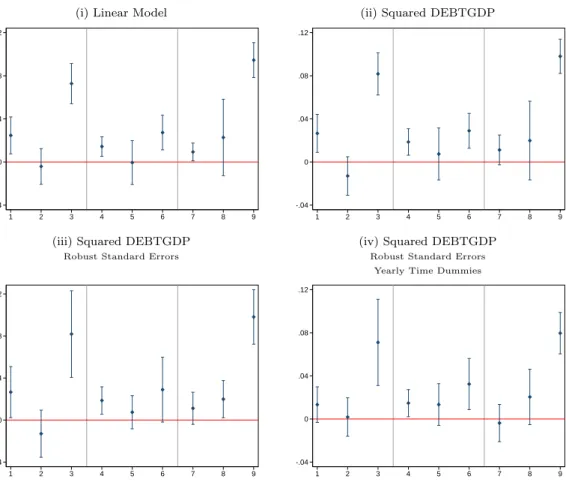
This section presents the baseline estimation results and discusses the implications for our hypotheses. For the latter, figure 3 provides a summary of the estimation results required to examine hypotheses H1 to H4. Each panel illustrates all nine regime-specific total marginal effects of the debt to GDP ratio upon bond yield spreads against Germany together with the corresponding 5% confidence intervals. The vertical axes
indicate the regimes r (r = 1, . . . , 9) for which the estimated effects are reported
(see also table 3). Since the main focus is on the role of public debt within the
GIIPS country cluster, the effects in regimes 3 (GIIPS, “PreEuro”-period), 6 (GIIPS, “ConEuro”-period) and 9 (GIIPS, “Crisis”-period) are of primary interest.
Panel (i) in figure 3 shows the effects derived from our most basic fixed effects estimation which considers the debt to GDP ratio and our set of remaining control variables. The basic setup initially disregards a squared term of the debt to GDP ratio and year fixed effects. For the regression results reported in panel (ii), we augment the model by considering a squared debt to GDP ratio accounting for a potential
non-linear effect, a commonly-stated feature in the literature.6 To ensure the validity of
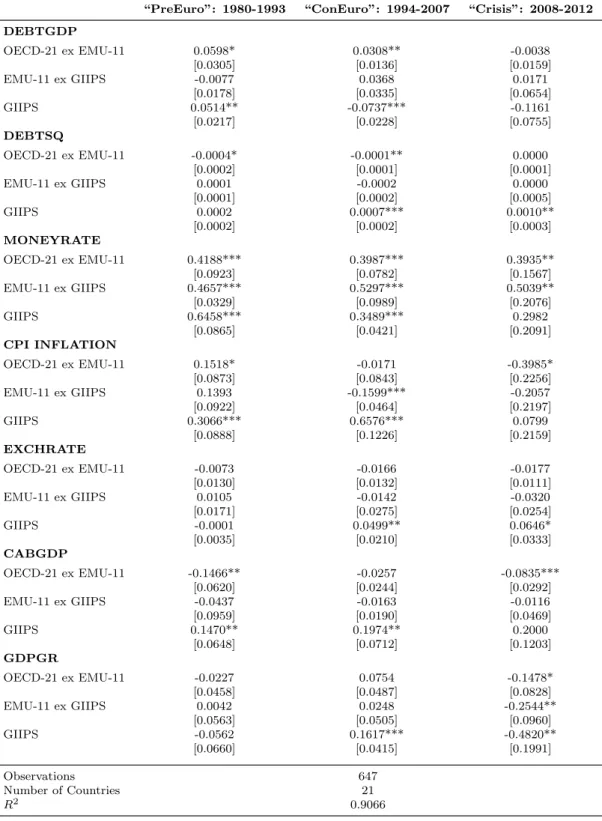
the previously reported baseline findings, the regression results illustrated in panel (iii) rely on heteroskedasticity and serial correlation robust standard errors. Finally, panel (iv) provides the results including annual dummies to capture the effect of common macroeconomic shocks. While extending the linear model to the squared specification does not involve noticeable changes in the results, as expected, the application of robust standard errors clearly broadens the confidence bands. However, the basic pattern does not change and is also maintained upon the inclusion of annual dummies. Notwithstanding the minor differences in the results across these alternative model specifications, in the subsequent analyses we focus on the specification which includes year time dummies and report inference statistics based on robust standard errors. Table 5 provides an overview of the regression for this baseline estimation.
[ Figure 3: Baseline. Total Marginal Effects of Public Debt to GDP Ratio on Bond Yield Spreads Against Germany. ]
[ Table 5: Baseline Estimation Results. ] 6
Note that in all of our non-linear specifications we consider total marginal effects rather than point estimates of single coefficients for the debt to GDP ratio and its square.
From the illustration in panel (iv) of figure 3 it is evident that hypothesis 1 is largely confirmed. We observe that for GIIPS countries, the total marginal effect of debt to
GDP in the “Crisis”-period (λ9) is higher than the effect of the debt to GDP ratio on
yield spreads in the “ConEuro”-period (λ6). This difference is statistically significant
as the corresponding 5% confidence bands do not overlap. The effect in the
“PreEuro”-period (λ3) exceeds the effect reported for the “ConEuro”-period. While the difference
is clearly statistically significant in panels (i) and (ii), for our estimations with robust standard errors the difference is not significant at the 5% level but on the 10% level (which would yield tighter confidence intervals). Hypothesis 2 is fully confirmed across all specifications. The effects of the debt to GDP ratio on yield spreads for GIIPS
countries in the “Crisis”-period (λ3) do not differ significantly from the
“PreEuro”-period (λ9). The effects are even close enough to maintain overlapping significance
bands when a 10% significance level is considered instead of the reported 5% level. Hypothesis 3 cannot be rejected either. During the “ConEuro”-period the effect of the debt to GDP ratio on spreads is not statistically different between the EMU-11
ex GIIPS cluster (λ5) and the GIIPS countries (λ6). Finally and completely in line
with hypothesis 4, we recognize that in both the “PreEuro”-period and the “Crisis”-period the total marginal effect of debt to GDP on government bond yield spreads is significantly higher for GIIPS compared to EMU-ex-GIIPS countries.
For evaluating our fifth hypothesis we carry out an explanatory power exercise which decomposes regime-specific levels of bond yield spreads against Germany into its explanatory factors. We thereby distinguish five components which explain the observed yield spreads: The first component, and the most crucial for our analysis, is the economic significance of the public debt to GDP ratio. The second one is the residual term, which is expected to be very small. Third, the constant which - as we use fixed effects in our baseline analyses - changes across countries. The fourth component contains the coefficients of the time dummies and thus captures changes over time which are identical over all country groups under consideration and are not explained by our regressors. Finally, the fifth component includes the consolidated information for the remaining control variables. These different components of the yield spread not only contain information about the marginal effects of different covariates but also consider changes in levels of the corresponding right hand side variables.
The results of the explanatory power analysis are presented in figure 8. The re-sults for the GIIPS countries are shown in panels (i) and (ii), while panels (iii) and (iv) demonstrate the results for the remaining EMU economies. Panels (i) and (iii) correspond to time-average components for the 3 time regimes under consideration. Panels (ii) and (iv) illustrate the changes in the average components over the three time regimes.
[ Figure 8: Explanatory Power Analysis. Contribution to Levels and Changes of Bond Yield Spreads Against Germany. ]
For all GIIPS countries yield spreads (i.e. the total height of the particular bar in the chart minus the negative components) decline from the “PreEuro”-period to the “ConEuro”-period and rise again in the “Crisis”-period. In order to confirm H5 we should find this pattern to be substantially driven by the debt to GDP component.
From the empirical analysis, this is precisely what can be observed. We do not just notice that the public debt to GDP ratio explains a significant part of the yield spread, but also that the changes in the debt to GDP component perfectly resemble the pattern observed for the yield spreads. That is, its level decreases from the “PreEuro”-period to the “ConEuro”-period and rises again in the “Crisis”-period.
This is particularly evident from panel (ii) in figure 8 which illustrates that the changes in the economic significance of the debt to GDP ratio are negative between the “PreEuro”-period and the period and positive between the “ConEuro”-period and the “Crisis”-“ConEuro”-period for all our GIIPS countries.
In contrast, for the EMU-11 ex GIIPS country cluster we do not find a comparable pattern. It has to be noted that the relevance of public debt increases in the “Crisis”-period. However, when comparing the “PreEuro”-period to the “ConEuro”-period, we do not find a decrease as in the case for the GIIPS countries but even observe a moderate increase.
5.2 Robustness Analyses
In what follows, we perform a variety of robustness analyses to examine whether our results hold against variations of the empirical model: First, we compare our baseline fixed effects estimations with two other panel-specific estimation techniques that
ex-ploit large T asymptotics. Second, we contrast our baseline results with estimations
which assume slightly different break dates. Third, we examine whether the consid-eration of the primary balance to GDP ratio as another fiscal indicator influences the estimated impacts of the public debt to GDP ratio upon sovereign yield spreads. Fourth, we add a lag component for the dependent variable to our baseline specification in order to account for potential dynamics and effects of persistence.
Are the Results Robust to Different Estimation Techniques?
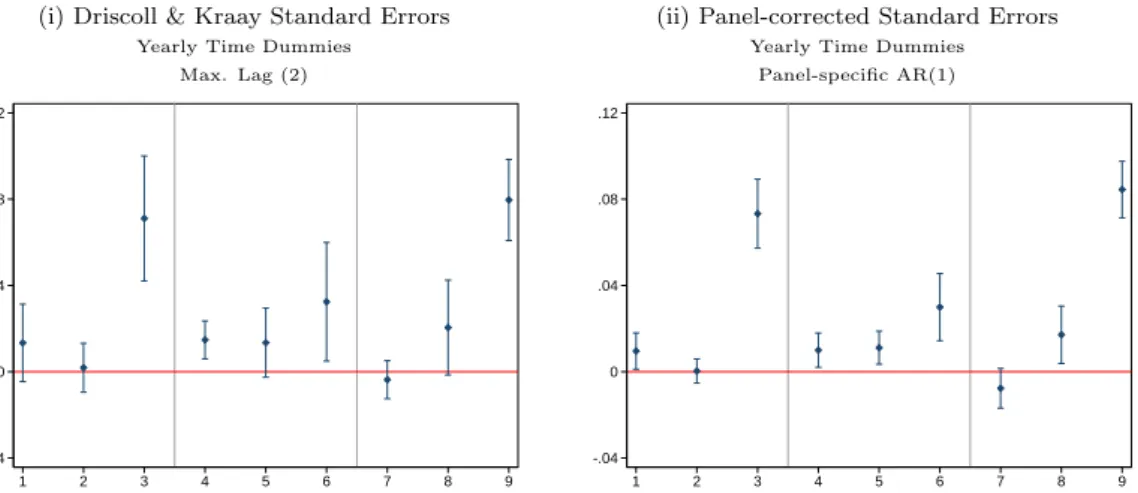
Panel (i) in figure 4 shows the estimated marginal effect of debt to GDP on bond yield spreads and the respective 5% confidence intervals when using Driscoll and Kraay standard errors. Panel (ii) shows the results for the same specification but with
panel-corrected standard errors. Both estimation methods use “large T” instead of “large
N” asymptotics. The results do not yield any crucial difference when compared to our
baseline fixed effects regression. The implications for the hypotheses testing remain valid. For the panel-corrected standard errors (panel (ii)) the results for hypothesis 1 on the changing effect of debt to GDP ratios over time are even more pronounced.
[ Figure 4: Robustness. Marginal Effects of Public Debt to GDP Ratio on Bond Yield Spreads Against Germany. Varying Estimation Techniques. ]
Do the Results Hold for Varying Break Dates?
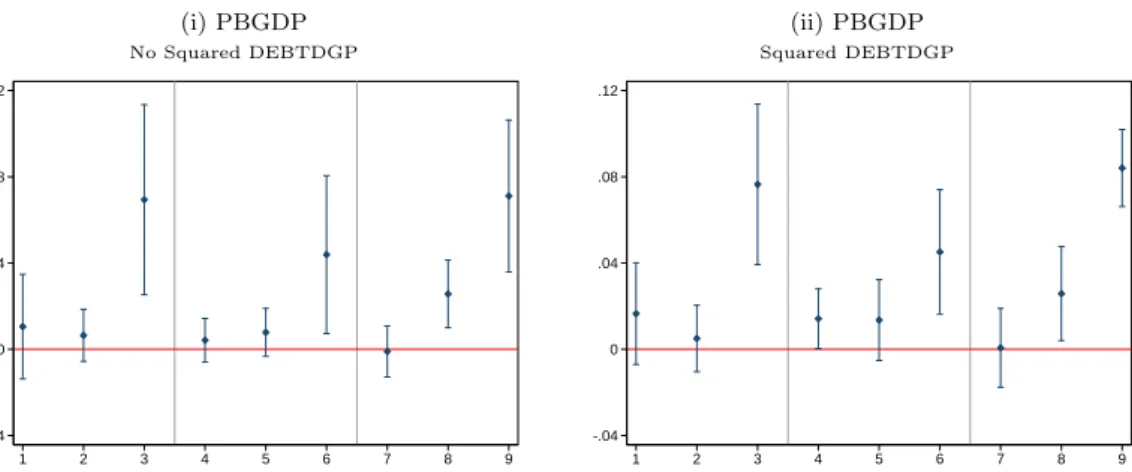
Next we check whether the results are affected by the choice of break dates that constitute the time dimension of the policy regimes. Accordingly, we re-estimate our model and vary both break dates pair-wise. That is, we construct the “Pre-Euro”-period covering the years from 1980-1994/95/96 respectively and the “Crisis”-“Pre-Euro”-period starting in 2009 instead of 2008. Figure 5 shows that the results do not change across these variations.
[ Figure 5: Robustness. Marginal Effects of Public Debt to GDP Ratio on Bond Yield Spreads Against Germany. Estimations Across Varying Breakdates. ]
Do the Results Depend on Different Sets of Covariates?
A further robustness issue considers the potential role of the primary balance to GDP ratio as an additional fiscal variable that might challenge the size of the effect of the public debt to GDP ratio upon the interest rate spread. The effects illustrated in figure 6 correspond to an estimation which includes the primary balance to GDP ratio as an additional regressor. The graphs highlight that the results remain stable, even for an expansion of the set of covariates.
[ Figure 6: Robustness. Marginal Effects of Public Debt to GDP Ratio on Bond Yield Spreads Against Germany. Considering Effects of the Primary Balance. ]
Are the Results Maintained in a Dynamic Model?
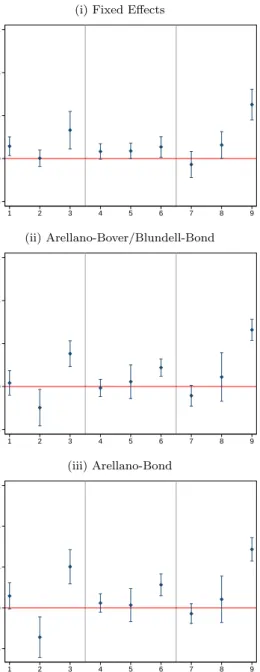
Finally, we estimate a dynamic model which includes one lag of the dependent variable as an additional covariate. As stated above, implementing a lagged endogenous variable into our fixed effects framework would violate the strict exogeneity assumption and thereby inducing the so-called ”Nickell-bias” (Nickell, 1981). On the other hand, this
bias may be small when T is large. In order to examine whether our hypotheses are
still confirmed within a dynamic framework we report the estimated marginal effect of the debt to GDP ratio on yield spreads when using fixed effects, Arellano-Bond and Blundell-Bond estimators. Figure 7 illustrates the corresponding results. We do not observe any notable changes in the results when applying different estimators.
[ Figure 7: Robustness. Marginal Effects of Public Debt to GDP Ratio on Bond Yield Spreads Against Germany. Dynamic Model. ]
5.3 Further Implications
Beyond the specific aspects covered in our hypotheses the results reveal several addi-tional facts and suggest a number of economic implications. In particular, our results document that with the start of the financial crisis, GIIPS countries experienced a strong re-assessment of fiscal imbalances measured as the public debt to GDP ratio. However, we also find that these countries benefited substantially in terms of their costs for taking on public debt from joining the EMU. During the “ConEuro”-period financial markets de facto neglected public debt as a pricing reference for a country’s solvency. Thus, we can ex post confirm the claim that the GIIPS countries bene-fited from an exceptionally low risk premium at that time. More precisely, we find that in the “ConEuro”-period as well as in the “Crisis”-period the marginal effects of the public debt to GDP ratio on yield spreads are significantly higher for the GIIPS group than for the EMU-11 economies excluding the GIIPS countries. This suggests that when adequately taken into account, for GIIPS countries the debt to GDP ratio
should generally play a more important role than for the core EMU country cluster.7
These findings are in line with the view that markets did not adequately differentiate default risk in the EMU during the ”ConEuro”-period (see Basurto et al. (2010), Kopf (2011) and Sinn (2012)). Therefore, it might be misleading to evaluate recent increases in sovereign default risk against the background of the relationship between the debt to GDP ratio and long-term interest rates based on the experience gained in the years
2000-2007.8 Due to the sufficiently long sample period our analysis illustrates that in
the medium run there was no stable structural relationship between public debt and yield spreads that could be regarded as a benchmark for a temporary overpricing of sovereign risk in the “Crisis”-period. In particular, given the information from the 1980s onwards, it is rather the ”ConEuro”-period that reflects a disconnection of fiscal fundamentals and sovereign risk premiums, though in the opposite direction.
6
Conclusion
We study the remarkable increase in sovereign bonds spreads for the so-called GIIPS economies over the course of the financial crisis. Providing a comprehensive assessment both across country groups and in the medium to long-term context, we use annual data for 21 OECD countries from 1980 to 2012. We find empirical evidence suggesting that the view of pronounced overpricing during the crisis needs to be qualified. We contrast our findings for different regional clusters against the backdrop of investors twice shifting the weighting of fiscal information for the assessment of sovereign credit
7
The theoretical explanation as to why we can observe such a relation goes beyond our analysis but would be an interesting question for future research.
8
Given their investigation period, compelling studies by De Grauwe and Ji (2013) and Beirne and Fratzscher (2013) among others might fall short of adequately accounting for that aspect.
risk. Unlike related studies, our information set allows us to compare the pricing of macroeconomic fundamentals before the signing of the Maastricht treaty with the EMU-convergence era and the financial crisis period. We evaluate the panel structure of our data by testing distinct hypotheses about changes in the role of country-specific macroeconomic fundamentals for the pricing of sovereign default risk.
We assume that the first shift in sovereign credit risk perception is associated with the institutional changes over the course of the convergence towards establishing the EMU. Our empirical findings point out that there was less significance attached to the debt to GDP ratio for the assessment of credit risk within GIIPS countries throughout that period. The second shift is due to the onset of the financial crisis. For this period, we observe the re-establishment of the temporarily interrupted pricing of debt sustainability as a crucial determinant for sovereign credit risk. Our findings are robust to variations in the estimating equation and the regression approach.
Our results qualify the view of pronounced overpricing during the crisis. Related studies, for example by Aizenman et al. (2013) and De Grauwe and Ji (2013), argue that due to negative market sentiments since the start of the sovereign debt crisis, financial markets overestimated sovereign risks in such a way that the spreads for some EMU countries (Greece, Ireland, and Portugal) increased in a manner which was disconnected from underlying fiscal indicators. On the one hand, our analysis confirms such a “wake-up call” phenomenon that lead to a dramatic jump in the effect of public debt upon sovereign risk perception from the “ConEuro”-period to the “Crisis”-period. On the other hand, our findings call for a reconsideration of the “overpricing”-hypothesis accordingly. Examining a longer time span reveals that there had been severe mispricing before the crisis. Furthermore, the shift in the role of public debt with the beginning of the EMU convergence process might have involved an overly optimistic, hypnotic effect on the perception of fundamentals in pricing sovereign credit risk. It therefore might be misleading to assess an uncoupling effect of public bond yield spreads from fiscal fundamentals by comparing the dynamics of the crisis to any time span within the “ConEuro”-period.
Focusing on the implications of such temporary mispricing for the development of portfolio structures in the financial sector and the consequences for financial stability is a question left open for further research. In particular, potential portfolio misallocation will certainly have contributed to increased contagion risk in both domestic as well as cross-border EMU banking sectors.
References
Aizenman, J., Hutchison, M., Jinjarak, Y., 2013. What is the risk of European sovereign debt defaults? Fiscal space, CDS spreads and market pricing of risk. Journal of International Money and Finance 34 (C), 37–59.
Arellano, M., Bond, S., 1991. Some Tests of Specification for Panel Data: Monte Carlo Evidence and an Application to Employment Equations. Review of Economic Studies 58 (2), 277–97. Arghyrou, M. G., Kontonikas, A., 2012. The EMU sovereign-debt crisis: Fundamentals, expec-tations and contagion. Journal of International Financial Markets, Institutions and Money 22 (4), 658–677.
Attinasi, M.-G., Checherita-Westphal, C., Nickel, C., 2009. What explains the surge in euro area sovereign spreads during the financial crisis of 2007-09? Working Paper Series 1131, European Central Bank.
Basurto, M. A. S., Caceres, C., Guzzo, V., 2010. Sovereign Spreads: Global Risk Aversion, Contagion or Fundamentals? IMF Working Papers 10/120, International Monetary Fund. Beck, N., Katz, J. N., 1995. What to do (and not to do) with time-series cross-section data.
American Political Science Review 89, 634–647.
Beirne, J., Fratzscher, M., 2013. The Pricing of Sovereign Risk and Contagion During the European Sovereign Debt Crisis. Journal of International Money and Finance 34 (C), 60– 82.
Bernoth, K., von Hagen, J., Schuknecht, L., 2012. Sovereign Risk Premiums in the European Government Bond Market. Journal of International Money and Finance 31 (5), 975–995. Blundell, R., Bond, S., 1998. Initial conditions and moment restrictions in dynamic panel data
models. Journal of Econometrics 87 (1), 115–143.
Buiter, W. H., Sibert, A., 2005. How the Eurosystem’s Treatment of Collateral in its Open Market Operations Weakens Fiscal Discipline in the Eurozone (and what to do about it). CEPR Discussion Papers 5387, C.E.P.R. Discussion Papers.
De Grauwe, P., 2011. Governance of a Fragile Eurozone. CEPS Papers 5523, Centre for Euro-pean Policy Studies.
De Grauwe, P., Ji, Y., 2013. Self-fulfilling Crises in the Eurozone: An Empirical Test. Journal of International Money and Finance 34 (C), 15–36.
Driscoll, J. C., Kraay, A. C., 1998. Consistent Covariance Matrix Estimation with Spatially Dependent Panel Data. Review of Economics and Statistics 80, 549–560.
Flemming, M., 2003. Measuring Treasury Market Liquidity. Federal Reserve Bank of New York Economic Policy Review 9, 83–108.
Fr¨ommel, M., Kruse, R., 2009. Interest Rate Convergence in the EMS prior to European Mon-etary Union. Ghent University Faculty of Economics and Business Administration Working Paper 610, Ghent University.
Giavazzi, F., Spaventa, L., 2010. Why the current account may matter in a monetary union: Lessons from the financial crisis in the Euro area. CEPR Discussion Papers 8008, C.E.P.R. Discussion Papers.
Giordano, R., Pericoli, M., Tommasino, P., 2013. Pure or Wake-up-Call Contagion? Another Look at the EMU Sovereign Debt Crisis. International Finance 16 (2), 131–160.
Gravelle, T., 1999. Liquidity of the Government of Canada Securities Market: Stylized Facts and Some Market Microstructure Comparisons to the United States Treasury Market. Bank of Canada Working Paper 99-11, Bank of Canada.
G¨artner, M., Griesbach, B., Jung, F., 2011. PIGS or Lambs? The European Sovereign Debt Crisis and the Role of Rating Agencies. International Advances in Economic Research 17 (3), 288–299.
Haugh, D., Ollivaud, P., Turner, D., 2009. What Drives Sovereign Risk Premiums? An Analysis of Recent Evidence from the Euro Area. OECD Economics Department Working Paper 718, OECD.
IMF, 2010. Global Financial Stability Report. Tech. rep., International Monetary Fund, Wash-ington DC.
Kopf, C., 2011. Restoring financial stability in the euro area. CEPS Papers 4292, Centre for European Policy Studies.
Nickell, S. J., 1981. Biases in Dynamic Models with Fixed Effects. Econometrica 49 (6), 1417– 26.
Silvia, A., Francesco, C., Timothy, L., 2007. Fiscal Discipline and the Cost of Public Debt Service: Some Estimates for OECD Countries. The B.E. Journal of Macroeconomics 7 (1), 1–35.
Sinn, H.-W., 2012. Die Target-Kredite der Deutschen Bundesbank. ifo Schnelldienst 65. StataCorp., 2011. Stata Statistical Software: Release 12. College Station, TX: StataCorp LP. von Hagen, J., Schuknecht, L., Wolswijk, G., 2011. Government Bond Risk Premiums in the
EU Revisited: The Impact of the Financial Crisis. European Journal of Political Economy 27 (1), 36–43.
Appendix: Tables
Table 1: Summary Statistics of Main Variables.
OECD-21 ex EMU-11
N mean p25 p50 p75 stdev min max
GERSPREAD 330 1.3 0.0 0.8 2.5 2.6 -4.5 11.5 DEBTGDP 298 58.6 39.1 51.9 69.6 31.7 13.7 210.0 DEBTSQ 298 4442 1528 2693 4851 6277 189 44099 MONEYRATE 328 6.6 3.1 5.6 9.6 4.7 0.0 23.3 CPI INFLATION 330 3.6 1.5 2.5 4.4 3.4 -1.4 18.0 EXCHRATE 330 104.0 90.2 103.9 115.7 24.2 32.1 216.4 CABGDP 330 0.6 -3.2 -0.7 3.5 5.3 -8.9 16.9 GDPGR 330 2.3 1.1 2.6 3.7 2.1 -5.8 8.5 EMU-11 ex GIIPS
N mean p25 p50 p75 stdev min max
GERSPREAD 198 0.9 0.0 0.2 0.9 1.5 -0.5 6.7 DEBTGDP 198 62.0 43.6 59.6 74.0 27.2 11.3 134.1 DEBTSQ 198 4578 1899 3558 5476 3987 129 17973 MONEYRATE 197 5.7 3.1 4.4 8.6 3.8 0.6 16.5 CPI INFLATION 198 2.9 1.5 2.3 3.3 2.4 -0.7 13.6 EXCHRATE 198 101.4 94.6 103.8 109.9 11.4 66.0 125.1 CABGDP 198 1.8 -0.7 1.8 4.0 3.0 -5.4 9.3 GDPGR 198 2.0 1.1 2.2 3.2 2.0 -8.4 5.8 GIIPS
N mean p25 p50 p75 stdev min max
GERSPREAD 157 4.0 0.3 2.8 6.4 4.3 0.0 24.0 DEBTGDP 165 73.7 49.6 66.2 99.8 31.6 16.5 198.3 DEBTSQ 165 6427 2456 4377 9954 5374 271 39309 MONEYRATE 163 9.2 3.1 8.1 14.9 6.6 0.6 24.9 CPI INFLATION 163 6.9 2.6 4.1 9.4 6.5 -4.5 28.9 EXCHRATE 165 127.6 106.3 110.9 121.2 59.4 93.5 511.8 CABGDP 165 -3.3 -5.5 -2.4 -0.3 4.0 -14.7 4.0 GDPGR 165 2.3 0.7 2.4 4.1 3.0 -7.0 11.2
Note: This table presents basic summary statistics of our main variables for the GIIPS, the EMU-11 ex GIIPS and the OECD-21 ex EMU-11 country clusters respectively.
Table 2: Country Groups and Time Periods.
Country Groups
GIIPS N = 5 ESP, GRC, IRL, ITA, PRT EMU-11 ex GIIPS N = 6 AUT, BEL, GER, FIN, FRA, NLD
OECD-21 ex EMU-11 N = 10 AUS, CAN, CHE, DNK, GBR, JPN, NOR, NZL, SWE, USA
Time Periods
“PreEuro”-period T = 14 1980-1993 “ConEuro”-period T = 14 1994-2007 “Crisis”-period T = 5 2008-2012
Table 3: Regimes for Time/Country-group Constellations.
“PreEuro”-period “ConEuro”-period “Crisis”-period
GIIPS 3 6 9
EMU-11 ex GIIPS 2 5 8
OECD-21 ex EMU-11 1 4 7
Table 4: Summary of Hypotheses.
Hypotheses for GIIPS Country Cluster
H1: Effect of Debt changes across time periods
λ3 > λ6 &λ6 < λ9
H2: Effect of Debt in “Crisis”-period is not different from “PreEuro”-period
λ3 =λ9
H3: Effect of Debt is not differen from core-EMU countries in “ConEuro”-period
λ5 =λ6
H4: Effect of Debt is different from core-EMU countries in “PreEuro”-period and “Crisis”-period
λ2 < λ3 &λ8 < λ9
H5: Contribution of Debt to spreads decreases from the “PreEuro”-period to the “ConEuro”-period
Table 5: Baseline Estimation Results.
“PreEuro”: 1980-1993 “ConEuro”: 1994-2007 “Crisis”: 2008-2012 DEBTGDP OECD-21 ex EMU-11 0.0598* 0.0308** -0.0038 [0.0305] [0.0136] [0.0159] EMU-11 ex GIIPS -0.0077 0.0368 0.0171 [0.0178] [0.0335] [0.0654] GIIPS 0.0514** -0.0737*** -0.1161 [0.0217] [0.0228] [0.0755] DEBTSQ OECD-21 ex EMU-11 -0.0004* -0.0001** 0.0000 [0.0002] [0.0001] [0.0001] EMU-11 ex GIIPS 0.0001 -0.0002 0.0000 [0.0001] [0.0002] [0.0005] GIIPS 0.0002 0.0007*** 0.0010** [0.0002] [0.0002] [0.0003] MONEYRATE OECD-21 ex EMU-11 0.4188*** 0.3987*** 0.3935** [0.0923] [0.0782] [0.1567] EMU-11 ex GIIPS 0.4657*** 0.5297*** 0.5039** [0.0329] [0.0989] [0.2076] GIIPS 0.6458*** 0.3489*** 0.2982 [0.0865] [0.0421] [0.2091] CPI INFLATION OECD-21 ex EMU-11 0.1518* -0.0171 -0.3985* [0.0873] [0.0843] [0.2256] EMU-11 ex GIIPS 0.1393 -0.1599*** -0.2057 [0.0922] [0.0464] [0.2197] GIIPS 0.3066*** 0.6576*** 0.0799 [0.0888] [0.1226] [0.2159] EXCHRATE OECD-21 ex EMU-11 -0.0073 -0.0166 -0.0177 [0.0130] [0.0132] [0.0111] EMU-11 ex GIIPS 0.0105 -0.0142 -0.0320 [0.0171] [0.0275] [0.0254] GIIPS -0.0001 0.0499** 0.0646* [0.0035] [0.0210] [0.0333] CABGDP OECD-21 ex EMU-11 -0.1466** -0.0257 -0.0835*** [0.0620] [0.0244] [0.0292] EMU-11 ex GIIPS -0.0437 -0.0163 -0.0116 [0.0959] [0.0190] [0.0469] GIIPS 0.1470** 0.1974** 0.2000 [0.0648] [0.0712] [0.1203] GDPGR OECD-21 ex EMU-11 -0.0227 0.0754 -0.1478* [0.0458] [0.0487] [0.0828] EMU-11 ex GIIPS 0.0042 0.0248 -0.2544** [0.0563] [0.0505] [0.0960] GIIPS -0.0562 0.1617*** -0.4820** [0.0660] [0.0415] [0.1991] Observations 647 Number of Countries 21 R2 0.9066
Robust standard errors in brackets *** p<0.01, ** p<0.05, * p<0.1
This table shows estimation results underlying panel (iv) in figure 3 which illustrates total effects of the public debt to GDP ratio. We control for country as well as year fixed effects.
Appendix: Figures
Figure 1: Long-term Interest Rates and Public Debt to GDP Ratios. Illustrations for Different Country Clusters.
(i) Long-term Interest Rate (ii) Public Debt to GDP Ratio
GIIPS GIIPS 0 10 20 30 1980 1990 2000 2010
ESP GRC ITA IRL PRT
0 50 100 150 200 1980 1990 2000 2010
ESP GRC ITA IRL PRT
(iii) Long-term Interest Rate (iv) Public Debt to GDP Ratio
EMU ex GIIPS EMU ex GIIPS
0 5 10 15
1980 1990 2000 2010
AUT BEL GER FIN FRA NLD
0 50 100 150
1980 1990 2000 2010
AUT BEL GER FIN FRA NLD
(v) Long-term Interest Rate (vi) Public Debt to GDP Ratio
OECD ex EMU OECD ex EMU
0 5 10 15 20 1980 1990 2000 2010 DNK GBR SWE USA JPN NOR CAN AUS CHE NLZ
0 50 100 150 200 1980 1990 2000 2010 DNK GBR SWE USA JPN NOR CAN AUS CHE NLZ
Note: This figure illustrates the evolution of long-term interest rates and the public debt to GDP ratio for the GIIPS, the EMU-11 ex GIIPS and the OECD-21 ex EMU-11 country clusters.
Figure 2: Regime-specific Sovereign Risk Perception Against Public Debt to GDP Ratio. Illustration for the GIIPS Country Cluster.
(i) GIIPS, 1980-1993 1980198119821983 1984 1985 1986 1987 1988 1989199019911992 1993 19801981 1982 1983 1984 1985 1986 19871988 1989 1990 1991 1992 1993 1980 1981 1982 1983 1984 1985 1986 19871988 1989199019911992 1993 1980 1981 1982 1983 1984 1985 1986 1987 1988 1989 19901991 1992 1993 1980 1981 1982 1983 1984 1985 1986 1987 1988 1989 1990 1991 1992 1993 -30 -20 -10 0
Real Interest Rate Spread
20 40 60 80 100 120
Public Debt to GDP Ratio
ESP GRC ITA IRL PRT
(ii) GIIPS, 1994-2007 199419951996 1997 1998 1999 2000 2001 2002 2003 2004 2005 2006 2007 1994 1995 1996 1997 1998 1999 2000 2001 2002 2003 2004 2005 2006 2007 1994 1995 1996 1997 1998 1999 2000 2001 2002 2003 2004 2005 2006 2007 1994 1995 1996 1997 1998 1999 2000 2001 2002 2003 2004 2005 2006 2007 1994 1995 1996 1997 1998 1999 2000 2001 20022003 2004 2005 20062007 -15 -10 -5 0
Real Interest Rate Spread
20 40 60 80 100 120
Public Debt to GDP Ratio
ESP GRC ITA IRL PRT
(iii) GIIPS, 2008-2012 2008 2009 2010 2011 2008 2009 2010 2011 2012 2008 2009 20102011 2012 2008 2009 2010 2011 2008 2009 2010 2011 2012 -5 0 5 10 15 20
Real Interest Rate Spread
50 100 150 200
Public Debt to GDP Ratio
ESP GRC ITA IRL PRT
Note: This figure illustrates regime-specific association of sovereign risk perception and the public debt to GDP ratio. Sovereign risk is approximated by the real interest rate spread, that is measured as the difference of the long-term real interest rate and the short term nominal interest rate.
Figure 3: Baseline. Total Marginal Effects of Public Debt to GDP Ratio on Bond Yield Spreads Against Germany.
(i) Linear Model (ii) Squared DEBTGDP .12 .08 .04 0 -.04 1 2 3 4 5 6 7 8 9 .12 .08 .04 0 -.04 1 2 3 4 5 6 7 8 9
(iii) Squared DEBTGDP (iv) Squared DEBTGDP
Robust Standard Errors Robust Standard Errors Yearly Time Dummies
.12 .08 .04 0 -.04 1 2 3 4 5 6 7 8 9 .12 .08 .04 0 -.04 1 2 3 4 5 6 7 8 9
Note: This figure illustrates our baseline estimations of regime-specific effects of the public debt to GDP ratio on the bond yield spread against Germany. Regimes are defined according to table 3. Panel (i) illustrates fixed effects estimation without a squared term of the public debt to GDP ratio, without yearly time dummies and without robust standard errors. Panel (ii) adds a squared term of the public debt to GDP ratio to the specification. Panel (iii) clusters standard errors at the country-level and panel (iv) additionally considers year time dummies.
Figure 4: Robustness. Total Marginal Effects of Public Debt to GDP Ratio on Bond Yield Spreads
Against Germany. Varying Estimation Techniques.
(i) Driscoll & Kraay Standard Errors (ii) Panel-corrected Standard Errors
Yearly Time Dummies Yearly Time Dummies Max. Lag (2) Panel-specific AR(1) .12 .08 .04 0 -.04 1 2 3 4 5 6 7 8 9 .12 .08 .04 0 -.04 1 2 3 4 5 6 7 8 9
Note: This figure illustrates regime-specific effects of the public debt to GDP ratio on bond yield spreads against Germany. Here, we contrast our baseline fixed effects results with the Driscoll and Kraay estimator as well as the panel-corrected standard error estimator.