MJEN MANAS Journal of Engineering
http://journals.manas.edu.kg MJEN 1 (1) (2013) 33–42
Developing a Scientific Publication Content Management System
with Peer Review Tools for Academic Institutions
Mehmet Tekerek
Kahramanmaraş Sütçüimam University, CEIT Department, Kahramanmaraş, Turkey, Kyrgyz-Turkish Manas Üniversity, Computer Engıneering Department, Bishkek, Kyrgyzstan [email protected]
Jumagul Nurakun kyzy
Kyrgyz-Turkish Manas Üniversity, Computer Engıneering Department, Bishkek, Kyrgyzstan [email protected]
Received:29.05.2013; Reviewed:13.06.2013; Accepted:23.09.2013
Abstract This paper describes efforts underway to construct a Scientific Publication Content Management System (SPCMS) with Peer Review Tools (PRT) for Academic Institutions. Firstly, known Scientific Publication processes have been reviewed and online publication process was chosen as a model for developing a scientific content publication and management system.
Next, the developed system is implemented as a case study to Kyrgyzstan-Turkey Manas University scientific journals. Since it is aimed to construct an online only journals, the system is supposed to be fast-tracking, fully manageable and, on the other hand, it should be highly secure since all the manuscripts are to be stored on the system. To undertake such problems as fast tracking, data processing and security was decided to implement self-developed system by using PHP and AJAX programming on Apache server with MySQL database application.
The result of this research is an automated publishing system for scholar manuscript publications, which covers the whole process from submission through peer review to publishing and provides to users an aggregative and manageable publishing tool from a single, dynamic destination.
1. INTRODUCTION
Nowadays information and communication technologies manifest themself in almost all aspects of social life, and the academic publishing is not an exception from that process. It has started undergo through certain systems within Information Technology (IT) infrastructure and become more dependent on internet technologies. In scientific publishing, the fundamental values are speed, transparency, reliability, accessibility, and sustainability concepts, which are actually the main advantages of using IT tools. On the other hand, these concepts merge because the publication of a scientific study should be done up to date in order for the study not to lose its actuality, evaluation and publication process should be transparent, publication office should be reliable and easily accessible and the location of electronic media has to be permanent.
If we look the historical adventure of scientific publications; the first scientific journal, Le Journal des Sçavans was published in France in 1665, which was followed by Philosophical Transactions published by the Royal Society in London later that year [1], [2], and since then the number of scientific journals have been progressively increasing, hitting 50 million by the year 2009 [3]. The number of articles is also increasing steadily. In [4] it was shown that there are direct correlations between the numbers of researchers, journals and articles, since all articles has to be included in some global scientific communication process by means of scientific journals. Thus, the problem of the organization of these processes arises.
We can formally divide the development of scientific journals into 3 eras. First era starts with the merge of the first journal and includes several models of the scientific communication process proposed by Garvey at al. in 1970s [5]. The Garvey-Griffith model [6] showed the communication process along with information technology-support.
The second era came along with development in computer technologies and computer scientists aimed at creating models of scientific communication process. Hurd proposed a new model, which included the effect of Internet on scientific communication process [7]. She later revisited the subject [8] taking into account developments such as self-publishing on the Web and institutional repositories.
Third era of scientific communication process started with work of Björk [9], where a new model of scientific communication as a global distributed information system was proposed based on a process modelling method IDEF0. It contains a comprehensive discussion of the scientific publication process from a life-cycle perspective and, in particular, synthesizes a large body of empirical evidence concerning the cost of different phases.
In this era all the steps of scientific communication models can all be done online. Electronic publishing brings us a host of changes. It increases the speed of communicating, disseminating and digesting knowledge. It provides new means of searching for, finding and analysing specific information. It reduces the need for additional shelf capacities in libraries. Also, electronic publishing can trim the publication process and make it cheaper. There are many debates about future of electronic journal publication. The copyright and peer-review in electronic publications are main topics of these discussions. The main point is that with the cost of print and distribution rising, along with labour, most, if not all, print journals (certainly as they are currently produced and distributed) must have a short lifetime remaining [10]. In [11] it is argued that with the peer-review tools, electronic publishing does not automatically affect scientific quality. This depends first of all on scientific performance and control, not on publication technologies.
1.1. CMS with PRT
The users of scientific publication system are usually non-technicians. Therefore, as a model of processing for SPS the Web Content Management System (WCMS) was chosen, this allows non-technical
users to make changes to a website with little training. A WCMS typically requires a systems administrator and/or a web developer to set up and add features, but it is primarily a website maintenance tool for non-technical staff. Thus, WCMS is a software system that provides website authoring, collaboration, and administration tools designed to allow users with little knowledge of web programming languages or mark-up languages to create and manage website content with relative ease. A robust WCMS provides the foundation for collaboration, offering users the ability to manage documents and output for multiple author editing and participation [14].
There are 3 types of WCMS Processing Systems [15] that can be applied as an implementation model for SPS: offline processing, online processing, and hybrid systems. These terms describe the deployment pattern for the WCMS in terms of when presentation templates are applied to render web pages from structured content. Offline processing systems, sometimes referred to as "static site generators", pre-process all content, applying templates before publication to generate web pages. Since pre-processing systems do not require a server to apply the templates at request time, they may also exist purely as design-time tools. Online processing systems apply templates on-demand. HTML may be generated when a user visits the page or it is pulled from a web cache. Most open source WCMS’s have the capability to support add-ons, which provide extended capabilities including forums, blog, wiki, web stores, photo galleries, contact management, etc. These are often called modules, nodes, widgets, add-ons, or extensions. Add-ons may be based on an open-source or paid license model. Last one is Hybrid systems - some systems combine the offline and online approaches. Some systems write out executable code (e.g., JSP, ASP, PHP, ColdFusion, or Perl pages) rather than just static HTML, so that the CMS itself does not need to be deployed on every web server. Other hybrids operate in either an online or offline mode [16].
WCMS is actually refers toContent Management System (CMS) [17][18][19], which is a computer program that allows publishing, editing and modifying content as well as maintenance from a central interface. Such systems of content management provide procedures to manage workflow in a collaborative environment. [20] The first CMS was announced at the end of the 1990s. This CMS was designed to simplify the complex task of writing numerous versions of code and to make the website development process more flexible. CMS platforms allow users to centralize data editing, publishing and modification on a single back-end interface [21].
The overall benefit from Web content management systems (WCMS) is the ability to control all of the content, a consistent, professional look and feel, easy access for the search. Since in scientific communication process the editorial board has to control the article publication process, and peer-review process should go in background, WCMS is a most appropriate tool to establish online journals [22].
Thus, in the modern models, the core, thus, the most time consuming part is the organization of journal publication. This can be done by means of Content Management Systems (CMS). But unlike many CMS, the journal publication should also contain peer review tools.
Figure 1. Scientific publication process (retrieved from [13])
The scientific publication process in Figure 1. describes traditional stages of manuscript publication: Author submits manuscript to academic journal editor. Editor determines whether manuscript has sufficient merit to be reviewed by editorial board or selected external reviewers. Manuscript sent back to the author with a rejection letter or sent on to reviewers. Reviewers return the manuscript to the editor with comments and recommendations (depending on peer review model). Editor sends manuscript back to the author with either a rejection letter or a request of correction. Author revises manuscript and resubmits to editor. Editor (sometimes) sends revised manuscript back to external reviewers. Editor accepts or rejects manuscript. Author provides editing or proofing of final copy before publication paper is eventually published in journal.
This model has held sway since the beginning of scholarly publishing. It relies on many individuals playing distinct roles within the overall process. [12]
Main Problems of Scientific Content Publication Process are a time-consuming, since review reports and review processes demands a lot of time for final proof and publish the manuscript. For this purpose PRT is necessary to reduce time-consuming at publication process. [23]
The process of academic publishing, which begins when authors submit a manuscript to a publisher, is divided into two distinct phases: peer review and production.
The process of peer review is organized by the journal editor and is complete when the content of the article, together with any associated images or figures, are accepted for publication. The peer review process is increasingly managed online, through the use of proprietary systems, commercial software packages, or open source and free software. A manuscript undergoes one or more rounds of review; after each round, the author(s) of the article modify their submission in line with the reviewers' comments; this process is repeated until the editor is satisfied and the work is accepted.
The production process, controlled by a production editor or publisher, then takes an article through copy editing, typesetting, inclusion in a specific issue of a journal, and then printing and online publication. Copy editing seeks to ensure that an article conforms to the journal's house style, that all of the referencing and labeling is correct, and that there are no spelling or grammatical errors. Typesetting deals with the appearance of the article - layouts, fonts, headings etc., both for print and online publication.
In much of the 20th century, such articles were photographed for printing into proceedings and journals, and this stage was known as camera-ready copy. With modern digital submission in formats such as PDF, this photographing step is no longer necessary, though the term is still sometimes used.
The author will review and correct proofs at one or more stages in the production process. The proof correction cycle has historically been labor-intensive as handwritten comments by authors and editors are manually transcribed by a proof reader onto a clean version of the proof. In recent years, this process has been streamlined by the introduction of e-annotations in Microsoft Word, Adobe Acrobat, and other programs, but it still remains a time-consuming [23].
In this paper the algorithms of software that can fulfil the above mentioned requirements is described. For Peer Review and Scientific Publishing, software is planned to be developed by means of Content Management System. Within the scope of the system, the realization of peer review and whole editorial process in web environment is intended to be implemented.
2. MATERIAL and METHOD
In this research KTMU scientific journals have been chosen as an academic institution. Developed ManasSPS was implemented into KTMU scientific journals. Chosen Academic Institution carry on its Editorial and Review processes with own academic resources.
2.1. SPCMS Hardware requirements
The developed system hardware infrastructure of needed by the system as follows:
Apache HTTP Server - open-source software. The application is available for a wide variety of operating systems, including UNIX, FreeBSD, Linux, Solaris, Novell NetWare, OS X, and Microsoft Windows.
FTP - File Transfer Protocol is a standard network protocol used to transfer files from one host to another host over a TCP-based network, such as the Internet. [24]
2.2. SPCMS software development requirements
PHP - Hypertext Preprocessor (PHP) is a server-side scripting language designed for web development but also used as a general-purpose programming language. PHP code is interpreted by a web server with a PHP processor module which generates the resulting web page: PHP commands can be embedded directly into an HTML source document rather than calling an external file to process data.[25]
AJAX (Asynchronous JavaScript and XML) [26] is a group of interrelated web development techniques used on the client-side to create asynchronous web applications. With Ajax, web applications can send data to, and retrieve data from, a server asynchronously (in the background) without interfering with the display and behavior of the existing page. Ajax is a group of technologies. HTML and CSS can be used in combination to mark up and style information.
JQuery is a multi-browser JavaScript library designed to simplify the client-side scripting of HTML.[27]. jQuery is free, open source software. jQuery's syntax is designed to make it easier to navigate a document, select DOM elements, create animations, handle events, and develop Ajax applications. jQuery also provides capabilities for developers to create plug-ins on top of the JavaScript library. This enables developers to create abstractions for low-level interaction and animation, advanced effects and high-level, theme-able widgets. The modular approach to the jQuery library allows the creation of powerful dynamic web pages and web applications. [27]
3. IMPLEMENTATION OF ManasSPS
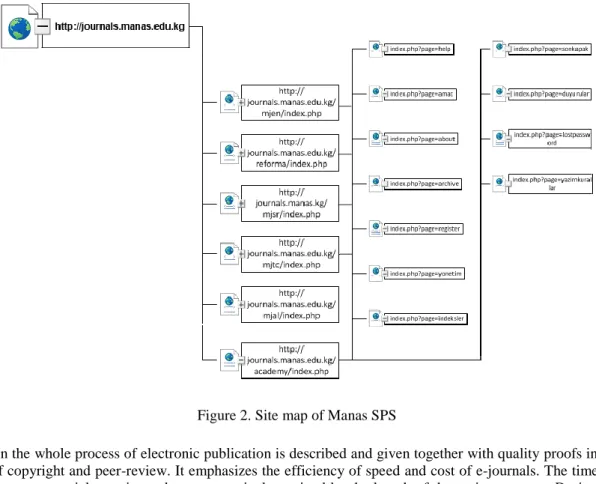
First step in developing web site for online journals publication system is site map, which described in Figure 2.
Figure 2. Site map of Manas SPS
In the whole process of electronic publication is described and given together with quality proofs in terms of copyright and peer-review. It emphasizes the efficiency of speed and cost of e-journals. The time span between an article receipt and acceptance is determined by the length of the review process. During this time articles are usually sent to 4 or more (up to 6) reviewers. The reviewed article is returned to the authors, together with copies of the reviewers' reports (without revealing their names). Unless the article is rejected at this stage, authors are invited to consider accommodate or convincingly refute the reviewer's comments and criticisms. It can take the authors weeks or even months to revise their work. The revision is again examined by reviewers (not necessarily the same ones). Depending on their recommendations, about 60% of the revisions are sent again to the authors for additional quality improvements. Sometimes this process must be repeated. When the editor finally accepts an article, it should be copy-edited, typeset and the result returned to the authors for examination [11].
3.1. Article Submission Process
To submit an article to the one of MANAS journals, the user has to go through simple registration process. After activation of the account by clicking the link sent by the system to the user’s email, the article submission process can be done. During this process author(s) are filling fields required for article management, i.e., they should agree with article submission agreement, insert title, abstract and keywords etc. Also, the manuscript submission should be totally blind, no personal information should be revealed at the submitted manuscript, since it is supposed to be further redirected to referees.
system as a draft, thus, the author can still manage the article. It can be edited or even deleted at this stage. But as long as the author(s) send the article to the editor, there is no more possibility for them to edit or delete paper, because by slicking on “send to editor” button, the authors initiate the review and peer review process for a given article.
3.2. Editorial Process
The editorial process starts when the author sends the article to the editors.
First, the article is received by executive editor, who is supposed to check if the article is written and edited in accordance in accordance with the journal’s standards; if it is not, the article is sent back to the author(s) with correction request. If it follows all the requirements, the article passes the preliminary evaluation and can be sent to section editor.
After the response comes from referees and section editor, the executive editor is supposed to manage the current volume and issue of the journal as well.
The field editor is responsible for the content of the article. In the scope of his/her duties the full preliminary review of the article. According to the results of this preview, the section editor can either accept the article and send it to referees or send to the author with the correction request or reject. If the article is rejected, the report explaining why the article is rejected should be supplied. Together with this report, the article is sent back to the author(s). Almost the same procedure is done when the corrections are required, with the only difference at the reports written by section editor. If the article is accepted, it is supposed to go through process of peer review. Therefore the article is sent to at least 2 referees chosen from the system’s database.
According to the response of referees, the section editor should make the decision about the article. It can either be acceptance or rejection.
3.3. Peer Review Process
When the article is sent to a referee for peer review, the referee receives an invitation to review the article. He/she can either accept or reject the request. In case of rejection, a referee will not be able to see the article, i.e. the access will be denied for the referee to download or preview the article, and the peer review request is sent to other referees. In case if the referee accepts the review request, he will find the article in the “Articles to be reviewed” list. By clicking “Review” button, the referee can now access the article and download it. After the review, the referee should feel all the necessary forms and click submit button. By this he/she is sending the reviewed article and review reports to the section editor.
Figure 3. Scientific publication process by Manas SPS at www.journals.manas.edu.kg 4. DISCUSSIONS and CONCLUSION
The aim of the study is to construct an online journal for academic institutions. The scientific content publishing system was supposed to be easy to use and fully manageable by authors, editors and reviewers. All scholarly publishing processes has been undertaken from approaches like: Article submission (in the format appropriate for the scientific publication and it’s uploading to the system), Editing (i.e., reviewing if the article is suitable to be published in the particular scientific journal, and if it is, sending it to the referees specializing in the same or close field of study) and refereeing (by the referees who work in the same field and can evaluate the article from the scientific point of view), which are major points required for the publication of a scientific article.
Thus, the aim of the study was at implementing of all these processes in the web environment, so that the implemented system was in accordance with the scientific publication standards, easy to manage and to use, and which would enable the relatively fast publication process. For that, first of all the Writer-Editor-Referee inter-process mechanism was developed.
Using this mechanism, the infrastructure of scientific e-journals was prepared. This infrastructure completely covers the whole process of publishing, starting from submission of an article by the authors till it is accepted for publication or rejected by the editor. Manas SPCS was tested on the six journals of Kyrgyzstan Turkey Manas University, namely, MANAS Journal of Engineering, MANAS Journal of Social Studies, Reforma, MANAS Journal of Turkish Civilization, MANAS Journal of Agriculture and Life Sciences and Academy.
As a result was shown the framework and implementation of the dynamic Scientific Publication Content Management System (SPCMS) with Peer Review Tools (PRT) for an Academic Institutions. SPCMS has been successfully implemented as a case study for Kyrgyzstan Turkey Manas University
online journals. As a result have been developed SPCMS, which supports from online scientific paper submission, peer-review aggregation to publishing process, from a single dynamic destination.
Acknowledgement
This study was withdrawn from M.S. thesis “Developing a Scientific Content Management, Referee and Publication System”
REFERENCES
[1] Brown, H. (1972). History and the Learned Journal. Journal of the History of Ideas 33: 365-78. Retrieved from http://www.jstor.org/stable/2709041
[2] Development of Science Publishing in Europe; Ed. Meadows, A. J., Elsevier, Amsterdam, 1980. [3] Jinha, A. (2010). Article 50 million: an estimate of the number of scholarly articles in existence
Learned Publishing, 23 (3), 258-263 DOI: 10.1087/20100308
[4] Mabe, M. (2003). The growth and number of journals. Serials 16: 191-197
[5] Tenopir, C. & King, D. (2000). Towards electronic Journals – realities for scientists, librarians and publishers, Washington D. C.: Special Libraries Association.
[6] Garvey, W.D. & Griffith, B.C. (1965). Scientific communication: the dissemination system in psychology and a theoretical framework for planning innovations. American Psychologist, 20(2), 157–164.
[7] Hurd, J. M. (1996). Models of scientific communications systems. In: S. Crawford, et al. (Eds) From print to electronic: the transformation of scientific communication. (pp. 9-33) Medford, NJ: Information Today Inc.
[8] Hurd, J.M. (2004). Scientific communication: new roles and new players. Science & Technology Libraries, 25(1-2), 5-22.
[9] Björk, B-C. (2007). "A model of scientific communication as a global distributed information system" Information Research, 12(2) paper 307. [Available at http://InformationR.net/ir/12-2/paper307.html]
[10] Heller, S.R., (2004). Electronic Publishing of Scientific Manuscripts
[11] Kinne, O., (1999). Electronic publishing in science: changes and risks. Australian Library Journal, 48 (4), 311.
[12] Publish not Perish. Tutorial provided by the University of Colorado libraries. Retrieved from http://www.publishnotperish.org/module1/process_overview.htm
[13] Hybrid Review Model. INNOQUAL. Journal for Innovation and Quality in Learning. Retrieved from http://innoqual.efquel.org/about-innoqual/about-the-hybrid-review-model
[14] Johnston, M., (2009). "CMS or WCM - Which is Which?". Retrieved from http://cmscritic.com. [15] Static Website Generators For Your Site, Blog Or Wiki. Retrieved from
http://en.wikipedia.org/wiki/Web_content_management_system [16] Web Content Management System. Retrieved from
http://en.wikipedia.org/wiki/Web_content_management_system
[17] Rockley, A., Kostur, P., Manning, S., (2003). Managing Enterprise Content: A Unified Content Strategy. New Riders.
[18] White, M., (2005). The content management handbook. Facet Publishing. [19] Boiko, B., (2005). Content Management Bible. John Wiley & Sons
[20] Paulsen, K., (2011). Moving Media Storage Technologies: Applications & Workflows for Video and Media Server Platforms. Francis US.
[21] Browning, P., Lowndes, M., (2001). JISC TechWatch Report: Content Management Systems, The Pennsylvania State University CiteSeer Archives
[22] Stephen R., Fraser G., (2002). “Building a Content Management System”, Apress, New York, NY, USA., ISBN: 1590590244.
[23] Academic Publishing. Retrieved from http://en.wikipedia.org/wiki/Academic_publishing. [24] File Transfer Protocol. Retrieved from http://en.wikipedia.org/wiki/FTP.
[25] Hypertext Preprocessor or Personal Home Page Tools. Retrieved from https://en.wikipedia.org/wiki/PHP.
[26] Garrett, J. J., (2005). "Ajax: A New Approach to Web Applications". Retrieved from www.adaptivepath.com.
[27] Resig, J., (2007). Advancing JavaScript with Libraries. YUI Theater. Retrieved from http://www.yuiblog.com/blog/2007/04/16/video-resig/
[28] Kyrgyzstan Turkey Manas University regulations and guidelines. Retrieved from http://manas.kg/index.php/tr/yoenetmelikler-ve-yoenergeler
![Figure 1. Scientific publication process (retrieved from [13])](https://thumb-us.123doks.com/thumbv2/123dok_us/1585709.2713341/4.816.210.639.84.376/figure-scientific-publication-process-retrieved.webp)