A Framework for Supporting DBMS-like Indexes
in the Cloud
Gang Chen
Zhejiang University
Hoang Tam Vo, Sai Wu, Beng Chin Ooi
National University of Singapore
{voht, wusai, ooibc}@comp.nus.edu.sg
M. Tamer Özsu
University of Waterloo
ABSTRACT
To support “Database as a service” (DaaS) in the cloud, the database system is expected to provide similar functionalities as in central-ized DBMS such as efficient processing of ad hoc queries. The system must therefore support DBMS-like indexes, possibly a few indexes for each table to provide fast location of data distributed over the network. In such a distributed environment, the indexes have to be distributed over the network to achieve scalability and re-liability. Each cluster node maintains a subset of the index data. As in conventional DBMS, indexes incur maintenance overhead and the problem is more complex in the distributed environment since the data are typically partitioned and distributed based on a subset of attributes. Further, the distribution of indexes is not straight for-ward, and there is therefore always the question of scalability, in terms of data volume, network size, and number of indexes.
In this paper, we examine the problem of providing DBMS-like indexing mechanisms in cloud DaaS, and propose an extensible, but simple and efficient indexing framework that enables users to define their own indexes without knowing the structure of the un-derlying network. It is also designed to ensure the efficiency of hopping between cluster nodes during index traversal, and reduce the maintenance cost of indexes. We implement three common indexes, namely distributed hash indexes, distributed B+-tree-like
indexes and distributed multi-dimensional indexes, to demonstrate the usability and effectiveness of the framework. We conduct ex-periments on Amazon EC2 and an in-house cluster to verify the efficiency and scalability of the framework.
1. INTRODUCTION
The cloud simplifies the deployment of large-scale applications by shielding users from the underlying infrastructure and imple-mentation details. There is substantial interest in cloud deploy-ment of data-centric applications. One good example application is the Customer Relationship Management (CRM), which is used to monitor sales activities, and improve sales and customer rela-tionships. While there are daily account maintenance and sales ac-tivities, there are certain periods when sales quota must be met, forecasting and analysis are required, etc., and these activities
re-Permission to make digital or hard copies of all or part of this work for personal or classroom use is granted without fee provided that copies are not made or distributed for profit or commercial advantage and that copies bear this notice and the full citation on the first page. To copy otherwise, to republish, to post on servers or to redistribute to lists, requires prior specific permission and/or a fee. Articles from this volume were invited to present their results at The 37th International Conference on Very Large Data Bases, August 29th - September 3rd 2011, Seattle, Washington.
Proceedings of the VLDB Endowment,Vol. 4, No. 11
Copyright 2011 VLDB Endowment 2150-8097/11/08...$10.00.
quire more resources at peak periods, and the cloud is able to meet such inconsistent resource requirements.
To support data-centric applications, the cloud must provide an efficient and elastic database service with database functionality, which is commonly referred to as the “database as a service” (DaaS). This work is part of our cloud-based data management system, named epiC (elastic power-aware data-intensive Cloud)1, which is
designed to support both analytical and OLTP workloads. In this paper we focus on the provision of indexing functionality in the context of DaaS. One obvious requirement for this functionality is to locate some specific records among millions of distributed can-didates in real time, preferably within a few milliseconds. A sec-ond requirement is to support multiple indexes over the data – a common service in any DBMS. Another important requirement is extensibility by which users can define new indexes without know-ing the structure of the underlyknow-ing network or havknow-ing to tune the system performance by themselves.
Currently no DaaS satisfies these requirements. Most popular cloud storage systems are key-value based, which, given a key, can efficiently locate the value assigned to the key. Examples of these are Dynamo [5] and Cassandra [8]. These systems build a hash index over the underlying storage layer, partitioning the data by keys (e.g., primary index). For supporting primary range index, a distributed B-tree has been proposed [2]. While these proposals are efficient in retrieving data based on primary index, they are not useful when a query does not use the key as the search condition. In these cases, sequential (or even parallel) scanning of an entire (large) table is required to retrieve only a few records, and this is obviously inefficient.
Recently, Cassandra [8] has started to support native distributed indexes on non-key attributes. However, these secondary indexes are restricted to hash indexes. A second line of research has been view materialization in the cloud to support ad hoc queries. In [1], a view selection strategy was proposed to achieve a balance between query performance and view maintenance cost. Secondary indexes can be implemented as a specific type of materialized views. Main-taining materialized views is orthogonal to our research and the comparison with this approach is our on going research.
Two secondary indexes have been proposed for cloud systems: a distributed B+-tree-like index to support single-dimensional range
queries [22], and a distributed R-tree-like index to support multi-dimensional range and kNN (k Nearest Neighbor) queries [21]. The main idea of both indexes is to use P2P routing overlays as global indexes and combine with local disk-resident indexes at each index node. The overlays are used to build a logical network for partition-ing data, routpartition-ing queries and distributpartition-ing the system workload. In contrast, IR based strategies in integrating distributed independent
databases over unstructured network, without any global index, are proposed in [13].
Like Dynamo [5] and Cassandra [8], our system adopts the peer-to-peer (P2P) model to provide highly available service with no single point of failure. Moreover, using DHT overlays as infras-tructure also allows building an elastic indexing service where in-dex nodes can be added or reduced based on load characteristics. In addition, while the proposals in [21, 22] illustrate the feasibility of supporting an index using the underlying overlay network, it is not feasible to support multiple indexes using these approaches since it is expensive to maintain multiple overlays – each overlay for a spe-cific index – over the distributed cluster nodes. In order to provide an indexing functionality that is able to support a variety of basic indexes efficiently, we propose an extensible indexing framework that supports multiple indexes over a single generic overlay.
Our framework is motivated by the observation that many P2P overlays are instances of the Cayley graph [12, 14]. Consequently, we abstract the overlay construction by a set of Cayley graph inter-faces. By defining the customized Cayley graph instances, a user can create different types of overlays and support various types of secondary indexes. This approach avoids the overhead of maintain-ing multiple overlays, as discussed above, while maintainmaintain-ing flex-ibility, and it achieves the much needed scalability and efficiency for supporting multiple indexes of different types in cloud database systems.
The main challenge in developing this framework is how to map different types of indexes to the Cayley graph instances. To address this problem, we define two mapping functions, a data mapping function and an overlay mapping function. The data mapping func-tion maps various types of values into a single Cayley graph key space. We propose two data mapping functions: a uniform map-ping function, which assumes the data are uniformly distributed and maps data to different keys with the same probability, and a sampling-based mapping function, which maps data based on the distribution of samples. The overlay mapping function is composed of a set of operators that represent the routing algorithms of dif-ferent Cayley graph instances. The user can define new types of overlays by implementing new operators, which simplifies the in-clusion and deployment of new types of indexes. Additionally, the use of data mapping and overlay mapping reduces the cost of index creation and maintenance.
Performance tuning in a cloud system is not trivial, and therefore, our indexing framework is designed to be self tunable. Indepen-dent of the index type, our self tuning strategies optimize the per-formance by adaptively creating network connections, effectively buffering local indexes and aggressively reducing the random I/Os.
In summary, the contributions of the paper are as follows.
• We propose an extensible framework for implementing DBMS-like indexes in the cloud. We exploit the characteristics of Cayley graphs to provide the much needed scalability for supporting multiple distributed indexes of different types.
• We define a methodology to map various types of data and P2P overlays to a generalized Cayley graph structure.
• We propose self-tuning strategies to optimize the performance of the indexes defined over the generic Cayley overlay, thereby achieving high performance and scalability.
• We implement the proposed framework and conduct exten-sive experimental study on Amazon EC2 and an in-house cluster. The results confirm the robustness, efficiency and scalability of our proposed framework.
The paper proceeds as follows. In Section 2, we give an overview of the indexing framework. We present the Cayley graph based indexing scheme in Section 3. We evaluate the performance of the indexes in Section 4 and conclude the paper in Section 5.
2. OVERVIEW OF THE FRAMEWORK
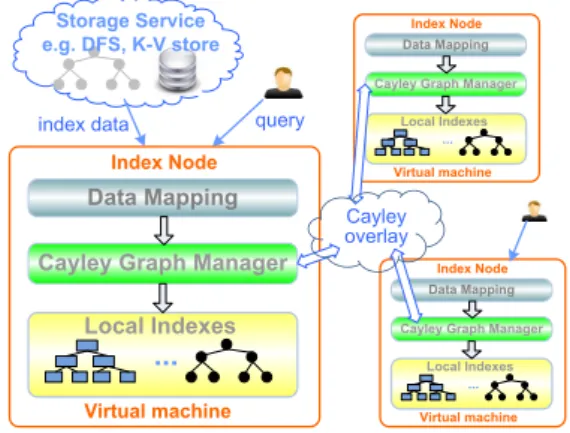
The proposed framework consists of an indexing service that is loosely connected with other cloud services, such as storage ser-vice and processing serser-vice. This is a commonly accepted design principle in the cloud, which enables different services to scale up and down independently. The indexing service runs as a set of dis-tributed processes on the virtual machines. The indexing service interacts with the underlying storage service where the base tables are stored, e.g. distributed file systems (DFS), and provides data retrieval interface for the upper layer applications.
We refer to the index process that runs on a virtual machine as an index node. The index nodes are organized into a generic Cay-ley graph based overlay. Figure 1 shows the architecture of the indexing service. The multiple types of indexes supported by the
index data Storage Service e.g. DFS, K-V store
Data Mapping
Cayley Graph Manager
Index Node
Local Indexes
... Virtual machine
Data Mapping
Cayley Graph Manager Index Node
Local Indexes ... Virtual machine
Data Mapping
Cayley Graph Manager Index Node Local Indexes ... Virtual machine query Cayley overlay
Figure 1: Indexing service in the cloud
framework are mapped to Cayley graph instance managed by the Cayley Graph Manager. One Cayley graph instance is required for each type of index. For example, a hash index on a string or nu-meric attribute is mapped to a Chord [19] instance while a kd-tree or R-tree index on multiple attributes can be supported by a CAN [16] instance. Cayley graph is described further in Section 3.1. We define a generalized key spaceS for the Cayley graph. A client application simply needs to define a data mapping functionFthat maps an index columncto a value inS. Based on the type of in-dexes, differentFs can be defined. If the index is built to support range index, Fmust preserve the locality of data. Otherwise, F
can be defined as a universal hash function to balance the system load.
After being mapped with functionF, the value of the index keys are normalized to the Cayley graph key space. The detailed de-scription of the data mapping technique is presented in Section 3.2. The indexing process in our framework is similar to the publication process in P2P overlays. Specifically, an index entry is composed of a key-value pair(k, v), wherekdenotes the value of the index column andvis the offset of the tuple in the underlying DFS or the value of the tuple itself (or possibly portions of the tuple) if the user opts to usecovering indexes. Under the covering index scheme, the indexes include additional, non-key columns in the index entries so that they can service the queries without having to refer to the base records, i.e., the indexes “cover” the queries. To index this key-value pair(k, v), we apply a P2P overlay routing protocol to publish(k, v)based onk0, the mapped value ofkwith the
map-ping functionF. Upon receiving a key-value pair(k, v)and the mapped keyk0 from the data mapper, the Cayley graph manager
retrieves the corresponding instance of the index column and ap-plies the routing protocols of the instance to index the data. Based on the routing protocol of the Cayley graph instance, the index node in the cluster system is responsible for a key set and needs to keep a portion of index data (i.e., the published data).
A typical database application such as Human Resource Man-agement or Customer Relationships ManMan-agement has many tables, and each table has a few indexes. Given the size of the current datasets, the index data will be too large to be maintained in mem-ory. To address this problem, each index node is expected to create one local disk-resident index such as the hash table or B+-tree for
maintaining the index data of a distributed index. Thus, the index lookup is performed in two steps. In the first step, we follow the routing protocol defined by the Cayley graph operators to locate the node responsible for the index data. In the second step, we search the node’s local index to get the index data. To further improve the search performance, we employ a buffer manager locally to reduce the I/O cost for traversing local indexes.
It is important to note that we aim to design a simple yet efficient and scalable solution for indexing data in the cloud. Our index-ing system is different from current proposals [21, 22] in two main aspects. First, our indexing system provides the much needed scal-ability with the scal-ability to support a large number of indexes of dif-ferent types. Second, in our design the indexing system is loosely coupled with the storage system while the indexes in [21, 22] ride directly on the data nodes of the storage system. Decoupling sys-tem functions of a cloud syssys-tem into loosely coupled components enables each component to scale up and scale down independently.
3. CAYLEY GRAPH-BASED INDEXING
In this section, we present a Cayley graph-based indexing scheme and use it to support multiple types of distributed indexes, such as hash, B+-tree-like and multi-dimensional index, on the cloud
plat-form.
3.1 Mapping P2P Overlays to Cayley Graph
Cayley graph, which encodes the structure of a discrete set, is defined as follows.
DEFINITION 1. Cayley Graph: A Cayley graphG= (S, G,L),
whereSis an element set, G is a generator set andLis a binary operator, is a graph such that
1. ∀e∈ S, there is a vertex inGcorresponding toe. 2. L: (S×G)→ S.
3. ∀e∈ Sand∀g∈G,eLgis an element inS and there is an edge frometoeLginG.
4. There is no loop inG, namely∀e∈S,∀g∈G→eLg6=
e.
In a Cayley graph, we create a vertex for each element inS. If for elementseiandej, there is a generatorgsatisfyingei
L
g=ej,
then edge(ei→ej)is created.
Each node in the Cayley graph can be considered a peer, allow-ing the Cayley graph to define a P2P overlay. Many P2P overlays, including Chord [19], an expanded BATON [7], and CAN [16], can be mapped to an instance of Cayley graph [12]. We discuss how this mapping occurs.
When a cluster node assumes the role of an index node in the Cayley graph, we use a hash function to generate a unique value in
Sas its identifier. Suppose the list of index nodes is{n0, n1, ..., nd}
and letI(ni)denote nodeni’s identifier.I(ni)refers to an element
inSand an abstract vertex in the Cayley graph. To support index construction, we partition the element set into subsets with contin-uous elements based on nodes’ identifiers. We first sort the nodes by their identifiers and hence,I(ni)< I(ni+1). The subsetSiis
defined as
Si= ½
{x|I(ni−1)< x≤I(ni)} ifx6= 0
{x|0≤x≤I(ni)∨I(nd)< x≤ S.max} otherwise
whereS.maxis the maximal element inS. Nodeniis responsible
for subsetSi. The overlay mapping problem is formalized as:
DEFINITION 2. Overlay Mapping : Given a P2P overlay O
and a Cayley graphG = (S, G,L),Ocan be mapped toGby using the following rules:
1. For a nodeninO,I(n)is defined as an element inS. 2. Given two nodes,niandnj,njis a routing neighbor ofni,
iff there is a generatorginG, satisfyingI(ni) L
g∈ Sj.
In a Cayley graph, the element set and generator set can be de-fined arbitrarily, which makes the mapping problem very complex. In our proposal, we fix the element setSand the generator setGas
{x|0≤x≤2m−1}and{2i|0≤i≤m−1}, respectively. In
this way, the overlay mapping problem is transformed into finding a properLfor each overlay. Popular P2P overlays such as Chord [19], CAN [16] and BATON [7] can be easily integrated into the above model. In fact, these three overlays are sufficient to support DBMS-like indexes similar to those commonly available in com-mercial centralized DBMS, namely the hash, B+-tree and R-tree.
In the following example, we show how to map Chord to the Cayley graph by defining a properoperator. Details of mapping other overlays are shown in Appendix A.
In our framework, Chord is a2m-ring since Cayley graph’s
el-ement set is{x|0 ≤ x ≤ 2m−1}(we setm = 30in our
ex-periments to support large datasets). We define the operatorxLy
as(x+y) mod2m. Therefore, given a noden
i and its
identi-fierI(ni)in the element setS, we create edges betweenI(ni)to
keysI(ni) + 2k(0 ≤ k ≤ m−1), based on the generator set
{2i|0≤i≤m−1}. Namely, each node maintainsmrouting
en-tries, which follows the structure of Chord. Algorithm 1 shows the routing algorithm that simulates the Chord protocol. In Algorithm 1,nirefers to the index node that receives the routing request and
startis the node’s identifier. Basically, we iterate all generators and try to route the message as far as possible. In line 7, given a key, the functiongetN odeByKeyreturns the address of the index node that is responsible for the key based on the routing table.
Algorithm 1ChordLookup(Node ni, Key dest)
1. Keystart=I(ni)
2. ifstart==destthen
3. returnnode
4. else
5. fori=m-1 to 0do
6. if(start+ 2imod2m)≤dest then
7. NodenextN ode=getN odeByKey(start+ 2i)
8. returnnextN ode
3.2 Data Mapping
The indexed columns may have different value domains. Since we use the values of indexed columns as the keys to build the index, before publishing an index entry with keykwe need to normalize
kinto a valuek0in the element spaceS. For this purpose, some
key mapping functions are required. Given an element domainS
and an attribute domainD, the mapping functionf:D → Smaps every value inDto a unique value inS.
Suppose we havedindex nodes,{n0, n1, ..., nd}, and useSito
denote the element subset ofni. Given a tableT, if the index is
built forT’s columnc0, the number of index entries published to
niis estimated as:
g(ni) = X tj∈T
Φ(f(tj.c0)) (1)
where functionΦ(x)returns 1 ifx∈ Si, or 0, otherwise.
A good mapping function should provide the properties of local-ityandload balance.
DEFINITION 3. Locality: The mapping functionf :D → S
satisfies the locality property, if∀xi∀xj ∈ D ∧xi < xj →
f(xi)≤f(xj).
DEFINITION 4. ²-Balance: The mapping functionf:D → S
is an²-balance function for columnc0, if for any two cluster nodes,
niandnj,gg((nni) j) < ².
Locality requirement is used to support range queries, but is not necessary for the hash index. Load balance guarantees that the workload is approximately uniformly distributed over the in-dex nodes. Definitions 3 and 4 can be extended to support multi-dimensional (multi-column) indexes. For thed-dimensional case, the mapping function is defined asf : D0 ×...× Dd → S,
while the locality is measured by the average value ofL(xi, xj) = d(xi,xj)
|f(xi)−f(xj)|, whered(xi, xj)returns the Euclidean distance
be-tween two multi-dimensional points,xiandxj.
DEFINITION 5. d-Locality: The mapping functionf : D0×
...×Dd→ Ssatisfies the locality property, if the averageL(xi, xj) is bounded by a function ofd.
In our current implementations, we provide two data mapping functions: a uniform mapping function and a sampling-based map-ping function.
3.2.1 Uniform Data Mapping
The uniform mapping function assumes that the data are uni-formly distributed in the key space. In the one dimensional case, given a keykin original key space[l, u], we map it to the new value
f(k) =min(2m−1,b(k−l)2m
u−l c) (2)
For example, suppose the original domain is[0,10]and the key space of Cayley graph is[0,22], keys 6 and 8 will be mapped to
values 2 and 3, respectively.
THEOREM 1. When the data distribution is uniform, Equation
2 provides a mapping function that has the properties of locality and 1-balance.
PROOF. Equation 2 is a monotonic increasing function and scales the original domain to the new key space using the same factor,
2m
u−l. Therefore, it satisfies the two properties.
For a string value, the uniform mapping function is defined as a hash functionh, which maps the string to a value inS. If the index needs to support range queries for strings,his implemented as a locality sensitive hashing [4].
0000 0001 (7,8) Q 0010 0011 0100 0101 0110 0111 1000 1001 1010 1011 1100 1101 1110 1111 0 3 6 9 12 0 2 4 6 8
Figure 2: Mapping Multi-Dimensional Data
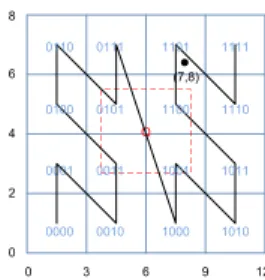
In the multi-dimensional case, we partition the space in a kd-tree style. The key space is partitioned into sub-spaces by differ-ent dimensions iteratively. In thexth partition, we partition each sub-space evenly by thejth dimension, wherej=xmodd. Sup-pose we have2asub-spaces before partitioning. The next iteration
will generate2a+1sub-spaces. The partitioning process terminates
when2mpartitions are created. Then, we assign each partition an
m-length binary string as its ID, recording its partitioning history. The ID can be transformed back to a value in[0,2m−1], namely
the key space of the Cayley graph. Note that in uniform mapping, sub-spaces have equal size. Suppose the Cayley graph key space is
[0,24−1]and the data domains arex= [0,12]andy = [0,8],
respectively. Figure 2 shows how a 2-D space is partitioned. The point[7,8]is transformed into 1101. Linking the partitions with adjacent IDs generates a multi-dimensional Z-Curve.
THEOREM 2. Z-Curve mapping provides a mapping function
that has the properties of d-locality and 1-balance for uniform dis-tributions.
PROOF. Hilbert-curve has been proven to satisfy d-Locality
us-ing the metric properties of discrete space-fillus-ing curve [6]. The same proof technique can be applied for Curve. Although Z-Curve performs a bit worse than Hilbert-Z-Curve, it still preserves the locality property. As we split the space into equal-size parti-tions, we also achieve the 1-balance property for uniform distribu-tion.
3.2.2 Sampling-based Data Mapping
If data distribution is skewed, the uniform mapping function can-not provide a balanced key assignment. Hence, some nodes may need to maintain more index data than the others, which is undesir-able. Consequently, we may need to use a load balancing scheme to shuffle the data dynamically during query processing, which is costly. In our framework, a sampling-based approach is used to address this problem.
Before we map and partition the space, we first collect random samples from the base tables to get a rough estimate of the data distribution. Seshadri and Naughton [17] showed that stratified ran-dom sampling method can guarantee perfect load balancing with-out reducing the accuracy of the estimation. Specifically, the do-main being sampled is partitioned into disjoint subsets and a spec-ified number of samples is taken from each subset.
Based on the retrieved samples, we map the data toSin such a way that each partition inS has approximately the same number of samples. In the one dimensional case, the partitioning strat-egy is equivalent to building an equal-depth histogram. In thek -dimensional case, we apply the kd-tree style partitioning. When partitioning a space, we guarantee that the generated subspaces have the same number of samples.
THEOREM 3. The sampling-based mapping keeps locality and
provideslog2N-balance (N is the total number of cluster nodes), if the samples provide an accurate estimate of the overall data dis-tribution.
PROOF. Since the proof of locality is similar to the uniform case, we do not discuss it. For any two cluster nodes,niandnj,
|Si|
|Sj| < log2N [19]. In our sampling-based mapping approach,
each sub-space has the same number of samples. When we dis-tribute the sub-spaces in the cluster, nodeniwill getksub-spaces,
wherekis proportional to|Si|. Therefore, if the samples provide an
accurate estimation for the data distribution, sampling-based map-ping approach has the property oflog2N-balance.
It is notable that bulk insertion from external data sources into cloud databases is a common operation [18]. For example, in a webshop application, the system needs to bulk insert the daily feed of new items from partner vendors into its operational table. Sam-pling operations are typically done during this bulk insertion pro-cess [18]. Therefore, the statistics such as data domains and data distribution could be estimated quite accurately. Note that these statistics might become obsolete due to many skewed online up-dates after the bulk insertion, and the distribution of the index data among index nodes will become unbalanced as a result. However, when the level of load imbalance reaches a predefined threshold, the system can activate a data migration process to redistribute the index data and update the data mapping function correspondingly.
Moreover, besides the default uniform and sampling-based map-ping functions, the user can define his own mapmap-ping function by extending the interface of the framework. In this interface, the abstract mapping function is defined. The user can overload the function with his customized implementation. When a mapping function is linked with an index, our indexing framework will auto-matically invoke it to transform the data for indexing and querying. Query Mapping.The objective of distributed indexes is to facil-itate fast retrieval of a subset of data without having to scan every data node. The query optimizer of the client applications will de-cide if index scan or full table scan should be employed. For queries that involve a small portion of data that fall within a small range, a simple but efficient mapping solution is sufficient to handle such a query pattern. A range queryQ, in the one dimensional case, is mapped into a single key range, while in the multi-dimensional case, is transformed into multiple key ranges. For example, in Figure 2, the queryQ = {3.5 ≤ x ≤ 8.5,3 ≤ y ≤ 5.5}
is transformed into four key ranges,[0011,0011], [0101,0101],
[1001,1001] and [1100,1100]. To retrieve the index forQ, we
need to search the four key ranges in the Cayley graph.
3.3 Index Functions
In this section, we describe three basic functions provided by the indexing framework for client applications to build the indexes, perform search on the indexes, and update data in the indexes.
3.3.1 Index Building
In our current framework, we have provided the operators for Chord [19], BATON [7] and CAN [16], as those overlays are used to build the common distributed hash, B+-tree-like and R-tree-like
indexes. The Cayley graph manager considers each operator as a class of overlays. In the initialization process of an index for col-umnc, suppose its operator isop, the Cayley graph manager regis-ters the index as an instance ofop. In other words, each operator can have multiple instances, referring to different indexes on the same type of overlays. The Cayley graph manager also keeps the information of table name, column name, value domain and data mapping function, which it broadcasts to all index nodes to initial-ize them.
Following the initialization, the index is created for each incom-ing tuple. Algorithm 2 shows how the index is built for a tuple. First
the overlay instance of the index is obtained from the Cayley graph manager, which is then used to map and publish the data. In line 6, thelookupfunction is an abstraction of the underlying routing al-gorithms, which will be transformed into different implementations of the overlay. In line 7, thegetIndexData(t)function returns the offset of tupletin the underlying DFS or the value of tupletitself (or possibly portions of the tuplet) if the user opts to use covering indexes. Algorithm 2 demonstrates the extensibility of our index-ing framework. It hides all the implementation details, such as how data are mapped and which routing algorithms are used, by provid-ing a highly abstract interface for users.
Algorithm 2Insert(Tuple t, CayleyManager M) 1. forevery columncioft do
2. ifM.isIndexed(ci)then 3. InstanceI=M.getInstance(ci) 4. MappingFunctionF=M.getMappingFunction(ci) 5. Keyk=t.ci 6. Noden=I.lookup(F(k)) 7. IndexDatav= getIndexData(t) 8. publish (k,v) ton
3.3.2 Index Search
Regardless of the underlying overlays, theSearchmethod can be abstracted as outlined in Algorithm 3. The inputs ofSearchare a search key and the index column name. The column name is used to identify the specific index and the corresponding overlay. The query engine first asks the Cayley graph manager to get the overlay instance for the column. Then, it invokes thelookupmethod of the overlay, which will return the index node that is responsible for the search key.
Algorithm 3 Search(Key k, CayleyManager M
Column ci)
1. InstanceI=M.getInstance(ci)
2. MappingFunctionF=M.getMappingFunction(ci)
3. Noden=I.lookup(F(k))
4. Array< IndexV alue > values=n.localSearch()
5. fori= 0tovalues.size-1do
6. getIndexTuple(values[i])
In line 4, after receiving the request, the index node performs a search on its local disk-resident indexes to retrieve the indexed data of the key, denoted as as a set of index values. If the index being used is a covering index, then the returned index values themselves are the tuples in the query result set. Otherwise, the index values are only the pointers to the base records, i.e. the offsets of the records in the underlying DFS. In this case, the system needs to invoke the interfaces of the underlying DFS to perform random accesses based on these offsets.
Range search can be processed in a similar way, except that in line 3, multiple index nodes could be returned. In this case, the query should be processed by these nodes in parallel. We note that this parallelism mechanism is especially useful for process-ing equi-join and range join queries. The joined columns of dif-ferent tables typically share the same data semantics and the index data of these columns are normally partitioned and distributed over the index nodes in the same way. Therefore, these index nodes can process the join queries in parallel. In addition, the support of parallel scans of different indexes also facilitates correlated access across multiple indexes, which is necessary when a query accesses multiple indexed columns. Note that the indexing service only pro-vides basic interfaces for upper layer applications to access the
in-dex data, while the join order between tables is determined by the upper layer query optimizer such as the storage manager of a cloud storage system [3] that includes the indexing service to extend its functionalities.
3.3.3 Index Update
Client applications update the index via the interface of the frame-work. Receiving the update request from clients, the indexing ser-vice realizes this update in two steps. First, the corresponding old index entries of the update are deleted from the system. Then, the update is inserted into the indexes as a new index entry. The per-formance of update operations is studied in Appendix D.3.
It is notable that the enforcement of consistency and ACID prop-erties for index update is based on the requirements of applications. Since there is a trade-off between performance and consistency, the client applications, based on its consistency requirements, will de-termine the policy to perform index updates. The indexes could be updated under strict enforcement of ACID properties or in a less demanding bulk update approach.
In the former approach, the client applications need to reflect all modifications on the base records to the associated indexes before returning acknowledgement messages to users. This approach typ-ically requires the client applications to implement a refresh trans-action in order to bring all associated index data up-to-date with the base data. Since these data are possibly located on different machines, an efficient distributed consensus protocol is more desir-able than the traditional two-phase commit protocol. Paxos-based algorithm has recently been shown as a more efficient alternative approach [15].
In the latter approach, the client applications can backlog the modification on the base records and bulk update these modifica-tions to the associated indexes.In addition, the client applicamodifica-tions can dynamically determine the frequency of index updates in run-time based on the system workload. Specifically, when the client application faces a peak load, i.e., a sudden increase in the input load, it can defer the index bulk update to reserve system resources for handling the user’s request first, and then resume the index bulk update process after the peak load. We note that the problem of guaranteeing ACID properties in the cloud is a broad research issue itself [11] and developing an efficient strategy for the maintenance of the proposed cloud indexing service is part of our future work.
3.4 System Performance and Availability
It is impractical for a user or upper layer application to do per-formance tuning with the existence of multiple types of indexes. Therefore, we identify the factors that may affect the performances for all types of indexes and apply general strategies to improve the global performance of the system.
First, the index process routes queries based on the operators de-fined in the Cayley graph instances; however, it is expensive for each process to maintain active network connections to all other processes. Second, the memory capacity of the index process rela-tive to the application size is limited and all the index entries cannot be cached. To solve these issues, regardless of the index types, our self tuning strategies optimize performance by adaptively creating network connections and effectively buffering local indexes. We describe these techniques in Appendix B.
In addition, the proposed indexing service is designed to meet service level agreements (SLA) such as 24×7 system availability – an important desideratum of cloud services, which requires the system’s ability to handle failures on the index nodes. We describe the replication of index data to ensure correct retrieval of data in the presence of failures in Appendix C.
4. PERFORMANCE EVALUATION
We have run a series of experiments to evaluate the robustness, efficiency and scalability of our proposed indexing framework. First, we study the query performance with two query plans:index cover-ingapproach where the index entries contain a portion of the data records to service the query request directly andindex+base ap-proach where the index entries only contain pointers to the records in the base table.
Second, we compare the performance of distritbuted indexes against parallel full table scans. Third, we study the scalability of the sys-tem in terms of both the syssys-tem size and the number of indexes. In Appendix D, we present additional experimental results on the ef-fect of varying data size, the efef-fect of varying query rate, the update performance, the ability of handling skewed data and query distri-bution, and the performance of equi-join and range join query.
4.1 Experimental Setup
We test the indexing framework in two environments. We ran a set of experiments in an in-house cluster to stress test the system with varying query and update rates. The cluster includes 64 ma-chines with Intel X3430 2.4 GHz processors, 8 GB of memory, 500 GB of disk capacity and gigabit ethernet.
We also conduct experiments on a cluster of commodity ma-chines on Amazon EC2 to test the robustness and scalability of the indexing framework when varying the system size from 16 to 256 nodes. Each index node in our system runs on a small instance of EC2. This instance is a virtual machine with a 1.7 GHz Xeon processor, 1.7 GB memory and 160 GB disk capacity.
We run most of experiments with TPC-W benchmark dataset2.
TPC-W benchmark models the workload of a database application where OLTP queries are common. These queries are relatively sim-ple and selective in nature, and thus building indexes to facilitate query processing is essential, especially in a large scale environ-ment such as the cloud.
We generate 10 million to 160 million records (each record has an average size of 1KB) of itemtable. Thus, the total data size ranges from 10 GB to 160 GB. The data records are stored in the underlying HDFS3 and sorted by their primary key, i.e., the
item id attribute. We build distributed indexes on theitem title
attribute and theitem costattribute by respectively instantiating a distributed hash index and distributed B+-tree-like index based on
the proposed indexing framework. We test the performance of the distributed indexes with two types of queries, namely exact match query with a predicate on theitem titleattribute:
Q1: SELECT item id FROM item WHERE item title =’ξ’ and range query with a predicate on theitem costattribute:
Q2: SELECT item id FROM item
WHERE item cost> αAND item cost< β
By setting the values ofαandβ, we can define the selectivity of the test queries.
In addition, to test the system with a bigger number of indexes, we also synthetically generated data and indexes as follows. There are multiple tablesTiwith schemaTi(a1, a2, a3, a4, p)where each
attributeaitakes integer values that are randomly generated from
the domain of 109 values, and attribute pis a payload of 1 KB
data. Each table is generated with 10 million records. For each tableTi, the attributea1is indexed with a distributed hash index,
a2 is indexed with a distributed B+-tree-like index, and(a3, a4)
is indexed with a distributed multi-dimensional index. Thus, each tableTihas 3 indexes, and we can test the effect of varying number
of indexes in the system by increasing the number of testing tables.
2http://www.tpc.org/tpcw 3http://hadoop.apache.org/hdfs
0 40 80 120 160 200 240 280 320 360 400 1 5 10 20
# Records in Query Result Query Latency (ms)
Index covering Index+base
Figure 3: Index covering vs. index+base 0 10 20 30 40 50 60 70 80 90 100 10 20 40 80 160 Data size (GB) Query Latency (second)
Full table (parallel) scan Using index, s = 0.04% Using index, s = 0.4% Using index, s = 4%
Figure 4: Index plan vs. full table scan 20 40 60 80 100 120 140 160 180 200 16 32 64 128 256 System size Query Latency (ms)
Exact match query Range query, s=0.001% Range query, s=0.002% Range query, s=0.004%
Figure 5: Scalability test on query latency (on EC2)
0 10 20 30 40 50 60 16 32 64 128 256 System size Query Throughput (in x 1000 ops/sec)
Exact match query Range query, s=0.001% Range query, s=0.002% Range query, s=0.004%
Figure 6: Scalability test on query throughput (on EC2) Table 1 summarizes the default experiment configuration. The
default system size for the experiments is 64 index nodes. The memory buffer for the local indexes at each node is set to 64 MB. The system uses the adaptive connection management strategy as the default setting. We test the system with the default 10 client threads at each node. Each client thread continually submits a workload of 100 operations to the system. A completed operation will be immediately followed up by another operation. We also vary the query rate and update rate submitted into the system by changing the number of client threads at each node.
Table 1 Experiment Settings
Parameter Default Min Max
System size 64 16 256
Data size 10 GB 10 GB 160 GB
Buffer size for local indexes 64 MB - -Number of client threads per node 10 5 50
Number of operations per thread 100 -
-Query type Exact match -
-Query plan Index covering -
-4.2 Index covering vs. Index+base Approach
In this experiment, we study the query processing performance using distributed indexes with two alternative query plans, namely
index coveringandindex+base. In the former approach, the index entries include the data of non-key attributes to service the queries directly. For example, if the index entries of the distributed index onitem costcontain theitem idinformation, then the above query Q2 can be processed efficiently with only index traversal. On the contrary, in the latter case, the query processing needs to follow the pointers in the index entries and perform random reads on the base table, which is costly when the base table is stored in the HDFS.
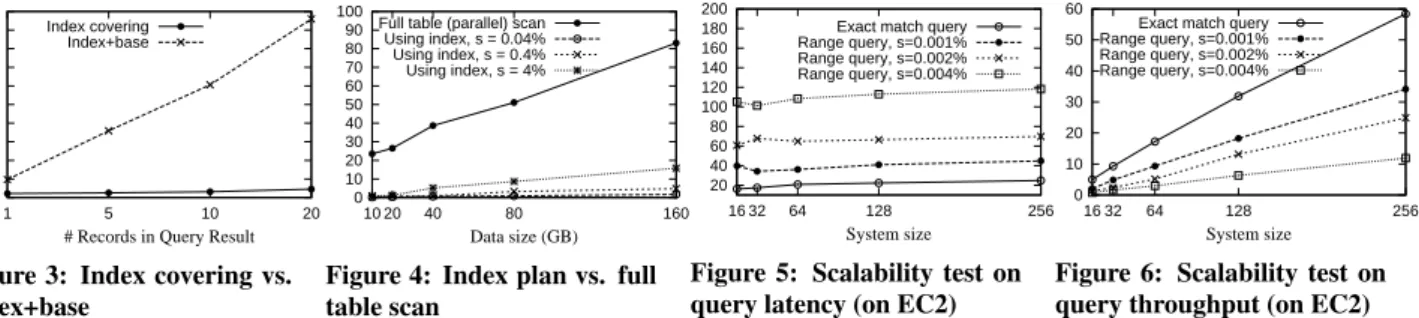
Figure 3 shows that theindex coveringapproach outperforms the
index+baseapproach, especially when the the size of the query re-sult set is large. Note that even though theindex+basehas worse performance in this case, it still performs better than scanning the whole table to retrieve only a few qualified data records. In our experiment, even a parallel scan using MapReduce4on the 10 GB
itemtable takes about 23 seconds (Figure 4), which is significantly slower than theindex+baseapproach. Moreover, it is also notable that the cost of bothindex coveringandindex+baseapproach de-pend only on the size of the query result set, while the cost of full (parallel) table scans increase with the table size.
In the extreme case of theindex coveringapproach, users can opt to include all the data of the original records in the index en-tries to speed up query processing. Although this approach incurs additional storage cost, the query performance using the secondary indexes is improved considerably. Moreover, the additional storage cost is acceptable in the case the sizes of data records are relatively small or we only include a portion of a data record that is needed
4http://hadoop.apache.org/mapreduce/
for common queries. Hence, we mainly test the performance of the system with theindex coveringquery plan in other experiments.
4.3 Index plan vs. full table parallel scan
In this test, we vary the data set size from 10 GB to 160 GB (from 10 million to 160 million records). We compare the performance of the system to process the query Q2 using the distributed B+
-tree-like index with the approach that performs a full parallel scan on theitemtable using MapReduce in a system of 64 cluster nodes.
As shown in Figure 4, when the data set size increases, the query latency of the distributed index approach also increases due to the increasing size of the result set. However, it still performs much better than the full table scan approach, whose query response time increases almost linearly along with the data set size.
The distributed index achieves better performance because it can directly identify the qualified records and retrieve them from the local indexes of the index nodes, while in the other approach the whole table is scanned. The parallel scans with MapReduce still consume a significant execution time when the table size is large. Note that the distributed index also employs parallelism to speed up query processing. When the query selectivity is set to 4% or higher, the data that qualify the query could be stored on multiple index nodes. These index nodes would perform the index scan in parallel and the query latency would not increase with the size of result set any longer.
4.4 Scalability test on EC2
In this experiment, we evaluate the scalability of the proposed in-dexing service in terms of the system size. We vary the system size from 16 to 256 virtual machines on EC2 and measure the latency and throughput of queries with different selectivities.
As can be seen from Figure 5, the system scales well with nearly flat query latency when the system size increases. In our exper-imental setting, the workload submitted to the system is propor-tional to the system size. However, more workload can be handled by adding more index nodes to the system. Therefore, the system response time for a query request with respect to a specific query selectivity is maintained nearly unchanged with different number of index nodes. Figure 5 also shows that a query with lower selectivity incurs higher latency, due to the larger result set, local processing costs, and higher communication cost.
As the number of index nodes increases, the aggregated query throughput also increases as shown Figure 6. In addition, the sys-tem query throughput scales almost linearly when the query has high selectivity, especially for the exact-match query. With a high query selectivity, the result set is small and therefore, the local pro-cessing at each index node and data transfer have less effect on the query throughput. More importantly, the indexing service achieves better throughput when there are more high selectivity queries for its ability of being able to identify the qualified data quickly rather than scanning multiple data nodes.
4.5 Multiple Indexes of Different Types
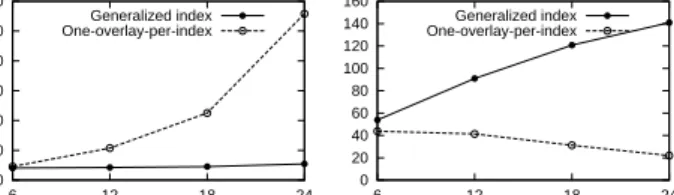
In this test, we experiment with 8 tables, each of which has 3 distributed indexes of the 3 different index types as described in the experimental setup. The workload, i.e., the number of client threads, submitted to the system is increased with the number of indexes in the system (1 client thread for each index). We expect more indexes in the system to be able to handle a bigger workload from the users. Figure 7 and Figure 8 plot the effect of varying the number of indexes on the query latency and system throughput respectively. 0 20 40 60 80 100 120 6 12 18 24 Number of indexes Mixed Query Latency (ms)
Generalized index One-overlay-per-index
Figure 7: Query latency with multiple indexes 0 20 40 60 80 100 120 140 160 6 12 18 24 Number of indexes Mixed Query Throughput (in x1000 ops/sec)
Generalized index One-overlay-per-index
Figure 8: Query throughput with multiple indexes The results confirm the superiority of ourgeneralized indexover theone-overlay-per-indexapproach that runs one overlay for a spe-cific index, i.e., 24 overlays totally for 24 indexes in this test. The
generalized indexcan guarantee a constant query latency and its query throughput increase steadily with the number of indexes that it instantiates. This is due to the fact that with more indexes, there will be more index traversal paths that can be used to answer the queries. In addition, the query execution load is better shared among the index nodes in the cluster.
While thegeneralized indexapproach only runs one index pro-cess to maintain multiple indexes and self-tunes the performance among these indexes via sharing resources such as memory and net-work connections, theone-overlay-per-indexapproach runs multi-ple processes, each for a specific overlay. When there are more in-dexes, the more processes need to be launched, which considerably adds overhead to the virtual machine and affects the query latency and throughput. Therefore, our approach provides the much needed scalability for supporting multiple indexes of different types in the cloud.
5. CONCLUSION
This paper presents an extensible indexing framework to support DBMS-like indexes in the cloud. The framework supports a set of indexes using P2P overlays and provides a high level abstraction for the definition of new indexes. The most distinguishing feature of our scheme is the ability to support multiple types of distributed indexes, such as hash, B+-tree-like and multi-dimensional index,
in the same framework, which significantly reduces the mainte-nance cost and provides the much needed scalability. To achieve this goal, we define two mapping functions to transform different indexes into the Cayley graph instances. We exploit the character-istics of Cayley graph to reduce the index creation and maintenance cost, and embed some self tuning capability. Finally, we evaluate our indexing scheme in an in-house cluster and Amazon EC2 with extensive experiments, which verify its efficiency and scalability.
Acknowledgment
The work in this paper was in part supported by the Singapore Min-istry of Education Grant No. R-252-000-394-112 under the project name of Utab. We would also like to thank the anonymous review-ers and the shepherd for their insightful comments.
6. REFERENCES
[1] P. Agrawal, A. Silberstein, B. F. Cooper, U. Srivastava, andR. Ramakrishnan. Asynchronous view maintenance for vlsd databases. InSIGMOD, pages 179–192, 2009.
[2] M. K. Aguilera, W. Golab, and M. A. Shah. A practical scalable distributed b-tree.PVLDB, 1(1):598–609, 2008. [3] Y. Cao, C. Chen, F. Guo, D. Jiang, Y. Lin, B. C. Ooi, H. T.
Vo, S. Wu, and Q. Xu. Es2: A cloud data storage system for supporting both oltp and olap. InICDE, 2011.
[4] M. Datar, N. Immorlica, P. Indyk, and V. S. Mirrokni. Locality-sensitive hashing scheme based on p-stable distributions. InSCG, pages 253–262, 2004.
[5] G. DeCandia, D. Hastorun, M. Jampani, G. Kakulapati, A. Lakshman, A. Pilchin, S. Sivasubramanian, P. Vosshall, and W. Vogels. Dynamo: amazon’s highly available key-value store.SIGOPS Oper. Syst. Rev., 2007.
[6] C. Gotsman and M. Lindenbaum. On the metric properties of discrete space-filling curves.IEEE Transactions on Image Processing, 5(5):794–797, 1996.
[7] H. V. Jagadish, B. C. Ooi, and Q. H. Vu. Baton: a balanced tree structure for peer-to-peer networks. InVLDB, 2005. [8] A. Lakshman and P. Malik. Cassandra: structured storage
system on a p2p network. InPODC, pages 5–5, 2009. [9] J. K. Lawder and P. J. H. King. Using space-filling curves for
multi-dimensional indexing. InBNCOD, pages 20–35, 2000. [10] P. L. Lehman and S. B. Yao. Efficient locking for concurrent
operations on b-trees.ACM Trans. Database Syst., 1981. [11] J. J. Levandoski, D. B. Lomet, M. F. Mokbel, and K. Zhao.
Deuteronomy: Transaction support for cloud data. InCIDR, pages 123–133, 2011.
[12] M. Lupu, B. C. Ooi, and Y. C. Tay. Paths to stardom: calibrating the potential of a peer-based data management system. InSIGMOD, pages 265–278, 2008.
[13] W. S. Ng, B. C. Ooi, K.-L. Tan, and A. Zhou. Peerdb: A p2p-based system for distributed data sharing. InICDE, pages 633–644, 2003.
[14] C. Qu, W. Nejdl, and M. Kriesell. Cayley dhts - a group-theoretic framework for analyzing dhts based on cayley graphs. InISPA, pages 914–925, 2004.
[15] J. Rao, E. J. Shekita, and S. Tata. Using paxos to build a scalable, consistent, and highly available datastore.PVLDB, 4(4):243–254, 2011.
[16] S. Ratnasamy, P. Francis, M. Handley, R. Karp, and S. Shenker. A scalable content-addressable network. In
SIGCOMM, pages 161–172, 2001.
[17] S. Seshadri and J. F. Naughton. Sampling issues in parallel database systems. InEDBT, pages 328–343, 1992. [18] A. Silberstein, B. F. Cooper, U. Srivastava, E. Vee,
R. Yerneni, and R. Ramakrishnan. Efficient bulk insertion into a distributed ordered table. InSIGMOD, 2008. [19] I. Stoica, R. Morris, D. Liben-Nowell, D. R. Karger, M. F.
Kaashoek, F. Dabek, and H. Balakrishnan. Chord: a scalable peer-to-peer lookup protocol for internet applications.
IEEE/ACM Trans. Netw., 11(1):17–32, 2003. [20] H. T. Vo, C. Chen, and B. C. Ooi. Towards elastic
transactional cloud storage with range query support.
PVLDB, 3(1):506–517, 2010.
[21] J. Wang, S. Wu, H. Gao, J. Li, and B. C. Ooi. Indexing multi-dimensional data in a cloud system. InSIGMOD, 2010. [22] S. Wu, D. Jiang, B. C. Ooi, and K.-L. Wu. Efficient b-tree
based indexing for cloud data processing.PVLDB, 3(1):1207–1218, 2010.
APPENDIX
A. OVERLAY MAPPING
We had demonstrated how Chord [19] can be mapped to a Cayley graph in Section 3.1. Here we discuss the mapping of BATON [7] and CAN [16].
1. BATON
To support BATON overlay,xLyis defined as(x+y)%2m
as well since BATON can be transformed to Chord by adding a virtual node. In our case, the key space is[0,2m−1]and thus the
maximal level of BATON tree ism. Given a BATON nodeniat
levell, suppose its ID at levellisx,nican be transformed into a
node in Chord by using the following function:
θ(l, x) = 2m−l(2x−1)
The routing neighbors of BATON are similar to those of Chord except for the parent-child and adjacent links. Ifniis a left child
of its parent, then the links to its parent node, right child and right adjacent node can be emulated byI(ni) + 2k. Since BATON has
a tree topology,ni’s left adjacent link and left child link cannot be
emulated by Chord’s routing fingers, and therefore we define new generators (2m−2x,xis an integer) to handle the links. However,
to keep the framework generic, we choose to use the old generator set, namely{2k|0≤k≤m−1}. Even without half adjacent/child
links, we note that the queries can still be routed to the destination node using a similar routing scheme as in Algorithm 1.
2. CAN
CAN partitions multi-dimensional space into zones such that each zone is managed by a node. The kd-tree space partitioning provides a good basis for multi-dimensional data indexing. Com-pared to other overlays, supporting CAN is more challenging, as we need to establish a mapping between CAN’s identifiers (multi-dimensional vector) and Cayley graph’s key space (1-(multi-dimensional value). There are many works on dimensionality reduction, such as Space Filling Curve [9].The basic idea is to partition the search space by each dimension iteratively, and assign a binary ID to each sub-space, which is mapped to the Cayley graph based on its ID. Similarly, a multi-dimensional query is transformed into a set of sub-spaces, which are denoted by their IDs as well.
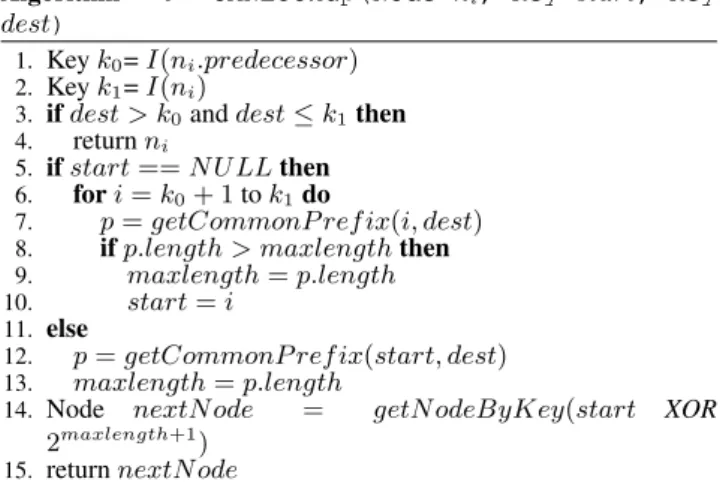
In CAN, we definexLyasx XOR y. The basic routing algo-rithm is shown in Algoalgo-rithm 4. We first get the key space of current node (lines 1 and 2). If the search keydestis covered by current node, the lookup process can stop by returning current node (lines 3 and 4). Otherwise, we handle the lookup as in the following two cases. First, if this is the first node receiving the search request, the initial keystartis empty. We iterate all keys in the node’s key space to find the one, which has the longest common prefix with the search keydest. That key will be used as the initial key
start(lines 5-10). Second, if the node is not the first node in the search route, the initial keystarthas already been decided by the last node in the route (lines 12 and 13). In either case, we attempt to reduce the difference betweendestandstartby routing to a property neighbor (lines 14 and 15).
B. PERFORMANCE SELF TUNING
In Section 3.4 we identified the factors that influence the perfor-mance of the proposed framework. Here we discuss our solutions to these issues.
B.1 Index Buffering Strategy
Each index process maintains the index data for different Cayley
Algorithm 4 CANLookup(Node ni, Key start, Key
dest)
1. Keyk0=I(ni.predecessor)
2. Keyk1=I(ni)
3. ifdest > k0anddest≤k1then
4. returnni
5. ifstart==N U LLthen
6. fori=k0+ 1tok1do
7. p=getCommonP ref ix(i, dest)
8. ifp.length > maxlengththen
9. maxlength=p.length
10. start=i
11. else
12. p=getCommonP ref ix(start, dest)
13. maxlength=p.length
14. Node nextN ode = getN odeByKey(start XOR
2maxlength+1)
15. returnnextN ode
graph instances. To support efficient retrieval of index data, given a Cayley graph instanceg, its index data, denoted asI(g), are stored in a local disk-resident index structure of the index nodes. Based on the type ofg, different index structures are built forI(g). For example, ifgis a Chord [19] overlay, then a hash index is created. Otherwise, ifgis an instance of CAN [16], we create an R-tree index forI(g). Similarly, a B+-tree index is created if gis an
instance of BATON [7].
Figure 9 shows how the local indexes are maintained. In this example, each index node is responsible for maintaining the index data for three Cayley graph instances. We use the instance ID (IID) to identify a specific instance in the Cayley graph manager.
Cayley graph overlay
Index node
Index node Index node
Index node
Table Indexed columns IID Local index
user postcode 0 Hash user age, salary 2 R-tree item price 1 B-tree
... ... ... ...
Figure 9: Local Indexes
To improve the performance of the local disk-resident indexes of each index node, we buffer some index entries, i.e., the nodes of B+-tree and R-tree, or buckets of hash index, in memory. However,
the available memory of the virtual machines hosting the indexing service relative to the application size is limited. Therefore, each index process establishes a buffer manager to manage the buffer dynamically.
LetIdx = {e1, e2, ..., em} be all index entries on the disk,
whereeirepresents a node of B+-tree and R-tree, or a bucket of
hash index. We define two functions to measure the importance of an index entry. f(ei)returns the number of queries involving
eiin lastT seconds andg(ei)is the size ofei. SupposeM bytes
are used to buffer the local indexes, we define a buffering vector
v= (v1, v2, ..., vm). Wheneiis buffered in memory,viis set to 1.
Otherwise,viequals to 0. The buffer manager tries to find a buffer
vector that maximizes
m X i=1 vif(ei) and satisfies m X i=1 vig(ei)≤M
This is a typical knapsack problem. We solve it using a greedy algorithm. After everyT seconds, we periodically run the above algorithm to select the index entries for buffering. The old entries are replaced by new ones to catch the query patterns.
B.2 Adaptive Network Connection
In our framework, the index process routes queries based on the operators defined in the Cayley graph instances. The approach to maintaining a complete connection graph is not scalable since each index process can only maintain a limited number of open connec-tions. Therefore, in our system a connection manager is developed to manage the connections adaptively. It attempts to minimize the routing latency by selectively maintaining the connections. The connection manager classifies the connections asessential connec-tionsandenhanced connections. An essential connection is an ac-tive network connection established between two index processes
(Ip, Ip0)whereIp0is a routing neighbor ofIpby the definition of any
Cayley graph instance in the Cayley graph manager. An enhanced connections is established at runtime between two frequently com-municating processes.
By maintaining essential connections, we keep the overlay struc-tures defined by Cayley graph instances. SupposeKtypes of in-dexes are defined in the framework for a cluster ofNnodes, each node will maintain at mostKlog2N essential connections, with
log2N connections for each type. That is, even if we have
thou-sands of indexes defined for the tables using theseKtypes of in-dexes, we will need onlyKlog2Nessential connections. Queries
can then be routed based on the overlay routing protocols with the essential connections.
Enhanced connections can be considered as shortcuts for essen-tial connections. When routing a message, the index process first performs a local routing simulation using the Cayley graph infor-mation. Then, it checks the enhanced connections for shortcuts. If no shortcut exists, it follows the normal routing protocols and forwards the message via an essential connection. Otherwise, it sends the message via the available enhanced connections, which is adaptively created during query processing as follows.
To route a query, the connection manager performs a local rout-ing simulation based on the Cayley graph information, and get a pathP which is a set of essential connections. We generate en-hanced connections by replacing the chain of essential connec-tions inP by a shortcut connection. Specifically, connectionc = (Ip, Ip0)is a candidate enhanced connection forPif there exists a
shortcut pathP0ofP, satisfying thatP0’s starting node isI pand
its ending node isI0 p.
The connection manager keeps a counter for each candidate con-nection, recording the number of appearances of the connection during query processing. After everyT seconds, the connection manager discards current enhanced connections and adds the top frequently used connections into the set of enhanced connections. The counters are then reset to 0 and a new tuning iteration starts.
C. FAILURES AND REPLICATION
While there could be fewer failures in a cloud environment rela-tive to the churn experienced in a P2P system, machine failures in large clusters are more common. Therefore, our indexing service employs replication of index data to ensure the correct retrieval of data in the presence of failures. Specifically, we use the two-tier partial replication strategy to provide both data availability and load balancing, as proposed in our recent study [20]. The first tier of replication, which consists of totallyKcopies of the index data, is designed to guarantee the data reliability requirement (Kis com-monly set to 3 in distributed systems with commodity servers [5, 15]). At the second tier, additional replicas of frequently accessed data are adaptively created in runtime based on the query work-load as a way to distribute the query work-load on the “hot” queried data across their replicas.
Given a Cayley graph instanceg, its index data, denoted asI(g), are partitioned and distributed on multiple index nodes. The index data on an index node (master replica) are replicated to the succes-sors (slave replicas) of that index node. Note that the successucces-sors of an index node regarding to a specific index are determined by the type ofg(e.g. Chord [19], BATON [7], CAN [16]), or more specif-ically, the operator of the Cayley graph (cf. Section 3.1). When the master replica fails, we apply the Cayley graph operator to locate its successors and retrieve the index data from one of these replicas. Hence, the query processing of our indexing service is resilient to the failures of index nodes.
Paxos-based replication algorithm [15] has been shown to be fea-sible to maintain strict consistency of replicas. However, the trade-off is the complexity of the system and the performance of write op-erations. When the relaxed consistency is acceptable for client ap-plications, the replicas can be maintained asynchronously instead. The master replica is always updated immediately, while the update propagation to slave replicas can be deferred until the index node has spare network bandwidth and its peak load has passed.
To avoid the “lost updates” problem, i.e., the master replica crashes while the update has not been propagated to other slave replicas, the system performs write-ahead logging before updating the master replica. Hence, in our indexing service, the updates to the master replica of the index data are durable and eventually propagated to the slave replicas. Note that if the master replica fails during the processing of an update, its immediate successor will be promoted to take over the mastership. Therefore, when an index node recov-ers from a failure, it can retrieve back all latest updates from the slave replica that previously has been promoted to the mastership. We studied the complete method for system recovery from various types of node failures in [20].
D. ADDITIONAL EXPERIMENTS
In this section, we present additional five sets of experimental results: 1) the effect of varying data size 2) the effect of varying query rate 3) the performance of update operations 4) the ability of handling skewed data and query distribution and 5) the perfor-mance of equi-join and range join query. The default experimental configuration is the same as described in Section 4.1.
D.1 Effect of Varying Data Size
In this experiment, we perform the scalability test on data size and study the query performance in the system. Specifically, we measure the latency of exact-match queries on theitem title at-tribute, a non-key attribute of theitemtable. By instantiating a distributed hash index on this attribute based on the proposed in-dexing framework, the system can support queries on this attribute efficiently without the need of full table scan. As shown in Figure