Farm management extension guide
FARM BUSINESS ANALYSIS
using benchmarking
by
David Kahan
FOOD AND AGRICULTURE ORGANIZATION OF THE UNITED NATIONS Rome 2010
The views expressed in this information product are those of the author(s) and do not necessarily reflect the views or policies of FAO.
ISBN 978-92-5-107545-6 (print) E-ISBN 978-92-5-107546-3 (PDF) © FAO 2013
FAO encourages the use, reproduction and dissemination of material in this information product. Except where otherwise indicated, material may be copied, downloaded and printed for private study, research and teaching purposes, or for use in non-commercial products or services, provided that appropriate acknowledgement of FAO as the source and copyright holder is given and that FAO’s endorsement of users’ views, products or services is not implied in any way. All requests for translation and adaptation rights, and for resale and other commercial use rights should be made via www.fao.org/contact-us/licence-request or addressed to [email protected].
FAO information products are available on the FAO website (www.fao.org/ publications) and can be purchased through [email protected].
iii
Preface
Farming for profit calls for a different approach to farming. Farmers are not only concerned with the day to day tasks involved in making a living but they increasingly plan for the future in an effort to make money. For business minded farmers profit is viewed as the goal; the goal that ensures survival of the business. The performance of the farm can best be explained by better understanding the farm business, identifying the goals set by the farmer and examining the factors that affect them.
Performance is concerned not only with the ‘bottom line’ of making money but also technical aspects of farming that contribute to making the farm business profitable and efficient. Improving the performance of the farm business requires a good understanding of both the business and technical aspects of farming. ‘Benchmarking’ is a concept that is used to analyse and better understand the farm as a business. To do this benchmarking is conducted in a way similar to a doctor diagnosing the condition of a patient. Diagnosing performance means understanding business concepts such as profitability and efficiency, identifying the problems that prevent the farm from achieving its potential and formulating strategies and actions to improve its business performance.
How do you, as an extension worker, assist farmers in finding ways of making improvements to the farm business? How do you as an extension worker help farmers improve profitability and performance?
The author would like to acknowledge the assistance of colleagues and friends. Thanks are due to Doyle Baker and Steve Worth for their review of the guide, Martin Hilmi for his contributions and reviews, Tom Laughlin, who managed the post-production process and Michael Breece, for the design and final layout of the publication.
David Kahan Senior Officer,
Agricultural Innovation and Extension
v
Contents
Preface ... iii
Acknowledgements ...iv
Attention extension workers ...vi
Part 1 INTRODUCTION TO BENCHMARKING Chapter 1: Benchmarking in farm business analysis ... 3
Chapter 2: Steps involved in benchmarking ... 19
Chapter 3: Benchmarking in extension ... 27
Part 2 STEP-BY-STEP FIELD GUIDE Organization Step 1: Organize benchmark learning groups ... 42
Identification Step 2: Identify problems to be examined ... 48
Step 3: Identify performance indicators ... 52
Step 4: Identify benchmark farms ... 72
Data collection Step 5: Collect comparable data and information ... 77
Comparison Step 6: Compare performance ... 93
Analysis Step 7: Interpret differences ... 99
Sharing Step 8: Share findings and results ... 113
Plan for change Step 9: Devise plans and implement changes ... 119
Monitor and evaluate Step 10: Reflect and evaluate results ... 125
Annex: Business concepts for benchmarking ... 129
Glossary ... 137
The methods recommended in this guide require familiarity with basic farm management economics as covered in Farm Management Extension Guide 2. The guide is expected to be used by extension workers with university level training and at least an introductory training in farm management economics. In countries where extension workers do not have this background, the more likely user of the guide would be farm management specialists. The role of farm management specialists is broad and their responsibilities are covered in Farm Management Extension Guide 4.
While benchmarking is useful for all types of small-scale farmers, family farmers that produce mainly for household consumption as well as market-oriented farmers, its practical use in farm business analysis will be more appreciated among commercially minded farmers that wish to improve their profitability and competitiveness.
While the guide draws on known farm management methods and experiences, the recommendations on approaches and activities for benchmarking are new and mostly untested. This guide is therefore being made available to stimulate innovation and adaptation.
Benchmarking may at first seem somewhat complex, but when the procedure is carefully explained and given an operational structure to follow, the process becomes much easier. This guide sets out to do just that. How the guide has been structured and what the reader can expect to find is briefly described below.
vii
Part 1: Introduction to benchmarking and overview.
This part begins with a discussion on benchmarking and how it is applied (informally, formally, internally, externally) followed by an introduction to the key concepts needed to analyse and measure farm and enterprise performance (profit, profitability, efficiency). A brief overview of a ten-step process to conduct a benchmarking exercise is also given. This part ends with a section on benchmarking and its application in extension work.
Part 2: Step-by-step field guide. This part has been
structured to provide detailed guidance for extension workers on how to undertake a benchmarking exercise: A ten-step process is described. Readers are urged to study the sequence from beginning to end until the process is clearly understood. Benchmarking procedures and data collection are discussed including some things ‘to do’ and some things ‘not to do’ in the field.
Each of the ten steps includes ‘Tips’ and ‘Questions to initiate discussion’ when conducting an exercise. This is to help and support you in the practical application of benchmarking.
Undoubtedly, during the course of reading, you will develop ideas of your own on how you plan to conduct your field exercises. These should be listed. Space has been provided for notes and observations. The material that has been covered here, together with your list of ideas, is intended to be used as a field guide. Remember, the best way to learn how to benchmark is by practice.
P a r t 1
Chapter 1
OVERVIEW OF THE MAIN CONCEPTS
Benchmarking
The process used to identify, learn from
and adapt better practices from other farmers
to help improve farm performance.
Profit
The difference between money that comes in
from the sales of a product
and the money that goes out to produce it.
Profit is used to measure the success
of the farm business and is vital
for its survival and growth.
Profitability
A measure of performance that shows how
well the resources available to the farmer
are used to generate income and profit.
Efficiency
Efficiency is the careful use
of the resources available to the farmer.
Efficiency can be either technical
(producing the highest possible output
from a given set of inputs)
or economic (the financial returns
from resources used).
Benchmarking
can lead to
increased
profit ...
... and
profitability ...
... and
to improved
efficiency
in the
farm business
Benchmarking in farm business analysis 5
BENCHMARKING What is benchmarking?
The term ‘benchmarking’ is used to cover a number of practices found in farming that are designed to highlight the good and make it possible to avoid the harmful. Benchmarking ,in business practice, is used to signify a particular systematic approach in which a business evaluates its own operations and procedures through a detailed comparison with those of another business, in order to establish best practices and improve performance.
When using benchmarking in farming, it involves gathering data about the best performing farms and comparing them with other farms. Benchmarking can show how higher levels of performance can be achieved. Many insights can be gained through a benchmarking exercise. It can uncover problems of production, management practices and other factors that affect productivity, cost of production and profitability. These insights and discoveries can be used to improve farm performance.
The process starts by identifying farms and farmers that are performing well and are successful at what they do. It requires a thorough understanding of their farming practices in order to identify strengths and weaknesses and steps needed to improve performance. The performance of these ‘benchmark’ farms are set as a standard for farmers to compare themselves against.
Benchmarking is a process of identifying,
learning from and adapting good practices
and processes to help improve performance
... but remember, benchmarking requires
comparing like with like.
There are two
main parts in
benchmarking ...
... collecting data
from farms and
comparing this data
against a
benchmark farm ...
... to make
meaningful
comparisons,
it is necessary
to collect
similar data
market. Why is this so? A farmer hears of another farmer who reduces costs by introducing a new technology.
Should she or he do the same? By observing and talking
to successful farmers, others can learn how to improve the performance of their farms. Informal benchmarking can result from something as straightforward as a walk around someone else’s farm. Farm visits are considered an important part of benchmarking and will be discussed later.
Formal benchmarking
However, for best results farmers will need to learn how to benchmark through a more systematic approach. Formal benchmarking takes farmers through the following steps: • examine their own farms and look for areas for
improvement;
• identify a similar farm that is performing better; • study that farm in detail and try to find out what it is
that the farmer does better;
• compare the performance of the two farms and understand the reasons for differences;
• plan and introduce changes to their farms based on what they have learned.
Formal benchmarking provides a standard for comparison. It can be applied to:
• compare the performance of any farm with a more successful farm;
• compare the past performance of a farm; • compare a farm plan with the actual outcome; • compare production levels to check if the farm is
technically efficient;
• compare production costs to check if the farm is economically efficient;
• examine the production and marketing processes to determine if they are sound;
Informal
benchmarking
can help improve
performance ...
... however, to be
efficient farmers
need to approach
the process in a
more structured,
formal manner
Benchmarking in farm business analysis 7 • learn from the experience of other farmers and
generate new ideas.
Benchmarking can be internal to the farm business or external by comparing one farm with another
Internal benchmarking
Internal benchmarking takes place when the performance of the farm business is compared with itself. This is an internal assessment of past results to determine ways to improve. Over time the farm business is analysed, performance is measured, weaknesses and opportunities are identified, and on this basis improvements can be made. Good farm records are of great help with this. Results of internal benchmarking can often be quite quick. The challenge is to know what farmers can do to improve performance once these lessons have been learned. The solution for farmers, however, often lies beyond the farm boundaries. This leads to external benchmarking.
External benchmarking
External benchmarking involves comparing the performance of a farm business with the performance of other farms that have similar farm enterprises. The benchmark may be a competing farmer or simply a successful one who is ready to share his or her good farm management practices with other farmers in the vicinity. Either way, the benchmark farm serves as a demonstration of how things should be done. It can be studied, learned from and copied. (Depending on the farm enterprises and operations that are being examined, there could even be a number of benchmark farms selected for comparison.)
When should benchmarking be conducted?
Benchmarking can be conducted at all times and
at all stages of the farm decision-making cycle,
from diagnosis and planning to implementation.
Comparative analysis
In developed countries, benchmarking has taken the form of detailed studies of the performance of farms located in the same area. Farms are usually clustered around similarity of the farming system and technology base. Benchmarks are identified by averaging data collected on farm performance from surveys of large groups of farms. The data collected is usually averaged out and standardised data is used for comparison. Sets of data are often calculated for different sub-groups of farms. Benchmarks on farm and enterprise profitability are commonly calculated. High profit benchmarks can be derived by selecting the farms in a group that are most profitable. Similarly other farms can be categorised as “weak” and average” performing.
There are many developing countries that have also institutionalised the tradition of collecting farm management data for comparative analysis. Annual or six-monthly reports are often prepared on a regular basis. The performance measures derived from the data are used at local levels in farm advisory work and at national levels to inform agricultural policy. This form of benchmarking is complex and requires the use of spreadsheets to analyse detailed financial and physical data. Within the farm management discipline this has traditionally been called comparative analysis.
Benchmarking in farm business analysis 9
Using ‘benchmarking’ as a tool for improved farm production and income
A small-scale farmer has a two hectare farm. She grows beans, cassava and millet. Half of her crop is sold at market and the rest is used by her family. She would like to do better and increase her yields and income. It seems that there are a few farmers in her area who do very well. They grow similar crops, produce more food and have higher incomes. She wants to understand how they do it. She contacts the local extension worker for advice.
The local extension worker suggests that together they visit a ‘better’ performing farm to gather information on methods of production, management and marketing practices. With this information they can identify ‘good practices’ as benchmarks for comparison. Using these as a guide she discovers new production practices and begins to experiment with small-scale drip irrigation, the better use of fertilizer and better harvesting practices.
She also knows that she should be making more money at the market. She learned from the ‘successful’ farmer that keeping an eye on the market and understanding market price information better is important. She collects market price data and finds that her main crop is harvested when prices are usually low. She knows from this exercise that the successful farmer either planted early or late in the season in order to avert low prices at harvest time. She learns to take more care about when to plant her crops.
After following these practices
our farmer finds herself with an
increase in production and surpluses
to sell in the market at better prices.
This she understands will improve
the livelihood of her family.
Women in Sierra Leone discussing farm enterprise alternatives
A farmer in South Africa diversifying her enterprises by introducing tomatoes
Improved handling and marketing of horticultural produce in Thailand
© F AO/J Thompson/24306 © F AO/J Spaull/21640 © F AO/J V an Acker/8205
‘Benchmarking’
can be used at
all stages in the
production cycle ...
... from planning,
to planting and
11 Benchmarking in farm business analysis
Farmers discussing and comparing benchmarking data – El Salvador Filling out a data sheet on market prices for record-keeping – Zambia Learning group discussing suitable formats for record-keeping – Sierra Leone
© F AO/21489/G Bizzarri © F AO/151 10/L Callerholm © F AO/17816/A Conti
It’s a good thing
to keep detailed
records of farm
activities ...
... it will make
benchmarking
much easier!
FARM BUSINESS ANALYSIS
To use benchmarking effectively, extension workers need to understand and apply the concepts of profitability, technical efficiency and economic efficiency as they relate to the farm business. Further, the relationships between inputs, costs, outputs and income also need to be clearly understood. The key concepts of profit and efficiency are explained below. For more detailed understanding the reader should refer to the Annex on Business Concepts for Benchmarking.
Profit
Profit is the difference between the money that comes in to the farm business from the sales of a product and the money that goes out to produce it. The money coming in is expressed as the total value of production. The money spent is expressed as costs.
Profit shows whether it is worthwhile engaging or remaining in the business. A number of reasons follow. Profit is necessary to keep the farm business going. If inadequate profits are generated the farmer will have to sell equipment, farm implements and other assets in order to find the money to cover everyday costs. If the situation carries on for too long the farmer may end up selling the farm. The farmer would then be out of business.
Profit is necessary for growth of the farm business. A farm business needs money in order to develop and grow. Profit generates this money. The money accumulated from profits can be used to buy new machinery, equipment and implements. It can also be used to rent or buy additional land. In this way, the farm business can grow and expand.
Profit is necessary
to ensure the
survival and
growth of the
farm business
Benchmarking in farm business analysis 13
Profit is used to measure the success of the farm as a business. Profit can be used as an indicator showing the success of the business. The more profit the farmer makes the more successful the business is and the more likely it is to survive.
Profit is a reward. Farmers and their families put in their time and effort to work on the farm to earn ‘benefits’. In most cases, the family members are not paid a salary like other workers. Profit represents their ‘wages’. It can also be understood as a reward for their energy, time and effort in managing and working the farm. Profit can be seen as a return for the time and capital invested.
Profit provides money for the farm family. Profit provides the money farmers and their families need to buy additional goods and services and to pay for education and health care. The greater the profit, the more farmers can provide for their families.
Profit is a wage, profit is a reward for effort, and profit is a return on investment.
Profitability
Profitability measures how well the farm business uses the resources available to generate income and profit. Profit and profitability are not the same. As mentioned before profit is the amount of money earned after total costs are deducted.
Two farmers may show the same profits but may not be equally profitable. This could be a result of the way farmers use their resources. In order to compare these farms, we need to see exactly how the farmers make use of their resources to generate profits. As an example, if a farmer makes a profit of $1 000 we do not know if this level is high or low. Could the farmer have earned more by using the resources differently?
Using profitability as a basis for comparison instead of profit means that one can compare like with like. A farm of 2 hectares can be compared with a farm of 20 hectares.
Profit is a wage,
profit is a reward
for effort, and
profit is a return
on investment
Profitability is
a measure that
attempts to answer
the question
“Are we making
enough money for
These farmers in Senegal used their profits to invest in a new cucumber enterprise
Profits can mean farm families in Bangladesh have more and different foods to eat
Profits mean that farmers in Sudan can send their children to school
© F AO/20887 © F AO/22882/G Diana © F AO/13210/F Mc Dougall
Profits
are very
important
for the
farm family
Benchmarking in farm business analysis 15
It may well be that while the farm of 2 hectares makes less profit than the farm with 20 hectares; the small-scale farm may be more profitable.
To compare profitability and performance, a farmer can use common measures such a gross margin, enterprise profit and farm profit *.
Efficiency
Efficiency is the careful use of the resources available to the farmer. While the farm business may generate profits and be profitable, an important question to ask is whether or not the farm business is efficient. A farm that is efficiently run is more likely to be profitable than a farm that is not. There are two forms of efficiency ...technical and economic
Technical efficiency: There is usually more than one way to grow a crop or raise livestock. It is possible to produce farm products by farming a small quantity of land very intensively, combining a lot of labour and capital. It is also possible to produce the same product by farming the same land area extensively, with only small amounts of labour and capital. Technical efficiency is producing farm products with the best combination of resources or inputs. Technical efficiency measures the farmer’s skill and success in producing the highest possible level of output from a fixed amount of inputs. It can be calculated by estimating crop and livestock yields, and the use of inputs such as fertilizer and labour. Technical efficiency is measured as yield per unit of a specific input as, for example, kilograms of fertilizer or seed.
Economic efficiency: Economic efficiency measures the financial returns on resources used. Economic efficiency looks at the cost of using resources to produce a given level of output. The most economically efficient method of production is the one that costs the least. It should be mentioned that methods that are technically efficient may not be economically efficient.
Technical
efficiency
occurs when the
maximum amount
is provided given
Is this method of fertilizing a crop in Burkina Faso technically efficient?
Or is this method more technically efficient in the use of fertilizer?
Is this method of watering small vegetables in Mozambique technically efficient?
© F AO/1 1852/C Errath © F AO/22285/A Proto © F AO/14519/D Debert
Technical
efficiency
is producing
farm products
with the best
combination
of resources
Benchmarking in farm business analysis 17
Is this small plot of intercropping in Ecuador economically efficient?
Or is this larger plot of intercropping in Ghana more economically efficient?
Is using a motor tiller economically efficient for planting rice?
© F AO/18309/P Cenini © F AO/22842/G Diana © F AO/23030/K Iversen
Economic
efficiency
measures the
financial
returns on
resources used
To use benchmarking effectively,
farmers need to understand
and apply the concepts of profitability,
technical efficiency and economic efficiency
as they relate to the farm business.
Further, the relationships between
inputs, costs, outputs and income
also need to be clearly understood.
Chapter 2
MONITOR AND EVALUATE PLAN FOR CHANGE
SHARING ORGANIZATION IDENTIFICATION DATA COLLECTION COMPARISON ANALYSIS
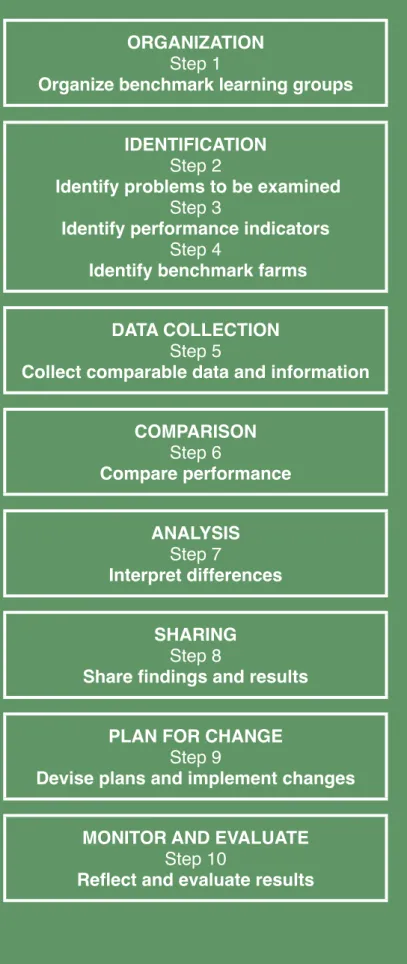
in Figure 1. Figure 2 presents the ten step process in
more detail. In most cases this exercise is conducted
by extension workers and farmers together. The
objective is to compare the profitability of the farms
selected for study in order to improve their farm
business performance and profitability. The information
gained can be shared with other farmers which, in itself,
can add to the learning process. It may also lead to new
business opportunities. The benchmarking process
can be continuous, with farmers constantly checking
their performance against that of others and working
to improve their profitability. It should be noted that the
steps in the benchmarking process can overlap.
Figure 1
The four working categories in the benchmarking process
Figure 2
The ten basic steps in the benchmarking process
ORGANIZATION
Step 1
Organize benchmark learning groups IDENTIFICATION
Step 2
Identify problems to be examined
Step 3
Identify performance indicators
Step 4
Identify benchmark farms DATA COLLECTION
Step 5
Collect comparable data and information COMPARISON Step 6 Compare performance ANALYSIS Step 7 Interpret differences SHARING Step 8
Share findings and results PLAN FOR CHANGE
Step 9
Devise plans and implement changes MONITOR AND EVALUATE
Step 10
Reflect and evaluate results
Step 1
Organize benchmark learning groups
In preparing for the benchmarking process, farmers should form learning groups where issues of farm management and farm productivity can be discussed. Farmers do not usually come together by themselves and often need someone to facilitate this process. So, as an extension worker, you may be required to assist in the formation of learning groups.
I D E N T I F I C AT I O N Step 2
Identify problems to be examined
Problems can be identified and examined by holding discussions in the learning group and arriving at a consensus. You may need to engage in a discussion about aspects of their farms that they are satisfied with and aspects that they are dissatisfied with. Such discussions provide a good foundation for the selection of indicators and benchmark farms.
Steps involved in benchmarking 23
I D E N T I F I C AT I O N Step 3
Identify performance indicators
This involves identifying measures that best illustrate and describe farm performance. Performance measures can be described in both physical and financial terms. They can be applied to the whole farm business as well as to individual farm enterprises. Farmers in the learning group need to know their own farms well. A good understanding of the farming system in which the farmers operate will greatly increase the success of any plan made at the end of the benchmarking process to improve the performance of their own farms.
I D E N T I F I C AT I O N Step 4
Identify benchmark farms
It is important to identify farmers in the learning group or in the area who are performing well and can be regarded as benchmarks. With technical guidance from you the extension worker, farmers should agree on the farm or farms to be used. It is also important that those considered are representative of a known farm type, so that those conclusions drawn would have the widest possible application.
Step 5
Collect comparable data and information
This requires the collection of data from both the learning group and the benchmarking farms. Information and data from all sources should be consistent since this will form the basis for the comparisons to be made of the farm businesses in question. Some other factors to be considered are: (i) the quality of the data, (ii) the cost and time involved in collecting it, and (iii) ways in which the data can be shared with other farmers.
C O M PA R I S O N Step 6
Compare performance
Comparisons of the performance of the farm business with the benchmark farm are made at this step in the process. Financial and technical indicators are used to compare performance and identify differences (gaps). These differences can suggest weaknesses within the farming system and its parts and the reasons for them. Alternatively the differences may suggest strengths in the farming system and its parts as well as the underlying reasons for them. This in turn, could suggest opportunities for improvement. The performance comparisons results in a better understanding of the causes of a problem and these in turn can lead to finding solutions.
Steps involved in benchmarking 25
A N A LY S I S
Step 7
Interpret differences
Once areas of improvement have been identified, it is useful to examine the benchmark farms in more detail. Digging beneath the data will help to understand what a particular farmer is doing better than the farmers in the learning group. More importantly, it will help them to understand how it is being done.
S H A R I N G
Step 8
Share findings and results
The sharing of findings and results of the benchmarking process is invaluable. Discussions with members of the learning group as well as other farmers located in the vicinity are important to ensure that the information derived from the benchmarking process is put to best use. You may find it difficult to convince farmers to share experiences about their farm business. Again, you will have to help farmers to see the value of sharing with one another. The information collected should provide benefits to all concerned.
Step 9
Devise plans and implement changes
The purpose of identifying performance gaps and causes is ultimately to introduce actions and devise plans that the farmers in the learning group can use to improve the performance on their farms. Plans should include realistic targets for each farmer to achieve. You can encourage, and support farmers and guide them in action planning, but the preparation of the plan ultimately rests in the hands of the individual farmer.
M O N I TO R A N D E VA L U AT E
Step 10
Reflect and evaluate results
The last step in the process is to reflect on and evaluate the results. This requires that the plan be monitored. The farmers can reflect on the outcome and decide on the next course of action. You can facilitate this learning process and help farmers in the learning group to increase the benefits received from the benchmarking process.
Chapter 3
EXTENSION ROLES
Benchmarking can take place more or less accidentally, as a consequence of passing by other farmers’ fields, through exchange of labour and/ or by chatting with farmers in a market place. But it is an activity that can be deliberately supported and stimulated by extension workers such as you.
Benchmarking can be easily incorporated into your extension work. If you have good knowledge of the performance of farmers in your area, you will be in a good position to facilitate benchmarking analyses with farmers. If you do not have this knowledge it is advisable that you survey the area under your responsibility to gain an understanding of the farming system, the problems that farmers face and identify well performing farmers. Some of the indicators that can be used in benchmarking are simple and part of your every day work as front line extension workers. It should be simple to compare crop yields, costs of production and some of the technical processes – time of sowing, time of harvesting, etc. – between farmers. For these benchmark comparisons you do not need to be an expert. Benchmarking, however, can become more complex in particular when making comparisons of farm enterprises and whole farm performance. This could be a task for a Farm Management Extension Specialist with a background in economics or farm business management. A description of the role and tasks of the Farm Management Specialist is the topic of Extension Guide 6.
While most farmers want to improve the productivity and profitability of their farms, they may not know how or where to start. They may not have the discipline or self-assessment needed to objectively analyse the
Benchmarking
can easily be
incorporated into
the daily routine of
the extension
worker
Benchmarking in extension 29
performance of the farm business. Your support as an extension worker is essential to facilitate the process.
As extension workers you should be able to assess the level of complexity of a benchmarking exercise that you will need to conduct and the skills that you will require to do so. FAO has also prepared more specialised training materials that have been developed to improve your skills in conducting more advanced benchmarking exercises looking at the performance of farm enterprises and the farm as a whole. This will require an understanding of the concepts of gross margins, enterprise budgets and whole farm profitability, subjects covered in depth in FAO training materials on farm planning and management1).
Benchmarking, whether conducted by front line extension workers or farm management specialists can be applied by working with farmers individually or with groups of farmers organized into farmer associations, cooperatives or specially formed ‘study groups’. Working with farmer study groups has considerable benefits for learning and sharing of information.
* * * * *
1) Reference materials include Market-oriented Farm Management for trainers of Extension workers in Africa.
BENCHMARKING AND LEARNING
Learning is a process that involves experience, practice and insight and can occur through observing the actions of other farmers and their consequences. Benchmarking is essentially a learning tool, where imitating successful farms or avoiding the actions of unsuccessful ones, can enhance the capacity and speed of learning. Learning, information sharing and the adoption of best practices to improve farm performance are crucial to benchmarking. Benchmarking has a strong social dimension especially when conducted in ‘learning groups’. Conducting benchmarking exercises in this way has been seen to lead to changes in practices and identifying new ways of reducing costs and increasing profitability. Unsustainable businesses can become economically sustainable. It can drive learning at different levels. Farmers have been seen to start keeping records, whilst developing an understanding of business management concepts and the factors that affect farm profitability. Learning from others often leads to the idea of learning with others through networks of farmers and even farmer organizations. Farmers who are usually more willing to adopt new ideas and methods are often leaders within their community. They can be a good example for farmers in the community and could assist in forming learning groups and take the lead in facilitating benchmarking. These farmers should be identified and approached first.
In preparing for benchmarking, farmers could form groups where issues of farm management and farm productivity can be discussed. Farmers do not usually come together by themselves and often need someone to facilitate this process. So, as an extension worker, you may be required to assist in the formation of learning groups.
Benchmarking in extension 31
A key to success in small group benchmarking is trust and a sense of collaboration. The willingness of farmers to share data, to keep good records and the social factor of groups meeting on each other’s farms and in social spaces, make learning through these groups worthwhile and enjoyable. They also appeal to the habit that farmers have of ‘peering over their neighbour’s fences’ to judge the performance of their own farm against that of others. Membership of a group can give the confidence to make changes, based on the experience of others, and to experiment with new innovations.
In short, a ‘learning group’ has the potential to: • Create motivation for change;
• Provide a vision for what a farm can look like after change;
• Provide data, evidence and success stories for inspiring change;
• Identify best practices for how to manage change; • Create a baseline or yardstick by which to evaluate
the impact of changes.
Facilitating learning is the skill of helping farmers increase their ability to assess their circumstances, weigh up options, see the consequences of various possibilities and then to make informed decisions as to the actions they need to take on their farms.
As extension workers you should be aware that in the end, it is the farmer’s choice about what to do or not to do. But it is your responsibility to help the farmer understand the positive and negative outcomes of choices and decisions made. This is a high-level skill for most extension workers because this is where the real learning from benchmarking takes place. So extension workers have to have the skills to know how to facilitate learning.
* * *
BENCHMARKING SKILLS
To be effective, you will need to acquire a range of skills that complement your current technical and extension training. These skills include:
• group formation; • farm diagnosis;
• farm business management • technical aspects of farming; • facilitation;
33 Benchmarking in extension
A summary of
the knowledge
and skills needed
to facilitate
benchmarking ...
Skills required for benchmarkingGroup formation and extension, such as:
• group development; • group performance;
• principles, techniques and tools of group dynamics;
• facilitation.
Agricultural production and technical knowledge
for assessing the technical efficiency of a farm, such as:
• the relationship between soil, climate, moisture, and crops and livestock;
• the relationship between inputs (e.g. fertilizer, pesticide, labour) and yields for crops and livestock;
• the various production processes in growing crops and raising livestock.
Farm management skills for assessing the economic efficiency of a farm, such as:
• calculating profit;
• calculating gross margins;
• the relationship between market prices and income;
• the relationship between input prices and income.
•
Diagnostic skills for identifying key performance
measures, and later for identifying gaps and causes.
Facilitation skills for helping farmers to understand
the positive and negative outcomes of their choices and decisions. A required skill is knowing how to facilitate learning.
KEY POINTS IN BENCHMARKING
The key points when conducting benchmarking exercises are that:
• Farmers need accurate information on their own farms in order to compare their farm businesses with others.
• Since their farms are to be compared with farms similar in type and size, benchmarking is usually conducted among farms in the same area
• When conducting benchmarking exercises remember to:
o compare like with like;
o be methodical about your work; record all of your findings;
o focus on negative gaps; these represent opportunities for improvement;
o try to establish the level of significance of the differences identified. (Highlight those with high impact on farm performance and profitability); and o adequately cover all of the agreed measures. As part of your extension role in working with farmers within a ‘learning group’ is to raise awareness amongst them that:
• There is a need for farmers to have improved business skills to effectively compete in modern farming.
• There is a need for farmers to be more competitive, profitable and efficient in their use of inputs.
• Competition is increasingly beyond the borders of their region and country.
• Benchmarking calls for famers to be open and willing to share their experiences.
Benchmarking in extension 35
Do ...
• Make sure that the enterprise, activity or function selected is the most critical to the farm business. • Ensure that the problem is well defined and can
be taken up quickly, preferably before the next crop or livestock cycle.
• Seek agreement regarding the choice of enterprises and problems to focus on.
• Give notice of the benchmarking exercise to other farmers in the area.
• Keep the exercise simple and match the level of complexity with the interest and skills of the farmers.
Do not ...
• Benchmark topics where learning group performance has been good.
• Benchmark topics or processes that are not important to your farmers.
• Benchmark processes that are so broad in scope and so poorly defined that your learning group cannot agree on the purpose of the exercise and will not focus its efforts. • Undertake major strategic benchmarking
initiatives if your farmers are not committed to change their current practices.
• Record keeping is essential to capture the data necessary for analysis.
• Learning groups are vital to build trust and openness. • Good facilitation is essential to effectively run the
learning group.
Things ‘to do’
and things
‘not to do’ in
benchmarking
BENCHMARKING: SOME CONCERNS
Benchmarking is not without weaknesses that need to be understood. Some of these are discussed here.
Finding comparable benchmarks
The diversity of the farming systems in some areas may make it hard to find comparable benchmarks. Each farm family is unique. Their goals, resources, abilities and Attitudes to risk are unique. No two farms are exactly the same. The differences in the ecology and the resource base of the farms sometimes make it difficult to find a standard of comparison. If farms are grouped by the main farm enterprise, they may come from different areas with different soils and climate. Each farm has different objectives and resources. In all cases the extension worker has an important role to facilitate the process to find the best or most representative benchmark farm possible.
Construction of averages and standards
In some situations specialists may be employed to construct benchmarks. This requires collecting data from similar farms in the vicinity and calculating standards based on average performance. The averages created provide a theoretical ‘benchmark’. There are, however, limits to the usefulness of constructing averages as a standard for comparison. Averages are artificial and do not always represent reality. There are always some farms in any group that are more profitable and efficient than the average farm. Also, average cost is an average for the whole year. It does not take into account seasonal variations and price variations. It is important for the extension worker to understand these limitations, especially when helping farmers to develop action plans that include projected outcomes. These outcomes will vary, and the variations may discourage farmers.
Benchmarking
is not without
weaknesses
that need to be
understood.
Some of these
are discussed here
37 Benchmarking in extension
Deficiencies in record-keeping
In many cases farmers do not record data in sufficient detail to allow meaningful comparisons to be made. Extension workers should be aware of this reality when setting up the farmer learning group. Positive results from a benchmarking exercise can alert farmers to the value of keeping records on their farms.
Inadequate diagnostics
Benchmarking may suggest a weakness but it does not determine the cause of the weakness. The weakness is not the cause of the gap in performance. It is merely a symptom of a missing element in farm management. There is often a tendency to stop the diagnosis once the weakness has been identified. The extension worker will need to encourage digging deeper until the root cause is found.
Sharing of information among farmers
Farmers are often reluctant to show their financial position as they are afraid of competition. Even where information is recorded there is a lack of willingness to be open and frank about the problems of the business. Poor results tend not to be discussed.
* * *
Differences
in performance
should be traced
to all parts of
the enterprise
budget and to the
profit of the farm
as a whole
Market-oriented farmers need to look at their profitability and efficiency in order to be competitive in farming. These are critical dimensions of the performance of the farm business. It is therefore vital for market-oriented farmers to benchmark profitability and efficiency as a starting point in better management of their farms. But benchmarking should not stop there if it is to be useful to farmers. Farmers also need information on why their profits or efficiency are low – or high as the case might be. Therefore, it is good practice in benchmarking to compare additional performance indicators that help to explain the performance of the farm as a whole. A wide range of potential performance indicators are discussed in Part 2 of this guide which can help in analysing and explaining profits and efficiency. One of the key challenges, however, is that there are costs involved in collecting this additional data as explained later in the guide. When providing support on benchmarking, it is important to discuss with farmers and agree in advance on the key practices or problems that are likely to be most important in influencing farm performance, and particularly farm profitability and efficiency.
P a r t 2
Step-by-step field guide
This part of the guide has been designed to be
used in the field when you begin to lead farmers in
exercises. Each step provides practical guidance
in conducting benchmarking exercises which
should be of help to you and farmers alike during
the entire process. Of course, and it cannot be
stressed too highly, the best way to become
proficient is to apply the steps in the field.
KEY ELEMENTS OF BENCHMARKING
Performance benchmarks must be found and used as the basis for comparison. The comparison between the farms will highlight performance differences. Further investigation will identify what causes the differences. Understanding the causes will help farmers identify changes that could be undertaken to improve their own farm performance and profitability. Comparisons can be made either for the farm as a whole or at the level of the individual farm enterprise.
Identification
of the
problem to be
examined
Performance
indicators
identified
Knowledge
of the
benchmark
farm to be
studied
Information
collected
from the
benchmark
farm
Changes
to be
implemented
to improve
performance
and
profitability
Causes
for the
differences
identified
through
analysis
Differences
identified
through
comparison
with the
benchmarks
Figure 3Step-by-step field guide 41
© F
AO/19637/G Bizarri
Organize benchmark learning groups
This step of the process should be familiar to most extension workers. You should understand the value of establishing learning groups to help carry out the benchmarking exercise. To successfully form and facilitate a learning group, you should have a sound understanding of:
• how to form groups;
• how groups develop over time; • how groups perform well;
• how extension is affected by group dynamics; • the principles of group leadership;
• group self-management and leadership.
Extension workers are often expected to form a learning group, organize regular meetings and ensure that the group performs well when meetings are convened. The following are some things to consider.
How to start a learning group ...
• Familiarize yourself with the farmers situated in your area and identify their strengths and weaknesses.
• Organize introductory meetings.
• Identify common interests among farmers as a basis for group formation.
• Ensure that the purpose of the group is clear to all its members.
• Ensure that farmers in the group are like minded, interested and motivated.
Step-by-step field guide 43
Notes
How to form a group ...
• Organize no more than 20 farmers into a learning group.
• Ensure that all farmers understand the learning objectives.
• Organize a timetable for learning group meetings.
• Gain consensus among farmers on length, duration and frequency of meetings.
• Encourage group motivation, participation and commitment.
• Select an appropriate venue for group meetings. • Develop rules all group members agree to and
will respect.
How to conduct meetings ...
• Plan meetings in advance.
• Discuss the topics to be covered.
• Make sure that the interests of both men and women members are addressed.
• Make sure that priorities are agreed upon. • Understand what the members expect to learn
from the meeting(s).
• Have clear objectives for each meeting.
• Encourage members to manage the meetings themselves.
• Make adequate provision for training materials and resources.
• Designate a person to keep meeting minutes. • Periodically check the interest and availability of
opportunity to contribute their ideas. • Facilitate learning within the group.
• Facilitate group discussions and decision making.
• Ensure that communications between members are clear and timely.
• Periodically reflect and assess group performance.
• Try to avoid conflicts among participants. • Develop skills to resolve conflicts when they
occur.
As a facilitator you should objectively assess your knowledge and skills to see if they match the tips provided on the opposite page. If they do, you are in a good position to lead a learning group. If you do not have all of the knowledge and skills listed, or have them only to a limited degree, then more training in group formation and management will be needed.*
ATTRIBUTES OF A GOOD FACILITATOR
•
good listener
•
open minded
•
patient and understanding
•
accepting different views
•
inclusive
•
respectful
•
impartial
•
dynamic
•
good communicator
•
well prepared
•
willing to learn from
mistakes
•
well mannered
•
composed and confident
•
in control
•
time conscious
* For additional information on group promotion published by FAO see FAO. 2000.Step-by-step field guide 45
Notes
Tips for facilitation ...
• Facilitation involves communication.
• A good facilitator will consider all modes of communication.
• Communication requires the facilitator to:
– convey information, ideas and emotions to others in such a way that they are received as intended;
– engage in active listening;
– develop good questioning skills-the ability to ask for information and opinions in a way that gets relevant, honest and appropriate responses; – engage in verbal communication;
– use and interpret non-verbal communication; – facial expressions, body movements and
physical contact;
– provide constructive feedback for the others involved.
• Encourage communication between group members.
• Limit how much you talk in meetings.
• Help the participants to listen to each other. • Help them understand and accept that all
opinions have value.
• Encourage the participants to discover solutions for themselves and take responsibility for their own learning.
• Manage conflict - it can be good for ideas to clash. It is not good for participants to clash. • Be aware and act when someone tries to
dominate.
Step-by-step field guide 47 © F AO/22588/A Proto
I D E N T I F I C AT I O N
Step 2
Identify problems
to be examined
Identify problems to be examined
Farmers have to understand that the problems that impact on farm business performance need to be well understood and articulated before benchmarking exercises are conducted. As a starting point, they need to have a good understanding of their farm as a business. This is important to ensure that benchmarking exercises are not carried out needlessly and the results do not contribute to farm performance.
Problems need to be defined carefully. “A problem well
defined is a problem half solved.” This is far from an easy
task and requires some discussion among the members of the learning group. As it is too time consuming to try to analyse every possibility, you should look for those factors that have a critical influence on bottom line profitability. This will often entail collecting data and information on farm and enterprise profitability from your farms and analysing them to define the most critical problems for analysis.
Furthermore, there should be a common interest among some or all of the farmers to address the problems identified. It is your job to ensure that the group members agree on these problems. If the problems have not been well defined and it is not apparent to all members the benchmarking process will be of little value. Understanding, agreement and consensus are required by farmers, before proceeding with the subsequent steps in the benchmarking process.
It is important to note that symptoms of a problem should not be confused with the problem itself. For example, low yields are a symptom of a problem that stems from the method of production and inputs used by the farmer. The real problem might be the inappropriate
Step-by-step field guide 49
use of fertilizer, the inefficiency of irrigation and poor crop spacing while planting.
You could pose probing questions to engage the group in a discussion on problems and opportunities on their farms. Such discussions could highlight the critical issues for benchmarking analysis.
* * *
CONDUCTING GROUP DISCUSSIONS ON PROBLEM IDENTIFICATION
What are the kind of problems that you are facing that are impacting negatively on your farm performance? Any suggestions?
Some of you have mentioned low profitability of your maize crop and others have identified low yields. A few of you highlighted the problems that you’re experiencing in producing tomatoes. Is this a problem of low yields, high cost of inputs or low prices that you’re getting for sales? Let’s study this in greater detail and form two groups: one group will analyse the factors that affect the profitability of maize and the other group will look at tomatoes. Do you agree on the topics? If so, we’ll discuss the way forward.
* * *
As the leader of a learning group you would be expected to carry out the following:
• Ensure that all farmers have a chance to express their problems openly and that all problems are discussed.
• Facilitate open discussion so that the real problem(s) surface.
• List all the problems and rank them in order of importance.
• Ensure that there is a consensus and that the problems are fully understood.
Notes
Tips for analysing farm enterprise profitability and performance ...
• Conduct a problem analysis for selected enterprises.
• Assist farmers in understanding market costs and margins in calculating the farmgate price. • Understand the reasons why prices change in
both the short and long term.
• Analyse market information over the season. • Draw up gross margin or enterprise budgets
Step-by-step field guide 51 © F AO/21517/G Bizzarri
I D E N T I F I C AT I O N
Step 3
Identify
performance
indicators
Step 3
Identify performance indicators
Establishing accurate measures and indicators is vital to the benchmarking process. Too many indicators will make the comparison difficult and time consuming. Too few indicators will not give sufficient information to help the farmers make decisions about ways to improve their performance. Successful benchmarking relies on selecting indicators that are most appropriate for the comparison being made.
Deciding on indicators is not simple but it is a task of the utmost importance. The indicators should reflect the most critical problem of the farm business that prevents it from performing better. It should be possible to look comprehensively at all aspects of the farm to arrive at indicators that appear to be the most important. Taking a view of the farm business as a whole and examining the complete range of possibilities can without doubt be time consuming. A practical way is to list those aspects of the farm business that have a critical influence on the bottom line – farm profitability.
Participation of farmers in defining indicators is a vital part of the process. They need to select key performance indicators that reflect the problems identified at the beginning of the benchmarking process. This involves identifying those that best illustrate or describe farm performance. The skills needed to identify performance indicators require a basic knowledge of farm business management. The more farmers are involved the more likely they are to understand and make use of indicators for farm management decision-making.
Step-by-step field guide 53
Notes
Prior to this, farmers need to have good knowledge of their farms and in particular their performance. To successfully manage this step, they must understand the farm as a system including the links that extend beyond the boundary of the farm itself. To be able to conduct a meaningful benchmarking exercise, information showing the relationship between inputs used and outputs is needed from the farm or farms being studied by the learning group as well as from the benchmark farm. These relationships are critical factors in analysing farm performance. Extension workers should be familiar with the concepts of profit and efficiency and be in the position to select indicators that reflect all aspects of the performance of the farm and its enterprises. It is important to remember that indicators can be used to measure the performance of the farm as a whole and its individual enterprises. This can be described in both physical and financial terms. Indicators can also be prioritized or ranked according to their contribution to farm and enterprise profitability. A small improvement in the indicators chosen should result in a significant improvement in the profitability of the farm.
Benchmarking, however, is not only concerned with the indicators of performance but also the processes that lie behind the measures. This includes the activities involved in transforming the farm inputs into outputs. The level of inquiry drills below the indicators of farm and enterprise performance down to the actions that farmers undertake and if improved could also result in greater efficiency and profitability. This requires better understanding of the decisions that successful farmers take to improve the performance of their farms. As such it is not only a comparison of economic results and indicators, although these are often used as a starting point, but also an analysis of each step in the production and marketing processes of farm products, identifying what can be done better and improving one’s own farm operations. The measures used for comparison of these processes and activities are often technical and
Selecting accurate measures and indicators can take time and it must be done with care to ensure that the indicators are reliable. The choice of measures is influenced by:
• what the farmers want to achieve;
• the problems that farmers are facing; and • the factors that have the greatest potential for
increasing farm income.
Some indicators fall outside of the control of the farmer’s influence. Thus, it is useful to divide indicators between those that can be affected by better management and those that cannot. It would not be worthwhile to collect data on indicators of which little can be done to improve performance.
Tips on indicators
• Select indicators that accurately measure the problem(s) identified.
• Indicate the types of data needed (e.g. land, labour, capital, production, market, input supply, infrastructure, enterprise and farm profitability). • Remember that farmers need to have an in-depth
understanding of the problems in order to select appropriate indicators.
• Make sure that you identify the main factors that influence farm or enterprise profitability and performance.
• Remember that input-output relationships are critical in analysing farm or enterprise performance.
• Point out that either too many indicators or too few indicators could make comparison difficult. • Ensure that all farmers understand the indicators
and that there is agreement on those to be used. • Ensure that all farmers in the learning group
Step-by-step field guide 55
Combinations of indicators
It is often of little value to compare a single indicator and take action to improve it. Many other efficiency factors could be derived to suit specific needs. It is also important to realize that many of the indicators in most farm businesses are interrelated. The ability to increase profit, for example, depends on production levels, prices received for produce sold and costs of production. Profitability is linked to efficiency and this in turn depends on the wise management and use of inputs and resources.
Improvements in some or all of these areas can make a considerable difference to farm performance. But which indicators are critical for the farm business? The question to ask is: What needs to be done to improve farm performance? It is often found that farm performance is influenced by combinations of factors that should be looked at as part of a system. Indicators should be considered together when diagnosing the problem.
* * *
It is therefore usually wiser to address the broader problem of low profitability by selecting, for example, a combination of indicators that cover productivity, efficiency and other aspects of farm or enterprise performance. Many other indicators could be derived that reflect the problem to be addressed. Because of the multiple causes of a problem, comprehensive strategies that relate to many aspects of the farming system are often necessary to improve farm and enterprise performance.
General
Possible indicators: climate, land under cultivation, cropping intensity, topography, soil quality, availability of water, irrigation management
Crop characteristics
Possible indicators: crop varieties, quality of seeds, source of seeds, stability of crop rotation, crop calendar
PRODUCTION OPERATIONS Preplanting
Possible indicators: timing of planting, quality of planting (depth consistency of line) spacing, row spacing, seeding rate
Fertilizer use
Possible indicators: application of fertilizer, type of fertilizer applied, application rate (for each dressing), use of compost, rate of compost use
Weed control
Possible indicators: timing of weeding, frequency of weeding,
use of chemical and sprays, application of chemicals per weeding, if weeding was conducted
Pests and diseases
Possible indicators: if pest and disease control conducted, chemicals used, sources of chemicals, rate of application
Irrigation
Possible indicators: form of irrigation, water use per hectare, frequency of irrigation
Step-by-step field guide 57
Notes
Crops, continued
PRODUCTION OPERATIONS, continued Crop growth
Possible indicators: rate of growth,
quality of growth (uniformity, height, vigour), coverage
Harvest
Possible indicators: timing of harvest, quality of harvest operations, yield
Machinery
Possible indicators: condition of machinery, condition of equipment, use of machinery, timing of operations, maintenance of machinery
POST-PRODUCTION OPERATIONS Post-harvesting
Possible indicators: quality of post harvest handling, storage practices (if any), quality of packaging
Marketing
Possible indicators: price of produce sold, marketing channel, marketing ma