PUBLICATIONS
PUBLICATIONS
SPP Research Paper
SPP Research Paper
Volume 12:12
April 2019
A PACE PROGRAM IN ALBERTA:
AN ANALYSIS OF THE ISSUES
Mukesh Khanal
SUMMARY
Poised to implement its own Property Assessed Clean Energy program (PACE), Alberta is in an ideal position to develop regulations that address the program’s main issues by learning from other jurisdictions’ experiences with PACE.
The goal of PACE is to help Albertans live greener by providing financing for clean energy upgrades to their properties. The funding would take the form of a loan repaid through an annual amount added to their property taxes. A 2018 survey reported that 68 per cent of Albertans believe the provincial economy would benefit by transitioning to lower carbon energy sources. Nova Scotia’s experience has borne out PACE’s intrinsic value – homes with PACE-financed upgrades in that province reduced their total energy consumption by 33 per cent, thus saving approximately 10 tonnes of greenhouse gas emissions per year for each home.
This paper examines the experiences with PACE in both the U.S. and Canada and offers a framework for creating an Alberta model. Still at square one with newly enacted legislation, the Alberta government must address through regulation such issues as the size of PACE loans, eligibility requirements for property owners, what types of environmental upgrades will be permitted and even the interest rate on loans funding the program.
The mayors of Calgary and Edmonton along with officials of smaller Alberta municipalities have expressed their enthusiasm for a provincial PACE program. However, Alberta will face a number of unique challenges first. The downturn in the provincial economy, combined with the decline in household income, the highest personal debt levels in Canada and the highest unemployment
rate in the country, may make Albertans averse to taking on more personal financial obligations. Finding trustworthy contractors, getting estimates and researching the products available for the desired upgrades can also add up to an exhaustive effort that could deter busy homeowners.
Clarity around the terms of the PACE lien will be a key factor for the program’s success in Alberta, as the lien has proven problematic elsewhere. The lien is supposed to be attached to the property and not the owner, but the U.S. has seen numerous instances in which buyers insisted the PACE lien be paid off before the sale closed or demanded that the seller lower the asking price to account for the loan’s outstanding balance. Problems with PACE in the U.S. have also included unethical and fraudulent practices on the part of contractors who have targeted low-income homeowners and the elderly, upselling them and falsely promising them large tax refunds from the renovations. The Alberta government will need to find a way forward that combines best practices from other jurisdictions with a regulatory framework that addresses PACE’s shortcomings. To paraphrase Kermit the Frog, being green may not be easy, but PACE’s challenges are not insurmountable. The research in this paper offers a starting point from which the Alberta government can fashion a strong and equitable PACE program that would be a model for other jurisdictions.
1. INTRODUCTION
In December 2015, Canada participated in the COP21 Paris meetings, “committed to reducing greenhouse gas emissions, to be a leader in the transition to a low-carbon and climate resilient economy,” and to contribute towards reducing global temperature increases (Barter 2016). In Alberta, the Climate Leadership Plan has a number of key action points, including “putting a price on greenhouse gas emissions … ending pollution from coal-generated electricity by 2030 … developing more renewable energy” (Government of Alberta 2018b). Initiatives in “consumer
rebates, supply chain incentives, and innovative financing options” can help achieve the federal and provincial targets (Advanced Energy Center 2016, 10). However, energy efficiency upgrades and renewable energy projects are major undertakings and require significant capital investments. Environmental advisors, such as Harrington and Heart (2014), widely believe that loans to finance such capital investments are difficult to obtain from traditional lenders.
Bill 10, An Act to Enable Clean Energy Improvements, was introduced in the Alberta legislature on April 12, 2018 “to let municipalities establish a Property Assessed Clean Energy (PACE) program that would make it more affordable for Albertans to upgrade their properties without having to put money down” (Government of Alberta 2018a). The Alberta government lists four steps that property owners will have to take to access the PACE program. First, property owners will have to decide what clean-energy upgrade they want for their property. Second, property owners then
sign an agreement with the municipality to repay a loan to finance the upgrade through an annual surcharge on their municipal property taxes. Third, property owners will have to find an approved
contractor to carry out the upgrades. Fourth, property owners pay the loans through property taxes and “the municipality passes that on to the lender” (Government of Alberta 2018a). See also Jensen (2018) for a capsule summary of how PACE programs work and their pros and cons.
Bill 10 passed on June 6, 2018 and the Alberta government announced that it would bring forward regulations for approval by the fall of 2018 and develop a PACE program in partnership with
Energy Efficiency Alberta, an agency of the provincial government (Government of Alberta 2018a).
The program “will front the cost, using private capital from a bank or pension fund partner” (Stolte 2018). However, as of February 2019, the government had yet to announce PACE regulations. The bill has support in Alberta’s two largest cities. While municipalities are not forced to participate in the program, Calgary Mayor Naheed Nenshi “expects council to sign on to the
program once it is fully fleshed out next year” (Wood 2018). Edmonton Mayor Don Iveson
also agrees that there is “a huge pent-up demand” for a PACE program (Stolte 2018). However, Environment Minister Shannon Phillips believes that “there will be enthusiasm for the program throughout Alberta, not just in Calgary and Edmonton” (Wood 2018). Alberta Construction
Association, and the Building Industry and Land Development Association have expressed support for the PACE program (Wood 2018). Devon, Drayton Valley, Red Deer, Wabasca and Brazeau County have all expressed interest in adopting PACE programs (Dodge 2017). A 2018 survey
showed that 68 per cent of surveyed Albertans feel the provincial economy would benefit by a
“transition to a reliance on lower carbon energy sources” (Anderson 2018).
This paper examines some of the major issues with PACE programs. It discusses the rationale behind the PACE program, which includes a discussion on market failures and market barriers
associated with energy efficiency improvements. The experiences of U.S. states and Canadian
provinces with PACE programs provide lessons for PACE implementation in Alberta with regard to
the administration, financing, access and legislation. Finally, the paper concludes with highlights of
At this time, the government has not issued the regulations governing the operation of PACE programs in Alberta. The goal of this paper is to provide the government and the public with an understanding of how the PACE program works in general terms and the key issues and challenges
that will have to be addressed based on the experience with PACE programs in the U.S., Nova
Scotia and Ontario.
2. RATIONALE FOR PACE
An average industrial or commercial building wastes 30 per cent of the energy it consumes (Ringlein 2016, 4). Twelve per cent of “greenhouse gas (GHG) emissions” in Canada are “from energy consumption in buildings, largely released from space and water heating” (Advanced
Energy Center 2016, 5). Commercial and industrial energy efficiency retrofits can achieve large
reductions in Canadian greenhouse gas emissions, especially since there are almost half a million commercial and industrial buildings in Canada, which all emit greenhouse gases (Advanced
Energy Center 2016, 5). However, some programs to improve residential energy efficiency come at
a very high cost per tonne of CO2 emissions reduction. A recent study by Fowlie, Greenstone and
Wolfram (2018) found that the mitigation cost of a U.S. weatherization program was $350/tonne. There are significant economic as well as health benefits to going green. Deloitte Consulting’s survey of large firms found that of the firms that had gone green, 75 per cent reported an
improvement in employee health, 87 per cent reported experiencing improved workforce
productivity and 100 per cent reported experiencing increased goodwill/brand equity (Boue 2010). A study of 154 green buildings in 10 cities across the United States showed that such buildings had
13 per cent higher rental rates and 3.5 per cent lower vacancy rates (Palmeri 2009).
Investments in renewable energy have been rising in Alberta, and there has been an interest in establishing a PACE-type program in Alberta for some time.1 However, large energy efficiency
investments are often not affordable, especially for households that may already have mortgages
and other kinds of debts. Then, there is the additional challenge of finding funding for such projects “in the traditional lending markets” because “the required payback period for such efficiency
upgrade projects is frequently too long for such projects to ‘cost out’ under traditional lending practices” (Harrington and Heart 2014). According to this view, while most households and businesses may understand the nature of the problem of energy loss, and would like to minimize
it, their options are limited because of their inability to secure loans to make energy efficiency
investments. Proponents of PACE programs argue that PACE is a useful tool to overcome this
financing issue. In the following section, we review the claims that the private sector fails to provide appropriate levels of financing for energy upgrades.
2.1 Market Failure in Financing Energy Efficiency Upgrades
The primary argument in support of government intervention through PACE legislation arises
out of the belief that private markets fail to allocate sufficient resources to energy efficiency
improvements. Since the publication of Adam Smith’s Wealth of Nations over 200 years ago, economists have developed a deeper understanding of how markets function, and, in some cases,
malfunction. They have identified three circumstances under which the “invisible hand of the market” fails to allocate resources efficiently and where government intervention may improve the
allocation of resources:
• The existence of public goods and externalities that produce spillovers of benefits or costs that are not reflected in market prices.
• Monopoly power that allows suppliers to set prices above the marginal costs of production. • Asymmetric information between the buyers and sellers about a product’s quality or its
expected cost of production.
Of the three generic sources of market failure, monopoly power does not seem to be a relevant
distortion in markets for energy efficiency upgrades to buildings. Therefore, we limit our discussion to the ways in which public goods/externalities and asymmetric information might impede the efficient allocation of resources for energy efficiency upgrades to buildings. In addition
to determining whether these are sources of market failure, it is necessary to ask whether a PACE program is an appropriate policy to deal with the market failure.
Public Goods and Externalities
Acquiring information about a new technology has some of the characteristics of a public good
– other individuals can benefit from the experience of those who expend the effort to acquire the
information. The public goods aspect of information acquisition is a potential source of market failure regarding the adoption of new technologies. Several historical examples show that an innovation is not automatically widely adopted. For example, available commercially since 1976, magnetic ballasts were lighter, had fewer component parts and performed as well or better than
standard ballasts in fluorescent lighting (Brown 2001, 1998). However, magnetic ballasts were not
widely adopted despite their superiority over standard ballasts. This public goods problem was
finally addressed when the federal government banned standard ballasts in 1990, forcing a wide
adoption of the new, better technology.
The public good/externality issues are also relevant because, in the absence of carbon taxes or
cap-and-trade regimes, fossil fuel prices do not take into account the environmental damages, such as greenhouse gas emissions, that fossil fuels generate. This is the externality market failure resulting from unpriced social costs of pollution. On the other hand, adoption of clean energy technology
and investments in energy efficiency improvements reduce emissions. These positive social benefits are not reflected in a private individual’s calculation of the benefits and costs of acquiring technologies with low emissions. If such positive externalities were to become a part of the benefits
calculation, projects that appear costly could actually be cost-effective. However, a PACE program
only helps to deal with the public good/externality issues –greenhouse gas emissions or acquisition
of information on new technologies – if it induces the public to increase investments in
Asymmetric information
When buyers and sellers have different information about the quality of a product, such as its
energy efficiency, then private market incentives may lead to under-provision of high-quality
products. These asymmetric information issues arise in the rental housing market. A landlord
may knowingly install cheaper appliances with low energy efficiency, which saves the landlord significant costs, but results in higher costs to tenants who lack information on the cost of operating the less energy-efficient appliances when they sign the rental agreements (de T-Serclaes and
Jollands 2007). Asymmetric information gives rise to a principal-agent problem in which an agent, the owner of the building in this case, “has the authority to act on behalf of a consumer,” the
tenant, “but does not fully reflect the consumer’s best interests” (Brown 2001, 1999). However, it is
not clear why a PACE program would change landlords’ incentive to purchase lower cost but less
energy-efficient appliances.
In Australia, there was evidence of non-aligned incentives in rental properties managed by real estate agents, who discouraged landlords from undertaking works that were not “required by law,”
such as energy efficiency improvements, and the agents also had “very low levels of knowledge about energy efficiency” (Wrigley and Crawford 2017, 371). Another example is from the U.K. where “the housing sector contributes approximately 27%” of U.K.’s greenhouse gas emissions, but “38% of private landlords” do not even have “an Energy Performance Certificate for their property
and do not plan to get one” (Hope and Booth 2014, 370).
While the Australian and U.K. experiences are an indication of asymmetric information problems
in the rental market, it is not clear how a PACE program addresses the underlying issues. Given the non-aligned incentives of landlords and tenants, it seems doubtful that a PACE program would
incentivize landlords to take out loans to finance energy efficiency upgrades that will be repaid
through higher future property tax payments.
It is sometimes argued that there is a market failure in the adoption of many energy efficiency
projects, such as solar installations that have very high upfront costs that only pay back over a long period, if the purchaser won’t be able to enjoy the returns in the future. A 2005 Pembina Institute report argued that “current owners have little incentive to make these investments if they will own the building only for a few years” (Peters et al. 2005, 32). This argument overlooks the fact that an
improvement in energy efficiency that lowers operating costs should be capitalized in the value of the property when it is sold to a future buyer. Those who invest in energy efficiency upgrades will benefit from the future reduction in energy costs through an increase in the value of their property
even if they no longer live in or own the building.
However, if potential future buyers cannot verify a building’s energy efficiency and the benefit of
the lower operating costs, they will undervalue the improvements in making their offers for the
property, reducing the original owner’s incentive to invest in energy efficiency upgrades.
Would a PACE program overcome the undervaluation of energy efficiency improvement by future buyers? It can be argued that if a building has undergone a PACE-financed energy upgrade, there will be a paper trail that documents the property’s energy efficiency. This could provide potential
future buyers with information required to correctly value the property and give the original owner the appropriate incentive to invest in the upgrade.
Overall, we conclude that there is only a very limited justification for a PACE program on the basis that it overcomes market failures in the provision of energy efficiency upgrades to buildings.
2.2 Market Barriers to Adoption of Energy Efficiency Upgrades
Market barriers are obstacles that result in “slow diffusion and adoption of energy-efficient
improvements.” Market barriers are distinct from market failures. They are costs that erode the net
benefit of adopting innovations that lead to energy efficient improvements. Brown (2001, 1204) has
argued that PACE programs help reduce market barriers to the adoption of technology to improve
energy efficiency.
The energy efficiency market faces significant market barriers. Some argue that consumers’
less-than-enthusiastic adoption of newer technologies arises because they apply high discount rates to future energy cost savings in making purchasing decisions. A 1983 experiment showed that
consumers continued to purchase inefficient refrigerators even when they were given an option to purchase an energy-efficient one for $60 extra and were informed that this $60 could be recouped
by the consumer within two years in energy-saving costs (Meier and Whittier 1983). However, the
purchase’s initial higher cost deterred consumers from buying the more energy-efficient models.
In another example, Brown (2001, 1198) highlights that when remote controls started becoming
common in televisions in the early 1990s, televisions started consuming an extra five to seven watts of standby power. Any improvement in energy efficiency would result in only a few dollars
of savings every year for consumers, but would increase the purchase price of a television upfront. Therefore, consumers had no interest in asking television manufacturers to be more energy
efficient, although the price increase could be recouped in one or two years in energy savings.
However, because millions of televisions are sold every year, the cost savings to the wider society as a result of lower energy consumption during standby times would be immense. Therefore, governments began to promote Energy Star labelling on televisions, requiring manufacturers to lower standby power consumption of televisions to three watts or less.
In the case of energy-efficient refrigerators and televisions, the extra upfront cost was considered a “capital market barrier.” High upfront costs of more energy-efficient products lead consumers to choose less energy-efficient products (Thaler and Sunstein 2008; Kahneman and Tversky 1979). Capital market barriers impede consumer adoption of energy-efficient technology. The cost of a typical energy efficiency improvement system is US$10,000 or more for a household (Eisen
2011). High upfront cost is “the largest barrier to the purchase and installation of improved energy
efficiency and renewable energy capacity” in individual homes (Wrapp 2013, 275). Without proper policies, such as net metering, or capital financing schemes, consumers may be unable to afford energy efficiency improvements, such as solar installations (Kollins et al. 2010).
PACE programs are designed to overcome this barrier by improving consumers’ access to capital to
finance energy efficiency improvements to their properties. It has also been argued that programs such as PACE, “that support financing through energy services companies and utilities” also
help address the barriers that households face in accessing capital (Brown 2001, 1204). However, lowering the barriers to households may require subsidizing interest rates, a cost that would have to be borne by the provincial or municipal governments providing the PACE program.
Another market barrier is the “transaction cost” of energy decision-making. PACE programs, by their legislative authority and recognized service providers, can help realize economies of scale
in transactions. For example, gathering information on energy efficiency issues is a transaction cost in making decisions on energy efficiency improvements. This can be alleviated if accurate
information and technical assistance are provided through PACE programs. The current way of
contractors,” running around to find the best alternatives and subsidies, “wrangling with local land use officials,” and monitoring the project (Eisen 2011, 56). That is, there is a significant hassle and transaction cost associated with energy efficiency improvement projects. Also, the energy efficiency improvements industry, at present, has not achieved economies of scale. The industry is
very fragmented, with only the most determined homeowner or business purchasing and investing
in energy efficiency projects. In the absence of economies of scale, transaction costs and overall
costs are high.
In addition, it has been argued that the superiority of PACE liens over other kinds of debt, such as
mortgages, leads to “lower costs for PACE financing compared to private real estate financing”
(Cox 2011, 95). Since PACE liens tend to be superior to other liens on a property, PACE lenders know the lien is secure and will be paid over time with little risk of default. This allows the lenders to provide PACE loans at a lower interest. The security means investors do not require “extensive underwriting and assurances regarding the homeowner’s repayment ability that would normally be imposed by a mortgage lender” (Cox 2011, 95). This, in turn, means more homeowners can
qualify for PACE financing than private financing. However, in the U.S., there has been a concern
that PACE loans increase the risk of default on residential mortgages. As a result, PACE loans for residential property are only available in three states.
The most advertised advantage of PACE financing is that “homeowners can confidently invest in
long-term energy improvements knowing that the burden of repayment will fall on future owners
of the home if the property is sold,” effectively resulting in a “cost-free” transfer of financing obligation (Cox 2011, 93). This cost-free transfer of financing obligation was “part of the draw” for
many homeowners who took out PACE loans believing “the loan goes with the property to the next owner so it can be a win all around” (Woody 2010). However, whether transfer of a PACE loan is cost free depends on whether the cumulative value of energy savings, repayment period and the interest rate on the loan will provide a competitive rate of return for the property purchaser. If not,
the value of the property will decline to reflect the burden of the PACE loan.
To summarize, proponents of PACE programs argue that these programs will help to overcome the
market barriers that inhibit property owners’ investments in energy efficiency upgrades. However,
as is discussed elsewhere in this paper, the argument that PACE reduces market barriers is
relatively weak and is based mainly on the potential reduction in the transactions cost in acquiring
information about energy efficiency upgrades and the potential cost reductions if the renovation
industry can achieve greater economies of scale through an increase in activity levels. Arguments supporting PACE based on lowering the loan interest rates and increasing the range of institutions
providing loans to households are inconsistent with the U.S. experience, where concerns that PACE
programs increase the risk of mortgage defaults have limited the application of residential PACE
programs to only three states. Interest rates on PACE loans in the U.S. have also been, in some cases, higher than other forms of finance. While proponents of PACE also argue that an attractive
feature of a PACE loan is that it is tied to the property and not the current owner of the property,
the U.S. experience indicates that many new owners ask that PACE loans be paid off before the
property is transferred to them. Furthermore, if the reduction in the present value of future energy
costs does not exceed the cost of an energy efficiency upgrade, the value of the property will
3. THE EXPERIENCE WITH PACE IN OTHER JURISDICTIONS
Alberta can learn much from the PACE experiences in other jurisdictions. In this section, we
review the experience with PACE programs in the United States, Nova Scotia and Ontario.2 3.1 PACE in the U.S.
The long and varied experience with PACE programs in the U.S. highlights the issues and
problems that arise with their adoption. Below, we relate a brief history of the adoption of
PACE programs in the U.S., the regulations that have applied to them and the push-back
against residential PACE programs.
The Beginning of PACE in the U.S.
PACE programs in the U.S. started in California. In 2008, California passed legislation for a PACE program (Ringlein 2016, 4), and Berkeley became the first municipality to test the concept (Kirkpatrick 2012). The program, called Berkeley FIRST, financed solar installations (Harrington
and Heart 2014). In July 2008, amendment AB 811of California’s Improvement Act of 1911 granted cities or counties the power to create their own districts or join other entities to implement PACE
programs (Kaatz and Anders 2014, 14). The first fully implemented PACE program started in Palm Desert in August 2008 after the city council approved Resolution 08-89 (Kirkpatrick 2012).
Today, 33 states plus Washington, D.C. have active PACE-enabling legislation, and 20 states and Washington, D.C. have active PACE programs (PACENation 2018). In Michigan, the Michigan Public Act 270 allows PACE to finance projects that “increase energy efficiency, water efficiency
or add renewable energy generating capacity,” excluding “incinerators and digesters” (Ringlein 2016, 5). In Ohio, the Ohio House Bill 1, passed on July 17, 2009, “allowed Ohio municipalities
and townships to assist property owners (to) finance solar photovoltaic and solar thermal systems … through a special financing district” (Headen et al. 2011, 50). This facilitated PACE financing
“through the levy of a special assessment on the real estate tax bill of any consenting, participating property owner” (Headen et al. 2011, 50). Soon after, the Ohio Amended Substitute Senate Bill 232“further expanded Ohio’s PACE program to provide financing for geothermal, wind, biomass, gasification, and energy efficiency projects” (Headen et al. 2011, 50).
Types of Projects Supported by PACE
States vary in the range of investments that PACE programs cover. In Michigan, PACE is used to
“finance projects using long-term, fixed rate loans that are repaid through a voluntary property tax assessment facilitated by the local taxing authority.” The program is used not only to finance new construction projects but also to “refinance completed energy efficiency upgrade projects” (Ringlein 2016, 5). Therefore, while PACE programs in California support energy-efficient
improvements to both residential and commercial properties, PACE Michigan only supports
commercial improvements. PACE Michigan also allows for refinancing of energy efficiency improvements. That is, if a company has already undertaken and completed an energy efficiency
improvement project with its own funds, it can apply to receive an equal amount from PACE to
2 In Canada, Yukon had PACE-type programs even before Nova Scotia and Ontario. In 1998, Yukon used a local
improvement charge (LIC) to “fund on-site, off-grid renewable energy systems and eventually energy-efficiency retrofits for specific buildings” (Hamilton 2013b). In fact, Yukon pioneered the use of LICs all the way back in 1984 when it “initiated
a new LIC-based program to assist residents living in rural areas to receive services by extending the electrical grid and landline telephone service to their properties” (Peters et al. 2005, 3).
finance another energy efficiency project, if it wants. Similarly, PACE Wisconsin only facilitates commercial energy efficiency improvements, and no public funding is given to the program (PACE
Wisconsin, 2016).
In 2016, the Department of Energy produced an updated guideline for PACE programs, making
it clear that energy efficiency measures eligible for PACE financing “should be limited to those permanently affixed to the property” (DoE 2016, 4). The guideline also states that the objective of such energy efficiency projects should be to reduce “energy costs while adding value” to the
properties (DoE 2016, 5). The guideline also makes it clear that “the term of the assessment should not exceed the useful life of the improvements” (DoE 2016, 5).
Sources of PACE Funding
Some states fund their PACE programs publicly, while others finance them through private funds
or through a public-private partnership. For example, Sonoma County, California, has a “full public program, operated by county staff” (Harrington and Heart 2014), while Riverside, California, has
a privately funded one (Ringlein 2016). Connecticut’s C-PACE program retains “third-party firms
to share responsibilities such as contractor training and third-party review of proposed projects” (Harrington and Heart 2014), while Los Angeles County’s and the City of San Francisco’s PACE
programs match commercial projects with private financial institutions (Ringlein 2016).
Ohio’s laws limit municipalities’ ability to issue general bonds, which means municipalities simply partner with the Ohio Port Authority to issue such bonds since the port authorities have that power (Headen et al. 2011, 52). Or, they simply “utilize federal programs designed to lower borrowing costs for states and local governments,” such as the Department of Energy’s Loan Guarantee Program and the Department of Agriculture’s Building and Industry Loan Guarantee program, to secure “low-interest-rate loans for PACE-style projects through federally designated ‘development
finance organizations’” (Headen et al. 2011, 52). Eligibility for PACE Loans
The Policy Framework for PACE Financing Programs,released in October 2009 by the Obama White House, suggests to states that the maximum available loan amounts should not commonly exceed “10 percent … of the appraised value of the home” (Headen et al. 2011, 49). However, states have their own limits for loan amounts, often exceeding the White House’s suggestion. In Michigan, maximum available loans are normally around 25 per cent of the property’s assessed value, and the repayments are generally spread over 15 to 20 years, the life of the project (Ringlein
2016). Michigan ensures that qualifying PACE projects costing over $250,000 be self-financing by
requiring that such projects “must generate energy savings in excess of all project costs and those savings must be guaranteed by the PACE project developer” (Ringlein 2016, 6).
The 2016 Department of Energy guideline establishes “a minimum equity threshold of 10% to qualify for a PACE assessment” (DoE 2016, 10). It requires PACE programs to “also establish a requirement that the sum of the PACE assessment and current debt secured by the property cannot
exceed the market value of the property at the time that PACE financing is approved” (DoE 2016,
11). The guideline also requires PACE lenders, before signing up a homeowner for a PACE loan, to “clearly explain and provide disclosures on … how PACE assessments and the PACE lien position
may affect options to sell or refinance the property,” and to clearly inform if the mortgage lender in the property “may be unwilling or unable to modify or refinance” (DoE 2016, 12).
Impact of PACE
There is very little public information on interest rates on PACE loans. One study of PACE
programs in three California locations found that “PACE financing increases the adoption of residential photovoltaic solar energy systems” very significantly, a “108% increase over the state average” (Kirkpatrick and Bennear 2014, 374). However, the interest rate for PACE programs in the study was seven per cent, which was higher than other financing options such as a “30-year fixed rate mortgage, home equity lines of credit” (Kirkpatrick and Bennear 2014, 360). Only “a 10-year
secured energy investment loan at 8.75 percent interest” during that period was higher than interest
charged on a PACE loan (Kirkpatrick and Bennear 2014, 360). Therefore, PACE loans were not the superior financing options in the market during the study. Better options were available.
PACE and Mortgages
The majority of PACE programs are for commercial properties, and only three states –California, Florida and Missouri – have residential PACE programs. Strong opposition from major lenders is the reason for a lacklustre adoption of residential PACE programs. Below, we recount the legal battles and administrative measures that have limited the adoption of residential PACE programs.
During the early years, PACE programs in the U.S. faced legal challenges, especially from those
who argued that superiority of PACE liens over other mortgages violated the Contract Clause of the
U.S. Constitution.3 While some argued that the program violated the Constitution (Swartz 2010),
others claimed that the PACE programs “fit squarely within the long-standing tradition consistently upheld by courts of land-secured financing for municipal programs” (Ranchod et al. 2010, 5). The
Supreme Court’s 1983 ruling on Energy Reserves Group v. Kansas Power & Light established a three-part test of whether a state law does or does not violate the Contract Clause. First, the state law must not substantially impair a contractual relationship. Second, any such state law should have
a significant and legitimate purpose, such as remedying an economic or social problem. Finally, the
law must be reasonable and appropriate for its intended purpose.
When PACE programs gathered momentum and started spreading across several states, private and public lender institutions began raising concerns about the programs. The concerns related to how
PACE financing violated standard mortgage provisions, and how it presented “significant safety and soundness concerns to the housing finance industry” (Pozdena and Josephson 2011, 3). The
concerns were based on the argument that PACE assessments were not really assessments but were effectively loans. Prioritizing PACE loans over other types of loans was, therefore, considered a violation of the standard mortgage provisions.
In June 2009, the Federal Housing Finance Agency (FHFA) “sent a letter to interested parties that
the emerging trend of PACE programs created a risk to impair the value of first mortgages and any subsequent holders of the first mortgages” (Harrington and Heart 2014). In May 2010, Freddie Mac
stated that “energy-related lien[s] may not be senior to any Mortgage delivered to Freddie Mac” (Hoops 2012, 910), and “issued letters to lenders stating that these agencies would cease purchasing mortgage loans secured by a property with an outstanding PACE loan originating after July 6,
2010, with a first lien priority” (Harrington and Heart 2014). In July 2010, the FHFA asserted again
3 According to Wikipedia, the Contract Clause appears in Article I, section 10, clause 1 of the U.S. Constitution. It states:
“No State shall enter into any Treaty, Alliance, or Confederation; grant Letters of Marque and Reprisal; coin Money; emit Bills of Credit; make any Thing but gold and silver Coin a Tender in Payment of Debts; pass any Bill of Attainder, ex post
facto Law, or Law impairing the Obligation of Contracts, or grant any Title of Nobility.” The primary intent of the Contract Clause was to stop states from granting “private relief,” which was a widespread practice at the time.
that PACE programs presented “significant safety and soundness concerns … [and] pose unusual and difficult risk management challenges for lenders” (Hoops 2012, 910). In August 2010, “Fannie Mae and Freddie Mac released guidance letters confirming that they would neither purchase nor refinance mortgages with … PACE liens,” effectively killing “residential PACE programs” throughout the U.S. because they together owned or guaranteed more than half of U.S. residential
mortgages (Hoops 2012, 910).
In July 2010, in response to the FHFA, Freddie Mac and Fannie Mae announcements, the California
attorney general’s office filed a lawsuit asking the federal court to “declare that participation in
PACE programs does not violate the standard lending documents of Fannie Mae and Freddie Mac” (Headen et al. 2011, 54). It asked the court to “not take any adverse action against property owners that participate in PACE programs” (Headen et al. 2011, 54). The Natural Resource Defense Council, Sonoma County (California), Leon County (Florida), the City of Palm Desert (California)
and the Sierra Club (Headen et al. 2011, 54) filed similar lawsuits. The lawsuits challenged the
lending agencies’ pronouncements and alleged that the “pronouncements were unlawful because they failed to follow formal rulemaking procedures” (Harrington and Heart 2014).
However, in March 2013, the Ninth Circuit Court of Appeals ruled that because the federal government took over Fannie Mae and Freddie Mac after the 2008 bailout, the FHFA was now the conservator of those two institutions, and, therefore, could adopt new rules for them, and that formal rulemaking was “not necessary to issue such directives” (Harrington and Heart 2014). Therefore, while the directives and the court ruling had no impact on commercial PACE, they
effectively killed residential PACE programs across the U.S. In response to these directives,
Vermont, Oklahoma, Maine and Rhode Island chose to make PACE “a junior lien with lower priority than mortgage payments,” hoping to see lenders continue to lend to PACE residential projects. However, PACE lenders found this approach to be “less attractive … than senior-lien PACE” (Renew Financial 2013). Today, even commercial PACE loans are not exempt from concerns that they pose a hazard to commercial real estate mortgages (SEIA 2017, 18).
Interest Rates on PACE Loans
In Florida, the residential PACE interest rate is set at 5.99 per cent (PACENation 2019a).
Bond-financed PACE in “Berkley charged homeowners 7.75% interest, Sonoma County 7%, and Boulder 6.68%,” which were all either “higher than, or at best comparable to, private financing” (Cox
2011, 109). A study of PACE programs in three California locations – Yucaipa, Palm Desert and
Sonoma County – showed that none of these programs exhibited “superior financial terms … when compared to existing financing methods that address up-front costs” (Kirkpatrick and Bennear
2014, 360). The National Consumer Law Center has documented dozens of consumer reports of high PACE interest rates in California, ranging from eight per cent to 11 per cent (NCLC 2017). A report from the Department of Energy stated that commercial PACE interest rates across the
U.S. were in the range of five per cent to 8.25 per cent (DoE 2015). PACE in Oregon charges six
per cent interest (PropertyFit 2019). In Minnesota, the rates are at least four per cent (CERTs 2019). Wisconsin allows lenders to charge the market interest rate (City of Milwaukee 2013). Texas interest rates are around six per cent (TX-PACE 2019). Missouri rates are in the 6.50-6.75 per cent range (PACENation 2019b). Rates in New York vary from 5.61 per cent to 6.90 per cent (Energize NY 2019).
Repayment of PACE Loans
In response to increasing concerns about the borrowing capacity of customers in the PACE program, then-governor Jerry Brown of California signed two bills in October 2017 to remedy the issues. Bill AB 1284 sets income and training requirements. It “establishes a minimum training
requirement for contractors” who work with lenders like Renovate America, and includes “a first-time requirement that a borrower’s income be factored into underwriting” (Khouri 2017a). Bill SB
242 “bars lenders from paying kickbacks to contractors and requires PACE providers [lenders] talk
with homeowners before they take out the loan to understand the terms” (Khouri 2017a). The aim
of AB 1284 is to ensure that homeowners are not being approved for loans that they clearly cannot afford to pay back. The aim of SB 242 is to ensure borrowers clearly know what they are signing up for and ensure that contractors are not hiding extra commissions. In response to consumer complaints and the new bills, Renovate America “initiated a third-party review of its practices, and a contractor rating system,” which resulted in “halting business with over 100 out of 7,000 approved contractors” who worked with the company (Dayen 2017). The new bills went into effect in April 2018.
There has been controversy over the default rate on PACE loans. The Wall Street Journal has reported that “despite lenders’ claims that few borrowers have missed payments,” loan defaults in PACE programs “have increased substantially” (Grind 2017). The Journal reported that
homeowners were being approved for loan amounts way beyond their means to repay. However, the reporting received criticism for omitting important pieces of information and misleading readers into biased conclusions. For example, while the report stated that the number of PACE defaults increased from 245 in 2015-2016 to 1,100 in 2016-2017, it failed to “mention that the number of people who participated in PACE increased by more than 53,000 over that period” (WRCOG 2017). That is, the report misled “the reader into concluding that the increase in delinquencies is
based on a static number of properties, instead of a pool of properties that increased significantly”
(WRCOG 2017). David Gabrielson, executive director of PACENation,4 argued that there were
“no data to suggest that PACE homes are delinquent or likely to default at rates higher than those for the broader housing market in PACE served communities,” and there was no proof that “PACE assessment has been the direct cause of the delinquencies or defaults” (PACENation 2017). For example, the default rate for PACE loans in California in 2013 was less than one per cent (Renew Financial 2013). This rate was lower than the default rates for prime or subprime mortgages at the time (Li and White 2009).
PACE Push-Back
The U.S. experience shows that PACE is vulnerable to fraud and unethical conduct by contractors. Contractors promised homeowners “a large tax refund as a result of their energy efficient
improvements,” even to “low-income homeowners … who have limited or no tax liability” and,
thus, “will not realize any significant benefit from the tax credit” (NCLC 2017). Contractors target a “very vulnerable group” of people (Dayen 2017), such as “elders living on fixed incomes and
suffering from health problems,” and they upsell, do shoddy work and make unaffordable loans to such people (NCLC 2017). Elderly homeowners reported signing up for PACE projects on a tablet and did not receive hard copies of their contracts. According to Adelaide Anderson, an attorney with Public Counsel in Los Angeles, when borrowers do receive paperwork, the paperwork is “not
clear at all,” and Anderson recalled her difficulty finding “the repayment amount” on a case despite
4 PACENation describes itself as an association of people and organizations joined in their support of PACE financing. See:
having worked on the case for a year (Dayen 2017). Thus, if seasoned lawyers like Anderson
struggle to clearly understand PACE contracts, regular folks have very little chance to figure out
what they signed up for.
In July 2017, Bakersfield – the ninth largest city in California – shuttered its PACE program. Homeowners in Bakersfield complained that home improvements that they bought with PACE loans came at highly inflated prices. Realtors and homeowners also complained of the difficulty of selling a home “because a buyer may not want to assume the loan,” or refinancing it because “a lender won’t want to be second in line in the case of a foreclosure” (Khouri 2017b). As a result, real estate agents in Bakersfield reported that sellers often had to pay their PACE lien in full before
selling their homes. This was to be expected as Cox (2011, 86) had anticipated during the PACE program’s early years, stating:
[h]omeowners will not be responsible for the improvements when a property sells because the repayments are in the form of a tax … fails to account for the existence of bargaining between home buyers and sellers and for the power of mortgage lenders to require repayment of the loan
on transfer. In actual practice, PACE financing is likely to operate similarly to mortgage loans
on transfer of the property.
Therefore, whether the homeowner paid the PACE lien in full before selling the property, or the buyer negotiated a lower price to account for the outstanding PACE lien, the seller in both these scenarios ends up paying the PACE lien one way or another. This effectively negates the argument that homeowners can transfer the PACE liens to future owners. In fact, while the available data
on resale or refinancing of homes with PACE liens are limited, they do “support the view that
homeowners will pay off PACE liens rather than engage in a cost-free transfer of the obligation” (Cox 2011, 98).
3.2 PACE in Nova Scotia
In 2010, Nova Scotia amended its Municipal Government Act to authorize the enforcement of
PACE programs, and section 81A(1)(d) now allows PACE loans “a first lien on the property until
the charge is paid in full” (Clean Foundation 2018). Nova Scotia’s PACE programs are intended to “reduce green-house gas emissions or achieve some other socially desirable results by funding improvements to properties … through the use of a Local Improvement Charge” (Berwick 2016). These “improvements to properties” are “upgrades” that ensure homes meet “the energy savings criteria” of the PACE program “through building envelope improvements or equipment installations” (Berwick 2016). Therefore, PACE programs complement Nova Scotians’ already
excellent appetite for energy efficiency upgrades.
In 2014, Richmond County, Nova Scotia, launched a PACE program called the Home Energy
Loan Program, but cancelled it the next year because of low participation (Efficiency Nova Scotia
2015). An organization called the Clean Foundation administers PACE programs in the Town of Bridgewater and the districts of Barrington, Digby, Lunenburg and Shelburne (Clean Foundation 2018). Acadia Management Group Inc. administers the PACE program in the Town of Berwick (Berwick 2016).
Efficiency Nova Scotia (2015) lays down the six-step process that the province’s PACE programs
follow:
1. Homeowners register for energy efficiency upgrades, which are then reviewed by the municipality;
2. Home energy assessment is performed to calculate the savings to investment ratio, which
must be 1.0 or greater for the upgrades to be approved;
3. Upon approval, customer signs an agreement with the municipality for the upgrades;
4. Customer performs the upgrades;
5. An energy advisor verifies the upgrades;
6. Customer pays back the loan via property tax.
In an email message to the authors received on June 6, 2018, Liam Cook, the program manager
at Efficiency Nova Scotia, writes that all PACE programs in Nova Scotia are funded 100 per cent by the municipalities themselves, and that banks or other financial institutions are not involved
as PACE lenders. Therefore, all PACE programs in Nova Scotia are funded with public money,
and third parties like Efficiency Nova Scotia simply administer the programs. Cook also writes
that when a municipality wishes to launch its own PACE program, the Department of Municipal Affairs looks into several factors – budget expenditure accuracy, liquid assets, operational reserves, debt to service ratio and uncollected taxes – to determine if the municipality is a strong candidate to operate a PACE program. The aim is to identify whether the municipality will be carrying
significant risks if it makes municipal funds available for PACE participants. That is, only those municipalities that carry the least amount of financial risk are allowed to operate a PACE program.
The interest rate on PACE loans is four per cent, which is lower than the interest rates charged by market lenders (Clean Foundation 2018). For example, market lenders in Lunenburg charge 10 per cent, while it is 12 per cent in Digby and Bridgewater, and 18 per cent in Barrington (Clean Foundation 2018). The Clean Foundation-run PACE requires that approved upgrades be completed within six months of signing the agreement, and homeowners can qualify for maximum
loan amounts of $10,000 to $20,000, which varies by municipality. For example, Lunenburg and Barrington allow a maximum of $10,000 in PACE loans, Digby allows a maximum of $15,000 and Bridgewater allows $15,000 maximum for properties with assessment values below $150,000, but $20,000 maximum for properties assessed at more than $150,000 (Clean Foundation 2018). PACE
loans under Acadia Management Group Inc.’s PACE program “may not exceed 15% of the assessed value of the Customer’s Property” and the loan has to be paid back within 10 years at a four per cent interest rate (Berwick 2016).
In 2016, the average amount borrowed under PACE programs administered by the Clean
Foundation in four municipalities was about $8,700, with a total of 25 homes obtaining PACE loans and another 32 homes on the waiting list (Johnson 2017). Energy efficiency upgrades are reported
to have reduced total energy consumption in those 25 participating homes by 33 per cent, saving around 10 tonnes of greenhouse gas emissions per year per home (Johnson 2017). Considering the
fact that several other Nova Scotia municipalities have PACE programs, energy efficiency upgrades
using PACE funding have resulted in tens of thousands of dollars in savings each year through reductions in greenhouse gas emissions.
PACE administrators verify property ownership, property tax and utility bill payment status and consent from mortgage lenders, if there are any (Berwick 2016). Homeowners are responsible for
finding contractors to complete approved clean energy upgrades. Although the contractors are
“approved contractors,” there is still a possibility that contractors can exploit homeowners, if the American evidence of contractor fraud and lies are any indicators. However, even the American evidence of contractor fraud is not comprehensive and may not be typical.
Since 2013, Halifax has had a PACE program called Solar City to finance solar hot water
installations. In the first 14 months of the program, “300 … solar-powered water heating systems”
were installed in Halifax, “more than the rest of Canada” (FCM 2015). Today, Halifax’s Solar City
PACE program finances a variety of solar technologies, not just solar hot water installations. The municipality estimates that PACE-financed solar photovoltaic installations cost $20,000 on average and save $57,000 in electricity costs over 25 years; solar hot air installations cost $4,000 on average and save $6,000 in space heating costs over 15 years; and solar hot water installations cost $9,000 on average and save $20,000 in space heating and hot water costs over 25 years (Halifax 2018).
Assuming the same energy savings in each year, the implied internal rates of return are 10.4 per cent for solar photovoltaic installations, 5.6 per cent for solar hot air installations and 7.4 per cent for solar hot water installations.
3.3 PACE in Ontario
Ontario was the third jurisdiction in Canada, after Yukon and Nova Scotia, to implement changes
to its regulations to allow local improvement charges as a means to finance energy efficiency projects (Hamilton 2012). Amendment 322/12 to the Ontario Municipal Act of 2001 was approved
in October 2012, thus allowing municipalities to finance energy efficiency improvements by
levying local improvement charges recouped through property taxes (Dunsky Energy Consulting 2013, 14). When the projects are about energy conservation and savings, Ontario calls them
Property Assessed Payments for Energy Retrofits, or PAPER. When the projects are renewable
energy installations, Ontario calls them Property Assessed Clean Energy. However, the same local improvement charge legislation allows for the property-assessed liens for PAPER or PACE projects (Hamilton 2012). This legislation change gave Ontario municipalities the impetus they
needed to generate funding and opportunities for energy efficiency projects on their own, since “the federal EcoEnergy home retrofit program … only tapped into 6 percent of Canada’s housing
stock” (Hamilton 2012). The PACE and PAPER-enabling legislation change would help Ontario municipalities expand and reach a larger housing stock than the federal program.
In July 2013, Toronto city council amended the City of Toronto Municipal Code Chapter 227, Reserves and Reserve Funds, to establish the Local Improvement Charge Energy Works Reserve
Fund (Toronto 2018a). This fund provided money to property owners for “qualifying retrofit projects on private property … under the Residential Energy Retrofit Pilot Program” (Toronto City
Council 2013). The program’s target was to encourage up to “1,000 houses and up to 10
multi-unit buildings” to borrow from a pot of $20 million that the City made “available to fund energy
assessments and installation costs,” which would be repaid through local improvement charges
(Hamilton 2013a). Single-family homeowners would have “between five and 15 years to pay back the loans,” while multi-unit residential building owners had five to 20 years to pay the loans
(Hamilton 2013a).
In March 2014, Toronto launched a pilot PACE program called the Home Energy Loan Program
“via installments on their property tax bill” (Toronto 2014). Because residential and commercial buildings accounted for “about 44 per cent of the greenhouse gas emissions” in Toronto, the City argued that the program would contribute to helping Toronto achieve its target of “80 per cent reduction in greenhouse gas emissions from 1990 levels by 2050” (Toronto 2014).
Toronto’s HELP PACE program charged different fixed interest rates, depending on the duration of the PACE loan. Today, the rate for a five-year loan is 2.0 per cent, while it is 2.75 per cent for a
10-year loan and 3.5 per cent for a 15-10-year loan (Toronto 2018b). Toronto requires a property owner’s mortgage lender’s consent before approving the property owner for PACE loans (Toronto 2018b).
The loans can be used to finance installation of high-efficiency furnaces/boilers/air conditioners, windows/doors, insulation, water heaters, rooftop solar panels, solar hot water systems, drain-water
heat recovery systems, air sealing and toilets (Toronto 2018b). The total value of the PACE loan
“cannot exceed 10 percent of the current value assessment” of a property “or $75,000, whichever
is less,” and there is an administrative charge of two per cent, “the City’s cost of administering the
program” (Toronto 2018b). Therefore, property owners can access up to $75,000 in PACE loans in Toronto, and another $2,250 maximum in incentives from utility companies. There is no penalty
for early repayment of the loan.
3.4 Summary of PACE Programs in Other Jurisdictions
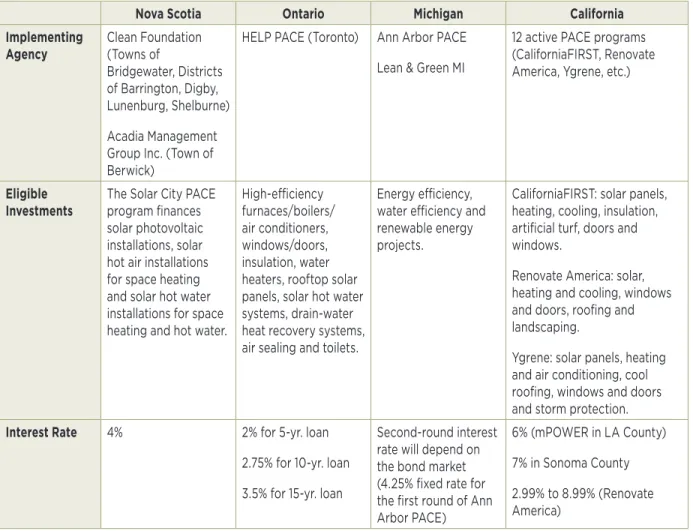
Table 1 summarizes how some of these key aspects of PACE programs have been handled in Nova Scotia, Ontario, Michigan and California. PACE programs cover a limited range of solar-related
applications in Nova Scotia, while PACE in Toronto covers a wide range of energy efficiency upgrades, including high-efficiency furnaces, boilers, air conditioners and insulation.
Interest rates on PACE loans are fixed at four per cent in Nova Scotia and vary from two per cent
to 3.5 per cent in Ontario with the length of the loan. Interest rates in Michigan and California are higher and related to market interest rates. The length of the loan varies from 10 years in Nova
Scotia to up to 25 years in California. Maximum loans are in the $10,000 to $20,000 range in Nova Scotia, up to $75,000 in Ontario and up to $350,000 in Michigan (where PACE only applies to
commercial property). PACE loan limits are also expressed as a percentage of the assessed value of the property, ranging from 10 per cent in Ontario to 25 per cent in Michigan. The municipalities provide the loans in Nova Scotia and Ontario, while a variety of public and private institutions lenders offer PACE program loans in Michigan and California. The latter two states restrict PACE
loans to projects that achieve certain energy efficiency improvements.
4. CONCLUSION AND RECOMMENDATIONS
Bill 10: An Act to Enable Clean Energy Improvements provides Albertan municipalities the
authority to implement PACE programs, but key regulations that will define the operation of the
program have not been promulgated. To implement the program, the Alberta government will have to determine the regulations that limit the size of PACE loans, eligibility of property owners, eligibility of environmental upgrades and possibly the interest rate on the loan. In developing these
regulations, the Alberta government can benefit from the experience with PACE programs in other
jurisdiction as summarized in this paper.
The take-up rate for PACE loans is difficult to forecast because private financial institutions may
be unwilling to provide PACE loans to individuals with poor credit ratings or on property that has a high mortgage to market value ratio. Whether property owners will be willing to take out
PACE loans for eligible upgrades will depend not only on the amounts of energy saved compared to non-supported alternatives, but also projected future energy prices and interest rates on PACE loans. As a result of the downturn in the Alberta economy, average real per capita household income has declined and the provincial unemployment rate exceeds the national average. Recent surveys indicate that Albertans have the highest debt levels in Canada and 64 per cent say they are struggling because of higher interest rates (Hudes 2019). It is likely that current economic
conditions in Alberta will significantly lower the take-up rate for PACE loans.
Several policy issues need to be considered when implementing a PACE program. First, an
argument for PACE policy adoption can be made based on public good/externality issues. Fossil
fuel prices do not account for their negative externality without a carbon tax or cap-and-trade regime. Similarly, positive externalities generated from the adoption of clean energy technology
and energy-efficient investments are not accounted as benefits of such undertakings. Considering the externalities, a PACE program is good policy if it significantly increases the public adoption of investments in energy-efficient technologies. To this end, PACE in Alberta would make financing of upgrades easier by complementing Energy Efficiency Alberta’s rebate programs and thus
increasing the take-up rate for the rebate programs.
Second, PACE could help tackle two major market barriers to energy-efficient investments – the
high upfront cost and the transaction cost. Latest and best technologies often have higher prices
than less efficient existing technologies. PACE supporters argue that the program lowers this
barrier by making funding available to households to enable them to purchase costly but more
energy-efficient appliances and technologies. However, this may require provincial or municipal
governments to subsidize the interest rates.
On the issue of transaction cost, the energy efficiency improvement industry today is very
fragmented and lacks economies of scale. That means homeowners interested in making
energy-efficient investments are responsible for finding the best alternatives and subsidies, wrangling with officials on permit-related issues, finding contractors and monitoring the projects. Also,
evidence shows that PACE interest rates are either similar to, or higher than, market interest rates. Considering additional program administration fees that PACE programs levy on borrowers,
borrowing in the financial market is often cheaper than through a PACE program.
PACE is a good policy only if it significantly reduces the transaction costs and achieves economies of scale. Energy Efficiency Alberta maintains an approved contractor list, and any contractor can apply to become approved by filling out an online form.5 This possibly contributes to reducing
the transaction cost. However, the program needs to attract large number of consumers to achieve economies of scale, which could reduce transaction costs further.
Fourth, the most advertised benefit of PACE is that the lien is attached to the property and not
the person. While there are very limited data available about PACE programs, newspaper-based accounts show that home buyers often ask previous owners to pay their PACE lien in full before the transfer of property. Furthermore, the superiority of PACE liens over other mortgages means the
biggest home mortgage lenders in the United States have refused to issue mortgages to homes with
PACE liens. As a result, only three states have residential PACE programs. The same could happen in Alberta. Therefore, PACE is a good policy only if it successfully tackles the thorny issues of lien transfer and lien superiority. However, the experience in Nova Scotia and Ontario appears to indicate that this has not been an issue in PACE implementation in Canada so far.
Finally, there needs to be a comprehensive study to determine whether a patchwork of ideas like
PACE, which supports customer-selected and financially approved/viable retrofits, is a better approach to launching the energy efficiency revolution, or whether something similar to the European Energiesprong whole-house retrofits is a better approach. PACE is essentially a loan
program while the Energiesprong promotes an “innovation intermediary” approach through
whole-house retrofits involving “the effective integration of multiple measures and systems and consideration of how they interact within a specific building – whether installed at once or over
time” (Brown et al. 2018, 2). The result is that Energiesprong achieves what PACE programs aim to achieve while also helping institute system innovations through additional knowledge and technical capabilities generation, fundamental changes in consumer and market practices and innovation (OECD 2015).
TABLE 1 SUMMARY OF KEY FEATURES OF PACE PROGRAMS
Nova Scotia Ontario Michigan California Implementing
Agency Clean Foundation (Towns of Bridgewater, Districts of Barrington, Digby, Lunenburg, Shelburne) Acadia Management Group Inc. (Town of Berwick)
HELP PACE (Toronto) Ann Arbor PACE Lean & Green MI
12 active PACE programs (CaliforniaFIRST, Renovate America, Ygrene, etc.)
Eligible
Investments The Solar City PACE program finances solar photovoltaic installations, solar hot air installations for space heating and solar hot water installations for space heating and hot water.
High-efficiency furnaces/boilers/ air conditioners, windows/doors, insulation, water heaters, rooftop solar panels, solar hot water systems, drain-water heat recovery systems, air sealing and toilets.
Energy efficiency, water efficiency and renewable energy projects.
CaliforniaFIRST: solar panels, heating, cooling, insulation, artificial turf, doors and windows.
Renovate America: solar, heating and cooling, windows and doors, roofing and landscaping.
Ygrene: solar panels, heating and air conditioning, cool roofing, windows and doors and storm protection.
Interest Rate 4% 2% for 5-yr. loan 2.75% for 10-yr. loan 3.5% for 15-yr. loan
Second-round interest rate will depend on the bond market (4.25% fixed rate for the first round of Ann Arbor PACE)
6% (mPOWER in LA County) 7% in Sonoma County 2.99% to 8.99% (Renovate America)
Nova Scotia Ontario Michigan California Length of
Loan 10 years (for Acadia Management Group Inc.’s PACE loans)
5 to 15 years 15 to 20 years Up to 20 years (Figtree Financing’s commercial loans) 5, 10, 15, 20, 25, 30 years (CaliforniaFIRST) Up to 30 years (Renew Financial)
5-25 years (Renovate America) 5, 10, 15, 20 years (mPOWER)
Maximum Loan
Amount Lunenburg and Bridgewater: $10,000; Digby: $15,000; Bridgewater: $15,000 (for homes with assessment value below $150,000); $20,000 (for homes with assessment value over $150,000); 15% of assessed value (for Acadia Management Group Inc.’s PACE loans)
$75,000 or 10% of assessed value of property 25% of assessed value of property; Min. $10,000; max. $350,000 (Ann Arbor PACE); Min. $10,000; No max. (Lean & Green MI)
Min. $5,000, no max. for commercial loans (Figtree Financing); Min. $50,000 (GreenFinance-SF); $250,000 (Renew Financial); 15% of assessed value of property (CaliforniaFIRST); $50,000 (Renovate America); Min. $2,500; max 9.99% of assessed property value (mPOWER)
Funding Source Municipality Municipality Lending partnerships Municipality (GreenFinance SF) General funds (Sonoma County)
Lending partnerships (such as Renew Financial, mPOWER, Renovate America, etc.)
Other
Regulations Projects costing over $250,000 must generate energy savings in excess of all project costs and those savings must be guaranteed by the PACE project developer; Michigan has
commercial PACE only to be used by private commercial, industrial, agricultural or multi-family business as well as private non-profits (churches, hospitals, schools, colleges).
GreenFinance-SF requires energy efficiency measures result in 10% improvement in building energy performance. Projects expected to cost less than $100,000 require ASHRAE Level 1 energy audit. Projects costing more than $100,000 require ASHRAE Level 2 energy audit.
REFERENCES
Advanced Energy Center. 2016. “Thinking Big: Scaling up Energy Efficiency in Canada’s Commercial
Building Stock.” Report prepared as input to the government of Canada’s public conversation on climate change. June 27.
Anderson, Bruce. 2018. “Analysis: Carbon Pricing Can Stand A Little More Help from Its Friends.”
Abacus Data. April 4. Available at https://abacusdata.ca/analysis-carbon-pricing-can-stand-a-little-more-from-its-friends/
Barter, Aaron. 2016. “Think Big: Scaling-up Commercial Energy Efficiency in Canada.” Advanced Energy Center. Aug. 22. [Cited March 23, 2018]. Available at https://www.marsdd.com/systems-change/advanced-energy-centre/news/think-big-scaling-commercial-energy-efficiency-canada/ Berwick, Town of. 2016. “PACE Program.” Aug. 8. [Cited March 6, 2018]. Available at http://www.
berwick.ca/municipal-documents-1/2016/8/8/pace-program?rq=pace
Boue, George. 2010. “Linking Green Buildings, Productivity and the Bottom Line.” [Cited Jan. 8, 2018].
Available at
https://www.greenbiz.com/blog/2010/07/08/linking-green-buildings-productivity-and-bottom-line
Brown, Donal, Paula Kivimaa, and Steven Sorrell. 2018. “How Can Intermediaries Promote Business Model Innovation: The Case of ‘Energiesprong’ Whole-House Retrofits in the United Kingdom (UK) and the Netherlands.” SPRU Working Paper Series 2018-2019. October.
Brown, Marilyn A. 2001. “Market Failures and Barriers as a Basis for Clean Energy Policies.” Energy Policy 29: 1197-1207.
CERTs. 2019. “PACE Frequently Asked Questions.” [Cited Jan. 26, 2019]. Available at https://www. cleanenergyresourceteams.org/pace-faq#progdiff
City of Milwaukee. 2013. “Property Assessed Clean Energy (PACE) Financing.” [Cited Jan.
26, 2019]. Available at https://city.milwaukee.gov/ImageLibrary/Groups/cityMe2/PDF/ PACEFINANCINGPROGRAMMANUALv5.pdf
Clean Foundation. 2018. “Clean Energy Financing.” [Cited Feb. 21, 2018]. Available at http://clean.ns.ca/ clean-energy-financing/clean-energy-financing-faqs/
Cox, Prentiss. 2011. “Keeping PACE? The Case Against Property Assessed Clean Energy Financing
Programs.” University of Colorado Law Review 83: 83-122.
Dayen, David. 2017. “I Tried to Make My Home Energy Efficient and It’s Ruining My Life.” Vice. [Cited
Jan. 19, 2018]. Available from https://www.vice.com/en_us/article/paqbpv/the-wrong-way-to-make-your-house-energy-efficient
de T’Serclaes, Philippine, and Nigel Jollands. 2007. Mind the Gap: Quantifying Principal-Agent
Problems in Energy Efficiency (Paris: International Energy Agency and the Organisation for Economic Cooperation and Development).
Department of Energy. 2015. “Commercial PACE: A Comparative Analysis.” [Cited Jan. 26, 2019].
Available at https://www.energy.gov/sites/prod/files/2017/05/f34/Pace%20Comparative%20 Analysis%20Webinar%202-26-15_r1%20%282%29.pdf.