Journal Programs and Cross-Disciplinary Research
Marianne A. Reed
Digital Initiatives Manager
University of Kansas Libraries
[email protected]
https://orcid.org/0000-0001-8452-6103
Abstract
I
n order for innovative cross-disciplinary research to find its audience, it must be easily discovered by scholars, professional practitioners, and the public. Journal publishing programs in libraries operate under the principle that investment in open access publishing of quality peer-reviewed research is the best way to make that research visible to a global audience and to shift control of publishing from commer-cial entities to the academy. Library publishers are therefore not constrained, as com-mercial publishers are, by the need to publish only research that will ensure a profit. This means that library publishing programs can provide a home for cross-disciplinary journals that break new ground and that may take time to find an audience.The lack of a profit imperative for library publishing programs also means that the platform for hosting journals is provided to journals at little or no cost, which makes library publishing very attractive to editors looking for a place to publish a new jour-nal. Once the infrastructure is operational, the cost to add a new journal to the system is negligible because the costs of maintaining the technology are already covered. This lowers the financial barriers to starting new journals, allowing editors to focus on the task of finding and publishing excellent peer-reviewed research instead of fundraising. Journal platforms used by library publishers are designed so that journals pub-lished on those systems automatically follow best practices and standards, such as those outlined by the Open Archives Initiative Protocol for Metadata Harvesting (OAI-MPH) that make the content readily discoverable by internet search engines. These platforms also integrate the use of machine-readable licenses that clearly indicate how the content can be used. In addition to infrastructure that ensures visibility, library publishing programs benefit from existing library expertise in collaboration, technol-ogy, copyright, data management, scholarly publishing, information literacy, digital preservation, and the effective promotion of online research.
In the late 1990s, as the cost of commer-cially-published journal subscriptions in-creased and library budgets held steady or declined, university libraries began to explore ways to change the scholarly publishing ecosystem through initiatives designed to shift control of academic publishing from commercial entities back to the academic community.1 One strate-gy employed was the creation of library
publishing programs that supported fac-ulty in the publication of quality open access journals that made peer-reviewed scholarly research freely available to any-one in the world with a computer and an Internet connection. Since they were not driven by profit, library journal programs could publish cross-disciplinary research that had scholarly merit, but was not con-sidered viable by commercial publishers.
These programs provided universities with new opportunities to showcase the research of their faculty and to make it available to a worldwide audience.2
In 1998, the Public Knowledge Proj -ect was founded and began the process of creating the first open-source journal publication system that supported the entire editorial workflow.3 The Open Journal Systems (OJS) software is avail-able free of charge and can be installed wherever the prerequisite technical re-quirements are met.4 This has made it at-tractive to new publishing programs in li-braries all over the world, allowing them to put scarce resources into producing high quality content instead of paying a commercial firm for journal hosting.
Business models of these library jour-nal programs vary, but almost all pro-vide basic journal hosting services free of charge. A few library publishing pro-grams offer additional tiers of fee-based services that further enhance the publi-cation process, such as website customi-zation, graphic design, copyediting, and promotional services. However, many editors do not have outside funding and, instead, collaborate with other scholars who can provide these services free of charge. These collaborations are actually helpful to a new cross-disciplinary jour-nal, since it creates a pool of researchers that are invested in the success of a jour-nal and will be more likely to serve as peer reviewers and to promote the jour-nal throughout their academic networks. Barriers to Publishing Cross-Disci-plinary Research
Financial Considerations
The publication of new cross-disci-plinary journals is less appealing to com-mercial publishers because these journals may initially have a smaller audience and may never be commercially viable. Conversely, some commercial publishers
may establish cross-disciplinary journals, only to cease publishing issues when they are no longer profitable. For example, the journals program at the University of Kansas (KU) Libraries was approached by a member of the KU faculty asking the program to take over the publication of an important journal in his field that was no longer going to be published by a commercial publisher. With the full assis-tance of the publisher, the journal moved to our OJS system and continues to pub-lish high-quality peer-reviewed research in its new home.
Article publication fees charged by some commercial open access journals to finance journal costs may be a barrier to authors of cross-disciplinary research who do not have outside funding avail-able to them. Lack of outside funding can also be a barrier to research in the hu-manities or when publishing with inter-national partners that might be unable to obtain funding.
Disciplinary Considerations
New forms of cross-disciplinary re-search submitted to traditional journals in the field are often rejected because their cross-disciplinary approach does not fit within the stated scope of the jour-nals.
Also, in order for the research in new cross-disciplinary journals to be taken seriously, the editors of new cross-disci-plinary journals must be well-respected members of their fields that are willing to risk failure if the journal does not find an audience. Finding scholars that can af-ford to take that risk may be difficult; un-tenured faculty who are still establishing their scholarly reputations often prefer to do editorial work for traditional journals in their discipline, because those are the positions that are given the most weight by tenure committees. Senior faculty who serve as editors of traditional
jour-nals may be reluctant to take a chance on a new cross-disciplinary journal, because failure of the journal may tarnish their scholarly reputation.
Access and visibility
Commercially published journals are typically kept behind paywalls, where access is by subscription only unless the author has paid the publisher to ensure that the research will be openly available. This limits the audience for that research to those readers, or their institutions, that are able to pay for access.
In addition, as journal prices rise and library budgets decline in purchasing power, less-accessed journals may be dropped from library subscription pack-ages, which limits visibility and access to research in those journals. Interlibrary loan is sometimes used to provide access from the collection of another institution, but those services are not available to all readers.
How Library Journal Programs Sup-port Interdisciplinary Research
Enhanced Visibility
Journal publishing in libraries ad-heres to standards such as the Open Ar-chives Initiative Protocol for Metadata Harvesting (OAI-PMH)5 that exposes journal content to the web search engines that make it available to a worldwide au-dience.
In addition to making content wide-ly discoverable, library journal programs encourage journals to follow best practic-es in licensing open materials, such as the use of Creative Commons licenses6 that make it clear to the reader how the re-search can be re-used without asking for permission from the copyright holders.
The visibility of journals hosted by li-brary publishing programs often results in more submissions to the journal, as scholars interested in cross-disciplinary research discover these outlets for
pub-lication. Another benefit of visibility is the possibilities for new research partner-ships for authors as other scholars with similar interests find the research.
Lower Cost, Lower Risk
Publishing through library publish-ing programs is cost effective for the journal, since the lack of a profit motiva-tion means that the costs of the library publishing infrastructure is subsidized so that journal hosting can be provided to journals free of charge. Traditional li-brary values emphasizing the preserva-tion and disseminapreserva-tion of knowledge ex-tend into their journal programs, which often provide for the long-term preserva-tion of journal content.
Open access publishing eliminates the need for the journal to allocate re-sources to subscription management, including reminders, renewals, tracking of payments, etc. Some smaller scholarly societies that publish journals find them-selves in the predicament of paying more to manage subscriptions than the sub-scriptions provide in revenue. By moving journals to a library publishing program and making them open access, a scholar-ly society not onscholar-ly saves those costs, but also provides a wider outlet for the re-search of its membership.
Once the publishing infrastructure is in place, there is very little cost to the li-brary journals program to publish a new cross-disciplinary journal. This lowers the financial risk to the publisher if a new journal fails to find an audience and ceas-es publication. Since library publishers have less to lose if they take a chance on a new journal, journals are not pressured to publish a minimum number of articles per issue or to find an audience in a short amount of time. This gives library-pub-lished journals the freedom to experi-ment with new forms and combinations
of scholarship that may not be commer-cially viable.
Existing print-only journals can elim-inate substantial printing costs by mov-ing to an online-only model on a library publishing platform. This has the added benefit of making the research in the jour-nal much more visible to an audience be-yond its previous subscribers.
Library Expertise
Journals published by libraries ben-efit from existing library expertise in scholarly publishing, project manage-ment, experience collaborating with peers to manage scarce resources, copy-right, digital preservation, and adherence to standards for the effective promotion of online research.
Libraries are also experts at building communities of interest. For example, the University of Kansas Libraries’ journal publishing program periodically hosts Editor Forums in the Libraries where fac-ulty editors from all disciplines can meet to talk about the challenges of journal ed-iting with other editors. An email discus-sion list allows KU editors to continue the conversations and ask for advice from other editors if a situation arises between meetings. This community of editors pro-vides support to new editors and allows experienced editors to share their exten-sive knowledge of scholarly publishing.
Visibility is the Key to Success
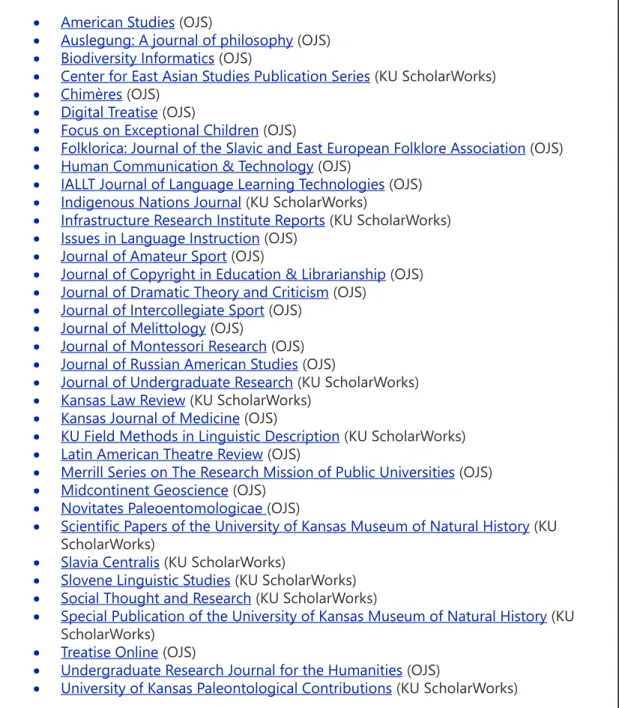
The visibility and discoverability of journals in library publishing programs results in a large number of downloads of journal content. For example, articles in the 24 journals hosted by the Univer-sity of Kansas Libraries on the OJS plat-form7were downloaded over 2.7 million times in 2019. See Figure 1 for a list of these journals, as well as those addition-al journaddition-als that are available through KU ScholarWorks, KU’s online institutional repository.
Common Strategies for Visibility
Open Access
• Make as much article content as possible publicly available with-out a paywall to encourage use and citation.
• Add all older issues and articles whenever possible when pub-lishing an established print jour-nal online for the first time. The more visible content there is, the more likely that readers will dis-cover the journal.
Make Articles Easier for Search En-gines to Find
Another strategy that can used by library journals programs to enhance visibility is to make article information available through other not-for-profit en-tities so that internet search engines can find journal content more easily. Here are some examples:
• Register DOIs with Crossref8 or DataCite9 to provide permanent links to journal articles and, as a byproduct of this process, to make article information more available to search engines.
• Encourage authors to add their Open Researcher and Contribu-tor ID (ORCID) when submitting an article. An ORCID is a unique researcher identification number used to connect research outputs such as articles to a particular re-searcher. An advantage of using ORCID is not only that research-ers with similar names can clear-ly identify the work that is theirs, but also that granting agencies are starting to use ORCID as an op-tional way to add faculty publica-tions to grant applicapublica-tions. Rather than typing the information for each publication, integration with ORCID allows the information to
Figure 1: Journals supported by the KU Libraries journal publishing program Journals and Serials
KU Libraries provides journal editors with the technical infrastructure to publish their journals on either of two platforms: KU ScholarWorks, KU’s institutional repository, which makes journals visible to a wide audience and assures their long term preserva-tion and Open Journal Systems (OJS), which makes journals visible and assures their preservation, but also supports the entire editorial management workflow, including article submission, multiple rounds of peer-review, and indexing.
• American Studies (OJS)
• Auslegung: A journal of philosophy (OJS) • Biodiversity Informatics (OJS)
• Center for East Asian Studies Publication Series (KU ScholarWorks) • Chimères (OJS)
• Digital Treatise (OJS)
• Focus on Exceptional Children (OJS)
• Folklorica: Journal of the Slavic and East European Folklore Association (OJS) • Human Communication & Technology (OJS)
• IALLT Journal of Language Learning Technologies (OJS) • Indigenous Nations Journal (KU ScholarWorks)
• Infrastructure Research Institute Reports (KU ScholarWorks) • Issues in Language Instruction (OJS)
• Journal of Amateur Sport (OJS)
• Journal of Copyright in Education & Librarianship (OJS) • Journal of Dramatic Theory and Criticism (OJS)
• Journal of Intercollegiate Sport (OJS) • Journal of Melittology (OJS)
• Journal of Montessori Research (OJS) • Journal of Russian American Studies (OJS)
• Journal of Undergraduate Research (KU ScholarWorks) • Kansas Law Review (KU ScholarWorks)
• Kansas Journal of Medicine (OJS)
• KU Field Methods in Linguistic Description (KU ScholarWorks) • Latin American Theatre Review (OJS)
• Merrill Series on The Research Mission of Public Universities (OJS) • Midcontinent Geoscience (OJS)
• Novitates Paleoentomologicae (OJS)
• Scientific Papers of the University of Kansas Museum of Natural History (KU
ScholarWorks)
• Slavia Centralis (KU ScholarWorks)
• Slovene Linguistic Studies (KU ScholarWorks) • Social Thought and Research (KU ScholarWorks)
• Special Publication of the University of Kansas Museum of Natural History (KU
ScholarWorks)
• Treatise Online (OJS)
• Undergraduate Research Journal for the Humanities (OJS)
be imported directly to the grant application.10
• Help journals apply for inclusion in the Directory of Open Access Journals (DOAJ) and, once they are successful, upload article in-formation to DOAJ as it is pub-lished.11
• Include machine-readable Cre-ative Commons licenses for arti-cles whenever possible to make it clear to readers how the content can be used. Machine-readable Creative Commons licenses also allow search engines to include those articles in results when a user searches for content that is licensed for re-use.12
• Follow the best practices in Goo-gle Scholar’s Inclusion Guidelines for Webmasters13 so that Google Scholar indexes the journal arti-cles.
Editors as Partners
Predatory open access journals that charge authors large fees to publish poor-ly researched or scholarpoor-ly research that does not undergo rigorous peer-review have warped many scholars’ perceptions of open access publishing as sub-stan-dard. There is a commonly-held belief, possibly nurtured by those that benefit, that only through commercial publishing channels can quality research be pub-lished.
However, for all journals, whether published commercially or not, the rep-utation of the journals are closely tied to the reputation of the editor and editorial team. Indeed, open access journals with respected editorial teams that do not charge author fees have no incentive to publish poor research, as there is no com-mercial reward for quantity over quality.
Editors can greatly contribute to the success of their cross-disciplinary
jour-nals by following a few simple guide-lines:
• Journals that are managed by one person trying to do everything are not sustainable and usual-ly cease publication after a few years. Share the burdens of edi-torship and ensure continuity of the journal by making sure that there is a group of scholars in-volved in running the journal, so-liciting content, and performing reviews. Including other scholars also brings other perspectives to the journal and helps minimize the risks of publishing in a new area of scholarship.
• Ensure that information on the journal website—e.g., focus and scope, author guidelines, copy-right information, and publica-tion agreements—is clear and complete.
• Require abstracts to be submitted with articles. More information on the article’s page gives readers incentive to download the article.
• Support all readers by following the World Wide Web Consor-tium’s Web Content Accessibility Guidelines (WCAG) to ensure that the journal website and journal content are accessible.14
• Encourage authors to share their articles in their online institution-al repositories with links back to the original published content. Since content in institutional re-positories is placed higher in search results by Google’s search algorithm, this will increase the visibility of your journal.
• Editors should use their exist-ing scholarly and social media networks to promoting the jour-nal. Sending calls for papers,
an-References
1. Chapman, A.L. and David E. Shulenburger. “The State of Research Endeavors: View from the Campus-wide Leadership Level.” MerrillSeries on The Research Mis-sion of Public Universities (1997): 67-68. https://doi.org/10.17161/merrill.1997.8173 2. Steinmetz, Joseph E. “The Role of Universities in Promoting Scholarly Work in
the Emerging Open Access World.” Merrill Series on The Research Mission of Public Universities (2018): 1-9. https://doi.org/10.17161/merrill.2018.9120
3. “History.” Public Knowledge Project. Accessed June 16, 2019. https://pkp.sfu.ca/ about/history/.
4. “Download Open Journal Systems.” Public Knowledge Project. Accessed June 16, 2019. https://pkp.sfu.ca/ojs/ojs_download/
5. “Open Archives Initiative Protocol for Metadata Harvesting.” Open Archives Initiative. Accessed June 16, 2019. https://www.openarchives.org/pmh/
6. “CC Licenses and Examples.” Creative Commons. Accessed June 16, 2019. https:// creativecommons.org/share-your-work/licensing-examples/
7. “Journals@KU.” University of Kansas Libraries. Accessed June 16, 2019. https:// journals.ku.edu
8. “Home.” Crossref. Accessed June 16, 2019. https://www.crossref.org/ 9. “Home.” DataCite. Accessed June 16, 2019. https://datacite.org/ 10. “Home.” ORCID. Accessed June 16, 2019. https://orcid.org/
11. “DOAJ (Directory of Open Access Journals.)” DOAJ. Accessed June 16, 2019. https://doaj.org/
12. “Home.” Creative Commons. Accessed June 16, 2019. https://creativecommons. org/
13. “Inclusion Guidelines for Webmasters.” Google Scholar. Accessed June 16, 2019. https://scholar.google.com/intl/en/scholar/inclusion.html
nouncements of special issues, and the publication of new issues to a disciplinary discussion list or forum is an excellent way to call attention to a journal. Announce-ments at conferences are often very successful, too, especially if connected to a presentation at the conference.
• Solicit articles from well-respect-ed scholars that are acquaintwell-respect-ed with members of the editorial team. A request from a friend is much more likely to be taken se-riously by a reputable scholar.
• Invite selected authors from the journal to be reviewers for future issues.
• The online guide for editors, Re-sources for Editors of Scholarly Journals,15 is a good starting point for those who are considering starting a journal or who are look-ing for information about manag-ing an existmanag-ing journal. For those journals on the OJS platform, the
Using Open Journal Systems
page can be especially helpful.16 Summary
Library publishing programs are uniquely positioned to help cross-dis-ciplinary journals prosper. For scholars thinking of starting a new journal or for editors of a journal that is looking for a new home, library publishing programs are the ideal partner to help the journal, and its editors, succeed.
14. “Web Content Accessibility Guidelines (WCAG) 2.1.” World Wide Web Consor-tium. Accessed June 16, 2019. https://www.w3.org/TR/WCAG21/
15. “Resources for Editors of Scholarly Journals: Getting Started.” Digital Publishing Services, University of Kansas Libraries. Accessed June 16, 2019. https://guides. lib.ku.edu/journal_editors
16. “Resources for Editors of Scholarly Journals: Using Open Journal Systems (OJS), version 3.x.” Digital Publishing Services, University of Kansas Libraries. Ac-cessed June 16, 2019. https://guides.lib.ku.edu/journal_editors/learn_ojs3