Embedding Co-Creation Method for the Development of
Knowledge Management System in Higher Learning Institutions
Ali Ahmad Zahrawi1* Yazrina Yahya2
1.Information Technology department, Al Khawarizmi International University College PO box 1178, Abu Dhabi,UAE
2.Faculty of Information Science and Technology, National University of Malaysia, 43600, Bangi, Selangor Malaysia
*E-mail: ali.zahrawi @khawarizmi.com; [email protected]
ABSTRACT
Knowledge Management (KM) is a vital aspect for any organization to stay competitive in global market. Most of the organizations around the world, have invested heavily for the purpose of developing a proper knowledge management system. It is unfortunate, that many organizations in different countries have not focused much on KM and its application, this was revealed based on the review conducted, in particular, the investigation on the Higher Learning Institutions (HLIs), especially in Malaysia, uncovered the failure or poor focus of KM system (KMS) due to various reasons. This paper however utilized an approach that could enhance the overall KM practice in the HLI domain, as it is believed user satisfactions and KMS success are correlated, therefore, this paper utilized co-creation as new recipe through which acquiring users values and needs towards the KMS. Following the steps of co-creation method had resulted set of attributes and features that forms the users values towards a KMS. As such, the obtained values originated to set of key roots forms the basic concepts to be utilized and enabled while developing the KMS. Based on the results obtained, the design and development of KMS application within HLI’s in general and in Malaysian HLIs particularly could be achieved.
Keywords: Knowledge Management (KM), Knowledge Management System (KMS), Higher Learning Institutions, Co-creation Value, user values,
1. Introduction
Every single organization in the world, irrespective of their size is, bound to be in a highly competitive ambience. Up to date information and utilizing the knowledge sources are very vital for the organizations, to stay alive in the market. It has become increasingly serious that a lot of organizations have non-utilized different kinds of assets, such as human skills, experience, know-how and best practices and this actually contributes negatively for those organizations growth (Choi, Poon, & Davis, 2008).
Swan et.al (1999) claim, that the advent of developments in knowledge management has opened the doors of many organizations to unearth, their hidden and unused knowledge and use it profitably.KM can be defined as the process of creating, sharing and utilizing knowledge, towards the betterment of any organization (Andreeva & Kianto, 2012). It is evident that, the KM has become one of the hot topics not only in business arena, but also in the domain of research field. Alavi & Leidner (2005) have stressed on the importance, of the development of KM Systems providing right knowledge to the right people. Based on the studies by (Makhija & Ganesh, 1997; Turner & Makhija, 2006), KM systems have to deal with both the important types of knowledge, namely tacit and explicit. The explicit knowledge can be expressed, systemized and saved in any given media and can be easily transmitted from one place to the other. Whereas, Turner & Makhija (2006) claim that, the real challenge of KM lies in dealing with tacit knowledge. They have added that, understanding the type of knowledge, before developing a KM is vital to transmit the right knowledge to the right people. Though KM has spread its wings across many domains, it still lacks its implementation in HLIs. Hence, this study targets on the possibilities of implementing KMS in HLI environment especially in Malaysia. We feel that presenting a physical platform, to fully utilize and share knowledge for HLI members will enhance their capabilities, both in the terms of efficiency and productivity (Gibb, Haskins, & Robertson, 2013; Hovland, 2003).
2. KMS in Higher Learning Institutions
The higher learning institutions are one of the organizations that undergo changes periodically. Every HLI involves in a lot of activities, such as academic processes, administration, social services and so on. Transferring of knowledge is the main activity of an HLI, followed by creating socially responsible and creative citizens and serving the community. The HILs generally have the objectives to serve national and international communities’ (Metaxiotis & Psarras, 2003).
Cronin (2001) has stated that, the HLIs missions clearly address the need of building KMS in HLI environment. It is evident from this study that knowledge sharing happens in all the corners of any HLI. It happens between students and teaching staff, among students, teaching staff and between teaching staff and other departmental staff and vice versa. It is believed that the staff and students do not hesitate in publicizing personal
knowledge.
Kidwell et al. (2000) believe that, the success of KMS in business domain has motivated the HLIs to open the doors for promoting the KMS development in the educational market. As the educational sectors are interlinked with industries and government organizations and departments, it is mandatory to have KMS in HLIs.
3. Issues
Even though many organizations have employed KMS and reaping the benefits, it is obvious that a lot of HLIs are lacing KMS facilities. Knowledge gap is one of the reasons for this moderate influence of KMS in the HLIs. The lack of significant knowledge inside HLIs, such as counseling, planning, registration, evaluation and marketing, are the other reasons for the poor usage of KMS (Dick Stenmark, 2008; Ramachandran, Chong, & Lin, 2008).
Interviews conducted with students, academic staff, non academic staff, administrators and computer centre staff as well, proved that most of them lack the awareness of KM as a broad concept, its main processes, and the enhancements and benefits that KM promises if it brought in action. It is ironical that some of them, seldom or fully utilize the existing KM practices. Thus, some of existing practices of KMS as application faces either resistance or lose of interest to use due to the poor understanding of KMS.
Observations, interviews, and the document support from the literature review, prove that the design of KMS and the development procedures have issues cause the poor implementation of KMSs. (Ali Thomas, Marir, Mikusauskas, & Patel, 2013; LUBEGA, OMONA, & VAN DER WEIDE, 2011; Matayong & Mahmood, 2012; Rao & Osei-Bryson, 2007; Stenmark & Lindgren, 2004; Whitfield Jr, 2008). Further investigations and observations show that the existing KMS in HLIs are poorly designed in terms of interface and functionality, as for instance poor management of information, including the different formats of files (text, image, audio and video) was discovered. Such issues turn away the users of fully utilizing these systems, as well demote the amount of knowledge exchanged within those systems. This causes disappointments or even failures of KMS in terms of usage rates.
In some cases, HLIs rely on applications that partially provide KM processes; wherein no sufficient support for HLI different processes is provided. Because the main purpose of such application is to offer features and functions to perform a specific task fits different types of organizations.
Payne et al.(2008) and Sharmin et al.(2009) have established the fact that, in order to encourage the HLI users to fully utilize the KMS, a well organized and excellently designed KMSs are mandatory. The KMS developers must keep in mind that the KMS must aid the betterment of all educational processes.
The above discussion leads to deduce the importance of the users as key actors at all the levels of managing the knowledge. However, review of the related literatures had discovered the KM application deal with people from one perspective, avoiding their values and interests before implementing the KMS which could reflect the low interest of KMS in HLIs. Most of KM applications do not provide wide perspectives of the different practices related with managing organizations knowledge; this is includes handling the tacit and explicit knowledge in one level.
Improving the KMS, as a desirable target could be achieved through different perspectives; this paper pays attention to the co-creation concept. Co-creation in the business world mainly assists the organizations to highlight and identify customers’ needs, and improving the overall front-end process of customers’ services to satisfy these needs (Lusch & Vargo, 2006). Hence, it is recommended to deploy the co-creation value in the design of the KMS within organizations, this will positively impact the cost and time, and remove any unnecessary capabilities of information technology investment (Payne, et al., 2008).
4. Mission
Based on the abovementioned reasons, this paper attempts to address those issues by following a different approach designing the system to enable the users to use various knowledge resources efficiently and effectively, which specifically fulfill the need of HLIs. Mining the users’ values, needs and thoughts corresponding to the KMS at early stage was achieved through the co-creation method, which will be discussed extensively in this paper.
5. The Value of Co-Creation
Lusch and Vargo (2006) ascertained that, the business world put mammoth efforts to be in the pace of latest technological developments in order to stay competitive in the market. The new business model that stormed the development world centers on co-creation. However, Prahalad and Ramaswamy (2004) claim that, co-creation is described as the common benefits attained by engaging the users and the organization in order to develop system or product. The co-creation is considered as a innovative method of systems/product development which involves exchange of ideas rather being developed unilaterally (Ramaswamy, 2008; Sanders & Stappers, 2008). Therefore, the term co-creation is broad enough to cover up various applications ranging from the physical to the
metaphysical and from the material to the spiritual (Kristensson, Matthing, & Johansson, 2008). Aside from that, the flexibility of co-creation could be used to (re-)design or develop new products or to offer service to the customers. Generally, the origin root of co-creation concept came from the service-dominant logic (S-D logic), in which the basic purpose and nature of organizations, markets and society, is unified to concern of service exchanging, whereby “service is exchanged for service” for each party. Thus, organizations instruct to market with customers, as well as other value-creation partners in the organization’s value network instead of being informed to market to customers. (Lusch & Vargo, 2006)
The concept of S-D logic influenced co-creation to be presented in various forms, in essence each form can be used by organizations to create values and reach out their desired goals and objectives (Kristensson, et al., 2008). For instance, form of “Co-production” (co-design) this form refers to the creativity of designers and the not trained in design people working together at early stage of profusion processes to come up with new design or new production that meets the exact customers need. (Lusch & Vargo, 2006), other form represented by “Value in use” idiom, which basically depend on understanding the values of the system or the product from the customer perspective, this form focuses on the users values to re-design or re-produce system or product thus help to improve the development process. Additionally, the form of Co-creation as new orientation, with the goal of promoting co-creation of unique experience environment, it is a user centric view in which organization focus more on relationships over any other elements, in this context of co-creation, customers has much more significant role than the organization itself, where value is co-created at multiple points of interactions and the basis of value is the co-creation experience (Ramasway & Prahalad, 2004).
It worth to mention here, that the term ‘customer’ is popular and appears in most of co-creation references as it is the domain of marking and business. However, customers refer to those end-users willing to use service or product. For this study purposes, the term customers refers to KMS end-users, those who are expected to utilize the different features, services, and functions provided within the KMS.
6. Co-Creation Method
As the concept of co-creation to be translated into practical form in order to implement a new version of KM system overcomes the problems and issues identified. Surveying the literature review had uncovered various models can be used to co-create values with users, such as the use of DART model, ethnography, and participatory approach.
Examinations conducted for DART model proposed by Prahalad and Ramaswamy (2004) revealed that the interaction among organizations and members its main focus. DART model considered as generic view for co-creation concept through its building blocks, namely dialogue, access, risk and transparency. Yet it lacks emphasizing the approaches could be used in order to achieve such interaction. Moreover, DART model blocks cannot be applied separately (Singh & Vennegoor op Nijhuis, 2010), and it is strongly recommended at least to combine the building blocks in any way to achieve the desired goals, as suggested by Prahalad and Ramaswamy (2004).
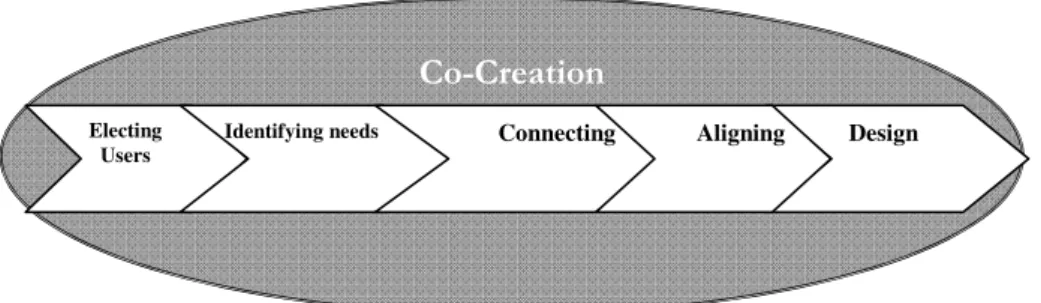
On the other hand, the social structure of the ethnographic methods and participatory approaches can be adjusted to be used as tool for co-creation. However, the feedback and inputs could be obtained through those methods for any subject matter hard to be controlled, due to the inclusion of wide range of participants which may create conflicts (Estabrook, Schutt, & Woodford, 2008; White, Suchowierska, & Campbell, 2004). Those methods are also required a great skills in terms of interpreting the participants inputs, in which more time and cost needed (Spinuzzi, 2005; Steen, Kuijt-Evers, & Klok, 2007).Therefore, a need to find distinguished approach able to acquire users values and needs at the same time integrates the organization business is targeted to develop efficient KMS. For that purpose, a hybrid method was developed by (Zahrawi & Yahya, 2010) is believed to suit this study (as shown in Figure 1).However, examining this method revealed it was constructed based on DART model features (Prahalad & Ramaswamy 2004) and the structural approach of the co-production principles (Kristensson et al. 2008). This strengthens the method by a practical approach supposed to ease building the interaction between system and users as Zahrawi and Yahya (2010) claims.
Figure 1. co-creation method (Zahrawi & Yahya, 2010)
Co-Creation
Electing Users
Literally, following the steps of this method, the users will be investigated to extract their interests, desirables, and values through multiple discussion sessions. Therefore, as this study focuses on HLIs domain, users within HLI are to be called to participate in more than one session. Mainly, to talk, discuss, and debate their needs and insights about the application of KM, while the researcher asks different types of questions related to KMS, in order to set the participants free of any constraints and allow them to better share their opinions, views, and insights without any formality. During the discussion, the researcher acts as observer to extract any possible values could be highlighted through the discussion. However, such sessions are so useful and efficient in terms of avoiding any stereotypes or myths accumulated in participants minds, the results are believed to assist in KMS development. The co-creation method adopted constitutes the following steps:
• Selecting users to participate: in this step, we have identified the sample of potential KMS users inside the HLI community for the purpose of KMS development. We assured that the selected users posses diverse ideas and thoughts. We have selected students (graduate and undergraduate), academic staff and non academic staff. The selection were made to 32 participants as in Table 1, participant were divided into three groups, each group discussion conducted in different time and place, since the selection was made from three different local Malaysian HLIs, bearing into mind, for each group at least one of the participants is representing HLI management, since one of core concept of this method is to make feasible the interaction among organization members and organisation top management.
• Identifying the users needs: investigation was made to each user by an informal question answering theme,
wherein at first, we assured users unawareness about the KMS intended to implement, as well as the issues or current problems found, this is to avoid any influence might caused by such details. However, the questions focused at users interests regarding any system, and pinpoints to their perspective towards having successful systems, the core concept of this step is monitor the users’ behaviour and to capture their needs based on their own settings and during different roles. Afterwards, and throughout the discussion, participants were given short gist about the KMS to be developed, and they were asked to share their opinions, suggestions, and insights of the overall system in various contexts.
• Connecting users and organization: this step concentrated at the contribution of ideas, creating new ideas, intensive discussions, providing a healthy platform for communication that will open the door for novelty and creativity. As mentioned in the earlier steps, the discussion involved HLIs management representatives, this bestow the session the realistic and significant theme, since all the participants have the chance to comment and evaluate each other opinions, thus guarantee practical and real insights and solutions provided. • Aligning organizations business processes with users values and needs: This step helped to find out the potentiality and capabilities to achieve the users’ values and needs through the current HLI infrastructure and readiness.
• Upon obtaining the values through the co-creation method, the KMS development to consider the users values gained and extracted.
Table (1) Number of participants for each background
Group Participants Background A B C Total Degree students 4 5 3 12 Posgraduate students 3 4 2 9 Non academic staff 2 2 3 7 Admin / academic Staff 1 2 1 4 Total 10 13 9 32
The social and flexible structure of the co-creation session promises more understanding of the potential users needs, as a consequence of the diversity of range and expertise of the participants involved. The general
objectives of this method were:
• To gain insight about the factors influencing KMS application usability and acceptance. • To gain insight of potential initiatives that may serve to enhance KMS.
• To use the insights from this study to construct KMS as functional model.
Aside from that, shedding lights on the most frequently used systems by the participants, and identifying the preferred features and services offered in those systems, provides awareness of the behaviour of participants and their current tendencies. Considering such attributes, features, and specifications while developing KMS, is believed to produce a new version of KMS that efficiently assist HLI to fully utilize their own resources and overcome issues related to their daily practice.
7. Results of Co-creation Method
Implementing the co-creation method had concluded various results. The results were looked at as the participants’ values that could be embedded into KMS. The values appear to be in different forms such as, features, functions, tools, and services. Knowing that throughout the discussion conducted, the answers attained, opinions shared, and suggestions made, were shattered in many disciplines, therefore, they were merged back to a root concept. As illustrated in the Table 2 below, the values of users of KMS application and their respective benefits.
Table (2) Root Values of Co-creation method Extracted
Value-The Root Aspect
Description
Personalization Ability to personalize and customize page according to interests and needs
Storing/ Retrieving
Ability to (re-)use, store knowledge
Sharing Ability to share owned
knowledge, disseminate among community
Refining Ability to enhance the
available knowledge
Interaction Ability to keep connected
with people in organization Interactive
outlook
The interface ease of use, good structure and content organization, with less ambiguity
1. Personalization: which is refers to the ability to customize, personalize, and modify the KMS pages based
on users preferences. This aspect was demonstrated by majority of the participants, in which they describe their need to personalize according to any personal details, such as, education degree, role, department, location, and so on. In addition to the ability to customize the page layout or specify the page content to be shown in the users own page.
2. Storing/Retrieving: The participants realize the importance of having the ability to share and exchange the different types of knowledge. Therefore, this aspect represents the desire to store/retrieve different resources in different formats (text files, media files, etc.) without any difficulties in easy and flexible manner. This involves the use of various technological tools to support such activities.
3. Sharing: The participants showed enormous interest on the availability of space, supportive tools, and collaborative facilities that enable knowledge distribution and access others’ knowledge. This process characterized by the informality and simplicity that encourage users to actively and freely share their insights, opinions, experiences in any regard. However, this aspect could be implemented in many forms, such as best practice, know-how, and learning from mistakes.
4. Refining: Insuring the accuracy of the shared knowledge is a desired target by many of the participant. As the knowledge within KMS is going to be as organizational memory. So, it is fundamental to find a proper method to allow users to modify what have been shared and stored, as well as keeps stored knowledge up to date and fully accommodates the organization and user needs.
5. Interaction: due to the availability of social networks and computing, majority of participants admitted the value of being connected with each other regardless time and location constraints. Applying this concept
through KMS, inside any organization such as HLI, contributes a lot in distributing and exchanging knowledge.
6. Interactive outlook: it was discovered that users are affected positively or negatively by the system outlook and design. Majority of participants demonstrated their intentions to avoid and ignore using complicated systems with a poor outlook design. Therefore, based on the participants view, the KMS should utilized latent trends in software engineering in terms of design and development. This is to ensure high usage rates and acceptance.
As discussed earlier, the extracted values will be used as inputs to develop a KMS, the functional model that satisfies the need of users and organizations as well, in particular, the HLIs members and decision makers. However, to ensure a methodological approach of development, system development method can be followed to develop the KMS. Aside from that, integration between the system development method and co-creation method can be achieved thus contribute to better designed and developed KM system.
8. Significance
The novelty of this study appears through the utilization of co-creation value concept, which is barley used in the IT world, neither in analysis nor development aspect. The co-creation value places more attention to the key actors of any development projects such as: the people, or customers. The co-creation is a part of service science, which is an interdisciplinary approach to the study, design, and implementation of services systems. In which specific arrangements of people and technologies take actions that provide value for others. Embedding the value of co-creation will definitely add up new flavour to the KMS, while knowledge management is about creating the intangible values from users, the value co-creation is a way of engaging users and organizations in order to develop system or product and gain a mutual benefits (Prahalad & Ramaswamy, 2004). Value of co-creation is considered as a method that represents a new form of open innovation for organizations, where ideas are shared rather than kept, thus providing a fresh perspective in businesses (Ramaswamy, 2008; Sanders & Stappers, 2008).
9. Conclusion and Future work
This paper has presented a different approach in identifying users’ perceptions and thoughts about the KM system as prior step of development process. The use of value co-creation concept enriched the development process of KM system with more sufficient and effective way of acquiring the user needs. Thus, higher satisfactions rates expected to be reached from all people involved in KMS. In this paper, following the steps of co-creation method, revealed set of attributes forms users values to be embedded in the KMS. Particularly, after selecting 32 participants with different backgrounds in the HLI domain, three sessions were conducted produced constructive discussion among the participants, the results of these sessions can be used to furnish the management of HLIs with KMS requirements. The study will continue to develop and functional system for managing the HLIs knowledge, this will act as proof of concept to the embedded co-creation aspect.
10. References
Alavi, M., & Leidner, D. (2005). Review: Knowledge Management and Knowledge Management Systems:
Conceptual Foundations and Research Issues. Knowledge Management.
Ali Thomas, G., Marir, F., Mikusauskas, R., & Patel, P. (2013). A Framework for Designing Knowledge
Management Systems: Aggregating the Existing Approaches. Paper presented at the eKNOW 2013, The Fifth International Conference on Information, Process, and Knowledge Management.
Andreeva, T., & Kianto, A. (2012). Does knowledge management really matter? Linking knowledge
management practices, competitiveness and economic performance. Journal of Knowledge
management, 16(4), 617-636.
Choi, B., Poon, S. K., & Davis, J. G. (2008). Effects of knowledge management strategy on organizational
performance: a complementarity theory-based approach. Omega, 36(2), 235-251.
Cronin, B. (2001). Knowledge management, organizational culture and Anglo-American higher education.
Journal of Information Science, 27(3), 129-137.
Dick Stenmark, R. L. (2008). Knowledge Management Systems: Towards a Theory of Integrated Support. In M.
Jennex (Ed.), Current Issues in Knowledge Management. PA,United States of America: Information
Science Reference-IGI Global.
Estabrook, R. E., Schutt, R. K., & Woodford, M. L. (2008). Translating research into practice: The participatory expert panel approach. The Open Health Services and Policy Journal, 1, 19-26.
Gibb, A., Haskins, G., & Robertson, I. (2013). Leading the entrepreneurial university: Meeting the
entrepreneurial development needs of higher education institutions Universities in Change (pp. 9-45): Springer.
Perspective: an Anotated Bibliography: Overseas Development Institute.
Kidwell, J. J., Vander Linde, K., & Johnson, S. L. (2000). Applying Corporate Knowledge Management Practices in Higher Education. Educause Quarterly, 23(4), 28-33.
Kristensson, P., Matthing, J., & Johansson, N. (2008). Key strategies for the successful involvement of customers in the co-creation of new technology-based services. International Journal of Service Industry Management, 19(4), 474-491.
LUBEGA, J. T., OMONA, W., & VAN DER WEIDE, T. (2011). Knowledge Management Technologies and
Higher Education Processes: Approach to Integration for Performance Improvement. International
Journal of Computing and ICT Research, 5, 55-68.
Lusch, R. F., & Vargo, S. L. (2006). Service-dominant logic as a foundation for a general theory. In R. F. Lusch & S. L. Vargo (Eds.), The service-dominant logic of marketing: Dialog, debate, and directions (pp. 406–420). New York: M.E. Sharpe.
Makhija, M., & Ganesh, U. (1997). The relationship between control and partner learning in learning-related joint ventures. Organization Science, 8(5), 508-527.
Matayong, S., & Mahmood, A. (2012). The studies of Knowledge Management System in organization: A
systematic review. Paper presented at the Computer & Information Science (ICCIS), 2012 International Conference on.
Metaxiotis, K., & Psarras, J. (2003). Applying knowledge management in higher education: the creation of a learning organisation. Journal of Information & Knowledge Management (JIKM), 2(4), 353-395. Payne, A. F., Storbacka, K., & Frow, P. (2008). Managing the co-creation of value. Journal of the Academy of
Marketing Science, 36(1), 83-96.
Prahalad, C. K., & Ramaswamy, V. (2004). Co-creating unique value with customers. Strategy & Leadership, 32(3), 4-9.
Ramachandran, S. D., Chong, S. C., & Lin, B. (2008). Perceived importance and effectiveness of KM performance outcomes: perspective of institutions of higher learning. International Journal of Innovation and Learning, 5(1), 18-37.
Ramaswamy, V. (2008). Co-creating value through customers' experiences: the Nike case. Strategy & Leadership, 36(5), 9-14.
Ramasway, V., & Prahalad, C. K. (2004). The Future of Competition.Co-Creating Unique Values With Customer.
Rao, L., & Osei-Bryson, K. M. (2007). Towards defining dimensions of knowledge systems quality. Expert Systems with Applications, 33(2), 368-378.
Sanders, E., & Stappers, P. J. (2008). Co-creation and the new landscapes of design. CoDesign, 4(1), 5-18. Sharmin, M., Bailey, B. P., Coats, C., & Hamilton, K. (2009). Understanding knowledge management practices
for early design activity and its implications for reuse. Paper presented at the Proceedings of the 27th international conference on Human factors in computing systems, Boston, MA, USA.
Singh, K., & Vennegoor op Nijhuis, M. (2010). www.Designedbymyself.com Co-creating fashion. Unpublished Thesis, University of Twente, PL Enschede, The Netherlands.
Spinuzzi, C. (2005). The methodology of participatory design. Technical Communication, 52(2), 163-174. Steen, M., Kuijt-Evers, L., & Klok, J. (2007). Early user involvement in research and design projects–A review
of methods and practices. Paper presented at the 23rd EGOS Colloquium, Vienna.
Stenmark, D., & Lindgren, R. (2004). Integrating knowledge management systems with everyday work: design principles leveraging user practice.
Swan, J., Newell, S., Scarbrough, H., & Hislop, D. (1999). Knowledge management and innovation: networks
and networking. Journal of Knowledge management, 3(4), 262-275.
Turner, K. L., & Makhija, M. V. (2006). The role of organizational controls in managing knowledge. Academy of Management Review, 31(1), 197-217.
White, G. W., Suchowierska, M., & Campbell, M. (2004). Developing and systematically implementing participatory action research. Archives of physical medicine and rehabilitation, 85(2), 3-12. Whitfield Jr, J. F. (2008). An empirical investigation of factors influencing knowledge management system
success: DTIC Document.
Zahrawi, A. A., & Yahya, Y. (2010). Deploying Value of Co-Creation in Designing Knowledge Management
System. Paper presented at the International Conference on Systems Science and Engineering ICSSE2010,Penang, Penang, Malaysia.