Do commitment based human resource
practices influence job embeddedness and
intention to quit?
Debjani Ghosh
a,*, L. Gurunathan
baKIIT School of Management, Krishna Campus (campus-7), KIIT, Bhubaneswar, India
bXaviers Labour Relations Institute, Jamshedpur, India
Received 19 June 2013; revised 2 February 2015; accepted 22 September 2015; available online 21 October 2015
KEYWORDS Strategic human resource management; Commitment based human resource practices; Job embeddedness; Retention; Intention to quit
Abstract This empirical paper provides evidence that commitment based human resource prac-tices (CBHRP) influence employees’ turnover intentions by embedding newcomers more exten-sively into organisations. The study was conducted with 501 managers in 19 financial service organisations in India. Results reveal that CBHRP enable organisations to actively embed em-ployees. The results also indicate that on-the-job embeddedness (on-the-JE) is negatively related to turnover intentions and mediates relationships between CBHRP and employees’ intention to quit.
© 2015 Production and hosting by Elsevier Ltd on behalf of Indian Institute of Management Bangalore.
Introduction
An emerging body of studies has sought to specify the link between high performing human resource management (HRM) practices and both, individual and firm, performance (Huselid, 1995). This strategic HRM (SHRM) literature has found that organisations practising SHRM not only increase perfor-mance but also decrease employee turnover (Arthur, 1994; Guchait & Cho, 2010; Wheeler, Harries, & Harvey, 2010).
Arthur (1994)outlines differences between SHRM perspec-tives, finding that commitment driven HR practices, which are oriented towards “committing” the human resource towards the organisation as against “controlling” them, show
superior results in organisational performance. However, our understanding of the mechanism by which commitment based human resource practices (CBHRP) influence employee re-tention is limited (Arthur, 1994; Evans & Davis, 2005; Guchait & Cho, 2010; Sun, Aryee, & Law, 2007; Williams & Mohamed, 2010). Commitment based human resource practices focus on mutual, long term exchange relationships (Collins & Smith, 2006) and, as a system of human resources practices, enhance employees’ level of skill, motivation, information, and em-powerment (Guthrie, 2001). Commitment based human re-source practices are typically studied at the organisational level (Arthur, 1994; Batt, 2002; Collins & Smith, 2006, Sun et al., 2007), but several researchers such asWilliams & Mohamed, 2010, Guchait & Cho, 2010, Berg, 1999andGuthrie, 2001concluded that the mechanism by which CBHRP influ-ences employee retention at the individual level warrants greater attention. These researchers further argue that CBHRP build up desired employee behaviours and attitudes by forging psychological links between organisational and employee goals.
* Corresponding author. Tel.: 09861034988.
E-mail address:[email protected](D. Ghosh).
Peer-review under responsibility of Indian Institute of Management Bangalore.
a v a i l a b l e a t w w w. s c i e n c e d i r e c t . c o m
ScienceDirect
j o u r n a l h o m e p a g e : w w w. e l s e v i e r. c o m / l o c a t e / i i m b
http://dx.doi.org/10.1016/j.iimb.2015.09.003
0970-3896 © 2015 Production and hosting by Elsevier Ltd on behalf of Indian Institute of Management Bangalore.
It is focussed on developing committed employees who can be trusted to use their discretion to carry out job tasks con-sistent with organisational goals (Arthur, 1994). Therefore, it becomes increasingly important to understand how CBHRP effectiveness increasingly enhances the critical psychologi-cal links between employees and organisations.
Drawing from the recent advances in employee reten-tion theory that stress the importance of employee embeddedness in understanding an employee’s intention to quit (Mitchell, Holtom, Lee, Sablynski, & Erez, 2001), we propose that one mechanism by which CBHRP influences in-tentions to quit at the individual level is job embeddedness. Job embeddedness provides a comprehensive view of the em-ployer and employee relationship by explaining how employ-ees become psychologically and socially embedded more extensively within the organisation and the community in which the organisation operates (Holtom & O’Neill, 2004; Wheeler et al., 2010).
To date, and to the best of our knowledge, only two studies have investigated the relationship between HRM and job embeddedness. The first study, byBergiel, Nguyen, Clenney, and Taylor (2009), found that the individual human re-source (HR) practices (which have been accepted to be less effective than bundle of HR practices,Williams & Mohamed, 2010), of growth opportunity, compensation, and supervi-sory, support positively impacted on-the-job embeddedness (off-the-job embeddedness was not included in the study) which in turn reduces employee’s intention to quit, and they failed to find the mediating impact on the fourth HR prac-tice, training. In another study,Wheeler et al. (2010) inves-tigated the effects of general HRM practices on job embeddedness and intention to quit but did not include any specific combination of HR practices.
Human resources management scholars have yet to de-termine how SHRM effectiveness can build employee job embeddedness as a means to develop the critical psycho-logical links between employees and organisations (Giosan, Holtom, & Watson, 2005; Holtom, Mitchell, Lee, & Tidd, 2006, andBergiel et al., 2009; Wheeler et al., 2010). Finally, lit-erature in the area of SHRM is framed primarily by the study of manufacturing organisations (Bowen & Schneider, 1988; Sun et al., 2007). Owing to the differences between the manu-facturing sector and the service sector (such as differences in demography, occupational groups, technologies, work pro-cesses, the level of technically required interdependence
among workers, and difference in the role of customers in the production process), there is a limitation to which findings in the former sector can be applied to the latter sector (Batt, 2002). Further,Combs, Liu, Hall, and Ketchen (2006)have stated that the study of specific bundles of CBHRP practices that would be suitable for the service sector has received less research attention.
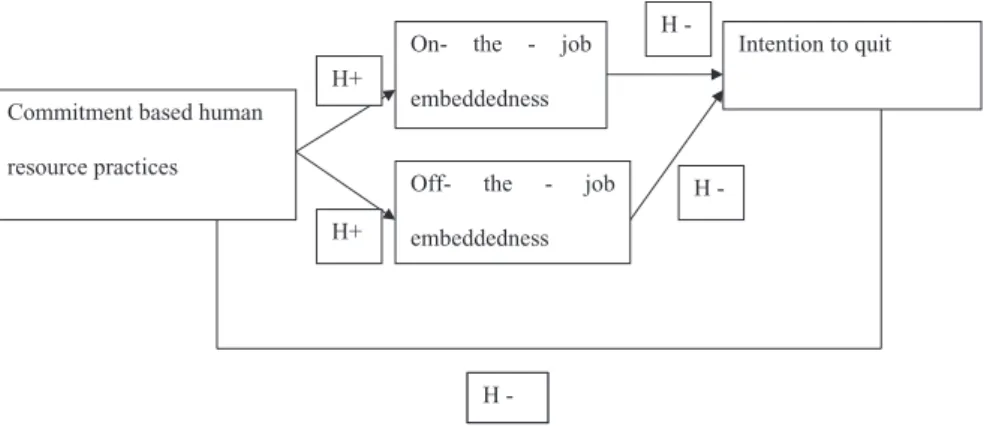
Responding to these research gaps this study explains the relationship between employee perceptions of CBHRP, on-the-job embeddedness and off-on-the-job embeddedness, and employee turnover intentions. Testable hypotheses are first developed, relying on a theoretical framework of job embeddedness, SHRM, and social exchange theory; and a model of these hypotheses is presented inFig. 1. As this figure indicates, it is predicted that both on-the-job embeddedness and off-the-job embeddedness mediate the relationship between CBHRP and employee turnover intentions. To test these hypotheses, data collected from a large scale field survey are analysed.
Literature review
Commitment based human resource practices (CBHRP)
The literature on SHRM can be traced to Barney’s resource-based view (Barney, 1991), according to which HR practices can contribute to competitive advantage by creating inimi-table, valuable resources and by providing behavioural per-spectives. Strategic HRM characterised by CBHRP signals a long-term investment in employees and suggests a rela-tional view of the employment relationship. Such a relation-ship obligates employees to reciprocate the organisation’s inducements with discretionary role behaviours or contribu-tions that benefit the organisation (Sun et al., 2007), leading to lower employee turnover (Arthur, 1994; Batt, 2002; Guchait & Cho, 2010; Huselid, 1995).
There has been much debate on the choice of HRM func-tions that should go to constitute CBHRP practices (Collins & Smith, 2006; Sun et al., 2007). Several scholars have adopted different measures of CBHRP across different studies, includ-ing recruitment and selection, job description, traininclud-ing, com-pensation, employee security, participation, communication, incentive pay, internal career opportunities, and team work
On- the - job embeddedness
Intention to quit Commitment based human
resource practices
Off- the - job embeddedness H+ H+ H - H - H -
(Collins & Smith, 2006; Huselid, 1995; Sun et al., 2007). This study includes CBHRP which is a combination of employee se-lection practices that assess fit to the company and create internal labour markets; compensation practices that facili-tate employee motivation on group and organisational per-formance indicators; and training programmes and performance appraisals that encourage long-term growth, team building, and development of firm specific knowledge adapted fromCollins and Smith (2006).
Strategic HRM authors argue that the way organisations adopt HRM practices impacts an employee’s perception of the intention of those practices. That perception in turn will affect the outcomes of the practices implemented. The employ-ee’s voice is often unheard in studies related to strategic HRM. This is partly because existing studies on HRM have often relied on quantitative studies with senior and/or HR managers as key informants (Cooke & Saini, 2010; Thite, Wilkinson, & Shah, 2012). This study, therefore, targets managerial employees as the key group of informants to evaluate the likely impact of SHRM practices on their perceptions to quit.
We submit that CBHRP would first directly influence the psychological link that affects the development of job embeddedness and then impact the psychological processes involved in predicting employee intentions to quit before it finally affects employee turnover. This focus on intention to quit is important because scholars have found intention to quit to be the best predictor of actual turnover over and above employee attitudes like job satisfaction and organisational commitment as predictors of actual turnover (Arnold & Feldman, 1982; Kumar & Singh, 2012; Steel & Ovalle, 1984; Zimmerman & Darnold, 2009). Predicting employee inten-tions to quit will help managers in adopting preventive mea-sures as it would be too late for the managers to take any concrete steps in the event of actual turnover.
Job embeddedness
Job embeddedness is seen as a totality of forces that keep employees embedded in their current employment. It differs from the traditional turnover model in that it is aimed at em-ployee retention (why people stay) instead of emem-ployee turn-over (why people leave) (Holtom & O’Neill, 2004). Although a number of studies have found that job embeddedness has gone beyond job satisfaction and organisational commit-ment in predicting variance in individual turnover (Holtom & O’Neill, 2004; Jiang, Liu, McKay, Lee, & Mitchell, 2012b; Lee, Mitchell, Sablynski, Burton, & Holtom, 2004; Mitchell et al., 2001; Ramesh & Gelfand, 2010; Wheeler et al., 2010), the overlap between the traditional model of voluntary turn-over and the job embeddedness model occurs mostly in the area of job satisfaction and organisational commitment, and particularly with continuance commitment dimension which has some aspects that are conceptually similar to job embeddedness (Mitchell et al., 2001). The continuance com-mitment scale encompasses two dimensions. The first dimen-sion is commitment due to lack of alternative employment opportunities and the second is the perceived sacrifice of in-vestments associated with leaving the organisation (Taing, Granger, Groff, Jackson, & Johnson, 2011).Mitchell et al. (2001)argued that job embeddedness and continuance com-mitment differ conceptually, mainly in three areas. First,
continuance commitment focuses on organisational issues only; second, continuance commitment does not include any items assessing job alternatives; and finally, job embeddedness as-sesses specific benefits that people feel they would have to give up if they left their jobs (such as future prospects and freedom).
Job embeddedness comprises three dimensions: links, fit, and sacrifice; each of these dimensions is associated with two factors, namely, on-the-job embeddedness and off-the-job embeddedness (Mitchell et al., 2001; Holtom & O’Neill, 2004). Links are characterised as formal connections (work team members, colleagues) or informal connections (family and friends) between a person and institutions or other people. The greater the number and the more important the links, the stronger will be the connection of the employee in a social, psychological, and financial web. Fit is defined as an employ-ee’s perceived compatibility or comfort with an organisation (such as employee’s personal values, and career goals) and with his or her environment (such as weather, amenities, and general culture). The better the fit, the higher the likeli-hood of an employee feeling professionally and personally tied to the organisation. Organisation sacrifice (such as giving up colleagues, interesting projects, job stability, and career ad-vancement) and community sacrifice (such as leaving a safe community, and respect in the community) captures the per-ceived cost of material or psychological benefits that may be forfeited by leaving the organisation or community. The more an employee would be required to give up while leaving, the more difficult it will be for him or her to sever employment with the organisation and connections with the community (Mitchell et al., 2001). Embeddedness represents the com-bination of several different kinds of forces. However,Lee et al. (2004)suggested that in some cases, it may be useful to consider on-the-job and off-the-job embeddedness sepa-rately and found that both the dimensions predicted differ-ent outputs.
The Indian context
As the context for this study, the experience of the advent of liberalisation of the Indian economy is significant enough to warrant some description. In 1991, following a serious balance of payment crisis India instituted dramatic free market reforms which included phased deregulation, elimination of the license regime to bring in competition, opening of the economy to foreign and private investment, rationalisation of tax structure, healthier functioning of capital markets, and increase in functioning autonomy of public sector undertak-ings’ (Som, 2008). Liberalisation intensified competition among the firms operating in India. As a result, HRM issues have now become more important with firms adopting strategies of ex-pansion, diversification, turnaround, and internationalisation. These developments have direct impact on Indian HR func-tions which are under severe pressure to develop a domes-tic workforce capable of facing the challenges brought forth by the economic liberalisation (Budhwar & Bhatnagar, 2008). To deal with the challenge managers felt the need to build capabilities, resources, competencies, strategies, and macro-as well macro-as micro-HRM activities, and this translates into stra-tegic HR roles. Thus, the general trend in Indian industry is encouraging for strategic human resource management
practices (Bhatnagar & Sharma, 2005). Linking innovative ap-proaches to HR with enhanced organisational productivity and sustainable competitive advantage (e.g.,Arthur, 1994; Delery & Doty, 1996; Guchait & Cho, 2010) is designated as CBHRP (Arthur, 1994). The emphasis of CBHRP literature is on utilising a system of management practices to give employees skills, information, motivation and latitude, which would result in a workforce that is a source of competitive advantage.
Studies investigating the extent to which HRM has been deployed strategically to facilitate employee retention in emerging economies such as India are rare, where the ap-proach to HRM and the HRM context may significantly differ from that of the West (Cooke & Saini, 2010). Among the few studies is the one byGuchait and Cho (2010)which found that when an organisation supported employees through a bundle of HR practices it made employees more committed to the organisation, which in turn lowered their turnover inten-tion. In our study we are including a potential mediator, job embeddedness, as it explains the variance in intent to quit and voluntary turnover more comprehensively than re-flected by attitudinal measures such as satisfaction or com-mitment (Allen, 2006; Holtom & O’Neill, 2004). The authors have further called for investigating the relationship with dif-ferent people, places and time to prove external validity. Holtbrugge, Friedmann, and Puck (2010)conducted a study which revealed that when foreign firms in India adopt HRM practices it decreased the likelihood of voluntary turnover. However, the study did not focus on Indian firms.
Strategic HRM research has occurred largely within the context of industrialised Western economies, and so it is im-portant to determine whether the same strategies are equally effective in other countries (Guchait & Cho, 2010). This re-search considers the impact of the Western SHRM frame-work and provides empirical evidence from India. Given the nascent stage of strategic HRM in India, both HR managers and researchers need a good understanding of HRM deter-minants in order to develop relevant policies and practices for the Indian context.
Commitment based human resource practice and job embeddedness
The link between HRM and strategy is becoming more useful because different strategies require different behaviours, and therefore different human resource policies to elicit and re-inforce those behaviours (Snell, 1992). There are various HR practices to choose from to achieve organisational goals. Arthur (1994)was the first to focus on commitment based human resource that invests in the long-term interest of the employees thereby ensuring their support for organisational goals. Strategic HRM researchers propagate that a combina-tion of HR practices such as CBHRP motivate, increase and empower employees to leverage their knowledge, skills, and abilities (KSAs) for organisational benefit by aligning their in-terests with those of the organisation, resulting in greater job satisfaction, lower employee turnover, higher productivity, and better decision making (Collins & Smith, 2006; Combs et al., 2006).
Commitment based HR practices facilitate in developing the fit dimension of job embeddedness by selecting people who have an overall fit with the company rather than the
specific job requirements. When more fitted employees are selected they may also develop fit with the organisation with respect to their personal values, career goals, and under-standing of the larger corporate culture. This will create a mutually reinforcing high-investment employer–employee re-lationship embedding employees more strongly in the organisation. When individuals perceive that the values of their organisation reflect their own identity, they would feel a strong bond with the organisation that would make leaving more difficult even if better tangible rewards were avail-able elsewhere. Moreover, individuals who share the values of employees in their organisation should find it easier to work and communicate with others, which should strengthen their bonds with the people at the organisation and make it more difficult for them to leave (Cable & DeRue, 2002).Ramesh and Gelfand (2010)argued that Indians are more likely to use these social ties to guide their choice of location thus fitting them strongly with the community.
Commitment based HR practices enable the implemen-tation of profit sharing and gain sharing incentives such as bonus based on the performance of the organisation. Such practices align individual goals with organisational goals (Evans & Davis, 2005) leading to better fit. Commitment based HR practices focus on creating an internal labour market, and companies wanting to provide their employees with growth opportunities will need to provide extensive training that fo-cusses on developing KSAs necessary to develop greater fit (Evans & Davis, 2005).
Commitment based HR practices facilitate the develop-ment of strong links through practices such as team build-ing, job rotation, and mentoring. Such practices make employees cooperate with and help their colleagues, offer suggestions to management, and join quality improvement committees linking an employee with more vertical and lateral work associates (Hom et al., 2009) further embedding them. Job rotation builds in different skill sets and different rela-tionships (Evans & Davis, 2005) enabling employees to develop their KSAs and also linking them to lateral associates embed-ding them in social relationships. Mentoring provides psy-chosocial support and career guidance along with improved communication between mentor and mentee (Fagenson-Eland, Marks, & Amendola, 1997). Such relationships link the em-ployee with senior management and losing such relation-ships will increase the perceived loss of such guidance to the employee. Relationships with experienced insiders can in-crease the number of links outside the organisation since mentors help develop more social networks; this in turn helps employees make sense of their environment, and embeds them in the community (Allen, 2006). Commitment based HR prac-tices encourage team based work design and organisation based compensation and rewards which encourage employ-ees to focus on organisational and team accomplishments based on organisation performance, thus increasing the preva-lence of shared values and goals (Collins & Smith, 2006). This develops employee cohesiveness and collective orientation (Collins & Clark, 2003), thus embedding employees strongly into the organisation. Further, encouraging team accom-plishments provides a platform for interaction and social learn-ing, forming closely-knit communities. The relationships developed due to such interactions may lead to ties of friend-ship and other links outside the organisation. Departing from such an organisation will increase the perceived personal loss
of losing colleagues, growth opportunities and social connections.
To strengthen the sacrifice factor, CBHRP encourages com-petitive compensation and organisation based rewards which ensure that invaluable employees are fairly rewarded (Collins & Smith, 2006) and reduce the perceptions of subjectivity, as the procedures for determining rewards are clear and absent of bias (Evans & Davis, 2005). Internal development opportunities such as cross training, mentoring and internal promotion demonstrate that employees are well invested in career development. These practices motivate employees to enhance their skills/knowledge and perform at levels that will increase their chance to realise their career goals (Wang, Bruning, & Peng, 2007). Further, a continuing relationship with such organisations will also be positively viewed by the family members and significant others outside the organisation, as a result of which employees will be less willing to take up other alternatives where they might run the risk of not getting family approval. Commitment based HR practices encourage em-ployees to develop firm-specific skills (skills which will in-crease his or her productivity only with the current employer). When organisations implement CBHRP they offer an ex-tended consideration of an employee’s wellbeing as well as an investment of the employee’s career within the firm, and in turn the employees develop a sense of obligation to the organisation. This in turn would lead to reciprocation in the form of willingness to learn firm specific skills and consider the organisation’s interest as important as core job duties, and assisting colleagues while working with groups (Tsui, Pearce, Porter, & Tripoli, 1997). This has the potential to serve as the source of competitive advantage (Jiang, Lepak, Hu, & Baer, 2012a). Firm specific skills help employees to con-tribute more within the firm where their skills are valued more than outside that organisation. Commitment based HR prac-tices such as work teams, mentoring, and cross training may provide employees with opportunities to share knowledge and to learn new skills (Collins & Smith, 2006; Jiang et al., 2012a, 2012b). Under such circumstances, severing relationships by leaving the organisation may be viewed as a sacrifice.
Hypothesis 1. Employee perceptions of CBHRP will be posi-tively related to on-the and off-the-job embeddedness.
Hypothesis 2. On-the-job and off-the-job embeddedness are negatively related to intention to quit.
Mediating influence of job embeddedness
Although the relationship between CBHRP and employee turn-over is well established, the intermediate elements are still not clear (Arthur, 1994; Delery & Doty, 1996; Guchait & Cho, 2010; Guthrie, 2001; Huselid, 1995; Sun et al., 2007; Williams & Mohamed, 2010). For example,Batt (2002)found that CBHRP correlated negatively with employee turnover and posi-tively with employee tenure. We expected CBHRP to be nega-tively related to intentions to quit in view of the learnings from the social exchange theory (Blau, 1964), particularly the norm of reciprocity (Gouldner, 1960) according to which one does not harm a partner from whom one has received ben-efits, such as the inducements and investments inherent in CBHRP. Since higher intentions to quit and turnover can un-dermine organisational performance (Guthrie, 2001), weexpect employees to reciprocate an organisation’s induce-ments with reduced intentions to quit.
We argue that CBHRP is likely to induce employee attach-ment through job embeddedness. When organisations invest in employees through CBHRP, the employees perceive the organisation as investing in them, which, under social ex-change theory, lowers their intentions to quit as they feel mu-tually obligated to the organisation (Shore, Bommer, Rao, & Seo, 2009). Commitment based HR practices suggest a long term employment relationship, and employees in organisations with such practices find themselves more congruent with organisational goals and values leading to better fit; they also find themselves vertically and horizontally linked with other colleagues leading to high level of attachment. The percep-tion of investments through training and development, in-ternal promotion, competitive compensation, mentoring, and company-wide social events increases the psychological cost of leaving a supportive organisation and community, reduc-ing an employee’s intentions to quit. Thus, the enmesh-ment of an employee in a web of different types of forces within a supportive work environment (fostered by CBHRP), such as link, fit and sacrifice, which is manifested in on-the-job embeddedness and off-the-on-the-job embeddedness, consti-tutes an underlying mechanism for the documented CBHRP– intentions to quit relationship.
Hypothesis 3. On-the-job and off-the-job embeddedness shall mediate the relationship between employee perceptions of CBHRP and intentions to quit.
Method
ParticipantsThis study surveyed full time managerial staff in the retail banking industry. The data were collected from 19 leading Indian banks (regional head offices only) which comprised 9 public sector undertaking (PSU) banks and 10 private sector banks. Survey invitations were circulated among 1056 em-ployees, and responses were obtained from 550 employees (52% response rate). Surveys with missing data were dropped from the sample for a final sample size of 501.
The range of respondents varied between 10 and 56 for each of the private banks and PSU banks. Respondents rep-resented a range of departments such as sales, operations, collections, information technology, human resource, and mar-keting. We received 250 (49.8%) completed surveys from private banks and 251 (50. 2%) questionnaires from public sector banks. Employees took part in the survey during company time, over a period of three months in June 2010. Statistical comparisons between the sample and overall popu-lation (all employees within the regional head offices) yielded no significant differences in age, gender, tenure, educa-tion, job level, or job type. These comparisons suggest that sampling bias, although not completely discounted, was not a major problem. In terms of gender makeup of the sample, 81.8% of the respondents were males and 18.2%, females. The average age of respondents was 38 years (standard devia-tion: s.d.=10.75), average organisation tenure was 12.06 years (s.d.=11.16) and the average city tenure was 7.49 years. In terms of the educational level of the sample 70% were
postgraduates, 1.0% had received an undergraduate degree, 0.5% had a PhD, and the other 28.5% were graduates.
Control variables
Gender, ownership, age, education, and organisational tenure served as control variables to control for alternative expla-nations. Past research shows that education and age are posi-tively correlated with job embeddedness (Giosan et al., 2005), and off-the-job job embeddedness decreases turnover, es-pecially among women (Holtom, Mitchell, Lee, & Eberly, 2008). Further,Holtom et al. (2006)found that with the in-crease in the organisational tenure, job embeddedness becomes more powerful in predicting voluntary turnover.
We propose that the time spent in the city may enmesh employees with their community by building strong relation-ships with the community members. Researchers frequently differentiate between public and private on the basis of own-ership. Entrepreneurs or shareholders own private sector firms, and public sector organisations are funded, owned, and con-trolled collectively by members of political parties at differ-ent levels of governmdiffer-ent (Budhwar & Boyne, 2004). This stance is adopted in this paper. Hence, the final control variable was ownership, which past research has shown to be related to HR policies and practices (Budhwar & Boyne, 2004; Sun et al., 2007).
Discriminant validity between on-the-job embeddedness, off-the-job embeddedness, CBHRP, and intentions to quit was assessed by using chi-square difference tests by computing theχ2difference of the chi-square values between the
con-strained (the covariance between each pair of constructs was fixed at 1) and unconstrained (all constructs were allowed to co-vary freely). For details, seeTable 1. This test was run for every possible pairing of constructs in the study. If the un-constrained model, with the drop of one degree of freedom, returns a chi-square value that is at least 3.84 lower than the constrained model, then a two factor solution provides a better fit to the data, and discriminant validity between two vari-ables is supported (Farrell, 2010).
Measures
A self-administered questionnaire was developed for this par-ticular study consisting of two components. The first com-ponent of the questionnaire comprised several Likert type
scale items. These statements sought to assess CBHRP, on-the-job embeddedness and off-on-the-job embeddedness, and intention to leave. The second part of the questionnaire iden-tified employees’ demographic data, such as age, gender, edu-cation level, ownership of the organisation, city tenure, and organisation tenure.
Organisation job embeddednesswas measured using nine items developed and validated byHoltom et al. (2006). The respondents indicated on a five-point Likert-type scales (1=strongly disagree and 5=strongly agree). A sample item for organisation job embeddedness is, “If I stay with my organisation”. Similar toLee et al. (2004), we averaged items for on-the-job embeddedness over their three sub dimen-sions of job embeddedness. The three organisation-focussed composites were aggregated to form organisation job embeddedness construct (α′s=0.83).
Community job embeddednesswas measured using 12
items. The respondents indicated on a five-point Likert-type scale (1=strongly disagree and 5=strongly agree) with 9 of the 12 items. The other 3 items measuring link commu-nity had yes or no answers. FollowingMitchell et al. (2001), we created Z-scores for three items. A sample item for com-munity job embeddedness is, “I really love the place where I live”. Similar toLee et al. (2004), the three community-focussed composites were aggregated to form community job embeddedness construct (α’s=0.74). To quoteFelps et al. (2009, p. 550)“Because individual job embeddedness is a for-mative (or indicator) construct, high internal consistency and unidimensionality are not the standards by which construct validity should be judged”. However, for descriptive pur-poses, we note that coefficient alpha was high.
Commitment based Human Resource Practices:CBHRP
was measured through the Collins and Smith’s Likert type scale (2006) comprising 16 items. Respondents rated each item on a five point scale (1=strongly disagree to 5=strongly agree). Cronbach’s alpha (using all the items) for the overall measure was 0.89.
Minor changes were made in the statements to make them suitable for getting the scale completed by the individual em-ployees. For example words like we, our, and employees were substituted with I and me. A sample item, both original and changed, for each of the sub dimension is as follows. The origi-nal item was “We select employees based on an overall fit to the company” and the changed item is “Employees are se-lected based on an overall fit to the company”; the original item, “Salaries for employees in these positions are higher than those of our competitors” was changed to “Salary for
Table 1 Chi-square difference test for examining discriminant validity.
Construct pair (unconstrained)χ2=2904 (d.f.=773) Constrainedχ2(d.f.=774) χ2difference
CBHRP–on-the job embeddedness 3045 141**
CBHRP–off-the-job embeddedness 3544 640**
CBHRP–ITQ 3302 398**
On-the job embeddedness–off-the-job embeddedness 3007 103**
On-the job embeddedness–ITQ 3289 385**
Off-the-job embeddedness–ITQ 3120 216**
Note 1: CBHRP=commitment based human resource practices; ITQ=intention to quit job.
my job is higher than those of our competitors”; the origi-nal item, “We have a mentoring system to help develop these employees” was changed to “My company uses mentoring system to help the employees develop”. We conducted a con-firmatory factor analysis where the items loaded cleanly on their respective human resource factors viz selection, train-ing and development, and performance management and com-pensation. We adopted the three-factor model in the study and used an additive index to reflect a single comprehen-sive measure of an HR system, which is consistent withSun et al. (2007). A high score on this factor reflects a high use of commitment based HR practices to manage the employer– employee relationship; a low score reflects a low use of com-mitment based HR practices.
Intention to quitwas measured through four items adopted fromMichaels and Spector (1982). Items were measured with a Likert-type scale on a scale of five (1=very unlikely, 5=very likely). A sample item is, “Am I actually planning to leave my job within the next six months?” Averaged composites were used in the analysis. The alpha reliability for the overall measure was 0.85.
Results
To test for multi-collinearity, we calculated tolerance indices, which are a direct measure of multi-collinearity. The sug-gested cutoff threshold is a tolerance value of 0.1 (Hair, Anderson, Tatham, & Black, 1998). FollowingHair et al. (1998) we adopted the method of omitting one of the highly corre-lated control variables as a remedy for the above-mentioned multi-collinearity. Hence, age was excluded and organisational tenure was included, because it was expected that employ-ees having longer organisational tenure would have more rel-evance to the relationship with on-the-job embeddedness and off-the-job embeddedness than age.
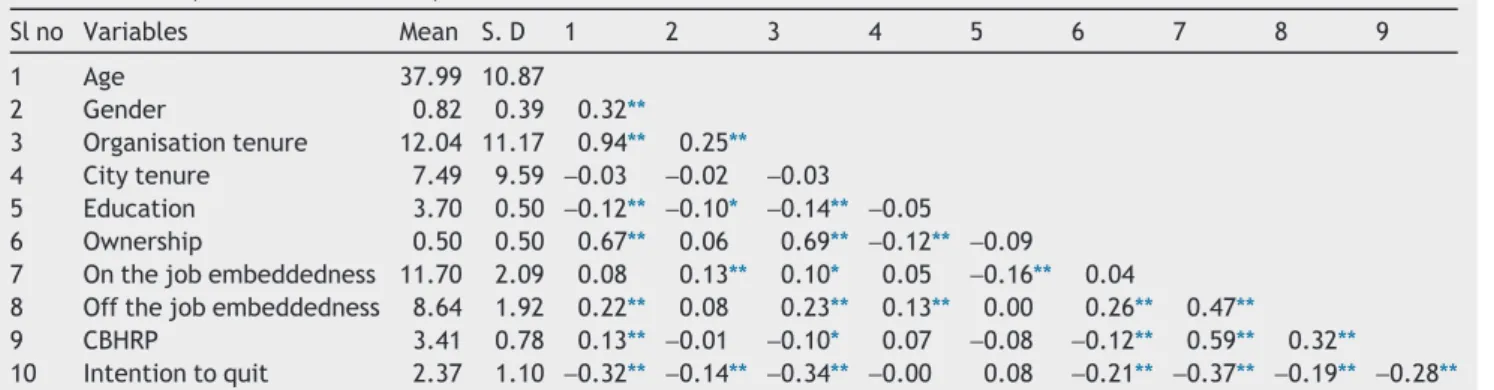
Table 2reports the mean, standard deviation, and cor-relations of all variables. The results showed statistically sig-nificant correlations between dependent and independent variables.
Hypothesis 1 posits that employee perceptions of CBHRP will be positively related to on-the-job embeddedness and off-the-job embeddedness. As noted inTable 2, the product–
moment correlation between CBHRP and on-the-job embeddedness is (r=0.59, p<0.001) and between CBHRP and off-the-job embeddedness is (r=0.32, p<0.001).Table 3 pres-ents the results for Hypothesis 1 viz the relationship between CBHRP and on-the-job embeddedness and off-the-job embeddedness. Hierarchical linear regressions were used, with the control variables in step 1 followed by the independent variables. The statistical significance of the relationship between the control variables and the dependent variable on-the-job embeddedness was R2=0.04 and with off-the-job
embeddedness R2=
0.10. The beta coefficient for gender and qualification was significant such that males reported greater on-the-job embeddedness than females, and highly quali-fied employees were less embedded on the job. In the second step, CBHRP variable was added to the existing control vari-ables and it was found to be significant (R2=0.39). We found
that the measure of CBHRP was significantly related to on-the-job embeddedness (β =0.59, p<0.001), after control-ling for organisational tenure, ownership, education, city tenure, and gender. For off-the-job embeddedness, the control variables in step 1 showed a statistically significant relation-ship (R2=0.10), with the coefficient for city tenure and
own-ership being significant such that long tenured employees with the city were embedded in the community and employees in the public limited companies were more embedded than the private limited companies. In the second step CBHRP was added and it was found to be significantly related to on-the-job embeddedness (β =0.59, p<0.001), after controlling for organisational tenure, ownership, education, city tenure, and gender (R2=0.22, p<0.001). We found that the measure of
CBHRP was significantly related to both on-the-job and off-the-job embeddedness (β =0.35, p<0.001). Thus, the data support Hypothesis 1.
Hypothesis 2 asserts that on-the-job embeddedness and off-the-job embeddedness will be negatively related to in-tention to quit. As noted inTable 2, the product–moment cor-relation between on-the-job embeddedness and intention to leave is negative and significant (r= −0.37, p<0.001) and between off-the-job embeddedness and intention to quit is negative and significant (r= −0.19, p<0.001). As noted in Table 3, for intention to quit, the control variable in step 1 was R2=0.12. In the second step job embeddedness was added
and it was found to be significant (R2=0.23). We found that
Table 2 Means, standard deviations, and correlations of measures.
Sl no Variables Mean S. D 1 2 3 4 5 6 7 8 9 1 Age 37.99 10.87 2 Gender 0.82 0.39 0.32** 3 Organisation tenure 12.04 11.17 0.94** 0.25** 4 City tenure 7.49 9.59 −0.03 −0.02 −0.03 5 Education 3.70 0.50 −0.12** −0.10* −0.14** −0.05 6 Ownership 0.50 0.50 0.67** 0.06 0.69** −0.12** −0.09
7 On the job embeddedness 11.70 2.09 0.08 0.13** 0.10* 0.05 −0.16** 0.04
8 Off the job embeddedness 8.64 1.92 0.22** 0.08 0.23** 0.13** 0.00 0.26** 0.47**
9 CBHRP 3.41 0.78 0.13** −0.01 −0.10* 0.07 −0.08 −0.12** 0.59** 0.32**
10 Intention to quit 2.37 1.10 −0.32** −0.14** −0.34** −0.00 0.08 −0.21** −0.37** −0.19** −0.28**
N=501.
The correlation coefficients are significant at *p<0.05, **p<0.01.
the measure of on-the-job embeddedness was significantly related to intention to quit and was the strongest predictor of intention to quit (β = −0.36, p<0.001) after controlling for organisational tenure, ownership, education, city tenure, and gender. The measure of off-the-job embeddedness was in-significantly related to intention to quit. Thus, the data support Hypothesis 2 partially.
Hypothesis 3 asserts that on-the job and off-the job embeddedness shall mediate the relationship between em-ployees’ perception of CBHRP and intention to quit. As shown inTable 3, the measure of CBHRP is significantly related to intention to quit (β = −0.31, p<0.001).
We used the bootstrap method (Preacher & Hayes, 2008) to test the mediation role of on-the-job embeddedness and off-the-job embeddedness. We generated 5000 bootstraps based on 501 observations with a 95% bias-corrected (BC) con-fidence interval and bootstrapped percentile for indirect effects.
We requested bootstrap estimates of indirect, direct, and total effects. As shown inTable 4, the bootstrapping results showed that the path coefficient of CBHRP→on-the-job embeddedness→intention to quit is statistically significant and CBHRP→off-the-job embeddedness→intention to quit is statistically insignificant. The interval between lower level confidence interval (CI) and upper level CI does not include zero, hence we can conclude that CBHRP is completely me-diated (as only indirect effect is significant) by on-the-job embeddedness. Off-the-job embeddedness did not mediate the effects of CBHRP and intentions to quit as hypothesised because off-the-job embeddedness (mediator) is statisti-cally insignificant in predicting intentions to quit (depen-dent variable). Taken together, these results provide partial support for Hypothesis 3.
Discussion
The purpose of the study was to examine (1) the influence of a specific combination of CBHRP practices on the em-ployee intentions to quit; (2) the mediating effects of on-the-job embeddedness and off-on-the-job embeddedness; (3) the relationship between CBHRP and employee intentions to quit. Commitment based HR practices emerged as a significant pre-dictor of employee intentions to quit. The index of the three HRM practices showed a strong influence on intentions to quit. The results indicate that when employees’ perception of the CBHRP practices is increased by one unit, their intentions to quit decrease by 0.31. The study also found that on-the-job embeddedness completely mediated the relationship between CBHRP and intention to quit, and off-the-job embeddedness did not have any mediating impact on intention to quit. This unique CBHRP–on-the-job embeddedness–intention to quit re-lationship suggested that the employees’ belief that an organisation intends to invest in them and maintain a long term relationship with them makes them more embedded in the organisation, which in turn can lower their intention to quit. As SHRM scholars have hypothesised about the poten-tially indirect relationship between CBHRP and intention to quit (Arthur, 1994; Delery & Doty, 1996; Huselid, 1995; Sun et al., 2007), this study empirically confirms that this rela-tionship is mediated by on-the-job embeddedness, but off-the-job embeddedness did not have any mediating impact;
Table 3 Results of regression analyses predicting job embeddedness a. Predictors On-the-job embeddedness Of f-the-job embeddedness Intention to quit TI TI TI TI TI TI TI Gender 0.10 * 0.91 0.10 * 0.91 0.05 0.91 0.05 0.91 − 0.05 0.91 − 0.05 0.91 − 0.02 0.90 Organisational tenure 0.07 0.47 0.10 0.47 0.07 0.47 0.09 0.47 − 0.35 ** * 0.47 − 0.37 ** * 0.47 − 0.33 ** * 0.47 Tenure in the city 0.04 0.98 − 0.01 0.98 0.16 *** 0.98 0.14 ** 0.98 − 0.01 0.98 0.01 0.98 0.00 0.95 Education − 0.14 ** 0.97 − 0.08 ** 0.97 0.05 0.97 0.08 0.97 0.03 0.97 0.00 0.97 − 0.02 0.93 Ownership − 0.02 0.5 − 0.03 0.50 0.22 *** 0.50 0.26 *** 0.50 0.04 0.5 0.01 0.50 0.02 0.48 CBHRP 0.59 *** 0.98 0.35 *** 0.98 − 0.31 *** 0.98 On-the-job embeddedness − 0.36 ** * 0.66 Of f-the-job embeddedness − 0.05 0.69 R 2 0.04 0.39 0.10 0.22 0.12 0.22 0.23 Δ R 2 0.03 0.38 0.09 0.21 0.11 0.21 0.22 F 4.44 ** 51.78 *** 10.94 *** 23.34 *** 13.76 *** 22.83 *** 21.41 *** Notes: N = 501. aStandardised coef ficients are shown; CBHRP = commitment based HR practices; TI = tolerance indices. * p ≤ 0.05. ** p ≤ 0.01. *** p ≤ 0 .001.
this is probably because off-the-job embeddedness may be a stronger predictor of intention to quit when turnover re-quires geographic relocation involving the severing of com-munity ties, and a stronger comcom-munity relationship may lead to greater awareness of job alternatives and perceptions of ease of finding a new job (Allen, 2006; Mitchell et al., 2001; Ramesh & Gelfand, 2010).
The findings of this study clearly indicate the need for Indian organisations as well as for multinational companies (MNCs) operating in India to focus on their CBHRP practices and invest in their employees, to retain their employees and maintain their efficiency level as employee turnover de-creases productivity (Guthrie, 2001). Thus, this research is in line with international HRM studies, adding to the growing body of literature on management practices and HRM in India. Ownership emerged as a strong predictor of off-the-job embeddedness such that employees in the public limited com-panies are strongly embedded with the community. A pos-sible explanation for this might be that in comparison to public limited companies, employees in Indian private sector organisations perceive their work climate to be more au-thoritarian, tightly controlled and more responsive to the com-petitive business environment, and that the private sector compensates their employees based on performance and com-petencies. On the other hand, Indian public-sector organisations still rely on total work experience to compen-sate their employees (Budhwar & Boyne, 2004). Therefore, when employees of public sector receive transfer orders it is seen that they often delay accepting the transfer order, and in many cases avoid transfers, which provides an oppor-tunity to the Indian public-sector employees to reside in a par-ticular community for a longer period. However, to develop a thorough understanding of the above relationship it is im-portant to conduct more empirical research.
Contrary toGiosan et al. (2005), our study revealed that the controlled variable city tenure predicted off-the-job embeddedness. This is a unique contribution of our study and suggests that employees may get attached to organisations because of their personal attachments to the cities/towns they stay in. Further, when an employee spends more time in a city it could mean that he/she loves the weather, ameni-ties, entertainment facilities or general culture of the loca-tion leading to a better fit with the community. Thus, those with more links and fit are likely to incur greater costs— whether financial, emotional, or psychological—in leaving their current place. Therefore, city tenure was included as a con-trolled variable (Holtom & O’Neill, 2004; Mitchell et al., 2001).
Managerial implications
This study has several implications for managers. Commit-ment based HR practice is a strategic human resource man-agement system that allows organisations to invest resources in individual employees so that employee performance and retention directly link to departmental productivity and organisational financial performance. An understanding of how CBHRP is likely to play a role in intention to quit will help to improve the accuracy and generalisability of CBHRP, thereby providing insight into how employees can be re-tained more effectively. Managers need to be aware that although SHRM may not directly affect turnover, it is through on-the-job embeddedness that SHRM creates employee attachment.
Managers can look for several strategies from CBHRP. Man-agers can strengthen the links by including training methods such as job rotation of individuals to job assignments that will help employees develop a broader understanding of work processes, establish mentoring programmes, sponsor social events, and strengthen teams. Further, to strengthen the fit between the individual and the organisation, managers can develop selective staffing systems that screen appli-cants on the job-related contextual criteria, providing op-portunities for multiple career paths. Also, organisations can provide extensive training that focusses on employee expectations and KSAs necessary to function effectively re-sulting in greater fit. Managers must clearly state core values, which support internal staff at all levels. Managers must develop commitment to continuous learning and career development.
Finally, organisations are encouraged to offer unique ben-efits that are hard for other companies to replicate such as training on firm-specific skills for future advancement within the company, competitive compensation, and aligning per-formance appraisal goals with personal development (incur-ring sunk costs limiting external mobility).
The findings provide added incentive for organisations to consider demographic factors such as city tenure as factors in employee selection. The second feature of this research is in line with international HRM studies, which adds to the growing body of literature on management practices and HRM on India. Finally, this research article contributes in provid-ing evidence from an important emergprovid-ing economy where the strategic role of HRM as a key driver of firm performance (lower intention to quit) has gained importance after the liberalisation of Indian economy in 1991.
Table 4 Results of mediation predicting intention to quita
. Bootstrapping Direct effect Indirect effect Boot standard error 95% Confidence interval LLCI ULCI
CBHRP–on-the-job embeddedness–intention to quit −0.09 (ns) −0.18*** 0.035 −0.255 −0.119 CBHRP–off-the-job embeddedness–intention to quit −0.24*** −0.04 (ns) 0.018 −0.076 0.001
Notes: N=501.
aCBHRP=commitment based HR practices, on-the-job embeddedness=on the job embeddedness; off-the-job embeddedness=off the
job embeddedness; LLCI=lower level confidence interval; ULCI=upper level confidence interval.
*p≤0.05.
**p≤0.01.
Limitations and future research directions
Although the results of this study are promising, some caveats are in order. There may be questions about the accuracy of the responses as the data were obtained only through self-reports i.e. all the variables studied in the above study were measured from the same source at the same time. Thus, any conclusion drawn from this research should be treated with caution. However, results showed that CBHRP related dif-ferently to on-the-job and off-the-job embeddedness, pro-viding some evidence that response is not merely the result of common method variance. We adopted scale reordering as a procedural option for minimising this bias, and the survey instrument used in this was structured such that job embeddedness and CBHRP items preceded the intention to quit items. Also, Harman’s one-factor test showed that the first factor accounted for only 23.8% of the covariance among measures (Podaskoff & Organ, 1986), suggesting that common method variance is not a significant issue. This study is cross-sectional in nature; hence, although intentions to quit may be the best predictor of quitting behaviour, unless longitu-dinal studies are undertaken, the degree to which stated quit-ting intentions are acted on cannot be assessed. Future research could use longitudinal methods for studying the impact of CBHRP on actual turnover through the mediation of on-the-job embeddedness and off-the-job embeddedness. Another limitation arises from the fact that we tested our model on a medium-sized sample drawn solely from banking enterprises in India, particularly from eastern India. Al-though we expect our findings to hold when applied to other industries and other countries, our exclusive focus on one in-dustry and our moderate sample size remains a limiting factor in the study. Future research could employ larger sample sizes and examine other types of industries to cross-validate our model in different settings.
Despite these limitations, the study provides a new ex-planation for the relationship between combinations of human resource programmes, policies, and practices that lead to spe-cific employee behaviour such as lowered intention to quit and increased employee retention. Even though our find-ings suggested that companies following CBHRP generally retain more employees than those not following a CBHRP ap-proach, we did not examine whether moderating conditions limit the positive impact of CBHRP. Future research could look at potential moderators of the relationships between CBHRP and on-the-job embeddedness, and investigate how job embeddedness evolves over time, as organisational tenure did not embed employees over time in the organisation.
Conclusion
This study provides preliminary evidence on the role of firm’s CBHRP in enhancing on-the-job embeddedness and off-the-job embeddedness. In particular, we found that CBHRP was significantly related to both the dimensions of job embeddedness. Moreover, on-the-job embeddedness medi-ated the relationship between CBHRP and intentions to quit, whereas off-the-job embeddedness did not have any impact. Our findings suggest that the managers of firms operating in India should carefully choose HR practices to manage their knowledge workers, because these practices may influence the relationship between employees and their organisations, which in turn, may affect their willingness to stay with the organisation. The results provide further insight into the reasons why effective SHRM by companies leads to de-creased intentions to quit. However, much still remains unknown, and studies on these topics can help inform prac-titioners on how to better achieve desired retention and per-formance outcomes.
Appendix
Factor structure of commitment based HR practices
References
Allen, D. G. (2006). Do organizational socialization tactics
influ-ence newcomer embeddedness and turnover.Journal of
Man-agement,32(2), 237–256.
Arnold, H. J., & Feldman, D. C. (1982). A multivariate analysis of the
determinants of job turnover.Journal of Applied Psychology,67(3),
350–360.
Arthur, J. B. (1994). Effects of human resource systems on
manu-facturing performance and turnover.Academy of Management
Journal,37(3), 670–687.
Barney, J. (1991). Firm resources and sustained competitive
advan-tage.Journal of Management,17(1), 99–120.
Batt, R. (2002). Managing customer services: human resource
prac-tices, quit rates, and sales growth.Academy of Management
Journal,45(3), 587–597.
Berg, P. (1999). The effects of high performance work practices on
job satisfaction in the United States steel industry.Industrial
Re-lations,54(1), 111–134.
Bergiel, E. B., Nguyen, V. Q., Clenney, B. F., & Taylor, G. S. (2009). Human resource practices, job embeddedness
and intention to quit.Management Research News,32(3), 205–
219.
Bhatnagar, J., & Sharma, A. (2005). The Indian perspective of
strategic hr roles and organizational learning capability.
Inter-national Journal of Human Resource Management,16(9), 1711– 1739.
Blau, P. (1964).Exchange and power in social life. New York:
Wiley.
Bowen, D. E., & Schneider, B. (1988). Services marketing and man-agement: Implications for organizational behavior. In B. M. Staw
& L. L. Cummings (Eds.),Research in organizational behaviour
(pp. 43–80). Greenwich, CT: JAI Press.
Budhwar, P., & Boyne, G. (2004). Human resource management in the Indian public and private sectors: an empirical comparison. International Journal of Human Resource Management,15(2), 346– 370.
Budhwar, P. S., & Bhatnagar, J. (Eds.), (2008).The changing face
of people management in India. Routledge.
Cable, D. M., & DeRue, D. S. (2002). The convergent and
discrimi-nant validity of fit perceptions.Journal of Applied Psychology,
87(5), 875–884.
Collins, C. J., & Clark, K. D. (2003). Strategic human resource prac-tices, top management team social networks, and firm perfor-mance: the role of human resource practices in creating
organizational competitive advantage.Academy of
Manage-ment Journal,46(6), 740–751.
Collins, C. J., & Smith, K. G. (2006). Knowledge exchange and com-bination: the role of human resource practices in the
perfor-mance of high technology firms.Academy of Management Journal,
49(3), 544–560.
Combs, J., Liu, Y., Hall, A., & Ketchen, D. (2006). How much do high-performance work practices matter? A meta-analysis of their
effects on organisational performance.Personnel Psychology,
59(3), 501–528.
Cooke, F. L., & Saini, D. S. (2010). How does the HR strategy support an innovation oriented business strategy? An investigation of in-stitutional context and organisational practices in Indian firms. Human Resource Management,49(3), 377–400.
Delery, J. E., & Doty, D. H. (1996). Modes of theorizing in strategic human resource management: tests of universalistic,
contin-gency, and configurational performance predictions.Academy of
Management Journal,39(4), 802–835.
Evans, W. R., & Davis, W. D. (2005). High-performance work systems and organizational performance: the mediating role of internal
social structure.Journal of Management,31(5), 758–775.
Factor and items Rotated factor loadings
Loadings I Loadings II Loadings III Internal candidates are given consideration over external candidates for job openings. 0.32
Employees are selected based on an overall fit to the company. 0.78
Our selection system focusses on the potential of the candidate to learn and grow with the organisation.
0.76 I have been made aware about the internal promotion opportunities available in my job. 0.61 Employee bonuses or incentive plans are based primarily on the performance of the
organisation.
0.59
Salary for my job is higher than those of our competitors. 0.71
Shares of stock are available to me through stock purchase plans. 0.63
Goals for incentive plans are based on business unit or company performance. 0.63 Multiple career path opportunities are provided to me to move across multiple functional
areas of the company.
0.61
Training is focussed on team-building and teamwork skills. 0.70
Company social events are sponsored for employees to get to know one another. 0.63 An orientation programme is offered to train employees on the history and processes of
the organisation.
0.71 My company uses Job rotation to expand the skills of employees. 0.75 My company uses Mentoring system to help the employees develop. 0.74 Performance appraisals are used primarily to set goals for personal development. 0.62 Performance appraisals are used to plan skill development and training for future
advancement within the company.
0.58
Eigen values 6.34 1.44 1.30
Explained variance (%) 39.65 8.96 8.06
Fagenson-Eland, E. A., Marks, M. A., & Amendola, K. L. (1997).
Per-ceptions of mentoring relationships.Journal of Vocational
Behavior,51(1), 29–42.
Farrell, A. M. (2010). Insufficient discriminant validity: a comment
on bove, pervan, beatty, and shiu (2009).Journal of Business
Research,63(3), 324–327.
Felps, W., Mitchell, T. R., Hekman, D. R., Lee, W. T., Holtom, B. C., & Harman, S. W. (2009). Turnover contagion: how cowork-ers’ job embeddedness and job search behaviors influence
quit-ting.Academy of Management Journal,52(3), 545–561.
Giosan, C. H., Holtom, B. C., & Watson, M. R. (2005). Antecedents to job embeddedness: the role of individual, organisational and
market factors.Journal of Organisational Psychology,5, 31–
44.
Gouldner, A. W. (1960). The norm of reciprocity: a preliminary
state-ment.American Sociological Review, 161–178.
Guchait, P., & Cho, S. (2010). The impact of human resource man-agement practices on intention to leave of employees in the service industry in India: the mediating role of organizational
commit-ment.The International Journal of Human Resource
Manage-ment,21(8), 1228–1247.
Guthrie, J. P. (2001). High involvement work practices, turnover and
productivity: evidence from New Zealand.Academy of
Manage-ment Journal,44(1), 180–190.
Hair, J. E., Anderson, R. E., Tatham, R. L., & Black, W. C. (1998). Multivariate data analysis(5th ed.). Englewood Cliffs. NJ: Pren-tice Hall.
Holtbrugge, D., Friedmann, C. B., & Puck, J. F. (2010). Recruit-ment and retention in foreign firms in India: a resource-based view. Human Resource Management,49(3), 439–455.
Holtom, B. C., Mitchell, T. R., Lee, T. W., & Eberly, B. M. (2008). Turnover and retention research: a glance at the past, a closer
review of the present, and a venture into the future.The Academy
of Management Annals,2(1), 231–274.
Holtom, B. C., Mitchell, T. R., Lee, T. W., & Tidd, S. (2006). Less is more: validation of a short form of the job embeddedness measure and theoretical extensions. Paper presented at the Annual meeting of the Academy of Management, Atlanta.
Holtom, B. C., & O’Neill, B. S. (2004). Job embeddedness: a theoretical foundation for developing a comprehensive nurse
retention plan.Journal of Nursing Administration,34(5), 216–
227.
Hom, P. W., Tsui, A. S., Wu, J. B., Lee, T. W., Zhang, A. Y., Fu, P. P., et al. (2009). Explaining employment relationships with social
exchange and job embeddedness.Journal of Applied
Psychol-ogy,94(2), 277–297.
Huselid, A. M. (1995). The impact of human resource management practices on turnover, productivity, and corporate financial
per-formance.Academy of Management Journal,38(3), 635–672.
Jiang, K., Lepak, D. P., Hu, J., & Baer, J. C. (2012a). How does human resource management influence organizational outcomes? A
meta-analytic investigation of mediating mechanisms.Academy of
Man-agement Journal,55(6), 1264–1294.
Jiang, K., Liu, D., McKay, P. F., Lee, T. W., & Mitchell, T. R. (2012b). When and how is job embeddedness predictive of turnover? A
meta-analytic investigation.Journal of Applied Psychology,97(5),
1077–1096.
Kumar, M., & Singh, S. (2012). Roles of perceived exchange quality and organisational identification in predicting turnover
inten-tion.IIMB Management Review,24(1), 5–15.
Lee, T. W., Mitchell, T. R., Sablynski, J. C., Burton, P. J., & Holtom, C. B. (2004). The effects of job embeddedness on organizational citizenship, job performance, volitional absences, and voluntary
turnover.Academy of Management Journal,47(1), 711–722.
Michaels, C., & Spector, D. E. (1982). Causes of employee turn-over: a test of the mobley, griffeth, hand, and meglino model. Journal of Applied Psychology,67(1), 53–59.
Mitchell, T. R., Holtom, B. C., Lee, T. W., Sablynski, C. J., & Erez, M. (2001). Why people stay: using job embeddedness construct
to predict Voluntary turnover.Academy of Management Journal,
44(6), 1102–1121.
Podaskoff, P. M., & Organ, D. W. (1986). Self-reports in
organiza-tional research: problems and prospects.Journal of
Manage-ment,12(4), 531–544.
Preacher, K. J., & Hayes, A. F. (2008). Asymptotic and resampling strat-egies for assessing and comparing indirect effects in multiple
me-diator models.Behavior Research Methods,40(3), 879–891.
Ramesh, A., & Gelfand, M. J. (2010). Will they stay or will they go? The role of job embeddedness in predicting turnover in
individu-alistic and collectivistic cultures.Journal of Applied
Psychol-ogy,95(5), 807–823.
Shore, L. M., Bommer, W. H., Rao, A. N., & Seo, J. (2009). Social and economic exchange in the employee-organization
relation-ship: the moderating role of reciprocation wariness.Journal of
Managerial Psychology,24(8), 701–721.
Snell, S. A. (1992). Control theory in strategic human resource man-agement: the mediating effect of administrative information. Academy of Management Journal,35(2), 292–327.
Som, A. (2008). Innovative human resource management and cor-porate performance in the context of economic liberalization in
India.The International Journal of Human Resource
Manage-ment,19(7), 1278–1297.
Steel, R. P., & Ovalle, N. K. (1984). A review and meta-analysis of research on the relationship between behavioral intentions and
em-ployee turnover.Journal of Applied Psychology,69(4), 673–686.
Sun, L., Aryee, S., & Law, K. S. (2007). High performance human re-source practices, citizenship behavior, and organisational
per-formance: a relational perspective.Academy of Management
Journal,50(3), 558–577.
Taing, M. U., Granger, B. P., Groff, K. W., Jackson, E. M., & Johnson, R. E. (2011). The multidimensional nature of continuance com-mitment: commitment owing to economic exchanges versus lack
of employment alternatives.Journal of Business and
Psychol-ogy,26(3), 269–284.
Thite, M., Wilkinson, A., & Shah, D. (2012). Internationalization and HRM strategies across subsidiaries in multinational corporations
from emerging economies—A conceptual framework.Journal of
World Business,47(2), 251–258.
Tsui, A. S., Pearce, J. L., Porter, L. W., & Tripoli, A. M. (1997). Al-ternative approaches to the employee-organization
relation-ship: does investment in employees pay off? Academy of
Management Journal,40(5), 1089–1121.
Wang, X., Bruning, N. S., & Peng, S. (2007). Western high-performance HR practices in China: a comparison among public-owned, private
and foreign-invested enterprises.International Journal of Human
Resource Management,18(4), 684–701.
Wheeler, A. R., Harries, K. J., & Harvey, P. (2010). Moderating and mediating the HRM effectiveness—intend to turnover
relation-ship: the roles of supervises & job embeddness.Journal of
Mana-gerial Issue,22(2), 182–196.
Williams, J. G., & Mohamed, R. B. (2010). A comparative study of the effects of “best practice” HRM on worker outcomes in
Ma-laysia and England local government.The International Journal
of Human Resource Management,21(5), 653–675.
Zimmerman, R. D., & Darnold, T. C. (2009). The impact of job per-formance on employee turnover intentions and the voluntary
turn-over process. A meta-analysis and path model.Personnel Review,