FLOW AND THE FIVE-FACTOR MODEL (FFM) OF PERSONALITY CHARACTERISTICS
A DISSERTATION IN Counseling Psychology
Presented to the Faculty of the University of Missouri – Kansas City in partial fulfillment of
the requirements for the degree DOCTOR OF PHILOSOPHY
by
PATRICIA LEE HAGER
M.A., University of Missouri – Kansas City, 2011 B.S., University of Central Missouri, 2008
Kansas City, Missouri 2015
© 2015
PATRICIA LEE HAGER ALL RIGHTS RESERVED
FLOW AND THE FIVE-FACTOR MODEL (FFM) OF PERSONALITY CHARACTERISTICS
Patricia Lee Hager, Candidate for the Doctor of Philosophy University of Missouri – Kansas City, 2015
ABSTRACT
Flow is an area that has had a flourish of research emerge within the past couple of decades originating in the sport psychology literature (Jackson & Eklund, 2006; Hefferon & Ollis, 2006; Kee & Wang, 2008) and in a multitude of other areas of study since such as
academics, creativity, motivation, and gaming (Cermakova, Moneta, & Spada, 2010; Fritz & Avsec, 2007; Fullagar & Mills, 2008; Jin, 2011; Lee, 2005). Presently, the study of flow has arisen in the area of personality and the individual characteristics that contribute to one’s personality (Ullén, et al., 2012). The purpose of the current study was to provide the
beginning investigation into flow and personality characteristics (as represented by the Five-Factor Model of Personality) to offer insight into dispositional flow and the autotelic
personality. Additionally, the purpose of this study was to improve on the limitations that were presented in Ullén and colleagues’ (2012) and Ross and Keiser’s (2014) studies. The sample consisted of 409 English-speaking adults who completed the study measures online. Results of exploratory and confirmatory factor analyses indicated relationships between dispositional flow and four of the five personality factor. Specifically, results revealed
positive relationships between dispositional flow and the following personality factors: extraversion, openness to experience, and conscientiousness. These relationships suggest that individuals higher in these personality traits may have a greater disposition to
experience flow. Results revealed an inverse relationship between dispositional flow and neuroticism suggesting that neurotic tendencies may possibly hinder an individual’s disposition to experience flow. Furthermore, the present study improved upon the limitations of the current studies by providing a larger, more heterogeneous sample that aligned more closely with the normative sample of the measurements and utilized valid and reliable measurements for dispositional flow and personality. The present findings highlight the complex and multi-dimensional relationships that exist between dispositional flow and personality characteristics; as well as providing a foundation for future research to continue to explore these relationships. Limitations, future areas of research, and implications are discussed.
APPROVAL PAGE
The faculty listed below, appointed by the Dean of the School of Education, have examined a dissertation titled “Flow and the Five-Factor Model (FFM) of Personality Characteristic,” presented by Patricia Lee Hager, candidate for the Doctor of Philosophy degree, and certify that in their opinion it is worthy of acceptance.
Supervisory Committee
Jacob Marszalek, Ph. D., Committee Chair Division of Counseling and Educational Psychology
Carolyn Barber, Ph.D.
Division of Counseling and Educational Psychology LaVerne Berkel, Ph.D.
Division of Counseling and Educational Psychology Nancy Murdock, Ph.D.
Division of Counseling and Educational Psychology Johanna Nilsson, Ph.D.
CONTENTS ABSTRACT ... iii LIST OF ILLUSTRATIONS ... x LIST OF TABLES ... xi ACKNOLWEDGEMENTS ... xii Chapter I. INTRODUCTION ... 1
II. LITERATURE REVIEW ... 9
Flow ... 11
Nine Dimensions of Flow ... 12
Flow in Different Contexts ... 14
Academics... 14
Procrastination and Motivation... 16
Creativity ... 20
Sports ... 24
Online and Video Gaming ... 28
Measurements of Flow ... 32
Flow State Scale – 2 (FSS – 2) ... 34
Dispositional State Scale – 2 (DFS – 2) ... 36
Personality Characteristics in Psychological Research and Flow ... 38
The Five-Factor Model of Personality ... 47
Neuroticism... 49
Openness to Experience ... 53
Agreeableness ... 55
Conscientiousness ... 56
Purpose of the Present Study ... 58
Research Hypotheses and Questions ... 59
III. METHODOLOGY ... 62
Participants ... 62
Procedure ... 65
Measures ... 67
Demographics ... 67
Dispositional Flow Scale – 2 (DFS - 2) ... 67
NEO Personality Inventory – Revised (NEO-PI-R) ... 68
IV. ANALYSIS ... 71
Data Preparation ... 71
Reliability ... 109
Dimensionality ... 110
Initial Exploratory Factor Analysis Results: Creation of Parcels ... 111
Dispositional Flow Scale – 2 (DFS - 2) ... 112
NEO Personality Inventory – Revised (NEO-PI-R) ... 116
Confirmatory Factor Analysis Results... 126
Overall Model ... 126
Individual Models: Flow & FFM Domains ... 126
Neuroticism... 130
Extraversion ... 135
Openness to Experience ... 139
Agreeableness ... 143
Conscientiousness ... 147
Relationships between DFS-2 Subscales & NEO-PI-R Facets ... 150
Conclusions... 155 V. DISCUSSION ... 157 Hypotheses ... 160 Hypothesis 1 ... 160 Hypothesis 2 ... 161 Hypothesis 3 ... 163 Research Questions ... 164 Research Question 1 ... 165 Research Question 2 ... 166 Research Question 3 ... 167
Limitations of the Present Study... 169
Strengths of the Present Study ... 172
Areas of Future Research ... 173
Conclusions... 174
Appendix A. DEMOGRPAHIC FORM ... 178
C. SOLICTATION ANNOUCEMENT FOR PSYCHPOOL ... 180
D. SOLICATION ANNOUCEMENT FOR MTURK ... 181
E. INFORMED CONSENT FOR LISTSERVS ... 182
F. INFORMED CONSENT FOR PSYCHPOOL ... 184
G. INFORMED CONSENT FOR MTURK ... 186
H. ONLINE RAFFLE FORM ... 188
I. IRB INITIAL APPROVAL LETTER ... 189
J. IRB AMENDMENT APPROVAL LETTERS ... 191
REFERENCE LIST ... 193
ILLUSTRATIONS
Figure Page
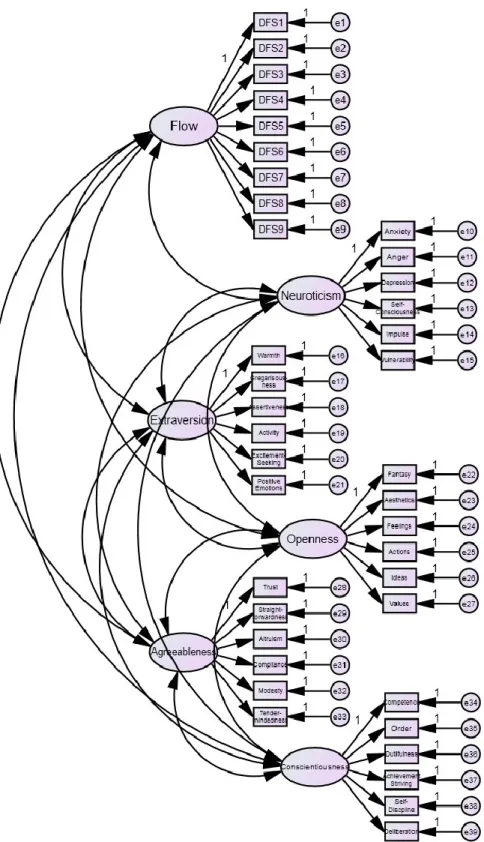
1. Heuristic diagram of the proposed CFA model relating the latent constructs of dispositional flow and FFM factors ... 61
TABLES
Table Page
1. Psychometric Properties of the DFS-2 ... 74
2. Psychometric Properties of the NEO-PI-R ... 77
3. Normative Means of the DFS-2 and NEO-PI-R ... 96
4. Correlations of the DFS-2 Subscales ... 98
5. Correlations of the NEO-PI-I Domains ... 99
6. Correlations of the NEO-PI-R Original Facets ... 99
7. Correlations of the NEO-PI-R Study Facets ... 103
8. Initial Exploratory Factor Analysis (EFA) Factor Loadings, Standard Errors, and Model Fit Indices – DFS-2 ... 114
9. Initial Exploratory Factor Analysis (EFA) Factor Loadings, Standard Errors, and Model Fit Indices – NEO-PI-R ... 118
10. Confirmatory Factor Analysis (CFA) Results ... 128
11. Final EFA Factor Loadings, Standard Errors, and Model Fit Indices – DFS-2 and Neuroticism (N) ... 134
12. Final EFA Factor Loadings, Standard Errors, and Model Fit Indices – DFS-2 and Extraversion (E) ... 138
13. Final EFA Factor Loadings, Standard Errors, and Model Fit Indices – DFS-2 and Openness to Experience (O) ... 142
14. Final EFA Factor Loadings, Standard Errors, and Model Fit Indices – DFS-2 and Agreeableness (A) ... 145
15. Final EFA Factor Loadings, Standard Errors, and Model Fit Indices – DFS-2 and Conscientiousness (C) ... 149
ACKNOWLEDGEMENTS
I want to thank the following people for being part of my journey and for touching my life in ways that I cannot fully express:
University of Missouri – Kansas City…Dr. Marszalek, for both being a mentor and supportive pillar for me, and for guiding me through this process throughout all the unique hurdles we encountered. The members of my committee (Dr. Barber, Dr. Berkel, Dr. Murdock, and Dr. Nilsson), not only for your feedback and guidance, but for your support throughout my journey and invaluable lessons you have taught me along this way. Dr. Duan, for teaching me to believe in myself and find my own path. My cohort, who I was so fortunate to experience this journey with and have made life-long friends.
Truman Medical Center…Dr. McDaniel, Dr. Shult, Dr. Sickle, and Leah, you have
been the driving force of encouragement along this final leg of the journey and an invaluable support system. You have helped me to grow in ways I could not have imagined and
created a supportive network I will always cherish.
University of Central Missouri…Dr. Viscusi, you were one of the first to believe in my ability to travel this journey and pushed me to achieve my dreams. Dr. Decker, you believed in me from the beginning and helped guide me along this journey with your wisdom and encouragement. My Honors College family, you continue to be a second-family to me and your support is irreplaceable. Dr. Stark-Wroblewski, you saw I had the potential to continue onto greater things, took me under your wings, and guided me to the place I am today.
Family…Chris, you have always supported me throughout this journey and made achieving my dreams possible. You have been my rock and I could not have done this without your love and support. I hope I can provide the same encouragement to you as you pursue your own dreams. Jaina, who has taught me that being a mother is one of the greatest joys in life and worth taking a break from the hectic life of graduate school. You have shown me so much about myself and I am privileged to be your momma. Mom, who has always supported me and loved me unconditionally. You have always believed in me and been my biggest supporter and cheerleader along the way. Ron and Vicki, you have become a second-set of parents to me and a constant support since I came into the family. Blaire, you are not only my best friend but a sister. We started this journey together in undergrad and you have been a source of constant support and encouragement since that day.
I am forever grateful to all of you for your love, support, guidance, and
encouragement. You have enriched my life in so many ways and I hope I am able to give back in a way that makes you proud.
CHAPTER I INTRODCUTION
Flow is an area that has had a flourish of research emerge within the past couple of decades. Coming out of the sport psychology literature, flow has continued to have a strong presence in that field into the 2000s (Jackson & Eklund, 2006; Hefferon & Ollis, 2006; Kee & Wang, 2008). Flow has also seen an emergence in research in many other areas aside from sport psychology over the past decade, including academics, creativity, motivation, video gaming, and online Internet use to simply name a few (Cermakova, Moneta, & Spada, 2010; Fritz & Avsec, 2007; Fullagar & Mills, 2008; Jin, 2011; Lee, 2005). Currently, flow is again seeing an emergence into a new area of study – personality and the individual characteristics that contribute to one’s personality (Ross & Keiser, 2014; Ullén et al., 2012). This area of research attempts to provide more information about the flow experience and why certain individuals may be more likely (or less likely) to possess a disposition to experience flow.
Flow is a motivational state that occurs when there is a balance between an individual’s perceived challenges and the individual’s skill level during an activity that results in an optimal mental state and profound enjoyment (Csikszentmihalyi, 1990). It has been defined as both a dispositional trait characteristic and a situational state characteristic. Individuals who engage more frequently in experiencing flow are said to possess an
experience of flow (Jackson & Eklund, 2002). Flow is described to have nine dimensions: challenge-skill balance, action-awareness merging, clear goals, unambiguous feedback, concentration on task, sense of control, loss of self-consciousness, time transformation, and autotelic experience (Csikszentmihalyi, 1990). A detailed discussion of each dimension can be found in Chapter 2.
The term flow has also been utilized by individuals to describe their state of mind when their consciousness is harmoniously ordered, and they pursue whatever they wish simply for the sake of doing it rather than other external rewards. Often times this can lead to greater happiness and satisfaction in life. This can easily be seen when looking at some of the activities that consistently produce a flow experience, such as sports, games, art, and hobbies. People who engage in these types of activities often report happier, more satisfied, and fulfilled lives (Csikszentmihalyi, 1990).
As flow is seen to be a beneficial aspect in an individual’s life, it is advantageous for individuals to learn how to engage in flow in multiple areas in their lives, such as during work, leisure activities, and interacting with others. When individuals can learn to derive moment-by-moment enjoyment from such activities, their quality of life improves and happiness often ensues (Csikszentmihalyi, 1990). This is considered to be an optimal level of performance or functioning. The field of positive psychology has an interest in studying how individuals achieve an optimal level of performance or functioning (Gable & Haidt, 2005), and thus flow may provide insight into how this can occur.
In order to best understand how individuals can achieve an optimal level of
performance or functioning, it is best to understand the autotelic personality or disposition to experience flow. The autotelic personality is combination of receptive and active qualities.
Receptive in that individuals are open and interested in new challenges they may discover and active in that they engage and are persistent through the challenges (Baumann, 2012). Autotelic derives from the Greek words of auto and telos – auto meaning self and telos meaning goal. Autotelic refers to a self-contained activity; an activity that is done because doing it is the reward in and of itself rather than engaging in the activity with the expectation of receiving benefits from an external source (Csikszentmihalyi, 1990). The simultaneous presence of these two qualities fosters a dynamic and dialectical tension for individuals leading to “optimal” personality development and evolvement of these individuals. Thus, these individuals may have a benefit or advantage in developing their talents and skills to their fullest extent (Baumann, 2012).
Because possessing an autotelic personality or disposition to experience flow is a desirable characteristic, researchers have sought to determine what may distinguish
individuals that possess an autotelic personality from those who do not (Csikszentmihalyi, 1990). Individuals who possess an autotelic personality are those who can easily take opportunities, even potential threats, and turn them into enjoyable challenges. These individuals are often engaged, and thus not bored, with activities in their lives; possess decreased levels of anxiety, are aware of their environments, and frequently engage in the experience of flow. They are able to self-derive their goals rather than relying on external forces to guide them. These individuals become immersed in activities in which they engage and grow deeply involved. They are able to allow their action and awareness to merge, sometimes leading to a loss of self-consciousness intensifying the deep involvement they experience. These individuals are those who are able to find enjoyment in almost any
circumstance or situation that may arise, because they are in control of their minds and experiences (Csikszentmihalyi, 1990).
In addition to the above characteristics outlined by Csikszentmihalyi, research has found other traits or attributes that those possessing an autotelic personality may also hold. Flow has been found to be related to subjective well-being, and more specifically, the
emotional aspects of well-being (Fritz & Avsec, 2007). Thus, these individuals likely have a greater sense of well-being than those who do not possess an autotelic personality.
Mindfulness has also been linked to flow, in that the more mindful an individual is, the greater the likelihood of engaging in a flow experience (Kee & Wang, 2008). Individuals possessing an autotelic personality are likely to be able to more easily engage in mindfulness practices, and thus allow them to be more open to flow experiences. Possessing confidence and intrinsic motivation have also been linked to greater experiences of flow (Fullagar & Mills, 2008; Hefferon & Ollis, 2006). Those with an autotelic personality are motivated internally to set and achieve their goals and often are perceived to be confident individuals.
Individuals possessing an autotelic personality and those who engage in flow experiences are highly motivated and often considered to be well-adjusted individuals. These individuals strive to perform well in all areas of their life including academically, professionally, and socially. They are productive individuals who help contribute the greater societal welfare (Csikszentmihalyi, 1990). Not only do these individuals help to promote the overall well-being of society, they are also motivated to produce positive outcomes for their fellow members of society. They attempt to help make society a better place for themselves to live and engage in, as well as, their fellow members. These
experience helps to facilitate these positive outcomes and well-being. Individuals who are able to engage in any flow experience are likely to be more productive societal members. These experiences can range from infrequent to consistent; however, despite the varying degrees that individuals may experience flow, any flow experience assists in creating well-adjusted, contributing individuals.
One area of society in which this could be illustrated is through those whose work affects the well-being and development of other individuals, particularly those working in the service industry. These individuals include those working in education, healthcare, protective services, social services, and the like. As these individuals are able to engage in a flow experience, they are able to provide better services to other individuals. For example, surgeons who can enter into flow while performing a life-saving surgery are more likely to perform at an optimal level of functioning and thus provide a better service to their patients increasing the patients’ survival rate and rate of recovery (Fave & Massimini, 2003;
Csikszentmihalyi, 1990). The same can also be seen in education. When educators are able to enter into a state of flow, they are performing optimally and thus providing the best level of education to their students and increasing the students’ desire to learn and become
productive members of society themselves (Fave & Massimini, 2003). These examples help to illustrate the importance those who are able to engage in flow play in society and the benefits that they provide. Assisting in identifying those who possess an autotelic personality and those who are likely to experience flow at varying degrees is not only a benefit to these individuals, but also to society as a whole (Csikszentmihalyi, 1990).
Additionally, insight into the autotelic personality and individuals’ disposition to experience flow may be of benefit to the field of counseling psychology. Counseling
psychologists strive to learn about their clients and their ability to cope with the demands of their environments. Insight into clients’ disposition to experience flow (or lack of
disposition) can provide counseling psychologists with information to better promote growth and change in their clients.
Although research has begun to decipher the autotelic personality and the
characteristics that individuals possessing an autotelic personality may hold, much is still unknown about how or why certain individuals may develop an autotelic personality rather other individuals. An area of study that may lend some insight into this investigation is that of personality and the different characteristics that go into making up an individual’s
personality (Baumann, 2012). The Five-Factor Model of Personality (FFM) has long been a widely studied and supported model of personality (McCrae & John, 1990). This model consists of the Big Five factors: neuroticism, extraversion, openness to experience,
agreeableness, and conscientiousness. A detailed discussion of each factor can be found in Chapter 2. Exploring the relationship each of these factors has with flow may lend further insight into the autotelic personality and individuals’ disposition to experience flow.
Neurotic individuals may likely possess characteristics that are found to be opposite of those who hold an autotelic personality. Often neurotic individuals are described as possessing a negative affect leading to anxiety, depression, and self-consciousness (McCrae & Costa, 1987; McCrae & John, 1990); traits that may impede individuals from engaging in flow experiences. The other traits of the FFM may more positively relate to those who hold an autotelic personality. Individuals possessing extraversion are often described as sociable, fun-loving, sensation-seeking, friendly, and assertive (McCrae & Costa, 1987). Many of these characteristics may also been seen in individuals who possess an autotelic personality.
Open individuals are those who are creative, imaginative, daring, and original (McCrae & Costa, 1987), while conscientious individuals are those who are able to problem solve, possess positive affect, and have a desire to achieve (McCrae & Costa, 1987; McCrae & John, 1990). Traits of both of these factors may also be seen in individuals who possess an autotelic personality and align with many of the traits outlined by Csikszentmihalyi (1990). Individuals possessing agreeableness are described as having altruism, being warm and trusting, cooperative, compliant, caring, and emotional supportive (McCrae & John, 1990). Although these traits may not align as precisely as the traits of some of the other personality factors, they may embody similar principles of many of the traits that those possessing an autotelic personality hold.
Overall, the investigation of the FFM and the characteristics associated with these traits may provide more insight into the autotelic personality and what individuals may or may not be likely to have a disposition to experience flow. Because this is an area of exploration that is needed in the current research, the present study will attempt to
investigate the possible relationships between an individual’s disposition or propensity to experience flow and the FFM. Currently, only a few studies have been found that examined the potential relationship between flow and personality characteristics (Ullén et al., 2012; Ross & Keiser, 2014). These studies provide insight into which personality characteristics may be more likely to have an association with individuals’ disposition (or the lack of disposition) to experience flow. Specifically, each of these studies found relationships with the FFM characteristics of neuroticism and conscientiousness with dispositional flow. Additionally, Ross and Keiser found relationships between dispositional flow and
relationships between the FFM and an individual’s disposition (or lack of disposition) to experience flow, limitations also arise from the studies. Thus, in addition to the explorative purpose of the present study, the present study will also attempt to improve upon the
limitations of the previous research and provide a stronger foundation to assist in guiding future research in the field. Continued research into the potential relationships between dispositional flow and personality will offer more insight into the characteristics of the autotelic personality and assist in providing information to fill this void in the current literature.
CHAPTER II LITERATURE REVIEW
Flow has emerged as popular area of interest in the field of psychology and related fields of study. Flow is a motivational state that occurs when there is a balance between the challenge of a given task and the individual’s skill level, resulting in an optimal mental state and profound enjoyment (Csikszentmihalyi, 1990). An area in which flow has been of particular interest is that of positive psychology. Positive psychology is “the study of conditions and processes that contribute to the flourishing or optimal functioning of people, groups, and institutions” (Gable & Haidt, 2005, p. 104). Positive psychology has urged the field of psychology to move beyond simply investigating the negative or neutral aspects of individuals and institutions towards an investigation of the positive aspects. In many ways positive psychology attempts to understand the “other side of the coin” and provide a full range of human experience (Gable & Haidt, 2005).
Flow also attempts to understand a full range of experience and provides research into positive aspects of performance. It is an optimal mental state and thus contributes to an individual’s optimal functioning. Three pillars of positive psychology have emerged: positive subjective experience, positive individual characteristics, and positive institutions and communities (Seligman, 2002). The study of flow assists in providing evidence for many of these pillars. Flow is a positive subjective experience that is enjoyable and sought by many individuals. Dispositional flow is a positive characteristic for individuals to
possess and allows individuals to engage more frequently in positive subjective experience and optimal functioning. Overall, the study of flow embodies the characteristics and pillars of positive psychology and provides insight into the positive aspect of the human
experience.
Positive psychology also has a strong connection to counseling psychology as each of these fields attempt to study ways in which individuals can perform optimally and operate utilizing a strengths-based approach. Counseling psychology utilizes strengths to help individuals better themselves and focus on the positive aspects of their experiences. Counseling psychology also emphasizes the interaction between individuals and their environments, and how individuals can utilize this interaction to help better themselves and increase positive experiences. (Gelso & Fretz, 2001). The theory of flow also embodies these characteristics. Flow is a positive experience that leads to optimal functioning, and the interaction between individuals and their environments can enhance or inhibit individuals’ ability to enter into flow. As with positive psychology, flow may also provide insight that may be utilized by those in the field of counseling psychology.
Recently, much literature has been devoted in attempting to understand the concept of flow and how individuals enter into the flow experience. One area that the current literature may continue to expand upon is the investigation of the autotelic personality and an individual’s ability or propensity to experience flow. Research into personality
characteristics may provide information that gives insight into which individuals may be more or less likely to experience flow. To date, limited research has been found that has examined the potential relationship between flow and personality characteristics (Ross &
Keiser, 2014; Ullén et al., 2012); thus the purpose of the current research is to examine that relationship and evaluate the validity of measuring the constructs utilized in the study.
Flow
Flow, as defined by Csikszentmihalyi (1990), is a motivational state that occurs when an individual’s perceived challenge and skill level during an activity are balanced, and the individual experiences optimal performance and profound enjoyment in the activity. Flow has also been described as “a state of consciousness where people become totally immersed in an activity” (Bakker, 2005, p. 26), and as a subjective experience in which an individual is deeply engaged in an activity or task (Keller & Bless, 2008). Thus, flow can be categorized as a positive and intrinsically rewarding motivational state for an individual.
Flow has been defined as both a dispositional trait characteristic and a situational state characteristic, and thus measurements have been developed to assess flow as both; the Dispositional Flow Scale-2 (DFS-2) measures flow as a trait characteristic, while the Flow State Scale-2 (FSS-2) measures flow as a state characteristic. Those who are dispositionally inclined to experience flow are considered to possess an autotelic personality, meaning they have a greater propensity to engage in activities for their own sake and to experience state flow (Jackson & Eklund, 2002). Those possessing an autotelic personality are focused on engaging in activities because they enjoy the activities for the sake of the activities
themselves rather than focusing on the external consequences of those activities (Csikszentmihalyi, 1990).
Nine Dimensions of Flow
Csikszentmihalyi (1990) defined nine dimensions of flow: challenge-skill balance, action-awareness merging, clear goals, unambiguous feedback, concentration on task, sense of control, loss of self-consciousness, time transformation, and autotelic experience.
1. Challenge-skill balance describes the process of matching both challenge and skill to one another. If the appropriate balance is not met, an individual may experience boredom, worry, or apathy rather than flow. Thus an activity should represent a challenge to an individual, but only to the extent that he/she is able to realize it.
2. Action-awareness merging occurs when individuals feel they are completely immersed or enmeshed in the current task, and thus lose track of everything outside of the activity. This is one of the most typical elements of flow that is described by individuals after a flow experience. For example, athletes will often report being “in the zone.”
3. Clear goals is another necessary element of the flow experience, and simply means that the demands for action are apparent and rational. Individuals often state they know what they are exactly supposed to do. This clarity occurs during all aspects of the performance and keeps the individual connected.
4. Unambiguous feedback is similar to clear goals, but instead of focusing on the demands for action, it states that the feedback from those demands should be explicit and not lacking in clarity. By being able to pay attention to feedback, the individual is able to determine if he/she is on track. Feedback can come from the individual and/or external sources.
5. Concentration on task ensures that individuals maintain focus on the current task at hand, and thus keep other stimuli to a minimum. An individual does not experience extraneous thoughts or distractibility as often is experienced during other thoughts or tasks. Simply stated, the individuals is focused solely on the here and now.
6. Sense of control refers to individuals’ ability to control themselves rather than those around them, and to not feel threatened by control of others.
7. Loss of self-consciousness is often described as self-forgetfulness, and is considered to be a lack of self-awareness. In order to experience flow, an individual must be able to let go of his/her “inner voice” that ensures expectations are being fulfilled, behavior satisfies the accepted rules, etc.
8. Time transformation is said to be experienced by many during flow, and refers to the alteration of the concept of time during the experience. The experience of time may differ from individual to individual, which some reporting that time stops, others that time is significantly slowed down, and still others stating that time speeds up.
9. Autotelic experience is the final component to the flow experience, and describes the nature of the experience as being the reward in itself; no extrinsic reward is needed. Flow is an enjoyable experience and thus an individual is motivated to return to its state. This experience is also what drives individuals towards greater challenges to continue their flow experiences. These feelings occur after the flow experience (performance) as during the performance an individual’s energy is directed toward the task.
Flow in Different Contexts
In order to understand flow and the dimensions of flow, research has been conducted in a number of different contexts and settings. These different contexts and settings allowed for a broad understanding of the general concept of flow, as well as each of the nine
dimensions. These contexts have included educational and classroom experiences, music and composition, sports and athletics, and online and video gaming to name a few. The following is a brief overview of how flow and its dimensions have been studied in these contexts.
Academics. Shernoff, Csikszentmihalyi, Schneider, and Shernoff (2003) utilized a longitudinal sample of high school students (N = 526) across the United States to examine how these students spent their time in the academic setting, and the conditions in which they reported being engaged. Participants reported experiencing increased engagement when the perceived challenge of the task and their own skill level were high and in balance with one another, the instruction was believed to be relevant, and the learning environment was under the participants’ control. Participants also reported to be more engaged in individual and group work rather than listening to classroom lectures, watching videos, or taking exams (Shernoff et al., 2003).
Results revealed that students reported the highest level of engagement under a condition set-up to facilitate state flow, rather than settings set-up to induce apathy, relaxation, or anxiety. When looking at levels of attention in the classroom, students also reported attending to instruction more often during the state flow setting than the other three settings. Finally, quality of experience—including mood, esteem, intensity, and
motivation—was also found to be greatest during the state flow setting (Shernoff, Csikszentmihalyi, Schneider, & Shernoff, 2003).
Cermakova, Moneta, and Spada (2010) sought to determine if dispositional flow partially mediated the relationship between attentional control and approaches to studying (e.g., deep approach to studying, strategic approach to studying, and surface approach to studying). Attentional control is the ability to inhibit the automatic fight-or-flight response and to foster the exploration of more elaborate and adaptive responses to a perceived threat or challenge. The authors hypothesized that attentional control would serve as a precursor of dispositional flow; thus, a part of the influence that attentional control has on the
approaches to studying is carried over by dispositional flow. They sampled undergraduate students (N = 237) from a university in London. The majority of the participants was from the United Kingdom, male, and identified as White. Participants completed measures one week prior to examinations (Cermakova et al., 2010).
Their results supported the hypothesis that dispositional flow partially mediates the relationship between attentional control and the three approaches to studying. Dispositional flow was found to have a significant and positive relationship with deep approach and strategic approach to studying, and a significant and negative relationship with surface approach to studying. Dispositional flow was found to mediate 42% of the total effect of attentional control on deep approach to studying, 47% of the total effect of attentional control on strategic approach to studying, and 42% of the total effect of attentional control on strategic approach to studying. These findings suggest that flow is a consistent mediator of the effects of attentional control on the three approaches to studying (p. 506) and explains
a substantial portion of attentional control’s influence on the approaches to studying (Cermakova, Moneta, & Spada, 2010).
Flow has long been a studied concept in the field of academics. Current research supports a positive relationship between flow, both as a state and disposition, and various aspects of academics. Particularly state flow has been shown to have a positive association with students’ level of engagement in academics and their ability to attend to instruction within the academic environment. State flow has also been shown to be positively related with overall quality of academic experience including components such as students’ esteem, mood, and motivation surrounding their academic endeavors (Shernoff, Csikszentmihalyi, Schneider, & Shernoff, 2003). Dispositional flow has also been found to be related to academics through various approaches to studying. A positive association has been found between proactive studying approaches such as deep studying and strategic approaches, while a negative association with less successful methods of studying such as surface level studying (Cermakova, Moneta, & Spada, 2010). Overall, the quality of these results support the notion that flow is related to various components of academics.
Procrastination and motivation. Procrastination has been a common area of research in academics and increasing in flow. Seo (2011) sought to expand on this area by looking at the relationships between procrastination, academic achievement, and flow level in the learning environment. He gathered data from 172 Korean undergraduate students enrolled in educational psychology courses at two universities in South Korea. The sample was primarily women in their sophomore year of college (Seo, 2011).
His findings suggested that procrastination may enable students to achieve a state of flow. More specifically he found that the later students began to prepare for their
examinations, the more likely they were to experience a state of flow. He suggested that procrastination may increase the task challenge, and often these students immerse
themselves in studying so that they lose an awareness of time, themselves, and all other matters except for their studying during this period of “cramming.” Despite the finding that “cramming” tends to lead to an increased experience of flow, these students were not likely to perform as well on the examination. Further, the study found that academic achievement was not associated with any of the nine dimensions of flow (Seo, 2011).
Lee (2005) also investigated the relationship of state flow and procrastination. Specifically, he investigated the relationship of motivation and state flow to academic procrastination. He utilized a sample of 262 Korean undergraduate students enrolled in an educational psychology course. The majority of students were male and in their sophomore year (Lee, 2005).
Lee (2005) found that students who are more likely to procrastinate on their
academic work are also less likely to experience flow in the learning process and possess a lack of self-determined motivation. More specifically, he found that students who were not in balance with their perceived skills and the perceived challenge of the task were more likely to procrastinate. In addition, students who did not have clear goals, were not able to concentrate on the task at hand, and had high self-consciousness experienced more
procrastination on academics. Finally, the impact of motivation on procrastination was examined and found that flow experience was a better predictor of students’ academic procrastination than motivation. These results indicate the importance that flow may play in student’s academic procrastination and motivation (Lee, 2005).
Thatcher, Wretschko, and Fridjhon (2008) explored the relationships between online procrastination, problematic internet use, and flow experiences on the internet. They sought to investigate these relationships due to the interrelatedness of the concepts (e.g., flow being a total absorption of work while procrastination is the complete avoidance of work) and their use as descriptors for online states (e.g., flow is a desirable state while procrastination and problematic Internet use are undesirable states). Their study utilized a sample of 1399 internet users from South Africa recruited through advertisements in an online information technology magazine. Results of their study revealed strong positive relationships between all variables. More specifically, the authors found that procrastination may be a moderator between the relationship of problematic internet use and flow experience, and problematic internet use may be a connector between the relationship of procrastination and flow experience. The authors, however, found flow experience did not impact the relationship between problematic internet use and procrastination (Thatcher, Wretschko, & Fridjhon, 2008).
The strong positive relationship between flow and problematic internet use is opposite previous findings, and the authors suggest that prolonged experiences of flow may lead to more problematic internet use (e.g., individuals spend more time on the internet to experience flow). The relationship between problematic internet use and procrastination was independent of flow; thus one who is high in problematic use will also likely be engaging in procrastination. The relationship between problematic internet use and flow was affected when procrastination was removed, thus their relationship is stronger when someone was utilizing the internet for procrastination. The relationship between
their relationship is weaker in individuals not displaying problematic internet use. Overall the results of Thatcher and colleagues (2008) study provide evidence for the
interconnectedness of the three components and the need for further study of procrastination, problematic internet use, and flow.
Similar to procrastination, motivation and flow has become an increasing popular area of study in flow research. Flow is described to be an intrinsically rewarding
experience, and thus, exploring its relation to different aspects of motivation may provide insight. Fullagar and Mills (2008) explored the relationship between state flow and different levels of motivation, including intrinsic, extrinsic, and amotivation. Intrinsic motivation refers to behaviors that are driven by internal rewards and satisfaction, extrinsic motivation to behaviors that are driven by external rewards or to avoid punishment, and amotivation to an absence of motivation and a feeling that individuals do not have control over their actions. To further explore this relationship, they evaluated the possible moderation by the need for autonomy of the relationship between flow experience in academics and intrinsic motivation. The authors recruited 327 architecture students to participate in an online survey. The sample was evenly divided between genders (51.8% male) with the majority of participants being in their third year of a five-year program (30.4%). The authors chose to focus on architecture students due to the creative nature of their work, which can lead to high motivation potential and the possibility for flow experience (Fullagar & Mills, 2008).
Results of their study revealed that more intense experiences of flow were associated with more self-determined forms of intrinsic motivation, as well as greater engagement. State flow was negatively related to amotivation; such students were the least likely to experience flow. These findings support flow theory because intrinsic motivation
(self-determined) is positively related to experiencing flow, while non-self-determined forms of motivation, such as amotivation, may be disadvantageous for those wishing to engage in the flow experience. Further, their results indicated that the need for autonomy moderated the relationship between flow experiences and intrinsic motivation. As the relationship between intrinsic motivation and state flow increased, the need for autonomy also increased,
suggesting that the strength of the relationship between intrinsic motivation and flow depends on the need for autonomy. Overall, the results of this study support the theory of flow and provide insight into what components may assist in increasing an individual’s ability to experience flow (Fullagar & Mills, 2008).
The current research provides sound evidence for the relationship of flow
experiences to procrastination and motivation. Research has shown that procrastination can lead to heightened experiences of state flow; however, these experiences do not necessarily lead to better performance (Seo, 2011; Thatcher, Wretschko, & Fridjhon, 2008). These results are further expanded upon by findings that suggest the more likely individuals’ are to procrastinate, the less likely they are to experience flow during the learning process (Lee, 2005). Research also supports the positive association between flow experiences and intrinsic motivation (Fullagar & Mills, 2008) supporting flow theory and the autotelic personality. Taken together, the research on procrastination and motivation provide insight in when individuals may likely engage in flow experiences and who may be more likely to engage in these experiences.
Creativity. Creativity has been found to be associated with flow with many studies stating that increases in creativity also lead to increases in flow experience. MacDonald, Byrne, and Carlton (2006) sought to study the relationship of state flow, creativity, and
quality of group compositions. They had first-year university students (N = 45) work together on group compositions in groups of three individuals. Flow was measured individually for each participant through experience sampling form (ESF), and individual scores were then used to create a group mean or group flow score for each group of three individuals. The majority of these students were male and all were enrolled at a university in central Scotland. Their results found that increased levels of state flow were associated with increased levels of creativity in music students, and more specifically, higher levels of flow were related to compositional creativity. In regards to group flow, as group flow increased, the levels of creativity also increased (MacDonald, Byrne, & Carlton, 2006).
Fritz and Avsec (2007) examined dispositional flow and the subjective well-being of music students during different musical activities (e.g, rehearsals, solo performances,
orchestra performances). They recruited 84 students at The Music Academy of Ljubljana in Slovenia to participate in their study. The majority of participants was female and played the piano (Fritz & Avsec, 2007). Their results revealed that dispositional flow was experienced during many different musical activities, and that playing in an orchestra or singing in a chorus appeared to offer the best opportunities to experience flow, because responsibility is dispersed among multiple individuals. Individuals did report experiencing flow during individual performances; however, anxiety was also present when performing in front of an audience, and thus, may have decreased an individual’s ability to experience flow. Their results confirmed that several aspects or dimensions of dispositional flow were positively correlated with measures of subjective well-being, including the dimensions of clear goals, challenge-skill balance, concentration on task, and autotelic experience. They also concluded that the experience of flow was more closely related to the emotional aspects
of subjective well-being, rather than the cognitive aspects; and thus dispositional flow emerged as an important predictor of subjective well-being (Fritz & Avsec, 2007).
Manzano, Harmat, Theorell, and Ullén (2010) investigated the possible relationship between psychophysiological measures and state flow experiences. Because flow has been found to have a positive correlation with performance, it is suggested that flow may function as a reward signal that promotes practice in individuals. Thus the authors sought to examine this by exploring the possible psychophysiological aspects of state flow. The authors
utilized piano playing as the flow-inducing experiencing. They asked professional classical pianists (N = 21) from the Stockholm area to play a musical piece and then rate their flow experience. Professional pianists were utilized as expertise has been shown to increase flow experiences. Individuals repeated their pieces five times to allow for variation of flow to be introduced while maintaining all other factors constant. During the individuals’
performances, the authors measured the following psychophysiological responses: pulse pressure waveform, respiration, head movements, and activity from the corrugator supercilii and zygomaticus facial muscles, which are involved in making one smile (Manzano,
Harmat, Theorell, & Ullén, 2010).
The results of their study revealed a significant relationship between state flow and the following psychophysiological responses: heart period, blood pressure, heart rate variability, activity of the zygomaticus facial muscles, and respiratory depth. More
specifically the results revealed decreased heart period, decreased cardiac output, increased activity of the zygomaticus facial muscles, and increased respiratory depth. These findings may suggest that during a physically and cognitively demanding task, an individual may experience increased activation in the sympathetic branch of the autonomic nervous system.
This activation, in combination with deep breathing and activation of the zygomaticus muscles may be used an indicator of effortless attention and flow. These activations are also seen in conjunction with their emotional responses, which in turn may impact the flow experience. For example, deep breathing and smiling are signs of relaxation and positive affect. Relaxation is an attribute of several dimensions of flow, such as action-awareness merging, sense of control, and loss of self-consciousness (Manzano, Harmat, Theorell, & Ullén, 2010).
The research on creativity and flow provide valuable insight into many different aspects of individuals’ and their experiences of flow. Overall the current research provides firm evidence for a positive relationship between individuals’ experiences and ability to experience flow and their level of creativity (Fritz & Avsec, 2007; MacDonald, Byrne, & Carlton, 2006). In addition to providing evidence for the relationship between flow and creativity, the research also provides insight into other areas such as subjective well-being and psychophysiological responses. More specifically, the research provides support for the positive relationship between subjective well-being, particularly the emotional aspects, and the experience of flow which also provides support for the theory of flow and autotelic personality (Fritz & Avsec, 2007). The research also provides some beginning investigation into psychophysiological responses during flow experiences providing support for the activation of the sympathetic branch of the autonomic nervous system (Manzano, Harmat, Theorell, & Ullén, 2010). Thus the research into flow and creativity reaffirms the already established relationships between these two constructs while also providing insight into other areas for continued research.
Sports. Sports and athletes have long been a field of research to which the concept of flow has greatly been applied. It is very common for athletes to report “being in the zone,” which corresponds to the experiences of flow. Kee and Wang (2008) examined the relationship between the concepts of mindfulness, flow disposition, and mental skills adoption. They sampled 182 university athletes from Singapore. The majority of the sample was female and was drawn from 23 different sports. Ninety athletes were from team sports (e.g., soccer, rugby, dragon boating), while 92 were from individual sports (e.g., Taekwondo, Malay martial arts, tenpin bowling, archery) (Kee & Wang, 2008).
Their results revealed four distinctive mindfulness clusters: 1 – novelty seeking, “average mindfulness;” 2 – novelty producing, “low mindfulness;” 3 – flexibility, “high novelty, high flexibility, low engagement;” 4 – high engagement, “high mindfulness.” Analyses showed that those with high mindfulness (Cluster 4) were more likely to experience flow, and scored higher on the flow dispositions than the other clusters, while those low in mindfulness scored lower on the measures of flow disposition. Their results also revealed that those of average mindfulness were more from team sports (Cluster 1), and those with high novelty, high flexibility, and low engagement were more from individual sports (Cluster 3). Clusters 2 and 4 had a more even distribution of individuals from both individual and team sports. The nine dimensions of flow were also examined for differences across the clusters. Clusters 1 and 2 were found to have significantly lower challenge-skill balance, clear goals, concentration on task, and sense of control as compared to the
individuals in Cluster 4. Cluster 2 also had significantly lower loss of self-consciousness than Cluster 4. Overall, the analysis revealed those who were more likely to be mindful
were also more likely to experience flow states, and tended to adopt mental skills, such as attentional and emotional control, goal setting, and self-talk strategies (Kee & Wang, 2008).
Russell (2001) studied both the qualitative and quantitative aspects of state flow within college athletes examining both gender and type of sport. He interviewed 42 athletes, the majority of whom were male. Twenty-eight individuals were from team sports (e.g., football, baseball, volleyball, softball, basketball) and 14 from individual sports (e.g., swimming, track, wrestling, triathlon). Each of these individuals was interviewed about factors they felt helped, prevented, and disrupted their experiences of flow (Russell, 2001).
Results indicated that college students experienced state flow factors similarly, regardless of gender or type of sport (e.g., team sports such as football, baseball, basketball, etc. and individual sports such as swimming, track, wrestling, etc.). Evidence was reported in the form of nonsignificant statistical tests and analyses of the athlete interviews. The only difference found among the nine dimensions of flow occurred for the dimension of action-awareness merging, in which team sport athletes reported much higher levels than those athletes from individual sports. Russell also discovered that the majority of the athletes perceived flow as controllable (64%; Russell, 2001). However, this finding is less than the finding by Jackson (1995), who reported that 79% of the athletes surveyed perceived state flow as controllable.
Hefferon and Ollis (2006) investigated the experiences of flow in dancers as they believed this an area to be lacking in the sport psychology literature. Nine professional dancers (five female) participated in their study specializing in the following: ballet, contemporary jazz, and Irish and Canadian dance (Hefferon & Ollis, 2006). The results of their study revealed that dance has its own unique facilitators and inhibitors of state flow.
Three dimensions of flow emerged as dominant in the dancers’ experiences of flow: autotelic experience, challenge vs. skill, and absorption in task. The most prevalent theme to arise from the data was the enjoyment that the dancers experienced during the state of flow. The dancers equated this to the autotelic experience. Dancers reported their flow experiences to occur when their abilities equaled the challenge presented to them. In this state, the dancers reported that they had a pure belief in themselves that was free from doubts and criticisms. The dancers reported that when a piece become too familiar or repetitive, it become more difficult to enter a flow state as the skill was high but the
challenge was low. Finally, all of the dancers reported they felt a loss of self-consciousness when they experienced state flow. Many described this as being in their own “bubble” in which the dance took over and all else faded into the background, including their sense of self. During this absorption, the dancers reported that time became distorted (e.g., either slowed down, increased, or did not exist), complete concentration, and an intense focus (Hefferon & Ollis, 2006).
The authors also examined the facilitators and inhibitors of the dancers’ flow experiences. They found confidence to be the main facilitator of state flow. This was achieved through extensive rehearsals, dedication and commitment, and clear goals that were established before performance. Along with confidence, music and choreography were also found to facilitate flow experiences. When dancers were able to connect with the music and feel comfortable with the choreography, they were more likely to experience flow. Pre-performance routines assisted in enhancing the dancers’ ability to experience flow. These routines helped to decrease the dancers’ anxiety and thus allow the dancers to focus on the task ahead. Costumes and make-up aided in enhancing flow as they allowed the dancers’ to
take on the persona of another individual and thus eliminate fears and vulnerability. Although beneficial, make-up and costumes may also inhibit the dancers’ experiences of flow if they cause distractions for the dancers. Another inhibitor of state flow was traveling and performing in unfamiliar settings. A final factor that impacted flow experiences was the relationship the dancers had with others involved in the dance production including
choreographer, artistic director, and the company. When the dancers felt comfortable and confident in these environments, they were more likely to be able to enter into a flow state. Overall, the results of Hefferon and Ollis (2010) provide in-depth insight into the flow experiences of professional dancers.
Kawabata and Mallett (2011) sought to clarify and expand upon the concept of state flow. They utilized an investigation of the interrelationships among the components of flow from a process-related perspective to clarify state flow. They had 1048 participants
complete the Japanese Flow State Scale-2; of these 1048 participants, 591 were determined to be in a flow state during the physical activity in which they engaged based on their scores. These individuals were recruited from various courses at a university including physical education, sport, and health science, as well as from university or private sport clubs (Kawabata & Mallett, 2011).
Kawabata and Mallett (2011) utilized a higher-order confirmatory factor model and full structural equation model to test the flow responses and gain an in-depth understanding of the state flow process. These results indicated that the nine factors of flow were indeed empirically classified during the flow state. They discovered that when challenge-skill balance is maintained, individuals are more likely to enter into a state of flow. In line with this finding, the authors concluded that having clear goals is an important component to be
able to focus on the present moment. During the flow state, the results revealed that individuals do not attend to distracting thoughts, they experience time to pass differently, and they find the experience to be intrinsically rewarding. These results support the findings of previous research and nine factors of flow. They also provide a more in-depth view of the flow process and how the individual may experience flow (Kawabata & Mallett, 2011).
Sports have long been a studied area of research in regards to individuals’ experiences of flow and their disposition to experience flow. Much of the research in support of the theory of flow has grown out of this research and it continues to be an area that produces solid research into the theory of flow. Currently the research supports that athletics is a common area in which individuals experience flow (Kawabata & Mallett, 2011; Kee & Wang, 2008; Hefferon & Ollis, 2006; Russell, 2001). The current research has sought to expand upon the specifics of the flow experience, both as a disposition and state. Research has shown a strong link between mindfulness and individuals’ propensity to
experience flow (Kee & Wang, 2008). Current findings also provide strong support for each of the nine dimensions of flow (Kawabata & Mallett, 2011; Hefferson & Ollis, 2006;
Russell, 2001) and athletes perceiving flow as a controllable state (Russell, 2001). Overall, the current research into flow and sports provides a continuing solid foundation of flow theory and greater insight into how flow is experienced by those engaging in athletics.
Online and video gaming. A more recent area of study to develop is that of online and video game play. Currently this is an area that has seen a surge of interest in the flow literature. Wan and Chiou (2006) examined the psychological motivations of Taiwanese adolescents addicted to online games in regards to the theory of flow. Participants were high school and college adolescents ranging in ages from 16-24 years (N = 127). The
authors focused on individuals that were actively involved in playing massive multi-player online role-playing games (MMORPGs). MMORPGs were chosen as the focus due to the main feature of obtaining goals and achievements through game play. MMORPGs create diverse motivations in individuals when they play and also constitute the most popular online gaming for Taiwanese adolescents (Wan & Chiou, 2006).
Results of Wan and Chiou’s (2006) study indicated that flow experiences were negatively related to online game addiction; these findings also indicated that individuals’ flow state and online game addiction were stable over the half-year time period in which they were studied. It was found that addicts also scored significantly lower on a flow state scale measure than their non-addict counterparts. Results also revealed that flow experience was not a significant predictor for players’ subsequent addictive inclination. In addition to exploring state flow and game addiction, the authors also explored the psychological needs of online game players, and discovered these needs were close to the two-factor theory of satisfaction and dissatisfaction. More specially, the authors found that the absence of online game play lead to a sense of dissatisfaction, thus addicted gamers’ need for gratification was to relieve their dissatisfaction rather than pursue an activity that provided satisfaction. The opposite was found for non-addict game players in that these individuals utilized online game play to purse satisfaction rather than relieve dissatisfaction. These findings suggest that the experience of flow is not the main motivator for addicts to engage in online game play. Flow is described as an enjoyable and rewarding experience that brings about satisfaction to engagement in the experience. One possible explanation of the lack of flow experience in the addicted game players in the current study was the motivation that drove them to play online games: the pursuit of relieving dissatisfaction rather than achieving
satisfaction. This motivation would likely not lead to individuals engaging in a flow experience (Wan & Chiou, 2006).
Weibel, Wissmath, Habegger, Steiner, and Groner (2008) examined the effects of computer- vs. human-controlled opponents in online games on presence, enjoyment, and state of flow. They hypothesized that those believing they were playing against a human-controlled opponent would experience higher levels of the three constructs rather than a computer-controlled opponent. The authors recruited a final sample of 70 undergraduate students at a public university. All participants were enrolled in psychology, and the sample was almost evenly divided among males (n = 33) and females (n = 37). Participants were matched by gender and randomly assigned to one of two conditions: control (n = 35; 18 females, 17 males) or experimental (n = 35; 19 females, 16 males). To test their hypothesis, the authors employed a one-factorial multivariate design with a factor of opponent
manipulated at two levels (computer vs. human opponent). The three constructs of presence, flow, and enjoyment served as the dependent variables (Weibel, Wissmath, Habegger, Steiner, & Groner, 2008).
Results supported the hypothesis: those who believed they were playing against a human opponent experienced more presence, enjoyment, and a state of flow, and all three concepts were positively related with one another. Presence was found to be positively correlated with a state of flow and enjoyment; and flow was found to mediate the
relationship between presence and enjoyment. Thus, higher levels of flow state have been reported by online gamers when the gamers perceive themselves to have a presence in or are highly enmeshed in the game, which in turn, increased the enjoyment of the gaming
Jin (2011) sought to examine the state of flow across three genres of video gaming: physical presence in medical simulation games, spatial presence in driving games, and self-presence in avatar-based narrative-driven games. Three Wii video games were utilized to test each type of presence: Trauma Center, Need for Speed, and Godfather. The author recruited 105 undergraduate students from a university on the East Coast of the United States. The majority of participants was female and averaged an age of 20 years. Participants played the games in a lab environment followed by completing all study materials (Jin, 2011).
Jin (2011) employed a 3 (skill: low, medium, high) X 3 (challenge: low, medium, high) between-subjects ANOVA to test the roles of the types of presence in the different games to clarify the theoretical link between the feelings of presence and the flow
experience during game play. For the medical simulation games, challenge was the key to engaging in a state of flow, which was mediated by physical presence. For the driving games, skill and challenge were found to be key components for a state of flow. Finally, empathy and self-presence were found to be important for experiencing a state of flow in character-driven games. Generally, this study found that involved and focused attention was important for an individual to experience a state of flow across all gaming genres. Jin implied that the results of the study provide possible implications for game manufactures, stating that creating games that induce a flow experience may increase game replaying by individuals (Jin, 2011).
Online and video gaming has been a new area of research to emerge within the flow literature. Currently the research is providing sound results into the possible relationship these types of games may have with individuals’ experiences of flow. These studies indicate
it is important for individuals to feel they have a presence in the game to be able to
experience flow and this leads to greater enjoyment and replayablility of games (Jin, 2011; Weibel, Wissmath, Habegger, Steiner, & Groner, 2008). Beginning research into online addiction has also found a negative relationship between the addiction and the experience of flow stating that flow does not serve as a motivator for individuals’ addiction to online game play (Wan & Chiou, 2006). Overall, the current research into this new area of study
provides promising evidence of the role flow may play in the world of online and video gaming.
Measurements of Flow
In order to be able to assess flow, it must be a measureable construct. Several different measures of flow have been established in the current research, including interviews, qualitative/open-ended surveys, observational protocols, and quantitative measures. Two measurements that have been utilized consistently in the literature to measure flow are the Flow State Scale-2 (FSS-2) and the Dispositional Flow Scale-2 (DFS-2) developed by Jackson & Eklund (Jackson, Eklund, & Martin, 2010; Jackson & Eklund, 2002). Each of these measures was adapted from the original Flow State Scale (FSS) and Dispositional Flow Scale (DFS). The FSS was designed to measure an individual’s flow experience during a particular activity while the DFS was designed to measure an
individual’s dispositional tendency to experience flow. Each of these measures and their updated counterparts are grounded in the nine dimensions of flow theory as outlined by Csikszentmihalyi (Jackson, Eklund, & Martin, 2010; Jackson & Eklund, 2002).
Other measurements of flow have included the Experience Sampling Method (ESM; Csikszentmihalyi, 1975), and surveys developed by researchers, such as the Flow Activities
Assessment (Whalen, 1997), and instruments by Ghani and Desphpande (1994), and Csikszentmihalyi, Rathunde, Whalen, and Wong (1997). The ESM attempts to provide a naturalistic research method in which to investigate the flow experience. Participants are given pagers in which they receive pages at random times to fill out questionnaires about their states and activities. These questionnaires offer ways in which flow can be quantified through correlating participants’ perceived ratios of skill and balance (Csikszentmihalyi, 1975). The other surveys that have been developed as stated above attempt to study the experience of flow through its antecedents and consequences, thus measuring flow as an indirect experience rather than directly during the flow experience itself (Webster, Trevino, & Ryan, 1993). The multiple means of attempting to measure flow have led to
discrepancies among researchers of flow, including how to define, identify, and measure the construct. Flow can be defined as both a state and a trait, and thus accurate measurements of flow should be able to account for both facets. Some measurements of flow may also
disrupt the flow process, and thus it is important to have measurements that allow for the flow process to be measured uninterrupted, but also accurately, in a retrospective manner. Both the FSS-2 and the DFS-2 have attempted to overcome some of the measurement issues present with the construct of flow (Jackson, Eklund, & Martin, 2010; Jackson & Eklund, 2002).
The FSS-2 attempts to measure flow as a state concept, while the DFS-2 as a trait or disposition. Another benefit that these methods of measurements of flow offer over other measurements is the fact that they are simple and quick to utilize, because each
measurement can be completed within a short-time span; these measurements are also quantitative in nature rather than qualitative, thus assisting in quantifying the concept of
flow. A common issue with the measurement of flow is the possible disruption of the flow experience that may occur due to the measurement utilized and its ability to be measured retrospectively. In order to combat this possible issue, the FSS-2 is usually completed right after engaging in the flow experience to ensure no disruption of flow. The immediacy of completion after the experience ensures the experience of engaging in flow remains with the individual. Although not perfect measurements, the FSS-2 and DFS-2 attempt to control for some of the common measurement issues found when conceptualizing the flow experience and provide reliable and valid methods of assessment for research purposes (Jackson, Eklund, & Martin, 2010; Jackson & Eklund, 2002).
Flow State Scale-2 (FSS-2). The FSS-2 was developed to overcome the conceptual and statistical issues that were present with the orig