Research Article
An NFV-Based Energy Scheduling Algorithm for a 5G Enabled
Fleet of Programmable Unmanned Aerial Vehicles
Christian Tipantuña ,
1,2Xavier Hesselbach,
1Victor Sánchez-Aguero,
3Francisco Valera,
4Ivan Vidal ,
4and Borja Nogales
41Department of Network Engineering, Universitat Polit`ecnica de Catalunya, Spain
2Department of Electronics, Telecommunications and Information Networks, Escuela Polit´ecnica Nacional, Ecuador 3IMDEA Networks Institute, Spain
4University Carlos III of Madrid, Spain
Correspondence should be addressed to Christian Tipantu˜na; [email protected]
Received 16 November 2018; Revised 29 January 2019; Accepted 7 February 2019; Published 20 February 2019
Academic Editor: Giovanni Stea
Copyright © 2019 Christian Tipantu˜na et al. This is an open access article distributed under the Creative Commons Attribution License, which permits unrestricted use, distribution, and reproduction in any medium, provided the original work is properly cited.
The fifth generation of mobile networks (5G) is expected to provide diverse and stringent improvements such as greater connectivity, bandwidth, throughput, availability, improved coverage, and lower latency. Considering this, drones or Unmanned Aerial Vehicles (UAVs) and Internet of Things (IoT) devices are perfect examples of existing technology that can take advantage of the capabilities provided by 5G technology. In particular, UAVs are expected to be an important component of 5G networks implementations and support different communication requirements and applications. UAVs working together with 5G can potentially facilitate the deployment of standalone or complementary communications infrastructures, and, due to its rapid deployment, these solutions are suitable candidates to provide network services in emergency scenarios, natural disasters, and search and rescue missions. An important consideration in the deployment of a programmable drone fleet is to guarantee the reliability and performance of the services through consistent monitoring, control, and management scheme. In this regard, the Network Functions Virtualization (NFV) paradigm, a key technology within the 5G ecosystem, can be used to perform automation, management, and orchestration tasks. In addition, to ensure the coordination and reliability in the communications systems, considering that the UAVs have a finite lifetime and that eventually they must be replaced, a scheduling scheme is needed to guarantee the availability of services and efficient resource utilization. To this end, in this paper is presented an UAV scheduling scheme which leverages the potential offered by NFV. The proposed strategy, based on a brute-force search combinatorial algorithm, allows obtaining the optimal scheduling of UAVs in time, in order to efficiently deploy network services. Simulation results validate the performance of the proposed strategy, by providing the number of drones needed to meet certain levels of service availability. Furthermore, the strategy allows knowing the sequence of replacement of UAVs to ensure the optimal resource utilization.
1. Introduction
Recent evolution in Unmanned Aerial Vehicles (UAV) boosted by the miniaturization of electronic and sensors have allowed the use of UAVs in different civilian applications. Their shrinking size in combination with price reductions has increased the popularity of these devices both in the amateur community as well as in professional applications. Accordingly, we are now witnessing the fast deployment of a new categorization in the UAV area: Small Unmanned Aerial
Vehicles (SUAV), commonly known as drones (that will be the preferred name in this article), which are low-cost devices with reduced payload capacities, restricted communication range, and limited battery time, but still powerful enough so as to carry small computers on board.
Drone applications are spreading throughout a plethora of different fields covering from smart agriculture scenarios to road traffic monitoring, public safety, sensor information retrieving, or even unmanned cargo. In general, these use cases are normally scheduled as relatively fixed missions of Volume 2019, Article ID 4734821, 20 pages
standalone drones [1]. This paper, in particular, is focused on the energy management challenge such that, although is obviously present in standalone drone short missions, its complexity is exponentially exacerbated when dealing with multidrone long-term operations.
This research work has been done within the frame-work of the Spanish research project 5G-City (5GCity is a coordinated national project (2017-2019), funded by the Spanish Ministry of Economy and Competitiveness with the following partners: Universidad Carlos III de Madrid, Uni-versidad de Granada, Fundacio i2Cat, Universitat Politecnica de Catalunya, Universidad de Vigo, and Universidad del Pais Vasco) that focuses on the provisioning of solutions for unpredictable critical events such as natural disasters or crowded events that produce damage and faults in the conventional network infrastructure (i.e.,legacy infrastruc-ture needs to be reinforced or is simply not available). The use of multidrone network is apparently a cost-effective solution which enables a fast and agile deployment in hard-to-reach locations and can straightforwardly be integrated into existing networks and adapt to unexpected changes. This flexibility can be certainly improved with the usage of Network Function Virtualization (NFV) 5G technology enabled drones as we have shown in [2]. However, drones have also several challenges that should be addressed. The weight a drone can carry determines the payload equipment and the size of the on-board battery. In consequence, we deal with low-resource payload (e.g., Single Board Computers) equipment and small batteries that provide limited service time. Because of these limitations, we need multidrone systems to cover areas of significant size and a fleet of reserve drones for replacements in order to provide long-term services. Apart from connectivity requirements, such as latency and bandwidth, a communication system provided by drones needs innovative management solutions (e.g., NFV) that enable the use of resources and energy efficiently.
For this reason, this article presents a strategy for the efficient management of resources in a communications system that provides services or network functions through the deployment of drones. The proposed solution leverages the potential offered by NFV and the 5G capabilities. In the context of the proposal, 5G technology is used to meet connectivity requirements, such as very low latency and high bandwidth in order to guarantee a correct migration procedure and also to provide communication between the different components in the system. Instead, NFV is in charge of the management tasks in the system. Specifically, in order to carry out the management tasks related to the replacement of drones and allocation of drones to services, an energy-aware scheduling algorithm has been developed, which is the main contribution of this paper.
The proposed algorithm, based on a brute-force search combinatorial method, explores all possible combinations of drones and service with the aim of providing the exact or optimal scheduling of drones to execute services. This exact allocation of drones over time ensures the continuity of services during a finite time interval, while leading to the optimal resource utilization. Apart from the replacement sequence, the algorithm can inform the total number of
drones (or batteries) to use to reach a certain level of availability. In addition, within an NFV scope, the drone scheduling strategy can be considered as a network service.
To validate the performance of our solution, two small-scale scenarios have been analyzed, one Generic and one Realistic, whose results can be applied in the planning of design stages in a variety of real use cases, such as services in emergency or natural disasters and relief services in search and rescue missions. In addition, the information obtained with our implementation is also useful as a baseline to develop mathematical models and faster suboptimal or heuristics methods for real-time practical implementations.
The rest of the article is organized as follows: Section 2 provides a general overview of the related work. In Section 3 the main problem is formally presented. Section 4 presents the drone scheduling procedure and the complexity analysis. The performance evaluation is described in Section 5 and results are illustrated in Section 5.2. Finally, Section 6 concludes the article.
2. Related Work
In the last years, drone uses have evolved from the basic on-board video camera applications to a wide range of novelty functions such as drones acting as first responders in an accident or drone swarming intelligence to provide network services. To conduct these assignments efficiently, on account of drones’ limitations, the use of 5G technologies such as NFV or SDN seems essential as they will enable an accurate operation. In particular, in this article, NFV is used to exemplify the execution of the proposed algorithm. There are several examples of the use of NFV in the UAV domain in the literature. In [3] an UAV platform provides to external controllers the opportunity to adapt the telemetry monitoring. In [4] is presented an NFV programmable infrastructure that enables the agile unification of services and functions, which may be determined by the operator of the UAVs at deployment time. NFV is used to decouple the drone hardware infrastructure from the control layer that virtualizes the infrastructure resources for the higher layers [5]. NFV is also used to enable multimission drones and sup-ports a flexible deployment of network services [2]. Finally, NFV allows the migration of Virtual Network Functions (VNF) [3], which are the responsible units for providing the network functionality through the software implementation. The VNF migration enables an agile and flexible execution of the network services encompassing those VNFs that can be accommodated by the drones. Basically, the migration of VNFs consists of moving a virtual machine from one drone unit to another. There are different migration types: nonlive migration, where the VNF is down and it is moved to a different compute node, and live migration, where the VNF is running throughout the migration. Well-known tools that are key in the NFV framework development, such as OpenStack (OpenStack: https://docs.openstack.org/ocata) or VMware (VMware: https://www.vmware.com/es.html), support migration. The use of NFV is reinforced by the appearance of multidrone systems. Drones can run different
VNFs, endowing a huge versatility to the drone swarm. Nonetheless, virtualization is a resource intensive process, and because of the limited on-board equipment, it is neces-sary to use solutions such as LXC Linux Containers (Linux Containers: https://linuxcontainers.org/) to provide a similar environment as a Virtual Machine (VM) but reduce the over-head that comes with running a separate kernel and simulate all the hardware. It should be noted that the migration of container-based VNFs presents an additional challenge since this virtualization unit is stateless and in principle cannot be migrated. However, there are recent works in which they aim at addressing migration issues with containers like CRIU (a project to implement checkpoint/restore functionality for Linux: https://github.com/checkpoint-restore/criu). For this reason, in this article, because of the selected VNFs, the migration process is not mandatory. Routing VNFs recover their status proactively, collecting all the necessary routes in a few seconds but, in complex network scenarios, the use of VNF migration is crucial for correct operation.
Different alternatives for drone communication have been proposed in [6] being the WiFi in ad hoc mode one of the most popular solutions. Regarding routing strategies, there are also several options that extend from mobile ad hoc networks (MANETs) and vehicular ad hoc networks (VANETs) and also some innovative proposal like Software Defined Network (SDN).
The main focus of this paper is set on the battery power consumption. All the drones are normally equipped with a Single Board Computer as payload (Raspberry Pi 3B (Raspberry Pi 3B: https://www.raspberrypi.org/products/ raspberry-pi-3-model-b/) (RPi) in our case), with an autonomous battery giving rise to an independent service of the drone. In standard drone applications (drone flying as expected), flight-engines consume most of the energy [7] while the power consumption by network services is practically negligible, so that the service time is limited by the drone battery time (around 20 minutes following the technical specifications (DJI Phantom 3 Pro: https://www.dji.com/es/phantom-3-pro)). Even so, when a drone has a static position, it tends to land whenever possible to save energy (a drone that is providing a WiFi access point service does not necessarily have to be flying). In this case, service time will be limited by the SBC battery time and network services should be taken into account and will play an important role in modeling battery consumption.
Regarding power consumption in mobile and portable devices, there are different examples studying the impact of hardware components on the energy consumption [8, 9] and also the impact related to wireless communication [10]. In [11] is presented a method for wirelessly charging the drone battery when it lands, without the need to remove it and replace it. Ground task automation has come to the attention of researchers during the past few years [12, 13] reducing the human operators at the Ground Control Station (GCS).
In addition, in order to efficiently manage the available resources (e.g., energy), various techniques, mechanisms, and procedures have been developed. One of the most widely used is the combinatorial analysis, in which all possible combina-tions of resources to be used are analyzed. In this proposal,
this mechanism is used to analyze all possible combinations of drones to run services. Considering a procedure similar to that described in [14], the proposed technique, by analyzing the whole set of possible cases, ensures the best (exact) result by providing the information of specific resources (drones and batteries) to be used. This optimal scheduling of drones guarantees an efficient use and management of available energy at every moment.
3. Problem Statement and System Model
In this section, first the statement of the problem is formally presented in Section 3.1. Then, the system model and nota-tions are described in Section 3.2 followed by the defininota-tions in Section 3.3 and the performance metrics in Section 3.4. Finally, the assumptions are presented in Section 3.5.
3.1. Problem Statement. Maintaining a certain degree or level of availability can become an important and even critical consideration in the deployment of network services. Especially in communication systems provided by drones, whose capacities in terms of processing and energy may have limitations, the efficient use and management of resources must be guaranteed in order to provide or maintain a desired level of availability. Therefore, this metric is an important factor in the design, planning, and deployment phases, considering that some applications may demand specific values for their operation.
In order to provide network services, by leveraging the connectivity capabilities offered by 5G networks and within an NFV context, a set of programmable drones can run VNFs, and, thus, provide the required services. In this sense, a fleet of programmable drones can offer different network services simultaneously, such as routing tasks, Internet connectiv-ity, video surveillance services, telemetry, and multimedia services. To ensure proper coordination and management of the devices that implement the VNFs or services, it is necessary for an entity or component to perform the corresponding management tasks. In this way, and in an NFV environment, the core management entity, i.e., the orchestrator, can perform the orchestration and management of available resources [15].
Besides, because the provision of services provided by drones is constrained to their autonomy or battery duration, an efficient energy management scheme is of paramount importance in both short- and long-term applications. In this regard, a policy or scheme that allows the coordination and replacement of drones, to keep the service in an active state while ensuring a certain level of availability, is essential. As a result of all aforementioned, this work presents a scheme or management system for the deployment and replacement of drones, in which an optimal scheduling algorithm is implemented in order to guarantee the continuity of services, i.e., a level of availability, during a finite time interval.
The proposed scheme is shown in Figure 1 and is composed of two components: (i) a set of drones, which are in charge of executing the VNFs and that constitute the Network Function Virtualization Infrastructure (NFVI)
ORCHESTRATOR
Scheduling algorithm
Ground Control Station Network
Services
Drone launch and battery replacement/charging point orchestration o rc h estra tio n Replacement state Service execution state
VNF2 2 VNF2 3 VNF migra tion
battery replacement/charging process drone launch 2 VNF2 3 VNF2 2 VNF2 3 VNF2 2 VNF1 1
Figure 1: Overview of the proposed approach.
and (ii) a GCS, where the elements and entities responsible for monitoring, control, and management of resources and network services are located. The latter is precisely the com-ponent (NFV orchestrator) where the developed algorithm is intended to be executed. In this regard, the complete system can be considered as a network service, which in an NFV environment and using the connectivity benefits provided by 5G such as very low latency and high bandwidth can offer the optimal or exact drone scheduling for services execution. In addition, because 5G is considered in the design of the system, the proposed solution can also be categorized as a novel 5G use case.
The goal of the proposed algorithm is to carry out an optimal drone scheduling over time, in order to maximize the use of available resources, drones, while providing a reli-able communications system guaranteeing continuity in the execution of services. In addition, the information provided by the algorithm can be used as a toolkit in mission plan-ning. Apart from the replacement sequence, the algorithm can inform the services availability level obtained with the deployment of a given number of drones, or in turn the results can be used to know the number of drones that must be deployed to obtain a given service level.
The proposed scheme is characterized based on two different states, which are described as follows.
(1) Service Execution State.In this state the drones, which are equipped with processing and communication devices, execute the VNFs to provide the demanded services. For its operation, the drones are battery powered. Therefore, the autonomy time or drone lifetime is constrained to the capacity of the power supply, the energy consumption of
the services to be executed, and the consumption of all the elements that allow the operation of the device.
In the proposed approach, the drones can execute the VNFs or services while they are in flight, as shown in the example of Figure 1. Also, for strategic reasons and with the aim of extending the service lifetime, it is possible to consider scenarios in which not all drones remain in flight. For example, for certain applications, such as the provision of connectivity services, some drones after their launch may land on specific locations. In the latter scenario, the service provided by the drones on the ground is not limited to the time that the drone can remain in the air. Even in this case, it is possible to consider the use of a secondary energy source to further lengthen the time of service provision. In any of the proposed scenarios, flying drones or drones on land, the algorithm guarantees the optimal drone scheduling overtime over time. Of course, depending on the scenario, for example, if all the drones are flying, the drone replacement procedure should be performed more frequently.
(2) Replacement State. In this state the drones do not provide the services. However, this phase is necessary to guarantee both the migration (transition) of VNFs and the replacement or recharging of drone batteries. Since the battery duration has a finite lifetime, it must be recharged or replaced, the replacement being a more useful and practical option in most cases, due to the agility involved in the process. In the proposal, the management system located at GCS has all information about available resources (drones and batteries) and service requirements (power demanded by each service and the total required availability time) because all is provided by the users of the system. Through the
execution of a scheduling algorithm, the system is able to provide the optimal allocation of drones to cover the demanded services. The scheduling algorithm is executed in the NFV domain, specifically in the NFV orchestrator as depicted in Figure 1.
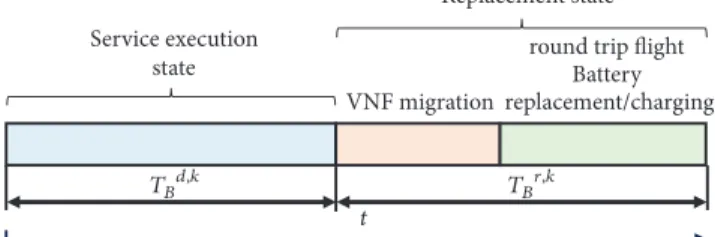
For the computation of the optimal allocation of drones, the algorithm considers both the consumption related to the service (service execution state) and the necessary power to perform the replacement process (replacement state). In the proposal, these power consumptions are represented by time variables, a service time related to the service state and a
replacement timeassociated with thereplacement state(see Figure 3). Thus, a percentage of the total battery capacity (majority) is assigned to service execution and the rest is dedicated to the execution of the replacement tasks (service migration). The time variables associated with the operating states of the system are described in detail in Section 3.3. Regarding theservice time, this value depends on the power demanded by the service and can vary greatly from one service to another; for example, considering the same battery capacity, a drone running a service that demands high power consumption will have a shorter service time compared to another running a service whose power consumption is lower. On the other hand, thereplacement timeis composed of the time needed to perform the migration of the VNFs, from old drone (low battery level) to new drone (high battery level), and the time associated with the round trip flight to (old drone) and from (new drone) the GCS. Since the replacement time is not directly linked to the execution of the service, the value of this parameter could be similar or the same for the different services.
In order to guarantee the continuity of the services in the proposed system, the service migration process starts when the drone that is going to be replaced is active; i.e., when it is running the service, specifically, the migration process begins at the end of theservice timeor at the beginning of the
replacement time(for a better understanding see Figures 3 and 5(e)). After the migration process has been carried out, i.e., when thereplacement timeis over, the replaced drone returns to the GCS; at this time this drone is no longer active but is still part of the system. Once the drone reaches the ground, its battery is replaced or recharged so that, according to the indications received by the GCS, it can be assigned for the execution of another service.
According to the aforementioned, in the system, the replacement time is sufficient to guarantee the transition of the services as well as the launching and landing of the drones. In addition, regarding the migration process, among the important aspects to consider are the service hand-off processes, from one drone to another, and the exchange of information associated with this procedure. Regarding the latter, in the proposal the exchange of information is accomplished thanks to features such as high connectivity and low latency time provided by 5G technology. Instead, the procedure related to the service transition is a process linked to the type and features of each service; therefore, although this is an interesting topic, it is not addressed in the article since it is out of scope of the proposal. However, it is worth mentioning that Section 5 presents the results of
the application of the proposal in a real case whose values of both theservice stateand thereplacement state(including the migration process) have been obtained through measure-ments.
At all times, the management system coordinates the resources that must be allocated (drones to be launched from the ground), because based on the initial information of services and drones, as well as the computations per-formed by the algorithm, the system is able to estimate the number of available drones, the status of the services, the sequence of replacement to be performed, and the availability level reached. Hence, the characterization of the system through the service state, the replacement state, and their corresponding time variables enables the system to operate with the appropriate margins so that the services can be executed continuously during a required time interval while the resource utilization is optimized.
For a better description and understanding of the dif-ferent states of the proposed energy management scheme, an example is presented below. In Figure 1 is considered an application environment composed by two VNFs, which are expected to be active during a finite time interval. To this end, the system initially uses two drones, drone 1 and drone 2, which execute VNF1 and VNF2, respectively. As time goes by, the management system evidences that drone 2 is draining its battery due to the consumption of the service and the consumption related to its flight. In response to this, and before the drone stops providing the service or in the worst case it stops working and collapses to ground, the system coordinates the sending of another drone. In this case drone 3 is selected, whose energy level is adequate to guarantee the execution of the VNF 2 for a subsequent time interval. At the moment that drone 3 is located at a suitable distance for the establishment of communication with drone 2, the migration of VNF2 from drone 2 to drone 3 is performed, so that the service is not interrupted and remains available. Subsequently, drone 2 returns to the ground station to recharge or replace its battery, so that it can be ready for a new allocation. Thus, drone 2 is available to run the VNF2 or a different VNF, and it depends on the decision that is made by the scheduling algorithm and the corresponding management system.
During all the time of operation of the service, all the actions both on land and in the air are coordinated by the management and orchestration systems. In summary, the replacement state includes the launching of the new drone (with high battery level) from the ground station, the return of the old drone (with low battery level) to the ground station, and the service migration process (VNF migration).
In addition, from the example described above, it can be observed that to guarantee a continuous execution of the service and a total availability level (100%), the number of available drones must be at least one unit greater than the number of services. In the example it is verified that, to guarantee the continuous operation of VNF1 and VNF2, it is necessary to use 3 drones, drone 1 (VNF1), drone 2 (VNF2), and drone 3 (VNF2).
Also, as aforementioned, the replacement state may include the battery replacement or recharge of it. In the first
Time slot 1
…
Time slot 2 Time slot z
0 1 2 z-1 z
…
Figure 2: Time representation.
case, the battery replacement is a process that can generally take less time; for example, in a search or rescue mission, it is possible to use a limited number of drones and a large number of batteries. Meanwhile, in the second case, the battery charging commonly is a slower process, but necessary if the drone is tampering resistant, or if the number of available batteries is limited.
In the proposal, regarding the replacement state, for practical reasons, has been considered the battery replace-ment procedure. Nonetheless, the algorithm developed has the flexibility to consider a battery charging procedure. In fact, within the characterization of the system, the battery charging phase could be considered as an additional state, the
battery charging state.
In summary, the proposed strategy bases its operation on a drone scheduling algorithm, which allows knowing how many drones are going to be used, how they should be replaced, and when the replacement should be made.
3.2. System Model. The drone scheduling algorithm is intended for providing the information of the optimal drone scheduling over time. In the proposal, the time variable has been divided into time slots, as shown in Figure 2. Thus, a drone is able to run a service over time (service execution state) during one or several slots according to its capabilities (available energy) and the features of the services that it can run. Similarly, the drone replacement state can last one or more time slots depending on the features of the drones (battery replacement procedure) and the scope of application of network services.
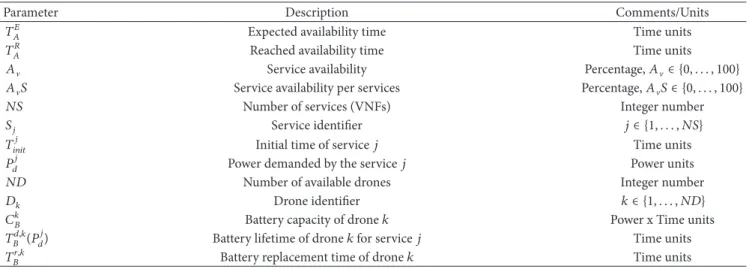
A summary of notations that describe the drone schedul-ing strategy is shown in Table 1. Then, these parameters are defined in Section 3.3.
3.3. Definitions
(1) Expected availability time(푇𝐴𝐸): also defined as service availability time, it represents the time interval where the services are expected to be active/available. (2) Reached availability time(푇𝐴𝑅): time interval during
which the services are active/available.
(3) Number of services(푁푆): the set of services or VNFs that are executed by the drones during a certain time period.
(4) Initial time of service 푗 (푇𝑖𝑛𝑖𝑡𝑗 ): time instant from which the service푗is available/active, initial time in which the service availability is analyzed.
(5) Power demanded by the service 푗 (푃𝑑𝑗): power demanded by each service 푗 to be executed. Each service may demand a different amount of power. In
t
VNF migration
Replacement state Service execution
state round trip flight Battery replacement/charging
TBd,k TBr,k
Figure 3: Time variables of the drone scheduling strategy.
general, this parameter represents the consumption demanded by the services, and in practical implemen-tations its units can also be given in terms of electric current (e.g., [mA]).
(6) Number of drones available(푁퐷): set of drones that are part of the system.
(7) Battery capacity of drone 푘 (퐶𝑘𝐵): it represents the amount of energy that can be stored in a battery of each drone푘. Moreover, in practical implementations this capacity can be expressed in terms of electric charge, i.e., electric current per time units (e.g., [mAh]).
(8) Drone battery lifetime(푇𝐵𝑑,𝑘(푃𝑑𝑗)): each drone푘with a battery capacity (퐶𝑘𝐵) can execute a service that demands a power level(푃𝑑𝑗)during a time period푇𝐵𝑑,𝑘. This relationship can be expressed as follows:
푇𝐵𝑑,𝑘(푃𝑑𝑗) =퐶𝑘𝐵
푃𝑑𝑗 (1)
This time variable represents the time interval linked to theservice execution state.
(9) Battery replacement time(푇𝐵𝑟,𝑘): this time variable is linked to thereplacement stateof a drone푘. The(푇𝐵𝑟,𝑘) includes the time associated with the sending of the new drone (drone with high level of energy supply), the time demanded to perform the migration process of the services, and the time needed for the old drone (drone with low level of energy supply) to reach the ground station (charging point).
A pictorial representation of the time variables related to the two states that characterize the system is shown in Figure 3.
3.4. Metrics. To assess the performance of the drone schedul-ing algorithm, two metrics have been defined.
(1)Services availability (퐴V): also defined as the total availability of services and expressed as a percentage, this metric shows the ratio between the time that all the services are available and the expected availability time. If the (푇𝐴𝐸) = (푇𝐴𝑅), i.e., all the services are available during all the time required, the(퐴V)= 100
Table 1: System parameters.
Parameter Description Comments/Units
푇𝐸
𝐴 Expected availability time Time units
푇𝑅
𝐴 Reached availability time Time units
퐴V Service availability Percentage,퐴V∈ {0, . . . , 100}
퐴V푆 Service availability per services Percentage,퐴V푆 ∈ {0, . . . , 100}
푁푆 Number of services (VNFs) Integer number
푆𝑗 Service identifier 푗 ∈ {1, . . . , 푁푆}
푇𝑖𝑛𝑖𝑡𝑗 Initial time of service푗 Time units
푃𝑑𝑗 Power demanded by the service푗 Power units
푁퐷 Number of available drones Integer number
퐷𝑘 Drone identifier 푘 ∈ {1, . . . , 푁퐷}
퐶𝑘
𝐵 Battery capacity of drone푘 Power x Time units
푇𝑑,𝑘
𝐵 (푃𝑑𝑗) Battery lifetime of drone푘for service푗 Time units
푇𝑟,𝑘
𝐵 Battery replacement time of drone푘 Time units
%; otherwise, this value will be lower. The service availability can be expressed as
퐴V=푇𝐴𝑅 푇𝐸 𝐴
⋅ 100% (2)
(2)Services availability per services(퐴V푆): this metric pro-vides the information of the mean availability value of all services. A service푗can reach an availability level equal to퐴V,𝑗, if this value is small compared to the availability of the other services, the퐴Vvalue will also be small and equal to퐴V,𝑗. For this reason, the
(퐴V푆)metric is defined, because it is less restrictive and weights all availability values, in order to provide information on the behavior of all the services that are part of the system. As a consequence, the퐴V푆value will always be greater or at most equal to the퐴Vvalue. The service availability per services is defined by
퐴V푆 = ∑
𝑁𝑆 𝑗=1퐴V,𝑗
푁푆 ⋅ 100% (3)
3.5. Assumptions. The following assumptions are made for the practical implementation of the algorithm:
(1) In practical implementations each programmable drone can execute more than one VNF concurrently. However, to simplify the analysis, in the proposed scheduling scheme, each drone푘can run only one VNF or service푗. This consideration is valid, since the execution of several services in the same drone would correspond to the consumption of different power levels. Thus, the processing of only one VNF and the analysis of its consumption could represent a summarized value of all the services that are executed in the drone.
(2) Similar to the previous consideration, the strategy considers that a service푗 can only be executed by one drone푘at the same time. This is with the aim of
simplifying the analysis in the distribution of drones and services.
(3) In the proposed system, any drone has the ability to execute any VNF. Likewise, any battery can power any available drone. In this sense, all available resources, drones and batteries, can be reused when demanded. It is clear that the services execution is limited to the capabilities of drones and the features of services, as previously discussed in Section 3.1.
(4) In the proposal it is considered that all services work simultaneously, i.e., all services are available as long as the system has the resources for their execution. (5) The푁퐷 must be at least equal to 푁푆. However, as
discussed in Section 3.1, to ensure the execution of services without interruption,푁퐷should be at least greater than or equal to푁푆 + 1 (푁푆 ≥ 푁퐷 + 1).
If푁퐷 < 푁푆, then퐴V = 0% and퐴V푆 = 0%. The
aforementioned consideration is mandatory in the initial execution or first drone allocation process, after this stage the algorithm is continuously evaluating the amount of available resources. Therefore, in the following allocation processes푁퐷could be smaller than 푁푆, in which case the algorithm analyzes the requirements of services to perform the correspond-ing allocations.
(6) In thereplacement state, the drone that is replaced arrives at the ground station, with a very low battery level (fully discharged battery). For the replacement process, a battery that has previously been charged up to 100% of its capacity is used (fully charged battery). Similarly, if the complete drone must be replaced and not just its battery, the device that replaces it will be equipped with a battery charged to the maximum level. This consideration is also valid for the drones that are assigned for the first time; i.e., the drones used in the first allocation process have their batteries fully charged. In addition, the system has enough batteries to guarantee the replacement process of all the drones that demand them.
(7) In the proposal it is assumed that communication requirements such as very low latency and high band-width capabilities are provided by 5G technology. Moreover, the level of connectivity provided by 5G allows for proper communication and coordination between the different components within the system.
4. Drone Scheduling Strategy
In this section, first the drone scheduling procedure is presented in Section 4.1; then, the complexity of the problem is discussed in Section 4.2.
4.1. Drone Scheduling Algorithm Procedure. The drone scheduling strategy consists of systematically computing the optimal set of available of drones to execute the services. To this end, the strategy follows the guidelines described in the
executionandreplacementstates.
The scheduling process starts with the individual analysis of the execution of each service for each available drone
(푇𝐵𝑑,𝑘(푃𝑑𝑗))then goes through the following three phases to obtain the optimal allocation of drones to run services.
(a) Computation of Combinations. In order to find the exact or optimal allocation of drones to run services, the algorithm, based on a brute-force search combinatorial method, explores all possible combi-nations of drones and services. Once all the possible combinations are obtained, the algorithm determines those that meet the system requirements (valid com-binations). Subsequently, this set of combinations is sorted in descending order according to the 퐴V metric. At the end of this phase, the best combination of drones (the first combination in the list from the top) is selected. In this context, this best combination represents the optimal set of drones whose services execution produces the highest 퐴V value in the system.
(b) Resource Allocation and Services Evaluation.Once the best combination of drones and services is obtained, the drones are allocated to their corresponding services. Afterwards, the 퐴V and 퐴V푆 metrics are computed; specifically, the퐴V푆 metric is computed because the퐴V metric was already obtained in the previous phase. If the퐴Vreached is equal or greater than the desired value, i.e.,푇𝐴𝑅 ≥ 푇𝐴𝐸, the algorithm stops its execution; otherwise, it analyzes the current availability level of all services (퐴V,𝑗) and the available resources (drones that have not been used) to proceed with the next allocations.
The analysis of the available resources is carried out in the following phase, while the analysis of availability per services is part of this phase and corresponds to the services evaluation, which is a procedure performed in order to reach the highest possible퐴V or푇𝐴𝑅value (both parameters completely equivalent), from the second allocation process. In this regard, based on the information of the last allocation made,
the algorithm lists the services in descending order according to the퐴V,𝑗reached, so that this information can be used in the computation and subsequent allocation of the best combination of drones. In specific, the objective of this process is to provide additional information to the algorithm in order to allocate the drones with the highest battery capacity to the services with the lowest current퐴V,𝑗values. In summary, the services evaluation contributes that the drones are allocated starting with the service with the lowest퐴V,𝑗 value. The mechanism described in this phase ensures an increasing퐴Vand efficient resource utilization.
(c) Verification of Available Resources.Throughout the scheduling process, the algorithm must know the status of the executed services (푇𝐴𝑅) and the informa-tion of the resources in the system. Especially from the second allocation process, the algorithm has to identify the resources used and available in order to perform the computation of combinations and the subsequent allocation of resources. In this regard, the algorithm has to evaluate at each time the information of the drones in the system, considering that this information consists of drones used, drones that have not been used, drones that must replace their battery, and drones whose battery has been replaced and are ready for a new allocation.
In an iterative process, the algorithm follows the phases described above and continuously calculates the best schedul-ing of drones to execute services. This procedure is carried out constantly until any of the two stopping criteria is met. The first criterion is the퐴Vvalue reached; if after an allocation process퐴V = 100%, the algorithm stops its execution. The second stop criterion is related to the number of available drones in the system, considering that this number is made up of drones that have not been used (not allocated yet) and drones whose battery has been replaced (or charged). In the event that the system does not have the necessary resources (drones) to perform the corresponding allocations, the algorithm stops its execution, under this condition퐴V ̸=
100% will be achieved. Finally, the algorithm provides the information of the(푇𝐴𝑅),퐴V, and퐴V푆reached.
The developed algorithm guarantees the best drone scheduling for services execution over time, by analyzing all possible drones-services combinations. However, the prob-lem tends to growth as the푁푆and푁퐷increase, which can be a problem if the capacity or processing time are constrains within the system.
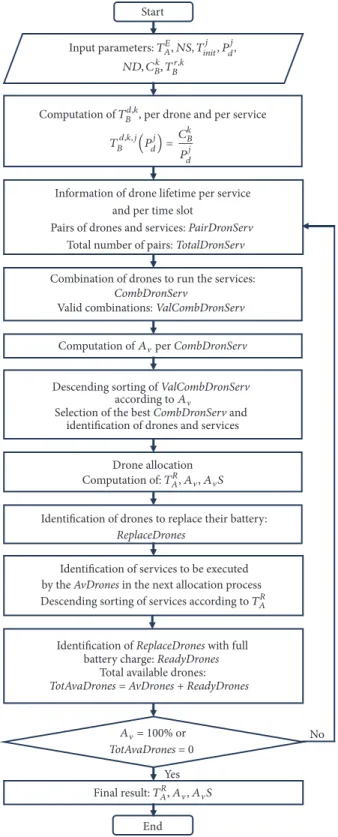
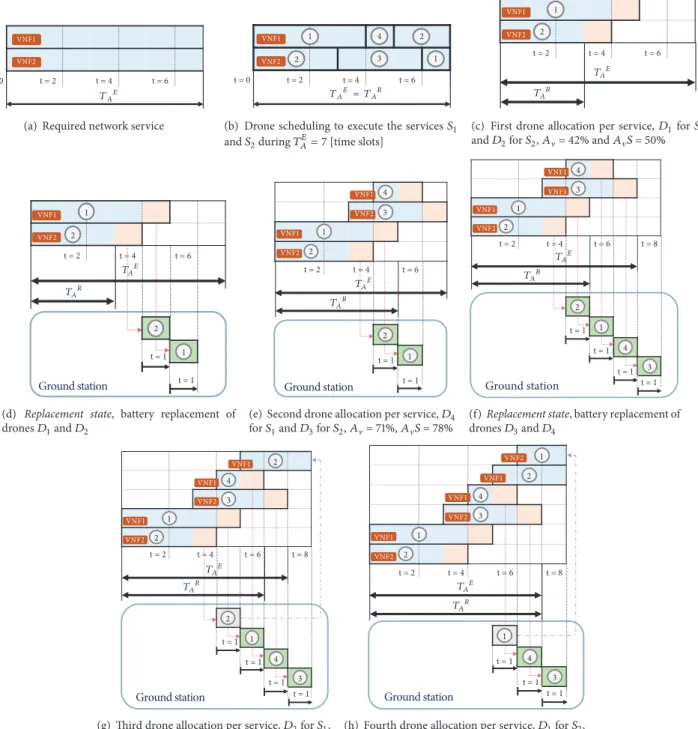
The phases discussed above are implemented in the algorithm through different steps. The drone scheduling algorithm is explained in Figure 4 and each step is described in detail based on the example depicted in Figure 5. In this example 푇𝐴𝐸 = 7 [time slots], and, for simplicity, the 푁푆 and 푁퐷 are limited to 2 and 4, respectively. A pictorial representation of the required services is shown in Figure 5(a). Moreover, the example considers a 푇𝐵𝑟,𝑘 = 2 [time slots]; the first time slot corresponded to the VNF
Start
Information of drone lifetime per service and per time slot
Pairs of drones and services: PairDronServ Total number of pairs: TotalDronServ
No
Yes
Combination of drones to run the services: CombDronServ
Valid combinations: ValCombDronServ
Descending sorting of ValCombDronServ identification of drones and services
Drone allocation
Identification of drones to replace their battery: ReplaceDrones
Identification of services to be executed by the AvDrones in the next allocation process
Identification of ReplaceDrones with full battery charge: ReadyDrones
Total available drones: TotAvaDrones = AvDrones + ReadyDrones
TotAvaDrones = 0
End
Selection of the best CombDronServ and Input parameters:TAE, NS, Tj
init, P j d,
ND, CBk, TBr,k
Computation ofTBd,k, per drone and per service
Computation ofAperCombDronServ
according toA
Descending sorting of services according toTAR
A= 100% or Computation of:TAR, A, AS Final result:TAR, A, AS TBd,k,j(Pdj)=C k B Pdj
Figure 4: Algorithm for drone scheduling.
migration process and the round trip time of the drone, and the second time slot referred to the time for battery replacement. In addition, to better understand the proposed strategy in Table 2 is provided a summary of parameters related to the processing of the combinations and the analysis
of the drones in the system. The different steps that are part of the algorithm are explained as follows.
(1) Input parameters:the input parameters comprise the
푇𝐸
𝐴 value and the information of services and drones, as
shown in Tables 3(a) and 3(b), respectively.
(2) Computation of 푇𝐵𝑑,𝑘(푃𝑑𝑗), per drone and per service:for the computation of these values, (1) is used.Table 4(a) presents all possible values of battery lifetime per drones (퐷1, . . . , 퐷4) and per services (푆1, 푆2).
(3) Information of drone lifetime per service and per time slot:in this step is provided the same information displayed in Table 4(a) but disaggregated in pairs of drones and services
(푃푎푖푟퐷푟표푛푆푒푟V), as shown in Table 4(b). Further, in this
step the information of푇𝐵𝑑,𝑘(푃𝑑𝑗)is presented in time slots, following the discrete time model discussed in Section 3.2. At this point, the algorithm provides the information of all possible drone options to execute the services individually. The total number of pairs of drone-services (푇표푡푎푙퐷푟표푛푆푒푟) is given by
푇표푡푎푙퐷푟표푛푆푒푟V= 푁푆 ⋅ 푁퐷 (4)
In the proposed example, with 푁푆 = 2 and 푁퐷 =
4 the 푇표푡푎푙퐷푟표푛푆푒푟V = 8 pairs of drones-services, from
푃푎푖푟퐷푟표푛푆푒푟V1to 푃푎푖푟퐷푟표푛푆푒푟V8, see Table 4(b).
There-fore, in this table are represented all possible service lifetime values depending on the drones to be used. For instance, if
푆1 would be executed by drone 퐷4 (푃푎푖푟퐷푟표푛푆푒푟V7), the service lifetime would be푇𝐵𝑑,4(푃𝑑1) = 1[time slot]; instead, if 푆1 would be run on drone 퐷1 (푃푎푖푟퐷푟표푛푆푒푟V1), the service lifetime would be several times greater and equal to
푇𝐵𝑑,1(푃𝑑1) = 4[time slots].
The information of each푃푎푖푟퐷푟표푛푆푒푟Vwill be used in the next step of the algorithm to analyze the joint action of drones to run services, in order to obtain the maximum possible퐴V and퐴V푆values in every allocation process.
(4) Combination of drones to run the services: since all services run simultaneously, the different combinations of drones and services (퐶표푚푏퐷푟표푛푆푒푟V) must be analyzed. Hence, the algorithm from a group of푁퐷drones must obtain a set of all possible combinations of drones to run푁푆services
(퐴푙푙퐶표푚푏퐷푟표푛푆푒푟V). In this context, the total number of
combinations (푁푢푚퐴푙푙퐶표푚푏) to be processed is given by the analysis of푁푆 ⋅ 푁퐷pairs (푇표푡푎푙퐷푟표푛푆푒푟, see Table 4(b)) taken푁푆at a time and can be expressed as
푁푢푚퐴푙푙퐶표푚푏 = (푁퐷 ⋅ 푁푆
푁푆 )
= (푁푆 ⋅ 푁퐷)!
푁푆! ⋅ (푁푆 ⋅ 푁퐷 − 푁푆)!
(5)
The 푁푢푚퐴푙푙퐶표푚푏 obtained in this step is critical,
because it contributes largely to the growth of complexity of the problem. For instance,푁푆 = 8and푁퐷 = 10produce over 28 billion of combinations to be processed.
In accordance with the criteria adopted for the drone scheduling strategy, see Section 3.5, not all
t = 0 t = 2 t = 4 t = 6 VNF1
VNF2
TAE (a) Required network service
t = 0 t = 2 t = 4 t = 6 VNF1 VNF2 1 2 4 3 2 1 TAE = TAR
(b) Drone scheduling to execute the services𝑆1 and𝑆2during𝑇𝐴𝐸= 7[time slots]
t = 2 t = 4 t = 6 2 1 VNF1 VNF2 TAE TAR
(c) First drone allocation per service,𝐷1for𝑆1 and𝐷2for𝑆2,𝐴V= 42%and𝐴V𝑆= 50%
t = 2 t = 4 t = 6 2 1 VNF1 VNF2 t = 1 1 t = 1 2 Ground station TAE TAR
(d) Replacement state, battery replacement of drones𝐷1and𝐷2 t = 2 t = 4 t = 6 2 1 3 4 VNF1 VNF2 VNF2 VNF1 t = 1 2 t = 1 1 Ground station TAE TAR
(e) Second drone allocation per service,𝐷4
for𝑆1and𝐷3for𝑆2,𝐴V= 71%,𝐴V𝑆= 78%
t = 2 t = 4 t = 6 t = 8 2 1 3 4 VNF1 VNF2 VNF1 VNF1 t = 1 2 t = 1 3 t = 1 1 t = 1 4 Ground station TAE TAR
(f)Replacement state, battery replacement of drones𝐷3and𝐷4 t = 2 t = 4 t = 6 t = 8 2 1 3 4 VNF1 VNF2 VNF2 VNF1 t = 1 2 t = 1 3 t = 1 1 t = 1 4 2 VNF1 Ground station TAE TAR
(g) Third drone allocation per service,𝐷2for𝑆1,
𝐴V= 85%and𝐴V𝑆= 92% t = 2 t = 4 t = 6 t = 8 2 1 3 4 VNF1 VNF2 VNF2 VNF1 t = 1 3 1 t = 1 t = 1 4 Ground station 2 VNF1 VNF2 1 TAE TAR
(h) Fourth drone allocation per service,𝐷1for𝑆2,
𝐴V= 100%and𝐴V𝑆= 100%
Figure 5: Example of the drone scheduling algorithm.
(see Table 4(b)), the combination of푃푎푖푟퐷푟표푛푆푒푟V1(퐷1, 푆1)
and푃푎푖푟퐷푟표푛푆푒푟V2(퐷1, 푆2) is not valid, because the same
drone (퐷1) is assigned to different services (푆1, 푆2) at the same time. Likewise, the combination of 푃푎푖푟퐷푟표푛푆푒푟V3 (퐷2, 푆1) and 푃푎푖푟퐷푟표푛푆푒푟V5 (퐷3, 푆1) is also not valid, because the same service (푆1) is executed by two drones (퐷2, 퐷3) concurrently. In contrast, the combination of
푃푎푖푟퐷푟표푛푆푒푟V1 (퐷1, 푆1) and 푃푎푖푟퐷푟표푛푆푒푟V4 (퐷2, 푆2) is valid, because once selected the drones 퐷1 and 퐷2 can be allocated to the services푆1and푆2, respectively. Considering
this, the total number of valid combinations (푁푢푚푉푎푙퐶표푚푏) is given by
푁푢푚푉푎푙퐶표푚푏 = (푁퐷 − 푁푆)!푁퐷! (6)
In the example, 푁푆 = 2 and 푁퐷 = 4 produce
푁푢푚퐴푙푙퐶표푚푏 = 28combinations and푁푢푚푉푎푙퐶표푚푏 = 12
combinations, the latter shown in Table 4(c).
(5) Computation of 퐴V and 퐴V푆 per 퐶표푚푏퐷푟표푛푆푒푟V: using the information of푉푎푙C표푚푏퐷푟표푛푆푒푟Vin Table 4(c) and
Table 2: Parameters related to the processing of combinations and drones in the scheduling algorithm.
Parameter Description
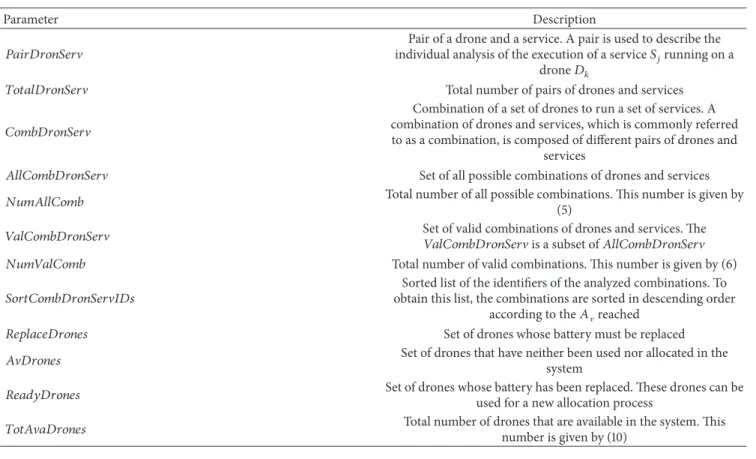
푃푎푖푟퐷푟표푛푆푒푟V individual analysis of the execution of a servicePair of a drone and a service. A pair is used to describe the푆𝑗running on a
drone퐷𝑘
푇표푡푎푙퐷푟표푛푆푒푟V Total number of pairs of drones and services
퐶표푚푏퐷푟표푛푆푒푟V
Combination of a set of drones to run a set of services. A combination of drones and services, which is commonly referred to as a combination, is composed of different pairs of drones and
services
퐴푙푙퐶표푚푏퐷푟표푛푆푒푟V Set of all possible combinations of drones and services
푁푢푚퐴푙푙퐶표푚푏 Total number of all possible combinations. This number is given by(5)
푉푎푙퐶표푚푏퐷푟표푛푆푒푟V Set of valid combinations of drones and services. The푉푎푙퐶표푚푏퐷푟표푛푆푒푟Vis a subset of퐴푙푙퐶표푚푏퐷푟표푛푆푒푟V
푁푢푚푉푎푙퐶표푚푏 Total number of valid combinations. This number is given by (6)
푆표푟푡퐶표푚푏퐷푟표푛푆푒푟V퐼퐷푠 obtain this list, the combinations are sorted in descending orderSorted list of the identifiers of the analyzed combinations. To
according to the퐴Vreached
푅푒푝푙푎푐푒퐷푟표푛푒푠 Set of drones whose battery must be replaced
퐴V퐷푟표푛푒푠 Set of drones that have neither been used nor allocated in thesystem
푅푒푎푑푦퐷푟표푛푒푠 Set of drones whose battery has been replaced. These drones can beused for a new allocation process
푇표푡퐴V푎퐷푟표푛푒푠 Total number of drones that are available in the system. Thisnumber is given by (10)
Table 3: Information of services and drones. (a) Information of services
푆𝑗 푇𝑖𝑛𝑖𝑡𝑗 [푇푖푚푒 푠푙표푡푠] 푃𝑑𝑗[푃표푤푒푟 푢푛푖푡푠] 1 0 1 2 0 1 (b) Information of drones 퐷𝑘 퐶𝑘𝐵[푃표푤푒푟 푥 푡푖푚푒 푠푙표푡푠] 푇𝐵𝑟,𝑘[푇푖푚푒 푠푙표푡푠] 1 4 2 1 3 2 3 3 2 4 1 2
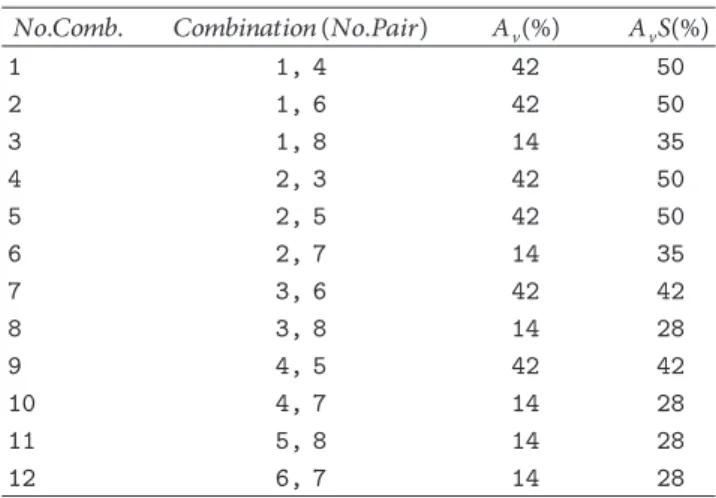
the푇𝐵𝑑,𝑘(푃𝑑𝑗)value, given in terms of time slots, in Table 4(b), it is possible to compute the퐴Vand퐴V푆metrics, for each of the
퐶표푚푏퐷푟표푛푆푒푟V. Table 5(a) shows the different퐴Vand퐴v푆
values for each퐶표푚푏퐷푟표푛푆푒푟Vof Table 4(c). In this table, the metrics have been rounded to the lower bound. An example of the computation of these metrics for the퐶표푚푏퐷푟표푛푆푒푟V1 is provided below. In the case of퐶표푚푏퐷푟표푛푆푒푟V1(composed by푃푎푖푟퐷푟표푛푆푒푟V1and푃푎푖푟퐷푟표푛푆푒푟V4),퐷1is allocated to푆1 during푇𝐵𝑑,1(푃𝑑1) = 4[time slots], while퐷2is allocated to푆2 during푇𝐵𝑑,2(푃𝑑2) = 3[time slots].
퐴V𝐶𝑜𝑚𝑏1=3 [푡푖푚푒 푠푙표푡푠]7 [푡푖푚푒 푠푙표푡푠]⋅ 100%= 42.86% (7)
퐴V푆𝐶𝑜𝑚𝑏1
=4 [푡푖푚푒 푠푙표푡푠] /7 [푡푖푚푒 푠푙표푡푠] + 3 [푡푖푚푒 푠푙표푡푠] /7 [푡푖푚푒 푠푙표푡푠]2
⋅ 100%= 50%
(8)
(6) Selection of the best 퐶표푚푏퐷r표푛푆푒푟V: the
푉푎푙퐶표푚푏퐷푟표푛푆푒푟Vare sorted in descending order according
to their퐴Vvalue (see Table 5(a)), using a quick sort method. The algorithm provides a list with these values and the combination with the best value; the first in the list is selected. Even if there is more than one better combination, the first one in the list is always selected. In the example, the sorted list of all푉푎푙퐶표푚푏퐷푟표푛푆푒푟Vis
푆표푟푡 퐶표푚푏퐷푟표푛푆푒푟V퐼퐷푠
fl{1, 2, 4, 5, 7, 9, 3, 6, 8, 10, 11, 12} (9)
where the 퐶표푚푏퐷푟표푛푆푒푟V1 (퐼 퐷 = 1) is the best combination, while the퐶표푚푏퐷푟표푛푆푒푟V12has the lowest퐴V level. After selecting the best퐶표푚푏퐷푟표푛푆푒푟V, in the example
퐶표푚푏퐷푟표푛푆푒푟V1, the algorithm proceeds to identify the
drones and services belonging to that combination, as shown in Table 5(b).
(7) Drone allocation and computation of푇𝐴𝑅,퐴V,and퐴V푆:
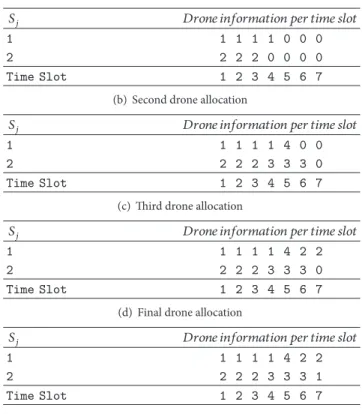
in this step, with the information of the best combination, the algorithm allocates the drones to their corresponding services over time. As shown in Table 6(a),퐷1is allocated to푆1and
퐷2 is allocated to 푆2. Figure 5(c) illustrates this allocation procedure, and in this figure is not only represented the
Table 4: Information of drones, services, and combinations. (a) Information about battery lifetime of drones for services𝑆1and𝑆2
퐷𝑘 푇𝑑,𝑘 𝐵 (푃𝑑1) [푇푖푚푒 푠푙표푡푠] 푇𝐵𝑑,𝑘(푃𝑑2) [푇푖푚푒 푠푙표푡푠] 1 4 4 2 3 3 3 3 3 4 1 1
(b) Information of pairs of drones and services and drone lifetime per time slot 푁표.푃푎푖푟 퐷𝑘 푆𝑗 퐷푟표푛푒 푝푒푟 푡푖푚푒 푠푙표푡 1 1 1 1 1 1 1 2 1 2 1 1 1 1 3 2 1 2 2 2 0 4 2 2 2 2 2 0 5 3 1 3 3 3 0 6 3 2 3 3 3 0 7 4 1 4 0 0 0 8 4 2 4 0 0 0 Time Slot 1 2 3 4
(c) Combinations among available drones to run the services
푁표.퐶표푚푏. 퐶표푚푏푖푛푎푡푖표푛 (푁표.푃푎푖푟) 퐷푟표푛푒푠 푆푒푟V푖푐푒푠 1 1, 4 1, 2 1, 2 2 1, 6 1, 3 1, 2 3 1, 8 1, 4 1, 2 4 2, 3 1, 2 2, 1 5 2, 5 1, 3 2, 1 6 2, 7 1, 4 2, 1 7 3, 6 2, 3 1, 2 8 3, 8 2, 4 1, 2 9 4, 5 2, 3 2, 1 10 4, 7 2, 4 2, 1 11 5, 8 3, 4 1, 2 12 6, 7 3, 4 2, 1
execution state(푇𝐵𝑑,𝑘(푃𝑑𝑗), blue color) but also thereplacement state(푇𝐵𝑟,𝑘, orange and green colors). Then, the performance metrics퐴Vand퐴V푆are computed. In this particular example the values reached are퐴V= 42% and퐴V푆 = 50%. This is the initial allocation of drones, and since none of the stop criteria have been met, i.e.,퐴V ̸= 100% and the system has available resources (drones 퐷3 and 퐷4), the algorithm continues its execution process.
(8) Identification of drones to replace their battery
(푅푒푝푙푎푐푒퐷푟표푛푒푠):the algorithm must constantly monitor the
drones used, so that when they finish their execution (푇𝐴𝑅), they have to change to thereplacement state(푅푒푝푙푎푐푒퐷푟표푛푒푠). In the example, in the first allocation drones퐷1and퐷2have been used, and, as can be seen in Figure 5(d), drone퐷2must start its replacement process in time slot 4; instead,퐷1must perform this procedure in time slot 5.
(9) Identification of services to be executed by the available drones(퐴V퐷푟표푛푒푠)in the next allocation process:to continue
Table 5: Computation of metrics for 푉푎푙퐶표푚푏퐷푟표푛푆푒푟V and selection of the best combination.
(a) Computation of𝐴Vand𝐴Vfor all𝑉𝑎𝑙𝐶𝑜𝑚𝑏𝐷𝑟𝑜𝑛𝑆𝑒𝑟V
푁표.퐶표푚푏. 퐶표푚푏푖푛푎푡푖표푛 (푁표.푃푎푖푟) 퐴V(%) 퐴V푆(%) 1 1, 4 42 50 2 1, 6 42 50 3 1, 8 14 35 4 2, 3 42 50 5 2, 5 42 50 6 2, 7 14 35 7 3, 6 42 42 8 3, 8 14 28 9 4, 5 42 42 10 4, 7 14 28 11 5, 8 14 28 12 6, 7 14 28
(b) Information of pairs of drones and services belonging to the best combination
푁표.푃푎푖푟 퐷𝑘 푆𝑗 퐷푟표푛푒 푝푒푟 푡푖푚푒 푠푙표푡
1 1 1 1 1 1 1
4 2 2 2 2 2 0
Time Slot 1 2 3 4
with the drone scheduling process, from the first allocation, an analysis of the priority of the executed services is carried out. This level of priority is given based on the(푇𝐴𝑅)parameter of the services. Thus, a service with a lower(푇𝐴𝑅)value will have a higher priority level to be processed in the next drone allocation step. In this way, the algorithm will allocate the drones with the highest(푇𝐵𝑑,𝑘(푃𝑑𝑗))values to the services with the highest priority levels. The priority in the execution time of the services is analyzed at the end of the first allocation process, since the start time of all the services is the same
(푇𝑖𝑛𝑖𝑡𝑗 = 0).
The priority information of the services is used in the computation of the combinations and in the selection of the best combination, from the second allocation. This process is carried out to guarantee an efficient and uniform allocation of the drones; otherwise, a specific service could achieve a
푇𝑅
𝐴value much higher than the others. This situation must be
avoided since the services must be executed simultaneously with the objective of always reaching an 퐴V as large as possible. In the example (see Figure 5(d)), 푆2 (푇𝐴𝑅 = 3 [time slots]) has higher priority level compared to푆1(푇𝐴𝑅 =
4 [time slots]). Therefore, later in the computation of all combinations this information will be considered so that the selection of the best combination allows a drone allocation
(퐴V퐷푟표푛푒푠 = 2,퐷3and퐷4) that favors the execution of푆2,
as shown in Figure 5(e).
The priority level of services is also useful in the case
that 푁퐷 < 푁푆, a situation that may occur after the first
drone allocation. In this particular case, the priority allows to know the services that must be attended, with the available
resources. In this scenario, the combinations are computed with the number of available drones.
(10) Identification of total available drones (TotAvaDrones): the total number of drones available in the system include drones that have not been used, which in the case of the example are퐷3 and 퐷4(퐴V퐷푟표푛푒푠), and drones whose battery has been replaced and are ready
(푅푒푎푑푦D푟표푛푒푠) to be used when the system demands
them. The푅푒푎푑푦퐷푟표푛푒푠 are the 푅푒푝푙푎푐푒퐷푟표푛푒푠that have completed thereplacement state. In the example proposed, at this point, the first drone allocation has been performed; therefore, the system does not have 푅푒푎푑푦퐷푟표푛푒푠. Under these conditions, the drones available are 퐷3 and 퐷4. In the next stages, the algorithm could have 푅푒푎푑푦퐷푟표푛푒푠 available, once they exceed thereplacement state.
The total number of available drones (푇표푡퐴V푎퐷푟표푛푒푠) in the system can be expressed as
푇표푡퐴V푎D푟표푛푒푠 = 퐴V퐷푟표푛푒푠 + 푅푒푎푑푦퐷푟표푛푒푠 (10)
(11) Iterative drone allocation: in an iterative process of computation of combinations, selection of the best combi-nation, drone allocation, priorities of services and metrics, the algorithm continues its execution until either of the two stopping criteria is met (퐴V = 100% or푇표푡퐴V푎퐷푟표푛푒푠 =
0). Continuing with the example, in the second iteration the algorithm allocates퐷3to푆2 and퐷4 to푆1, as shown in Table 6(b) and in Figure 5(e). The results after this procedure are퐴V= 71% and퐴V푆 = 78%. In a similar way to the process carried out at the end of the first iteration, once the services have been completely executed by drones퐷3and퐷4, these devices pass to thereplacement state. Specifically, this status will be reached at time slot 5 for퐷4 and at time slot 6 for
퐷3, as represented in Figure 5(f). For practical reasons, the time window in proposed example has been limited to 8 [time slots].
After the second iteration has been completed, the algo-rithm checks the total number of available drones. At this point, given that퐴V퐷푟표푛푒푠 = 0, the algorithm checks if any
of푅푒푝푙푎푐푒퐷푟표푛푒푠has become푅푒푎푑푦퐷푟표푛푒푠. In the example,
the unique drone that meets this condition is 퐷2, which after the corresponding computations is allocated to푆1, as shown in Table 6(c) and in Figure 5(g). At the end of the third iteration퐴V = 85% and퐴V푆 = 92%. Once the third iteration is finished, the scheduling process continues in the same way as in the previous iterations and according to the steps described in the Figure 4. The fourth iteration is the last in the example. In this iteration퐷1, whose battery has been replaced, is allocated to푆2, as seen in Figure 5(h) and in Table 6(d). Resulting in the final values:푇𝐴𝑅 = 푇𝐴𝐸 = 7 [time slots] for both services (푆1 and푆2),퐴V = 100% and
퐴V푆 = 100%. Once these values are obtained, the algorithm
stops its execution.
A summary of the complete drone allocation procedure is depicted in Figure 5(b). The final drones sequence is퐷1,
퐷4, and퐷2for푆1and퐷2,퐷3, and퐷1 for푆2. Moreover, as a relevant result the algorithm allows knowing the number of drones (resources) needed to reach a certain availability level. In the example, during a time window of푇𝐴𝐸= 7[time
Table 6: Progressive allocation of drones to fulfill the network services.
(a) Initial drone allocation
푆𝑗 퐷푟표푛푒 푖푛𝑓표푟푚푎푡푖표푛 푝푒푟 푡푖푚푒 푠푙표푡
1 1 1 1 1 0 0 0
2 2 2 2 0 0 0 0
Time Slot 1 2 3 4 5 6 7
(b) Second drone allocation
푆𝑗 퐷푟표푛푒 푖푛𝑓표푟푚푎푡푖표푛 푝푒푟 푡푖푚푒 푠푙표푡
1 1 1 1 1 4 0 0
2 2 2 2 3 3 3 0
Time Slot 1 2 3 4 5 6 7
(c) Third drone allocation
푆𝑗 퐷푟표푛푒 푖푛𝑓표푟푚푎푡푖표푛 푝푒푟 푡푖푚푒 푠푙표푡
1 1 1 1 1 4 2 2
2 2 2 2 3 3 3 0
Time Slot 1 2 3 4 5 6 7
(d) Final drone allocation
푆𝑗 퐷푟표푛푒 푖푛𝑓표푟푚푎푡푖표푛 푝푒푟 푡푖푚푒 푠푙표푡
1 1 1 1 1 4 2 2
2 2 2 2 3 3 3 1
Time Slot 1 2 3 4 5 6 7
slots], with 4 drones and an optimal scheduling, the system can reach an퐴V= 100% in the services execution.
4.2. Complexity Analysis. The 푁푆 and 푁퐷 values have an impact on the growth of complexity of the algorithm. The growth rate of the problem is not linear, because it depends on the product of푁푆 ⋅ 푁퐷, as shown in (4) and in Table 4(b). The steps 3 and 4 define the growth of the algorithm. This growth rate as a function of푁푆and푁퐷can be expressed as
𝑓 (푁푆 ⋅ 푁퐷) = 푁푆 ⋅ 푁퐷 + 퐶 (푁푆 ⋅ 푁퐷, 푁푆) (11)
where the second term is the dominant term within the expression. As described in Section 4 it represents total set of all combinations (퐴푙푙퐶표푚푏퐷푟표푛푆푒푟V) that the algorithm must analyze in a mandatory manner in order to find the valid combinations푉푎푙퐶표푚푏퐷푟표푛푆푒푟Vto be processed.
Thus, according the Big-O classification [16], ignoring the low-order terms, i.e., the first term in (11), the order of growth of the drone scheduling algorithm is O(퐶(푁푆 ⋅
푁퐷, 푁푆)). Hence, this complexity reveals the drawbacks that
the algorithm has for the selection of푁푆and푁퐷values.
5. Performance Evaluation
To validate the resource planning algorithm proposed in the previous section, it is necessary to define reasonable scenarios that can integrate all the different parameters that should be assessed and provide the complex environment where this type of algorithms is normally applied. The evaluation will
then be carried out through extensive simulations using these scenarios. Section 5.1 describes the simulation setup and the two application scenarios and then the evaluation results are presented and discussed in Section 5.2.
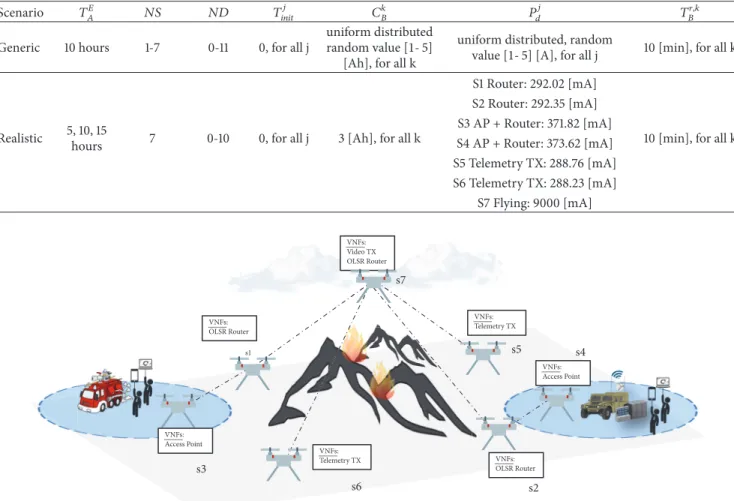
5.1. Simulation Setup. The drone scheduling strategy is evaluated in two different application scenarios: a Generic Scenariothat uses random values for some parameters and aRealistic Scenariowhose values are based on experiments and measurements, as shown in Table 7. These scenarios are described in detail below, and, for practical reasons, in both scenarios the푁푆has been limited up to푁푆 = 7services. The scheduling algorithm has been implemented using Matlab (Matlab R2017b).
The Generic Scenario has been run on a computer equipped with a 3.33 GHz x 12 cores Intel Core i7 Extreme processor and 12 GB RAM. This simulation leverages parallel processing and multiple CPU cores (up to 6 cores) have been used in each simulation. In order to ensure stability of the results, each case (푁푆) was repeated 50 times except for
푁푆 = 7, which was executed only once due to its excessive
running time. Results are shown, in Figures 10 and 11, with a confidence interval of 95%. The total running time for this scenario (all cases) exceeded 300 hours.
Meanwhile, theRealistic Scenariohas been executed on a machine with a 3GHz x 4 cores Intel Core i5-7400 processor and 64 GB RAM. In this case parallel processing has also been exploited, and all 4 cores have been used during the simulation. Because this scenario is deterministic, only one simulation has been executed for each case (푇𝐴𝐸= 5,푇𝐴𝐸= 10 and푇𝐴𝐸 = 15hours). The execution time for this scenario is around 80 hours, and results are shown in Figure 12.
5.1.1. Generic Scenario. This scenario corresponds to a very general application environment with the intention of per-forming an initial validation of the proposed solution. To this end, it is assumed that the different drones can execute the services in the air (with a much higher power consumption), a subset can land on the ground after its launch from the ground control station, or even a hybrid situation can also be possible (different cases are discussed in Section 3.1).
The scenario is not particularized for specific applications and it is considered that applications can vary from the provision of video surveillance services to the provision of connectivity services, etc. (this is modeled in the scenario by considering the power demanded by the different services
푃𝑑𝑗to be a random value between 1 and 5 A). In addition, to provide more diversity, batteries capacities퐶𝑘𝐵are considered to be different for each drone, choosing for them random values between 1 and 5 Ah. This assumption (see Table 7) will produce services with different푇𝐴𝑅 values (service execution state) varying from푇𝐴𝑅 = 0.2[hours] (minimum value) to
푇𝑅
𝐴= 5[hours] (maximum value).
Considering the parameters described above, a푇𝐵𝑟,𝑘= 10 [minutes] (replacement state) and a time window of(푇𝐴𝐸)= 10 [hours], the algorithm has to perform many transitions among theservice execution stateand thereplacement state
in order to optimally allocate the available resources to the corresponding services, which is exactly the situation that is wanted to be forced in this scenario in order to test the algorithm capabilities. The metrics achieved for the different
푁푆and푁퐷values are shown later in Section 5.2.
5.1.2. Realistic Scenario
Scenario Definition.The objective of this scenario is to test the algorithm under more real conditions replacing the random values used in the Generic Scenario by some other values that may be closer to some real ones.
In particular the scenario that will be described in this section (Figure 6) shows a set of drones each one with an on-board SBC (they carry an RPi with its own battery) linked through an ad hoc WiFi network and using a certain FANET (Flying Adhoc Network) routing protocol to guarantee con-nectivity. The drones are including different VNFs depending on the role they are assuming (Access Point (AP), router, or telemetry transmitter (i.e.,video or sensor data).
In this scenario the energy consumption for a particular drone may depend on many diverse factors. In first place there are two different types of batteries and also drones that are flying and drones that are landed (so depending on the situation the battery that limits the service maybe either one or the other). For the drones that are not flying (the drone battery is not presenting any limitations for them and only the RPi battery is used) the measurements must consider the different WiFi interfaces, the WiFi communications (different traffic including video, telemetry, routing messages, etc.), CPU load, external hardware, etc.
As it can be appreciated it is not easy in this environ-ment to evaluate how the energy consumption curve will perform for the different drones and how many drones are in fact needed in order to guarantee that the service can be maintained over time (considering a certain replacement time), etc. This is considered to be a suitable scenario so as to validate the combinatory algorithm and the rest of the section will provide more details on the scenario itself and about the validation methodology.
A total of seven drones have been considered in this scenario that may represent a natural disaster use case (e.g., earthquake, fire, flood) where drones can enable communica-tions between emergency services islands; as seen in Figure 6 drones accommodate different VNFs and play different roles within the network to perform the overall service that will be taken into account by the algorithm:
(1)Optimized Link State Routing (OLSR) Router VNF.
Because of the drone network nature (e.g., node mobile, volatile network) OLSR [17] has been selected as routing protocol. OLSR is a distributed and proac-tive routing protocol used to establish connections between participant nodes in an ad hoc wireless network proposed for Mobile Ad hoc Networks (MANETs) and extended for Flying Ad hoc Networks (FANETs). The main advantage of this type of routing protocol is its dynamic discovery allowing stateless