ORIGINAL REPORTS
first Century Surgery Using
Twenty-first Century Technology: Surgical Robotics
Col Michael R. Marohn, USAF, MC, and Capt Eric J. Hanly, USAF, MCDepartments of Surgery, Uniformed Services University, Bethesda, Maryland; Malcolm Grow USAF Medical Center, Andrews Air Force Base, Maryland; and Johns Hopkins University, Baltimore, Maryland
INTRODUCTION: The “Nintendo” surgery revolution, which began in 1987, has impacted every surgical specialty. However, our operating rooms remain isolated worlds where surgeons use awkward, primitive, rigid instruments with sub-optimal visualization. We need “smart instruments,” “smart technology,” and “smart imaging.” Is surgical robotics the answer?
METHODS: We provide an analysis of current surgical tech-nology and skills, propose criteria for what the next generation of surgical instruments and technology should achieve, and then examine the evolution and current state of surgical robotic solutions, assessing how they answer future surgical needs. Fi-nally we report on the U.S. Military’s early experience with surgical robotics and the lessons learned therein.
RESULTS: Current surgical robotic technology has made re-markable progress with miniaturization, articulating hand-im-itating instruments, precision, scaling, and three-dimensional vision. The specialty-specific early clinical applications re-viewed are promising, but they do have limitations. Surgical robotics offers enormous military application potential. Needed future refinements are identified, including haptics, communications, infrastructure, and information integration. CONCLUSIONS: Laparoscopic surgery is a transition tech-nology, constrained by instrument, equipment, and skill limi-tations. Surgical robotics or, more properly, computer-assisted surgery may be the key to the future. The operating room of the future will be an integrated environment with global reach. Surgeons will operate with three-dimensional vision, use real-time three-dimensional reconstructions of patient anatomy, use miniaturized minimally invasive robotic technology, and be
able to telementor, teleconsult, and even telemanipulate at a distance, thus offering enhanced patient care and safety. (Curr Surg 61:466-473. © 2004 by the Association of Program Di-rectors in Surgery.)
KEY WORDS: surgical robotics, computer-assisted surgery, telesurgery, minimally invasive surgery, surgery, telemedicine
INTRODUCTION
Change and technology seem the watchwords of the twenty-first century. Where is the future of surgery headed? Since the “Nintendo” surgery revolution began with Philippe Mouret’s laparoscopic cholecystectomy in Lyon, France, March 17, 1987,1 no breakthrough has changed modern surgery more rapidly, definitively, or irrevocably. But what is next? Surgical robots have made their entry. Are they just new expensive gad-gets or gateways to advancing surgery?
The operating room of the future will be different. Current operating rooms remain isolated worlds with limited technolo-gies where surgeons use awkward, primitive, ergonomically un-friendly instruments to perform arguably spectacular proce-dures. Pressures toward minimally invasive surgery are ubiquitous. We need to assess our current technologies and skills and then ask what technologies do we need for the future? What solutions will enhance minimally invasive surgery? What role will surgical robotics play?
This article examines the limitations of current minimally invasive surgical technology, equipment, and current mini-mally invasive surgical skills to help frame what questions we should ask next from surgical innovation.
CURRENT LAPAROSCOPIC SURGICAL TECHNOLOGY
To understand the implications and potential of surgical robot-ics or, more properly, “computer-assisted surgery,” we need to examine lessons learned from the laparoscopic surgery revolu-tion. Mouret’s laparoscopic cholecystectomy in 1987 ushered in minimally invasive surgery, not only changing general sur-Correspondence: Inquiries to Col Michael R. Marohn, Johns Hopkins University
School of Medicine, Department of Surgery/Halsted 608, 600 North Wolfe Street, Baltimore, MD 21287; fax: (410) 502-0726; e-mail: [email protected]
The research efforts of Drs. Marohn and Hanly are funded through grants from the Telemedicine and Advanced Technology Research Center (TATRC), and the United States Army Medical Research and Materiel Command (USAMRMC), Fort Detrick, Maryland.
The opinions and assertions contained herein are the private views of the authors and are not to be construed as official or as reflecting the views of the United States Government, the Department of Defense, or the Department of the Air Force.
gery, but all of surgery. Laparoscopic cholecystectomy was ac-cepted as “standard of care” by 1992, just 5 years after its intro-duction.2,3 By the same year, laparoscopic approaches had already been used to perform solid organ removal and anti-reflux, colon, urologic, thoracic, and trauma procedures. Now, 10 years later, minimally invasive surgery impacts all surgical specialties.
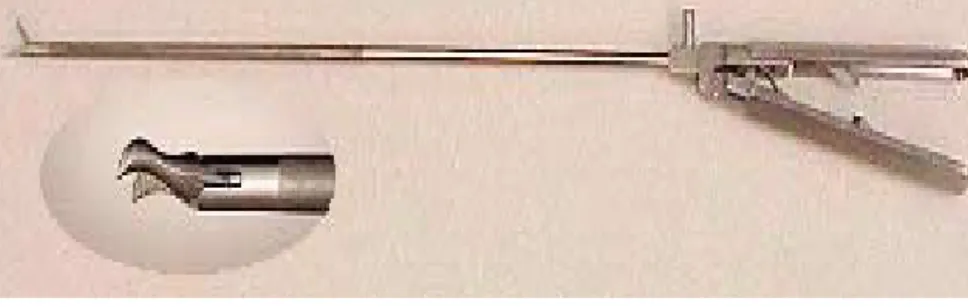
Has current surgical technology kept pace? In many respects, twenty-first century operating rooms (ORs) are not all that different from what was used several hundred years ago. Sur-geons are usually still isolated from “the rest of the world” while in their operating room, and even in today’s “high technology” minimally invasive surgery world, surgical instruments are primitive, rigid, and inflexible, with limited tactile feedback. Laparoscopic instruments can be characterized as modified “chop sticks” with limited degrees of freedom of motion, often inadequate precision, and poor ergonomics (Fig. 1). Visualiza-tion is limited to two-dimensional images of the three-dimen-sional operative field. The array of advanced procedures per-formed by skilled laparoscopic surgeons is remarkable given the limitations of current laparoscopic surgical equipment and in-struments.
CURRENT LAPAROSCOPIC SURGICAL SKILLS
Minimally invasive surgical skills can be divided into two lev-els— basic and advanced. Basic laparoscopic skills are one-handed, involve simple organ removal, require limited vascular control and no reconstruction, and can be performed safely by most any surgeon. It was fortuitous that the laparoscopic sur-gery revolution began with cholecystectomy, which met these parameters, explaining its rapid and safe promulgation.4 Ad-vanced videoendoscopic surgeries require two-handed skills, such as bimanual manipulation, suturing, and knot tying.
What is the current skill level for most practicing surgeons (general surgeons and subspecialists)? For example, in urology, there are few “simple” laparoscopic procedures; yet there are increasing patient-driven pressures to provide minimal access surgery options for more complex procedures, such as nephrec-tomy, donor nephrecnephrec-tomy, and even prostatectomy. These pro-cedures require either dissection and control of vessels adjacent
to the largest in the body (in the case of nephrectomy) or a challenging reconstruction (in the case of prostatectomy). But the number of urologists with the necessary skill set for ad-vanced laparoscopic procedures is limited. Leaders in scopic urology argue that currently, most advanced laparo-scopic urology cases are performed by less than 2% of urologists. These low numbers are even more staggering for other surgical specialties.
Every general surgeon can perform laparoscopic cholecystec-tomy and is capable of performing basic laparoscopic proce-dures. But advanced laparoscopic skills are less pervasive. A sobering reality is that in most hospitals, the majority of ad-vanced laparoscopic cases are performed by a minority of gen-eral surgeons.
LEVELING THE PLAYING FIELD
What do we need for future surgery? To avoid a future where complex minimally invasive surgery is limited to a few laparo-scopic wizards, we need either better surgeon training or better enabling surgical technology. A polemic against current surgical simulation technology is an important emerging topic in surgi-cal education, but it is beyond the scope of this review.
Therefore, our discussion focuses on the latter solution: look-ing for better enabllook-ing surgical technology that will allow more surgeons to perform complex laparoscopic surgery.
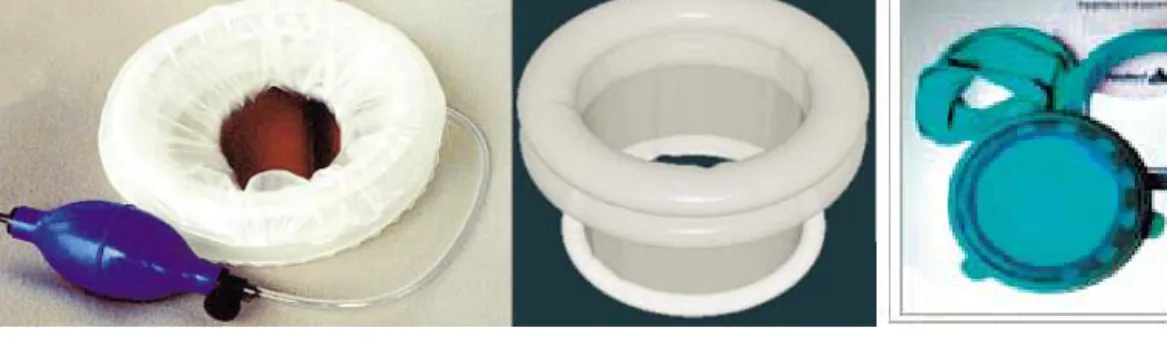
“Low technology” solutions are available. Hand-assisted laparoscopic surgery devices allow the surgeon to overcome skill and instrument limitations; yet it still offers patients a portion of the benefits of minimally invasive surgery (Fig. 2). Currently, hand-assisted surgery is more popular among urologists than general surgeons and is commonly used for minimal access donor nephrectomy. There is increasing interest in hand-as-sisted laparoscopic surgery among surgeons performing colo-rectal surgery, but laparoscopic approaches to colocolo-rectal surgery accounted for a small minority of all colorectal procedures per-formed in the United States in 2002. Because laparoscopic colorectal surgery is difficult, some assist technology may be required to enable greater penetration into the field.
The enabling elements of “high technology” solutions to enhance future surgery skills include miniaturization, articulat-ing hand-held instruments, computer-assisted surgery, and
G
FIGURE 1. Laparoscopic instruments: modified “chop sticks” with poor ergonomics and limited degrees of freedom of motion, precision, and tactile feedback.
three-dimensional vision. The enabling developments in the last 45 years derive from breakthroughs in computer science. Beginning with the Eniac computer in 1946, then William Shockley’s transistor in 1947, the integrated circuit in 1959, and the microprocessor in 1971, integrating these technologies laid the foundation for the first commercial surgical robotic device, Aesop (Computer Motion, Sunnyvale, CA, 1994), a voice-activated system that controls movement of the scopic camera. The engineering solution to current laparo-scopic “chop sticks” is in miniaturized, articulating, remote-controlled laparoscopic instruments. Add development of three-dimensional vision, and the cumulative solution is an integrated surgical robotics system.
Surgical robotics is defined as a computer interface between the surgeon and the patient. Computer-assisted surgery can enhance human visualization, strength, precision, and degrees of motion in performing surgical tasks. Surgical robotic hand instruments can mimic hands, allowing the surgeon a full 6 degrees of freedom of motion, just as the human wrist has in conventional open surgery (Fig. 3).5Several surgical visualiza-tion opvisualiza-tions have been developed. The highest fidelity three-dimensional solution is achieved through a binocular laparo-scope. In this solution, two side-by-side rod-lens telescopes are connected to two camera systems, and the two disparate images are presented separately to the surgeon’s two eyes in an
immer-sive environment. The surgeon’s eyes then fuse the two dispar-ate images in the calcarine fissure of the occipital lobe, complet-ing a true stereoscopic three-dimensional image, takcomplet-ing advantage of the best three-dimensional vision solution known, human binocular depth perception.
CURRENT SURGICAL ROBOT SYSTEMS
Surgical robots have evolved from simple camera control de-vices to complex surgical robotic systems. As described above, Aesop (1994) is a voice-activated laparoscopic camera “opera-tor” that eliminates the need for a camera driver. By 1998, two commercially available surgical robot systems emerged meeting varying levels of U.S. Food and Drug Administration (FDA) approval for human use. The two systems are Zeus, developed by Computer Motion in Goletta, California, and daVinci, de-veloped by Intuitive Surgical in Sunnyvale, California. Both systems cost approximately $1 million. On March 7, 2003, the two companies announced plans for a merger, which was final-ized June 30, 2003. The impact of this merger on future surgi-cal robotic research remains uncertain. The potential for collab-oration between two previously competing research and development teams to build from the strengths of both systems is promising. However, it appears that the Zeus system will not remain in production in the near future. A third system called
G
FIGURE 2. “Low tech” solutions to enhancing laparoscopic surgery skills: hand-assist devices.
G
FIGURE 3. Advanced surgical robotic “hand” instruments mimic the movement and functionality of human hands and wrists in “open” surgery, allowing 6 degrees of freedom of motion.
Laprotek is being developed in Boston, Massachusetts, by en-doVia. This system still requires regulatory clearance by the FDA, but it hopes to be commercially available sometime in 2004. Although the three systems differ significantly and pos-sess distinct strengths and weaknesses, they share a basic com-mon framework—three components: surgeon console, robot platform, and camera equipment tower.
The Zeus and Laprotek robot platforms are table-mounted and modular (Fig. 4). In the case of Zeus, one robot platform module is Aesop (the camera operator). The other two (or three) Zeus components are its table-mounted, independent operating arms, which employ miniaturized hand instruments with 5degrees of freedom of motion. Each component is actu-ated independently by the surgeon sitting at the separate sur-geon console. The system has a small footprint, is lightweight (approximately 38 pounds), and is therefore portable. The elec-tronic control from console to robot arms is “signal only,” so there is no limit to distance separation of the Zeus components beyond the latency of video coding and decoding algorithms (codecs), and the speed of light. A strength of the Zeus is its
potential for true telesurgery, defined as telemanipulation at a distance (see the later discussion about Jacques Marescaux’s transatlantic telerobotic laparoscopic cholecystectomy). A weakness is the lack of integration of the system: Its arms work independently and do not “know” where they are in space, thus limiting the robot’s potential for integration with three-dimen-sional image data. Laprotek shares most of the strengths (and weaknesses) of Zeus, but it costs about a quarter of the price of either Zeus or daVinci.
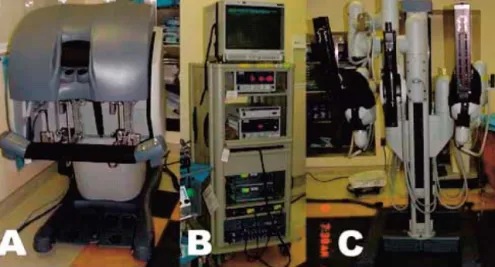
The daVinci robot platform is floor mounted and is not modular. All three (or four) daVinci robot arms (camera and two or three operating arms) develop from a single floor-based stage (Fig. 5). daVinci’s footprint is large, and the robot weighs in at 1200 pounds. Given its size, careful planning is required for daVinci draping and setup (Fig. 6). Movement of all three (or four) arms is integrated by a computer motherboard incor-porated into the surgeon console. The daVinci surgical robotic system employs miniaturized hand instruments with 6 degrees of freedom of motion. A strength of daVinci is that it is a fully integrated system: Its arms “know” where they are in
three-A
B
dimensional space at all times (see the later discussion about integration of imaging with robotic functional platforms). The daVinci also provides binocular three-dimensional vision. A limitation of daVinci is that the electronic control from console to robot arms is “signal and power”—a “master-slave” relation-ship—so there is currently an inherent limit to distance separa-tion of the daVinci components.
HAPTICS AND THE ROBOTIC SURGERY ENVIRONMENT
Using a surgical robotic system, particularly daVinci, is an “im-mersive” experience. The surgeon becomes engrossed in the three-dimensional operative field. A limitation of current ro-botic systems is lack of haptics, or force feedback. The visual experience in surgical robotics is so enriched (by three-dimen-sional vision; magnification; bright, contrast, and high-fidelity imaging) that many robotic surgeons become unaware
that they have no tactile feedback. And although “immersion” can be seductive for the surgeon, the surgeon is separated from the remainder of the operative team. Last year, Intuitive Surgi-cal released a “John Madden teleprompter” device that provides a link between the surgeon console and the tableside surgeon (or a supervising teaching surgeon). This may minimize the isola-tion problem, and it may also be key to remote real-time surgi-cal consultation. Nonetheless, the lack of haptics remains a research challenge limiting some surgical robotic applications.
CURRENT SURGICAL ROBOTIC APPLICATIONS
Although surgical robots are creeping their way into the oper-ating rooms of surgeons from virtually every subspecialty, cur-rently, the most popular surgical robotic applications are in cardiothoracic and urologic surgery.
In cardiothoracic surgery, surgeon tremor, rigid instruments, and visualization constraints caused by the bony thorax limit current minimally invasive cardiothoracic surgery approaches. By improving visualization, eliminating surgeon tremor, im-proving instrument ergonomics and dexterity, and applying motion scaling, surgical robotics expands cardiac surgeon capa-bilities and is being applied to expand minimal access cardio-thoracic surgery, with applications including coronary artery bypass graft (CABG) (even “off pump” bypass),6valve repair and replacement, and thoracoscopic sympathectomy, among others.
In urology, visualization and manipulation in the narrow, difficult-to-access male pelvis are severely limited, and thus minimally invasive approaches to radical prostatectomy have been employed by only a handful of expert videoendoscopic urologic surgeons. Surgical robotics, with three-dimensional visualization and precise, flexible instruments extends the lapa-roscopic urologist’s skills to enable routine robotic-assisted laparoscopic radical prostatectomy. Dr. Mani Menon (who does not claim to be a laparoscopic surgical guru) performs up
FIGURE 5. daVinci surgical robotic system: (a) surgeon console, (b) equipment tower, and (c) robot arm platform.
FIGURE 6. daVinci robot draped and positioned for clinical use. Robot platform is floor mounted and does not move with patient and table; thus, position is fixed once instruments are in place.
to seven such procedures weekly at Henry Ford Hospital in Detroit, Michigan, reporting better visualization, comparable cancer specimens, shorter hospitalization, and more rapid re-covery for his patients.7
General surgery use of surgical robotic technology has probed a wide array of applications, including laparoscopic cholecystectomy, Nissen fundoplication, paraesophageal hernia repair, Heller myotomy, adrenalectomy, splenec-tomy, and Crohn’s stricturoplasty, among others. Interest-ingly, however, consensus among laparoscopic general sur-geons with surgical robotic experience has not been to push for expanded use, at least not when compared with cardio-thoracic and urologic surgery. This attitude is partly caused by the relative confidence that general surgeons feel with laparoscopy because significant laparoscopy training is in-herent to general surgery residency.
MILITARY RELEVANCE OF SURGICAL ROBOTICS
The Defense Advanced Research Projects Agency (DARPA) and the National Aeronautics and Space Administration (NASA) have supported research in surgical robotics and tele-surgery for over 15 years, with spinoffs from DARPA projects leading to early surgical robotic systems from Stanford Research Institute (SRI), a forerunner of the company that makes the daVinci system. Recognizing the potential for remote telesur-gery, projecting surgical expertise into a hostile environment,
the U.S. Army acquired a daVinci surgical robotic system in 2001. The Army’s daVinci was first installed at the Walter Reed Army Institute of Research (WRAIR) for multidisciplinary ori-entation in the use of the machine and for testing of the surgeon learning curve during familiarization training on daVinci.8 Three months later, the robot was moved to Walter Reed Army Medical Center (WRAMC) for clinical use, with the first case, robotic-assisted laparoscopic cholecystectomy, performed by the authors on February 15, 2002. During the first year in clinical use at WRAMC, 130 cases were performed using the daVinci robot.Table 1summarizes the distribution of daVinci cases by surgical service during the first year at WRAMC.
The U.S. Air Force (USAF) Surgeon General and the USAF Directorate of Modernization are committed to exploring the potential of surgical robotics for the U.S. Air Force. LtGen (Dr.) George “Peach” Taylor hopes to acquire a surgical robotic system for Wilford Hall USAF Medical Center (WHMC) within the next 12 months.9Although it is not yet entirely clear what role complex surgical robots will play in civilian clinical practice, it is clear that the potential military applications for this technology are vast, and therefore, all branches of the ser-vice are beginning to engage.
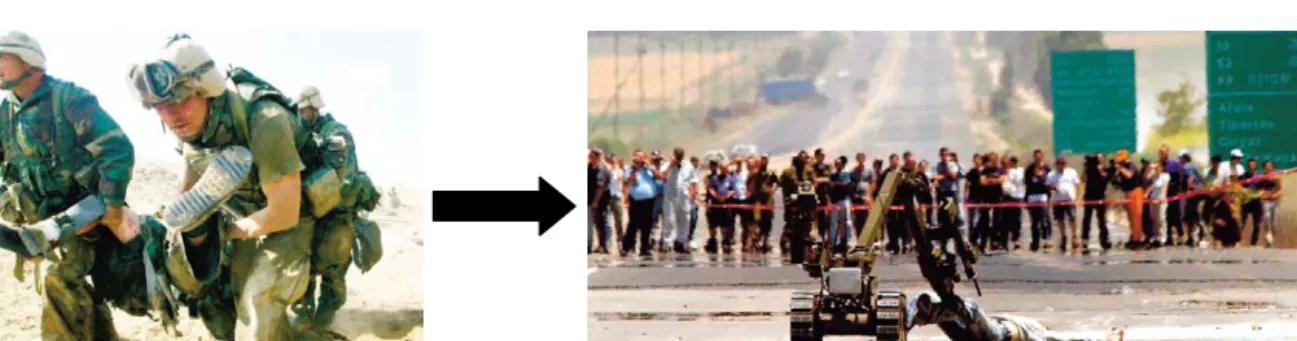
From a military perspective, robotic technology to project function into a hostile environment (combat, nuclear/chemi-cal/biological) has clear applicability (Fig. 7). The daVinci sur-gical robotic system may not currently meet military deploy-ment needs, but the modular, lightweight Zeus and Laprotek systems have the potential to project surgical expertise far for-ward. For example, the Aesop device, if connected to a tele-medicine link, can offer the field surgeon capability to obtain consultation from a surgeon at one of the military’s large, state-side medical centers, who could share the same field of view in real time. As robotic and telemedicine, even telesurgery, capa-bilities expand, surgical robotics could become a force multi-plier and project surgical expertise either to the combat theater or to hostile (biological, chemical, nuclear, etc.) environments. Regarding the peacetime military medical core mission, surgical robotics may be able to enhance surgeon education and exper-tise, patient safety, and, when integrated with telemedicine, provide distant expert consultation to remote locations. TABLE 1. Robotic Operations Performed by Surgical Service in
the First Year of da Vinci Use at Walter Reed Army Medical Center
Surgical service daVinci casesNumber of
Cardiothoracic 86 General Surgery 15 Otolaryngology 11 Urology 18 Total 130 G
FIGURE 7. Current deployable medically relevant robotic capability. The next generation will not only recover the injured in a hostile environment, but also will be capable of diagnosis and limited treatment.
LESSONS LEARNED
Lessons learned from the early experience at Walter Reed in-clude confirmation of the value of a multidisciplinary surgeon and operative team orientation to the surgical robotic system. To our knowledge, Walter Reed was the first institution to develop a formal multidisciplinary (including cardiothoracic surgery, general surgery, neurosurgery, obstetrics and gynecol-ogy, otolaryngolgynecol-ogy, plastic surgery, and urology) orientation program, including measurement of learning curve metrics, prior to deployment of the surgical robotic system for clinical use.8Our experience has taught us that having two surgical robotic systems would be ideal— one in a laboratory setting for research and training and one in the operating room for clinical use. In addition, we have learned that a dedicated team is needed to support this high-technology, high-cost system. The system is cumbersome and requires careful planning to deploy, particularly given the limitation that the system’s robotic arms are independent of the patient and operating table, limiting the ability to move the patient once the arms are deployed.
Our clinical experience has taught us that although the da-Vinci’s enhanced vision system provides a positive immersive experience for the surgeon, the lack of haptic feedback remains a limitation. Furthermore, current daVinci vision systems are limited to 0- and 30-degree telescopes. More options are re-quired, as is a wide-angle view (which has recently been intro-duced). We have also found that because of the current “stand-off” distance required for the robotic arms, and because of the fixed nature of the device once deployed, multiquadrant da-Vinci surgery is extremely difficult.
TELEROBOTIC SURGERY
On September 7, 2001, Professor Jacques Marescaux’s team from IRCAD/EIST (European Institute of Telesurgery) and the University of Louis Pasteur performed the first transatlantic telerobotic laparoscopic cholecystectomy using the Zeus robot. The surgeon and robotic console were in New York City; the patient and surgical robot were in Strasbourg, France. The re-markable elements of this milestone were the multidisciplinary team that Professor Marescaux assembled to solve the surgical, engineering, computer, and telecommunication challenges to make surgery safe for his patient. Prior to this demonstration, Rick Satava, a pioneer in surgical robotics and telemedicine, had posited the “200 mile limit” as the maximum distance possible for telesurgery. Dr. Satava argued that the human brain can only tolerate a signal latency of 330 ms, which would limit a round-trip video signal to 200 miles.10 Using high-band-width, proprietary video compression and infrastructure, Pro-fessor Marescaux’s group reported a remarkable “round-trip” latency of only 155 ms.11
When asked about the significance of this breakthrough at Professor Marescaux’s press conference announcing “Opera-tion Lindbergh” (the name given to this demonstra“Opera-tion), the author commented that this was the most expensive
cholecys-tectomy in history, with $1.5 million in equipment, 80 people required to monitor the integrity of the equipment and signal, and $150 million in research and development by France Tele-com spent over the preceding 2.5 years achieving the remark-able telecommunications speed. But Professor Marescaux has pushed us to the next level of innovation— he has proven that it is possible to safely perform surgery at a distance.
FUTURE OF COMPUTER-ASSISTED SURGERY
Robotic technology is expensive and will require further devel-opment for widespread clinical use. Industry experience with robotic technology is expensive, but in manufacturing (for tool exchange and for precise, repetitive functions), reliability and accuracy rates have exceeded 99.9%. Granted, there is a signif-icant difference between the use of robots for automated tasks and their use as human enhancement devices. However, the Institute of Medicine (IOM) report in 1999 describing between 44,000 and 98,000 deaths annually in the United States from medical errors ushered in an environment where any error re-duction technology has appeal.12
Beyond refinements in surgical robotics technology, includ-ing haptics, better instrumentation, and more compact, deploy-able systems, the links to information systems and telemedicine are essential. Information systems need to be integrated with the surgical robotic platforms, allowing the surgeon real-time access to patient imaging data, including three-dimensional re-constructions of patient anatomy. Telemedicine connectivity can allow real-time expert consultation during surgery, which meets Ron Merrill’s criteria for “telesurgery.”13But to expand Jacques Marescaux’s definition of telesurgery as telemanipula-tion, we need to extend telecommunication connectivity be-yond short distance cable to nonproprietary long-distance ca-ble, we need to resolve bandwidth and compression algorithm limitations, and we even need to investigate wireless capability (for battlefield, ship, or space applications).
It is clear that surgical robots can enhance human visualiza-tion, strength, precision, and degrees of freedom of motion in minimally invasive surgery. At $1 million each, the daVinci and/or Zeus systems currently have a limited niche, but there are over 250 surgical robotic systems already deployed world-wide. Key to this discussion is the recognition that surgical robotics represents a shift in how we use technology. The lapa-roscopic revolution represents a transition technology, stretch-ing the vestiges of the industrial age. Surgical robotics represents the next step, the information age.14Robots are not machines, but they are information systems with arms. Computed tomog-raphy (CT) and magnetic resonance (MR) scanners are not imaging systems, but information systems with eyes.
We currently have the capability to convert digital computed tomography or magnetic resonance images into three-dimen-sional reconstructions of our patients’ anatomy. Although un-derused, we have the technology today to manipulate these reconstructions to simulate best approaches for surgery before
the procedures are actually performed. The implications for improving patient care with better preoperative planning are compelling. Furthermore, surgical education using three-di-mensional reconstructions of contemporary patient anatomy for preoperative teaching and rehearsal offer a significant ad-vance beyond current, often primitive, surgical simulators.
Recall that the daVinci surgical robotic system “knows” where its arms are along “x,” “y,” and “z” axes at all times. If we could register the three-dimensional image of our patient’s anatomy on the three-dimensional functional platform of such a surgical device, we could not only simulate and rehearse our patients’ surgeries preoperatively, but once, after multiple trials, we determine the “best” surgical approach, we could program the robot to perform the surgery in a fully automated fashion. Virtual surgery? This scenario may seem far-fetched, but we have the needed elements of the technology today.
Ethical challenges are frequently embedded in technology research. How do we justify the cost of $1 million robots when 80% of the world’s healthcare needs are underserved? Obvi-ously the surgical robots of today must be viewed as the precur-sors to the telerobotic technology that will bring greatly needed surgical care to the underserved. Technology is neutral; it is neither good nor bad. It offers exciting opportunities, but we must use it wisely. For example, cell phone technology, al-though initially cost-prohibitive for everyone except large cor-porations and the very wealthy, has allowed Third World coun-tries to “leap-frog” over the cumbersome challenges of telephone wire infrastructure. Surgical robotics has the poten-tial to create a similar paradigm shift in the way surgical care is delivered worldwide.
CONCLUSIONS
Laparoscopic surgery remains exciting, but it is a transition technology. As such, the laparoscopic instruments of today will serve as a bridge from the industrial age to the information age. Laparoscopic surgery will continue to grow, but it is already ushering in computer-assisted minimally invasive surgery, based on integration of “smart” technologies. Although current laparoscopic surgery “wizards” perform amazing tasks with “chop stick” instruments using two-dimensional vision, we can do much better with three-dimensional vision and precise, ar-ticulating, intelligently designed robotic instruments. The next generation of surgical platforms will integrate this “smart” tech-nology with imaging systems, ultimately enhancing patient care and safety.
REFERENCES
1. Mouret P. How I developed laparoscopic cholecystec-tomy.Ann Acad Med Singapore. 1996;25:744-747.
2. Proceedings of the NIH Consensus Development Confer-ence on Gallstones and Laparoscopic Cholecystectomy. Bethesda, Maryland, September 14-16, 1992.Am J Surg. 1993;165:387-548.
3. A prospective analysis of 1518 laparoscopic cholecystecto-mies. Southern Surgeons Club.N Engl J Med. 1991;324: 1073-1078.
4. Wherry DC, Rob CG, Marohn MR, Rich NM. An exter-nal audit of laparoscopic cholecystectomy performed in medical treatment facilities of the Department of Defense. Ann Surg. 1994;220:626-635.
5. Mukherjee R, Minor M, Song G, Satava R. Optimization of an articulated instrument for enhanced dexterity in minimally invasive therapy. Minimally Invasive Therapy Allied Technologies. 1998;7:335-342.
6. De Canniere D. Closed chest coronary surgery. State of the art.J Cardiovasc Surg. 2003;44:323-330.
7. Menon M, Tewari A, Baize B, Guillonneau B, Vallancien G. Prospective comparison of radical retropubic prostatec-tomy and robot-assisted anatomic prostatecprostatec-tomy: the Vat-tikuti Urology Institute experience.Urology. 2002;60:864-868.
8. Hanly EJ, Marohn MR, Bachman SL, et al. Multiservice laparoscopic surgical training using the daVinci surgical system.Am J Surg. 2004;187:309-315.
9. Elliott S. Surgical robotics.Military Med Technol. 2003;7: 10-13.
10. Satava RM, Simon IB. Teleoperation, telerobotics, and telepresence in surgery.Endosc Surg Allied Technol. 1993; 1:151-153.
11. Marescaux J, Leroy J, Gagner M, et al. Transatlantic ro-bot-assisted telesurgery.Nature. 2001;413:379-380. 12. Kohn L. To err is human: an interview with the Institute
of Medicine’s Linda Kohn.Jt Comm J Qual Improv. 2000; 26:227-234.
13. Merrell RC. Telemedicine in the 90’s: beyond the future. J Med Syst. 1995;19:15-18.
14. Merrell RC, Jarrell BE, Schenkman NS, Schoener B, Mc-Cullough K. Telemedicine for the operating room of the future.Semin Laparosc Surg. 2003;10:91-94.