Performance Analysis of Cache-Enabled Millimeter Wave Small Cell Networks
Yongxu Zhu , Gan Zheng , Senior Member, IEEE,
Kai-Kit Wong, Fellow, IEEE, Shi Jin , Member, IEEE,
and Sangarapillai Lambotharan , Senior Member, IEEE
Abstract—Millimeter wave (mmWave) small-cell networks can provide
high regional throughput, but the backhaul requirement has become a performance bottleneck. This paper proposes a hybrid system that com-bines traditional backhaul-connected small base stations (SBSs) and cache-enabled SBSs to achieve the maximum area spectral efficiency (ASE) while saving backhaul consumption in mmWave small cell networks. We derive and compare the ASE results for both the traditional and hybrid networks, and also show that the optimal content placement to maximize ASE is to cache the most popular contents. Numerical results demonstrate the perfor-mance improvement of deploying cache-enabled SBSs. Furthermore, given a total caching capacity, it is revealed that there is a tradeoff between the cache-enabled SBSs density and individual cache size to maximize the ASE.
Index Terms—Millimeter wave, cache-enabled network, backhaul, area
spectral efficiency.
I. INTRODUCTION
Deploying small base stations (SBS) using the millimeter wave (mmWave) band is a promising solution to meet the grow-ing demand for data and support emerggrow-ing technologies in next generation mobile communications. However, the expensive high-capacity backhaul links have become a major challenge for realizing the benefits of small cell networks. Based on the observation that mobile data are dominated by multimedia con-tents and especially videos which are reusable, edge caching at SBSs is a viable solution that will minimize unnecessary data transport costs, latency and increase the effective system throughput [1], [2].
Proactive caching at mmWave SBSs for video streaming has been studied in [3] and it is shown to significantly reduce the handoff delays and connection latency. Area spectral efficiency (ASE) defined as average throughput per unit area, which is one of the most visualized performance metrics to analyze the impact of the path loss, shadowing, and multipath fading simul-taneously for a radio mobile communication link than spectral Manuscript received October 25, 2017; accepted January 14, 2018. Date of publication February 28, 2018; date of current version July 16, 2018. This work was supported by the U.K. Engineering and Physical Sciences Research Council under Grants EP/N007840/1 and EP/N008219/1. The work of S. Jin was supported by the National Natural Science Foundation of China under Grant 61531011. The review of this paper was coordinated by Dr. Z. Cai.
(Corresponding author: Yongxu Zhu.)
Y. Zhu, G. Zheng, and S. Lambotharan are with the Wolfson School of Mechanical, Electrical and Manufacturing Engineering, Loughborough Univer-sity, Leicestershire LE11 3TU, U.K. (e-mail: [email protected]; g.zheng@ lboro.ac.uk; [email protected]).
K.-K. Wong is with the Department of Electronic and Electrical Engineer-ing, University College London, London WC1E 6BT, U.K. (e-mail: kai-kit. [email protected]).
S. Jin is with the National Mobile Communications Research Laboratory, Southeast University, Nanjing 210096, China (e-mail: [email protected]).
Color versions of one or more of the figures in this paper are available online at http://ieeexplore.ieee.org.
Digital Object Identifier 10.1109/TVT.2018.2797047
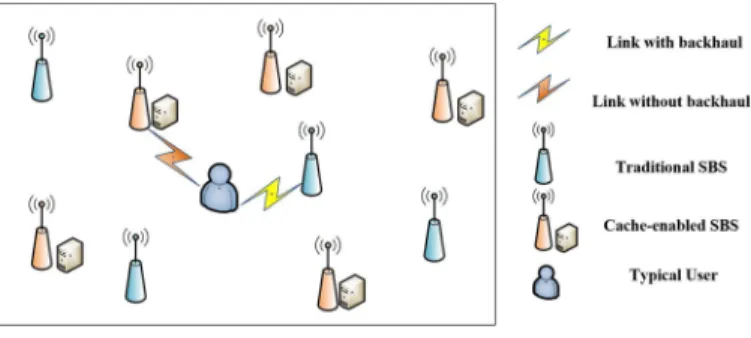
Fig. 1. System model.
efficiency, because it also considering the congestion and load within the cell area. [4], [5]. The ASE of cache-enabled hetero-geneous networks (HetNets) in the sub-6 GHz band has been investigated in [6] where helper nodes with large storage but no backhaul are introduced. It is found that there is an optimal helper density to achieve the maximum ASE. A coded caching scheme was investigates in a large-scale small-cell network in [7], where each SBS stores a certain number of different coded packets of each file and the typical user to be associated with the set of nearest SBSs to obtain the required number of differ-ent packets for decoding. The deploymdiffer-ent of unmanned aerial vehicles (UAVs) and cache placement at UAVs are studied in [8] based on predicted user requests in a cloud radio access network.
There have been very few works towards understanding the benefits and design tradeoffs in cache-enabled mmWave small cell networks which have distinctive channel characteristics. In this correspondence, we introduce a hybrid downlink mmWave small cell network, in which cache-enabled SBSs will replace some traditional backhual-connected SBSs, to achieve the ben-efits of both cache and backhaul. We adopt stochastic geometry to analyze and compare the ASEs of the traditional network with the proposed hybrid mmWave network including both the line of sight (LoS) and non-line of sight (NLoS) components. The main contributions of this paper are summarized as follows:
r
We derive the analytical results of ASEs for both traditionalSBSs and cache-enabled SBSs in mmWave networks;
r
We prove that storing the most popular contents (MPC) ateach cache-enabled SBS will achieve the maximum ASE performance;
r
It is shown that given the total caching capacity, thecache-enabled SBSs density needs to be carefully optimized to combine the benefits of cache and backhaul.
II. SYSTEMDESCRIPTION A. Hybrid mmWave Small Cell Network Layout
The proposed hybrid downlink cache-enabled mmWave small cell cellular network is illustrated in Fig. 1. We define the path loss model including both LoS and NLoS links. Blockages effects are modeled as random process of rectangles in the outdoor scenario, where all mmwave SBSs are distributed as independent homogeneous Poisson point processes (PPPs) with
densityλo, denoted asΦO, which is composed of the LoS region ΦL
O and the NLoS regionΦNO, respectively [9]. We model the millimeter wave channel without small scale fading because of the sparse scattering mmWave environment [10]. Cache is de-ployed at a portion of SBSs denoted asΦCwith densityηλo to replace backhaul, where 0≤η≤1 is the cache-enabled SBSs density factor. The remaining traditional SBSs are connected to backhaul with limited capacity, denoted asΦO(ΦC∪ΦO = ΦO) with density(1−η)λo. Notice thatΦO = ΦO whenη=0 and ΦC= ΦOwhenη=1.
We use a sectored antenna pattern to approximate the mmWave beam, and the antenna gain is expressed as
Gtrk = ⎧ ⎪ ⎪ ⎪ ⎪ ⎪ ⎨ ⎪ ⎪ ⎪ ⎪ ⎪ ⎩ Gt MGrM, Pr tr M M = (2θ ϑπ)2 Gt MGrm, PrtrM m = (2π−θ)ϑ (2π)2 Gt mGrM, Pr tr m M = θ(2π−ϑ) (2π)2 Gt mGrm, Prtrm m= (2π−θ)(2π−ϑ) (2π)2 , (1) whereGtr
lk =Gt(θ)Grk(ϑ)(, k∈ {M,m})denotes the total di-rectivity gain with beamwidth θ andϑ in the links from the transmitter and the receiver, respectively.Gr&t
M is the main lobe
array gain with probabilityPrrM&t= 2υπ(υ∈ {θ, ϑ})andGr&t
m
is the sidelobe array gain with probabilityPrrm&t =2π−υ
2π .Pr tr k denotes the probability with the antenna gainGtandGrk. B. Caching Placement Strategies
We assume that users request contents from the libraryF= {f1, f2, . . . , fJ}randomly, where the content library cardinality isJ. Each filejis requested according to the probabilityaj. We assume that the request distribution for each contentfj is aj wherea1> a2>· · ·> aJ, and
J
j=1aj =1. Assume that all contents have the same size normalized to 1. Each SBS has a cache capacity ofKcontents (1< K J), and can store up to
X ∈[K, J]contents with the random caching probability which is denoted asbj for thej-th content,X =Kis a special case when only the most popular contents are stored at each SBS. Therefore, we have Xj=1bj ≤K. The remaining uncached contents are served by the traditional SBSs via backhaul.
ΦC,j denotes the set of the cache-enabled SBSs with density
bjηλowho can support the typical user when thej-th content is requested, andΦC=∪j∈JΦC,j.
C. Transmission Scheme
Following the analytical framework of stochastic geometry, we consider the user association based on the closest distance to the active SBS [9]. To minimize the backhaul usage, we assume the typical user is associated with a cache-enabled SBS, as long as the requested file can be found in the cache; otherwise, the user is associated with the nearest traditional SBS. In the following, we will define the signal-to-interference-plus-noise ratios (SINRs) for different scenarios which are necessary for the ASE analysis.
Definition 1: When the typical user is associated with a tradi-tional mmWave SBS with only the backhaul link, the downlink SINR is given by SINRo =PtG t MGrML(|Xo|) Io+Io+σo2 , (2)
where the Pt is transmit power which is the same for all SBSs, Gt
M and GrM is the associated SBS and the typical
user’s maximum array gain. We employ a short-range propa-gation model with corresponding distance |Xo| from the as-sociated o-th SBS to the typical user. The path loss func-tion is denoted as L(|Xo|) =β|Xo|−αo, where β is the fre-quency dependent constant parameter, andαo is the path loss exponent given by αo =αL for the LoS area and αo=αN
for the NLoS area, respectively. We use the approximation of an equivalent LoS ball [9] and define LoS reference area less than D, i.e., the link is considered LoS if |Xo| ≤D, and NLoS otherwise. Note that we neglect the small-scale fading since it has limited impact due to the lack of spatial scattering [11]. We have the interference from the traditional SBSsIo =
i∈ΦO\oPtGtGrkL(|Xi|)and the interference from cache-enabled SBSsIo =
g∈ΦCPtG
t
GrkL(|Xg|)in (2) where
|Xi|and|Xg|are the distances between the typical user and the traditional SBSi, and the cache-enabled SBSg, respectively. Whenη=0,Io =
i∈ΦO\oPtGtGrkL(|Xi|), andIo =0.σ2o denotes the noise power.
Definition 2: When the typical user is associated with a cache-enabled SBS and requests thej-th content, the downlink SINR is defined as:
SINRc,j = PtGtMGrML(|Xn ,j|) Ic,j +Ic,j +Io +σo2 , (3) whereIc,j = h∈ΦC, j\{n}PtG t
GrkL(|Xh|0)is the sum inter-ference from the active cache-enabled SBSs who store thej-th content in ΦC,j, Ic,j =
g∈ΦC\{ΦC , j}PtG t
GrkL(|Xg|) is the sum interference from the active cache-enabled SBSs who do not store the j-th content, and Io =i∈Φ
OPtG
t
GrkL(|Xi|) is the sum interference from the active traditional SBSs with-out cache.|Xh|,|Xg|, and|Xi|denote the distances between the typical user and the corresponding interfering SBSs in the above three categories, respectively.
We use ASE as the performance indicator to measure the aver-age network capacity which is defined as the averaver-age throughput per unit spectrum and area [4], [6]. For the traditional mmWave small cell networks without caching, ASE can be obtained as
Ao =λoRO, (4)
whereRO = min{E[log2(1+SINRo)],RB},SINRois the spe-cial case ofSINRo in (2) when η=0 , RB is the backhaul capacity limit andE[·]denotes the expectation operation.
For the proposed hybrid systems with mixed cache-enabled SBSs and traditional SBSs, ASE can be obtained as
Ac= X j=1 aj(bjηλo)RC,j AC c + J j=X+1 aj(1−η)λoRO AB c , (5) whereAC
c denotes ASE of cache-enabled SBSs aggregated in ΦC.RC,j =E[log2(1+SINRc,j)]is the achievable rate of the
j-th requested content.RO= min{E[log2(1+SINRo)], RB}is the achievable rate of the traditional network with limited back-haul capacity.
ΘL ,j(z, x, bjη) = ,k∈{M,m} Prtrk ×f|Xn , j|(bjη, x)· 1−e−z PtGtMGrMβ x−αL ΨL(z, x, bjη), (7) with ΨL(z, x, μ) =e −z2πλoPtGt r kβ m i n{D2−αL−μ x2−αL,(1−μ)D2−αL} 2−αL − m a x{D2−αN, μ x2−αN+ (1−μ)D2−αN} 2−αN (8) ΘN ,j(z, x, bjη) = ,k∈{M,m} Prtrk×f|Xn , j|(bjη, x)· 1−e−z PtGtMGrMβ x−αN ΨN(z, x, bjη), (9) ΨN(z, x, μ) =e −z2πλoPtGt r kβ (1−μ)D2−αL 2−αL − μ x2−αN+ (1−μ)D2−αN 2−αN (10)
III. PERFORMANCEANALYSIS
In this section, in order to derive the ASEs of the hybrid cache-enabled network and the traditional network, we first de-rive the achievable rate ofRC,jandRO, respectively. Then the optimal content placement probability the maximizes that ASE is proved.
A. Achievable Rate Through Cache-Enabled SBSs
Theorem 1: The average delivery rate when the typical user requests thej-th content and is associated with a cache-enabled SBS is given by: RC,j = 1 ln2 ∞ 0 D 0 1 zΘL ,j(z, x, bjη)e −z σ2 odxdz + 1 ln2 ∞ 0 ∞ D 1 zΘN ,j(z, x, bjη)e −z σ2 odxdz, (6)
where ΘL(z, x, bjη)andΘN(z, x, bjη)are given by (7)–(10), shown at the top of this page, respectively.
Proof 1: The average rate of thej-th content served by a cache-enabled SBS can be expressed as
RC,j =E[log2(1 +SINRc,j)] (a) = 1 ln2 × ∞ 0 1 zE (1−e−zSc , j)e−zIc , j Δj(z) ×Ee−z(Ic , j+Ic) Δj(z) e−z σ2odz, (11)
where (a) comes from [12] which is valid for SINRc,j ≥ 0. Sc,j =PtGtMGrML(|Xn ,j|) depends on the nearest active cache-enabled SBS with distance |Xn ,j|=x. First, we can directly obtain Δj(z) with signal and interference from the cache-enabled SBS who serves thej-th file
Δj(z) = D 0 1−e−z PtGtMGrMβ x−αL e−zIc , jL (z ,x) ΔL , j(z ,x) f|Xn , j|(x)dx + ∞ D 1−e−z PtGtMGrMβ x−αN e−zIc , jN (z ,x) ΔN , j(z ,x) f|Xn , j|(x)dx, (12)
where f|Xn , j|(x) is the PDF of the distance |Xn ,j| between the typical user and its nearest cache-enabled serving SBS that stores the j-th content, which is given by f|Xn , j|(x) = 2πbjηλoxe−π bjηλox
2
.
ΔL ,j(z, x) is the interference inside the LoS area with the radiusD andΔN ,j(z, x)is the interference of the NLoS area. Based on the law of total expectation, we can directly obtain ΔL ,j(z, x)andΔN ,j(z, x)as ΔL ,j(z, x) =EΦL C, j/{n} e−zILc , j(x) = ,k∈{M,m} Prtrk ×exp −z2πbjηλoPtGtrkβ × D m in(x,D) r1−αLdr + ∞ m ax(x,D) r1−αNdr , (13) and ΔN ,j(z, x) =EΦN C, j/{n} e−zIc , jN (x) = ,k∈{M,m} Prtrk ×exp −z2πbjηλoPtGtrkβ ∞ x r1−αNdr . (14)
ThenΔj(z)in (12) can be derived with (13) and (14) avail-able. Next, we deriveΔj(z). It includes two sources of interfer-ence: one comes from the cache-enabled SBSs who do not have thej-th content, and the other comes from the traditional SBSs. SoΔj(z)is given by Δj(z) =EΦC\{ΦC , j}∪ΦC e−z(Ic , j+Ic) = ,k∈{M,m} Prtrk ×exp −z2π(1−bjη)λoPtGtrkβ × D 0 r1−αLrdr+ ∞ D r1−αNdr . (15)
Substituting (12) and (15) into (11), we attain the desired results in (6), (7) and (9). This completes the proof.
B. Achievable Rate Through Traditional SBSs
For comparison, we derive the achievable rate of the tradi-tional network, which is novel and necessary in order to obtain the average achievable rate of the typical user in the hybrid net-work with limited backhaul, which is summarized in the theorem below.
Theorem 2: The average achievable rate of the typical user that is associated with a traditional SBS in hybrid caching net-works with limited backhaul which can be quantified as
RO= min R O,RB , (16) whereROis derived as R O =ln12 ∞ 0 D 0 1 zΘL(z, x)e −z σ2 odxdz + 1 ln2 ∞ 0 ∞ D 1 zΘN(z, x)e −z σ2 odxdz, (17) ΘL(z, x) = ,k∈{M,m} Prtrk ×f|Xo|(x) ·1−e−z PtGtMGrMβ x−αL ΨL(z, x,1−η) (18) ΘN(z, x) = ,k∈{M,m} Prtrk ×f|Xo|(x) ·1−e−z PtGtMGrMβ x−αN ΨN(z, x,1−η) (19)
andΘL(z, x)andΘN(z, x)are given by (18) and (19) on the
next page, respectively.
Proof 2: Similar to Theorem 1, the achievable rate of the typical user that is associated with a traditional SBS is given by R O= 1 ln2 ∞ 0 1 z 1−e−zSINRo dz= 1 ln2 ∞ 0 1 zE e−zIo ¯ Λ(z) × ⎡ ⎢ ⎢ ⎣ D 0 1−e−zSoE e−zIoL(x) ΛL(z ,x) f|Xo|(x)dx + ∞ D 1−e−zSoE e−zINo(x) ΛN(z ,x) f|Xo|(x)dx ⎤ ⎥ ⎥ ⎦e−z σ2odz, (20) whereΛL(z, x),ΛN(z, x)andΛL(z, x)are obtained from (13) and (14) by replacing the parameterbjηby→1−η, and chang-ingf|Xo|(x)to be the PDF of the distance|Xo|=xbetween the typical user and its serving traditionalmmWave SBS, which is given byf|Xo|(1−η, x) =2π(1−η)λoxe−
π(1−η)λox2. Then we obtain the desired results in (16) and (17) and this completes the proof.
C. Optimal Content Placement
Here we aim to optimize the content placement probability {bj}to reduce the backhaul usage or maximizeACc. The opti-mization problem can be formulated as:
P1: max 0≤bj≤1,X AC c = X j=1 aj(bjηλo)RC,j in (5) s.t. X j=1 bj ≤K, and bj =0,∀j > X. (21) Its solution is given in Theorem 3 below.
Theorem 3: To maximizeAC
c, caching the MPC is the opti-mal solution, i.e., the optiopti-mal caching placement probabilities are given bybj =1,∀0≤j≤Kandbj =0 otherwise. In this case,X =K.
Proof 3: We can rewrite RC,j as RC(bj), and from (6) it can be seen thatRC(bj)is an increasing function of the prob-abilitybj. Also notice that the optimal solution should satisfy
bj ≥bm,∀j < m, because{aj}is arranged in a decreasing or-der. Define a utility functionUj(bj)ajηλoRC(bj), and it is obvious thatUj(bj)≥ Um(bm),∀j < m, and now we can see thatUj(bj)is an increasing function ofbj but it is a decreasing function ofj.
Next introduce the auxiliary linear programming problem below P2: max 0≤bj≤1 X j=1 bjUj s.t. X j=1 bj ≤K, and bj =0,∀j > X, (22) where we have introduced an auxiliary constantUjwhich is non-increasing inj but not a function ofbj. The optimal solution of the linear problemP2is given bybj =1 for 0≤j≤Kand
bj =0 otherwise.
By comparingP1andP2, we can see the only difference inP1 is thatUj(bj)is a function ofbj, but it is still a non-increasing function in j regardless the solution bj (bj ≥bm,∀j < m should be satisfied). Therefore the optimal solution ofP1 re-mains the same as that ofP2. This completes the proof.
Based on Theorem 3, MPC is the optimal cache placement policy, which simplifiesActo
Ac=pcηλoRC,j+po(1−η)λoRO, (23) wherepc=
K
j=1ajis the hit probability for theKMPCs, and
po is the hit-miss probability for the remaining contents. IV. NUMERICALRESULTS ANDDISCUSSIONS
In this section, we provide numerical evaluation of the ASE and compare the performance of the traditional and the proposed hybrid cache-enabled mmWave networks. The system parame-ters are shown in Table I. We assume that both the transmitter and the receiver have the same array gain and beamwidth.
To generate the numerical results, the Zipf request distribution is used and consequently the probability that the contentfj is requested is equal to aj =j−δ/ J k=1 k−δ, (24)
TABLE I
SYSTEMPARAMETERVALUES[13]
Parameters Values
Main-lobe array gain ((Gt M, G t m, θ) = (GrM, G r m, ϑ)) (3dB,−3dB,45◦) LoS region (D) 15 m
Transmit power of each MW-SBSPt 30 dBm
Path loss exponentfc=60 GHz αL=2.25,αN=3.76
Available bandwidth in mmwave (W) 1 GHz
SBS cache capacity (K) 100
Content library size (J) 104
Backhaul constraint (RB) 0.4 bit/s/Hz
Fig. 2. Area spectral efficiencies, whenη=0.5. (a)λo=800/km2,δ=1.2.
(b)δ=1.5.
where δ is the Zipf exponent that represents the popularity skewness.
In Fig. 2, we compare the traditional ASEAoin (4) with the ASEAcin (23) which is achieved by the hybrid cache-enabled network. The ASEs achieved by caching and backhaul only are also shown as AC
c andABc, respectively. From Fig. 2(a), we can see that as the transmit power increases,Ao is limited by the backhaul capacity, butAc can keep increasing and achieve better performance thanAo. From Fig. 2(b), it is observed that the proposed cache-enabled SBSs achieve better performance in high-density networks.
Next we investigate the tradeoff between the cache-enabled SBSs densityηand the individual cache capacity limitK, given a total cache capacity ofKt, and we haveK= min(J,ηλKo·|A|t ).
Fig. 3 shows the comparison of cache-enabled ASE in a square of side lengthRa=1 km given the total cache capacityKt =
8×10⁴. The Zipf skewnessδvaries from(0,2). The red line
shows the optimal value of the cache-enabled SBS densityη
when the Zipf skewnessδvaries. The result shows that with high Zipf skewness, the ASE always increases with the cache-enabled SBS density. On the other hand, in the lower Zipf skewness case, there exists an optimal cache-enabled SBSs densityη to maximize the ASE, andη=1 is not necessarily the optimal strategy.
V. CONCLUSION
In this paper, we have derived the ASE performance of the proposed hybrid cache-enabled mmWave small cell networks
Fig. 3. Area spectral efficiencies,λo=200/km2.
and contrasted it with the traditional mmWave small cell net-works without caching. We have shown that caching the MPCs is the optimal content placement strategy. Numerical results demonstrated that cache-enabled SBS networks can achieve higher ASE and save more backhaul consumption especially when the transmit power is high. For a given total cache ca-pacity within an area, there is an optimal cache-enabled SBSs density that maximizes ASE. Our work is limited to the fixed network topologies without considering user mobility, we will consider in our future work.
REFERENCES
[1] S. Woo, E. Jeong, S. Park, J. Lee, S. Ihm, and K. Park, “Comparison of caching strategies in modern cellular backhaul networks,” in Proc. 11th
Annu. Int. Conf. Mobile Syst., Appl., Serv., Taipei, Taiwan, Jun. 2013,
pp. 319–332.
[2] X. Wang, M. Chen, T. Taleb, A. Ksentini, and V. Leung, “Cache in the air: Exploiting content caching and delivery techniques for 5g systems,”
IEEE Commun. Mag., vol. 52, no. 2, pp. 131–139, Feb. 2014.
[3] J. Qiao, Y. He, and X. S. Shen, “Proactive caching for mobile video streaming in millimeter wave 5G networks,” IEEE Trans. Wireless
Com-mun., vol. 15, no. 10, pp. 7187–7198, Aug. 2016.
[4] M.-S. Alouini and A. J. Goldsmith, “Area spectral efficiency of cellular mobile radio systems,” IEEE Trans. Veh. Technol., vol. 48, no. 4, pp. 1047– 1066, Jul. 1999.
[5] J. G. Andrews, “Seven ways that HetNets are a cellular paradigm shift,”
IEEE Commun. Mag., vol. 51, no. 3, pp. 136–144, Mar. 2013.
[6] D. Liu and C. Yang, “Caching policy toward maximal success probabil-ity and area spectral efficiency of cache-enabled HetNets,” IEEE Trans.
Commun., vol. 65, no. 6, pp. 2699–2714, Jun. 2017.
[7] X. Xu and M. Tao, “Modeling, analysis, and optimization of coded caching in small-cell networks,” IEEE Trans. Commun., vol. 65, no. 8, pp. 3415– 3428, Aug. 2017.
[8] M. Chen, M. Mozaffari, W. Saad, C. Yin, M. Debbah, and C. S. Hong, “Caching in the sky: Proactive deployment of cache-enabled unmanned aerial vehicles for optimized quality-of-experience,” IEEE J. Sel. Areas
Commun., vol. 35, no. 5, pp. 1046–1061, May 2017.
[9] T. Bai and R. W. Heath, “Coverage and rate analysis for millimeter-wave cellular networks,” IEEE Trans. Wireless Commun., vol. 14, no. 2, pp. 1100–1114, Feb. 2015.
[10] O. El Ayach, S. Rajagopal, S. Abu-Surra, Z. Pi, and R. W. Heath, “Spa-tially sparse precoding in millimeter wave MIMO systems,” IEEE Trans.
Wireless Commun., vol. 13, no. 3, pp. 1499–1513, Mar. 2014.
[11] T. S. Rappaport et al., “Millimeter wave mobile communications for 5g cellular: It will work!” IEEE Access, vol. 1, pp. 335–349, May 2013.
[12] K. A. Hamdi, “Capacity of MRC on correlated Rician fading channels,”
IEEE Trans. Commun., vol. 56, no. 5, pp. 708–711, May 2008.
[13] T. S. Rappaport, E. Ben-Dor, J. N. Murdock, and Y. Qiao, “38 GHz and 60 GHz angle-dependent propagation for cellular & peer-to-peer wire-less communications,” in Proc. IEEE Int. Conf. Commun., Ottawa, ON, Canada, Nov. 2012, pp. 4568–4573.