REPUBLIC OF TURKEY
Road Improvement and Traffic Safety Project
Traffic Safety Project
NATIONAL TRAFFIC SAFETY
PROGRAM
2. yeniden düzenleme
Kasım 2001
FOR TURKEY
MINISTRY OF INTERIOR
MINISTRY OF NATIONAL EDUCATION
MINISTRY OF PUBLIC WORKS AND SETTLEMENT
MINISTRY OF HEALTH
GAZİ UNIVERSITY
EXECUTIVE SUMMARY
This National Traffic Safety Program for Turkey is presented in: Main Report and Appendices
Foreword
In Turkey more than nine thousand persons are killed in road accidents every year and
probably some two hundred thousand are injured. In other words, around 25 people are killed and more than 500 are injured every day on Turkish roads. Some of the injured are
handicapped for life. Many of the victims are young, which means that major parts of their lives are totally or partially destroyed.
In addition to pain and suffering, grief and sorrow, accidents cause huge economic losses to the Turkish society and its citizens. It has been estimated that the socio-economic costs of road crashes amount to TL 2 000 000 billion per year (1999 price level).
It is not reasonable to accept that the road transport system creates such human disaster every year. In order to substantially reduce the problem, this National Traffic Safety Program has been developed within the Traffic Safety Project (financed partly by World Bank loans and partly by Turkish funds).
The aim is to tackle the accident and casualty problem by firstly analyzing the Problem, formulating a safety Vision, developing a Strategy and an action Plan, and then by implementing proposed actions. The time-period for the Program is 2002-2011. The overall long-term safety vision is that:
Nobody should be killed or seriously injured (as a result of a road accident) on Turkish
roads.
The medium-term safety objectives are that:
The numbers of persons killed and seriously injured (as a result of a road accident) should
be continuously reduced.
Special attention should be paid to the safety of vulnerable road users and children.
The safety targets compared with 1999 are that:
by 2006
- the number of killed should be reduced by 20 percent,
- the number of killed vulnerable road users should be reduced by 20 percent,
- the number of killed children (0-14 years) should be reduced by 25 percent,
by 2011
- the number of killed should be reduced by 40 percent.
- the number of killed vulnerable road users should be reduced by 40 percent.
- the number of killed children (0-14 years) should be reduced by 50 percent.
Implementing the proposed interventions and attaining these targets will altogether save more than 4 200 lives over the next 5 years.
transport policy, attitudes towards safety, organization, cooperation and coordination, safety staff, funding, data banks, and safety research and development, as well as a number of technical areas: safer roads and vehicles, safer road users, better education, better legislation and enforcement, and improved emergency services. The Program also includes some specially prioritized areas, reduced speeding and aggressive driving, and increased use of safety equipment.
The proposed interventions will require additional funds, improved social responsibility and tougher regulations and enforcement. The success of the Program will of course depend on its implementation. Increased efforts are needed from all parts of society: public agencies, private enterprises and organizations as well as all individuals.
It must be stressed that traffic safety is a most important responsibility for all involved in road transport. Everyone has a stake, the Parliament and the government, many ministries and government authorities (KGM, Police and Jandarma, MoNE and MoH etc.), provincial governments, local authorities, car makers and importers, fuel/tire and insurance companies, transport providers, universities, schools, emergency services and health care organizations, media, planning and design organizations, and non-governmental organizations (NGOs), all have a role in creating the conditions for safer road traffic. Last but not least, the individual road user – drivers, riders and walkers – has an important role.
The intention is that this national Program should be complemented by provincial and local safety programs, which are consistent with the Program, but reflecting provincial and local problems and imperatives.
The progress of the Program should be continuously monitored and evaluated. In 2006 the Program should be reviewed and revised.
The Program has been prepared by SweRoadx) in collaboration with the “Task Force” of the Traffic Safety Project. A draft version of this Program has been sent for consultation to the main actors. Their comments have been considered and included in this final version.
TRAFFIC SAFETY STARTS WITH YOU
Ankara, December 2001
The members of the Task Force recommend this National Traffic Safety Program to be implemented:
Ahmet Bulut, KGM Mustafa Çandır, MoNE Sabri Yıldız, KGM Recep Altın, MoNE Burhan Altındal, EGM Tacettin Kakillioğlu, MoH
Baki Özer, EGM Mehmet Ali Bumin, Gazi University
Karl-Olov Hedman SweRoad, Team Leader ______
CONTENTS
PAGE
FOREWORD 1
1 INTRODUCTION 4
1.1 Background 4
1.2 Objectives of the program 4 1.3 Basic principles and structure of the program 4 1.4 Authorization, responsibility and accountability 5 1.5 Monitoring and evaluation 5 1.6 Time-periods and revisions 6 2 PROBLEM 7 2.1 Statistics and forecasts 7 2.2 “Institutional” areas 11
2.3 “Technical” areas 12
3 VISION 15
3.1 Background 15
3.2 Proposed safety vision 16
4 STRATEGY 17 4.1 General 17 4.2 “Institutional” actions 18 4.3 “Technical” actions 19 5 PLAN 23 5.1 General principles and top priorities 23
5.2 “Institutional” actions 24
5.3 “Technical” actions 24
5.4 Safety effects and costs 24
1
Introduction
1.1 Background
The Government of Turkey is carrying out a “Road Improvement and Traffic Safety Project”, financed by World Bank loans and domestic funds. The Traffic Safety Project, which is part of the mentioned project, has a budget of close to USD 91 million*), and consists of three parts: a Pilot Project, a National Project and a Strategy for a National Road Traffic Safety System (NRTSS).
The Swedish company “Swedish National Road Consulting AB” (SweRoad) is providing consultancy services for the Traffic Safety Project. A special Task Force is the counterpart of the Client, and has the function of a discussion group and an approval and decision body for SweRoad.
According to the Terms of Reference, the Consultant will “produce a proposed long-term Traffic Safety Plan (2001-2010) by the end of September 2000**). The plan shall cover the institutional framework for traffic safety, a mid-term (5 years) program of priority activities and list of performance indicators required for monitoring implementation of the Traffic Safety Plan and related programs. The overall target of the Traffic Safety Plan shall be to “reduce the amount of fatalities and injuries in traffic accidents by at least 40 percent within a 10 year period from the commencement of implementation of the Plan”.
The final report for the NRTSS has been called the National Traffic Safety Program for Turkey. This publication is an Executive Summary of the Program.
1. 2 Objectives of the program
The overall objective of the program is to substantially reduce the accident and casualty problem in Turkey during the next decade and in the future.
This is to be achieved by firstly analyzing the Problem, formulating a safety Vision, developing a Strategy and an action Plan, and then by implementing proposed actions.
1. 3 Basic principles and structure of the program
The National Traffic Safety Program is developed in four steps:
1. Analysis of the present accident and casualty problem (“Problem”)
2. Formulation of a safety vision (“Vision”)
3. Development of a strategy (“Strategy”)
4. Development of an action plan (“Plan”)
_________
*) later reduced to about USD 80 million **) later postponed until December 2001.
In “Problem”, the road accident and casualty problem is analyzed, mainly by studying
accident statistics and major factors effecting the safety situation. The Problem forms an important and necessary basis for the Strategy and the Plan.
In “Vision”, the ultimate and ideal, long-term image for traffic safety is formulated. The
Vision forms an important basis for the Strategy and the Plan. The Vision is also necessary in order to increase politicians’, media’s and the general public’s interest in traffic safety. In “Strategy”, the overall objectives and the long-term targets are developed. It is also
proposed what strategic actions should be taken in order to achieve the targets in an efficient way. The Strategy has to be carefully prepared and agreed upon, and forms an important and necessary basis for the Plan.
In “Plan”, mid- and short-term targets are developed. It is also proposed what actions should
be taken in order to attain the targets in an efficient way. The Plan has to be carefully prepared and agreed upon.
1. 4 Authorization, responsibility and accountability
It is suggested that the Program, after having been approved by the Task Force, should be authorized by the Supreme Highway Traffic Safety Council (SHSC) or some of the involved ministries. This authorization should imply that the Program is finally approved and should be implemented, and that necessary state financing is secured.
It is further suggested that the Program be published by the Highway Traffic Safety Council (HTSC) or the Task Force, in principle, by order from the SHSC.
The ultimate responsibility and accountability for the Program and its implementation rests with the SHSC or the authorizing ministries. However, it is suggested that the HTSC should act as a preparatory and assisting group for the SHSC (or the authorizing ministries) in this matter, and act on its behalf. This implies that the HTSC should take responsibility for “minor” matters. For “extensive and far-reaching” matters, the SHSC (or the authorizing ministries) has the ultimate responsibility.
1. 5 Monitoring and evaluation
It is suggested that the implementation of the Program be monitored by a special group from the proposed Traffic Safety Secretariat (see “Strategy” and “Plan”). Awaiting this, the present Task Force should act as the monitoring group. The group should report its findings to the HTSC at least twice a year. The HTSC then decides about “minor” actions needed. If the necessary actions are “extensive and far-reaching”, the question has to be transferred to the SHSC (or the authorizing ministries). The HTSC reports to the SHSC (or the authorizing ministries), at least once a year on this matter. The SHSC can then take further action.
1. 6 Time-periods and revisions
The time-period for the Program is suggested to be 2002-01-01--2011-12-31. The intention is that the Program should be reviewed and revised in the year 2006 to cover the period 2007-01-01--2011-12-31.
2
Problem
In the Problem section, the road accident and casualty problem is analyzed, mainly by studying accident statistics and major factors affecting the safety situation.
Three areas have been studied: Statistics and forecasts, “Institutional” areas, “Technical” areas.
2.1
Statistics and forecasts
The historic development of reported road traffic accidents and casualties are shown in Figure
1, 2 and 3 respectively.
Figure 1: Number of reported accidents (Police and Jandarma).
Traffic accidents (1970-2000) 0 100000 200000 300000 400000 500000 600000 1970197119721973197419751976197719781979198019811982198319841985198619871988198919901991199219931994199519961997199819992000 Police Jandarma Reported by:
Figure 2: Number of reported injuries (Police and Jandarma).
Figure 3: Number of reported fatalities (Police and Jandarma).
The number of reported road traffic accidents has increased from about 115 000 in 1990 to 466 000 in 1999 (corresponding to an average annual increase of 17 percent). In 2000 the number was 501 000.
The number of reported injuries has increased from about 88 000 in 1990 to 126 000 in 1999 (corresponding to 4 percent annually). In 2000 the number was 135 000.
Injuries in traffic accidents (1970-2000) 0 20000 40000 60000 80000 100000 120000 140000 160000 1970197119721973197419751976197719781979198019811982198319841985198619871988198919901991199219931994199519961997199819992000 Police Jandarma Reported by:
Fatalities in traffic accidents (1970-2000) 0 1000 2000 3000 4000 5000 6000 7000 8000 1970197119721973197419751976197719781979198019811982198319841985198619871988198919901991199219931994199519961997199819992000 Police Jandarma Reported by:
The number of reported fatalities was about 6300 in 1990 and 6100 in 1999 (corresponding to a 0.4 percent decrease annually). In 2000 the number was 5600.
The present situation concerning accident and casualty reporting and statistics can be
characterized as follows:
EGM and Jandarma report accidents, injury accidents, injuries, fatal accidents and fatalities (dead at the accident scene). From 1999, special data for so-called “hit and run” cases are also reported by EGM.
There is no official information available concerning how many injured persons die during transport to medical care.
MoH publishes hospital statistics concerning annual number of deaths in hospital from “motor vehicle accidents” and from “other transport accidents”.
Altogether this means that it is very difficult to get a true picture of the total accident and casualty situation.
The estimated number of fatalities, which are reported by EGM, Jandarma and MoH, is about
8 500 in 1997 and 8 800 in 1998. In 1999, the corresponding value is 8 700. If “hit and run” cases are added, the value is 9 100 in 1999. To these values should be added the number of injured who die during transport to hospital. This means that the total number of fatalities (with the 30-days definition of a road fatality) amounts to somewhere between 8 900 (in 1997) and 9 550 (in 1999, including “hit and run”).
The number of reported injuries has been between 106 000 and 126 000. If the “hit and run” cases are added, the total for 1999 amounts to 136 000. The number of reported accidents has varied between 388 000 and 466 000. If the “hit and run” cases are added, the total for 1999 amounts to 479 936.
Predictions of accidents and casualties have been made based on forecasts of number of
inhabitants and motor vehicles as well as forecasts of number of accidents and casualties per inhabitant and motor vehicle. In Table 1 the predicted numbers of reported accidents, injuries and fatalities (by EGM and Jandarma) are shown.
Table 1: Actual and predicted numbers of reported accidents, injuries and fatalities as well as estimated accident and casualty costs (1999 price level).
Year Fatalities (number/year) Injuries (number/year) Accidents (number/year) Costs**) (TL billion/year) 1990 6 286*) 90 520 115 295 1 360 000 1999 6 130*) 125 586 465 915 1 780 000 2006 best estimate 5 850 155 000 800 000 2 060 000 2011 best estimate 6 050 180 000 1 150 000 2 420 000
From the table it can be seen that if safety interventions are being carried out “as usual” (i.e., if no additional or special safety actions are taken):
the number of reported accidents will increase by about 250 percent from 1999 to 2011, the number of reported injuries will increase by 40 percent,
the number of reported fatalities will decrease by 1 percent,
the costs of reported accidents and casualties will increase by 36 percent.
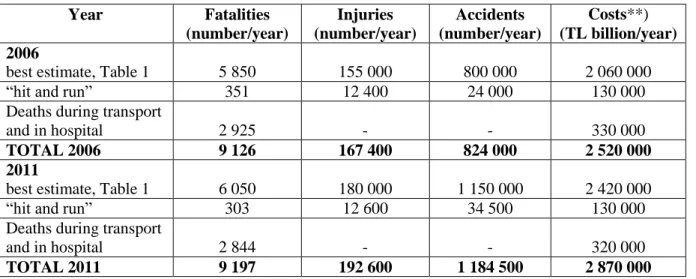
To these estimates of reported accidents and casualties should be added the number of “hit and run” cases, and the number of fatalities during transport to hospital and in hospital. The total estimated numbers are given in Table 2.
Table 2: Predictions of total fatalities and reported injuries and accidents for 2006 and 2011.
Year Fatalities (number/year) Injuries (number/year) Accidents (number/year) Costs**) (TL billion/year) 2006
best estimate, Table 1 5 850 155 000 800 000 2 060 000 “hit and run” 351 12 400 24 000 130 000 Deaths during transport
and in hospital 2 925 - - 330 000
TOTAL 2006 9 126 167 400 824 000 2 520 000
2011
best estimate, Table 1 6 050 180 000 1 150 000 2 420 000 “hit and run” 303 12 600 34 500 130 000 Deaths during transport
and in hospital 2 844 - - 320 000
TOTAL 2011 9 197 192 600 1 184 500 2 870 000
*) “hit and run” cases included. **) 1999 price level.
Altogether, it is estimated that there will be approximately: in 2006:
9 125 fatalities
167 000 injuries (reported) 824 000 accidents (reported)
at the cost of TL 2 500 000 billion (1999 price level). in 2011:
9 200 fatalities
193 000 injuries (reported) 1 185 000 accidents (reported).
at the cost of TL 2 900 000 billion (1999 price level).
The numbers are based on the assumption that the “historic development” in a way repeats itself in the next 10-year period. If, however, there will be substantial changes in attitudes towards safety and increases in safety interventions, the numbers can be reduced substantially.
It must be observed that the numbers are based on available statistics and that they are “best estimates” with a considerable degree of uncertainty.
2.2
“
Institutional” areas
The main problems for the different institutional areas are:
Transport policy:
There is no established transport policy.
There are no established transport policy objectives.
There is an unbalance between different transport modes and different transport policy objectives.
Attitudes towards safety:
There is low awareness of, and interest in, traffic safety.
Some people consider that accidents and casualties are results of fate and destiny.
Politicians and other high-level decision-makers do not give sufficient support to safety.
General approach to safety activities:
There is no systematic approach to traffic safety work, including vision, objectives, targets, strategies and plans.
There is a general lack of methods, knowledge and experience.
Organization, cooperation and coordination:
There is no single organization with overall responsibility. Duties are not clearly defined.
There are many ministries, government agencies and other organizations involved.
There seems to be a pronounced lack of cooperation and coordination.
There are several deficiencies concerning the present national safety organization.
Provincial and local safety organizations do not appear to work effectively.
There is little cooperation between public agencies and private sector.
Traffic safety staff:
There is a severe lack of competent and experienced traffic safety staff.
There is limited university education and very few other courses on safety.
There are few positions available for people interested in working with safety.
Funding of safety activities:
The present funding for traffic safety is very limited and split into many organizations.
Data banks and accident statistics:
There is no comprehensive and modern common data bank for traffic safety.
There is no statistics that include all necessary information on accidents/casualties, roads, traffic, vehicles and drivers.
The international 30-days definition of a road fatality is not implemented.
Accident reports and records are unreliable, sometimes with low quality data.
There are no data for vehicle-kilometers for urban areas, and no data for person-kilometers traveled.
Safety research and development:
Present applied traffic safety R&D appears to be under-funded, limited and fragmented.
There is no main body responsible. Cooperation and coordination seem to be very limited.
There appears to be almost no international cooperation.
Other ”institutional” areas:
There are no reductions in taxes or other charges, for example VAT, for traffic safety related equipment.
Insurance premiums may not properly reflect drivers’ and vehicles’ accident records.
2.3
“
Technical” areas
The main problems for the different technical areas are:
Modal split:
The present modal split is not suitable. The percentage of road transport is very high, both for passenger and freight transport.
Road infrastructure – rural roads:
Road design is not always safe.
Road equipment is not always used in a suitable and sufficient manner.
Land-use planning does not seem to be well coordinated and controlled.
There appears to be a lack of systematic safety considerations in road investment planning. The methods and values used in economic appraisals need up-dating.
Comprehensive guidelines for road design and equipment are missing. Existing guidelines are not always followed in practice.
Safety audits of planned and existing roads are not used, but preparations have started.
The maintenance of roads and equipment is sometimes poor.
There is no special unit at KGM responsible for guidelines for road design and equipment.
Road infrastructure – urban roads and streets:
Road/street design is not always safe.
Road equipment is not always used in a suitable and sufficient manner.
Land-use and urban planning does not seem to be well coordinated and controlled.
Functional classification of roads/streets does not seem to be sufficiently well elaborated. There appears to be a lack of systematic safety considerations in urban road planning. Economic appraisals are probably not used.
Present guidelines for design of roads/streets and equipment may need revision and are not always used in practice.
Black spot identification and elimination is not carried out. There are no methods available.
Safety audits of existing or planned roads/streets are not carried out. There are no methods available.
Traffic calming is hardly used at all. Facilities for vulnerable road users are often lacking or of inferior quality.
The maintenance of roads/streets and equipment is sometimes poor.
There seems to be no established organization for cooperation between local authorities and only limited cooperation between local authorities and KGM concerning roads, traffic and safety.
Vehicles:
The periodic vehicle inspection is under-staffed and under-equipped, and the inspection is rudimentary.
Commercial traffic:
Road freight transport is not sufficiently safe.
Passenger transport by bus is not sufficiently safe.
Road user behavior:
In general, road user behavior is poor.
Speed violations are very frequent.
The use of seat belts by drivers is low.
Red light, stop sign and one-way regulations are frequently violated.
Lane markings and normal rules for choosing lane before turning are very often ignored. At signalized junctions, drivers frequently drive too close to the junction area.
Drivers very often ignore pedestrians, even at marked pedestrian crossings.
Parking habits are deficient.
Many drivers show an aggressive driving style.
“Public” drivers often ignore basic traffic rules.
The use of safety helmets for motorcycle and moped riders is very low.
The use of seat belts for passengers and restraint systems for children is very low.
Pedestrians cross roads everywhere, even on wide major arterials.
Pedestrians do not use retro-reflective devices at night.
Pedestrians often have to walk on the carriageway/street.
The use of safety helmets for bicyclists is almost non-existent.
There is a lack of reliable data on speeds, seat belt use and other safety related indicators, especially for urban roads.
Safety education in schools:
Curricula are not sufficiently adapted to different age-levels.
There is lack of trained teachers.
There is lack of relevant and updated educational materials. The existing materials do not encourage or support practical training.
Contents are to a large extent focused on rules instead of risks.
Parents’ participation is very limited.
There is no safety education in universities for prospective teachers.
Driver training and licensing:
Curricula and teaching and training methods are not up-to-date. Practical training and tests are inadequate. The theoretical test is too long and the practical one too short.
Registration of vehicles and driving licenses:
There is lacking conformity with the Vienna Convention and the EU Directives.
The licenses do not contain information about date of expiry.
Theadministration of the registration system is heavy, not efficient, and not consumer friendly.
Safety information and campaigns:
There is no long-term plan for major safety information and campaign activities.
There is no single body with overall responsibility. Duties are not clearly defined.
There is lack of coordination and cooperation.
The quality of some performed safety campaigns has been inferior.
Very few evaluations have been carried out.
Traffic legislation:
There is lacking compatibility between Turkish traffic legislation, the Vienna Convention and the EU Directives.
There are ambiguities between the traffic law and the traffic regulations, and between the traffic legislation and the penal code.
There are deficiencies concerning rules for revocation of licenses, drunken driving and use of safety equipment. In addition, some relations between offences, fines and penalties are unsuitable.
There is no “transportation law” regulating road transport.
Surveillance and enforcement:
It is difficult to evaluate the effectiveness of surveillance and enforcement.
Working methods can be improved.
Some types of efficient surveillance equipment are missing.
Training has been lacking but is now better.
The responsibility for surveillance is shared between Police and Jandarma.
There is limited cooperation and joint training between Police and Jandarma.
Working conditions for traffic police officers are not always satisfactory.
Police officers do not always enforce the traffic law when they observe traffic offences.
Traffic police drivers are not always “good examples” in traffic. The basic principle “equality before the law” is not always applied.
Emergency rescue, medical care and rehabiltation:
The present emergency alarm system is unsuitable.
In small towns and villages, there can be a lack of competence and suitable equipment.
There is little coordination and cooperation between involved emergency service organizations. The function “On Scene Commander” is not sufficiently developed.
There is lack of knowledge of first aid.
Special regional problems:
In certain regions there are many agricultural tractors on public roads during certain time-periods.
3
Vision
In the Vision section, the ultimate and ideal, long-term image for traffic safety is formulated. The Vision forms an important basis for the Strategy and the Plan. The Vision is also
necessary in order to try to increase politicians’, media’s and the general public’s interest in traffic safety.
3. 1 Background
In Turkey more than nine thousand persons are killed in road accidents every year and
probably some two hundred thousand are injured. In other words, around 25 people are killed and more than 500 are injured every day on Turkish roads. Some of the injured are
handicapped for life. Many of the victims are young, which means that the major parts of their lives are totally or partially destroyed.
In addition to pain and suffering, grief and sorrow, road accidents cause huge economic losses to the Turkish society and its citizens. It has been estimated that the socio-economic costs of road crashes amount to TL 2 000 000 billion per year (1999 price level).
It is not reasonable to accept that the road transport system creates such human disaster every year. If another technical “system”, for example, air transport, suddenly should start to show similar numbers, politicians and individuals should be very worried and firm action should be taken immediately. It seems, somehow, as if the heavy toll on the roads is accepted as an unavoidable price for mobility.
Can the Turkish people really accept that so many persons are killed and injured on the roads every year? The answer must be NO! Firm action has to be taken immediately aimed at eliminating the principle causes of this disaster.
Safety is a most important responsibility of anyone involved in road transport. Everyone has a stake, the Parliament and the government, many ministries and government authorities (KGM, Police and Jandarma, MoNE and MoH etc.), provincial governments, local authorities, car makers and importers, fuel/tire and insurance companies, transport providers, universities and schools, emergency services and health care organizations, media, planning and design organizations, and NGOs, all have a role in creating the conditions for safer road traffic. Last but not least, the individual road user – drivers, riders and walkers – has an important role. In reality, a balance has to be struck between improving traffic safety and furthering many other legitimate community objectives. Outside the transport system, there are needs
concerning education, social welfare and hospital care, etc. Within the transport system there are needs for improved railway, port and airway facilities, as well as improved roads.
Nowadays, the need for improved internet and e-mail communications is also strong. Within the road transport system there are needs for improved mobility (accessibility and speed, etc.), reduced transport costs and lowered environmental impact, in addition to improved safety. It is often considered that better roads and increased traffic will yield economic and
environmental pollution and accidents. So even within the road sector, there are many
considerations to be made in order to strike the most beneficial balance between all legitimate objectives within available resources. This is naturally a very difficult problem with many facets. The priority given to traffic safety should reflect the value that the community places on the preservation of human life and the prevention of serious injury.
3.2 Proposed safety vision
The following safety vision is proposed:
Nobody should be killed or seriously injured (as a result of a road accident) on Turkish
roads.
In the long-term perspective, the structure and the function of the road transport system has to be brought into line with all demands this vision entails. The vision allows property damage only accidents and slight injury accidents to occur.
In the medium-term perspective, the following safety objectives are proposed as complements to the vision:
The numbers of persons killed and seriously injured (as a result of a road accident) should
be continuously reduced.
Special attention should be paid to the safety of vulnerable road users and children.
For a long period of time in the future, intermediate safety targets should be set and resources should be provided in order to attain these targets and the objectives, and to approach the vision. All kinds of interventions should be used. The benefit-cost ratio and/or the
4
Strategy
In the Strategy section, overall objectives and long-term targets are developed. It is also proposed what strategic actions should be taken in order to achieve the objectives and targets in an efficient way. The Strategy forms an important and necessary basis for the Plan.
Three areas have been studied: General,
“Institutional” actions, “Technical” actions.
4.1 General
The strategy for the different general areas should be to:
Systematic approach to traffic safety:
Develop and implement a systematic approach to tackle the road accident and casualty problem, including “tools”.
Develop and implement principles and methods for target/result-oriented way of working.
Monitor implementation. Follow up and evaluate. Disseminate results to involved agencies and other interested parties.
Objectives and targets:
Develop and implement a system for traffic safety statistics about accidents, casualties and measures of risk exposure, including links to data on roads, traffic, vehicles, drivers and enforcement etc.
Apply the following safety targets (compared with the numbers for 1999):
1. The total number of killed should be reduced by at least 20 percent in year 2006 and
40 percent in 2011.
2. The number of killed vulnerable road users should be reduced by at least 20 percent in
2006 and 40 percent in 2011.
3. The number of killed children (0-14 years) should be reduced by at least 25 percent in
2006 and 50 percent in 2011.
Develop and apply suitable safety performance indicators to use in connection with a target/result-oriented way of working.
General strategy and top priorities:
Increase the awareness of, and interest in, traffic safety of high-level decision-makers in the Parliament, the government and the administration.
Establish a Traffic Safety Secretariat to support the existing safety Councils. Investigate if it is suitable to establish a special Traffic Safety Directorate.
Strengthen university education on traffic safety and arrange special courses for safety staff.
4.2
“
Institutional” actions
The strategy for the different institutional areas should be to:
Improved transport policy:
Develop and implement a comprehensive national transport policy.
Improved attitudes towards safety:
Promote awareness of, and interest in, the accident problem and traffic safety.
Inform about cost-effective countermeasures.
Improved organization, cooperation and coordination:
Review the function, duties and composition of the two Traffic Safety Councils.
Establish a Traffic Safety Secretariat to support the Councils, the Parliament and the government.
Supply the national public safety organization with sufficient authority.
Review the function and duties of other involved, national public organizations.
Review the function, duties and composition of provincial and local safety organizations.
Establish partnership and cooperation with private enterprise, NGOs and media.
Improved safety staff:
Develop competence of traffic safety staff by improved university education and special safety courses.
Increase the number of specialist staff working with safety. Create positions for people interested in safety work.
Promote the prestige of working with safety.
Send national experts to important international safety events. Participate in international cooperation concerning safety issues.
Improved funding of safety activities:
Use available funds in a more efficient way for traffic safety interventions.
Increase state, provincial and municipal funding for safety.
Study if “commercializing” safety is a suitable funding option. Increase safety funding by private enterprises and NGOs.
Improved data banks and accident statistics:
Develop and implement a reliable nationwide data bank for traffic safety. Improve cooperation between EGM, Jandarma and MoH concerning accident reporting.
Develop and implement an improved national statistical yearbook on accidents, roads and traffic.
Implement the 30-days definition of a road fatality. Study if the term “hospitalised” could be used instead of “seriously injured”.
Improve the quality of accident reports and records.
Develop and implement improved methods for accident analysis.
Improve information about risk exposure, mainly vehicle-kilometers and person-kilometers traveled.
Improved safety research and development:
Establish a national Center for applied traffic safety R&D.
Increase funding for safety R&D.
Improve cooperation and coordination between safety R&D-organizations, universities and executing agencies.
Develop and implement a program for safety R&D.
Take part in international cooperation on safety R&D.
Other institutional actions:
Investigate if it is suitable to implement a system with low or no VAT on safety related equipment.
Investigate if it is suitable to change present principles for setting car insurance premiums in relation to drivers’ and vehicles’ accident records.
4.3
“
Technical” actions
The strategy for the different technical areas should be to:
Improved modal split:
Promote transport systems that reduce road transport, especially freight transport.
Promote public transport and other means to reduce car traffic.
Safer infrastructure – rural roads:
Develop and implement improved methods for land-use planning.
Develop and implement improved methods for road planning and economic appraisal.
Develop and implement comprehensive guidelines for road design and equipment.
Develop and implement improved methods for black spot identification and elimination.
Develop and implement safety audits for planned and existing roads.
Develop and implement improved guidelines for some safety related maintenance activities.
Establish a special unit for guidelines at KGM Head Office.
Improve cooperation between KGM and local authorities concerning safety issues related matters.
Improve cooperation within KGM concerning safety issues. Increase the use of working groups.
Improve the competence of KGM staff working with safety.
Safer infrastructure – urban roads and streets:
Develop and implement improved methods for land-use and urban planning.
Develop and implement improved methods for functional road/street classification, roads/streets planning and economic appraisal.
Review and revise present guidelines for road/street design and equipment.
Develop and implement methods for black spot identification and elimination.
Develop and implement methods for safety audits of planned and existing roads/streets.
Develop and implement methods and guidelines for traffic calming and facilities for vulnerable road users.
Create an association for cooperation between provinces and local authorities concerning roads, traffic and safety.
Increase the number and competence of traffic safety personnel in major cities.
Safer vehicles:
Improve accident prevention, protection of car occupants, and protection of other road users struck in collisions, mainly by actively taking part in international cooperation concerning vehicle design and equipment, and by implementing relevant international regulations.
Develop and implement better safety information to consumers.
Improve the periodic vehicle inspection and its organization.
Safer road users – children and youths:
Children and youths should be able to walk and cycle in safety. Appropriate action should be taken for all age groups.
Give sufficient and relevant safety education to pre-school, primary-school and high-school students. Promote parents’ involvement. Improve cooperation on education with other involved organizations.
Improve safety education for prospective teachers.
Local authorities and KGM should take a more active part in creating safe routes for children.
EGM and Jandarma should carry out special enforcement around schools.
Inform about accident problems for children and youths and suitable safety interventions.
Safer road users – driver training and licensing:
Prepare the learner drivers by improved school traffic education (in high-school).
Develop and implement new curricula for driving education and training. Raise the standards of tuition offered by driving instructors. Improve the tests, especially the practical one. Address the special needs of professional drivers.
Improve surveillance and enforcement of license suspension and revocation.
Safer road users – alcohol, drugs and drowsiness:
Adopt drink-driving alcohol limits according to the EU or tougher.
Enforce and punish drunk-driving harder.
Develop effective ways to tackle “drug-driving”.
Strengthen and enforce laws on driving time working hours for commercial drivers.
Inform about the dangers of alcohol and other drugs, and how much tiredness can contribute to accidents.
Safer road users – vulnerable road users:
Local authorities should give priority to the safety of walking and cycling, and develop and implement local transportion plans, including networks for pedestrians and cyclists.
KGM should develop and implement plans for improved facilities for pedestrians and cyclists, especially for city-passings.
Encourage vulnerable road users to take responsibility for their own safety.
Encourage NGOs to take part in traffic training for pedestrians and cyclists, and promote the use of retro-reflective devices and safety helmets.
Strengthen legislation and enforcement to improve car driver behavior towards pedestrians and cyclists, especially when they are crossing the road.
Inform about the dangers of motorcycle and moped riding, and promote the use of safety equipment for riders.
Safer road users – safety information and campaigns:
Strengthen the organization for general traffic safety information and campaigns.
Develop and implement a long-term plan for safety campaigns, so whilst continuing to target many different issues, a new understanding of everyone’s social responsibility in road traffic is being built.
Design and implement well targeted and focused safety awareness campaigns with high quality according to the long-term plan.
Evaluate the results of the campaigns in terms of increased knowledge, changed attitudes and behavior, and, if possible, reduced accidents.
Build partnerships with NGOs to obtain a strong, powerful and sustainable safety opinion.
Better traffic legislation:
Make traffic legislation better understood, supported and accepted (or tolerated) by the public.
Improve enforcement of the traffic legislation. Educate and train police officers.
Review and implement revised versions of some identified parts of present legislation.
Develop and implement a “transportation law” to regulate road transport.
Better surveillance and enforcement:
Maximize the contribution that traffic surveillance and enforcement can make to reducing road casualties.
Make penalties and court procedures more effective.
Investigate if the present sharing of responsibility for surveillance between EGM and Jandarma is the most suitable.
Improve existing cooperation and joint training between EGM and Jandarma.
Try to obtain better public understanding of, and respect for, traffic law.
Develop, test and introduce new surveillance technology.
Improve working conditions for traffic police officers.
Always enforce the law when traffic offences are observed.
Every EGM/Jandarma officer must act as a “good example” in traffic. Apply “equality before the law” as a basic principle.
Reduced speeding and aggressive driving:
Widely publicize the risks of high speed and speeding and the reasons for speed limits.
Develop and implement national guidelines for determining appropriate speed limits on all roads and streets.
Enforce speed limits strictly, and increase the fines in relation to increased risks.
Strictly enforce red light, stop sign, one-way regulations, dangerous overtakings, driving too close to the vehicle in front, and other kinds of aggressive driving.
Promote and enforce the use of safety helmets for motor cyclists and moped riders.
Promote the use of safety helmets and retro-reflective devices for cyclists as well as reflective devices for pedestrians.
Improved emergency rescue, medical care and rehabilitation:
Develop and implement one joint emergency alarm system.
Improve first aid knowledge of emergency services personnel, students, teachers, road users and the general public.
Follow up and evaluate the results of the ongoing EAPP.
Develop and implement an improved system for emergency services, including improved cooperation between different types of emergency services.
Improved registration of vehicles and driving licenses:
Change the Turkish categories of motor vehicles to comply with the Vienna Convention and the EU Directives.
Change the categories of vehicles a license holder is authorized to drive in accordance with the Vienna Convention and the EU Directives.
Improve the present registration system and database.
Safer commercial traffic:
Strengthen regulations on professional drivers’ working hours.
Improve regulations of heavy vehicles brakes and other safety related equipment.
Enforce speeding, overloading, work hours, and regulations on heavy vehicles safety equipment.
Design roads and road equipment to reduce crashes resulting from loss of alertness and driver fatigue (e.g., by applying shoulder rumble strips).
New technology:
Take part in international cooperation concerning ITS in order to build competence.
Carry out tests with some types of ITS.
Reduced regional problems:
Strengthen and enforce legislation on the use of agricultural tractors on public roads.
Inform tourists about the special risks in Turkish traffic and Turkish road users about the special dangers with tourist drivers and pedestrians.
5
Plan
In the Plan section, mid-and short-term targets are developed. It is also proposed what actions should be taken in order to attain the targets in an efficient way.
Five areas have been studied:
General principles and top priorities, “Institutional” actions,
“Technical” actions, Safety effects and costs,
Implementation, follow-up and evaluation.
5.1
General principles and top priorities
In the Plan, a number of safety interventions for different areas are proposed. For each area, targets have been set.
The interventions are listed in tables. The suggested starting time for the interventions are classified in three groups:
“Immediately”, which means that the intervention should start within 6 months from the date the Program is authorized.
“Medium-term”, which means that the intervention should start within 2 years. “Long-term”, which means that the intervention should start within 5 years.
In the tables, “Deadline” indicates when the actual intervention should be finalized at the latest. “Responsible agency(-ies)” shows which organizations have the main responsibility for the interventions.
The following interventions should be started immediately, given top priority and finalized before the “Deadline”.
Intervention Deadline Responsible
agency(-ies)
1. Increase the awareness of, and interest in, traffic safety of high-level decision-makers in the Parliament, the government and the administration.
Immediately SHSC and HTSC Involved agencies
2. Establish a Traffic Safety Secretariat to support the existing safety Councils, the Parliament and the government. Study if it is suitable to establish a special Traffic Safety Directorate.
2002-12 Parliament Government SHSC and HTSC
3. Strengthen university education on traffic safety and arrange special courses for safety staff.
2002-09 MoNE HEC Universities Involved agencies
4. Develop a nationwide comprehensive traffic safety database. 2003-12 SHSC and HTSC EGM Jandarma KGM MoH Involved agencies 5. Establish a national Center for applied traffic
safety research and development (R&D).
2003-12 Parliament Government SHSC and HTSC EGM
Involved agencies 6. Strengthen the organization for traffic safety
information and campaigns.
2002-12 Parliament Government SHSC and HTSC MoNE
Involved agencies 7. Improve traffic safety education in schools. 2002-12
revisions
Government MoNE
Involved Agencies
5.2
“
Institutional” actions
For each of the institutional areas (the same as in “Strategy”), a number of interventions are proposed (see ”Plan”).
5.3
“
Technical” actions
For each of the technical areas (the same as in “Strategy”), a number of interventions are proposed (see ”Plan”).
5.4
Safety effects and costs
The estimated reduction in fatalities for different types of actions in the Plan is illustrated in the following table. Values are given for both the year 2006 and the time period 2002 – 2006.
Action Reduction of fatalities in 2006 Reduction of fatalities in the period 2002 – 2006 “Institutional/administrative” actions + ++ “Technical” actions
Improved modal split 100 150
Safer infrastructure – rural roads 170 360 Safer infrastructure – urban roads and streets 90 150
Safer vehicles 75 120
Safer road users – children and youths 75 140 Safer road uses – driver training and licensing 25 40 Safer road users – alcohol, drugs and drowsiness 70 140 Safer road users – vulnerable road users 80 140 Safer road users – safety information and campaigns
(other)
70 140
Better traffic legislation 35 65
Better surveillance and enforcement (other) 70 140 Reduced speeding and aggressive driving 480 1 400 Increased use of safety equipment 430 850 Improved emergency rescue, medical care and
rehabilitation
100 200
Improved registration of vehicles and driving licenses 5 15
Safer commercial traffic 70 140
New technology 5 5
Reduced regional problems 5 15
Total 1 955 + 4 200++
Percentage of 1999 value 20.6
The reduction in 2006, compared with the estimated value for 1999 (9 500 fatalities, with the 30-days definition of a road fatality), will be more than 1 955 fatalities, corresponding to the 20 percent reduction which is the target for year 2006 (see “Strategy”). During the period 2002 – 2006, a total of more than 4 200 lives will be saved if the Plan is implemented.
The most effective interventions are reduced speeding and agggressive driving, and increased use of safety equipment. It must be observed that the most effective interventions for the period up to 2006 are those which yield good effects also in the short-term perspective. Other interventions, such as, improved institutional actions, extensive major road constructions and school education etc., need a longer time to become really effective. Such interventions will therefore be more effective in the next 5-year period and in the following future.
For the period 2007 – 2011, it is roughly estimated that the number of fatalities will go down further by at least 1 800 fatalities per year in the year 2011.
The annual, additional costs for the proposed interventions according to the Plan are estimated to be around USD 130 million in year 2006. As this is a rather uncertain value, it should be said that the total additional costs in 2006 are between USD 100 and 150 million per year. The
If these estimates are used, it could be concluded that for an additional cost of approximately USD 130 million per year more than 1 955 lives per year can be saved, that is, less than USD 70 000 per life. Within the EU it has been stated that EURO 1 million could be spent on safety measures to save one life. Based on this, it could be said that the monetary price to save one life in Turkey is very reasonable.
The additional costs for the period 2007 – 2011 are estimated to be of the same order of magnitude as for the first period, that is USD 100 – 150 million per year.
5.5
Implementation, follow-up and evaluation
During the implementation of the safety interventions, it is necessary to try to monitor accidents and casualties as well as different safety performance indicators (e.g., conflicts and other behavioral indicators) to ensure that the situation is under control and that no
unexpected safety or other problems have been created.
The follow-up and evaluation of this Program should include:
implementation of proposed interventions according to Plan (incl. deadlines etc.), safety targets according to Strategy,
safety performance indicators and other targets according to Plan. It would be valuable if also the costs of the interventions could be recorded. It is importantto follow up and evaluate the interventions in order to:
learn if forecasted effects (and costs) were obtained and if targets were attained, gain knowledge for future safety projects and programs.
The follow-up must be planned in advance. This is very important since when the intervention already is implemented, it is too late to make any before measurements.
In order to be able to follow up and evaluate, it is necessary to keep track of what has been done by documenting the interventions.
One way to distinguish between different kinds of follow-up and evaluation is to differentiate between:
initial short-term evaluation (or monitoring), long-term evaluation.
Just after the implementation of an intervention has been finalized it could be suitable to carry out the first initial, short-term evaluation. The aim is to see if the intervention is functioning as planned and to ensure that no unexpected safety or other problems have been created. Such initial evaluation cannot normally be carried out in terms of safety indicators (accidents and casualties) because the time-period after the implementation is finalized is usually too short. Possible follow-up variables could be attitudes, knowledge and behavior.
After some time, long-term evaluation could be carried out. The aim is to estimate the effect of the intervention. Such long-term evaluation could concern accidents and casualties as well as attitudes, knowledge and behavior.
There are several problems connected with evaluations. Studying attitudes, knowledge and behavior are difficult tasks. There are also many statisticalmethods and pitfalls to be considered. Therefore, the assistance of experienced persons (behavioral scientists and statisticians etc.) is valuable and often necessary.