D9.6 – Automatic Deployment Strategies Version: v1.0, Date: 31/03/2015
Project Title: ARTIST Contract No. FP7-317859
www.artist-project.eu
ARTIST
FP7-317859
Advanced software-based seRvice provisioning and
migraTIon of legacy Software
Deliverable D9.6
Automated Deployment Strategies
Editor(s):
Jesús Gorroñogoitia
Responsible Partner:
ATOS
Status-Version:
v1.0
Date:
31/03/2015
D9.6 – Automatic Deployment Strategies Version: v1.0, Date: 31/03/2015
Project Title: ARTIST Contract No. FP7-317859
www.artist-project.eu
Project Number:
FP7-317859
Project Title:
ARTIST
Title of Deliverable:
Automated Deployment Strategies
Due Date of Delivery to the EC:
31/03/2015
Workpackage responsible for
the Deliverable:
WP9 - New software generation by forward
engineering
Editor(s):
ATOS
Contributor(s):
TUWIEN, SPIKES, ICCS, INRIA
Reviewer(s):
Kleopatra Konstanteli (ICCS)
Approved by:
All Partners
Recommended/mandatory
readers:
WP6, WP7, WP9, WP12
Abstract:
This
deliverable
comprises
automatically
executable transformations needed for deploying
the modernized applications in specific Cloud
infrastructures
Keyword List:
Forward Engineering, Model Transformation,
Deployment
Licensing information:
Generally EPL (open source), indicated otherwise.
The document itself is delivered as a description
for the European Commission about the released
software, so it is not public.
D9.6 – Automatic Deployment Strategies Version: v1.0, Date: 31/03/2015
Project Title: ARTIST Contract No. FP7-317859
www.artist-project.eu
Document Description
Document Revision History
Version Date
Modifications Introduced
Modification Reason Modified by
v0.1 24/02/15 ToC, First draft version ATOS, TUWIEN, ICCS,
SPIKES, INRIA
v0.2 10/03/15 Contributions TUWIEN, ATOS
V0.3 11/03/15 Contributions TUWIEN, ICCS, ATOS
V0.4 12/03/15 Contributions TUWIEN, ATOS
V0.5 13/03/15 Peer-Review Version ATOS
V0.6 25/03/15 Peer-Review ICCS
D9.6 – Automatic Deployment Strategies Version: v1.0, Date: 31/03/2015
Project Title: ARTIST Contract No. FP7-317859
www.artist-project.eu
Table of Contents
Table of Contents ... 4
Table of Figures ... 5
Table of Tables ... 6
Terms and abbreviations ... 7
Executive Summary ... 9
1 Introduction ... 11
1.1 About this deliverable ... 11
1.2 Document structure ... 12
1.3 Fitting into the overall ARTIST solution ... 13
1.4 Main Innovations... 14
2 Cloud Target Selection Tool ... 16
2.1 Functional description ... 16
2.2 Technical description ... 17
2.2.1 Cloud Target Selection Tool Architecture ... 18
2.2.2 Components description ... 19
2.2.2.1 UML Model Service ... 19
2.2.2.2 View Data-Model ... 20
2.2.2.3 User Interface ... 21
2.2.3 Technical specification ... 23
3 Modelling Deployment in UML ... 23
3.1 CAML By-Example ... 24
3.2 Reusable Deployment Templates ... 25
3.3 Interoperability with Cloud Modelling Approaches and Standards ... 26
4 Deployment Tool ... 27
4.1 Functional description ... 27
4.2 Technical description ... 27
4.2.1 Deployment Tool architecture ... 27
4.2.2 Components description ... 29
4.2.2.1 Metamodels for Bridging the Technical Spaces ... 30
4.2.2.2 CloudML2DeploymentTarget Transformer ... 30
5 Delivery and usage ... 32
5.1 Package information ... 32
5.1.1 Cloud Target Selection Tool ... 32
D9.6 – Automatic Deployment Strategies Version: v1.0, Date: 31/03/2015
Project Title: ARTIST Contract No. FP7-317859
www.artist-project.eu
5.2 Installation instructions ... 34
5.3 User Manual ... 34
5.3.1 Cloud Target Selection Tool ... 34
5.3.2 Deployment Tool ... 35
5.4 Licensing information ... 41
5.5 Download ... 41
6 Conclusions ... 42
7 References ... 43
APPENDIX A: Analysis of the state of the art ... 45
APPENDIX B: Analysis of deployment patterns and frameworks for selected Cloud providers . 46 Google App Engine ... 46
Amazon WS ... 47
Microsoft Azure ... 51
APPENDIX C: Analysis of platform-independent deployment patterns and entities ... 53
Platform independent meta-model for deployment patterns ... 54
Platform Domain Models for Cloud providers ... 58
Table of Figures
FIGURE 1ARTISTOVERALL DEPLOYMENT PROCESS ... 13FIGURE 2CLOUD TARGET SELECTION TOOL USER INTERFACE ... 17
FIGURE 3SUB TASKS PERFORMED DURING THE TARGET SELECTION PROCESS ... 18
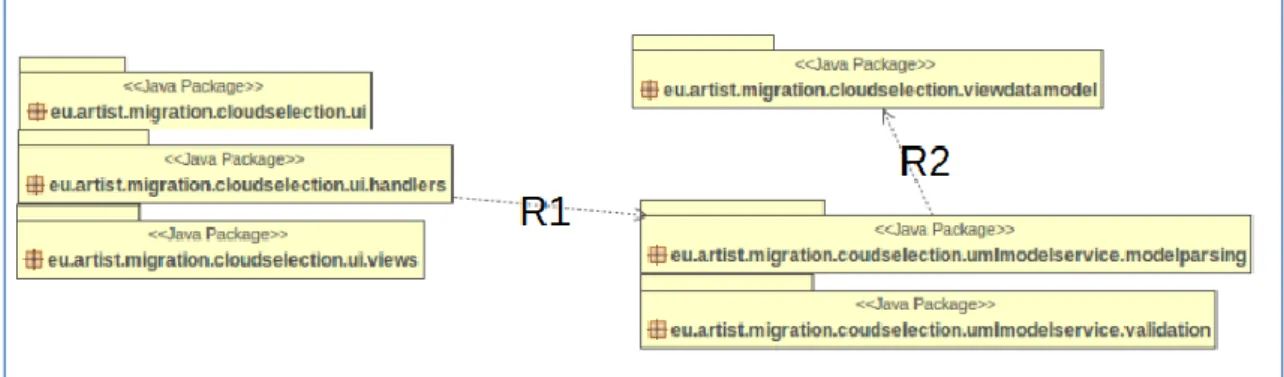
FIGURE 4PACKAGE DIAGRAM WITH RELATIONS OF UML MODEL SERVICE COMPONENT ... 19
FIGURE 5CLASS DIAGRAM OF VIEW DATA-MODEL ... 21
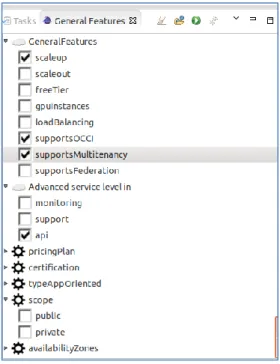
FIGURE 6GENERAL FEATURES VIEW ... 22
FIGURE 7SERVICE FEATURES VIEW ... 22
FIGURE 8PLUG-IN DEPENDENCIES FOR CLOUD TARGET SELECTION TOOL ... 23
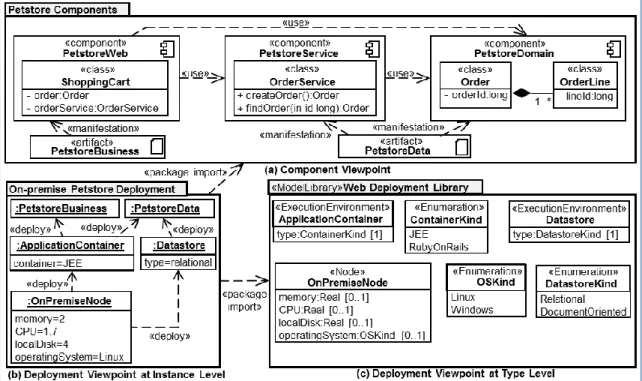
FIGURE 9ON-PREMISE DEPLOYMENT OF REFERENCE USE CASE ... 24
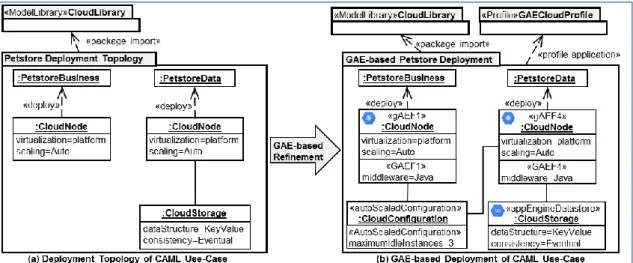
FIGURE 10REFERENCE USE CASE DEPLOYED ONTO GOOGLE APP ENGINE ... 25
FIGURE 11REUSABLE DEPLOYMENT TEMPLATE FOR AMAZON AWS ... 26
FIGURE 12DEPLOYMENT TOOL PROCESS ... 27
FIGURE 13DEPLOYMENT TOOL PROCESS.GENERATION OF THE APPLICATION DEPLOYMENT PSM ... 28
FIGURE 14DEPLOYMENT TOOL PROCESS:ARTEFACTS GENERATION. ... 29
FIGURE 15DEPLOYMENT TOOL COMPONENTS ... 29
FIGURE 16ECORE-BASED METAMODELS AS A BRIDGE BETWEEN MODELWARE AND XMLWARE ... 30
FIGURE 17CLOUDML2DEPLOYMENT TRANSFORMER ... 31
FIGURE 18PACKAGE STRUCTURE ... 33
FIGURE 19DEPLOYMENT TOOL SUB-PROJECTS ... 33
FIGURE 20TOOLBAR OF THE VIEWS ... 35
D9.6 – Automatic Deployment Strategies Version: v1.0, Date: 31/03/2015
Project Title: ARTIST Contract No. FP7-317859
www.artist-project.eu
FIGURE 22DEPLOYMENT MODEL FOR DEWS USE CASE ... 37
FIGURE 23DEPLOYMENT MODEL FOR LOB USE CASE ... 38
FIGURE 24DEPLOYMENT TOOL DIALOG ... 39
FIGURE 25GAE GENERATED DEPLOYMENT DESCRIPTORS FOR EACH MODULE OF DEWS USE CASE ... 39
FIGURE 26GAE DEPLOYMENT DESCRIPTOR ... 39
FIGURE 27AZURE GENERATED DEPLOYMENT DESCRIPTORS AND SCRIPTS FOR EACH MODULE OF LOB USE CASE 40 FIGURE 28AZURE SERVICE DEFINITION DESCRIPTOR... 40
FIGURE 29AZURE SERVICE CONFIGURATION DESCRIPTOR ... 40
FIGURE 30AZURE SERVICE DESCRIPTION ... 41
FIGURE 31AWSDEPLOYMENT SERVICES ... 48
FIGURE 32COMPATIBLE CLIENTS FOR AWSDEPLOYMENT SERVICES ... 51
FIGURE 33DEPLOYMENT PLATFORM-INDEPENDENT META-MODEL FOR CLOUD PROVIDER PERSPECTIVE ... 55
FIGURE 34DEPLOYMENT PLATFORM-INDEPENDENT META-MODEL FOR APPLICATION PERSPECTIVE ... 57
FIGURE 35CROSS-REFERENCING META-MODEL CONCEPTS FOR DEPLOYMENT ... 58
FIGURE 36GOOGLE APP ENGINE PDM SNIPPET ... 59
FIGURE 37AMAZON WEB SERVICE PDM SNIPPET ... 60
FIGURE 38MICROSOFT AZURE PDM SNIPPET ... 61
Table of Tables
NO TABLE OF FIGURES ENTRIES FOUND.D9.6 – Automatic Deployment Strategies Version: v1.0, Date: 31/03/2015
Project Title: ARTIST Contract No. FP7-317859
www.artist-project.eu
Terms and abbreviations
ATL Atlas Transformation Language
AWS Amazon Web Services
CAML Cloud Application Modelling Language
CCUI Command and Console User Interface
DBMS Database Management System
DEWS Distance Early Warning System
DSL Domain Specific Language
EAR Enterprise Archive
EE Enterprise Edition
EMF Eclipse Modelling Framework
EPL Eclipse Public License
GAE Google App Engine
GUI Graphical User Interface
IaaS Infrastructure as a Service
JAR Java Archive
LoB Line of Business
M2M Model to Model
M2MT Model to Model Transformation
M2T Model to Text
MDTB Model Discovery Toolbox
MUTB Model Understanding Toolbox
OVF Open Virtualization Format
PaaS Platform as a Service
D9.6 – Automatic Deployment Strategies Version: v1.0, Date: 31/03/2015
Project Title: ARTIST Contract No. FP7-317859
www.artist-project.eu
PI Platform Independent
PSM Platform Specific Language
SDK Software Development Kit
UI User Interface
UML Unified Modelling Language
VM Virtual Machine
WAR Web Archive
WP Work Package
XMI XML Metadata Interchange
D9.6 – Automatic Deployment Strategies Version: v1.0, Date: 31/03/2015
Project Title: ARTIST Contract No. FP7-317859
www.artist-project.eu
Executive Summary
Task 9.5 ‘Deployment patterns expressed as transformations’ manages one of the activities required during the modernization phase of the ARTIST Methodology, performed on the components of an application being migrated to the Cloud. Once the models (PSM) that described the application components have been “cloudified” and optimized (resulting on modernized models) and the corresponding target source code has been generated (out of these modernized models), there is still an important task remaining, since the modernized components need to be deployed into the target Cloud environment. This deployment process is conducted and personalized by a set of descriptor files, which require to be generated for the selected target Cloud environment. These descriptors customize the deployment process by expressing concrete deployment needs on the target and configuring the required Cloud services. Moreover, the modernized components can only be deployed, depending on the target, when packaged into concrete deployment units, which are typically compliant with strict deployment standards, which are Cloud or application dependent (like for instance WAR or EAR files for J2EE platform deployment or OVF for VM packaging).
The deployment process itself is supported by the target Cloud environment, normally through a target-dependent SDK, which offers UI tools that enable the deployment process. Most of the deployment SDKs offer command-line scripts that enable the manual deployment process (intended for advanced users), although many Cloud providers offer as well GUIs (either standalone ones or integrated within popular IDEs or Web-accessible ones) that simplify the deployment process for not-advanced users.
As a consequence, the task to deploy a modernized application (or certain components) requires (for most of the Cloud environments, either infrastructure or platform) the elaboration of a set of artefacts supporting the deployment process itself.
Before supporting this process, application owners need to identify the Cloud target provider and its offerings, based on the selection of Cloud services, required by the application. In this context, the Cloud Target Selection Tool, specified in this document, supports the application owner in the identification of required Cloud services and their matching against the available Cloud provides, described by the available CloudML@ARTIST models.
Moreover, this model-driven deployment approach relies on the availability of deployment models for the application. These models include generic deployment specifications, based on UML complemented with the platform-independent CloudML@ARTIST meta-model, and Cloud provider specifications, (included in CloudML@ARTIST as well).
The deployment tool enables the semi-assisted generation of deployment artefacts, out of these models, assuming that they already contain deployment information and requirements. In a similar approach followed by T9.4 Target Generation, this tool produces these textual-based deployment artefacts by obtaining the deployment requirements and configuration from the models.
ARTIST focuses on the model-driven migration support for selected target Cloud providers, namely Google App Engine (GAE), and Microsoft Azure. Nonetheless, the ARTIST model-driven deployment support will be investigated towards achieving the most generic and extensible deployment support possible, compatible with the specific characteristics of these Cloud providers.
This document reports the specification, design and implementation of the Cloud Target Selection and Deployment Tools, and also elaborates on the model-based specification of the deployment. Additionally, it reports on the preliminary research analysis that was conducted
D9.6 – Automatic Deployment Strategies Version: v1.0, Date: 31/03/2015
Project Title: ARTIST Contract No. FP7-317859
www.artist-project.eu for the design and implementation of the tools, as well as the conceptual deployment strategies identified during this research.
Modelling deployment in UML, using CloudML@ARTIST is explained by example, using the ARTIST Petstore use case. Deployment for the other ARTIST use cases (i.e. DEWS and Spikes LoB) is modelled as well, as described in the user manual section of the Deployment Tool. Reusable deployment templates for concrete Cloud providers and the interoperability of the ARTIST deployment modelling approach with others are further elaborated.
Cloud Target Selection Tool and Deployment Tool specifications (both functional and technical) are provided, including components and implementation details. For both tools, a walk-through user guide is provided. For the Deployment Tool, this user guide describes its usage to generate deployment descriptors for the Google App Engine and the Microsoft Azure Cloud platforms, for DEWS and LoB use cases, respectively.
The implementation of the Deployment Tool provides specific support for deployment on Google App Engine and Microsoft Azure, the default target Cloud platforms of choice for ARTIST use cases. No specific implementation support for Amazon Web Services (AWS) was implemented, despite it was included in the preliminary analysis, mainly for the following two reasons:
AWS support has not being required by ARTIST use cases for deployment
Deployment in AWS is already supported by the Cloud platform deployment framework of ModaCloud, based on CloudML. ARTIST provides a translator from CloudML@ARTIST to CloudML@ModaCloud, whereby deployment models for AWS created within ARTIST can be translated and used to support AWS deployment using the ModaCloud framework.
Nonetheless, the ARTIST deployment approach is founded on solid and generic enough model-driven techniques, underpinning a common deployment modelling language, which enables the adaptation, with little effort on implementation, of the Deployment Tool to support other Cloud target environments.
D9.6 – Automatic Deployment Strategies Version: v1.0, Date: 31/03/2015
Project Title: ARTIST Contract No. FP7-317859
www.artist-project.eu
1
Introduction
1.1
About this deliverable
The modelling of the application deployment to the Cloud takes place during modernisation phase of the ARTIST Methodology. It happens once the models that described the application components have been modernised and optimized, and their source code, compatible with the target Cloud offering, has been generated (from these modernised models). Then, there is still an important activity remaining, since the application components need to be deployed into the target Cloud environment.
The deployment activity is supported and configured by a set of deployment descriptors. These descriptors personalized the deployment process by expressing concrete deployment configurations for the target Cloud environment and by configuring the required services. Additionally, the modernized components are deployed, depending on the target, bundled within specific deployment units, which are compliant with formal deployment standards, some of them Cloud specific (OVF for VM packaging), but other application specific (EAR for J2EE platform).
The deployment process is typically Cloud provider specific, driven by vendor specific procedures and mechanisms, although supported by SDKs, which offer tools that simplify the deployment process, including GUIs, either standalone or integrated with popular IDEs or Web-accessible. Most of these deployment tools also offer command-line scripts, targeting advance users, enabling a manual deployment process.
In the particular case of Cloud infrastructure providers, there are public common libraries that offer a common SDK supporting deployment on a wide range of providers through the same interface, such as Apache jClouds1 or libCloud2 .Up to our knowledge, there is no similar initiative concerning Cloud platforms, although some attempts to standardize a common Cloud platform interface have already been started (i.e. CAMP3).
As a consequence, the task to deploy a modernized application (or certain components) requires (for most of the Cloud environments, either infrastructure or platform) the elaboration of a set of artefacts supporting the deployment process itself:
● One or more deployment descriptors, which are typically Cloud provider specific. ● One or more deployment units (i.e. bundles), which are either application- (e.g.
framework) or Cloud provider-specific.
● One or more deployment scripts (i.e. invocations of a deployment SDK).
Before supporting the deployment process itself, application owners requires identifying the Cloud target provider and its offering, based on the selection of Cloud services required by the application. In this context, the Cloud Target Selection Tool supports the application owner in the identification of required Cloud services and the matching of these requirements against the available Cloud provides, identified by the CloudML@ARTIST models available.
Moreover, the Model-Driven deployment approach, described in this document, relies on the availability of deployment models for the application. These models include generic deployment specifications, based on UML complemented with CloudML@ARTIST, and specifications Cloud provider specifications, based on CloudML@ARTIST.
1 http://jclouds.apache.org/ 2 http://libcloud.apache.org/ 3 https://www.oasis-open.org/committees/tc_home.php?wg_abbrev=camp
D9.6 – Automatic Deployment Strategies Version: v1.0, Date: 31/03/2015
Project Title: ARTIST Contract No. FP7-317859
www.artist-project.eu T9.5 ‘Deployment patterns expressed as transformations’ enables the semi-assisted generation of these deployment artefacts, as introduced in the previous enumeration, out of these deployment models. In a similar approach followed by T9.4 ‘Target Generation’, this task produces these textual-based deployment artefacts, by inspecting the deployment requirements and configuration for the modernized application.
However, T9.5 does NOT support the deployment process itself: this task does not provide a homogeneous and universal deployment SDK supporting a wide range of target Cloud environments. Nevertheless, T9.5 can provide (for some selected target Cloud environments offering a command-line SDK) some tailored scripts which, once executed by end-users, deploy the modernized application (or concrete components) into the target Cloud environment. It is implied that the end-user has previously installed an operative target Cloud deployment framework.
In a wider context, the deployment of complex distributed applications on the Cloud has been increasingly receiving attention in the last years [1]. ARTIST focuses on the model-driven migration support for selected target Cloud providers, namely Google App Engine (GAE) and Microsoft Azure. Nonetheless, the ARTIST model-driven deployment support will be investigated towards achieving the most generic and extensible deployment support possible, compatible with the specific characteristics of these Cloud providers.
This document reports the specification, design and implementation of the Cloud Target Selection Tool and the Deployment Tool. It also depicts the CloudML@ARTIST approach to model deployment requirements. Additionally, it reports on the preliminary research analysis that was conducted for the design and implementation of these tools, as well as the conceptual deployment strategies identified during this research.
The implementation of the Deployment Tool provides specific support for deployment on Google App Engine and Microsoft Azure, the default target Cloud platforms of choice for ARTIST use cases. No specific implementation support for Amazon Web Services (AWS) was implemented, despite although it was included in the preliminary analysis, mainly for the following two reasons:
AWS support seems not being required by ARTIST use cases for deployment
Deployment in AWS is already supported by the Cloud platform deployment framework of ModaCloud [27], based on CloudML. ARTIST provides a translator from CloudML@ARTIST to CloudML@ModaCloud [28], whereby deployment models for AWS created within ARTIST can be translated and use to support AWS deployment using the ModaCloud framework.
1.2
Document structure
This document is structured as follows. Section 2 provides the functional and technical specification of the Cloud Target Selection Tool, which enables users to determine the most suitable target Cloud offering where to deploy the migrated application, based on browsing the services offered by the Cloud provider. Section 3 describes the operational approach for deployment modelling based on CloudML@ARTIST and UML. Section 4 provides the functional and technical specification of the Deployment Tool, which enables the users to create required deployment descriptors and scripts from deployment models, for selected target Cloud offerings. Section 5 provides details for the delivery and usage of the Cloud Target Selection
D9.6 – Automatic Deployment Strategies Version: v1.0, Date: 31/03/2015
Project Title: ARTIST Contract No. FP7-317859
www.artist-project.eu and Deployment tools, as well as their user manuals. Section 6 concludes the document outlining the main results of this work, and foreseen future work and improvements. APPENDIX A reports the analysis of survey conducted on the state of the art on model-driven support for deployment to Cloud. APPENDIX B reports on the analysis of the deployment strategies for the reference Cloud offerings: Google App Engine, Amazon Web Services and Microsoft Azure. APPENDIX C reports the research conducted aiming at detecting platform independent deployment patterns (from the analysed ones) as well as designing a platform independent meta-model for expressing conceptually these deployment patterns. Based on this meta-model, platform description models (PDMs) for reference Cloud offerings were derived.
1.3
Fitting into the overall ARTIST solution
In the following, we describe from a functional point of view how the Deployment Tool fits into the overall ARTIST migration tool suite. The Deployment Tool is developed in the context of WP9 and considered as part of the forward engineering process. Models reverse-engineered by the MDTB and the MUTB – both are provided by WP8 – and modernized by the MCF are considered as input of modelling the deployment. In fact, the component viewpoint is of primarily interest for producing deployment models. Components are materialized by artefacts that are deployed onto a Cloud environment. Hence, the quality of the reverse-engineered and modernized components plays a crucial role. Only if they are appropriately designed, the quality of the deployment models will be sufficient and useful to generate deployment scripts required for initiating the resource provisioning at the target cloud environment. While producing deployment models is considered to be mainly a manual task, the generation of deployment scripts for a certain cloud environment is supported by dedicated model transformations. To select an appropriate cloud provider and guide the developer through this complex decision making process, the Cloud Target Selection tool is provided. It builds on information captured by CloudML@ARTIST developed in WP7.
Figure 1 ARTIST Overall Deployment process
Figure 1 outlines the overall ARTIST deployment process. By using the Cloud Target Selection tool (cf. Section 2), users can determine the Cloud providers that better fits their requirements expressed by selecting the Cloud services they are looking for. Once the Cloud target has been selecting, they can use CloudML@ARTIST to model the concrete deployment requirements and topology for their application components (cf. Section 3). Finally, they can use the deployment tool to generate target-specific deployment descriptors from the former models (cf. Section 4).
Cloud Target
Selection
Deployment
Modelling
Deployment
Descriptors
Generation
D9.6 – Automatic Deployment Strategies Version: v1.0, Date: 31/03/2015
Project Title: ARTIST Contract No. FP7-317859
www.artist-project.eu
1.4
Main Innovations
The main focus of this deliverable is to report on the languages, techniques, and components applied to produce cloud-based deployment models, select suitable Cloud providers that offers required services and generate the deployment descriptors required to deliver to Cloud the migrated application. Main innovations in this respect can be summarized as follows.
Cloud Target Selection. The main innovations of Cloud Target Selection tool lie in the challenge of exploiting the CloudML@ARTIST model structure and can be concluded as follows: It contains a fully extensible mechanism which supports the filtering of the information contained within the meta-models and providing it to the end user in a human-consumable format through a user-friendly environment. From the extensibility point of view, extensions can be easily made in order to support even more perspectives of the existing underlying models, or extensions of them. E.g. legal aspects, and benchmark results.
The information exchange taking place through the interaction with the user, does not require but a minimum set of knowledge about the elements described and defined in the meta-models. This means that, in the future, potential changes in the cloud providers’ descriptions or even in the definitions of general cloud environments in the context of CloudML@ARTIST meta-model, will not result in non-compatibility with the tool. On the contrary, new features can automatically be detected and take their place in the equation solving the problem of selecting cloud target.
It allows the user to express their requirements against the target cloud environments, thus fully utilizing and exploiting all the benefits coming from the construction of CloudML@ARTIST modelling language.
Users’ expression of cloud requirements immediately and automatically result in reports and suggestions about the best matching supported provider. Otherwise, this task, even with the use of the same meta-models, would take a lot of time and effort while it would absolutely require a good level of modelling knowledge in general and in particular about the specific meta-models under use.
Modelling Cloud-based Deployments in UML. Current cloud modelling approaches [2] address the diversity of cloud environments by introducing a considerable set of modelling concepts in terms of novel domain-specific languages. At the same time, general-purpose languages, such as UML, provide modelling concepts to represent software, platform and infrastructure artefacts from different viewpoints where the deployment view is of particular relevance for specifying the distribution of application components on the targeted cloud environments. The generic nature of UML's deployment language calls for a cloud-specific extension to capture the plethora of cloud services at the modelling level. For that reason we developed the Cloud Application Modelling Language (CAML) as part of CloudML@ARTIST to enable cloud-based deployments to be specified directly in UML. This is especially beneficial for migration scenarios where reverse-engineered UML models are tailored towards a selected cloud environment as it is advocated by ARTIST.
Deployment Tools for the Cloud. As it is described in this document (see APPENDIX A and B), the existence of a plethora of Cloud providers, with their offerings and services, imposes a diversity of deployment approaches, interfaces and services. Initiatives to harmonize this diversity, offering a common deployment interface have focused mainly on supporting the
D9.6 – Automatic Deployment Strategies Version: v1.0, Date: 31/03/2015
Project Title: ARTIST Contract No. FP7-317859
www.artist-project.eu Cloud infrastructure, but only recently standardization initiatives to harmonize the deployment on the platform have started. In this work, we show how a common modelling language supporting deployment specifications (UML combined with CloudML@ARTIST) can be exploited to generate the required deployment descriptors for a selection of Cloud providers (i.e. Google App Engine, Microsoft Azure), by developing model-to-model transformations, which convert deployment models, compliant to UML-CloudML@ARTIST into those compliant to the specific Cloud meta-models describing those descriptors. A set of model-to-text serializers, also developed in this work, generate the descriptors. This approach is generic, and can be extended to support the deployment into any other Cloud provider, with low effort.
D9.6 – Automatic Deployment Strategies Version: v1.0, Date: 31/03/2015
Project Title: ARTIST Contract No. FP7-317859
www.artist-project.eu
2
Cloud Target Selection Tool
The Cloud Target Selection tool is an Eclipse plugin aiming at guiding the user through the complex process of making the final decision for the target platform of the migration of their application or application components. This tool targets developers who have a good insight of the application's technical and functional needs, but little knowledge about the services or the benefits coming from the cloud platform providers. This case is quite common for developers with little experience on cloud, or with much experience on a single cloud vendor's platform, as the tasks of browsing through the countless documentation sheets and web-pages, as well as of modelling and combining the resulting information, in order to get to the final decision, are confusing and time consuming.
2.1
Functional description
The Cloud Target Selection Tool aims at exploiting the information lying in the meta-models, in order to make a suggestion about the target platform that best fits the needs of the application to be migrated. More precisely, the functionality of the tool, as a whole, can be summarised in three main activities:
• It supports the visualization of the main features and service characteristics of the target platforms, as they have been identified and modelled in the context of ARTIST project.
• It allows the selection of the ones - of the above features - that are considered to be important offerings for the specific application's needs, through a user-driven process. This way, the user can actually set the target platform standards for hosting the components of the application.
• It performs a matching process between the user's selection and the actual real-world target platform offerings, so as to indicate the best fitting solution among the available choices.
As described in Figure 2, the actions to be performed from the user’s perspective are: • Action 1: Open the Eclipse views showing features and services.
• Action 2: Select the desired ones from the tree-structures of these views.
• Action 3: Indicate the candidate cloud providers among the supported ones by the CloudML@ARTIST.
• Action 4: Ask for a validation to be performed over the selections made in previous steps.
D9.6 – Automatic Deployment Strategies Version: v1.0, Date: 31/03/2015
Project Title: ARTIST Contract No. FP7-317859
www.artist-project.eu
Figure 2 Cloud Target Selection tool User Interface
2.2
Technical description
The Cloud Target Selection Tool is implemented as an Eclipse plug-in. In this respect, Eclipse libraries are used in order to provide the user interface which is essential for the tool to become functional and fulfil its purpose, as a user-driven decision making engine. In addition, a profile querying mechanism has been developed, with the support of the UML2 Java library (see Section 2.2), in order to exchange information between the CloudML@ARTIST meta-models [11] and the user interface. All Java classes composing this tool are developed in order to contribute into the following tasks (see Figure 3):
1. Read the core meta-model providing all the profiles/stereotypes that are applicable on the target cloud platform meta-models.
2. Transform the information coming from task 1 and visualize it using tree-structures including checkboxes for enabling the user to make selections.
3. Obtain the user's selection through the checkboxes.
4. Transform user's selection into a UML-compatible format by forming and populating query structures specifically created for this purpose.
5. Perform queries to each of the meta-models representing the target cloud platforms. 6. Validate the results of the queries by assigning scores to each target cloud platform
according to the level of compatibility with the user's requirements as set in step 4. 7. Report the results to the user.
Each of these tasks, except for the cloud features visualization (Task 2), and the report of the validation results (Task 7), are hidden from the end-user.
D9.6 – Automatic Deployment Strategies Version: v1.0, Date: 31/03/2015
Project Title: ARTIST Contract No. FP7-317859
www.artist-project.eu
Figure 3 Sub tasks performed during the target selection process
2.2.1
Cloud Target Selection Tool Architecture
The Java classes created in the context of the Cloud Target selection tool are placed in four different packages, following a conceptual grouping process. Each package plays a different role in the architecture, as a whole. All the packages to be described are sub-folders of the general source package: “eu.artist.migration.cloudselection”.
• UML Model Service: This package is responsible for any action connected with UML-related tasks. Such tasks include UML file handling, model querying, memory handling (total control of loading and unloading UML resources) and transformation of the query results into forms or structures accessible by any other package with no dependencies by the UML Java library. In addition, it is responsible for making the validation of user's requirements in a match-making process between the requests to the models and the corresponding responses.
• User Interface: This package (including two sub-packages) contains all classes which compose the user interface, dedicated to interact with the end user. Every information exchange between the tool and the user is defined and controlled through this component.
View Data-model: This component represents the data structure which is visualized so as to be accessed by the end user through the views. It provides a model which acts as a bridge between the user-accessible and the UML-formatted information. While it does not contain any definition of tasks to be performed, it is used to store information, which will eventually be used by every other component of the tool.
WD9.6. – Automated Deployment Strategies Version: v1.0 – Final, Date: 31/03/2014
Project Title: ARTIST Contract No. FP7-317859
www.artist-project.eu
2.2.2
Components description
2.2.2.1 UML Model Service
This component is involved in any task that includes UML file handling or interaction with UML resources and model elements. More precisely, user actions that trigger classes from this package are (referring to the corresponding user actions as described in section 2.1):
Action 1: When the user demands for a view to open, this component is accessed in order to: • Load the UML resources(R1 in Figure 4)
• Perform a search over these resources in order to find services and features to display to the user. During this search, applied instances of the stereotypes “CommonFeatures” and “Service” are to be found.
• Translate the results into “view data-model elements” (R2 in Figure 4). Action 4: When the user asks for a validation to be made, this component:
• Gets as input all the user requests (R1 in Figure 4).
• Translates these requests into UML-compatible requests. This step requires the definition of structures for allowing different types of model queries to be generated and stored.
• Loads, one by one, the UML resources of the potential cloud target platforms. For each loaded resource, the component performs the queries resulting from the previous steps of the action, and after having obtained and stored the results, unloads, one by one, the UML resources. So for each resource the action chain is: load-validate-unload. • Processes the query results in order to make the final suggestion.
Figure 4 Package diagram with relations of UML model service component
A very important feature of the UML Model Service component is the fact that it performs the search over the core UML file, in a generic way. This means that the Java classes are unaware of the structure of the UML models to be queried in the highest possible degree. The only information hardcoded in the classes is about the name of the two stereotypes investigated (“CommonFeatures” and “Service”) and about one Enumeration (“HighLevelEvaluation”), which is the datatype of some properties. This means that possible changes in the cloud meta-model will not necessarily indicate changes to the Cloud Target Selection tool. Furthermore, it provides the tool with the benefit of extensibility (in the future, more profiles can be used as input for constructing different views containing different types of features for the user to select, without affecting the implementation for the already included profiles).
WD9.6. – Automated Deployment Strategies Version: v1.0 – Final, Date: 31/03/2014
Project Title: ARTIST Contract No. FP7-317859
www.artist-project.eu Another issue to be discussed is the way the scores are assigned to each target platform, according to the query results. The score assigning process is different for the detected types of queries and answers:
• Type1 - High-level evaluation features queries. These queries aim at validating over features which are of type “HighLevelEvaluation”. This is an enumeration allowing three values: “poor”, “average”, “extensive”. If the user requests for such a feature then the score assignment is defined as:
◦ case poor, score = 0 ◦ case average, score = 0.5 ◦ case extensive, score = 1
• Type2 - Boolean feature queries. These queries aim at indicating whether a feature or service exists or not. The possible answers are translated into scores as:
◦ if exists, score = 1
◦ if does not exist, score = 0
• Type3 - Multivalued element queries. These queries apply in the case of service-based evaluation (and could apply in other views too, if extended). Again they indicate whether a feature exists, but the features are grouped into service categories. For instance, in case of Infrastructure as a Service, the Storage Service may support a number of storage types such as raw storage, volume storage and block blobs. If the user selects n features of a specific service type, and the potential target platform provides m of them (m<=n) then: score = m/n
In any case, 0<=score<=1 for every single query.
Final score for every potential platform will be: (s1+s2+…+sn)/n, where si the score for the ith
query.
2.2.2.2 View Data-Model
The Data model component is used by all the other components of the tool, while it is independent from them. As shown in Figure 5, it contains the basic class which is the “ModelElement”. Every other class extends it. While most classes do not have functional differences among them, the declaration of so many distinct elements is essential, in order for the tree-viewer of the graphical user interface to be aware of how to present each item, and for the UML parsing component to be aware of how to search for each one of them in the models, in case user selects it. In other words, the whole component serves as the “encoding” and “decoding” mechanism between the specific UML entities, and the data generically for user consuming.
WD9.6. – Automated Deployment Strategies Version: v1.0 – Final, Date: 31/03/2014
Project Title: ARTIST Contract No. FP7-317859
www.artist-project.eu
Figure 5 Class Diagram of View Data-Model
2.2.2.3 User Interface
The user interface has two main features: views and handlers. Views
This component contains all the classes that handle communication between the tool and the user, which is enabled through a graphical user interface. This GUI relies mostly on the tools provided by Eclipse for plug-in development. For the time being, two very important views are available (following a twofold interpretation of the core meta-model of CloudML@ARTIST). Each one of them presents a tree-view, containing information coming from the core meta-model parsing.
• The first view (Figure 6) comes from the applied stereotype “CommonFeature”. With regard to the query types as discussed in Section 2.2.2.1, it contains features of Type1 (e.g. monitoring, support, API), Type2 (e.g. scaleup, supportsOCCI) and Type3 (e.g. Scope).
• The second view comes from all the applied stereotypes which extend the stereotype “Service” and are shown in (Figure 7). This view contains only features of Type3. However, apart from the selectable features, it exploits the view data-model in such say, so as to contain information about the grouping of the applied stereotypes into different profiles (IaaS and PaaS are UML profiles included in the core profile).
In addition to these two views, there is a third one which is responsible for presenting all the available providers. It also enables the selection of some among these providers which will be the subjects of the research to be performed later on in the tool’s usage.
WD9.6. – Automated Deployment Strategies Version: v1.0 – Final, Date: 31/03/2014
Project Title: ARTIST Contract No. FP7-317859
www.artist-project.eu
Figure 6 General Features view
Figure 7 Service Features view
Handlers
In order to exploit the potentials provided by the view, four handlers have been designed and developed. Some of them can be used to handle events such as pressing one of the buttons appearing on the right upper corner of each view, or executing a command incorporated to the menu. The implemented handlers are:
WD9.6. – Automated Deployment Strategies Version: v1.0 – Final, Date: 31/03/2014
Project Title: ARTIST Contract No. FP7-317859
www.artist-project.eu • ProvidersFileHandler: Handles the opening of the view containing the list of the
available providers.
• ValidateCommonsHandler: Initiates the process of making the validation for the selections in the “general features” view.
• ValidateServiceHandler: Initiates the process of making validation for the selections in the “Service Features” view.
• ResultsHandler: Shows the result to the user.
2.2.3
Technical specification
The Cloud Target Selection tool has been implemented as an Eclipse plugin and has been tested against Eclipse Java EE IDE, version Kepler Service Release. It requires Java v7. It extends the Eclipse IDE by implementing commands and views as well as contributing to the main menu. In addition, it uses uml2 resources4 in order to parse UML profiles. Another plugin used is the CloudML@ARTIST plugin which is responsible for providing the metamodel on which the target selection is based. As a result, the required plug-ins are shown in Figure 8.
Figure 8 Plug-in dependencies for Cloud Target Selection Tool
3
Modelling Deployment in UML
General-purpose languages, such as UML, provide modelling concepts to represent software, platform, and infrastructure artefacts from different viewpoints where the deployment view is of particular relevance for specifying the distribution of software components on the targeted cloud environments. Providing extensions to UML that satisfy current cloud modelling requirements appears beneficial, especially when cloud-oriented migration scenarios [3] need to be supported where reverse-engineered UML models are tailored towards a selected cloud environment. For that reason, we have proposed the Cloud Application Modelling Language (CAML) [4][5], that enables cloud-based deployment topologies to be represented directly in UML and their refinement towards a concrete cloud environment. Features of existing cloud environments are captured by dedicated UML profiles. Thereby, a clear separation is achieved between cloud-environment independent and cloud-environment specific deployment models [6], which is in accordance with the PIM/PSM concept. In our case, the “platform” refers to the cloud environment. We developed profiles for three major cloud environments: Amazon AWS5, Google Cloud Platform6, Microsoft Azure7. Inspired from common cloud computing literature [7][8][9], recent cloud modelling approaches [10] and cloud programming approaches8, we developed CAML's model library that facilitates developing base deployment topologies to which cloud environment profiles are applied. The benefits of realizing CAML as an internal language of UML are threefold: (i) UML provides a rich base language for the
4
http://eclipse.org/modeling/mdt/?project=uml2 5
Amazon AWS: http://aws.amazon.com
6 Google Cloud Platform: http://cloud.google.com 7
Microsoft Azure: http://azure.microsoft.com 8
WD9.6. – Automated Deployment Strategies Version: v1.0 – Final, Date: 31/03/2014
Project Title: ARTIST Contract No. FP7-317859
www.artist-project.eu deployment viewpoint, (ii) “cloudifying” UML models is facilitated without the need to re-model existing applications, and (iii) profiles in UML allow hiding details of cloud provider offerings from models and dynamically switching between them by (un-/re-)applying respective cloud environment profiles. CAML is considered as part of the CloudML@ARTIST [11].
3.1
CAML By-Example
To emphasize the benefits of employing UML as the host language for realizing CAML, we give an overview of UML's structural viewpoints that support representing application deployments by means of the ARTIST reference use case9. We take the viewpoint of the software components and their deployment. Figure 9a depicts some components of our application, an excerpt of their realizing classes and the manifestation of these components by deployable artefacts. A possible on-premise deployment for them is presented in Figure 9b. It covers instances of the two deployable artefacts and connects them to a Java-based middleware and a relational DBMS, which are in turn deployed onto a node with specified (virtual) machine characteristics. The model elements of the deployment are instances of the custom types defined in the component viewpoint, cf. Figure 9a, and the deployment viewpoint, cf. ¡Error! No se encuentra el origen de la referencia.c, respectively. To exploit modern cloud features, deployment models need to be expressive enough to capture them. This is exactly the purpose of CAML. Because it is realized in terms of lightweight extensions to UML, CAML models are applicable to UML models and so to our modelled reference use case as depicted in Figure 9. To demonstrate how CAML is applied, Figure 10 presents a possible deployment topology and refinement towards the Google App Engine of our introduced use case, cf. Figure 9. In a first step, we modelled the deployment topology. It consists of two automatically scaled cloud nodes and a key-value cloud storage for managing the application data in an eventually consistent way.
Figure 9 On-premise deployment of reference use case
9
WD9.6. – Automated Deployment Strategies Version: v1.0 – Final, Date: 31/03/2014
Project Title: ARTIST Contract No. FP7-317859
www.artist-project.eu As the cloud nodes are specified as platform-level offering, we directly deployed the application components onto them. Then, in a second step, we applied the Google App Engine profile and the respective stereotypes to refine the deployment model towards concrete cloud offerings provided by the Google App Engine. As a result, the modelled cloud nodes refer to the “F1” and “F4” instance types that host a Java-based middleware. The configuration attached to these cloud nodes constrains the maximum number of idle cloud nodes. Finally, Google App Engine's key-value data-store is employed for the required cloud storage capabilities.
Figure 10 Reference use case deployed onto Google App Engine
3.2
Reusable Deployment Templates
As CAML is based on UML, its reuse mechanisms can be applied for cloud application deployments. This is particularly useful for providing frequently occurring deployment patterns as predefined UML templates. To show their usefulness and give first evidence of CAML's expressivity, we developed several templates as reusable deployment blueprints, most of them are based on Amazon's best practices10. We modelled their inherent topology with CAML's cloud library and refined them with stereotypes from the cloud profile dedicated to Amazon. To demonstrate the use of a blueprint, we show how our reference use case is bound to a template, which refers in our case to a 2-tier web architecture [9]. To reuse the predefined template, the deployable artefacts need to be bound to the template parameters. Figure 11 depicts the component viewpoint of our reference use case and the respective CAML template. It consists of two cloud nodes that refer to the “M3Medium” offering of Amazon. Their location is required to be in Europe while the operation system needs to be Linux. For reliability reasons, they are placed in different availability zones. Requests that arrive at the cloud nodes are first handled by a load balancing service, which enables a higher fault tolerance of the application. The number of running cloud nodes is automatically managed by Amazon as expressed by the scalability strategy. Only the minimum number of running cloud nodes and their adjustment is configured. Both cloud nodes are connected to a cloud storage that in turn is replicated to improve data availability. Finally, as Amazon cloud nodes operate at the infrastructure level, the required middleware for our reference application is defined. In fact, we directly reused it from the on-premise deployment given in Figure 9.
10
WD9.6. – Automated Deployment Strategies Version: v1.0 – Final, Date: 31/03/2014
Project Title: ARTIST Contract No. FP7-317859
www.artist-project.eu
Figure 11 Reusable Deployment Template for Amazon AWS
3.3
Interoperability with Cloud Modelling Approaches and Standards
One major aspect in model-based engineering is to place models as first-class entities in the engineering process. Ideally, they should be turned into executable or interpretable artefacts. Regarding the deployment viewpoint, it appears desirable to translate the respective models into descriptors and scripts that are passed to provisioning engines for cloud environments. For instance, a Google App Engine based deployment requires specific descriptors for defining the assignment of application modules to a concrete instance type. This assignment can be derived from a CAML model as discussed in Section ¡Error! No se encuentra el origen de la referencia.. At the same time, there are ongoing efforts in standardizing the specification of cloud-based application deployments. The recently accepted TOSCA standard aims at supporting portable cloud applications. With the notion of management plans, emerging TOSCA-compliant engines are capable to interpret such deployment topologies and initiate the provisioning of defined service templates [13]. Also, in the ModaClouds project, a provisioning engine for CloudML is developed [14]. Clearly, this is also of practical value for CAML models. For that reason, we have developed dedicated model transformations to enable interoperability between these languages.WD9.6. – Automated Deployment Strategies Version: v1.0 – Final, Date: 31/03/2014
Project Title: ARTIST Contract No. FP7-317859
www.artist-project.eu
4
Deployment Tool
4.1
Functional description
This section introduces the functional scope of the Deployment Tool and its deployment support and collects the main requirements that drive its design and development.
From a functional point of view, the techniques and tools developed in this task (in collaboration with the T9.2 CloudML specification, from the application perspective, and the T9.4 Target Generation) offer to the end-user the following features:
● Ability to express deployment requirements and information on the modernized models that describes the migrated application (or specific components)
○ Ability to express deployment units (i.e. separate deployment units corresponding to deployable components)
○ Ability to express deployment patterns/topologies (i.e. to specify the deployment layout of components, )
○ Ability to express both platform and infrastructure requirements (i.e. services or frameworks)
● Ability to generate the deployment descriptors, for the entire application or for individual components, for the selected target Cloud environment.
○ Deployment descriptors are editable and modifiable by end user using third-party editors (i.e. Eclipse XML Editors)
● Ability to package deployment units, for the entire application or for individual components, compliant with the frameworks they were developed for (platform) or with the VM specification format (infrastructure). This feature requires that compilable units have been created before using the Target Generation Tool (T9.4)
○ Deployment units can be open, browsed and modified using third party tools (i.e. Jar/Zip editors for WAR, EAR or VMWare OVF Tool, etc.).
● Ability to generate deployment scripts that launch the deployment process on the selected target Cloud environment. These scripts require the availability of a command-line interface provided by the SDK of the selected target Cloud environment.
4.2
Technical description
4.2.1
Deployment Tool architecture
The model-driven approach for automating Cloud deployment strategies, implemented in the Deployment tool is depicted below in Figure 12.
WD9.6. – Automated Deployment Strategies Version: v1.0 – Final, Date: 31/03/2014
Project Title: ARTIST Contract No. FP7-317859
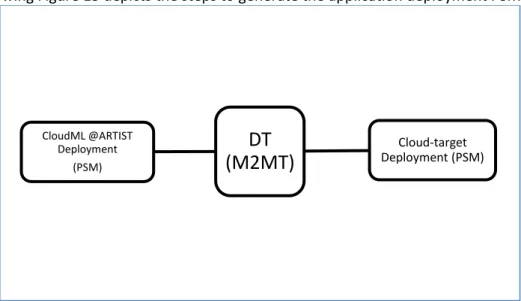
www.artist-project.eu Conceptually, this is a two-steps process. In the first step an application deployment PSM is computed for the concrete target Cloud provider. In the second step, the deployment artefacts are generated from former deployment PSM. Let’s further specify these two steps separately. The following Figure 13 depicts the steps to generate the application deployment PSM.
Figure 13 Deployment Tool process. Generation of the application deployment PSM
In this first step, the Deployment Tool generates a model (PSM) for deploying the application in a selected target Cloud provider. This model will contain all the information required to generate the deployment artefacts for the selected target Cloud provider. This process requires the following input elements:
● An UML deployment model (PSM) of the application. This model, apart from describing the application itself (and its constituting components), distributed in an deployment layout (i.e. UML nodes), contains additional deployment information (specified by using CloudML@ARTIST profiles) about:
○ Selected target Cloud environment for deployment.
○ Required Cloud target-specific services or frameworks (e.g. see deployment meta-model description in Appendix C) that require to be configured during the deployment.
○ Deployment requirements that can be likely communicated in a platform independent way (expressed using CloudML@ARTIST, see PI meta-model in Appendix C). If the user needs to specify platform specific deployment requirements, she can do it, using the CloudML@ARTIST profile available for the selected target Cloud environment.
As depicted in the ¡Error! No se encuentra el origen de la referencia., this model is fed into the Deployment Tool (conceptualized in the picture as a M2M deployment pattern or a set of M2M deployment patterns). The purpose of this first step is to produce a platform specific deployment model for the application that personalises all the deployment requirements according to the selected target Cloud environment. In order words, a set of M2M transformations convert an instance of UML deployment meta-model (annotated with CloudML@ARTIST profiles) into one or more instances (compliant to one or more target-specific meta-models) that describe the deployment of the application into the concrete cloud-target offering.
DT
(M2MT)
CloudML @ARTIST Deployment (PSM) Cloud-target Deployment (PSM)WD9.6. – Automated Deployment Strategies Version: v1.0 – Final, Date: 31/03/2014
Project Title: ARTIST Contract No. FP7-317859
www.artist-project.eu In the second step (see Figure 14 below), the Deployment Tool applies a set of M2T transformations to the application deployment model (PSM) to obtain the target specific deployment descriptors. Additionally, the Deployment Tool can pack these descriptors with the migrated compilation units (provided as input) to generate deployment units (not depicted in the picture). Besides, a similar technique based on M2T transformations can be used to generate target-specific deployment scripts, which are functionally described in previous sections.
Figure 14 Deployment Tool process: Artefacts generation.
Figure 15 Deployment Tool components
The main Deployment Tool components are depicted in Figure 15. The CloudML2Deployment Target Transformer processes the first step of the deployment descriptors generation described in Figure 13, while the Deployment Target Serializer obtains the serialized deployment descriptors as described in Figure 14. Both components exchange the cloud-target-specific deployment models obtained in the first step.
4.2.2
Components description
Generating deployment scripts for Google App Engine and Microsoft Azure from a deployment model expressed in CloudML@ARTIST/CAML, requires overcoming the different encodings and
DT
(M2TT)
Cloud-target Deployment (PSM) Cloud-target Deployment Descriptors/ScriptsDeployment
Tool
CloudML2DeploymentTarget Transformer DeploymentTarget SerializerWD9.6. – Automated Deployment Strategies Version: v1.0 – Final, Date: 31/03/2014
Project Title: ARTIST Contract No. FP7-317859
www.artist-project.eu providing a conceptual mapping of the various concepts. The latter is the basis for implementing a transformation to automate the generation of pertinent deployment scripts. First, we describe how we bridge the different encodings by providing an Ecore-based metamodel as a bridging technology (see Section 4.2.2.1). Then, we introduce the mappings we have implemented in terms of model-to-model transformations where the target metamodels of them are the bridging metamodels (see Section 4.2.2.2).
4.2.2.1 Metamodels for Bridging the Technical Spaces
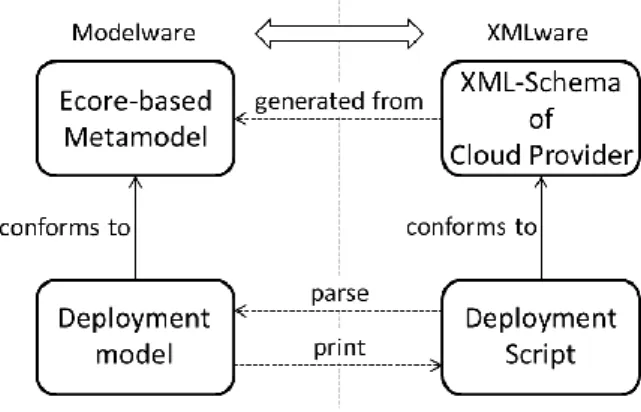
To generate deployment scripts for Google App Engine and Microsoft Azure from a deployment model, we are confronted with two technical spaces: Modelware and XMLware. Basially, the deployment scripts need to be encoded in the correct format, which is XML, whereas the common format for encoding models is XMI as standardized by the OMG. Moreover, they need to conform to the respective XML schemas provided by both Google App Engine and Microsoft Azure. These XML schemas provide all the concepts to which correspondences from the concepts of CloudML@ARTIST/CAML need to be identified and implemented in terms of transformations. Directly implementing a transformation that produces deployment scripts in XML format would require overcoming two challenges at once. Hence, we advocate a two-step approach, where in a first a model-to-model transformation is applied to translate between concepts of CloudML@ARTIST/CAML and the target cloud environment. Then, in a second step, the produced model of the model-to-model transformation is translated into the encoding expected by the cloud environment. To achieve such a two-step approach an Ecore-based metamodel is used as a bridge between the two technical spaces [15][16]. In fact, an Ecore-based metamodel can be automatically generated from an XML schema while the parser and printer to translate between the technical spaces is provided by EMF. Figure 16 summaries the use of Ecore-based metamodels as a bridging technology. The generated metamodel can be used as the target for model-to-model transformations. This is exactly the approach we followed to implement the transformations of our deployment tool as discussed in Section 4.2.2.2.
Figure 16 Ecore-based metamodels as a bridge between Modelware and XMLware
4.2.2.2 CloudML2DeploymentTarget Transformer
This section describes the M2M transformer that converts an UML deployment model into a set of cloud-target-specific (Google App Engine, Microsoft Azure) deployment models (one of each available cloud-target-specific meta-models), which are finally serialized by the Descriptor Serializer (see Section 4.2.2.1).
WD9.6. – Automated Deployment Strategies Version: v1.0 – Final, Date: 31/03/2014
Project Title: ARTIST Contract No. FP7-317859
www.artist-project.eu
Figure 17 CloudML2Deployment Transformer
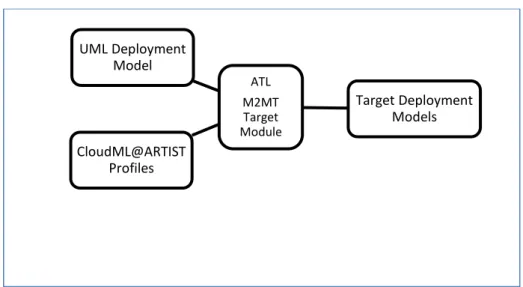
Figure 17 depicts the process performed by CloudML2DeploymentTarget Transformer components, in terms of inputs and outputs of the ATL M2MT target module.
This module takes as input:
The deployment model designed by the user, which is an instance of the UML meta-model, and has been annotated with stereotypes taken from the CloudML@ARTIST DSL.
The CloudML@ARTIST profiles that are manage by the module, particularly those providing a deployment vocabulary.
This module produces, as output:
The specific deployment models for the selected cloud target. These models are concrete instances of the cloud-target-specific meta-models. In particular, Google App Engine requires one concrete deployment descriptor for Java-based applications (i.e. appengine-web), whose concrete model is an instance of the Google App Engine AppEngineWeb metamodel. Microsoft Azure requires different service descriptors: configuration, definition and description, whereby three different models (as instances of Microsoft Azure service configuration, definition and description) are created. In practice, different ATL modules are specialized to create one single output deployment descriptor model. As such, to generate the different Microsoft Azure descriptors, different ATL modules are invoked in sequence.
The following code snippet contains the ATL module declaration for the CloudM2GAE transformation, which describes the input and out signature of the module:
ATL M2MT Target Module UML Deployment Model CloudML@ARTIST Profiles Target Deployment Models
WD9.6. – Automated Deployment Strategies Version: v1.0 – Final, Date: 31/03/2014
Project Title: ARTIST Contract No. FP7-317859
www.artist-project.eu As seen in the module declaration, this M2MT creates a Google App Engine appengine-web model from an UML model, using the CloudML@ARTIST profile for Google App Engine, the core profile and the security profile.
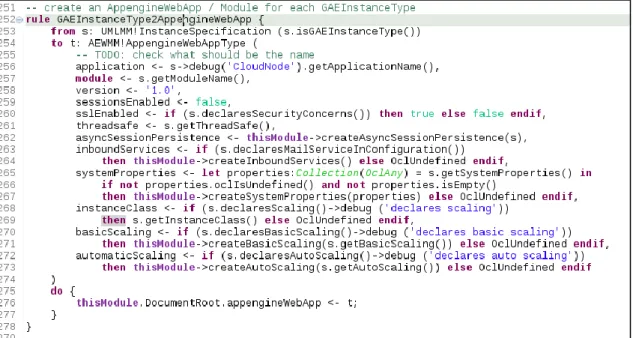
The following ATL rule defines the mapping between an CloudNode instance (of type GAE) in the CloudML@ARTIST input deployment model and the AppengineWebAppType element in the output cloud-target-specific deployment model:
Similar ATL M2MT modules have been created to generate cloud-target-specific models from CloudML@ARTIST, for Microsoft Azure service deployment descriptors: service configuration, service definition and service description.
When some elements of the cloud-target-specific meta-models cannot be derived from the CloudML@ARTIST, default values have been set up, based on the analysis of the specification. It is up the Deployment Tool user to modify these default values when it is required.
5
Delivery and usage
5.1
Package information
5.1.1
Cloud Target Selection Tool
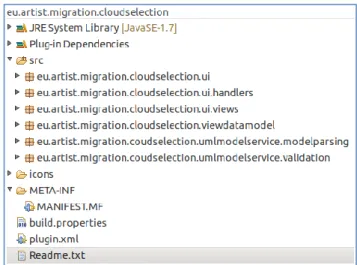
Figure 18 shows file structure of the plug-in. The contained files are: src - All java files included
icons - Image files accessed at runtime META-INF - The plug-in manifest file
build.properties - Defines all properties needed to run the plugin plugin.xml - Description of extending the eclipse platform Readme.txt - Installation and usage instructions
WD9.6. – Automated Deployment Strategies Version: v1.0 – Final, Date: 31/03/2014
Project Title: ARTIST Contract No. FP7-317859
www.artist-project.eu
Figure 18 Package structure
5.1.2
Deployment Tool
The Deployment Tool components are packaged either as Eclipse plugins or Eclipse projects. These plugins are shown in the next Figure 19:
Figure 19 Deployment tool sub-projects
eu.artist.migration.deployment project implements the UI of the Deployment Tool and its contributions to the Eclipse workbench. It launches the Deployment Tool generators selected by the user on a concrete deployment model.
eu.artist.migration.deployment.azure.service.configuration provides the Microsoft Azure service configuration metamodel, its Java entities and EMF-based helper classes to serialize the Azure service configuration descriptor (*.cscfg).
eu.artist.migration.deployment.azure.service.definition provides the Microsoft Azure service definition metamodel, its Java entities and EMF-based helper classes to serialize the Azure service definition descriptor (*.csdef).
eu.artist.migration.deployment.azure.service.description provides the Microsoft Azure service description metamodel, its Java entities and EMF-based helper classes to serialize the Azure service descriptor script (*.ps).
eu.artist.migration.deployment.azure.transformation provides Java helpers and ATL M2M transformations to migrate from deployment model instances of
WD9.6. – Automated Deployment Strategies Version: v1.0 – Final, Date: 31/03/2014
Project Title: ARTIST Contract No. FP7-317859
www.artist-project.eu CloudML@ARTIST to the Azure service configuration, definition, description metamodels.
eu.artist.migration.deployment.features packages all Deployment Tool plugins as a single Eclipse feature.
eu.artist.migration.deployment.gae.appengine.web.app provides the Google App Engine web app definition metamodel, its Java entities and EMF-based helper classes to serialize the Google App Engine web application descriptor (appengine-web.xml). eu.artist.migration.deployment.gae.transformation provides Java helpers and ATL
M2M transformations to migrate from deployment model instances of CloudML@ARTIST to the Google App Engine web application definition metamodel.
5.2
Installation instructions
The Cloud Target Selection Tool plug-in has been tested on of Eclipse Kepler SR2. Java v7 is required. Before installing this tool, the user should download and install the UML2 plugin as well as the CloudML@ARTIST plugin11. The next step is to copy the Cloud Target Selection Tool plugins on the “dropins” folder of the Eclipse installation.
The Deployment Tool is bundle as a zip file that contains the Deployment Tool feature and its plugins. In order to install them, just unzip DT.zip into the Eclipse folder and start Eclipse. Alternatively, Deployment Tool can be installed through the ARTIST update site. Go to “Help->Install New Software”, select ARTIST in the “Work with” combo. If ARTIST update site is not available, click on “Add->Archive” and browse your local file system to locate the ARTIST update site you have downloaded from the ARTIST web site.
Once the site has been loaded, in the ARTIST category, select “Deployment Tool” and install it.
5.3
User Manual
5.3.1
Cloud Target Selection Tool
In order to ensure the success of the tool's installation, the user sh