Resource Overbooking and Application Profiling in
Shared Hosting Platforms
Bhuvan Urgaonkar
,
Prashant Shenoyand
Timothy RoscoeyDepartment of Computer Science,
yIntel Research at Berkeley
University of Massachusetts
2150 Shattuck Avenue Suite 1300
Amherst MA 01003
Berkeley CA 94704
f
bhuvan, shenoy
g@cs.umass.edu
Abstract
In this paper, we present techniques for provisioning CPU and network resources in shared hosting platforms running potentially antagonistic third-party applications. The primary contribution of our work is to demonstrate the feasibility and benefits of overbooking resources in shared platforms, to maximize the platform yield: the revenue generated by the available resources. We do this by first deriving an accurate estimate of applica-tion resource needs by profiling applicaapplica-tions on dedi-cated nodes, and then using these profiles to guide the placement of application components onto shared nodes. By overbooking cluster resources in a controlled fash-ion, our platform can provide performance guarantees to applications even when overbooked, and combine these techniques with commonly used QoS resource allocation mechanisms to provide application isolation and perfor-mance guarantees at run-time. When compared to provi-sioning based on the worst-case, the efficiency (and con-sequently revenue) benefits from controlled overbooking of resources can be dramatic. Specifically, experiments on our Linux cluster implementation indicate that overbook-ing resources by as little as 1% can increase the utiliza-tion of the cluster by a factor of two, and a 5% overbook-ing yields a 300-500% improvement, while still providoverbook-ing useful resource guarantees to applications.
1
Introduction and Motivation
Server clusters built using commodity hardware and soft-ware are an increasingly attractive alternative to tradi-tional large multiprocessor servers for many applications, in part due to rapid advances in computing technologies and falling hardware prices.
Portions of this research were done when Timothy Roscoe was a researcher at Sprint ATL and Bhuvan Urgaonkar was a summer intern at Sprint ATL. This research was supported in part by NSF grants CCR-9984030, EIA-0080119 and a gift from Sprint Corporation.
This paper addresses challenges in the design of a type of server cluster we call a shared hosting platform. This can be contrasted with a dedicated hosting platform, where either the entire cluster runs a single application (such as a web search engine), or each individual pro-cessing element in the cluster is dedicated to a single application (as in the “managed hosting” services pro-vided by some data centers). In contrast, shared hosting platforms run a large number of different third-party ap-plications (web servers, streaming media servers, multi-player game servers, e-commerce applications, etc.), and the number of applications typically exceeds the number
of nodes in the cluster. More specifically, each application
runs on a subset of the nodes and these subsets may over-lap. Whereas dedicated hosting platforms are used for many niche applications that warrant their additional cost, economic reasons of space, power, cooling and cost make shared hosting platforms an attractive choice for many ap-plication hosting environments.
Shared hosting platforms imply a business relationship between the platform provider and application providers: the latter pay the former for resources on the platform. In return, the platform provider gives some kind of guar-antee of resource availability to applications [17]. The central challenge to the platform provider is thus one of resource management: the ability to reserve resources for individual applications, the ability to isolate applications from other misbehaving or overloaded applications, and the ability to provide performance guarantees to applica-tions.
Arguably, the widespread deployment of shared host-ing platforms has been hampered by the lack of effec-tive resource management mechanisms that meet these requirements. Most hosting platforms in use today adopt one of two approaches.
The first avoids resource sharing altogether by employ-ing a dedicated model. This delivers useful resources to application providers, but is expensive in machine
re-sources. The second approach shares resources in a best-effort manner among applications, which consequently receive no resource guarantees. While this is cheap in resources, the value delivered to application providers is limited. Consequently, both approaches imply an eco-nomic disincentive to deploy viable hosting platforms.
Recently, several resource management mechanisms for shared hosting platforms have been proposed [1, 3, 7, 23]. This paper reports work performed in this context, but with two significant differences in goals.
Firstly, we seek from the outset to support a diverse set of potentially antagonistic network services simulta-neously on a platform. The services will therefore have heterogeneous resource requirements; web servers, con-tinuous media processors, and multiplayer game engines all make different demands on the platform in terms of resource bandwidth and latency. We evaluate our system with such a diverse application mix.
Secondly, we aim to support resource management policies based on yield management techniques such as those employed in the airline industry [19]. Yield man-agement is driven by the business relationship between a platform provider and many application providers, and results in different short-term goals. In traditional ap-proaches the most important aim is to satisfy all re-source contracts while making efficient use of the plat-form. Yield management by contrast is concerned with ensuring that as much of the available resource as possi-ble is used to generate revenue, rather than being utilized “for free” by a service (since it would otherwise be idle).
An analogy with air travel may clarify the point: in-stead of trying to ensure that every ticketed passenger gets to board their chosen flight, we try to ensure that no plane takes off with an empty seat (which is achieved by over-booking seats).
An immediate consequence of this goal is our treat-ment of “flash crowds”—a shared hosting platform should react to an unexpected high demand on an application only if there is an economic incentive for doing so. That is, the platform should allocate additional resources to an application only if it enhances revenue. Further, any in-crease in resource allocation of an application to handle unexpected high demands should not be at the expense of contract violations for other applications, since this is economically undesirable.
1.1
Research Contributions
The contribution of this paper is threefold. First, we show how the resource requirements of an application can be derived using online profiling and modeling. Sec-ond, we demonstrate the efficiency benefits to the plat-form provider of overbooking resources on the platplat-form, and how this can be usefully done without adversely im-pacting the guarantees offered to application providers.
Thirdly, we show how untrusted and/or mutually antag-onistic applications in the platform can be isolated from one another. The rest of this section presents these contri-butions in detail.
Automatic derivation of QoS requirements: We
dis-cuss techniques for empirically deriving an application’s resource needs. The effectiveness of a resource man-agement technique is crucially dependent on the ability to reserve appropriate resources for each application— overestimating an application’s resource needs can result in idling of resources, while underestimating them can de-grade application performance. Consequently a shared hosting platform can significantly enhance its utility to users by automatically deriving the QoS requirements of an application. Automatic derivation of QoS requirements involves (i) monitoring an application’s resource usage, and (ii) using these statistics to derive QoS requirements that conform to the observed behavior.
We employ kernel-based profiling mechanisms to em-pirically monitor an application’s resource usage and pro-pose techniques to derive QoS requirements from this ob-served behavior. We then use these techniques to ex-perimentally profile several server applications such as web, streaming, game, and database servers. Our results show that the bursty resource usage of server applications makes it feasible to extract statistical multiplexing gains by overbooking resources on the hosting platform.
Revenue maximization through overbooking: We
dis-cuss resource overbooking techniques and application placement strategies for shared hosting platforms. Pro-visioning cluster resources solely based on the worst-case needs of an application results in low average utilization, since the average resource requirements of an application are typically smaller than its worst case (peak) require-ments, and resources tend to idle when the application does not utilize its peak reserved share. In contrast, pro-visioning a cluster based on a high percentile of the ap-plication needs yields statistical multiplexing gains that significantly increase the average utilization of the cluster at the expense of a small amount of overbooking, and in-creases the number of applications that can be supported on a given hardware configuration.
A well-designed hosting platform should be able to provide performance guarantees to applications even when overbooked, with the proviso that this guarantee is now probabilistic (for instance, an application might be provided a 99% guarantee (0.99 probability) that its re-source needs will be met). Since different applications have different tolerance to such overbooking (e.g., the la-tency requirements of a game server make it less toler-ant to violations of performance guartoler-antees than a web server), an overbooking mechanism should take into ac-count diverse application needs.
over-booking resources in shared hosting platforms, and pro-pose techniques to overbook (i.e. under-provision) sources in a controlled fashion based on application re-source needs. Although such overbooking can result in transient overloads where the aggregate resource de-mand temporarily exceeds capacity, our techniques limit the chances of transient overload of resources to pre-dictably rare occasions, and provide useful performance guarantees to applications in the presence of overbook-ing. The techniques we describe are general enough to work with many commonly used OS resource allocation mechanisms.
Placement and isolation of antagonistic applications:
We describe an additional aspect of the resource manage-ment problem: placemanage-ment and isolation of antagonistic applications. We assume that third-party applications may be antagonistic cannot be trusted by the platform, due ei-ther to malice or bugs. Our work demonstrates how un-trusted third-party applications can be isolated from one another in shared hosting platforms in two ways. Lo-cal to a machine, each processing node in the platform employs resource management techniques that “sandbox” applications by restricting the resources consumed by an application to its reserved share. Globally, we present automated placement techniques that allow a platform provider to exert sufficient control over the placement of application components onto nodes in the cluster, since manual placement of applications is unfeasibly complex and error-prone in large clusters.
1.2
System Model and Terminology
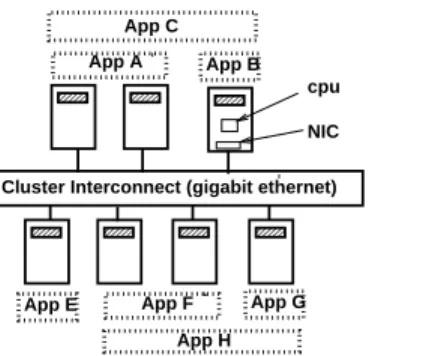
The shared hosting platform assumed in our research con-sists of a cluster of nodes, each of which concon-sists of pro-cessor, memory, and storage resources as well as one or more network interfaces. Platform nodes are allowed to be heterogeneous with different amounts of these re-sources on each node. The nodes in the hosting platform are assumed to be interconnected by a high-speed LAN such as gigabit ethernet (see Figure 1). Each cluster node is assumed to run an operating system kernel that supports some notion of quality of service such as reservations or shares. In this paper, we focus on managing CPU and network interface bandwidth in shared hosting platforms. As [1] points out, management of other resources which are inherently temporal in nature, such as disk bandwidth, can be performed by similar mechanisms. Spatial re-sources, in particular physical memory, present a different challenge. A straightforward approach is to use static par-titioning as in [1], although recently more sophisticated approaches have been implemented [5].
We use the term application for a complete service run-ning on behalf of an application provider; since an appli-cation will frequently consist of multiple distributed com-ponents, we use the term capsule to refer to the
compo-App A App E App B App F App G App C App H
Cluster Interconnect (gigabit ethernet) cpu
NIC
Figure 1: Architecture of a shared hosting platform. Each application runs on one or more nodes and shares resources with other applications.
nent of an application running on a single node. Each application has at least one capsule, possibly more if the application is distributed. Capsules provide a useful ab-straction for logically partitioning an application into sub-components and for exerting control over the distribution of these components onto different nodes. To illustrate, consider an e-commerce application consisting of a web server, a Java application server and a database server. If all three components need to be colocated on a single node, then the application will consist of a single capsule with all three components. On the other hand, if each component needs to be placed on a different node, then the application should be partitioned into three capsules. Depending on the number of its capsules, each application runs on a subset of the platform nodes and these subsets can overlap with one another, resulting in resource shar-ing (see Figure 1).
The rest of this paper is structured as follows. Sec-tion 2 discusses techniques for empirically deriving an ap-plication’s resource needs, while Section 3 discusses our resource overbooking techniques and capsule placement strategies. We discuss implementation issues in Section 4 and present our experimental results in Section 5. Section 6 discusses related work, and finally, Section 7 presents concluding remarks.
2
Automatic Derivation of Application
QoS Requirements
The first step in hosting a new application is to derive its resource requirements. While the problem of QoS-aware resource management has been studied extensively in the literature [4, 12, 13], the problem of how much resource to allocate to each application has received relatively little attention. In this section, we address this issue by propos-ing techniques to automatically derive the QoS require-ments of an application (the terms resource requirerequire-ments and QoS requirements are used interchangeably in this
pa-per.) Deriving the QoS requirements is a two step process: (i) we first use profiling techniques to monitor application behavior, and (ii) we then use our empirical measurements to derive QoS requirements that conform to the observed behavior.
2.1
Application QoS Requirements:
Defini-tions
The QoS requirements of an application are defined on a per-capsule basis. For each capsule, the QoS require-ments specify the intrinsic rate of resource usage, the vari-ability in the resource usage, the time period over which the capsule desires resource guarantees, and the level of overbooking that the application (capsule) is willing to tolerate. As explained earlier, in this paper, we are con-cerned with two key resources, namely CPU and network interface bandwidth. For each of these resources, we de-fine the QoS requirements along the above dimensions in an OS-independent manner. In Section 4.1, we show how to map these requirements to various OS-specific resource management mechanisms that have been developed.
More formally, we represent the QoS requirements of an application capsule by a quintuple(;;;U;O):
Token Bucket Parameters(;): We capture the basic
resource requirements of a capsule by modeling resource usage as a token bucket(;)[22]. The parameter
de-notes the intrinsic rate of resource consumption, while
denotes the variability in the resource consumption. More specifically, denotes the rate at which the capsule
con-sumes CPU cycles or network interface bandwidth, while
captures the maximum burst size. By definition, a token
bucket bounds the resource usage of the capsule tot+
over any intervalt.
Period: The third parameter denotes the time
pe-riod over which the capsule desires guarantees on re-source availability. Put another way, the system should strive to meet the QoS requirements of the capsule over each interval of length. The smaller the value of, the
more stringent are the desired guarantees (since the cap-sule needs to be guaranteed resources over a finer time scale). In particular, for the above token bucket parame-ters, the capsule requires that it be allocated at least+
resources every time units.
Usage Distribution U: While the token bucket
pa-rameters succinctly capture the capsule’s resource re-quirements, they are not sufficiently expressive by them-selves to denote the QoS requirements in the presence of overbooking. Consequently, we use two additional parameters—UandO—to specify resource requirements
in the presence of overbooking. The first parameterU
de-notes the probability distribution of resource usage. Note thatU is a more detailed specification of resource usage
than the token bucket parameters(;), and indicates the
probability with which the capsule is likely to use a certain
fraction of the resource (i.e.,U(x)is the probability that
the capsule uses a fractionxof the resource,0x1).
A probability distribution of resource usage is necessary so that the hosting platform can provide (quantifiable) probabilistic guarantees even in the presence of overbook-ing.
Overbooking Tolerance O: The parameterO is the
overbooking tolerance of the capsule. It specifies the probability with which the capsule’s requirements may be violated due to resource overbooking (by providing it with less resources than the required amount). Thus, the overbooking tolerance indicates the minimum level of service that is acceptable to the capsule. To illustrate, if
O =0:01, the capsule’s resource requirements should be
met 99% of the time (or with a probability of 0.99 in each interval).
In general, we assume that parameters and O are
specified by the application provider. This may be based on a contract between the platform provider and the ap-plication provider (e.g., the more the apap-plication provider is willing to pay for resources, the stronger are the pro-vided guarantees), or on the particular characteristics of the application (e.g., a streaming media server requires more stringent guarantees and is less tolerant to violations of these guarantees). In the rest of this section, we show how to derive the remaining three parameters,andU
using profiling, given values of andO.
2.2
Kernel-based Profiling of Resource
Us-age
Our techniques for empirically deriving the QoS require-ments of an application rely on profiling mechanisms that monitor application behavior. Recently, a number of ap-plication profiling mechanisms ranging from OS-kernel-based profiling to run-time profiling using specially linked libraries have been proposed.
We use kernel-based profiling mechanisms in the con-text of shared hosting platforms, for a number of reasons. Firstly, being kernel-based, these mechanisms work with any application and require no changes to the application at the source or binary levels. This is especially impor-tant in hosting environments where the platform provider may have little or no access to third-party applications. Secondly, accurate estimation of an application’s resource needs requires detailed information about when and how much resources are used by the application at a fine time-scale. Whereas detailed resource allocation information is difficult to obtain using application-level techniques, kernel-based techniques can provide precise information about various kernel events such as CPU scheduling in-stances and network packet transmissions times.
The profiling process involves running the application on a set of isolated platform nodes (the number of nodes required for profiling depends on the number of capsules).
time
End CPU quantum/Network transmission Begin CPU quantum/Network transmission
Idle/ Non capsule
related activity (OFF) Busy period (ON)
Figure 2: An example of an On-Off trace.
By isolated, we mean that each node runs only the min-imum number of system services necessary for execut-ing the application and no other applications are run on these nodes during the profiling process—such isolation is necessary to minimize interference from unrelated tasks when determining the application’s resource usage. The application is then subjected to a realistic workload, and the kernel profiling mechanism is used to track its re-source usage. It is important to emphasize that the work-load used during profiling should be both realistic and representative of real-world workloads. While techniques for generating such realistic workloads are orthogonal to our current research, we note that a number of different workload-generation techniques exist, ranging from trace replay of actual workloads to running the application in a “live” setting, and from the use of synthetic workload generators to the use of well-known benchmarks. Any such technique suffices for our purpose as long as it real-istically emulates real-world conditions, although we note that, from a business perspective, running the application “for real” on an isolated machine to obtain a profile may be preferable to other workload generation techniques.
We use the Linux trace toolkit as our kernel profil-ing mechanism [14]. The toolkit provides flexible, low-overhead mechanisms to trace a variety of kernel events such as system call invocations, process, memory, file sys-tem and network operations. The user can specify the specific kernel events of interest as well as the processes that are being profiled to selectively log events. For our purposes, it is sufficient to monitor CPU and network ac-tivity of capsule processes—we monitor CPU scheduling instances (the time instants at which capsule processes get scheduled and the corresponding quantum durations) as well as network transmission times and packet sizes. Given such a trace of CPU and network activity, we now discuss the derivation of the capsule’s QoS requirements.
2.3
Empirical Derivation of the QoS
Re-quirements
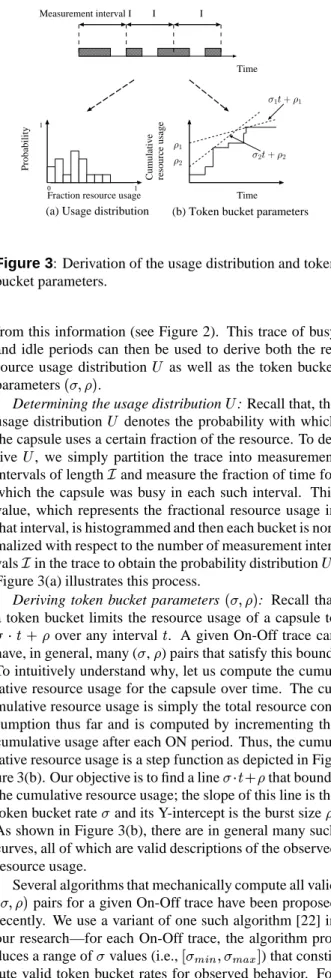
We use the trace of kernel events obtained from the pro-filing process to model CPU and network activity as a simple On-Off process. This is achieved by examining the time at which each event occurs and its duration and deriving a sequence of busy (On) and idle (Off) periods
Measurement interval I
Time Fraction resource usage
0 1 Probability 2 t+ 2 1 t+ 1 1 2 Time
Cumulative resource usage
1
I I
(a) Usage distribution (b) Token bucket parameters
Figure 3: Derivation of the usage distribution and token bucket parameters.
from this information (see Figure 2). This trace of busy and idle periods can then be used to derive both the re-source usage distributionU as well as the token bucket
parameters(;).
Determining the usage distributionU: Recall that, the
usage distributionU denotes the probability with which
the capsule uses a certain fraction of the resource. To de-riveU, we simply partition the trace into measurement
intervals of lengthIand measure the fraction of time for
which the capsule was busy in each such interval. This value, which represents the fractional resource usage in that interval, is histogrammed and then each bucket is nor-malized with respect to the number of measurement inter-valsIin the trace to obtain the probability distributionU.
Figure 3(a) illustrates this process.
Deriving token bucket parameters(;): Recall that
a token bucket limits the resource usage of a capsule to
t+over any intervalt. A given On-Off trace can
have, in general, many (,) pairs that satisfy this bound.
To intuitively understand why, let us compute the cumu-lative resource usage for the capsule over time. The cu-mulative resource usage is simply the total resource con-sumption thus far and is computed by incrementing the cumulative usage after each ON period. Thus, the cumu-lative resource usage is a step function as depicted in Fig-ure 3(b). Our objective is to find a linet+that bounds
the cumulative resource usage; the slope of this line is the token bucket rateand its Y-intercept is the burst size.
As shown in Figure 3(b), there are in general many such curves, all of which are valid descriptions of the observed resource usage.
Several algorithms that mechanically compute all valid
(;)pairs for a given On-Off trace have been proposed
recently. We use a variant of one such algorithm [22] in our research—for each On-Off trace, the algorithm pro-duces a range ofvalues (i.e.,[
min ;
max
]) that
eachwithin this range, the algorithm also computes the
corresponding burst size. Although any pair within this
range conforms to the observed behavior, the choice of a particular(;)has important practical implications.
Since the overbooking toleranceO for the capsule is
given, we can useOto choose a particular(;)pair. To
illustrate, if O = 0:05, the capsule needs must be met
95% of the time, which can be achieved by reserving re-sources corresponding to the 95
th
percentile of the us-age distribution. Consequently, a good policy for shared hosting platforms is to pick a that corresponds to the
(1 O)100
th
percentile of the resource usage distribu-tionU, and to pick the correspondingas computed by
the above algorithm. This ensures that we provision re-sources based on a high percentile of the capsule’s needs and that this percentile is chosen based on the specified overbooking toleranceO.
2.4
Profiling Server Applications:
Experi-mental Results
In this section, we profile several commonly-used server applications to illustrate the process of deriving an appli-cation’s QoS requirements. Our experimentally derived profiles not only illustrate the inherent nature of various server application but also demonstrate the utility and benefits of resource overbooking in shared hosting plat-forms.
The test bed for our profiling experiments consists of a cluster of five Dell PowerEdge 1550 servers, each with a 966 MHz Pentium III processor and 512 MB memory running Red Hat Linux 7.0. All servers runs the 2.2.17 version of the Linux kernel patched with the Linux trace toolkit version 0.9.5, and are connected by 100Mbps Eth-ernet links to a Dell PowerConnect (model no. 5012) eth-ernet switch.
To profile an application, we run it on one of our servers and use the remaining servers to generate the workload for profiling. We assume that all machines are lightly loaded and that all non-essential system services (e.g., mail services, X windows server) are turned off to prevent interference during profiling. The parameters
andI were both set to 1 sec in all our experimentation.
We profile the following server applications in our exper-iments:
Apache web server: We use the SPECWeb99
bench-mark [20] to generate the workload for the Apache web server (version 1.3.24). The SPECWeb bench-mark allows control along two dimensions—the number of concurrent clients and the percentage of dynamic (cgi-bin) HTTP requests. We vary both pa-rameters to study their impact on Apache’s resource needs.
MPEG streaming media server: We use a
home-grown streaming server to stream MPEG-1 video files to multiple concurrent clients over UDP. Each client in our experiment requests a 15 minute long variable bit rate MPEG-1 video with a mean bit rate of 1.5 Mb/s. We vary the number of concurrent clients and study its impact on the resource usage at the server.
Quake game server: We use the publicly available
Linux Quake server to understand the resource usage of a multi-player game server; our experiments use the standard version of Quake I—a popular multi-player game on the Internet. The client workload is generated using a bot—an autonomous software program that emulates a human player. We use the publicly available “terminator” bot to emulate each player; we vary the number of concurrent players connected to the server and study its impact on the resource usage.
PostgreSQL database server: We profile the
post-greSQL database server (version 7.2.1) using the
pg-bench 1.2 pg-benchmark. This pg-benchmark is part of
the postgreSQL distribution and emulates the TPC-B transactional benchmark [16]. The benchmark pro-vides control over the number of concurrent clients as well as the number of transactions performed by each client. We vary both parameters and study their impact on the resource usage of the database server. We now present some results from our profiling study.
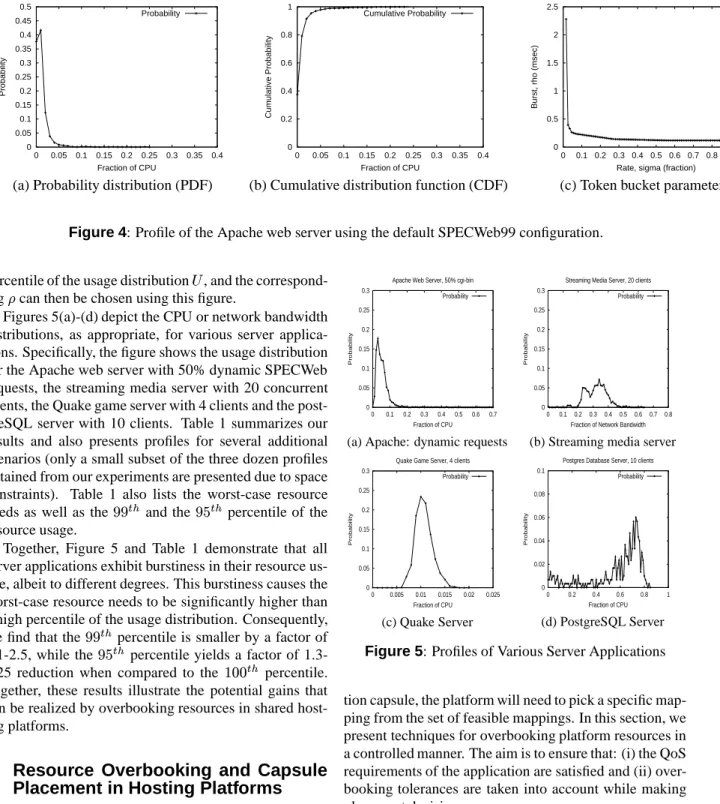
Figure 4(a) depicts the CPU usage distribution of the Apache web server obtained using the default settings of the SPECWeb99 benchmark (50 concurrent clients, 30% dynamic cgi-bin requests). Figure 4(b) plots the corre-sponding cumulative distribution function (CDF) of the resource usage. As shown in the figure (and summarized in Table 1), the worst case CPU usage (100
th
percentile) is 25% of CPU capacity. Further, the99
th
and the95 th
percentiles of CPU usage are 10 and 4% of capacity, re-spectively. These results indicate that CPU usage is bursty in nature and that the worst-case requirements are signif-icantly higher than a high percentile of the usage. Conse-quently, under provisioning (i.e., overbooking) by a mere 1% reduces the CPU requirements of Apache by a fac-tor of 2.5, while overbooking by 5% yields a facfac-tor of 6.25 reduction (implying that 2.5 and 6.25 times as many web servers can be supported when provisioning based on the99
th
and95 th
percentiles, respectively, instead of the
100 th
profile). Thus, even small amounts of overbooking can potentially yield significant increases in platform ca-pacity. Figure 4(c) depicts the possible valid(;)pairs
for Apache’s CPU usage. Depending on the specified overbooking toleranceO, we can setto an appropriate
0 0.05 0.1 0.15 0.2 0.25 0.3 0.35 0.4 0.45 0.5 0 0.05 0.1 0.15 0.2 0.25 0.3 0.35 0.4 Probability Fraction of CPU Apache Web Server, SPECWEB99 default
Probability 0 0.2 0.4 0.6 0.8 1 0 0.05 0.1 0.15 0.2 0.25 0.3 0.35 0.4 Cumulative Probability Fraction of CPU Apache Web Server, SPECWEB99 default
Cumulative Probability 0 0.5 1 1.5 2 2.5 0 0.1 0.2 0.3 0.4 0.5 0.6 0.7 0.8 0.9 1
Burst, rho (msec)
Rate, sigma (fraction) Valid Token Bucket Pairs
(a) Probability distribution (PDF) (b) Cumulative distribution function (CDF) (c) Token bucket parameters
Figure 4: Profile of the Apache web server using the default SPECWeb99 configuration.
percentile of the usage distributionU, and the
correspond-ingcan then be chosen using this figure.
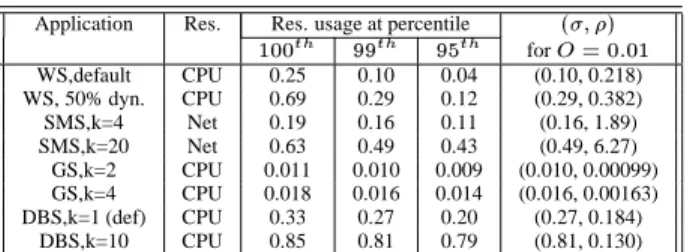
Figures 5(a)-(d) depict the CPU or network bandwidth distributions, as appropriate, for various server applica-tions. Specifically, the figure shows the usage distribution for the Apache web server with 50% dynamic SPECWeb requests, the streaming media server with 20 concurrent clients, the Quake game server with 4 clients and the post-greSQL server with 10 clients. Table 1 summarizes our results and also presents profiles for several additional scenarios (only a small subset of the three dozen profiles obtained from our experiments are presented due to space constraints). Table 1 also lists the worst-case resource needs as well as the99
th
and the95 th
percentile of the resource usage.
Together, Figure 5 and Table 1 demonstrate that all server applications exhibit burstiness in their resource us-age, albeit to different degrees. This burstiness causes the worst-case resource needs to be significantly higher than a high percentile of the usage distribution. Consequently, we find that the99
th
percentile is smaller by a factor of 1.1-2.5, while the95
th
percentile yields a factor of 1.3-6.25 reduction when compared to the 100
th
percentile. Together, these results illustrate the potential gains that can be realized by overbooking resources in shared host-ing platforms.
3
Resource Overbooking and Capsule
Placement in Hosting Platforms
Having derived the QoS requirements of each capsule, the next step is to determine which platform node will run each capsule. Several considerations arise when making such placement decisions. First, since platform resources are being overbooked, the platform should ensure that the QoS requirements of a capsule will be met even in the presence of overbooking. Second, since multiple nodes may have the resources necessary to house each
applica-0 0.05 0.1 0.15 0.2 0.25 0.3 0 0.1 0.2 0.3 0.4 0.5 0.6 0.7 Probability Fraction of CPU Apache Web Server, 50% cgi-bin
Probability
(a) Apache: dynamic requests 0 0.05 0.1 0.15 0.2 0.25 0.3 0 0.1 0.2 0.3 0.4 0.5 0.6 0.7 0.8 Probability
Fraction of Network Bandwidth Streaming Media Server, 20 clients
Probability
(b) Streaming media server
0 0.05 0.1 0.15 0.2 0.25 0.3 0 0.005 0.01 0.015 0.02 0.025 Probability Fraction of CPU Quake Game Server, 4 clients
Probability (c) Quake Server 0 0.02 0.04 0.06 0.08 0.1 0 0.2 0.4 0.6 0.8 1 Probability Fraction of CPU Postgres Database Server, 10 clients
Probability
(d) PostgreSQL Server
Figure 5: Profiles of Various Server Applications
tion capsule, the platform will need to pick a specific map-ping from the set of feasible mapmap-pings. In this section, we present techniques for overbooking platform resources in a controlled manner. The aim is to ensure that: (i) the QoS requirements of the application are satisfied and (ii) over-booking tolerances are taken into account while making placement decisions.
3.1
Resource Overbooking Techniques
A platform node can accept a new application capsule so long as the resource requirements of existing capsules are not violated, and sufficient unused resources exist to meet the requirements of the new capsule. However, if the node resources are overbooked, another requirement is added:
Application Res. Res. usage at percentile (;) 100 th 99 th 95 th forO=0:01 WS,default CPU 0.25 0.10 0.04 (0.10, 0.218) WS, 50% dyn. CPU 0.69 0.29 0.12 (0.29, 0.382) SMS,k=4 Net 0.19 0.16 0.11 (0.16, 1.89) SMS,k=20 Net 0.63 0.49 0.43 (0.49, 6.27) GS,k=2 CPU 0.011 0.010 0.009 (0.010, 0.00099) GS,k=4 CPU 0.018 0.016 0.014 (0.016, 0.00163) DBS,k=1 (def) CPU 0.33 0.27 0.20 (0.27, 0.184) DBS,k=10 CPU 0.85 0.81 0.79 (0.81, 0.130)
Table 1: Summary of profiles. Although we pro-filed both CPU and network usage for each applica-tion, we only present results for the more constrain-ing resource due to space constraints. Abbreviations: WS=Apache, SMS=streaming media server, GS=Quake game server, DBS=database server, k=number of clients, dyn.=dynamic, Res.=Resource.
the overbooking tolerances of individual capsules already placed on the node should not be exceeded as a result of accepting the new capsule. Verifying these conditions in-volves two tests:
Test 1: Resource requirements of the new and existing capsules can be met. To verify that a node can meet the
requirements of all capsules, we simply sum the require-ments of individual capsules and ensure that the aggregate requirements do not exceed node capacity. For each cap-suleion the node, the QoS parameters (
i,
i) and
i
re-quire that the capsule be allocated( i i + i )resources
in each interval of duration
i. Further, since the capsule
has an overbooking toleranceO
i, in the worst case, the
node can allocate only( i i + i )(1 O i )resources
and yet satisfy the capsule needs (thus, the overbooking tolerance represents the fraction by which the allocation may be reduced if the node saturates due to overbook-ing). Consequently, even in the worst case scenario, the resource requirements of all capsules can be met so long as the total resource requirements do not exceed the ca-pacity: k +1 X i=1 ( i min + i )(1 O i )C min (1)
where C denotes the CPU or network interface
capac-ity on the node, k denotes the number of existing
cap-sules on the node,k+1is the new capsule, and min = min( 1 ; 2 ;::: k +1
)is the period for the capsule that
desires the most stringent guarantees.1
1Note that since the
i for capsule
i was chosen based on the
(1 O
i )100
th
percentile of the capsule’s resource usage distribu-tion, this multiplication with(1 O
i
)may seem like penalizing the
capsule twice. However, this is not so becauseiin combination with
the burstiis an upper envelop of the requirements of capsulei. The
multiplication with(1 Oi)allows us to overbook the resources on a
node in a controlled manner.
Test 2: Overbooking tolerances of all capsules are met.
The overbooking tolerance of a capsule is met only if the total amount of overbooking is smaller than its specified tolerance. To compute the aggregate overbooking on a node, we must first compute the total resource usage on the node. Since the usage distributionsU
i of individual
capsules are known, the total resource on a node is simply the sum of the individual usages. That is,Y =
P k +1 i=1
U i,
whereY denotes the of aggregate resource usage
distribu-tion on the node. Assuming eachU
iis independent, the
resulting distributionY can be computed from elementary
probability theory.2 Given the total resource usage distri-butionY, the probability that the total demand exceeds
the node capacity should be less than the overbooking tol-erance for every capsule, that is,
Pr(Y >C)O i
8i (2)
where C denotes the CPU or network capacity on the
node. Rather than verifying this condition for each indi-vidual capsule, it suffices to do so for the least-tolerance capsule. That is,
Pr(Y >C)min(O 1 ;O 2 ;:::;O k +1 ) (3) wherePr(Y > C) = P 1 x=C
Y(x). Note that Equation
3 enables a platform to provide a probabilistic guarantee that a capsule’s QoS requirements will be met at least(1 O
min
)100% of the time.
Equations 1 and 3 can easily handle heterogeneity in nodes by using appropriateCvalues for the CPU and
net-work capacities on each node.
A new capsule can be placed on a node if Equations 1 and 3 are satisfied for both the CPU and network interface.
3.2
Capsule Placement Algorithms
Consider an application withmcapsules that needs to be
placed on a shared hosting platform withN nodes. For
each of themcapsules, we can determine the set of
fea-sible platform nodes. A feafea-sible node is one that can
satisfy the capsule’s resource requirements (i.e., satisfies Equations 1 and 3 for both the CPU and network require-ments). The platform must then pick a feasible node for each capsule such that all mcapsules can be placed on
the platform, with the constraint that no two capsules can be placed on the same node (since, by definition, two cap-sules from the same application are not colocated).
The placement of capsules onto nodes subject to the above constraint can be handled as follows. We model the
2This is done using the z-transform. The z-transform of a random
variableUis the polynomialZ(U)=a0+za1+z 2
a2+where
the coefficient of thei th
term represents the probability that the random variable equalsi(i.e.,U(i)). IfU1;U2;:::;U
k +1are
k+1independent
random variables, andY = P k +1 i=1 Ui, thenZ(Y)= Q k +1 i=1 Z(Ui).
The distribution ofY can then be computed using a polynomial
multi-plication of the z-transforms ofU1;U2;;U k +1.
placement problem using a graph that contains a vertex for each of themcapsules andN nodes. We add an edge
between a capsule and a node if that node is a feasible node for the capsule (i.e., has sufficient resources to house the application). The result is a bipartite graph where each edge connects a capsule to a node.
Given such a graph, we use the following algorithm to determine a placement. The algorithm starts with the cap-sule that is most constrained (i.e., has the least number of edges/feasible nodes) and places it on any one of its feasi-ble nodes. The node and all of its edges are deleted (since no other capsule can be placed on it). The algorithm then picks the next most constrained capsule and repeats the above process until allmcapsules are placed onto nodes.
It can be shown that such a greedy algorithm will always
find a placement if one exists (see an extended version of
this paper [24] for a formal proof). This property is used as follows — if no node is found to place a capsule, the al-gorithm terminates declaring that no placement exists for the application. Further, the algorithm is efficient, since capsules can be placed in a single linear scan once they are sorted in the increasing order of out-degree, resulting in an overall complexity ofO(mlogm).
In our description of the placement algorithm above, we left unspecified how a node is chosen for a capsule out of the many possible feasible nodes. The choice of a particular feasible node can have important implications on the total number of applications supported by the plat-form. Consequently, we consider four policies for making this decision. The first policy is random, where we pick one feasible node randomly. The second policy is best-fit, where we choose the feasible node which has the least unused resources (i.e., constitutes the best fit for the cap-sule). The third policy is worst-fit, where we place the capsule onto the feasible node with the most unused re-sources. In general, the unused network and CPU capaci-ties on a node may be different, and similarly, the capsule may request different amounts of CPU and network re-sources. Consequently, defining the best and worst fits for the capsule must take into account the unused capac-ities on both resources—we currently do so by simply considering the mean unused capacity across the two re-sources and compare it to the mean requirements across the two resources to determine the “fit”. A fourth policy is to place a capsule onto a node that has other capsules with similar overbooking tolerances. Since a node must always meet the requirements of its least tolerant capsule per Equation 3, colocating capsules with similar over-booking tolerances permits the platform provider to maxi-mize the amount of resource overbooking in the platform. For instance, placing a capsule with a tolerance of 0.01 onto a node that has an existing capsule withO =0:05
reduces the maximum permissible overbooking on that node to 1% (sinceO
min
=min(0:01;0:05)=0:01). On
the other hand, placing this less-tolerant capsule on an-other node may allow future, more tolerant capsules to be placed onto this node, thereby allowing nodes resources to be overbooked to a greater extent. We experimentally compare the effectiveness of these three policies in Sec-tion 5.2.
3.3
Handling Dynamically Changing
Re-source Requirements
Our discussion thus far has assumed that the resource re-quirements of an application at run-time do not change af-ter the initial profiling phase. In reality though, resource requirements change dynamically over time, in tandem with the workload seen by the application. In this sec-tion we outline our approach for dealing with dynamically changing application workloads.
First, recall that we provision resources based on a high percentile of the application’s resource usage distribution. Consequently, variations in the application workload that affect only the average resource requirements of the cap-sules, but not the tail of the resource usage distribution, will not result in violations of the probabilistic guaran-tees provided by the hosting platform. In contrast, work-load changes that cause an increase in the tail of the re-source usage distribution will certainly affect application QoS guarantees.
How a platform should deal with such changes in re-source requirements depends on several factors. Since we are interested in yield management, the platform should increase the resources allocated to an overload applica-tion only if it increases revenues for the platform provider. Thus, if an application provider only pays for a fixed amount of resources, there is no economic incentive for the platform provider to increase the resource allocation beyond this limit even if the application is overloaded. In contrast, if the contract between the application and plat-form provider permits usage-based charging (i.e., charg-ing for resources based on the actual usage, or a high per-centile of the usage ), then allocating additional resources in response to increased demand is desirable for maxi-mizing revenue. In such a scenario, handling dynamically changing requirements involves two steps: (i) detecting changes in the tail of the resource usage distribution, and (ii) reacting to these changes by varying the actual re-sources allocated to the application.
To detect such changes in the tail of an application’s resource usage distribution, we propose to conduct con-tinuous, on-line profiling of the resource usage of all cap-sules using low-overhead profiling tools. This would be done by recording the CPU scheduling instants, network transmission times and packet sizes for all processes over intervals of a suitable length. At the end of each interval, this data would be processed to construct the latest re-source usage distributions for all capsules. An application
0 0.05 0.1 0.15 0.2 0.25 0.3 0 0.1 0.2 0.3 0.4 0.5 0.6 0.7 Probability Fraction of CPU Apache Web Server, Offline Profile, 50% cgi-bin
Probability 0 0.05 0.1 0.15 0.2 0.25 0.3 0 0.1 0.2 0.3 0.4 0.5 0.6 0.7 Probability Fraction of CPU Apache Web Server, Expected Workload
Probability 0 0.05 0.1 0.15 0.2 0.25 0.3 0 0.1 0.2 0.3 0.4 0.5 0.6 0.7 Probability Fraction of CPU Apache Web Server, Overload
Probability
(a) Original profile (b) Profile under expected load (c) Profile under overload
Figure 6: Demonstration of how an application overload may be detected by comparing the latest resource usage profile with the original offline profile.
overload would manifest itself through an increased con-centration in the high percentile buckets of the resource usage distributions of its capsules.
We present the results of a simple experiment to illus-trate this. Figure 6(a) shows the CPU usage distribution of the Apache web server obtained via offline profiling. The workload for the web server was generated by us-ing the SPECWeb99 benchmark emulatus-ing 50 concurrent clients with 50% dynamic cgi-bin requests. The offline profiling was done over a period of 30 minutes. Next, we assumed an overbooking tolerance of 1% for this web server capsule. As described in Section 2.3, it was as-signed a CPU rate of 0:29 (corresponding to the 99
th
percentile of its CPU usage distribution). The remain-ing capacity was assigned to a greedy dhrystone applica-tion (this applicaapplica-tion performs compute-intensive integer computations and greedily consumes all resources allo-cated to it). The web server was then subjected to exactly the same workload (50 clients with 50% cgi-bin requests) for 25 minutes, followed by a heavier workload consist-ing of 70 concurrent clients with 70% dynamic cgi-bin requests for 5 minutes. The heavier workload during the last 5 minutes was to simulate an unexpected flash crowd. The web server’s CPU usage distribution was recorded over periods of length 10 minute each. Figure 6(b) shows the CPU usage distribution observed for the web server during a period of expected workload. We find that this profile is very similar to the profile obtained using offline measurements, except being upper-bounded by the CPU rate assigned to the capsule. Figure 6(c) plots the CPU usage distribution during the period when the web server was overloaded. We find an increased concentration in the high percentile regions of this distribution compared to the original distribution.
The detection of application overload would trigger re-medial actions that would proceed in two stages. First, new resource requirements would be computed for the affected capsules. Next, actions would be taken to pro-vide the capsules the newly computed resource shares —
this may involve increasing the resource allocations of the capsules, or moving the capsules to nodes with sufficient resources. Implementing and evaluating these techniques for handling application overloads are part of our ongoing research on shared hosting platforms.
4
Implementation Considerations
In this section, we first discuss implementation issues in integrating our resource overbooking techniques with OS resource allocation mechanisms. We then present an overview of our prototype implementation.
4.1
Providing Application Isolation at Run
Time
The techniques described in the previous section allow a platform provider to overbook platform resources and yet provide guarantees that the QoS requirements of applica-tions will be met. The task of enforcing these guaran-tees at run-time is the responsibility of the OS kernel. To meet these guarantees, we assume that the kernel employs resources allocation mechanisms that support some no-tion of quality of service. Numerous such mechanisms— such as reservations, shares and token bucket regulators [4, 12, 13]—have been proposed recently. All of these mechanisms allow a certain fraction of each resource (CPU cycles, network interface bandwidth) to be reserved for each application and enforce these allocations on a fine time scale.
In addition to enforcing the QoS requirements of each application, these mechanisms also isolate applications from one another. By limiting the resources consumed by each application to its reserved amount, the mechanisms prevent a malicious or overloaded application from grab-bing more than its allocated share of resources, thereby providing application isolation at run-time—an important requirement in shared hosting environments running un-trusted applications.
Our overbooking techniques can exploit many com-monly used QoS-aware resource allocation mechanisms. Since the QoS requirements of an application are de-fined in a OS- and mechanism-independent manner, we need to map these OS-independent QoS requirements to mechanism-specific parameter values. We consider three commonly-used QoS-aware mechanisms — reservations, proportional-share schedulers and rate regulators. Due to space constraints, we present only the mapping for reser-vations here and point the reader to an extended version of this paper [24] for the remaining mappings.
A reservation-based scheduler [12, 13] requires the re-source requirements to be specified as a pair(x;y)where
the capsule desiresx units of the resource everyy time
units (effectively, the capsule requests x y
fraction of the resource). For reasons of feasibility, the sum of the re-quests allocations should not exceed 1 (i.e.,
P j x j y j 1).
In such a scenario, the QoS requirements of a capsule with token bucket parameters(
i ;
i
) and an
overbook-ing toleranceO
ican be translated to reservation by setting
(1 O i ) i = xi y i and(1 O i ) i =x
i. To see why, recall
that(1 O i
)
i denotes the rate of resource
consump-tion of the capsule in the presence of overbooking, which is same as x
i yi
. Further, since the capsule can requestx i
units of the resource everyy
itime units, and in the worst
case, the entire x
i units may be requested continuously,
we set the burst size to be (1 O i ) i = x i. These equations simplify tox i =(1 O i ) iand y i = i = i.
4.2
Prototype Implementation
We have implemented a Linux-based shared hosting plat-form that incorporates the techniques discussed in the previous sections. Our implementation consists of three key components: (i) a profiling module that allows us to profile applications and empirically derive their QoS requirements, (ii) a control plane that is responsible for resource overbooking and capsule placement, and (iii) a QoS-enhanced Linux kernel that is responsible for enforc-ing application QoS requirements.
The profiling module runs on a set of dedicated (and therefore isolated) platform nodes and consists of a vanilla Linux kernel enhanced with the Linux trace toolkit. As explained in Section 2, the profiling module gathers a ker-nel trace of CPU and network activities of each capsule. It then post-processes this information to derive an On-Off trace of resource usage and then derives the usage distri-butionUand the token bucket parameters for this usage.
The control plane is responsible for placing capsules of newly arriving applications onto nodes while overbook-ing node resources. The control plane also keeps state consisting of a list of all capsules residing on each node and their QoS requirements. It also maintains information about the hardware characteristics of each node. The
re-quirements of a newly arriving application are specified to the control plane using a resource specification language. This specification includes the CPU and network band-width requirements of each capsule. The control plane uses this specification to derive a placement for each cap-sule as discussed in Section 3.2. In addition to assigning each capsule to a node, the control plane also translates the QoS parameters of the capsules to parameters of com-monly used resource allocation mechanisms (discussed in the previous section).
The third component, namely the QoS-enhanced Linux kernel, runs on each platform node and is responsible for enforcing the QoS requirements of capsules at run time. For the purposes of this paper, we implement the H-SFQ proportional-share CPU scheduler [10]. H-SFQ is a hierarchical proportional-share scheduler that allows us to group resource principals (processes, lightweight pro-cesses) and assign an aggregate CPU share to the entire group. We implement a token bucket regulator to provide QoS guarantees at the network interface card. Our rate regulator allows us to associate all network sockets be-longing to a group of processes to a single token bucket. We instantiate a token bucket regulator for each capsule and regulate the network bandwidth usage of all resource principals contained in this capsule using the(;)
pa-rameters of the capsule’s network bandwidth usage. In Section 5.3, we experimentally demonstrate the efficacy of these mechanisms in enforcing the QoS requirements of capsules even in the presence of overbooking.
5
Experimental Evaluation
In this section, we present the results of our experimental evaluation. The setup used in our experiments is identi-cal to that described in Section 2.4—we employ a clus-ter of Linux-based servers as our shared hosting platform. Each server runs a QoS-enhanced Linux kernel consisting of the H-SFQ CPU scheduler and a leaky bucket regulator for the network interface. The control plane for the shared platform implements the resource overbooking and cap-sule placement strategies discussed earlier in this paper. For ease of comparison, we use the same set of applica-tions discussed in 2.4 and their derived profiles (see Table 1) for our experimental study.
5.1
Efficacy of Resource Overbooking
Our first set of experiments examine the efficacy of over-booking resources in shared hosting platforms. We first consider shared web hosting platforms — a type of shared hosting platform that runs only web servers. Each web server running on the platform is assumed to conform to one of the four web server profiles gathered from our pro-filing study (two of these profiles are shown in Table 1; the other two employed varying mixes of static and dynamic
0 200 400 600 800 1000 1200 1400 0 20 40 60 80 100 120 140
Number of Web Servers Placed
Number of Nodes Placement on Clusters of Different Sizes
No overbooking ovb=1% ovb=5% 0 50 100 150 200 250 300 350 0 20 40 60 80 100 120 140
Number of Streaming Servers Supported
Number of Nodes Placement on Clusters of Different Sizes
No overbooking ovb=1% ovb=5% 000 111 00 00 11 11 00 00 00 00 11 11 11 11 00 00 00 00 00 00 00 11 11 11 11 11 11 11 00 00 00 00 00 00 00 00 00 00 00 00 00 11 11 11 11 11 11 11 11 11 11 11 11 11 00 00 00 00 00 00 00 00 00 00 00 00 00 00 00 00 00 00 00 00 00 00 00 11 11 11 11 11 11 11 11 11 11 11 11 11 11 11 11 11 11 11 11 11 11 11 000 000 111 111 00 00 11 11 0000 00 11 11 11 000 000 000 000 111 111 111 111 000 000 000 000 000 000 000 000 111 111 111 111 111 111 111 111 000 000 000 000 000 000 000 000 000 000 000 000 000 000 111 111 111 111 111 111 111 111 111 111 111 111 111 111 0 50 100 150 200 250 300 350 5 16 32 64 128
Number of Applications Supported
Cluster size
Collocating CPU Bound and Network Bound Capsules
Streaming Server Apache Server Postgres Server
(a) Web servers (b) Streaming media servers (c) Mix of applications
Figure 7: Benefits of resource overbooking for a bursty web server application, a less bursty streaming server appli-cation and for appliappli-cation mixes.
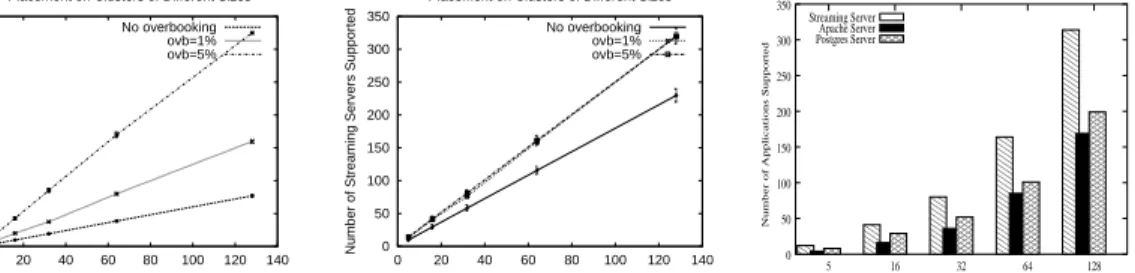
SPECWeb99 requests). The objective of our experiment is to examine how many such web servers can be sup-ported by a given platform configuration for various over-booking tolerances. We vary the overover-booking tolerance from 0% to 10%, and for each tolerance value, attempt to place as many web servers as possible until the platform resources are exhausted. We first perform the experiment for a cluster of 5 nodes (identical to our hardware config-uration) and then repeat it for cluster sizes ranging from 16 to 128 nodes (since we lack clusters of these sizes, for these experiments, we only examine how many applica-tions can be accommodated on the platform and do not actually run these applications). Figure 7(a) depicts our results with 95% confidence intervals. The figure shows that, the larger the amount of overbooking, the larger is the number of web servers that can be run on a given plat-form. Specifically, for a 128 node platform, the number of web servers that can be supported increases from 307 when no overbooking is employed to over 1800 for 10% overbooking (a factor of 5.9 increase). Even for a modest 1% overbooking, we see a factor of 2 increase in the num-ber of web servers that can be supported on platforms of various sizes. Thus, even modest amounts of overbook-ing can significantly enhance revenues for the platform provider.
Next, we examine the benefits of overbooking re-sources in a shared hosting platform that runs a mix of streaming servers, database servers and web servers. To demonstrate the impact of burstiness on overbooking, we first focus only on the streaming media server. As shown in Table 1, the streaming server (with 20 clients) ex-hibits less burstiness than a typical web server, and con-sequently, we expect smaller gains due to resource over-booking. To quantify these gains, we vary the platform size from 5 to 128 nodes and determine the number of streaming servers that can be supported with 0%, 1% and 5% overbooking. Figure 7(b) plots our results with 95% confidence intervals. As shown, the number of servers that can be supported increases by 30-40% with 1%
over-booking when compared to the no overover-booking case. In-creasing the amount of overbooking from 1% to 5% yields only a marginal additional gain, consistent with the pro-file for this streaming server shown in Table 1 (and also indicative of the less-tolerant nature of this soft real-time application). Thus, less bursty applications yield smaller gains when overbooking resources.
Although the streaming server does not exhibit signif-icant burstiness, large statistical multiplexing gains can still accrue by colocating bursty and non-bursty applica-tions. Further, since streaming server is heavily network-bound and uses a minimal amount of CPU, additional gains are possible by colocating applications with differ-ent bottleneck resources (e.g., CPU-bound and network-bound applications). To examine the validity of this as-sertion, we conduct an experiment where we attempt to place a mix of streaming, web and database servers—a mix of CPU-bound and network-bound as well as bursty and non-bursty applications. Figure 7(c) plots the number of applications supported by platforms of different sizes with 1% overbooking. As shown, an identical platform configuration is able to support a large number of appli-cations than the scenario where only streaming servers are placed on the platform. Specifically, for a 32 node cluster, the platform supports 36 and 52 additional web and database servers in addition to the approximately 80 streaming servers that were supported earlier. We note that our capsule placement algorithms are automatically able to extract these gains without any specific “tweaking” on our part. Thus, colocating applications with different bottleneck resources and different amounts of burstiness enhance additional statistical multiplexing benefits when overbooking resources.
5.2
Capsule Placement Algorithms
Our next experiment compares the effectiveness of the best-fit, worst-fit and random placement algorithms dis-cussed in Section 3.2. Using our profiles, we construct
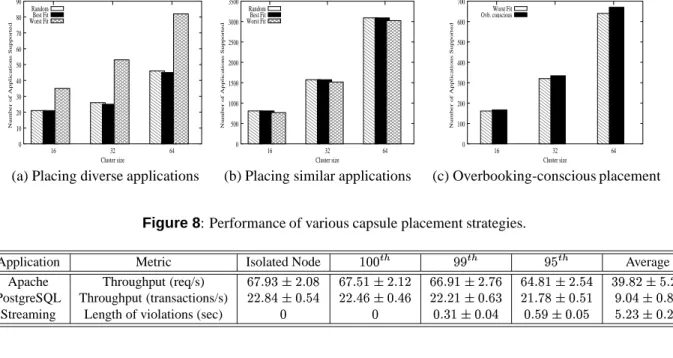
two types of applications: a replicated web server and an e-commerce application consisting of a front-end web server and a back-end database server. Each arriving ap-plication belongs to one of these two categories and is assumed to consist of 2-10 capsules, depending on the degree of replication. The overbooking tolerance is set to 5%. We then determine the number of applications that can be placed on a given platform by different place-ment strategies. Figure 8(a) depicts our results. As shown, best-fit and random placement yield similar performance, while worst-fit outperforms these two policies across a range of platform sizes. This is because best-fit places capsules onto nodes with smaller unused capacity, result-ing in “fragmentation” of unused capacity on a node; the leftover capacity may be wasted if no additional applica-tions can be accommodated. Worst fit, on the other hand, reduces the chances of such fragmentation by placing cap-sules onto nodes with the larger unused capacity. While such effects become prominent when application capsules have widely varying requirements (as observed in this ex-periment), they become less noticeable when the applica-tion have similar resource requirements. To demonstrate this behavior, we attempted to place Quake game servers onto platforms of various sizes. Observe from Table 1 that the game server profiles exhibit less diversity than a mix of web and database servers. Figure 8(b) shows that, due to the similarity in the application resource require-ments, all policies are able to place a comparable number of game servers.
Finally, we examine the effectiveness of taking the overbooking tolerance into account when making place-ment decisions. We compare the worst-fit policy to an overbooking-conscious worst-fit policy. The latter policy chooses the three worst-fits among all feasible nodes and picks the node that best matches the overbooking toler-ance of the capsule. Our experiment assumes a web host-ing platform with two types of applications: less-tolerant web servers that permit 1% overbooking and more tol-erant web servers that permit 10% overbooking. We vary the platform size and examine the total number of applica-tions placed by the two policies. As shown in Figure 8(c), taking overbooking tolerances into account when making placement decisions can help increase the number of ap-plications placed on the cluster. However, we find that the additional gains are small (<6% in all cases),
indi-cating that a simple worst-fit policy may suffice for most scenarios.
5.3
Effectiveness of Kernel Resource
Allo-cation Mechanisms
While our experiments thus far have focused on the im-pact of overbooking on platform capacity, in our next ex-periment, we examine the impact of overbooking on ap-plication performance. We show that combining our
over-booking techniques with kernel-based QoS resource al-location mechanisms can indeed provide application iso-lation and quantitative performance guarantees to appli-cations (even in the presence of overbooking). We be-gin by running the Apache web server on a dedicated (isolated) node and examine its performance (by measur-ing throughput in requests/s) for the default SPECWeb99 workload. We then run the web server on a node run-ning our QoS-enhanced Linux kernel. We first allo-cate resources based on the100
th
percentile of its usage (no overbooking) and assign the remaining capacity to a greedy dhrystone application. We measure the throughput of the web server in presence of this background dhrys-tone application. Next, we reserve resources for the web server based on the99
th
and the 95 th
percentiles, allo-cate the remaining capacity to the dhrystone application, and measure the server throughput. Table 2 depicts our results. As shown, provisioning based on the100
th
per-centile yields performance that is comparable to running the application on an dedicated node. Provisioning based on the99
th
and95 th
percentiles results in a small degra-dation in throughput, but well within the permissible lim-its of 1% and 5% degradation, respectively, due to over-booking. Table 2 also shows that provisioning based on the average resource requirements results in a substan-tial fall in throughout, indicating that reserving resources based on mean usage is not advisable for shared hosting platforms.
We repeat the above experiment for the streaming server and the database server. The background load for the streaming server experiment is generated using a greedy UDP sender that transmits network packets as fast as possible, while that in case of the database server is generated using the dhrystone application. In both cases, we first run the application on an isolated node and then on our QoS-enhanced kernel with provisioning based on the 100 th , 99 th and the95 th
percentiles. We also run the application with provisioning based on the average of its resource usage distribution obtained via offline profil-ing. We measure the throughput in transaction/s for the database server and the mean length of a playback viola-tion (in seconds) for the streaming media server. Table 2 plots our results. Like with the web server, provisioning based on the100
th
percentile yields performance compa-rable to running the application on an isolated node, while a small amount of overbooking results in a corresponding small amount of degradation in application performance.
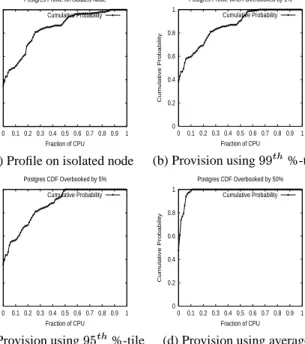
For each of the above scenarios, we also computed the application profiles in the presence of background load and overbooking and compared these to the profiles gath-ered on the isolated node. Figure 9 shows one such set of profiles. It should be seen in combination with the sec-ond row in Table 2 that correspsec-onds to the PostgreSQL application. Together, they depict the performance of the
00 11 000 000 000 000 000 000 000 111 111 111 111 111 111 111 00 00 00 00 00 00 00 00 11 11 11 11 11 11 11 11 00 00 00 00 00 00 00 00 00 00 00 00 00 00 11 11 11 11 11 11 11 11 11 11 11 11 11 11 00 00 11 11 000 000 000 000 000 000 000 000 000 000 111 111 111 111 111 111 111 111 111 111 00 00 00 00 00 00 00 00 00 00 00 00 00 00 00 11 11 11 11 11 11 11 11 11 11 11 11 11 11 11 00 00 00 00 00 00 00 00 00 00 00 00 00 00 00 00 00 00 00 00 00 00 11 11 11 11 11 11 11 11 11 11 11 11 11 11 11 11 11 11 11 11 11 11 0 10 20 30 40 50 60 70 80 90 16 32 64
Number of Applications Supported
Cluster size Performance of Different Placement Heuristics, ovb=5% Random Best Fit Worst Fit 000 111 00 00 00 00 00 00 00 11 11 11 11 11 11 11 00 00 00 00 00 00 00 00 00 00 00 00 11 11 11 11 11 11 11 11 11 11 11 11 000 000 000 000 000 000 000 000 000 000 000 000 000 000 000 000 000 000 000 000 000 000 111 111 111 111 111 111 111 111 111 111 111 111 111 111 111 111 111 111 111 111 111 111 000 000 111 111 00 00 00 00 00 00 00 11 11 11 11 11 11 11 000 000 000 000 000 000 000 000 000 000 000 000 111 111 111 111 111 111 111 111 111 111 111 111 00 00 00 00 00 00 00 00 00 00 00 00 00 00 00 00 00 00 00 00 00 11 11 11 11 11 11 11 11 11 11 11 11 11 11 11 11 11 11 11 11 11 0 500 1000 1500 2000 2500 3000 3500 16 32 64
Number of Applications Supported
Cluster size Performance of Different Placement Heuristics, ovb=5% Random Best Fit Worst Fit 00 11 000 000 000 000 000 000 000 111 111 111 111 111 111 111 00 00 00 00 00 00 00 00 00 00 00 11 11 11 11 11 11 11 11 11 11 11 000 000 000 000 000 000 000 000 000 000 000 000 000 000 000 000 000 000 000 000 000 000 111 111 111 111 111 111 111 111 111 111 111 111 111 111 111 111 111 111 111 111 111 111 0 100 200 300 400 500 600 700 16 32 64
Number of Applications Supported
Cluster size Comparison of Worst Fit and Close Overbooking Worst Fit
Ovb. conscious
(a) Placing diverse applications (b) Placing similar applications (c) Overbooking-conscious placement
Figure 8: Performance of various capsule placement strategies.
Application Metric Isolated Node 100
th 99 th 95 th Average
Apache Throughput (req/s) 67:932:08 67:512:12 66:912:76 64:812:54 39:825:26
PostgreSQL Throughput (transactions/s) 22:840:54 22:460:46 22:210:63 21:780:51 9:040:85
Streaming Length of violations (sec) 0 0 0:310:04 0:590:05 5:230:22
Table 2: Effectiveness of kernel resource allocation mechanisms. All results are shown with 95% confidence intervals. database server for different levels of CPU provisioning.
Figures 9(b) and (c) show the CPU profiles of the database server when it is provisioned based on the99
th
and the
95 th
percentiles respectively. As can be seen, the two profiles look similar to the original profile shown in Fig-ure 9(a). Correspondingly, Table 2 shows that for these levels of CPU provisioning, the throughput received by the database server is only slightly inferior to that on an isolated node. This indicates that upon provisioning re-sources based on a high percentile, the presence of back-ground load interferes minimally with the application be-havior. In Figure 9(d), we show the CPU profile when the database server was provisioned based on its average CPU requirement. This profile is drastically different from the original profile. We also present the corresponding low throughput in Table 2. This reinforces our earlier obser-vation that provisioning resources based on the average requirements can result in significantly degraded perfor-mance.
Together, these results demonstrate that our kernel re-source allocation mechanisms are able to provide quan-titative performance guarantees even when resources are overbooked.
6
Related Work
Research on clustered environments over the past decade has spanned a number of issues. Systems such as Condor have investigated techniques for harvesting idle CPU cy-cles on a cluster of workstations to run batch jobs [15]. The design of scalable, fault-tolerant network services
running on server clusters has been studied in [8]. Use of virtual clusters to manage resources and contain faults in large multiprocessor systems has been studied in [9]. Scalability, availability and performance issues in dedi-cated clusters have been studied in the context of clus-tered mail servers [18] and replicated web servers [3]. Ongoing efforts in the grid computing community have focused on developing standard interfaces for resource reservations in clustered environments [11]. In the con-text of QoS-aware resource allocation, numerous efforts over the past decade have developed predictable resource allocation mechanisms for single machine environments [4, 12, 13].
Statistical admission control techniques that overbook resources have been studied in the context of video-on-demand servers [25] and ATM networks [6], but little work as been published to date in the context of shared, cluster-based hosting platforms.
Most closely related to our work is Aron [1, 2], who presents a comprehensive framework for resource man-agement in web servers, with the aim of delivering pre-dictable QoS and differentiated services. New services are profiled by running on lightly-loaded machines, and contracts subsequently negotiated in terms of application level performance (connections per second), reported by the application to the system. CPU and disk bandwidth are scheduled by lottery scheduling [26] and SFQ [10] re-spectively, while physical memory is statically partitioned between services with free pages allocated temporarily to services that can make use of them. A resource monitor running over a longer timescale examines performance
0 0.2 0.4 0.6 0.8 1 0 0.1 0.2 0.3 0.4 0.5 0.6 0.7 0.8 0.9 1 Cumulative Probability Fraction of CPU Postgres Profile on Isolated Node
Cumulative Probability
(a) Profile on isolated node 0 0.2 0.4 0.6 0.8 1 0 0.1 0.2 0.3 0.4 0.5 0.6 0.7 0.8 0.9 1 Cumulative Probability Fraction of CPU Postgres Profile When Overbooked by 1%
Cumulative Probability (b) Provision using99 th %-tile 0 0.2 0.4 0.6 0.8 1 0 0.1 0.2 0.3 0.4 0.5 0.6 0.7 0.8 0.9 1 Cumulative Probability Fraction of CPU Postgres CDF Overbooked by 5% Cumulative Probability (c) Provision using95 th %-tile 0 0.2 0.4 0.6 0.8 1 0 0.1 0.2 0.3 0.4 0.5 0.6 0.7 0.8 0.9 1 Cumulative Probability Fraction of CPU Postgres CDF Overbooked by 50% Cumulative Probability
(d) Provision using average
Figure 9: Effect of different levels of provisioning on the PostgreSQL server CPU profile.
reported by the application and system performance in-formation and flags conditions which might violate con-tracts, to allow extra resources to be pro