A Mobile Application for Collecting
Numerical and Multimedia Data during
Experiments and Field Trips in Inquiry Learning
Adam GIEMZA*, Oliver KUNTKE & H. Ulrich HOPPEUniversity of Duisburg-Essen, Germany
Abstract: In this paper, we present work in progress on developing and integrating a mobile application for collecting numerical and multimedia data into a learning environment called SCY-Lab. This learning environment is currently being developed within the European SCY project on collaborative inquiry learning. In SCY, collaboration is centered around the sharing of "emerging learning objects" (ELOs) produced by the students themselves. The aim of this paper is to show how the ELO centered approach of SCY has been used to integrate mobile scenarios into the SCY system.
Keywords: mobile, data collecting, learning environment, integration, SCY, Android
Introduction
A considerable portion of work on mobile learning aims at supporting the usage of mobile devices in learning scenarios outside the classroom. Here, we can distinguish the functions of knowledge provision for the student through the device as opposed to the collection of data and learning objects for later analysis and/or re-use. Knowledge provision is often used for language learning [1, 2]. Data collection scenarios have been elaborated in [3, 4, 5]. A combination of both scenarios has been shown using a mobile application for teaching butterfly ecology, in which information is provided on the devices and also data can be collected [6]. Moreover, many mobile learning applications are not well integrated with learning environments and follow-up activities.
In this paper, we present work in progress on a mobile application for form-based collection of numerical and multimedia data and the integration of this activity into the SCY project [7]. The objective of SCY is to provide a learning environment for constructive and productive learning of science in different domains. SCY uses a flexible and adaptive pedagogical approach to learning, which is based on “emerging learning objects” (ELOs) that are created by learners in different missions. Students work on these missions using the SCY learning environment called SCY-Lab. Within this system students use different tools to work on experiments, simulations, read background information, create mind maps and produce reports. One of these missions is the so-called ECO mission that deals with topics of the students’ ecological environment. These missions combine the domains of biology, chemistry and environmental science and formulate questions like: “What influence has light on the size/distribution of the plant populations?” or “What influence has environment (soil, factories, acid rain) on the pH of the water?”. For this purpose students need to go to the field, take measurements and collect data in the real world environment. This paper presents a system that consists of a mobile application for the actual data collecting activity and an authoring application for structuring these activities as forms. All the data will be
shared and stored as ELOs in the central repository and will therefore be accessible in the main learning environment, the SCY-Lab, for follow-up activities.
1. Data Collecting Scenario
In SCY students work as junior researchers and have to organize and plan their work in a mission. SCY-Lab offers tools for planning and organizing the work. The same applies for data collecting activities in the field. Typically, students prepare the field trip in the classroom, defining the goal of the trip, i.e., the data they need to collect for later analysis and to get results for follow-up activities like mind maps or simulations. Taking the research question “What influence has light on the size/distribution of the plant populations?” as an example throughout this paper, the students could define the following data to collect:
pictures of plant, description of plant, size of plant, location, date, intensity of light (by an external tool, e.g., a luxmeter).
To achieve meaningful results, these data need to be collected in different locations with different lighting conditions. This can be achieved by one group of students or by several groups working at different locations. In order to get comparable results, the collection of data needs to be structured and organized. In our approach flexible forms with different types of fields represent the data collection. These forms are created using a dedicated authoring application and are stored into the repository as templates. On the mobile device these templates can be queried from the repository and opened for the data collection. During the outdoor activity, students can then fill the forms according to the form template and store their results on the mobile device. Back in the classroom the collected data can be uploaded into the repository and used for further processing.
2. Concept of Forms for Collecting Data
The basic idea of forms for collecting data is to standardize and structure the data collection. This has the advantage that data can be compared between collections based on the same form(s). Furthermore data have a defined meaning and a type identified by the form entry and are therefore better readable and understandable in later post-processing.
There are two types of forms: the template forms created by the authoring tool and the
instantiated orfilled forms with actual data. The lifecycle of forms starts with the template that is later on being filled with data during the activity and can also further emerge, i.e., by refilling and modifying it afterwards. In general, forms have a title, a description and a
version number. The description can be used to describe the data to be collected by this form or, if created by a tutor or teacher, to formulate a task for the students. The version number identifies the version of the form during iterative modifications.
Forms consist of several fields. Each field has specific parameters, i.e., field name, field type, field cardinality, events and the actual value. The name describes the field, e.g.,
“height of plant in cm”. The field type defines the data type of the value, e.g., the height would be entered as a number. Currently the following data types are supported: text, audio, photo, time, date, number, counter and GPS location. The field cardinality defines the quantity of values that can be collected in this form field, e.g., a cardinality of “3” on a field with the type photo would allow to take three photos and store them as the value of this field; a cardinality of “0” means unlimited amount. Finally, events can be defined to be fired
before and after the data has been captured. These events can store the GPS location, date
Forms are stored as ELOs in the SCY repository for exchange between the authoring application and the mobile devices as well as for later retrieval for follow-up activities.
3. Flexible Form Authoring Tool
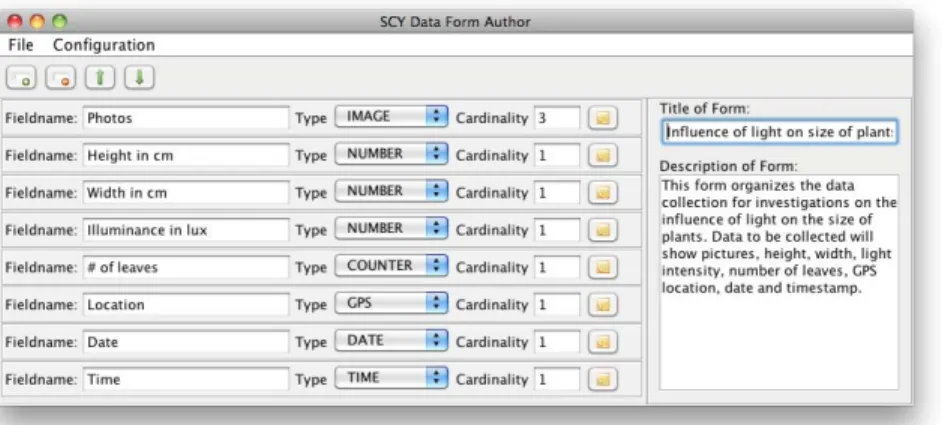
To support students or teachers in creating form templates for data collecting activities, a form authoring tool has been developed. It provides a simple way to author forms and store them into the repository. Figure 1 shows an example form for the previously defined research question.
Figure 1: SCY Data Form Authoring Tool
The application reflects the form defined in section 2. On the right hand side the title and the description can be provided for the form. The rows in the center of the application represent the form fields and can be flexibly added, removed and reorganized. The properties field name, type and cardinality can be set as well as the events (using the button at the end of a row). Finally, this document can be stored locally as an XML file or as an ELO in the SCY repository.
4. Mobile Client for Data Collection
Once the form template has been stored in the repository, students can access and download it using the mobile client, called “SCY Data Collector”. For this purpose students need to login to the SCY system and connect to the server. They can query for form templates or already filled in data forms to continue their work. The mobile client has been implemented for the Google Android platform on HTC Magic devices.
Following the scenario, the students first download the empty form template and open it on the device. They can read the title and description and start collecting data. The presentation of the form is very similar to the presentation in the authoring tool.
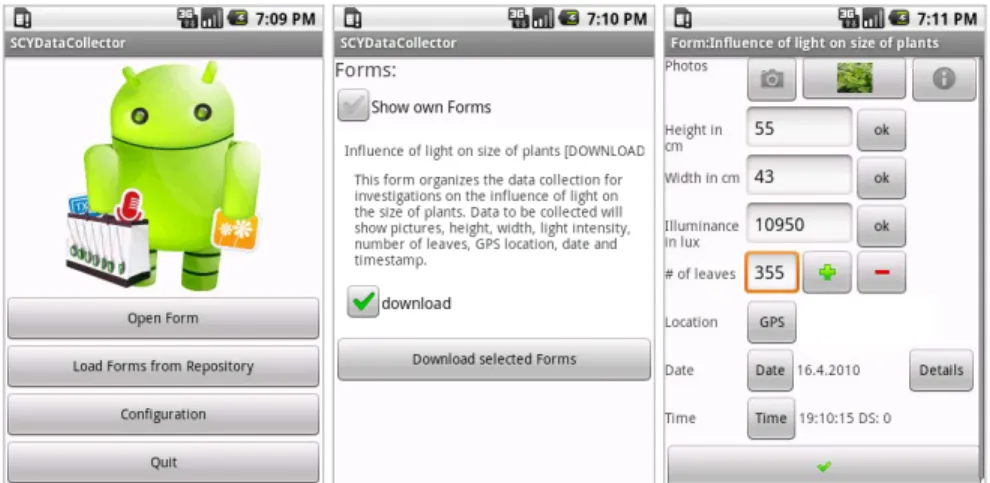
Figure 2 presents the main application screen on the left side. The menu items allow for
opening forms from the device’s database, loading forms from repository, configuration of the application and finally to quit the application. The first step in the scenario would be to download form templates from the repository (c.f. center of Figure 2). Here the student can select to download templates or already filled in forms. Once a form has been downloaded, the student can open it and start collecting and filling in data (c.f. right side of Figure 2).
Figure 2: Different Views of SCY Data Collector
The fields of the row will be presented to the student in a similar way to the authoring tool, but are extended with data type specific controls for interaction, e.g., the photo field will have a button to capture a photo using the built-in camera of the smartphone. Audio recording will be done using well-known icons for recording, stopping and playing an audio file. Finally, the counter has a “+” and a “-“ button to increment and decrement the counter. With this flexible user interface the user can start collecting data and the application will automatically access the different hardware components of the device for capturing photos, GPS and so forth. Finally, the student can store the filled in form to the local database of the device and upload it to the repository.
5. System Architecture
Figure 3: Integration through Web Services into the SCY system
The presented system is a distributed and heterogeneous system in terms of hardware devices and implementation platforms. SCY-Lab and the Form Authoring Tool are desktop applications implemented on the Java platform, whereas the mobile client is implemented for the Android mobile devices on the Android platform. The integration of these two worlds has been achieved by providing a platform independent web service based on JSON and XML.
Figure 3 shows a simplified overview of the system architecture. The SCY ELO repository, called RoOLO (Repository of Open Learning Objects), is running in the server environment and is directly accessed by SCY-Lab using native means of the Java platform, which are not available on other platforms. The web service provides heterogeneous access to the repository for integration with the SCY system. ELOs are based on a common XML format, allowing for sharing, creating and processing ELOs on different platforms in different programming languages. SCY has defined a schema for the XML ELO format, containing a rich set of meta data and a flexible content part, that can handle various kinds of different ELOs created in different scenarios, for different purposes by different devices.
6. Discussion and Conclusion
This paper presents work in progress on developing and integrating a mobile data collecting activity into the learning environment SCY-Lab. The approach described allows for flexible authoring of forms for collecting numerical and multimedia data with access to the central SCY ELO repository. A mobile application has been developed for conducting the data collecting activity in the field with access to the repository for accessing and storing forms. This integration allows for later reuse of the collected data within SCY-Lab by extracting and post-processing collected data and further usage in simulations and experiments. The SCY project is a still ongoing project. Next steps in the development are the reuse and post-processing of the collected data as well as final specifications of missions with outdoor activities. Furthermore, the system is currently being tested in first trials and will be finally evaluated towards the end of the project, including the presented application.
Acknowledgement:
This work was conducted in the context of Science Created by You (SCY), which is funded by the European Community under the Information and Communication Technologies (ICT) theme of the 7th Framework Programme for R&D (Grant agreement 212814). This document does not represent the opinion of the European Community, and the European Community is not responsible for any use that might be made of its content.
References
[1] Joseph, S., Uther, M., “Mobile devices for language learning: multimedia approaches”, Research and Practice in Technology Enhanced Learning (RPTEL), 4 (1), 2009, pp. 7-32.
[2] Yin, C., Ogata, H., Liu, Y., Yano, Y., “PDA-based Language system for learning Japanese Polite Expressions”, The Supplementary Proceedings of ICCE 2007 WS/DSC, Vol.1, pp.69-74, Hiroshima, Japan, 05.Nov, 2007.
[3] Vogel, B., Spikol, D., Kurti, A., Milrad, M., “Integrating Mobile, Web and Sensor Technologies to Support Inquiry-Based Science Learning”, Proceedings of the 6th IEEE WMUTE Conference, Kaohsiung, Taiwan, April, 2010.
[4] Giemza, A., Bollen, L., Seydel, P., Overhagen, A., Hoppe, H.U., “LEMONADE: A Flexible Authoring Tool for Integrated Mobile Learning Scenarios”, Proceedings of the 6th IEEE WMUTE Conference, Kaohsiung, Taiwan, April, 2010.
[5] Verdejo, M. F., Celorrio, C., Lorenzo, E. J., Millan, M., Prades, S., Velez, J., “Constructing Mobile Technology-Enabled Environments for an Integrated Learning Approach”, Innovative Mobile Learning: Techniques and Technologies , IGI Global, 2008, pp. 147-171.
[6] Chu, H., Hwang, G., Huang, S., Wu, T., “A knowledge engineering approach to developing e-libraries for mobile learning”, Electronic Library. Vol. 26, no. 3, pp. 303-317. 2008
[7] de Jong, T., et al., “Learning by creating and exchanging objects: the SCY experience“, British Journal of Educational Technology, in-press.