
Broadband Mid-Infrared Lasers
IRINA T. SOROKINA
Photonics Institute, Vienna University of Technology
e-mail: [email protected] also with Department of Physics, Norwegian University of Science and Technology
e-mail: [email protected]
Abstract. A survey of broadband Co2+- and Cr2+-based lasers is presented. These mid-IR sources, operating in the very interesting “molecular fingerprint” region between∼1.6 and 3.5µm offer the broadest bandwidth from all solid-state vibronic lasers. The emphasize is made on Cr2+-doped lasers, which have not only the widest and the highest gain, but also operate at room-temperature and produce the shortest pulses of only several optical cycles around 2.5µm directly from the resonator. Ten years after their invention, Cr2+-doped lasers have come of age and emerge in applications, demanding high power and extreme bandwidth. The paper reviews advances in the existing and novel Cr2+-based lasers, such as mixed Cr2+:ZnSxSe1−x, Cr2+:CdMnTe and Cr2+:CdZnTe lasers, which are likely to extend these features even further, and briefly describes a number of novel and yet upcoming applications. The first steps towards electrically pumped nanocrystalline lasers are described and the underlying physics is outlined.
Keywords:Transition metal doped II-VI; Cr2+:ZnSe; Cr2+:ZnS; Cr2+:CdSe; tunable mid-infrared lasers; ultrashort-pulsed mid-infrared lasers; mid-infrared random lasers.
1. Introduction 1.1. MOTIVATION
The big advantage of crystalline solid-state lasers is their ability to generate the widest among known modern lasers spectra directly from the resonator. The ultimately broad bandwidth can be achieved either in color-center lasers (otherwise called F-center lasers) or in transition metal ion doped lasers. However, the main drawbacks of the first group of sources include the use of insulating vac-uum, and the necessity of cryogenic cooling, especially in the mid-infrared region. In the seventies and eighties the F-center lasers, including commercial ones, have found a widespread use in various applications, especially in high-resolution spectroscopy requiring high spectral or temporal resolution, and in frequency stan-dards. However, with the rapid progress in the last decade in room-temperature
225
M. Ebrahim-Zadeh and I.T. Sorokina (eds.), Mid-Infrared Coherent Sources and Applications,225–260. c
ion-doped crystalline lasers the F-center lasers lost their practical meaning. For this reason we will concentrate in this chapter on transition-metal ion doped crys-talline lasers with the special emphasize on chromium doped II-VI compound based lasers as the most successful room-temperature diode-pumpable sources in the wave-length range between∼2 and∼3.5µm.
The mid-infrared (mid-IR) wavelength range, which is also often called a “molecular fingerprint” region, and in particular, the range between 2 and 5µm is characterized by the presence of the strong fundamental and overtone vibrati-onal absorption lines of atmospheric constituents, vapours and other gases. Those include, e.g.: water vapour (H2O), filling the whole range between 2.5 and 3µm with maximum around 2.7µm, carbon monoxide (CO) with strong features around 2.3–2.4µm, carbon dioxide(CO2)absorbing around 2.7–2.8µm, nitrous oxide (N2O), having several absorption features all through 2–4µm range, as well as many other species. The ability of broadband solid-state lasers to spec-trally cover in a single shot or by rapidly tuning the laser the widest wavelength range, containing all the above molecular absorption lines, is the main advantage of these compact and user friendly coherent sources.
Detection of low concentrations of these and other molecules, constituting air pollutants or green-house gases for the purpose of environmental diagnostics or even the human breath for the purpose of medical diagnostics is currently done using laser systems, which are based mainly on nonlinear optical conversion tech-niques and include optical parametric oscillators (OPO) and difference frequency generators. OPO is almost an ideal solution, but rather complex and costly.
Another possibility would be to employ semiconductor lasers, including het-erojunction lasers, lead-salt, antimonite and quantum cascade lasers (QCL), which are probably the simplest and the most cost effective sources in the Mid-IR wave-length region. However, they provide narrow tuning ranges (compare∼140 cm−1 tuning range of a quantum cascade laser and ∼1800 cm−1 tuning range of a Cr:ZnSe laser) and limited output power levels at room temperature. Besides, even at cryotemperatures the QCLs operate so far only above 3.4µm, and this hurdle is not going to be overtaken easily in the near future [1].
The crystalline solid-state lasers [2], on the other hand, which operate at room-temperature and have the largest relative bandwidth of∼45% of the central wavelength of the laser, can provide very high power levels retaining the good beam quality and narrow spectral linewidth at the wide tuning range. In com-bination with near-infrared diode lasers as pump sources these lasers can offer stability, efficiency and compactness as well as the broad spectral coverage and tuning ranges, which are generally inaccessible for semiconductor lasers.
1.2. APPLICATIONS
For femtochemistry, molecular time-resolved measurements, molecular spec-troscopy, trace gas analysis, biomedical applications, etc. one should directly
Wavelength (µm) 2.0 2.5 3.0 3.5 Tissue absorption (cm − 1) 10 100 1000 10000 Penetration depth (µm) 1 10 100 1000 Biological tissue absorption
due to water content
hydroxylO-H aminesN-H Cr:ZnSe tuning range
(2.0 - 3.1µm)
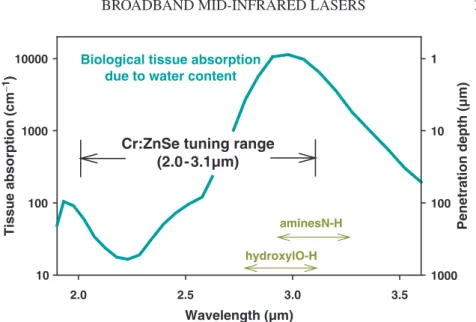
Figure 1. Typical absorption and penetration depth of the biological tissue, as well as the typical
absorption ranges of some important radicals.
reach molecular frequencies. Mid-IR tunable and femtosecond sources are required, which would possess sufficient bandwidth and have a good spatial coherence (preferably TEM00 mode), be low-cost, compact, directly diode-pumpable.
Availability, since recently, of the room-temperature diode-pumped broadband tunable solid-state lasers as simple and compact alternative to semiconductor lasers and nonlinear optical frequency conversion devices in this wavelength region is a significant step forward in remote sensing and trace gas detection (for details see Chapter 3.5), as well as in other medical applications (Chapter 3.6). Indeed, as it can be seen in Fig. 1, biological tissue has a maximum of absorption around∼2.9µm mostly due to the water content. Therefore, such medical appli-cations as ophthalmology, tissue cutting and welding, neurosurgery, dermatology and bioimaging would benefit from broadband and rapidly tunable coherent sources in this wavelength region. For further details on these applications the reader is referred to Chapter 3.6.
The ultrabroad gain bandwidth of some laser crystals allows generation of the ultimately short pulses of only few optical cycles. Such pulses, especially in the mid-infrared range are unique diagnostic tools for numerous transient processes on the femtosecond scale. These lasers are also attractive for such applications as MIR free-space communications, optical frequency standards as well as optical coherence tomography (OCT).
2. Bandwidth and wavelength scaling rules
In this section we will analyse implications of the large band-width and the long operation wavelenght on the laser properties of continuous-wave tunable, as well as femtosecond lasers.
First of all, we must clearly define the notion of bandwidth. The gain band-width is one of the most important characteristics, determining the ability of the laser material to be tuned and to produce short pulses. Generally speak-ing, the laser transitions in the mid-infrared tend to be broadband. Indeed, the widths of the individual states (in energy units) are determined by the particular crystal-lattice interaction and inhomogeneous broadening, which are characteris-tic for the given ion and host. The transition bandwidthhν(in energy units) is then the sum of the widths of the transitions between the upper and lower states. Since the transition energy hν is inversely proportional to the wavelength, the relative bandwidthof the transitionν/ν=λ/λincreasestowards the infrared. To provide the fair comparison of the bandwidth of the materials the spectra are plotted in the semi-logarithmic scale, keepingλ/λconstant.
Central wavelength also dramatically influences the laser threshold. In Ref. [2] the following scaling rule for the required pump intensity at threshold could be obtained: It h ∝ 1 F O M 1 ηQ E λ λ0 n2 λ4 0 , (1)
whereηQ E is the quantum yield of the transition, defined as:
ηQ E =
τ τr ad
(2) and FOM (figure of merit) is the ratio of absorption coefficients at the pump wavelength and at the lasing wavelength. One important conclusion, arising from the formula, is that the threshold power density scales with the bandwidth. This explains the relatively high threshold, characteristic for the broadband materials. Only the progress in the pump sources, when the laser pumping became available, made the laser action of the broadband materials possible. As a result, the first Argon-laser pumped tunable Ti:sapphire appeared [3, 4], followed by a number of exciting developments in the femtosecond pulse generation [5–8]. Nowdays there exists only a limited number of directly diode-pumped broadband solid-state lasers. The materials, which proved to be easily diode-pumpable, include (in the order of increasing wavelength): Cr:LiSAF [9] and Cr:LiSGaF [10, 11], Cr:YAG [OLCrYAG], and since recently also Cr:ZnSe [13] and Cr:ZnS [14].
The further analysis of the formula (2) shows that there is a factor λ4in the denominator, which effectively decreases the threshold for the longer wavelength transitions. For the mid-infrared this is a very encouraging factor. Provided that the active material has a high FOM and a high quantum yield (like it is the case in e.g., Cr:ZnSe) this makes direct diode-pumping in the mid-IR feasible. To get a feeling
of what difference theλ−4factor can produce, compare e.g. the otherwise quite similar Ti:sapphire(λ0 = 780 nm)and Cr:ZnSe (λ0 = 2450 nm): the threshold intensity differs by two orders of magnitude!
Therefore, the direct diode-pumping of Ti:sapphire will remain a challenge even if high-power blue-green laser diodes become available. This makes any nonlinear-optical conversion systems based on Ti:sapphire laser more expensive and costly than the mentioned above directly diode-pumped lasers. What concerns the ultrashort pulse generation, the first three mentioned lasers generate pulses as short as five optical cycle pulses, whereas Cr:ZnSe generates so far down to 10 optical cycles [15, 16] with a good outlook to match Ti.sapphire in generation of single optical cycle pulses.
With recent progress in ultrashort-pulse generation from the Cr:ZnSe laser (for details see the following Section of this Chapter), which allowed for the first time the generation of ultraintense light pulses comprising merely several electric field oscillation cycles at 2.5µm wavelength, new applications start to appear. For example, long wavelength ultrashort pulses can prove to be beneficial for XUV and X-Ray generation in comparison to near-infrared ultrashort pulses from Ti:sapphire. The detailed analysis of this phenomenon is given in Chapter 3.7. Here we will give only a brief explanation of the physics involved. Consider a schematic diagram of a high-harmonic generation (Fig. 2). Indeed, the arising intensity gradient of the ultrashort pulse propagating through some noble gas allows electrons to survive in their bound atomic state up to external field strengths a few times higher than the binding Coulomb field and gives rise to ionization rates comparable to the light frequency. After ionization in a high field of an ultrashort pulse (Fig. 2a) an electron is torn apart from the nucleous and then ruturns back after a half-cycle, having acquired the ponderomotive energyUp from the light
field. For a given light field this energy has a certain maximum, which defines a cut-off wavelength for high-harmonic generation process (Fig. 2b). The cut-off energy is given by the following formula:
(h¯ω)cut−off =Wb+Up=Wb+3.17 e2E2
4mω2 Ipeakλ 2
(3)
where the field frequency is in the denominator. We thus see, that by the given peak intensity, which is limited by the full ionization, the cut-off energy scales asλ2!
It should not be forgotten, that the pulse width also scales with the wavelength: τpulse= const ν =const· λ2 λ ∝λ· λ λ (4)
so that the pulse duration is proportional to the wavelength and the number of optical cycles of the electric field of the pulse. We can therefore rewrite the cut-off energy using the pulse energy flux J in the following form:
(h¯ω)cut−off Jpulse
τpulse
λ2∝
Jpulse·λ (5)
Thus, to reach a given cut-off frequency using a mid-infrared driving source we would need less energy in the pulse. As an illustrative example, when moving from 800 nm wavelength of a Ti:sapphire laser to 2.5µm wavelength of a Cr:ZnSe laser we need to apply about an order of magnitude lower pulse intensities, or a few times lower pulse energies. Thus, a compact table-top femtosecond Cr:ZnSe laser can do the same job as the currently used more powerful, and therefore more complex Ti:sapphire laser system. In other words, size and cost of the femtosecond laser system scales asλ−1!
3. TM2+-based solid-state lasers
3.1. HISTORICAL PERSPECTIVE AND STATE-OF-THE-ART SOURCES
Historically, the first tunable continuous-wave solid-state lasers were those based on the divalent 3d transition-metal ions (TM2+). It should be noted that the existing TM2+-ions, lasing on the 3d-3dtransitions in the mid-IR, can be divided into two major groups: those ions, which occupy octahedral sites (like e.g. Ni2+ and Co2+in halides), and those, which can be found in tetrahedral positions (like e.g. Cr2+, Fe2+, Ni2+and Co2+in chalcogenides). The electric-dipole transitions of the ions in octahedral sites (possessing inversion symmetry) are parity for-bidden and have therefore generally low oscillator strength and long lifetime. The ions in the tetrahedral sites, lacking inversion symmetry, are characterized by the high oscillator strength and short lifetime. The other distinguishing feature of the TM2+-ions in tetrahedral sites is the relatively low crystal-field splittings, placing optical transitions further into the infrared.
Broadband transition-metal ion doped solid-state lasers are being frequently used as a constituent driving part of the optical parametric devices. At the same time they represent an attractive and simple alternative to these somewhat more
1500 2000 2500 3000 3500
Co:MgF2
Cr:CdSe
Cr:ZnSe Cr:ZnS
Cr:ZnSSe
Emission cross-sect. (a. u.)
Wavelength (nm)
Figure 3. Gain curves of the existing ultrabroadband mid-infrared lasers at room temperature.
complex and costly devices in the mid-infrared. Indeed, only this type of lasers allows tuning ranges reaching∼0.5λ0and few optical cycle pulses. In the recent years along with the Ti:sapphire based lasers systems, parametrically converting radiation to the mid-infrared, a lot of attention of researchers was devoted towards the alternative compact and cost effective continuous-wave and ultrashort pulsed sources based on Cr2+-doped crystals of the II-VI family.
In the last decade a number of such sources have been developed in the “molecular fingerprint” range between∼2 and 3.5µm (Fig. 3).
The first really ultrabroadband laser was a Co2+:MgF2laser, which could be tuned between 1.75 and 2.16µm as early as 1964 [18]. The necessity for cryogenic cooling hindered commercial development of this device. Further advent of the laser pumping allowed tight focusing of the pump beam into the laser medium and therefore partially compensated for the low emission-cross section. Using laser pumping and cryogenic cooling, CW operation has been achieved in Co2+as well as in Ni2+-doped MgF2[19,20]. Later also the pulsed room-temperature operation has been achieved [21]. The active mode-locking of Co2+:MgF2 laser was demonstrated in Ref. [22]. With the rapid development of the cryogenic cooling technique in the last years one may expect the revival of interest towards this laser. At longer wavelengths (beyond 2µm) the multiphonon relaxation processes set the fundamental limit for obtaining continuous-wave room-temperature laser operation from vibronic transitions. Because of this the majority of the known vibronically broadened laser transitions in the mid-infrared are quenched at room temperature.
The major break-through in this respect came with the invention in the middle of nineties by the group of scientists at the Lawrence Livermore National Lab-oratory of the new class of transition-metal doped zinc chalcogenides [23–25]. Shortly afterwards similar families of transition-metal doped cadmium chalco-genides based on CdSe [26, 27] as well as on CdTe and compounds [28, 29] were proposed simultaneously by the other two groups. Since that time TM2+-ions
have been incorporated into several binary and ternary II-VI compounds, including ZnSe, ZnS, ZnTe, CdSe, CdS, Cd1−MnxTe, Cd1−xZnxTe, ZnMgSe and ZnMgSeTe. In all these crystals TM2+ ions occupy low crystalline field tetra-hedral sites coordinated by the heavy selenide, telluride or sulphide anions. The low maximum phonon frequency in chalcogenides (compare: 240 cm−1in ZnSe and e.g. 850 cm−1 in YAG) leads to the decrease of the nonradiative decay rate and increase of the fluorescence quantum yield. At room-temperature the latter is close to unity in Cr:ZnSe and is comparably high in other chalcogenide materi-als. This provides Cr:ZnSe the highest gain among vibronic lasers and enables efficient room-temperature operation. It is not a surprise that in the following years Cr:ZnSe draw a lot of attention as a room-temperature broadly tunable continuous-wave (CW) laser operating around 2.5µm [30–32], and since very recently also as a source of ultrashort pulses [15, 16]. Besides Cr2+ ion, Fe2+ was successfully used as a lasing ion in ZnSe (for references and details see Chapter 2.4).
Availability of Cr2+-based lasers in the infrared is therefore of primary importance for many applications, all of which can be found in the Part III of the present book. Consideration of TM2+-doped lasers in this Section will be limited to Co2+and Cr2+-doped materials, with the emphasis on Cr2+:ZnSe and Cr2+:ZnS as materials providing superior laser performance so far.
3.2. Co:MgF2LASER
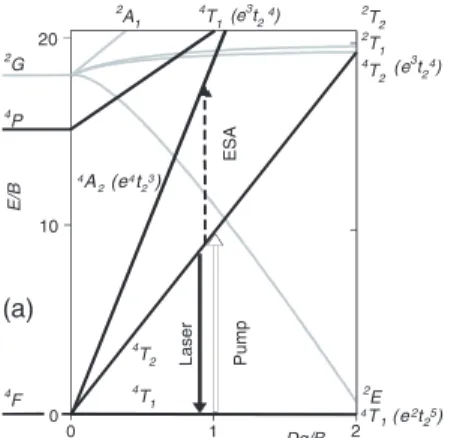
Co2+ ions in octahedral sites have the 3d8 configuration. The free ion term 4F splits into 4T1, 4T2, and 4A2 levels with 4T1 level being the ground state. The absorption bands resulting from the4T
1→4T2transition around 8000 cm−1 and 4T
1 → 4A2 transition around 18000 cm−1 [33] allow pumping with 1.32µm Nd-laser and 514 nm Ar-laser correspondingly (Fig. 4). The large configurational coordinate offset of the upper laser level 4T2 results in the broadband infrared luminescence spectrum (Fig. 5) ranging from 1.5 to over 2.3µm and correspond-ing to the4T2→4A2transition. The unusually broad bandwidth is explained not only by the vibronic nature of the transition, but also by the fact that the ground state is split into six sublevels spread over 1300 cm−1, each having an associated vibronic transition [18,34]. The corresponding zero-phonon lines lie between 1.47 and 1.85µm. As a result, the luminescence spectrum is a sum of the six zero-phonon lines and related sidebands, which can be clearly seen in Fig. 5a. ESA in the4T2 → 4A2and4T2 → 4T1transitions in Co2+:MgF2and Co
2+
:ZnF2 have been found to reduce efficiency in laser operation of these crystals [35]. ESA also effectively decreases the gain cross-section and leads to a large saturation fluence of 100 J/cm2[36].
It is also important to note that the main problem of Co2+: MgF2is the rapid decrease of the upper laser level lifetime with temperature (Fig. 6), which drops
0 1 Dq/B 2 (e3t 24) (e3t 24) 4A 2 (e4t23) 2A 1 4T 2 4T 1 4T 1 2T2 2T 1 4T 2 10 20 0 4F 2G 4P 4T 1 (e2t25) Laser Pump ESA 2E E/B (a)
Figure 4. Tanabe-Sugano diagram for an octahedrally coordinated Co2+ion (3d7configuration).
Free-ion terms are shwn to the left. The excited-state absorption (ESA) transition is spin-allowed and affects the effective cross-sections and laser efficiency [2].
1400 1600 1800 2000 2200
Luminescence (a.u.)
Wavelength (nm)
a) b)
Figure 5. a) Luminescence spectrum of Co2+:MgF2[37] at 77 K and b) the corresponding tuning
curve [38]. 0 50 100 150 200 250 300 0.1 1 Lifeteime (ms) Temperature (K)
from 1.3 msec at 77 K down to 36µsec at 300 K [34]. Similar lifetime behaviour has been reported for KMgF3by Sturge [Sturge73] and is assumed to be caused by the increased rate of non-radiative decay due to multiphonon emission [34]. For this reason all these lasers need liquid-nitrogen cooling to maintain lifetimes in the millisecond range.
The good news is that the thermal conductivity of Co2+:MgF2 of 0.3 W/ (m·K), Mohs hardness of 6, and the negligibly smalldn/d T [21] partially com-pensate the above mentioned deficiencies. This allows pumping at high power levels without deterioration of the output characteristics. Rineset al [36] could generate as much as 6.5 W of average output power in the pulsed regime at 2.05µm with a repetition rate of 9 Hz and a pump energy of 2.7 J. Cryogenically cooled CW Co2+: MgF2laser exhibited high energy conversion efficiency of 31% at 1.3µm, and high output power of 1 W at 1.86µm [39]. Moulton demonstrated more than 4 W of output power in TEM00mode at 1.92µm in CW regime at 15 W of pump power [34]. No indication of output power saturation due to heating effects was observed.
A few years ago, Di Lieto realized a high power broadly tunable Co2+: MgF2 CW laser [38]. Using 12 W Nd:YAG laser at 1.3µm as a pump source, he could achieve up to 3 W output power in TEM00 mode at 1.67µm, and 2 W at 1.77µm. The slope efficiency of 32% compares with the best values reported in other works, and the broad continuous tuning range between 1.6 and 2.1µm (Fig. 5b) makes this laser a practical tool for spectroscopic [38] and solid-state laser pumping purposes [32].
The room-temperature pulsed operation is possible in Co2+-doped lasers at the expense of the higher threshold and lower slope efficiency [21, 35, 36]. However, in this case the active medium should be pumped on a timescale short enough compared to the upper state lifetime of 36µs. In the pulsed regime a Nd:YAlO3 pumped Co2+: MgF2 laser has been tuned over the broad wavelength range bet-ween 1.5 and 2.3µm [34]. This laser has finally matured to the commercially available laser system [21].
Taking into account the rapid developments in cryogenic technique, which we evidence in the recent years, one may expect further developments in Co2+: MgF2lasers. This may lead in the future to the compact user-friendly high power, broadly tunable, and maybe even ultrashort-pulsed lasers in the very interesting wavelength range between 1.6 and 2.3µm.
3.3. Cr2+-DOPED II-VI LASERS
The Cr2+ions reside in II-VI hosts in tetrahedral sites. These sites do not possess inversion symmetry and are characterized by the high oscillator strength (high cross-sections) and short lifetime of typically a few microseconds. The other distinguishing feature of the Cr2+-ions in tetrahedral sites is the relatively low
Figure 7. Tanabe-Sugano (a) and configurational (b) diagrams of the energy level splitting of Cr2+ions in tetrahedral configuration. Only two quintet states,5E and5T2are available for laser transitions. Note the Jahn-Teller splitting of the lower level (two of three branches are shown).
crystal-field splitting, placing optical transitions into infrared. The Cr2+ions in the above crystals have the simplest (similarly to Ti3+ion in sapphire) single electron configuratione2t22. The Two levels (5T2and5E) originate from the crystal-field splitting of the5D ground state of the free-ion with d4 configuration, which is the only quintet state (Fig. 7). Since all the higher lying states are singlets or triplets, the excited state absorption (ESA) transitions from the upper state are spin-forbidden. Altogether this ensures that Cr:ZnSe has the highest gain among all vibronic solid-state lasers and enables efficient broadband room-temperature operation.
As a result, Cr2+-doped II-VI lasers provide access to the 2–4µm wavelength region, exhibit smooth tunability at the highest possible efficiency, Watt-level output powers and narrow spectral linewidth, which are generally inaccessible for semiconductor lasers. One of the crystals of this family, Cr2+:ZnSe, exhib-ited efficient room-temperature diode-pumped continuous-wave and mode-locked operation also in the ceramic form. These lasers are nowadays probably the sim-plest and the most cost effective light sources in this wavelength region [78,90,91]. 3.3.1. Material and spectroscopic properties
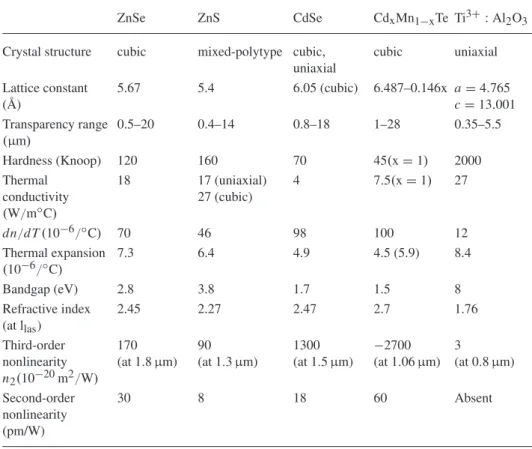
The material and spectroscopic properties of the most important crystalline hosts for Cr2+ ion are summarized in Tables 1 and 2 respectively. Among the listed crystals especially Cr2+:ZnSe and Cr2+:ZnS are distinguished by their remarkable characteristics, combining the ultrabroad bandwidth, the high emission cross-section of the order of 10−18cm2[24], the negligibly low excited state absorption
TABLE 1. Material properties of the Cr2+-doped laser crystals.
ZnSe ZnS CdSe CdxMn1−xTe Ti3+:Al2O3 Crystal structure cubic mixed-polytype cubic,
uniaxial cubic uniaxial Lattice constant ( ˚A) 5.67 5.4 6.05 (cubic) 6.487–0.146x a=4.765 c=13.001 Transparency range (µm) 0.5–20 0.4–14 0.8–18 1–28 0.35–5.5 Hardness (Knoop) 120 160 70 45(x=1) 2000 Thermal conductivity (W/m◦C) 18 17 (uniaxial) 27 (cubic) 4 7.5(x=1) 27 dn/d T(10−6/◦C) 70 46 98 100 12 Thermal expansion (10−6/◦C) 7.3 6.4 4.9 4.5 (5.9) 8.4 Bandgap (eV) 2.8 3.8 1.7 1.5 8 Refractive index (at llas) 2.45 2.27 2.47 2.7 1.76 Third-order nonlinearity n2(10−20m2/W) 170 (at 1.8µm) 90 (at 1.3µm) 1300 (at 1.5µm) −2700 (at 1.06µm) 3 (at 0.8µm) Second-order nonlinearity (pm/W) 30 8 18 60 Absent
(ESA) [42], with the fairly good chemical and mechanical stability and the thermal conductivity approaching that of sapphire. The laser induced damage threshold was measured to be 2.3 GW/cm2in ZnSe (compare with 6 GW/cm2in diamond) [43]. Here it is worth noting that the laser induced damage threshold generally correlates with the bandgap and is therefore the highest in ZnS and the lowest in CdTe [44]. The authors of Ref. [45] showed that the damage threshold irradiance in CdTe, ZnSe and CdS is independent of the focal radius and scales as t−1/2 (where t is the laser pulse duration), which is characteristic of surface damage due to surface contamination. It achieves 1.96 GW/cm2(at 42 ps pulse duration) in CdTe and 14.9 GW/cm2in ZnSe (at 34 ps pulse duration). This is a reasonable value to enable high power laser applications of Cr:ZnSe. The only drawback of Cr:ZnSe and Cr:ZnS materials is the relatively high thermal lensing parameter dn/dT (∼70·10−6K−1in Cr:ZnSe, 46·10−6K−1in ZnS compared to 12·10−6K−1 in sapphire). However, the latter is compensated by the generally low thermal load due to the absence of such parasitic processes as ESA or upconversion.
TABLE 2. Spectroscopic and laser characteristics of Cr2+-doped laser materials. ZnSe ZnS CdSe (pulsed) Cd0.55Mn0.45Te (pulsed) Ti3+: Al2O3 Peak emission cross-sectionσem (10−20cm2) 130 90 [24] 140 75 [24] 200 170 39 [40] 45 [41] λmax lum (nm) 2450 2350 2200 2480 780 Peak absorption cross-sectionσabs (10−20cm2) 110 87 [24] 100 52 [24] 300 170 6.5 λmax abs (nm) 1780 1680 1900 1900 500 τem(µs)at 300 K 5.5 8 [24] 4.3 8 [24] 6 4.8 3 Saturation intensity Isatem(kW/cm2) 11 14 8 10 210 Luminescence bandwidth (nm) 900 800 550 770 300 Relative bandwidth 0.41 0.34 0.25 0.31 0.38 Optical quantum efficiency 1 0.73 1 1 0.9 Slope efficiency (%) 53 71 48 64 35 CW output power (W) 1.8 0.7 – – up tp 10
Output energy (average power) 0.43 mJ (18 W) 0.1 mJ 0.8 mJ 0.6 mJ >1 J >10 W Mode-locked output power (mW) 120 (fs) 400 (ps) 140 – – up to 3000 Pulse duration 80 fs 1 ps – – 5 fs
Diode-pumping yes yes no yes no
The spectroscopic properties of Cr2+(d4) ion in II-VI compounds have been extensively studied since back in the sixties (see e.g., [46–49]) and later in the seventies-eighties (see e.g., [50–56]). The first thorough spectroscopic investigation of Cr2+-doped chalcogenides as laser materials and measurement of absorption and emission cross-sections were carried out in Refs. [23, 24].
The absorption and emission spectra of Cr2+ ion in Cr:ZnSe, Cr:ZnS and Cr:CdSe are depicted in Fig. 8 and Fig. 3 respectively. A broad absorption band centered around ∼1.8µm in Cr:ZnSe, around ∼1.7µm in Cr:ZnS and around 1.9µm in Cd-compounds allows pumping by Tm-doped lasers, which are avail-able as pulsed and continuous-wave sources of over 100 W average power [2] and recently also as fiber lasers with even higher power. The spectroscopy of
Figure 8. Absorption spectra of Cr:ZnS, Cr:ZnSe and Cr:CdSe.
Cr2+-doped II-VI materials has been extensively reviewed in Ref. [58] from the laser point of view. It should be noted here that these media are characterized by high transition cross-section,µs lifetime and relatively low thermal quenching at room temperature, all being the results of inversion symmetry at the Cr2+ site (Table 2). Another important point is the additional broadening of the fluores-cence spectrum due to the large Jahn-Teller splitting of the ground state, reaching 340 cm−1and 300 cm−1in Cr.ZnSe and Cr:ZnS respectively [49].
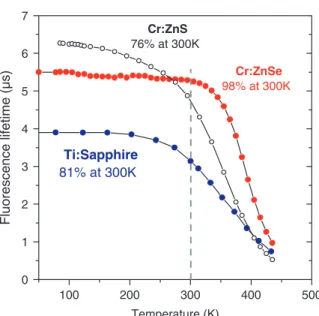
The direct measurement of the emission life-timeτin in Cr2+:ZnSe has been carried out by several authors [51–54]. All of them report Cr2+lifetime in various chalcogenides to be a few microseconds and not quenched up to ∼300 K. The extensive lifetime measurements were carried out in the last years for mainly polycrystalline [59] as well as for single crystalline Cr2+:ZnSe crystals [60]. The latter study report only negligible increase of the lifetime from 5.4µs at 77 K to 5.6µs at 300 K. They also correlate with the similar investigations in Cr2+:CdSe [61] and report concentration quenching of Cr2+ lifetime. In Fig. 9 we provide a direct comparison between the temperature dependent lifetime of Cr:ZnSe and Ti:sapphire. It is interesting to note that whereas the lifetime of Ti:sapphire is somewhat quenched at room temperature, this does not happen to Cr:ZnSe, which has a quantum yield close to unity. The data on lifetime lead to the absorption and emission cross-sections of 1.1×10⁻¹⁸cm2and 1.3×10⁻¹⁸cm2 correspondingly [2, 60]. The strong reabsorption has been reported [60], which might compromise the lifetime. These data should be taken into account when designing the laser based on these crystals.
The spectroscopic investigation in Cr2+:ZnS has been reported in Ref. [62]. Among other II-VI compounds ZnS is distinguished by the largest energy gap of 3.8 eV, the smallest lattice constant and the correspondingly blue shifted fluores-cence peaking around 2.1µm (the corresponding emission cross-section peaking around 2.3µm). As in case of Cr2+:ZnSe the measurements yielded decreased (in comparison to 11µs in Ref. [23]) radiative lifetime of 5µs and correspond-ingly corrected absorption and emission cross sections of ∼1×10⁻¹⁸cm2 and
100 200 300 400 500 0 1 2 3 4 5 6 7 Cr:ZnS 76% at 300K Ti:Sapphire 81% at 300K Cr:ZnSe 98% at 300K Fluorescence lifetime (µs) Temperature (K)
Figure 9. Temperature dependence of the active ion lifetime in Cr:ZnSe, Cr:ZnS and Ti:sapphire.
1.4×10⁻¹⁸cm2 respectively. Cr2+:ZnS, otherwise very similar to Cr2+:ZnSe, is characterized by a more rapid onset of the thermally activated nonradiative decay with temperature (Fig. 9). Relatively to the 77 K lifetime the room-tempera-ture lifetime drops by∼24%. The difference between Cr:ZnSe and Cr:ZnS may be explained by a higher maximum phonon frequency in this crystal (com-pare∼250 cm−1in ZnSe [63] and∼350 cm−1in ZnS [64]). On the positive side there are the lowestdn/dTand the best hardness and the highest damage threshold among the Cr2+-doped media. All this makes Cr:ZnS especially attractive for high power applications.
Cr2+:CdSe [26, 27, 65–67] has a somewhat larger lattice constant than Cr2+:ZnS and Cr2+:ZnSe (Table 1). The Cr2+ emission is therefore shifted by 100–200 nm towards the infrared and spreads out to over 3.5µm. If not rather inferior to Cr2+:ZnS and Cr2+:ZnSe thermo-optical properties, this laser crystal would be a perfect candidate for continuous-wave lasing beyond 3µm. Similarly to Cr2+:ZnSe and due to the same reason, the lifetime of 6µs in Cr2+:CdSe does not change between 60 and 300 K [26]. The peak absorption and emis-sion cross-sections were measured to be 3 × 10⁻¹⁸cm2 and 2 × 10⁻¹⁸cm2 respectively [26].
3.3.2. Broadly tunableCr2+-based lasers
Since the first demonstrations in 1995 at Lawrence Livermore National Lab the laser related research largely focused around Cr2+:ZnSe, Cr2+:ZnS and Cr2+:CdSe lasers. The implemented so far pump sources include: tunable
Co2+:MgF2laser [23, 24, 32], 1.9–2.1µm Tm3+,Ho3+-lasers [30, 42],∼1.6µm Er-fiber lasers [14, 68, 69], 1.8µm Tm:fiber laser [86], ∼1.6µm NaCl:OH color center laser [31], ∼1.6µm Raman-shifted Nd:YAG laser [70], ∼1.6µm Raman-fiber laser [71] as well as 1.6–1.9µm InGaAsP/InP semiconductor lasers [13, 14, 72, 73]. The direct diode-pumping yields the highest wall-plug efficiency. However, for high-power generation a 1.8–1.9µm Tm-fiber laser may be the best choice.
Since the first experimental demonstration the performance of these materials has greatly improved. At the initial stage experiments concentrated on the pulsed regime using a Co:MgF2laser at 1.86µm as a pump source. Using the grating in the Littrow configuration tunability over 2150–2800 nm was achieved. However, the laser emitted a relatively broad linewidth of∼40 nm. Later these results were improved and 45% slope efficiency was demonstrated in Ref. [74]. The first diode-pumping in the pulsed mode was demonstrated in Ref. [75].
Cr:ZnSe material is also suitable for power scaling. The lifetime quenching does not exceed 25% up to the concentration levels of 1×1019cm−3 [60], cor-responding to>10 cm−1peak absorption coefficient, a typical figure for Yb:YAG thin disk lasers. In the pulsed mode, Schepler et. al. have demonstrated in the thin disk configuration 4.2 W of output power at 10 kHz repetion rate [67, 76]. The laser yielded up to 1.4 W in continuous-wave mode. The pump wavelength of 1.89µm required relatively thick samples for good absorption. An optimized Cr:ZnSe thin disk laser design with reduced disk thickness and proper pump wave-length should be able to produce much higher output power in a good transversal mode. In a classical pumping arrangement Alford et al further scaled the output power in the pulsed regime up to 18.5 W at 30 W absorbed power pumped by the Q-switched Tm:YAlO3 laser at 7 kHz repetition rate (Fig. 10). Slope efficiency
of 65% (59% optical-to-optical efficiency) has been demonstrated [77]. In this experiment tunability between 2.1 and 2.85µm was achieved at up to 10 W output power. Based on the analysis of the mechanical, thermal, spectroscopic, and laser properties of Cr:ZnSe, the output powers over 10 W in CW regime and several Watts in the mode-locked or amplifier regime can be anticipated.
To this point the following record parameters were demonstrated from this laser: 1) the output power up to 18.5 W in gain-switched regime [77]; 2) the output power up to 1.8 W in a polarized TEM00 mode [78]; 3) the highest efficiency exceeding 70% in the pulsed mode [79]; 4) the broadest tuning bandwidth of 1100 nm between 2000 and 3100 nm in CW regime from the conventional res-onator (see Fig. 4 in Chapter III.5 of this book) and the bandwidth of 1300 nm between 1800 and 3100 nm in the intracavity pumping arrangement [80]; 5) narrow-linewidth 600 MHz operation without any intracavity etalons [58] as well as single longitudinal mode operation with 20 MHz linewidth, using intracavity etalons [81]; 6) 350 nm tuning range at 65 mW output power in the diode-pumped regime [13] (450 nm in Cr:ZnS [14]); 7) parametrical conversion of 2.5µm radiation of Cr :ZnSe to 4–4.85µm [82], and 8), the active [83, 84] and passive-mode-locking [15, 16, 85] with pulses as short as 4 ps at 400 mW of output power, and 80 fs at 80 mW, in active and passive mode-locking regimes, respectively.
The most impressive results have been obtained so far using the Cr2+:ZnSe crystals. The Cr2+:ZnS crystal was less studied as a laser material due to the lack of good optical quality single crystals. Having similar spectroscopic properties to Cr:ZnSe, Cr:ZnS is known to have a larger bandgap, better hardness, a higher thermal shock parameter (7.1 and 5.3 W/m1/2 in Cr:ZnS and Cr:ZnSe, respec-tively [23]), and the lowerdn/d T than in Cr:ZnSe (Table 1). At the same time, the temperature quenching of the Cr:ZnS lifetime starts at lower temperatures, than in Cr:ZnSe (Fig. 9), which might be a serious disadvantage, especially in CW applications. With proper cooling, however, the power handling capability of this material should be on par or better than that of Cr:ZnSe, making Cr:ZnS attractive for high-power applications. Our experiments with equally doped Cr:ZnS and Cr:ZnSe (e.g. with the same thermal load per unit length) showed, that Cr:ZnS performed at least as good as Cr:ZnSe. The pulsed laser operation of Cr:ZnS laser has been first reported in [23, 24, 87]. The spectroscopic study and the first contin-uous wave operation was reported in [88]. Using Er-fiber pumping up to 700 mW room temperature tunable over 700 nm (between 2.1–2.8µm) CW operation was demonstrated [14]. Tuning over 400 nm between 2250–2650 nm in the directly diode-pumped configuration [14] as well as an Er-fiber pumped CW microchip laser at 2320 nm were recently demonstrated [69]. An advantage of Cr:ZnS is the shift of the absorption peak by about 100 nm to the blue (Fig. 8), allowing a convenient pumping of this material with available 1.6-µm telecommunications diodes [14].
Another important issue is extending the operation range of the Cr2+-doped lasers, especially beyond 3-µm wavelength. This could be obtained by using other II-VI compounds with a larger lattice constant and hence lower crystalline field (see Fig. 7a). For example, hosts like CdSe [26, 27], CdTe [89], and CdMnTe [28, 29] also allow room temperature operation with Cr2+ ion. Tuning up to the record 3.4µm in the pulsed regime was demonstrated in Cr:CdSe [66]. It makes sense to consider other mixed ternary and quaternary compounds that would pro-vide both a control over the central wavelength and the additional inhomogeneous broadening of the spectrum, as it will be shown in the next section.
Finally, maybe one of the most interesting advantages of these materials is the availability of the technologically developed and low cost polycrystalline material. The existing technologies of producing ceramic ZnSe, such as a chemical vapour deposition (CVD) method or the hot-press method of powders, result in high opti-cal quality low-cost substrates of arbitrary size. Many of the above reported results were obtained with ceramic active media, which allow also directly diode-pumped CW tunable and actively mode-locked operation [90, 91]. With proper optimiza-tion, a directly diode-pumped femtosecond ceramic laser could be created. This would be a most practical source of few-cycle light pulses.
3.3.3. Ultrashort-pulsedCr2+:ZnSe andCr2+:ZnS lasers
Direct femtosecond laser sources, producing only few optical cycle pulses in the mid-IR range between 2 and 3µm, are highly important for such applica-tions as nano- and micro-structuring in semiconductors (e.g. for fabrication of Si-photonic structures), wavelength conversion towards shorter (X-ray), as well as longer (up to THz) wavelength ranges, time-resolved spectroscopy, trace-gas sensing, as well as for continuum generation in the mid-IR. Such pulses in the mid-infrared spectral region can be used as unique diagnostic tools for investi-gation of numerous transient processes on the femtosecond scale. The broadly tunable ultrashort pulsed lasers in this wavelength range are also attractive for such applications as optical coherence tomography, ophthalmology, and dermatology in medicine. They can be also be used for pumping mid-IR OPOs to produce even longer wavelengths [82, 92]. Nowadays, femtosecond pulses in this wavelength range are being produced by multi-stage parametric frequency converters based on Ti:sapphire laser, which are rather bulk and inefficient in comparison to the directly diode-pumped Cr:chalcogenide lasers, emitting in this wavelength region. In the last few years picosecond mode-locking, both active and passive, has been achieved in Cr2+:ZnSe [83–85, 93] and Cr2+:ZnS laser [94]. The first works used an acousto-optic modulator to mode-lock the laser with the shortest pulses being 4 ps [83, 84] at up to 400 mW output power. Later, the first semiconduc-tor saturable absorber (SESAM) mode-locked Cr2+:ZnSe laser generating 11 ps pulses at 2.5µm at 400 mW output power was demonstrated [85]. The pulse
Figure 11. Chirped mirrors for the Cr:ZnSe laser.
duration was presumed to be limited by some intrinsic limitation like an etalon. For some time the reported pulse durations were in the picosecond range. To overcome a picosecond barrier in Cr2+lasers became therefore a highly desirable, but also a very challenging task.
Recently we could finally identify the physical cause of this picosecond barrier, which was due to the water absorption lines in the resonator around 2.5µm. As a result, we could report the first femtosecond Cr:ZnSe laser, pas-sively mode-locked by an InAs/GaSb SESAM and generating 106 fs pulses at up to 75 mW power around 2.5µm wavelength [15]. Later, optimization of the dis-persion compensation schemes with the use of chirped mirrors (Fig. 11) allowed to demonstrate for the first time a chirped-mirror controlled femtosecond laser oscillator (Fig. 12), generating the shortest reported so far 80 fs pulses (10 optical cycles) at 80 mW output power (Fig. 13). Dispersion compensation by chirped mirrors is a very challenging task in the mid-IR due to the necessity to design and fabricate especially thick multilayer mirrors. This causes additional absorp-tion losses at large penetraabsorp-tion depth at the long-wavelength side, as evidenced by Fig. 11. Solving this technological problem would allow generation of even broader spectra with corresponding pulse shortening.
Finally we should note that Cr:ZnSe is capable of power-scaling and produc-ing up to 1µJ pulses directly from the oscillator. In Ref. [95] the analytic theory of a chirped pulsed oscillator (CPO) mode-locked by SESAM and operating in the
Cr2+:ZnSe SESAM on heatsink OC 2-6% YAG Er:fiber λ=1.61 µm R=50 R=75 R=100 f=40 CM CM CM
Figure 12. Schematic diagram of a femtosecond Cr:ZnSe laser. The pump at 1.61µm and the
output radiation are polarized in the plane of the figure. OC, output coupler. CM, chirped mirror.
2300 2400 2500 2600 Round-trip GDD (fs 2) Spectral intensity Wavelength (nm) −2000 −1000 0 4 mm ZnSe 3.1 mm YAG 4x CM −200 −100 0 100 200 0 2 4 6 8 FWHM 137 fs Pulse FWHM 81 fs (Gaussian)
SHG intensity (rel. units)
Time delay (fs)
Figure 13. Autocorrelation trace, spectrum and round-trip GDD for a Cr:ZnSe laser using a
combination of chirped mirrors and the thin YAG plate for dispersion compensation.
positive dispersion regime was developed. Application of the developed theory to the analysis of the Cr-chalcogenides CPOs demonstrated their high potential to generateµJ-level sub-100 fs pulses at 2.5µm. The most promising candidates are Cr:ZnS and Cr:ZnSe, which could potentially even outperform Ti:Sapphire CPO in terms of achievable pulse energy.
3.3.4. Engineering of the new Cr-doped II-VI laser media.
The crystal field engineering of Cr-doped II-VI materials proved to be successful in several cases. The central frequency of the vibronic transition is defined by the crystal-field splitting. In case of Cr2+, the splitting is proportional to the crystal field parameterDq/B, which inversely scales with the unit cell size:
λ0=c/ν0∝(Dq/B)−1∝a0 (5) wherea0is the unit cell size. For example, changing the unit cell size froma0 = 5.4 ˚A in Cr:ZnS througha0=5.67 ˚A in Cr:ZnSe toa0 =6.05 ˚A in Cr:CdSe one decreases the crystal field splitting correspondingly. This shifts the absorption and emission wavelengths gradually towards longer wavelengths (Fig. 3 and Fig. 8).
This is an example of simple crystal field engineering with binary AI IBV I compounds. The more complex methods involve design of the laser media based
on ternary compounds (AI IBI I)CV I like, e.g. Cr2+:CdxMn1−x Te compounds. These represent an interesting alternative to selenide or sulfide laser materials [28, 29, 89, 96–99].
Besides the fluorescence wavelength shift, the chemical composition would also affect the bandgap (in CdxMn1−x Te, it can be increased from 1.44 eV to 2.3 eV by varyingx between 1 and 0.55). The only disadvantage, preventing their use in continuous-wave lasers, remains the relatively poor thermal properties of these crystals (Table 1). The radiative lifetimes in Cr2+:CdxMn1−xTe compounds vary between 3.2 and 4.5µs depending upon the crystal composition [100]. Rela-tively to the 77 K lifetimes the room-temperature lifetimes are quenched by∼35% in Cr2+:CdTe, and by∼62% in Cr2+:Cd0.85Mn0.15Te [100]. In the latter crystal the absorption and emission cross-section were measured to be 1.4×10⁻¹⁸cm2and 1.3×10⁻¹⁸cm2respectively [97]. These values are close to those in Cr2+:ZnSe and Cr2+:ZnS.
Another incentive to engineer these materials is that it is easier to grow them in comparison to selenides [100]. Free-running operation of the pure Cr2+:CdTe, has been reported in [89]. The laser delivered 132µJ at 2 Hz repetition rate, when pumped by 1.4 mJ from a Cr,Tm,Ho:YAG laser at 2.09µm. In Cd0.85Mn0.15Te tuning has been accomplished by using a quartz birefringent filtre and extended from 2.3 to 2.6µm [96], as well as by a grating in a Littrow configuration and extended between 2.17 and 3.01µm [99]. Output energies as high as 0.6 mJ could be achieved at absorbed pump energy of∼1.6 mJ. The first CW and direct diode-pumped operation was demonstrated as well [72], however, at the expense of the output power, which in CW regime did not exceed 6 mW (15 mW in the pulsed regime).
In a similar way more recently Cr2+:CdxZn1−xTe has been developed. The laser operated at room-temperature in continuous-wave regime. However, the out-put power was limited to only a few mW due to the poor thermal conductivity and strong thermal lensing in this material like in the case of CdMnTe [101].
The third way to make a mixed compound is to create a ternary system AI I(BV ICV I), like e.g. Cr:ZnSxSe1−x [102]. There is an important difference to the previous case: since Cr2+ substitutes an AII ion, mixing of the BVICVI ions occurs in the immediate neighbourhood of the chromium ion. Opposite to Cr:CdMnTe, where changing of the lattice parameter merely shifts the emission spectrum towards longer wavelength, in the latter case the crystal field experi-enced by the Cr2+ion should be strongly affected by mixing and one may expect a large inhomogeneous broadening. Undoped solid solutions of ZnSxSe1−x[103] are used as substrates for epitaxial growth of blue-emitting diodes, as well as active media for e-beam longitudinally pumped lasers. In our work, we realized diffusion doping of this crystal grown by seeded chemical vapor transport. Based on the Raman and infrared absorption spectra we determined the content of ZnS to be 42% (crystal composition ZnS0.42Se0.58).
The results of the absorption and room-temperature luminescence measure-ments are given in Fig. 14 and summarized in Table 3. As seen in Fig. 1, the high-quality absorption due to predominantly Cr2+ ions could be obtained in this crystal with peak absorption coefficient of 9.5 cm−1 the maximum around 1.69µm. The room-temperature lifetime was measured to be 3.7µs, which is close to the corresponding value measured in concentrated Cr2+:ZnS and
Figure 14. Comparison of the absorption (upper graph) and fluorescence (lower graph) spectra
of Cr:ZnSe, Cr:ZnS, and Cr:ZnSSe [104]. The emission spectra are corrected for the detector and spectrometer response.
TABLE 3. Main spectroscopical data of Cr:ZnSSe in comparison with Cr:ZnSe and Cr:ZnS [104]. Cr:ZnS Cr:ZnSSe Cr:ZnSe Absorption peak (nm) 1695 1696 1770 Absorption width (nm) 350 400 355 Gain peak (nm) 2315 2410 2400 Gain bandwidth (nm) 800 930 850 Lifetime at 300 K(µs) 4.3 3.7 4.8
2200 2400 2600 2800 Cr:ZnSSe
Cr:ZnSe
Output power (rel.u.)
Wavelength, nm 90 95 100 Transmission, % Air 0 100 200 300 0 10 20 30 40 50 Cr:ZnSSe, pump 1.67 µm OC2%, slope eff.16% OC4%, slope eff.24%
Output power (mW)
Absorbed pump power (mW)
a) b)
Figure 15. Output characteristics (a) and tuning (b) of the Cr:ZnSSe laser. For comparison, tuning
curve of the ceramic Cr:ZnSe is given [105]
Cr2+:ZnSe, as are the corresponding values for absorption and emission cross sections. However, emission bandwidth is noticeably broader than in Cr:ZnS or Cr:ZnSe and is peaked at the same wavelength as in Cr:ZnSe (Fig. 14).
Thus, Cr2+:ZnSSe represents an interesting alternative to pure selenides and sulphides. The only disadvantage may be the higher maximum phonon frequency in this crystal (compare ∼350 cm−1 in ZnS
0.42Se0.58 [104] with ∼250 cm−1 in ZnSe). Similar to Cr2+:ZnS, this leads to the more rapid onset of nonradiative decay in this crystal relative to Cr2+:ZnSe. At room temperature, the quantum yield is about 76%.
In the laser experiments, we used a 1-mm thick polished plate of poly-crystalline Cr:ZnS0.42Se0.58 in the conventional three-mirror configuration (as in Ref. [14]). Without additional cooling, the laser operated at room temperature in continuous-wave regime, producing ∼30 mW of output power at 3% output coupling with 170-mW threshold pump power.
These results could be further improved using the Co:MgF2laser at 1.67µm. The laser output characteristics are given in Fig. 15a. The threshold was measured to be less than 80 mW of absorbed power at 2% output coupling. For compari-son, in the similar cavity, Cr:ZnS exhibits 210 mW and Cr:ZnSe few tens of mW threshold. Without additional cooling, the laser operated at room temperature in continuous-wave regime around 2480 nm, producing ∼50 mW of output power with 4% output coupling at 600 mW of incident pump power, and 24% slope efficiency.
Using a dry fused silica Brewster prism as a tuning element, we were able to demonstrate tunability over ∼560 nm: from 2099 to 2658 nm (Fig. 15b). In order to provide a fair comparison, a tuning curve of the polycrystalline Cr:ZnSe sample of comparable quality in similar conditions is given. The tuning range of Cr:ZnS0.42Se0.58significantly exceeds that of the Cr:ZnSe on the short wavelength side. The long wavelength cutoff for both samples was due to the water vapor absorption in the cavity, as shown by the air transmission curve.
Summarizing, Cr:ZnS0.42Se0.58represents an interesting alternative to Cr:ZnS and Cr:ZnSe, when having the largest possible emission bandwidth is an issue. However, more work has to be done in order to achieve the same high optical quality as in Cr:ZnSe crystals.
3.3.5. Nanocrystalline Cr2+:ZnSe and Cr2+:ZnS powder lasers
As already discussed, the Cr2+-doped laser materials are characterized by high gain and an intrinsically low lasing threshold, as well as by such remarkable spectroscopic features as the absence of excited state absorption and high quantum yield. The active media can be obtained by diffusion doping of metallic chromium into the ceramic ZnSe. Along with several other techniques of producing ceramic ZnSe, the latter is often obtained by hot-pressing the micro- and nanocrystalline ZnSe powder. A somewhat odd (but not without good reason) question arises as to whether it would be possible to get laser action from Cr2+:ZnSe or any other Cr2+-doped II-VI compound in the powder form?
Indeed, random powder lasers is a hot topic in the modern photonics research. For extensive reviews on this subject the reader is referred to Refs. [106–108]. This type of laser has been extensively studied since the first proposal in 1966 by Ambartsumyanet .al.[109] of lasers with nonresonant feedback, and demon-strated in ZnO by Nikitenko et. al.[110] and in Nd3+:LaMoO4 by Markushev et. al.[111]. During the last decade, a great variety of random powder lasers has been developed, all of them emitting in the UV to near infrared wavelength range. Recently, we reported the first eye-safe midinfrared ion-doped semiconductor random lasers based on Cr2+:ZnSe [112] and Cr2+:ZnS [113] powders operating around 2.4µm and 2.3µm, respectively. The experimental details can be found in Ref. [78]
At pump energy flux comparable to the absorption saturation flux Jsat of bulk Cr:ZnSe and Cr:ZnS (i.e. between 0.3Jsat-0.3Jsat)we observe the dramatic shortening of the emission lifetime (Fig. 16a), the threshold-like behavior of the emission intensity (Fig. 16b), and the radical narrowing of the emission spec-trum at gain peak (Fig. 17). The maxima of the narrowed spectra at 2400 nm and 2300 nm correspond to the gain maxima of both crystals and are shifted by 100 nm from each other. Threshold pump energy density as low as∼20 mJ/cm2could be observed in Cr:ZnSe and a factor of 1.5 higher in Cr:ZnS, which corresponds to the higher threshold of Cr:ZnS in the bulk form [14]. An interesting feature of this new class of midinfrared random lasers is a remarkably low threshold. In fact, the threshold pump intensities in the powder and bulk samples are comparably low (4–6 kW/cm2in powder vs. 3–4 kW/cm2in bulk samples), and significantly lower than in such undoped semiconductor random lasers like ZnO, where the threshold pump intensityIthis∼80 MW/cm2[114]. This makes the Cr2+-doped random lasers very attractive for real-world applications.
0.0 0.2 0.4 0.6 0.8 1.0 1.2 1.4 Cr:ZnSe (high loss, small grain) Cr:ZnSe (high loss, largegrain) Cr:ZnS Cr:ZnSe (low-loss)
Emission intensity (rel.units)
Incident pump energy (mJ) 0.1 1 10 0.0 0.2 0.4 0.6 J/Jsat Decay time (µs) 0.0 0.1 0.2 0.3 Pump energy (mJ) a) b)
Figure 16. a) Decay time dependence on pump energy in the Cr2+:ZnSe powder (excitation
wavelength 1780 nm, pump spot diameter 0.7 mm). b) Emission intensity vs. pump energy for Cr2+:ZnSe and Cr2+:ZnS (excitation wavelength 1780 nm, pump spot diameter 1.1 mm) [113].
Figure 17. Emission spectra of the Cr2+:ZnSe powder (upper graph) and Cr2+:ZnS powder (lower
Finally, it should be noted that the stimulated emission in Cr2+:ZnSe and Cr2+:ZnS powders is eye safe and eye safe-pumped. This opens a broad range of applications of mid-infrared random nanolasers in aero- and space technolo-gies, for marking and identification, search and rescue, etc. The demonstrated extremely low laser threshold in both lasers renders continuous wave operation in these powder materials feasible.
A few years ago, a sensitization of induced radiation in these crystals in the presence of charge transfer processes [13, 58] has been observed, allowing to pump the upper laser level of Cr2+through the charge transfer mechanism. This phenomenon served as the first milestone on the way towards electrically pumped active-ion doped nanocrystalline ZnSe lasers. The following investigations by other authors confirmed this mechanism as described below and in the Chapter II.4 of this book.
3.3.6. On the way towards electrical pumping and opto-optical switching An important feature, distinguishing the Cr2+-doped materials from all the other solid-state lasers combines the properties of semiconductors with that of the traditionally used in solid-state lasers dielectric materials. As a result, Cr2+-doped materials possess the excellent laser properties along with the inter-esting physics as well as optical and nonlinear properties, distinguishing them from the traditionally used dielectric laser media. This opens up an exciting white field of research and new opportunities for the use of these materials in laser- and nonlinear-optical applications, as well as for direct electrical pumping. Here we only briefly touch this topic. For more details on the subject the reader is referred to the following Chapter II.4.
Because of the semiconductor nature of II-VI compounds the charge transfer processes play an important role in these materials. For the first time they were studied in application to the Cr2+-doped lasers in Ref. [115]. In this work it was demonstrated that the lasing of Cr2+-ions can be achieved by pumping through the charge transfer channels. In the following works other authors observed this phenomenon as well [116,117]. Observation of the manifestation of charge trans-fer processes in Cr2+-doped lasers and their understanding was an important milestone, because these processes paved the route to electrical pumping.
Let us summarize the most important features of these materials, which distinguish them from other oxide and fluoride laser crystals:
1. Noncentrosymmetric tetrahedral sites for Cr2+ions. This leads to the partially allowed electric-dipole transitions and large absorption and emission cross-sections(∼10−18cm2).
2. Covalent rather than ionic type of bonding leads to the fact that intraionic laser processes are not purely “intracentral” in these materials, which results in high probability of charge-transfer processes and explains multiple
valency of transition-metal ions, especially in highly concentrated samples (∼1019cm−3), as required for diode-pumping;
3. Semiconductor nature of the crystals implies that charge-transfer processes generate free carriers leading to photorefractive phenomena; it also leads to the high second- and third-order nonlinearity of the host crystal;
Indeed, the tetrahedral sites provide lower crystal-field stabilization of the ions than the octahedral sites [118]. Covalent bonding plays larger role in the tetra-hedral sites, causing the frequently observed multiple valence states of the transition-metal ions in these sites and the high probability of charge-transfer processes. Whereas in octahedral sites internal e ↔ t2 transitions do not sig-nificantly redistribute the charge around the active ion (i.e., both the initial and the final one-electron wave functions are almost equally localized around the impurity, hence the term “internal” transitions), in covalent tetrahedral sites such excitations can redistribute the charge from impurity-centered orbitals (i.e. essen-tially purelyd-likeestates) to ligand-centered orbitals (i.e., the p-dhybridizedt2 states) [119,120]. They are, therefore, not really “internal” transitions. All this is especially true for tetrahedrally coordinated Cr2+ions in II–VI compounds.
As it has been recently shown, the charge transfer processes in some cases may affect the laser performance of Cr:ZnSe and Cr:ZnS lasers with the active ions in tetrahedral sites [13, 14, 115]. In both these lasers we observed a novel effect of sensitization (modulation) of the induced radiation around 2.5µm with only a few milliwatt of the visible and near-infared radiation (470–770 nm). The reported phenomenon is of the photorefractive nature and involves charge trans-fer to Cr ions, similar to the mechanism of photorefraction, which takes place in other transition-metal doped chalcogenides. Typical examples are chromium doped GaAs [121], vanadium-doped CdMnTe [122,123] or CdTe[124]. The de-tails of the experiment on the sensitization of induced radiation can be found in Refs. [13, 14, 58]).
Discussing the mechanisms of the observed phenomenon, we notice that it is of photorefractive nature and involves charge transfer to Cr ions [58]. Under the visible excitation, two relevant types of charge-transfer processes are known to occur, described by the following formulas:
Cr2++hν→Cr1++hVB, (6) Cr1++hν→ [Cr2+]∗+eCB, (7) where hVB and eCB denote a hole in the valence band (VB) and an electron in the conduction band (CB), respectively. The two-step electronic transitions of a free carrier from the valence band to the conduction band were observed at high concentration of chromium (1.0 ·1019cm−3) [125,126]. The positions of Cr1+ and Cr2+ states in Cr:ZnSe are 1.24 and 2.26 eV beneath the conduction band edge respectively [125]. The 532 nm and 633 nm wavelengths coincide well
with the rather broad charge transfer band, having a maximum just beneath the fundamental absorption edge around∼2 eV. The process (6) reduces the number of active Cr2+ions, causing a drop in efficiency and an increase of the threshold. In the process (7), Cr1+ ions release an electron to the CB under excitation with shorter than∼1µm wavelength, resulting in an excited state[Cr2+]∗. The process (7) [125,127] increases the number of active ions and counteracts the process (1). This last process can be used for electrical pumping in the properly optimized crystal. The link between the ionization transition of Cr1+ and Cr2+ ions and the 2.4µm infrared emission of Cr2+has been earlier discussed by other authors [128], as well as in Chapter II.4 (see references therein).
Summarizing, the described effect of sensitization of induced radiation can be used for both, electrical pumping of Cr2+-laser, and for opto-optical switching. Indeed, the “zero-to-one” switching was realized in Cr:ZnSe laser by switching on and off the probe beam, whereas the laser changed its condition from the state with “no lasing” to the state with laser operation. This was a proof-of-principle demonstration of using a diode-pumped solid-state laser as an alternative type of switching device.
4. Conclusion and outlook
Summarizing, Cr2+-doped lasers have come of age and already entered several real-world applications, such as gas analysis, ultrasensitive spectroscopy, and quantum optics. They can be diode-pumped and operate in various regimes. The wavelength coverage reached 3.1µm (CW) and 3.5µm (pulsed) at room temperature, with output powers ∼2 W (CW) and ∼20 W (pulsed), 400 mW (mode-locked) at sub-ps pulse durations. Crystal field engineering allows ex-tension of operation wavelength and bandwidth (Cr:CdMnTe, Cr:CdZnTe and Cr:ZnSSe).
Passive mode-locking of Cr:ZnSe using InAs/GaSb SESAM generated down to 80 fs pulses at 80 mW at 2450 nm, which corresponds to only ten oscillations of electric field!
Maybe one of the most exciting developments in Cr2+-doped lasers recently was the demonstration of the first Cr:ZnSe random nanolaser, based on nanometer (down to 200 nm) sized Cr2+:ZnSe powder emitting around 2.4µm. Potentially the semiconductor particle size can be decreased down to<10 nm (less than the Bohr radius of the exciton in ZnSe), allowing to deliberately engineer spectral properties of the material. This opens way to the new class of nanophotonic solid-state lasers. One of the strongest incentives to investigate the proposed type of nanolasers is their potential for mass-scale production in the same way as diode-lasers are produced. Indeed, the Cr2+doped nanoparticles can be incorporated in various hosts, including fibers, waveguides, multiple quantum wells, etc.
Looking into the future one can envisage broadband tunable and high-power Cr:ZnSe based nanocrystalline doped fiber lasers, operating in the very inter-esting for remote sensing and trace gas sensing applications wavelength region around 2.5µm. Development of such a laser, which would be complementary to the existing Tm-fiber laser at 1.9µm, will be a leap forward in the fiber laser technology.
5. Acknowledgements
It is my pleasure to thank Tim Carrig, Vladimir Kalashnikov, Nikolai Kuleshov, Vladimir Levchenko, Mikhail Noginov, Victor Shcherbitsky, and Evgeni Sorokin for the invaluable contribution and useful discussions all through the work on Cr2+-lasers. I would also like to acknowledge support from the Austrian Nation Science Foundation (FWF)-Research Grant P17973-N08.
References
1. J. Faist, private communication.
2. I. T. Sorokina, Crystalline Mid-Infrared Lasers, in Solid-State Mid-Infrared Laser Sources, Topics Appl. Phys. 79 (Springer, Berlin, 2003) pp. 255–350.
3. P. Albers, E. Stark, G. Huber, Continuous-wave laser operation and quantum efficiency of titanium-doped sapphire, JOSAB,3, 134–139 (1986).
4. P. F. Moulton, Spectroscopic and laser characteristics of Ti:Al2O3, J. Opt. Soc. Am. B ,3, 125–133 (1986).
5. D. Spence, P. Kean and W. Sibbett, 60-fsec pulse generation from a self-mode-locked Ti:sapphire laser, Opt. Lett.16, 41 (1991).
6. M. Piche, Beam reshaping and self-mode-locking in nonlinear laser resonators, Optics Commun.86, 156–160 (1991).
7. Ch. Spielmann, P. F. Curley, T. Brabec, F. Krausz, Ultrabroadband femtosecond lasers, IEEE JQE30, 1100–1114 (1994).
8. Y. Chen, F. X. K¨artner, U. Morgner, S. H. Cho, H. A. Haus, E. P. Ippen, J. G. Fujimoto, J. Opt. Soc. Am B16, 1999–2004 (1999).
9. R. Mellish, N. P. Barry, S. C. W. Hyde, R. Jones, P. M. W. French, C. J. Van der Poel, and A. Valster, Diode-pumped Cr:LiSAF all-solid-state femtosecond oscillator and regenerative amplifier, Opt. Lett.20, 2312–2314 (1995).
10. I. T. Sorokina, E. Sorokin, E. Wintner, A. Cassanho, H. P. Jenssen, M. Noginov, Efficient continuous-wave TEM00 and femtosecond Kerr-lens mode-locked Cr:LiSrGaF laser, Opt. Lett., 21, 204–206 (1996).
11. V. P. Yanovsky, F. W. Wise, A. Cassanho, H. P. Jenssen, Femtosecond diode-pumped Cr:LiSGAF lasers, IEEE J. Quantum Electron., 2, 465 (1996).
12. I. T. Sorokina, S. Naumov, E. Sorokin, E. Wintner, and A. V. Shestakov, Directly diode-pumped tunable continuous-wave room-temperature Cr4+:YAG laser, Opt. Lett., 24, 1578–1580 (1999).
13. E. Sorokin, I. T. Sorokina, Tunable diode-pumped continuous-wave Cr2+:ZnSe laser, Appl. Phys. Lett.80, 3289–3291 (2002).
14. I.T. Sorokina, E. Sorokin, S. Mirov, V. Fedorov, V. Badikov, V. Panyutin, K. Schaffers, “Broadly tunable compact continuous-wave Cr2+:ZnS laser”, Opt. Lett.27, 140–142 (2002). 15. I. T. Sorokina, E. Sorokin, T. Carrig, “Femtosecond pulse generation from a SESAM
mode-locked Cr:ZnSe laser”, CLEO/QELS’2006 Technical Digest on CD, paper CMQ2 (2006). 16. I. T. Sorokina, E. Sorokin, “Chirped-Mirror Dispersion Controlled Femtosecond Cr:ZnSe
Laser”, paper WA7 at Advanced Solid-State Photonics 2007, Vancouver, Jan.28–Feb.1, 2007. 17. T.Brabec, F. Krausz, “Intense few-cycle laser fields: Frontiers of nonlinear optics”, Rev. Mod.
Phys.72, 545–591 (2000).
18. L. F. Johnson, R. E. Dietz, and H. J. Guggenheim, Spontaneous and stimulated emission from Co2+ions in MgF2and ZnF2, Appl. Phys. Lett.,5, 21–22 (1964).
19. P. F. Moulton and A. Mooradian, Broadly tunable CW operation of Ni:MgF2and Co:MgF2 lasers, Appl. Phys. Lett.,35, 838–840 (1971).
20. P. F. Moulton, A. Mooradian, and T. B. Reed, Efficient CW optically pumped Ni:MgF2laser, Opt. Lett.,3, 164–166 (1978).
21. D. Welford and P. F. Moulton, “Room-temperature operation of a Co:MgF2laser”, Opt. Lett.,
13, 975–977 (1988).
22. B. C. Johnson, P. F. Moulton, A. Mooradian, “Mode-locked operation of Co:MgF2 and Ni:MgF2lasers”, Opt. Lett.10, 116 (1984).
23. R. H. Page, L. D. DeLoach, G. D. Wilke, S. A. Payne, R. J. beach, W. F. Krupke, “Cr2+-doped II-VI crystals: new widely tunable, room-temperature mid-IR lasers, Lasers and Electro-Optics Society Annual Meeting, 1995, 8th Annual Meeting Conference Proceedings, Vol.1, IEEE, 449–450 (1995).
24. L.D. DeLoach, R.H. Page, G.D. Wilke, S.A. Payne, and W.P. Krupke, Transition metal-doped zinc chalcogenides: spectroscopy and laser demonstration of a new class of gain media, IEEE J. Quantum Electron.,32, 885–895 (1996).
25. R.H. Page, K.I. Schaffers, L.D. DeLoach, G.D. Wilke, F.D. Patel, J.B. Tassano, S.A. Payne, W.F. Krupke, K.-T. Chen, and A. Burger, Cr2+-doped zinc chalcogenides as efficient, widely tunable mid-infrared lasers, IEEE J. Quantum Electron.,33, 609–619 (1997).
26. K. L. Schepler, S. Kueck, L. Shiozawa, Cr2+ emission spectroscopy in CdSe, Journal of Luminescence,72–74, 116–17 (1997).
27. J. McKay, K. L. Schepler, G. C. Catella, Efficient grating-tuned mid-infrared Cr2+:CdSe laser, Optics Letters,24, 1575–1577 (1999).
28. U. H¨ommerich, X. Wu, V. R. Davis, S. B. Trivedi, K. Grasze, R. J. Chen, and S. W. Kutcher, Demonstration of room-temperature laser action at 2.5µm from Cr2+:Cd0.85Mn015Te, Optics Letters,22, 1180–1182 (1997).
29. S. B. Trivedi, K. Grasze, R. J. Chen, S. W. Kutcher, U. H¨ommerich, X. Wu, Jae Tae Seo, Chromium doped cadmium manganese telluride: a novel solid-gain media for mid-infrared lasers, Physics of Semiconductor Devices,2, 762–767 (1998).
30. G. J. Wagner, T. J. Carrig, R. H. Page, K. I. Schaffers, J. Ndap, X. Ma, and A. Burger, Continuous-wave broadly tunable Cr2+:ZnSe laser, Opt. Lett.,24, 19–21 (1999).
31. A. Sennaroglu, A. Ozgun Konza, and C. R. Pollock, “Continuous-wave power performance of a 2.47-µm Cr2+:ZnSe laser: experiment and modelling”, IEEE J. Quantum Electron.,36, 1199–1205 (2000).
32. I.T. Sorokina, E. Sorokin, A. Di Lieto, M. Tonelli; R. H. Page, K. I. Schaffers, Efficient broadly tunable continuous-wave Cr2+:ZnSe laser, JOSA B,18, pp.926–930 (2001).
33. R. G. Pappalardo, D. L. Wood, R. C. Linares, Optical absorption study of Co-doped oxide systems II, J. Chem. Phys.,35, 2041 (1961).
34. P. F. Moulton, An investigation of the Co: MgF2laser system, IEEE J. Quantum Electron.,
QE-21, 1582–1595 (1985).
35. H. Manaa, Y. Guyot, R. Moncorge, Spectroscopic and laser properties of Co2+-doped single crystals, Phys. Rev. B,48, 3633 (1993).
36. D. M. Rines, P. F. Moulton, D. Welford, G. A. Rines, High-energy operation of a Co: MgF2 laser, Opt. Lett.,19, 628 (1994).
37. B. Henderson and R. H. Bartram, Crystal-field engineering of solid-state laser materials, 398 p., Cambridge University Press, 2000.
38. A. Di Lieto, Development of a cw Co:MgF2laser, Opt. Laser Eng.39/3
![Figure 2. Illustration of a typical high-harmonic generation. (adopted from Ref. [17])](https://thumb-us.123doks.com/thumbv2/123dok_us/692127.2584983/5.892.188.684.805.1033/figure-illustration-typical-high-harmonic-generation-adopted-ref.webp)


![TABLE 2. Spectroscopic and laser characteristics of Cr 2 + -doped laser materials. ZnSe ZnS CdSe (pulsed) Cd 0 .55 Mn 0 .45 Te(pulsed) Ti 3 + :Al 2 O 3 Peak emission cross-section σ em (10 −20 cm 2 ) 130 90 [24] 140 75 [24] 200 170 39 [40]45 [41] λ max lum](https://thumb-us.123doks.com/thumbv2/123dok_us/692127.2584983/13.892.170.701.261.784/table-spectroscopic-characteristics-materials-pulsed-pulsed-emission-section.webp)

![Figure 10. Output power and tuning of a high-power pulsed Cr:ZnSe laser [77].](https://thumb-us.123doks.com/thumbv2/123dok_us/692127.2584983/16.892.190.672.767.1012/figure-output-power-tuning-power-pulsed-znse-laser.webp)