C O V E R F E A T U R E
Accelerating
Development with
Agent Components
A
s the demand for more flexible, adaptable,extensible, and robust Web-based enterprise application systems accelerates, adopting new software engineering methodologies and development strategies becomes criti-cal. These strategies must support the construction of enterprise software systems that assemble highly flex-ible software components written at different times by various developers. Traditional software development strategies and engineering methodologies, which require development of software systems from scratch, fall short in this regard.
Component-based software engineering offers an attractive alternative for building Web-based enter-prise application systems. CBSE works by developing and evolving software from selected reusable software components, then assembling them within appropriate software architectures. By promoting the use of soft-ware components that commercial vendors or in-house developers build, the component-based software devel-opment approach promises large-scale software reuse. Component-based software development has the potential to
• significantly reduce the development cost and time-to-market of enterprise software systems because developers can assemble such systems from a set of reusable components rather than building them from scratch;
• enhance the reliability of enterprise software sys-tems—each reusable component undergoes sev-eral review and inspection stages in the course of its original development and previous uses, and CBSE relies on explicitly defined architectures and interfaces;
• improve the maintainability of enterprise soft-ware systems by allowing new, higher-quality components to replace old ones; and
• enhance the quality of enterprise software sys-tems—application-domain experts develop com-ponents, then software engineers who specialize in CBSE assemble those components into enter-prise software systems.1
Researchers generally agree that developers create software components primarily so that they can be reused in various software systems. They also gener-ally accept that a component is a unit of independent deployment that interacts with its environment through its well-defined interfaces while encapsulat-ing its implementation.
The component-based software development life cycle differs from traditional software development in many ways. The component-based software-sys-tem design phase includes new activities such as selec-tion and creaselec-tion of software architectures, as well as selection and customization of a set of software components. In addition, the implementation phase deals with the integration of a set of software com-ponents within appropriate software architectures. This requires developing wrappers that glue reusable components together to build the software system, rather than extensive coding to build a software sys-tem from scratch. Late integration of components developed by others eliminates the confidence usu-ally drawn from integration testing in a traditional software engineering model. Developers must archi-tect and design extensibility into a system and all its parts—or the components in the resulting system will not be independently producible and deployable.1,2
This analytical survey of agent components reveals that the technology
will likely form the foundation for flexible, intelligent, Web-based enterprise
application systems.
Martin L.
Griss
Hewlett-Packard LaboratoriesGilda Pour
San Jose State UniversitySoftware agents offer greater flexibility and adapt-ability than traditional components. Agent-oriented software engineering allows developers to use a set of high-level, flexible abstractions to represent and understand Web-based enterprise application sys-tems. Rapid integration of distributed agents provides opportunities to build such software systems.
For example, the increasing volume of Internet traf-fic that various Web-based enterprise applications require has inspired the delegation of information search, analysis, and negotiation to automated assis-tants, implemented using software agent technology. Examples include Shopbots and Pricebots, which monitor product availability and price, then negoti-ate and complete sales of goods and stocks to opti-mize business-to-consumer and business-to-business interactions.
Agents communicate by passing dynamically adapt-able rich messages, using flexible knowledge-based techniques to facilitate building and evolving software systems as software technologies and requirements change.3Developers use increasingly pervasive mes-sage-based middleware and component technologies, Java, Extensible Markup Language (XML), and the Hypertext Transfer Protocol (HTTP) to create agent-based enterprise software systems. New, mobile appliance-oriented application servers and portal tech-nologies based on these techtech-nologies, such as HP’s “totally e-mobile” Bluestone, provide a base for more robust agent-oriented, Web-based enterprise applica-tion systems. These technologies promise to make the use of mobile appliances, adaptive content, and soft-ware agents quicker and easier.
Intelligent agents—autonomous components that have their own goals and beliefs and can reason about their present and future behavior—offer ample oppor-tunity for rapid, incremental development of Web-based enterprise application systems. Developers can
apply these systems to a variety of complex, dynamic domains, ranging from e-commerce to human plane-tary exploration.
AGENTS: NEXT-GENERATION COMPONENTS
Although we lack a universal definition of agents, according to the commonly used one, an agent is a proactive software component that interacts with its environment and other agents as a surrogate for its user, and reacts to significant changes in the environ-ment. We call a component an agent if it exhibits a combination of several of the following characteris-tics, as shown in Figure 1:
• Autonomous. The agent proactively initiates activ-ities in accord with its goal, has its own thread of control, and can act on its user’s behalf, largely independent of messages other agents send. • Adaptable. Either its own learning, user
cus-tomization, or downloading new capabilities can change an agent’s behavior after deployment. • Knowledgeable. The agent can reason about its
goals, acquired information, and knowledge about other agents and users.
• Mobile.The agent can move from one executing context to another, either by moving its code and starting afresh or by serializing its code and state, continuing execution in a new context and retain-ing its state to continue its work.
• Collaborative.The agent can communicate and work cooperatively with other agents to form dynamic or static multiagent societies, collabo-rating to perform a task.
• Persistent. The infrastructure enables agents to retain knowledge and state over extended peri-ods of time, including robustness in the face of possible runtime failures.
We view agents as next-generation components and agent-oriented software engineering as an extension of conventional CBSE. Developers can integrate dif-ferent agent types—personal, mobile, and collabora-tive—to build agent-based enterprise systems in a wide variety of problem domains. Daemons are simple agents that patrol networks to find available resources. Other, more complex and intelligent agents navigate the Internet to collect relevant data, perform tasks, and even make decisions on behalf of their users. The new generation of intelligent software agents can manage, organize, and sift through enormous amounts of data on behalf of their users. For instance, agents in e-merce applications can dynamically discover and com-pose e-services and mediate interactions. Agents can also serve as delegates to handle routine tasks, moni-tor activities, set up contracts, execute business processes, and find the best services.4
Autonomous Adaptable Knowledgeable Mobile Persistent Collaborative Figure 1. Components as agents. A compo-nent can be called an agent if it exhibits a combination of the characteristics shown here.
Agent-oriented programming5decomposes large and complex distributed systems into relatively autonomous agents. An agent-oriented developer cre-ates a set of agents—each driven by its own beliefs, desires, and intentions—that collaborate among them-selves by exchanging structured messages. Developers can apply and adapt design methods, architectures, patterns, and generators based on the Unified Modeling Language (UML) to aid in the rapid incre-mental development of agent-based systems.
Developers often use distributed objects, active objects, and scriptable components to implement agents. Usually driven by goals and plans rather than procedural code, agents encapsulate business or domain knowledge. They often differ more from each other by the knowledge they have and the roles they play than by the differences in their implementing classes and methods. Agents can use different mixes of mobility, adaptability, intelligence, agent communication lan-guages (ACL), and multilanguage support. Developers can use either artificial intelligence or conventional pro-gramming technology to implement agents.
AGENT SYSTEM ARCHITECTURE
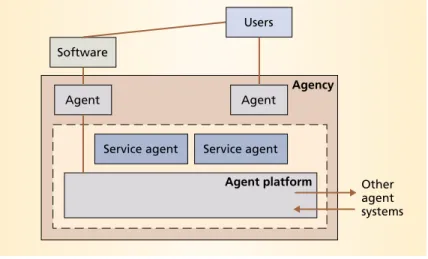
Agents reside and execute in a conceptual and phys-ical location called an agency. The agency provides facilities for locating and messaging mobile and detached agents and for collecting knowledge about groups of agents. The agency’s core is the agent plat-form, a component model infrastructure that provides local services for agents and includes proxies to access remote services such as agent management, security, communication, persistence, and naming. In the case of mobile agents, the agent platform also provides agent transport. Most agent systems provide addi-tional services in the form of specialized agents that reside in some—possibly remote—agency. Some agent systems also include standard service agents, such as a broker, auctioneer, or community maker. These ser-vice agents augment the basic agent infrastructure. The agent platform and additional service agents can monitor and control message exchanges to detect any violation of the rules of engagement. Figure 2 shows the agent system architecture.
Multiagent communication
An agent system consists of components with sim-ple interfaces. Much of the system’s power comes from its loose coupling style, in which agents interact dynam-ically by exchanging asynchronous messages. An agent system’s complex behaviors result from the messages the components process and exchange with each other. To communicate with one another, the agents must con-form to some common, well-defined interaction stan-dard. An ACL is a specialized declarative language that defines the overall structure and standard patterns of
interaction between agents. The agent system associ-ates the ACL with the component model and factors messages into several relatively independent parts: the message type, addressing, context, and message con-tent. Some message parts describe the domain, others describe the expected conversation pattern. This approach makes it easier to dynamically extend agents to new problem areas while the system checks confor-mance to expectations and lets the component model infrastructure manage messages and agents.3
Several well-known agent communication lan-guages, such as KQML6and FIPA ACL (http://www. fipa.org/), have been converted to a standard XML form. At HP Labs, developers define KXML 1.0 using an XML encoding that combines aspects of several ACLs.3Some ACLs support the beliefs, desires, and intentions model, while others make it easy to con-firm that agents conform to organizational conven-tions and display acceptable behavior. Each ACL factors messages in different ways and provides dif-ferent standard reusable parts. All ACLs make it pos-sible to write agent components more quickly and more independently of other agents, allowing the agents to exchange messages so they can dynamically discover each other and the services they offer.
Agents interact with one another using a set of vocabularies—also called an ontology—grounded in the application domain. A vocabulary consists of a word set that describes things, attributes, and actions from some domain, their relationships and meanings, and how the agent system uses the vocabulary to struc-ture interactions and access services. An international standards committee such as OMG, EDI, or SWIFT can agree upon terminology to use in creating a vocab-ulary, or industry groups such as banking or motor parts manufacturers can agree upon terminology for specific markets.
Several organizations are standardizing vocabular-ies and related e-commerce frameworks, which vary
Service agent Agent Software Service agent Agent platform Agent Users Agency Other agent systems
Figure 2. Agent sys-tem architecture. The agent platform serves as the system’s core, while a component model infrastructure provides agents with local services and proxy access to remote services.
from one problem domain to another. If a problem domain is dynamically formed based on a specific application, its ontology is also dynamic. Any of the following can represent an agent vocabulary:
• a natural language dictionary that lists terms, their meanings, and intended use;
• an XML document type definition that defines terms and some relationships—such as attribute syntax and some typing—where comments or an external dictionary explain the meaning, addi-tional relationships, and intent;
• an object-oriented XML schema (see http:// www.w3c.org/) that more precisely defines struc-tured data types and attributes, uses element inheritance, and provides more precise control over how many of each element type and attri-bute are permitted; and
• a full modeling language and tool, such as UML or Ontolingua, for defining vocabulary class and type elements, inheritance or association rela-tionships, and semantics and constraints using OCL and comments.
The interacting agents must understand the vocabu-lary used to communicate with one another. Some words can be defined formally in terms of other words, but others must be described in a standard dictio-nary—such as BizTalk (http://www.biztalk.org), On-tology.org (http://www.onOn-tology.org), CommerceNet (http://www. commercenet.com), CommerceOne (http:// www.commerceone.com), and RosettaNet (http:// www.rosettanet.org)—that tells the agent program-mer how the agent system uses the words. HP E-Speak
provides a basic vocabulary for describing and man-aging other vocabularies (http://www.hp.com/e-speak).
Multiagent coordination
The complex tasks an enterprise computing envi-ronment requires demand that developers integrate a group of various agents to coordinate this activ-ity. Building reusable multiagent interaction tech-niques into the integration infrastructure itself facilitates rapid integration. A multiagent system can group agents statically or dynamically and the agents can coordinate with other agents as well as with people. We call the conversation between agents themselves and agents and people choreog-raphyor conversation management.
Several technologies and tools have emerged that make defining these interaction patterns easier. The expected message sequences can have several possi-ble levels of choreography, depending on how loosely or tightly the system must control the allowed inter-actions.3In all cases, rather than directly program-ming the code to handle message coordination, we use some form of higher-level declarative rules or graphical models. These models make it easier to see how the agents interact. The system can use explicit rules or models to monitor or enforce compliance, easing the programmer’s task.
Techniques for agent coordination include the fol-lowing:
• Rules.We can define a set of rules for any agent or community of agents. For example, we could customize an agent’s time to wait for a response, the number of other agents it can talk to at one Depending on their function, we can
classify agents in one of several major cat-egories.
Personal Agents
These agents interact directly with a user, presenting some personality or char-acter, monitoring and adapting to the user’s activities, learning the user’s style and preferences, and automating or sim-plifying certain rote tasks. Toolkits such as Microsoft Agent (http://www.microsoft. com/msagent) offer a software services set that supports the presentation of software agents as interactive personalities and includes natural language and animation capabilities. Simple examples built using this technology include Microsoft’s Bob or Paper Clip. The site http://www. bottechnology.com provides a survey of some personal agent technologies, while http:// www.redwhale.com describes per-sonalizable interfaces that use aspects of agent technology. Many of the
informa-tion agents developed at MIT fall into this category as well.
Mobile Agents
Sent to visit remote sites and collect information before returning with the results, mobile agents aggregate and analyze data or perform local control. Developers typically implement these agents in Java, Java-based component technologies, TCL,1 VBScript, Perl, or Python (http://www.python.org/). Such data-intensive analysis is often better performed at the source because doing so avoids the shipment of bandwidth-consuming raw data. Examples of such applications include network manage-ment agents, Internet spiders, and NASA’s mobile agents for human planetary explo-ration.
Collaborative Agents
These agents communicate and interact in groups, representing users,
organiza-tions, and services. Multiple agents ex-change messages to negotiate or share in-formation. Collaborative agent examples include those that expedite online auc-tions, planning, negotiation, and logistics, supply-chain, and telecom service provi-sioning. Cobalt, for example, uses KQML, Corba, CIM, IDL, and XML for coopera-tive service and network management.2
References
1. J. Ousterhout, “TCL: An Embeddable Control Language,” Proc. Usenix Conf., Usenix Assoc., Berkeley, Calif., 1990, pp. 133-146.
2. M. Griss, “Software Agents as Next-Gen-eration Software Components,” Compo-nent-Based Software Engineering: Putting the Pieces Together, G. Heineman and W. Council, eds., Addison Wesley Longman, Reading, Mass., to be published June 2001.
time, and what sort of responses to make to a spe-cific message from various agent types.
• Conversation protocols.Expressed as finite state machines that use UML state charts, these pro-tocols enable a group of agents to lockstep through a standard protocol of exchanged mes-sages—if A says x, then B says y—when, for example, bidding during an auction or responding to a call for proposals.
• Workflow.The most powerful technique is used when the conversation coordination for interac-tions of multiple agents and humans must be more complex and precise. A workflow system allows the explicit definition and control of a group of participants that executes a process. Many e-commerce applications involve some form of inter- or intraorganizational workflow. Using a defined set of rules, a workflow system automates all or part of a business process, document exchange, or transmission of information or tasks to be acted upon from one participant to another. Workflow systems such as ActionWorks Metro, Endeavors, HP Change-Engine, IBM FlowMark, Little-JIL, or Verve Work-flow describe allowed connections between partici-pants, desired and exceptional processing conditions, the assignment of roles, and the request and allocation of resources. For example, depending on the situation, a telecom management system could alert a human operator or assign a repair or provisioning engineer.
We view this use of workflow as a next-generation scripting language. Workflow functions as a struc-tured scripting or glue language in which agents rep-resent the participants and resources while the society of agents collaborates to enact the workflow. The Little-JIL process programming language demon-strates how we can use a workflow language to coor-dinate agents. Worklets, an agent-like lightweight process workflow system, uses Java and JPython for its implementation.7
Automated workflow systems do not yet adequately address information mobility or tasks disconnected from the rest of a business process. MAGI—the Micro-Apache Generic Interface, based on the Apache HTTP server—provides an open-architecture frame-work that explicitly addresses e-business messaging and deployment issues across a broad range of com-puting platforms. Both HP’s E-Speak and SUN’s Jini map well to MAGI’s architecture.8
Agents in agent-oriented e-commerce systems dynamically discover and compose e-services and mediate interactions. XML can encode information and services with meaningful structure and semantics that agents can understand.
Using a structure coordination system and either a visual state chart, UML activity, or another workflow
model, we can quickly diagram complex coor-dination patterns and rapidly convert them into an executing system. We can also use other visual and generative techniques to build agent-based systems, such as agent patterns, interaction dia-grams, and aspect-oriented programming.9-11
WEB-BASED DEVELOPMENT
TECHNOLOGIES
Developers often use distributed objects, active objects, and scriptable components to implement agents. They can use Java, Java-based component technologies, XML, and HTTP to build agents. These technologies are simple to use, ubiquitous, heterogeneous, and platform-independent. Developers can use HTTP and XML to implement many agent capabilities for nam-ing and communication, and they can use the univer-sal resource locator and univeruniver-sal resource identifier for naming and locating. XML will likely become the standard language for agent-oriented e-commerce interaction to encode exchanged messages, docu-ments, invoices, orders, service descriptions, and other information.12HTTP provides many services, includ-ing robust and scalable Web servers, firewall access, and some level of security.
The available agent systems and toolkits—such as Agent-TCL, Aglets, Concordia, FIPA-OS, Grasshopper, Jackal, JADE, Jatlite, Jumping Beans, Voyager, and Zeus—have different mixes of mobility, adaptability, intelligence, ACL, and multilanguage support.3
RELATED AGENT-ORIENTED SYSTEMS
The following examples describe some of the many research projects currently investigating the develop-ment of agent-oriented systems for complex, dynamic environments.
HP Labs research prototypes
Several experimental agent projects are under way at HP Labs in Palo Alto, Bristol, and Grenoble. These projects include work on application management, agent-mediated e-commerce, multiagent negotia-tion and coordinanegotia-tion, and personal and workplace assistants.10,13
The CWave lightweight mobile agent system and visual toolkit, developed jointly by HP Laboratories and the University of Utah for experimental application management and process control, uses COM/OCX, a publish-subscribe bus, HTTP, and VBScript.14,15Agents include standard libraries of measurement objects and methods to initiate, change, and dynamically update measurement (http://beast.cs.utah.edu). HP Labs is also developing an experimental Web-based economic sim-ulation environment for a shopping mall, integrating the environment with personal agents and mobile
appli-Workflow functions
as a structured
scripting language in
which agents
represent participants
and resources while
the society of agents
collaborates to enact
ances based on HP CoolTown (http://www.cooltown. com)3and using Zeus16as a base. The most recent work uses the JADE agent system and HP Bluestone to pro-totype a variety of workplace productivity assistants for mobile workers.
HP’s agent projects tackle important issues such as how to effectively define and construct agents, how agents communicate, and how to establish and control collaborations between groups of agents. The combi-nation of agents and workflow provides significant benefits beyond those traditionally associated with components and scripting.
Software agents have differing characteristics such as mobility, autonomy, collaboration, persistence, and intelligence. Some research seeks to simplify the direct definition and implementation of different agent sys-tems’ capabilities. Researchers combine aspects and components that represent key capabilities to con-struct an agent, or a set of compatible agents. UML models of vocabularies, workflow, role diagrams, pat-terns, and feature trees will drive aspect-oriented gen-erators to create highly customized agent systems.9,10 The Iconic Modeling Tool11uses visual techniques and UML to assemble and control mobile-agent pro-grams and itineraries. Such agents can perform a range of simple or complex tasks, such as automatic notifica-tion via e-mail that a report is available, sending a reminder or rescheduling a meeting, or negotiating on behalf of users.
Web-based multiagent systems for
NASA’s human planetary exploration
Future NASA missions will require robust and flex-ible Web-based information systems that designers can rapidly develop, extend, and customize. Thus, the agency can meet these requirements by adopting agent-oriented software engineering and agent com-ponents. For example, a new Web-based multiagent system can enhance human performance during plan-etary exploration in hostile environments. Figure 3 shows this system’s high-level design, which consists of mobile intelligent agents.
Such a system must meet the requirements of an extremely dynamic environment in which nodes
appear and disappear from clusters, and transient communication links undergo rapid changes. These parameters motivated the design of an agent-based system-control-and-configuration model (SCCM) to allow multiple people using multipleinstruments and computers to automatically create a unique data record of scientific activities.
The SCCM creates a map of the system configura-tion by listening for the presence of each component on the network. Exploration tools such as digital cameras will use the federation of Jini Lookup services to adver-tise their presence, function, and status to other net-work nodes. The data-acquisition-and-correlation agent acquires field data from a digital camera after the explorer presses the shutter. The communication-monitoring agent determines the data transfer path, and the storing-and-forwarding agent stores and for-wards the image to the system-control-and-configuration center (SCCC).
The SCCC then passes both the event and location of the new data to the human-centered-computing (HCC) agents to determine what to do with the image, based on the HCC’s workflow model. The data is stored in local Web servers, which allow Web browsers to be the primary human-computer inter-face. Loose coupling of mobile agents and the use of workflow in this project allow rapid development of robust and flexible Web-based systems that NASA can customize and extend to meet the requirements of future human planetary exploration.
Candidate technologies for developing this system include Java 2 Platform, Enterprise Edition, several Jini mechanisms, Java-based component technologies such as Enterprise JavaBeans and JavaBeans, and agent technologies based on XML and HTTP.17
AGENT-BASED MIDDLEWARE
As agents become more powerful, message-oriented middleware and agents will share the task of provid-ing a variety of services, includprovid-ing
• location services that enable agents to find and interact with one another in peer-to-peer or client-server configurations;
• application services for functions such as dynamic self-configuration and deployment; • management services for functions such as
reg-istration and life-cycle management; and • dynamic binding services between agents and
hardware.
Middleware can also provide federation, ownership, and mobility services.
We agree with Ebrahim Mamdani and Jeremy Pitt18 that, as the intelligence of an overall system increases, the distribution of intelligence will inevitably tend
Data-acquisition-and-correlation agents System-control-and-configuration center (SCCC) Storing-and-forwarding agents System status viewer
Human-centered-computing (HCC) agents work planHCC
viewer Commands Status Human events Automation agents Communication-monitoring agents Figure 3. High-level design of a Web-based, multi-mobile-agent system for human planetary exploration. Built around a system-con-trol-and-configuration model, the system allows multiple peo-ple using multipeo-ple instruments and com-puters to automatic-ally create a unique data record of scien-tific activities.
toward the agents and away from the middleware. This shift will result in a transition from intelligent networks to networked intelligence in which any mid-dleware functionality will itself be an agent. The avail-ability of E-Speak; the Java 2 Platform, Enterprise Edition; Jini; .NET; and Bluestone will help make this transition possible.
A
gent-component technology and agent-oriented software engineering have the potential to be more powerful than traditional, less dynamic compo-nents for rapid incremental development. Most agent and e-service systems offer several capabilities that work together to provide unprecedented flexibility and promise to be more effective at handling the resulting software’s evolution, distribution, and complexity.Further, some agents can act as mediators, or inter-mediaries, transforming and delegating requests to other agents and transforming and aggregating responses. All these capabilities facilitate maintenance and the evolution of agent-based enterprise systems as requirements and technology change. Thus, agent-oriented software engineering offers unique opportu-nities for developing and maintaining Web-based enterprise systems at Internet speed. ✸
References
1. G. Pour, “Component Technologies: Expanding the Pos-sibilities for Component-Based Development of Web-Based Enterprise Applications,” Handbook of Internet Computing, B. Furht, ed., CRC Press, Boca Raton, Fla., 2000, pp. 133-156.
2. I. Jacobson, M. Griss, and P. Jonsson, Software Reuse, Architecture, Process, and Organization for Business Suc-cess,Addison Wesley Longman, Reading, Mass., 1997. 3. M. Griss, “Software Agents as Next-Generation Soft-ware Components,” Component-Based Software Engi-neering: Putting the Pieces Together,G. Heineman and W. Council, eds., Addison Wesley Longman, Reading, Mass., to be published June 2001.
4. Q. Chen et al., “Multi-Agent Cooperation, Dynamic Workflow and XML for E-Commerce Automation,” Proc. 4th Int’l Conf. Autonomous Agents 2000, ACM Press, New York, June 2000, pp. 255-256.
5. Y. Shoham, “Agent-Oriented Programming,” Artificial Intelligence, vol. 60, no. 1, 1993, pp. 139-159. 6. T. Finin, Y. Labrou, and J. Mayfield, “KQML as an
Agent Communication Language,” Software Agents, J.M. Bradshaw, ed., MIT Press, Cambridge, Mass., 1997, pp. 291-316.
7. G. Kaiser, A. Stone, and S. Dossick, “A Mobile Agent Approach to Lightweight Process Workflow,” Proc. Int’l Process Technology Workshop, ACM Press, New York, 1999; http://www-adele.imag.fr./IPTW/.
8. G.A. Bolcer, “MAGI: An Architecture for Mobile and
Disconnected Workflow,” IEEE Internet Computing, May/June 2000, pp. 46-54.
9. E.A. Kendall, “Role Model Designs and Implementa-tions with Aspect-Oriented Programming,” Proc. OOP-SLA 99, ACM Press, New York, pp. 353-369. 10. M.L. Griss, “My Agent Will Call Your Agent,” Software
Development Magazine, Feb. 2000, pp. 43-46. 11. B. Falchuk and A. Karmouch, “Visual Modeling for
Agent-Based Applications,” Computer, Dec. 1998, pp. 31-37. 12. R.J. Glushko, J.M. Tenenbaum, and B. Meltzer, “An
XML Framework for Agent-Based E-Commerce,” Comm. ACM, Mar. 1999, pp. 106-114.
13. M.L. Griss and R. Letsinger, “Games at Work—Agent-Mediated E-Commerce Simulation,” Proc. 4th Int’l Conf. Autonomous Agents 2000, ACM Press, New York, June 2000, HPL-2000-52 for extended version; http://www-adele.imag.fr/IPTW/.
14. M.L. Griss and R.R. Kessler, “Building Object-Oriented Instrument Kits,” Object Magazine, Apr. 1996, pp. 71-81. 15. C. Mueller-Planitz, “CWave 2000—A Visual Workbench
for Distributed Measurement Agents,” doctoral disserta-tion, Computer Science Dept., Univ. of Utah, Salt Lake City, 2000.
16. H. Nwana et al., “ZEUS: A Toolkit for Building Dis-tributed Multi-Agent Systems,” Artificial Intelligence, vol. 13, no. 1, 1999, pp. 129-186.
17. G. Pour, “A Jini-Based Mobile Agent Architecture for Planetary Exploration,” Proc. Int’l Conf. Technology of Object-Oriented Languages and Systems, IEEE CS Press, Los Alamitos, Calif., to be published 2001.
18. E. Mamdani and J. Pitt, “Responsible Agent Behavior: A Distributed Computing Perspective,” IEEE Internet Computing, Sept./Oct. 2000, pp. 27-31.
Martin L. Griss is a principal laboratory scientist at Hewlett-Packard Laboratories, Palo Alto, Calif. His research interests include software engineering processes and systems, systematic software reuse, object-oriented development, component-based soft-ware engineering, softsoft-ware agent technology, personal agents, mobile appliances, and e-services. Griss received a PhD in physics from the University of Illi-nois. He is an adjunct professor at the University of Utah and a member of the ACM SIGSOFT Executive Committee. Contact him at martin_griss@ hp.com.
Gilda Pour is a professor of software engineering at San Jose State University. Her research and industrial experience is in distributed object technology and component-based enterprise software engineering, with current emphasis on component-based and agent-oriented development of Web-based enterprise application systems. Pour received a PhD in computer science and software engineering from the University of Massachusetts. She is a member of the IEEE Com-puter Society. Contact her at [email protected].