http://dx.doi.org/10.12988/ijma.2013.310246
Radiative Flow Past a Parabolic Started Isothermal
Vertical Plate with Uniform Mass Flux
R. Muthucumaraswamy1 and J. Venkatesan2* 1
Deparment of Applied Mathematics, Sri Venkateswara College of Engineering Sriperumbudur-602 117, India
2
Department of Mathematics, Rajalakshmi Engineering College, Thandalam Sriperumbudur 602 105, India
*corresponding author: e-mail: [email protected]
Copyright © 2013 R. Muthucumaraswamy and J. Venkatesan. This is an open access article distributed under the Creative Commons Attribution License, which permits unrestricted use, distribution, and reproduction in any medium, provided the original work is properly cited.
Abstract
Exact solution of unsteady flow past a parabolic started infinite isothermal vertical plate with uniform mass flux, in the presence of thermal radiation has been studied. The dimensionless governing equations are solved using Laplace-transform technique. The plate temperature is raised uniformly and the mass diffused from the plate to the fluid at a constant rate. The fluid considered here is a gray, absorbing-emitting radiation but a non-scattering medium. The effects of the velocity, the temperature and the concentration are studied for different physical parameters like thermal radiation parameter, thermal Grashof number, mass Grashof number, Schmidt number and time. It is observed that the velocity increases with decreasing values of the thermal radiation parameter. The trend is just reversed with respect to the thermal Grashof number or mass Grashof number.
Keywords: parabolic, radiation, isothermal, mass flux, vertical plate, heat and mass transfer
1
Introduction
The study of radiative heat and mass transfer in convective flows is important from many industrial and technological points of view. Mass transfer is one of the most commonly encountered phenomena in chemical industry as well as in physical and biological sciences. The radiative heat and mass transfer flow of an electrically conducting fluid has wide applications in geophysics, geothermal, engineering and solar physics. It plays an important role in manufacturing industries for the design of fins, steel rolling, nuclear power plants, gas turbines and various propulsion device for space vehicles, aircraft, missiles, energy conversion methods that involve fossil fuel combustion, solar radiation and furnace design, satellites, materials processing, energy utilization, temperature measurements, remote sensing for astronomy and space exploration, food processing and cryogenic engineering, as well as numerous agricultural, health and military applications. If the temperature of the surrounding fluid is rather high, radiation effects play an important role and this situation does exist in space technology. In such cases, one has to take into account the combined effect of thermal radiation and mass flux.
Cess [4] investigated thermal radiation effects on heated vertical plate using singular perturbation technique. Free convection effects on the flow past an accelerated vertical plate in an incompressible dissipative fluid by Gupta et al [5]. Kafousias and Raptis [8] extended this problem to include mass transfer effects subjected to variable suction or injection. Soundalgekar [13] studied the mass transfer effects on flow past a uniformly accelerated vertical plate. Mass transfer effects on flow past an accelerated vertical plate with uniform heat flux was analyzed by Singh and Singh [12]. Free convection effects on flow past an exponentially accelerated vertical plate was studied by Singh and Naveen Kumar [11]. The skin friction for accelerated vertical plate has been studied analytically by Hossain and Shayo [7]. Mass transfer effects on exponentially accelerated infinite vertical plate with constant heat flux and uniform mass diffusion was studied by Basant Kumar Jha et al [3].
Hossain and Takhar [6] have analyzed radiation effects on mixed convection along an isothermal vertical plate. Agrawal et al [2] studied free convection due to thermal and mass diffusion in laminar flow of an accelerated infinite vertical plate in the presence of magnetic field. Agrawal et al [1] further extended the problem of unsteady free convective flow and mass diffusion of an electrically conducting elasto-viscous fluid past a parabolic starting motion of the infinite vertical plate with transverse magnetic plate. The governing equations are tackled using Laplace transform technique. Raptis and Perdikis [10] studied the effects of thermal radiation and free convection flow past a moving vertical plate. The governing equations were solved analytically. Muthucumaraswamy and Saravanan [9] have
discussed unsteady flow past an oscillating semi-infinite vertical plate of uniform mass flux with thermal radiation using implicit finite difference scheme.
It is proposed to study the effects of on flow past an infinite isothermal vertical plate subjected to parabolic motion with uniform mass flux, in the presence of thermal radiation. The dimensionless governing equations are solved using the Laplace-transform technique. The solutions are in terms of exponential and complementary error function.
2
Mathematical Analysis
Thermal radiation effects on unsteady flow of a viscous incompressible fluid past an infinite isothermal vertical plate with uniform mass flux has been considered. The x-axis is taken along the plate in the vertically upward direction and the y -axis is taken normal to the plate. At timet0, the plate and fluid are at the same temperature Tand concentration C . At time t0, the plate is started with a velocity uu0.t2 in its own plane against gravitational field and the temperature from the plate is raised to Tw and the concentration level near the plate are also raised at an uniform rate. The plate is infinite in length all the terms in the governing equations will be independent of x and are functions of y and tonly. The fluid considered here is a gray, absorbing-emitting radiation but a non-scattering medium. Under the usual Boussinesq approximation the unsteady flow is governed by the following equations:
2 2 ' ' ) ( * ) ( y u C C g T T g t u (1) y q y T k t T Cp r 2 2 = (2) 2 2 y C D t C (3) With the following initial and boundary conditions:
, 0 u T T, CC for all y,t0 0 t : uu0.t2, T Tw, D j y C' '' at y 0 (4) 0 u T T, CC as y
The local radiant for the case of an optically thin gray gas is expressed by ) ( 4 = a* T4 T4 y qr (5)
It is assumed that the temperature differences within the flow are sufficiently small such that T4 may be expressed as a linear function of the temperature. This is accomplished by expanding T4 in a Taylor series about T and neglecting higher-order terms, thus
4 3 4 3 4 T T T T (6) By using equations (5) and (6), equation (2) reduces to
) ( 16 = 2 * 3 2 T T T a y T k t T Cp (7) The dimensional quantities are defined as
, 3 1 2 0 u u U ', 3 1 2 0 t u t , 3 1 2 0 u y Y T T T T w , 3 1 0 3 2 '' u D j C C C
1 3 0 . w T T g Gr u ,
2 '' 3 1 3 0 1 3 0 * , . j g Du Gc u 16 * . , 3 2 0 2 3 u k T a R k Cp Pr , D Sc (8)Using in the equations (1), (3) and (7), reduce to the following dimensionless form: 2 2 Y U GcC Gr t U (9) Pr Pr 1 2 2 R Y t (10) 2 2 1 Y C Sc t C (11) The initial and boundary conditions in non-dimensional quantities are
0 U , 0, C0 for all Y,t0 2 : 0 U t t , 1 , 1 Y C at Y 0 (12) 0 U , 0, C0 as Y
The dimensionless governing equations (9) to (11) and the corresponding initial and boundary conditions (12) are tackled using Laplace transform technique we get,
exp(2 Pr ) ( Pr ) exp( 2 Pr ) ( Pr )
2 1 at erfc at at erfc at (13)
2 exp ( ) 2 Sc erfc Sc Sc t C (14) (15) where, Pr R a= , Sc Sc Gc e Pr b Gr d Pr R b ) 1 ( 3 = , ) (1 2 = , 1 = and t Y 2 = .3
Numerical results and discussion
In order to determine the effect of different physical parameters such as Gr, Gc, R, Sc and t on the problem, the numerical values of the temperature field,
concentration and velocity profile were computed and are shown in the figures. The value of the Prandtl number Pr is taken as 0.71 which represent air.
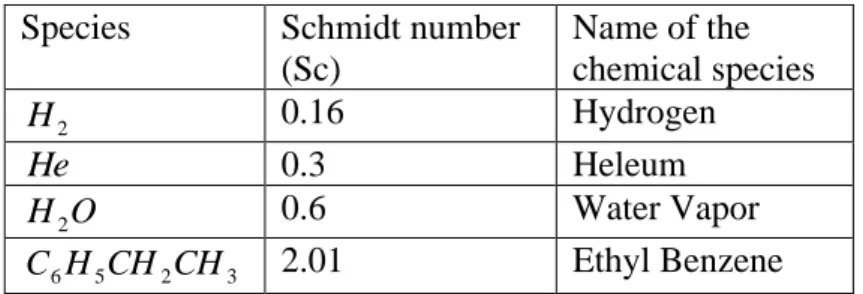
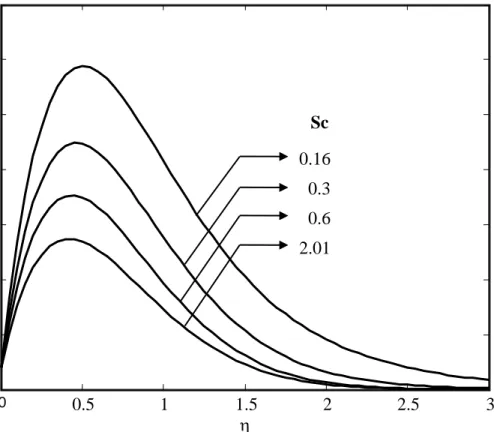
The numerical values of the Schmidt number Sc are chosen such that they represent a reality in case of air. The effect of Schmidt number play an important role in the concentration. The numerical values of the Schmidt number and the corresponding species are listed in the following table:
Species Schmidt number (Sc) Name of the chemical species 2 H 0.16 Hydrogen He 0.3 Heleum O H2 0.6 Water Vapor 3 2 5 6H CH CH C 2.01 Ethyl Benzene
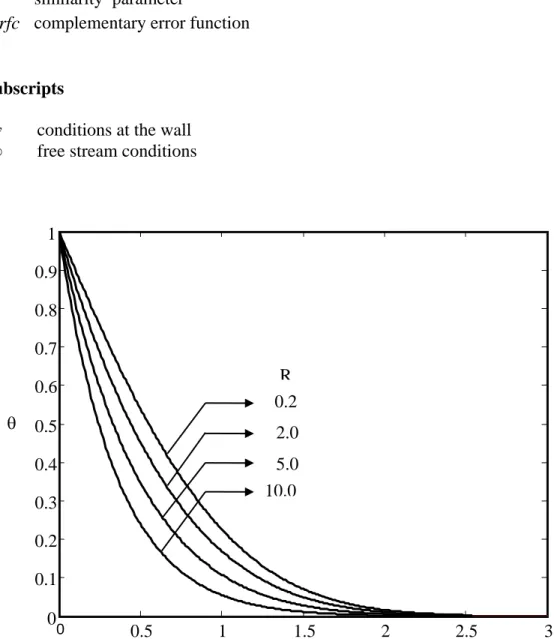
The temperature profiles are plotted in Figure 1 for different values of thermal radiation parameter R with = 0.2t . The effect of thermal radiation parameter is important in the temperature profiles. It is observed that an increase in the radiation parameter marginally decreases the temperature. This shows that the heat loss is more due to higher thermal radiation.
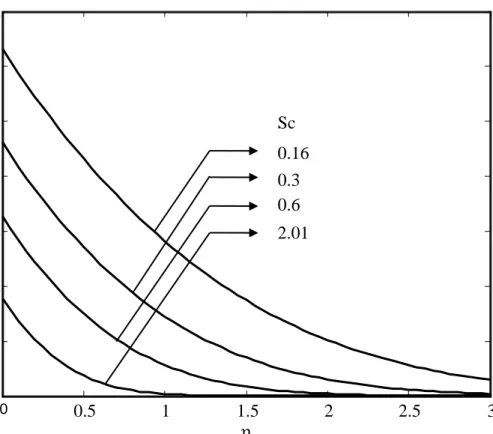
Figure 2 represents the effect of concentration profiles for different Schmidt number Sc as shown in the above table with time = 0.2t . The effect of Schmidt number is important in concentration field. The profiles have the common feature that the concentration decreases in a monotone fashion from the surface to a zero value far away in the free stream. It is noted that the wall concentration increases considerably with decreasing values of the Schmidt number.
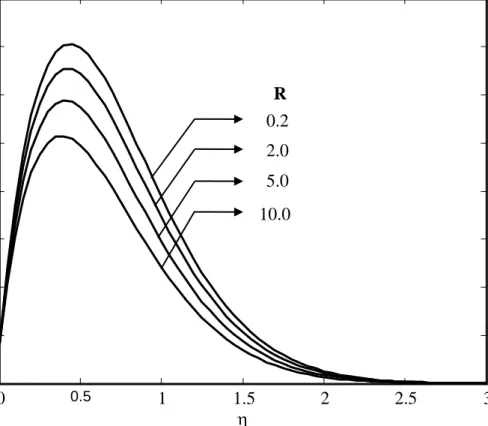
The effect of velocity for different values of the radiation parameter = 0.2, 2,5,10
R with Gr= 5Gc Sc, 0.6 and = 0.2t are shown in Figure 3. It is clear that the velocity increases considerably as radiation parameter decreases. The trend shows that the velocity increases rapidly and attains maximum value around η = 0.5 and then decreases gradually from η = 2.5. Also, it is seen that the velocity decreases in the presence of high thermal radiation. This shows that the buoyancy effect on the temperature distribution is very significant in the air. Figure 4 describes the behavior of the transient velocity with changes in the values of Schmidt number Sc for t = 0.2. The velocity decreases considerably due to an increase in Sc. It is found that velocity increases rapidly and attains maximum value at η = 0.5, and then decreases gradually for increasing values of η. The velocity boundary layer seems to grow in the direction of motion of the plate.
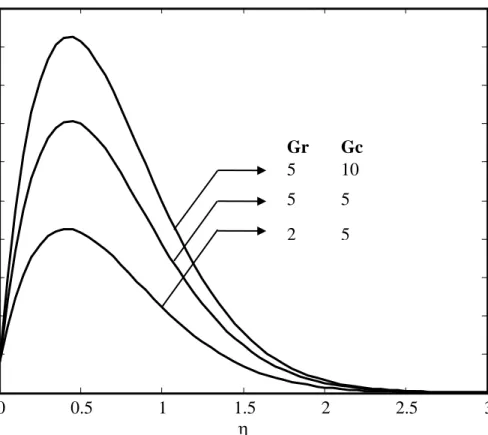
The effects of different thermal Grashof number Gr = 2, 5 and mass Grashof number Gc = 5,10 on the velocity profile with t = 0.2. is sketched in Figure 5. The thermal Grashof number signifies the relative effect of the enhancement in buoyancy force to the viscous hydrodynamic force and the mass Grashof number defines the ratio of the species buoyancy force to the viscous hydrodynamic force. It is observed that the velocity increases significantly with increasing values of the thermal Grashof number and mass Grashof number. It is seen that the peak values of the velocity increases rapidly near the plate as thermal Grashof number and mass Grashof number increases and then decays to the free stream velocity.
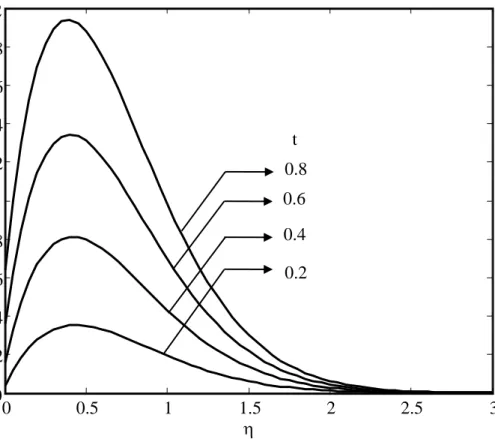
The effects of velocity profiles for different values of timeare illustrated in Figure 6. It is found that the velocity increases significantly with respect to time t.
4
Conclusion
The theoretical solution of unsteady thermal radiation effects on flow past a parabolic starting motion of an infinite isothermal vertical plate with uniform mass flux, has been studied. The dimensionless governing equations are solved by the usual Laplace transform technique. The effect of different physical parameters like thermal radiation parameter, Schmidt number, thermal Grashof number, mass Grashof number and time are studied graphically. The conclusions of the study are as follows:
(i) The velocity increases with increasing thermal Grashof number or mass Grashof number, but the trend is just reversed with respect to the thermal radiation parameter or Schmidt number.
(ii) The temperature of the plate increases with decreasing values of the thermal radiation parameter.
(iii) The plate concentration increases with decreasing values of the Schmidt number.
References
[1] A.K. Agrawal, S.N. Gupta and N.K. Samria, Study of heat and mass transfer past a parabolic started infinite vertical plate, Journal of Heat and mass transfer, 21 (1999), 67 – 75.
[2] A.K. Agrawal, S.N. Gupta and N.K. Samria, Free convection due to thermal and mass diffusion in laminar flow of an accelerated infinite vertical plate in the presence of magnetic field, Journal of Heat and mass transfer, 20 (1998), 35 - 43.
[3] Basanth Kumar Jha, Ravindra Prasad, Surendra Rai, Mass transfer effects on the flow past an exponentially accelerated vertical plate with constant heat flux, Astrophysics and Space Science, 181 (1991), 125 - 134.
[4] R.D. Cess, The interaction of thermal radiation with free convection heat transfer, International Journal of Heat and mass transfer, 9 (1966), 1269 - 1277.
[5] A.S. Gupta, I. Pop, V.M. Soundalgekar, Free convection effects on the flow past an accelerated vertical plate in an incompressible dissipative fluid, Rev.Roum. Sci. Techn. Mec. Apl., 24 (1979), 561 - 568.
[6] M.A. Hossain, H.S. Takhar, Radiation effects on mixed convection along a vertical plat with uniform surface temperature, Heat and mass transfer,31 (1996), 243 - 248.
[7] M.A. Hossain, L.K. Shayo, The skin friction in the unsteady free convection flow past an accelerated plate, Astrophysics and Space Science, 125 (1986), 315 - 324.
[8] N.G. Kafouias, A.A. Raptis, Mass transfer and free convection effects on the flow past an accelerated vertical infinite plate with variable suction or injection, Rev. Roum. Sci. Techn.-Mec. Apl., 26 (1981), 11 - 22.
[9] R. Muthucumaraswamy, B. Saravanan, Numerical solution of unsteady radiative flow past an oscillating semi-infinite vertical plate with uniform mass flux, Computational methods in science and technology, 19 (2013), 1 - 9.
[10] A. Raptis, C. Perdikis, Radiation and free convection flow past a moving plate, Int. J. App. Mech & eng., 4 (1999), 817 ‐ 821.
[11] A.K. Singh, Naveen Kumar, Free convection flow past an exponentially accelerated vertical plate, Astrophysics and Space Science, 98 (1984), 245 - 258.
[12] A.K. Singh, J. Singh, Mass transfer effects on the flow past an accelerated vertical plate with constant heat flux, Astrophysics and Space Science, 97 (1983), 57 - 61.
[13] V.M. Soundalgekar, Effects of mass transfer on the flow past an accelerated vertical plate, Letters in Heat and Mass Transfer, 9 (1982), 65 - 72.
Nomenclature
C species concentration in the fluid kgm3 C dimensionless concentration
p
C specific heat at constant pressure J.kg1.k D mass diffusion coefficient m2.s1
Gc mass Grashof number Gr thermal Grashof number
g acceleration due to gravity m.s2
mass flux per unit area at the plate W/m2 k thermal conductivity W.m1.K1
P r Prandtl number Sc Schmidt number
T temperature of the fluid near the plate K t time s
u velocity of the fluid in the x-direction m.s1
0
u velocity of the plate m.s1 U dimensionless velocity
x coordinate axis along the plate m
y coordinate axis normal to the plate m
Greek symbols
volumetric coefficient of thermal expansion K1
volumetric coefficient of expansion with concentration K1
coefficient of viscosity Ra. s kinematic viscosity m2.s1 density of the fluid kg.m3
dimensionless temperature similarity parameter
erfc complementary error function
Subscripts
w conditions at the wall
free stream conditions
0 0.5 1 1.5 2 2.5 3 0 0.1 0.2 0.3 0.4 0.5 0.6 0.7 0.8 0.9 1
Figure 1. Temperature distribution profiles for different values of R 0.2 2.0 5.0 10.0 R
0 0.5 1 1.5 2 2.5 3 0 0.2 0.4 0.6 0.8 1 1.2 1.4
Figure 2. Concentration profiles for different values of Sc C 0.16 0.3 0.6 2.01 Sc
0 0.5 1 1.5 2 2.5 3 0 0.05 0.1 0.15 0.2 0.25 0.3 0.35 0.4
Figure 3. Velocity profiles for different values of R U R 0.2 2.0 5.0 10.0
0 0.5 1 1.5 2 2.5 3 0 0.1 0.2 0.3 0.4 0.5 0.6 0.7
Figure 4. Velocity profiles for different values of Sc U Sc 0.16 0.3 0.6 2.01
0 0.5 1 1.5 2 2.5 3 0 0.05 0.1 0.15 0.2 0.25 0.3 0.35 0.4 0.45 0.5
Figure 5. Velocity profiles for different values of Gr and Gc U 5 10 5 5 2 5 Gr Gc
Received: October 16, 2013 0 0.5 1 1.5 2 2.5 3 0 0.2 0.4 0.6 0.8 1 1.2 1.4 1.6 1.8 2
Figure 6. Velocity profiles for different values of t U 0.8 0.6 0.4 0.2 t