Variant-rich Web Services
Bardia Mohabbati, Mohsen Asadi, Dragan Gaˇsevi´c, and Jaejoon Lee
Abstract Service-Oriented Architecture (SOA) enables enterprise for distributed and flexible software development. SOA aims at promoting effective software as-set reuse by means of encapsulating functionalities as reusable services accessible through well-defined interfaces. However, one of the challenging problems for the realization of this regard is an ever-increasing need for the design and management of variants of SOA-based solutions which require customization to meet stakehold-ers’ individual functional and non-functional requirements. In this chapter, we have introduced a methodological foundation for modeling and developing variant-rich SOA-solutions by incorporating the principles of Software Product Line Engineer-ing (SPLE) into the SOA development life cycle.
1 Introduction
Nowadays enterprises and companies deal with several challenges for developing SOA-based solutions. To stay relevant with the global competition, they need to rapidly and cost-effectively develop and deploy stockholder-tailored services to meet a wide variety of their particular domain or targeted market sectors within a particular domain or targeted market sectors. These challenges motivate enter-prises to shift from mass software production to mass software customization. A
Bardia Mohabbati
Simon Fraser University, Canada, e-mail:[email protected]
Mohsen Asadi
Simon Fraser University, Canada, e-mail:[email protected]
Dragan Gaˇsevi´c
Simon Fraser University, Canada, e-mail:[email protected]
Jaejoon Lee
Lancaster University, United Kingdom, e-mail:[email protected]
trend towards developing software applications composed ofreusable software as-setsfor different requirement sets To enable mass customization in the context of Service-Oriented Architectures (SOAs), innovative software engineering methods and models need need: 1) to capture the knowledge of variable requirements and re-flect variability of services 2) to support the reuse of services and all other software development assets 3) to enable the customizing and managing of service according to stockholders’ functional and non-functional requirement [13, 35, 2].
Software Product Line Engineering (SPLE) is one of the most promising and well-established paradigms focusing on the development of software prod-uct lines [47, 12] based on the principles of variability modeling and mass-customization. SPLE research has proposed numerous approaches and techniques for the efficient production of similar software systems (also known as software families). Hence, the adaptation of SPLE approaches for mass customization is the center of attention now and has already been applied successfully to many enter-prises [38]. Employing SPLE techniques results in the reduction of cost, effort, time-to-market and the improvement of quality, together decreasing the complexity of design, facilitating and expediting the customization, maintenance, and evolution of software. [47, 43, 12].
SPLE offers promising prospects to provide scalable solutions to the current chal-lenges of the development, management and customization of Web services and generally SOA-based systems [13, 35, 34, 14] to which we refer, in the course of this paper, asService-Oriented Product Lines (SOSPLs). In this chapter, we provide a comparison of SPL and SOA from different perspectives then present a method for a systematic development of a family of SOA-based applications (i.e., SOSPL). The underlying idea of which is to guide the development process of an SOSPL and which extends the conventional SPLE life-cycle to support modeling, developing and managing variant-rich service-oriented applications.
This chapter is organized as follows: Section 2 introduces the basic concepts of SPLE and outlines some of the main SPLE activities. Section 3 presents a holistic comparison of SPL and SOA which focuses on reuse, architectural and variability aspects of the two paradigms. Section 4 introduces the end-to-end methodology for SOSPL development by focusing on the main engineering activities of the approach. Section 5 discusses in details the proposed approach, and conclusion is given in Section 6.
2 Software Product Line Engineering (SPLE)
SPLE addresses the issues of software reuse and mass-customization. An SPL or a software product family is defined as:“a set of software-intensive systems, sharing a common, managed set of features that satisfy the specific needs of a particular market segment or mission and are developed from a common set of core assets in a prescribed way ”[12]. The ‘particular market segment’ refers to a domain (i.e., a business area) and the business strategies of an enterprise or organization whose
objectives of the business area are determined with changes in its stockholders’ requirements in mind.
A key idea in SPLE is to capture the essential concepts of ‘commonality’ and ‘variability’ among a set of similar software products belonging to the same do-main. Therefore, rather than describing a single software system, the model of soft-ware product lines describes the set of products in the same domain. A product line includes predicted variations that are introduced by tailoring the core assets using variation mechanisms. Variability introduced in SPLE is an abstraction that enables and facilitates customization. It empowers product derivation of different applications by explicit modeling and management of variation points which de-fine decision points determining how the product family members may differ from each other [47, 56]. Variations along with their possible choices, functions or qual-ities, can be defined at each level of abstraction (e.g. requirements, architecture, or components).
SPLE relies on a fundamental distinction ofdevelopment for reuseand devel-opment with reusewith aims at maximizing reusability and eliminating wasteful generic development of components used only once. This insight can be leveraged to improve software development life-cycle that SPLE shifts from the development of a specific application or individual system to a domain, in turn, leads to two char-acterized development processes commonly referred to asdomain engineeringand application engineering[47, 12].
SPLE shifts from the development of a specific application or individual system to a domain. This, in turn, leads to two characterized development processes which are commonly referred to asdomain engineeringandapplication engineering. Do-main engineering models variability among product family members and develops the reusable software platform by focusing ondeveloping-for-reuse. The software platform encompasses all software development artifacts that are liable to be reused. On the other hand, application engineering adopts the developing-with-reuse ap-proach, where products are customized and derived from product family and refer-ence platform which is constructed and developed in the domain engineering phase. Reuse of the software platform and binding variability for different applications are then enacted in application engineering. Differentiating these two development life-cycles allows for establishing the software platform, application customization, and product derivation.
Approaches to the analysis and construction of SPLs can be classified into three strategies: i) proactive, ii) reactive, and iii) extractive [22]. A proactive strategy is similar to the waterfall approach in conventional software engineering, where all product variations on the foreseeable horizon are analyzed and designed, while ar-chitectures for the target domain are defined and implemented upfront. This ap-proach is appropriate for enterprises to foresee and plan ahead of their product line requirements well and that have available resource and time for a long development cycle. A reactive strategy is an incremental approach where only the product-line reusable assets needed in immediate terms are developed and built. Hence, this ap-proach typically requires less upfront efforts than proactive. In a reactive strategy, one or several variations of software products can be analyzed, designed and
im-plemented in each development spiral. Such an approach is appropriate where the upfront requirements for product variations cannot be predicted well in advance or where enterprises have to to meet tight schedule, which is usually limited in resources, through the transition to an SPLE approach. An extractive strategy is between proactive and reactive ones and reuses existing software products as the product line initial baseline.
3 Comparison of SPL and SOA
SPL and conventional SOA-based approaches to software development share com-mon goals with both promoting the concepts of reuse and foster organizations to recycle existing assets and capabilities rather than repeatedly redeveloping them for new software systems. Recent years have witnessed growth of research in the explo-ration of synergies of the combination of SPL and SOA. [13, 23, 35, 14, 26, 9, 59]. Even though two paradigms support software reuse, there are different perspectives and outlooks [36]. In this section, commonalities and differences corresponding to the two paradigms are discussed helping to enlighten how SPLE can be adopted and leveraged for the development and customization of a family of SOA-based appli-cations. To compare SPL and SOA, we consider four main aspects including devel-opment processes, reusability notions, architectural styles, and variability modeling and management.
3.1 Development Processes
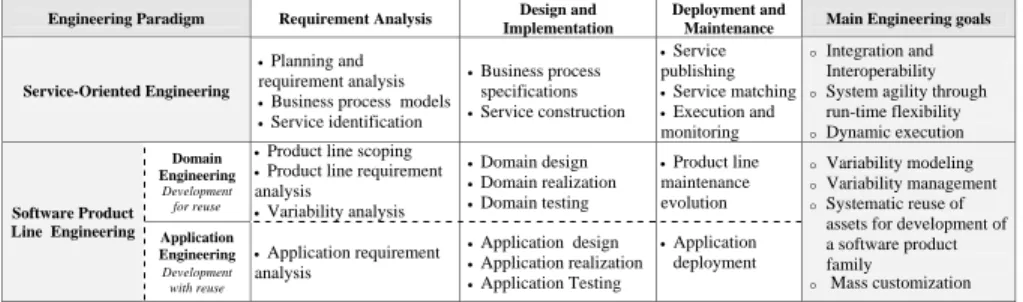
SPL and SOA follow different engineering goals. Thus, the activities associated with their software development life-cycles are different. One of the main objectives of SPLs is to reduce the overall engineering efforts required to produce a set of similar software applications by capitalizing on the commonality and by managing the knowledge of variability and customization. Therefore, the engineering goal of SPL is remarked as the systematic development and management of core assets and software platform in order to achieve the high level of reusability [22, 47, 43, 12]. In contrast, service-oriented approaches set the goal of achieving system agility and of enabling automation to cope with integration, inteoperability and dynamic execution in heterogeneous environments, and providing runtime flexibility [6, 20, 46]. Table 1 shows a summary of major life-cycle phases of two paradigms essentially including requirement and domain analysis, design and implementation and deployment.
• Requirement and Domain Analysis:Service-oriented design and development are basically based on an iterative and incremental process. The process is initi-ated with planning proportional to the requirements which, for a new application, are investigated in analysis phase. This process comprises of reviewing business goals and objectives that derive the modeling and development of business
pro-Software Product Line Engineering to Develop Variant-rich Web Services 5
Table 1 Comparison of the major engineering activities of software product line engineering and
service orientation
Engineering Paradigm Requirement Analysis Implementation Design and Deployment and Maintenance Main Engineering goals
Service-Oriented Engineering
Planning and requirement analysis
Business process models
Service identification Business process specifications Service construction Service publishing Service matching Execution and monitoring oIntegration and Interoperability
oSystem agility through
run-time flexibility oDynamic execution Software Product Line Engineering Domain Engineering Development for reuse
Product line scoping
Product line requirement analysis Variability analysis Domain design Domain realization Domain testing Product line maintenance evolution oVariability modeling oVariability management oSystematic reuse of
assets for development of a software product family o Mass customization Application Engineering Development with reuse Application requirement analysis Application design Application realization Application Testing Application deployment
cesses. Business processes and services are identified in a stepwise manner in the analysis phase the main objective of which is to facilitate [20, 45]. The main objective of the analysis is to facilitate the reuse (or reproposing) of the busi-ness process functionality through the identification and orchestration of services when constructing new applications.
The requirement-analysis phase in SPLE also consists of determining the requirement and using domain information. Nevertheless, SPLE focuses on the analysis and specification of requisites for the entire product family (i.e., product line). To this end, domain engineering of SPLE mainly concentrates on a systematic analysis and the settlement of variability of both functional and non-functional (quality) requirements performed by scoping the product line, analysing product line requirements, and identifying commonalities and variabilities among product line members. Requirement analysis in the appli-cation engineering life-cycle further focuses on the analysis and determination of prerequisites of individual stakeholders. In the application engineering life-cycle, requirement analysis is established for configuring reusable software assets developed and produced in the domain engineering life-cycle.
• Design and Implementation: Service-oriented design and implementation is followed by the design and specification of business processes and service components corresponding to the requirements. Service implementation and testing involves the discovery of available services in local or remote repositories and the development of services, using the specifications in the design phase. In SPL, domain design and implementation involve the detailed design and realizing the reusable software components for the entire product family. It starts with the domain design sub-process which consists of 1) defining and modeling the commonality and variability based on the domain-specific requirements identified in the requirement-engineering phase; 2) specifying the product-family reference architecture which provides a common, high-level structure for all the product-line applications. Furthermore, the domain design incorporates configuration mechanisms into the reference architecture for supporting variability management in order to enable further product
customization and derivation. The domain realization sub-process focuses on the implementation and the testing of each component planned and designed for the reuse in different contexts (i.e., the applications of the product line). The application design sub-process in the application design sub-process in the life-cycle of application engineering incorporated application specific adaptation and employs the reference architecture to refine and instantiate the application architecture. Afterward, the application realization sub-process focuses on the selection and configuration of reusable software components and testing for specific application- already contained product line architecture developed in domain engineering phase.
• Deployment and Maintenance:Service-oriented development deals with pack-aging, provisioning, publishing services, service-matching based on require-ments of stakeholders, executing stakeholders-acceptance testing, and monitor-ing performance in the production environment. the SPLE development phase including the configuration and deployment of a final product is associated with application engineering with activities for custom-building systems according to the result of domain engineering.
3.2 Reuse in SPL versus SOA
Software reuse, as one of the important goals in software engineering, can improve the quality and productivity of software development. For this purpose, several soft-ware reuse approaches have been devised. Component-based softsoft-ware engineering (CBSE) facilitates software reuse and promotes quality and productivity.
CBSE focuses on the interoperability, reusability, and extensibility to facilitate fast delivery of scalable, evolving software systems with research on SOA being a modern instance of this vision, leveraging a logical framework by decoupling several logical units of functionality (services) [32]. This logical framework yields facility reusability through obviating the recreation of common services, thus the achievement of business goals by way of loosely connected services with their vari-ability guided by SOA policies [6, 44].
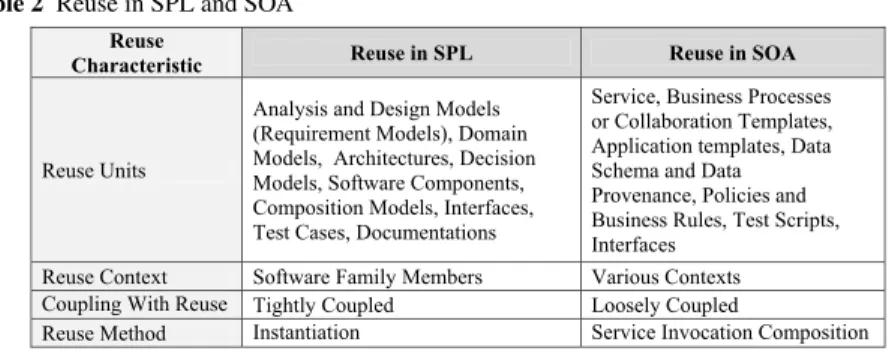
Reuse in SPL vs. services in SOA have different characteristics (cf. Table 2). As mentioned, reusable assets in SPL encompass all the reusable software artifacts. A core asset is the most essential element of SPL since it is a common asset which is reused within multiple products and the reusability of which will largely determine the success of the whole product line [47]. For instance, the most distinguishable reusable assets in SPL context are as follows [12]:
• Analysis and design models: including the requirements and variability models, which describe the common and variable features for all family members
• Domain models: describing and representing all the entities and concepts that can be utilized in the context of software product families
Table 2 Reuse in SPL and SOA Reuse
Characteristic Reuse in SPL Reuse in SOA
Reuse Units
Analysis and Design Models (Requirement Models), Domain Models, Architectures, Decision Models, Software Components, Composition Models, Interfaces, Test Cases, Documentations
Service, Business Processes or Collaboration Templates, Application templates, Data Schema and Data Provenance, Policies and Business Rules, Test Scripts, Interfaces
Reuse Context Software Family Members Various Contexts Coupling With Reuse Tightly Coupled Loosely Coupled
Reuse Method Instantiation Service Invocation Composition
Characteristic SPL Architecture SOA Architecture
Architectural Degree Centralized Decentralized and Centralized (distributed and centralized architectures) Composition Rules Predefined Composition Rules Business Rules and Policies
• Architectures: specifying and determining which of the reusable components are needed for configuring executable applications and how to configure software families that best satisfy non-functional requirements
• Design decision models: specifying the family configuration model and deter-mining how to derive software products based on specific requirements
• Software components: supporting variation points and implementing the required functionalities of software families
• Interfaces: enabling different implementation of the same functionality
• Test artifacts: reusing test plans, test cases and scenarios, and test data
On the other hand, in SOA, services are intended to be reusable building blocks and units of sharable software assets for different applications which implement different business processes. As a consequence, services can be orchestrated to con-struct composite services through business processes.
Core assets in SPL including a generic architecture and components develop ap-plications whereas services are basic building blocks to support compositional soft-ware development in SOA in which business processes or application templates specify entire application through the definition of execution sequences of valid workflows. Services can be reusable artifacts which enable rapid SOA application development [54].
Assets and applications are generally tightly coupled in SPL, while services are loosely coupled which is one of the most pronounced properties of services in SOA research [46]. Services are highly independent of context and the state of other ser-vices.
Software components often operate within a context defined by a generic archi-tecture for product family members in SPLs. SOA is grounded on the idea of open integration of business processes by means of shared services where services are described through standard-interface and are intended for reuse in different con-texts. Nevertheless, services can also be developed and reused for internal processes within organizations. In essence, SOA basically envisages and focuses on large scale reuse [27] because SOA promotes services to be seamlessly consumed by diverse applications where they can be published, discovered and invoked through standard-ized specifications [6].
3.3 Architectural aspects of SPL versus SOA
Both SPL and SOA require defining the architectural context and composition rules with SPL architecture often centralized, static, and specialized into concrete prod-ucts but SOA as decentralized. Composition rules are predefined in SPL, which describe common and variable behavioral characteristics of architecture, while in SOA composition or business rules are generally defined to govern the way in which a composition is constructed. SPL basically aims at providing a common architec-ture for reuse, whereas SOA lacks enough support for large grained software reuse at the architectural level. Gomma et al. [24, 51] discuss software architectural issues in SOA and describe various practices to develop reusable services in order to craft and compose systems from services efficiently. They draw attention that the architectural solution space offered by SOA promises to provide potentially significant benefits for reutilization. However, achieving SOA’s benefits may not be guaranteed just by implementing based on the SOA solution. Accordingly, the important software ar-chitecture and reuse issues should be addressed prior to creating a SOA [51]. Tsai et al. propose a classification schema of architectures for SOA-based applications in order to evaluate variety of architectures [54]. The slackly coupling characteristic and platform-independent view inherited in SOA may address many architectural is-sues that are open-design and integration problems. Furthermore, architecture style offered by SOA is potential to maximize reuse beside interoperability and flexibility; however, SOA lacks support to manage variability at the architectural level [13, 35] whereas SPL enables managing variability to improve reutilization at such level.
3.4 Variability in SPL and SOA
The concept ofvariabilityrefers to the ability of software systems or artifacts to be efficiently extended, modified, specialized, or configured (customized) for(re)usein the specific context for a particular application [56]. This characteristic enables for applying changes at different levels from software architecture to implementation. Two important concepts related to variability discussed in the literature are variation points and variants with the former being places in the design or implementation at which variants occur and with the latter being the alternatives to be selected at those variation points [47, 56].
Therefore, variability can specify a part of an architecture which remains vari-able, as variation points, or what is not completed at design time. Variability can be implemented at design time or run-time [52]. It is noteworthy that variability and flexibility are closely interconnected. Flexibility offers adaptation and changes of architecture, while variability deals with various version of architecture.
Variability in SPL encompasses all software artifacts from requirements to code [56, 12]. Therefore, there are numerous modeling methods proposed with the objective of modeling variability within software artifacts and at different levels of abstraction. Van Gur et al. discuss about the notion of variability in SPL [56], where
variability is exposed at different levels: platform technologies and user expecta-tions, requirements specificaexpecta-tions, designs, component source code, compiled code, linked code, and running code in the context of which variability refers to the ability to select among these artifacts at various stages.
Effective management of variability, which determines how flexibly new mem-bers of a given SPL can be obtained and defines SPL boundaries is essential for the success of SPLs [56]. The distinction between variability modeling and other tech-niques is based on the diversity between variability modeling and variability mecha-nism. Variability modeling techniques model the variability provided by the product line artifacts while variability mechanisms, several of which have been proposed in the literature such as conditional compilation, patterns, generative programming, macro programming, and aspect-oriented programming are commonly considered ways to introduce or implement variability in those artifacts.
Accordingly, variability in SPL is an essential concern in all phases of devel-opment life-cycle. Variability identification, modeling and management is rather a large field of research in SPL [11]. Most current works address identification and management of variability by modeling the concepts as featureswhich con-sidered as the first-class representation of variability and in terms of which the major advantages of discussing a software system is that the concept of feature bridges the gap between the requirements and technical design decisions in view of the fact that software components rarely address a single requirement but rather an entire set of essentials (details are given in Sec. 5). There are number of well-studied feature-oriented approaches for domain analysis and modeling common and variable requirements in SPLE such as FODA (Feature-Oriented Domain Analy-sis) [28] and its extension FORM (Feature-Oriented Reuse Method) [29], RSEB (Reuse-Driven Software Engineering Business) [25], GPM (Generative Program-ming Methods) [16] and PLUSS (Product Line Use case modeling for Systems and Software engineering) [19]. Every method generally shares feature as the common concept used in the analyses of commonality and variability. Some approaches are architecture-centric such as Hoek [55], Koalish [4], and Thiel [53]. Some of which are configuration-based, e.g., COVAMOF [48] and Koalish [4]. Some of which ex-tend UML to model variability like VPM [58]. Some proposed approaches focus on separating variability representation from the representation of various SPL artifacts such as Bachmann [5].
The development of SOA-based applications is accomplished through different abstraction layers: business process or orchestration layer, service interface layer, and service implementation or component layer with the business process layer or orchestration consisting of composite services implementing coarse-grained busi-ness activities, or even an entire busibusi-ness process [45]. The service layer is com-posed of self-contained and business-aligned services which provide the implemen-tation for fine-grained business activities. The service interface layer comprises the interface of services published by a service provider. Finally, the component layer (i.e., implementation layer) consists of a set of components that realize service inter-faces and provide the implementation for services. Variability in SOA affects these different layers thoroughly. Chang et al. [9] discuss four types of variation points
which occur in a general four-layered SOA architecture: workflow variability, com-position variability, interface variability, and business logic variability with work-flow variability identified as variation of the control work-flow of a business process, i.e., tasks to be alternatively and optionally completed in a workflow depending on the individual service user, composition variability identified as variability when there is more than one possible service interfaces for activity construct in the business process which implement the service with either different logic or quality attributes and with Interface variability occurring when the candidate services interfaces are different. Finally, components which realize and implement service interfaces by different logic impose logic variability.
Granularity Levels:Granularity in SPL refers to the degree of detail and pre-cision of variability as produced by design or implementation artifacts. SPL vari-ability may exist at different levels of granularity ranging from entire components to single lines of code [30, 16]. SPLE takes a top-down approach and decomposes artifacts into fine grained artifacts whereas a bottom-up compositional approach is often adopted in SOA to combine artifacts into larger entities- inserting service into composite services (i.e., business processes) that finally form the application. De-composition or top-down modeling means that an SPL architecture specifies the decomposition of a family into architectural components. However, there are also hybrid approaches, such as product populations modeled using Koala [57] where the mixture of bottom-up and top-down approaches are leveraged. In SOA, gener-ally there is no particular architecture specifying the decomposition.
In SOA, granularity specifies the scope of variability in functionality exposed by a service. A component which provides an implementation for a service interface can be of various granularity levels that software developers can always encapsu-late the entire functionality of a solution into a single service is possible due to the well-known ‘fractal’ nature of services, where a higher-level service can encap-sulate lower-level services to any level of granularity [8]. However, a fine-grained service is more easily reused; in distinction, coarse-grained service is more difficult to be reused [51, 45]. Nevertheless, services with high-level interfaces increase the reusability because providing interfaces with a coarse-grained granularity masks specialized or implementation-specific methods, thereby, making a service adopt-able and reusadopt-able by multiple applications. Moreover, creating and designing high-level, coarse grained interfaces that implement a complete business process is de-sirable from the perspective of service-oriented design and development [45, 20]. However, there is a trade-off between fine-grained and coarse-grained.
Services at different levels of granularity can be generally classified into different categories [33]: basic services, intermediary services, process-centric services and public enterprise services.
Basic services that represent the elements of a vertical domain are simple logic-centric or data-logic-centric services with data-logic-centric services handling persistent data and logic-centric services encapsulate algorithms for complex calculations or busi-ness rules and intermediary services designed to bridge a technical gasp in archi-tecture. They provide service links with other services or application front-ends and services in gateways, adapters (mapping message formats to enable
interop-erability), facades (providing a different view on one or more services), and other functionality-adding services (extending functionality of existing services without altering them internally). In SOA, process-centric services control and maintain the state of the enterprises business processes which uses basic or intermediary services to perform task and deal with business data. These services separate process logic from representation layer and encapsulate the process complexity for a single point of administration. A common example is an online shopping process which includes filling the shopping cart, ordering products, and executing billing. Public enterprise services offered to partner companies as an in-house-system interface which, in turn, have the granularity of business documents and are coarse-grained integrate enter-prises (B2B).
4 Running Example
To illustrate the concepts and the approach presented in the following sections, we select a part of case study of a family of online marketplace portals providing appli-cations for online trading like eBay1. The portal, as an SOSPL, can be customized
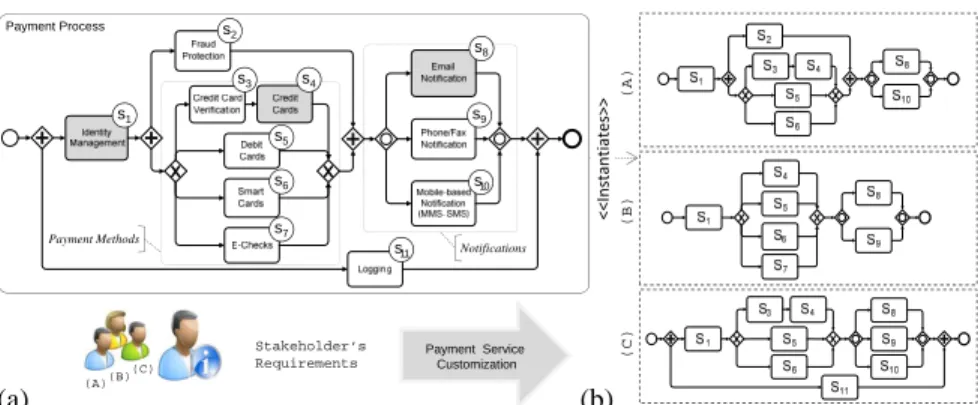
and deployed based on different business requirements of targeted stakeholders. Fig.1.(a) presents a service scenario of e-payment processes- part of a large prod-uct family that defines a common framework for online payment provided in online marketplace. For the simplicity, a high-level view of the payment process is repre-sented, and the details are omitted.
Different methods of online payment can be considered for different instances of products from a family. Therefore, the number of possible payment method vari-ations of a reference payment process, as a catalog and template, can be derived and customized according to the stakeholders’ requirements and business objec-tives. Some services are indispensable and prerequisite of the payment process (e.g., Credit Cardpayment feature as the dominant online payment), which should be included for all the stakeholders’ service product instance whereas some functional services (for exampleSmart Card e-CheckandDebit Card) or extra-functional services (for instance Logging and Monitoring) can be determined as optional that can be included or excluded based on stakeholders’ needs (See Fig.1.(b)). As a case in point,Stakeholder Amay require additional features for having highly-secured payment transactions, incorporating a fraud protection service, even though this service is not required in the payment process of the final customized portal for Stakeholder B. In another scenario,Stakeholder Ccould ask the payment process to be supported by aMobile-based Notificationservice in addition to the common payment notification services such as theMail-based Notification service. Therefore, in the context of a product family, a business process should be imposed inevitably by variants (optional and mandatory services) which are required
to be managed, specialized and customized in order to meet different stakeholders’ functional or quality requirements.
<<Instantiates>> (B) Payment Methods Notifications s1 s2 s3 s4 s5 s6 s7 s8 s9 Stakeholder’s Requirements Payment Service Customization (a) (A) (b) (B)(C) s10 Monitoring Non-functional Services
logging Data transformation s11 Payment Process (C) (A) Book chapter +
Fig. 1 a) A holistic view of e-Payment process family. b) e-Payment Process variants example
5 Applying SPLE for Development of Service-Oriented Software
Product Lines
It is already mentioned that even though SOA has been widely adopted, there are still no systematic methods to support modeling and managing variability during the development of SOA-based applications and further service management. , which calls for a well-defined development process and understanding variability in func-tional and non-funcfunc-tional requirements in the course of development.
This section outlines the activities of a proactive methodology. The proposed method is an extension of a traditional software product-line life-cycle in order to support development and customization of a family of SOA-based applications. The proposed top-down method follows a two-life-cycle approach that separates two core activities related toService-Domain EngineeringandService-Application En-gineering(See Figs. 2 and 6). Service-domain engineering constructs and evolves the reuse infrastructure by analyzing the requirements and scoping the product line as a whole and producing any common, reusable business processes and services. On the other hand, service-application engineering derives individual services (i.e., customized services) from the reference architecture. Domain and application en-gineering life-cycles can rely on fundamentally different processes, namely, plan-driven and agile methods. In the following, we describe the major activities and their artifacts for three major development phases: (1) analysis (requirement engi-neering), (2) design, and (3) implementation and testing.
5.1 Service-Domain Engineering
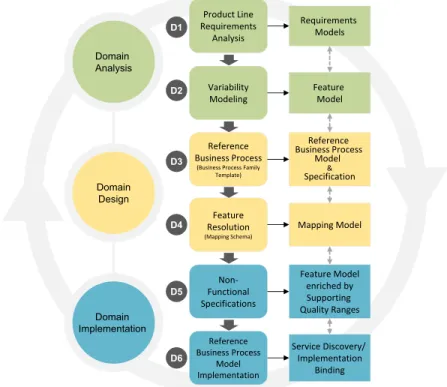
The overall service-domain engineering processes of an SOSPL is depicted in Fig. 2. These activities (D1-D6 in Fig. 2) are performed iteratively. Domain anal-ysis in SOSPL mainly encompasses product-line requirements engineering stage (D1) along with the analysis of variability by using feature modeling (D2). A fea-ture model, as software artifact outcome of the feafea-ture modeling process, include the knowledge of variability associated with the functional and non-functional re-quirements and describes the permissible configuration space further guiding the customization process and determining how the reference business process model should be tailored according to the stakeholders’ requirements in the application engineering life-cycle. During the domain design phase (D3), a reference business process model (also known as business process family) is designed and constructed for the product line architecture based upon the outcomes of the requirement engi-neering phase (D1). The model mapping (D4) establishes the mapping relationships between the features within the feature model and the corresponding activities speci-fied within the reference business process model. The activities of the reference busi-ness process are delegated to the service(s) in SOSPLs. Inasmuch as non-functional (quality) requirements may also vary for different stakeholders, variability in the quality properties of services should also be captured and specified during the con-struction of an SOSPL (D5). To this end, features in the feature model are annotated by quality ranges which are supported by the entire product line architecture pro-gressively helping service engineer and developers to evaluate the impact of variant features selected according to the quality characteristics that services provide [39]. In the final phase, the reference business process model is realized and implemented either by binding to the existing services or by developing new services. In the fol-lowing, we detail these activities.
5.1.1 Product Line Requirements Analysis:
Similar to traditional requirements engineering, domain requirements engineering should at least include the following activities [50]: 1)elicitation, in which the prod-uct line business goals and stakeholders’ requirements are discovered and scoped; 2) specifications, in which the requirements are analyzed in detail; 4)validation, in which the requirements are validated and consistency and completeness are checked, and 4)management, in which the requirements can be managed in terms of changes or refinements. In addition to these activities, domain requirements engi-neering captures commonality and variability between the requirements of several stakeholders. Moreover, an important activity of the requirements analysis of an SOSPL is to define the product line scope [13, 47, 43] and decide on the boundary of the product line.
A successful scoping which is determined by factors such as the knowledge of similar domain services and the future demands of stockholders is required to be performed carefully because a scope - either too large or too small - will impair the
capability of a SOSPL in achieving the goals of stockholders [12]. A goal-oriented domain analysis can be employed at the early stage of the requirement analysis in order to capture the product line goals for requirement elicitation and to further align the final service products with the business goals and intentions of both the stakeholders and service providers. This is accomplished at the different levels of abstraction by goal modeling about which interested readers can further read in [3]. The outcome of this phase is the requirements models which can be described by goal models, use-cases, documentations and details, which are used subsequently for the variability analysis of the product line under development.
Variability Modeling Feature Resolution (Mapping Schema) Reference Business Process
(Business Process Family
Template) Reference Business Process Model Implementation Non‐ Functional Specifications Product Line Requirements Analysis Requirements Models Feature Model Reference Business Process Model & Specification Service Discovery/ Implementation Binding Mapping Model Feature Model enriched by Supporting Quality Ranges Domain Implementation Domain Design Domain Analysis D1 D2 D3 D4 D5 D6
Fig. 2 Service-Domain Engineering of an Service-Oriented Software Product Line
5.1.2 Variability Analysis and Modeling:
The product line requirement engineering activity follows the variability analysis and modeling of the entire family in order to identify common and variable features. Afeatureis commonly defined as a visible incremental functionality and quality in software system(s) [28]. Nevertheless, depending on the stage of development
it may also refer to a requirement or a coarse-grained or fine-grained component in the system(s) which provide the required functionality from different technical views. The emphasis in the variability (i.e., feature) analysis is on optional features because optional features substantially differentiating one member of the family from the others.
In SOA, services constituting the orthogonal concept to the components notion, encapsulating functionality, and providing individual non-functional properties (i.e., QoS) through a well-described and published interfaces are characterized as build-ing blocks of software that are loosely-coupled. From this view in the context of SOSPL, we define a feature as an increment in service functionality [1], which re-flects stakeholders’ both functional and non-functional requirements. Therefore, a feature, based on the granularity levels, can be realized and associated to a com-posite service at the high-level business processes, or associated and realized by an atomic service at the lower-level.
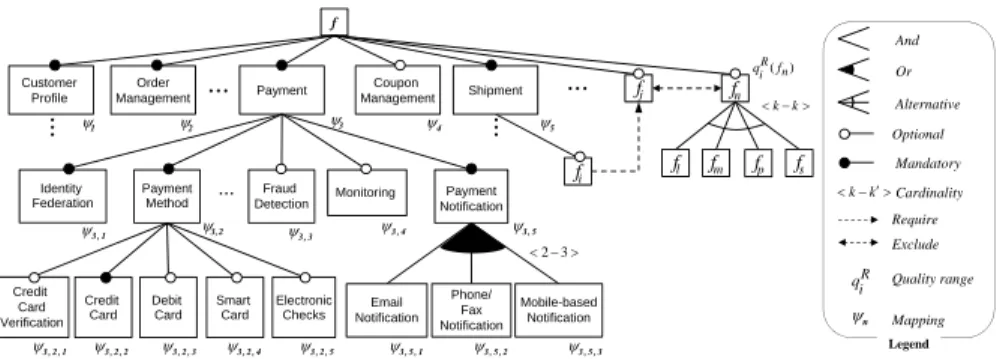
Feature-oriented development [28, 29, 16] is widely employed as a means for analysis, management, and visualization of commonality and variability in SPLE in terms of features at different abstraction levels. Feature modeling essentially or-ganizes features of a software product family into a model called feature model residing between the requirement model and the design specification model (i.e., the reference business process model described in Sec. 5.1.3). Fig.3 shows a part of a feature model representing the variants (namely optional and alternative fea-tures) that characterize a requirements model. These features are selected to derive service products during the application engineering. Moreover, this model serves as a catalog of the variability space offered by a product family to accommodate the idiosyncrasies of the stakeholder enterprise or company.
Feature Model:A feature model consists of both formal semantics and graphical representation (e.g., feature diagram) and encompasses the knowledge of configura-tion for a product line. A feature model is a hierarchical decomposiconfigura-tion of features in terms of parent-child relations on different levels of abstraction. Some of the features are not assumed to be present in every product during the application engi-neering, this differentiation is expressed by the indication of feature types and their relationships. Contrary to a mandatory feature always being selected if its parent is selected, an optional feature may or may not be selected. For instance, in Fig. 3, all the products should include theCredit Cardfeature as a mandatory feature. Other payment methods Fig. 3 are specified as optional features.
A feature cardinality and group cardinality can also be determined in cardinality-based feature modeling [17]. A cardinality defined as an interval, from zero to a given value and associated to a feature determines the lower and upper bound of the number of features required in any product in a product family. In the SOSPL context, this attribute specifies the number of service instances that should be linked to a given service at run time.
Or feature groupswith defined cardinality indicate that at leastkand at most k0features that can be included out of thenfeatures (k≤k0≤n) in a group if the parent is selected. Moreover, Alternative feature groupswith specified cardinality indicate that that onlykout ofnfeatures in the group must be included if the parent
is selected. Back to the simplified feature model example from Fig. 3, all the prod-ucts should include thePayment Notificationfeatures. Also, all the final derived service products should include at least two methods of notification according to the feature model.
Furthermore, because features are not always independent,integrity constraints (i.e., theincludes and excludes) can be defined over features of a feature model to model dependencies and relations which can exist among them. They are the means to describe that the presence of a certain feature in the product imposes the presence or exclusion of another feature (See Fig.3).
Payment Management Service + Customer Account Management Service
+
AND XOR OR (feature realization)Mapping
Fraud Detection Payment Notification Debit Card Smart Card Payment Method Credit Card Verification Payment Credit
Card NotificationEmail
Phone/ Fax Notification Mobile-based Notification Identity Federation 2 3 f ... And Or Alternative Optional Mandatory Cardinality Legend Require Exclude Electronic Checks Monitoring fi fj fn k k fm k k fl fp fs ... ... Customer Profile Order Management Coupon Management Shipment ... ( ) R n i q f R i q Quality range Mapping n 1 3 , 4 2 3 , 3 3 , 5 3 , 2 , 2 3 , 2 , 1 4 3 5 3 , 1 3 , 2 , 3 3 , 2 3 , 2 , 4 3 , 2 , 5 3 , 5 , 1 3 , 5 , 2 3 , 5 , 3 1 2 3 4 5 : n FMBP ... 3 , 3 3 , 4 3 , 5 3 , 2 , 1 3 , 1 3 , 2 , 2 3 , 2 , 3 3 , 2 , 4 3 , 2 , 5 3 , 5 , 1 3 , 5 , 2 3 , 5 , 3
Fig. 3 Feature model of e-Payment (conforming stakeholders’ requirements model)
Feature models are an efficient abstraction of variability derived from the domain and stakeholders’ requirements. They also help to derive the design and the devel-opment of variability through all the stages of the develdevel-opment including service identification and design, and further customization [13, 40].
In the feature-oriented analysis phase, which subsequently guides the identifica-tion of candidate services with right granularity, we organize feature based on the following criteria:
• Features supporting a particular business process can be grouped and abstracted as a higher-level feature on a coarse-grained level (e.g.,Payment)
• Features supporting specific functional or non-functional services can be grouped and abstracted as a higher-level feature (e.g., Payment Notification and Loggingservices)
• A feature which incrementally realizes a feature at the upper-level, subsequently becomes as a sub-feature at the lower-level
5.1.3 Reference Business Process Model:
The previous activities, domain decomposition, and top-down variability analysis and modeling provide an insight into product features of a target domain. A feature model is generated as an output of the domain analysis. This model, which is gener-ated as an output of the domain analysis, is then used to derive reference architecture and develop reusable components (business processes and services) in the course of the domain design. The design phase produces an architecture-interdependent model defining reference architecture as the behavioral model of features for the entire family and specifies how features are composed at run-time.
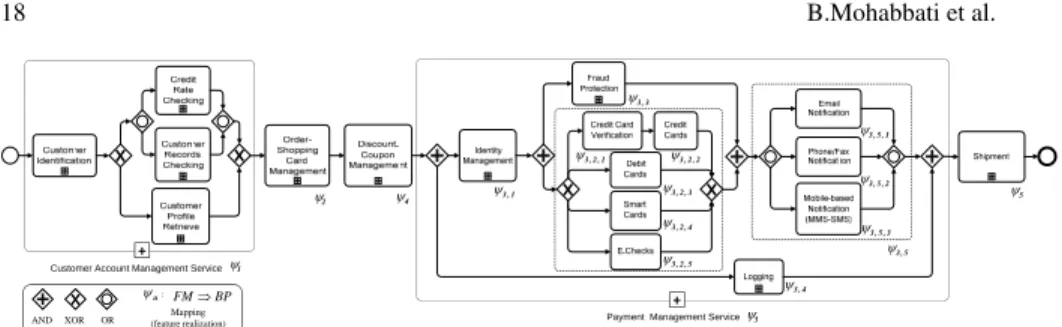
A template-based approach has been widely adopted in SPLE to create the ref-erence model. In the case of SOSPLs, such a refref-erence model is designed as a tem-plate for the entire service products family in a superimposed way [15]. A reference business process model, as a model template, describes and specifies the execu-tion sequence of services for all instances of the product line. That is, a reference business process model is a union of all the business processes of the product line and provides the common business logic for orchestration and choreography of ser-vices, which implement features. The reference model comprises functional inter-faces specifying services capabilities, pre and post conditions of the services, and configuration properties representing the data needed to configure a service before its use, and service bindings. The reference business process model can be modeled by using process-oriented modeling languages (e.g., BPMN, EPC, and/or YAWL), and incrementally refined and optimized. For example, Fig.4 illustrates a part of ref-erence business process model, where variability and configuration knowledge have been modeled and encapsulated in given feature model in Fig. 3.
The reference business process model configured through the selection/elimina-tion of features from the feature model during the applicaselection/elimina-tion engineering and exec-utive instances are derived (See Fig. 1.(b)). In other words, according to the fact that architectural variations in the reference model are encoded as features, various parts of the reference business process model are organized in variation points. These variation points are managed and configured by means of feature models. To point out the differences between design and runtime variability, it should be mentioned that feature models capture and encapsulate only architectural variability at design time. In contrast, business process models describe behavioral variability, i.e., how features are composed, which drives runtime variability through composition pat-terns (discussed in the next section).
Furthermore, feature model configuration (i.e., specialization and customization) is performed during the build time. The configuration can be done through the pro-cess of staged-configuration [18] where features further are prioritized and selected according to the (non-)functional requirements of the stakeholders [40]. All con-figured service products, which are instances of the family, have to conform to the reference architecture.
18 B.Mohabbati et al.
Payment Management Service + Customer Account Management Service
+
AND XOR OR (feature realization)Mapping
Fraud Detection Payment Notification Debit Card Smart Card Payment Method Credit Card Verification Payment Credit Card Email Notification Phone/ Fax Notification Mobile-based Notification Identity Federation 2 3 ... Or Alternative Optional Mandatory Cardinality Legend Require Exclude Electronic Checks Monitoring fi fj fn kk fm kk fl fp fs ... ... Customer Profile Order Management Coupon Management Shipment ... (n) i q f R i q Quality range Mapping n 1 3 , 4 2 3 , 3 3 , 5 3 , 2 , 2 3 , 2 , 1 4 3 5 3 , 1 3 , 2 , 3 3 , 2 3 , 2 , 4 3 , 2 , 5 3 , 5 , 1 3 , 5 , 2 3 , 5 , 3 1 2 3 4 5 : n FMBP ... 3 , 3 3 , 4 3 , 5 3 , 2 , 1 3 , 1 3 , 2 , 2 3 , 2 , 3 3 , 2 , 4 3 , 2 , 5 3 , 5 , 1 3 , 5 , 2 3 , 5 , 3
Fig. 4 A part of reference business process model
5.1.4 Feature Resolution and Mapping Model:
During the design phase, feature resolution is the analysis and connection of the feature model and the reference business process model in order to specify ex-plicit mapping links between the two models: feature and reference business process model, the outcome of which constitutes a mapping model including links between features in the feature model activities in the reference business model. This map-ping model enables configuration of the reference business process model through feature section during application engineering. From a certain point of view, this mapping model also provides the traceability links between the requirements and implementation [15, 49].
A mapping model can simply consist of boolean expressions specifying presence or removal of a modeling element (e.g., activity (abstract service)) in a model tem-plate (i.e., a reference business process model in our case) based on the selection of features in the feature model [15]. In our approach, we consider a boolean vari-ableψicorresponding to each feature fi. This approach usespresence conditions (PC) as annotation properties for each activity within the reference business process model. The PC of an activity is formulated as a boolean expression ofψivariables corresponding to the features mapped to the activity (See Fig. 3 and 4). Both the feature and activity constructs refer to model elements of feature models and ref-erence business process models. Thereby, when domain engineers map features to activities, the PCs of activities are defined. In application engineering, when a fea-ture fiare removed from the configuration, its correspondingψ variables are set to
false.
Feature resolution also helps to identify cross-cutting concerns related to general non-functional requirements. For example, featureMonitoringwith given mapping annotation ψi in Fig. 3 is mapped to activityMonitoring as an extra-functional abstract service in the reference business process model (see Fig. 4). Based on the selection of features from the feature model in application engineering, the reference business process model is configured (Fig. 1.(b)).
5.1.5 Non-functional Specifications:
The domain design phase is also followed by the specification of non-functional properties based on the non-functional requirements (NFRs) analysis because NFRs are interlaced and related to functional requirements. Variability in NFRs influences the SOSPL design and implementation. Non-functional variations often exhibit dif-ferent types and levels of quality properties (e.g., normal and strong authentication or security). For instance, NFRs for featureCredit Cardcan includecost, secu-rity, availabilityandreliabilityor they can also entail defined domain-specific non-functional aspects such asusabilityandconvenience of use. Furthermore, in applica-tion engineering, non-funcapplica-tional variaapplica-tions directly impact the selecapplica-tion of appropri-ate services from candidappropri-ate services, all of which provide equivalent functionalities even though with different degrees of non-functional properties related to the ser-vice quality specification. To this end, there are a number of proposals [7], in which feature models are extended to support feature attributes to comprise non-functional properties which can be measured (or to be measured) such as cost, availability, latency, bandwidth, etc).
Payment Email Notification Phone/ Fax Notification Mobile-based Notification 2 3 f 3 , 5 3 fi ... 3,5,1 ( ) R k q f S3(1) S3(2) .. . S3(10) S1(1) S1(2) .. . S1(5) S2(1) S2(2) .. . S2(8) 3,5,2 ( ) R k q f qkR(f3,5,3) Cost = [A-B] Availability = [%C-%D] Reliability = [%E-%F) Security = [%G-%H] ... ( 3,5,3) , R LB UB k k k q f q q ( ) R i k q f i 3,5 ( ) R k q f Payment Notification ... ...
Feature Model Business Process Model
3 , 5 ( ) , R LB UB k k k q f q q R k q Upper bound Lower bound Quality Range Service Set
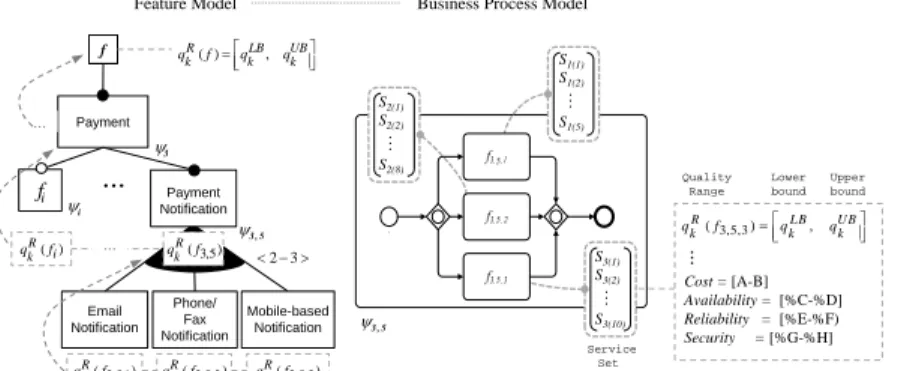
Fig. 5 Non-functional specification and aggregation for evaluating quality range supports by
prod-uct line architecture
In the context of SOSPL, these non-functional properties can be viewed as QoS properties, which are associated with each feature. Mapping models interconnecting feature and business process models enable propagation of quality property values of concrete service sets, bounded to activities (abstract services) within in the pro-cess model. Based on the underlying implementation of a set of functionally equiv-alent services, which may be available for each feature, ranges of values of quality properties can be further specified and aggregated for each feature. Particularly dur-ing the domain engineerdur-ing life-cycle, determindur-ing the implied QoS ranges for indi-vidual feature helps domain engineers ensure that the product line architecture will fulfill and deliver the upper and lower bounds of the values of the quality require-ments requested by the stakeholders. Moreover, quality range computation enables for keeping track of the product line quality ranges even after the specification of the
service quality has changed. For example, in Fig. 5, sets of candidate services pro-vide different range of quality, denoted asqR, for each features. The range of thekth quality property for feature fican be hierarchically computed. In [39], we introduce a generic evaluation model and method for aggregation and computation of ranges of quantified values of quality properties defined for product line architectures.
5.1.6 Reference Business Process Model Implementation:
The domain design phase produces a reference business process model and archi-tecture for a family of service products (i.e, SOSPL). In the domain implementation and realization, the reference business process model is realized and implemented, which involves implementing and testing the detailed architecture of the family modeled by reference model. Abstract services specified by the reference business process model are implemented using component models such as Java class, Enter-prise Java Beans, or .Net components. However, some of the services needed for the implementation might already be available; for instance, it can either be found in service catalog or retrieved through a service discovery process, and some of the services could potentially be built by partly reusing or modifying existing solutions.
5.2 Service-Application Engineering
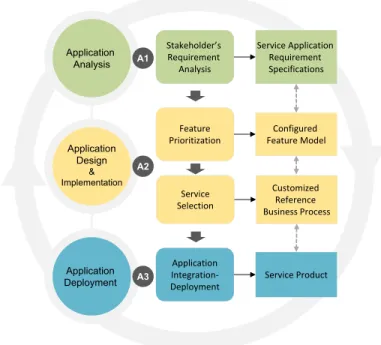
This section describes a holistic view to the application engineering life-cycle which includes the major phases of service customization and derivation from the business process family. Regardless of the chosen variability modeling approach, the ultimate of in-service-application engineering is to employ the variability defined in domain engineering by selecting shared assets similarly developed in domain engineering. Fig. 6 depicts a high-level application engineering process which starts with the elicitation and capturing of both the functional and non-functional requirements of an individual stakeholder through the phase of application-requirements analysis (A1). In the application design phase (A2), features are prioritized based on the stakeholder’s captured preferences and business objectives concerning the optional features and quality needs. Thereafter, the feature model is specialized through the decision-making process of selecting optional features. Subsequently, the reference business process model is configured and corresponding services are selected and bound in the deployment and integration phase (A3). The details of these application engineering phases can be found in [40].
Feature Prioritization Application Integration‐ Deployment Stakeholder’s Requirement Analysis Service Application Requirement Specifications Configured Feature Model Service Product Application Deployment Application Design & Implementation Application Analysis A1 A2 A3 Service Selection Customized Reference Business Process
Fig. 6 Application Engineering of an Service-Oriented Software Product Line
5.2.1 Application Analysis:
This phase focuses on the elicitation of requirements of a particular stakeholder to derive customized process variants, which can be deployed as the final product. The preferences of the stakeholder are captured and later utilized for feature prioritiza-tion and selecprioritiza-tion. Similar to the requirements engineering phase in service engi-neering methodologies like SOMA [2], activities in the application analysis phase capture requirements for a single service (application); however, the application analysis activities reuse the family requirements models to develop requirements models of a target service. For example, assuming a family requirement model is represented in a goal model, the service goal model is developed through reasoning on the family goal model based on the inputs of current stakeholders [3, 60]. Val-idation and verification of the application requirements model with respect to the stakeholder’s needs and product line constraints are performed. In the context of marketplace portals, stakeholders of a target service application may request pay-ment, shippay-ment, order managepay-ment, and manage customer functionalities as well as high security and low cost. The detail of stakeholders requirements can be achieved by applying label propagation algorithms on the marketplace family goal model.
5.2.2 Application Design and Implementation:
During this phase, the feature model is utilized to manage and select variants con-stituting service product instances. This is accomplished through the feature pri-oritization and selection of sub-processes. This activity includes the selection of the best and permissible combination of optional features along with the selection of the corresponding services that would optimally satisfy the stakeholder’s func-tional and non-funcfunc-tional requirements. Several automatic or semi-automatic and manual feature model configuration techniques have been proposed to guide the fi-nal product configuration (i.e., customization) according to the requirements and preferences of stakeholders. Automatic configuration approaches employ AI opti-mization techniques such as Genetic Algorithms (GAs), Bayesian Belief Networks, and Constraint Satisfaction Optimization Problem (CSOP) to create the final cus-tomized product [7]. On the other hand, manual configuration techniques through staged-configuration [18] provide specialization steps for service engineers and help them resolve variability in the process of family customization (see Sec. 6). After configuring the feature model, due to the established mappings between the feature model and the reference business process model, a concrete business process for a target service-oriented application and its realizations are derived from the fam-ily design and implementation models. However, since there may be some require-ments which could not be satisfied by existing assets (i.e., services) contained in the developed SOSPL architecture, further refinement of instantiated service prod-ucts from the reference model can be performed, and new required services can be implemented. In our running example, according to the requirements of the current application derived in the previous stage, application engineers can configure mar-ketplace feature model and derive a business process model for the service-oriented application under development. Also, proper services based on the requested quality of services (e.g., high security and low cost) are selected.
5.2.3 Application Deployment:
This phase focuses on creating an executable business process and deployment of the customized services in the production environment after validating the cus-tomized services against the application requirement specification. After the deploy-ment of the final service product on to the stakeholders’ environdeploy-ment, the execution of the customized services is monitored to ensure the compliance of the service execution to stakeholders’ requirements and any service level agreements.
6 Discussion
The development, management and evolution of many modern software systems rely on the notion of variability and suitable design techniques. SPLE research
has devoted a considerable amount of resources to the development of various ap-proaches to deal with variability analysis, modeling, management, customization and related challenges over the last decade. These approaches can be employed in the design and development of variant-rich service-oriented applications (referred to as SOSPLs in this chapter).
Feature-oriented analysis is a means to create variability in services at different levels of abstraction and to subsequently make the managing and customizing it possible. Variability can be considered in terms of four different general levels of abstractions in service-oriented development [45]: requirements, business process models, service interface model and service component. In that sense, variability at a lower-level of abstraction realizes variability at a higher level. As described earlier in the chapter, we leveraged feature modeling for managing variability by focus-ing on the requirements and business processes at the higher levels of abstraction. However, feature models can also be employed to model, represent and manage variability at the levels of service components and interface to support efficient ser-vice management. For instance, in [21], Fantinato et al. employed feature modeling to manage and enable customization in service contracts.
Nguyen et al. [41] propose a feature-based service customization framework to model and manage variability of complex Web service specifications. The proposed approach employed feature models as an extension to service description artifacts in order to facilitate the customization of service interfaces. In [42], the same authors adopt a feature-oriented approach to model variability in process-based service com-positions and to enable process customization. The approach extends the BPMN 2.0 metamodel to allow for defining variation points and variants within business pro-cess models. The extension is focused on modeling variability of three aspect of business process: control flow, data flow, and message flow. A variation point in a control flow is interpreted as any location in a process model at which different execution paths can take place, and variants can be arbitrary process fragments. Variability in data flow is considered as a different way for storing data objects. Variability in message flow is identified as alternative conversations and interactions between two parties, i.e., the process and a partner service (or a consumer).
Koning et al. [31] investigate how variability can be incorporated into service-based systems in order to enable variability modeling and management. They de-scribe how variability management helps to support run-time reconfiguration of systems by service replacement corresponding to the non-functional requirements of stakeholders. VxBPEL is proposed as an extension of Business Process Execu-tion Language (BPEL) to the process descripExecu-tion and definiExecu-tion. VxBPEL allows for run-time variability and variability management in Web service-based systems. Variability information is defined in-line with the process definition. VxBPEL builds upon COVAMOF [48], a framework to model variability.Koning et al. note that the architectural modeling and management of variability in Web service-based systems provides the following advantages: enhancing the extensibility of systems through service replacement, improving run-time flexibility to configure and rebind services (e.g., being able to optimize quality through reconfiguration).
As already mentioned, improving reusability in service-oriented development is an often-stated goal in the literature. There are a number of important concerns that can influence highly-important analysis and design decision for the quality of service design. The major concerns include analysis and design for service reuse, service granularity management, and design of composable service [45]. Hence, it is a demanding feat to develop service-oriented systems such as how to identify reusable services at the right level of granularity to facilitate service composition and in turn, testifying that the identification of service candidate is a challenging task in service engineering [2, 45]. SPL approaches can be adopted to consolidate design principles and service identification during the course of service engineering. Lee et al. [37] present a feature-oriented approach to the analysis, identification and development in order to improve reusability of service-based systems. The pro-posed approach provides guidelines about how to address the key issue of granular-ity and orchestration of services by using feature models. They show how reusable service can be identified and specified based on software features. The proposed method is based on analysis of features that may vary from a user’s point of view and will be subject to reconfigurations at runtime. Another approach to using feature-oriented analysis for service identification during the analysis and design phases is proposed by Chen et al. [10]. They focus on re-engineering towards service-oriented systems and the remark of whom that feature-oriented analysis bridges the gap be-tween the abstract architectural and source code level, whereas business processes are excluded.
Service-Oriented Modeling and Architecture (SOMA) proposed by IBM [2] has been developed as a generic development method for SOA-based applications. SOMA provides the guidelines for identification and specialization of services that realize and implement business processes through service composition. The authors of SOMA remarks that variability analysis in the practical SOA solution design is crucial for the initial finding-binding relationships between a service consumer (i.e., stakeholder) and a service provider. Moreover, it was noted that the publishing and discovery of relationships are often affected by variations, which are identified later in the design process. Hence, such variations may cause expensive fundamental re-design of SOA-based solutions [2]. To address this problem, the authors remark that a development life-cycle for SOA-based solutions should be extended by a variation-oriented analysis as an extra dimension that should be performed.
7 Conclusion
We can observe that the convergence of service-oriented and software product line engineering is gaining a considerable amount of attention and rapidly emerging as a viable and important software development paradigm. As we have discussed in this chapter, they both share common goals and promises to collaborate in the de-velopment of flexible, cost-effective software systems and to support a high level of reuse. Yet, their main goals are somewhat different. In this chapter, we discussed