Neural Network of C. Elegans as a Step Towards Understanding More
Complex Brain Processes
Marek Dobeš, Institute of Social Sciences, Slovak Academy of Sciences, Košice, [email protected]
DOBEŠ, Marek. Neural Network of C. Elegans as a Step Towards Understanding More Complex Brain Processes. Individual and Society, 2013, Vol. 16, No. 1.
Study provides a starting point for computational modeling of the dynamics of C. elegans neural network. It lists basic structural properties of the network together with a simple example of modeling dynamics. It discusses some obstacles in modeling biologically realistic phenomena and speculates about how study of simpler organisms can help us in understanding more complex brains.
Neural network. C. elegans. Brain.
Introduction
The Blue Brain Project funded by the EU and the upcoming US initiative Brain Activity Map both aim at better understanding of the human brain. Although there are great advances in studying structural characteristics of human brain, the dynamics of its action is still very poorly understood. One approach to understand better what is going on in a human brain is to study the brains or nervous systems of other species that are less complex.
Nematode C. elegans is an organism well suited for this task. Its nervous system comprises 302 neurons (hermaphrodite) and its connectome has been established by a hallmark work of White et al. (1986). Although very simple compared to even a brain of flies (drosophila melanogaster has more than 100 000 neurons), we still do not understand its dynamics. Therefore the first step towards understanding processes in more advanced brains could be first understand what is going on in the nervous system of c. elegans.
Study of activity of nervous systems is closely tied with genetics. Brain activity depends on properties of neurons and synapses such as number and permeability of ion channels, type of neurotransmitter used, etc. All these are in turn determined by a genetic makeup of a neuron and its interactions with surrounding environment. C. elegans has more than 22000 known protein-coding genes (Spieth, Lawson, 2006), its genome is fairly well mapped, which is another reason for it to be a suitable test organism.
Neural network of C. elegans consists of 302 neurons that fall into 118 distinct morphological classes (Hobert, 2010). There are more than 6000 synapses, both chemical and electrical. Studies show, for example, that a single sensory neuron expresses 14 different neurotransmitter receptors and 10 neuropeptides (Etchberger et al., 2007 in Hobert, 2010). Dynamics of the network
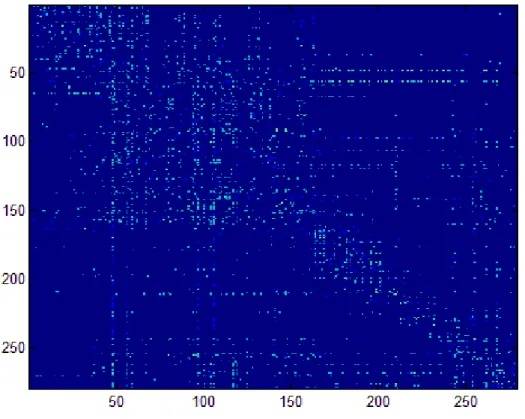
When we want to study dynamics of C. elegans (or some other biological) neural network, we need to take into account that there are different mechanisms underlying transmission of a signal using chemical and electrical synapses. We may view the network as consisting of two interacting subnetworks. Figure 1 shows how chemical and electrical synapses overlap.
Figure 1: Adjacency matrix of connections between C. elegans neurons. Light blue – chemical synapses, dark blue – electrical synapses, green – both chemical and electrical synapses. Figure created using data from Varshney et al. (2011).
Property that is often studied in networks is the distribution of inbound and outbound connections. In most biological networks (whether gene regulatory networks, metabolic or signaling networks, neurons in a human brain) their distribution follows the power law. We can see in figures 2 and 3 that this also holds true for c. elegans neural network.
Figure 2: Histogram of distribution of inbound connections of C. elegans neurons. Figure created using data from Varshney et al. (2011).
Figure 3: Histogram of distribution of outbound connections of C. elegans neurons. Figure created using data from Varshney et al. (2011).
In theory, dynamics of chemical synapses can be studied using differential equations that take into account changes in electrical current and voltages that drive action potentials that serve as a mean of communication between neurons. Dynamics of electrical synapses is easier to model using linear equations as currents flowing through electrical synapses seem to follow the Ohm law.
In practice, however, we still miss many important parameters of the system. We need to establish what synapses are excitatory and what inhibitory, what neurons are intrinsicaly bursting, what is the capacitance of neurons, coupling ratios of electrical synapses, etc.
To provide a simple example of a simulation, we modeled dynamics of C. elegans chemical synapses. We used data on strengths of chemical synapses from Varshney et al. (2011). To decide about excitatory or inhibitory nature of synapses we used data from McIntire et al. (1993). We assumed GABAergic synapses to be inhibitory and rest of the synapses to be excitatory. We understand this to be a simplification, however, no complete description of modality of synapses is yet available.
To model the dynamics we used differential equation dV/dt = -(V-Vrp)/tau
where Vrp is the resting potential (-55 mV), tau a membrane time constant (100 ms). We set spike threshold to -50 mV and reset value to -60 mV. We used Brian neural simulator under Python (Goodman, Brette, 2009).
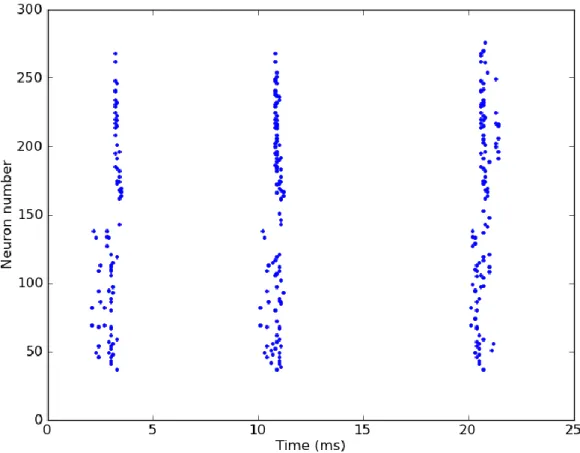
First, we activated the network using 20 mV input to AWCL and AWCR sensory neurons at times 2 ms, 2.6 ms, 3 ms, 10 ms and 20 ms. We can see from figure 4 that the activity spreaded but quickly died away.
Figure 4: Raster plot of activity of 279 C. elegans neurons after input to AWCL and AWCR neurons.
Then we activated the network using 20 mV input to AVAL and AVAR interneurons at times 2 ms, 2.6 ms, 3 ms, 10 ms and 20 ms. We can see from figure 5 that the activity spreaded but quickly died away.
Figure 5: Raster plot of activity of 279 C. elegans neurons after input to AVAL and AVAR neurons.
The results were suprising as sensory neurons are substantially less connected than interneurons. However, spike patterns they activated were very similar. The results suggest that to obtain sustained activity in the network, ensembles of neurons should be active at the same time.
Conclusion
We are still very far away from understanding the workings of a mammalian brain on the level of individual neurons. To approach this problem, study of nervous systems of simpler organisms may be the first step. Even then, dynamics of such neural networks is still difficult to elucidate. We need more biological data together with better mathematical models to understand all the interactions that are happening in real-life neural networks. However, basic principles seem to be the same across species – workings of a neuron, basic structural properties of neural networks and dynamics of interactions among neurons. We tried to provide some basic facts that can help us start modeling the dynamics of C. elegans neural network in silico and start collecting first bits of knowledge that will enable us to understand the big picture of workings of more complex brains.
Neurónová sieť C. Elegans ako predpoklad porozumenia zložitejším procesom v mozgu
Článok popisuje možnosti modelovania neuronálnych procesov na základe dostupných údajov o konektóme c. elegans. Uvádza jednoduché príklady toho, ako môžeme pomocou počítačového modelovania získať vhľad do fungovania interakcií v neurónových sieťach živých organizmov.
Literature:
GOODMAN, D. F. – BRETTE, R. (2009). The Brian simulator. Front Neurosci. doi:10.3389/neuro.01.026.2009.
HOBERT, O. Neurogenesis in the nematode Caenorhabditis elegans (October 4, 2010), WormBook, ed. The C. elegans Research Community, WormBook, doi/10.1895/wormbook.1.12.2, http://www.wormbook.org.
MCINTIRE S. L. – JORGENSEN, E. – KAPLAN, J. – HORVITZ, H. R. (1993). The GABAergic nervous system of Caenorhabditis elegans. Nature 364, 337-341.
SPIETH, J. – LAWSON, D. Overview of gene structure (January 18, 2006), WormBook, ed. The C. elegans Research Community, WormBook, doi/10.1895/wormbook.1.65.1, http://www.wormbook.org.
VARSHNEY, L. R. et al. (2011). Structural Properties of the Caenorhabditis elegans Neuronal Network. PLoS Computational Biology, 7, 2.
WHITE, J. G. – SOUTHGATE, E. – THOMSON, J. N. – BRENNER, S. (1986). The structure of the nervous system of the nematode Caenorhabditis elegans. Philos. Trans. R. Soc. Lond. B Biol. Sci. 314: 1-340.