CPRI Specification V6.0
(2013-08-30)
Interface SpecificationCommon Public Radio Interface (CPRI);
Interface Specification
The CPRI specification has been developed by Ericsson AB, Huawei Technologies Co. Ltd, NEC Corporation, Alcatel Lucent and Nokia Siemens Networks GmbH & Co. KG (the “Parties”) and may be updated from time to time. Further information about CPRI, and the latest specification, may be found at http://www.cpri.info
BY USING THE CPRI SPECIFICATION, YOU ACCEPT THE “Interface Specification Download Terms and Conditions” FOUND AT
http://www.cpri.info/spec.html
IN ORDER TO AVOID ANY DOUBT, BY DOWNLOADING AND/OR USING THE CPRI SPECIFICATION NO EXPRESS OR IMPLIED LICENSE AND/OR ANY OTHER RIGHTS WHATSOEVER ARE GRANTED FROM ANYBODY.
© 2013 Ericsson AB, Huawei Technologies Co. Ltd, NEC Corporation, Alcatel Lucent, and Nokia Siemens Networks GmbH & Co. KG. .
Table of Contents
1.
Introduction ... 5
2.
System Description ... 7
2.1.
Definitions/Nomenclature ... 7
2.2.
System Architecture ... 10
2.3.
Reference Configurations ... 12
2.4.
Functional Description ... 14
2.4.1.
Radio Functionality ... 14
2.4.2.
CPRI Control Functionality ... 16
3.
Interface Baseline ... 17
3.1.
Supported Radio Standards ... 17
3.2.
Operating Range ... 17
3.3.
Topology/Switching/Multiplexing... 17
3.4.
Bandwidth/Capacity/Scalability ... 19
3.4.1.
Capacity in terms of Antenna-Carriers ... 19
3.4.2.
Required U-plane IQ Sample Widths ... 20
3.4.3.
Required C&M-plane Bit Rate ... 21
3.4.4.
Required Real-Time Vendor Specific Bits ... 21
3.5.
Synchronization/Timing ... 21
3.5.1.
Frequency Synchronization ... 21
3.5.2.
Frame Timing Information ... 22
3.5.3.
Link Timing Accuracy ... 23
3.5.4.
Round Trip Delay Accuracy ... 24
3.5.5.
Accuracy of TDD Tx-Rx switching point ... 24
3.6.
Delay Calibration ... 24
3.6.1.
Round Trip Cable Delay per Link ... 24
3.6.2.
Round Trip Delay of a Multi-hop Connection ... 25
3.7.
Link Maintenance ... 25
3.8.
Quality of Service ... 26
3.8.1.
Maximum Delay ... 26
3.8.2.
Bit Error Ratio U-plane ... 26
3.8.3.
Bit Error Ratio C&M-plane ... 27
3.8.4.
CPRI Link Quality Monitoring ... 27
3.9.
Start-up Requirement... 27
3.9.1.
Clock Start-up Time Requirement ... 27
3.9.2.
Plug and Play Requirement ... 27
4.
Interface Specification ... 29
4.1.
Protocol Overview ... 29
4.2.
Physical Layer (Layer 1) Specification ... 30
4.2.1.
Line Bit Rate ... 30
4.2.2.
Physical Layer Modes ... 30
4.2.3.
Electrical Interface ... 32
4.2.4.
Optical Interface ... 32
4.2.5.
Line Coding ... 32
4.2.6.
Bit Error Correction/Detection ... 32
4.2.7.
Frame Structure ... 33
4.2.8.
Synchronization and Timing ... 61
4.2.9.
Link Delay Accuracy and Cable Delay Calibration ... 62
4.2.10.
Link Maintenance of Physical Layer ... 65
4.3.1.
Layer 2 Framing ... 71
4.3.2.
Media Access Control/Data Mapping ... 71
4.3.3.
Flow Control ... 71
4.3.4.
Control Data Protection/ Retransmission Mechanism ... 72
4.4.
Data Link Layer (Layer 2) Specification for Fast C&M Channel ... 72
4.4.1.
Layer 2 Framing ... 72
4.4.2.
Media Access Control/Data Mapping ... 73
4.4.3.
Flow Control ... 75
4.4.4.
Control Data Protection/ Retransmission Mechanism ... 75
4.5.
Start-up Sequence ... 75
4.5.1.
General ... 75
4.5.2.
Layer 1 Start-up Timer ... 76
4.5.3.
State Description ... 77
4.5.4.
Transition Description ... 81
5.
Interoperability ... 84
5.1.
Forward and Backward Compatibility ... 84
5.1.1.
Fixing Minimum Control Information Position in CPRI Frame
Structure ... 84
5.1.2.
Reserved Bandwidth within CPRI ... 84
5.1.3.
Version Number ... 84
5.1.4.
Specification Release Version mapping into CPRI Frame ... 84
5.2.
Compliance ... 85
6.
Annex ... 86
6.1.
Delay Calibration Example (Informative) ... 86
6.2.
Electrical Physical Layer Specification (Informative) ... 89
6.2.1.
Overlapping Rate and Technologies ... 89
6.2.2.
Signal Definition ... 90
6.2.3.
Eye Diagram and Jitter ... 90
6.2.4.
Reference Test Points ... 91
6.2.5.
Cable and Connector ... 91
6.2.6.
Impedance ... 91
6.2.7.
AC Coupling ... 91
6.2.8.
TX Performances ... 92
6.2.9.
Receiver Performances ... 97
6.2.10.
Measurement Procedure ... 100
6.3.
Networking (Informative) ... 101
6.3.1.
Concepts ... 101
6.3.2.
Reception and Transmission of SAP
CMby the RE ... 101
6.3.3.
Reception and Transmission of SAP
IQby the RE ... 102
6.3.4.
Reception and Distribution of SAP
Sby the RE ... 102
6.3.5.
Reception and Transmission of CPRI Layer 1 Signalling by the
RE ... 102
6.3.6.
Bit Rate Conversion ... 102
6.3.7.
More than one REC in a radio base station ... 102
6.3.8.
The REC as a Networking Element ... 103
6.4.
E-UTRA sampling rates (Informative) ... 103
6.5.
Scrambling (Normative) ... 103
6.5.1.
Transmitter ... 104
6.5.2.
Receiver ... 107
6.6.
GSM sampling rates (Informative) ... 107
6.7.1.
64B/66B Supported format ... 108
6.7.2.
Control block format with Terminate Control Character ... 108
6.7.3.
Control block format with Start Control Character ... 109
6.7.4.
Data Block Format ... 110
6.7.5.
64B/66B Scrambling ... 111
6.8.
Additions to line bit rate auto-negotiation (informative) ... 111
6.8.1.
General recommendation for line bit rate auto-negotiation... 111
6.8.2.
Situation with more than 4 line bit rates for initial start-up ... 111
7.
List of Abbreviations ... 113
8.
References ... 116
1. Introduction
The Common Public Radio Interface (CPRI) is an industry cooperation aimed at defining a publicly available specification for the key internal interface of radio base stations between the Radio Equipment Control (REC) and the Radio Equipment (RE). The parties cooperating to define the specification are Ericsson AB, Huawei Technologies Co. Ltd, NEC Corporation, Alcatel Lucent and Nokia Siemens Networks GmbH & Co. KG.
Motivation for CPRI:
The CPRI specification enables flexible and efficient product differentiation for radio base stations and independent technology evolution for Radio Equipment (RE) and Radio Equipment Control (REC).
Scope of Specification:
The necessary items for transport, connectivity and control are included in the specification. This includes User Plane data, Control and Management Plane transport mechanisms, and means for synchronization. A focus has been put on hardware dependent layers (layer 1 and layer 2). This ensures independent technology evolution (on both sides of the interface), with a limited need for hardware adaptation. In addition, product differentiation in terms of functionality, management, and characteristics is not limited.
With a clear focus on layer 1 and layer 2 the scope of the CPRI specification is restricted to the link interface only, which is basically a point to point interface. Such a link shall have all the features necessary to enable a simple and robust usage of any given REC/RE network topology, including a direct interconnection of multi-port REs.
Redundancy mechanisms are not described in the CPRI specification, however all the necessary features to support redundancy, especially in system architectures providing redundant physical interconnections (e.g. rings) are defined.
The specification has the following scope (with reference to Figure 1):
1. A digitized and serial internal radio base station interface that establishes a connection between ‘Radio Equipment Control’ (REC) and ‘Radio Equipment’ (RE) enabling single-hop and multi-hop topologies is specified.1
2. Three different information flows (User Plane data, Control and Management Plane data, and Synchronization Plane data) are multiplexed over the interface.
3. The specification covers layers 1 and 2.
3a. The physical layer (layer 1) supports both an electrical interface (e.g., what is used in traditional radio base stations), and an optical interface (e.g. for radio base stations with remote radio equipment).
3b. Layer 2 supports flexibility and scalability.
Figure 1: System and Interface Definition
1 The CPRI specification may be used for any internal radio base station interface that carries the information flows mentioned in the
scope of point 2.
Radio Equipment (RE)
Radio Equipment Control (REC)
Layer 1 Layer 2 Control & Mgmt. User Sync. Air Interface Network Interface
DigitizedRadio Base Station InternalInterfaceSpecification
Layer 1 Layer 2 Control & Mgmt. User Sync.
2. System Description
This chapter describes the CPRI related parts of the basic radio base station system architecture and defines the mapping of the functions onto the different subsystems. Furthermore, the reference configurations and the basic nomenclature used in the following chapters are defined.
The following description is based on the UMTS (Universal Mobile Telecommunication System), WiMAX Forum Mobile System Profile [11] based on IEEE Std 802.16-2009 [13], Evolved UMTS Terrestrial Radio Access (E-UTRA), and GSM. However, the interface may also be used for other radio standards.
2.1. Definitions/Nomenclature
This section provides the basic nomenclature that is used in the following chapters.
Subsystems:
The radio base station system is composed of two basic subsystems, the radio equipment control and the radio equipment (see Figure 1). The radio equipment control and the radio equipment are described in the following chapter.
Node:
The subsystems REC and RE are also called nodes, when either an REC or an RE is meant. The Radio Base Station system shall contain at least two nodes, at least one of each type; REC and RE.
Protocol layers:
This specification defines the protocols for the physical layer (layer 1) and the data link layer (layer 2). Layer 1 defines:
• Electrical characteristics • Optical characteristics
• Time division multiplexing of the different data flows • Low level signalling
Layer 2 defines:
• Media access control • Flow control
• Data protection of the control and management information flow
Protocol data planes:
The following data flows are discerned:
Control Plane: Control data flow used for call processing.
Management Plane: This data is management information for the operation, administration and maintenance of the CPRI link and the nodes.
User Plane: Data that has to be transferred from the radio base station to the mobile station and vice versa.
Synchronization: Data flow which transfers synchronization and timing information between nodes. The control plane and management plane are mapped to a Service Access Point SAPCM as described below. User plane data:
• For base stations with a functional decomposition according to section 2.4, the user plane data is transported in the form of IQ data. Several IQ data flows are sent via one physical CPRI link. Each IQ data flow reflects the data of one antenna for one carrier, the so-called antenna-carrier (AxC). • For base stations with a functional decomposition different from section 2.4, the user plane data may
Antenna-carrier (AxC):
One antenna-carrier is the amount of digital baseband (IQ) U-plane data necessary for either reception or transmission of only one carrier at one independent antenna element.
Control data stream for Antenna Carrier (Ctrl_AxC):
A Ctrl_AxC designates one AxC specific control data stream. Two bytes per hyperframe are reserved for each Ctrl_AxC as shown in section 4.2.7.10. For CPRI line bit rate option 1 (614.4 Mbps) in total eight Ctrl_AxCs are available while for higher line bit rates this number increases proportionally. The mapping of Ctrl_AxCs with number Ctrl_AxC# to AxCs as well as the actual content of the control data bytes are not defined in CPRI but are vendor specific.
Antenna-carrier (AxC) Group:
An AxC Group is an aggregation of NA AxC with the same sample rate, the same sample width, the same
destination SAPIQ, and the same radio frame length. In case of NA=1 an AxC Group is the same as an AxC. AxC Container:
An AxC Container is a sub-part of the IQ data block of one basic frame. The size of an AxC Container is always an even number of bits. The mapping of AxC Containers into the basic frame is specified in section 4.2.7.2.3.
• For base stations with a functional decomposition according to section 2.4 the content of AxC Containers is defined below:
• An AxC Container for UTRA-FDD contains the IQ samples of one AxC for the duration of one UMTS chip.
• An AxC Container for WiMAX contains IQ sample bits of one AxC and sometimes also stuffing bits.
• An AxC Container for E-UTRA contains one or more IQ samples for the duration of one UMTS chip or it contains IQ sample bits and sometimes also stuffing bits.
• An AxC Container for GSM contains IQ sample bits of one AxC and sometimes also stuffing bits. • For base stations with a functional decomposition different from section 2.4 an AxC Container
contains user plane data that may not be IQ data. This means that the content, the format and the mapping of user plane data within the AxC Container are vendor specific and are not further specified within this specification. In this case an AxC Container does not necessarily relate to one AxC. The term “AxC Container” is used here for simplicity reasons, since the same rules for the size and the mapping into the basic frame apply.
AxC Container Group:
An AxC Container Group is an aggregation of NC AxC Containers containing IQ samples for an AxC Group in one basic frame. NC is defined in section 4.2.7.2.7.
AxC Symbol Block:
An AxC Symbol Block is an aggregation in time of NSAM IQ samples for one WiMAX symbol plus NS_SYM
stuffing bits. NSAM and NS_SYM are defined in section 4.2.7.2.6. AxC Container Block:
An AxC Container Block is an aggregation in time of KAxC Container Groups or an aggregation in time of NSYM AxC Symbol Blocks plus NS_FRM stuffing bits. It contains S IQ samples per AxC plus stuffing bits. K
and S are defined in section 4.2.7.2. NSYM and NS_FRM are defined in section 4.2.7.2.6. Service Access Points:
For all protocol data planes, layer 2 service access points are defined that are used as reference points for performance measurements. These service access points are denoted as SAPCM, SAPS and SAPIQ as
illustrated in Figure 2. A service access point is defined on a per link basis.
Stuffing bits:
Stuffing bits are used for alignment of WiMAX/E-UTRA sample frequencies to the basic frame frequency. Stuffing bits are also sent in TDD mode during time intervals when there is no IQ data to be sent over CPRI. The content of stuffing bits is vendor specific (“v”).
Stuffing samples:
If the total sampling rate per AxC Group is not the integer multiple of the CPRI basic frame rate (3.84MHz), then stuffing samples are added to make the total sampling rate the integer multiple of the CPRI basic frame rate. Stuffing samples are filled with vendor specific bits (“v”).
Link:
The term “link” is used to indicate the bidirectional interface in between two directly connected ports, either between REC and RE, or between two nodes, using one transmission line per direction. A working link consists of a master port, a bidirectional cable, and a slave port.
Master/master and slave/slave links are not covered by this specification (for the definition of master and slave see below).
Passive Link:
A passive link does not support any C&M channel, i.e. it carries only IQ data and synchronization information. It may be used for capacity expansion or redundancy purposes, or for any other internal interfaces in a radio base station.
Hop:
A “hop” is the aggregation of all links directly connecting two nodes.
Multi-hop connection:
A “multi-hop connection” is composed of a set of continuously connected hops starting from the REC and ending at a particular RE including nodes in between.
Logical connection:
A “logical connection” defines the interconnection between a particular SAP (e.g., SAPCM) belonging to a port
of the REC and the corresponding peer SAP (e.g., SAPCM) belonging to a port of one particular RE and
builds upon a single hop, or a multi-hop connection, between the REC and that particular RE. Logical connections for C&M data, user plane data and synchronization can be distinguished.
Master port and slave port:
Each link connects two ports which have asymmetrical functions and roles: a master and a slave. This is implicitly defined in CPRI release 1 with the master port in the REC and the slave port in the RE. This master/slave role split is true for the following set of flows of the interface:
• Synchronization
• C&M channel negotiation during start-up sequence • Reset indication
• Start-up sequence
Such a definition allows the reuse of the main characteristic of the CPRI release 1 specification, where each link is defined with one termination being the master port and the other termination being the slave port. At least one REC in a radio base station shall have at least one master port and optionally have other ports that may be slave or master.
An RE shall have at least one slave port and optionally have other ports that may be slave or master.
Under normal conditions a link has always one master port and one slave port. Two master ports or two slave ports connected together is an abnormal situation and is therefore not covered by this specification.
Downlink:
Direction from REC to RE for a logical connection.
Uplink:
Direction from RE to REC for a logical connection.
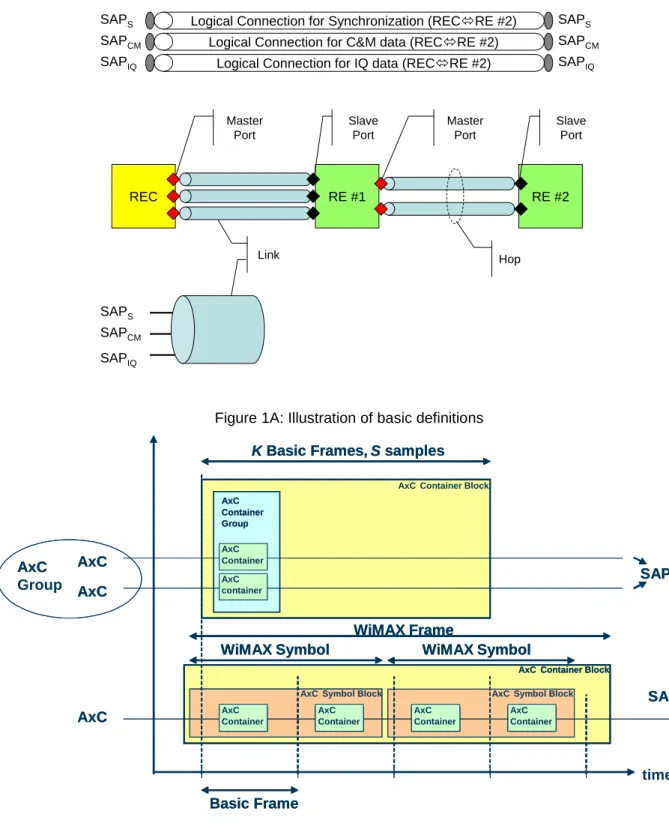
REC RE #1 RE #2 Master Port Slave Port Link
Logical Connection for IQ data (RECRE #2) Logical Connection for Synchronization (RECRE #2)
Logical Connection for C&M data (RECRE #2)
Master Port Slave Port SAPCM SAPIQ Hop SAPS SAPCM SAPCM SAPIQ SAPIQ SAPS SAPS
Figure 1A: Illustration of basic definitions
Figure 1B: Illustration of AxC related definitions
2.2. System Architecture
Radio base stations should provide deployment flexibility for the mobile network operators, i.e., in addition to a concentrated radio base station, more flexible radio base station system architectures involving remote radio equipment shall be supported. This may be achieved by a decomposition of the radio base station into two basic building blocks, the so-called radio equipment control (REC) and the radio equipment (RE) itself. Both parts may be physically separated (i.e., the RE may be close to the antenna, whereas the REC is located in a conveniently accessible site) or both may be co-located as in a conventional radio base station design. AxC AxC Basic Frame AxC Container AxC container AxC AxC Container
KBasic Frames, Ssamples
AxC Container AxC Container AxC Container AxCSymbol Block
AxC Container Group WiMAXSymbol AxC Group SAPIQ SAPIQ AxCContainer Block
WiMAXSymbol WiMAXFrame time AxC AxC Basic Frame AxC Container AxC Container AxC container AxC AxC Container
KBasic Frames, Ssamples
AxCContainer Block
AxC Container AxC Container AxC Container AxC Container AxC Container AxC Container AxC Container Group WiMAXSymbol AxC SAP IQ SAPIQ AxCSymbol Block
AxCContainer Block
WiMAXSymbol
The REC contains the radio functions of the digital baseband domain, whereas the RE contains the analogue radio frequency functions. The functional split between both parts is done in such a way that a generic interface based on In-Phase and Quadrature (IQ) data can be defined.
For the UMTS radio access network, the REC provides access to the Radio Network Controller via the Iub interface, whereas the RE serves as the air interface, called the Uu interface, to the user equipment.
For WiMAX, the REC provides access to network entities (e.g. other BS, ASN-GW), whereas the RE serves as the air interface to the subscriber station / mobile subscriber station (SS / MSS).
For E-UTRA, the REC provides access to the Evolved Packet Core for the transport of user plane and control plane traffic via S1 interface, whereas the RE serves as the air interface to the user equipment. For GSM, the REC provides access to the Base Station Controller via the Abis interface, whereas the RE serves as the air interface, called the Um interface, to the mobile station.
A more detailed description of the functional split between both parts of a radio base station system is provided in Section 2.4.
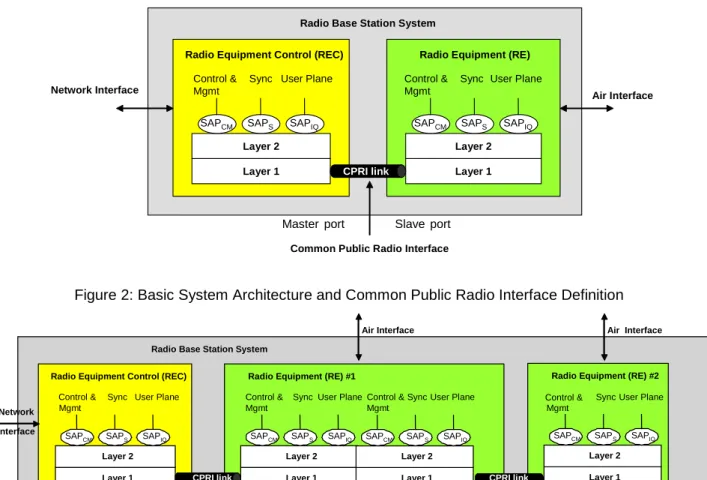
In addition to the user plane data (IQ data), control and management as well as synchronization signals have to be exchanged between the REC and the RE. All information flows are multiplexed onto a digital serial communication line using appropriate layer 1 and layer 2 protocols. The different information flows have access to the layer 2 via appropriate service access points. This defines the common public radio interface illustrated in Figure 2. The common public radio interface may also be used as a link between two nodes in system architectures supporting networking. An example of a common public radio interface between two REs is illustrated in Figure 2A.
Figure 2: Basic System Architecture and Common Public Radio Interface Definition
Figure 2A: System Architecture with a link between REs
Radio Equipment (RE) Radio Equipment Control (REC)
Layer 1 Layer 2 Control & Mgmt User Plane Sync SAPCM Air Interface Network Interface
Common Public Radio Interface Layer 1 Layer 2 Control & Mgmt User Plane Sync
Radio Base Station System
CPRI link
SAPS SAPIQ SAPCM SAPS SAPIQ
Master port Slaveport
Radio Equipment (RE) #1 Radio Equipment Control (REC)
Layer 1 Layer 2 Control & Mgmt Sync SAPCM Network Interface
Common Public Radio Interface Layer 1 Layer 2 Radio Base Station System
SAPS SAPIQ SAPCM SAPS SAPIQ
Radio Equipment (RE) #2 Air Interface
Common Public Radio Interface Layer 1 Layer 2
SAPCM SAPS SAPIQ
Air Interface
Layer 1 Layer 2
SAPCM SAPS SAPIQ
Control & Control & Control &
Mgmt Mgmt Mgmt
SyncUser Plane SyncUser Plane SyncUser Plane
User Plane
Master port Slave port Master port Slave port
2.3. Reference Configurations
This section provides the reference configurations that have to be supported by the CPRI specification. The basic configuration, shown in Figure 3, is composed of one REC and one RE connected by a single CPRI link. The basic configuration can be extended in several ways:
• First, several CPRI links may be used to enhance the system capacity as required for large system configurations involving many antennas and carriers (see Figure 4). It is required that an IQ data flow of a certain antenna and a certain antenna-carrier (see Section 2.1) is carried completely by one CPRI link (however, it is allowed that the same antenna-carrier may be transmitted simultaneously over several links). Therefore, the number of physical links is not restricted by this specification. • Second, several REs may be served by one REC as illustrated in Figure 5 for the so-called star
topology.
• Third, one RE may be served by multiple RECs as illustrated in Figure 5D. The requirements for this configuration are not fully covered in the CPRI specification; refer to section 6.3.7 for further explanation.
• Furthermore, three basic networking topologies may be used for the interconnection of REs:
o Chain topology, an example is shown in Figure 5A
o Tree topology, an example is shown in Figure 5B
o Ring topology, an example is shown in Figure 5C
• Any other topology (e.g. combination of RECs and REs in a chain and tree) is not precluded. An example of reusing the CPRI interface for other internal interfaces in a radio base station is depicted in Figure 5E.
o If a radio base station has multiple RECs, e.g. of different radio access technologies, the CPRI interface may be used for the interface between two RECs.
o The requirements for this configuration are not fully covered in the CPRI specification; refer to sections 6.3.7 and 6.3.8 for further explanation.
REC CPRI link RE
Figure 3: Single point-to-point link between one REC and one RE
REC
...
RECPRI link
CPRI link
REC RE RE
...
CPRI lin k(s)...
CPRI lin k(s)Figure 5: Multiple point-to-point links between one REC and several REs (star topology)
Figure 5A: Chain topology
Figure 5B: Tree topology
Figure 5C: Ring topology
REC CPRI link(s) RE CPRI link(s) RE
CPRI link(s) RE RE
...
...
CPRI link(s) REC RE CPRI link(s) CPRI link(s)REC CPRI link(s) RE CPRI link(s) RE
CPRI link
Figure 5D: Multiple point-to-point links between several RECs and one RE
Figure 5E: Chain topology of multiple RECs
2.4. Functional Description
2.4.1.
Radio Functionality
This section provides a more detailed view on the functional split between REC and RE, which provides the basis for the requirement definition in the next chapter.
The REC is concerned with the Network Interface transport, the radio base station control and management as well as the digital baseband processing. The RE provides the analogue and radio frequency functions such as filtering, modulation, frequency conversion and amplification. An overview on the functional separation between REC and RE is given in Table 1 for UTRA FDD, in Table 1A for WiMAX and E-UTRA and in Table 1AA for GSM. A functional split of base stations that is different from this section is not precluded by the CPRI specification.
REC CPRI link(s) REC CPRI link(s) RE
...
REC CPRI link(s) RE CPRI link(s) RECTable 1: Functional decomposition between REC and RE (valid for the UTRA FDD standard)
Functions of REC Functions of RE
Downlink Uplink Downlink Uplink
Radio base station control & management
Iub transport RRC Channel Filtering
Iub Frame protocols D/A conversion A/D conversion
Channel Coding Channel De-coding Up Conversion Down Conversion Interleaving De-Interleaving ON/OFF control of each
carrier
Automatic Gain Control Spreading De-spreading Carrier Multiplexing Carrier De-multiplexing
Scrambling De-scrambling Power amplification and
limiting
Low Noise Amplification MIMO processing
Adding of physical channels
Signal distribution to signal processing units
Antenna supervision Transmit Power Control
of each physical channel
Transmit Power Control & Feedback Information detection
RF filtering RF filtering
Frame and slot signal generation (including clock stabilization)
Measurements Measurements
Table 1A: Functional decomposition between REC and RE (valid for WiMAX & E-UTRA)
Functions of REC Functions of RE
Downlink Uplink Downlink Uplink
Radio base station control & management Add CP (optional)
Backhaul transport Channel Filtering
MAC layer D/A conversion A/D conversion
Channel Coding, Interleaving, Modulation
Channel coding, De-Interleaving,
Demodulation
Up Conversion Down Conversion
iFFT FFT ON/OFF control of each
carrier
Automatic Gain Control Add CP (optional) Remove CP Carrier Multiplexing Carrier De-multiplexing
MIMO processing Power amplification and limiting
Low Noise Amplification Signal aggregation from
signal processing units
Signal distribution to signal processing units
Antenna supervision Transmit Power Control
of each physical channel
Transmit Power Control & Feedback Information detection
RF filtering RF filtering
Frame and slot signal generation (including clock stabilization)
TDD switching in case of TDD mode
Table 1AA: Functional decomposition between REC and RE (valid for the GSM standard)
Functions of REC Functions of RE
Downlink Uplink Downlink Uplink
Radio base station control & management
Channel Filtering Channel Filtering
Abis transport D/A conversion A/D conversion
Abis Frame protocols Up Conversion Down Conversion
Channel Coding Channel De-Coding ON/OFF control for each carrier
Automatic Gain Control Interleaving De-Interleaving Carrier Multiplexing Carrier De-multiplexing Modulation De-Modulation Power amplification Low Noise Amplification
Frequency hopping control Frequency hopping
Signal aggregation from signal processing units
Signal distribution to signal processing units
Antenna supervision Transmit Power Control
of each physical channel
Transmit Power Control & Feedback Information detection
RF filtering RF filtering
Frame and slot signal generation (including clock stabilization)
Measurements Measurements
2.4.2.
CPRI Control Functionality
This section provides a more detailed view on the functional split between REC and RE for CPRI functionality beyond the specification itself.
Basically, the REC is concerned with the management of the CPRI and the CPRI topology. The RE may optionally provide interconnection functionality between REs. An overview of the functional separation between REC and RE is given in Table 1B.
Table 1B: Functional decomposition between REC and RE (valid for CPRI control functionality)
Functions of REC Functions of RE
Downlink Uplink Downlink Uplink
CPRI control management
CPRI topology management CPRI interconnection between REs
(forwarding/switching/cross-connecting of CPRI SAP data between REs)
3. Interface Baseline
This chapter provides input requirements for the CPRI specification. The requirements are to be met by the CPRI specification, and will be used as a baseline for future enhancements of the CPRI specification. Note that this chapter does not specify the requirements on a CPRI compliant device (see chapter 5.2) but expresses the superset of requirements for an interface from all expected applications using the CPRI.
3.1. Supported Radio Standards
The interface shall support transmission of all necessary data between REC and RE in both directions for a radio base station consisting of one REC and one or more REs compliant to the following radio standards:
Requirement No. Requirement Definition Requirement Value Scope
R-1 Supported Radio
Standards and Releases
3GPP UTRA FDD, Release 10, March 2012
Logical connection WiMAX Forum Mobile System
Profile Release 1.5 Approved Specification (2009-08-01) 3GPP E-UTRA, Release 10, March 2012
3GPP GSM/EDGE Radio Access Network, Release 10, March 2011
The support of other standards is not required in this release of the CPRI specification, but the future use of the interface for other standards shall not be precluded.
3.2. Operating Range
The interface shall support a continuous range of distances (i.e., cable lengths) between master and slave ports. The minimum required range is defined by the cable length in the following table:
Requirement No. Requirement Definition Requirement Value Scope
R-2 Cable length (lower limit) 0 m Link
R-3 Cable length (upper limit) >10 km Link
The interface shall support one cable between master and slave with separate transmission media (e.g., optical fibres) for uplink and downlink.
3.3. Topology/Switching/Multiplexing
The interface shall support the following networking topologies:Requirement No. Requirement Definition Requirement Value Scope
R-4 Topology Star topology,
Chain topology, Tree topology, Ring topology Radio base station system
The support of other topologies is not required in this release of the specification, but the use of the interface in other topologies shall not be precluded.
The interface shall support multiple hops when used in a networking configuration:
Requirement No. Requirement Definition Requirement Value Scope
R-4A Maximum number of hops
in a logical connection
At least 5 hops Logical connection
One RE may support several ports to fit in the different topologies but at least one is a slave port:
Requirement No. Requirement Definition Requirement Value Scope
R-4B Number of ports per RE RE may support
more than one CPRI port
Node
Requirement No. Requirement Definition Requirement Value Scope
R-4C Number of slave ports
per RE
RE shall support at least one CPRI slave port
Node
A logical connection may use a multi-hop connection composed of links with different line bit rates.
Requirement No. Requirement Definition Requirement Value Scope
R-4D One logical connection
may consist of successive hops with different link numbers and line bit rates.
N/A Logical
connection
Requirement No. Requirement Definition Requirement Value Scope
R-4E A link may be used as a redundant link in any network topology.
N/A Link
It shall be possible to mix different Radio Standards on a link.
Requirement No. Requirement Definition Requirement Value Scope
R-4F Different Radio
Standards may be mixed on a link.
N/A Link
3.4. Bandwidth/Capacity/Scalability
3.4.1.
Capacity in terms of Antenna-Carriers
The capacity of one logical connection shall be expressed in terms of UTRA-FDD/E-UTRA-antenna-carriers (abbreviation: “antenna-carrier” or “AxC”). One UTRA-FDD/E-UTRA-antenna-carrier is the amount of digital baseband (IQ) U-plane data necessary for either reception or transmission of one UTRA-FDD/E-UTRA carrier at one independent antenna element. One antenna element is typically characterized by having exactly one antenna connector to the RE.
CPRI shall be defined in such a way that the following typical NodeB configurations can be supported: • 1 RE supports one sector
o Up to 4 carriers x 1 antenna per RE (e.g. 6 REs for 3 sectors)
o Up to 4 carriers x 2 antennas per RE (e.g. 3 REs for 3 sectors)
o Up to 2 component carriers2 x 8 antennas per RE (E-UTRA Rel-10 and later)
o Up to 5 component carriers2 x 2 antennas per RE (E-UTRA Rel-10 and later)
o Any combination of “up to 5 component carriers2” x “up to 8 antennas” per RE (E-UTRA Rel-10 and later)
• 1 RE supports 3 sectors
o From 1 to 4 carriers x 2 antennas x 3 sectors per RE
Therefore, the following number of AxC shall be supported by the CPRI specification:
Requirement No. Requirement Definition Requirement
Value
Scope
R-103 Number of antenna
carriers per logical connection for UTRA FDD/E-UTRA
1..40 Logical connection
3.4.2.
Required U-plane IQ Sample Widths
The IQ sample widths supported by the CPRI specification shall be between 4 and 20 bits for I and Q in the uplink and between 8 and 20 bits in the downlink.
Requirement No. Requirement Definition Requirement
Value
Scope
R-11 Minimum uplink IQ sample
width for UTRA FDD only
4 Logical connection
R-11A Minimum uplink IQ sample
width for WiMAX, E-UTRA, and GSM
8 Logical connection
R-12 Maximum uplink IQ sample
width for UTRA FDD only
10 Logical connection
R-12A Maximum uplink IQ sample
width for WiMAX, E-UTRA, and GSM 20 Logical connection R-13 Minimum downlink IQ sample width 8 Logical connection R-14 Maximum downlink IQ sample width 20 Logical connection Notes:
• Oversampling Factor of 2 or 4 is assumed for UTRA FDD in uplink • Oversampling Factor of 1 or 2 is assumed for UTRA FDD in downlink • Oversampling Factor of 1 is assumed for WiMAX and E-UTRA
• Oversampling Factor is not specified for GSM. The sampling rate may be:
o either a multiple of the GSM symbol rates (1625/6 = 270.833kHz or 325kHz)
o or a multiple or a sub-multiple of the UTRA FDD chip rate (3.84MHz) • Automatic Gain Control may be used in uplink
3 Former requirements R-5 ... R-9 have been merged to R-10. Requirement R-10 is not necessarily fulfilled by one link, but by the most
3.4.3.
Required C&M-plane Bit Rate
The interface shall support a minimum bit rate for the M-plane transmission per link:
Requirement No. Requirement Definition Requirement Value Scope
R-15 Minimum transmission rate
of M-plane data (layer 1)
200 kbit/s Link
Additionally, the interface shall support a minimum bit rate for the transmission of C-plane data per AxC:
Requirement No. Requirement Definition Requirement Value Scope
R-16 Minimum transmission rate
of C-plane data (layer 1)
25 kbit/s Logical connection
The overhead on layer 2 due to frame delineation and frame check sequence depends on the frame length determined by higher layers. Assuming this overhead is well below 20%, a minimum net bit rate of 20kbit/s per AxC is available at the service access point SAPCM as shown in Figure 2 and Figure 2A.
3.4.4.
Required Real-Time Vendor Specific Bits
The interface shall provide additional bandwidth to transfer “Real-Time Vendor Specific Bits” in case of high line bit rates. The usage of “Real-Time Vendor Specific Bits” includes but is not limited to the following examples:
・ To verify the quality of CPRI links by using CRC.
・ To transfer auxiliary information for the IQ data, e.g. common exponents for multiple IQ samples in multiple AxC containers, and other auxiliary information used for IQ data compression.
・ To transfer header information of vendor specific user plane data (which may not be IQ data) in multiple AxC containers.
・ To extend U-plane IQ data transport.
Requirement No. Requirement Definition Requirement Value Scope
R-16A Minimum number of bits
for Real-Time Vendor Specific Bits
32 bits per 1/3.84MHz Link (line bit rate > 10.0Gbps)
3.5. Synchronization/Timing
3.5.1.
Frequency Synchronization
The interface shall enable the RE to achieve the required frequency accuracy according to: • 3GPP TS 25.104 [8] section 6.3 for UTRA FDD
• WiMAX Forum System Profile [11] section 4.2.4 for WiMAX • 3GPP TS 36.104 [14], section 6.5.1 for E-UTRA
• 3GPP TS 45.010 [23], section 5.1 for GSM
The central clock for frequency generation in the RE shall be synchronized to the bit clock of one slave port. With 8B/10B or 64B/66B line coding the bit clock rate of the interface shall be a multiple of 38.4MHz in order to allow for a simple synchronization mechanism and frequency generation in the RE.
The impact of jitter on the frequency accuracy budget of the interface to the radio base station depends on the cut-off frequency of the RE synchronization mechanism. The interface shall accommodate a synchronization mechanism cut-off frequency high enough so that a standard crystal oscillator suffices as master clock of the RE. The contribution
∆
f
f
0 of the jitterτ
to the frequency accuracy shall be defined with the cut-off frequencyf
CUT as follows:df
f
f
f
f
dB f L fCUT⋅
⋅
⋅
⋅
=
∆
∫
10 ) ( 0 2 0 010
2
1
, (1)where
L
(
f
)
is the single-side-band phase noise in dBc/Hz acquired on the interface with the following relation to the jitterτ
:df
f
f dB f L⋅
⋅
⋅
⋅
⋅
=
∫
2 0 10 ) ( 0 010
2
2
1
π
τ
(2)The reference point for the jitter and phase noise specification is a stable clock signal at the service access point SAPS as shown in Figure 2. The frequency of this clock signal is denoted as
f
0.With
f
CUT in equation (1) being the maximum allowed cut-off frequency, the impact of jitter on the radio base station frequency accuracy budget shall meet the following requirements:Requirement No. Requirement Definition Requirement Value Scope
R-17 Maximum allowed cut-off
frequency
f
CUT of RE synchronization 300 Hz Link R-18 Maximum contribution 0f
f
∆
of jitter from the CPRI link to the radio base station frequency accuracy budget (between master SAPS and slave SAPS)±0.002 ppm Link
Any RE shall receive on its slave port a clock traceable to the main REC clock. This requires any RE reuses on its master ports a transmit clock traceable to REC, i.e. a clock retrieved from one of its slave ports.
Requirement No. Requirement Definition Requirement Value Scope
R-18A Receive clock on RE slave
port
The clock shall be traceable to REC clock
Link
Traceable clock means the clock is produced from a “PLL” chain system with REC clock as input. “PLL” chain performance is out of CPRI scope.
3.5.2.
Frame Timing Information
The synchronization part of the interface shall include mechanisms to provide precise frame timing information from the REC to the RE. The frame timing information shall be recovered on the RE in order to achieve the timing accuracy requirements as described in the sections below.
The RE shall forward frame timing information transparently when forwarding from a slave port to all the master ports. The frame timing information is allocated to the service access point SAPS as shown in Figure
2. Timing accuracy and delay accuracy, as required in the subsections below, refer to the accuracy of timing signals at the service access point SAPS. These timing signals shall be used in the RE for the precise timing
of RF signal transmission and reception on the air interface.
3.5.3.
Link Timing Accuracy
In this section the link accuracy requirement (R-19) is introduced based on the following requirements from the supported radio standards:
1. 3GPP UTRA-FDD Tx diversity and MIMO compliancy4
The interface shall enable a radio base station to meet the requirement “time alignment error in Tx Diversity and MIMO transmission” (3GPP TS 25.104 [8] section 6.8.4).
2. 3GPP UTRA-FDD UE positioning with GPS timing alignment:
The interface shall also support ”UTRAN GPS Timing of Cell Frames for UE positioning“ (3GPP TS 25.133 [9] section 9.2.10), which requires absolute delay accuracy.
3. WiMAX network synchronization with GPS (sections 8.3.7.1.1 and 8.4.10.1.1 of IEEE 802.16 [13]) 4. E-UTRA Time alignment between transmitter branches
The interface shall enable a radio base station to meet the requirement “time alignment between transmitter branches” (3GPP TS 36.104 [14], section 6.5.3).
5. GSM internal BTS carrier timing
The timing difference between the different carriers shall be less than ¼ normal symbol periods, measured at the BTS antenna (3GPP TS 45.010 [23], section 5.3).
Requirement R-19 is based on the following three criteria:
a) Meet the 1st,4th and 5th requirement in a star configuration as shown in Figure 5:
• for UTRA-FDD or E-UTRA, when TX diversity or MIMO signals belonging to one cell are transmitted via different REs;
• for GSM, when different carriers are transmitted via different REs.
b) Meet the 2nd and 3rd requirement at any RE connected to the REC via multi-hop connection to the REC with the number of hops as given in R-4A.
c) Allow enough margin for additional delay tolerances in the RE implementation which is not part of CPRI. The delay accuracy on one interface link excluding the group delay on the transmission medium, i.e. excluding the cable length, shall meet the following requirement.
Requirement No. Requirement Definition Requirement Value Scope
R-19 Link delay accuracy in
downlink between SAPS
master port and SAPS
slave port excluding the cable length.
± 8 . 1 3 8 n s [ = ±TC/ 3 2 ]
Link
Note: The scope “link” for R-19 was chosen since the requirement R-19 can be met on a link. In multi-hop configurations the delay tolerances per link may add up, so the total tolerance may depend on the number of hops. Therefore it is not mandatory for CPRI to support a certain delay accuracy requirement for all multi-hop connections.
4 With UTRA-FDD release 7, MIMO was introduced in the same section 6.8.4 of TS 25.104 [8] in addition to TX diversity without
3.5.4.
Round Trip Delay Accuracy
The round trip delay accuracy requirement (R-20) is introduced based on the following requirements from the supported radio standards:
• 3GPP UTRA-FDD, round trip time absolute accuracy
The interface shall enable a radio base station to meet the requirement “round trip time absolute accuracy ±0.5 TC” (3GPP TS 25.133 [9] section 9.2.8.1).
• 3GPP E-UTRA, timing advance
The interface shall enable a radio base station to meet the Timing Advance report mapping minimum resolution of 65 ns (3GPP TS 36.133 [15], section 10.3).
• GSM, initial timing advance accuracy (3GPP TS 45.010 [23] section 5.4). • GSM, delay tracking
The interface shall enable a radio base station to meet the requirement “delay assessment error < ½ symbol period” (3GPP TS 45.010 [23] section 5.6).
The round trip time absolute accuracy of the interface, excluding the round trip group delay on the transmission medium (i.e., excluding the cable length), shall meet the following requirement.
Requirement No. Requirement Definition Requirement Value Scope
R-20 Round trip absolute
accuracy excluding cable length
± 1 6 . 2 7 6 n s [ = ±TC/ 1 6 ]
Logical connection
Note: For round trip delay absolute accuracy even in multi-hop scenarios the delay tolerances per link do not add up as can be seen from the timing relations in section 4.2.9 and annex 6.1. Therefore the scope of requirement R-20 is “logical connection”, which can be met in all configurations.
3.5.5.
Accuracy of TDD Tx-Rx switching point
For WiMAX and E-UTRA TDD applications the Tx – Rx switching point needs to be transmitted per AxC. The required maximum contribution of the interface to the switching point accuracy shall meet the following requirement.
Requirement No. Requirement Definition Requirement Value Scope
R-20A Maximum contribution of
the interface to the accuracy of TDD Tx-Rx switching point ± 1 6 . 2 7 6 n s [ = ±TC/ 1 6 ] Multi-hop connection
3.6. Delay Calibration
3.6.1.
Round Trip Cable Delay per Link
The interface shall enable periodic measurement of the cable length of each link, i.e., measurement of the round trip group delay on the transmission medium of each link. The measurement results shall be available on the REC in order to meet the following requirements without the need to input the cable length to the REC by other means. The round trip delay accuracy requirement (R-21) is introduced based on the following requirements from the supported radio standards:
• “time alignment error in Tx Diversity shall not exceed ¼ TC” (3GPP TS 25.104 [8] section 6.8.4)
• “UTRAN GPS Timing of Cell Frames for UE positioning“ (3GPP TS 25.133 [9] section 9.2.10) • WiMAX network synchronization with GPS (sections 8.3.7.1.1 and 8.4.10.1.1 of IEEE 802.16 [13]) • E-UTRA, Timing Advance minimum resolution of 65 ns (3GPP TS 36.133 [15], section 10.3) • GSM internal BTS carrier timing (3GPP TS 45.010 [23] section 5.3)
• GSM, initial timing advance accuracy (3GPP TS 45.010 [23] section 5.4) • GSM, delay tracking (3GPP TS 45.010 [23] section 5.6)
The accuracy of the measurement of round trip group delay on the transmission medium of one link shall meet the following requirement:
Requirement No. Requirement Definition Requirement Value Scope
R-21 Accuracy of the round trip
delay measurement of cable delay of one link
± 1 6 . 2 7 6 n s [ = ±TC/ 1 6 ]
Link
3.6.2.
Round Trip Delay of a Multi-hop Connection
The interface shall enable periodic measurement of the round trip group delay of each multi-hop connection. The measurement results shall be available on the REC in order to meet the following requirements without the need to input the cable lengths of the involved links to the REC by other means. The round trip delay accuracy requirement (R-21A) is introduced based on the following requirements from the supported radio standards:
• “round trip time absolute accuracy ±0.5 TC” (3GPP TS 25.133 [9] section 9.2.8.1)
• E-UTRA, Timing Advance minimum resolution of 65 ns (3GPP TS 36.133 [15] section 10.3) • GSM, initial timing advance accuracy (3GPP TS 45.010 [23] section 5.4)
• GSM, delay tracking (3GPP TS 45.010 [23] section 5.6)
By measuring the round trip delay of the multi-hop connection directly, REC based computation of round trip delay shall be possible whatever the topology and the RE location within the branch, without adding delay tolerances of all links and networking REs used in the multi-hop connection.
The accuracy of the measurement of round trip group delay on the multi-hop connection shall meet the following requirement:
Requirement No. Requirement Definition Requirement Value Scope
R-21A Accuracy of the round trip
delay measurement of the multi-hop connection
± 1 6 . 2 7 6 n s [ = ±TC/ 1 6 ]
Multi-hop connection
3.7. Link Maintenance
The layer 1 of the interface shall be able to detect and indicate loss of signal (LOS) and loss of frame (LOF) including frame synchronization. A remote alarm indication (RAI) shall be returned to the sender on layer 1 as a response to these errors. In addition the SAP defect indication (SDI) shall be sent to the remote end when any of the service access points is not valid due to an equipment error.
The signals • LOS • LOF
• SDI • RAI
shall be handled within layer 1 and shall also be available to the higher layers of the interface.
Requirement No. Requirement Definition Requirement Value Scope
R-22 Loss of Signal (LOS)
detection and indication
- Link
R-23 Loss of Frame (LOF)
detection and indication
- Link
R-24 SAP Defect Indication
(SDI)
- Link
R-25 Remote Alarm Indication
(RAI)
- Link
3.8. Quality of Service
3.8.1.
Maximum Delay
In order to support efficient implementation of UTRA-FDD inner loop power control5, the absolute round trip time for U-plane data (IQ data) on the interface, excluding the round trip group delay on the transmission medium (i.e. excluding the cable length), shall not exceed the following maximum value:
Requirement No. Requirement Definition Requirement Value Scope
R-26 Maximum absolute round
trip delay per link excluding cable length
5µs Link
Round trip time is defined as the downlink delay plus the uplink delay. The delay is precisely defined as the time required transmitting a complete IQ sample over the interface. The availability and validity of an IQ sample is defined at the service access point SAPIQ as shown in Figure 2. The precise point of time of
availability and validity is indicated by the edge of an associated clock signal at the service access point SAPIQ . The delay (e.g. in downlink) is defined as the time difference between the edge at the input SAPIQ
(e.g. on REC or RE) and the edge at the output SAPIQ (e.g. on RE).
This definition is only valid for a regular transmission of IQ samples with a fixed sample clock.
3.8.2.
Bit Error Ratio U-plane
The interface shall provide U-plane data transmission (on layer 1) with a maximum bit error ratio as specified below:
5 Even with the introduction of new standards (e.g. WiMAX, E-UTRA, and GSM) UTRA FDD inner loop power control is still assumed to
Requirement No. Requirement Definition Requirement Value Scope
R-27 Maximum bit error ratio
(BER) of U-plane 10
-12 Link
It should be a design goal to avoid forward error correction on layer 1 to achieve a cost efficient solution. There shall not be any data protection on layer 2.
3.8.3.
Bit Error Ratio C&M-plane
The interface shall provide C&M-plane data transmission with a maximum bit error ratio (on layer 1) as specified below:
Requirement No. Requirement Definition Requirement Value Scope
R-28 Maximum bit error ratio
(BER) of C&M-plane 10
-12 Link
Additionally, a frame check sequence (FCS) shall be provided for C&M-plane data bit error detection on layer 2. The minimum length of the frame check sequence is defined in the following table:
Requirement No. Requirement Definition Requirement Value Scope
R-29 Minimum length of frame
check sequence (FCS)
16 bit Link
3.8.4.
CPRI Link Quality Monitoring
Layer 1 of the interface shall provide a mechanism for the higher layers to determine whether the link is operating within the CPRI specified limits as given in R-27 and R-28.
Requirement No. Requirement Definition Requirement Value Scope
R-29A Link quality monitoring N/A Link
3.9. Start-up Requirement
3.9.1.
Clock Start-up Time Requirement
CPRI shall enable the RE clock to achieve synchronization with respect to the frequency accuracy and absolute frame timing accuracy within 10 seconds. The time needed for auto-negotiation of features (see Plug and Play requirement in section 3.9.2) is excluded from this requirement.
Requirement No. Requirement Definition Requirement Value Scope
R-30 Maximum clock
synchronization time
10 s Link
3.9.2.
Plug and Play Requirement
Requirement No. Requirement Definition Requirement Value Scope
R-31 Auto-negotiation of line bit rate - Link
R-31A Maximum number of line bit
rate options on a master port for auto-negotiation.
At least 4 Link
CPRI shall support auto-negotiation for selecting the C&M-plane type and bit rate (layer 1).
Requirement No. Requirement Definition Requirement Value Scope
R-32 Auto-negotiation of C&M-plane type and bit rate (layer 1)
- Link
CPRI shall support auto-detection of REC data flow on slave ports:
Requirement No. Requirement Definition Requirement Value Scope
R-33 Auto-detection of REC data flow on slave ports
- Link
CPRI shall support auto-negotiation of scrambling:
Requirement No. Requirement Definition Requirement Value Scope
R-34 Auto-negotiation of scrambling - Link
CPRI shall support auto-detection of the scrambling seed:
Requirement No. Requirement Definition Requirement Value Scope
R-35 Auto-detection of scrambling
seed
4. Interface Specification
4.1. Protocol Overview
CPRI defines the layer 1 and layer 2 protocols for the transfer of user plane, C&M as well as synchronization information between REC and RE as well as between two REs6. The interface supports the following types
of information flows:
• IQ Data: User plane information in the form of in-phase and quadrature modulation data (digital baseband signals).
• Synchronization: Synchronization data used for frame and time alignment.
• L1 Inband Protocol: Signalling information that is related to the link and is directly transported by the physical layer. This information is required, e.g. for system start-up, layer 1 link maintenance and the transfer of time critical information that has a direct time relationship to layer 1 user data.
• C&M data: Control and management information exchanged between the control and management entities within the REC and the RE. This information flow is given to the higher protocol layers.
• Protocol Extensions: This information flow is reserved for future protocol extensions. It may be used to support, e.g., more complex interconnection topologies or other radio standards.
• Vendor Specific Information: This information flow is reserved for vendor specific information. The user plane information is sent in the form of IQ data. The IQ data of different antenna carriers are multiplexed by a time division multiplexing scheme onto an electrical or optical transmission line. The control and management data are either sent as inband protocol (for time critical signalling data) or by layer 3 protocols (not defined by CPRI) that reside on top of appropriate layer 2 protocols. Two different layer 2 protocols for C&M data – subset of High level Data Link Control (HDLC) and Ethernet – are supported by CPRI. These additional control and management data are time multiplexed with the IQ data. Finally, additional time slots are available for the transfer of any type of vendor specific information. Figure 6 provides an overview on the basic protocol hierarchy.
Time Division Multiplexing
User Plane
Management
Control&
Plane
Electrical
Transmission
Transmission
Optical
IQ
Data
Ethernet
HDL
C
L1
Inband
Prot
oc
ol
Vendor S
pec
ific
Layer 1
Layer 2
SYNC
Figure 6: CPRI protocol overview
4.2. Physical Layer (Layer 1) Specification
4.2.1.
Line Bit Rate
In order to achieve the required flexibility and cost efficiency, several different line bit rates are defined. Therefore, the CPRI line bit rate may be selected from the following option list:
• CPRI line bit rate option 1: 614.4 Mbit/s, 8B/10B line coding (1 x 491.52 x 10/8 Mbit/s) • CPRI line bit rate option 2: 1228.8 Mbit/s, 8B/10B line coding (2 x 491.52 x 10/8 Mbit/s) • CPRI line bit rate option 3: 2457.6 Mbit/s, 8B/10B line coding (4 x 491.52 x 10/8 Mbit/s) • CPRI line bit rate option 4: 3072.0 Mbit/s, 8B/10B line coding (5 x 491.52 x 10/8 Mbit/s) • CPRI line bit rate option 5: 4915.2 Mbit/s, 8B/10B line coding (8 x 491.52 x 10/8 Mbit/s) • CPRI line bit rate option 6: 6144.0 Mbit/s, 8B/10B line coding (10 x 491.52 x 10/8 Mbit/s) • CPRI line bit rate option 7: 9830.4 Mbit/s, 8B/10B line coding (16 x 491.52 x 10/8 Mbit/s) • CPRI line bit rate option 8: 10137.6 Mbit/s, 64B/66B line coding (20 x 491.52 x 66/64 Mbit/s) It is mandatory that each REC and RE support at least one of the above cited CPRI line bit rates.
All CPRI line bit rates have been chosen in such a way that the basic UMTS chip rate of 3.84 Mbit/s can be recovered in a cost-efficient way from the line bit rate taking into account the line coding schemes as defined in Section 4.2.5. For example, the 1228.8 Mbit/s correspond to an encoder rate of 122.88 MHz for the 8B/10B encoder and a subsequent frequency division by a factor of 32 provides the basic UMTS chip rate.
4.2.2.
Physical Layer Modes
CPRI is specified for several applications with different interface line bit rates and REC to RE ranges. Table 2 defines several CPRI physical layer modes:
Table 2: CPRI physical layer modes
Line bit rate Electrical Optical
Short range Long range
614.4 Mbit/s E.6 OS.6 OL.6
1228.8 Mbit/s E.12 OS.12 OL.12
2457.6 Mbit/s E.24 OS.24 OL.24
3072.0 Mbit/s E.30 OS.30 OL.30
4915.2 Mbit/s E.48 OS.48 OL.48
6144.0 Mbit/s E.60 OS.60 OL.60
9830.4 Mbit/s E.96 OS.96 OL.96
10137.6 Mbit/s E.99 OS.99 OL.99
For each of those CPRI “modes” the layer one shall fulfil the requirements as specified in Section 3.5 (clock stability and noise) and Sections 3.8.2 and 3.8.3 (BER < 10-12).
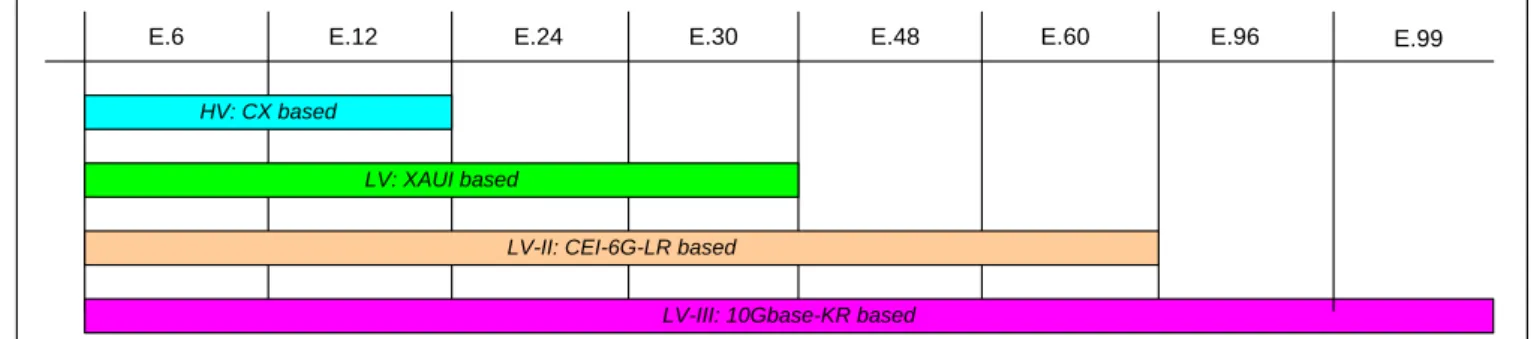
Four electrical variants are recommended for CPRI usage, denoted HV (high voltage), LV (low voltage), LV-II (low voltage II) and LV-III (low voltage III) in Figure 6A below. The HV variant is guided by IEEE 802.3-2005 [1], clause 39 (1000base-CX) but with 100 ohm impedance. The LV variant is guided by IEEE 802.3-2005 [1] clause 47 (XAUI) but with lower bit rate. The LV-II variant is guided by OIF-CEI-02.0, clause 7, but with lower bit rate. The LV-III variant is guided by IEEE 802.3 [22], clause 72.7 and 72.8 (10GBase-KR). See annex 6.2 for more details on the adaptation to CPRI line bit rates and applications.
HV: CX based
LV: XAUI based
LV-II: CEI-6G-LR based
LV-III: 10Gbase-KR based
E.6 E.12 E.24 E.30 E.48 E.60 E.96 E.99
Figure 6A: HV (high voltage), LV (low voltage), LV-II and LV-III electrical layer 1 usage It is recommended to reuse optical transceivers from the following High Speed Serial Link standards:
• Gigabit Ethernet: Standard IEEE 802.3-2005 [1] clause 38 (1000BASE-SX/LX) • 10 Gigabit Ethernet: Standard IEEE 802.3-2005 [1] clause 53 (10GBASE-LX4) • Fibre channel (FC-PI) – Standard ISO/IEC 14165-115 [3]
• Fibre channel (FC-PI-4) – INCITS (ANSI) Revision 8, T11/08-138v1 [18] • Infiniband Volume 2 Rel 1.1 (November 2002) [6]
• 10 Gigabit Ethernet: Standard IEEE 802.3-2008 [22], Clause 52(10GBASE-S/L/E)
It is recommended to use an optical solution which allows for reuse of SERDES components supporting at least one of the HV, LV, LV-II, LV-III electrical variants.
The specification does not preclude the usage of any other technique that is proven to reach the same BER performance (BER < 10-12) and clock stability for the dedicated CPRI application.
CPRI clock tolerance is driven by 3GPP requirements (see 3GPP TS 25.104 [8]), which fully permits the usage of existing high speed serial link standards.
4.2.3.
Electrical Interface
4.2.3.1.
Electrical Cabling
No specific cabling is recommended by CPRI.
The cable performance shall be such that transmitter and receiver performance requirements in section 3 are fulfilled. See also annex 6.2 for explicit recommendations on electrical characteristics.
4.2.3.2.
Electrical Connectors
CPRI electrical implementation may use connector solutions that are described and defined in ISO/IEC 14165-115 (Fibre channel FC-PI) [3], INCITS Fibre channel FC-PI-4 [18] or IEEE 802.3-2005 [1].
These solutions are known to achieve the performance required in section 3. See also annex 6.2 for explicit recommendations on electrical characteristics.
4.2.4.
Optical Interface
4.2.4.1.
Optical Cabling
The cable performance shall be such that transmitter and receiver performance requirements in section 3 are fulfilled. The fiber cables recommended for CPRI are:
• IEC 60793-2-10:2002.Type A1a (50/125 µm multimode) [4] • IEC 60793-2-10:2002.Type A1b (62.5/125 µm multimode) [4] • IEC 60793-2-50:2002.Type B1 (10/125 µm single-mode) [5]
The exception characteristic as specified in IEEE 802.3-2005 [1] Table 38-12 and IEEE 802.3-2005 [1] Table 53-14 as well as INCITS Fibre channel FC-PI-4 [18] Table 6 and Table 10 may be taken into account.
4.2.4.2.
Optical Connectors
CPRI optical implementation may use connector solutions that are described and defined in ISO/IEC 14165-115 [3] (Fibre channel FC-PI), INCITS Fibre channel FC-PI-4 [18] or IEEE 802.3-2005 [1].
These solutions are known to achieve the performance requirements in section 3. A high flexibility in the choice of connector and transceiver can be achieved by adopting the SFP [19] and SFP+ [20], [21] building practice.
4.2.5.
Line Coding
For CPRI line bit rate options 1, 2, 3, 4, 5, 6 and 7 the 8B/10B line coding shall be used for serial transmission according to IEEE 802.3-2005 [1], clause 36.
For CPRI line bit rate option 8 the 64B/66B line coding shall be used for serial transmission according to IEEE 802.3-2008 [22], clause 49.
4.2.6.
Bit Error Correction/Detection
The physical layer is designed in such a way that a very low bit error ratio can be achieved without expensive forward error correction schemes (see requirement R-27). Therefore, no general bit error correction is applied at layer 1. Some layer 1 control bits have their own protection, see chapter 4.2.7.6.2.
For 8B/10B line coding the RE and the REC shall support detection of 8B/10B code violations. Link failures shall be detected by means of 8B/10B code violations.
For 64B/66B line coding the RE and the REC shall support detection of sync header violations. Link failures shall be detected by means of sync header violations.
4.2.7.
Frame Structure
4.2.7.1.
Basic Frame Structure
4.2.7.1.1.
Framing Nomenclature
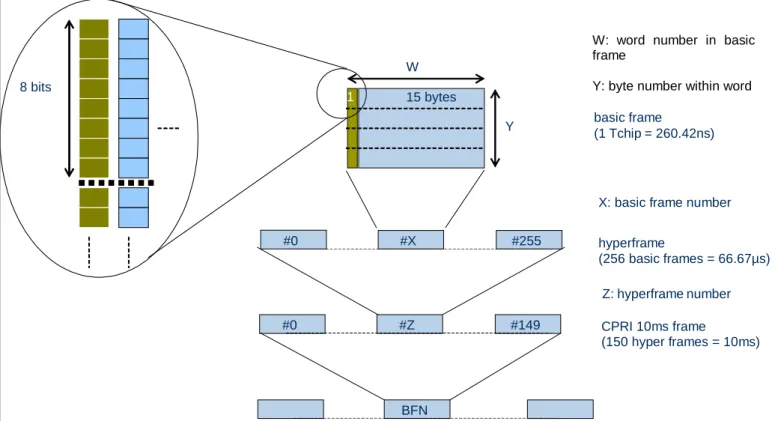
The length of a basic frame is 1 TC = 1/fc = 1/3.84 MHz = 260.416667ns. A basic frame consists of 16 words
with index W=0…15. The length T of the word depends on the CPRI line bit rate as shown in Table 3. Each bit within a word is addressed with the index B, where B=0 is the LSB and B=T-1 is the MSB. Each BYTE within a word is addressed with the index Y, where B=0 is LSB of Y=0, B=7 is MSB of Y=0, B=8 is LSB of Y=1, etc...
The first TCW bits of the word with index W=0 are used for one control word. If TCW is not equal to T, the
remaining (T-TCW) bits of the word with index W=0 are for real time vendor specific usage (according to
section 3.4.4 real time vendor specific usage also includes U-plane IQ data transport). For the notation #Z.X.Y please refer to Section 4.2.7.3.
Table 3: Length of control word
CPRI line bit rate [Mbit/s] length of word [bit] Length of control word [bit]
control word consisting of BYTES with index 614.4 T=8 TCW = T Z.X.0 1228.8 T=16 Z.X.0, Z.X.1 2457.6 T=32 Z.X.0, Z.X.1, Z.X.2, Z.X.3 3072.0 T=40 Z.X.0, Z.X.1, Z.X.2, Z.X.3, Z.X.4 4915.2 T=64 Z.X.0, Z.X.1, Z.X.2, Z.X.3, Z.X.4, Z.X.5, Z.X.6, Z.X.7 6144.0 T=80 Z.X.0, Z.X.1, Z.X.2, Z.X.3, Z.X.4, Z.X.5, Z.X.6, Z.X.7, Z.X.8, Z.X.9 9830.4 T=128 Z.X.0, Z.X.1, Z.X.2, Z.X.3, Z.X.4, Z.X.5, Z.X.6, Z.X.7, Z.X.8, Z.X.9, Z.X.10, Z.X.11, Z.X.12, Z.X.13, Z.X.14, Z.X.15 10137.6 T=160 TCW = 128 Z.X.0, Z.X.1, Z.X.2, Z.X.3, Z.X.4, Z.X.5, Z.X.6, Z.X.7, Z.X.8, Z.X.9, Z.X.10, Z.X.11, Z.X.12, Z.X.13, Z.X.14, Z.X.15
The remaining words (W=1…15), 15/16 of the basic frame, are dedicated to the U-plane IQ data transport (IQ data block).
4.2.7.1.2.
Transmission Sequence and Scrambling
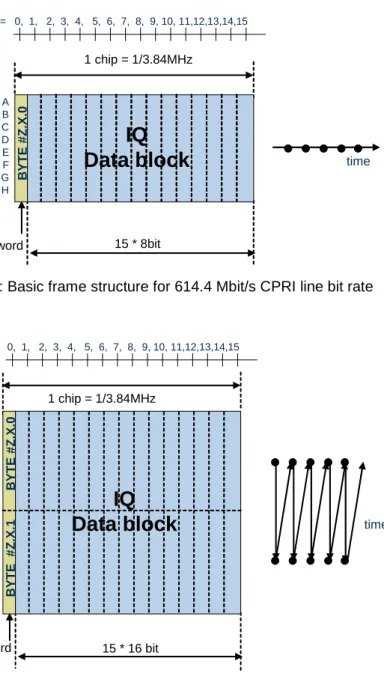
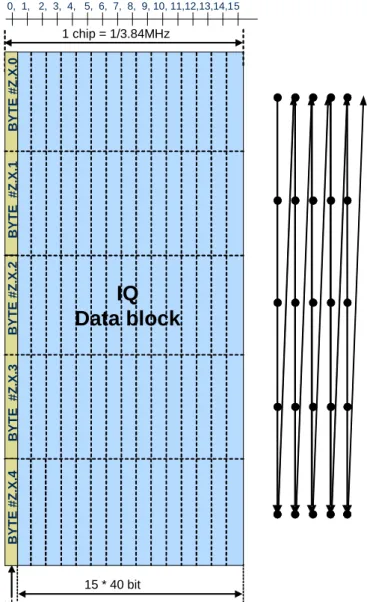
The control BYTES of one basic frame are always transmitted first. The basic frame structure is shown in Figure 7 to Figure 9A for different CPRI line bit rates. The generic basic frame structure is shown in Figures 9B and 9C for two different cases of TCW.
For 8B/10B line coding:
The bit assignment within a BYTE is aligned with IEEE 802.3-2005 [1], namely bit 7 (MSB) = H to bit 0 (LSB) = A. The physical transmission sequence of the encoded data is defined by IEEE 802.3-2005 [1]. The transmission sequence of the BYTES is indicated on the right hand side of Figure 7 to Figure 9B with one ball representing a BYTE. After 8B/10B encoding the 10bit code-groups (“abcdei fghj”) are transmitted as serial data stream with bit “a” first.
If the protocol version BYTE #Z.2.0 is set to 2 all data shall be scrambled before 8B/10B line coding by a side-stream scrambler except for control BYTES #Z.X.Y with index Y≤1 of subchannel Ns=0 and
subchannel Ns=2. Any seed – including zero – is allowed (see Annex 6.5 for more details on the scrambling mechanism).
A device being capable of supporting scrambling (according to annex 6.5) with any seed is defined to be a device supporting both protocol versions, #Z.2.0=2 and #Z.2.0=1. When transmitting (respectively receiving) with protocol version #Z.2.0=1 scrambling (respectively descrambling) shall be switched off, which can be achieved by setting the seed to zero. The protocol version is used in the start-up sequence as specified in section 4.5.
For 64B/66B line coding:
The coding is based on a block size of 64 bits. The hyperframe start shall be a