Brief Paper
Sampled-data iterative learning control for nonlinear systems with
arbitrary relative degree
夽Mingxuan Sun, Danwei Wang*
School of Electrical and Electronic Engineering, Nanyang Technological University, Nanyang Avenue, Singapore 639798, Singapore Received 31 August 1999; revised 21 March 2000; received in"nal form 9 August 2000
Abstract
In this paper, a sampled-data iterative learning control method is proposed for nonlinear systems without restriction on system
relative degree. The learning algorithm does not require numerical di!erentiations of any order from the tracking error. A su$cient
condition is derived to guarantee the convergence of the system output at each sampling instant to the desired trajectory. Numerical
simulation is conducted to demonstrate the theoretical result. 2000 Elsevier Science Ltd. All rights reserved.
Keywords: Learning control; Convergence; Relative degree; Sampled-data; Nonlinear systems
1. Introduction
Iterative learning control theory can be traced back to the midst of the 1980s. It attracted considerable attention largely due to applications in motion control of robotic manipulators. Many researchers focused their attention on ILC using di!erentiation, including D-type ILC and
its variations. The explicit su$cient conditions
guaran-teeing the convergence and robustness have been derived (Arimoto, Kawamura & Mivazaki, 1984; Hauser, 1987; Moore, 1993; Bien & Xu, 1998; Chen & Wen, 1999; Sun & Huang, 1999). The fundamental characteristics of such learning algorithms have been examined for systems with direct transmission term (Sugie & Ono, 1991) and higher relative degree (Ahn, Choi & Kim, 1993). Especially, in Ahn et al. (1993), it was shown that ILC using di!
erenti-ation can be applied to the systems with higher relative degree, in which the highest order of the error derivatives is equal to the relative degree. Numerical methods might be applied to obtain the error derivatives in the practical implementation of an ILC using di!erentiation. If the
system output is contaminated with measurement noises, the numerical di!erentiation can be a source of severer
noises.
夽This paper was not presented at any IFAC meeting. This paper
was recommended for publication in revised form by Associate Editor T.-H. Gee under the direction of Editor Frank Lewis.
*Corresponding author. Tel.:#65-7905376; fax:#65-7920415. E-mail address:[email protected] (D. Wang).
In order to avoid the non causal operation, ILC with-out using di!erentiation was proposed by Kawamura,
Miyazaki and Arimoto (1988), which is now referred to as P-type ILC. Several technical analyses of P-type ILC were presented for nonlinear continuous-time systems by imposing somewhat strict requirement on system dynam-ics, for example, the passivity property (Arimoto, Naniwa & Suzuki, 1991) and the boundedness of the input}
output coupling matrix (Kuc, Lee & Nam, 1992; Saab, 1994; Chien & Liu, 1996). By these analysis techniques, it seems di$cult to prove convergence of P-type ILC for
nonlinear systems with higher relative degree. Recently, in Wang (2000), a fundamental concept was introduced in parallel to the P- and D-type ILCs, and a simple learning algorithm was proposed for easy implementation. It was shown that sampled-data ILC is one such particular form. Results have been developed for systems with rela-tive degree one. In this paper, this approach is extended to the systems with any relative degree.
From the practical point of view, it is more convenient and direct to apply the digital control techniques for ILC design. Up to now, relative few studies dealt with sam-pled-data ILC problem (Tso & Ma, 1993; Cheah, Wang & Soh, 1994; Chien, 1997; Park, Bien & Hwang, 1998). In Tso and Ma (1993) and Cheah et al. (1994), the sampled-data learning algorithms based on the approximation of acceleration of the continuous cases were proposed for robotic manipulators. In Chien (1997), a sampled-data ILC was investigated for a class of nonlinear systems and a case study was also presented for the systems with zero
0005-1098/01/$ - see front matter 2000 Elsevier Science Ltd. All rights reserved. PII: S 0 0 0 5 - 1 0 9 8 ( 0 0 ) 0 0 1 4 1 - 2
input}output coupling matrix. It was shown that the
learning processes can be done without using any di!
er-entiation of the output error. In Park et al. (1998), a learning algorithm adopting the holding mechanism is applied to LTI systems without restriction on relative degree. However, the existing results do not o!er a way of
converting the theories for nonlinear continuous-time systems with arbitrary relative degree to those for the sampled-data counterpart. Sampled-data ILC for non-linear systems without restriction on system relative degree is still an open problem.
This paper aims to apply sampled-data iterative learn-ing control methodology to a class of nonlinear systems with arbitrary relative degree. For this purpose, extended relative degree of nonlinear systems with a zero-order hold device is de"ned and a simple learning algorithm is
developed using output measurements only. Conver-gence proof is provided by a new analysis technique instead of conventional j-norm. It is shown that the proposed learning algorithm is applicable to a class of non-linear continuous-time systems that most of the existing ILC theories fail to work, including D- and P-type ILCs.
2. Problem formulation and preliminaries
A class of nonlinear continuous-time systems with linear input action is described by
x(t)"f(x(t))#B(x(t))u(t), (1)
y(t)"g(x(t)), (2)
wherex3RL, u3RP, andy3RKdenote the state, the con-trol input, and the output of the system respectively. The functions f())3RL,B())"[b
()),2,b
P())]3RL"P, and
g())"[g
()),2,g
K())]23RK are smooth in their do-main of de"nition, which are known about certain
properties only. The system performs repeated operation and every operation ends in a"nite time¹, i.e. t3[0,¹]. For each"xedx(0),Sdenotes a mapping from
(x(0),u(t),t3[0,¹]) to (x(t),t3[0,¹]), andOa mapping from (x(0),u(t),t3[0,¹]) to (y(t),t3[0,¹]). In these nota-tions,x())"S(x(0),u())) andy())"O(x(0),u())).
Due to applying digital control techniques, the opera-tion interval [0,¹] is divided intoNequal intervals with a chosen increment h. Then h"¹/N is the sampling period and t"jh, 04j4N are the sampling instants. The control input is generated using a zero-order hold device. Namely, the control input is taken piecewise
constant between the sampling instants,
u(t)"u(jh), t3[jh,jh#h), 04j4N!1. (3) The control problem to be solved in this paper is for-mulated as follows. Given a realizable trajectory y
B(jh), 04j4Nand a tolerance error bounde'0,"nd
a control input u(t) described by (3) so that the error between the output y(t) of system (1) and (2) at the sampling instants and the desired trajectoryy
B(jh) is with
the tolerance error bound, i.e. ""y
B(jh)!y(jh)""(e, 04j4N, where "")"" is the vector norm de"ned as
""x"""max
XGXL"xG" for an n-dimensional vector
x"[x ,2,x
L]2. Throughout the paper, for a matrix
A"+a
GH,3RK"L, the induced norm ""A""" max
XGXK LH"aGH" is used. For an appropriate initial
condition, the realizability of a given trajectory yB(jh), 04j4Nrefers to that there exist a continuous-time trajectory yB(t), satisfying yB(jh)"y
B(t)"RHF, and
a control input described by (3) to generate the continu-ous-time trajectory.
To describe the input}output causal relationship of
system (1)}(3), we introduce the following de"nition.
De5nition 2.1. System (1)}(3) has extended relative
degree +g ,2,g
K, for x(t)3RL,t3[0,¹], if, for 04j4N!1,
HF>F HF ¸ @NgO(x(t)) dt"0, HF>F HF R HF 2R G HF ¸ @N¸GDgO(x(tG>)) dtG>2dt"0, 14i4g O!2,where 14p4r, 14q4mand them;rmatrix
is of full-column rank.
Remark 1. If system (1)}(3) has extended relative degree
+g,2,g
K,, the component of the system output
y(t)"[y
(t),2,y
K(t)]2at the sampling instantjh#his directly a!ected by at least one component of the control
input atjh. Namely, for 04j4N!1, 14q4m, yO(jh#h)"g O(x(jh))#h¸ DgO(x(jh))#2 # hE O\ (g O!1)! ¸EO\ D gO(x(jh)) #
HF>F HF R HF 2R EO\ HF ¸EO DgO(x(tEO)) dtEO2dtFig. 1. Sampled-data iterative learning control system. #
HF>F HF R HF 2R EO\ HF [¸ @¸EDO\gO(x(tEO)),2, ¸ @P¸EDO\gO(x(tEO))] dtEO2dtu(jh). (4)It indicates that the outputy(jh#h) is due to the control action u(jh). Thus, +u(jh),yO(jh#h),14q4m, is one causal pair.
Remark 2. De"nition 2.1 allows that¸
@N¸EDO\gO(x)"0,
14p4r, and/or¸
@N¸EDO\gO(x)"0, 14q4mfor some
states, in contrast to the nonzero requirement in Ahn et al. (1993) and Isidori (1995). And the number of outputs can be greater than the number of inputs.
Also the following properties for system (1)}(3) are
assumed:
(A1) The mappingsS andOare one to one.
(A2) The system has extended relative degree
+g,2,gK,for allx(t)3RL, t3[0,¹]. (A3) The functions f()),B()), ¸GDg
O()), 04i4g
O,
14q4mand¸
@N¸EDO\gO()), 14p4r, 14q4m
are uniformly globally Lipschitz inxon the interval [0,¹]. The Lipishitz constants are denoted by l
D,l@,lDEandl@DE, respectively.
(A4) The operatorB()) is bounded onRL. Given a realizable trajectoryy
B(jh), 04j4Nfor sys-tem (1)}(3) with extended relative degree +g
,2,g
K,,
there exists a continuous-time trajectoryy
B(t)"[y B(t),
2,y
KB(t)]2, t3[0,¹] where y
OB(t) isgO times
continu-ously di!erentiable for 14q4m. (A1) implies that there
exists a unique control input u
B(t), satisfying
u
B(t)"u
B(jh), t3[jh,jh#h),04j4N!1, which drives the system output to follow the continuous-time traject-ory so that yB(t)"g(x B(t)), (5) xB(t)"f(x B(t))#B(x B(t))uB(t), (6)
wherexB(t) is the resultant state.
3. Sampled-data ILC and convergence analysis
To the learning control design, the next input action is updated based on the action and its produced result in the previous operation cycle. In view of (4),
+u(jh),y(jh#h), is a pair of algebraically related cause and e!ect. This observation is lent to the updating
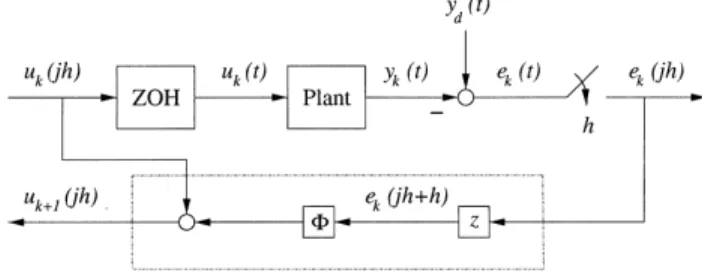
law u I>(jh)"u I(jh)#' I(jh)eI(jh#h), 04j4N!1, (7) where k indicates the number of operation cycle and e
I(jh#h)"y
B(jh#h)!y
I(jh#h) is the output error,
or the tracking error, and '
I(jh)3RP"K is the learning gain matrix piecewise continuous and bounded for 04j4N!1 and for allk. The sampled-data iterative learning control system is illustrated in Fig. 1.
We need the following lemma to aid the presentation of our main result.
Lemma 3.1. Let+aI,be a real sequence dexned as
a
I4oa
I\#b
I, 04o(1, whereb
I is a specixed real sequence. Then lim
IbI" b
implies thatlim supIaI4b
/(1!o). Proof. De"ning s I"a I!b /(1!o) and t I"b I!b leads to s I4os I\#t I, wheret
I converges to zero askPR. Therefore, there exists a positive integerK, for any givene'0, such that
"t I"(eask'K. Then, fork'K, s I(oIs #1 !oI 1!oe.
Since 04o(1 and e can be arbitrary value, lim sup
IsI40. The lemma follows. 䊐
When the updating law (7) is applied to system (1)}(3)
which has extended relative degrees +g,2,gK,, the convergence result is summarized in the following theorem.
Theorem 3.1. Given a realizable trajectory y
B(jh),
04j4N with the sampling period h being small enough, let system (1)}(3) satisfy assumptions (A1)}(A4),
and the updating law (7) be applied. The control input error u
B(jh)!u
I(jh) for 04j4N!1, the state error x
B(jh)!x
I(jh) and the output error yB(jh)!y
I(jh) for
04j4Nconverge to zero askPR,ifx
I(0)"x
B(0)for
allk,and the learning gain matrix'
I(jh)is designed such
that,for04j4N!1and for allk,
""I!'
where D I(jh)"
HF>FHF R HF2RE\ HF [¸@¸ED\g(xI(tE)),2,¸@P¸ED\g(xI(tE))] dtE2dt $ HF>FHF R HF2REK\ HF [¸ @¸EDK\gK(xI(tEK)),2,¸@P¸EDK\gK(xI(tEK))] dtEK2dt . Proof. De"ne*u I())"u B()) and *x I())"x B())!x I()). It follows from (4) to (7) that*u I>(jh)"(I!' I(jh)DI(jh))*uI(jh) !' I(jh)(uI(jh)#l I(jh)), where uI(jh)"[u I(jh),2,uKI(jh)]2, lI(jh)"[l I(jh),2,lKI(jh)]2, and uOI(jh)"g O(xB(jh))!g O(xI(jh)) #h[¸ DgO(xB(jh))!¸ DgO(xI(jh))] #2 # hE O\ (g O!1)![ ¸EO\ D gO(xB(jh))!¸EO\ D gO(xI(jh))], lOI(jh)"
HF>F HF R HF 2R EO\ HF (¸EO DgO(xB(tEO)) !¸EO DgO(xI(tEO))) dtEO2dt #HF>F HF R HF 2R EO\ HF [¸ @¸EDO\gO(xB(tEO)) !¸ @¸EDO\gO(xI(tEO)),2,¸@P¸EDO\gO(xB(tEO)) !¸ @P¸EDO\gO(xI(tEO))] dtEO2dtuB(jh),where 14q4m. Taking the norms and applying the bounds and the Lipschitz conditions, we have that
""*u I>(jh)""4o""*u I(jh)""#c (""uI(jh)""#""l I(jh)"") (9) and ""uI(jh)""4c ""*xI(jh)"" ""lI(jh)""4c
HF>FHF R HF2RE\ HF ""*xI(tE)""dtE2dt $ HF>FHF R HF2REK\ HF ""*xI(tEK)""dtEK2dt , where cis the norm bound for 'I(jh); c" max+1#h/1!#2#hEG\/(g G!1)!,i"1,2,m,l DE, c "l DE#rl
@DEcSB andcSB"sup
XHX,\""uB(jh)"".
Integrating state equations (1) and (6) for t3[jh,jh#h] and applying Bellman}Gronwall lemma yield ""*x I(t)""4#*x I(jh)""eAR\HF#
R HF eAR\Qc ""*u I(s)""ds 4c ""*xI(jh)""#(eAF!1)c ""*uI(jh)"", (10) wherec "l D#l cSB, c is the norm bound forB(xI(t)),
c
"eAF andc
"c /c
, which gives rise to
""*x I(jh)""4c ""*xI(jh!h)""#(eAF!1)c ""*uI(jh!h)"", 14j4N. Sincex I(0)"x
B(0) for all k, then
""*x I(jh)""4H\ G (eAF!1)cH\\G c""*uI(ih)"", 14j4N. (11)
Substituting (10) into (9) produces
""*u I>(jh)""4o(""*u I(jh)""#c ""*xI(jh)"", (12) where o("o#c Fcc(eAF!1)c , c"c c#c Fccc, andcF"max+hE/g !,2,hEK/gK!,. Then substituting (11) into (12) and de"ning c
"(eAF!1)max+1,c ,2, c,,cc, we get ""*u I>(jh)""4o(""*u I(jh)""#c H\ G""* u I(ih)"", 14j4N!1. (13)
Now, the estimation of the control input errors can be made. For the"rst sampling instantj"0, it follows from
(12) that, by usingx I(0)"x B(0) for allk, ""*u I>(0)""4o(""*u I(0)"". (14)
Since 04o(1, it is possible to choose the sampling periodhsmall enough such thato((1. Applying Lemma
3.1 to (14) gives lim
I""*
uI(0)"""0. (15) For the second sampling instantj"1, (13) reduces to
""*uI>(h)""4o(""*u
I(h)""#c
""*uI(0)"". (16)
Applying Lemma 3.1 to (16) results in lim sup I ""* u I(h)""4 c 1!o( lim I""* u I(0)""
and furthermore, (15) implies lim
I""* u
Fig. 2. Tracking errorsJ I. Now, by induction, assume that at sampling instants
j"0,1,2,l!1, we obtain lim
I""* u
I(jh)"""0.
For the sampling instant j"l, applying Lemma 3.1 to (13), we see that lim sup I ""* u I(lh)""4 c 1!o( lim I J\ G""* u I(ih)"" which leads to lim I""* u I(lh)"""0.
Therefore, the result for *u
I(jh) is shown for each
04j4N!1. Then it is easy to obtain the results for
*x
I(jh) by using (11) and foreI(jh) by using the
assump-tion that g()) is Lipschitz in x. This complete the proof. 䊐
Remark 3. The updating law (7) utilizes the output
measurements available at sampling instants and the control input requires to be updated atNinstants only. Thus, the proposed ILC method demands less computa-tion and memory. In the practical implementacomputa-tion, input saturation can be used to keep the input from wandering excessively in the transient stage of learning. Con-vergence of the updating law (7) installed with input saturation, however, follows the similar lines to those for the proof of Theorem 3.1.
4. An illustration example
Consider a simple nonlinear continuous-time systems described by x(t)"x (t), x (t)"0.1 sin(x (t))#(1#0.1 cos(x (t)))u(t), y(t)"x (t),
wheret3[0,1]. The sampling period is chosen ash"0.1 second and thusN"10. Let the desired trajectory take the value at each instant as
y
B(jh)"4(jh)!3(jh), 04j410.
Both relative degree of the continuous-time system and extended relative degree of the system via ZOH holding mechanism are two. The updating law (7) is used with the learning gain"70 that satis"es (8). The initial
condi-tions at each iteration are set to x
GI(0)"0,i"1,2, matching the desired initial conditions, and the initial control is chosen asu
(t)"0,t3[0,1]. The input satu-ration function is adopted to keep the input from wandering excessively. De"ne the performance index J
I"max
XHX"yB(jh)!y
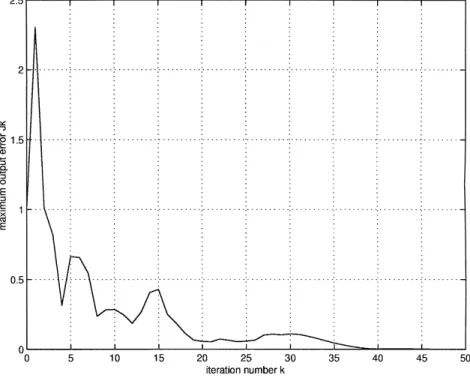
I(jh)". The iteration stops
when the tracking indexJ
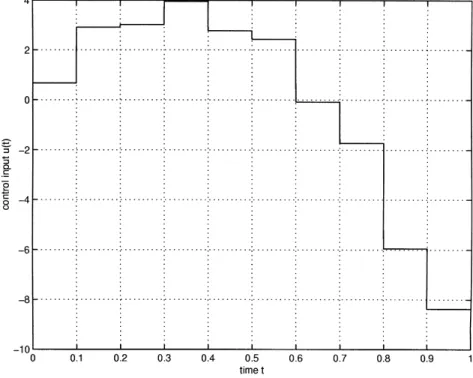
I(0.001. Via simulation, the tracking performance is achieved at the 47th iteration. Figs. 2 and 3 show the tracking errors and the resultant input trajectory. It is clearly shown that the output trajectory converges to the desired trajectory at all samp-ling instants, and that the proposed ILC approach is e!ective.
Fig. 3. Input pro"leu(t) at the 47th iteration.
5. Conclusion
In this paper, the concept of the extended relative degree is introduced to describe the input}output
causal-ity of a class of nonlinear systems where a zero-order hold device is used. A sampled-data ILC is proposed which updates the control input using the tracking error one step ahead. If the sampling period is set to be small enough and certain condition is imposed on the learning gain matrix, the system output at each sampling instant has been shown to converge to the desired trajectory. The convergence is proved by new analysis techniques instead of conventionalj-norm. The proposed control method does not require the extended relative degree explicitly and thus is applicable to nonlinear continuous-time sys-tems with arbitrary relative degree.
References
Ahn, H.-S., Choi, C.-H., & Kim, K.-B. (1993). Iterative learning control for a class of nonlinear systems. Automatica, 29(6), 1575}1578.
Arimoto, S., Kawamura, S., & Miyazaki, F. (1984). Bettering operation of robots by learning.Journal of Robotic Systems,1(2), 123}140.
Arimoto, S., Naniwa, T., & Suzuki, H. (1991). Selective learning with a forgetting factor for robotic motion control.Proceedings of the 1991 IEEE International Conference on Robotics and Automation, Sacramento, CA (pp. 728}733).
Bien, Z., & Xu, J.-X. (1998). Iterative learning control * analysis, design, integration and applications. Boston: Kluwer Academic Publishers.
Cheah, C. C., Wang, D., & Soh, Y. C. (1994). Convergence and robust-ness of a discrete-time learning control scheme for constrained manipulators.Journal of Robotic Systems,11(3), 223}238.
Chen, Y., & Wen, C. (1999).Iterative learning control*convergence, robustness and applications. London: Springer.
Chien, C. J. (1997). The sampled-data iterative learning control for nonlinear systems. Proceedings of the 36th IEEE conference on decision and control, San Diego, CA (pp. 4306}4311).
Chien, C. J., & Liu, J. S. (1996). A P-type iterative learning controller for robust output tracking of nonlinear time-varying systems. Interna-tional Journal of Control,64(2), 319}334.
Hauser, J. E. (1987). Learning control for a class of nonlinear systems. Proceedings of the 26th IEEE conference on decision and control, Los Angles, CA (pp. 859}860).
Isidori, A. (1995).Nonlinear control systems. Berlin: Springer. Kawamura, S., Miyazaki, F., & Arimoto, S. (1988). Realization of robot
motion based on a learning method.IEEE Transactions on Systems, Man and Cybernetics,18(1), 126}134.
Kuc, T.-Y., Lee, J. S., & Nam, K. (1992). An iterative learning control theory for a class of nonlinear dynamice systems.Automatica,28(6), 1215}1221.
Moore, K. L. (1993).Iterative learning control for deterministic systems. Advances in Industrial Control. London: Springer.
Park, K.-H., Bien, Z., & Hwang, D. -H. (1998). Design of an iterative learning controller for a class of linear dynamic systems with time delay.IEE Proceedings Part*D,145(6), 507}512.
Saab, S. S. (1994). On the P-type learning control.IEEE Transactions on Automatic Control,39(11), 2298}2302.
Sugie, T., & Ono, T. (1991). An iterative learning control law for dynamical systems.Automatica,27(4), 729}732.
Sun, M., & Huang, B. (1999). Iterative learning control. Beijing: National Defence Industrial Press.
Tso, S. K., & Ma, L. Y. X. (1993). Discrete learning control for robots
*strategy, convergence and robustness.International Journal of Control,57(2), 273}291.
Wang, D. (2000). On D-type and P-type ILC designs and anticipatory approach.International Journal of Control,23(10), 890}901.
Danwei Wang received the Ph.D. and M.S.E. degrees from the University of Michigan, Ann Arbor, USA, in 1989 and 1984, respectively, and the B.E. degree from the South China University of Technology, China in 1982, all in electri-cal engineering. Danwei Wang is a recipient of the Alexander von Hum-boldt Fellowship, Germany in 1996 and 1997.
In 1989, he joined the faculty of the School of Electrical and Electronic Engin-eering, Nanyang Technological University, Singapore, where he is now an Associate Professor. Since 1994 he is deputy director of the Robotics Research Center, NTU.
His research interests include robotics, automation and control engineering. He has published over 100 technical papers in refereed international journals and academic conferences. His current research projects are in the areas of mobile robotics and intelligent control theory and applications.
Mingxuan Sun received the Bachelor of Engineering degree in January 1982 from the Xi'an University of Technology, the
Master of Science in Engineering degree in 1987 from the Beijing Institute of Techno-logy, both in China.
From 1982 to 1984, he was with the Hefei Institute of General Machinery where he became an Assistant Engineer of the Institute in 1983.
He joined the faculty of the Department of Electrical Engineering of the Xi'an
Insti-tute of Technology in 1987. During his stay, he had served as an Associate Professor since 1994 and the Deputy Director of the Depart-ment since 1997. He is currently a Ph.D. candidate of the School of Electrical and Electronic Engineering of the Nanyang Technological University, Singapore. He has authored or coauthored more than 50 journal and conference papers and the book Iterative Learning Control (1999, National Defence Industrial Press, Beijing). His research interests are in iterative learning control, optimal control, optimization, intelli-gent robotics and servomechanism.