The Internet in the Communication
Infrastructure of Urban Residential
Communities: Macro- or Mesolinkage?
By Sorin Matei and Sandra Ball-Rokeach
The article refines the view that the Internet is increasingly incorporated in every-day life, concluding that the new medium has been partially integrated in the “communication infrastructure” of English-speaking Los Angeles neighborhoods. Here, Internet connectedness is associated with civic participation and indirectly contributes to “belonging” to a residential community. However, in predominantly Asian and Latino areas, the Internet is disengaged from communication environ-ments that lead to belonging, being associated with mainstream media. In these communities its contribution is contradictory; although it probably contributes to the process of ethnic assimilation, it might also lead to disengagement of most edu-cated and technologically savvy residents from their neighborhoods. A possible “mag-nifying glass effect” is proposed as explanation for the differential integration of new media in community life.
The question, “what is the social role of the Internet,” although actively pursued by many researchers, is still a moving target (Haythornthwaite, 2001). It is clear, however, that an increasingly large body of scholarship is more tantalized by the question of how “virtual” social interactions supplement or mesh up with those already existing in everyday life, than by questions about how electronic commu-nication acts as an autonomous force, changing people’s lives from the outside (Haythornthwaite, 2001; Lievrouw et al., 2001). Briefly put, the major question of the day concerns how online ties emerge in the context of (rather then opposed to) people’s real lives and locale-bound social environments.
Extending this line of research, we are especially interested in finding out how the Internet affects local or community social integration (Ball-Rokeach, 1985). In
Sorin Matei (PhD, University of Southern California) teaches in the Department of Communication at Purdue University. Sandra Ball-Rokeach (PhD, University of Washington) is a professor of communica-tion and sociology and director of the Communicacommunica-tion Technology and Community Program, Annenberg School for Communication, University of Southern California. This manuscript reports findings from an ongoing research project, Metamorphosis, conducted under the auspices of the Communication Tech-nology and Community Program at the Annenberg School for Communication. The project is funded by the Annenberg School and the Annenberg Center for Communication at the University of Southern California.
Durkheimian terms, we see the Internet as part of the general media system, as one of the factors that support a satisfactory level of “dynamic density” so neces-sary to sustain the highly differentiated modern social fabric, especially in urban residential areas.
Taking this sociological approach, we rely on a “communication infrastructure” perspective (Ball-Rokeach, Kim, & Matei, 2001). We focus on an urban-metropoli-tan population, characterized by a wide variety of immigration experiences and by high ethnic and cultural diversity. The goals of this paper are two: first, to understand if and how Internet communication, alone or in interaction with other communication channels, influences people’s “belonging” to their residential ar-eas—that is, their level of social participation and involvement with their direct neighbors—and second, if the ethnic or immigration settings of these communi-ties influence the way in which the Internet is incorporated in the communication infrastructure.
A Medium Among Other Media
Several significant studies have consolidated the idea that the Internet is not a one-of-a-kind technological device, but rather yet another layer in an already complicated postindustrial “social cake” (Ball-Rokeach, 1998; Haythornthwaite, 2001; Lievrouw et al., 2001). Although it is too early to talk about the “definitive” long-term effects of the Internet, there are signs that, although in many instances the medium is a facilitator of strong social bonds, in others it fosters weak social ties. When more stable patterns of use develop, we might find out if the new medium has what tentatively can be called a “magnifying glass effect”—strength-ening the level of social anchoring to geographic communities for those already prepared for a rich social life and weakening anchoring among people with frail social ties (Matei, 2001).
Granting that in today’s media environment impact studies can only provide transitory and tentative results, important projects, such as the one conducted by the Pew Internet Group, indicate that the Internet reinforces preexisting social networks. Internet users are more likely to have large social networks and to maintain them (Howard, Rainie, & Jones, 2001). Sixty percent of those who use email to communicate with their families say that they communicate more often with them since getting access to the new messaging system (Howard et al., 2001). Looking at social support, Howard et al. showed, controlling for basic sociodemographics, that those who have gone online have 24% greater odds of saying that they do know other people to turn to in times of need than people who have never gone online.
Data provided by four Syntopia surveys (1995, 1996, 1997, and 2000) have shown that, controlling for demographic differences, Internet use is associated with increased community and political involvement. Users were significantly more likely to belong to at least one community organization than nonusers in both the 1995 and 2000 surveys (Katz, Rice, & Aspden, 2001). Wellman, Haythornthwaite, and their colleagues have explored the same issues in a number of projects
(Hamp-ton, 2001; Haythornthwaite, 2001; Wellman, Haase, Witte, & Hamp(Hamp-ton, 2001). A study conducted in a broadband-connected Toronto suburb found that Internet-connected residents know three times as many local residents, talk with twice as many, and are more likely to invite their neighbors to their homes than their non-Internet connected neighbors (Hampton, 2001). Wellman et al. (2001) concluded that heavy Internet use is associated with increased participation in voluntary organizations and politics.
Shah, McLeod, and Yoon (2001), using the DDB Life Style Study data, also employed by Putnam (2000) and controlling for all relevant sociodemographic characteristics, found weak but significant positive effects for people who used the Internet for information exchange (principally email) in terms of level of civic participation, especially if they were young (born after 1963). Looking at the specific role the Internet plays in sustaining behaviors and attitudes that generate “social capital,” Shah et al. (2001) also reported that the Internet increases trust in people and civic participation more than print and broadcast media, espe-cially among younger people. From a broader social perspective, when people use email in strong communities, there is a low, but statistically significant, extra boost for their civic involvement coming from this interaction, above and beyond the individual effect of being an email user or a member of a strong community.
Studying the Internet From a Communication Infrastructure Perspective These studies provided evidence for two tentative conclusions: The Internet is in the process of becoming a part of the social and communicative fabric and new media supplement rather than replace old communication channels. Yet, although broad in scope and extremely valuable, most of the studies mentioned do not have access to sufficient in-depth information about intact residential communi-ties. The studies also heavily rely on English-speaking or mainly middle-class samples. The newer immigrant groups, especially those of Asian and Latino de-scent, are usually not included in these studies, although they can, potentially, derive a higher utility from the medium.
The Metamorphosis project, through which the data analyzed and presented in this article were collected, offers this opportunity both empirically and theoreti-cally. Focusing on the communication infrastructure of four ethnic groups (Black, White, Latino, and Asian), residing in seven different ethnically marked neighbor-hoods of Los Angeles, the study aims to describe how urban neighborneighbor-hoods are constructed, as social and civic spaces, through communication.
The distinguishing characteristic of this study is its “communication infrastruc-ture” concept, which is defined as a storytelling system set in its communication action context. This is employed to reveal, in broad terms, the unique contribu-tion of communicacontribu-tion process to maintaining the integrity of space-based resi-dential communities. Storytelling processes are considered central elements in community life because they motivate people, individually and collectively, to engage in those communication behaviors that establish both subjective and
ob-jective “belonging”—an attachment to a residential area that is evidenced in ev-eryday exchange behaviors. Our focus upon residential areas reveals resistance to claims that “place” no longer matters. Residential places are where we most sen-sually experience the conditions of everyday life. Our challenge is to look at the vitality of individuals’ communication behavior and their residential communica-tion environments to understand why belonging thrives or withers. Our concept of communication infrastructure builds upon the assumptions of media system dependency (Ball-Rokeach, 1998) and goes beyond it to more inclusive consider-ation of the interplay between interpersonal and mediated storytelling systems and their contexts (Wyatt, Katz, & Kim, 2000). Of the two basic components of a communication infrastructure—the communication action context and the multi-level storytelling system—present purposes dictate that we devote more attention to the storytelling system than to the communication action context.
Communication Action Context
We draw the term from Habermas (1984), who developed it to capture the impor-tance of the preconditions of rational discourse in the public sphere. Our use of the term differs somewhat in that our aim is to unfold the discourse preconditions for storytelling in a specific neighborhood. They include the elements that prevent or encourage communication: the physical makeup of the urban grid, sociocul-tural characteristics that facilitate (or hinder) communication, and so on. In es-sence, the communication action context varies along a dimension of openness and closedness. Simplifying, for the purposes of this summary, the complex mecha-nisms by which the context influences the storytelling process, an open context is one that encourages people to engage each other in communication, whereas a closed context discourages such encounters. Any particular context will have ele-ments of both openness and closedness.
The Storytelling System: Distinctions Between Storytelling Levels
A storytelling system brings together people and institutions. In essence, it is a web of connections cutting across individual and group levels of analysis. It is organized into various communication environments, recognized as its macro-, meso-, and microlevels. Distinctions among these three elements are made in terms of their primary storytelling referent and their imagined audience, although this feature is conceptual rather than “natural” because rare is the story that does not bounce from one storytelling level to another.
Macroagents, including institutions, newspapers, national television networks, and cable systems, but also public relations agencies or departments, and their audiences, bring to life stories primarily about the region, the nation, even the world. Their imagined audience is broadly conceived as the population of the city, region, or nation. Stories about, or set in, particular residential areas are told, but they are a secondary concern. Mesoagents are more focused upon a particular part of the city and, in some cases, upon certain residents of that area (e.g., a particular ethnicity, class, gender, or lifestyle group). They can include informa-tion disseminators such as local publicainforma-tions or the communicainforma-tion departments
of community organizations. Both community organizations and local media can directly affect the level of neighborhood belonging to the extent that the stories they tell serve as catalysts for microlevel storytelling (e.g., activate neighbors storytelling their neighborhoods), or serve as a bridge between macro- and microstorytelling (e.g., getting neighborhood stories into mainstream media or on the agenda of civic decision makers; Wilson, 2001). Microagents are usually indi-viduals or grassroots, informal residential networks and the communication pro-cesses they foster. Although microagents or networks of neighbors tell stories about many things far from their neighborhoods, they, nonetheless, carry the most concrete burden of “storytelling” their neighborhoods.
The Ideal Storytelling System: Connections and Connectedness
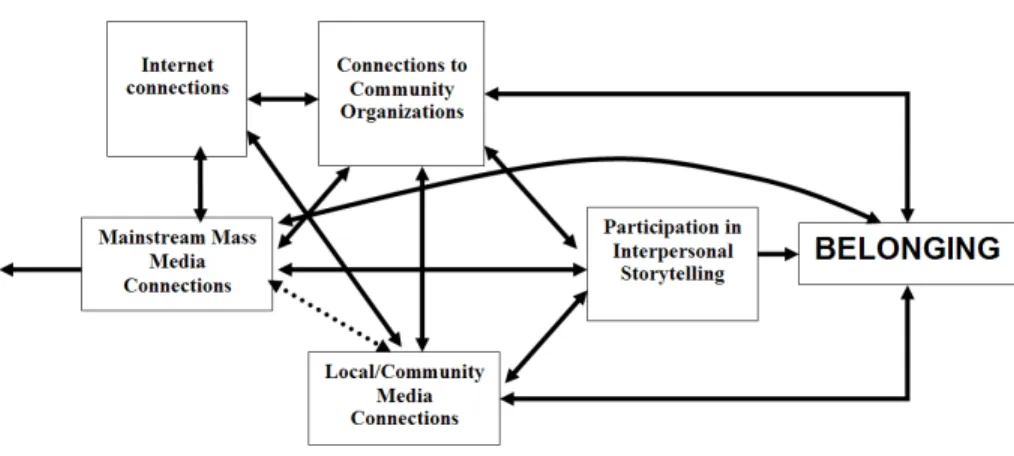
The “ideal-typical”—using the consecrated Weberian heuristic term—storytelling system (figure 1) would be broad (from world to neighborhood referents), deep (many stories about all referents), and integrated (strong linkages between macro-, meso-, and microstorytelling production systems). Of these features, we place particular emphasis upon the degree of integration. This is not, however, conceived in institutional terms. It is not the simple presence of macro-, meso-, or microstoryteller institutions or situations that automatically shape belonging. Rather, it is the strength of the residents’ connections with each other and with the area as a whole, mediated by these communication environments that create a well-integrated communication infrastructure and the premises for weak or strong belonging.
When people read the newspaper, talk with their neighbors, participate in community organization activities, watch TV, or use the Internet, they do more than acquire information for personal use; they connect to a community that is larger than the sum of its parts. Media connection, then, is important because is a Figure 1. Ideal-typical communication infrastructure model.
potential springboard for storytelling and, by implication, for community building. At the individual level, connections translate into “connectedness”—which is an-other way of describing density of sociomediated ties—a concept whose operationalization will be discussed in the methods section.
A denser connectedness network translates into better integrated communica-tion infrastructures. Integracommunica-tion, however, is not important in and of itself. Measur-ing communicative integration and “level of connectedness” is important because this exercise allows us to learn how strong the potential for belonging to one’s community is. Belonging, in turn, is important because as our previous research indicated, this is one of the factors that encourages civic vitality and community strength (Ball-Rokeach et al., 2001).
Although connectedness to micro-, meso-, or macrostorytelling is measured at the individual level, we treat them conceptually as tracers of processes that are reflected in, rather than are reflective of, individual propensities. These processes are part of the general dynamic of the communication infrastructure, rather than of particular individuals. For example, for us, participation in community organi-zations is not a simple issue of individual proclivity for investing personal time and energy in group projects. The effect does not come only from personal civic-mindedness to social capital. Because community organizations have a social func-tion of their own, that is, fostering civic storytelling, participafunc-tion in their daily life, in fact, measures the strength of mesolevel communication channels that emerges from, but goes beyond the individual’s participation in these activities. This justi-fies talking about the communication infrastructure as a group phenomenon, rather than an individual phenomenon.
Looking at the ideal-typical communication infrastructure model (Figure 1), the arrows between the storytellers signify that people who are enmeshed in one communication environment will also be more likely to be caught up in other types of communication (storytelling situations), which will contribute to a stron-ger level of anchoring to local community. Our model, in essence, allows us to measure—using a cross-level of analysis perspective—how variations in commu-nicative integration can be seen both as an individual and a collective process that has consequences for community strength.
The Internet as a Storyteller
Returning to the core question of this study: Where does the Internet fit in the communication infrastructure/storytelling system, a good section of the literature suggests that Internet usage can be directed toward mesostorytelling because this is associated with higher community organization participation (Katz et al., 2001; Shah et al., 2001). A first research question then should ask:
RQ1: Is the Internet a meso-linkage in the communication infrastructure?
Because most of previous research was conducted on White, middle-class popu-lations, the expectation that the Internet will be a mesolinkage is especially strong for English speaking, old immigrant communities. Our rich, ethnically diverse
data and some of our previous research indicate that the communication infra-structure is inflected differently by social, ethnic, and immigration background. For example, Ball-Rokeach et al. (2001) reported that the communication infra-structure in new immigrant Asian areas was considerably weaker, especially due to missing links between mesostorytellers (community media and organizations). Although not as affected, the Latino areas also suffered from frailer connections between storytellers. Because the Asian sample was the one with the most recent immigrants, followed by the Latino, White, and African American ar-eas, the communicative differences between ethno-immigrant groups mirror their immigration history. Strength of belonging also reflects this hierarchy; older immigrant groups have not only stronger communication infrastruc-tures but also higher levels of belonging. In this context, our second research question emerges:
RQ2: Does the position and the role of the Internet in the communication infrastructure change when comparing old with new immigrant areas?
The goal of the question was to find out if the Internet bridges the possible gaps that appear in the infrastructure or if it will widen them.
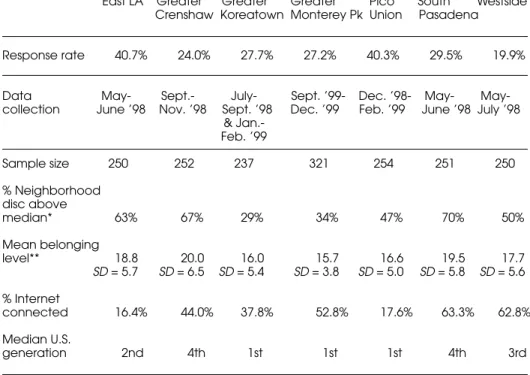
Table 1. Sample summary
East LA Greater Greater Greater Pico South Westside Crenshaw Koreatown Monterey Pk Union Pasadena
Response rate 40.7% 24.0% 27.7% 27.2% 40.3% 29.5% 19.9%
Data May- Sept.- July- Sept. ’99- Dec. ’98- May- May-collection June ’98 Nov. ’98 Sept. ’98 Dec. ’99 Feb. ’99 June ’98 July ’98
& Feb. ’99 Sample size 250 252 237 321 254 251 250 % Neighborhood disc above median* 63% 67% 29% 34% 47% 70% 50% Mean belonging level** 18.8 20.0 16.0 15.7 16.6 19.5 17.7 SD = 5.7 SD = 6.5 SD = 5.4 SD = 3.8 SD = 5.0 SD = 5.8 SD = 5.6 % Internet connected 16.4% 44.0% 37.8% 52.8% 17.6% 63.3% 62.8% Median U.S. generation 2nd 4th 1st 1st 1st 4th 3rd
Method Data Collection
Although the Metamorphosis study has collected data using a variety of methods (surveys, focus groups, mapping exercises, etc.) the data employed in this article concern primarily a telephone survey conducted in 1998–1999 (N = 1,812) in selected Los Angeles neighborhoods. One ethnicity was surveyed in each neigh-borhood, as follows: West Los Angeles, White; Greater Crenshaw, African Ameri-can; East Los Angeles, Mexican origin; Pico-Union, Central American origin; Koreatown, Korean origin; South Pasadena, White; Greater Monterey Park, Chi-nese origin (see Table 1). Interviews were conducted in English or native lan-guages (Chinese—both in the Mandarin and Cantonese dialects, Korean, and Span-ish; Matei, Ball-Rokeach, Wilson, Gibbs, & Gutierrez Hoyt, 2001). The neighbor-hoods and the ethnicities represented key areas or groups in the Los Angeles core urban area. All are located within 10 miles of the Los Angeles civic center and contain populations representative of 90% of Los Angeles population. The population we selected gives a good picture of the Los Angeles ethnic and social mosaic (Matei et al., 2001).
The response rate to the telephone survey was low, 31%, calculated by divid-ing the number of completed interviews by the number of theoretically eligible phone numbers. Despite the fact that the phone interview was relatively long (40 to 45 minutes) the cooperation rate—percentage of eligible respondents con-tacted who completed the survey—was relatively high, 62%. Although there were sample biases due to the response rate, they appear to be within the normal range for a survey of this complexity (Keeter, Miller, Kohut, Groves, & Presser, 2000). The sample overrepresents females, higher income earners, those with higher education, and older residents. No sample was significantly more biased than the others along these dimensions. For details, see Matei (2001).
Variables. The study contains the following types of measures collected through telephone interviews: (a) participation in storytelling environments; (b) “sense of belonging” to local community or neighborhood, measured as perceived interac-tion with one’s neighbors and assessment of “neighborly spirit,” and (c) Internet connectivity. Participation in the storytelling environments was operationalized using, according to the nature of the data, several methods.
For macro- (traditional mass media) connections, which link people mainly to nonlocal groups (mainstream newspapers, television, and radio) one “yes” versus “no” variable was created indicating if the respondent watches television, or reads a newspaper or listened to radio produced or published by a big, commercial, English-language media company to learn about his or her community (social orientation), for shopping (instrumental action), or for entertainment (play). This goal-oriented variable measured the relative centrality of the medium in a person’s life. The goals were, based on media dependency theory (Ball-Rokeach, 1985), central actional anchors in an individual’s life.
Mesoconnections, which mainly include community media connections, were operationalized in a similar manner. A yes/no variable indicated if the respondent watched television, read newspapers, or listened to radio that cater to their local
community or ethnic group in order to satisfy the same three goals. In this cat-egory were also included any public (nonprofit) media outlets.
Participation in community organizations was also considered to be a meso-linkage because, for the purposes of this study, community organizations are considered to be one-of-a-kind storytellers. The reasoning behind this is that com-munity organizations are active information collection and dissemination chan-nels; a lot of what goes on in a neighborhood can be propagated through home-owner association meetings, neighborhood watch newsletters, or other local group activities. Participation was operationalized as a yes (respondent is member of any community organization) or no (he or she is not member of any community organization) variable.
Microconnections were originally operationalized through a continuous scale measuring intensity of interpersonal discussion about the neighborhood. In the original instrument, respondents were asked to indicate, on a scale of 1 to 10, where 1 represents never and 10 represents all the time: How often do you have discussions with other people about things happening in your neighborhood?” (mean = 4.6, standard deviation = 2.9). Due to the nature of the statistical analysis chosen, the variable was dichotomized at the median.
Internet connectivity—not defined a priori as micro-, meso-, or macrovariable— is operationalized as yes or no answers to the question: “Do you use any com-puter to connect with the Internet or go online? This could be a comcom-puter at work, school, home, or anywhere else.” Again, the meaning of this variable is that people have the ability to participate (or not) in this specific “storytelling environment.”
Belonging is measured through an eight-item index (see appendix). Ranging on scale between 0 and 40, it combines a count of number of neighbors ”known well enough to . . .” with perception of “neighborly spirit” (Chavis & Wandersman, 1990; Hui, 1988; McLeod et al., 1996). For this analysis the variable was dichoto-mized into low (bottom two thirds) and “high” (upper one third) scores (belongers).
Analysis
Due to the categorical nature of most of the variables, the chosen statistical analy-sis was log-linear modeling. This involves fitting a theoretical model to observed frequencies in cross-tabulations of multiple categorical variables. The model rep-resents a set of expected frequencies resulted from hypothetical associations be-tween two or more variables that may or may not resemble the observed frequen-cies. If the differences between observed and expected frequencies are not statis-tically significant, then the model is accepted, that is, the model accurately reflects reality, is not different from it.
Testing the model on a sample produces a limited number of significant vari-able associations (i.e., situations in which the observed matched the expected frequencies). The strength of this association is expressed in odds-ratio, for ex-ample, the odds that the variables will be associated. Using two of our own variables as an example, what are the odds that Internet connectors will also be members of community organizations?
In the present study the theoretical model includes all two-way interactions among the six communication infrastructure variables. This reflects our theoreti-cal assumption that an ideal-typitheoreti-cal communication infrastructure will present a fully integrated fabric. The theoretical log-linear model was tested three times, on three different subsamples distinguished by their ethnic background, Internet connectedness, and level of belonging. The logic behind this strategy was to find out how far or close the models are, especially with regard to the position occu-pied by the Internet in them, from the empirical reality of the three ethno-geo-graphic communities. Of particular importance was finding out in what samples Internet connectedness was associated, directly or indirectly, with belonging.
The three subsamples included the mostly English-speaking, old-immigrant popu-lation (White and African American, N = 699) and the ones combining the two Asian (N = 526) and two Latino (N = 477) groups. The analyses were performed at ethno-immigrant group level, rather than at community level, for several reasons. First, this division reflects the parallel variations in belonging, immigration history and storytelling. For example, combining the African American and the White samples is warranted because these samples, compared to the Latino but also the Asian groups, share a common linguistic background, have been in the U.S. for more than three genera-tions, and have some of the highest levels of belonging or neighborhood interper-sonal interaction and some of the highest levels of Internet penetration (see Table 1). Second, this subsample structure facilitates answering the research questions, especially the first one (where does the Internet fall in the communication infra-structure), in a more parsimonious way. The distinctions are rougher than if we looked at the local communities individually, but our focus in this article is more on differences determined by ethnic and immigrant backgrounds than by specific area location. Third, log-linear routines require, for a model including six vari-ables, such as the case here, a 64-cell cross-tabulation. Combining the samples into larger subgroups increases the average number of respondents per cell and consequently the statistical reliability of the test.
Results
The first log-linear analysis fits the theoretical communication infrastructure model, including all two-way interactions, to the old-immigrant (White and African Ameri-can) subsample. The model presents satisfactory goodness of fit (L2= 41.98, df =
42, sig. = .47); the ideal-typical model adequately describes the data.
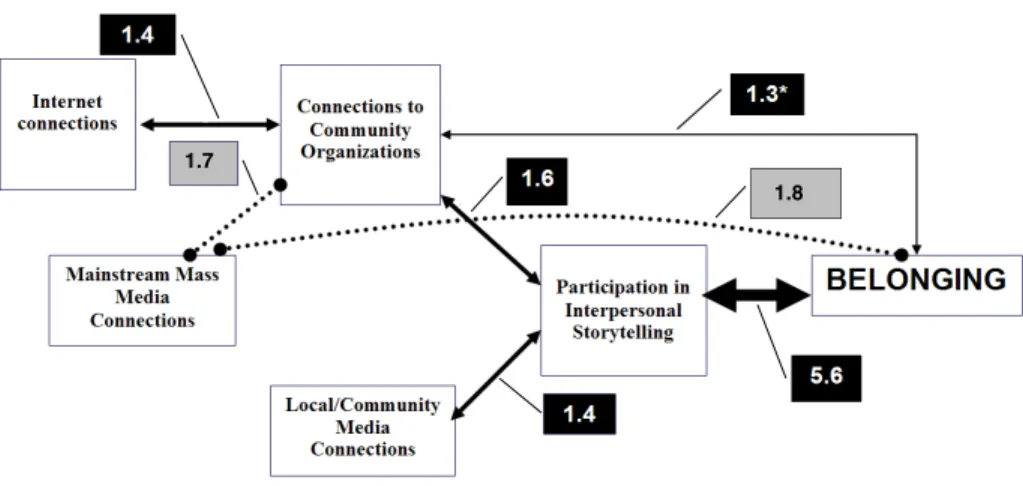
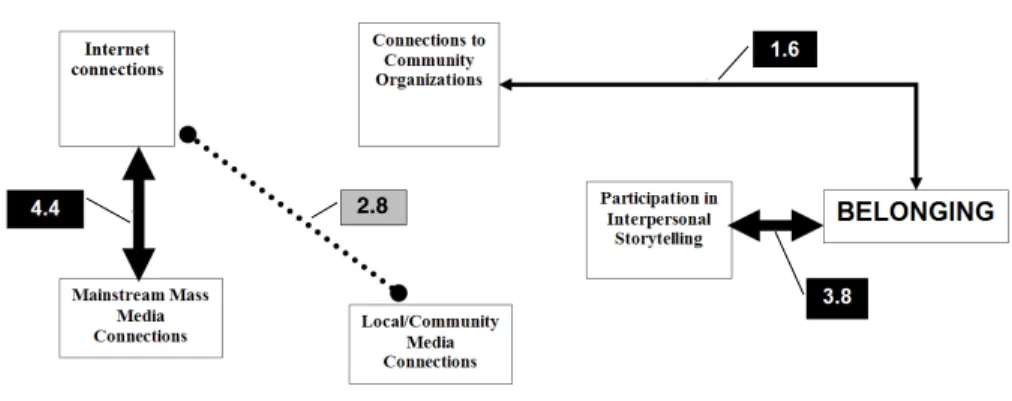
Figure 2 presents the results. The number and strength of the significant vari-able associations detected in the sample denote that the communication infra-structure presents a number of essential connections that hinge on interpersonal (micro) storytelling. The three arrows converging on microstorytelling signify that those who talk with other people about their neighborhoods above the median will have (a) 5.6 times greater odds of being “belongers,” (b) 1.6 times greater odds of being community organization members, and (c) 1.4 times greater odds of being community media connectors. People who storytell are caught in a web of local community situations, which enhances their self-assessed level of belonging.
The infrastructure misses, however, important linkages or has weak connec-tions in essential areas. For example, the thinnest line indicates that although community organization members are 1.3 times more likely to belong, we are only 85% confident that this is true, compared to 95% in the other situations. Also, there is no direct connection between community media and belonging, and nei-ther is nei-there a linkage between community media and being a member of a community organization. Finally, mainstream media connectors are 1.8 times more likely to be low “belongers” and 1.7 times nonmembers of community organiza-tions. This indicates that mainstream media is not one of the components of the communication infrastructure that contribute to belonging.
Where does the Internet fit in this picture? Internet connectedness is positively associated with community organization membership; people who connect to the Internet are 1.4 times more likely to be members of community organizations. Because this variable is also positively associated with belonging, the Internet is a weak and peripheral, but present, component of the communication infrastruc-ture that contributes to belonging.
In conclusion, the answer to the first research question should be in the affir-mative: The Internet is a mesolinkage of the communication infrastructure and indirectly contributes to belonging in old-immigrant areas. However, is this rela-tionship present in the communication infrastructure of Asian and Latino areas? Or, as research question 2 phrases it, when comparing old with new immigrant areas, will the position and the role of the Internet change?
Testing the ideal-typical model on the Asian and Latinos subsamples also pro-vides satisfactory goodness of fit (Asian group, L2 = 32.61, df = 42, p = .85; Latino
group, L2= 28.33, df = 42, p = .95), indicating that the model is a statistically
accurate representation of the data. Yet, compared to the old-immigrant subsample, Figure 2. Variable associations in the communication infrastructure of old-immigrant groups. Dotted lines represent negative association. The figures in boxes represent odds-ratios. All associations significant at p < .05, *p < .15.
1.7
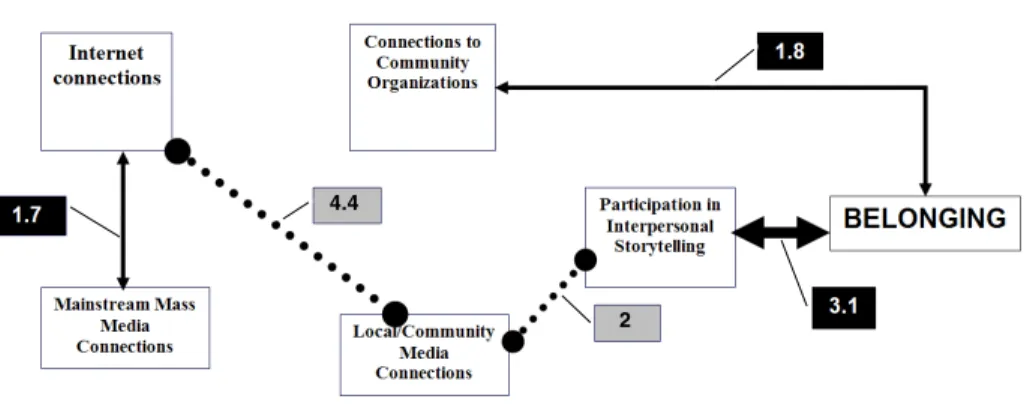
the number of significant variable associations is smaller and the communication infrastructure has a very different configuration. Especially notable is the fact that Internet connectedness does not contribute to self-assessed level of belonging (Figures 3 and 4). Internet connectors are neither more nor less likely to partici-pate in the communication environments leading to belonging or to be “high belongers” themselves. Instead, they form a separate group, having greater odds of being mainstream media connectors. In the Asian sample, they have 1.7 (Figure 3) and in the Latino sample 4.4 times greater odds (Figure 4) of being mainstream media connectors. The Internet-connected Asian respondents also have almost 3 times and the Latino respondents 4.4 times greater odds not to be local/ethnic media connectors, further highlighting the problematic situation of community media in new immigrant areas.
To summarize, in both new immigrant groups the communication infrastruc-ture is less integrated than the one identified for the old immigrant group. Con-nections between various types of communication environments that have a posi-tive influence on belonging are, in both cases, less numerous. In addition, local media is either disconnected (for Latino) or even negatively associated (for Asians) with participation in communication environments leading to belonging. Asian respondents relying on community media, which here includes the ethnic Chi-nese and Korean press, have almost twice the odds of not talking with other people about their residential area (Figure 3). This highlights a supplementary problem with these infrastructures, which will be discussed below.
Discussion
The first substantive comment about our findings is that although Internet connecters in old-immigrant areas are more likely to be community organization members, they are not directly high belongers. We interpret this as coming in support of the Figure 3. Variable associations in the communication infrastructure of new immigrant (Asian) areas. Dotted lines represent negative association. The figures in boxes represent odds-ratios. All variables significant at p < .05.
4.4
general tenet of this article, that the Internet cannot have by itself a strong positive influence on the residential social fabric because it is only one of several possible social linkages in a residential community. This is important to remember because the thrust of the article is to identify what role, among other linkages, the Internet plays in the communication infrastructure and not to prove that this is the most important or consequential linkage.
A second observation is that although old immigrant communities in Los Ange-les have a relatively better integrated communication infrastructure, this is not perfect. Important links are missing, especially those between community media connectedness or community organization participation and belonging. Equally important, however, is that the communication infrastructure hinges on interper-sonal communication, which emphasizes the validity of the storytelling model.
A third observation is that in the new immigrant communities the storytelling structures are more fragmented. Community media are conspicuously disengaged or even opposed to storytelling practices or environments leading to belonging. One explanation is that community media in new immigrant areas include and rely mainly on native language publications and broadcasting channels. Their role, confirmed through what the residents told us during postinterview focus groups and through a separate census of local media available in each area, is to reinforce ethnic identities. These channels, in many instances owned and oper-ated by country of origin media organizations tell stories primarily about their birthplace and about the members of its diaspora spread throughout U.S. or the globe. Local-residential stories are relatively scarce.
Fourth, the Internet does not compensate for the frailty of the communication infrastructure. Those who engage the Internet use English media more exten-sively. The Internet appears to contribute to the process of assimilation in the American social and cultural mainstream. Is this a good or a bad thing for the local communities? Will this, in the long run, lead to total disengagement from their local or ethnic community?
Figure 4. Variable associations in the communication infrastructure of new immigrant (Latino) areas. Dotted line represents negative association. The figures in boxes represent odds-ratios. All associations significant at p < .05.
Fifth, it was encouraging to see that the role of the Internet in the old-immi-grant communities was independent of that of old mainstream media, and it was associated with connections to community organizations, which extends the body of literature mentioned above (Howard et al., 2001; Katz et al., 2001; Shah et al., 2001). On the other hand, the negative role of “old media” in these groups high-lights the problematic nature of these outlets in maintaining belonging to local communities.
To conclude, we found that although the Internet seems to be a mesolinkage in the old immigrant areas, in the new immigrant areas it is becoming part of a constellation of factors that do not contribute to belonging. Is this evidence of what we once called an “Internet magnifying glass effect” (Matei, 2001)? Although it does not directly detract people from belonging or civic participation, the Internet adds only to those people who already have sufficient connections to communi-cative resources. This can translate at least into an “opportunity loss,” which if it becomes chronic, can become a real loss for new immigrant communities.
The present study adds significant information about the role of new media in community life. Yet, its main assets, a detailed and multiethnic dataset collected from intact urban neighborhoods, can also represent a limitation. Although, ac-cording to the 2000 U.S. Census, more than 60% of Americans live in metropolitan areas of over 1 million people, one should not ignore the uniqueness of the Los Angeles urban experience studied here. This is very hard to translate into the local experience of small town and rural areas outside metropolitan areas. More re-search should be done using this conceptual apparatus on other urban and nonurban areas before we can generalize our findings beyond Los Angeles.
Another limitation of the study is operationalization of Internet “connections,” which were reduced to being a user or nonuser. Ideally, we should have used a measure similar to the one employed for the mass media connections variables: relative goal centrality versus peripherality in people’s lives. The reason for not doing so is that, although in some neighborhoods over 60% of respondents use the Internet, they do not report many central Internet dependency relationships. Tentatively, one can advance the hypothesis that although integrated in everyday life, users’ own perceptions about what the Internet is good for or the higher purposes it serves are not entirely clear. As the medium matures, we hope that it will be easier to develop a goal-oriented measure.
Until then, we expect that the current wave of research, which gives testimony to the way in which the Internet is becoming an integral part of everyday life, will offer a better and more complete understanding of how media and communities coevolve in increasingly complex webs of interaction.
Appendix Belonging Index
Do you strongly agree, agree, neither agree nor disagree, disagree, or strongly disagree with the statement (response on a 5-point Likert scale):
1) You are interested in knowing what your neighbors are like (55% of respon-dents agreed or strongly agreed);
2) You enjoy meeting and talking with your neighbors (73% of respondents agreed or strongly agreed);
3) It’s easy to become friends with your neighbors (67% of respondents agreed or strongly agreed).
4) Your neighbors always borrow things from you and your family (32% of re-spondents agreed or strongly agreed).
How many of your neighbors do you know well enough to ask them to (respon-dent specifies a number):
1)Keep watch on your house or apartment? (mean = 3.5; standard deviation = 5.8);
2) Ask for a ride? (mean = 3; standard deviation = 5.6);
3) Talk with them about a personal problem? (mean = 1.4, standard deviation = 2.8);
4) Ask for their assistance in making a repair? (mean = 1.9; standard deviation = 3.4)
Note. Cronbach’s α = .78. “Number of neighbor” variables were winsorized at 10; that is, values 11 or larger were recoded as 10 to reduce skewness. To bring all eight items to a common metric, the “number of neighbor” responses were further divided by 2. In order to recover missing cases due to failure to respond to all eight items, we replaced missing values with the variable mean score.
References
Ball-Rokeach, S. J. (1985). The origins of individual media system dependency: A sociological frame-work. Communication Research, 12, 485–510.
Ball-Rokeach, S. J. (1998). A theory of media power and a theory of media use: Different stories, questions, and ways of thinking. Mass Communication and Society, 1, 5–40.
Ball-Rokeach, S. J., Kim, Y.-C., & Matei, S. (2001). Storytelling neighborhood: Paths to belonging in diverse urban environments. Communication Research, 28, 392–428.
Chavis, D. M., & Wandersman, A. (1990). Sense of community in the urban environment: A catalyst for participation and community development. American Journal of Community Psychology, 18, 55–79. Habermas, J. (1984). The theory of communicative action. (T. McCarthy, Trans.). Boston: Beacon Press. Hampton, K. (2001). Living the wired life in the wired suburb: Netville, glocalization, and civic society.
Unpublished doctoral dissertation, University of Toronto, Toronto.
Haythornthwaite, C. (2001). The Internet in everyday life. American Behavioral Scientist, 45, 363–382. Howard, P., Rainie, L., & Jones, S. (2001). Days and nights on the Internet: The impact of a diffusing
technology. American Behavioral Scientist, 45, 383–404.
Hui, C. H. (1988). Measurement of individualism & collectivism. Journal of Research in Personality, 22, 17–36.
Katz, J., Rice, R. E., & Aspden, P. (2001). The Internet, 1995–2000: Access, civic involvement, and social interaction. American Behavioral Scientist, 45, 405–420.
Keeter, S., Miller, C., Kohut, A., Groves, R. M., & Presser, S. (2000). Consequences of reducing nonresponse in a national telephone survey. Public Opinion Quarterly, 64(2), 125–148.
Lievrouw, L., Bucy, E., Finn, A., Frindte, W., Gershon, R., Haythornthwaite, C., et al. (2001). Bridging the subdisciplines: An overview of communication and technology research. Communication Year-book, 24, 272–296.
Matei, S. (2001). The magnifying glass effect: Negotiating individualism and community on the Internet.
Unpublished doctoral dissertation, University of Southern California, Los Angeles.
Matei, S., Ball-Rokeach, S. J., Wilson, M., Gibbs, J., & Gutierrez Hoyt, E. (2001). Metamorphosis: A field research methodology for studying communication technology and community. Electronic Journal of Communication/La Revue Electronique de Communication, 11. Retrievable from http:// www.cios.org/www/ejc/v11n201.htm
McLeod, J. M., Daily, K., Guo, Z. S., Eveland, Jr., W. P., Bayer, J., Yang, S. C., et al. (1996). Community integration, local media use, and democratic processes. Communication Research, 23, 179–209. Putnam, R. D. (2000). Bowling alone: The collapse and revival of American community. New York:
Simon & Schuster.
Shah, D. V., McLeod, J. M., & Yoon, S.-H. (2001). Communication, context, and community: An explo-ration of print, broadcast and Internet influences. Communication Research, 28, 464–506. Wellman, B., Haase, A. Q., Witte, J., & Hampton, K. (2001). Does the Internet increase, decrease, or
supplement social capital? Social networks, participation, and community commitment. American Behavioral Scientist, 45, 436–455.
Wilson, M. (2001). Leading the community chorus: The role of organizations in society. Unpublished doctoral dissertation, University of Southern California, Los Angeles.
Wyatt, R. O., Katz, E., & Kim, J.-H. (2000). Bridging the spheres: Political and personal conversation in public and private spaces. Journal of Communication, 50, 71–92.