Linac 10-Tsukuba
A.Pisent RFQ for cw applications
Prologue: smooth
approximation
Andrea Pisent
Istituto Nazionale di Fisica Nucleare (Italy) A.Pisent RFQ for cw applications Linac 10-Tsukuba
Smooth approximation
The general idea is that for a Hill equation:
) ( ) ( 0 ) ( " K s x K s L K s x (1)
we want an approximate solution of pendulum kind:
L z a x 0sin 0 (2)
by applying some averaging. The problem is not completely trivial since the average of the force is null:
L dz z K L K 0 0 ) ( 1 (3) 0 180 54.61705 180 54.61705 2 0 2 2 180 109.23411 0 2 3 2 180 109.23411 0 2 4 6 8 10 2 10 3 0 2 10 3 length s/L ,y ( ) y Z i1 Z i1 xsingola i kkk i kkk 0 axT 2 Z i0 TLinac 10-Tsukuba
A.Pisent RFQ for cw applications
The proof of smooth approximation is simple and powerful: we consider that the solution of the Hill equation can be written as the product of two terms, the first is fast and is periodic with L, the second is so slow that can be averaged on the period L. Namely:
1 q(s)
X(s) q(s L) q(s)x (11)
q(s)<<1 has the following proprieties:
) ( " 0 ) ( ' ) ( 0 0 K K q dz z q dz z q L L
(12)The substitution of (11) into Hill’s equations (1) gives:
0 ) 1 ( ' ' 2 )) ( ( ) 1 ( " q X K K X q K q X X (13)
When we average this expression over a period, for the fast term averages following the (12), and we have that the only surviving terms give and harmonic oscillator equation for the slow term X:
0" K qK X
X (14)
where we have now a phase advance defined also if K has average null (or negative, like a FODO with space charge or RF defocussing).
Let’s use these formulas in two important cases, the thin lens FODO above and a sinusoidal focusing channel (the RFQ). The FODO is coherent with the value from matrix calculation, namely the phase advance (8) and envelope modulation (10).
Istituto Nazionale di Fisica Nucleare (Italy) A.Pisent RFQ for cw applications Linac 10-Tsukuba
Smooth approximation for FODO and RFQ
K q FODO )) 2 / ( ) ( ( 1 ) ( z z L f z K 2 2 2 1 8 2 2 8 ) ( L z L z f f L L z f z f L z q 2 2 2 4 f L RFQ K() Bcos2 cos2 4 ) ( B2 q 2 2 2 8 B 0180 29.55545 180 14.48187 2022 180 46.54566 0232180 38.76466 0 5 10 15 20 25 30 35 40 45 50 0.002 0 0.002 length s/L ax, ay K (s ) arbitrary s cale Zi 1 Zi 3 kkki kkk0 axT 2 asmooth Zi 0 T bsmooth Zi 0 T Zi 0 T
With space charge and RF defocusing
2 2 2 2 0 2
2
2
a
L
RF
0
"
K
qK
X
X
Linac 10-Tsukuba
A.Pisent RFQ for cw applications
Smooth approximation of a FODO lattice
F 0 D 0 L/2 L/2 sin 2 sin 1 L a
Istituto Nazionale di Fisica Nucleare (Italy) A.Pisent RFQ for cw applications Linac 10-Tsukuba
Linac 10-Tsukuba
A.Pisent RFQ for cw applications
The problem of capture efficiency in a linac
• Starting with a continuous mono energetic beam from source, only particles in the separatrix will be captured.• Typically if
0=-200 only60/360=17% of particles will be captured
• Something must be invented, especially for high intensity or for rare ion beams.
o
3
Istituto Nazionale di Fisica Nucleare (Italy) A.Pisent RFQ for cw applications Linac 10-Tsukuba d
Buncher (gap+drift)
4 2 0 2 4 0.1 0 0.1 dw2nn d1nn 4 2 0 2 4 0.1 0 0.1 dw2nn d2nn 100 75 50 25 0 25 50 75 100 4 3 2 1 0 1 2 3 4 3.142 3.142 d2nn 30 180 30 180 100 100 d0nn 100 buncher linac buncher linacAfter the bunching cavity the longitudinal phase distribution Evolves with a density peak at the wanted phase.
Linac 10-Tsukuba
A.Pisent RFQ for cw applications
d
Buncher (gap+drift)
4 2 0 2 4 0.1 0 0.1 dw2nn d1nn 4 2 0 2 4 0.1 0 0.1 dw2nn d2nn 100 75 50 25 0 25 50 75 100 4 3 2 1 0 1 2 3 4 3.142 3.142 d2nn 30 180 30 180 100 100 d0nn 100 buncher linac buncher linacAfter the bunching cavity the longitudinal phase distribution Evolves with a density peak at the wanted phase.
Istituto Nazionale di Fisica Nucleare (Italy) A.Pisent RFQ for cw applications Linac 10-Tsukuba
d
Buncher (gap+drift) Two harmonics
100 75 50 25 0 25 50 75 100 4 3 2 1 0 1 2 3 4 3.142 3.142 d2nn 30 180 30 180 100 100 d0nn 100 4 2 0 2 4 0.2 0 0.2 0.13 0.13 dw2nn 3.142 3.142 d1nn buncher linac buncher linac
About 75% efficiency can be reached
4 2 0 2 4 0.2 0 0.2 0.13 0.13 dw2nn 3.142 3.142 d2nn linac
Linac 10-Tsukuba
A.Pisent RFQ for cw applications
Beam dynamics in RFQ
linear accelerators
Andrea Pisent
Istituto Nazionale di Fisica Nucleare (Italy) A.Pisent RFQ for cw applications Linac 10-Tsukuba
outline
• Wikipedia RFQ “invented by Soviet physicists I. M. Kapchinsky and
Vladimir Teplyakov in 1970, the RFQ is presently used as an injector by major laboratories and industries throughout the world for
radiofrequency linear accelerators.[2]”
• Main features
– RF acceleration at low energy / replace the high voltage injectors – Adiabatic bunching / high capture efficiency
Linac 10-Tsukuba
A.Pisent RFQ for cw applications
RFQs replace with RF linac electrostatic injectors
example CERN RFQ2
Istituto Nazionale di Fisica Nucleare (Italy) A.Pisent RFQ for cw applications Linac 10-Tsukuba
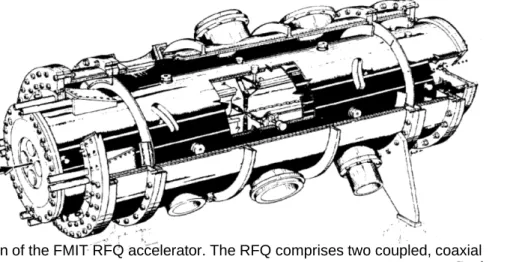
Fusion Material Irradiation Test Project - FMIT a US Department of Energy project,
accepted as a necessary and vital element for the development of fusion power.
• Construction project approved 1975
• Accelerator construction undertaken by new Accelerator Technology Division at Los Alamos January 1978, after discussions in 1977.
• No IF’s firm budget and schedule, BUT huge R&D question
-injection of 100 mA cw into DTL required several 100 kV DC injector. • Discovery of Teplyakov RFQ work in Russia.
• Proposal to DOE for RFQ development, approved!
Courtesy of R. Jameson Fig. 1. Initial design of the FMIT RFQ accelerator. The RFQ comprises two coupled, coaxial
resonators. The rf power is loop coupled into the outer section. or manifold, which more uniformly distributes the power into the four quadrants of the inner resonator, or core. A 75keV beam is
injected (arrow, left in the figure) and accelerated to 2 MeV.
Linac 10-Tsukuba
A.Pisent RFQ for cw applications
RFQs general parameters
Name Lab ion energy vane beam RF Cu Freq. length Emax Power density
voltage current power power ave max
MeV/u k V mA k W k W MHz m lambda k ilpat W/cm2 W/cm2
IFMIF EVEDA LNL d 2.5 79-132 130 650 585 175 9.8 5.7 1.8 3.5 60
pulsed CERN linac 2 CERN p 0.75 178 200 150 440 202 1.8 1.2 2.5
SNS LBNL H- 2.5 83 70 175 664 402.5 3.7 5.0 1.85 1.1 10
CERN linac 3 LNL A/q=8.3 0.25 70 0.08 0.04 300 101 2.5 0.8 1.9
CW LEDA LANL p 6.7 67-117 100 670 1450 350 8 9.3 1.8 11.4 65
FMIT LANL d 2 185 100 193 407 80 4 1.0 1 0.4
high p IPHI CEA p 3 87-123 100 300 750 352 6 7.0 1.7 15 120
TRASCO LNL p 5 68 30 150 847 352 7.3 8.6 1.8 6.6 90
CW SARAF NTG d 1.5 65 4 12 250 176 3.8 2.2 1.6
mid p SPIRAL2 CEA A/q=3 0.75 100-113 5 7.5 170 88 5 1.5 1.65 0.6 19
CW ISAC TRIUMF A/q=30 0.15 74 0 0 150 35 8 0.9 1.15 -
-lp PIAVE LNL A/q=6 0.58 280 0 0 8e-3 (SC) 80 2.1 0.5 - -
-IFMIF-EVEDA RFQ
• 18 modules 9.8 m
• Powered by eight 220 kW rf chains and 8 couplers
• High availability 30 years operation.
• Hands on maintenance
• First complete installation in Japan (Rokkasho site)
The RFQ is
INFN Italy responsibility LNL
Padova Torino ..Bologna
Istituto Nazionale di Fisica Nucleare (Italy) A.Pisent RFQ for cw applications Linac 10-Tsukuba
Linac 10-Tsukuba
A.Pisent RFQ for cw applications
A. Pisent "Introduzione alle Macchine acceleratrici " 2007
E
v
B
e
dt
p
d
Istituto Nazionale di Fisica Nucleare (Italy) A.Pisent RFQ for cw applications Linac 10-Tsukuba
The field between electrodes can be calculated in quasi static approximation. The general solution of Laplace equation in cylindrical coordinates is:
n n m n nm n nr n A I kr n mkz A V z r r r r r z t z r E , 2 2 0 2 2 2 2 2 2 2 cos 2 cos ) ( 2 cos 2 ) , , ( 0 1 1 ) cos( ) , , ( NB already encontered yesterday for magnetic quadrupoles (n=1) and RF gap (order n=0). To accelerate and focus we need again these two terms:
With k. The electrods correspond to the equipotentials . For z=0
Have the minimum aperture (called a) in x plane and the maximum aperture (called ma in the y
plane; m>1 (modulation factor) is a real number (nothing to do with mass)
Electrode modulation
A r A I kr kz
V z r cos2 ( )cos 2 ) , , ( 2 10 0 01 2 ) , , (r z V
2 ) ( 2 ) 0 , 2 , ( 2 ) ( 2 ) 0 , 0 , ( 0 10 2 2 01 0 10 2 01 V mka I A a m A V ma V ka I A a A V a Istituto Nazionale di Fisica Nucleare (Italy) A.Pisent RFQ for cw applications Linac 10-Tsukuba
The field between electrodes can be calculated in quasi static approximation. The general solution of Laplace equation in cylindrical coordinates is:
n n m n nm n nr n A I kr n mkz A V z r r r r r z t z r E , 2 2 0 2 2 2 2 2 2 2 cos 2 cos ) ( 2 cos 2 ) , , ( 0 1 1 ) cos( ) , , ( NB already encontered yesterday for magnetic quadrupoles (n=1) and RF gap (order n=0). To accelerate and focus we need again these two terms:
With k. The electrods correspond to the equipotentials . For z=0
Have the minimum aperture (called a) in x plane and the maximum aperture (called ma in the y
plane; m>1 (modulation factor) is a real number (nothing to do with mass)
Electrode modulation
A r A I kr kz
V z r cos2 ( )cos 2 ) , , ( 2 10 0 01 2 ) , , (r z V
2 ) ( 2 ) 0 , 2 , ( 2 ) ( 2 ) 0 , 0 , ( 0 10 2 2 01 0 10 2 01 V mka I A a m A V ma V ka I A a A V a Istituto Nazionale di Fisica Nucleare (Italy) A.Pisent RFQ for cw applications Linac 10-Tsukuba
h
2 0 0 2 0 0 0 2 01 0 2 0 2 10 0 10 2 2 01 0 10 2 01 1 ) ( ) ( ) ( ) ( 1 ) ( ) ( 1 1 ) ( 1 ) ( R ka I m mka I ka I mka I a A A ka I m mka I m A mka I A a m A ka I A a AThe vane profile is only approximately sinusoidal:
kz kx AI R x cos ) ( 2 2 0 0 2
The electrodes follow only approximately the two terms potential.
1. Does not extend as an hyperbola to infinity
2. The radius of vane tip is constant (and generally less than R0 to limit the surface field).
The modulation factor m has to be enhanced to get the necessary acceleration.
In the computer simulation the field applied includes the higher order components
Linac 10-Tsukuba
A.Pisent RFQ for cw applications
Equations of motion
From the two terms potential
A I kr kz R y x V z y x ( )cos 2 ) , , ( 2 0 0 2 2
The transverse and longitudinal equations (respect to the parameter ) read d dz
2 0 2 2 2 2 0 2 2 2 3 0 2 2 0 2 0 0sin
4
)
(
sin
0
2
cos
cos
2
)
cos(
)
2
cos(
)
(
R
mc
eV
B
mc
eAV
mc
eE
K
x
K
B
d
x
d
eAV
z
z
dzE
e
d
dw
a RF RF z
Istituto Nazionale di Fisica Nucleare (Italy) A.Pisent RFQ for cw applications Linac 10-Tsukuba
Equations of motion
From the two terms potential
A I kr kz R y x V z y x ( )cos 2 ) , , ( 2 0 0 2 2
The transverse and longitudinal equations (respect to the parameter ) read d dz
2 0 2 2 2 2 0 2 2 2 3 0 2 2 0 2 0 0sin
4
)
(
sin
0
2
cos
cos
2
)
cos(
)
2
cos(
)
(
R
mc
eV
B
mc
eAV
mc
eE
K
x
K
B
d
x
d
eAV
z
z
dzE
e
d
dw
a RF RF z
focussing acceleration focussing accelerationLinac 10-Tsukuba
A.Pisent RFQ for cw applications
Equations of motion
From the two terms potential
A I kr kz R y x V z y x ( )cos 2 ) , , ( 2 0 0 2 2
The transverse and longitudinal equations (respect to the parameter ) read d dz
2 0 2 2 2 2 0 2 2 2 3 0 2 2 0 2 0 0sin
4
)
(
sin
0
2
cos
cos
2
)
cos(
)
2
cos(
)
(
R
mc
eV
B
mc
eAV
mc
eE
K
x
K
B
d
x
d
eAV
z
z
dzE
e
d
dw
a RF RF z
focussing acceleration focussing acceleration Focussing factorIstituto Nazionale di Fisica Nucleare (Italy) A.Pisent RFQ for cw applications Linac 10-Tsukuba
Parameters dependence: A
acceleration
Freg 01 1.5 2 2.5 3 0.2 0.4 0.6 0.8 A x .8( ) A x ..6( ) A x .4( ) A x .2( ) A x 0( ) x21 x21 m m ka
a
ka
m
m
ka
I
m
mka
I
m
ka
m
A
ka2
1
1
)
(
)
(
1
)
,
(
2 2 0 0 2 0 2
Linac 10-Tsukuba
A.Pisent RFQ for cw applications
Parameters dependence:
average aperture R
0
m m R0/a2
1
)
(
)
(
)
(
)
(
)
,
(
0 0 0 2 0 0
m
ka
I
mka
I
ka
I
m
mka
I
ka
m
a
R
R0/a 1 1.5 2 2.5 3 1 1.5 2 2.5 chi x .8( ) chi x .6( ) chi x .4( ) chi x .2( ) chi x 0( ) x 1 2 x 1 1.5 2 2.5 3 0.8 0.9 1 1.1 1.2 chinorm x .8( ) chinorm x .6( ) chinorm x .4( ) chinorm x .2( ) chinorm x 0( ) xIstituto Nazionale di Fisica Nucleare (Italy) A.Pisent RFQ for cw applications Linac 10-Tsukuba 1 1.5 2 2.5 3 0 0.05 0.1 0.15 0.2 EasuEs x .8( ) EasuEs x .6( ) EasuEs x .4( ) EasuEs x .2( ) EasuEs x 0( ) x 0 1 2 3 0 0.05 0.1 0.15 EasuEs 1.5 ka jj EasuEs 2 ka jj EasuEs 3 ka jj
kajjchi 1.5 ka jjkajjchi 2 ka jjkajjchi 3 ka jj
Accelerating field vs surface field
• In new RFQs the field is generally increased at high energy to compensate the decrease of Ea with typical of a constant voltage structure
kRo m 0 0 0 0 2 0 0 0 0 0 0 0 1 2 ) 2 ( 2 ) , ( ) , ( 4 ) , ( ) , ( 4 ) , ( R q AkR qkR I q kR m kR m kR m A kR E E R V kR m E kR m VkA AV E s a s a Ea/Es Ea dipendance with modulation Parameters
Es is the surface field
Linac 10-Tsukuba
A.Pisent RFQ for cw applications
Transverse focussing vs surface field
• Concerning transverse
focusing there are two results • If a high B is needed (to
counteract RF defocussing or space charge) R0 and
therefore V must be reasonably low
• From the point of view of acceptance (to avoid losses on halo) it is convenient high voltage and large aperture.
V
m
B
R
a
kR
m
kR
m
A
kR
E
E
R
mc
e
E
B
R
mc
eV
B
R
V
kR
m
E
n s a s s
2 2 0 2 0 0 0 0 2 2 2 0 2 2 0 01
2
8
)
,
(
4
)
,
(
)
,
(
Istituto Nazionale di Fisica Nucleare (Italy) A.Pisent RFQ for cw applications Linac 10-Tsukuba
Break
Linac 10-Tsukuba
A.Pisent RFQ for cw applications
Beam dynamics: parameters period by
period
Istituto Nazionale di Fisica Nucleare (Italy) A.Pisent RFQ for cw applications Linac 10-Tsukuba Modulation “m”, average aperture “r0” [cm], small aperture “a” [cm], Voltage/100 [kV] E0 [MV/m], Acceleration factor “A10”, Energy “W”, Focusing “B”, ‐Sync. Phase/100 [deg], Pole tip “rho”, along the RFQ Shaper GB Accelerator Ions d
Energy range 0.1-5 MeV
input-output nom emitt 0.25 mmmrad (rms) Ouput long emitt. 0.2 MeV deg (rms) Output current 0.2
Tansmission 98 % WB distr. 95 % Gsussian distr.
Linac 10-Tsukuba
A.Pisent RFQ for cw applications
Istituto Nazionale di Fisica Nucleare (Italy) A.Pisent RFQ for cw applications Linac 10-Tsukuba
Beam matching at the input
• The beam at RFQ input iscontinous and has to be matched to a time-dependent focusing. The focusing has to rise adiabatically to allow the transverse capture
Linac 10-Tsukuba
A.Pisent RFQ for cw applications
Bunching section
• Prepares the buch to be accelerated
• In the shaper A and are raised linearly to form the separatrix
• In the gentle buncher A and
0 are raised keeping the sigmal (bunch length in space) and the separatrix area (to keep the captured particles)
Modulation “m”, average aperture “r0” [cm], small aperture “a” [cm], Voltage/100 [kV] E0 [MV/m], Acceleration factor “A10”, Energy “W”, Focusing “B”,
‐Sync. Phase/100 [deg], Pole tip “rho”, along the RFQ
Istituto Nazionale di Fisica Nucleare (Italy) A.Pisent RFQ for cw applications Linac 10-Tsukuba
Linac 10-Tsukuba
A.Pisent RFQ for cw applications
accelerating section
• The field is ramped in the
accelerating section to
compensate the decrease of Ea with typical of a
constant voltage structure.
• The increase is limited by the power per structure meter, and transverse acceptance.
Modulation “m”, average aperture “r0” [cm], small aperture “a” [cm], Voltage/100 [kV] E0 [MV/m], Acceleration factor “A10”, Energy “W”, Focusing “B”,
‐Sync. Phase/100 [deg], Pole tip “rho”, along the RFQ
Istituto Nazionale di Fisica Nucleare (Italy) A.Pisent RFQ for cw applications Linac 10-Tsukuba
Cavity cross section
12/06/2008 36 Wb Wb Beginning End 340 mm 173 173.5 174 174.5 175 175.5 0 200 400 600 800 1000 z axis [cm] Frequency [MHz] 0 1 2 3 4 5 Half Width Vane Base [cm] Frequency WBASE 0 50 100 150 200 250 300 0 200 400 600 800 1000 z axis [cm] Shunt Im peda nce [k *m] 0 100 200 300 400 500 600 700 Po wer [W/c m ] Rs [kOhm*m] (4 quad) P [W/cm] 4 quad 2d simulation values
Linac 10-Tsukuba
A.Pisent RFQ for cw applications
0.5 1 1.5 2 2.5 3 3.5 4 4.5 5 5.5 0 100 200 300 400 500 600 700 800 900 1000 A cce p tan ce [mmmra d ]; m; a [mm] RFQ Length [cm] Acce (mmmrad) m a (mm)
Acceptance increase in the accelerator part
Shaper GB Accelerator
Istituto Nazionale di Fisica Nucleare (Italy) A.Pisent RFQ for cw applications Linac 10-Tsukuba
Beam Loss [uA/m]
0 5 10 15 0 200 400 600 800 1000 z Cur re n t Lo ss [u A /m ] Series1 Beam Loss [W/m] 0 50 100 150 200 250 0 200 400 600 800 1000 z Pow e r Lo ss [W /m ] Series1
Neutron production estimate [n/(s*m)]
0.00E+00 5.00E+08 1.00E+09 1.50E+09 2.00E+09 0 200 400 600 800 1000 RFQ Length [cm] ne ut ro ns [n /( s* m )] Series1 RFQ Length [cm] Integral 1.4 mA Integral 3.8 10^9 n/s Integral 549 W
WB distribution 0.25 mm mrad rms norm 1 . 2 7 10 * 15 . 5 Nw n
Linac 10-Tsukuba
A.Pisent RFQ for cw applications
Effect of Input Current and beam distribution
Runs with TraceWin; emit=0.25 mmmrad RMS; Np=100000
Istituto Nazionale di Fisica Nucleare (Italy) A.Pisent RFQ for cw applications Linac 10-Tsukuba
The Phase Advance along the RFQ
I=0
I=130
Linac 10-Tsukuba
A.Pisent RFQ for cw applications
Error studies
• The error study shows tolerances in beam alignment and electrode
displacements of the order of 0.1 mm, while the RF field law has to be
followed with an accuracy of 1-2%. • Example: displacement between two
modules (9 modules) 93.5 93.8 94.1 94.4 94.7 95 95.3 95.6 95.9 96.2 96.5 800 940 1080 1220 1360 1500 1640 1780 1920 2060 2200 0 10 20 30 40 50 60 70 80 90 100 Tr a n sm issi o n [% ] Po w er Lo ss [W a tts ]
Profile Max Error [um]
Gaussian Seg 550 mm
Power Loss min [W] Power Loss ave [W] Power Loss MAX [W] Tr [%] min Tr [%] ave Tr [%] MAX
Transmission and Power loss due to the segmentations applied with gaussian and waterbag input beam distribution.(TOUTATIS)
97.1 97.3 97.5 97.7 97.9 98.1 98.3 98.5 98.7 98.9 99.1 200 300 400 500 600 700 800 900 1000 1100 1200 0 10 20 30 40 50 60 70 80 90 100 Tr a n sm issi o n [% ] Pow er Lo ss [W atts ]
Profile Max Error [um]
WaterBag Seg 550 mm
Power Loss min [W] Power Loss ave [W] Power Loss MAX [W] Tr [%] min
Tr [%] ave Tr [%] MAX
Istituto Nazionale di Fisica Nucleare (Italy) A.Pisent RFQ for cw applications Linac 10-Tsukuba
Linac 10-Tsukuba
A.Pisent RFQ for cw applications
CERN lead ion RFQ (Pb injector of LHC)
• A/q=208/25• 100 uA Pb beam (pulsed low duty) • Energy range 2.5-250 keV/u
• Transmission 93% with large
multipole correction (kR0=3.3, m=1.1) • Operational since 1994
• Built in Italy at De Pretto and Cinel • Linac 3 will inject Pb in LHC
• The linac 3 was built by an international collaboration (INFN-GANIL-GSI-CERN). • INFN LNL delivered in time and in specs
the LEBT the MEBT and the RFQ (except the RF, done by GSI)
Istituto Nazionale di Fisica Nucleare (Italy) A.Pisent RFQ for cw applications Linac 10-Tsukuba
Modulation in
Linac3 RFQ
• Respect to the high intensityapproach
• The aperture is kept quite large (B low) to increase acceleration
• there is a PB section, where the bunch is compressed fast at low energy.
• To bunch at low energy is very convenient for the length of the acceleartor.
• In the section called booster the aperture is closed up to specified one.
Linac 10-Tsukuba
A.Pisent RFQ for cw applications
Modulation in
Linac3 RFQ
• Respect to the high intensityapproach
• The aperture is kept quite large (B low) to increase acceleration
• there is a PB section, where the bunch is compressed fast at low energy.
• To bunch at low energy is very convenient for the length of the acceleartor.
• In the section called booster the aperture is closed up to specified one.
Istituto Nazionale di Fisica Nucleare (Italy) A.Pisent RFQ for cw applications Linac 10-Tsukuba
Parametric
resonance has
been avoided
• In a preliminary dynamics the RFQ was shorter, but crossing the
condition
• Below are the stability limits of Mathiew equation
T
L
Linac 10-Tsukuba
A.Pisent RFQ for cw applications
PIAVE SRFQ
The only superconducting RFQ operting in the world
Successfully in cw operation since 2006 at INFN • A/q=8.5 (used up to 7)
• 5 uA cw current
• Energy range 37-585 keV/u
• Large modulation factor (m up to 3) and intervane voltage (up to 280kV)
• Transmission 60% with external bunching • Operational since 2006
• Built in Italy at INFN (Nb electrodes machining) and Zanon.
Istituto Nazionale di Fisica Nucleare (Italy) A.Pisent RFQ for cw applications Linac 10-Tsukuba
RFQ functions
charge number 28 mass number 238 Injection platform 315 kV SRFQ #1 SRFQ #2 in out in out Energy 37.1 351.3 585.4 keV/u 8.82 83.61 139.33 MeV Beta 0.0089 0.0275 0.0355 Voltage 148.0 148.0 280.0 280.0 kV Length 138.9 74.4 cm Ncell 43 13 m 1.2 2.8 2.7 2.8 a 0.7 0.4 0.8 0.8 cm R0 0.80 0.80 1.53 1.53 cm Phis 40.0 18.0 12.0 12.0 degMax. Surface field 24.1 24.0 MV/m
Stored energy 1.8 3.5 J
Total length 213.27 cm (TTF in the first QWR=
0.87
Eq. voltage 4.66 MV
Average acc. 2.19 MV/m
Linac 10-Tsukuba
A.Pisent RFQ for cw applications
• The physical distance between the two SRFQs (200mm) determines a transverse beam mismatch in
SRFQ2 (where the acceptance is large).
• This mismatch has been minimized interrupting SRFQ1 in a point
where the Twiss parameter are
x=y=0. 200 746 Scala 1:10 1378 SRFQ2 SRFQ1
Servizio UFFICIO TECNICO
half cell terminati on
Istituto Nazionale di Fisica Nucleare (Italy) A.Pisent RFQ for cw applications Linac 10-Tsukuba
• The physical distance between the two SRFQs (200mm) determines a transverse beam mismatch in
SRFQ2 (where the acceptance is large).
• This mismatch has been minimized interrupting SRFQ1 in a point
where the Twiss parameter are
x=y=0. Z3i 1 Z3i 3 kkk3i kkk30 axT 2 Z3i 0 T 0 1 2 3 4 5 6 7 8 9 10 0.005 0 0.005 B eam en ve lo pe s [arb itrary scale] Z2i 1 Z2i 3 kkki kkk0 axT 2 Z2i 0 T 0 1 2 3 4 5 6 7 8 9 10 0.005 0 0.005 z B eam en ve lo pe [arb itrary scale] - vertical envelope Horizontal envelope transmission 0 0.2 0.4 0.6 0.8 1 1.2 0 0.3 0.5 0.7 0.9 1.2
Input Norm. Em ittance [mm mra d]
T ran sm is si o n s trans.SRQ1 trans. SRFQ2 trans SRFQ2 half-cell Nominal 200 746 Scala 1:10 1378 SRFQ2 SRFQ1
Servizio UFFICIO TECNICO
half cell terminati on
Linac 10-Tsukuba
A.Pisent RFQ for cw applications
RFQ emittance
ECR buncher SRFQs QWRs buncher buncher ALPI
x
+
y
B
44 channels 1: Transverse NormalizedEmittance at SRFQs exit.Ion ΕRMS,x [mm-mrad] ΕRMS,y [mm-mrad]
40Ar9+ 0.10 0.10
16O3+ 0.11 0.12
Istituto Nazionale di Fisica Nucleare (Italy) A.Pisent RFQ for cw applications Linac 10-Tsukuba
Conclusions
• The beam dynamics of an RFQ is written once for ever in the
metal.
– The designer has the choice of modulation parameters in some hundreds of modulation periods.
– This flexibility allows different approaches and very optimized accelerators for many specific high performance applications.
• BUT
– Once built the RFQ is not flexible at all, since very few parameters can be changed in operation.
– The construction has to follow strict tolerances (important technological challenges related to construction and RF tuning).
– One has to relay on computer simulations and design approaches, since experimental verification of the correctness of the design arrives after many years.
Linac 10-Tsukuba
A.Pisent RFQ for cw applications
Name Lab ion energy vane beam RF Cu Freq. length Emax Power density operate
voltage current power power ave max
MeV/u k V mA k W k W MHz m lambda k ilpat W/cm2 W/cm2
IFMIF EVEDA LNL d 2.5 79-132 130 650 585 175 9.8 5.7 1.8 3.5 60 NO
p pp
CW SARAF NTG d 1.5 65 4 12 250 176 3.8 2.2 1.4 24 190 only p
RFQ four rods or four vanes
IFMIF-EVEDA SARAF at SOREQ (Israel)
• Smaller cross section and dipoles at higher frequency.
• Diffused hot spots
• Better shunt impedance, possibility to reach high voltage
• Larger dimensions, dipole stop band to master
Istituto Nazionale di Fisica Nucleare (Italy) A.Pisent RFQ for cw applications Linac 10-Tsukuba
Name Lab ion energy vane beam RF Cu Freq. length Emax Power density operate
voltage current power power ave max
MeV/u k V mA k W k W MHz m lambda k ilpat W/cm2 W/cm2
IFMIF EVEDA LNL d 2.5 79-132 130 650 585 175 9.8 5.7 1.8 3.5 60 NO
p pp
CW SARAF NTG d 1.5 65 4 12 250 176 3.8 2.2 1.4 24 190 only p
RFQ four rods or four vanes
IFMIF-EVEDA SARAF at SOREQ (Israel)
• Smaller cross section and dipoles at higher frequency.
• Diffused hot spots
• Better shunt impedance, possibility to reach high voltage
• Larger dimensions, dipole stop band to master
Linac 10-Tsukuba
A.Pisent RFQ for cw applications
Questions
1. What is the field of application of Radio Frequency Quadrupoles? 2. Why for RFQ it is convenient to focus transversally with an electric
field?
3. What is the modulation factor m and which is the effect to encrease it?
4. Why in a RFQ it is possible to bunch the beam with a very high efficiency?
5. Why at higher energy it is convenient to increase the intervane voltage along the RFQ?
6. Why an RFQ in the case of negligible space charge can be shorter? 7. For an RFQ (already in operation) by increasing the voltage, how
does the output energy change (in first approximation)?
8. If during the design the input energy is decreased, what happens to the RFQ length (for similar bunching law)?