Problem Alcohol Use in Ukrainian Children: Association with Family Factors, Peer Drinking and Child Externalizing Behavior Problems
by Viktor Burlaka
A dissertation submitted in partial fulfillment of the requirements for the degree of
Doctor of Philosophy (Social Work and Psychology) in The University of Michigan
2015
Doctoral Committee:
Professor Jorge Delva, Co-Chair
Professor Sandra A. Graham-Bermann, Co-Chair Professor Lorraine M. Gutierrez
Dedication
I dedicate my dissertation to my family and friends. I am extremely thankful to my parents, Volodymyr and Halyna. Thank you, Mom, for teaching me to read—every book reminds me of you. I will always be grateful to my English teacher, Petro Honcharenko, for making me a global citizen. I also dedicate this dissertation to my colleague and dear friend Lennart Lundquist for sharing his wisdom and introducing me to social work. Most important, I dedicate this dissertation to my wife, Iuliia, and my daughters, Valeria, Liza, and Anna.
Acknowledgements
I started my doctoral program after many years of clinical practice and capacity-building work within social and health care sectors in post-Soviet countries. I owe hundreds of
colleagues in Sweden, the United States, Finland, the Netherlands, Italy, Moldova, Ukraine, Russia, and Kyrgyzstan who shaped me as a social worker and created foundations for my research agenda. I would like to recognize several colleagues who then helped me to become a social scientist.
First and foremost, I wish to thank Professor Jorge Delva for holding a life-changing conversation with me in Crimea in 2008. Although I implemented research projects earlier in my carrier, only after that conversation did I begin imagining research as my primary
occupation. It goes without saying that my decision to follow the path of a social scientist was partly based on a lack of knowledge about the overwhelming amount of preparation and stress ahead of me. I am immensely grateful for the support and mentorship I have received from Professor Delva from my very first hours in the United States. Without his encouragement and help, I would not have been able to design and implement this and other research projects.
It gives me great pleasure to also acknowledge the support of my social work advisor, Professor Joseph Himle. I carry with me his insightful advice. His ability to transform anxiety into elegant action plans was instrumental in my success in this program.
I am indebted to Professor Larraine Gutiérrez for reshaping my views early on in the program, breaking the interdisciplinary borders and introducing me to critical knowledge about multiculturalism and community-based research.
It was a great honor to work with and learn from Professor Mary Ruffolo. Numerous ideas expressed in this research derive from her clinical practice class as well as from program evaluation initiatives in which I had the privilege to participate. I am thankful to Dr. Ruffolo and Dr. Gutiérrez for helping me better conceptualize this dissertation to highlight the
intersectionality of alcohol use and abuse by paying attention to patterns of systematic injustice and oppression related to the Ukrainian sociocultural context.
I would also like to share the credit for this work with Professor Andrew Grogan-Kaylor, who spent many hours with me and Stata, nursing my passion for statistical analyses.
I also wish to thank Professor Robert Zucker for his long-standing and widely appreciated commitment to the development of substance-abuse research in several Eastern European countries, including Ukraine. Thanks to his leadership, a new generation of highly trained social scientists and medical doctors are able to provide quality services and produce high-impact research. It was during one of the workshops organized by Dr. Zucker that I met Dr. Delva and other internationally acclaimed substance-use and substance-abuse researchers. I am grateful for the honor of working with Dr. Zucker and continuing to learn from his research. His vision of alcohol-use disorder as a developmental illness transmitted within families was a major inspiration for this research.
I cannot find enough words to express my deep gratitude to my academic advisor and mentor Professor Sandra Bermann. I feel extraordinarily lucky that Dr.
Graham-Bermann welcomed me to her Child Violence and Trauma Laboratory. Working with her, I gained a thorough understanding of the ways that violence influences parents and children. I am fortunate to have worked with other members of our lab to evaluate the effectiveness of clinical interventions developed by Professor Graham-Bermann. Dr. Graham-Bermann taught me how to use research to advance my commitment to stop violence against women and children, and I am thankful for the opportunity to integrate these ideas in my research.
Finally, I would like to thank the following for enormous support, without which this research and this dissertation would not have been written: Mr. Todd Huynh for his unparalleled professionalism; Professors Karen Staller, Michael Spencer, and Berit Ingersoll-Dayton; the Doctoral Program at the University of Michigan School of Social Work, Department of
Psychology; Mrs. Svitlana Vasylkivska, director of the Methodological Psychological, Medical and Pedagogical Center (Dnipropetrovs’k oblast, Ukraine) and the members of Ukrainian research team; Dr. Tetiana Nickelsen, director of the Center for Medical and Psychosocial Rehabilitation “Zlagoda” (Vinnytsia oblast, Ukraine); Mr. Serhiy Hryhoriev and Mrs. Oksana Hryhorieva (Odesa oblast, Ukraine); research participants; the Horace H. Rackham School of Graduate Studies; the Fogarty International Center (grant 1D43 TW009310); the National Institute of Alcohol Abuse and Alcoholism; and the National Institute on Drug Abuse.
Table of Contents Dedication……….………..ii Acknowledgements………iii List of Tables……….………….….….….vii List of Figures……….……….viii List of Appendices……….…..……….……….….ix Abstract……….……….………..x Chapter I. Introduction………1
II. Effect of Parent- and Family-level Predictors on Positive and Negative Parenting………..……….54
III. Externalizing Behaviors of Ukrainian Children: The Role of Parenting……..….. 96
IV. Youth Alcohol Problems: Relationship with Child Externalizing Behaviors, Gender and Age, Parental IPV, Parenting Practices, and Parent and Peer Alcohol Use……….………126
V. Conclusion……….…….157
List of Tables Table
1.1 Correlations, Means, Standard Deviations, and Cronbach Alpha Coefficients
of the Major Study Variables Displayed in Figure 1.2……….90
1.2 Standardized Coefficients of Direct, Indirect and Total Effects of Study Predictors on Positive and Negative Parenting………91
1.3 Multiple R2 Values for Study’s Endogenous Variables…….……….…….……….92
1.4 Indirect Effects of Education, Income, Alcohol Use and IPV on Parenting………93
2.1 Study Variables (N=320)………122
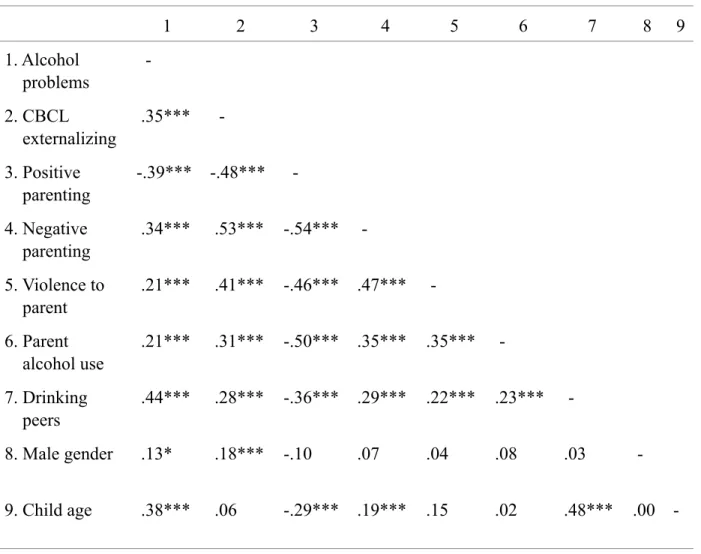
2.2 Pearson Correlations (N = 320)………..123
2.3 Relationship between Parenting Practices and Child Externalizing Behaviors (N = 320)………….……….……….………124
3.1 Major Study Variables (N = 320)……….……….……….152
3.2 Pearson Correlations (N = 320)………..153
3.3 Robust Regression Coefficients in the Model Predicting to Children’s Alcohol-Related Problems………..154
List of Figures Figure
1.1 Means and Standard Deviations of APQ Parenting Scales………..………94 1.2 Effects of Parental Alcohol Use, Family Functioning, IPV and Sociodemographic
Characteristics on Positive and Negative Parenting………95 2.1 Locally Weighted Regression of Child Externalizing Problems on
APQ Parenting Practices……….………..….125 3.1 Average Number of Alcohol Problems in Youths by Gender and Age (N = 320)……….155 3.2 Total Child Alcohol Problems by Mean Child Externalizing Problems………156
List of Appendices Appendix
1. Child Behavior Checklist for Ages 6-18 (CBCL/6-18)………169
2. Revised Conflict Tactics Scales (CTS2)………….……….………….………173
3. Alabama Parenting Questionnaire (APQ)……….174
4. Drinking and other Drug Use………176
Abstract
The purpose of this three study dissertation was to assess risk and protective factors associated with child alcohol problems. Family systems theory and Bronfenbrenner’s ecological model constituted the framework used for building and testing analytic models. Quantitative data were collected during face-to-face interviews with 320 parent-child dyads in 11
communities in Eastern, Southern and Central Ukraine. Children were 9-16 years of age and 50% were males.
The first study assessed the association between parent sociodemographic variables, alcohol use, domestic violence and family cohesion and flexibility, and parenting behaviors. Results indicated that higher violence in the home, higher alcohol use and unbalanced family functioning were related to more frequent use of negative parenting and less frequent use of positive parenting practices. Additionally, lower parent education was associated with negative parenting. The second study estimated the relationship between parenting practices and child externalizing behaviors, such as aggression, delinquency and attention problems. Results revealed that positive parenting, child monitoring and avoidance of corporal punishments were associated with fewer child externalizing symptoms. Results also indicated that child male gender, parent unemployment and single parenting had significant and positive association with child externalizing behaviors. The third, final study assessed child alcohol problems and their association with child gender and age, externalizing behaviors, parental IPV, parenting
practices, and peer and parent alcohol use. Children reported that they had alcohol related problems in multiple areas of life and mostly alcohol use affected their relationships with other people, school life and led to rule-breaking behaviors. Alcohol problems were more prevalent among males than among females. Results also revealed that children’s alcohol problems were significantly related with older child age, higher peer drinking and more symptoms of
externalizing behavior. This dissertation made an important contribution to the global
psychosocial research on children and families. These findings can be used to design alcohol prevention programs and policies in Ukraine.
Chapter I Introduction
Alcohol users in Ukraine consume, on average, 20.3 liters of pure alcohol per year, bringing the level of alcohol consumption in Ukraine 28% higher than in Europe and 124% higher than the average alcohol consumption level in the world (World Health Organization [WHO], 2014). Although globally, 48% of people abstain from alcohol use (WHO, 2014), in Ukraine only 1.0% of men and 4.7% of women report never having used alcohol (Webb et al., 2005). In a nationally representative sample of Ukrainian adolescents aged 15–17 years, the lifetime alcohol use was 93.1%, the last 12-month use was 78.1%, and the last month use was 56.3% (Balakireva et al., 2011). In this study, 30.8% of adolescents reported current binge drinking, defined as five or more drinks consumed on a single occasion during the last 30 days. Horachuk, Dudka, Skrypka, Smyrnova, and Pyankova (2011) studied adolescent social behavior and risks for health in a sample of 403 school children (males = 53%), aged 15–17, in the capital of Ukraine, Kyiv. In this study, 12% of the adolescents indicated that they did not try alcohol, 25% initiated drinking before age 11, 50% initiated drinking between the ages of 12 and 15, and 20% had alcohol for the first time when they were older than 16 years of age. Presently, no study has reported on alcohol use among younger children in Ukraine. Without
this information, it is impossible to estimate at what age children in Ukraine begin harmful consumption of alcohol on such a regular basis.
To address this gap, I have designed a study of factors associated with the development of alcohol-related problems among Ukrainian children. Specifically, in this Introduction section, I provide a summary of the literature on alcohol problems worldwide and a summary of
comorbidity, theoretical models, and cultural contexts related to alcohol use in Ukraine. Next, I will use empirical data from Ukrainian children and parents to examine three research
questions. In Chapter II, I will explore the effect of parent and family-level correlates on positive and negative parenting (RQ1). In Chapter III, I will examine the relationship between parenting practices and child externalizing problems (RQ2). In Chapter IV, I will analyze the association of child alcohol problems with parenting practices, child externalizing problems, and parent and peer drinking behaviors (RQ1). And finally, in Chapter V, I will discuss the results and limitations of this study, make conclusions, and present recommendations for practice and further research.
Historical and Contextual Correlates of Alcohol Use in Ukraine Alcohol and Historical Trauma of the Ukrainian People
Although alcohol plays an important role in the lives of Ukrainians and is used for celebrations, religious practices, and medicinal purposes, as well as to enhance a sense of well-being, it is also used as a means to cope with trauma (Ingram, 1998; Marsh, 1996; Rouhier-Willoughby, 2008). People suffer because they have experienced a traumatic event as
individuals or as community members, and this suffering leads to increased mental health and addiction problems (Fassin, 2009). This relationship became particularly evident in research
involving U.S. victims of terrorist attacks who increased their alcohol consumption as a result of exposure to traumatic events (e.g., Wu et al., 2006). Yuriev (2004) observed that poor mental health and high rates of alcohol addiction in Ukraine can be related to historical trauma, prolonged prohibition of religion, poverty, family problems, environmental issues, and general feelings of fear that many Ukrainians have experienced in their lives. The effects of such traumatic experiences as cultural oppression, war, and acts of genocide live in families and are passed on through generations.
Such trauma is particularly relevant for Ukrainian families who have been subjected to violence for hundreds of years. For example, the forced Russification of Ukraine was
implemented by Russian tsars between 1700 and 1917 (Kononenko & Holowinsky, 2001). During this period, people were not allowed to use their native language and were coerced to use the Russian language in schools and at work. Following the Russian Revolution of 1917, Ukraine enjoyed 5 years of independence, which ended when the Communist Red Army occupied Ukraine in 1922 and joined the republic to the Soviet Union, with the capital in Moscow (Roseberry, 1997). Once again, the Russian Communist Party enforced Russification, limiting the use of the Ukrainian language between 1923 and 1991 (Farmer, 1978; Kononenko & Holowinsky, 2001). Ukrainian families who chose to use their mother tongue were treated as inferiors.
In addition to systematic efforts to eliminate Ukrainian culture, in the 1920s Moscow’s communists initiated a genocide policy of confiscating all food from Ukrainian homes
(Conquest, 1987; Dolot, 1987). As a result, by 1933, 7.5 million people died of hunger in Ukraine. Communists also confiscated private property, factories, and land, killing or resettling
the owners to other Soviet republics. A few years later, Germany attacked Ukraine, leading to the deaths of an additional 6.8 million Ukrainians (Erlikhman, 2004). After World War II, Ukrainian families started to raise their communities from ruins while suffering another famine. Furthermore, between 1922 and 1953, under the rule of Joseph Stalin, every family member lived in fear of being arrested, imprisoned, or executed by the communist authorities. In fact, between four million and almost 10 million artists, researchers, army and government officials, peasants, and intellectuals were killed during the repressions of Stalin’s era, in addition to those who died in famines (Getty, Rittersporn, & Zemskov, 1993; Wheatcroft, 1990, 1996, 1999).
In the 1960s and 1970s, the West experienced booming cultural and economic growth. Meanwhile, the Soviet people had to conform to a boring ideology and were forced to live in a gloomy totalitarian society with limited access to modern entertainment and a failing economy; consequently, they used alcohol as a coping mechanism and as an enjoyable activity (Laqueur, 1994). In the 1970s and 1980s, the Soviet communist regime sent young military men to fight in Afghanistan, and tens of thousands of wounded or killed soldiers were returned to their families (Krivosheev, 1993). Soviet authorities destroyed Christian churches and banned all forms of religion (Rouhier-Willoughby, 2008). In 1986, a disaster in the Ukrainian city of Chornobyl led to fallout of nuclear waste that was “200 times that of the combined releases from the atomic bombs dropped on Hiroshima and Nagasaki” (Fairlie, Sumner, & Nyagu, 2006, p. 7). Fairlie et al. (2006) estimated that this accident will result in up to 60,000 deaths as a result of cancer. Hundreds of thousands of people lost their homes and were resettled in other communities. With this miserable quality of life and so many traumatic events that incessantly impacted practically every Ukrainian home, it is little wonder that during the last years of its existence, the Soviet
Ukraine was drenched with profound political demoralization. During the late 1980s, alcohol abuse reached staggering levels, which were likely the result of the pervasive societal processes.
Although a majority of Ukrainians expected a better life after the collapse of the Soviet Union in 1991, the newly independent Ukraine entered another period of instability and economic recession. The government-owned economy became privatized and a majority of Ukrainians lost their savings. During 23 years of independence, Ukraine experienced a number of political transformations, many of which led to painful and traumatic experiences, including the Orange Revolution and Russian occupation of parts of Ukrainian territory (United Nations Office for the Coordination of Humanitarian Affairs [OCHA], 2015). The concurrent alcohol use in Ukraine is one of the highest in the world (WHO, 2014). In sum, Ukrainian people were exposed to extraordinary levels of trauma, and for many, alcohol use was the only way to cope with stressful experiences. Unfortunately, to my knowledge, there are no studies that have tested this relationship using empirical data.
Alcohol-Related Policies and Legislation
Vague and half-effective Ukrainian policies can provide another possible explanation for alcoholism in this country. For example, in Ukraine, there is no criminal responsibility for selling alcohol to minors under 18 years of age. If caught by authorities, the seller is required to pay UAH6,800, a negligible fee equal to approximately US$200 (Verkhovna Rada, 2010a). In addition, it is legal to openly advertise alcohol in Ukraine, albeit with certain limitations such as, for example, a ban on featuring models who are younger than 18 years of age using alcohol (Cabinet of Ministers of Ukraine, 2004). And although the consumption of alcohol has been recently prohibited in public places, such as educational establishments and health care
facilities, children’s playgrounds, and government offices (Verkhovna Rada, 2010b), the punishment for violation of this law is a warning or a trifling fee. Besides, there is no
punishment for possession or use of alcohol by minors. Overall, the most severe punishment related to alcohol use is stipulated for driving under the influence of alcohol. This violation is punished with a fee of US$110 or suspension of a driver’s license for up to 2 years, 40 to 50 hours of public works, or confinement for seven to 10 days (Ministry of Internal Affairs and Ministry of Health of Ukraine, 2009).
Definitions and Conceptualizations of Alcohol-Using Behaviors
Although most people do not experience problems related to alcohol use, it is estimated that 4.1% of adults ages 18 and older in the world have an alcohol use disorder (AUD; WHO, 2014). According to the 10th edition of the International Classification of Diseases (ICD-10; WHO, 1992), an AUD may be indicated by the harmful use of alcohol and by alcohol
dependence. Although a harmful use of alcohol happens when alcohol use leads to damages in mental and physical health, alcohol dependence (also known as alcoholism or alcohol
dependence syndrome) develops as a result of a repeated intake of alcohol. Dependence is associated with behaviors, cognitions, and physiological experiences that promote the continued consumption of alcohol despite harmful consequences. These consequences include the
impaired ability to control alcohol use and prioritizing alcohol use over important life activities and responsibilities as well as the craving for alcohol, a heightened tolerance of alcohol, and the occurrence of withdrawal symptoms when alcohol use is suspended (WHO, 2014).
In the United States, the main tool used for classification and diagnoses of mental disorders is the fifth edition of the Diagnostic and Statistical Manual of Mental Disorders
(DSM-5), which was developed by the American Psychiatric Association (APA; DSM-5; American Psychiatric Association, 2013). The DSM-5 sets criteria for AUD, alcohol
intoxication and withdrawal, and other alcohol-induced and alcohol-related disorders. The AUD is considered to be mild when an individual has experienced 2–3 symptoms during the last 12 months, moderate when there have been 4–5 symptoms, and severe when there have been 6 or more symptoms out of the total 11 diagnostic criteria for the AUD. The first AUD symptoms described in the DSM-5 refer to people who lose control over the amount of alcohol consumed and the time spent on consumption (Criterion 1) or who have the desire but fail to reduce or control alcohol consumption (Criterion 2; APA, 2013). The next AUD symptom describes individuals who reshape their lives in ways that accommodate their efforts aimed at securing, using, and recovering from alcohol intoxication (Criterion 3). Craving is a strong desire to use alcohol and is the fourth criterion of AUD. Craving is an external manifestation of an
underlying neurocognitive response that involves activation of the brain’s reward mechanisms that coax individuals with AUD into repeated alcohol use (Miller, Westerberg, Harris, & Tonigan, 1996). The DSM-5 (APA, 2013) also specifies a set of criteria pertaining to social impairment as a result of alcohol use. The social impairment is seen as an inability to combine alcohol use with obligations at home, in school, or at work (Criterion 5); continued alcohol involvement despite knowledge that it causes or aggravates social or interpersonal problems (Criterion 6); and a partial or complete disengagement from social, family, and professional life, as well as hobbies, because of alcohol consumption (Criterion 7). The eighth DSM-5 criterion for AUD describes repeated use of alcohol in situations that can lead to physical risks, whereas the ninth criterion is characterized by the continued alcohol involvement despite knowledge that
it causes physical or psychological problems. Finally, the DSM-5 criteria for AUD identification include tolerance (i.e., the need to consume increased amounts of alcohol to achieve desired effects or the inability to experience the same effect with continued intake of the same amount of alcohol; Criterion 10) and withdrawal (i.e., the presence of alcohol-specific withdrawal symptoms or use of alcohol to alleviate or evade such symptoms following discontinued alcohol use; Criterion 11).
Alcohol Use Disorder and Somatic and Mental Health
Alcohol is known to cause problems across various areas of life and is linked to
increased mortality. It is estimated that 3.3 million people die each year in the world as a result of alcohol consumption (WHO, 2014). In a meta-analysis of 34 prospective studies that
involved over one million participants and 94,533 deaths, Di Castelnuovo et al. (2006) found that drinking less than one to two drinks per day for women and two to four drinks per men is associated with higher probability for survival, whereas drinking in excess of the
aforementioned amounts has a significant relationship with a staggering increase in death rates. The authors conclude with a strong message that low to moderate drinking is beneficial for health. At the same time, the study fails to control for other health-promoting behaviors. For example, it is possible that individuals who choose to moderate their drinking are the same individuals who choose to exercise, avoid risky situations, and maintain a balanced diet.
Although moderate involvement with alcohol might contribute to an increase in the survival rate, the intake of more than 20–72 grams of ethanol per day is associated with significant increases in the risk for cancers of the esophagus, pharynx and larynx, and oral cavity (Corrao, Bagnardi, Zambon, & La Vecchia, 2004). Additionally, in a meta-analyses of
156 studies, Corrao et al. (2004) reported a strong link between alcohol use and cancers of the rectum, colon, liver, and breast. Finally, results of that study indicate that increased alcohol consumption is related to acts of violence and injuries, hypertension, chronic pancreatitis, and liver cirrhosis. This is particularly worrying in countries such as Ukraine, where on a typical drinking occasion, Ukrainian adult women consume 80 grams and men consume 120 grams, and this heavy alcohol use is common among 22% of adults (Webb et al., 2005). However, only 4.9% of adults (9.3% men and 1.1% women) are estimated to have AUD in Ukraine (WHO, 2014). Although not all people who consume large amounts of alcohol receive an AUD
diagnosis, heavy drinkers tend to have shorter lives. Death is one of the main contributors to the declining prevalence of the alcohol disorder among older Ukrainians who mostly begin to die because of circulatory system illnesses, liver cirrhosis, cancer, and alcohol-related poisoning and injuries when they are in their 40s (Mesle, Vallin, Shkolnikov, Pyrozhkov, & Adamets, 2012).
In addition to severe and life-threatening health consequences, there exists a robust link between alcohol abuse and a range of mental illnesses and pathological behaviors. Researchers believe that genes are primarily responsible for the co-occurrence of substance use disorders, other mental illnesses, and rule-violating behaviors. According to Volkow (2008), substance use co-occurs with mental illnesses in three ways: (a) substance use leading to mental health
symptoms; (b) mental illnesses promoting substance use as self-medication; and
(c) development of both substance use and other mental illnesses because of the underlying brain structure and functioning, traumatic and stressful experiences, and genetic factors.
Research shows that genetic liabilities might explain 40 to 60% of the risk for addiction (Volkow, 2008).
The AUD often co-occurs with mental illnesses. Alegría et al. (2010) reported results from the National Epidemiologic Survey on Alcohol and Related Conditions (NESARC; N = 43,093) that points to a strong link between alcohol use disorder and generalized anxiety disorder (GAD). The patterns of comorbidity between AUD and GAD are similar in U.S. and South Korean samples (Chou et al., 2012), suggesting that this relationship remains significant across culturally diverse environments. Fenton et al. (2012) analyzed two waves of the
NESARC data, and their results indicated that alcohol dependence was a significant predictor of drug use disorder (related to consumption of such drugs as cannabis, inhalants, cocaine,
sedatives, hallucinogens, stimulants, heroin, opioids, tranquilizers, and others). In another prospective study with 814 adolescents, alcohol use, abuse, and dependence were among significant predictors of the onset of nicotine dependence (Griesler, Hu, Schaffran, & Kandel, 2011). Hasin et al. (2007) used a nationally representative dataset to understand correlates of alcohol abuse and dependence among U.S. adults. In this study, the male gender, a young age, an unmarried status, and White and Native American races, as well as a low income, were associated with a higher risk for alcohol use and dependence. The authors also reported the high frequency with which alcohol disorder co-occurred with other substances as well as mood (depression, bipolar, dysthymia), anxiety, and personality disorders. O’Neil, Conner, and Kendall (2011) reviewed the empirical literature on the temporal relationship between internalizing disorders such as depression and anxiety and substance use disorders in youth.
This study found that, to a large extent, internalizing problems precede and increase the risk for subsequent development of substance use disorders.
In addition to internalizing and externalizing behavior problems, AUDs have a high comorbidity with antisocial personality disorder (APD; APA, 2013; Ball, Tennen, Poling, Kranzler, & Rounsaville, 1997), because they may have shared etiology related to the inability to self-control that leads to alcoholism as well as rule-breaking behaviors (Sher & Trull, 1994). Indeed, individuals who receive a diagnosis of APD tend to exhibit the following behaviors, referred to as “Cluster B”: (a) violate societal rules and norms, (b) engage in repeated illegal behavior, (c) cheat for personal gains, (d) act impulsively and without careful planning, (e) exhibit aggression and show complete indifference to personal safety and the safety of others, (f) be consistently irresponsible at work, and (g) have an impaired ability to feel guilt or remorse for hurting or mistreating other people (APA, 2013). Thus, individuals with APD and AUD have similarities in diagnostic criteria in that both diagnoses include maladjustment with regard to performance of social roles and following societal norms. Additionally, similar to individuals with APD, people with AUD may experience difficulties in regulating negative emotions (Sher & Grekin, 2007). Tragesser et al. (2008) explored this relationship and reported that Cluster B antisocial personality disorder influences AUD through mediatory mechanisms in which alcohol use allows individuals with APD to cope with negative feelings and enhance their positive emotions. Other features of the APD diagnosis require that symptoms do not occur during schizophrenia or bipolar episodes and that these individuals must be at least 18 years of age and show a pattern of disruptive and rule-breaking behaviors since the age of 15 (APA, 2013). This means that all adult individuals who are diagnosed with antisocial personality
disorder have a long-standing history of norm violating and rule-breaking behaviors that begin in childhood and adolescence. Such behaviors, referred to as conduct disorder (CD), often violate the rights of other people and include destruction of property, theft and deceitfulness, and aggression to people or animals (APA, 2013). Developmentally, CD is often preceded by oppositional defiant disorder (ODD; Pardini, Frick, & Moffitt, 2010), and the presence of callous–unemotional (CU) traits predicts criminal involvement and APD even after controlling for ODD and CD symptoms (McMahon, Witkiewitz, Kotler & The Conduct Problems
Prevention Research Group, 2010).
Impulsivity is another characteristic that is often linked to conduct disorder in children and antisocial behavior in adults (Kendler, Prescott, Myers, & Neale, 2003). Additionally, impulsivity is associated with alcohol abuse and attention-deficit/hyperactivity disorder (ADHD; Congdon & Canli, 2005). It is believed that impulsivity has a neural basis that
influences an individual’s ability to perform response inhibition tasks (Congdon & Canli, 2005). Research has shown that individuals who self-reported higher impulsivity needed more time to stop the initiated processes in a stop-signal experiment (Logan, Schachar, & Tannock, 1997). Additional dimensions of impulsivity include a lower ability to premeditate (carefully consider things before doing them), greater positive or negative urgency (propensity to make hasty decisions while being in a positive or negative mood), sensation seeking (risk-taking, pursuit of pleasures and new sensations), and lack of perseverance (not finishing projects or tasks; Dick et al., 2010; Whiteside & Lynam, 2001, 2003; Zuckerman, 1994). Impulsivity is known to be related to externalizing behaviors and alcohol abuse (Whiteside & Lynam, 2003). Consumption of alcohol that leads to problems in various areas of life is by itself an example of such
behaviors as lack of premeditation and sensation seeking. Furthermore, some research suggests that alcohol use can set off impulsive behaviors through its pharmacological impact, leading to biological changes in the areas of prefrontal cortex responsible for decision making and impulse control (Goldstein & Volkow, 2002; Jentsch & Taylor, 1999). Yet, studies with pathological gamblers whose brains are not affected by substances show addictive behaviors similar to individuals who abuse alcohol and drugs (Bechara, 2003; Potenza, 2001). Additionally, a study with individuals involved in pathological gambling and people with alcohol dependency
showed that they share between 12% and 20% of genetic vulnerability (Slutske et al., 2000) due to dopamine polymorphisms largely present in people with both types of addictive behaviors (Comings et al., 1996). Furthermore, similar changes in dopamine neurotransmission are associated with conduct disorder and ADHD, which require treatment with psychostimulant medications influencing the dopamine system (Aron & Poldrack, 2005). Thus, the
aforementioned studies represent robust evidence that alcohol abuse has a shared neurocognitive foundation that explains its high comorbidity with attention problems, conduct disorder, and antisocial personality disorder. Furthermore, this comorbidity has behavioral similarities; for example, when underage youths break rules while abusing alcohol and violate other societal norms and engage in aggressive acts.
Developmental Framework of Alcohol-Use Disorder and Co-Occurring Psychopathology
Alcoholism is a developmental condition that begins with identifiable risks at birth and progresses from childhood through adolescence to the SUD endpoint. In a classical study of genetic risk for alcoholism, Goodwin, Schulsinger, Hermansen, Guze, and Winokur (1973) compared adopted Danish children born to parents with alcoholism with children of parents
who did not have a history of SUD. These researchers found that children of alcoholic parents had significantly more alcohol disorder symptoms than children without genetic risks, albeit both groups were raised in nonalcoholic environments. This research indicates that having at least one biological parent with AUD constitutes a significant marker that is present at birth for some children and sets these children on a life trajectory with increased risk of developing AUD later in their life. Although there is a significant risk to inherit AUD from parents, a recent meta-analysis of 42 published studies of common six candidate genes (BDNF, DRD1, DRD3, DRD4, GRIN2B and MAOA) involved in neurotransmission of AUD did not confirm the consistent role of any of these genes in the increased risk for AUD (Forero, López-León, Shin, Park, & Kim, 2015). This finding stresses the importance of social and behavioral research for identification of risk factors and treatments for AUD.
Scientists observed that some children were at increased risk for other problem
behaviors that co-occurred with alcohol abuse. For example, Costello, Mustillo, Erkanli, Keeler, and Angold (2003) conducted analyses of the longitudinal data from 1,420 children who were initially assessed at ages 9–13 years and then annually until age 16 for mental health disorders. In this study, substance use disorder was among mental illnesses that showed high homotypic continuity both for boys and for girls. However, as for heterotypic continuity, the presence of anxiety earlier in life significantly increased the risk of substance use disorder in older adolescent age. In another study, Donovan and Jessor (1985) used four waves of U.S.
longitudinal data spanning from adolescence to early adulthood that advanced an understanding that some adolescents shared a broadband common factor of antisocial externalizing behaviors. In this study, this common factor accounted for correlations with such problem behaviors as
alcohol and drug abuse, delinquent and deviant actions, and precocious sexual intercourse. Later, in addition to antisocial alcoholism, another type, with low antisocial continuity, has been identified using data from male participants of the first wave of the Michigan Longitudinal Study (Zucker, Ellis, Fitzgerald, Bingham, & Sanford, 1996). In this study, participants who had an antisocial type of AUD with antisocial traits had a longer history and intensity of
involvement with alcohol, lower social adjustment, and more marital problems and symptoms of depression than participants with a non-antisocial type of AUD. More important, people who developed an antisocial type of AUD were more likely to report a family history of alcoholism, early onset of alcohol use, greater socioeconomic disadvantage of their family of origin,
depression, and lower academic success during their development. Interestingly, participants with a non-antisocial type of AUD were raised in families with higher involvement with alcohol than a third group identified in this study—non-antisocial nonalcoholic participants. Moreover, non-antisocial AUD status was correlated with having the first drink earlier in life and having a lower education, income, and social status than those in the group that had no antisocial
tendencies and no AUD. Although this study relied on cross-sectional analyses and prior life experiences that were reconstructed from participants’ memories, these results raised the importance of distinguishing between groups of alcohol users who had either higher or lower co-occurring antisocial tendencies. Also, the authors proposed a set of correlates that accounted for participants’ membership in one category or another, such as level of education, degree of wealth, individual mental health, and family’s involvement with alcohol. The finding that lower socioeconomic status during child maturation has such a strong impact on development of the
end-stage AUD in adulthood is particularly important for future studies of alcoholism in countries with developing economies.
The knowledge that broadband externalizing and alcohol-specific genetic risk factors are related led researchers to the question regarding developmental patterns of these influences. To estimate these patterns, Kendler, Gardner, and Dick (2011) used twin data from the first two waves of the Virginia Adult Twin Study of Psychiatric and Substance Use Disorders.
Researchers used a life history calendar interview (Freeman, Arland, Camburn, Alwin, & Young-DeMarco, 1988) to elicit information about genetic risk (based on data on parent or co-twin alcohol abuse and dependence) and information about genetic risk for externalizing
disorders. The risk for externalizing disorders was based on the total externalizing score derived from the co-twin’s symptoms of conduct disorder and antisocial personality disorder as well as on the report of the co-twin about antisocial personality disorder in twin and biological father. Other covariates were involvement with deviant peers, prosocial behaviors, parent–child
bonding, and parental monitoring. The study showed that both alcohol-specific genetic risks and externalizing genetic vulnerability predicted increased consumption of alcohol, but there were different developmental patterns. The general externalizing genetic vulnerability had a stronger relationship with increased alcohol consumption in adolescent age (15–17 years), and thereafter its influence on alcohol use steadily declined. However, the alcohol-specific genetic risks had their strongest association with increased involvement with alcohol between ages 30 and 33. Parental monitoring was the strongest environmental predictor of increased alcohol
consumption followed by association with deviant peer groups and alcohol availability. Involvement in prosocial behaviors and good parental bonding had a smaller protective effect
on alcohol using behaviors. Another important finding reported in this study was that the extent of involvement with deviant peers moderated the genetic risks for increased alcohol
consumption. For participants who had less interaction with deviant peers, genetic risk had no significant impact on alcohol involvement. However, for those participants who had more contacts with peer deviance, genetic risk had a strong association with the quantity of alcohol consumed.
In a more recent study, Meyers et al. (2014) used prospective, longitudinal Finnish twin data to confirm divergent impact of risk factors on developmental trajectories of alcohol use. Specifically, researchers collected data from participants at ages 12, 14, 17, and 22. Consistent with the findings reported by Kendler et al. (2011), Meyers et al. (2014) found that externalizing genetic risks had a strong association with alcohol use during adolescent age, whereas alcohol-specific genetic risks revealed their impact on alcohol using behaviors in young adulthood. Researchers also reported that alcohol-specific genetic risks had a greater impact on early alcohol use among female adolescents than among male adolescents. Adolescent girls aged 14– 17 with twin brothers were at particularly high risk for alcohol intoxication.
Weichold, Wiesner, and Silbereisen (2013) specifically studied gender differences in association with problem alcohol use and childhood and mid-adolescent correlates using five waves (N = 1,619) of the Younger Cohort of the Leipzig Schüler-Intervall, Eastern Germany adolescents’ prospective, longitudinal data. In this study, four classes of alcohol-use trajectories were identified for male participants: early peakers, regular users, late escalators, and rare users. Although none of the variables differentiated between membership in the early peaker and regular user classes, a single factor—involvement with the risky peer context—was related
to increased levels of alcohol use for the regular user class at age 15.5 years. Late escalators (in comparison with regular users) were likely to have more educated parents and parents who had lower involvement with alcohol, and they hailed from larger communities. Likewise, rare users were more likely than regular users to be from large communities and have good relationships with their parents and fewer conduct problems at school. For females, these researchers identified four trajectories of alcohol involvement: rare users, decreasers, increasers, and regular users. Predictors for the rare user group (vs. baseline regular use group) were higher impulsivity, lower parent alcohol use, lower involvement with a risky peer context, and fewer conduct problems at school. For the decreaser group (vs. regular use group), there was a significant association with higher impulsivity and lower parent alcohol use. Increasers (in comparison with regular users) were more likely to have higher impulsivity, higher parent education, lower parent alcohol use, lower body mass index, and lower involvement with a risky peer context. This research showed that males and females have different drinking trajectories, although regular users were present among both genders. The regular users had rather high levels of use between the ages of 14 and 18, unlike the male group of late escalators and the female group of increasers who had normal or low alcohol consumption levels.
Grouping adolescents in such a way represents a great value for effective alcohol prevention programs that must rely on the identification of gender-specific trajectories of AUD.
Monahan, Rhew, Hawkins, and Brown (2014) also reported on the impact of peer delinquency and substance-use behaviors on adolescent pathways to co-occurring problem behaviors with the data from 2,002 control group participants of the Community Youth Development Study conducted in seven U.S. states. These participants were public school
students who completed surveys in five waves between grades 5 and 10 with questions on delinquent behavior, substance use, peer delinquency, and peer substance use. In this study, analyses using a variable of peer substance use (including alcohol, cigarettes, smokeless tobacco, marijuana, inhalants, and prescription drugs that were not prescribed by a doctor) returned identical results as analyses using a variable limited only to alcohol use. Using delinquent behaviors and substance use as binary indicators, researchers estimated a solution with four latent classes of youths: (a) youths who were at low risk for delinquent behavior and substance use (abstainers), (b) youths who were at increased risk for delinquent behavior and decreased risk for substance use (delinquent-only), (c) youths who had an increased risk for substance use and decreased risk for delinquent behaviors (substance-use-only), and (d) youths who had co-occurring high risk both for substance use and delinquent behaviors (co-occurring problem behavior). There were changes in the membership in these classes over time, with the abstainers class declining over time from 67% in the sixth grade to 42% in the 10th grade; the delinquent-only class increasing from 22% in the sixth grade to 26% in the 10th grade; the substance-use-only class increasing from 2.3% to 8% by the 10th grade; and the co-occurring problem behavior group increasing from 7.6% to 24% in the 10th grade. The abstainer class was the most stable class in this study. However, some youths did transition from this class, mostly to the delinquent-only class (up to 25%) rather than to the substance-use-only group (less than 5% over time). Of members of the delinquent-only class, just 3–5% were likely to transition to the substance-use-only class, but only between grades 8 and 9 and 9 and 10. Monahan et al. (2014) further reported that participating youths were likely to transition from the substance-use-only class to the abstainer class only between sixth and seventh grades. In general, the
probability of this type of transition decreased with age. In fact, youths were more likely to transition to the co-occurring class over time. The transition to the delinquent-only class was improbable except between eighth and ninth grades. Results of this study indicated that once youths were in the co-occurring class, there was a small chance for them to transition to either the class with increased substance use risk or the class with increased risk for delinquency. Results of this study illuminated important sex differences for the likelihood of youths
transitioning from both delinquent-only or substance-use-only behaviors to the abstainer class, with males being more likely to make such a reverse transition than females. Interestingly, higher involvement with delinquent peers was associated with transitioning from abstinence to delinquent-only behaviors. Peer substance use did not predict transitioning from abstinence to delinquent-only behavior but had a significant impact on transitioning from abstinence to substance-use class. Likewise, associating with delinquent peers led to transitioning to delinquent behaviors. Moreover, youths who had fewer delinquent peers were more likely to transition to abstainer class from delinquent, substance-using, and co-occurring classes. Transitioning from co-occurring class to delinquent class was associated with greater
involvement with delinquent peers, whereas those who transitioned from co-occurring class to substance-use-only class were more likely to have peers with lower delinquency. Peer substance use was not a significant predictor for this transition. In sum, results of this study indicate that adolescents have multiple problems and that some youths transition between different types of problems or return to a problem-free life. Additionally, the study produced clear evidence of the developmental progression from delinquency to substance use. Additionally, females who transitioned to substance use or delinquency were less likely to transition to abstinence.
Similarly, the youths with co-occurring problems were less likely to return to abstinence or only one problem. The authors warrant that interventions should begin before youths progress to co-occurring substance use and delinquent behavior problems. Finally, the most striking
developmental pattern observed in this study is related to the influence of peers in association with increases in corresponding behaviors in youths.
Conceptual Understanding of Family as a Context for Children’s Development and Adjustment
Klagsbrun and Davis (1977) defined family as “a relatively stable living group, a distinct psychosocial unit, that comprises at least some form of the ‘nuclear’ family and may include other members not necessarily blood-or marriage-related” (p. 1). An understanding of family as a basic unit of social organization, its influences on people’s patterns of behavior, and its pivotal role in making change was rooted in social work (Collins, Jordan, & Coleman, 2009). In her classic text, Mary Richmond (1917) stressed the importance of treating the whole family rather than its individual members. Richmond understood and called on the necessity to consider family systems in casework. After World War II, Ludwig von Bertalanffy (1950) published the outline of the general systems theory (GST). Bertalanffy believed that the world consists of systems organized in a hierarchical order. In his view, foundation elementary particles are a part of a larger system of atomic nuclei, which are included in atoms making molecules present in cells organized in larger systems, organisms, sociocultural systems, and symbolic systems (Bertalanffy, 1969). An adolescent with an alcohol abuse problem belongs to all these levels, being a living organism aware of the self and the world and belonging to a family system, school, and neighborhood and a symbol-determined culture with language, morals, and logic.
Bertalanffy’s GST provides a useful opportunity to see such an adolescent as a part of the organized whole—a system—rather than a social atom—an elementary and isolated psychosocial unit.
Bertalanffy (1969) recognized the importance of boundaries for human beings, linking weak ego boundaries with mental health problems and rigid boundaries with limited
potentialities. The “closed” systems limit input from the environment by maintaining
impermeable boundaries, and because it is impossible to completely eliminate environmental input to human systems, such systems should generally be considered “open” (Bertalanffy, 1969). However, some limitations of openness, or the maintenance of the semipermeable boundaries, can have a protective function. For instance, families can encourage their
adolescents to build relationships outside of the family, yet they may help their offspring select prosocial friendships and avoid alcohol-abusing peers.
The development of the system’s components (e.g., individual family members), their differentiation, often signifies renegotiation of previously established boundaries. The
adolescent age is a major developmental period of intensive differentiation from the nuclear family system, a process in which functions, thoughts, feelings, and language transform over time from being general to being more articulated, specific, hierarchically ordered, and, importantly, distinct from those of others in the family. Bertalanffy (1969) stressed that regression in human behavior was associated with the loss of organization and impaired differentiation. Bowen (2004) seconded the importance of differentiation for family members’ well-being. He perceived a family as an “undifferentiated family ego mass” (Bowen, 2004, p. 107) and believed that, ideally, children were to achieve self-differentiation from this mass by
clearly shaping their ego boundaries, thus becoming mature and emotionally independent. According to Bowen, when well-differentiated from their own families, children are very likely to meet well-differentiated spouses as adults for a relationship that would allow them to
maintain their own identity, individuality, and a comfortable degree of emotional closeness. In fact, Bowen proposed to “put the entire range of human functioning on a single scale with the highest self-differentiation level on the top” (p. 109). Interestingly, self-differentiated members of the family are better at family cohesion; that is, maintaining strong emotional bonds with each other (Bowen, 2004), a quality that has long been associated with protection of family members against disruptive behaviors and with the reconstruction of such behaviors (Richmond, 1917). Indeed, research shows that low family cohesion predicts adolescent addictive behaviors (Tafa & Baiocco, 2009).
The role of the parent and degree of cohesion are intimately related with adolescent alcohol abuse. Undifferentiated parents run the risk of having a drinking adolescent child, who, by doing so, improves cohesion between parents and protects the family from disintegration (Bowen, 1974). Poor parenting, including low levels of parental involvement with their offspring and dysfunctional attachment patterns (Zucker et al., 2006), as well as a lack of positive parenting, such as consistent discipline and monitoring and positive guidance and reinforcement of the desired behaviors
(Brody & Forehand, 1993; Cohen et al., 1990; Gilvarry, 2000), are some of the mechanisms found in the research on alcohol-abusing adolescents’ family systems. Furthermore, the success of the parenting role is mediated by “attitudes toward the child that are communicated to the child and create an emotional climate, in which the parent’s behaviors are expressed” (Darling
& Steinberg, 1993, p. 493). Indeed, helping the adolescent child eliminate drinking problems calls for cooperation from the adolescent. Darling and Steinberg (1993) suggested that
adolescents’ willingness to openly provide parents with information on their lives, thus enabling parents to influence their behaviors, depends on whether parental styles are characterized by sufficient closeness and warmth. Contrary to Darling and Steinberg’s belief that parenting styles provide the context for socialization of parents and adolescents, other researchers suggested that adolescents’ willingness to self-disclose varies depending on specific issues or domains of their social life and the presence of trust and positive communication in their relationship with their parents (Nucci, 1981; Smetana et al., 2009). Many adolescents are not willing to disclose information on imprudent behaviors, such as their sexual activity and substance abuse, because of concern of being punished by parents or because they do not think that their behavior is harmful. Still, those who have high-quality relationships with parents (measured on an
attachment scale), tend to more openly disclose with parents their imprudent, peer-relation, and personal information (Smetana et al., 2009). These adolescents can truly benefit from the larger family system, which provides them with nurturance and feedback they are able to receive and use in their decision making related to involvement with alcohol. This interaction becomes possible if, when in communication with the adolescent, the parental subsystem recognizes the boundaries of the child, actively listens, and tries to understand the story of the adolescent, and encourages the child to become independent in the process of her or his growth by seeding and nurturing positive and self-guided behaviors.
Research is unequivocal on the direct impact (Emery, 1982), as well as the indirect influence through disturbance of parenting behaviors (Faircloth, 2012), of interparental conflict
on adolescents. Conflict in the parent subsystem often leads to dysfunction or impairment in a child, contributing to internalizing and externalizing behaviors problems, including alcohol abuse (Cummings, Ballard, & El-Sheikh, 1991; Zucker et al., 2006). Bowen (2004) proposed that “the triangle, a three-person emotional configuration, is the molecule or the basic building block of any emotional system, whether it is in the family or any other group. The triangle is the smallest stable relationship system. A two-person system may be stable as long as it is calm, but when anxiety increases, it immediately involves the most vulnerable other person to become a triangle. When tension in the triangle is too great for the threesome, it involves others to become a series of interlocking triangles” (p. 373). This view is consistent with Anderson and Henry’s (1994) idea that family systems with ineffective boundaries between subsystems and excessive involvement with the child of one parent and distancing of another parent, may benefit from adolescent alcohol abuse, which distracts parents from their unresolved relational problems. The relationship between adolescents and their parents can have a varying degree of closeness, from over-involvement to emotional “cutoff.” Cutoff is defined as a “process of separation, isolation, withdrawal, running away, or denying the importance of the parental family” (Bowen, 2004, p. 382). Consistent with this is a tendency of undifferentiated young persons to handle unresolved emotional attachment by avoiding being with the parents (e.g., running away), emotional isolation (e.g., abuse of psychoactive substances, internalized symptoms, and the like), or both.
One theme that lacks self-evident understanding concerns the fact that in the same family, one child develops alcohol problems while another does not. Bowen (2004) argued that this happens due to the family projection process, in which parents can project their lack of
differentiation, anxiety, and immaturity to children by either neglecting them or overfocusing on them. Most often one child becomes a focus of parental over-involvement and deep emotional attachment and ends up developing symptomatic behavior, such as alcohol abuse, whereas the other children stay outside of this process and receive a chance to self-differentiate beyond the level of parents. However, the child who is the focus of the family projection process will develop to be less differentiated. Bowen could observe progressively lower self-differentiation levels from generation to generation, which he called the “multigenerational transmission process” (p. 205).
Another concept, “emotional process in society,” which was included in Bowen’s (2004) theory, recognized an important connection between increased anxiety in society and the
corresponding augmentation of emotional disruptions in the family. This idea of social and cultural influences of different contexts on the child’s and family’s functioning and development extends the limits of the family system theory and is consistent with Vygotsky’s social
development theory (Vygotsky & Cole, 1978). According to Vygotsky, children’s learning and development happens due to social interaction with the specific sociocultural environment. Vygotsky believes that children first encounter new functions interpsychologically and then intrapsychologically. The child learns from a more knowledgeable other (MKO), who can be a parent, a teacher, a friend, or a computer program. This learning happens through adult or peer guidance (scaffolding) in what Vygotsky called a “zone of proximal development” (ZPD; p. 86), representing a learning space for tasks that still require mastering. Once children master a new skill in the ZPD, they will proceed to use this skill without external support. For example, when children learn to use alcohol and drugs, they initially lack the specific knowledge and skills
required for use. Additionally, they may feel reluctant to use them because they lack knowledge about dosage and the effects of substances. At this initial stage of substance use, they often receive guidance from their peers and even some parents, who may comfort them, share use-related skills, and provide necessary paraphernalia. When a child feels comfortable around alcohol, drugs, or cigarettes, he or she can continue using them independently.
Urie Bronfenbrenner’s ecological model (1981) represents another useful tool for understanding the development of substance abuse. In this model, children can learn
maladaptive behavior patterns such as conduct problems and substance use in the immediate setting in which they live. Furthermore, the child’s conduct problems may depend in part on the quality of the interactions in the home but also on the nature of the ties between the family and peers as well as between the child’s family and a school. The next level of the ecological environment suggests that the child’s development is profoundly affected by the exosystem, a set of environmental elements that influence a child’s development even though that child is not directly involved with them. For example, parents working long hours for little pay might have fewer opportunities to enhance their children’s knowledge and help them engage in recreational activities. They might experience social injustice and have more limited psychological and economic resources to steer their child’s development or to deal with mental health issues than wealthier and more educated people (cf., Burlaka, Bermann, & Graham-Bermann, 2014). Such parents might also have smaller and less powerful social networks and receive less social support to cope with daily stress. Factors in the exosystem can have a powerful influence on both mesosystems and microsystems. Finally, there are cultural influences that represent blueprints for the organization of schools and families, neighborhoods and communities, and
even whole countries. Bronfenbrenner argued that these blueprints can change over time and that such changes in society can lead to remarkable changes in people’s behaviors. Research suggests that changes in national alcohol policy can reduce alcohol use and alcohol-related problems on an individual level (e.g., Chaloupka & Wechsler, 1996).
Families and Adolescent Alcohol Abuse in Ukrainian Sociocultural Context
In Ukraine, family functions are believed to include reproduction, recreation, economic support, socialization, and the upbringing of children (Hryshchuk, 2011). Ivanova (2009) assumed that the Soviet Revolution affected family values and diminished the role of parents in children’s upbringing. Communists created social movements for children of three age groups. First, children aged 6 to 9 were accepted to the Oktiabriata (“Little Octobrists”). At the age of 10, children who behaved well and were academically successful were accepted to the Young Pioneer organization. Children who misbehaved or had lower grades were accepted to Pioneers during the next year. At the age of 15, Young Pioneers joined the Komsomol, the youth division of the Communist Party of the Soviet Union, where they continued learning communist values. Ivanova has pointed out that these children’s movements robbed parents of their ability to select for their children food, clothes, occupations, health care, and the content of cultural education, which had been centrally designed and provided to all children in a uniform manner in Ukraine. Furthermore, Soviet authorities systematically eliminated national Ukrainian identity, including language and family traditions and fostered the socialist, collective identity (Ivanova, 2009). According to Ivanova, the post-Soviet Ukrainian government failed to continue providing appropriate behavior norms while families have not yet developed them, which left young people unprotected against the influences of mass culture and economic interests.
Denysiuk, Belenka, and Bohinich (2003) studied knowledge, attitudes, and practices of child-rearing in five Ukrainian regions in a sample of 756 parents (mothers = 80%). In this study, 76% of the parents indicated a need for additional information on parenting. In addition, parents from rural areas experienced a need in parenting knowledge twice as often as parents from the urban neighborhoods. The areas of particular interest for parents were first aid (46%), cognitive development (44%), health care (41%), and education and the upbringing of a healthy child (41%). In this study, every third family reported having their child by chance. For many, the pregnancies were unwanted because of, for example, poverty or because impregnation happened outside of wedlock or because a family already had several children. Denysiuk et al.’s study further revealed that half of the parents planned to restrain themselves from using alcohol before pregnancy, but only 14% of mothers and 12% of fathers could give up drinking before conception of the child and 25% began maintaining sobreity during pregnancy.
A study by Horachuk et al. (2011) indicated that only 6% of Ukrainian children are not satisfied with their relationships with their parents, even though, according to Denysiuk (2004), Ukrainian parents tend to select the authoritarian style when parenting their children. These parents use emotional or psychological violence, physical violence, or threaten their children with mythical creatures who can come and punish them. Parenting by alcohol-abusing parents creates additional problems, including insecurity, poverty, and lack of a structured life and warmth and trust, and exposes children to frequent and severe domestic violence (Dovgopol, 2009). Dovgopol (2009) reported that adolescents in these families tend to have greater internalizing and externalizing behavior problems, lack social skills, experience academic problems, run away from home, and frequently abuse alcohol and other drugs.
Bezhenar and Yablonska (2010) also examined the ways in which 64 Ukrainian
adolescents perceived their families. Specifically, two family system characteristics—cohesion and adaptability—were measured with the Family Adaptation and Cohesion Scales (FACES-III; Olson, 1985), a widely used 20-item self-report instrument. Participants were 13- to 17-year-old schoolchildren who reported considerably more problematic cohesion and adaptability patterns than those observed in the normative study among 1,315 “normal” parents and their 12- to 19-year-old children in the United States (Olson, Russell, & Sprenkle, 1983). As for
adaptability, the majority of Ukrainian children (59%) perceived their families as chaotic (vs. 14% in the U.S. sample), 31% thought that their families were flexible (vs. 33% in the normative U.S. sample), and 10% reported that their families were structured (vs. 37% in the U.S. sample). On the cohesion subscale, adolescents characterized their families as disengaged (39% vs. 19% in U.S. sample), separated (46% vs. 30% in the U.S. study) and connected (15% vs. 36% in the U.S. sample). These findings point out the striking differences between
Ukrainian and U.S. families in that Ukrainian families demonstrate less unity and are more disorderly than U.S. families. However, more in-depth research with a larger Ukrainian sample would need to be done for higher reliability of any conclusions regarding intercultural
differences.
Bowen’s concept of differentiation has been examined in a study by Bolkun (2010), who described individual differences of identification and differentiation of adolescents from
vulnerable families. According to this study, differentiation is a basic ontogenetic feature of a human being, which begins with separation from the mother during birth. However, adolescence marks the most intensive period of differentiation and lays the foundation for personality
development. According to Bolkun, identification and differentiation have rarely been a subject of research in Ukrainian psychology, and even though these concepts have been extensively studied internationally by various domains of psychology, there are very few studies in Ukraine that would examine initial differentiation and the way it develops in different ages and
depending on people’s individual qualities. Bolkun suggested that a healthy and harmonic personality may evolve in a healthy environment, particularly within a family. The vulnerability of Ukrainian families can reveal itself in conflicts, brutal relations, a mismatch of interests and needs, hostility, and lack of partnership and emotional support between family members. Every member has his or her own agenda and does not show any interest in supporting the others. Single parenthood, often motherhood, illness, homelessness, lack of food and clothes, or the imprisonment of one family member tend to influence parents who then have inadequate parental feelings and become more inclined to neglect or reject their children. Unable to find models with which they can self-identify, adolescents from such families try to identify with other people in the environment, including peers, teachers, neighbors, or actors from the movies. Adolescents may have internalizing behavior problems or become excessively aggressive. Bolkun hoped that future research will be able to address the meaning and the function of the identification and differentiation and define measurement criteria for these processes in Ukrainian society.
While modern Ukrainian psychologists are struggling with the meaning of problematic behaviors, one prominent Ukrainian humanistic educator has proposed a promising way of working with troubled teenagers (Sukhomlynsky, 1978). Sukhomlynsky argued that family influenced current behavior problems of the child and advocated for the use of interventions that
would begin with empowerment, focus on positive qualities the teenager has, promote academic success, and foster skills that would increase future employability of the adolescent
(Sukhomlynsky, 1978). He suggested that the family should be on track with these school efforts, even though schools often lacked adequate mechanisms for cultivating change within the family and would concentrate on activities with the child.
Modern researchers recognize that the child is imitating the parents, as well as their relationship, use of agreement, respect, attunement, problem-solving styles, and communication patterns (Chumak & Tkachenko, 2008). Furthermore, socialization of the child depends on parenting styles (authoritarian, liberal, and democratic). Authoritarian families raise insecure, fearful children with low self-esteem. They learn to be aggressive with the weaker self and tend to submit to the more powerful individuals. Liberal parents have no control over their children and can be neglectful. This leads to children being less developed emotionally, egoistic, and infantile. Democratic parenting promotes development of the child’s personality and self-responsibility. Chumak and Tkachenko (2008) argued that success of the child also depends on the family’s socioeconomic status and the psychological climate in the home, including family anxiety, mutual understanding, respect, compassion, and support. Another component that Chumak and Tkachenko pointed out is the education of the parents and their cultural level. These authors underlined that successful parenting feeds from building constructive and respectful relations with the child; the child receives high status in the home, and the parents take the child’s needs seriously and give them overriding priority. Consistent with earlier described research, Chumak and Tkachenko suggested that family conflicts, lack of cohesion, and neglectful parenting are typical of vulnerable parents and lead to multiple negative behavior