MINIMUM
REQUIREMENTS
FOR ThE wINTER
UNIvERSIadE
MINIMUM
REQUIREMENTS
FOR ThE wINTER
UNIvERSIadE
Maison du sport international 54 avenue de rhodanie ch-1007 Lausanne | switzerland tel +41 21 6130810 | fax +41 21 6015612 www.fisu.net winter universiade contact: [email protected]
Photos: ©fisu archives this document is not for public distribution and remains the property of fisu
1. INTROdUcTION 9 2. abbREvIaTIONS aNd GlOSSaRy 10 3. FISU STRUcTURE 12
3.1. the General assembly 12
3.2. the Executive committee 12
3.3. the committees 12
3.4. the internal auditor 14
3.5. working structure 14
4. cREaTION OF aN ORGaNISING cOMMITTEE 15
4.1. Evolution Phases 16
4.2. Proposed functional areas 16
4.3. organisation of functional areas 20
4.4. Proposed organisation chart 21
5. accOMMOdaTION 22 5.1. General overview 22 5.2. Planning 23 5.3. clients requirements 24 6. accREdITaTION 26 6.1. General overview 26 6.2. accreditation Process 27
6.3. types of accreditation cards 29
6.4. accreditation system 29
6.5. facilities, Equipment and staff 30
6.6. access control 31
7. adMINISTRaTION aNd OFFIcE
MaNaGEMENT 32
7.1. General overview 32
7.2. Key responsibilities 32
8. aRRIval aNd dEpaRTURE 32
8.1. General overview 32
8.2. Ports of Entry and Points of arrival and departure 32
8.3. Planning 33
8.4. arrivals and departures services 35
8.5. airlines cooperation 36
8.6. airports operation 36
9. aThlETES’ vIllaGE 37
9.1. General overview 37
9.2. security and access control 38
9.3. residential Zone 39 9.4. international Zone 42 9.5. operational Zone 47 9.6. transportation areas 48 10. bRaNd pROTEcTION 51 10.1. General overview 51
10.2. Planning and implementation 52 11. bRaNd, IdENTITy aNd lOOk
OF ThE GaMES 53
11.1. General overview 53
11.2. brand and identity 53
11.3. Look of the Games 54
11.4. Planning and implementation 55
11.5. recommendations 56
12. bROadcaSTING 57
12.1. General overview 57
12.2. host broadcast facilities 57
12.3. official film and video recordings 57
13. cEREMONIES 59
13.1. General overview 59
13.2. opening and closing ceremonies 59
13.3. delegation welcome ceremonies 60
13.4. awarding ceremonies 60
13.5. coordination with fisu 61
13.6. recommendations 61 15.2. Logo 64 15.3. Public relations 64 15.4. official website 64 15.5. Promotional Material 64 16. cUlTURal acTIvITIES 65 16.1. General overview 65
16.2. cultural activities in the athletes’ village 65
16.3. cultural activities in the city 66
16.4. universiade Park 66
16.5. the fisu Gala 66
17. dElEGaTION SERvIcES 67 17.1. General overview 67 17.2. Planning 67 17.3. Pre-universiade services 68 17.4. Games-time operation 70 17.5. Post-Event services 71 18. dOpING cONTROl 72 18.1. General overview 72
18.2. doping control requirements 72
18.3. Planning and implementation 73
19. EdUcaTIONal EvENTS 75 20. EvENT SERvIcES 75
20.1. General overview 75
20.2. Key responsibilities 75
20.3. Planning and implementation 76
21. FINaNcE 77
21.1. General overview 77
21.2. financial obligations 77
21.3. the winter universiade budget 78
21.4. sample of income and Expenditure sheets 78 22. FISU RElaTIONS 80
22.1. General overview 80
22.2. fisu relations 80
22.3. future organising committee services 80
22.4. fisu Meetings 81
23. FOOd aNd bEvERaGES 82
23.1. General overview 82
23.2. athletes’ village dining hall 84
23.3. on-venue Meals 86
23.4. hospitality Lounges 87
23.5. other food and beverages services 87 24. GOvERNMENT RElaTIONS 88
24.1. General overview 88
24.2. Key responsibilities 89
25. INFORMaTION aNd cOMMUNIcaTIONS
TEchNOlOGy 90
25.1. General overview 90
25.2. ict infrastructure (including Energy services) 90
25.3. Games Management system 90
25.4. t&s and ovr systems and services 90
25.5. Games information Management 90
25.6. administrative systems 90
25.7. communications services 91
25.8. technology operations centre
and operational support 91
25.9. constitution and obligations of the ict function 91
25.10. Project and risk Management 91
26. kNOwlEdGE MaNaGEMENT 93 26.1. General overview 93 26.2. fisu seminar 93 26.3. observer Programme 93 26.4. fisu debriefings 94 26.5. transfer of Materials 94
26.6. review and survey 94
28.1. General overview 97
28.2. Legacy and impact areas 97
28.3. sustainability 98 28.4. Planning 98 29. lIcENSING 99 29.1. General overview 99 29.2. Merchandising 99 29.3. ancillary Events 99 30. lOGISTIcS 100 30.1. General overview 100 30.2. Planning 100 30.3. implementation 100 31. MaRkETING 101 31.1. General overview 101 31.2. Marketing Programme 101
31.3. fisu Partner agreements 101
31.4. no other Marketing Programmes 102
31.5. sports Equipment suppliers 102
31.6. uniforms 102
31.7. Marketing workshops 102
32. MEdIa SERvIcES 103
32.1. General overview 103
32.2. Liaison with fisu 103
32.3. Media Liaison 103
32.4. Main Press centre 104
32.5. Media facilities in venues 105
32.6. Media services 106
33. MEdIcal caRE 106
33.1. General overview 106
33.2. organisation of the Medical division 107
33.3. Medical care 107
33.4. Medical requirements on food and beverages 112
33.5. Medical requirements on accommodation 112
33.6. final reports 112
34. plaNNING aNd c4 113
34.1. General overview 113
34.2. Evolution of the roles 113
34.3. Key responsibilities 115 35. pROTOcOl 119 35.1. General overview 119 35.2. fisu Protocol 119 35.3. Protocol services 120 35.4. hospitality Programme 121
35.5. coordination with fisu 121
36. pUblIcaTIONS 123
36.1. General overview 123
36.2. Planning and Management 123
36.3. Practical Manuals 124 36.4. official reports 125 36.5. distribution 126 36.6. fisu archives 126 37. RISk MaNaGEMENT 127 37.1. General overview 127
37.2. risk Management framework 127
37.3. risk analysis 127
37.4. insurance Programme 128
37.5. incident/accident and claims Management
reporting and investigation Policy 131
38.3. required operations 137
39. SIGNaGE 138
39.1. General overview 138
39.2. types of signage 138
39.3. Planning and implementation 138 40. SpORT aNd SpORT SERvIcES 142
40.1. General overview 142
40.2. international technical committee
for the winter universiade 144
40.3. technical committees 144
40.4. relations between the oc, the nsf and isfs 145
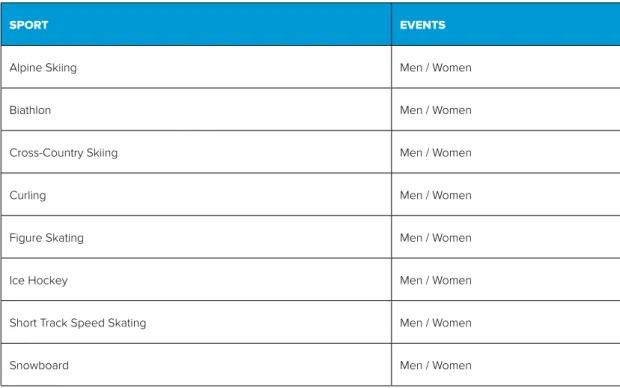
40.5. winter universiade Programme 145
40.6. winter universiade regulations 148
40.7. technical officials 148
40.8. sports Equipment 149
40.9. sport Presentation 149
40.10. sport information services 150
40.11. weather services 150
41. TEST EvENTS MaNaGEMENT 151
41.1. General overview 151 41.2. Planning 151 41.3. organisation 152 42. TIckETING 153 42.1. General overview 153 42.2. accredited access 153
42.3. Prime Event access 153
42.4. ticket sales 153
43. TRaNSpORTaTION 154
43.1. General overview 154
43.2. Planning and implementation 155
43.3. clients requirements 158
44. vENUE aNd INFRaSTRUcTURE 163
44.1. General overview 163
44.2. tender Preparation 164
44.3. venue adaptation 164
44.4. Environment and Energy 164
44.5. Legacy and sustainability 165
45. vENUE MaNaGEMENT 166
45.1. General overview 166
45.2. venue Planning 166
45.3. venuisation 168
45.4. venue testing 168
45.5. sports venues General requirements 168
45.6. sports venues specific requirements 171
45.7. compulsory sports 171
45.8. optional sports 179
46. wORkFORcE 180
46.1. General overview 180
46.2. Planning and budgeting 180
46.3. recruitment 181
46.4. training 183
46.5. administration and staff relations 184
46.6. uniforms 185
46.7. venue workforce 186
46.8. volunteers Management 186
1. INTROdUcTION
the purpose of this document is to outline the minimum requirements for the organisation of a winter universiade. it is a further step forward to increase consistency and reduce the potential for dispute by providing future organisers with an information service.
specified by the fisu Executive committee, the requirements are cross-referenced with the attribu-tion contract, the Guidelines for submitting a candidature dossier to organise the winter universiade, the fisu regulations, the application rules for fisu sports events and other fisu guidelines and doc-umentations.
the fisu General secretariat constantly upgrades the information available for fisu events, particu-larly for the winter universiade. thus the contents mentioned herein may evolve owing to technical developments or specific advancements of a technical nature or particular to a sport, some of which may be beyond the control of fisu and the organising committee. where this is the case, the organ-ising committee commits itself to accept these modifications, after consultation, in the best interests of the winter universiade.
further reference documents are specified in each chapter.
the fisu Executive committee and the fisu General secretariat will be pleased to provide any further information upon request.
2. abbREvIaTIONS aNd GlOSSaRy
adaMS the anti-doping administration & Management system aTM automated teller Machine
ccTv closed circuit television cd fisu disciplinary committee cdE fisu student committee
cdSU fisu committee for the development of university sport cEG fisu committee for Gender Equality
cF fisu finance committee
cI fisu international council
cIc fisu international control committee
cJ fisu Legal committee
cM fisu Medical committee
cMc fisu Media and communication committee cMI fisu international Medical committee compTIa international Project Management association
cpMS fisu committee for Marketing and strategic Partnership cRS fisu committee for sports regulations
cSU fisu universiade supervision committee cSU-h fisu winter universiade supervision committee cT fisu technical committee
cTI fisu international technical committee
cTI-Uh fisu international technical committee for the winter universiade d&O directors and officers Liability insurance
Ec fisu Executive committee Educ fisu Education committee ENT Ear, nose and throat
Fa functional area
FE form final Engagement form FF&E furniture, fixture and Equipment FIS international ski federation
FISU international university sports federation
FOp field of Play
hOd head of delegation
hvac heating, ventilation and air-conditioning I form individual Entry form
Ibc international broadcasting centre IbU international biathlon federation IcT information & communication technology IIhF international ice hockey federation INFO Games information system IOc international olympic committee ISF international sport federation
ISO international organisation for standardisation ISU international skating union
IT information technology ITO international technical official
kOp Kit of Parts
MOc Main operation centre Mpa Marketing Plan agreement
Mpc Main Press centre
NSF national sport federation NTO national technical official
NUSF national university sports federation
Oc organising committee
OvR on-venue results
pa Personal accident
pc Personal computer
pMI Project Management institute Q form quantitative Entry form T&S timing and scoring
Ta athletes’ transportation system
Td technical delegate
TF technical official transportation system TO technical official
TS spectating athletes transportation system vapp vehicle access and/or Parking Permit vIp very important Person
wada world anti-doping agency wcF world curling federation
associate Member a legally constituted supranational continental organisation, which is a recognised contribu-tor to the promotion and management of university sport at the continental level.
FISU Family refers to the fisu Executive committee members, honorary and emeritus members as well as committee members, fisu staff and fisu advisors. during the winter universiades, the fisu family also encompasses the fisu guests.
Member association a national university sports federation that is a member of fisu participation Fee
a participation fee is the fee that an organising committee is entitled to collect from the par-ticipating countries, per day and per person, to cover accommodation, food and beverages, transportation and other associated local services that are relevant for participating in the winter universiade, and in accordance to fisu rules.
Technical Officials
technical officials include referees and judges and other sport-specific officials that are required for the smooth running of the sports competitions. there are international techni-cal officials (itos) and national technitechni-cal officials (ntos) in accordance with the rules and regulations of each sport.
3. FISU STRUcTURE
as the leading organisation for international university sport, and the owner of one of the biggest mul-ti-sport events worldwide, fisu has a flexible and efficient structure.
3.1. thE GEnEraL assEMbLy
Every two years the fisu General assembly brings together the national university sports federations that are fisu Member associations, and it elects the fisu Executive committee and the internal auditor for a four-year period. it adopts the budget and the programme of fisu activities.
3.2. thE ExEcutivE coMMittEE
the Executive committee consists of twenty-three members elected for four years by the electoral Gen-eral assembly, and the Presidents of the organisations with the status of associate Member of fisu. it meets twice a year to ensure the proper functioning of fisu. the five representatives of the fisu associ-ate Members, the fisu secretary General and the internal auditor attend the meetings of the Executive committee, as non-voting members.
the fisu steering committee consists of the President, the first vice-President, the four vice-Presi-dents, the treasurer, and the first assessor. it meets periodically at the call of the President, to carry out business between Ec meetings. the fisu secretary General may attend steering committee meetings.
3.3. thE coMMittEEs
the committees assist and advise the fisu Executive committee in the overall administration of fisu. there are sixteen permanent committees:
pRESIdENT 1st vIcE-pRESIdENT 4 vIcE-pRESIdENTS TREaSURER 1st aSSESSOR 15 aSSESSORS 5 REpRESENTaTIvES OF FISU aSSOcIaTE MEMbERS STEERING cOMMITTEE ExEcUTIvE cOMMITTEE
There are sixTeen permanenT commiTTees:
1. INTERNaTIONal TEchNIcal cOMMITTEES: the cti is composed of three sub-committees, one for the summer universiade, one for the winter universiade and one for the world university championships, which monitors the preparation of the competitions from a technical point of view, drawing up the competition programme and ensuring the smooth running of the event.
2. cOMMITTEE FOR SpORTS REGUlaTIONS: the crs ensures that the sports regulations are updated and proposes new rules to the Ec.
3. INTERNaTIONal MEdIcal cOMMITTEE: the cMi supervises the organisation of medical care and the norms of security and hygiene. it also supervises the doping control procedures.
4. INTERNaTIONal cONTROl cOMMITTEE: the cic verifies that the participants fulfil the conditions of participation.
5. EdUcaTION cOMMITTEE: the Educ promotes the study of university sport by organising a conference during the universiade, as well as the fisu forum.
6. MEdIa aNd cOMMUNIcaTION cOMMITTEE: the cMc inspects and controls all the infrastructures and technical means provided to the press. it cooperates with international media in order to ensure media coverage of fisu events.
7. & 8. UNIvERSIadE SUpERvISION cOMMITTEE (SUMMER aNd wINTER): the csu is responsible for supervising the evolution of the preparation of the universiade, by making inspection visits and meeting regularly with the leaders of the organising committees.
9. FINaNcE cOMMITTEE: the cf studies the budget plan with the treasurer.
10. cOMMITTEE FOR ThE dEvElOpMENT OF UNIvERSITy SpORT: the cdsu is responsible for studying all the projects aiming at developing the structures of fisu and its Member associations.
11. lEGal cOMMITTEE: the cJ advises the Ec on all legal matters related to fisu activities.
12. cOMMITTEE FOR MaRkETING aNd STRaTEGIc paRTNERShIp: the cPMs is composed of members of the fisu Executive committee. it supervises the implementation of the fisu marketing plan.
13. cOMMITTEE FOR GENdER EQUalITy: the cEG advises the Ec on suitable policies to be developed to encourage the participation of women in sport.
14. dIScIplINaRy cOMMITTEE: the mission of the cd is to preserve the integrity and reputation of fisu and fisu events, to contribute to ensure the security of the fisu student-athletes, and to take appropriate disciplinary actions in cases of incidents.
15. INTERNaTIONal cOUNcIl: the ci assesses the specific needs to encourage, support and enhance university sport in each continent.
16. STUdENT cOMMITTEE: the cdE represents the student-athletes or student managers involved in university sports organisations.
FINaNcE cOMMITTEE lEGal cOMMITTEE cOMMITTEE FOR MaRkETING aNd STRaTEGIc paRTNERShIp dIScIplINaRy cOMMITTEE EdUcaTION cOMMITTEE STUdENT cOMMITTEE cOMMITTEE FOR UNIvERSITy SpORTS dEvElOpMENT INTERNaTIONal cOUNcIl cOMMITTEE FOR GENdER
EQUITy 2 UNIvERSIadE SUpERvISION cOMMITTEES INTERNaTIONal TEchNIcal cOMMITTEE INTERNaTIONal MEdIcal cOMMITTEE INTERNaTIONal cONTROl cOMMITTEE cOMMITTEE FOR SpORTS
REGUlaTIONS MEdIa aNd
cOMMUNIca-TION cOMMITTEE GENERal aSSEMbly ExEcUTIvE cOMMITTEE FISU GENERal SEcRETaRIaT ORGaNISING cOMMITTEE INTERNaTIONal SpORTS FEdERaTIONS IOc INTERNaTIONal ORGaNISaTIONS (SpORTaccORd, wada,…) MEdIa pOlITIcal aUThORITIES FISU cOMMITTEES
3.4. thE intErnaL auditor
the internal auditor verifies all of fisu’s accountancy.
3.5. worKinG structurE
composed of 167 Member associations, the fisu General assembly meets every two years. it is during this assembly that the guidelines and policies of fisu, as well as its financial management, are deter-mined and approved. Every four years, the fisu General assembly elects the members of the fisu Executive committee, which is the board of directors of fisu.
for the daily administration of the federation, the fisu Executive committee relies on the secretary Gen-eral, who is assisted by the fisu staff and various committees.
two important entities, the organising committees and the international sports federations, must ob-viously be integrated into this organisational structure. the fisu General secretariat, the fisu commit-tees, the organising committees and the international sports federations work in close collaboration on the preparation of the fisu sporting events, which are the universiades and the world university championships.
as regards the fisu committees, the Executive committee appoints their members during the meeting that follows the elective General assembly.
fisu is also in close contact with the major international sports organisations such as the ioc, sport-accord, wada and, of course, the media. fisu plays an important role in the relations with the political authorities of the countries hosting fisu events.
4. cREaTION OF aN ORGaNISING
cOMMITTEE
the fisu Member association of the host country, which has been attributed a winter universiade must assign the organisation of the event to an organising committee within six months after the attribution, and the organising committee must appoint liaison officers who have an overall knowledge of the prepa-rations of the winter universiade and must be fluent in either English or french, in order to establish a good cooperation with fisu.
the organising committee must act under the powers delegated to it within prescribed limits, and must not usurp the power and responsibilities of fisu or the fisu regulations.
the organising committee must work in conjunction with the nusf, and the nusf President or his/her representative is required to become an oc member. however, the nusf remains directly responsible to fisu and reports to the fisu Executive committee.
the organising committee’s primary objectives are to:
•
observe and comply with the fisu regulations, application rules and the present Minimum requirements,
as well as the technical rules of each particular sport, with the aim of allowing competitors and officials to achieve their best results under the best possible competition conditions;
•
provide the best possible conditions for all personnel, outside contractors, media personnel, etc. to
carry out their duties;
•
provide a welcoming atmosphere to all viPs, government authorities and competitors honouring the
4.1. EvoLution PhasEs
typically, from the attribution of the winter universiade to the dissolution of the organising committee, the following phases are gone through:
•
Foundation phasethe foundation phase is the period during which the organising committee finalises its host city contract and other documents.
•
Functional planning phasethe functional planning phase is the period for the organising committee to start developing the master plan and master schedule, to build up its budget as well as its construction and integration strategy, as well as to employ heads for the key functional areas.
•
operational planning phasenormally this is the longest period for the organising committee. during the operational planning phase, the main tasks are to develop the functional operational plan, venue operating plans, test event strategy as well as to design the model competition venues.
•
Testing and readiness phasethe testing and readiness phase arrives when the winter universiade is approaching, normally one or two years before the event. the focuses of this phase include carrying on test events, fine tuning, finalis-ing the venue operatfinalis-ing plan and developfinalis-ing contfinalis-ingency plans.
•
operating phasethe operating phase is the so-called “games-time”.
•
post event phasethe post event phase is the dissolution period with staff being transited and the oc being winded up.
4.2. ProPosEd functionaL arEas
in order to fulfil these objectives, the organising committee must have a complete and competent structure.
from inception to the final run-up to the winter universiade opening ceremony, the number of people involved in the organisation typically grows from tens to thousands. whilst each host city faces its own particular situation and requirements, a list of key functional areas is hereby provided along with a rec-ommended standard organisation chart that may be adapted to the needs of the organising committee, in agreement with fisu.
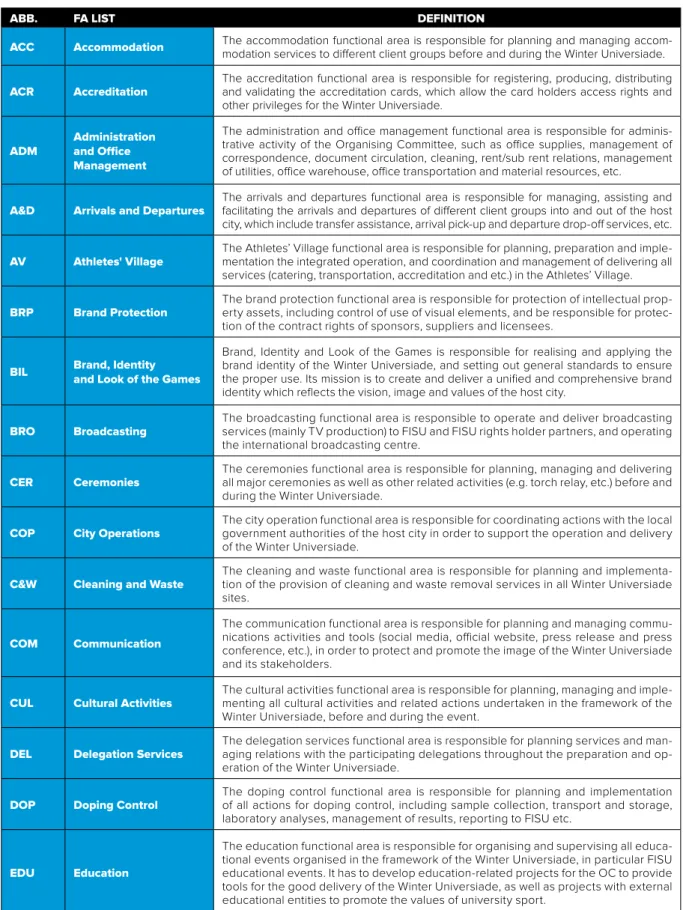
it is suggested that each function is headed on a full-time basis by an individual having specific experi-ence in the tasks involved. the minimum requirements for the majority of these key functional areas are detailed in subsequent chapters, while we leave much space for the organising committee to develop the ones that should be handled internally according to the local laws and rules.
abb. Fa lIST dEFINITION
acc accommodation the accommodation functional area is responsible for planning and managing accom-modation services to different client groups before and during the winter universiade.
acR accreditation the accreditation functional area is responsible for registering, producing, distributing and validating the accreditation cards, which allow the card holders access rights and other privileges for the winter universiade.
adM administration and Office Management
the administration and office management functional area is responsible for adminis-trative activity of the organising committee, such as office supplies, management of correspondence, document circulation, cleaning, rent/sub rent relations, management of utilities, office warehouse, office transportation and material resources, etc.
a&d arrivals and departures the arrivals and departures functional area is responsible for managing, assisting and facilitating the arrivals and departures of different client groups into and out of the host city, which include transfer assistance, arrival pick-up and departure drop-off services, etc. av athletes' village the athletes’ village functional area is responsible for planning, preparation and imple-mentation the integrated operation, and coordination and management of delivering all
services (catering, transportation, accreditation and etc.) in the athletes’ village. bRp brand protection the brand protection functional area is responsible for protection of intellectual prop-erty assets, including control of use of visual elements, and be responsible for
protec-tion of the contract rights of sponsors, suppliers and licensees.
bIl brand, Identity and look of the Games
brand, identity and Look of the Games is responsible for realising and applying the brand identity of the winter universiade, and setting out general standards to ensure the proper use. its mission is to create and deliver a unified and comprehensive brand identity which reflects the vision, image and values of the host city.
bRO broadcasting the broadcasting functional area is responsible to operate and deliver broadcasting services (mainly tv production) to fisu and fisu rights holder partners, and operating the international broadcasting centre.
cER ceremonies the ceremonies functional area is responsible for planning, managing and delivering all major ceremonies as well as other related activities (e.g. torch relay, etc.) before and during the winter universiade.
cOp city Operations the city operation functional area is responsible for coordinating actions with the local government authorities of the host city in order to support the operation and delivery of the winter universiade.
c&w cleaning and waste the cleaning and waste functional area is responsible for planning and implementa-tion of the provision of cleaning and waste removal services in all winter universiade sites.
cOM communication
the communication functional area is responsible for planning and managing commu-nications activities and tools (social media, official website, press release and press conference, etc.), in order to protect and promote the image of the winter universiade and its stakeholders.
cUl cultural activities the cultural activities functional area is responsible for planning, managing and imple-menting all cultural activities and related actions undertaken in the framework of the winter universiade, before and during the event.
dEl delegation Services the delegation services functional area is responsible for planning services and man-aging relations with the participating delegations throughout the preparation and op-eration of the winter universiade.
dOp doping control the doping control functional area is responsible for planning and implementation of all actions for doping control, including sample collection, transport and storage, laboratory analyses, management of results, reporting to fisu etc.
EdU Education
the education functional area is responsible for organising and supervising all educa-tional events organised in the framework of the winter universiade, in particular fisu educational events. it has to develop education-related projects for the oc to provide tools for the good delivery of the winter universiade, as well as projects with external educational entities to promote the values of university sport.
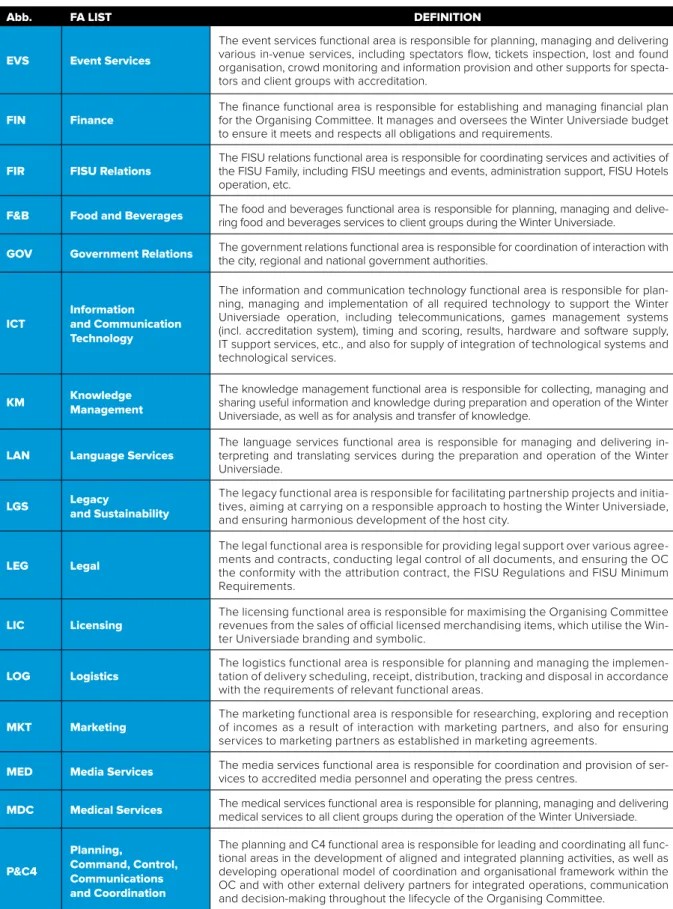
abb. Fa lIST dEFINITION
EvS Event Services
the event services functional area is responsible for planning, managing and delivering various in-venue services, including spectators flow, tickets inspection, lost and found organisation, crowd monitoring and information provision and other supports for specta-tors and client groups with accreditation.
FIN Finance the finance functional area is responsible for establishing and managing financial plan for the organising committee. it manages and oversees the winter universiade budget to ensure it meets and respects all obligations and requirements.
FIR FISU Relations the fisu relations functional area is responsible for coordinating services and activities of the fisu family, including fisu meetings and events, administration support, fisu hotels operation, etc.
F&b Food and beverages the food and beverages functional area is responsible for planning, managing and delive-ring food and beverages services to client groups during the winter universiade. GOv Government Relations the government relations functional area is responsible for coordination of interaction with the city, regional and national government authorities.
IcT Information and communication Technology
the information and communication technology functional area is responsible for plan-ning, managing and implementation of all required technology to support the winter universiade operation, including telecommunications, games management systems (incl. accreditation system), timing and scoring, results, hardware and software supply, it support services, etc., and also for supply of integration of technological systems and technological services.
kM knowledge Management the knowledge management functional area is responsible for collecting, managing and sharing useful information and knowledge during preparation and operation of the winter universiade, as well as for analysis and transfer of knowledge.
laN language Services the language services functional area is responsible for managing and delivering in-terpreting and translating services during the preparation and operation of the winter universiade.
lGS legacy and Sustainability the legacy functional area is responsible for facilitating partnership projects and initia-tives, aiming at carrying on a responsible approach to hosting the winter universiade, and ensuring harmonious development of the host city.
lEG legal
the legal functional area is responsible for providing legal support over various agree-ments and contracts, conducting legal control of all docuagree-ments, and ensuring the oc the conformity with the attribution contract, the fisu regulations and fisu Minimum requirements.
lIc licensing the licensing functional area is responsible for maximising the organising committee revenues from the sales of official licensed merchandising items, which utilise the win-ter universiade branding and symbolic.
lOG logistics the logistics functional area is responsible for planning and managing the implemen-tation of delivery scheduling, receipt, distribution, tracking and disposal in accordance with the requirements of relevant functional areas.
MkT Marketing the marketing functional area is responsible for researching, exploring and reception of incomes as a result of interaction with marketing partners, and also for ensuring services to marketing partners as established in marketing agreements.
MEd Media Services the media services functional area is responsible for coordination and provision of ser-vices to accredited media personnel and operating the press centres. Mdc Medical Services the medical services functional area is responsible for planning, managing and delivering medical services to all client groups during the operation of the winter universiade.
p&c4
planning,
command, control, communications and coordination
the planning and c4 functional area is responsible for leading and coordinating all func-tional areas in the development of aligned and integrated planning activities, as well as developing operational model of coordination and organisational framework within the oc and with other external delivery partners for integrated operations, communication and decision-making throughout the lifecycle of the organising committee.
abb. Fa lIST dEFINITION
pRc procurement the procurement functional area is responsible for planning, managing and delivering purchases and/or acquisition of goods and service required for the preparation and ope-ration of the winter universiade.
pTc protocol the protocol functional area is responsible for providing protocol services to the high-ranking national and international dignitaries, and ensuring the respect of protocol as-pects in all ceremonies, special events, activities and venues.
pUb publications the publication functional area is responsible for planning, managing and publishing all reports, management publications, practical manuals to provide necessary information to client groups.
RTc Rate card the rate card functional area is responsible for planning and providing a tariff directory of goods and services, managing booking on the given directory from client groups, controlling the execution of orders and return of the goods.
RM Risk Management
the risk management functional area is responsible for evaluating and identifying risks that have an impact on the operation of the winter universiade, developing methods and strategies for minimisation of risks, and management of incidents during the winter uni-versiade.
SEc Security the security functional area is responsible for ensuring a safe and secure environment for the universiade and related activities before, during and after the event, by managing all aspects of security, including protection, safety, disaster response, etc.
SIG Signage the signage functional area is responsible for ensuring that all client groups get to and from their destinations in a smooth and seamless fashion by providing clear and winter universiade look way finding signage in all venues.
SpT Sport and Sport Services the sport and sport services functional area is responsible for planning, managing and delivering all sports competitions, trainings and associated support services for the win-ter universiade.
TEM Test Events Management the test events management functional area is responsible for planning, managing and delivering various test events prior to the winter universiade.
TkT Ticketing the ticketing functional area is responsible for planning and delivering access solutions into winter universiade venues for non-accredited persons by developing ticketing strategy and managing all ticketing related activities, such as sales and distribution. TRa Transportation the transportation functional area is responsible for planning, managing and delivering safe and reliable transportation services to various client groups, and also ensuring
smooth public transportation to the winter universiade venues.
vEN venue and Infrastructure the venue and infrastructure functional area is responsible for planning, coordinating and reporting all activities on the winter universiade venues, facilities and infrastructure design and construction to ensure their on-time delivery.
vM venue Management the venue management functional area is responsible for planning, preparation and implementation of integrated operations among various functional areas within all winter universiade venues and facilities.
wF workforce
the workforce functional area is responsible for planning, recruitment, training, coor-dination and management of all paid staff and volunteers required for the winter uni-versiade, and also for management and coordination of outsourced service providers before and during the event.
4.3. orGanisation of functionaL arEas
as mentioned, each host city faces its own particular situation and requirements in organising its struc-ture. the organisation of functional areas may vary from one organising committee to another, depend-ing on local culture, the host city past mega event experience, functions of government bureaus, back-ground of division leaders, etc.
having all these on mind, fisu would not force the organising committee to apply a certain structure, but would rather recommend the general divisions as stated below. the organising committee is free to accept, apply and adapt this recommendation according to its own situation.
4.3.1. General secretariat
an organising committee typically includes around fifty functional areas and hundreds of full time staff. in or-der to manage this complex organisation, several functional areas should work together to develop and mon-itor overall games planning, to ensure consistency of operational concepts, and unified delivery of outcomes. the general secretariat consistently supports all functional areas and supervise its planning and preparation. it is essentially a combination of planning and control, project management, internal and external coordination and company secretariat responsibilities.
4.3.2. corporate and commercial
the organising committee is responsible for the organisational aspects involved in the preparation of the winter universiade, such as workforce recruitment, budgeting and finance. it must also support the different functional areas and act as a bridge with other constituent parties, thus providing a good corpo-rate image that can be easily marketed for fund-raising.
4.3.3. Venues
a great number of sports and non-sports venues are required for the hosting of the winter universiade. the organising committee must set up professional teams in order to develop the venue planning, to monitor the design and development of facilities to ensure they are completed and handed over in time and meet all requirements, as well as to manage and maintain the facilities and deliver the agreed level of services to relevant client groups.
4.3.4. sport and sport services
as one of the biggest divisions, the sport and sport services is responsible for the sports management and the liaison with fisu, the isfs and nsfs in various aspects related to the sports programme, sports services as well as the sports venues and facilities along with their required equipment.
sports are the core of the winter universiade, for which preparations should start well in advance from setting up the competition and training venues with equipment and personnel. the function also manag-es the competitions’ operations and embracmanag-es the management of various sports servicmanag-es before and during the event.
4.3.5. Games services
the main characteristic of the winter universiade is to be a major multi-sport event running in both sports and non-sports venues, and involving thousands of participants of different client groups. therefore, spe-cific games services need to be provided before, during and even after the winter universiade.
all the functional areas listed under this block provide essential supports to the operations of the winter universiade, and manage an exceptionally large, diverse and complex portfolio of responsibilities to various client groups.
4.3.6. additional Deliverables
while sport is the key deliverable of the winter universiade, there are also other deliverables which greatly enhance the image of the event and further promote the international university sports movement by using different platforms, such as ceremonies, educational activities, etc.
4.4. ProPosEd orGanisation chart
GEnEraL sEcrEtariat adMinistration and officE MGMt city oPErations fisu rELations GovErnMEnt rELations PLanninG and c4 tEst EvEnts ManaGEMEnt ORGaNISING cOMMITTEE corPoratE and coMMErciaL brand ProtEction brand, idEntity and LooK of thE GaMEs coMMunication financE KnowLEdGE ManaGEMEnt LanGuaGEs sErvicEs LEGacy and sustainabiLity LEGaL LicEnsinG MarKEtinG ProcurEMEnt PubLications ratE card risK ManaGEMEnt ticKEtinG worKforcE sPorts
sPort and sPort sErvicEs vEnuEs athLEtEs’ viLLaGE cLEaninG and wastE siGnaGE vEnuE and infrastructurE vEnuE ManaGEMEnt GaMEs sErvicEs accoMModation accrEditation arrivaL and dEParturE broadcastinG dELEGation sErvicEs doPinG controL EvEnt sErvicEs food and bEvEraGEs inforMation and coMMunication tEchnoLoGy LoGistics MEdia sErvicEs MEdicaL carE ProtocoL sEcurity transPortation additionaL dELivErabLEs cErEMoniEs cuLturaL activitiEs Education
5. accOMMOdaTION
5.1. GEnEraL ovErviEw
the accommodation functional area supports the accommodation of all winter universiade participants, which translates to sufficient number of rooms as well as appropriate type, quality, location, price and dates. its responsibility also includes coordination of the accommodation sites involved (e.g. hotels, dorms), reservation management and dealing with other aspects such as furnishings and equipment in the various accommodation sites.
the main accommodation sites during the winter universiade include:
•
athletes’ village;•
fisu hotel;•
accommodation for technical officials;•
accommodation for media;•
accommodation for workforce.athletes’ Village
typically for the winter universiade, the organising committee accommodates athletes and delegation officials in a large accommodation facility in one single location, which is called the athletes’ village. based on its past winter universiade experience, fisu may consider the possibility to accommodate ath-letes and delegation officials in different hotels (“hotels accommodation concept”) instead of in one single location (athletes’ village). this option could be preferred in order to be closer to the venues for example. concerning the hotels accommodation concept the following should be considered:
•
the concept has to be well detailed in the bidding book of the candidate city;•
the minimum requirements for the athletes’ village basically apply as well for the hotelsaccommoda-tion concept. some adaptaaccommoda-tion may be communicated by fisu (e.g. hod offices, medical rooms...);
•
an “accommodation cluster” includes the hotels located within the same area (e.g. mountain and city cluster);•
the accommodation clusters should be defined considering the needs of the delegations, the distancefrom the venues as well as the spirit of the winter universiade;
•
after the approval of competition and training venues by the fisu cti-uh, the hotels accommodationconcept has to be finalised;
•
the different hotels in which the delegations will be accommodated must have similar standard andmust be approved by fisu;
•
no changes are allowed after the oc has designated the hotels for the athletes and delegation officialsand the hotels accommodation concept has been officially approved by fisu.
Please refer to the athletes’ village chapter for more information. Please note that each time the athletes’ village is mentioned in the fisu documents it refers as well to the hotels accommodation concept (if the oc adopted this concept).
in the following text, we are mainly developing the planning and operation of the other accommodation sites.
5.2. PLanninG
researching in local marketing and planning of accommodation should be carried out in a very early phase. by visiting and evaluating the local resources, the organising committee is able to establish its accommodation facility inventory, which includes the type and quality of accommodation facilities, the room availability, the price, the distance to the main winter universiade venues, as well as the client groups that will stay in these facilities.
5.2.1. Types of accommodation
several types of accommodation facilities can be used for staging the winter universiade, such as stand-ard hotels, village, university dormitories, apartments, etc.
•
standard hotelsstandard hotels refer to the accommodation facilities offering individual bedrooms with one or two beds, as well as private bathrooms. Most of the hotels are equipped with food and beverages services, while some may offer only breakfast. standard hotels makes up the majority of the accommodation facilities as they are requested the most by the client groups.
•
Villagesa village is a large accommodation facility in one single location. it consists of several smaller accommo-dation options, such as different types of apartments, studios and rooms, etc. based on the actual situa-tion of the village and the request from different client groups, the organising committee can dedicate a village to one certain client group, providing a tailor-made service. the concept of having one client group accommodated in a village helps to ease the complexity of services, e.g. transportation, food and beverages, information distribution, etc. distance from the village to the main winter universiade venues of this certain client group plays a key role in accommodation allocation. common practice in the past events includes a media village and a technical official village.
•
other Facilitiesother accommodation facilities may also be used as long as they meet the requirement of their client groups. these other facilities can be various types, including apartments, camps, cruise ships and dormi-tories etc. in case cruise ships are used, the organising committee should carefully consider the capacity and structure of the relevant ports to ensure the supporting services.
5.2.2. Quality of accommodation
the quality of the accommodation facilities must be controlled and ensured by the organising commit-tee. the internationally accepted start rating system is recommended when the organising committee rate and present the accommodation facilities to fisu and the relevant client groups.
5.2.3. new construction
for some host cities, new accommodation facilities may be proposed for the winter universiade. in case these facilities are not existing by the date of proposal, the organising committee needs to present supporting information and documents to guarantee the construction authorisation, the financing and timelines of the project as well as the responsible company. a very close follow up is required in order to ensure the facilities be ready on time.
5.2.4. agreements and contracts
Preliminary agreements should be signed with all selected accommodation facilities as early as possible to ensure their participation. the key elements of this agreement should include the room availabilities, duration of stays, room rates, service rates and timeline of renovation, etc.
the organising committee should establish a more detailed contract with all accommodation facilities when the accommodation plan is finalised. the contract may vary depending on the client groups, but should be kept as similar as possible. timelines should be well considered as the later that the organis-ing committee proposes the contract to the owners of accommodation facilities, the more complicated the negotiations will be. apart from the traditional room services, the following items should be taken into consideration: room release schedule, reservation procedure, working space for the organising commit-tee, parking, meeting rooms, marketing rights, medical support and security method, etc.
the organising committee is responsible for the contracts with all accommodation facilities, except that fisu signs its own contract with the fisu hotels.
5.3. cLiEnts rEquirEMEnts
5.3.1. Technical officials
the organising committee must provide facilities separate from the athletes’ village for the accommo-dation of all technical officials. technical officials cannot be accommodated in the athletes’ village. international technical officials must be accommodated in single rooms in 4 star hotels or equivalent, un-less otherwise approved by fisu. the cost of such accommodation and subsistence is borne either by the organising committee or by the participating delegations, according to the fisu regulations. a winter universiade typically requires around 130 international technical officials, depending on the number and type of sports.
5.3.2. FisU Family
the hotels dedicated to the fisu family and Guests are called the fisu hotels. with the agreement of fisu, the organising committee must recommend one or more fisu hotels (5 or 4 stars) in close prox-imity to the athletes’ village and competition venues.
the fisu Executive committee, the committee members, the international federations’ delegates, the fisu staff and fisu guests must be accommodated in the fisu hotel. the fisu specific requirements must be followed, including dedicated rooms for the fisu General secretariat offices, meeting rooms, etc. fisu is responsible for the costs of stay, meal, accommodation in standard and single/double rooms for the fisu family during the winter universiade. while assistance, local transportation, information and medical assistance for the fisu family during the entire period of their stay for the winter universiade is the responsibility of the organising committee. where possible, the organising committee is recom-mended to secure 100% usage of the fisu hotels facilities as exclusive use helps to simplify operation. the fisu guests are under the responsibility of fisu or their own organisation. the accompanying peo-ple of the fisu family are responsible for their extra cost of stay excluding accommodation and break-fasts when sharing the room of the fisu family member.
the fisu family members are composed of around 200 persons, including around 120 persons on duty and around 80 guests , viP’s, future organising committees, etc.
in addition, observer/hospitality programmes are held during the universiade, which requires accommo-dation services for around 100 people. the organising committee of the next winter universiade also needs accommodation for around 50 people for the flag-handover and the cultural performance at the closing ceremony. the expenses incurred by those two groups are borne either by them or by fisu.
5.3.3. media
the organising committee must ensure that there is sufficient and adequate accommodation for all ac-credited media, at the expense of such acac-credited media, using hotels and/or media villages.
rooms must be available at different price ranges, and the distance between the media accommodation facilities to the ibc/MPc, and to major competition venues should be well considered to ensure a short transfer. Efforts must be made to group all the accredited media representatives in the smallest possible number of accommodation facilities to facilitate the operation of the media transport system.
5.3.4. Workforce
adequate accommodation should also be foreseen for the viPs and guests of the organising committee, such as heads of state, heads of Government, Ministers, international and domestic guests, marketing partners, etc. accommodation requirement for these client groups can be very high during the opening and closing ceremonies, and the standard of the rooms should also reach a certain level.
apart from the viPs and guests, the organising committee should also make provision to accommodate its workforce who does not live in the region, such as volunteers, staff, contractors, technicians, suppliers, security personnel, etc. this accommodation should be of moderate quality and price and be located close to the venues where they will be working.
6. accREdITaTION
6.1. GEnEraL ovErviEw
the mission of the accreditation function is to process the official registration of all client groups partici-pating in the winter universiade, provide appropriate accreditation cards for personal identification and access control, and allocate access rights according to job positions in the overall organisation and the tasks to be carried out during the winter universiade. the key responsibilities of this function includes:
•
official entries management for all participants;•
allocation of rights (concerning access, transportation, etc.) according to the categories and dutiesof participants;
•
design, production and delivery of temporary cards (in coordination with the cic) and accreditation cards;•
coordination with security (e.g. access control) and other functional areas for participant accreditation(e.g. delegation services, workforce, security personnel);
•
management of accreditation centres.the accreditation process is one of the key processes in the organisation of a winter universiade. Ensur-ing a smooth accreditation process is instrumental to achievEnsur-ing satisfaction of all participants and suc-cess of the winter universiade itself. while planning the set-up and budget for this area, several aspects need to be taken into account: software (system) that supports the complete accreditation process (from initial registration to the issuing of accreditation badges), definition of accreditation types and access rights, facilities and equipment necessary for the smooth operation of the system, and staff.
it is worth emphasising that the accreditation process requires coordination and close cooperation be-tween several functional areas of the organising committee: sport Entries, accreditation, security, food and beverages, delegation services and international relations etc. and venue Management on one hand and fisu, on the other. this process starts with the definition of requirements by the organising committee, aligning them with the fisu requirements. in order to be clear on the terminology to be used, here are several commonly used terms and their definition:
registration – the first step of the accreditation process. it starts one year before the winter universiade with the official invitation and ends with the submission of the individual Entry forms (i form). the oc must provide an online registration system.
sport entries – this is a sport-specific sub-set of information submitted during the registration process. it includes the General Entry form (G1 and G2 forms), final Engagement form (fE form), quantitative Entry forms (q form) and individual Entry forms (i form). coordination between the sport and sport services function and the accreditation function is crucial in handling these entries. the owner of the process is sport Entries; therefore, the responsibility for the accuracy of the data is with the sport Entries, even though the accreditation function is in charge of the management of the whole registration process.
Please note that the FE forms and related team sports entry procedures are managed by FISU.
accreditation – includes the processes listed above, but also the very specific process on site, when delegations arrive: preparation and issue of temporary cards, preparation, approval and issue of per-manent cards, approval and processing of day/special passes. it should be noted that “accreditation” is also used to denote the badge itself.
6.2. accrEditation ProcEss
the accreditation process of the winter universiade may be summarised as follows:
•
the organising committee defines the entry forms and the accreditation card layout according to thefisu regulations and the winter universiade “look and feel”.
•
intention of Participation forms, General Entry forms, quantitative Entry forms and nominative Entry formmust be sent to the organising committee in accordance with the deadlines set in the fisu regulations.
•
individual Entry forms must be sent to the organising committee no later than one month before theevent. for large local groups (especially volunteers, oc staff and contractors), it is recommended to carry out the process even earlier.
•
the accreditation function allocates access rights depending on the category and function ofpartic-ipants in accordance with the fisu accreditation matrix, before finally pre-printing the accreditation.
•
the organising committee and fisu control and approve accreditation cards according to the differentcategories.
•
accreditation centres resolves incidents and provide re-accreditation if necessary.6.2.1. Delegation accreditation
the cic is responsible for controlling the qualification of competitors at the winter universiade. it is empowered to supervise the following:
•
terms of participation;•
authenticity of national entries;•
academic status of competitors;•
nationality and age of competitors.the cic must work in close cooperation with the organising committee to ensure a quick and effective accreditation process.
without cic approval, no competitor is entitled to compete or receive a permanent accreditation card. therefore, temporary cards for competitors allowing them access to the athletes’ village for 24 hours following arrival should be issued.
the head of delegation manages accreditation on behalf of all the members of the delegation, avoiding the need for those members to visit an accreditation centre unless required.
the on-site flow for delegation accreditation may be summarised as follows:
•
arrival of delegations and welcome at the accreditation centre;•
the organising committee provides temporary accreditation cards if the pre-payment of the 25%de-posit is done;
•
the head of delegation confirms the list of participants in the delegation;•
changes/updates are recorded as necessary, including photographs;•
the head of delegation pays the participation fees;•
the head of delegation arranges to meet the cic on the following day;•
the organising committee provides temporary accreditation card;•
the delegation is transported to the athletes’ village;•
within 24 hours, the head of delegation collects all necessary documentation from participants andpresents it to the cic;
•
once the payment of registration fees is made and documentation is validated by the cic, pre-printedaccreditation cards are signed off, laminated and delivered to the head of delegation;
•
the head of delegation distributes accreditation cards to the individuals.6.2.2. oc accreditation
as mentioned above, the accreditation process for local groups, e.g. staff, volunteers, contractors, should be carried out earlier so that things could be operative well in advance.
the following points must be considered when planning the accreditation of staff, contractors and vol-unteers:
•
Ensure that venue access is available on time for them to carry out their duties, which in some casesmay be needed quite early. note that the security function must determine the appropriate time for accreditation to become compulsory, taking into consideration the need for many non-accredited con-tractors to have access to venues during set-up.
•
concerning outsourced services, the oc must take into account rotation of personnel. a type ofac-creditation or pass, different from regular participant acac-creditation, must be considered because of security reasons.
•
in order to effectively manage the accreditation of the many volunteers, the process and schedulemust be coordinated by the workforce function. similarly, accreditation of security personnel must be coordinated by the security function.
6.2.3. other accreditation
there are other client groups (press, broadcasters, fisu family, technical officials, guests, etc.) that re-quire specific arrangement for their accreditation. detailed plans and sufficient information on where and how to pick up the accreditation card is key to avoid confusion and queuing in accreditation centres. some groups (in particular, media and guests) are likely to have last minute changes and walk-in re-quests, and it is recommended that an efficient process is planned for problem solving and that accredi-tation centre managers are empowered to make decisions.
6.3. tyPEs of accrEditation cards
More details on the cards and rules for issuing them are available in the accreditation Procedure for fisu Event. however, it is worth noting that the following cards should be planned, as they require different backgrounds and materials:
•
temporary cards – issued only to the delegations as an interim card until the permanent ones are ap-proved and issued by the cic. these cards are valid only for 24 hours and allow access to accommo-dation, food and beverages. athletes are not allowed to compete and to train during the official training with temporary cards.•
permanent cards – issued to all the participants’ groups with different access rights and privileges defined in a separate guideline.•
day passes – issued to visitors, giving access to venues of special interest (athletes’ village, ibc, MPc, sports venues, etc.) to which they normally do not have access. the official request to receive a day pass must be done at least 24 hours in advance by the head of delegation.•
bump-in/bump-out cards – these cards are useful especially for the period of set-up/tear-down of the venues for the staff that is only hired for this purpose. in this way the load is taken off both the accredi-tation and security functions, as it avoids unnecessary granting of access for the whole duration of the winter universiade.Please refer to the FISU Regulations regarding the participant accreditation cards.
6.4. accrEditation systEM
in order to support the above-mentioned processes, it is necessary to use software for collection and processing of the participants’ data, and the system should support the whole registration process, opti-mally starting from G1 forms. all the process must be proceeded by an online accreditation system. hav-ing in mind the complexity of the accreditation process, especially the necessity of smooth and accurate exchange of data with t&s, ovr and info systems, as well as high costs and time requirements for the development of an own solution, it is strongly recommended that the organising committee opt for a solution of a renowned vendor to avoid complications during the execution of the winter universiade. this system should be able to support collection and processing of all the participants’ required data, assignment of categories, functions, privileges, general codes, access rights, etc., with the possibility of imposing certain limitations and requirements regarding sport entries, age limits, etc.
the system must provide each accredited individual with a unique number as a means of identification, which is used to identify competitors and officials for the purposes of developing cic-approved start lists, team lists and entering results (i.e. for use by the results service and by the doping control function). it is of paramount importance that this database is used for all other applications/processes to ensure qual-ity and uniformqual-ity of data. of course, log of all data entry and reporting is an obligatory part of the system.
Please refer to the FISU Technology Minimum Requirements for more detailed requirements regarding the accreditation system.
6.6. accEss controL
without access control, the accreditation process loses its purpose. this feature should be coordinated with the police and the security function to define the access control modes (visual, scanners, etc.). the organising committee must assign staff and equipment in all venues to administer access restric-tions, including regular security checks of all personnel and accreditation passes, and ensure that all personnel controlling access understand the meaning of the different access categories.
Given the fact that the installation of scanners might prove to be a strain on the budget, special attention should be paid to the training of the security staff in order to ensure proper visual control of the cards. furthermore, both the accreditation and security functions must be involved in the definition of zoning of the venues (with the venue managers) as well as access rights (especially, when defining the lines of movement of the viPs, athletes, press, etc.).
Please refer to the FISU Events Accreditation Procedure Guidelines for more detailed requirements. Please refer to the FISU Regulations regarding the composition and responsibilities of the CIC.
6.5. faciLitiEs, EquiPMEnt and staff
the accreditation of the following participant groups should be kept separate, in terms of using different facilities:
•
delegations – should be accredited at the Main accreditation centre located in the athletes’ village. this location could also be used for the accreditation of staff (internal and external) prior to the arrival of the first delegations;•
staff and volunteers – should be accredited at the oc accreditation centre well in advance;•
iTos and nTos – should be accredited at the oc accreditation centre well in advance;•
FisU Family and Guests, Vips, sponsors – should be accredited at the fisu viP accreditation centre located in the fisu hotel;•
media – should be accredited at the Press accreditation centre located in the Main Press centre. for each of these accreditation centres, necessary infrastructure and equipment should be provided. clear zoning, smooth entrance flow and separate office space should be considered when making the venue design, and the layout of the accreditation centres should be approved by the cic well in advance. the equipment includes but is not limited to the following:•
computers;•
fax;•
internet connection;•
cameras;•
printers;•
scanners;•
additional lighting requirements;•
phones;•
consumables – paper, toner, pre-printed paper for accreditation cards, plastic coats for accreditationcards, etc.;
•
laminators.Given the level of coordination required and the volume of necessary communication with various groups, special attention should be paid to the selection, recruitment and training of the paid staff and volunteers. in addition, the organisation of the work in the accreditation centres should be defined early on. the best practice is to assign staff members to a particular country or a group of countries (in case of smaller delegations) based on language skills. in that way, confidence is created with the delegations and clear communication lines are established in handling all requests of a delegation or group of del-egations. this staff should also coordinate between the delegations and the cic to ensure a smooth running of the accreditation process. during the entire period of the winter universiade, there must be a key person with enough power to make decisions in the accreditation centre.