NAVAL
POSTGRADUATE
SCHOOL
MONTEREY, CALIFORNIA
DISSERTATION
Approved for public release; distribution is unlimited AN APPLICATION OF ALLOY TO STATIC ANALYSIS
FOR SECURE INFORMATION FLOW AND VERIFICATION OF SOFTWARE SYSTEMS
by Alan B. Shaffer December 2008
REPORT DOCUMENTATION PAGE Form Approved OMB No. 0704-0188
Public reporting burden for this collection of information is estimated to average 1 hour per response, including the time for reviewing instruction, searching existing data sources, gathering and maintaining the data needed, and completing and reviewing the collection of information. Send comments regarding this burden estimate or any other aspect of this collection of information, including suggestions for reducing this burden, to Washington headquarters Services, Directorate for Information Operations and Reports, 1215 Jefferson Davis Highway, Suite 1204, Arlington, VA 22202-4302, and to the Office of Management and Budget, Paperwork Reduction Project (0704-0188) Washington DC 20503.
1. AGENCY USE ONLY (Leave blank) 2. REPORT DATE
December 2008
3. REPORT TYPE AND DATES COVERED
Doctoral Dissertation
4. TITLE AND SUBTITLE: An Application of Alloy to Static Analysis for Secure Information Flow and Verification of Software Systems
6. AUTHOR(S) Alan B. Shaffer
5. FUNDING NUMBERS
7. PERFORMING ORGANIZATION NAME(S) AND ADDRESS(ES)
Naval Postgraduate School Monterey, CA 93943-5000
8. PERFORMING
ORGANIZATION REPORT NUMBER
9. SPONSORING / MONITORING AGENCY NAME(S) AND ADDRESS(ES)
N/A
10. SPONSORING / MONITORING AGENCY REPORT NUMBER 11. SUPPLEMENTARY NOTES The views expressed in this thesis are those of the author and do not reflect the official policy or position of the Department of Defense or the U.S. Government.
12a. DISTRIBUTION / AVAILABILITY STATEMENT
Approved for public release; distribution is unlimited.
12b. DISTRIBUTION CODE
A
13. ABSTRACT (maximum 200 words)
Within a multilevel secure (MLS) system, flaws in design and implementation can result in overt and covert channels, both of which may be exploited by malicious software to cause unauthorized information flows. To address this problem, the use of control dependency tracing has been explored to present a precise, formal definition for information flow. This work describes a security Domain Model (DM), designed in the Alloy formal specification language, for conducting static analysis of programs to identify illicit information flows, such as control dependency flaws and covert channel vulnerabilities. The model includes a formal definition for trusted subjects, which are granted extraordinary privileges to perform system operations that require relaxation of the mandatory access control (MAC) policy mechanisms imposed on normal subjects, but are trusted to behave benignly and not to degrade system security. The DM defines the concepts of program state, information flow and security policy rules, and specifies the behavior of a target program. The DM is compiled from a representation of the target program, written in a specialized Implementation Modeling Language (IML), and a specification of the security policy written in the Alloy language. The Alloy Analyzer tool is used to perform static analysis of the DM to detect potential security policy violations in the target program. This approach demonstrates that it is possible to establish a framework for formally representing a program implementation and for formalizing the security rules defined by a security policy, enabling the verification of that program representation for adherence to the security policy.
15. NUMBER OF PAGES
182
14. SUBJECT TERMS
Security domain model, static analysis, automated program verification, trusted subjects, covert channels, dynamic slicing, specification language.
16. PRICE CODE 17. SECURITY CLASSIFICATION OF REPORT Unclassified 18. SECURITY CLASSIFICATION OF THIS PAGE Unclassified 19. SECURITY CLASSIFICATION OF ABSTRACT Unclassified 20. LIMITATION OF ABSTRACT UU
NSN 7540-01-280-5500 Standard Form 298 (Rev. 2-89)
Approved for public release; distribution is unlimited
AN APPLICATION OF ALLOY TO STATIC ANALYSIS FOR SECURE INFORMATION FLOW AND VERIFICATION OF SOFTWARE SYSTEMS
Alan B. Shaffer
Commander, United States Navy B.S., United States Naval Academy, 1986
M.S., Naval Postgraduate School, 1995 Submitted in partial fulfillment of the
requirements for the degree of
DOCTOR OF PHILOSOPHY IN COMPUTER SCIENCE
from the
NAVAL POSTGRADUATE SCHOOL December 2008
Author: __________________________________________________ Alan B. Shaffer
Approved by:
________________________ _________________________
Mikhail Auguston Cynthia E. Irvine
Associate Professor of Professor of Computer Science Computer Science,
Dissertation Supervisor
________________________ _________________________
Gurminder Singh Gordon H. Bradley
Professor of Computer Science Professor of Operations Research ________________________
Timothy E. Levin
Research Associate Professor of Computer Science
Approved by: __________________________________________________ Peter Denning, Chair, Department of Computer Science Approved by: __________________________________________________
ABSTRACT
Within a multilevel secure (MLS) system, flaws in design and implementation can result in overt and covert channels, both of which may be exploited by malicious software to cause unauthorized information flows. To address this problem, the use of control dependency tracing has been explored to present a precise, formal definition for information flow. This work describes a security Domain Model (DM), designed in the Alloy formal specification language, for conducting static analysis of programs to identify illicit information flows, such as control dependency flaws and covert channel vulnerabilities. The model includes a formal definition for trusted subjects, which are granted extraordinary privileges to perform system operations that require relaxation of the mandatory access control (MAC) policy mechanisms imposed on normal subjects, but are trusted to behave benignly and not to degrade system security. The DM defines the concepts of program state, information flow and security policy rules, and specifies the behavior of a target program. The DM is compiled from a representation of the target program, written in a specialized Implementation Modeling Language (IML), and a specification of the security policy written in the Alloy language. The Alloy Analyzer tool is used to perform static analysis of the DM to detect potential security policy violations in the target program. This approach demonstrates that it is possible to establish a framework for formally representing a program implementation and for formalizing the security rules defined by a security policy, enabling the verification of that program representation for adherence to the security policy.
TABLE OF CONTENTS
I. INTRODUCTION...1
A. HYPOTHESIS...1
B. INTRODUCTION AND MOTIVATION...1
C. CONTRIBUTIONS...4
D. DISSERTATION ORGANIZATION ...8
II. INFORMATION ASSURANCE PRINCIPLES ...11
A. INTRODUCTION...11
B. HIGH ASSURANCE COMPUTER SYSTEM EVALUATION ...11
1. Introduction...11
2. Trusted Computer Security Evaluation Criteria System (TCSEC)...11
3. The Common Criteria ...12
4. The Trusted Computing Exemplar (TCX) Project...15
C. FORMAL SECURITY MODELS AND POLICIES ...16
1. Introduction...16
2. Discretionary Access Control (DAC) Models...17
a. Access Matrix Models / Graham-Denning ...17
b. HRU Model ...18
3. Mandatory Access Control (MAC) Models...19
a. Bell and LaPadula Model ...19
b. Biba Integrity Model ...21
c. Lattice Model...22
d. Clark/Wilson Model ...24
e. Noninterference ...25
4. Role Based Access Control (RBAC) Model ...27
5. Summary...29
D. COVERT CHANNELS ...30
E. DYNAMIC SLICING...32
F. INFORMATION FLOW AND CONTROL DEPENDENCIES ...34
G. TRUSTED SUBJECTS ...35
H. SUMMARY ...36
III. REVIEW OF RELATED WORK...37
A. INTRODUCTION...37
B. INFO FLOW TRACING AND COVERT CHANNEL ANALYSIS ...37
C. TRUSTED SUBJECT IMPLEMENTATION ...39
D. DYNAMIC SLICING FOR SECURITY TRACING...42
E. DOMAIN-SPECIFIC MODELING IN SECURITY...42
F. DYNAMIC SECURITY POLICY DEVELOPMENT ...44
G. SUMMARY ...45
IV. IMPLEMENTATION MODELING LANGUAGE...47
A. INTRODUCTION...47
1. Lexical Concepts ...47
2. Assignment...48
3. Device Input/Output Statements ...49
4. File Random Access ...49
5. System Clock ...50
6. Program Control Statements ...51
C. SUMMARY ...51
V. THE SECURITY DM APPROACH ...53
A. INTRODUCTION...53 B. DM STRUCTURE ...53 1. Invariant Model ...55 2. Implementation Model ...62 C. DM-COMPILER...63 D. SUMMARY ...67
VI. EXAMPLE DM IMPLEMENTATIONS ...69
A. INTRODUCTION...69
B. EXAMPLE PROGRAMS ...69
1. Overt Control Dependency Flaw...69
2. Timing Covert Channel Resulting from Exploitation of System Clock...71
3. Flow Violation Caused by a Trusted Subject Operation ...72
4. Trusted Subject Dual Violation – Information Flow Violation and Overt Flaw...75
5. Storage Covert Channel Resulting from a Trusted Subject Operation ...76
C. TESTING RESULTS...78
D. SUMMARY ...80
VII. CONCLUSIONS AND FUTURE WORK ...81
A. CONCLUSIONS ...81
1. Implementation Modeling Language (IML) ...82
2. Security Domain Model (DM)...82
3. DM-Compiler ...83
B. RECOMMENDATIONS FOR FUTURE WORK...83
1. Correctness of the DM...83
2. Formal Analysis of DM Artifacts ...84
3. IML Expansion ...84
4. Dynamic Security Policies ...84
5. Networked Analysis ...85
6. Model-Driven Software Development...86
LIST OF REFERENCES ...87
APPENDIX A – DM-COMPILER RIGAL FILE ...95
RIGAL FILE – PARSER.RIG ...95
APPENDIX B.2 – GENERATED DM FOR BASE PROGRAM EXAMPLE 2 ...123
APPENDIX B.3 – GENERATED DM FOR BASE PROGRAM EXAMPLE 3 ...133
APPENDIX B.4 – GENERATED DM FOR BASE PROGRAM EXAMPLE 4 ...141
APPENDIX B.5 – GENERATED DM FOR BASE PROGRAM EXAMPLE 5 ...151
LIST OF FIGURES
Figure 1. Domain Model approach to system security verification. ...6
Figure 2. Common Criteria development class (ADV) correspondences (from Common Criteria, 2006). ...15
Figure 3. Lattice of Subsets for {x, y, z} (from Denning, 1976). ...23
Figure 4. Clark/Wilson Model of Integrity (from Neumann, 1998). ...24
Figure 5. RBAC Role Relationships (after Ferraiolo and Kuhn, 1992). ...29
Figure 6. Program Dependency Graph for Code Snippet (after Agrawal and Horgan, 1990). ...33
Figure 7. Domain Model approach to system security verification. ...53
Figure 8. Alloy enumerated type for AccessLabel, and signature for the DM Policy element ...56
Figure 9. Alloy signature for the DM Statement element ...57
Figure 10. Alloy enumerated type for the DM Stmt_type element...57
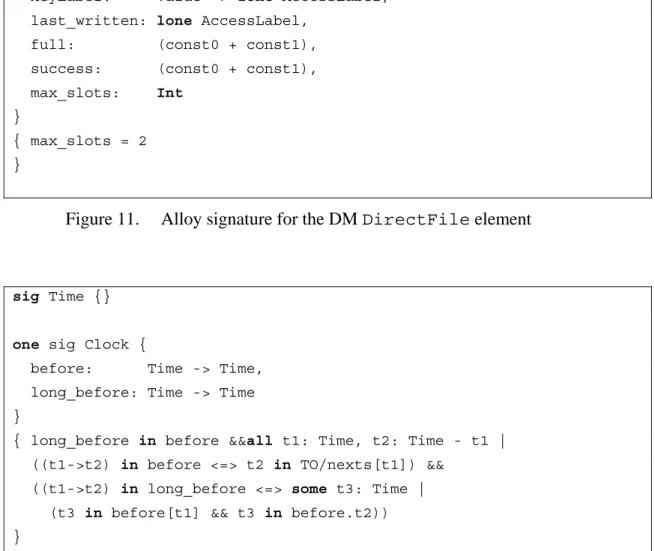
Figure 11. Alloy signature for the DM DirectFile element ...58
Figure 12. Alloy signatures for the DM Time and Clock elements...58
Figure 13. Alloy signature for the DM State element ...59
Figure 14. Alloy enumerated type for the DM Error element ...60
Figure 15. Alloy signature for the DM InitialState element ...61
Figure 16. Example Alloy signatures for Variable and Value elements ...63
Figure 17. Sample Base Program Statements, in IML Syntax...63
Figure 18. DM-Compiler Generated Alloy Signatures for Sample Base Program ...64
Figure 19. Alloy Predicate to Discover Overt Control Dependency Flaw...70
Figure 20. Alloy Predicate to Discover Timing Covert Channel ...71
Figure 21. Alloy Function for Trusted Subject Filter...73
Figure 22. Alloy Predicate to Discover Illicit Information Flow ...74
Figure 23. Alloy Predicate to Discover Storage Covert Channel...76
Figure 24. Direct File filled by storage channel SysHigh sender ...77
LIST OF TABLES
ACKNOWLEDGMENTS
Above all, I wish to thank Dr. Mikhail Auguston, my dissertation supervisor. His endless encouragement and patient mentoring were vital to my completing this work. I thank the other members of my committee for guiding my research, in particular Dr. Cynthia Irvine and Tim Levin, who strengthened my work with their knowledge and expertise in the field of computer security. I would also like to thank Dr. Dennis Volpano for his suggested improvements to this paper, and Dr. Don Brutzman for his insightful advice at certain key moments when I needed a bit of “course correction.”
For the past few years, I have had the good fortune of working alongside a wonderful group of fellow doctoral students. Our monthly “breakfast club” meetings were a source of true camaraderie, whether we were swapping war stories, telling bad jokes, or just helping each other survive the world of academic research. Their friendship and advice are truly appreciated.
I could not have reached this milestone without the love and support of my family. While Ashley prepared for her own transition from high school to college and Sam literally grew from young boy into young man, they dealt with a dad who (still!) spent his evenings and Sunday afternoons doing schoolwork. Throughout all of this, they never complained nor let me forget what is most important in my life. And to Sandra, who supported me without exception, I can never thank enough. At the most challenging moment, she offered the advice I needed most when she simply encouraged me to “get this thing done!”
Finally, I dedicate this dissertation to the men and women of the U.S. Navy’s ships, squadrons and stations. They do the hard work of the fleet, and I hope this and future research can serve to make their jobs safer and more secure.
This material is based upon work supported by the Office of Naval Research, the National Science Foundation under Grant Number CNS-0430566, with support from DARPA ATO. Any opinions, findings, and conclusions or recommendations expressed in this material are those of the authors and do not necessarily reflect the views of the National Science Foundation of DARPA ATO.
I. INTRODUCTION
Working calmly will let you elaborate and extend things, but the breakthroughs generally come only after great frustration and emotional involvement.
— Richard Hamming A. HYPOTHESIS
In the development of secure systems, ensuring that the implementation of a system is faithful to its stated security objectives is a process laden with difficulties and challenges. It is possible, however, to establish a framework for formally representing a program implementation and for formalizing the security rules defined by a security policy. This enables the verification of that program representation for adherence to the security objectives. Such a framework can be supportive of the Common Criteria requirements for secure system development.
B. INTRODUCTION AND MOTIVATION
Widely accepted evaluation standards (Common Criteria, 2006; DoD TCSEC, 1985), and (NSA SKPP, 2007) require that high assurance secure systems be designed, developed, verified, and tested using rigorous development processes. This evaluation process must include demonstration of correct correspondence between system representations at various levels of abstraction, such as security policy objectives, security specifications, and program implementation. In addition, the National Institute of Standards and Technology Source Code Security Analysis Tool Functional Specification (NIST, 2007) requires that security analysis tools report weaknesses that they identify using semantically meaningful names and identifying location within a program, with an “acceptably low false positive rate.” This dissertation describes an approach to analyzing programs for preservation of security properties through state transitions, and advances the ability to analyze software for information flow by describing automated techniques for information flow static analysis. Classic work on secure information flow, including the use of lattice theory for ordering of security
classes based on the dominance relationship and the idea of labeling state variables to track such flows as a way to certify a program (Denning, 1976; Denning and Denning, 1977), and type systems for security analysis (Volpano et al., 1996), provide a foundation for this research.
Formal security models are often based on an expression of properties such as program secure state and state transitions (McLean, 1994). High assurance evaluation standards (Common Criteria, 2006; DoD TCSEC, 1985) require a formal verification that the state transitions resulting from program execution preserve the security properties defined by a policy. Formal verification must also include advanced vulnerability analysis of a system, during which covert channel analysis must be considered in order to achieve successful evaluation of such systems at the highest levels of assurance (Common Criteria, 2006). The approach described here analyzes programs for preservation of specific security properties across state transitions. This dissertation presents a precise, formal definition for an MLS security policy, and for various types of information flow violations with respect to that policy, including examples of control dependency flaws and covert channels, extending classic work in this area by Denning and Denning (1977), and Volpano et al. (1996). A security domain-specific model is described as a framework for conducting static analysis of abstract representations of target program implementations (see Chapter VI).
Within a multilevel secure (MLS) system, trusted subjects may be granted privileges to perform operations, in some cases within prescribed limits (Schell et al., 1985; Schellhorn et al., 2000) not normally allowed for ordinary subjects controlled by mandatory access control (MAC) policy enforcement mechanisms. Granting of such privileges is predicated on the idea that trusted subjects will not conduct malicious activity or degrade the system’s overall security. This dissertation presents a formal definition for trusted subject behaviors, which depend upon a representation of information flow during execution of a high-level language program, referred to as a
target program. It describes a security domain model to formally represent security policy with respect to trusted subjects, trusted subject behaviors, information flow tracing through program execution, various types of covert channels, and a means for conducting
static analysis of target program implementations. In addition to trusted subjects and security kernels, we also include the analysis of programs (see Section VI.2) comprising interleaved statements of subjects with different labels. While this is not necessarily a literal representation of an application program, it can be viewed as the sequential actions that a trusted subject or security kernel takes in response to the interleaved requests of different subjects.
Static analysis of non-trivial programs has been shown to be undecidable (Rice, 1953). Even heuristics for static analysis may be computationally challenging, for example the problem of state explosion with model checkers (Clarke et al., 1986). Jackson (2006) suggests a pragmatic approach to this dilemma, in the form of the Alloy language small scope hypothesis, which conjectures that most flaws in models can be revealed on small instances. In the approach described here, the Alloy Analyzer tool (Alloy, 2008) is used to perform static analysis of an abstract representation of a target program, referred to as a base program, to identify execution paths that might violate security policy rules. Our work assumes the small scope hypothesis for information flow tracing, and in the examples examined (see Section VI.C), a scope within the processing power of current technology was sufficient. The impact of this decision is that our approach is somewhat limited to evaluation of classes of programs for which proofs are not required. We feel that, as a proof of concept of the ability of our approach to perform automated static analysis, this is acceptable, and the work provides an important first step toward future advances that may overcome this.
This dissertation research is being conducted under the auspices of the Naval Postgraduate School’s (NPS) Center for Information Systems Security Studies and Research (CISR) Trusted Computing Exemplar (TCX) project. The overarching goal of the TCX project is to present a working example to demonstrate how trusted computing systems and components could be constructed (Irvine et al., 2004; Nguyen et al., 2005). The goals of the TCX project are directly supported by the Office of Naval Research, the National Reconnaissance Office, and the National Science Foundation under grant CNS-
0430566. Any opinions, findings and conclusions or recommendations expressed in this material are those of the authors and do not necessarily reflect the views of the ONR or the NSF.
C. CONTRIBUTIONS
This dissertation advances classic work in information flow tracing and static analysis verification of high assurance systems by presenting a new framework for automating the verification program representations for their adherence to a set of security policy rules. The framework is based on a domain-specific model (DSM) for security properties that supports static analysis of a representation of the target implementation. Our research delivers the following contributions:
1. The Implementation Modeling Language (IML), a language that supports basic information processing via assignment statements, conditional and loop statements, read/write statements, file random access, and access to a system clock. The IML facilitates static analysis of source code by providing a formalism that captures the essence of imperative programming language paradigms, while ignoring non-essential (for these purposes) elements, such as data type, inheritance, polymorphism, etc. In this research, a target program refers to the high-level language program under examination; the base program represents an IML abstraction of the target program and provides a basis for analysis for adherence to a security policy. At this time, the verification of correspondence of the base program to the target program is outside the scope of this dissertation.
2. The security Domain Model (DM), represented as an Alloy (Jackson, 2006; Alloy, 2008) specification, has a two-fold purpose in providing a model of program behavior, as well as a model for describing security properties. The DM is a unified representation of a base program and the intended information flow policy, including restrictions on both overt and covert information flow. The DM comprises an Invariant
Model, which defines the logical structure for program state, information flow, and security policy; and an Implementation Model, which specifies the semantics of the base program.
3. This research has formalized well-established security properties by defining specific security rules in the DM framework. We have defined an information flow security rule to verify that information flows within a program abide by a policy and do not flow in an illicit manner. For example, a policy might authorize information to flow from a Low source to a High destination, but not the reverse; the information flow security rule will identify any program execution path that allows information to flow illicitly from Low to High.
In our framework, we have also defined rules for detecting potential covert
channels in a program. In the context of the DM, we do this by formalizing the definition of both a covert storage channel, using a shared information storage repository, and a covert timing channel, based on access to an abstraction of the system clock. For each of these covert channel classes, we define a security rule that identifies programs with execution paths that may be vulnerable to either violation.
In addition to covert channels, we have formalized the concept of overt control
dependency flaws within a program. Using dynamic slicing techniques to track control dependencies through execution of a program representation, the security rule identifies execution paths with implicit control dependencies that violate the defined security policy.
Finally, our model is expressive enough to support trusted subjects and their behaviors. The DM defines a trusted subject through a special assignment operation that abstracts the idea of trusted downgrading. The model allows trusted subject behaviors, while ensuring that regular subjects cannot perform illicit activities during execution of a program. We do this through verification of the described security rules.
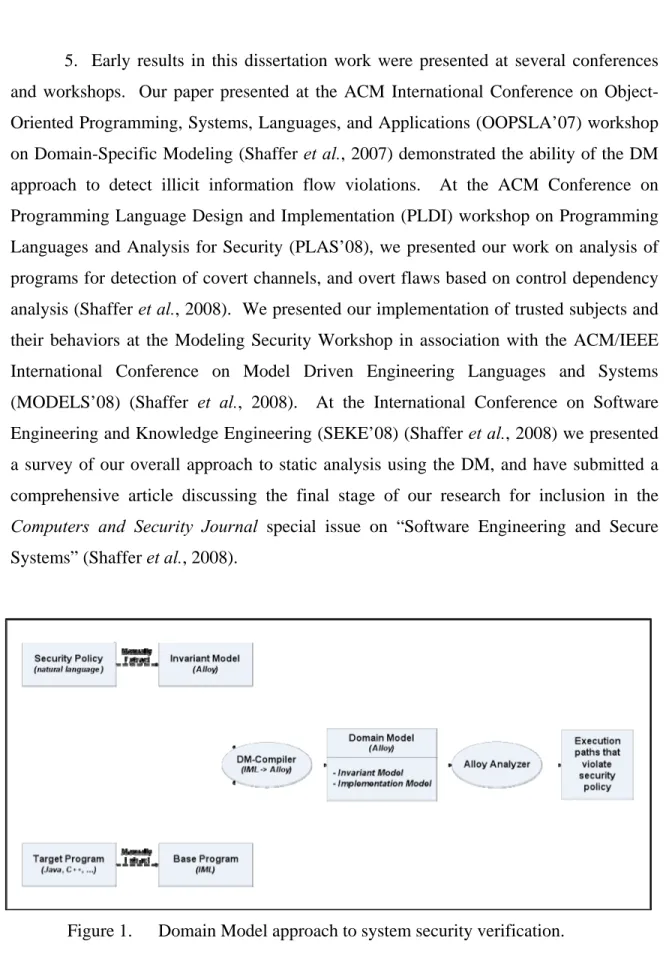
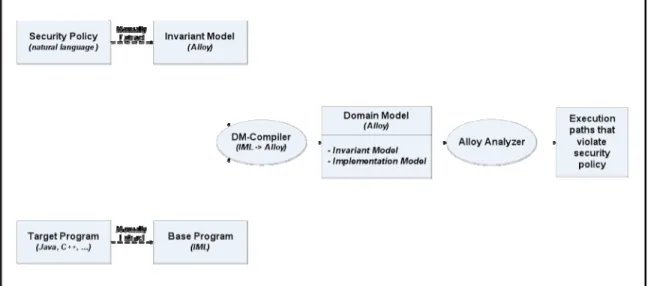
4. We have implemented a prototype for static analysis of programs based on the DM framework. This framework includes a specialized DM-Compiler, developed to translate a base program written in IML into an Implementation Model and to integrate it with the Invariant Model to form a complete DM specification to represent the original
target program. This prototype implementation architecture is depicted in Figure 1, and will be explained in detail in Chapter V.
5. Early results in this dissertation work were presented at several conferences and workshops. Our paper presented at the ACM International Conference on Object-Oriented Programming, Systems, Languages, and Applications (OOPSLA’07) workshop on Domain-Specific Modeling (Shaffer et al., 2007) demonstrated the ability of the DM approach to detect illicit information flow violations. At the ACM Conference on Programming Language Design and Implementation (PLDI) workshop on Programming Languages and Analysis for Security (PLAS’08), we presented our work on analysis of programs for detection of covert channels, and overt flaws based on control dependency analysis (Shaffer et al., 2008). We presented our implementation of trusted subjects and their behaviors at the Modeling Security Workshop in association with the ACM/IEEE International Conference on Model Driven Engineering Languages and Systems (MODELS’08) (Shaffer et al., 2008). At the International Conference on Software Engineering and Knowledge Engineering (SEKE’08) (Shaffer et al., 2008) we presented a survey of our overall approach to static analysis using the DM, and have submitted a comprehensive article discussing the final stage of our research for inclusion in the
Computers and Security Journal special issue on “Software Engineering and Secure Systems” (Shaffer et al., 2008).
In addition to these publications, we have built a Security Domain Model Project website (http://cisr.nps.edu/projects/sdm.html) that provides discussion of the research, with links to our papers, and example IML base programs with respective DM specification code.
6. Relevance to Department of Defense (DoD). Highly secure systems are significantly more expensive to build than typical IT systems. because a contributing factor to these high costs is the need for formal verification, which requires a large amount of effort by highly trained specialists. The contributions described in this work advance the ability to automate a portion of the formal verification process. This automation has two significant effects: it has the potential to reduce errors caused by human mistakes in the verification process, making systems more secure; and it can reduce the effort required for verification, making secure systems more affordable.
These techniques are applicable to the verification of a specific class of components (target programs) in secure MLS systems, for which the DoD has projected both a significant need and future support of extensive research and development (NSA GIG, 2005). These components perform the following abstract function:
• Given a machine with two input ports (labeled HIGH and LOW) and two output ports (also labeled HIGH and LOW), the machine processes inputs and sends output only to the appropriate output port, where “appropriate” is defined by the security policy.
The framework developed here supports automated static analysis to determine whether the system component in question conforms to, or enforces, its security policy. The framework does this by: (1) associating with each incoming datum an internal label equal to the label of the input port, (2) modifying the internal label of a datum, if necessary, as it is processed, and (3) detecting if a datum leaves the component through an output port that is inappropriate with respect to the datum’s internal label and the output port label.
Examples of such components are trusted subject programs, security kernels, and separation kernels configured to enforce an MLS policy. Trusted subjects are often used
in MLS systems as downgraders, multilevel switches, and for other critical functions that make MLS systems useful and effective. Security kernels and separation kernels are the foundation of most DoD systems that provide multilevel security. The DoD, working with other government agencies, is researching systems for sharing information across differing security levels, under the aegis of the Unified Cross Domain Management Office (UCDMO) (Thuermer, 2007).
D. DISSERTATION ORGANIZATION
An outline for the remainder of this dissertation follows:
• Chapter II presents an overview of information assurance principles germane to this dissertation research. Specific discussions include high assurance system evaluation processes and standards, formal security models and policies, multilevel secure (MLS) systems, information flow tracing, covert channels, trusted subjects, and an introduction to dynamic security policies.
• Chapter III provides an analytical review of previous work related to the fields of the dissertation, to include background research on security models and policies, analysis of systems for illicit control dependencies and covert channels, implementation of a trusted subject into secure systems, and development and implementation of systems which implement dynamic security policies.
• Chapter IV presents the Implementation Modeling Language (IML), developed as a specialized language for representing target program implementations as base programs.
• Chapter V presents the Security Domain Model (DM) framework and an associated approach to performing static analysis of base programs to verify their adherence to security policy rules.
• Chapter VI presents several example base program test cases, each with security vulnerabilities discoverable using the DM approach, and provides an analysis of results of the testing.
• Chapter VII presents conclusions of this research, and suggests areas of future work.
• Appendices are included at the end of this dissertation to provide RIGAL compiler construction language code for the DM-Compiler files, and several example base programs with complete Alloy specifications for each associated Security DM.
II.
INFORMATION ASSURANCE PRINCIPLES
A. INTRODUCTION
This chapter discusses concepts and principles, within the information assurance domain, germane to this research. It begins with an introduction to high assurance system evaluation, and the established standards that govern this process. A discussion of formal security models and policies follows this. Next, we introduce the concepts of information flow through program execution, and control dependencies which can affect such flows. The concepts of covert channel analysis, and trusted subjects and their behaviors are then discussed. Finally, dynamic security policies are introduced, as an area for future work in this research.
B. HIGH ASSURANCE COMPUTER SYSTEM EVALUATION
1. Introduction
The Common Criteria (CC) is a recognized International Organization for Standardization (ISO) standard for evaluating computer systems against varying levels of assurance. Initially published in January 1996, the CC essentially combined the older and independent U.S., European and Canadian standards for system evaluation, incorporating the best principles and tenets of each. While the CC was also intended to replace the older Department of Defense (DoD) Trusted Computer Security Evaluation Criteria System (TCSEC), the de facto U.S. standard since the mid 1980s, a few proponents of the TCSEC continue to promote it as a superior standard. Thus, while the CC is the official evaluation criteria used by the U.S. government and DoD, both standards have their advocates within the security community.
2. Trusted Computer Security Evaluation Criteria System (TCSEC)
Developed by the DoD as part of the Rainbow Series of computer security publications, the TCSEC (commonly referred to as “the Orange Book” because of the color of its cover page) was initially drafted in 1983, and accepted in 1985 as the US standard for computer systems assurance evaluation and classification (DoD TCSEC,
1985). The TCSEC defined a range of hierarchical assurance levels, based upon the effectiveness of security provided by and within a particular system being evaluated, such that a given level includes all of the requirements of a lower level, and more. The assurance levels increase from level D through level A, with the higher levels (C, B, A) further divided into classes based on the specific protection characteristics provided. These levels represent the assurance classification for a system, from one evaluated to have minimal or no security capabilities (level D), up through one that has undergone formal methods verification that its protection system and model are correct, and whose implementation corresponds to the formal top-level specification (level A1).
The TCSEC required the identification of security properties such as those identified by Bell and LaPadula (1973) in their security model of mandatory access control, and was based heavily on the reference monitor concept for adjudicating accesses of subjects to objects within an operating system (Anderson, 1972). Also, the Orange Book focuses on operating system security, while the need clearly exists to account for security of many other types of systems (in fact, other books in the Rainbow
Series were written specifically to address non-OS computer systems). These shortfalls, coupled with the lack of an international standard, provided the impetus for development of an encompassing standard for system security evaluation.
3. The Common Criteria
Schell (2001) defined four epochs spanning the history of scientific developments in computer security, each one progressing beyond the previous toward better security and more assured systems – that is, each epoch but the last. This final (and current) epoch Schell defined as being one of a period of security decline, with the Common Criteria as its hallmark. He pointed to the fact that, while the CC evaluates individual products, the science of computer security should instead focus on evaluating entire systems, which comprise multiple software and hardware products. Schell believed that by making no distinction between system and subsystem evaluation, the CC limits us to examining only isolated components of any system, never evaluating the system and its IT environment in their entirety.
Schell’s negative assessment notwithstanding, the CC represented a paradigm shift in the security evaluation process, and has become the US and international standard for the development of computer system security specifications. The CC allows evaluation of a specific system (or product), or more generally, families of systems (or products), by establishing security assurance criteria against which they can be measured. The CC introduced the concept of a Protection Profile (PP) to describe the security requirements of a category of products. A PP is typically written to define the requirements for a class of system by some user community, and it generally defines the requirements for both functionality and assurance of the system. A Security Target (ST), on the other hand, is used to evaluate a specific system or product. An ST is often written based on an existing PP for a like class or category of system, in order to define the requirements of the target of evaluation (TOE) (Common Criteria, 2006).
The CC defines a number of assurance classes within which security criteria and requirements are defined. Among the assurance classes are such topical areas as development, life-cycle support, and testing, for example. These broad classes are subdivided into families that further describe the unique objectives of the class. As an example, the Development class (identified as “ADV”) contains a family called Security Architecture (uniquely identified as “ADV_ARC”) whose objective is to allow “the developer to provide a description of the security architecture of the TSF” (Common Criteria, 2006). Finally, each family is defined by some number of hierarchically ordered
components, each of which describe the scope, depth and rigor required of a security criterion, in order for the product to meet a particular assurance level.
The goal of the CC in defining assurance classes is to allow evaluators to measure a system against the objectives described by the families of these classes. For this, the CC defines Evaluation Assurance Levels (EALs) which “provide an increasing scale that balances the level of assurance obtained with the cost and feasibility of acquiring that degree of assurance” (Common Criteria, 2006). The CC EALs were written with the intent that they correlate roughly to the TCSEC Orange Book grading levels, primarily so
that earlier evaluated systems could remain relevant. Since the two systems evaluate assurance in different ways, however, their respective grading levels should not be regarded as equivalent.
For a system to achieve a given EAL, it must meet the security criteria for all of the family components of that level. To be evaluated at the highest CC assurance level – EAL7 – a computer system must undergo a more comprehensive analysis than that required for lower assurance levels. This evaluation analysis must include formal representation of system requirements, demonstration of formal correspondences, and comprehensive testing of system components. In particular, the formal correspondences must be demonstrated as mappings between the security policy model and the functional specification of a system.
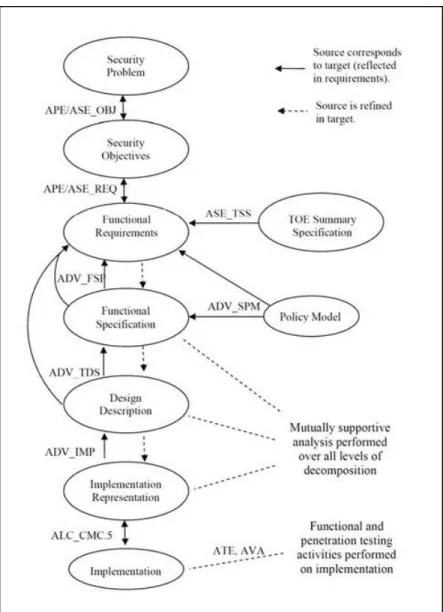
Further, a complete correspondence must be demonstrated between the system security objectives and functional requirements, and between the functional specification and functional requirements. In general, with respect to the implementation of the system, a full mapping must be shown to exist between all levels of design description and specification, as depicted in Figure 2. This formal correspondence must be proven between all constructs of the system in order for a high-assurance system to be evaluated at EAL7.
Figure 2. Common Criteria development class (ADV) correspondences (from Common Criteria, 2006).
4. The Trusted Computing Exemplar (TCX) Project
The Trusted Computing Exemplar (TCX) project is being conducted by the Center for Information Systems Security Studies and Research’s (CISR) at the U.S. Naval Postgraduate School (NPS) in Monterey, California. The goal of TCX is to demonstrate in an openly distributed, worked example, how a trusted computing system and its components can be built to meet high assurance evaluation criteria. Its specific approach to meeting this goal is fourfold (Irvine et al., 2004):
• Create a prototype framework for high-assurance system development
• Develop a trusted computing component as a reference
• Evaluate the component, through a third-party, against CC EAL7
• Provide a means for open distribution of all deliverables and artifacts To date, the TCX project has achieved milestones in defining a high-assurance development framework, and the design specification for a web-based dissemination system (Levin et al., 2004; Nguyen et al., 2005). Its least privilege model has been articulated, and features to support transitive trust have been described. The project has created a working prototype and is developing design and implementation of the TCX Least Privilege Separation Kernel (TCX-LPSK) as a trusted component. By developing a framework of application mechanisms for specifying and verifying the mapping of higher level security requirements for a system, this dissertation research directly supports the goals of the TCX project.
C. FORMAL SECURITY MODELS AND POLICIES
1. Introduction
McLean (1994) stated that security models are “used to describe any formal statement of a system’s confidentiality, availability, or integrity requirements.” Security models provide a detailed and precise means of formally describing security policies, and proving their validity. Since a system must not only be secure, but demonstrably so, formal security models provide system designers with evidence that they are constructing a self-consistent system, and with a foundation for further demonstration that the system as implemented meets its specifications (Landwehr, 1981).
In a typical formal methods approach to security model development, a security policy is initially translated from words into a mathematical model. From this, a formal specification is created and shown to satisfy the mathematical model, deriving from the original policy. To prove conformance to the policy, the specification must be implemented and shown to be an accurate representation of the specification. This “chain
aspects of security may be outside the scope of the formal security policy model (for example, physical security and good password hygiene).
While it would be difficult to provide an exhaustive review of every security model that has ever been developed or proposed, we attempt to provide here a representative overview of some well-known ones. This analysis will divide security models into two logical categories: discretionary access control (DAC) models and mandatory access control (MAC) models. Generally, DAC systems allow one user to extend to other users or subjects his rights to the objects for which he controls access. In DAC systems, the ability to modify access rights is subject to some set of rules which can change during the course of system operation. Conversely, MAC systems attempt to provide a global and persistent policy, where access control is fixed in a predetermined state by a predefined set of rules and all modifications are relative to that established set of allowed access rights.
2. Discretionary Access Control (DAC) Models
a. Access Matrix Models / Graham-Denning
In the context of computer operating systems, Lampson (1971) defined protection as “all the mechanisms which control the access of a program to other things in the system.” To describe how this control of access would occur, he developed the concept of using matrices as a way to illustrate the access of subjects to objects within a computer system.
An access matrix scheme is comprised of objects and subjects formed into a matrix of allowed accesses. The objects can represent anything in the system that needs to be protected, including files and processes. Subjects represent system entities that can have access to objects. The access matrix scheme also includes a set of rights representing the types of accesses which a subject may have to an object, for example read, write, execute, or owner.
In general, an access matrix defines a cross-mapping between the objects and subjects in a system. Cells in the matrix represent monitors that control access of a particular subject to a particular object. A given access matrix reflects a security policy
for the system. A “snapshot” of the current access matrix can be thought of as a specific protection state of the system, and defines the access rights in that state; to modify or add to the set of allowed accesses would require some transition into a new matrix, or protection policy.
The Graham-Denning Model (1972) formalized the concept of using access matrices for access control within operating systems. Their model defined basic access rights of a system in terms of a set of eight allowable operations across subjects and objects within that system. These operations permitted a subject x to create and delete objects and subjects, and to read, grant, delete and transfer the access rights of another subject s to an object o. The Graham-Denning model is generally considered to be the first formal DAC scheme proposed and the first general access matrix model.
An access matrix is a static representation of a security system, and corresponds to a set of access rights for a given security policy. Rules might be established to define how subject-to-object access rights could be modified over time, possibly allowing users the discretion to extend rights to other subjects. Changes to the system from such rules would transition the system into a new state, essentially representing a new security policy.
b. HRU Model
The Harrison-Ruzzo-Ullman (HRU) Model (Harrison et al., 1976) defined authorization systems that allowed the modification of access rights, along with the ability for creating and deleting subjects and objects within the system. It also introduced a safety property: that access to an object within the system was impossible without the concurrence of the owner of that object.
In reality, since an owner in a DAC system may extend rights to an object that in turn may be given away without his knowledge, no protection system can be safe by this definition. To solve this problem, the HRU model provided a weaker definition that simply required a protection system to ensure that objects are kept “under control” by their owner, meaning that the owner has some intuition as to whether his granting of a
Even this weaker definition of safety is too strict for all protection systems, since it is generally undecidable whether, “given an initial access matrix, there is some sequence of commands in which a particular generic right is entered at some place in the matrix where it did not exist before.” They proved that, while an algorithm could be found to show whether a given mono-operational system is unsafe for some generic right, it is not possible to devise an algorithm to decide the safety of any generic protection system for all of its possible configurations.
3. Mandatory Access Control (MAC) Models
Mandatory access control models are representative of multilevel systems in which subjects and objects are hierarchically or partially ordered according to their sensitivity levels, and the system ensures that data from objects higher, or non-comparable, in the hierarchy is not available to subjects lower in the hierarchy. One of the most common examples of a MAC structure is the military classification system.
a. Bell and LaPadula Model
The Bell and LaPadula (BLP) Model (Bell and LaPadula, 1973) can be used to formally describe the enforcement of military policies associated with classified information. At the heart of the BLP model is the concept that all objects in the system are assigned a classification level based on their relative sensitivity, and all users are similarly assigned a clearance level based on their job, rank, experience, etc. System subjects (users) are granted access to objects (files, applications, resources, etc.) based on the relationship between the clearance level they possess and the defined classification level of the object.
The BLP Model defines the simple security (ss-) property, which states that a subject at a given security level can only access objects assigned an equal or lower classification level, commonly referred to as “read down”. Similarly, they define the
confinement (*-) property, which prevents sensitive information from being copied into less sensitive objects by malicious software, by ensuring that a subject cannot write into an object that is of a lower classification level; this rule prevents “write down”. These
rules allow (and restrict) the flow of information across the multiple levels of the security structure, thus the BLP model and its derivatives are popular information flow models.
The BLP model can be described by a set of rules governing the relationship between objects and subjects, and the associated access functions over them. Stated more formally these rules, or properties, provide the most common way of representing the model:
• The simple security (ss-) property states that every “observe” access triple (subject,
object, read right) in the current access set b must have the property that the level of the subject dominates the level of that object.
• The *-property states that, if a subject has simultaneous “observe” access to object O1 and “alter” access to object O2, then the level of O1 is dominated by the level of O2.
• The discretionary security (ds-) property states that, if (subject i, object j, attribute x) is in the current access set b, then x is recorded in ij’th component of the access matrix M.
As an example of the BLP model, suppose a system user has been assigned a clearance level of “secret.” This means that the user possesses the access rights to read documents that are classified at the secret level and lower while logged onto the system at the secret level, and to write to secret and higher documents (although the user would not have read access to higher classified documents in this system, in order to write to them in a coherent manner).
The rigidly defined structure of the BLP model is both its strength for protecting military classified information, and its most commonly highlighted weakness. In particular, enforcement of the *-property does not allow an object to be downgraded to a lower classification level. While this is a basic requirement of a practical MLS system, the *-property prevents it. To address this shortcoming, Bell and LaPadula introduced the idea of a trusted subject, which is one that can be trusted not to violate the intent of the *-property. Critics have also pointed out that the BLP model could allow a malicious user to simply request the system administrator to temporarily declassify a file, thus
LaPadula added the so-called tranquility property (Bell and LaPadula, 1976). The strong
tranquility property states that the security labels of objects can never change during system operation, while the less stringent weak tranquility property stated that the labels can never be changed in such a way that violates any of the other defined security properties.
b. Biba Integrity Model
The BLP model was concerned only with confidentiality of objects. While this was intended by design, a follow-on information flow model was developed that specifically classified data according to integrity levels; here, integrity can be thought of as the quality of the information, for example, stored in an object. The Biba
Integrity Model (Biba, 1977) can be thought of as complementary to the BLP model: whereas BLP focuses on the sensitivity of objects, Biba defines its rules based on maintaining their integrity. With the proliferation of digital data storage, there is good reason for a policy that ensures that the near- and long-term integrity of data is maintained.
The goal of the Biba model is to ensure that high integrity documents will not be contaminated by lower integrity data. In doing this, Biba ensures that a subject is only allowed to view objects of an equal or higher integrity level than itself. Under the Biba model, individual integrity levels are defined for all subjects and objects in the system. The higher the integrity level, the higher the level of confidence, reliability and trustworthiness in that entity (this concept has nothing to do with an object’s inherent sensitivity). The rules of the Biba model define a strict integrity policy which prevents information flows from lower to higher integrity levels, and can be formalized by the following axioms (note that the differences between these and the properties that define the BLP model are symmetric):
• The simple integrity (si-) axiom states that a subject s can read from an object o iff the integrity of the subject is dominated by that of the object; in other words, a subject cannot read from an object of lesser integrity (“no read down”).
• The integrity *-property axiom states that a subject s can have write access to an object o iff the integrity of the subject dominates that of the object; in other words, a subject cannot write data to a higher integrity level than its own (“no write up”).
While the concepts underlying the Biba model seem straightforward, particularly when understood as the dual of BLP, Biba has been difficult to implement in real-world systems. However, integrity policies have been investigated in some high assurance systems, such as GEMSOS (Schell et al., 1985), which implemented Biba controls using integrity labels. The general difficulty in implementing Biba lies in how one defines integrity. Whereas the sensitivity level for subjects and objects can be readily defined and assigned – one only need consider the military classification system as a practical example of this – the same cannot be said for assigning integrity levels.
Establishing criteria for assignment of various integrity levels to subjects and objects has proven difficult. What parameters should be taken into account when assigning an integrity level to a user? Integrity for one class of users may be defined very differently from that of another, for example the integrity of medical records is quite different from that of the source code for a popular video game. In addition, Irvine and Levin (2001; 2002) pointed out the “integrity problem” of a system based on its integrity
capacity. They showed that, in order to ensure the integrity of all its objects, a system is practically limited to maintaining (modifying) only data whose integrity is as low as its lowest integrity component. For implementation of integrity policies in high-assurance systems, Schellhorn et al. (2000) have suggested using Common Criteria EAL levels, for example, as integrity labels when storing applications to smart cards, however, this requires that evaluation criteria for these applications must always be compatible.
c. Lattice Model
The Lattice Model is another in the class of mandatory access control models, and is based on the idea of classes of objects being organized into a universally bounded lattice. Developed by D. Denning (1976) as “a structure consisting of a finite partially ordered set together with least upper and greatest lower bound operators on the set,” her goal was to find a model with suitable restrictions such that its security would be
not only decidable, but simply decidable. This would ensure a system with proven ability not to leak information from an object at a high sensitive level to a subject at a lower sensitivity level.
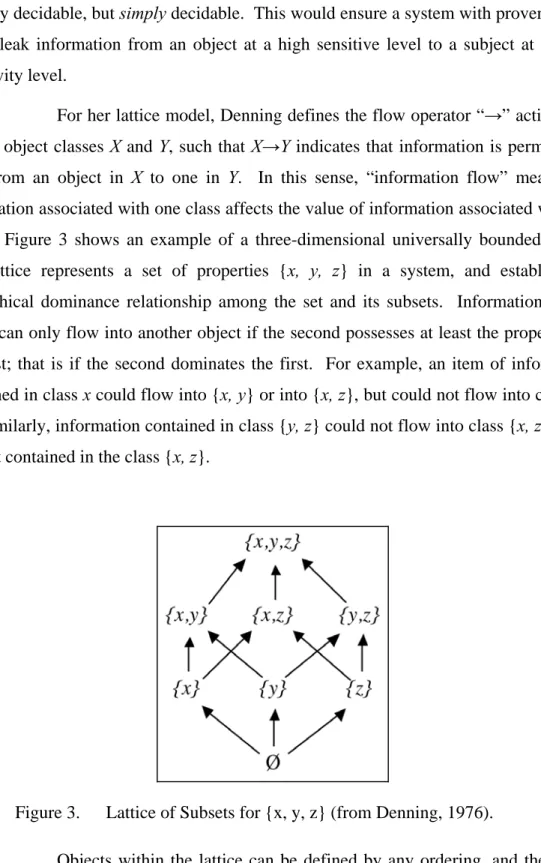
For her lattice model, Denning defines the flow operator “→” acting on a pair of object classes X and Y, such that X→Y indicates that information is permitted to flow from an object in X to one in Y. In this sense, “information flow” means that information associated with one class affects the value of information associated with the other. Figure 3 shows an example of a three-dimensional universally bounded lattice. The lattice represents a set of properties {x, y, z} in a system, and establishes a hierarchical dominance relationship among the set and its subsets. Information in one object can only flow into another object if the second possesses at least the properties of the first; that is if the second dominates the first. For example, an item of information contained in class x could flow into {x, y} or into {x, z}, but could not flow into class {y,
z}. Similarly, information contained in class {y, z} could not flow into class {x, z}, since
y is not contained in the class {x, z}.
Figure 3. Lattice of Subsets for {x, y, z} (from Denning, 1976).
Objects within the lattice can be defined by any ordering, and the lattice may be defined with categories non-comparable to one another in ordering objects. This does not preclude, however, a lattice from being ordered by a combination of sensitivity
or integrity, provided information flows were properly defined to ensure that the
ss/si-properties and the *-property were adhered to (Lunt et al., 1990).
d. Clark/Wilson Model
As with the previous examples of MAC models, the Clark/Wilson Model (Clark and Wilson, 1987) is an information flow security model which, like the Biba Model, ensures the integrity of objects. Clark and Wilson stated that prevention of unauthorized disclosure of sensitive information, which is vitally important in military security, is less important in commercial applications where integrity of information and prevention of unauthorized data modification is paramount. Loss or corruption of a company’s records and stored data through fraud or errors is often the gravest danger.
The C/W model addresses the flow of information by relying on software application well-formed transactions (WFT), and separation of duties among users to ensure that no single user can contaminate a data object through unauthorized changes. WFTs ensure that no user can arbitrarily modify data, either maliciously or unintentionally, and can only act in constrained ways that ensure data integrity. In addition, strict logging of all user actions facilitates auditing the system for erroneous or malicious transactions.
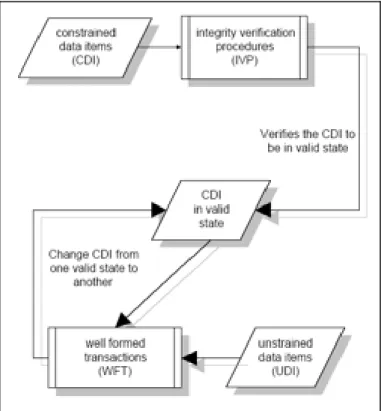
In addition, the C/W model further defines constrained data items (CDI) as those objects requiring integrity; integrity verification procedures (IVP) as applications procedures which provide confirmation that all data adheres to security specifications on the system; and unconstrained data items (UDI) as those objects outside the system that have yet to be verified for integrity.
Figure 4 provides a simple example of data object flow through a C/W system. In this snapshot of the system, all CDIs have previously been verified for integrity by an IVP, thus placing them in a valid state. Any proposed manipulation on a CDI must be performed via a WFT, which will ensure the CDI’s return to a valid state. Introduction of a new UDI into the system will require verification of its integrity through an IVP before it can be reclassified a CDI and placed into a valid state.
Shockley (1988) showed how the C/W model could be partially implemented as an MLS system, using BLP mechanisms, and Ge et al. (2004) showed the implementation of the C/W model using a DBMS server. Since the C/W model relies heavily on application procedures for its WFTs, these procedures must be proven valid for all possible states. Otherwise, there is no assurance that a WFT returns a CDI to a new valid state after the transaction.
e. Noninterference
Some approaches to secure information flow do not distinguish between classes of covert channels, or between covert and overt flows for that matter. These approaches rely on the concept of noninterference, which states that the actions of one subject can have no effect on the output of a lower subject in a system. Goguen and
Meseguer (1982) described a model wherein security policies are defined in terms of only noninterference assertions, rather than by the combination of access control and covert channel restrictions. In their research on security policies and models, they described noninterference within a system in terms of information flows permitted between high and low subjects. They explained that “one group of users, using a certain set of commands, is noninterfering with another group of users if what the first group does with those commands has no effect on what the second group can see.” Haigh and Young (1987) further expanded the noninterference ideas of Goguen and Meseguer in follow-on work.
The noninterference concept, when initially proposed, appeared to be a logical description of confidentiality in the context of an MLS system, however, problems were soon realized in implementing noninterference. In practice, high-level data often has an effect on low-level data, such as the case where a highly classified file is encrypted or declassified, and then transmitted over a low channel. An activity such as this would represent a low user receiving information (declassified data) based on the actions of a high user (the downgrader), and would not be allowed under the strict definition of noninterference. In addition, noninterference had a significant shortcoming, with respect to BLP, in that it did not prevent “read up” of high sensitivity objects by a low sensitivity subject. While noninterference ensures that the actions of a high level subject will not affect low level outputs in a system, it does nothing to prevent a low level subject from somehow observing high level information, and then acting on that information.
The access control models described above (the BLP Model, etc.) are used in formal verification to prevent Low subjects from accessing High information, using a two-part strategy: (1) by enforcing rules regarding how subjects may access objects; and (2) by performing covert channel analysis to close remaining illicit flows. While noninterference was ostensibly proposed as a way to define information flows, in practice it was also seen as a better way to explain covert channels, since access control did not adequately do this, and in fact, noninterference sought to unify the concepts of access control and covert channel analysis.
Noninterference with respect to security properties is often considered limited by the refinement paradox, which states that a system’s abstract security properties for information flow cannot be guaranteed to be preserved through refinement to concrete implementation (McLean, 1990; 1996; Roscoe, 1995). Also, in their report from the 2001 Computer Security Foundations Workshop, Ryan et al., (2001) stated that noninterference, as a way to ascertain covert channels (due to algorithm or design flaws), does not pass the necessary and sufficient test. A covert channel does not necessarily imply the presence of interference on a practical level. That is, while interference is
sufficient to imply a covert channel, it may be so small as to be of no practical exploitable use. The report stated, “in most noninterference models, a single bit of compromised information is flagged as a security violation, even if one bit is all that is lost. To be taken seriously, a noninterference violation should imply a more significant loss.” The ability of noninterference to adequately contain information flows and covert channels, as well as its overall validity as a security model, has been hotly debated in the computer security field.
4. Role Based Access Control (RBAC) Model
RBAC security models represent a hybrid class of non-discretionary access control security policies that were designed to provide for the security requirements of non-military organizations. RBAC was developed at the National Institute of Standards and Technology (NIST) to meet the needs of industry and civilian government organizations, where the strict requirements of a military MAC policy do not address the security needs for handling sensitive unclassified information (Ferraiolo and Kuhn, 1992; Sandhu et al., 1996). This type of environment can be exemplified by a medical facility, where personal patient information can often be extremely sensitive, although not classified in a strict sense. In this type of environment, specific information should be handled by only qualified classes of users, based on the sensitivity level of the information. As an example, while medical charts and patient history are vital information that doctors and nurses must access to effectively do their jobs, such data need not (and should not) be made available to hospital administrative staff, who have no such valid access requirement. The opposite would be true of financial information
concerning a patient’s ability to pay for medical care services. In each case, the role of the user represents the key factor in determining whether or not information should be made available.
To address this type of security environment, an RBAC model grants access rights to groups of users based on their role requirements, rather than providing rights to users individually. Essentially, RBAC is a variation of an access matrix model, where groups of subjects represent roles, and rights are assigned uniformly to the group, as opposed to individual users (subjects). Each role defines a specific set of operations that the individual acting in that role may perform, or in terms of access rights, the set of objects a user has access to, based on his role.
The military classification system’s compartmentalization labels for classified messages may be viewed as another application of RBAC. In addition to hierarchical classification labels representing secrecy level, messages may also be tagged with a compartment label, e.g., NUCLEAR, which can be viewed as analogous to a role. In this scheme, users are granted access to messages with a particular compartment label (assuming they also possess adequate clearance level), based on their job requirements. At a later time based on changing job requirements, a user may be debriefed out of a particular compartment, essentially losing this role, at which time that user would no longer have access to messages with this compartment label.
Figure 5. RBAC Role Relationships (after Ferraiolo and Kuhn, 1992).
Figure 5 shows a simple relationship between users, roles, and objects. In the example, User4 is identified as possessing Role1, presumably by virtue of his job description. Because he possesses this role, he implicitly has been granted access to
Object1. If at some time in the future User4 were to lose possession of Role1, he would no longer have access to Object1 (note that this change would require no modification whatsoever to Object1, nor to User5’s or User6’s access to it).
The RBAC model provides the means to readily support the principle of least privilege at the granularity of the role or group. This principle states that a subject will have access to only the objects needed to perform his or her job, and nothing more. In an RBAC model, specific rights and privileges can be granted to an entire group based on the required functionality of their role. The administrative strength of RBAC is that privileges can be granted (or retracted) to the group as a whole, without the need for manipulation of individual user rights.
5. Summary
This section has described well-known mandatory and discretionary access control security models, intended to protect both confidentiality and integrity of information. Because our research focuses on MLS systems, particularly systems