FINAL EVALUATION OF THE HOT DOG CAFÉ – COFFEE
STOP SHOP CADET PROGRAMME
Commissioned and conducted by:
Monitoring and Evaluation Unit
Research and Policy Division
National Youth Development Agency
11 Broadwalk Avenue
Halfway House
Midrand
Email:
[email protected]
Website:
www.nyda.gov.za
08600 YOUTH (96884)
National Youth Development Fund, March 2012
Date: MARCH 2012
DisclaimerViews expressed by the evaluator are not necessarily that of NYDA and the findings and recommendations of the evaluation are with some limitations and they can not therefore be generalized to all NYDA projects. The NYDA is not liable for the any views expressed or misprint in the evaluation report.
TABLE OF CONTENTS
ACKNOWLEDGEMENTS... 6
ACRONYMS ... 7
EXECUTIVE SUMMARY ... 8
1.
INTRODUCTION ... 15
2.
PURPOSE AND OBJECTIVES OF THE EVALUATION ... 17
3.
EVALUATION METHODOLOGY ... 18
4.
LIMITATIONS... 19
5.
OUTCOME OF DOCUMENT REVIEW ... 20
5.1. PROJECT CONCEPTUALISATION ... 20 5.2. PROJECT CONTRACTING ... 23 5.3. QUARTERLY REPORTING ... 26 5.3.1. Quarter 1 ... 26 5.3.2. Quarter 2 ... 28 5.3.3. Quarter 3 ... 40 5.3.4. Quarter 4 ... 41 5.3.5. Quarter 5 ... 42 5.3.6. Quarter 6 ... 43
6.
OUTCOME OF THE INTERVIEWS ... 48
6.1. Outcome of interviews with NYDA Project Manager ... 48
6.2. Outcome of interview with key informants at Hot Dog Café... 50
6.3. Outcome of interview with participants that dropped from the Cadet Programme ... 58
6.1. Outcome of interview with participants that successfully completed the Cadet Programme ... 69
7.
KEY FINDINGS ... 109
8.
KEY DISCUSSION POINTS... 111
9.
LESSONS LEARNED ... 112
10.
CONCLUSIONS... 113
11.
RECOMMENDATIONS ... 114
12.
ANNEXURES ... 115
12.1. Annexure 1 – Questionnaire for NYDA Project Manager ... 115
12.2. Annexure 2 – Questionnaire for key informants at Hot Dog Café 124 12.3. Annexure 3 – Questionnaire for Participants ... 140
LIST OF FIGURES
Figure 1 Depiction of relationships in establishing the Coffee Stop Franchise .... 51
Figure 1 Names of stores where the participants were earmarked to be placed or allocated-dropped out participants ... 60
Figure 2 How participants got to know about the Cadet Programme-dropped out participants ... 61
Figure 3 Highest qualification of the participants at the start of the programme-dropped out participants ... 62
Figure 4 Occupational status of the participants before joining the programme-dropped out participants ... 63
Figure 5 Assessment whether participation in the programme had impact on the lives of the dropped out participants ... 64
Figure 6 Occupational status of participants at the time of conducting the evaluation-dropped out participants ... 66
Figure 7 Assessment of whether those employed are in the food retail industry-dropped out participants ... 67
Figure 8 Assessment whether employment was due to participation in the Cadet Programme-dropped out participants ... 68
Figure 1 Names of stores where the participants were earmarked to be placed or allocated ... 71
Figure 2 How participants got to know about the Cadet Programme ... 72
Figure 3 Highest qualification of the participants at the start of the programme . 73 Figure 4 Occupational status of the participants before joining the programme . 74 Figure 5 Adequacy of time allocated for theoretical training ... 84
Figure 6 Ease of understanding materials used for training ... 85
Figure 7 Usefulness of the training material in relation to the operations of the Coffee Stop Store ... 86
Figure 8 Pitching of theoretical training at the level of the participants ... 87
Figure 9 Knowledge levels of the facilitators ... 88
Figure 10 Level of interaction between the facilitator and learners ... 89
Figure 11 Confirmation of allocation of an in-store manager ... 90
Figure 12 Relationship with in-store manager ... 91
Figure 13 Skills of the mentor ... 92
Figure 14 Relationship between mentor and learners... 93
Figure 15 Satisfaction level with selection of Coffee Stop Store owners ... 95
Figure 16 Visibility of the NYDA in the Coffee Stop Cadet Programme ... 96
Figure 17 Level of preparation of training by HDC for employment ... 97
Figure 18 Level of preparation of HDC training for further studies ... 98
Figure 19 Assessment whether participation in the programme had impact on the lives of the participants ... 99
Figure 20 Occupational status of participants at the time of conducting the evaluation ... 104
Figure 21 Participants still employed in Coffee Stop Stores ... 105
Figure 22 Participants appointed as Coffee Stop Store owner ... 106
LIST OF TABLES
Table 1 Schedule of reports ... 24
Table 2 Schedule of reports to be submitted by Hot Dog Cafe ... 25
Table 3 Summary of all stores that participated in the Coffee Stop Cadet Programme ... 57
Table 1 Gender breakdown of dropped out participants ... 59
Table 2 Race of the respondents-dropped out participants ... 59
Table 3 Disability status of the respondents-dropped out participants ... 59
Table 4 Confirmation of participation in the Cadet Programme-dropped out participants ... 59
Table 1 Gender breakdown of successful participants ... 69
Table 2 Race of the respondents ... 70
Table 3 Disability status of the respondents ... 70
Table 4 Confirmation of participation in the Cadet Programme ... 70
Table 5 Level of completion of the Cadet Programme ... 74
Table 6 Pass rate of the Cadet Programme ... 75
Table 7 Before and after comparison of knowledge levels-Life Skills module ... 75
Table 8 Before and after comparison of knowledge levels-Personal finance module ... 76
Table 9Before and after comparison of knowledge levels-Personal hygiene module ... 76
Table 10 Before and after comparison of knowledge levels-Food hygiene module ... 76
Table 11 Before and after comparison of knowledge levels-Customer service expectations module ... 77
Table 12 Before and after comparison of knowledge levels-Cash control module ... 77
Table 13 Before and after comparison of knowledge levels-Safety and security module ... 78
Table 14 Before and after comparison of knowledge levels-Stock control and ordering module ... 78
Table 15 Before and after comparison of knowledge levels-Daily procedures module ... 78
Table 16 Before and after comparison of knowledge levels-Standard of operations module ... 79
Table 17 Before and after comparison of knowledge levels-Pilot back office module ... 79
Table 18 Before and after comparison of knowledge levels-Equipment module . 80 Table 19 Before and after comparison of knowledge levels-Pilot invoicing module ... 80
Table 20 Before and after comparison of knowledge levels-Product module ... 80
Table 21 List of modules that gave participants a challenge ... 81
Table 22 Confirmation of receiving training certificate from HDC ... 89
ACKNOWLEDGEMENTS
The evaluators would like to thank Ms Delaine Galloway who supplied all the project documentation and records in possession of the NYDA. These records enable the evaluators to have a representative picture of what transpired in the project and also assisted to identify the gaps in the evaluation. We are also thankful to the staff at Hot Dog Café. Ms Liza Pietersen (Financial Manager) provided all the documentation regarding the operations of the Coffee Stop Stores and legal records towards providing the loan to the young person and establishing the legal entity under which the stores were located. Mr Derek Smith (Managing Director) and Ms Tonie van den Heever (Head Operations: Coffee Stop Brand) shared extensive knowledge and experiences regarding the cadet programme, and the transformation that they have witnessed with young people moving from being disempowered, employers to becoming managers and shareholders. We are forever grateful to the cadets who agreed to be interviewed telephonically. During the evaluation, we learnt of the passing of Nomathemba Thembi and we would like to pass our heartfelt condolences to her family and relatives.
ACRONYMS
BDS Business Development Service
BDSVP Business Development Service Voucher Programme BEE Black Economic Empowerment
BOSS Business Opportunity Support Service
CIPC Companies and Intellectual Property Commission CV Curriculum Vitae
GDP Gross Domestic Product GPA Gross Profit Analysis
ECDC Eastern Cape Development Corporation EDP Entrepreneurship Development Programme EF Enterprise Finance
FASA Franchise Association of South Africa FoH Front of House
FSDC Free State Development Corporation HDC Hot Dog Café
IDC Independent Development Corporation JOBS Job Opportunities Seekers Database LAB Learning Ability Battery
LIMDEV Limpopo Economic Development Enterprise M&E Monitoring and Evaluation
MEGA Mpumalanga Economic Growth Agency
NAMAC National Coordinating Office for Manufacturing NEF National Empowerment Fund
NWDC North West Development Corporation NYS National Youth Service
OD Organisational Development PBO Pilot Back Office
POS Point Of Sales
SD&T Skills Development & Transfer
SEDA Small Enterprise Development Agency SLA Service Level Agreement
SOP Standards Of Operations SPO Service Provider Organisation
THETA Tourism & Hospitality Sectoral Education and Training Authority UYF Umsobomvu Youth Fund
VAT Value Added Tax
WEGRO Western Cape Investment and Trade Promotion Agency YAC Youth Advisory Centre
EXECUTIVE SUMMARY
IntroductionHot Dog Cafe (Pty) Ltd, a franchisor accredited by the Franchise Association of South Africa, partnered with Umsobomvu Youth Fund (now operating as National Youth Development Agency). The partnership came as a result of Massmart’s intentions to achieve Black Economic Empowerment goals. Builders’ Warehouse were targeted to host the Coffee Stop Stores wherein the ownership will be given to young people to manage and operate them. HDC was always going to be providing business and guidance as this was a Franchise setup.
The roll-out for the ten stores was intended to take place in the following provinces: • •• • Gauteng, • •• • Free State, • •• • Eastern Cape, • •• • Mpumalanga, • •• • Limpopo, and • •• • Kwa-Zulu Natal
The cadets were recruited using advertising on media as well as using the NYDA JOBS database. The cadets were requested to attend a briefing to obtain deeper understanding about what the programme is about and to see whether they would the opportunity would be suitable for them. Once the participants were convinced that they needed to be in the programme, they underwent face-to-face interviews. Those that went through the interviews had to undergo the LAB tests to assess their numeracy and literacy skills. The Coffee Stop Cadet Programme involved an eight months training programme of which the cadets were accommodated for 6-8 weeks in Tshwane and undergone classroom and practical training. As part of the training the cadets were hosted by a Coffee Stop store for practical exposure to the operations of the business. Thereafter, the cadets moved permanently into the Coffee Stop for six months to learn all the operational and management skills required.
In addition to the training on the operations of the Coffee Stop store, the agreement was also in place for NYDA to provide 51% equity funding for the best cadet to own and manage the store. All the cadets were given equal opportunity to prove themselves towards becoming owners of the Coffee Stop store. The selection towards being selected as owner of Coffee Stop store required the cadets to present on a selected topic, and thus their presentability was, communication skills and non-verbal skills were assessed. The cost of one Coffee Stop store in 2008 was R800,000 and therefore NYDA made R408,000 towards the acquisition. HDC would actually receive the funds and use them
towards building of the Coffee Stop Store. A company is setup by HDC and the Coffee Stop store is placed under it as an asset as well as the other cadets who did not receive ownership of the store as workers. NYDA hold 19% of the shares and the young person holds the remaining 32% until such time that the capital is paid back in full to NYDA. HDC provided all the mentoring and in-store coaching until the young people are able to operate on their own and then the normal obligations of the franchise agreement kicks in.
Purpose and objectives of the evaluation
The evaluation is intended to provide a mid-term assessment of the extent to which the project has reached its objectives.
The objectives of the evaluation are underpinned by the following points:
• ••
• To determine if the project deliverables have been met. •
••
• To establish the factors that are necessary for a successful mentoring in
youth business operation.
• ••
• To assess efficiency of implementing the project. •
••
• To determine the gaps in the implementation and how they can be
circumvented.
• ••
• To lift elements of the project that can inform the organisational approach
towards entrepreneurship development as a long-term exercise.
Evaluation methodology
A multi-pronged approach was followed that included review and scrutiny of programme document and records, face-to-face interviews with key informants and telephonic interviews with the participants.
The documents that were reviewed include quarterly reports, concept documents, mentoring schedule, attendance registers, performance results, shareholders agreements between HDC-Young Person and NYDA, loan agreements between HDC and NYDA, Financial reports of Coffee Stop Shops, Certificates of incorporation, CM29 Certificates from CIPC and other relevant records.
The interviews were conducted through self administered questionnaires facilitated on a face-to-face approach, interview guides for the NYDA Project Manager, and the key informants based at Coffee Stop.
Key findings
This is most probably one of the best projects that represented internal integration as much as possible. Right from the beginning, it was evident that the other divisions were involved in the conceptualization and planning of the project. While the project was led by the Entrepreneurship Development Programme that
was based within Skills Development-National Youth Service division at the time, the other programmes such as Business Development Services and Enterprise Finance had a significant role to play also during the implementation. It is an indication that the level of buy-in was achieved with much ease.
The interest rate charged by NYDA is about 2 percent above the financial development institutions and as such it is not seen to be friendly to the young entrepreneurs and business practitioners in general.
The Coffee Stops stores that could not be included in the cadet programme include the following: Polokwane, Bloemfontein and Durban. The integration plans between NYDA and HDC was not in place and therefore the training could not be covered by NYDA. However, it is reported that the NYDA provided the equity funding for those stores.
The four stores that received the full cadet programme training and provision of equity for the store owners are Centurion, Port Elizabeth, Northgate and Kempton Park. As such there were full quarterly narrative reports for the duration of the contract period.
The Training Manager was also playing the role of Mentor to the newly appointed store owners. She spent about 2 days per store engaging with the new cadets to ensure that they are settled and fully applying their skills to run the stores efficiently. She also had to compile the quarterly report which took about one week to compile.
The in-store coaches were appointed during the project and as such had a bit of a challenge with operating the stores efficiently. It was also noted that the loss of an in-store coach led to reduced momentum in the business as the newly appointed in-store coaches had to exude the same motivation and buy-in to make the business a success.
As at February 2010, there was a total of 95 participants that had took part in the cadet programme for the four stores that obtained full support. It was indicated that 1 cadet had failed, 29 dropped out, 18 were still in the training and 47 had completed successfully. It was also found out that one of the cadets that completed successfully had passed on while the project was being evaluated. There were high levels of employment even amongst the participants that dropped out. The participants with higher level of qualifications, i.e. degree/diploma reported increased chances of being employed. There were also equal chances of becoming employed elsewhere – there was no direct link found between employment of those that dropped out and the training provided by HDC, however the exposure made the participants to become hungrier and their levels of motivation and determination increased. The challenges experienced by
those that dropped out were related to non-availability of funds for travel, need for closer accommodation and the salary levels were deemed too low.
Over 70% of the cadets that completed the programme were employed. Over 95% of those that completed the programme reported that the programme had an impact in their lives. There was a negligible difference in terms of whether the HDC training prepares participants for employment or for further education and training. The participants felt that the visibility of NYDA was fair in the programme and therefore needs to take full advantage of the possible credits. The training was seen to be relevant to the operations of the Coffee Stop stores and it was also indicated to be easy to understand. There was a near split with regards to adequacy of the time allocated for training. Modules that involved mathematical calculations gave participants a challenge. Placement of advert on printed media was effective as the overwhelming majority knew about the programme from there.
The cadets had to grow and transform during the project from taking instructions and being employees to be managers and shareholders in the business. They had to start to think about profitability of the business even when discussing possible salary increases.
Massive growth was noted in the cadets as they learned how to be responsible, understanding what is right and wrong, differentiating what is acceptable and not acceptable, utilisation of finance, using computers, operating a complex business based on a new business model. They had to build a lot of endurance and energy required to work and service customers in a store and also understand the importance of time management, cash flow management and saving cash at the bank.
Key discussion points
This project brought together almost all the relevant programmes within NYDA together in an integrated manner. The project was certainly thoroughly conceptualised with the aim of truly empowering young people. This is the kind of empowerment projects that are needed in this country. The positive points about this project are that it has a solid product to offer and the exit opportunities are very clear. Young people were not just trained in generic stuff and left hanging without any exit opportunities.
Young people were presented with the chance of being owners of a Coffee Stop Store by proving themselves to be worth the opportunity, with the same exposure, training and support and thereby promoting the benefits of hard work and transparency. This is the kind of Private-Public-Partnership that is needed to get the young people in this country to contribute meaningfully towards growing the economy of the country. Even if the young people are not employed by Coffee Stop Stores, they received solid training that will make them to be
employable in the retail industry which is massive in South Africa. The kind of support rendered in a Franchise setup increases the chances of success of the store owners.
Lessons learned
The selection of participants in the Coffee Stop Cadet Programme needs to be strengthened such that the adverts are extended wider to attract the best candidates to even bolter the chances of success of the project. The in-store coaches need to be increased and to be engaged right at the beginning of the project to ensure that there is a stronger relationship between the cadets and the store management. The frequency of conducting mentoring visits can also be bolstered to be at least twice per month especially at the launch of the store. The mentors selected for the stores, are people with knowledge about the franchise and therefore it does require that each store should have its own dedicated mentor.
It is also clear that the interest charged by NYDA as compared to other Development Finance Institutions is not competitive and thus can be seen to be not user friendly towards new entrepreneurs. Gearing 100% of the business is not always advisable because any mishaps in the income streams can result in too much pressure on the financial situation of the operation.
Young people are regularly let down by their greed and fraudulent behaviour. They therefore become their worst enemies by not considering all the options and thinking clearly about the consequences of the actions that they are doing. As far as the quality of applicants was concerned, the JOBS database needed to provide more relevant participants, with details corrected, interest established, prepared for the interview including a formatted and updated CV. These are some of the finer but critical steps that make the difference between earning an income or contributing towards unemployment statistics.
The opening of stores will always be difficult to track unless superior communication is in place. A couple of stores could not receive training for the Cadet training even though the equity was provided by NYDA, i.e. Nelspruit, The Glen, Polokwane and Zambesi. It means that the alignment of plans between Builders Warehouse and NYDA was not in place. The lead times for different institutions are not always the same and this need to be established and negotiated prior to commencement of the project. The reporting from the side of NYDA is seen to be too laborious and options of using ICT systems should be explored to make things easier and establish proactive reporting. It also has to be mentioned that the HDC team also needed additional resources as the Training Manager was also doing the mentoring for the newly operational stores with who were guided by newly appointed in-store coaches. These are certainly areas of improvement in the future in projects of this nature.
Conclusions
The cadet programme resulted in significant positive impact on the lives of the participants. The training was not only relevant for the participants who worked at Coffee Stop stores but also for working throughout the food retail industry. The stores were provided support to ensure that they operate efficiently as part of the franchise model. The support ensured that even if the loan payments are not achieved, but the interest must be paid. The hand-holding proved to be critical in the successful operation of the stores. HDC did not only give cadets opportunities in the Coffee Stop stores, but one deserving cadet received opportunity to manage the Hot Dog Café in Strubensvalley, and two other cadets received the opportunity to operate Hot Dog Café Cart Franchises in Port Elizabeth. The commitment from HDC looked very real to truly empower the participants.
Recommendations
The following recommendations can be made to improve implementation in the future:
• ••
• The interest rate charged by NYDA on loans issued should be similar to those
offered by Development Finance Institutions to contribute significantly to the role of true “development”.
• ••
• The model of providing 51% shareholding is truly enabling for the young
people to gain ownership of out of reach franchise businesses. The NYDA should continue to keep the shareholding of 19% and conduct after-care site visits to check how young people are doing in their businesses.
• ••
• The selection of the participants should involve a broader but targeted
approach to ensure that the best talent is attracted to access the business opportunities.
• ••
• The focus on entrepreneurial flair when selecting participants in a programme
of this nature is critical to make sure that the best young people are selected to maximise the return on investment and levels of sustainability.
• ••
• The advertising of these kinds of programmes should ensure that it captures
the true essence of what is expected from the participants to increase the opportunities of finding suitable candidates right from the onset.
• ••
• The recruitment needs to cater for about 30% drop out rate to ensure stability
in the operations of the business and reduce the levels of re-training.
• ••
• The JOBS database should ensure that the beneficiary details are updated
prior to sharing with external partners. They should go on to explain in full to the young people about the opportunity, confirm their interest, prepare them for the interview and update their CV’s.
• ••
• The NYDA should continue its relationship with HDC as it has a strong
backing, well established brand, and well prepared facilities within which the Coffee Stop stores can be located.
• ••
• NYDA should strengthen lobbying for development finance institutions to fund
franchise opportunities for young people from institutions such as NEF, SEDA, IDC, Ithala, MEGA, ECDC, FSDC, NWDC, LIMDEV, WESGRO, etc. in order to leverage the limited resources.
1. INTRODUCTION
Hot Dog Cafe (Pty) Ltd, a franchisor accredited by the Franchise Association of South Africa, partnered with Umsobomvu Youth Fund (now operating as National Youth Development Agency). The partnership came as a result of Massmart’s intentions to achieve Black Economic Empowerment goals. Builders’ Warehouse were targeted to host the Coffee Stop Stores wherein the ownership will be given to young people to manage and operate them. HDC was always going to be providing business and guidance as this was a Franchise setup.
The roll-out for the ten stores was intended to take place in the following provinces: • •• • Gauteng, • •• • Free State, • •• • Eastern Cape, • •• • Mpumalanga, • •• • Limpopo, and • •• • Kwa-Zulu Natal
The cadets were recruited using advertising on media as well as using the NYDA JOBS database. The cadets were requested to attend a briefing to obtain deeper understanding about what the programme is about and to see whether they would the opportunity would be suitable for them. Once the participants were convinced that they needed to be in the programme, they underwent face-to-face interviews. Those that went through the interviews had to undergo the LAB tests to assess their numeracy and literacy skills. The Coffee Stop Cadet Programme involved an eight months training programme of which the cadets were accommodated for 6-8 weeks in Tshwane and undergone classroom and practical training. As part of the training the cadets were hosted by a Coffee Stop store for practical exposure to the operations of the business. Thereafter, the cadets moved permanently into the Coffee Stop for six months to learn all the operational and management skills required.
In addition to the training on the operations of the Coffee Stop store, the agreement was also in place for NYDA to provide 51% equity funding for the best cadet to own and manage the store. All the cadets were given equal opportunity to prove themselves towards becoming owners of the Coffee Stop store. The selection towards being selected as owner of Coffee Stop store required the cadets to present on a selected topic, and thus their presentability was, communication skills and non-verbal skills were assessed. The cost of one Coffee Stop store in 2008 was R800,000 and therefore NYDA made R408,000 towards the acquisition. HDC would actually receive the funds and use them towards building of the Coffee Stop Store. A company is setup by HDC and the Coffee Stop store is placed under it as an asset as well as the other cadets who
did not receive ownership of the store as workers. NYDA hold 19% of the shares and the young person holds the remaining 32% until such time that the capital is paid back in full to NYDA. HDC provided all the mentoring and in-store coaching until the young people are able to operate on their own and then the normal obligations of the franchise agreement kicks in.
2. PURPOSE AND OBJECTIVES OF THE EVALUATION
The evaluation is intended to provide a mid-term assessment of the extent to which the project has reached its objectives.
The objectives of the evaluation are underpinned by the following points:
• ••
• To determine if the project deliverables have been met. •
••
• To establish the factors that are necessary for a successful mentoring in
youth business operation.
• ••
• To assess efficiency of implementing the project. •
••
• To determine the gaps in the implementation and how they can be
circumvented.
• ••
• To lift elements of the project that can inform the organisational approach
3. EVALUATION METHODOLOGY
A multi-pronged approach was followed that included review and scrutiny of programme document and records, face-to-face interviews with key informants and telephonic interviews with the participants.
The documents that were reviewed include quarterly reports, concept documents, mentoring schedule, attendance registers, performance results, shareholders agreements between HDC-Young Person and NYDA, loan agreements between HDC and NYDA, Financial reports of Coffee Stop Shops, Certificates of incorporation, CM29 Certificates from CIPC and other relevant records.
The interviews were conducted through self administered questionnaires facilitated on a face-to-face approach, interview guides for the NYDA Project Manager, and the key informants based at Coffee Stop.
4. LIMITATIONS
The Senior Investment Officer at the NYDA could not be interviewed as he had already left the organisation. The Training Manager at HDC who also played the role of Mentor could not be interviewed as she had left the employment of HDC. The In-Store Coaches also could not be interviewed as they had left the employment of HDC. The participants without telephonic contact details were excluded from the survey conducted by the NYDA Call Centre and that reduced the possible number of respondents.
5. OUTCOME OF DOCUMENT REVIEW
5.1.
PROJECT CONCEPTUALISATION
The concept document indicates that it was jointly developed by Mr Kris Chetty (who played the role of Project Manager) and Ms Delaine Galloway (who played the role of Project Support) which is encouraging already to see that integration was taking place right at the beginning of the project. The proposed project was introduced to the Agency by the BOSS team at the Tshwane YAC through discussions with Mr Derek Smith (Managing Director of Hot Dog Café (Pty) Ltd). Hot Dog Café is a franchisor accredited with Franchise Association of South Africa and is already a partner to the Agency in a joint venture with Massmart wherein 19 Hot Dog Cart franchises and 1 E-Diner franchise have been sold to youth. It was therefore deemed appropriate to broaden the scope of the existing joint venture without the need to create a parallel structure.
The document proposed that Umsobomvu Youth Fund (henceforth known as National Youth Development Agency) to participate in the Coffee Stop Cadet Programme in order to develop 150 young people in management and operational training to prepare them for employment and possible ownership of the Coffee Stop. The roll-out for the ten stores was intended to take place in groups of 15 in the following provinces:
• •• • Gauteng, • •• • Free State, • •• • Eastern Cape, • •• • Mpumalanga, • •• • Limpopo, and • •• • Kwa-Zulu Natal
Some of the lessons learned from implementation at Nelspruit and The Glen Shopping Centre:
It is pointed out that selection of participants would involved more people for the interviewing process so as to allow for a broader view about the participants. The document points out that most of the cadets have very little self confidence when they enter the programme and they do not believe that they are capable of learning theoretical information. It further indicates that this is one of the biggest challenges facing that would face the training. The approach was therefore to spend a lot of time building self-confidence and self belief through the services of an instructor who focuses on teaching learners on how for example to remain calm.
Other areas of training that offered challenges to the learners related to numeracy and it is indicated that numeracy is introduced at an early stage and repeated daily until all the cadets know and can apply the formulas. The small numbers of students per training session are seen to be allowing for greater one-on-one exchange. Furthermore, another challenge is getting cadets to bear responsibility for themselves and to manage time effectively such as: not wearing full and correct uniform, not getting their timesheets in on time all, of which are not tolerated after the first offence.
Most of the cadets are intimidated by classroom training and as such the trainer has to draw the cadets into the process of learning by “forcing” participation from them in such a way that the cadets aspire to be noticed through participation. Extra time has been allocated to play teambuilding games, working on articulation, selection of word choices and confidence building games.
With regard to practical, in-store training, it is pointed out that the cadets in the first store training were moved directly from the training at Head Quarters to the store for the next six months training in contrast to the second group who as part of their classroom training were placed in a store for a week. This resulted in the cadets being better able to ‘jump in” and perform their respective functions as a result of being given an opportunity to spend time in an already operational store. It is further reported that cadets gave very positive feedback on how this experience dispelled fears of not knowing what to expect on entering their provided store.
The proposed training was therefore going to include a week of practical training in-store exposure in preparation for the six months of full time on the job training. It would be useful, if the evaluators can receive a report outlining the contents of such assessments (based on the experience of implementation in Nelspruit and The Glen) so that it can be critically interrogated. It is also the view of the evaluators that it is important to align the training contents with the applicants and do proper formative assessments so that the efforts required are not too heavy and therefore do not lead to slow progress.
The duration was planned to be eight months of which cadets would spend and be accommodated for 6-8 weeks in Tshwane to undergo classroom and practical training.
As part of the training they are to be hosted by a store for practical exposure to the operations of a store. Thereafter, they should move into the Coffee Stop for six months to learn all the operational and management skills required.
These are the specific objectives and results of the project:
• 150 young people trained in the day to day activities of a Coffee shop business.
• 10 Trainee Managers identified. • Mentorship of 150 young people. • Aftercare of the store.
It was also planned that the learners would be hosted by a store for practical exposure to the operations of a store. It is further indicated that, the best performing cadet would be awarded the franchise and a loan to purchase 51% of the store at the end of the training period.
Even though, only one owner was going to be selected for each identified site, the focus of the training was to give all the cadets exposure to being trained and mentored as an owner. The remaining cadets who successfully complete the course were targeted to be employed by the Coffee Stop, and it was also intended to give them preference for ownership of other franchise opportunities through Hot Dog Café.
The cadets were also going to receive individual mentoring by the Hot Dog Café training department during the six months of on-the-job training. The learners were going to receive their management certificate from Hot Dog Café at the end of the programme.
It was also expected that, after implementing the programme, specific improvements would be recognised as a structured, hands-on support is provided to franchisees in the following ways:
• ••
• More franchises will be new franchises which create, instead of retain, new
jobs;
• ••
• Franchises will be more affordable; •
••
• Failure rate of franchises will reduce as gearing improves; •
••
• More youth in the age category around 25 years old will be involved in
franchising; and
• ••
• More franchises will be established in Limpopo, Mpumalanga and Free State.
The project was deemed to have a good resonance with the Agency’s different programmes because it involved selection of black youth from the JOBS database in order to undergo life skills, technical skills and business training so as to access franchise opportunities at Massmart stores. The Enterprise Finance unit was to facilitate pre and post business support as well as provide finance to the successful franchisees to start their own franchises.
In the view of the evaluators, it is discouraging that the initial joint venture agreement between Massmart and NYDA was not formally evaluated to glean lessons in order to document the recommendations and to apply them as part of continuous improvement efforts.
5.2.
PROJECT CONTRACTING
A service level agreement was entered into between Umsobomvu Youth Fund (from henceforth known as National Youth Development Agency) and Hot Dog Café (Pty) Ltd which had a duration from 1st August 2008 to 31st January 2010. According to the SLA, the project was going to benefit 105 historically disadvantaged, unemployed people between the ages of 18 to 35 years old, who wished to earn a living and it targeted:
• ••
• Those who do not have marketable skills or educational qualifications
necessary to gain access to further training opportunities in the economy, and
• ••
• Unemployed graduates.
Their selection and training was essentially organised into 3 groups of 30, 30 and 45 which gave a total of 105 beneficiaries. The training was planned such that the recruitment and training for the different sites would be arranged as follows:
• ••
• Northgate and Centurion •
••
• Kempton Park and Port Elizabeth •
••
• Bloemfontein, Polokwane, and Durban.
As such, the sites were based in Gauteng, Kwa-Zulu Natal, Limpopo, Free State and Eastern Cape. In the end, seven participants stood the chance of being selected Coffee Stop business owners.
The objectives articulated in the SLA were as follows:
• ••
• Provide classroom theory and technical skills training to beneficiaries on
the management of Coffee Stops.
• ••
• Provide on the job training to beneficiaries on the day to day activities of
running of running a Coffee Stop business.
• ••
• Provide mentorship to the beneficiaries. •
••
• Identify 7 Trainee Managers for ownership of the Coffee Stops. •
••
• Provide after-care to the 7 Coffee Stop owners.
The payment of instalments was mainly based on the following submissions:
• ••
• A quarterly expenditure report of the amount which was disbursed to
undertake activities in the preceding quarter of the month,
• ••
• A quarterly narrative progress report on activities undertaken of the
preceding quarter or month.
• ••
• A quarterly beneficiary progress report on a predetermined template. •
••
• A general ledger, bank statement, cash book or trial balance in support of
the quarterly or monthly expenditure for the period being reported.
• ••
• A completed notice of drawdown. •
••
• A tax invoice quoting the amount due to Hot Dog Café.
The Agency was also expected to reconcile the amount disbursed to Hot Dog Café with the actual expenses incurred. In the case where the expenses incurred by Hot Dog Café exceeded the amount disbursed by the Agency, then Hot Dog
Café was expected to carry those costs from their own separate funds. If the expenses incurred by Hot Dog Café were less than the amount disbursed by NYDA for the preceding period, the Agency was expected to reduce the amount due to Hot Dog Café for the upcoming period by the amounts equivalent to the unspent amounts.
The reduction of funds to the Service Provider before completion of the project can hamper smooth progress of the project. There may be a situation where the activities are postponed to the next quarter and therefore it would not make sense for the funds to be withdrawn. This has to be taken in that context and therefore it should always be noted that it is better for the funds to be recovered at the end of the project. The most important thing is to communicate about the changes experienced during the implementation of the project, have good accounting standards, good reporting and reduce the level of administration experienced.
Annexure A of the SLA contained all the outcomes and deliverables. It was planned that a total of 7 stores would be opened around which the project would be based. The deliverables revolved around establishment of a Coffee Stop shop and the major activities include the following:
• ••
• Recruitment, Assessment and selection. •
••
• Classroom theory training. •
••
• In-house technical training. •
••
• On-the-job practical training. •
••
• Selection of business owners. •
••
• Provision of equity funding. •
••
• Employment of trained cadets. •
••
• Provision of after-care for franchisees.
In addition, there were two activities that dealt with conducting of a mid-term as well as a final evaluation.
According to Annexure E of the SLA, the total amount that was supposed to be disbursed to Hot Dog Café (Pty) Ltd was R2,050,600.00 because it excluded internal disbursement cost items of project evaluation and project review which accounted for R190,000.00. The correct amount of R2,050,600.00 that are due to Hot Dog Café are specified on page 4 of the SLA.
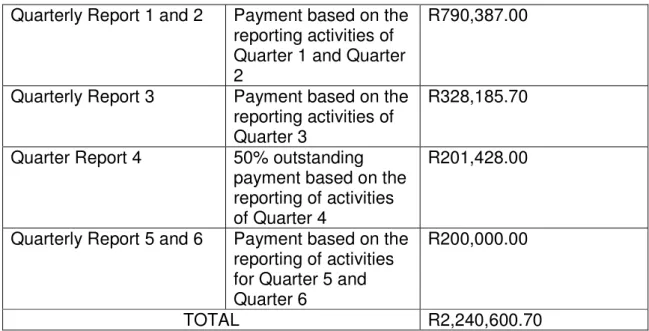
The schedule of reports and payments can be broken down as per the table below.
Table 1 Schedule of reports
Milestone Description Amount
No report, on signing of contract
Upfront payment for Quarter 1 and Quarter 2 due on 23 October 2008
Quarterly Report 1 and 2 Payment based on the reporting activities of Quarter 1 and Quarter 2
R790,387.00
Quarterly Report 3 Payment based on the reporting activities of Quarter 3
R328,185.70
Quarter Report 4 50% outstanding payment based on the reporting of activities of Quarter 4
R201,428.00
Quarterly Report 5 and 6 Payment based on the reporting of activities for Quarter 5 and Quarter 6
R200,000.00
TOTAL R2,240,600.70
Table 2 Schedule of reports to be submitted by Hot Dog Cafe
The total funds that are due to be paid out is R2, 240,600.70 which means that the internal disbursements have also been included which is a mistake. It should also be pointed out that the amount in Annexure F does not add up to the total amounts as the cents are simply ignored. It is incorrect to indicate that the amounts are all tied to the quarterly reports.
Trying to consolidate the budget template (Annexure E) with Schedule of reports (Annexure F) is confusing and therefore is suggested that the quarterly budget template should be amended accordingly by including a column for upfront payment/contract signing fee. The schedule of reports is translated as indicating that quarter 1 and quarter 2 reports will be jointly submitted as Annexure A is silent on these outputs. The submission of quarterly reports should be outlined in Annexure A and Annexure F should separate quarterly report 1 and 2 in the future. As such, quarterly report 1 should be indicated on its own with no payment against it because its funds would have been made during signing of contract. The recipient of the funds should also be indicated. The disbursement of project evaluation and project review funds should be stipulated separately against the correct deliverables.
The project disbursement receipt form (Annexure H) then accurately stipulates that the total amount due to Hot Dog Café will be R2, 050,600.00. An expenditure report template is attached as Annexure I with space for populating different cost items within the categories of administration, capital expenditure items, programme/project activities, Human Resources/Salaries and OD Training/Capacity building. During each quarter, the following items needed to be specified for each cost category: budget, expenditure and unpaid invoices. The cost categories are not consistent with those specified in Annexure E, which are
only administration and programme/project activities. The expenditure report template must be adapted for the type of project and not just to send a generic template.
A progress report template (Annexure J) is also attached and it was made for GDP, which means that the indicators have not been adapted to the Coffee Stop Cadet Programme. These indicators need to be well thought through so that it makes it easy for Hot Dog Café to report appropriately.
Annexure K (budget reallocation template) need to be as comprehensive as possible on the different cost categories because funds may be transferred from the two indicated in the budget to new cost categories.
5.3.
QUARTERLY REPORTING
5.3.1. Quarter 1
During first quarter, it was reported that two groups of cadets were being trained and both Coffee Stop Stores (i.e. Centurion and Northgate) were opened on 23rd October 2008. When the report was submitted, the cadets were involved in on-the-job training. The learners had not attended life skills workshop and it was hoped that it would take place during late November 2008 or early in 2009. Pass rate achieved an average of 70% and all cadets that did not achieve 80% were to be given an opportunity to rewrite in December 2008.
It was reported that all candidates that were selected to do classroom training were accommodated at a lodge near the Hot Dog Café training facilities and were provided with three meals a day as well as transport to and from the accommodation.
Requests were made before intake of cadets for NYDA to assist with identifying suitable candidates. In the end, 13 candidates were submitted for Northgate and 9 for Centurion. It was therefore seen to be critical to place external adverts to attract additional suitable candidates. The selection process for cadets in Centurion included the following steps:
• ••
• 120 applications were received from 18-22 September 2008. •
••
• 30 applications that were from the wrong area or did not send in all of the
required information were rejected.
• ••
• 90 participants were invited to presentation – 22nd September 2008. •
••
• 53 participants participated in the presentation. •
••
• 38 participated in interviews. •
••
• 24 invited for the learning ability battery. •
••
• ••
• 15 participants were selected into the cadet programme which represented
12.5% of the applications received.
The group average age was calculated to be 25 years old. The oldest was 19 and the youngest was 34. The group average ranking was 90.56%. There were a few surprises as to why some of those who got higher scores on the LAB were not selected such as: Masabata Bakopane and Sophy Kabini who scored 90% and 94% respectively. There were 5 participants that scored lower than both of them and selected include the following: Charlotte Baloyi (78%), Maluleka Renoldah (86%), Nosipho Mazibuko (86%), Doreen Ndlovu(83%), and Lesley Ngubane(87%).
The selection process for cadets in Northgate included the following steps:
• ••
• 94 applications were received. •
••
• 39 applications were rejected because the people were from the wrong area,
or did not send in all of the required information.
• ••
• 55 participants were invited to presentation. •
••
• 18 candidates participated in the presentation. •
••
• 18 participants were interviewed. •
••
• 15 participants were invited for the LAB. •
••
• 17 participants wrote the LAB (instead of reported 14). •
••
• 12 participants were selected into the project which represented 12.7% of the
applications received.
In order to cater for the shortfall, it was reported that 2 candidates had joined the project and were to complete the LAB tests with the next group planned to start on 25th September and another cadet was to be recruited simultaneously with the next cadet programme and would complete the theoretical training with that group. The average age of the candidates in Northgate was slightly higher than Centurion at 27 years old. The group ranking on the performance was considerably lower than Centurion at 83.44%. The only surprise came in with non-selection of Siyabonga Zungu who attained a ranking of 96% (unless if he had dropped out after writing the test).
It is said that 30 participants have successfully completed their classroom training while the counting of those that completed the LAB tests are 27.
The opening of the stores posed a challenge for the Coffee Stop staff but management provided adequate support to both stores and the cadets handled the pressure of the opening very successfully. Hot Dog Café had to adjust the opening schedule for their stores to the dates that were dictated by Builders Warehouse who are partners to NYDA. There were some delays and Hot Dog Café managed to work around those issues.
All candidates do a life skills section in their theoretical training where they cover topics such as:
• •• • Time management, • •• • Culture, • •• • Beliefs, • •• • Ethics, • •• • Communication, and • ••
• Managing people’s characters.
Every cadet is given the responsibility of ensuring the cleaning up and locking of the training room daily as well as come cadets being selected to help those who are behind with the work. As part of entrenching a positive culture, all cadets are encouraged to identify their own solutions to problems they may encounter. Typical challenges included the drop out of a few cadets from the programme once they are placed in store. It is becoming evident that even with much effort that goes into preparing the cadets for the challenges of working within the store, for a small number of them the reality is more than they can handle. It is seen that once they are expected to commit to the daily operations of the store, it seems a small number may not be suited to the programme leading to a undertaking that in the future a natural attrition of between 2-3 cadets should be expected and appropriately catered for.
The process of bringing people into a work environment will need better integration in the future such that different personalities can be tolerated. It was noted that once a few cadets battle to manage conflict situations, they choose to drop instead. It is suggested that additional mentoring should be conducted early on during the in-store training to help the cadets with adjusting. The evaluators also feel that an open communications channel will also help wherein candidates can express their feelings with the knowledge that it will not be used against them in any way whatsoever.
5.3.2. Quarter 2
The period of reporting covered by this report is from November 2008 to January 2009 and indicated that the actual number of participants was 47. During this time of the project, it was reported that a total of R720 600.00 had been received out of the planned R2,240,600.00. It was reported that three of the cadet programmes (i.e. Northgate, Centurion and Port Elizabeth) were underway and the cadets were in-store for on-the-job training. It was reported that all the cadets were also being mentored twice monthly with continuous on the job coaching from the store manager. All the cadets were also being mentored twice monthly with continuous on-the-job coaching from the store managers.
The project staff had not attended the Life Skills workshop at the time of submitting the report and the training manager was booked to attend the course from 2-5 March 2009.
Classroom training was completed for the 17 Port Elizabeth cadets and they were accommodated, fed and transported for a month in Pretoria while they were in class during November 2008. The participants went into the store on 24th November to prepare for the opening and receive in-house training. The store was successfully opened on 1st December 2008 and the cadets and manager handled the opening very well.
NYDA provided a total of 25 CV’s for possible candidates to be selected into the project and 3 were selected for training. A number of participants had dropped from the project indicating that the training programme is not suited for them and it was already reported that they have been replaced and classroom training was going to be arranged in January 2009. The selection process for cadets in Port Elizabeth took place from 8-24 October 2008 and included the following steps:
• ••
• 167 applications were received. •
••
• The number of rejected applications was not specified. •
••
• 94 participants were invited to the presentation. •
••
• 60 participants participated in the presentation. •
••
• 50 candidates participated in the interviews. •
••
• 25 participants invited to conduct the LAB test. •
••
• 20 participants wrote the LAB test. •
••
• 17 participants were selected into the project.
As a result, the selected participants represented 10.2% of the total applications received. Once the applications were received, the applications were sorted based on the residence area of the applicants and proximity to the stores, and/or if not all information was not sent. On counting those that wrote the LAB test, it was discovered that 21 participants wrote instead of 20 as reported earlier. The first mentoring report was produced during December 2008. It was indicated that the cadets were excited to be back home and were ready for their first month of trade as well as beginning the practical side of training. A considerable number of cadets dropped out from the project as they found alternative employment early in December one or two realised that they were going to have difficulties with transportation. To cater for the low turnout of cadets, casuals were employed and they were also targeted for full-time recruitment as cadets in January 2009. It is pointed out that the remaining cadets managed to settle in nicely.
The mentoring report for Port Elizabeth during December 2008 can be summarised as follows:
• ••
• Customers have been very complimentary of service provided especially by
Kim who was requested to be stationed at the HDC site. This proves some level of flexibility between the management and staff and shows that requests are addressed accordingly if submitted on time and within reasonable requirements. The store did have its own share of lack of stock due to
problems with suppliers as was also indicated by Faith that they experienced the problem of ordering and receiving stock from The Coffee Stop and this was eventually addressed as a routine that works was also found. Request for open communication especially with the Manager was made in order to boost the morale and build the team from Kim, Denver, Nandie and Busie.
• ••
• Aspects of cadets requesting for more responsibilities such as Thembi as she
felt that she could handle more work and she also wanted to see the workload being equally distributed. On the other hand Denver demonstrated dedication as he also put in extra time where needed. One other person who was indicated to be doing very well was Astley and had a positive attitude about volunteering for new duties, he did well as the coffee station and his stock takes were most often accurate.
• ••
• Nolu raised the issue of taking too long to close the store at the end of the day
as they often go home late but it was also realised that the situation would improve once they have a better routine. Thasko experienced a few problems between the front of house and the kitchen and he acknowledged that there would be some hiccups as they try to understand and work with each other and he was willing to resolve the challenges within themselves.
• ••
• Ricky was noted to be making a lot of mistakes due to lack of concentration
and otherwise the feeling that the Manager was not adequately listening to the cadets was discussed and resolved. This indicates a high level of tolerance and openness as was shown by Emile who asked questions when not understanding. The Manager did note that Faith needed to be provided with encouragement and motivation.
• ••
• Nandie took some time to adjust to the work environment as she took over the
coordinating in the kitchen from Emile and had done a good job. A few problems regarding her attitude required to be changed as the other cadets indicated that she was ‘bossy’.
A follow-up progress report was provided indicating that the mentoring at Port Elizabeth store in session for 2 months at the time of submitting the quarterly report. It is reported that it was a bit difficult for the cadets to settle into their routine and subsequently the daily operations of the stores were improving. The cadets had a better understanding of how the stores were supposed to function and they were managing to settle into the work environment. All casuals that were employed in December have been accepted onto the cadet training programme.
The mentoring report for Port Elizabeth during January 2009 can be summarised as follows:
• ••
• Three cadets left the programme and include: Busie and Nandie who obtained
a permanent employment, Denver who left due to internal conflict with other cadets.
• ••
• Further progress narration was provided for the reported thirteen cadets. •
••
• In general all cadets were reported to be showing dedication and enthusiasm
• ••
• There were identified cadets that had started to take leadership responsibility
specifically Nolu, Emile, and Astley.
• ••
• Some cadets were unable to handle tensions with their managers including
Kim, Elme and Thembi. In the case of Thembi, she had to adapt to the management style of the Manager, similarly with Kim who has put effort to try and understand the working methods of the Manager, and Elme has accepted the importance of respect between colleagues.
• ••
• Other cadets such as Ricky were pointed out to be easily influenced by other
members of his team and he was advised not to get involved in internal politics, tensions were noted with Wendy as she battled to settle into the work environment due to tensions that were subsequently solved between people at Hot Dog Café sections and The Coffee Stop.
• ••
• New cadets included Nolu, Thasko, Ricky, Elme, Wendy, Diana, Bulelwa and
Diana. They are indicated as new cadets based on the fact that their names could not be found in the LAB test results.
The cadets at the Northgate site were reported to be doing well and adapted well to being on the programme as at November 2008. Most of the cadets were indicated to have grown a lot as individuals and taking on a lot more responsibilities. An incident was noted where a cadet was caught stealing for the second time and as a result was requested to leave the programme.
The highlights from the mentoring report for Northgate during November 2008 can be summarised as follows:
• ••
• During the period of mentoring, Vanessa was off sick while Kopano was asked
to leave as he was caught stealing.
• ••
• Zanele was deployed at the Front of House (completed section: Front of
House) during submission of the mentoring report. Her problems are associated with being late and she was reported to be trying to find a solution as she knows it is very disruptive to the others. She was advised to find a way of balancing work and home life.
• ••
• Maggie who was deployed at Front of House (Completed: Coffee Station &
Kitchen Salads) at the time of submitting the report suggested additional marketing as the store was quite and was going to engage her manager about trying some of them. She has also discovered that she can be too short tempered and her manager has agreed to find solutions for controlling her emotions.
• ••
• Angelina was busy with Front of House (completed section: Kitchen) as the
time of submitting the report. Angelina is enjoying Front of House and coping well with customers. She sometimes has challenges with balancing her life and her family have been very supportive. She has been commended for informing her manager when she was late. She was realised that her manager can be strict sometimes and learnt how to handle different types of people and deal with them.
• ••
• Dumisani is enjoying management training and can complete the
lead a staff meeting. He has learnt a lot about himself such as working under pressure, and how to work with different people. He is working on his leadership abilities on communication and listening skills between himself and the other cadets. He has completed Front of House and Management.
• ••
• Daphne is doing very well on Front of House (completed section: Kitchen) and
struggles sometime for the early shift but always make arrangements. Her family is supportive to her in terms of balancing her life as she gets home tired and has to study, do house chores nonetheless feels confident of overcoming with support from her family.
• ••
• Thandeka is still learning the coffee station and she is starting to enjoy it. She
has identified transport challenges and acknowledged that she would need to make alternative arrangements if she is serious about being a business owner.
• ••
• Hope is deployed in the Kitchen and did well on management as she can now
complete gross profit calculations, do the stock take and can manage people. She did well when leading some of the staff meetings and is commended for making a good cappuccino. As coordinator for the kitchen, she finds that other cadets do listen to her and acknowledged that leadership requires respect and discipline from both herself and others.
• ••
• Tebogo has just at the Coffee Station (completed section: Kitchen) and it is all
still new to her. She has no challenges with punctuality and also manages to maintain a balance of her life. She is excited to do Front of House as she wants to know every aspect of running the business.
• ••
• Akhona was deployed at Front of House and found out that being coordinator
was hard for her but it went well. She has learnt that she needs to be strong in this environment and not to take everything to heart.
• ••
• Nkosinathi is coping well in the Kitchen (completed section: Coffee Station)
and is managing in aspects. He feels that he has grown a lot on the programme and is now able to take care of himself, be more responsible and disciplined.
• ••
• Phakamisa has been moved to Front of House (completed section: Kitchen)
and is beginning to relax a bit as he is building confidence. He is looking forward to begin the management section during December. He appreciates the assistance and guidance that he gets from the manager especially when he taking initiative.
• ••
• Bongani is enjoying Front of House and he has completed the Kitchen section.
The manager is still taking him by the hand were required. He has learnt that he can be a patient person and it is important not to let anger cloud his judgement as this will also bring harmony to the work environment.
• ••
• Nosipho found the kitchen work interesting but she still loves Front of House
(which she just completed). She finds it hot in the kitchen and has been advised to drink lots of water and make sure that she eats breakfast every morning to stop herself feeling dizzy. She did have some problems about punctuality which she subsequently solved. Her family is very supportive about what she is doing and she has even started to cook at home which she never used to do before. Her short temperedness due to her being impatient and