Running head: MOTION-INDUCED BLINDNESS MEASURED OBJECTIVELY
Motion-Induced Blindness Measured Objectively
Peter Kramer*, Stefano Massaccesi, Luca Semenzato, Stefano Cecchetto,and Paola Bressan
Dipartimento di Psicologia Generale, Università di Padova, Italy
* Corresponding author: Peter Kramer, Dipartimento di Psicologia Generale, Università di
Padova, Via Venezia 8, 35131 Padova, Italy.
Abstract
During central fixation, a moving pattern of non-targets induces repeated temporary blindness to even salient peripheral targets: motion-induced blindness (MIB). Hitherto, behavioral measures of MIB have relied on subjective judgments. Here we offer an objective alternative that builds on earlier findings regarding the effects of MIB on the detectability of physical target-offsets. We propose a small modification of regular MIB displays: following a variable duration (lead time), one of the targets is physically removed. Subjects are to
respond immediately afterwards. We hypothesize that illusory target-offsets, caused by MIB, are mistaken for physical target-offsets and that errors should thus increase with lead time. Indeed, for both non-salient and salient targets, we found that detection accuracy for physical target-offsets dramatically decreased with lead time. We conclude that target-offset detection accuracy is a valid objective measure of MIB. With our method, effects of guessing are minimal and the fitting of psychometric functions straightforward. In principle, a staircase extension—for more efficient data collection—is also possible.
If central fixation is maintained, a moving pattern of non-target shapes (henceforth
inducers) provokes repeated temporary blindness to even salient peripheral target shapes: motion-induced blindness (MIB; Bonneh, Cooperman, & Sagi, 2001). The effect is most likely due to a failure of awareness (Donner, Sagi, Bonneh, & Heeger, 2008; Klotz & Ansorge, 2007; Mitroff & Scholl, 2004, 2005; Montaser-Kouhsari, Moradi, Zandvakili, & Esteky, 2004) involving the thalamus (Wilke, Mueller, & Leopold, 2009) and various areas of the visual cortex (Donner at al., 2008; Libedinsky, Savage, & Livingston, 2009;
Schölvinck & Rees, 2009).
So far, the behavioral measurement of MIB has relied on subjective judgments that are usually provided with button presses. Two measures can be found in the literature (and in the related literature on perceptual filling-in): (1) the time until the target is judged to disappear for the first time, and (2) the proportion of the trial during which the target is judged invisible. The two measures tend to lead to similar results (Hsu, Yeh, & Kramer, 2004). In the current study, we seek an objective version of the first measure. In this version, unlike in subjective ones, responses are verifiably correct or incorrect and subjects are given the opportunity to improve with feedback.
Our method builds on previous investigations of the effects of MIB on the detectability of physical target-offsets. Whereas physical onsets during MIB tend to disrupt the phenomenon (Kawabe, Yamada, & Miura, 2007), physical offsets do not and tend to go unnoticed. In general, physical offsets do produce a different physiological response than illusory offsets (Donner et al., 2008). If, however, under suitable conditions, they occur during illusory
offsets (caused by MIB), then physical offsets do not trigger the N1 event-related potential that is normally observed with physical offsets and only produce a weak P3 potential that is attributed to a type of after-effect (Klotz & Ansorge, 2007). The suitable conditions are those in which the contrast between the targets and the background is not too high and the targets are sufficiently far away from fixation (and, we add, not too large). Moreover, under these conditions, physical offsets not only produce a minimal physiological response, but also a minimal behavioral one. That is, they do not reach awareness (Klotz & Ansorge, 2007; Montaser-Kouhsari et al., 2004; cf. Mitroff & Scholl, 2004).
Hitherto, as far as we know, MIB has only been measured subjectively, never objectively. Research on the effects that MIB has on the detectability of physical target-offsets is no exception; subjects indicate the onset of MIB with a button press on the basis of their
personal impression, which is unverifiable and neither correct nor incorrect. Unlike MIB, the detectability of physical offsets is instead measured objectively; if subjects indicate that an offset has occurred, and it did occur, then they are correct, otherwise they are incorrect. If one’s goal does not concern the detectability of physical target-offsets during MIB, but the characteristics of MIB itself (how it varies with such factors as stimulus duration, target contrast, perceptual grouping, or even some particular mental disorder; Tschacher, Schuler, & Junghan, 2006), then physical target-offsets could be used to objectively measure MIB.
More specifically, we argue that only a small modification of regular MIB displays is needed to allow a very simple, straightforward, and objective measurement of MIB. Unlike the usual methods, ours involves the physical removal of one of the targets (or the only target, if there is only one) after a variable duration (henceforth lead time; see Supplementary
response is correct. In the case of an anticipation or missed response deadline, the response is incorrect. The task involves an extremely simple go/no-go decision: when the target
disappears, respond; otherwise wait. We hypothesize that the probability of an illusory target-offset, due to MIB, increases with lead time. This, in turn, should reduce the probability of detecting the target’s physical offset. That is, we argue that the accuracy in detecting the physical target-offset can be taken as an objective measure of MIB, and we predict that this accuracy will decrease with lead time.
Intuitively, targets with a low contrast with respect to the background disappear from view earlier, and for a longer duration, than targets with a moderately high contrast (Hsu et al., 2004). Counter-intuitively, however, so do targets with a high contrast (Bonneh et al., 2001; Hsu et al., 2004). That is, MIB is a U-shaped function of target contrast. The illusory
disappearance of salient, high-contrast targets surprises naïve observers, who often find it hard to believe that, physically, these targets are still present. The saliency effect may not be due to contrast, but to a concurrent effect of perceptual grouping between target and inducers (Hsu et al., 2004). Nonetheless, it is a striking feature of MIB. If our objective method of measuring MIB works as predicted, then we should be able to replicate MIB with salient targets and ideally find a larger MIB effect with these salient targets than with non-salient, but still well-visible, ones.
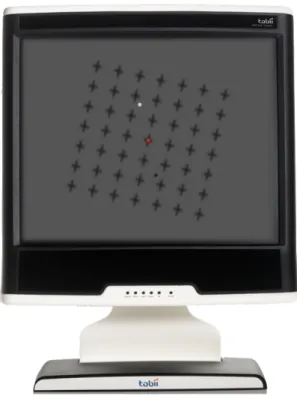
Here, more specifically, we investigated whether on a gray background, containing dark-gray moving inducers, more MIB (lower accuracy) would be observed with a white target disk (salient) than with a black one (well visible, but less salient; Figure 1; see Supplementary Materials). The white target disk not only has a higher contrast with the background as whole (including the inducers) than the black disk, but also an opposite luminance polarity with
respect to the inducers. That is, whereas the luminance of the white disk is higher than that of the background, the luminance of the inducers is lower. This circumstance should produce poorer grouping between the white target and the inducers than between the black target and the inducers (Masin, 2003; see also Bressan & Kramer, 2008). The differential grouping strengths, in turn, should result in more MIB for the white, than for the black, target (Hsu et al., 2004).
A final step to ensure success involves enforcing proper fixation. Monitoring eye
movements during MIB is uncommon. Asking experienced subjects not to move their eyes is usually enough to prevent them from fixating a target. Because targets are typically presented peripherally, far away from fixation, subjects tend to notice when they have (involuntarily) moved their eyes toward a target and can then warn the experimenter about it. Although on average it is weakened by microsaccades, MIB can occur in their presence (Bonneh, Donner, Sagi, Fried, Cooperman, Heeger, & Arieli, 2010). However, we informally noticed that MIB is completely eliminated by continuously moving one’s eyes back and forth throughout the trial, even if these eye movements are not directed toward a target. Whereas low-level retinotopically-specific adaptation is not critical to MIB (Mitroff & Scholl, 2004; Montaser-Kouhsari et al., 2004), this finding suggests that adaptation or inhibition (Gorea & Caetta, 2009; Hsu, Kramer, & Yeh, 2006) at a higher, non-retinotopically-specific level does play a crucial role. This is also suggested by the fact that MIB is never instantaneous. Therefore, to avoid any confounding effects of eye movements, we monitored them and excluded trials that contained them.
Method
Apparatus
The stimuli were created and presented with E-Prime 2.0 Professional (Psychology Software Tools) on an IBM-compatible PC with a 17ʹ′ʹ′ flat-screen monitor (1280×1024 pixels). Placed immediately below the monitor was a built-in Tobii T120 eye tracker that measured eye movements of both eyes (measurement error about 0.5o; sampling frequency 120 Hz). A chin-and-forehead rest immobilized the head and controlled the 57-cm viewing distance. The ambient illumination was dim.
Participants and payment
Thirty-two naïve students of the University of Padua (16 males, 16 females; average age: 23.8 years) with normal, or corrected-to-normal, vision participated in return for a small payment that depended on performance. The earnings were increased by an average of 0.11 euros with each correct response and reduced by 0.10 euros with each anticipation or missed response deadline; the total pay could reach a maximum of 11.88 euros. Eye movements during the trials were discouraged, and trials affected by them were discarded, but this had no monetary consequences. For reasons that will be discussed in a dedicated non-methodological article, the exact payment scheme was varied and counterbalanced between subjects. Here it suffices to note that the current objective measurement of MIB, unlike previous subjective ones, allows performance manipulation via trial-by-trial monetary rewards.
Stimulus
Figure 1 and the Supplementary Materials illustrate the stimulus. On each trial, one white and one black disk (respectively, the salient and non-salient targets; radius: 0.5o; luminances:
120.9 and 11.6 cd/m2) were presented on opposite sides of a red fixation spot (radius: 0.4o;
luminance: 120.9 cd/m2; CIE: 0.6456, 0.3342). The white disk was presented randomly, but equally often, at one of 12 evenly distributed locations 4.4o away from fixation. The gray background (30.4 cd/m2) contained a 7×7 pattern (18.2o×17.3o) of blurred dark-gray crosses (inducers; each 1.6 o×1.2 o and 9.7 cd/m2). This pattern rotated randomly either clockwise or counter-clockwise at a speed of 3.48 rotations per second.
Figure 1. The stimulus on a monitor with a built-in Tobii eye tracker in the black rectangular area immediately below the screen. The red disk is the fixation spot. The pattern of crosses (MIB inducers) rotates at 3.48 rotations/s. The black and white disks are the targets. After a variable lead time, one of them is removed at random.
After a variable duration (lead time), randomly, one of the targets was physically removed. There were 18 possible lead times that were each presented, at random, an equal number of
times during each block of trials. Within each block and lead-time condition, black and white targets were removed an equal number of times. The lead times ranged from 1000 to 7800 ms, with 400-ms increments. With the current method, guessing is of no concern. Accuracy thus ranges from 0 to 100% (like in a yes/no task) and not from a particular guessing rate to 100% (like the 50 to 100% range typical of the 2-alternative-forced-choice task). Instead of presenting 18 different lead times, one could employ a staircase procedure. This should increase data-collection efficiency, but requires careful consideration of potential guessing effects.
Design
The experiment consisted of 108 trials, divided into a practice block of 12 trials and 3 experimental blocks of 36 trials each. Target color (black vs. white) and lead time (18 different durations) were both within-subject variables.
Procedure
Each subject underwent a standard 9-point eye-tracker calibration procedure after which the experiment started. During each trial, subjects were to maintain fixation and refrain from blinking (our eye tracker tended to respond to blinks as if they were eye-movement errors). During the 2000-ms intertrial interval subjects were free to blink and move their eyes, but after this interval, the fixation spot flickered until it was fixated, and a new trial did not start until proper fixation was achieved. The limits on eye movements, although strict, did not seem to burden the subjects much; they enjoyed the experiment as if it were a video game.
The subjects’ task was to press the spacebar immediately after one of the two targets had been removed from the screen and before an 832-ms response deadline. Correct responses
were followed by a short pleasant high-pitched ringing of a bell, anticipations and missed deadlines by a short unpleasant low-pitched alarm, and eye-movement errors by a series of short low-pitched beeps. Each trial ended immediately after either a correct response or an error. After each experimental block subjects received feedback on the amount of money won so far, they took a brief self-paced break, and then pressed the spacebar to continue. At the end of the experiment, the total amount of money won was shown and the subject was either paid, or thanked without pay if the amount was zero or below zero.
Results and Discussion
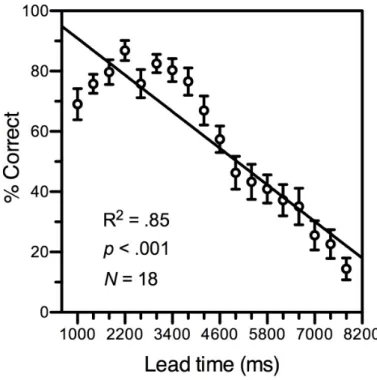
Figure 2 shows the main result: as predicted, accuracy in detecting the physical offset of the target decreased dramatically with the time leading up to this event (except for one single missed deadline, all errors that were not due to eye movements were anticipations). With increasing lead time, accuracy first improved slightly and then steadily declined. Future research is needed to determine whether suboptimal preparedness of the subject at trial onset could explain the odd initial improvement or whether it is a genuine characteristic of MIB. The general pattern, however, is clear: target-offset detection accuracy declines with lead time, indicating that it is a valid objective measure of MIB.
Figure 2. Target-offset detection accuracy as a function of lead time. The diagonal line represents the linear fit to the data. Error bars depict ± 1 standard error.
With the least-squares method, we fitted both a linear and a logistic curve to the data. The linear one was best, and the proportion of the variance that it explained was large, R2 = .85, p
< .001, N = 18. For two reasons, the logistic fit was poor in particular at the two tails of the accuracy distribution: (1) at the shortest lead times, accuracy first improved and only then declined, and (2) at the longest lead times, accuracy did not reach an asymptote. Increasing the subjects’ preparedness at trial onset might eliminate the initial improvement and addition of longer lead times is likely to cause accuracy to reach an asymptote. Both should improve the fits to the data of the logistic function and of S-shaped curves in general.
desirable. Nevertheless, consistent with our hypothesis, all the 32 correlations between lead time and accuracy, calculated separately for each of the participants, were negative and 29 of them significantly so.
There was an effect of experimental block on accuracy, F(62) = 18.72, p < .0001; means were respectively 51, 60, and 63%. The last two blocks were significantly different from the first block, both t(31) > 4.86, p < .0001, but not from one another, t(31) = 1.13, p = .27, suggesting that performance had reached an asymptote.
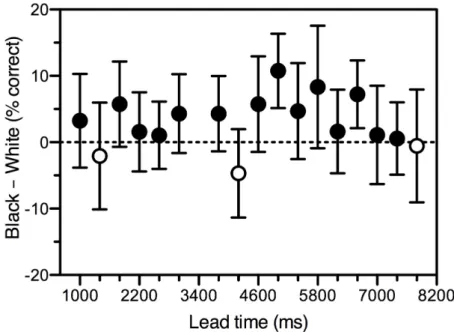
Figure 3 shows that, as predicted, accuracy did not increase, but decreased, with target salience. That is, there was more MIB (a lower accuracy) for the salient white targets than for the non-salient black ones. The counter-intuitive effect was small (3.1%), but significant, one-sample t(16) = 3.29, p = .005 (excluding one outlying data point that was more than 2.5 standard deviations away from the mean; with the outlier included, the result was marginal: 2.3%, one-sample t(17) = 1.87, p = .08). The greater saliency of the white targets, relative to the black ones, can be seen as the result of the former grouping less well than the latter with the dark-gray inducers (grouping by luminance polarity; Masin, 2003). More radical
manipulations of grouping between the two should produce bigger effects (Hsu et al., 2004). In any case, it is overwhelmingly clear that our objective measure, like previous subjective ones, indicate that even quite salient targets are subject to MIB.
Figure 3. Difference in accuracy between black and white targets for 17 different lead times (one outlying data point was excluded). Filled symbols represent a greater accuracy for black than for white targets. Open symbols represent the converse. Error bars depict ± 1 standard error.
Conclusion
We have presented a method that, for the first time, permits motion-induced blindness to be measured objectively and with feedback—a method that produces observations that are verifiably either correct or incorrect. This method allows straightforward fitting of
psychometric functions, with accuracy data that range from 0 to 100% (like in a yes/no task) and not from a guessing rate to 100% (like in a 2-alternative-forced-choice task). In principle, a staircase extension of the method, for more efficient data collection, is also feasible. It should be possible to apply the method presented here not only in MIB studies, like the current one, but also in investigations of similar types of temporary blindness that are induced
without motion (New & Scholl, 2008), or even without dynamic inducers of any kind (Gorea & Caetta, 2009; Hsu, Kramer, & Yeh, 2010). In sum, the method we propose is objective, very simple, it measures what it intends to measure, and produces data which are easy to collect and straightforward to analyze.
Acknowledgments
This work was supported by a grant from the University of Padua (Progetto di Ricerca di Ateneo CPDA084849) to Paola Bressan. We are grateful to Marco Zorzi for the use of his eye tracker and laboratory.
References
Bonneh, Y. S., Cooperman, A., & Sagi, D. (2001). Motion-induced blindness in normal observers. Nature, 411, 798-801.
Bonneh, Y. S., Donner, T. H., Sagi, D., Fried, M., Cooperman, A., Heeger, D. J., & Arieli, A. (2010). Motion-induced blindness and microsaccades: Cause and effect. Journal of Vision, 10(14):22, 1-15.
Bressan, P. & Kramer, P. (2008). Gating of remote effects on lightness. Journal of Vision, 8(2):16, 1-8.
Donner, T. H., Sagi, D., Bonneh, Y. S., & Heeger, D. J. (2008). Opposite neural signatures of motion-induced blindness in human dorsal and ventral visual cortex. Journal of
Neuroscience, 28, 10298-10310.
Gorea, A. & Caetta, F. (2009). Adaptation and prolonged inhibition as a main cause of motion-induced blindness. Journal of Vision, 9(6):16, 1-17.
Hsu, L.-H., Yeh, S.-L. & Kramer, P. (2004). Linking motion-induced blindness to perceptual filling-in. Vision Research, 44, 2857-2866.
Hsu, L.-H., Yeh, S.-L. & Kramer, P. (2006). A common mechanism for perceptual filling-in and motion-induced blindness. Vision Research, 46, 1973-1981.
Hsu, L.-H., Kramer, P., & Yeh, S.-L. (2010). Monocular depth effects on perceptual fading.
Vision Research, 50, 1649-1655.
Kawabe, T., Yamada, Y., & Miura, K. (2007). How an abrupt onset cue can disrupt motion-induced blindness. Consciousness & Cognition, 16, 374-380.
Klotz, W. & Ansorge, U. (2007). Preceding stimulus awareness augments offset-evoked potentials: Evidence from motion-induced blindness. Psychological Research, 71, 694-702. Libedinsky, C., Savage, T., & Livingston, M. (2009). Perceptual and physiological evidence
for a role for early visual areas in motion-induced blindness. Journal of Vision, 9(1):14, 1-10.
Masin, S. C. (2003). Effects of algebraic and absolute luminance differences on achromatic surface grouping. Perception, 32, 615-620.
Mitroff, S. R. & Scholl, B. J. (2004). Seeing the disappearance of unseen objects. Perception, 33, 1267-1273.
Mitroff, S. R. & Scholl, B. J. (2005). Forming and updating object representations without awareness: Evidence from motion-induced blindness. Vision Research, 45, 961-967. Montaser-Kouhsari, L., Moradi, F., Zandvakili, A., & Esteky, H. (2004).
Orientation-selective adaptation during motion-induced blindness. Perception, 33, 249-254. New, J. J. & Scholl, B. J. (2008). “Perceptual scotomas”: A functional account of
motion-induced blindness. Psychological Science, 19, 253-259.
Schölvinck, M. L. & Rees, G. (2009). Neural correlates of motion-induced blindness in the human brain. Journal of Cognitive Neuroscience, 22, 1235-1243.
Tschacher, W., Schuler, D., & Junghan, U. (2006). Reduced perception of the motion-induced blindness illusion in schizophrenia. Schizophrenia Research, 81, 261-267. Wilke, M, Mueller, K.-M., & Leopold, D. A (2009). Neural activity in the visual thalamus,