T h e E s t e y C e n t r e J o u r n a l o f
International Law
and Trade Policy
Decoupling EU Farm Support:
Does the New Single Payment Scheme
Fit within the Green Box?
*Alan Swinbank
Centre for Agricultural Strategy, The University of Reading
Richard Tranter
Centre for Agricultural Strategy, The University of Reading
Recent reform of the EU’s Common Agricultural Policy (CAP) has led to a further decoupling of farm support. The EU believes that the new Single Payment Scheme, which replaces the former system of area and headage payments to farmers, tied to production, will qualify for green-box status in the WTO. We examine this contention, particularly in light of the recent WTO panel report on upland cotton.
Keywords: decoupling, EU, green box, Single Payment Scheme, WTO
Introduction
R
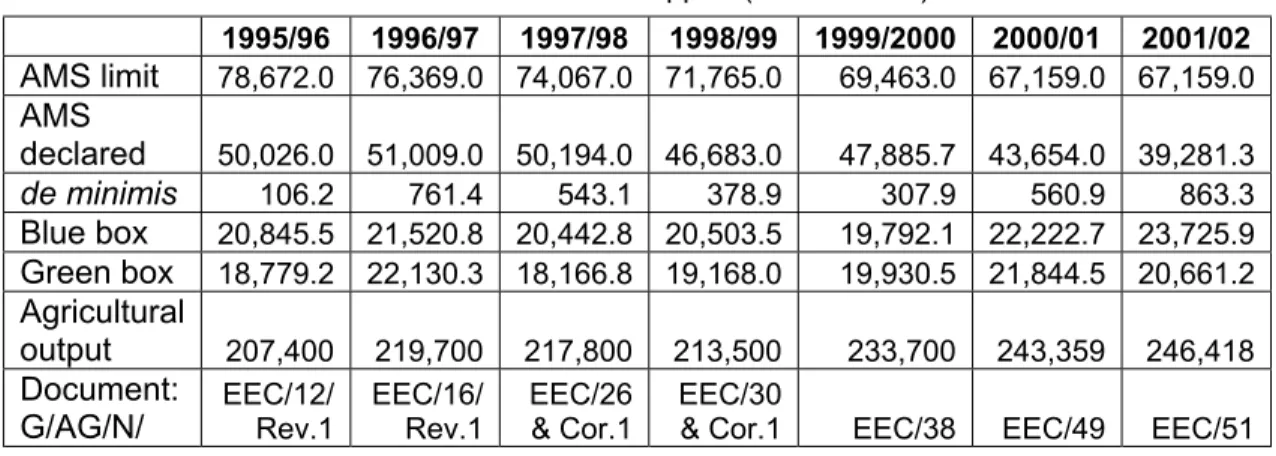
eference is frequently made to the three pillars of the Uruguay Round Agreement on Agriculture (URAA): domestic support, market access and export competition. Domestic support in developed countries falls into one of three categories, often referred to as “boxes”: 1) the amber box of trade-distorting subsidies, comprising a de minimis element and an aggregate measurement of support (AMS) subject to reduction commitments; 2) the green box (Annex 2 of the URAA) of policies that have “no, or at most minimal, trade-distorting effects or effects on production”; and 3) the blue box (Article 6(5)) encompassing “[d]irect payments under production-limiting programmes”. The WTO Secretariat has subsequently suggested that the blue box “covers payments linked directly to acreage or animal numbers, but under schemes which also limit production by imposing production quotas or requiring farmers to set aside part of their land” (WTO, 2004a, The “Blue Box”: Phase 1). The blue box was written into the URAA by the United States and the EU at Blair House in November 1992 and, as Blandford (2001, 37) points out, its provisions were specifically designed to embrace the deficiency payments then paid in the United States, and the arable area and livestock headage payments that became characteristic of the EU’s Common Agricultural Policy (CAP) following the MacSharry reforms of 1992.Table 1 EU’s WTO Declarations of Domestic Support (ecu/€ million)
1995/96 1996/97 1997/98 1998/99 1999/2000 2000/01 2001/02 AMS limit 78,672.0 76,369.0 74,067.0 71,765.0 69,463.0 67,159.0 67,159.0 AMS declared 50,026.0 51,009.0 50,194.0 46,683.0 47,885.7 43,654.0 39,281.3 de minimis 106.2 761.4 543.1 378.9 307.9 560.9 863.3 Blue box 20,845.5 21,520.8 20,442.8 20,503.5 19,792.1 22,222.7 23,725.9 Green box 18,779.2 22,130.3 18,166.8 19,168.0 19,930.5 21,844.5 20,661.2 Agricultural output 207,400 219,700 217,800 213,500 233,700 243,359 246,418 Document:
G/AG/N/ EEC/12/ Rev.1 EEC/16/ Rev.1 EEC/26 & Cor.1 EEC/30 & Cor.1 EEC/38 EEC/49 EEC/51 The source WTO documents are given in the bottom row.
The ecu (formerly the European Currency Unit) was a basket of EU currencies. It was replaced by the euro (€) on 1 January 1999 at 1 ecu = €1. The value of the ecu/€ against the U.S. dollar has varied significantly over the period, but the average monthly rate was about €1= US$1.1.
The EU’s WTO declarations of domestic support are given in table 1. The declaration for the marketing year 2001/02 was made in November 2004. The table shows the AMS binding commitment for the year in question, followed by the actual level of AMS declared for the year. The de minimis support, outside the AMS limit, is both product and non–product specific. Clearly the EU was well within its AMS limits during 1995–2002. This was largely because of the MacSharry reforms of 1992 which – through partial decoupling for cereals and beef, and policy redesign for oilseeds, beef and sheep – shifted previously amber-box support into the blue box. Had the blue-box provisions not existed, with blue-box expenditure rolled into the amber box, the AMS limits would have been approached. Green-box expenditure is also shown, and – to facilitate comparison with the de minimis declaration – the overall value of agricultural output for the year in question.
Although the blue box is a permanent feature of the URAA, policies that fell within it might be construed as being contrary to other GATT provisions. Thus the Peace Clause (Article 13 of the URAA) provided potentially useful protection (Josling, 2004, 175), although its provisions expired at the end of 2003 (or the 2003/04 marketing year, depending upon interpretation). This prompted Blandford (2001, 37) to comment, somewhat inaccurately, that the “fact that the exemption for blue-box payments expires in three years is of great concern to the EU.” Certainly the EU has argued for the blue-box provisions continuing into any successor to the URAA, as discussed below. But the CAP reforms of 2003, according to the EU, shifted a large part of its blue-box spending into the green box. The prime purpose of this article is to examine the validity of that claim.
We next outline the key requirements to be met if the EU’s new Single Payment Scheme (SPS) is to fit within the green box. Then we introduce the SPS and test the validity of the claim, particularly in light of the recent WTO panel report on upland cotton (WTO, 2004c).1 Finally, before concluding, we outline the EU’s position on the blue box in the Doha Round.
Decoupling and the Green Box
A
large and evolving literature has developed on decoupling, which we will not discuss here other than to remark that the term can be defined with reference to policy design (an ex ante, or policy-maker’s approach), and/or with reference to its impact (an ex post approach, more attractive to applied economists) (see table 2). The latter allows for considerations of how a lump-sum transfer affects the behaviour of farm businesses or households.Table 2 Contrasting Definitions of Decoupling
… with reference to policy design … with reference to payment impact
“Only subsidies that do not depend on current prices, factor use, or production can be considered fully decoupled from farm production decisions” (Burfisher & Hopkins, 2003, 4).
“A policy is fully decoupled if it ‘does not influence production decisions of farmers receiving payments, and if it permits free market determination of prices’” (OECD, 2000, 12, quoting Cahill, 1997).
The URAA definition of a green-box policy combines elements of both types of definition (see box 1). An over-arching “fundamental” requirement is that green-box policies have “no, or at most minimal, trade-distorting effects or effects on production”. There is no indication how the word “minimal” is to be interpreted (Rude, 2001, 1015), which might lead to interesting deliberations by a future WTO dispute settlement panel.2 But a series of policy design criteria are set out.
Box 1 Extract from Annex 2 (The Green Box)
Annex 2 is headed:
Domestic Support: The Basis for Exemption from the Reduction Commitments
1. Domestic support measures for which exemption from the reduction commitments is claimed shall meet the fundamental requirement that they have no, or at most minimal, trade-distorting effects or effects on production. Accordingly, all measures for which exemption is claimed shall conform to the following basic criteria:
(a) the support in question shall be provided through a publicly funded government programme (including government revenue foregone) not involving transfers from consumers; and,
(b) the support in question shall not have the effect of providing price support to producers;
plus policy-specific criteria and conditions as set out below. …
5. Direct payments to producers
Support provided through direct payments (or revenue foregone, including payments in kind) to producers for which exemption from reduction
commitments is claimed shall meet the basic criteria set out in paragraph 1 above, plus specific criteria applying to individual types of direct payment as set out in paragraphs 6 through 13 below. Where exemption from reduction is claimed for any existing or new type of direct payment other than those
specified in paragraphs 6 through 13, it shall conform to criteria (b) through (e) in paragraph 6, in addition to the general criteria set out in paragraph 1.
6. Decoupled income support
(a) Eligibility for such payments shall be determined by clearly defined criteria such as income, status as a producer or landowner, factor use or
production level in a defined and fixed base period.
(b) The amount of such payments in any given year shall not be related to, or based on, the type or volume of production (including livestock units) undertaken by the producer in any year after the base period.
(c) The amount of such payments in any given year shall not be related to, or based on, the prices, domestic or international, applying to any production undertaken in any year after the base period.
(d) The amount of such payments in any given year shall not be related to, or based on, the factors of production employed in any year after the base period.
(e) No production shall be required in order to receive such payments.
Again there are over-arching requirements: that this is a government-funded programme and that it does not have the effect of granting price support to farmers. In addition, there are programme-specific requirements. We presume the EU intends to declare its SPS under paragraph 6 (Decoupled income support) or, failing that, under the second sentence of paragraph 5 (Direct payments to producers). Next, we introduce the SPS, and then we ask whether it meets these paragraph 6 criteria.
The EU’s Single Payment Scheme
I
n June 2003, the EU’s Council of Ministers agreed a further decoupling of direct payments – the arable area and livestock headage payments declared as blue-box support (see table 1) – to create the SPS (enacted in September 2003 (Council of the European Union, 2003)). The EU’s Commissioner for Agriculture, Franz Fischler, launched the reform debate in June 2002 (Commission of the European Communities, 2002). A second round of reforms was agreed in April 2004 (Agra Europe, 2004a, EP/1), when direct payments to cotton, olive oil, tobacco and hop producers, previously declared as amber-box support, were brought into the SPS. A reformed sugar regime is expected.We will not discuss the wider context of the Fischler reforms or their content, apart from noting that the WTO dimension did form a part. Thus, in July 2002, the Commission of the European Communities (2002, 19) said that its proposal “will provide a major advantage within the WTO, since the Green Box compatibility of the scheme will help secure these payments in an international context”; and following the June 2003 decisions of the Council of the European Union, Fischler (2003) said:
“today we have largely said goodbye to an old system of support which distorted trade. The new agricultural policy is trade-friendly …. This will put us on the offensive at the WTO negotiations in Cancún in September …. The EU has done its homework. Now others must make a move, for example our American friends who, unlike the EU, have in recent years revived their old system of support and massively increased their trade-distorting agricultural subsidies.”
The SPS starts in 2005, but member states can delay application to 2007. The
basic idea is “an income support for farmers” (Council of the European Union, 2003, Article 1) based on past claims for arable area (and livestock headage) payments over the period 2000–2002. This will determine the farm’s payment entitlement, expressed as x hectares of entitlement at €y/x per hectare, where y is the average of the farm’s annual claim for payments in the base period and x is the average number of hectares cited in the claims. (Member states also have the option of applying the scheme on a regionalised basis, under which all eligible land in the region would attract a payment entitlement on a flat-rate basis, but that does not fundamentally affect this discussion.) Claims under the SPS are to be made annually. The claimant (a farmer) must have “eligible” hectares to match “entitlement” hectares: the entitlement cannot be redeemed unless the farmer is farming an equivalent area of eligible land on which to validate the claim.
In the light of the WTO panel ruling on upland cotton, an important provision is that land under permanent crops and fruit and vegetables cannot be used to claim SPS payments. Furthermore, eligible land must be farmed or maintained in “good agricultural and environmental condition” (Council of the European Union, 2003, Article 5). The set-aside provision is carried forward from the old regime, and cross compliance applies.3 Under cross compliance various statutory requirements relating to animal welfare, the environment, and public, animal and plant health across the whole farm must be met. If not, the SPS payment may be reduced or withheld (articles 3 to 6). Does the SPS scheme meet the criteria of paragraphs 5 or 6 of the green box?
Paragraph 6 Criteria, and the Precedent of Upland
Cotton
T
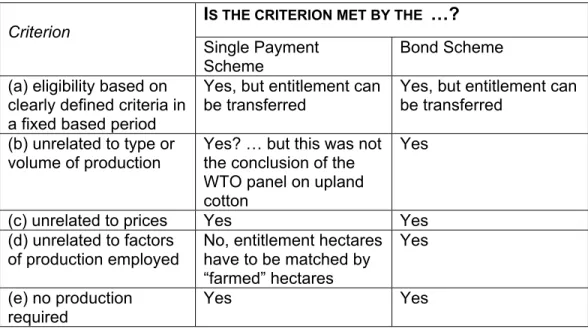
able 3 contrasts the above provisions with criteria (a) to (e) of paragraph 6 (see box 1). We also contrast the SPS to the fully decoupled bond scheme advocated by Swinbank and Tangermann (2004). Criterion (a), that “[e]ligibility for such payments shall be determined by clearly defined criteria such as income, status as a producer or landowner, factor use or production level in a defined and fixed base period”, is slightly problematic for both schemes, in that entitlement can betransferred by sale, inheritance, etc. However, if 6(a) cannot be satisfied, the declaration simply switches to paragraph 5.
Initially one might conclude that the SPS (and bond scheme) is unrelated to type or volume of production, whereas the old area and headage payments were. However, the (as yet unadopted) WTO panel ruling on upland cotton casts doubt on this. The panel concluded
that PFC payments, DP payments, and the legislative and regulatory provisions which establish and maintain the DP programme, do not fully conform with paragraph 6(b) of Annex 2 of the Agreement on Agriculture. They are not green box measures (WTO, 2004c, paragraph 7.413).
Table 3 Comparison of Paragraph 6 Criteria and the Single Payment and Bond Schemes
I
S THE CRITERION MET BY THE…?
Criterion
Single Payment Scheme
Bond Scheme (a) eligibility based on
clearly defined criteria in a fixed based period
Yes, but entitlement can be transferred
Yes, but entitlement can be transferred
(b) unrelated to type or volume of production
Yes? … but this was not the conclusion of the WTO panel on upland cotton
Yes (c) unrelated to prices Yes Yes (d) unrelated to factors
of production employed
No, entitlement hectares have to be matched by “farmed” hectares Yes (e) no production required Yes Yes
This conclusion was based on the fact that the payment level did depend upon the crop grown: for most crops (including upland cotton) the PFC or DP was paid in full, whereas if fruit or vegetables were grown it was not. Brazil argued that in limiting the crops that could be grown, the effect “is to funnel production on base acreage to particular types of crops” (WTO, 2004c, paragraph 7.358). The EU, doubtless conscious of similar provisions in the SPS introduced by the 2003 Fischler reforms, argued as follows:
[T]he reduction of payment linked to the production of fruit and vegetables must be seen as part of a scheme which permits a farmer to grow any type of crop, or even not to produce at all. Such a scheme, taken as a whole, meets the criteria that payments are not related to a type of production. To
find otherwise would not permit a WTO Member wishing to introduce decoupled payments to take account of important elements of internal competition, in an historical perspective, and avoid those farmers receiving decoupled payments from enjoying both the decoupled payments and a privileged position vis-à-vis farmers who are not entitled to such payments (WTO, 2004c, paragraph 7.363).
However, the panel did not comment on this issue.4
Future panels are not bound by the deliberations of past panels (and Appellate Body reports), and – political considerations aside – the EU could easily adjust to allow fruit and vegetable production on SPS land. But the question arises, If criterion (b) can be so easily infringed, what about the other provisions of paragraph 6?
Both the SPS and the bond scheme appear to satisfy criteria (c), that production is unrelated to prices, and (e), that no production is required. However, the SPS scheme (but not the bond scheme) has difficulty with criterion (d), that the “amount of such payments in any given year shall not be related to, or based on, the factors of production employed in any year after the base period.” No doubt the EU would dispute our claim, but the insistence that SPS payments are tied to land that is “maintained in good agricultural and environmental condition” (Article 5) weakens the EU’s case. An SPS payment in any year depends upon the amount of land “farmed” that year. Whether any WTO member would challenge the EU’s use of the green box to shelter its SPS payments is another issue, to which we return briefly in our conclusion.
There is another question to address: Would partially decoupled schemes fit in the green box, even if the requirements of paragraph 6 had been met for the basic SPS? There are two situations where this can arise. First, some crop-specific supplementary payments have survived the Fischler reforms. Thus, in addition to the basic per hectare payments outlined above, supplements are also available as a specific quality premium on durum wheat, protein crops (peas, sweet peas and lupins), rice, nuts and energy crops (with similar provisions in the second tranche of the reforms for cotton, olive oil, hops and tobacco). Second, even for the old arable area and headage payments, member states can make only a partial switch to decoupled SPS payments. The rules are complex, particularly for livestock, but, for example, up to 25 percent of the old arable aid can be retained as crop-specific area aid, with 75 percent rolled into the SPS (Council of the European Union, 2003, Article 66). France has chosen this partial decoupling for arable crops (Agra Europe, 2004b, N/1).
How will these partially decoupled payments be declared to the WTO in future? One presumes that the coupled component will remain in the blue box (if it survives the Doha Round), whilst the decoupled SPS component will qualify for the green box.
But would this interpretation go unchallenged in the WTO if certain of the EU’s trading partners wanted to challenge the CAP?
Once the scheme is operational, a French cereal farmer would receive three revenue flows for each hectare planted to wheat:
1) for the sale of the crop,
2) an SPS payment determined on the basis of the farm’s 2000–2002 area and headage claims, and
3) a crop-specific arable area payment.
If the farmer chose not to grow wheat (and moved to some other, unsupported crop), or to otherwise forgo the crop-specific arable area payment, it could (subject to the caveats discussed above) be claimed that the SPS payment on that land should be green-boxed. But if the blue-boxed, crop-specific, arable area payment is claimed as well, would this not subordinate the erstwhile green-box payment? On one piece of land, the crop-specific payment could be claimed provided an eligible arable crop had been planted. On the same piece of land, a decoupled SPS payment could be claimed provided the land is maintained in good agricultural and environmental condition. This requirement would be met by the aforesaid arable crop. Does that not make the supposedly decoupled SPS payment dependent on the planting of this arable crop? We pose, but do not answer, the question.
Developments in the Doha Development Agenda
B
oth the future of the blue box and the content of the green box have been subject to scrutiny in the Doha Round, and earlier in the opening phases of the Article 20 URAA negotiations that began in March 2000. The EU, as the dominant user of the blue-box provisions, advocated its retention, whilst others wished it abolished. The Cairns Group’s initial negotiating proposal on domestic support, for example, did not differentiate been amber- and blue-box support, and wanted a “formula approach … to deliver major reductions in trade and production distorting domestic support … leading to the elimination of such support”, with a substantial down-payment (a 50 percent reduction at least) in the first year of implementation of the new agreement (WTO, 2000b, 2). The opening U.S. bid proposed that the blue box be abolished and that such support be rolled into the amber box, which would then be subject to reduction commitments “to a new final bound level that is equal to a fixed percentage of the member’s value of total agricultural production in a fixed base period” (WTO, 2000a, 1).The EU, in its “offer” of January 2003, said it was in favour of a 55 percent reduction in AMS bindings; that support “categorised as blue box has proved to be
less trade-distorting than amber box domestic support and has been an essential mechanism for reducing the most trade-distorting support” and consequently that it wanted the blue box retained; and that the de minimis provision should be eliminated for developed countries (European Communities, 2003, 4–5). At the time, of course, the EU was in the throes of its internal negotiations on the SPS, meaning that it could not yet concede any reduction in the blue box.
A few weeks later, Stuart Harbinson’s draft modalities suggested that blue-box payments should be “capped at the most recent notified level and bound at that level” and then either reduced by 50 percent over five years or rolled into the AMS (WTO, 2003a, 9). This indication that the WTO negotiations might result in a significant reduction in the largess of the blue box may have been instrumental in helping Commissioner Fischler secure agreement on his SPS proposal later that year.
Following the EU’s decision in June 2003 to adopt the SPS, and with deadlock in the WTO negotiations on the agriculture modalities, in August the EU and the United States came up with a compromise they hoped would lead to a framework agreement before the WTO Ministerial in Cancún. Paradoxically, the U.S. position on the blue box had shifted yet again. At Blair House in 1992 the United States had wanted the blue box, and indeed in 1995 had declared significant blue-box expenditure on deficiency payments (WTO, 2004a, The “Blue Box”: Phase 1). Then, with the passing of the 1996 Farm Bill, its position changed, as it no longer used the blue box and advocated its abolition. This, it was felt, left the EU exposed as the only major WTO member using, and wanting to retain, the blue box. However, following passage of the 2002 Farm Bill, the United States now wanted to find a suitable location for its new
countercyclical payments, which would not fit within the green box.
Accordingly, the joint U.S.-EU text of August 2003 suggested retaining the blue box, proposed that such expenditure should “not exceed 5% of the total value of agriculture production by the end of the implementation period”, and suggested that overall support (on blue- and amber-box support, including the de minimis provision) be reduced by an unspecified amount below its 2004 level (U.S.-EU, 2003, paragraph 1.2). Furthermore, as the WTO Secretariat pointed out, the U.S.-EU text would have removed the reference to “production-limiting programmes” from the blue-box provision (WTO, 2004a, The frameworks on the Blue Box). Subsequently the U.S. Trade Representative, Robert Zoellick, said that the proposed redefinition of the blue box was “basically designed” to accommodate the U.S.’s countercyclical payments (International Trade Reporter, 2004). The G-20 countered by proposing the elimination of the blue box, but the Cancún texts were essentially based on the U.S.-EU draft (WTO, 2004a, The frameworks on the Blue Box).
Despite this opposition, the General Council decision of 31 July 2004, which finally determined a Framework for Establishing Modalities in Agriculture, agreed that the blue box would be “reviewed” so that members could have recourse to two blue-box measures. These would either be “direct payments under production-limiting programmes”, as currently provided for in Article 6(5) of the URAA, or direct payments that do not require production if
• such payments are based on fixed and unchanging bases and yields or are • livestock payments made on a fixed and unchanging number of head; and • such payments are made on 85 percent or less of a fixed and unchanging
base level of production.
In addition, blue-box support would be limited to 5 percent, of the value of agricultural production, and there would be a cap to the overall level of trade-distorting support (WTO, 2004b: Annex A, paragraphs 13, 15 & 7). Whilst the
Framework is not of course the final agreement, it does seem likely that an enlarged blue box, meeting the aspirations of the United States and those of the EU, will be retained in any new agreement.
With regard to the green box, some WTO members have expressed concern about “the sheer scale of Green Box subsidies in some countries” (WTO, 2004a, Green Box: ”modalities” phase); and in their pre-Cancún paper the G-20 suggested that all direct payments covered by paragraphs 5 to 13 of the green box provisions should be, “as appropriate, capped and/or reduced for developed countries” (WTO, 2003b, 2). The July 2004 Framework does not adopt this stance, but promises that “Green Box criteria will be reviewed and clarified with a view to ensuring that Green Box measures have no, or at most minimal, trade-distorting effects or effects on production. Such a review and clarification will need to ensure that the basic concepts, principles and effectiveness of the Green Box remain and take due account of non-trade concerns” (WTO, 2004b, paragraph 16).
Concluding Comments
W
e have suggested that the EU’s new SPS possibly does not fit within the green box of the existing URAA. First, land on which fruit and vegetables are grown cannot be used to claim an SPS payment, suggesting that payment is linked to production, although the precedent-setting ruling in Upland Cotton could yet be overturned by the Appellate Body. Second, payments are directly related to farmland kept in good agricultural and environmental condition. The first of these discrepancies could be overcome by allowing any crop to be grown on SPS land, although this would overturn a provision that had been thought necessary to assuage the concerns ofsome member states. Repeal of the second provision, altogether removing the link with farmland, would turn the SPS into something akin to the bond scheme. We have also questioned whether, under partial decoupling, the total payments received by farmers can be split between the blue and green boxes, or whether the whole should be declared as blue-box expenditure. This analysis begs the question, Does anyone care? Would any WTO member challenge the EU’s use of the green box? We believe the answer partly rests on future developments in the Doha Round. If the round can quickly be brought to an amicable solution, we suspect the chances are slight. However, the EU may be advised to seek slight changes to the green-box criteria to ensure that the SPS can be deemed unambiguously to be contained therein. If, however, negotiations become protracted and bitter, we would not discount the possibility of a WTO challenge to the green-boxing of the EU’s new subsidy regime. After all, Brazil did challenge the green-box status of the U.S.’s PFC payments.
Postscript
O
n 3 March 2005 the WTO’s Appellate Body upheld the panel’s finding “that production flexibility contract payments and direct payments are not ‘decoupled income support’ within the meaning of paragraph 6, [and] are not green box measures exempt from the reduction commitments by virtue of Annex 2 of the Agreement on Agriculture” (WTO, 2005, paragraph 342).Agra Europe (2004a) 23 April.
Agra Europe (2004b) 21 May.
Blandford, David (2001) Are disciplines required on domestic support? The Estey Centre Journal of International Law and Trade Policy 2(1): 35-59.
Burfisher, Mary E., & Jeffrey Hopkins (eds.) (2003) Decoupled payments: Household income transfers in contemporary U.S. agriculture. Agricultural Economic Report No. 822. Washington D.C.: USDA.
Cahill, Sean A. (1997) Calculating the rate of decoupling for crops under CAP/oilseeds reform. Journal of Agricultural Economics 48(3): 349-378. Commission of the European Communities (2002) Communication from the
Commission to the Council and the European Parliament. Mid-term review of the Common Agricultural Policy. COM(2002)394. CEC: Brussels.
Council of the European Union (2003) Council Regulation (EC) No. 1782/2003 of 29 September 2003 establishing common rules for direct support schemes for farmers …. Official Journal of the European Union L270: 1-69.
European Communities (2003) The EC’s proposal for modalities in the WTO agriculture negotiations. pdf document downloaded from http://europa.eu.int/ comm/agriculture/external/wto/officedoc/index_en.htm (accessed 12 January 2004; also available within the WTO as document JOB(03)/12).
Fischler, Franz (2003) The new, reformed agricultural policy. Final press conference after the decision of the Council on Agriculture, Luxembourg, 26 June 2003. Speech/03/326, http://europa.eu.int/rapid/ (accessed 30 June 2003).
International Trade Reporter (2004) 20 May. http://www.bna.com/itr/arch247.htm (accessed 6 July 2004).
Josling, Tim (2004) Domestic farm policies and the WTO negotiations on domestic support. In Agricultural policy reform and the WTO: Where are we heading? ed. Giovanni Anania, Mary E. Bohman, Colin A. Carter & Alex F. McCalla. Cheltenham: Edward Elgar.
Organisation for Economic Co-operation and Development, Directorate General for Food, Agriculture and Fisheries (2000) Decoupling: A conceptual overview. COM/AGR/APM/TD/WP(2000)14/FINAL. Paris: OECD.
Rude, James (2001) Under the green box. The WTO and farm subsidies. Journal of World Trade 35(5): 1015-1033.
Swinbank, Alan, and Stefan Tangermann (2004) A bond scheme to facilitate CAP reform. In Swinbank and Tranter (2004).
Swinbank, Alan, and Richard Tranter (eds.) (2004) A bond scheme for Common Agricultural Policy reform. Wallingford: CABI.
U.S.-EU (2003) Joint initiative by EU and USA presented today (13/8/2003) to trade partners in Geneva (WTO) with a view to advancing the negotiations in the Doha Round towards a successful conclusion in Cancún as requested by our other
trading partners. pdf document downloaded from http://europa.eu.int/comm/ agriculture/external/wto/officedoc/index_en.htm (accessed 12 January 2004). World Trade Organization (2000a) Committee on Agriculture special session, ‘Note
on domestic support reform. Negotiations on agriculture. Submission from the United States’. G/AG/NG/W/16, 23 June 2000. Geneva: WTO.
World Trade Organization (2000b) Committee on Agriculture special session, ‘WTO negotiations on agriculture. Cairns Group negotiating proposal. Domestic support’. G/AG/NG/W/35, 22 September 2000. Geneva: WTO.
World Trade Organization (2003a) Committee on Agriculture, special session,
‘Negotiations on agriculture. First draft of modalities for the further commitments. Revision’. TN/AG/W/1/Rev. 1. Geneva: WTO.
World Trade Organization (2003b) Ministerial Conference fifth session, Cancún, 10-14 September 2003, ‘Agriculture – Framework proposal. Joint proposal by Argentina, Bolivia, Brazil, Chile, China, Colombia, Costa Rica, Cuba, Ecuador, El Salvador, Guatemala, India, Mexico, Pakistan, Paraguay, Peru, Philippines, South Africa, Thailand and Venezuela’. WT/MIN(03)/W/6, 4 September 2003. Geneva: WTO.
World Trade Organization (2004a) Agricultural negotiations: Backgrounder. Updated 20 April 2004. http://www.wto.org/english/tratop_e/agric_e/ (accessed 6 July 2004).
World Trade Organization (2004b) General Council, 27 and 31 July 2004, Doha Work Programme draft General Council decision of 31 July 2004. WT/GC/W/5351. Geneva: WTO.
World Trade Organization (2004c)United States – Subsidies on Upland Cotton.
WT/DS267/R. Geneva: WTO.
World Trade Organisation (2005) United States – Subsidies On Upland Cotton, Report of the Appellate Body. WT/DS267/AB/R. Geneva: WTO.
Endnotes
* This paper stems from a project funded by the European Commission under the Framework 6 Research Programme (GENEDEC:
http://www.grignon.inra.fr/economie-publique/genedec/eng/home.htm) and follows on from an earlier project funded under Framework 5 (Swinbank & Tranter, 2004). We are grateful to the European Commission for financial support and to our partners on both projects for their advice and support; however, we alone are responsible for the content of this paper.
1. The panel report has yet to be adopted, and the United States has said it will appeal a number of its findings.
2. In United States – Subsidies on Upland Cotton, Brazil had claimed that the U.S.’s productionflexibility contract (PFC) payments (under the 1996 Farm Bill) and its
The views expressed in this article are those of the author(s) and not those of the
Estey Centre Journal of International Law and Trade Policy nor the Estey Centre for Law and Economics in International Trade. © The Estey Centre for Law and Economics in International Trade.
more recent direct payments (DP) (from the 2002 Farm Bill) infringed this fundamental requirement (WTO, 2004c, paragraph 7.355). However, the panel decided that, as it had determined that another criterion in paragraph 6 had not been satisfied, it was unnecesary to determine whether or not this fundamental requirement was met (paragraph 7.412).
3. Set-aside was introduced by the 1992 CAP reform. In order to claim area payments, farmers had to set aside a specified fraction of their arable land. 4. In this particular instance, the panel’s view (which may yet be overturned) that
the U.S.’s PFC and DP payments were not genuine green-box payments had little practical import: the United States was not being challenged on the overall level of amber-box support, but instead on whether these measures result in “serious prejudice to the interests of Brazil within the meaning of Article 5(c) of the SCM
[Subsidies and Countervailing Measures] Agreement”. The panel concluded that Brazil had not established that to be so (WTO, 2004c, paragraph 8.1(g)(ii)).