Flexible Retirement
Daniel van Vuuren
CPB Discussion Paper
No 174 March 2011
Flexible Retirement
Daniel van Vuuren
2
CPB Netherlands Bureau for Economic Policy Analysis Van Stolkweg 14
P.O. Box 80510
2508 GM The Hague, the Netherlands
Telephone +31 70 338 33 80 Telefax +31 70 338 33 50 Internet www.cpb.nl
3
Abstract in English
Flexible retirement - that is, the opportunity to choose one’s own personal retirement age - serves as a hedge against pension risk and provides insurance to workers facing health or productivity shocks. Flexible retirement and flexible pension schemes are in practice closely linked because of imperfect capital markets and institutional restrictions. This paper discusses three conditions to provide insurance through flexible retirement. First, it should be possible to adjust the pension starting date at limited cost. This condition is gradually being fulfilled, as many countries are moving towards more actuarially neutral pension schemes. Second, individuals should be willing to adjust their labour supply in case of a wealth shock. This condition seems largely fulfilled, although the available empirical evidence suggests that the framing of pension wealth is at least as important as the income effect. Third, the labour market should be able to deal with flexible individual retirement decisions. This condition is gaining importance, but has not yet received much attention in the literature. Institutions often hamper employment past the ‘standard retirement age’. Moreover, the hiring rates of older workers are low and their unemployment duration is high. Institutional reforms facilitating flexible retirement opportunities are desirable from an insurance perspective.
Key words: retirement, insurance, labour market for older workers
JEL code: J26, H55
Abstract in Dutch
Flexibele uittreding - de mogelijkheid om individueel de datum te kiezen waarop men stopt met werken - helpt om het pensioenrisico en risico’s met betrekking tot gezondheid en productiviteit op te vangen. Flexibele uittreding is in de praktijk nauw verbonden met een flexibel
pensioenschema. Dit komt door kapitaalmarktimperfecties en instituties die de opname van pensioen verbinden met de arbeidsaanbodbeslissing. In dit paper worden drie voorwaarden geformuleerd waardoor flexibele uittreding als een verzekering kan functioneren om de genoemde risico’s af te dekken. Ten eerste moet het voor de werknemer mogelijk zijn om de pensioenleeftijd aan te passen zonder dat dit veel kosten met zich meebrengt. De tendens richting actuarieel neutrale pensioenen heeft deze kosten weliswaar significant doen dalen, maar in Nederland en in andere landen is nog altijd sprake van ‘aanpassingskosten’. Ten tweede moeten werknemers bereid zijn om hun arbeidsaanbod aan te passen als sprake is van een vermogensschok. Dit blijkt het geval te zijn, al suggereert de literatuur dat men nog meer reageert op de vormgeving van de pensioenschok - bijvoorbeeld in termen van
4
de arbeidsmarkt voor ouderen het mogelijk maken dat men zijn uittredingsleeftijd aanpast. Deze voorwaarde wordt weliswaar steeds belangrijker, maar heeft nog niet veel aandacht gekregen in de literatuur. Fiscale en sociale zekerheidsinstituties kunnen het langer doorwerken
ontmoedigen. De werkloosheidsduur van ouderen is lang en oudere werkzoekenden vinden moeilijk een baan. Institutionele hervormingen die flexibele uittreding beter mogelijk maken leiden tot verzekeringswinst.
Flexible Retirement
Daniel van Vuuren
Abstract
Flexible retirement – that is the opportunity to choose one‟s own personal retirement age – serves as a hedge against pension risk and provides insurance to workers facing health or productivity shocks. Flexible retirement and flexible pension schemes are in practice closely linked because of imperfect capital markets and institutional restric-tions. This paper discusses three conditions to provide insurance through flexible re-tirement. First, it should be possible to adjust the pension starting date at limited cost. This condition is gradually being fulfilled, as many countries are moving towards more actuarially neutral pension schemes. Second, individuals should be willing to adjust their labour supply in case of a wealth shock. This condition seems largely fulfilled, although the available empirical evidence suggests that the framing of pension wealth is at least as important as the income effect. Third, the labour market should be able to deal with flexible individual retirement decisions. This condition is gaining importance, but has not yet received much attention in the literature. Institutions often hamper em-ployment past the „standard retirement age‟. Moreover, the hiring rates of older workers are low and their unemployment duration is high. Institutional reforms facilitating flexi-ble retirement opportunities are desiraflexi-ble from an insurance perspective.
Keywords: retirement, insurance, labour market for older workers
1. Introduction1
Flexible retirement means that the individual worker is able to adjust his working-life according to his own preferences and circumstances. Such adjustment may take place at the intensive margin (hours worked) or at the extensive margin ((non-)withdrawal from the labour market). Flexible retirement opportunities are gaining importance. The (im-plicit) insurance provided to individual workers through flexible retirement opportuni-ties has become more relevant now that many western countries have reformed their official and unofficial early retirement schemes. In the Netherlands, the disability insur-ance scheme has long served as an unofficial early retirement route, but this scheme was gradually closed off for early retirees without serious disabilities (Euwals et al., 2011). Consequently, more individuals may now fall back on a flexible retirement scheme in-stead of applying for disability benefits. In addition to the insurance aspect, the oppor-tunity of adjusting one‟s working-life serves as a hedge against pension risk. In particu-lar, two of the three macro-economic risks mentioned in Bovenberg and van Ewijk (2011) – viz. returns on non-human assets and demographic and health risks – can be hedged by the individual‟s labour supply. The ageing society increases the importance of these two risks as they are largely borne by an increasingly smaller share of the popu-lation, and the hedging function of flexible retirement is therefore gaining importance as well. An important consequence of flexible retirement opportunities is that it allows for more risk taking in pension assets (Bodie et al., 1992; Choi and Shim, 2006; Farhi and Panageas, 2007; Choi et al., 2008). Within the Dutch institutional context this would imply that pension premiums could be lowered and/or expected pension benefits could go up.
Flexible retirement may properly function as a hedge against pension risk if the following conditions are met: (i) it is possible to either defer or advance the starting date of pension benefits at limited cost (both for the individual and pension fund or govern-ment); (ii) employees are willing to adjust their labour supply in case they are
1
I thank Lans Bovenberg, Casper van Ewijk, Mauro Mastrogiacomo, Pierre Pestieau, and Ed Westerhout for discussions and useful comments on earlier drafts of this paper.
fronted with a change in their pension wealth; and (iii) the labour market makes it pos-sible to adjust one‟s retirement decision. These three conditions are discussed in detail in this paper. The first and second condition refer to the supply side of the labour market for elderly, and have been studied quite extensively in the literature. For instance, Gru-ber and Wise (2004) discuss labour supply effects of implicit taxes resulting from pen-sion and early retirement schemes. The demand side of the labour market for elderly has been studied to a much lesser extent. Studies such as Daveri and Maliranta (2006), Daniel and Heywood (2007), Heywood and Siebert (2009), and Heywood et al. (2010) have nevertheless tried to explain the labour market outcomes of elderly. Policy has also largely focused on the first and second condition, in particular the role of financial in-centives in retirement decisions. In this paper, it is argued that the third condition, namely a proper functioning of the labour market for elderly, is also an essential ingre-dient for the facilitation of flexible retirement. Older workers who are willing to adjust their retirement decisions should also be able to do so. Labour market reform – e.g. of employment protection and other institutional barriers to employment at higher age – seems key. To the extent that labour market reform increases the opportunities for flexi-ble retirement, it strengthens the pension system and provides more income security to households.
In section 2 the link between flexible retirement and flexible pension schemes is discussed, together with some recent trends in flexible retirement. Section 3 discusses the effect of implicit taxes and subsidies which are typically the result of flexible pen-sion schemes. Section 4 discusses the effect of penpen-sions on labour supply, in particular the effect of a wealth change and the framing of pension wealth into „standard retire-ment ages‟. In section 5 I discuss some typical characteristics of the labour market for elderly which may in practice hamper adjustments in the individual‟s retirement deci-sion. In section 6 I discuss two recent practical cases for the Netherlands: reforms in second-pillar pension schemes and their effects on the labour market for elderly, and raising the statutory pension age and making first-pillar pensions flexible. Section 7 concludes.
2. Flexible retirement and flexible pension schemes
2.1 Definition
An individual has basically two options on how to react to a negative wealth shock. First, he may decrease his life-time consumption. As the consumption adjustment will be similar in most periods, this option implies that some private savings must be re-served to cover up a part of the income loss in the period of retirement. Second, he may increase his labour supply. The labour supply increase will then often be concentrated at the end of the individual‟s career (French and Jones, 2011). In practice, individuals will most likely apply a combination of these options, and raise their old-age labour supply to a certain extent. A discussion of the empirical estimates will follow in section 4.1. Pestieau and Possen (2009) assess the importance of flexible retirement opportunities after a wealth shock in the context of an overlapping generations growth model. They conclude that in the absence of flexible retirement, individuals would have to save con-siderably more in order to insure themselves against a wealth shock. Allowing individu-als to make their retirement decision dependent on their future state implies that they do not have to save as much, and are capable of avoiding abrupt changes in their life-time consumption. Flexible retirement opportunities thus serve as a hedge against wealth shocks, including pension wealth shocks.
Increasing one‟s labour supply at old age may be facilitated by a flexible pension scheme. Flexible pensions are defined as pensions with a variable starting date. The individual is free to choose the starting date of his pension income. This starting date is not necessarily equal to the retirement date, i.e. the date at which one leaves to labour market. The coincidence of pension take-up and retirement depends amongst others on the restrictions imposed by the pension fund or public pension law (see section 5.4). The option to take up pension income at an earlier or later age is valuable for many in-dividuals. If capital markets would be well-functioning, then there seems little reason for flexible pension schemes. In that case the age of take-up would not matter, as it would be possible to either annuitize revenues – in the case of postponing retirement – or borrow against future pension income – in the case of earlier retirement. It is how-ever well-known that capital markets are imperfect. Most annuities offer notoriously
poor returns (Friedman and Warshawsky, 1988; Mitchell et al., 1999), and borrowing against pension income is often problematic.
Apart from providing insurance against a loss in pension wealth (e.g. as the re-sult of poor stock market returns), flexible pension schemes may as well provide insur-ance against personal risks. Flexible pension schemes may facilitate adjustments in re-tirement choices in response to changes in personal circumstances, such as divorce or the death of a spouse.2 Personal risks can be hedged by the option of increasing one‟s labour supply at old age. On the other hand, the possibility of early retirement may pro-vide insurance to the individual facing a loss in earnings capacity. This last case is well studied in the literature. It is difficult to provide regular disability insurance for potential retirees, as it is virtually impossible for the insurer to determine who is really disabled and who is not (Diamond, 1977). The government (or pension fund) can therefore raise total welfare by introducing a flexible pension scheme, which provides insurance to workers who become disabled before their planned retirement date (Diamond and Mirrlees, 1978, 1986).3 The authors demonstrate that the optimal pension scheme has increasing benefits with retirement age, but that the accrual is less than actuarially fair. This can either be achieved through the tax system or an implicit tax within the pension scheme. The extent to which the optimal scheme is actuarially unfair depends on the trade-off between the work disincentive induced by the implicit tax and the protection provided to disabled elderly. If work disincentives of implicit taxes are relatively strong, then there is no case for an actuarially non-neutral scheme. If, however, the asymmetric information problem of disabled elderly is relatively important, then there is a case for
2
Apart from hedging risks, a labour supply increase may be a matter of individual preference. For instance, it is known that leisure of partners in a household is complementary (Coile, 2004; Schirle, 2008), so that divorce or death of a spouse may increase the individual’s willingness to postpone retirement.
3 Diamond and Mirrlees rule out the possibility of simultaneously receiving pension benefits and working in their model. In an alternative model, Cremer, Lozachmeur, and Pestieau (2008) relax this constraint to an ‘earnings test’. It is then allowed to take up pension benefits and work at the same time, but wages are taxed at a higher rate than before the pension take-up. If there were no earnings test, then everybody would take up their pension benefits early, and the system would become very costly.
implicit taxes in the flexible pension scheme. Cremer, Lozachmeur, and Pestieau (2004a) also show that it is optimal to tax old-age labour supply, e.g. through the pen-sion and social insurance system, in order to provide protection to workers with bad health and falling productivity rates.4 The asymmetric information underlying the insur-ance argument may be partly solved by holding audits in which the workers health status and/or productivity fall are assessed (Diamond and Sheshinski, 1995; Cremer, Lozachmeur, and Pestieau, 2004b). This can for instance be done by a medical exam-iner. In a system with audits, the pension (or social insurance benefit) provided to un-healthy/unproductive workers has a higher implicit tax than the pension provided to their healthy counterparts.
2.2 Trends in flexible retirement
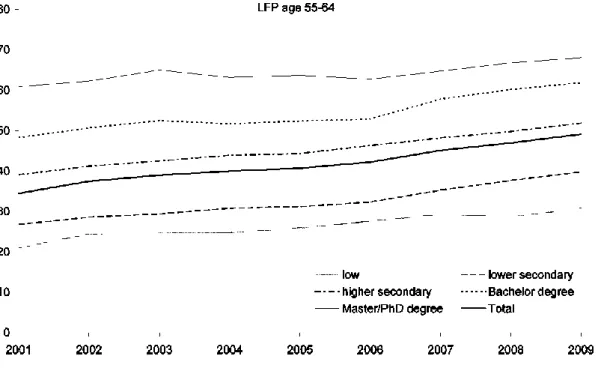
We Individuals have different tastes for leisure, different earnings capacities, and differ-ent wealth, and therefore differdiffer-ent preferences for the age of retiremdiffer-ent. An illustration of population heterogeneity in relation to retirement age is given in figure 2.1. The par-ticipation rate of individuals with lower secondary education is about 10%-point lower than the average participation rate, whereas that of individuals with at least a bachelor degree is about 15%-point higher. Participation rates have grown for all education groups, but differences between groups are remarkably persistent. Many studies provide more formal evidence for heterogeneous retirement preferences. For instance, Hanel and Riphahn (2009) identify heterogeneous retirement preferences across birth cohorts, education, and sector of industry where the individual is employed. Schirle (2008) finds different retirement behaviour according to education level, labour force participation of the spouse, and the presence of children.
4
The authors do not distinguish between early retirement and social insurance schemes – such as Disability Insurance and Unemployment Insurance – but take the system as a whole. It is therefore difficult to compare their quantitative outcomes (simulation results) with the actual implicit taxes observed in many countries (see, e.g., Gruber and Wise, 2004).
Figure 2.1 Labour force participation in the Netherlands for different education levels (source: Statistics Netherlands).
Many countries acknowledge this heterogeneity in retirement preferences and therefore allow pension take-up at different ages. Such flexibility may go both ways: either earlier or later take-up than some „standard pension age‟. In the US, it was already possible since a long time to take up Social Security benefits before the statutory pension age. Once the US pension age is raised to 67, it will be possible to take up Social Security benefits at the age of 62 with a discount of 25% in the pension benefit level. The elimi-nation of mandatory retirement in 1983 was an important step to allow retirement be-yond the age of 65. In Switzerland, it has been made possible to take up state pension benefits before the statutory pension age at a discount of 6.8% per year. Pension take-up past the statutory pension age is also possible, with benefit adjustments between 5 and 7.5% per year. Flexible pension take-up in Switzerland is also possible through occupa-tional pension schemes, with similar benefit adjustments (OECD, 2009). In the Nether-lands, flexible occupational pensions came up in the late 1990s and are now observed in most sectors of industry. The occupational pension schemes allow workers to retire be-fore the statutory pension age of 65, usually at or around the age of 63. Apart from the
US and Switzerland, the possibility of early take-up of first pillar pensions is also possi-ble in Austria, Finland, Germany, Italy, and Sweden (tapossi-ble 2.1). The minimum age is usually at or around 62, with a benefit reduction for each year of early take-up. Pension take-up of the first-pillar pension before the statutory pension age is not facilitated in the Netherlands and the UK. Some countries impose restrictions on the combination of paid work and receiving a pension before the statutory pension age – e.g. Austria and the US. In the US, it is allowed to receive Social Security benefits and work at the same time. But above a threshold earnings amount of about $37,000, Social Security benefits are partially withheld, and paid out later after full retirement. In Spain and Portugal, it is not allowed to have paid work while receiving a state pension. First-pillar pension take-up after the statutory pension age is possible in all mentioned countries, except for the Netherlands. Most countries allow the combination of work and pension income after the statutory pension age.
Table 2.1. Pension age in first-pillar pensions (source: OECD, 2009)
Statutory pension age Early option Later option Earnings test
Austria 65 62 (m) 68 with later pension take-up
57 → 60 (f)
Finland 65 62 yes -
Germany 67 63 yes -
Netherlands 65 - -
Sweden 65 61 yes with early pension take-up
Switzerland 65 63 (m) 70 -
62 (f)
UK 65 → 68 (m) - 70 -
60 → 68 (f)
US 66 → 67 62 70 with early pension take-up
Note: A „→‟ indicates that the pension age will be raised in the future. In case the pension age differs between men and women, the different pension ages are indicated by „m‟ and „f‟.
Flexible retirement can be achieved through gradual withdrawal from the labour market, either by reducing work hours within the same job (phased retirement) or change to a less demanding job with typically fewer hours and lower earnings (partial retirement). The transition process may combine wage income with a partial state pension and/or occupational pension during the period of gradual retirement. An example is the
Swed-ish pension system, where workers above age 61 may reduce their working hours by as much as 50%, while receiving either 25, 50, 75, or 100% of their full pension benefits. According to Wadensjö (2006), the Swedish partial-pension system has resulted in higher participation rates of elderly. That is, the effect that people continue to work part-time instead of taking an early exit route is larger than the effect that people who would have continued to work full-time instead work part-time. The Swedish system is however an exception to the rule, as gradual transitions between work and full retire-ment are still quite uncommon in most countries. A large majority of workers and em-ployers in western societies still consider retirement a binary choice (Kantarci and van Soest, 2008; Heywood and Siebert, 2009). This is likely related to demand factors and institutions surrounding the retirement decision. For instance, employment protection is often high for older workers and suddenly falls to zero. And employers are often not keen on reducing work hours at the same hourly wage rate. These and other issues are discussed further in Bovenberg and van Ewijk (2011).
Both phased retirement and partial retirement typically involve a reduction of work hours, and thus more part-time work. The availability of part-time jobs could therefore be important for stimulating participation at old age. While it is true that some workers start to work less hours once it is possible to work part-time, findings in Wa-densjö (2006) suggest that this effect is smaller than the effect of workers extending their careers in part-time jobs. In the Netherlands, part-time jobs are exceptionally popular, and this is also reflected in jobs of the elderly. During the period 1992-2008, about two thirds of the participation growth prior to the statutory pension age was in part-time jobs, and virtually all participation growth after the statutory pension age was in part-time jobs (figure 2.2). It is likely that older workers in part-time jobs have a preference for flexible pension schemes, not only with variable take-up ages, but proba-bly also with flexible drawings from their pension wealth to complement their wage income.
Figure 2.2. Labour force participation in the Netherlands,a according to gender and hours worked (source: Statistics Netherlands)
a
The participation rate is defined as the number of individuals having paid work (for certain hours per week) divided by the total population in the concerning age category. Unemployed workers are thus not included in this definition of the participation rate. The category „1-11‟ means that at least 1 hour per week is worked, and at most 11 hours, etc.
3. Implicit taxes and subsidies
In theory, a flexible pension scheme can be designed such that it provides income to the retiree without affecting the price of leisure. In an actuarially neutral pension scheme, the delay of pension take-up leads to higher benefits in subsequent years such that total (expected) pension wealth remains unchanged. A drawback of an actuarially neutral scheme is that it provides only little insurance to workers with bad health or falling pro-ductivity. Such insurance would require an implicit tax on the delay of pension take-up (section 2.1). On the other hand, some studies have indicated that the labour supply elasticity of elderly is relatively high, which would provide a rationale for an implicit subsidy for elderly according to Ramsey optimal tax considerations (Fenge et al., 2006; French and Jones, 2011). Third, an implicit subsidy on labour increases possibilities to hedge a shock in pension wealth against labour income. Until present, the economic
literature has not provided a clear answer on which of these three arguments dominates the others, and therefore it remains uncertain whether departures from an actuarially neutral pension scheme are optimal. The vast majority of the economic literature has hitherto studied the detrimental welfare effects of high implicit taxes on labour supply, and policy has principally focused on bringing the price of leisure closer to its market value. In the Netherlands, this was done by stimulating actuarially neutral pension schemes (section 6.1). This policy has in any case increased possibilities to use labour supply as a hedge against a pension wealth shock.
Although flexible pension schemes in western countries have typically moved towards actuarial neutrality, they mostly still tend to impact the price of leisure.5 Pen-sion schemes are often – either implicitly or explicitly – linked to the labour supply de-cision of individuals, for instance through a work test, the fiscal system, or collective agreements between employers and employees putting restrictions on the combination of labour supply and occupational pensions (see section 5.4). Many pension and social security systems are still not actuarially neutral and lead to an implicit tax on continued work from a certain age. Empirical studies have shown that this has an important effect on the labour supply of elderly (Duval, 2003; Gruber and Wise, 2004). For the US it has been found that a change from a zero reward for continued work – that is, an implicit tax of 100% – to a postponement reward of one year-salary for a year of work leads to a postponement of retirement of about 10 months (Coile and Gruber, 2001; Asch et al., 2005). Euwals et al. (2010) find that changing the reward to retirement postponement from zero to one year-salary leads to postponement of retirement by 6 months on aver-age. The empirical analysis of Hanel (2009) suggests a similar effect for Germany.
5
Note that the tax system may also impact the price of leisure, e.g. through age-dependent taxes. See section 5.4 for a brief discussion.
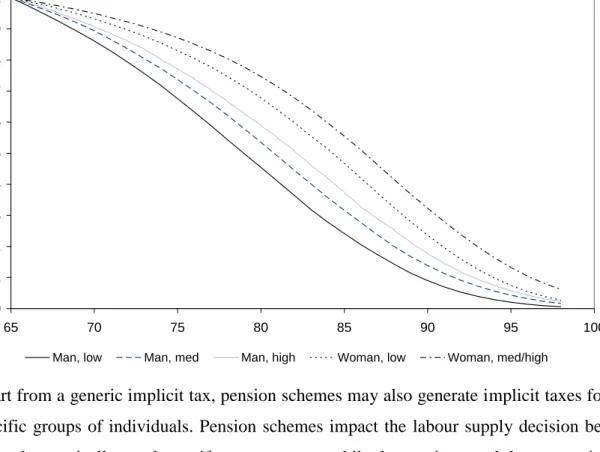
Figure 3.1 Heterogeneous mortality rates: survival probabilities conditional on having reached the age of 65, for different education levels (source: Statistics Netherlands)
Apart from a generic implicit tax, pension schemes may also generate implicit taxes for specific groups of individuals. Pension schemes impact the labour supply decision be-cause they typically employ uniform parameters while there exists much heterogeneity among individuals. Even if a pension scheme is actuarially neutral at the aggregate level – say for the average individual – then the pension scheme may still cause large distor-tions in the individual labour supply decisions. I discuss two cases: (i) the actuarial cor-rection factor used in flexible pension schemes, and (ii) the uniform contribution and accrual rate.
The first type of implicit tax results from the uniformity in actuarial correction factors. Most pension funds make use of one discount factor and one mortality table based on (historical or expected) mortality rates for an average participant. First-pillar pension schemes with flexible take-up also typically use a uniform correction factor. Whenever pension take-up is related to the labour supply decision – and this is often the case in practice – the uniformity of the actuarial correction factor results in an implicit
0 0.1 0.2 0.3 0.4 0.5 0.6 0.7 0.8 0.9 1 65 70 75 80 85 90 95 100
tax on labour supply. The uniform actuarial correction factor contrasts with the hetero-geneity in time preferences of potential retirees, which is well-known in the economic literature. Many studies have shown that there is a great deal of variation in both indi-vidual discount factors and mortality rates. Estimates by Samwick (1998) and Gustman and Steinmeier (2005) show that only 40% of the population has a time preference rate below 5%, and that about one quarter to one third has an individual discount rate above 15%. The heterogeneity in mortality rates is large as well. There is quite some interna-tional evidence on the correlation between mortality rates and socio-economic charac-teristics (Cutler et al., 2006; Hupfeld, 2009). An illustration for the Netherlands is given in figure 3.1. The median life expectancy at age 65 for low educated men is 79 years, whereas for medium and higher educated women it is more than 7 years higher. Kalwij et al. (2009b) estimate that the remaining life expectancy at age 65 for low income indi-viduals in the Netherlands is about three years lower than for high income indiindi-viduals. This implies that high income individuals receive a higher rate of return than low in-come individuals when postponing their pension starting date. In general, a uniform correction factor for flexible pensions stimulates the expectedly long-lived to take up their pension at a later age, and the expectedly short-lived to take up pensions early. This form of adverse selection leads to a more expensive pension system. All individu-als with life expectancy deviating from the average life expectancy can raise their total pension income by retiring either later or earlier. As far as pension take-up is related to retirement, the expectedly long-lived receive implicit subsidies when they delay retire-ment, whereas the expectedly short-lived pay implicit taxes and are thus discouraged to supply labour at old-age. This way, women, non-migrants, wealthy, married, and well-educated individuals receive implicit subsidies through the pension system when retir-ing relatively late. These subsidies are paid by men, migrants, poor, unmarried, and less-educated individuals (Brown, 2003). On the other hand, the latter categories receive implicit subsidies by retiring early.
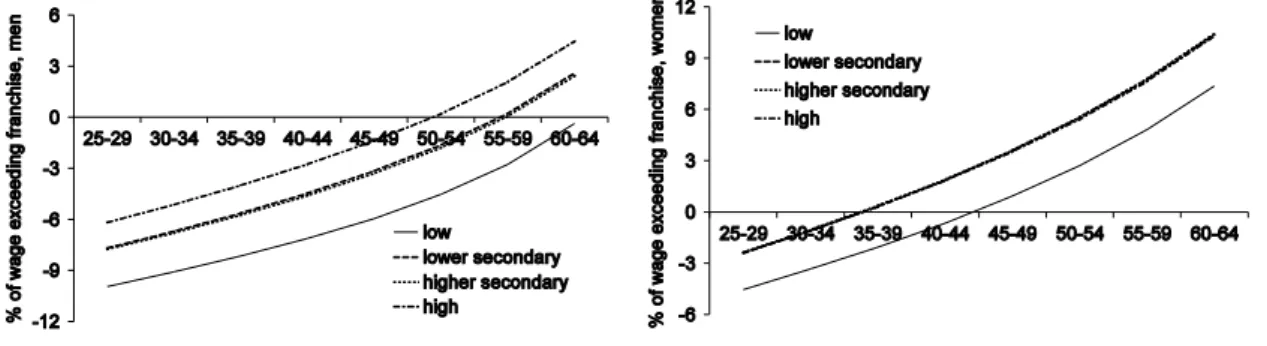
Figure 3.2 Implicit bonuses (+) and taxes (-) resulting from the uniform contribution rate to second pillar pensions in the Netherlands (source: Euwals et al., 2009; Bonenk-amp, 2009)
The second type of implicit taxes is related to the fact that defined benefit pension schemes are typically „backloaded‟. That is, pension accruals are lower than pension contributions early in life, and this is only compensated at the end of the worker‟s career (Ippolito, 1985; Disney and Whitehouse, 1996; Bonenkamp, 2009). Workers thus „in-vest‟ in the pension plan early in life and re-earn their investment if they are also em-ployed later in life.6 In many countries, participants in a defined benefit pension scheme pay the same contribution rate to the pension scheme, whereas the accrual rate is also constant among individuals. The uniform contribution and accrual rates drive a wedge between the market value of the pension contract and the actual contributions of the individual worker. Uniform contribution rates in second-pillar pensions are amongst others observed in Switzerland, the Netherlands and the UK. As an example, figure 3.2 shows the amount of redistribution over the life-cycle for both male and female workers in the Netherlands, for different degrees of education. The amounts are expressed in percentages of wages. Older workers, women, and highly educated receive an implicit subsidy within the Dutch system. Younger workers, men, and lowly educated pay
6 If the degree of backloading differs between pension plans, then workers may face incentives during some points in their careers to either stay with the firm or leave for another firm. In case a pension plan has a relatively high backload, the employee has an incentive to stay with the same firm until retirement. In that case, the pension plan can be regarded as part of an ‘implicit contract’ between the firm and the worker (Salop and Salop, 1976; also see section 5.1).
plicit taxes. Older women receive the largest implicit subsidies, whereas young men with low educational attainment pay the highest implicit taxes. The labour supply incen-tive effects are thus particularly relevant for older women and young men. Higher edu-cated men above age 50 receive an implicit subsidy on work through the pension sys-tem. Medium educated men start receiving implicit subsidies in their late 50s, whereas lowly educated men do not receive any implicit subsidies over their entire life-cycle. All women above age 45 receive implicit subsidies on labour through the pension system. In conclusion, a large majority of older workers receives an implicit subsidy on contin-ued work through the pension system. In other words, the marginal tax rate of older workers is lowered through the pension system whereas it is made higher for younger workers.
4. Pension wealth and its framing
Pension schemes affect labour supply in different ways. Apart from the substitution effects described in the previous section, pension wealth itself and its framing into „standard pension ages‟ impact the retirement decisions of individuals. This section gives an overview of three different mechanisms. First, large pension wealth may stimu-late individuals to retire early (section 4.1). Second, pension schemes may affect retire-ment behaviour through socio- and psychological mechanisms (section 4.2). Finally, liquidity constrained and myopic individuals tend to retire whenever the opportunity exists, and early retirement opportunities in flexible pension schemes may therefore suppress labour supply (section 4.3). Apart from these three mechanisms, a malfunc-tioning labour market – e.g. as a result of institutional constraints – may discourage workers to supply labour. That is, problems on the demand side may as well have con-sequences on the supply side of the labour market. A discussion of the underlying de-mand side problems is however left for the following section. As will be seen in this section, individuals are willing to adjust their labour supply after a wealth shock. This adjustment however appears to be modest, and perhaps even less important than the frames of the individual‟s pension. In particular, both the earliest possible pension age and the standard pension age have an important impact on the retirement decision. This
should be taken into account when using labour supply as a hedge against pension shocks. For instance, an unexpected decrease in pension wealth could justify higher early and standard pension ages.
4.1 Income effect
Pension wealth is meant to finance retirement. However, many empirical studies explor-ing the impact of a marginal change in pension wealth on the retirement decision find modest effects. Krueger and Pischke (1992) find that a reform in the US state pension did not affect labour supply. Euwals et al. (2010) find a statistically significant but lim-ited effect of (second-pillar) pension wealth on early retirement in the Netherlands. They find that a wealth increase of one year-salary on average implies nearly two months earlier retirement. Banks et al. (2007) find virtually the same effect for the UK. For working individuals above age 50, they find that a reduction of pension wealth of about one year-salary leads to a retirement postponement of about two months. French (2005) and Bloemen (2010) also find limited effects of pension wealth on labour sup-ply. Bloemen‟s estimation results imply that a reduction in pension wealth by one year salary leads to later retirement by one month and a half. In a more general context – not specifically focused on retirement – Imbens et al. (2001) estimate that lottery winners consume just 11% of their winnings on leisure, which is in the same order of magnitude as the studies specifically focusing on pension wealth effects. Despite the relatively modest income effects found in the literature, it has been argued that many studies even overestimate the pension wealth effect on retirement (Van Ooijen et al., 2010). If indi-viduals have at least some freedom of choice in their pension wealth, then a high prefer-ence for retirement will go together with high pension wealth. This endogeneity prob-lem is often not properly taken into account.
Several studies suggest that the impact of pension wealth on the retirement deci-sion is stronger than the impact of other sources of wealth. This could be the result of a „labeling effect‟; see for example Thaler (1990). An impact of the wealth‟s label on re-tirement appears irrational from the life-cycle point of view: wealth should be spent where it maximizes the individual‟s utility irrespective of the source of income. A
ra-tional agent following the life-cycle model would typically smooth a wealth increase over his remaining life-cycle and allocate it to different goods, services and/or leisure. The empirical literature provides some indirect evidence on labelling effects in pension wealth.7 Studies such as Diamond and Hausman (1984) and Samwick (1998) find only very little, if any, effect of private wealth on the timing of retirement. Moreover, hous-ing wealth is only of minor importance in the retirement decision (Skinner, 1996). Con-fronted with the empirical literature on the pension wealth effect, these findings suggest that indeed pension wealth appears to have a stronger effect on retirement than private wealth. However, van Ooijen et al. (2010) contradict this stance, as they do not find convincing evidence that the private wealth effect – excluding the housing wealth8 – deviates from the pension wealth effect on retirement.
In sum, the empirical evidence largely confirms that individuals adjust their re-tirement decisions to a change in their pension wealth. The literature suggests that this adjustment is larger than to a shock in private wealth, and in any case larger than to a shock in housing wealth. Most empirical studies concentrate at the extensive labour supply margin, and find that retirement is postponed by about two months if pension wealth is decreased by one year salary. A possible explanation for the modest wealth effects found in the literature is that individuals were probably not able to adjust their labour supply, even if they were willing to do so. As will however be discussed in the following section, a change in pension wealth may have a larger effect if it is framed as a change in the statutory pension age.
4.2 Social norms and default options
Social norms and default retirement ages in pension schemes both lead to individuals focusing on particular institutionalized retirement ages more than on alternative retire-ment ages. In most pension schemes one or two ages are the „standard‟ retireretire-ment ages,
7
There is no direct empirical evidence (yet) on a labeling effect of pension wealth. Some em-pirical evidence does exist for other applications, such as child benefits (Kooreman, 2000). 8
The authors find that the housing wealth effect on retirement is substantially smaller than the effects of other sources of private wealth.
and many agents – in particular, workers, employers, and unions – appear to focus pre-cisely on these ages. In the US, the ages of 62 and 65 were the standard choices. In the Netherlands, the early retirement eligibility age – usually around the age of 60 – was for a long time considered the „standard‟ retirement age. As will be discussed in section 6.1, the reform of early retirement arrangements has led to a higher „norm age‟ in the Neth-erlands. In most sectors, the standard retirement age is now between 63 and 65 years. Although pension systems often contain financial incentives to retire at particular insti-tutionalized ages, several studies have shown that a typical large unexplained retirement „spike‟ remains at these ages (Lumsdaine et al., 1996; Duflo and Saez; 2003). Mastro-buoni (2009) has therefore taken a different empirical approach which leaves room for effects that are not directly related to financial incentives. Indeed, he finds larger effects of raising the „normal retirement age‟ in US Social Security than studies which focus on the effects of financial incentives. This empirical evidence suggests that social and psy-chological issues play an important role in the tendency of workers to retire at a specific institutionalized age. Hanel and Riphahn (2009) achieve a comparable result based on a Swiss reform which entailed an increase in the normal retirement age in the (first-pillar) public pension scheme for women from 62 to 64 years. The empirical findings of Mas-trobuoni (2009) and Hanel and Riphahn (2009) suggest that both social norms and de-fault retirement options play a significant role in the retirement decisions of individuals. Social norms affect consumption and labour supply behaviour, and are important for the welfare state. The utility of individual workers may incorporate disutility from norm deviation (Lindbeck et al., 1999). If the norm is to participate in the labour market as long as one is able to, then – apart from the utility derived from leisure – early re-tirement would generate disutility to the individual worker. Such a norm would there-fore stimulate the worker to postpone retirement. If a social norm is changed, this will lead to an adjustment in individual behaviour, and subsequently to a new equilibrium. For instance, if a social norm of early retirement at the age of 60 no longer applies, then this can have far-reaching consequences not only for participation rates of elderly, but also for their productivity and wages. There is no direct empirical evidence that social norms affect retirement behaviour, but the retirement spikes just mentioned together
with Mastrobuoni‟s findings suggest that social norms do play a role in retirement be-haviour. Moreover, in a recent survey Brown (2006) finds that many individuals tend to retire at the age which they consider the “usual retirement age”. About half of the (American) individuals in his sample consider the ages 62 or 65 as the „usual‟ retiment ages, one sixth considers another age as the „usual‟ retireretiment age, and the re-maining third does not consider any retirement age to be „usual‟. It should be noted that social norms are not necessarily beneficial to society, and in fact they can be even harm-ful. Akerlof (1980) refers to the „norm‟ that employers should not hire unemployed per-sons at a lower wage rate than the current wage rate. Such a social norm leads to higher unemployment, which makes both unemployed persons and the employer worse off. It is well possible that a similar norm has played a role in the early retirement preferences of many European workers. Early retirement was for a long time considered something „good‟, not only for the large amounts of leisure received at a „low price‟, but also be-cause it was believed by many that it would help to lower youth unemployment (Kalwij et al., 2009a). As this norm appears to be disappearing, the participation effects of rais-ing the normal retirement age are probably much larger now than they would have been in the 1980s and 90s.
Psychological effects may play a role as well. Individuals often seem to choose the most „neutral‟ option from a choice set. In the literature, this is referred to as the tendency to choose a „default option‟, to focus at a „reference point‟, or „status quo bias‟ (see, e.g., Kahneman et al., 1991). According to experimental studies, the tendency to choose a default option is positively related to the number of alternative options. This may play a role in the retirement decision, where loss averse individuals prefer to choose the standard option rather than taking up their pension benefits earlier or later. In addition, financially illiterate workers may be unable to judge whether early or late take-up of pension benefits is beneficial to them, and therefore stick to the standard re-tirement age. Default options have been studied mainly in the context of pension portfo-lio rather than retirement age. In that context, there is overwhelming evidence that de-fault options play an important role in the savings and pension portfolio decisions of
individuals and households (see, e.g., Samuelson and Zeckhauser, 1988; Thaler and Benartzi, 2004).
4.3 Borrowing constraints and myopia
As was discussed in section 4.2, many empirical studies find a „retirement spike‟ both at the earliest possible retirement age and at the „standard‟ retirement age. Apart from the sociological and psychological explanations discussed in that section, the retirement spike at the earliest possible retirement age may also be related to borrowing constraints and myopic behaviour. Some individuals are not able to retire before the pension eligi-bility age, as they cannot access the funds necessary to finance this earlier exit. If capital markets would function properly and individuals were rational and forward-looking, then these individuals would be able to undo their forced savings in the mandatory pen-sion scheme by borrowing against their future penpen-sion income. Likewise, the individu-als could borrow against their first-pillar pension wealth. If, however, such borrowing is not possible, then these individuals are forced to work until they can access their pen-sion rights, and therefore some clustering of retirement ages will occur at the earliest possible pension age. Rust and Phelan (1997) regard the retirement „spike‟ at the earli-est possible retirement age in the US as indirect evidence for the relevance of borrowing constraints.
In addition, myopic individuals will tend to retire at the earliest possible age simply because they highly value their leisure in the near future. The retirement deci-sions of both liquidity constrained and myopic individuals are thus relatively sensitive for the earliest possible age of pension take-up. That is, the participation of these groups may be importantly stimulated by raising this early pension age.
5. The labour market for elderly
Much of the literature on the labour market for elderly has focused on the supply side. This is understandable in light of the large labour supply disincentive effects of pension schemes that were prevalent for a long time (section 3). Recent studies have however argued that further reforms should focus on the demand side. The participation rate of
elderly is now growing in most western societies as a result of better financial incen-tives and better education. Meanwhile, the labour market for elderly does not seem to function well (for the Netherlands, see Euwals et al., 2009). This is reflected in low hir-ing rates of older jobseekers, low job-to-job mobility, high unemployment duration, and negative perceptions by employers. In this section, I discuss both market forces and institutional factors which hamper the allocation of labour supplied by older workers. Deferred pay incentive schemes and specific capital are discussed in sections 5.1 and 5.2, respectively, and some relevant institutional factors are discussed in sections 5.3 and 5.4. In particular, the impact of employment protection on the labour market posi-tion of older workers is discussed in secposi-tion 5.3.
5.1 Deferred pay incentive schemes
Wage profiles and pension schemes can be designed such that they initially stimulate workers to stay with the firm, and after some time stimulate (early) retirement. This can be typically achieved by implicitly saving a part of the worker‟s compensation for a later moment in her career. The deferred payment – which may for instance occur through high seniority wages or generous pensions – can be made conditional on the performance of the employee, so that it creates an incentive for the average worker to increase her productivity. These payment schemes have important implications for the labour market of older workers. Apart from the stimulation of early retirement by firms, an important consequence is that it may be unattractive for firms to hire older workers.
In a „bonding scheme‟ the worker is required to post a „performance bond‟ be-fore work begins. Deferred pay at the end of the contract equals the bond itself. The incentive to perform is derived from the threat that the firm does not pay off the implicit bond to the worker (Becker and Stigler, 1974). Lazear (1979, 1981, 1983) proposed a payment scheme which connects the stylized model of Becker and Stigler with some empirical facts observed in the labour market. Instead of paying money to his employer, a worker in the Lazear model implicitly posts a performance bond in the early years of his career by accepting wages below his productivity level. The Lazear model is consis-tent with the empirical findings that employers typically stimulate their older workers to
retire, and that relative earnings increase in time although relative performance does not (Medoff and Abraham, 1980, 1981; Flabbi and Ichino, 2001; Dohmen, 2004). Wages thus typically show an increasing pattern during the worker's career, and the perform-ance bond is paid out to the worker at the end of his career. The steepness of the pay-ment scheme is closely linked to the probability that a shirking worker is caught. A low probability typically implies a steep wage profile (relative to the productivity profile), as workers can only be deterred from shirking by the threat of losing future payments (Lazear, 1979). The performance bond can for instance be paid out through a back-loaded pension scheme (section 3) or higher wages at the end of the career.
As older workers become relatively expensive in such a payment scheme, the firm needs to get rid of these older workers in order to sustain the payment scheme. Ac-cording to Lazear (2010), the mere fact that firms stimulate their older workers to retire can be considered “prima facie evidence that ... elderly workers are overpaid relative to their productivity”. Retirement can e.g. be stimulated through a pension plan containing disincentives to continue working (i.e. implicit taxes) or mandatory retirement. On the other hand, deferring pay generates an incentive for the firm to hire younger workers. Younger workers are relatively cheap and often bearing the costs of deferred payment of the firm‟s older cohorts of workers.9 Deferred payment schemes are therefore typi-cally associated with low hiring rates of older workers (Hutchens, 1986; Daniel and Heywood, 2007; Heywood et al., 2010).
Several empirical studies provide support for deferred pay incentive schemes (see, e.g., Lazear and Moore, 1984, Hellerstein and Neumark, 2004, for the US; Crepon et al., 2003 for France). Many of these studies are not able to directly prove the rele-vance of the theory, but rather find results which are consistent with the theory. On the other hand, some studies – e.g. Hellerstein et al. (1999) – produce results which are not consistent with deferred pay incentive schemes.
9
This need not be the case if the deferred payment scheme is capital funded. However, it seems unlikely that for each worker, excess wages at the end of his career precisely corres-pond to the posted implicit bond on an actuarially neutral basis.
Lazear style implicit contracts will perhaps become less important in the future The low hiring rates of older workers may rise as a result of autonomous forces. First, young workers seem nowadays less willing to post implicit bonds, because lifetime jobs have become quite uncommon. Labour mobility has increased for younger cohorts of workers, and the average lifetime of firms has decreased. It will therefore be more diffi-cult for firms to offer implicit contracts to employees in the form of deferred payment schemes. Moreover, the ageing workforce would imply more redistribution from young workers to old workers and retirees in order to sustain deferred payment schemes. It is questionable whether young workers would be willing to pay „implicit taxes‟ in addition to their „implicit performance bonds‟. Third, older workers often stay with the firm for a longer period than before, which makes deferred payment schemes more expensive for the firm. It is now more difficult for firms to terminate contracts of older workers as a result of institutional reforms. Mandatory retirement was banned in the US in 1983, and in the Netherlands, participation rates of elderly have gone up as a result of the reforms of pathways into early retirement (pensions, disability insurance).
5.2 Specific capital
The demand for labour of older workers may be relatively low because hiring them in-volves specific investments which are not easily recovered. The firm typically incurs some fixed costs per newly hired employee, which are the result of the hiring and selec-tion procedure, and training of the newly hired worker. The tenure of older workers is typically limited as a result of an institutional pension age. Firms prefer to hire young workers given that the expected tenure of older workers is relatively short (Hairault et al., 2010). This argument is particularly important in a world with immobile workers. In that case, firms will only hire young workers and earn a maximum rent on the specific investments made. It was however argued in the preceding section that young workers are becoming more mobile in most western countries. As a result, young workers be-come relatively less attractive, and the hiring rates of older workers may be increased.
It seems questionable whether specific capital plays a decisive role in the wages of older workers. An implication of specific capital theory is that workers are paid less
than their value to the firm, as the firm and worker share the rents on specific invest-ments. This seems less plausible for older workers. Many studies have shown that wage profiles are steeper over the life-cycle than productivity profiles (see the previous sec-tion), which is at odds with specific capital theory. Moreover, many firms encourage their older employees to retire, which is at odds with the firm benefiting from the worker‟s specific capital. This is not to say that specific capital is irrelevant. The claim is that deferred payment schemes appear more relevant in explaining labour market out-comes of elderly than specific capital theory (Lazear, 2011; de Hek and van Vuuren, 2011).10
5.3 Employment Protection Legislation (EPL)
As was seen in section 5.1, deferred payment schemes may stimulate productivity over the worker‟s life-cycle. As long as redistribution takes place within the firm, such pay-ment schemes are apparently in the interest of both the firm and the employee. Steep wage profiles can however be inefficient if they are driven by public institutions. Better employment protection of older workers implies a stronger bargaining position. It en-ables them to bargain higher wages, in particular when older workers have a relatively large vote in trade unions. The resulting wage profiles cause distortions in the hiring and firing decisions of firms. Moreover, they contribute to the „golden chains‟ for older workers, making them less mobile, less willing to train and less motivated.
Firms are less likely to hire older workers if EPL is specifically protecting the rights of this group. Older employees are often better protected than younger employ-ees, and are therefore on average more expensive. For instance, severance pay in the Netherlands depends on age (the so-called „ABC-rule‟). Newly hired workers build up severance pay rights twice as quickly if they are above age 50 when compared to work-ers under age 40. This is usually justified on grounds that older workwork-ers have more firm-specific human capital, and that they are entitled to unemployment insurance for a
10
Some empirical studies find that specific capital is most relevant for young workers, whereas deferred payment schemes are most relevant for older workers (Seltzer and Merrett, 2000; Dustmann and Meghir, 2003; Shaw and Lazear, 2008).
relatively long period (internalization of unemployment costs). In France, the lower firing tax for workers that were hired after age 50 has increased the relative hiring rates of these workers (Behagel et al., 2008). On the other hand, firing rates increased as well. Similarly, Kugler et al. (2003) conclude that the decrease in firing costs in Spain has increased both hiring and firing of older workers.
The currently observed pattern of rising EPL up to the statutory pension age and then suddenly dropping to zero seems questionable. As a worker approaches retirement, the return period for firm-specific human capital falls, as does the remaining period over which the elderly worker can claim unemployment insurance. It suggests that employ-ment protection should display a hump shape, falling to zero again as the worker ap-proaches retirement. Chéron et al. (2008) find that a hump shaped firing tax profile is first best, on grounds that the distortionary effects are greater for older workers than for younger ones. In a world with labour market frictions, bargaining power and unem-ployment benefits, the authors even conclude that the optimal firing tax profile is strictly decreasing with age.
Workers may lose their accumulated employment protection „rights‟ when they switch employer. This creates golden chains for (older) workers, reducing job-to-job mobility. An alternative is to make the accumulated severance pay portable. In 2003, Austria switched to a system of individual savings accounts for job loss. Employers pay contributions to this account. Employees can receive a payment from the account in case of dismissal, but can also carry over the account to a new job. At retirement the remaining funds go to the individual retirement account. This system breaks the golden chains. However, it also eliminates some insurance.
5.4 Other institutional factors
Restrictions on the combination of work and pension income are among the most im-portant causes of employment differences in OECD-countries (Alonso Ortiz, 2009). In countries such as Portugal and Spain, people will only receive a state pension if they do not work. In France, it is obliged to take a 6-month break after the pension starting date. Until 2000, individuals drawing Social Security benefits in the US faced an earnings
test implying benefit reduction above an income threshold level. In the UK, the earnings test was abolished in 1989. Contrary to many other countries, the Dutch state pension has never involved an earnings test. One is free to participate in the labour market while receiving a (full) state pension. Participants are however not entitled to social insurance for workers (disability and unemployment benefits), and have no employment protec-tion. In fact, most workers who reach the state pension eligibility age in the Netherlands lose their employment protection. Note that an earnings test could make sense in the context of flexible pensions as an insurance device (see section 2). However, it obvi-ously discourages labour supply.
Tax rules or collective agreements between social partners may also hamper the employment of elderly. Occupational pension schemes may limit possibilities to stay in the labour market. In the US, most employees cannot access their pension benefits while staying in the same job. The same holds for many employees in the Netherlands. De-fined benefit pension schemes based on final pay discourage part-time work or partial retirement, and may therefore stimulate early retirement. However, most pension schemes in the Netherlands have now switched from final pay to average pay, so that this kind of work disincentive has largely disappeared. On the other hand, the tax sys-tem may encourage employment of elderly. In the Netherlands, older workers receive a „work bonus‟ through the tax system. The effective tax rate on labour supplied by older workers is therefore lower than for younger workers.
Older workers are often not able to reduce their working hours and prolong their stay in the labour market. Inflexibilities regarding hours of work may be caused by fixed employer costs or production technology (Hurd, 1996). Fixed costs may for in-stance result from administrative duties and workplace costs. Restrictions in production technology may relate to indivisibilities of tasks and difficulties in job scheduling. Ac-cording to a survey among Western European personnel executives, “hidden extra costs” was the mostly named (32%) obstacle for working hours reduction (Smolkin, 1996). “Production problems” was named an obstacle by 30% of the respondents. Van Dalen et al. (2008) find that a majority of full-time employed older workers in the Neth-erlands would prefer to reduce their working hours. 41% of the interviewed workers
prefers a working-time reduction with 20%. The fact that these workers are full-time employed suggests that working hours constraints play a role. It is also remarkable to see most workers past the age of 65 work part-time, whereas a majority of workers who have not reached the public pension age works full-time (figure 2.2). Employees past the age of 65 face less institutional restrictions (e.g. EPL, social insurance). In the US, it is known that health insurance may hamper job changes of older workers, in particular if they have a chronic health problem (Hurd, 1996). Employers are more likely to per-mit a reduction in working hours for the individual white-collar worker „who requires little supervision and makes an extra effort to get the job done‟ (Hutchens, 2010).
6. Experience in the Netherlands
In this section I highlight recent developments in the Netherlands on flexible pensions. The reform of early retirement schemes and their integration into the second-pillar pen-sions was largely seen as a success, as it has removed high implicit taxes on labour sup-ply (section 6.1). On the other hand, some doubts have arisen on the (more recently proposed) flexibilisation of first-pillar pensions, as this does not appear to add much to the Dutch institutional context (section 6.2). Remarkably, one of the core arguments in this paper – flexible pensions as a hedge against pension shocks – has hardly played a role in the Dutch pension debate.
6.1 Flexible retirement in occupational pensions
During the 1970s and first half of the 1980s, many sectors of industry in the Nether-lands introduced pay-as-you-go early retirement schemes without actuarial adjustments for different retirement ages. After reaching a certain age, a worker could retire and re-ceive gross benefits of about 80% of the last earned wage. The net replacement rate was even higher due to the progressive tax system and a continued accrual of old-age pen-sion rights. The eligibility age varied over the sectors of industry from about age 58 to 62. The implicit tax rate of continuing to work another year was more than 100% for most workers, implying a net subsidy on retirement rather than a reward for work (De Vos and Kapteyn, 2004). The resulting drop in the participation rate of elderly was
ac-tually an explicit goal of these schemes in order to save jobs for the young. The early retirement schemes, however, became costly and some serious doubts arose about the saving of jobs for the young.11
During the 1990s the Dutch unions and employer organizations agreed on trans-forming the early retirement schemes into less generous actuarially fair schemes. The participants of the pension scheme for civil servants were the first to face the new early retirement conditions, from April 1997 onwards. In most sectors of industry it was de-cided to implement transitional arrangements. The transition was initially supposed to be completed in the year 2022, but was accelerated considerably in 2006. Since then, the Dutch early retirement scheme is integrated with the second-pillar pension system. The fiscal framework of occupational pensions allows for a building up of a pension benefit (flat-rate state pension benefit plus occupational pension) of a full 100% of the last or average earned wage at age 65. Workers are allowed to retire before age 65. The special fiscal treatment stays in place as long as the pension benefit is adjusted in an actuarially neutral way. Some of the largest Dutch pension funds allow for an early re-tirement benefit of about 70% of the average earned wage at age 63. In addition, a life-course arrangement – a fiscally subsidized savings arrangement to finance leave during the working-life – was introduced. It is however mainly used to finance early retire-ment. Since January 2009, older workers receive an age-related tax credit on their wage income, which aims to stimulate their participation.
Within a time span of about ten years, the Netherlands has moved from a system with an implicit tax on continuing to work of about one hundred percent to a system with an implicit subsidy on continued work. The implicit subsidy through the tax sys-tem ranges between 5 and 10% for ages 62-65, and the implicit bonus through the back-loaded pension system ranges between 0 and 10% for these ages. It could be optimal to subsidize the labour supply of older workers in case they are more elastic than younger
11
Although most economists do not believe that early retirement leads to less youth unem-ployment – a form of the so-called ‘lump of labour fallacy’ – many non-economists appear to have believed in it (Barr and Diamond, 2009). In a recent empirical study, Kalwij et al. (2009a) confirm that youth unemployment and early retirement are not negatively correlated.
workers (section 3). The empirical evidence on the variation of labour supply elasticities with age is however very limited, and therefore it seems too early to reach a final con-clusion on this argument (Weinzierl, 2008; Euwals et al., 2009). The „norm age‟ for retirement has importantly increased. In the 1990s and before, the early retirement eli-gibility age was about 60, and nowadays the „standard‟ early retirement ages in the Netherlands are 63 or higher. The impact of both financial incentives and the norm ef-fect on the participation rate is substantial. Euwals et al. (2009) estimate that improved financial incentives (in particular cutting implicit taxes) have led to an increase of the average retirement age by about two and a half years.
6.2 Raising the statutory pension age
The fiscal sustainability gap in many western economies is for an important part caused by a fixed pension age in combination with increased longevity (see, e.g., Cournède and Gonand, 2006; van Ewijk et al., 2006). Individuals spend a larger share of their lives in (pay-as-you-go financed) retirement and a smaller share doing paid work. Many west-ern countries have therefore implemented legislation to raise the statutory pension age. In the US and Norway the pension age was raised to 67 years, with possibilities for flexible take-up between the ages of 62 and 70. The pension age is also being raised in Germany, Denmark, the UK, and other countries. Raising the statutory pension age stands high on the political agenda in the Netherlands. If the statutory pension age is raised by two years, i.e. from 65 to 67, then total pension wealth decreases on average by one to one-and-a-half year-salary.12 This includes lower savings in occupational pen-sions, as the standard retirement age in occupational pensions is typically linked to the statutory pension age. According to estimates in Euwals et al. (2010), the income effect would then increase the average retirement age by two to three months. Socio- and psy-chological effects would lead to a further increase in elderly participation rates (section 4.2).
12
The average pension replacement rate in the Netherlands (both first and second pillar) is between 50 and 75%.
Much of the policy discussion in the Netherlands has focused on differentiation of the pension age between groups of workers. Although some groups favour flexibili-sation of the first-pillar pension scheme, doubts have arisen on its benefits. Second-pillar pensions already offer much retirement flexibility at the extensive margin, so that the benefits of a flexible pension age discussed in section 2.1 already apply for an im-portant part. In addition, the intensive margin is relatively flexible in the Netherlands. Adjustment of hours worked is relatively easy in the country with the highest incidence of part-time work. Furthermore, flexibilisation lowers the socio- and psychological ef-fects boosting participation rates. Both social norms and default options become less important, as the focus on the institutional retirement age(s) becomes less. Finally, the pension system will become more expensive as the expectedly short-lived will retire earlier than the expectedly long-lived (adverse selection). In the Netherlands, flexible retirement opportunities can be organized without a flexible first-pillar pension scheme.
7. Conclusion
Flexible retirement opportunities provide insurance to individual workers. Health and productivity risks can be covered by the opportunity to shorten one‟s working life. The risk of income loss as the result of divorce or death of a spouse can be covered by the opportunity to extend one‟s working life. Flexible retirement can also serve as a hedge against pension risk: a loss in pension wealth can be compensated by later retirement. Flexible retirement is in practice closely linked to a pension scheme with flexible start-ing dates as a result of borrowstart-ing constraints, an imperfect annuity market, and institu-tional restrictions. Insurance through flexible retirement works well if (i) it is possible to adjust the pension starting date at limited cost; (ii) the individual is willing to adjust his labour supply in response to a pension wealth shock, and (iii) labour market institutions and employer-employee relations facilitate later retirement.
The first condition seems largely fulfilled in most countries, as they have moved towards actuarially neutral pension schemes. The cost of adjusting the retirement age is then in principle zero for the average individual (and also for the pension fund or gov-ernment). Population heterogeneity – for instance in longevity – and backloaded