Creating Collaborative Business Processes
Introduction
Collaboration is becoming a critical business tool. We see new uses of social networks, instant messaging, voice and web conferencing, tweets, etc. to increase individual and team access to an ongoing flow of information. However, these technologies are often still being used outside traditional enterprise IT boundaries and therefore are not yet integrated into the formal business processes.
Over the past 30+ years, businesses have been very effective at defining and optimizing their business processes to take advantage of transactional IT systems. These processes and systems guide (some would say force) the user through a predefined set of steps or tasks (workflow) that are embedded in IT systems. Typically, these systems have been based on optimizing the flow of a business document through various process steps and then measuring and managing the overall process toward specific performance goals.
However, with the increasingly global distribution and mobile nature of business, including integrated value chains in which critical support functions are outsourced, a new and different type of business process needs to be supported in the enterprise - one that combines the management, security, measurability, and standardization benefits of traditional, transactional-based processes with the advantages and opportunities provided by more open, Web 2.0-based collaboration. In these processes, we need to move beyond the business document as the primary metaphor and incorporate the rich set of media types readily available to any Internet user (and that mirror more natural human communication), in a trusted, secure, and reliable fashion.
This document discusses some of the opportunities and challenges of combining more flexible, impromptu
collaboration and more traditional predefined business processes, which until now, have not been effectively linked. We believe that this is the next big opportunity in business process optimization, which should lead to knowledge-worker productivity gains. And although some enhancements are still required in the business-process tools to enable enterprises to take full advantage of the concepts presented here, you can take some steps immediately to begin gaining the benefits of collaboration improving current business processes.
Typical Business Interaction Today
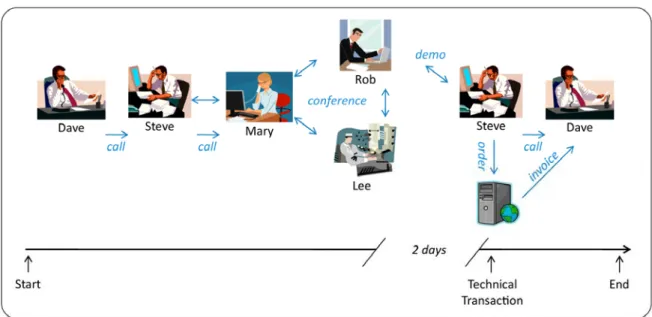
Consider an example of a typical business interaction using a sales scenario (a rich-media version of which can be found at http://cisco.com/en/US/products/sw/voicesw/index.html). In this example, illustrated in Figure 1, Steve, a sales person, receives a call from an important customer, Dave. Dave has new market requirements, and before he renews his order he wants to know if Steve can meet the new product specifications and delivery dates. Dave needs an answer and a quote within a week. To answer Dave’s question, Steve needs to coordinate with R&D, so he sets up a collaboration session to discuss the requirements with Mary, the product manager. She adds Rob from R&D to the call, and they jointly view and discuss the specifications on a shared desktop using web conferencing technology. Rob needs to check with manufacturing to see what effect the new parts and processes might have, and calls Lee at the factory to discuss it. Two days later, Rob and Lee do a successful test run of the prototype and report back to Steve, who shares the results with Dave. The result: A sale is made.
Figure 1. Sample Business Sales Interaction
This example is typical of the activities that knowledge workers engage in today. Let’s examine some of the characteristics of this type of business interaction:
● Knowledge workers: The primary participants in this type of interaction are knowledge workers, those people on whom the business relies to make intelligent, informed decisions that often cannot be scripted in advance. But to make these types of decisions, the workers need access to accurate, up-to-date information, whenever and wherever it is.
● Unpredictable: The unpredictable nature of knowledge worker-based scenarios is one of the most important and difficult process characteristics. We don’t know at the outset whom we will need to include in the collaboration. Steve and Mary need to evaluate the situation, and then bring in the necessary experts on an as-needed basis. This scenario requires two important components: the ability to identify available experts (we don’t want to call Joe if he is on vacation, so instead we call Rob), and the ability to contact and include them immediately in the discussion.
● Subject to delay: The interactive nature of the scenario illustrates the huge possibility for delays. If Steve cannot reach Mary to set up a conference call, then the entire process will be delayed until the situation is resolved. Although people are not always readily available, new communications and collaboration technologies can significantly reduce delays.
● Subject to error: Human interaction by its very nature is subject to error. So, first we try to eliminate causes of error as much as possible. In a scenario like this one, errors often occur because workers do not have access to the most up-to-date information. Again, new collaboration technologies can make the most current information immediately available, any place, any time. But, this availability may still not be enough. People make mistakes through misunderstanding, ambiguity, etc., so we also need to keep track of the interactions between them, and be able to go back and verify what was said when and to whom to identify and address any misunderstandings in this process that may occur.
● Interactive and collaborative: The overall process depends on the collaboration of many different knowledge workers. The more interactive the collaboration, the faster the overall process can be completed, and the less opportunity for error and delay.
● Not document-based: Although a document (or the electronic equivalent) is the final output of the overall process (the purchase order and invoice), it is not the primary medium for most of the interaction. Rather, a full
range of rich communication media is involved, including voice, video conferences, email messages, instant messaging, etc.
Of course, behind the scenes there is still a business process for taking an order, scheduling production, and issuing an invoice. Unfortunately with most of today’s systems, most of the critically important human interaction that overlays the transactional business interaction is not managed, stored, or more importantly, associated with the order. But, imagine instead if we could manage this type of impromptu interaction as a formal process. Let’s call this process the “request-to-order” process. What metrics might be important to a business about this process?
◦
As a business, we are interested in how successful we are in turning requests into orders.◦
We may also be interested in the performance of individual sales people when performing this process.◦
We want to reduce process latencies due to resource or information availability, or misunderstandings in communication that delay the business process.If we were managing the entire process, including the human collaboration throughout the process, we could easily keep track of these metrics. We could then use such information to cut time out of the process and discover what steps, if any, are unnecessary, what are the bottlenecks, what are we missing, and so on.
Using Business Activity Monitoring (BAM) and other related business intelligence tools, we can analyze and optimize the process. Then, using improved communications and collaboration tools, we may be able to further reduce delays and errors. If, for example, we want to be able to see the status of all in-process requests and allocate requests to appropriate sales resources, technology such as presence gives us real-time visibility into the availability of resources, not only for monitoring, but also for inclusion into improved business-process rules.
Moreover, for certain types of transactions, particularly those subject to regulatory scrutiny, we want to be able to see exactly what was said, requested, suggested, promised, etc. among all of the parties involved. Questions of auditing or propriety are quickly resolved by examining content of the complete, combined, human and automated enterprise transaction. In addition, by introducing enterprise-class collaboration technology, auditing of the process is enhanced with the ability to search the contents of any interactions. Participants can review communication exchange, and errors can be quickly identified and corrected. Richer communication tools reduce the potential for misunderstanding and ambiguity in communication.
To incorporate these benefits, ideally what we need is an integrated approach that combines the advantages of formal processes and enriches them with new technologies. To understand how these processes could make this business process more manageable, we need to examine business processes more closely. Let’s start with some definitions.
Collaboration and Business Process
Wikipedia tells us that “Collaboration is a recursive process where two or more people or businesses work together toward an intersection of common goals by sharing knowledge, learning, and building consensus. Structured methods of collaboration encourage introspection of behavior and communication.”
At first look, the recursive human-oriented nature of collaboration may seem to clash with the more inherently linear system-oriented nature of formal business processes. For example, Davenport says, “A process is a specific ordering of work activities across time and space, with a beginning and an end, and clearly defined inputs and outputs: a structure for action.” Bringing human collaboration and business processes somewhat closer together, Rummler & Brache use a definition that focuses on the organization’s external customers when stating that: “A business process is a series of steps designed to produce a product or service. Some processes result in a product or service that is received by an organization’s external customer. We call these primary processes. Other processes produce
products that are invisible to the external customer but essential to the effective management of the business. We call these support processes.”
Regardless, the predominant view of business processes in the industry today is linked to the idea of a well-defined sequence of steps, or workflow. Most of the business-process tools, such as Business Process Management Systems (BPMS) or Workflow Management Systems (WMS), are optimized around the design, execution, management, analysis, and reporting of process flows.
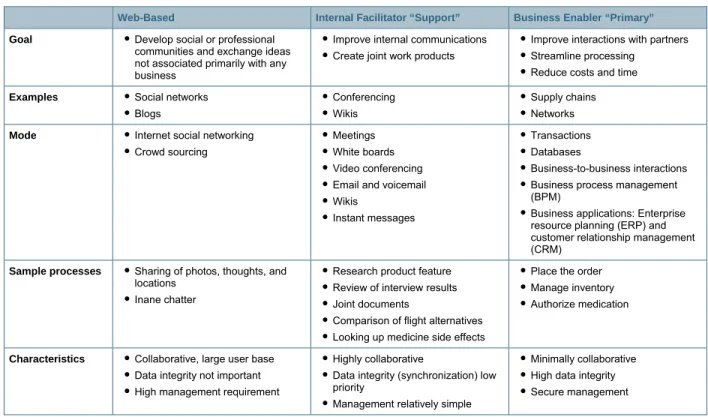
At the same time, much of what we see today in collaboration activities and technologies focuses on web consumers, or if it occurs in business, on improving internal communications. These uses, which strive to facilitate internal activities, could be thought of as “support”. Fortunately, we are now starting to see the use of collaboration techniques to improve the interaction between businesses and their customers, partners, suppliers, etc. - in other words, to enhance the “primary business processes”. We now realize that we need to incorporate human activity: to include human-to-human as well as human-to-system interactions in the solution. Table 1 summarizes these different types of interactions and their characteristics.
To truly get to a more integrated and optimized process flow, we need to apply collaboration capabilities and
technologies not only to the support functions, but also to the primary business processes. This entails more than just the introduction of new process or collaboration tools. An evolution in the way we think about business processes and collaboration is required, in addition to integrated workspace tools to implement and manage them.
The new paradigm for enterprise collaboration we are discussing has as its objective the dramatic acceleration of business processes by taking advantage of all enterprise resources (employees, partners, data, applications, and many more) wherever they are, whenever they are needed, and combining them in whatever way is optimal from a contextual point of view - all in a managed and controlled environment leading to continual business optimization and improvement.
Next-generation business processes do not consist of people chatting, twittering, or blogging - the business process is about actors gathering, sharing, and transforming information to achieve business outcomes in the context of business rules. Collaboration brings the actors together faster, wherever they are, and gives them the access and tools that are optimized to process the information, aligned with the business process.
Table 1. Comparison of Types of Collaborative Processes
Web-Based Internal Facilitator “Support” Business Enabler “Primary”
Goal ● Develop social or professional communities and exchange ideas not associated primarily with any business
● Improve internal communications ● Create joint work products
● Improve interactions with partners ● Streamline processing
● Reduce costs and time Examples ● Social networks
● Blogs
● Conferencing ● Wikis
● Supply chains ● Networks Mode ● Internet social networking
● Crowd sourcing
● Meetings ● White boards ● Video conferencing ● Email and voicemail ● Wikis
● Instant messages
● Transactions ● Databases
● Business-to-business interactions ● Business process management
(BPM)
● Business applications: Enterprise resource planning (ERP) and customer relationship management (CRM)
Sample processes ● Sharing of photos, thoughts, and locations
● Inane chatter
● Research product feature ● Review of interview results ● Joint documents
● Comparison of flight alternatives ● Looking up medicine side effects
● Place the order ● Manage inventory ● Authorize medication
Characteristics ● Collaborative, large user base ● Data integrity not important ● High management requirement
● Highly collaborative
● Data integrity (synchronization) low priority
● Management relatively simple
● Minimally collaborative ● High data integrity ● Secure management
What Does Collaboration Mean in a Business Process?
To better understand the topic, let’s look at the foundation of traditional business processes and workflow. Historically, these factors have been based on the idea of “business documents”, such as a “request for bid”. A business process is defined by breaking down the handling of the request into “activities” or “steps” using a functional decomposition technique. For example, a request for bid might be broken down into: acknowledge request, validate customer, check resources, check inventory, calculate cost, determine customer-specific pricing, approve, and propose bid. The required information is passed from step to step in the form of a document. A BPMS automates the flow of the document from participant to participant following the business rules defined in the business process, typically using the metaphor of an “inbox” for incoming work and an “outbox” for completed work. Some steps may be automated, such as calculating a price or checking inventory. Other steps may require human action, such as an approval function, in which case the document is placed in the person’s “inbox”.
In today’s transactional support systems, one problem with human interaction is that much of it is not recorded or used for further auditing, improvement, or analysis. In other words, none of the conversations, email messages, wiki discussions, etc. is associated with the primary business process that each relates to, yet these supporting
interactions are vital to leading the business process forward at critical junctures. With current process technologies, only the automated (technical and transactional) part of the overall business transaction is recorded, managed, and optimized.
Another problem in effectively capturing interactive processes is the time they take to complete. Using the request-for-bid example again, we can define the process start time as beginning with some initiating business event, such as the receipt of the request, and continuing until a completion event, such as issuing an invoice if the proposal is accepted. The duration of the process includes all the time that the request is sitting in someone’s inbox, all the “out-of-scope” interaction (such as conversations about specific customer concerns, the context for making adjustments to pricing, etc.), as well as the time to route from one person to another and the time for the people to perform their specific tasks. The time for a workflow requiring human interaction is typically hours or days.
The problem is that traditional business IT systems and databases have been structured around the idea of a transaction. A technical transaction, or a transaction implemented by an IT system, has certain properties that ensure the integrity of business data. (These properties are the well-known ACID properties: atomic, consistent, isolated, and durable). But, to achieve this integrity, transactional systems require that the duration of transactions be very short (called a short-running transaction). Automated business processes often involve short-running
transactions. However, because workflow processes involve human interaction and take much longer (a long-running transaction), they need to be handled differently - resulting in disconnect between the actual business transaction and the technical transaction. This phenomenon is illustrated in the top half of Figure 2.
Keeping with our example, the overall business transaction starts when the request for bid is received, and ends when the proposal is accepted and an invoice is issued. However, only the technical transaction - the interaction with the billing system - is managed by the IT systems. The rest of the interactions are lost, or at best, not tied to the technical transaction or to each other. This limitation, based on the capabilities of past and current business-processing systems, continues to restrict the opportunities for managing the entire actual business process.
Figure 2. Business Versus Technical Transactions
What we would like, as illustrated in the bottom half of Figure 1, is for the business and technical transactions to be completely co-incident. In other words, we want a managed technical transaction to start at the first interaction (receipt of request), encompass and store all of the communications and interactions including the billing transaction, and end at the appropriate time (issuance of invoice). Ideally, the improved collaboration would shorten the overall transaction time as well.
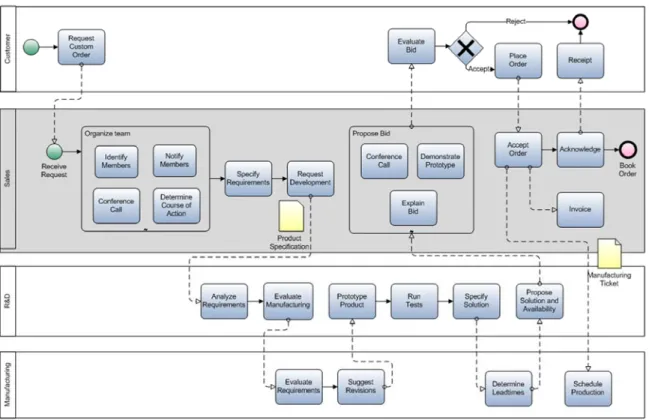
Now consider the previous business interaction modeled as a business process, as illustrated in Figure 3 (shown in the industry-standard Business Process Modeling Notation [BPMN]).
Figure 3. BPMN Model of Request-to-Order Process
Each participant in the process (customer Dave, salesman Steve, R&D “wiz” Rob, and manufacturing liaison Lee) are represented by a swim lane. The sales swim lane is highlighted to signify that it is the main participant in the process. The request-to-order process starts when sales receives the request for customization. The first thing sales does is to organize a team by calling Mary, setting up a conference call, and bringing in the other members. So, we can now
start to keep track of and manage the impromptu activities of the knowledge worker. In fact, this process is
represented by an “impromptu sub-process” in the diagram (denoted by the ~ in the bottom of the rounded rectangle). Because the activity is temporary, there are no sequence flows inside this type of sub-process.
The impromptu process of team formation addresses a persistent business problem, bridging the gap between specialization and distance. With rich, visual, real-time collaboration capabilities, Steve can have just-in-time (JIT) specialist engagement - the right expert at the right time. After the team is organized (including Steve, Mary, Rob, and Lee) and they decide on a course of action, the particular custom requirements are specified in a “Product
Specification” and sent to R&D for analysis. The dotted line represents the message flow between sales and R&D, and the folded-cornered rectangle represents the data or message that is being sent.
When R&D receives the specification, it analyzes the requirements - in particular how they may affect manufacturing - and then sends a message to manufacturing for evaluation. Notice that some message flows have specific
documents defined with them, such as the Product Specification, whereas others represent a collaborative exchange between the two participants. Nonetheless, we still want to keep track of, manage, and optimize these interactions. Next, manufacturing reviews and perhaps makes some suggestions and replies to R&D. A prototype is required to test the specification, so R&D develops the prototype and runs the tests. Based on the results, a product and manufacturing specification is finalized and sent to manufacturing to get a production date. Finally, R&D returns the final specification and availability information to sales.
Sales kicks off another temporary sub-process to conference with the customer, demonstrate the prototype and test results, and explain the bid. The product is a winner, so the customer accepts the bid and places the order. Sales sends a manufacturing ticket to manufacturing to schedule production, an invoice request to the billing system (a technical transaction), and an acknowledgement to the customer.
The formal process provides several advantages. First, it explicitly acknowledges and accommodates the interactive nature of the activities of knowledge workers. But, rather than being out of scope of the transaction, all of these communications are part of it. Impromptu communications are supported, delays and errors are reduced, and everything can be checked or audited. Now, the enterprise can go back and evaluate the process against
performance goals. What is the success rate of this process? What is the success rate of individual sales people? Is it taking too long to produce a bid given the request? Could some of the steps be removed or streamlined? Which ones, and where? Could the process be improved with some additional information? With the overall business process, implemented in an integrated workspace, all of these questions can be answered and the business results improved.
However, business and IT problems come in all shapes and sizes, so it should not come as a surprise that processes and workflows also come in different shapes and sizes, as do the approaches for defining them. There are two main approaches to defining business processes, orchestration and choreography. Orchestration is where a central or master element controls all aspects of the process. Choreography is where each element of the process is
autonomous and controls its own agenda. Both types of processes exist in most organizations, but are not well-integrated. Collaboration will play a critical role in bringing these processes together to meet today’s business challenges.
Orchestration
Orchestration is the most common approach, used within both workflows (WMS) and business processes (BPMS). With orchestration, you define the sequence of steps within a process, including conditions and exceptions, and then use a BPMS (central controller) to implement the sequence. You can implement the sequence with a variety of different techniques. For more complex orchestrations, however, you will often use a tool to create a visual model of the sequence (such as the BPMN model of Figure 3), and then to generate the code that executes that sequence, typically within a dedicated run-time environment.
Today’s standards for orchestration include BPMN for defining the visual representation of the sequence, and business process execution language (BPEL) as the “code” that executes the sequence.
In summary, orchestration:
● Assumes a single master that controls all aspects of a process (top-down approach)
● Supports a graphical view of the sequence
● Is usually simpler to start with, but often more difficult to scale to very complex or collaborative processes
● Is directed by the graphical process model; that is, function follows form
● Represents the state-of-the-practice, and is supported by most tools
So, the popularity of this approach is understandable, but it does not support all types of processes equally well.
Choreography
Choreography provides a different approach that is gaining acceptance in scenarios that have complex processes with many interacting parts, are highly collaborative, or have event- and agent-based systems. In a choreography approach, rules are created that determine the behavior of each participant in the process. The overall behavior of the process emerges based on the interaction of the individual pieces, each autonomously following its own rules. If you are familiar with the work going on with complex event processing (CEP), you will see the similarity in the problem space of CEP and a choreography approach; in other words, how can you manage the interaction of multiple, independent events (or participants) to yield an overall, predictable business result?
We can think of a collaborative process as leading toward choreography. The process definition defines the interaction between participants. In other words, it defines the rules that each party must follow to interact, but not necessarily how the participants will implement those rules internally.
In summary, in choreography:
● The overall process behavior “emerges” from the working of its parts (bottom up). No global perspective is required.
● Complex work processes are decomposed into work agendas where each autonomous element controls its own agenda.
● Choreography easily maps to highly collaborative processes and event- and agent-based systems.
● Choreography is usually more difficult to start, but often easier to scale to complex processes.
● It represents the state-of-the-art, and is gaining support with emerging modeling tools.
● Choreography either explicitly or implicitly benefits from improved collaboration infrastructure.
Trade-Offs
Some useful guidelines for understanding which approach is most appropriate for a given scenario follow: Use orchestration:
● When off-the-shelf process automation products are required (because this approach is implemented by most current products)
● For well-defined, composed processes
● For relatively static process definitions
● Where a graphical process definition is desired Use choreography:
● Where participants are highly collaborative and yield emergent behaviors
● Where opacity of process details is desired among process partners (such as business-to-business relationships)
● Where different process partners may require their own process customizations
● Where processes are highly dynamic or goal-seeking
Looking forward, we are beginning to see a migration from traditional orchestrated business processes toward choreography. These new approaches better serve the needs of knowledge workers, and they coincide with the emergence of collaboration as a critical business process-enabling tool.
Preparing for the Challenge
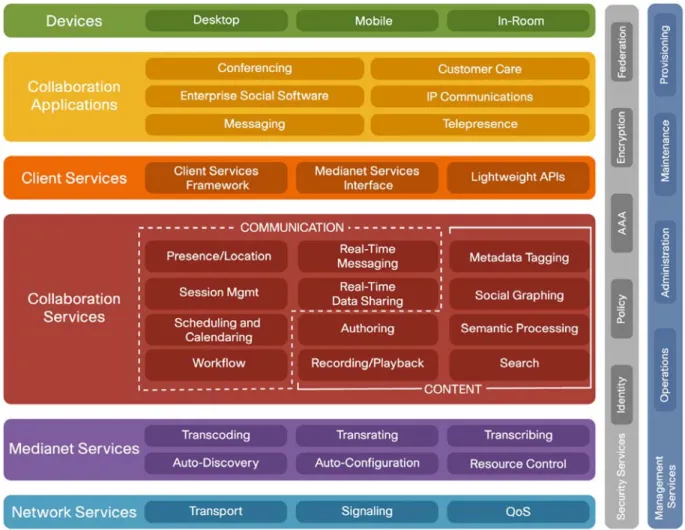
As technologies advance, the collaborative experience becomes more sophisticated as the content becomes richer, including voice, images, and video that go well beyond the traditional business document. The tools that we have at our disposal to store and reproduce rich information have overtaken our traditional way of thinking about record keeping, and about the way we implement workflows. The Cisco collaboration architecture (Figure 4) helps ensure interoperability between existing and new forms of communication and collaboration technologies, further enabling both structured and impromptu business processes. Individual components can be implemented onsite using existing infrastructure, they can be offered as hosted software-as-a-service (SaaS) solutions, or they can be deployed as a combination of the two.
Figure 4. Cisco Collaboration Architecture
Collaboration Capabilities
These capabilities support basic and sophisticated communications and collaborations across a wide variety of devices and content, including:
● Voice comprises synchronous verbal communications, including traditional telephones, mobile communications, and voice-over-IP (VoIP) systems.
● Video allows for the display of video information, and the use of real-time video to enable video conferencing, web cams, etc.
● Messaging provides the ability to send brief, asynchronous messages to others, and through the use of presence services, to know whether the recipient is online or not.
● Conferencing, the use of voice and video to create a virtual conference between two or more participants, also includes aspects such as white boards, presentations, and desktop and application sharing.
● Enterprise social software (ESS) provides work environments focused on specific workers, tasks, or processes that integrate collaboration and process capabilities. It also includes the creation of groups, selection of members, and definition of roles and entitlements.
● Content management involves management and publication of content including storage, versioning, searching, and knowledge management. Publication options include forums, wikis, blogs, documents, portals, etc.
● Identity provides a secured identity and role of each participant.
● Presence and location provide current information about location and status of participants.
● Security provides for authentication, authorization, encryption, and other services as required. Business-Process Capabilities
Technologies for managing collaborative business processes include:
● Visual process modeling: The ability to create visual models to define internal processes, collaboration, and messages, etc.
● Orchestration: The ability to have a centrally controlled, sequential business process
● Choreography: The ability to have autonomously cooperating participants with emergent behavior, yet still within the confines of a managed transaction
● Long-running transactions: Consistent transactions that span hours or days
● Management and monitoring: The ability to manage and monitor transactions, and to see the current state of any transaction, perform restart, recovery, etc.
● BAM: The ability to measure and monitor transaction activity in real time and link the output to business dashboards, key performance indicators (KPIs), and instantaneous process adjustment
Although not all of the capabilities are available yet in off-the-shelf tools (specifically, choreography and collaborative business processes), much of the enabling technology is available today, and an enterprise can begin to put the foundation in place now. In fact, those technologies, such as unified communications and collaboration tools, can be used immediately to provide value to any organization, while also building the capabilities, skills, and mind set necessary for the next generation of business processes.
Conclusion
Enterprises are under constant pressure to expand business capabilities, improve real-time information access, and provide richer user interactions. Globalization and new business models are breaking down traditional enterprise boundaries - and new Internet capabilities are raising customer and partner expectations and demands on user interaction. Businesses must respond with a new generation of applications for today’s realities, delivering business
value and competitive advantage, and taking advantage of the latest technologies. Next-generation applications will address these challenges by integrating collaboration into business processes at new and fundamental levels. Enterprises can move beyond traditional transactional system optimizations to begin enhancing white-collar
productivity and foster new models of people working together to achieve common goals both within and outside the extended enterprise.
However, next-generation applications require next-generation business processes that are not limited to traditional implementations of workflow and documents, and that provide the capability to enable, capture, measure, and secure collaboration and rich media across end-to-end processes. In addition, generation processes require next-generation infrastructure that provides networking and collaboration capabilities with the performance, reliability, and security required for tomorrow’s borderless enterprise.
You can begin enhancing business processes today by taking advantage of existing collaboration technologies and the API sets available to integrate them into existing applications. Fortunately, we already have next-generation infrastructures that support sophisticated, reliable communications, interaction, and rich content, including voice, images, video, and documents. And as understanding of the way in which process management needs to change matures and business demand grows, the industry will likely meet the challenge with new collaborative business-process tools. Increasingly, business-business-process capabilities will be added to vendor collaboration suites to take business to the next level of productivity, supporting both choreography and orchestration in modeling the next generation of collaborative business processes.