Graduate Theses and Dissertations Graduate College
2010
Web-based collaboration in horizontal
construction
Aaron Charles Zutz
Iowa State University
Follow this and additional works at:http://lib.dr.iastate.edu/etd Part of theCivil and Environmental Engineering Commons
This Thesis is brought to you for free and open access by the Graduate College at Digital Repository @ Iowa State University. It has been accepted for inclusion in Graduate Theses and Dissertations by an authorized administrator of Digital Repository @ Iowa State University. For more information, please [email protected].
Recommended Citation
by
Aaron Charles Zutz
A thesis submitted to the graduate faculty
in partial fulfillment of the requirements for the degree of MASTER OF SCIENCE
Major: Civil Engineering (Construction Engineering and Management) Program of Study Committee:
Charles T. Jahren, Major Professor Jennifer S. Shane
Bruce L. Bassler
Iowa State University Ames, Iowa
2010
TABLE OF CONTENTS
LIST OF FIGURES ... v LIST OF TABLES ... vi ABSTRACT ... vii CHAPTER 1: INTRODUCTION ... 1 1.1. Background ... 1 1.2. Problem Statement ... 3 1.3. Research Objectives ... 3 1.4. Report Content ... 4CHAPTER 2: REVIEW OF LITERATURE ... 6
2.1. Introduction ... 6
2.2. History of Web-based Project Management ... 6
2.3. Web-based Collaboration ... 8
2.4. Benefits ... 10
2.5. Issues Affecting the Success of systems ... 11
2.6. How To Maximize Benefits ... 14
2.7. Future ... 15
2.8. Action Research ... 16
2.9. Rapid Prototyping ... 17
2.10.Surveys... 17
2.11.Summary ... 18
CHAPTER 3: WEB-BASED PROJECT MANAGEMENT IN HORIZONTAL CONSTRUCTION ... 19
3.1. Introduction ... 19
3.2. Previous Research on Web-Based Collaboration ... 20
3.3. Implementation of WMPS in Horizontal Construction ... 21
3.4. Functional Needs for WMPS ... 22
3.5. Discussion ... 25
3.6. Conclusion ... 26
CHAPTER 4: WEB-BASED PROJECT MANAGEMENT ACTION RESEARCH ... 27
4.2. Theoretical Basis... 28 4.3. Research Method ... 29 4.4. First Iteration... 31 4.5.1. Diagnosing ... 32 4.5.2. Action Planning ... 32 4.5.3. Action Taking ... 33 4.5.4. Evaluation ... 34 4.5.5. Specifying Learning ... 34 4.5. Second Iteration ... 35 4.5.1. Diagnosing ... 35 4.5.2. Action Planning ... 35 4.5.3. Action Taking ... 36 4.5.4. Evaluation ... 37 4.5.5. Specifying Learning ... 38
4.6. Application of Specified Learning for the Third Iteration ... 39
4.6.1. Diagnosing ... 39
4.6.2. Action Planning ... 39
3.7. Discussion ... 40
3.8. Conclusion ... 41
CHAPTER 5: 2009 REASEARCH REPORT ... 43
5.1. Introduction ... 43
5.1.1. Problem Statement... 43
5.1.2. Research Objectives ... 43
5.1.3. Implementation of Solutions ... 44
5.2. Identification of Functional Needs ... 45
5.2.1. Interviews ... 45
5.2.2. Required Functionality ... 52
5.3. Functionality of Available Solutions ... 53
5.3.1. Identifying Commercially Available Solutions ... 53
5.3.2. Categorizing Software Programs ... 54
5.3.3. Review of Solutions ... 56
5.4.1. I-80 Project ... 58
5.4.2. Jackson 108 Project ... 58
5.4.3. Lessons Learned ... 60
5.5. Full-Implementation Pilot Project ... 60
5.5.1. Pilot Projects ... 60
5.5.2. Request for Proposals ... 61
5.5.3. Special Contract Provision ... 62
5.6. Summary ... 62
5.7. Research for Phase II ... 63
CHAPTER 6: CONCLUSION ... 65 6.1. Summary ... 65 6.2. Conclusions ... 65 6.3. Research Limitations ... 66 6.4. Future Work ... 67 REFERENCES ... 68
APPENDIX A.SAMPLE WEB-BASED PROJECT MANAGEMENT SYSTEM ... 71
APPENDIX B. GENERAL INTERVIEW QUESTIONS ... 75
APPENDIX C. LIST OF INTERVIEWEES ... 76
APPENDIX D. INDENTIFIED COMMERICAL SOLUTIONS ... 77
APPENDIX E. SOFTWARE REVIEW MATRIX ... 78
APPENDIX F. REQUEST FOR PROPOSALS ... 102
LIST OF FIGURES
Figure 3.1: Desired Features of WPMS ... 23
Figure 3.2: User Access to WPMS ... 24
Figure 4.1: First Iteration WPMS Workflow ... 33
Figure 4.2: Second Iteration WPMS Workflow ... 37
Figure 4.3: Automated WPMS Workflow ... 38
Figure A.1: Project Entry Screen ... 71
Figure A.2: Submittal Dashboard ... 72
Figure A.3: Sample Submittal... 72
Figure A.4: New Submittal Form ... 73
LIST OF TABLES
Table 2.1: WPMS Features ... 12 Table 4.1: Technical Advisory Committee ... 31 Table 5.1: State Survey ... 51
ABSTRACT
Web-based collaboration tools offer many benefits in the management of construction projects. These systems have become increasing popular in the vertical construction sector; however, they have not been widely implemented in the horizontal construction sector. Research was completed to determine how prevalent the use of web-based collaboration software is with state departments of transportations (DOT) and what needs exist within state DOTs for web-based collaboration.
To learn how web-based collaboration could be implemented within state DOTs a pilot project was conducted with the Iowa DOT. This project focused on identifying the Iowa DOT’s project management needs on bridge projects and implementing web-based project management systems (WPMS) to meet these needs. Systems were implemented using an action research methodology in an iterative nature in order to meet the immediate needs of the Iowa DOT while working towards a long term solution. Through this process a commercial solution was selected and pilot tested on bridge construction projects. Based on previous iterations and a functional analysis of the Iowa DOT’s needs this solution focused on the management of contract documents, shop drawing submittals, and requests for information.
Results of this pilot project and research will help provide the horizontal construction sector with information for successfully implementing WPMS. By targeting specific
construction documents and beginning by initially implementing smaller scale systems, organizations may be able to improve the success of WPMS implementations and reduce the initial cost and risk of implementing WPMS.
CHAPTER 1: INTRODUCTION
1.1. Background
Communication and the transfer of information on construction projects is becoming increasingly complicated. Projects are incorporating more participants and these participants are often quite geographically diverse. Shrinking project durations, complex details, and innovative contracting methods are also requiring project participants to effectively and efficiently communicate and share project information.
In horizontal construction new construction methods such as Accelerated Bridge Construction (ABC) are compressing schedules. The accelerated schedules and
constructability issues require more communication between the owner, contractor and designer (WA DOT 2009). Additionally, with design-build construction becoming more prevalent in horizontal construction effective communication is becoming even more important. In the Federal Highway Administration’s (FHWA) (2006) report on the effectiveness of design-build construction they highlight communication as a key lesson learned from previous projects and something that is very important to improving design-build programs.
As project participants face these challenges the need to improve communication has become critical. Communication is an integral part of project success and effectively
communicating has been shown to be an important factor in the success of a project (Chassiakos and Sakellaropoulos 2008). One way that project participants can further facilitate and improve communication is through the use of Information Technology (IT). Specifically within IT initiatives web-based project management (WPMS) has developed as a way to help project teams communicate and transfer information.
The general idea of WPMS revolves around the use of the Internet to facilitate rapid exchange and access to project information through web-based collaboration. By utilizing the Internet information is centrally stored and can be easily accessed by project participants. This access allows project participants to collaborate during design and construction more easily. By using the Internet over other mediums of communication users are able to take
advantage of common standards to help overcome compatibility issues of different programs (O’Brien 2000). Web-based Project Management Systems may be referred to by many names, two other commons ones are, Project Specific Website and Project Information Management System (Nitithamyong and Skibniewski 2003).
WPMS have grown over time but typically work to manage information in four main areas: financial, project, design, and management. The financial portion of a system
manages information such as cash flow projections, contract status reports, and the general ledger. The project information contains descriptive information about the project; this may include photos, participant directories, and a project description. Design information
typically manages contract drawings and specifications. Finally, the management
information area contains many construction documents such as meeting minutes, Requests for Information (RFIs), submittals, and progress reports (Mead 1997).
Utilization of WPMS offers many benefits with the primary one being improved access to project information (O’Brien 2000). Some of the other benefits touted by
proponents of WPMS include a reduction in documentation errors, better financial control, increased speed of work, increase transparency, and reduced cost (Nitithamyong and Skibniewski 2004; Nikas et al. 2006). The resulting goal of these benefits is ultimately to improve communication and information transfer between project participants and hopefully project success.
As these systems have developed the number of them commercially available has dramatically increased. A brief search of the Internet will show dozens of WPMS solutions. These systems vary greatly in terms of their features, cost, and licensing and hosting options. The variety of options allows a project or organization great flexibility in selecting a solution that best meets their needs. Recently the development of licensing these programs as part of a Software as a Service (SaaS) agreement has greatly increased their availability
(Nitithamyong and Skibniewski 2004).
With such a wide variety of options available in WPMS the selection of a solution is critical. One of the primary setbacks of these systems is the difficultly of successfully
implementing them into organizations. Many solutions, while technically sound, fail due to the organizational, human, implementation, and change factors influencing the success of a WMPS. The most common reasons for failing to receive the full benefits from a WPMS are: poor capture of user requirements, lack of strategic approaches, lack of proper planning, user resistance to change, lack of user involvement, and technical characteristics (Erdogan et al. 2008). Of these reasons, five of the six relate to how the solution is chosen or developed and how it is implemented. Three of the six reasons directly relate to the users of the system. For these reasons it is critical for the success of a WPMS to understand the organizational and project needs, goals, and cultures.
1.2. Problem Statement
When WPMS were introduced they were heralded as a something that would dramatically change how projects were managed. Since that time the level of adoption of these systems has been somewhat low. Research by Engineering News Record (ENR) (2005) in the 2005 showed adoption levels of WPMS to be less than 20%. Additionally, a survey by ENR (2004) in 2004 showed that 80% of readers involved in information technology purchases felt that improving communication and collaboration was the most important contribution of technology to their company in the next five years. Thirdly, in 2005 the FHWA conducted a focus group to look for innovations in the vertical construction industry that could be applied to the horizontal construction industry. One of the
recommendations was for the increased use of WPMS within the horizontal construction industry.
Considerable research has been done to investigate the benefits of WPMS and also to examine what affects the success of WPMS implementations. Since the FHWA report was completed in 2005 little has been done to specifically investigate what level of adoption of WPMS exists in the horizontal construction sector and what the industry’s specific needs are. 1.3. Research Objectives
To learn more about the needs and implementation of WPMS in the horizontal construction industry work was completed to quantify the level of adoption within the
horizontal construction industry and also investigate what needs exist for WPMS. To do this, state DOTs were targeted to sample the horizontal construction sector. This sample was surveyed to find out the level of implementation of WPMS. This sample was also surveyed to find out which project participants would benefit most from access to WMPS and what construction documents the DOTs thought could be best managed by WPMS.
State DOT’s were targeted since owners are often the drivers of implementation and are typically the most successful at implementing WPMS (Dossick and Sakagami 2008). The goal of surveying the state DOTs was first of all to learn more about the level of adoption within the horizontal construction industry. Secondly, a goal was to learn more about what needs existed in horizontal construction in order find out how to more effectively implement solutions.
Finally, pilot testing of WPMS on bridge construction projects was conducted with the Iowa DOT. Work with the Iowa DOT was completed to investigate their needs to help them best implement WPMS. To best serve the Iowa DOT this research was conducted using the method of action research to allow the greatest benefits to the Iowa DOT while also conducting research. The nature of action research allowed for multiple iterations of WPMS to be implemented to meet the immediate needs of the Iowa DOT while working towards a long term solution. The results of this case study could be beneficial in helping other DOTs implement or evaluate WPMS for their own use.
1.4. Report Content
The remaining chapters of this report are organized as follows. Chapter 2 contains a literature review of work previous completed on WPMS and the research methods utilized in the case study with the Iowa DOT. Chapter 3 is written in the style of a technical note for an academic journal on the level of implementation of WPMS in the horizontal construction industry and the desire for project participants to have access to WPMS and manage certain construction documents with WPMS. Chapter 4 is written in the style of an academic journal article on the case study of implementing WPMS in the Iowa DOT. It describes the iterative process of implementing WPMS on bridge projects using the methods of action research and
rapid application development. Chapter 5 contains the report submitted to the Iowa DOT for the first year of the research project on pilot testing WPMS on Iowa DOT bridge projects. Chapter 6 contains the summary of work completed and conclusions along with research limitations and recommended future work.
CHAPTER 2: REVIEW OF LITERATURE
2.1. Introduction
The use of the internet to facilitate the management of construction projects through technologies such as web-based project management systems has become quite prevalent. These programs have been widely used within the vertical construction industry to assist in the management of projects. However, the use of these programs has not been as prevalent in the horizontal construction industry. In 2005 the FHWA initiated a tour of vertical construction projects and companies for a group of horizontal construction professionals. The goal of this tour was to look for innovations in the vertical construction industry that could be applied to horizontal construction. One innovation recommended for further implementation in horizontal construction was web-based project management systems (WPMS) (FHWA 2005).
2.2. History of Web-based Project Management
The use of project management software to assist managers is not something new to the construction industry. Project management software has been used for decades to manage many types of information from financial data to scheduling to document management (Suchaic 2001). The use of project management software and its applications has been steadily changing over time to help better meet the needs of the industry. Throughout the history of project management software there have been a number of outside factors that have dramatically changed the way that software has been used. In the early 1990’s the increased availability of personal computers allowed project management software to be much more readily available to individual users and more recently abundant access to the Internet has made the transfer of information much more efficient.
With the advent of widespread access to the Internet in the 1990’s information could be exchanged in new ways, which, created a great change in use of project management software. Utilizing the Internet, companies were able to transfer documents much quicker and cheaper than before (Anumba et al. 2007). By incorporating the internet into project management programs users were able to collaborate by sending and receiving information
much faster, thus helping reduce unnecessary delays. This use of web-based collaboration was designed to help overcome the chaotic nature of communication in construction that often leads to lapses in communication, poor understanding, conflict, and cost and schedule overruns (O’Brien 2000).
As web-based collaboration matured it allowed the development of project websites in the late 1990’s. The idea behind project the website was that each project would have its own unique website which would serve as a centralized location to store information so that it would be easily accessible to the project participants (O’Brien 2000). By using a project website for this task information became more accessible then through other mediums of communication such as fax, mail, and email. This increased availability was because the project website stored the information on central servers which were connected to the Internet. This allowed all project participants access to the same information at any time (Mead 1997). The improved accessibility and transfer of information allowed for
collaboration between project participants during the design and construction process.
Ultimately the idea was that improved collaboration and access to projects information would lead to improved project performance.
Initially the implementation of project websites was quite limited in the construction industry. Anumba (2007) suggests that this maybe have been due to the fragmented nature of the construction industry and also because project websites were not meeting the needs of projects. An additional factor that may have hindered the implementation of project websites was their cost. In the mid 1990’s costs for project websites were often over $40,000 per project, however by the year 2000 costs were usually below $10,000 (O’Brien 2000).
Since the introduction of project websites as a means for collaboration in the 1990’s the use of these systems has been steadily increasing (Nitithamyong and Skibniewski 2004). A survey by the Construction Financial Management Association (CFMA) in 2004 showed 80% of owners believed project collaboration software could help improve communications. In this same survey 62% of owners listed “More effective communications” as the most important factor to improve project delivery (ENR 2004). With owner’s viewing
collaboration software as a viable way to improve communication on their projects the use of web-based project management should continue to increase.
2.3. Web-based Collaboration
The basic premise of a web-based collaboration system is that there is a website specific to the project that allows users to access the project management software through any internet connection (Johnson 2004). The project website “provides a centralized, commonly accessible, reliable means of transmitting and storing project information” (Nitithamyong and Skibniewski 2004). Beyond this definition, WPMS vary significantly among their features and setup.
When talking about project websites and WPMS it is important to differentiate these systems from other systems that allow the transfer of information via the internet, one of the most common these is the FTP site. These sites allow the posting of files in a folder structure similar to those in internal networks. However, these systems do not track who does what in the system and the user interface is typically not very user friendly. Because of this project websites offer many benefits that FTP sites lack (Johnson 2004).
WPMS can be broken down into three main categories. The first type is the Project Collaboration Network (PCN). PCN solutions focus on facilitating project management by assisting project participants with sharing documents, communications, and workflows. The system also tracks what is accessed and when, and manages the versions of documents. The second type of system is the Project Information Portal (PIP). These systems are usually free and are used to track codes, permits, economic trends, cost data, and project planning information. The third type of solution is the Project Procurement Exchange (PPE). PPE are used to electronically manage bidding and procurement (Nitithamyong and Skibniewski 2003).
When discussing WPMS there are three primary options for acquiring a system: it can be developed and hosted by the system owner, it can be purchased and hosted “in-house” by the system owner, or it can be purchased as service while a vendor hosts the system
large firm working far in advance of the need. However, developing an in-house solution can be quite expensive depending on the circumstances. Purchasing software and
self-hosting can serve as a middle ground when owners do not want to develop software, but want the information to reside on their own servers. This generally has a reduced initial cost when compared to custom developed software, but still requires a significant amount of in-house technical know-how and equipment. The final option is to lease the software in an
Application Service Provider (ASP) or Software as a Service (SaaS) agreement. In this arrangement the owner typical pays a monthly fee for a third party to host and maintain the system. This option is gaining popularity because it requires minimal, technical, financial, and human resources to develop and operate. It also allows for the most rapid deployment of the system. Often this option is most viable for small to medium size companies who lack significant technical resources (Nitithamyong and Skibniewski 2004; Chan and Leung 2004). Regardless of the hosting situation access to WPMS are usually password protected to prevent unauthorized access to information contained on the site. The use of a user login also serves an additional purpose. By requiring users to login, the system can track what each user does in the system and also restrict what users have access to (Nitithamyong and
Skibniewski 2004). The benefit of this can be an increase accountability and reduction of errors in communication.
The application of WPMS varies significantly from system to system. In general there are four main areas that WPMS are designed to address: project information, design information, management information, and financial information (Mead 1997). The project information category contains general project information, photos, and directories of project participants. Design information contains contract drawings, revisions, and specifications. Management information contains meeting minutes, submittals, change orders, as built drawings, Requests for Information (RFI), logs, schedules and, financial information, which includes information relating to the accounting of the project. Systems can be designed to cover one or all of these areas. Other areas such as bidding and procurement have been incorporated in to systems more recently (Nitithamyong and Skibniewski 2004).
Workflow management is an important part of project websites. By incorporating workflow into a project website, users can set a predetermined route for information. For example, a workflow can be setup that will allow the project manager to assign “tasks” to users, such as responding to an RFI. When the user has completed their task the system automatically prompts the next task for that item and the user who is affected (Chan and Leung 2004).
Finally it is important for collaboration systems to be able to integrate with other systems within a company. By allowing the integration of systems WPMS can allow
automatically retrieve information such as the meta-data from documents to help simplify the transfer of information from one system to another. This can greatly reduce the effort required to move information (Chan and Leung 2004).
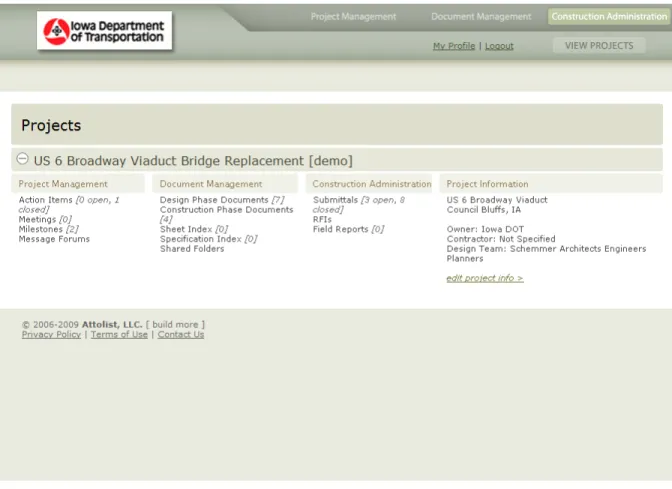
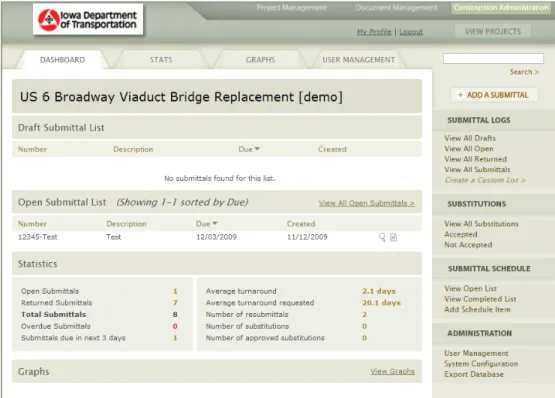
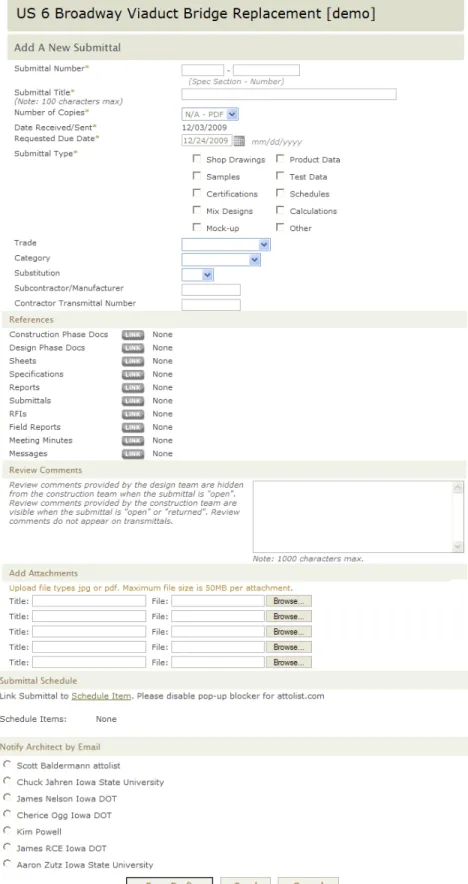
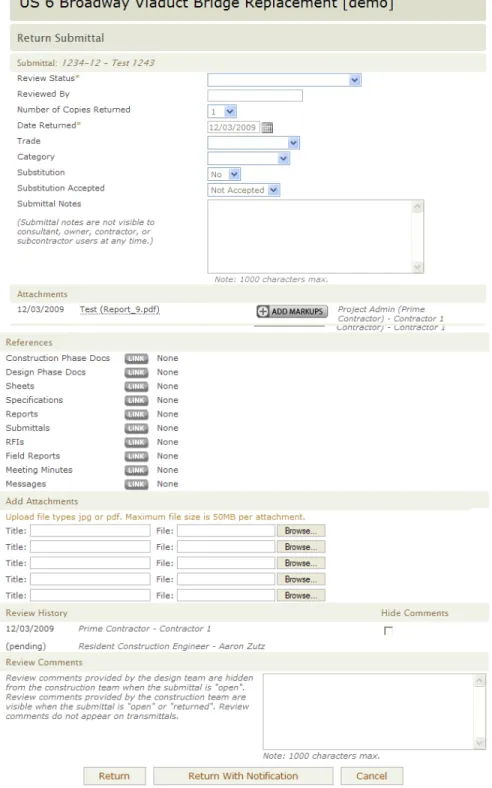
To demonstrate what a commercially available WPMS looks like some screen shots have been included in Appendix A. The solution shown in the screen shot is Attolist, a commercially available WPMS (attolist.com). These screenshots show a basic overview of the system and also depict the submittal process. The RFI process, not shown, is very similar to the submittal process within the system.
2.4. Benefits
The primary advantage of using WPMS over other forms of project management solutions is the availability of the information. Initial project websites sought to use the Internet to provide superior means of communication. Using the Internet allowed for better access to information then means such as phone, fax, overnight mail, and email (O’Brien, 2000). Ideally this improved method of communication would lead to improved project results.
This increased availability allows anyone with a computer and an Internet connection to access the project website. This is becoming much more important as project teams are gaining geographic diversity. Also, since all project participants are accessing the same site they all have access to the same information. This means that everyone sees the same
version of drawings, which, helps increase the accuracy as well as the accessibility of information for project participants (Thorpe and Mead 2001)
Another major benefit of web-based collaboration is increased efficiency. Utilizing WPMS allows for more rapid transmittal of information. This can also help project
participants deal with large volumes of information quickly (Mead 1997). Additionally, by managing information through a single web-based system all of the steps of a process can be documented in one place, and workflows can be set up to dictate the flow of information. This allows for better documentation and controls of information (Nitithamyong and Skibniewski 2006).
As projects management needs change, web-based project management systems can help construction professionals better manage a number of factors in the changing
environment of construction management. These factors include: globalization, economical forces, increasing project complexity, the need to achieve faster results, rapid changes to project scope, new procurement practices, and client sophistication (Alshawi and Ruikar 2002).
2.5. Issues Affecting the Success of systems
To maximize the benefits of WPMS the proper selection and implementation of the system is critical. Regarding the implementation of IT initiatives the failures of these
systems are rarely found to be technical. The majority of the time they are related to change, implementation, human and organization factors, and the roles of the management and end users (Erdogan et al. 2008). Because of this a focus on the selection and implementation of solutions is critical to the long term success of a WPMS
According to Erodgan (2008), the most common reasons for failing to receive the full benefit from collaboration systems are: poor capture of user requirements, lack of strategic approaches, lack of proper planning, user resistance to change, lack of user involvement, and technical characteristics. Of these reasons, five of the six relate to how the solution is chosen or developed and how it is implemented. Three of the six reasons directly relate to the users of the system.
To successfully implement a WPMS the first step is to evaluate the need for a system. “Most of the IT systems are usually introduced because of operational requirements, and therefore most of these fail due to the lack of alignment with the strategic and business requirements and long term goals” (Erodgan et al. 2008). When evaluating the need for WPMS some factors that should be considered are: the number of project participants, the number of physical locations of project participants, volume of information that needs to be shared, the amount of time required to set up a system, access to the Internet and computers for users, existing contracts for WPMS, user technological experience, and previous
experience with WPMS (Johnson 2004). Comparing project types, it should be noted that WPMS have been mostly used on commercial projects. Nitithamyong and Skibniewski (2006) theorize this may be due to the increased amount of relatively simple drawing, such as submittals and RFIs, on commercial projects compared to heavy and industrial projects. This difference has allowed commercial project to most easily transfer documents via WPMS.
When selecting a system it is important to select a WMPS that has the same
functionality as required by the project or organization. The functionality may vary based on the phase of project requiring web-based collaboration: conceptual planning, design,
construction, or program management. The type of information flow required in the system: one-way or two-way and, the expense of the system and also the general type of system, file sharing or construction management. Based on these initial functions systems can be evaluated based on their features. Some important features to evaluate include are shown in Table 2.1, as listed by Johnson (2004).
Table 2.1: WPMS Features
Important Features Typically Provided in a Project Website 24/7 access to the system by secure login/password
Home page with directory and project images/logos Team directory and calendar
Institutive easy to understand user interface
Ability of system to be minimally functional at dial-up speeds (56k)
Table 2.1: (Continued) Important Features Not Always Provided
Ability to search and find documents by filename, author, or text keywords Ability to set up and customize project sites by an internal administrator Ability to archive all stored information at the end of the project on a CD Ability to organize and name folders as needed for document management Email notification of posted documents with a link to the issue
Good quality customer support system including email and phone support Drawing review and mark-up capability
Accountability: Name, time stamp, action of person accessing files on system Storage of large amounts of data on a secure server
Important for Construction Projects
Customizable workflow for tracking documents such as RFI's Documents management and review capability, built in file viewer Nice-to-have Features
Executive dashboard: Ability to see hot issues across projects on one screen Compatibility with hand-held computers for some functions
Drawing management system with secure checkout procedures Ability to integrate new system with legacy systems
High security (encrypted) data transmission using certificates Vendor & Internal Issues
Expected long-term viability of vendor software/ASP provider Large customer base and number of projects under management
Mature software product, relatively bug-free, infrequent upgrades expected Do major software upgrades include data-transition to new version?
Minimum expected changes to the software over time that require re-training Efficient access speed - DSL/T1 line desirable
User and Situation-dependent Issues
Efficiency advantage over non-web-based existing collaboration systems Affordable and justifiable cost
Clear value of system to critical users, such as the contractor or owner Existing PW vendor agreement or internal PW development capability?
When comparing systems it is also important to consider the amount of unnecessary features included. The ideal system will only have the necessary functions required by the user; unnecessary functions can hinder the user friendliness of the system (Johnson 2004). Other issues that can affect a WPMS and should therefore be considered include the
reliability of the system, the security of the system, legal issues of transactions on the system, and the ownership of data at the end of the project (Nitithamyong and Skibniewski 2004).
Throughout both the evaluation of needs and selection of the system, users must be taken into account and involved. People are generally resistant to change, however the majority of people are pragmatists and are willing to accept change if they can be showed the proof of benefit (O’Brien 2000). One issue with this is it can be difficult to quantify the benefits and cost of WPMS (Nitithamyong and Skibniewski 2004). Some of most effective ways to help reduce problems with users in the system include the following two ideas. First, involve users early on in the life cycle of a WPMS, this can help reduce the end user
resistance to the system. Second, predefine people’s roles within the system so they know how to use the system, this can also help reduce user resistance (O’Brien 2000).
Another issue affecting the success of WPMS can be password access to the site. The use of a password implies that decisions must be made as to who can use the system. This can create boundaries within the project team. Along these lines, the degree of collaboration the website allows is an important factor in its success, truly collaborative work requires a non-hierarchal approach. Often times some control is needed in the hierarchy of systems, but this must be balanced carefully (O’Brien 2000). Additionally, while project websites are superior to many means of communication, they do create another channel of communication users must manage. Finally, the different needs of project participants must be considered, not all participants have the same needs. So while a project website may be convenient for the owner, it may also be a hindrance to the contractor.
2.6. How To Maximize Benefits
Awareness of the issues affecting the success of WPMS is critical in planning for the success of a system. There are a number of specific recommendations for working to
overcome obstacles that may reduce the effectiveness of a system. Beyond addressing issues regarding the selection and implementation of a system it is important to get upper
management support for the system. This should include designating a “Champion”, someone who personally takes responsibility for the WPMS. Also, the website needs to be
explicitly defined prior to the project and these definitions and guidelines for use need to be enforced. The roles of people need to be laid out and users must understand that not
everyone may personally benefit from the use of the solution. Generally, WPMS should not be imposed on a project already in progress (O’Brien 2000).
Proper training of system users also serves as a way to help improve the success of a system. When training system users it is important to make sure the system performs
properly during the training seminar. Also including the system “Champion” in the training can help improve success. Providing training for critical users prior to the training general users can also be helpful. The training should focus on the parts of the system the users will be using and should be completed near the use of the system, ideally within two to three weeks of use. Finally, trainers should follow up with trainees after the training to find out how they are doing (Johnson 2004).
Erodgan (2008) has identified nine steps for successfully implementing collaboration: 1. Recognize need for a new system
2. Feasibility analysis
3. User requirements capture 4. Design of technical system 5. Planning the adaption process
6. Choosing the optimum amount the adaptive alternatives 7. Testing and evaluation
8. Implementation 9. Fine tuning 2.7. Future
As web-based project management continues to mature a number of trends are expected. Firstly, there will be a reduction in the number of available solutions.
Additionally, there will be a standardization of features, more integration between systems, a decrease in price, and an increase in data security (Nitithamyong and Skibniewski 2004). This will be seen as WPMS solutions work their way further down the ladder from the large projects and contractors to medium and smaller ones. As the benefit of these systems are
more widely recognized they will be more widely incorporated in projects, and a “new era of productivity will be begin to unfold” (Nitithamyong and Skibniewski 2003).
2.8. Action Research
Action research as a research method has been widely used in the social sciences. Action research is used because it allows research to be conducted while investigating and solving actual problems. Action Research differs from traditional research in that its emphasis is to “improve” rather than “prove”. The goal of action research is to help better understand situations and thus resolve problems that arise (Hauck and Chen 1998).
Utilization of the model of action research described by Susman and Evered has been used to research software (Olesen and Myers 1998). This action research method includes five steps: diagnosing, action planning, action taking, evaluation, and specifying learning. The first step, diagnosing, involves identifying the problems that need to be addressed. The second step, action planning, entails determining what actions will be taken to eliminate the identified problems. Thirdly, in the action taking step the planned actions are implemented. In the fourth step, evaluation, the results of the actions are reviewed and compared to their intended results. Finally, in the specifying learning step, the knowledge captured during the process is specified and communicated to both the organization participating in the research and the scientific community. The cyclical nature of this method allows the benefit of conducting multiple iterations (Susman and Evered 1978).
Action research has served as a good method for many information technologies. By allowing researchers to test theories, gain feedback, and modify the theory through close work with developers and system action research allows researchers to address immediate concerns. The iterative nature also allows knowledge learned in the research to be directly applied back into the project. This emphasis on collaboration makes action research well suited for information technology research (Olesen and Myers 1999).
While action research has been praised for the relevance of its results it has also been criticized for its lack of rigor (Davison, 2004). Because of this, researchers must make sure they are explicit with their aim, theory and method to protect the integrity of their research.
If the work that is lacking in these areas that is at risk for being considered as consulting rather than research work (Olesen and Myers 1999).
2.9. Rapid Prototyping
To help meet the demands of a faster pace economy rapid application development (RAD) has become an increasingly popular route for the development of software. The goal of this technique is to accelerate the design and deployment of prototype solutions. RAD accomplishes this by actively involving users in the design and by accelerating the phases of the solution development and deployment to decrease the time until users see working solutions (Whitten et al. 2000).
Utilization of RAD offers many benefits. RAD almost always results in a lower cost of software development and often better quality. Using RAD on projects can help better meet business needs, fit user capabilities, reduce system bugs, improve human factoring, and create systems that can continuously evolve (Martin 1991).
2.10. Surveys
Surveys can be used to collect information about a variety of topics. Using surveys serves as a good way to gather information directly for groups of people (Fink, 2006). They can be conducted through various mediums and in various formats to obtain information (Tull and Hawkins 1980). The format and medium of a survey can greatly impact its results, so it is important to evaluate how a survey will be conducted.
Surveys can be conducted as structured or unstructured depending on how close the interviewer sticks to the wording of the questions and instructions of the questionnaire. Structured interviews reduce interviewer bias which can help control the responses of interviewees. Unstructured interviews allow the interviewer more control in the
administration of the questionnaire. This type of interview is best suited to a topic where less is known about the subject being investigated. Because of this unstructured interviews are often used in exploratory interviews (Tull and Hawkins 1980).
Surveys are also differentiated by the way the interview questions are presented to interviewees, direct or indirect. In direct interviews, interviewees are aware of the purpose of the questions they are asked. This help make the response easier to interpret. Indirect questions mask the purpose of the questions. Indirect techniques are generally used when direct questions are not available (Tull and Hawkins 1980).
When designing a questionnaire there are a number of considerations that must be taken into account. Seven areas to consider are: preliminary considerations, question content, question wording, response format, question sequence, physical characteristics of the
questionnaire and the pretest. Moving through these categories in developing the
questionnaire serves as a good way to make sure that a survey has been designed in a manner to provide good results (Tull and Hawkins 1980). Properly creating a survey will help insure a reasonable response rate and also accurate results.
Once the results of a survey and have been received and compiled analysis of the results must be conducted to gain insight into the results. Statistical analysis can be
conducted to find correlations, regressions and descriptive statistics (Fink 2006). Using the results of the survey and analysis, graphs and figures should be created to visually depict the results of the survey.
2.11. Summary
Based on the literature review, previous research has identified many benefits associated with the use of WPMS. This research has also investigated what affects the success of WPMS. However, research has not been conducted to find out what the specific needs of the horizontal construction industry are, or what level of implementation exists within the horizontal construction sector. Conducting surveys could serve as away to investigate the level of adoption of WPMS within the horizontal construction industry. Additionally, the methods of action research and RAD could serve as ways to investigate how WPMS could improve project management within the horizontal construction sector, and help implement solutions.
CHAPTER 3: WEB-BASED PROJECT MANAGEMENT IN
HORIZONTAL CONSTRUCTION
3.1. Introduction
The size and complexity of large construction projects present many unique
challenges. Along with the increased cost of these projects there is a substantial increase in number of shop drawing submittals and RFI’s that are processed. The quantity of these documents and others can make their management difficult. Utilization of web-based project management systems (WPMS) on projects to transmit, track, and store these documents can help simplify their management. The benefits of using web-based project management to manage these documents can include decreased transmittal time, decreased documentation errors, increased transparency, and faster access to data for project participants
(Nitithamyong and Skibniewski 2004; Nikas et al. 2006). This ultimately has the possibility to help all project participants better manage projects.
As the Internet came of age in the new millennium it was predicted to revolutionize the way that information would be managed (Anumba and Ruikar 2001). Among many areas, project management was seen as an area that could be greatly affected by the Internet in the near future (Alshawi and Ingirige 2003). A survey conducted for Adobe Systems in 2005 regarding the means of communication in architecture, engineering, and construction found that only 17% of respondents used WPMS to exchange files. In 2005 separate survey by Engineering News Record (ENR) showed that 80% of readers involved in information
technology (IT) purchases felt that improving communication and collaboration was the most important contribution of technology to their company in the next five years (Sawyer 2006).
A scanning team of horizontal construction professionals was created by the FHWA in 2005 to tour vertical construction projects and companies. The goal of scanning team was to look for innovations in the vertical construction industry that could be applied to
horizontal construction. One innovation recommended for further implementation in horizontal construction was WPMS (FHWA 2005).
Researchers at Iowa State University sought to find out how prevalent the use of WMPS is in the horizontal construction industry and in what applications did owners most desire the features of WPMS. Since the use of WPMS is often driven by the owner of a project, researchers surveyed state departments of transportation (DOTs) to answer several questions.
3.2. Previous Research on Web-Based Collaboration
Past research identified many benefits associated with the use of WPMS. The most widely anticipated benefit of using WPMS is improved communication. Communication has been shown to have a direct impact on the success of a project and its associated productivity (Chassiakos and Sakellaropoulos 2008). Improved communication on projects results in benefits in a multitude of areas. Nitithamyong and Skibniewski have stated some of these benefits to be increased quality of documents and speed of work, better financial control, and simpler and faster access to common data as well as a decrease in documentation errors (2004). Furthermore, increased transparency, time savings, and cost savings have also been attributed to improved communication through web-based collaboration (Nikas et al. 2006).
One of the major issues limiting the success of WPMS is in the implementation. When implementing WPMS many concerns must be considered beyond the technical aspects of the system. Erdogan (2008) states that many systems fail due to a lack of focus on factors related to change, implementation, human and organizational factors, and management of end user. Because of this, many systems that are technically sound ultimately fail upon implementation. Additionally, as with many information technology initiatives, it is difficult to quantify the benefits of using WPMS. Technical issues such as system security and reliability as well as legal issues can also hider the success of a WMPS (Nitithamyong and Skibniewski 2004).
A review of literature has shown that the benefits of WMPS and the barriers to successfully implementing them have been already researched and are fairly well grasped. Research has also been done as to how to overcome these barriers (Dossick and Sakagami 2008). However, since the FHWA published their report recommending further use of
WPMS in the horizontal construction sector, not much has been written about the level of adoption. Additionally, changes in the WPMS market have made them much more widely available and cost effective for smaller companies and projects. This has specifically been seen with the recent influx of WPMS marketed through Software as a Service (SaaS)
agreements, where the vendor hosts the solution and customers purchase on-demand licenses (Nitithamyong and Skibniewski 2006).
3.3. Implementation of WMPS in Horizontal Construction
In the fall of 2008, researchers from Iowa State University along with personnel from the Iowa Department of Transportation conducted a survey among state DOTs. The DOTs were surveyed to find out if they were using WPMS to manage construction projects, and if so, in what capacity the systems were being used. Based on the responses of these surveys, researchers sought to get a baseline understanding of the prevalence of WMPS in the horizontal construction sector.
Surveys were sent out to 51 different Chief Constructions Engineers at state DOTs and the District of Colombia’s DOT. Surveys were emailed directly to the Chief
Construction Engineers with blank spaces provided for their answers. This format was chosen to make the survey user friendly for the respondents.
Of the 51 surveys sent out, 27 responses were received. Among the states responding to the survey, only three states, or 11%, indicated that they used WMPS on projects in order to collaborate with project participants from multiple organizations. Another six states, or 22%, identified using project management software, but only internally.
A follow up with these three respondents that use WMPS external to the DOT showed that each of the three was currently in the process of implementing the system and did not have it fully operational as of the fall 2008. These respondents were implementing a variety of solutions, both custom and commercial. Additionally, these respondents planned to use the systems on all projects, not just select large and complex projects.
3.4. Functional Needs for WMPS
In the fall of 2009 Iowa State University researchers conducted a second survey of the Chief Construction Engineers from state DOTs to find out in what areas they felt WPMS could assist them with in the management of their projects. The survey asked the
respondents questions in two areas. First they were asked which construction documents were the best candidates for WPMS assistance. Second, respondents were asked which project participants would be best served by access to WMPS.
The survey listed various construction document types and typical project participants and asked respondents to rate whether or not they felt that web-based collaboration would be beneficial for their management or benefit. Respondents were asked to state their agreement with statements using a five point Likert scale regarding the possible benefit of managing each document type with WPMS or granting a project participant access to WPMS. As with the previously described survey, researchers again contacted the Chief Construction
Engineers of the 50 state DOTs and the District of Colombia DOT through email. In total, eighteen responses were received providing a response rate of 35%.
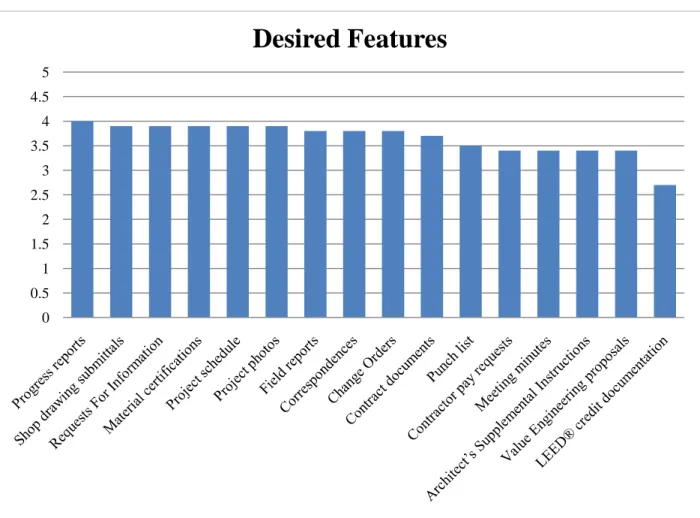
A review of the responses to the first set of questions regarding the value of managing various construction documents with WPMS indicated that the average response to the questions was 3.7 out of 5. Removing the responses regarding two the questions relating to document types that are not common in horizontal construction, Leadership in Energy and Environmental Design (LEED) credit documentation and Architect’s Supplement
Instructions (ASI), the average response rose to 3.8. This showed a general interest in WPMS and the feeling that WPMS could help better manage many types of construction documents.
Based on the survey answers, areas that respondents felt could be best aided by WPMS were in the management of shop drawing submittals, RFI, and progress reports. The only area where respondents indicated WPMS would not aid them, shown by an average score of less than three, was in the management of LEED documentation. This was expected since LEED certification is more applicable to vertical than horizontal construction projects.
Architect’s Supplemental Instructions (ASI) was one question that received a high ranking of importance unexpectedly since this is not a common construction document type in
horizontal construction. It is hypothesized that ASI’s were ranked highly since they are often synonymous with an equivalent document for horizontal construction. These two questions were included in the survey to better gauge the relative importance of construction document types. A graph of the average response for each document is shown Figure 3.1. The ranking values correspond to 5 = strongly agree, 4 = agree, 3 = neutral, 2 = disagree, and 1 = strongly disagree with respect to how much each feature could assist in project
management.
Figure 3.1: Desired Features of WPMS
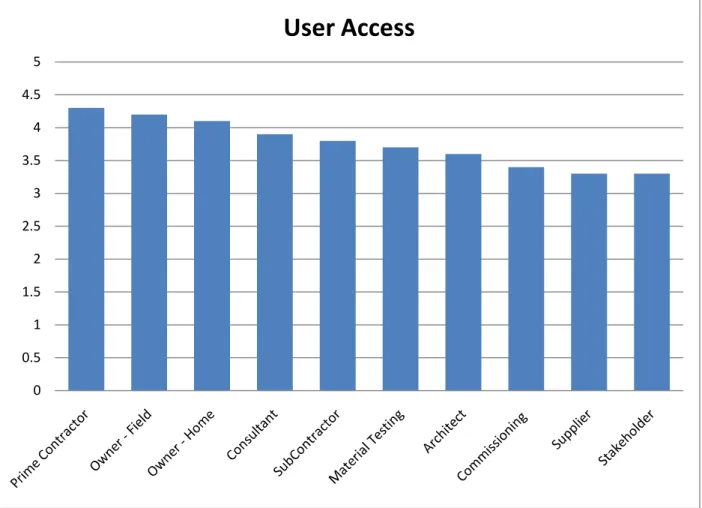
In the second part of the survey, respondents were asked who on the project team would most benefit from the implementation of WPMS. Respondents to the survey gave an average ranking to this set of questions of 3.8, again showing a general interest in providing
0 0.5 1 1.5 2 2.5 3 3.5 4 4.5 5
Desired Features
WPMS and the feeling that it would aid most project participants in the management of projects.
Respondents indicated that both office and field members of the owner’s organization and the prime contractor would be most benefited by access to web-based collaboration. Strong preference was also given to the consultant, subcontractor, and material testing agency. One participant with surprising results was the architect. The high importance given to architects, who often are not involved in horizontal projects, may be because the survey respondents assumed that the term architect was synonymous designer. A graph of the average response for each user is shown Figure 3.2. The ranking values correspond to 5 = strongly agree, 4 = agree, 3 = neutral, 2 = disagree, and 1 = strongly disagree with respect to how much each participant would benefits for access to WPMS.
Figure 3.2: User Access to WPMS 0 0.5 1 1.5 2 2.5 3 3.5 4 4.5 5
User Access
3.5. Discussion
The current implementation rate of 11% for WPMS by state DOT’s versus an
implementation rate of 17% by respondents to the 2005 survey conducted for ENR indicates that the use of WPMS in the horizontal construction sectors is less than in other sectors. However, while only 11% of the state DOTs responding to our survey indicated that they use WPMS for project management, the use of these systems by state DOTs seem to be
increasing. Additional interviews by researchers with personnel from the state DOTs that responded to the survey have shown that at least two states have subsequently begun
implementing WPMS on select large bridge projects or when innovative contracting methods are used. Sometimes the use of these systems is even driven by the contractor, which in turn exposes the state DOT to the use of WPMS for future use. Some of the states responding to the survey that had previously only used project management software internally were beginning to branch out and allow other project participants access to the systems. These results show that the implementation of web-based collaboration in horizontal construction is increasing.
The construction documents listed in the first part of the second survey are managed by most commercially available WPMS. As WPMS systems have matured they have grown to encompass the management of most construction documents. With the average response exceeding three, indicating that WPMS could help manage that particular document, for fifteen of sixteen construction document types WPMS seems poised to meet the project management needs of the DOTs. Furthermore, the contractor was given the highest importance of project participants who would benefit from access to WPMS showing the increasing need for external access to project information. This will make systems such as WPMS even more appealing in the future.
Examining the highest categories rated by the respondents in both parts of the second survey could serve as an effective way to begin to implement WPMS. By targeting only a three documents and four project participants state DOT’s may be able to begin to implement WPMS more easily. Based on the results of the survey the best documents to begin with would be shop drawings submittals, RFI’s, and progress reports. The project participants to initially focus on include the owner’s main office and field office, consultant, and contractor.
Reducing the number of documents and project participants initially involved in an implementation effort would likely help implementers focus on issues that may hinder the success of a WPMS while simultaneously reducing the effort required to implement one. 3.6. Conclusion
While the current level of adoption of WPMS among state DOTs is lower than the rest of the construction industry, the level of adoption is changing rapidly. During the time elapsed between the two surveys researchers noted an increase in the number of states
utilizing WPMS. As more states become exposed to WPMS and learn how their organization can benefit from it, the level of adoption should continue to increase.
As states begin to evaluate their need for WPMS and implement it the results of these two surveys could serve as a way to help the DOTs focus initial efforts implementing a system. By utilizing WPMS to manage key construction documents and connect key project personnel, state DOTs could more easily initially implement basic versions of WMPS to help manage projects. This could allow organizations to test WPMS with reduced cost and risk. Additionally, focusing on only a couple documents could serve as a way to expose WPMS to project participants with simpler interfaces, thus possibly reducing user resistance. Ultimately helping organizations better implement WPMS to meet their needs.
In conjunction with these surveys researchers conducted a case study with the Iowa DOT. To assist the Iowa DOT in managing large bridge project researchers worked to implement WPMS. Researchers began with only a two construction document types and four of user types. To meet the Iowa DOT’s needs researchers implemented a system to help mange shop drawing submittals and RFIs. The Iowa DOT already has a system to manage progress reports. Access was given to Iowa DOT personnel both in the field and in the main office, contractors, and consultants.
Workings with these initial needs researchers were able to implement a preliminary WPMS to meet the Iowa DOT’s needs. Use of a preliminary solution allowed researchers to rapidly implement a system with reduced cost and risk. Additionally, this allowed
researchers to better identify needs for a more permanent solution and investigate issues that could hinder the success of a solution.
CHAPTER 4: WEB-BASED PROJECT MANAGEMENT ACTION
RESEARCH
4.1. Introduction
As construction projects incorporate more complex details and schedule durations shrink, the management of these projects becomes more complex. Additionally, as project teams become more geographically diverse, communication between team members becomes an increasing challenge. The use of web-based project management systems (WPMS) can help unite project teams and enhance their effectiveness; these solutions can be used to manage bids, schedules, budgets, documents, and construction administration. The result is more rapid transmittal of information, more accountability and transparency between team members, and easier access to information for project participants in comparison to other collaboration methods. Ultimately, WPMS offers the prospect of improved project success for all participants.
In 2008 the Iowa Department of Transportation (DOT) initiated a five year period in which the construction of several complex bridges would occur. As construction began on the first of these bridges, the agency became aware that their current project management practices were insufficiently effective for these larger projects. The size of these projects meant that a DOT Engineer would be overwhelmed with thousands of scattered emails for a single project that had to be rethreaded in order to understand the underlying issues. An investigation showed that the primary cause of this information overload to be related to the management of shop drawing submittals and Requests for Information (RFI). The need to effectively manage information on these large bridge projects without an increase in personnel resources drove the Iowa DOT to consider the utilization of WPMS.
To evaluate and implement WPMS, researchers began investigations using the method of action research: an iterative process of continuous improvement. This allowed researchers to not only evaluate the effectiveness of WPMS as a solution to project
management needs, but also to develop temporary work around techniques that addressed immediate project needs and served as a test bed for subsequent full WPMS implementation. Since the Iowa DOT has considerable in-house information technology expertise, partial
custom WPMS solutions were developed as part of early action research iterations. This incorporated the method of Rapid Application Deployment (RAD) on the bridge projects that were currently in need of the solutions. This not only helped the Iowa DOT better manage these projects, but also gave researchers initial feedback on the feasibility of WPMS as an improved management tool for bridge projects. Utilizing these processes, researchers have worked through two full action research iterations with the Iowa DOT and at this writing are in the process of executing a third iteration.
4.2. Theoretical Basis
As the technology has developed and costs have decreased, the use of WPMS in the construction industry has become more prevalent. Additionally, the improved
communication associated with WPMS is increasingly being viewed as a necessity to
projects. A survey conducted in 2005 by Engineering News Record (ENR) showed that 80% of readers involved in information technology (IT) purchases felt that improving
communication and collaboration would be the most important contribution of technology to their company in the next five years (Sawyer 2006). This push for collaboration on projects is compelling an increase in the use of WPMS. In the past, web-based collaboration solutions were primarily used for long-term, high-budget projects (Sawyer 2004). More recently the influx of WPMS solutions have been marketed as part of a Software as a Service (SaaS) agreement, where the vendor hosts the solution and customers purchase on-demand licenses, have made WPMS much more widely available and cost effective for smaller companies and projects (Nitithamyong and Skibniewski 2006).
Many benefits have been attributed to the use of WPMS, with the most widely
anticipated benefit being improved communication. Communication has been shown to have a direct impact on the success of a project and its associated productivity (Chassiakos and Sakellaropoulos 2008). Improved communication on projects results in benefits in a
multitude of areas. Nitithamyong and Skibniewski (2004) have stated some of these benefits to be increased quality of documents and speed of work, better financial control, and simpler and faster access to common data as well as a decrease in documentation errors. Furthermore,
greater transparency, time savings and cost savings have also been associated with improved communication through WPMS (Nikas et al. 2006).
While WPMS offers great possibilities, many implementations of such solutions fail to realize their full benefit. One of the main reasons for the failure is the lack of focus on concerns related to change, implementation, human and organizational factors, and
management of the end user. Therefore, many systems that are technically sounds ultimately fail upon implementation (Erdogan et al. 2008). The success of WPMS also may be hindered by the difficulty of quantifying cost and benefits, system reliability and security, ownership and legal issues, and Internet access (Nitithamyong and Skibniewski 2004).
Because collaboration solutions sometimes fail to achieve their full benefits, their proper selection and implementation is critical to ensure success. Recent research has identified a number of factors affecting the success of an implementation. When implementing a system, is it important to align the goals of the system with long term strategic goals of the organization. Additionally, significant attention must be given to the end user. The requirements of the users must be met by the system and the users should be involved in its implementation. As part of this process user resistance to change must be addressed (Erdogan et al. 2008). Consideration of not only the functionality of the system to the project, but also the functionality for the users is necessary for WPMS to be successful. 4.3. Research Method
Throughout this project researchers met the immediate needs of the sponsor and started working toward the implementation of a long term solution. To meet both of these aspects, researchers chose to use action the research methodology and also incorporate RAD into the creation of custom partial WPMS. By using both methods researchers were able to quickly implement partial solutions while using these and future implementations as stepping stones for an ultimate solution to meet future project management needs.
This investigation was guided by the action research methodology outlined by Susman and Evered (1978), a process entailing five steps:
1. Diagnosing: Identification of the problems that need to be addressed 2. Action Planning: Determination of what actions will be taken 3. Action Taking: Planned actions are implemented
4. Evaluation: The results of the actions are reviewed
5. Specifying Learning: Knowledge captured is specified and communicated This project utilized the cyclical nature of this method to take advantage of the continuous improvement through multiple iterations.
Within the action research method, the custom development of solutions was driven by the RAD technique. The goal of this technique is to accelerate the design and deployment of prototype solutions. RAD accomplishes this by actively involving users in the design and by accelerating the phases of the solution development and deployment to decrease the time to implementation (Whitten et al. 2000). As with the overriding action research process, RAD is also iterative allowing continual improvement of prototypes. RAD served as an excellent complement to the action research method used. Together, the methods addressed immediate needs while working toward a long term solution.
While the literature includes several theoretical explanations and case study examples regarding action research and RAD, none address in detail how the first one or two iterations may be started, especially within a construction context. This article addresses that gap by offering a case study about how a team initiated action research during the early stages of a state transportation authority funded research project by involving the sponsor’s technical advisory committee (TAC) and the research team during the initial stages of the
investigation. The TAC members shown in Table 4.1 helped developed the first two
solutions, participated in the pilot projects, and served on the committee for the development and issuance of an Request for Proposals (RFP) for a more permanent solution. The process used here may be generalized elsewhere, because many investigations are conducted that include a research team that is guided by a TAC in an effort to help identify or develop a new process that benefits a sponsor.
Table 4.1: Technical Advisory Committee Technical Advisory
Committee Membership
4 DOT Construction Engineers 2 DOT Bridge Engineers
7 DOT Information Technology Specialists
2 Consultant Engineers 2 Contractors 1 FHWA Representative
Concurrently with the first and second iteration, the research team executed some of the diagnosing and action planned steps of the third iteration. This included systematically conducting interviews to document workflow, reviewing possible solutions, and developing a rating system for the selection of proposals that would be tendered in response to a future RFP that would result from the third iteration. The evaluation phase of the first and second iterations contributed to the research team’s understanding of the workflow and necessary functionality for that was needed for planning the third iteration.
4.4. First Iteration
The first iteration began shortly after the agreement between the research sponsor and the research team was established. The research sponsor charged the research team with helping the sponsor to select an appropriate WPMS tool; it was anticipated the such a tool would have the ability for all project participants to upload and download documents such as submittals and RFIs, facilitate the workflow as such documents are reviewed, and track the status of each document in a fully automated fashion. It was expected that over the course of a year, the required functionality would be established and that a solution for pilot test would be selected using a competitive, open RFP processes. However, the research team and sponsor’s TAC decided to look for opportunities to quickly develop partial solutions to provide a test bed by actually using an improved process that had partial functionality.