
Chapter 2
PRESENT STATE OF KNOWLEDGE ABOUT
RADIANT COOLING SYSTEMS
2.1 All-Air Systems vs. Radiant Cooling Systems
An air-conditioning system is designed to control indoor temperature and humidity, and to provide fresh, filtered air to building occupants.1 The majority of air-conditioning systems currently in operation are all-air systems, meaning that they employ air not only for the ventilation task, but also as a heat and humidity transfer medium.
The overall energy used to cool buildings with all-air systems includes the energy necessary to power the fans that transport cool air through the ducts. Because the fans are usually placed in the air stream, fan movement heats the conditioned air, thus adding to the thermal cooling peak load. Usibelli and collaborators [2] found that, in the typical office building in Los Angeles, air transport accounts for 13% of the building peak cooling demand. By comparison, external loads account for 42%, lighting for 28%, people for 12%, and office equipment for 5% of the building peak cooling demand. Computer modeling for different California climates using the California Energy Commission (CEC) base case office building show that, at the time of the peak cooling load, only 10% to 20% of the supply air is fresh air [3]. Only this small fraction of the supply air is necessary to ventilate buildings to maintain acceptable indoor air quality. The difference in volume between supply air and fresh outside air is made up by recirculated air. The recirculated air is necessary in all-air systems to remove excess heat from a building and maintain a comfortable indoor environment. This additional amount of supply air often causes draft,2 and may contribute to indoor air quality problems due to the dispersal of pollutants throughout the building. Due to inefficiencies in the duct systems, recirculation also exacerbates duct air leakage and heat transfer through duct walls [4].
A radiant cooling (RC) system consists of a cooled surface and an air distribution system. The RC system employs long-wave (infrared) radiation to the cooled surface to remove unwanted heat from a space, and maintains acceptable indoor air quality and controls indoor air humidity by supplying fresh, filtered, dehumidified air through its air distribution system. In its operation as an air-conditioning systems, a RC system thus
1. Commercial buildings typically feature DOP-tested [1] 30%-efficient filters at the fresh air intake. The use of higher-efficiency filters would lead to improved indoor air quality, but also to a higher pressure drop across the supply fan, and thus to higher energy use by the air-conditioning system. A compromise value for filter efficiency in commercial applications is 60%, although few buildings employ such filters. 2. Draft is an undesired local cooling of the human body caused by air movement.
separates the task of sensible cooling from those of humidity control and ventilation. Because it relies on radiation from a cooled surface to provide sensible cooling, a RC system can provide comfort at a higher indoor air temperature than an all-air system. Most RC systems use water as a transport medium to connect the interior radiant surface with an exterior heat sink. The thermal properties of water allow RC systems to (1) remove a given amount of heat from a building and use less than 25% of the transport energy necessary for an all-air system to remove the same amount of heat, (2) shift the peak cooling demand to later in the day, and (3) more easily interface with thermal energy storage systems. Because RC systems can use large surfaces for heat exchange (usually the radiant surface occupies most of the ceiling or of a vertical wall in a space), the temperature of the cooling water must be only a few degrees lower than the room air temperature. This small temperature difference allows the use of either heat pumps with very high coefficient of performance (COP) values, or of alternative cooling sources (for example, indirect evaporative cooling), to further reduce the electric power demand of the building.
By transporting only the air necessary for ventilation purposes, RC systems significantly reduce both the volume and the velocity of air transported through buildings, thus prac-tically eliminating draft. At the same time, because the air does not play a major sensible cooling role, it does not have to be cooled far below the indoor air temperature. This reduces the problems caused by duct leakage and heat loss from ducts. The relatively low air volume supplied by RC systems also allows the reduction of the space necessary for the ventilation system and its duct work. RC systems only require about 25% of the build-ing volume occupied by a traditional air-conditionbuild-ing system. Floor-to-floor buildbuild-ing height can thus be reduced by reducing plenum height from the typical 1 to 3 m to a quar-ter of this size. Alquar-ternatively, building occupants can enjoy spaces with higher ceilings.
2.2 Short History of Radiant Cooling Systems
Mechanical heating and cooling of indoor spaces has been practiced for a long time. The thermal structures at Bath, England, and Rome, Italy, represent the first known type of large-surface radiant heating system. Built more than 2000 years ago, the Roman hypocaust system consisted of raised floors made of concrete and covered in mosaic tiles. Hot gases from a furnace travelled through the hollow spaces under the raised floors until they were released in the atmosphere through a flue in a wall [5]. Anecdotal information suggests that, around the same time, the Turks were cooling their dwellings by tapping cold river water and circulating it through interstices in walls or floors [6].
Radiant heating as practiced by the Romans was not adopted throughout the world. One possible explanation resides in the cost of the installations in the Roman thermal buildings, as well as in the complexity of their design. Instead, for centuries fireplaces served as a main source of heat. Around the middle of the 18th century cast-iron stoves
became the preferred heating source [7]. Next, the hot water boiler was introduced, together with its system of large pipes through which the hot water was carried. The first known such design is attributed to Sir John Stone, who installed a heating system of pipes in the Bank of England in 1790. From here the design of radiators evolved gradually, the use of water giving way to that of steam, then again to water, this time pumped through thinner pipes. The compact radiators used today were introduced at the beginning of this century.
The modern development of radiant heating started in 1907, when Arthur H. Barker, a British professor, discovered that small hot water pipes embedded in plaster or concrete formed a very efficient heating system [5]. Subsequently, “panel heating” was used in Europe in conventional buildings, on the open terraces of many sanatoriums, and in an open-air roofed pavilion at a British World Fair [7]. In the US, Frank Lloyd Wright installed radiant panel heating in the Johnson Wax Building in 1937. By 1940, “Architectural Record” reported the existence of eight such installations in different types of buildings in the US: four residences, a church, a high school, an office building, and an airplane hangar [7]. In the beginning radiant systems were considered suitable for moderate climates only. Over time, however, projects showed that radiant heating can be designed to operate efficiently and comfortably in any climate.
Radiant heating installations are easily converted into radiant cooling installations by running cold water through the radiant panels. Most of the early cooling ceiling systems developed in the 1930s failed, however, because condensation often occurred in cooling mode. Subsequent studies showed that this problem could be avoided if the radiant system was used in conjunction with a small ventilation system designed to lower the dew-point of the indoor air. This combination proved successful in a department store built in 1936-1937 in Zürich, Switzerland [8], and in a multi-story building built in the early 1950s in Canada [7].
In the San Francisco Bay Area, the Kaiser Building in Oakland, dating from the early 1950s, is equipped with a radiant cooling system. A study conducted in 1994 [9] showed that this system does not perform to the satisfaction of the occupants: it fails to provide acceptable thermal comfort. The study demonstrated that the failure of the system is due to the design of the building (single-pane windows with aluminum frames, a large facade facing west), to a gradual increase of personal computers and office equipment over time, and to the relatively low cooling power of the radiant panels employed.
Given the benefits of radiant systems - improved comfort due to the radiant exchange, less building volume requirement, less energy consumption - it is not clear why all-air systems prevailed starting in the 1950s. One explanation might reside in the historical development of mechanical cooling in the US: the implementation of air-conditioning started in the US South, where the weather is typically hot and humid. The high amount of dehumidification required to provide acceptable comfort indoors must have been considered incompatible with the small amount of air employed by radiant cooling
systems. Regardless of the cause, however, radiant cooling systems were essentially forgotten from the 1950s until the mid-1980s.
During the past decade, building occupants have developed a critical attitude towards all-air systems. Terms such as “complaint buildings” and “sick buildings” were born. Several studies on the subject of occupant satisfaction in air-conditioned and naturally-ventilated buildings came to the conclusion that the number of unsatisfied occupants in airconditioned buildings is significantly higher than in naturally ventilated buildings [10] -[13]. Esdorn and collaborators [14] state that “the existence of air-conditioning systems is actually only noticed when they are not functioning properly.”
All-air systems can employ one of two strategies to remove heat from a building: (1) supply the required amount of ventilation air at a very low temperature (cold air distribution systems), and (2) supply moderately cool air at a rate exceeding the required amount of ventilation air (recirculating air systems). The first strategy leads to the uneven distribution of fresh air in the occupied zone. The second strategy achieves better mixing, but often leads to draft, as the air flow is normally turbulent in the occupied zone. Depending on the air temperature and turbulence level, even low air velocities (less than 0.2 m/s) have been shown to elicit complaints from 10 to 20% of the building occupants [15].
Due to comfort problems and the excessive use of transport energy by all-air systems, new ventilation strategies appeared in the late 1980s [16]. Among these, displacement ventilation was specifically developed to overcome the problems of mixing ventilation systems. Displacement ventilation consists of air flows of low turbulent intensity that supply clean air to the breathing zone and displace contaminants [17]. The natural driving forces of the vertical air transport are the heat sources in the space, as they create convective air currents (plumes). The ventilation efficiency of the resulting air flow pattern is greatly improved.1
Upward displacement ventilation shows a characteristic temperature profile caused by the convective currents driven by the heat sources. As supply air enters the room at floor level, the temperature gradient forms a barrier that prevents low energy currents from reaching the top of the room. Upward displacement ventilation also achieves some cooling. However, the cooling capacity of displacement ventilation systems is small because (1) the temperature gradient between feet and head cannot exceed 3 °C due to comfort requirements, therefore the inlet air cannot be too cold [17], and (2) displacement ventilation systems supply only the small amount of air needed for ventilation [19] - [20]. The most efficient use of displacement ventilation is in association with a cooling source that does not require air transport inside the room. The logical choice is the coupling of displacement ventilation systems with radiant cooling surfaces, a strategy that also allows
1. Ventilation efficiency is a measure of how quickly a ventilation system removes a contaminant from a room [18].
the separation of the tasks of ventilating and cooling in the building [17]. The theoretical air flow pattern and the heat exchange mechanisms in a room with a cooled ceiling and a displacement ventilation system are shown in Figure 2.1.
It is worth noting that, if the radiant cooling surface is too cold, its presence in a space might cause vertical mixing, and thus lower the efficiency of the displacement ventilation. In practice however, the temperature of the radiant cooling surface is only a few degrees lower than that of the ambient air, and radiantly cooled spaces present characteristic, relatively stable, vertical air stratification.
Recent information about building practices in Europe [6] shows renewed interest in radiant cooling. A relatively large number of commercial buildings in Germany (see Table 2.1) and Switzerland are currently equipped with radiant cooling systems. In the US, radiant cooling systems have been installed in only two contemporary projects, both new construction: a commercial facility in Utah and a residence in Arizona. The author has been unable to find information about other projects that might involve radiant cooling in the near future.
Figure 2.1. Air flow and heat exchange in a room with cooled ceiling.
Inlet Convection Cooled ceiling (heat sink)
Exhaust Convective heat from equipment (heat source) Radiative heat from occupant (heat source) Radiation from walls (heat sources) Radiation from walls Radiative heat from the sun (heat source)
2.3 Thermal Comfort Considerations
The human body continuously generates heat, with an output varying between 100 W for a sedentary person and 1000 W for a person exercising strenuously. To perform normal functions the body has to maintain a balance between heat generation and heat loss. Thermal comfort is usually defined as thermal neutrality,1 and represents the condition in which a person would prefer neither warmer nor cooler surroundings.
Heat can be lost by the body in different ways: radiation to surrounding surfaces, convection to the ambient air, conduction, evaporation, respiration and excretion. Radiation has the highest heat transfer coefficient, and is followed in order by convection and conduction. The possibilities of increasing heat loss through respiration and excretion are very limited.
To explain the impact of radiation, Baker [21] gives the following example: “A person sitting out of doors under a clear sky on a summer evening may be chilly although the air temperature is in the high 70s (°F). Were he indoors at this same temperature, he probably would feel uncomfortably warm. The appreciable heat loss by radiation to the clear sky explains the different sensations of comfort between outdoors and indoors.”
Heat loss by radiation is caused by the difference between the body surface temperature and the mean radiant temperature, which is a function of the temperatures of the surrounding surfaces. Fanger [22] defines mean radiant temperature as follows: “The mean radiant temperature in relation to a person in a given body posture and clothing placed at a given point in a room, is defined as that uniform temperature of black surroundings which will give the same radiant heat loss from the person as the actual case under study.”
The mean radiant temperature is easy to define but quite complicated to calculate or measure in practice because of the nature of the variables required in the characterization
1. A person exposed to radiation asymmetry might experience thermal neutrality, but is frequently uncomfortable.
Table 2.1 Data about radiant cooling systems installed in Germany in 1994 [6]. Surfaces [1000 New buildings installed m2] Retrofits Unfulfilled [1000 New buildings orders m2] Retrofits Jan. 1 - Mar. 31 215 99 295 95 Jan. 1 - Dec. 31 496 314 435 300
of the radiant exchange. For example, due to the non-uniform distances and angles of a person in relation to the walls, floor and ceiling of an enclosure, each part of the enclosure must be treated separately in the mean radiant temperature calculation. If a given surface is not isothermal, it must be divided into a collection of smaller isothermal surfaces. Each surface can be assumed to have high emissivity [23]. The radiation emitted and reflected from any surface is considered distributed as diffuse radiation, which is a good approximation for all normal non-metallic surfaces [22]. The enclosure surfaces often found in a typical room have rectangular shape, therefore the angle factors in the mean radiant temperature calculation are defined between a person and a number of vertical or horizontal planes. The body posture of a person is also important. The mean radiant temperature in relation to a standing person is not necessarily the same as in relation to a seated one [22]. Likewise, the location and orientation of the person inside the room must be known, because the mean radiant temperature often varies from point to point. The first experiments of thermal and comfort sensations to radiation experienced by seated persons were conducted by Schlegel and McNall [24], and McNall and Biddison [25]. If a person could not lose heat by radiation, and if convection were the only available heat loss mechanism, the rate of heat loss from the body would correspond to the air velocities close to the human skin. An increase in air velocities leads to an increase in heat loss. However, increasing air velocities beyond a certain limit would lead the air flow close to the skin into turbulent regime. Depending on the air temperature and turbulence intensity, further increase of air velocity in this regime may cause draft, and therefore a different type of discomfort.
Air movement plays a special role among the factors influencing comfort. According to Esdorn and collaborators [14], air movement is the single largest cause of complaints from building occupants. Beside the average air velocity, the fluctuation of the air velocity has an important influence on convective heat transfer at the human body surface. Mayer [26] relates comfort directly to the convective heat transfer coefficient, rather than to the average air velocity. According to Mayer [27], draft is felt at an air temperature of 22 °C if the convective heat transfer coefficient is above 12 W/m2-K. This translates to average air velocities for laminar flows of 1.35 m/s, for transition flows of 0.15 m/s, and for turbulent flows of 0.10 m/s.1 Lower air temperatures significantly reduce the acceptable air velocities.
The combined effects of radiation and convection inside an enclosure are often evaluated by using a parameter called the “operative temperature”. Operative temperature is defined as the average of the ambient temperature and the mean radiant temperature inside the enclosure, weighed by their respective heat transfer coefficients. Another
1. Although this estimate may seem counterintuitive, it is consistent with the work of Fanger and collabo-rators [15]. They show that supplying air at 22 °C with a velocity of 0.10 m/s and 30% turbulence inten-sity would elicit complaints of draft from 10% of building occupants.
environmental index is the “effective temperature” ET*. Effective temperature combines ambient temperature, radiant temperature and humidity into a single index. Operative temperature and effective temperature as comfort parameters do not indicate the presence of radiation asymmetry inside an enclosure. Asymmetric or non-uniform thermal radiation may be caused in winter by cold windows, uninsulated walls or heated ceilings, and in summer by mechanically cooled ceilings. In cases where radiation asymmetry is important, the use of operative temperature or effective temperature in evaluating thermal comfort ought to be done cautiously, because it may lead to erroneous results.
Fanger [22] shows that the overall thermal sensation can be predicted by “the comfort equation”, an equation that connects six variables that have a large influence on comfort. Fanger’s comfort variables are: activity level (heat production in the body), thermal resistance of the clothing (clo-value), air temperature, mean radiant temperature, relative air velocity, and water vapor pressure in the ambient air. In his work, Fanger showed that although individuals of different gender, age, or race prefer the same thermal environment (i.e. indicate the same environmental conditions when in thermal neutrality), not all individuals react identically when exposed to heat or cold, low or high air velocities, etc. Fanger’s work constitutes the basis for most of the contemporary comfort studies and comfort standards. For example, the “comfort zones” specified in ASHRAE Standard 55-92 [28] and ISO Standard 7730 [29] are based on Fanger’s results. The “comfort zone” sets limits for the variation of each of the comfort variables, so that the resulting indoor environment be acceptable to 90% of building occupants (ASHRAE Handbook of Fundamentals [30], Chapter 8). In theory, air-conditioning systems are designed to maintain indoor conditions within the “comfort zone”. In practice however, most air-conditioning systems maintain only the indoor air temperature and moisture within the limits specified by the “comfort zone”.
2.4 The Cooling Power of Radiant Cooling Systems
Beside ensuring the cooling of a building, the operation of a radiant cooling system has to prevent or minimize two side-effects associated with the presence of the cold surface in the building. Prevention of these adverse side-effects limits the cooling power of the RC system.
The first side-effect is a decline in comfort due to the asymmetrical character of the radiant exchange in a room with a cooled surface. Based on Fanger’s limit of 5% uncomfortable as a rule for determining the acceptability of a system, a radiant temperature asymmetry of 10 °C is acceptable in the presence of a cool wall, and of 14 °C is acceptable in the presence of a cooled ceiling [31]. Kollmar [32] shows that in an office environment the lower limit for cooled ceiling temperatures is 15 °C.
The second side-effect is condensation. In theory, the surface temperature of the radiant surface must not be lower than the dew-point temperature of the air in the cooled zone.
There are three strategies to minimize the risk of condensation inside a building equipped with a radiant cooling system: (1) control indoor and outdoor humidity sources (for example, by placing cooking zones near the return registers, venting showers directly to the outside, sealing windows shut, venting the building entrance, etc.), (2) for a given radiant surface temperature, reduce the dew-point temperature by dehumidifying the supply air, and (3) for a given range of the dew-point temperature of the ambient air, set a limit for the minimum radiant surface temperature. In practice, a combination of the three strategies is used: (1) radiant cooling systems are installed mainly in office buildings, where the internal sources of moisture are relatively easy to control; (2) the ventilation air is supplied at a certain temperature, and therefore is simultaneously dehumidified to a certain level; (3) the lower limit of the radiant surface temperature is generally set 2 °C higher than the average dew-point temperature of the ambient air. The cooling power of a RC system is a function of the heat transfer between the room and the cooled ceiling. This heat transfer has two components: radiation and convection. The radiation heat transfer can be calculated based on the room geometry and room surface characteristics. The convective heat transfer is a function of the air velocity at the ceiling level, which in turn depends on the room geometry, the location and power of the heat sources, and the location of the air inlet and exhaust.
Trogisch [33] compares experimentally-derived heat transfer coefficients for cooled ceilings with the description of convective heat transfer (downward) from a cold flat surface, as published in textbooks. He finds that investigations concerning cooled ceilings report overall heat transfer coefficients of 9 to 12 W/m2-K. Given a heat transfer coefficient for radiation of about 5.5 W/m2-K for a difference of 10 °C between the mean radiant temperature and the cooled surface temperature, the resulting convective heat transfer coefficient would be in the order of 3.5 to 6.5 W/m2-K. However, this range for the convective heat transfer coefficient is characteristic for forced convection, while in reality the air movement near the ceiling is driven by the temperature difference between the room air and the cool surface. Trogisch concludes that measurements and textbook formulas for heat transfer coefficients do not agree, therefore textbook formulas for the convection near the radiant surface should not be used in the evaluation of the overall heat transfer coefficient.
Radiant cooling elements extract heat from a room by cooling the air directly, through convection, and indirectly, by cooling the other surfaces of the room envelope. If the difference between the average room envelope temperature and the air temperature is small, the two effects can be estimated jointly [34]. Under this assumption, the specific cooling power of a cooled ceiling can be expressed by the following empirical equation:
q = 8.92 (tair-tcold surface)1.1 (2.1) where
The 9 to 12 W/m2-K overall heat transfer coefficient, together with the maximum temperature difference of 10 °C between the cooled surface temperature and the mean radiant temperature reported by Trogisch [33], suggest that the cooling power of radiant cooling ceilings is generally limited to around 120 W/m2. A survey of cooled ceilings [35] reports cooling outputs ranging from 40 to 125 W/m2. However, the survey is based on information from manufacturers, and does not specify the boundary conditions under which the reported cooling outputs were measured. This brings up the necessity of establishing standards for both measurement conditions, and measurement techniques for the cooling output of radiant panels. As discussed below, significant efforts have already been made in this direction.
•A test facility and a method of testing have been developed at the Department of Vet-erans Affairs. Their final report [36] proposes a procedure for the measurement of the thermal performance of radiant panels in the test facility and indicates the accuracy of the instrumentation necessary.
•ASHRAE's technical committee TC 6.5 Radiant Space Heating and Cooling currently sponsors committee SPC 138 P. The purpose of SPC 138 P is to establish a method of testing that enables the rating of the thermal performance of radiant panels used for heat-ing and/or coolheat-ing of indoor spaces [37].
•In Germany two competing test procedures have been published. The Fachinstitut Gebaeude-Klima (FGK) presented its testing procedure in December 1992 [38]. The FGK industrial standard is based on the measurement of the cooling power of radiant panels in a rectangular enclosure (2.4 m x 1.2 m x 1.5 m) with an internal operative tem-perature of 26 °C. The panel water supply temtem-peratures are 12, 14, and 16 °C. The DIN-standard was presented in April 1993 [39]. It measures the performance of radiant pan-els in the presence of natural convection. The test is based on measurements performed in a closed test chamber (4 m x 4 m x 3 m) with a conditioned metal envelope. The cool-ing load is simulated by 12 perforated tubes containcool-ing three 60 W bulbs each. The mea-surements are performed under steady-state conditions, for a range of temperatures and water mass flows.
While testing procedures and future standards can rate the performance of a radiant cooling system with panels under given boundary conditions, the efficiency of the same system in a specific, but different, application is difficult to determine. The difficulty arises from the fact that the rated performance greatly depends on the testing procedure. For example, a procedure for measuring the efficiency of a cooled ceiling could use the temperatures of the ceiling and of the exhaust air in a test room as a measure for the convective heat transfer between the ceiling and the room air. In a hypothetical situation, a shortcut between the supply and the exhaust of the ventilation system in the test room could cause high air velocities near the ceiling surface. In this situation a large fraction of the exhaust air would be air that has been cooled by the ceiling but that has not interacted with the rest of the room. The small difference between the temperatures of the ceiling
surface and the exhaust air would suggest in this case a convective heat transfer higher than in reality. The measurements would therefore appear as having been performed under low air flows, and the ceiling would appear to have high cooling power. The functioning of the same ceiling in a normal situation (without the short-circuit causing forced convection) is likely to give different results. Noting the importance of information collected from such measurements, these considerations show the current difficulties encountered by a building designer faced with a specific application. Before deciding to use a type of radiant cooling system, a designer should consider the details of the testing/rating procedure performed for the given type, and compare the rating with that for other types of radiant cooling systems available on the market.
2.5 Numerical Modeling of Radiant Cooling Systems
The theoretical performance of radiant cooling systems can be evaluated by numerical modeling of the thermal behavior of buildings equipped with radiant cooling systems. The few computer models currently available were developed as design tools for radiant cooling systems. In general, these codes cannot be used to determine the behavior of radiant systems in any conditions other than the design conditions.
Emulating building engineering practice, the code developed by Kilkis and collaborators [40] proposes a design procedure for radiant cooling systems that assumes steady-state conditions. Koschenz and Dorer [41] acknowledge the fact that the design of radiant cooling systems should be done based on dynamic calculations. However, their design procedure does not employ a truly dynamic method, as they use a step-by-step approach that ignores feedback effects in the thermal balance of their test room. Niu and van der Kooi [42] propose a similar step-by-step approach.
The simulation codes developed so far are either stand-alone programs [40], [42], or use sections of existing building energy analysis programs (for example, instead of developing a simulation code for an entire numerical room, Koschenz and Dorer [41] create a numerical room by connecting their code for a cooled ceiling with TRNSYS modules for the other room surfaces). Consequently, none of the large building energy analysis programs available publicly (DOE-2, TRNSYS, BLAST) has the capability to simulate buildings cooled by radiant cooling systems. There have been attempts to adapt DOE-2 so that it can approximate radiant cooling performance [43] -[44]. However, this approach involves laborious artifices, and is not accessible to the average DOE-2 user. A separate module simulating the specifics of radiant cooling systems should therefore be designed and integrated into one of the existing building analysis programs.
2.6 Cooling Performance of Radiant Cooling Systems: Case Studies
In the absence of a computer program to evaluate the dynamic effects associated with theoperation of a RC system, back-of-the-envelope calculations, pilot projects, and case studies based on existing buildings are the only sources of quantitative information about radiant cooling system performance. This section describes two experimental investigations of the performance of radiant cooling. The next section contains a back-of-the-envelope calculation of the peak power savings potential of a radiant cooling system as compared to an all-air system.
Kuelpmann [45] reports on an experimental investigation in a temperature-controlled test cell. In his experiments the air was supplied at floor level and exhausted approximately 0.2 m below the ceiling level. Internal loads were simulated by fluorescent lights and by electrically heated mannequins seated next to computer displays. External loads were introduced by heating either one of the side walls, or the floor. For displacement ventilation and no cooling with supply air, the room air temperatures measured at different heights did not differ very much.
The extraction of 100 W/m2 internal load by the radiant cooling system caused temperature differences of approximately 2 °C between the air supply and exhaust registers. Upon increasing the temperature difference between the room air and the supply air, the vertical profile of the room temperature became more pronounced. In this case, in the lower part of the room, the vertical temperature profile became close to, or exceeded the comfort limits.
In all cases examined by Kuelpmann the differences between the room air temperature and the surface temperatures of the “internal walls” were relatively small (0.4 °C). Due to the radiation exchange with the cooled ceiling, the floor surface temperature was usually below the wall surface temperatures.
Kuelpmann measured air flow velocities at 1 m distance from the supply air grille, at 0.1m height above ground. At an air exchange rate of 3.2 air changes per hour (ACH) and a supply air temperature of 19 °C, the measured mean air velocity and turbulence intensity were low (0.12 m/s and 20%).
Measurements of radiant temperature asymmetry at 100 W/m2 cooling power in Kuelpmann’s showed an 8 °C difference at 1.1 m above the floor level, in the middle of the room. This corresponds to less than 2% of occupants dissatisfied [28].
The performance of radiant cooling was also tested in two parliamentarian offices in Bonn, Germany [46]. The outside air, supply air and room air temperature and relative humidity were measured. Temperature measurements were also made in the supply and return water registers of the radiant system, and at three points on the ceiling surface. For an outside air temperature of 30 °C the air velocities measured in the occupied zone were less than 0.10 m/s. Below the ceiling, near-surface air velocities between 0.10 and 0.15 m/s were detected. These low velocities indicate that less than 40% of the heat transfer to the cooled ceiling occurs by convection.
2.7 Cooling Performance of Radiant Cooling Systems:
Back-of-the-Envelope Calculation
The following exercise uses simple calculations to compare the electrical peak power demand of an all-air system and a RC system that provides the same indoor air temperature and relative humidity to a given space.
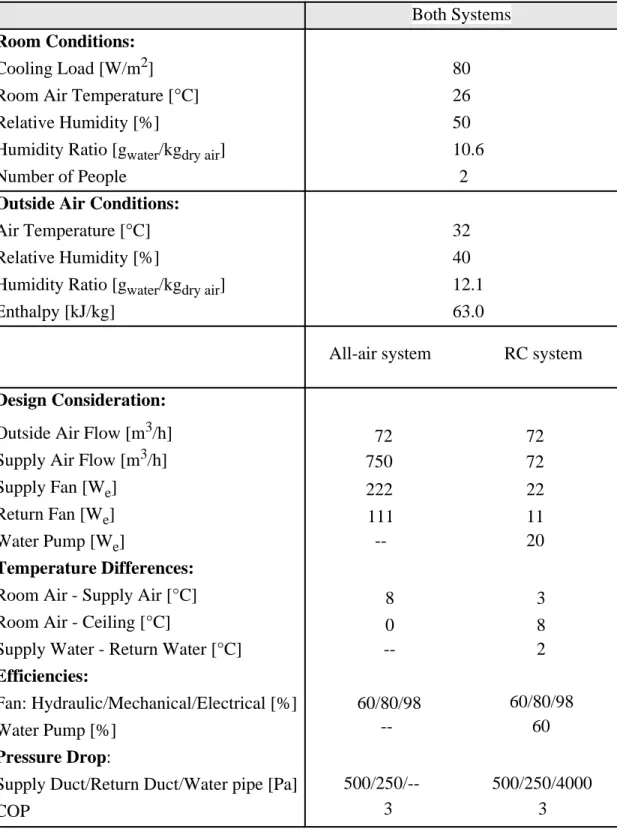
Consider an office space with a floor area of 25 m2, two-person occupancy, and total heat gain (solar heat gain and internal gains from occupants, equipment and lights) of 2000 W. The specific cooling load amounts to 80 W/m2 of floor area, which is in the range manageable by a radiant cooling system. The room temperature setpoint is 26 °C. Additional assumptions and design considerations are shown in Table 2.2.
The all-air system supplies cooling to the room as follows: a cooling coil dehumidifies the outside air according to the target room conditions. ASHRAE Standard 62-1989 [47] specifies a minimum air volume flow of 36 m3/h person, which means that for this example the minimum outside air volume flow must be 72 m3/h. To remove internal heat gains, a recirculating volume flow of 678 m3/h is necessary. For an outside air temperature of 32 °C and a return air temperature of 26 °C, the mixing temperature is 26.5 °C. Similarly, the humidity ratio of the mix of outside and return air is 10.75 g water/kg dry air.
The 26.5 °C mix of outside and return air is directed through a cooling coil. To adjust for the temperature increase due to the fan work, the air must be cooled further than the 18 °C specified as supply air temperature. The temperature adjustment depends on the pressure drop, fan efficiency and volume flow. In this example, the air handling temperature rise is considered equal to 1.0 °C, therefore the supply air is cooled to 17 °C. To remove the internal latent load generated by the two occupants of the office space, the mix of supply and return air must be dehumidified below the design humidity ratio of the office space (10.6 g water/kg dry air). Consequently, the 18 °C air is supplied to the office with a humidity ratio of 10.47 g water/kg dry air.
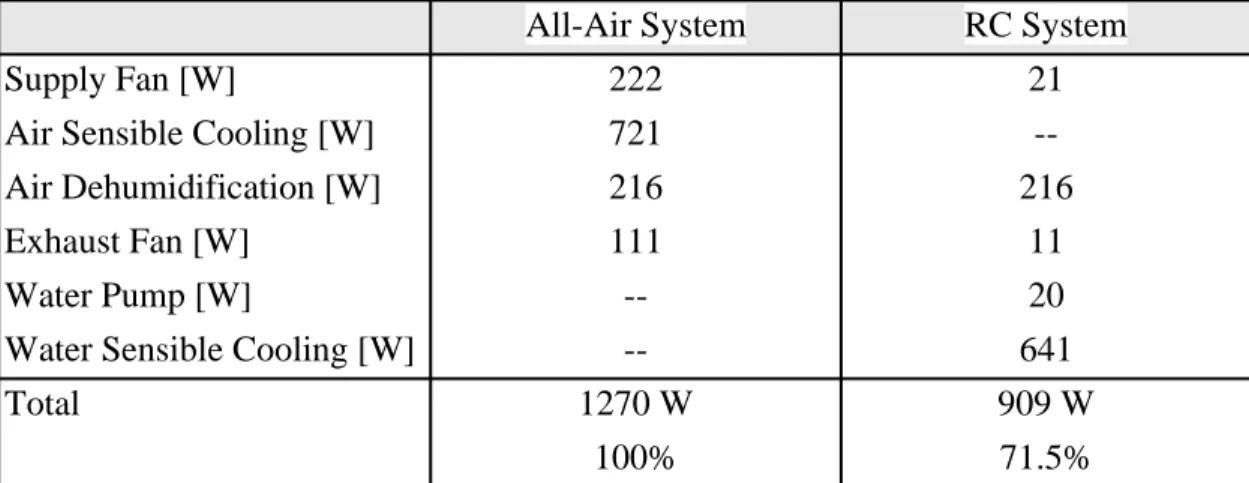
To compare the two systems, the boundary conditions must be the same. This includes the efficiencies of fans and motors, the pressure drops on the supply and exhaust fans, and the coefficient of performance (COP) of the chiller. Considering the air volume flow and the pressure drop across the fans (see Table 2.2), the supply fan electrical power demand is 222 Welectric, and the return fan electrical power demand is 111 We. The cooling coil requires 721 We for air sensible cooling and 216 W for air dehumidification.
While the all-air system removes the cooling load by means of circulating cold air, the RC system removes the load mainly by means of water circulation. The tasks of the ventilation side of the RC system are to supply the room with the fresh air rate specified by ASHRAE Standard 62-1989 (72 m3/h for a double-occupancy office), and to avoid humidity buildup by controlling the dew-point in the room. To provide a stable
displace-Table 2.2 Assumptions used for the comparison of peak power demand for an all-air system and a RC system conditioning the same office space.
Both Systems Room Conditions:
Cooling Load [W/m2] Room Air Temperature [°C] Relative Humidity [%]
Humidity Ratio [gwater/kgdry air] Number of People 80 26 50 10.6 2 Outside Air Conditions:
Air Temperature [°C] Relative Humidity [%]
Humidity Ratio [gwater/kgdry air] Enthalpy [kJ/kg] 32 40 12.1 63.0 Design Consideration: Outside Air Flow [m3/h] Supply Air Flow [m3/h] Supply Fan [We] Return Fan [We] Water Pump [We]
Temperature Differences: Room Air - Supply Air [°C] Room Air - Ceiling [°C]
Supply Water - Return Water [°C] Efficiencies:
Fan: Hydraulic/Mechanical/Electrical [%] Water Pump [%]
Pressure Drop:
Supply Duct/Return Duct/Water pipe [Pa] COP
All-air system RC system
72 72 8 3 0 8 -- 2 60/80/98 60/80/98 -- 60 500/250/-- 500/250/4000 3 3 750 72 222 111 --22 11 20
ment ventilation, the ventilation air should supplied at only about 3 °C below the room air temperature. The required temperature of the supply air cannot be more than 23 °C. The cooling power of the ventilation air is about 72 W (3 W/m2). The radiant cooling ceiling must therefore remove the difference to 80 W/m2.
To remove the internal latent load, the supply air must be dehumidified to 9.2 g water/kg dry air, which indicates that the outside air must be cooled to 13 °C, which is lower than the prescribed 23 °C supply temperature. However, a reheater can be installed which warms the air using waste heat from the compressor. The air could be warmed more efficiently if channeled through building components before arriving to the room inlet. This would save the power to reheat and provide some conditioning at the same time. The power demand calculation for the RC system shows that the electrical power demand is 22 Welectric for the supply fan, 11 We for the return fan, and 20 We for the water pump. The cooling coil requires 21 We for air sensible cooling, 641 We for water sensible cooling, and 216 We for air dehumidification.
Table 2.3 summarizes the components of the electrical power demand of the all-air system and the RC system. The values in the table show that the electrical power demand of the RC system is only 71.5% of the electrical power demand of the all-air system.
2.8 Economics of Radiant Cooling Systems
Although companies that manufacture radiant cooling systems provide general design and cooling power information, they generally do not disclose information regarding the economics of already-installed systems, on the grounds that it is proprietary. However, a few papers were found that address the economics of radiant cooling systems.
Table 2.3 Estimated electrical power demand for the removal of internal loads from a two-person office with a floor area of 25 m2.
All-Air System RC System
Supply Fan [W]
Air Sensible Cooling [W] Air Dehumidification [W] Exhaust Fan [W]
Water Pump [W]
Water Sensible Cooling [W]
222 721 216 111 --21 --216 11 20 641 Total 1270 W 100% 909 W 71.5%
Feil [48] compares different ventilation/cooling systems for an office. In a comparison with a variable air volume (VAV) system, Feil shows that a RC system has lower first-cost if the peak specific cooling load is higher than 55 W/m2. The break-even specific cooling load of 55 W/m2 corresponds to a first cost of approximately 575 DM/m2 of floor space (in 1991 DM). Because the first cost structure is different in US and in Germany, translating this first cost into US$/m2 provides a value of little significance for the US market.
Hoenmann and Nuessle [49] estimate yearly energy consumption for an office building in Europe (see Table 2.4). The building has 5000 m2 of floor area distributed over four floors. The peak specific cooling load is 50 W/m2. The relatively low savings potential for the overall energy consumption of the building (less than 8%), is due to the large energy consumption by heating and lighting. Unfortunately, the authors do not provide consumption data for cooling only. Furthermore, the VAV system uses an economizer mode, while the analogous savings potential is not matched in the RC system by a water-side economizer.
The space requirement for the two systems are shown in Table 2.5 [49]. The largest space savings, 36%, appear in the equipment rooms, followed by 28% for the air shafts.
Table 2.4 Estimated annual energy consumption [kWh/m2] for a European office building with a floor area of 5000 m2 [49].
VAV System RC System
Heating
Domestic Hot Water Lighting Miscellaneous Ventilation Fans/Pumps Cooling 43 4 34 10 12 31 7 43 4 34 10 8 24 8 Total 141 131
Table 2.5 Estimated space requirements for air-conditioning systems in a Euro-pean office building with a floor area of 5000 m2 [49].
VAV System RC System
Shafts [m2] Equipment Rooms [m2] Plenum Height [m] 25 165 0.4 18 107 0.1
For systems with dropped ceilings the reduction in height per floor is in the order of 0.15 to 0.20 m. Radiant systems that consist of water coils embedded into the ceiling lead to even higher space savings.
For first cost calculations, Hoenmann and Nussle [49] estimate that their aluminum panel system has a lower first cost than an all-air system if peak specific cooling loads exceed 50 W/m2, and ventilation air is supplied at an air exchange rate of 3 ACH.
2.9 Types of Radiant Cooling Systems
Most radiant cooling systems belong to one of four different system designs. The most often used system is the panel system, built from aluminum panels with metal tubes connected to the side of the panel facing away from the conditioned space (see Figure 2.2).
The connection between the panel and the tubes is a critical detail. Poor connections provide only limited heat exchange between the tubes and the panel, resulting in increased temperature differences between the panel surface and the cooling fluid. Panels built in a “sandwich system” include the water flow paths between two aluminum panels (similar to the evaporator in a refrigerator). This arrangement reduces the heat transfer problem and increases the panel surface directly cooled.
In the case of panels suspended below a concrete slab, approximately 93% of the cooling power is available to cool the room. The remaining 7% cools the floor of the room above
Drawing by
Fläkt Lufttechnik GmbH
(see Figure 2.3).1
The temperature profiles for the different ceiling panel systems have been published by Graeff [51].
Cooling grids (Figure 2.4) made of small plastic tubes placed close to each other can be embedded in plaster or gypsum board. Cooling grids can also be mounted on ceiling panels such as acoustic ceiling elements. This second system was developed in Germany and has been on the market for several years. Because the plastic tubes are flexible the cooling grid system may be the best choice for retrofit applications.
When the tubes are embedded in plaster the heat transfer from the room above is higher than in the case of cooling panels (Figure 2.5). The heat transfer to the concrete slab couples the cooling grid to the structural thermal storage of the slab. Adding a layer of insulation below the floor reduces the cooling power dedicated to cooling the floor of the room above.
Plastic tubes mounted on suspended cooling panels show thermal performance
compara-1. While cooling the floor of the room above does not constitute a loss of cooling energy, it may cause discomfort due to un unwanted cooling of the occupants at ankle level. Therefore, it is preferable that the fraction of the cooling power dedicated to cooling the room be as high as possible.
Panels Concrete Air Space Carpet Floor Direction of heat flow 93% 7%
ble to that of the panel systems described above. Tubes embedded in gypsum board can KaRo Information Service
Drawing Courtesy of
Figure 2.4. Construction of a cooling grid [49].
Direction of heat flow 82% 18% 91% 9% Carpet Floor Concrete Insulation Tubes embedded in plaster
be directly attached to a wooden ceiling structure without a concrete slab. Insulation must be applied in this case to reduce the cooling of the floor above.
A third system is based on the idea of a floor heating system. Plastic tubes are embedded in the core of a concrete ceiling. The thermal storage capacity of the ceiling allows for peak load shifting but limits the ability to control the concrete core system. Relatively high surface temperatures are therefore required for the ceiling, to avoid the uncomfortable conditions that would occur in the case of a sudden drop in loads. This high temperature requirement limits the cooling power of the system [52].
The concrete core cooling system is particularly suited for coupling with alternative cooling sources, especially the heat exchange with cold night air. The faster warming of rooms with a particular high thermal load can be avoided by operating the water pump for short times during the day. A balance between these warm rooms and rooms with a lower thermal load can be achieved this way.
Due to the location of the cooling tubes in the core cooling system, a higher portion of the cooling is applied to the floor of the space above the slab. Approximately 83% of the heat removed by the circulated water is from the room below the slab, while 17% is from the room above (Figure 2.6 [50]).
Insulation Concrete Floor Carpet 17% (Tubes Embedded) 83% heat flow Direction of
A fourth system has been developed in Germany, but is also commercially available in California. It provides cooling to a raised floor. In this system the ventilation supply ple-num is located under the floor. Air is supplied below the windows, reducing the radiative effect of cold window surfaces in winter and hot window surfaces in summer [53].
2.10 Radiant Cooling System Controls
In spaces conditioned by radiant cooling systems, the cooling power of radiant heat exchange is limited by the need avoid the formation of condensation on the radiant surface. As discussed in Section 2.4, the risk of condensation is avoided in practice by simultaneously dehumidifying the ventilation air to a certain level, and maintaining the cooling surface above the dew-point of the ambient air for all operational conditions. If the dew-point is further reduced through dehumidification of the supply air, the temperature of the radiant surface can also be reduced, and higher sensible loads can be removed by radiation. As the cooler temperature of the radiant surface increases radiation asymmetry and decreases operative temperature and effective temperature, precautions must be taken in such a case not to exceed the comfort limits in the space. In particular, the temperature of the cooling surface should not be reduced below the limit of 15 °C [32], and the indoor air temperature should be controlled so that the effective temperature is maintained within the range specified by ASHRAE Standard 55-1992 [28] (23-26 °C for summer conditions and 20-23 °C for winter conditions).
Another strategy of reducing the risk of damage due to condensation is to switch off the supply of cold water as soon as the relative humidity reaches “dangerous” levels. A variation of this control scheme consists of window contacts that switch off the water supply if windows are opened.
The different types of RC systems presented in Section 2.9 have very different response times, and this influences the temperature control strategy that can be employed for each type of system. Panel systems with water supply close to the cooling surface and with little thermal mass have a response time comparable to all-air systems. The cooling grid system and concrete cooling system work with high thermal mass and are relatively slow in response to load changes. However, control strategies can be designed to allow all types of radiant systems to promptly remove the cooling loads associated with indoor temperature swings. For example, Meierhans [50] reports on the control strategy adopted in an office building equipped with a core cooling radiant system. He states that operating the radiant system at night to pre-cool the building structure eliminates the need for mechanical daytime cooling during most of the cooling season (the ventilation system is operated during the day). Information regarding the internal sensible loads of the building allows the adaptation of this nighttime pre-cooling operation to virtually any daytime cooling needs of the building. Such an operation of the radiant system not only makes the system compatible with operable windows, but also restores some natural variability into the building.
2.11 Summary
Following a few applications in the late 1930s to the 1950s, radiant cooling was more or less abandoned in Europe as well as in the United States. User complaints about all-air systems have changed some designers’ attitude towards these systems, and have led to new system designs incorporating better controls. When combined with efficient ventilation systems, and when the humidity controls and operation strategies are finely-tuned to respond to the specific needs of each situation, RC systems present several advantages when compared to traditional all-air systems.
The reviewed literature shows that RC systems provide draft-free cooling, reduce building space requirements, reduce the energy consumption for thermal distribution and for space conditioning, and might even have lower first-cost, if peak specific cooling loads exceed 50 - 55 W/m2.
Literature has not been found that describes the dynamic thermal behavior of RC systems in buildings. Dynamics are important because the comfort temperature in a space is not only dependent on the air temperature, but also on the (dynamic) variation of the surface temperatures in the space. Since existing thermal building simulation programs do not provide the data necessary for evaluating the dynamic performance of RC systems, the development of dynamic models is the logical next step in examining their potential.
2.12 References
1. National Air Filtration Association, NAFA Guide to air filtration, first edition. NAFA, Washington, DC, 1993.
2. Anthony Usibelli, S. Greenberg, M. Meal, A. Mitchell, A. Johnson, G. Sweitzer, F. Rubinstein, D. Arasteh, Commercial-sector conservation technologies. Rep. LBNL-18453, 1985.
3. Helmut E. Feustel, Economizer rating. Final Rep. prepared for Southern California Edison Company, 1989.
4. David Jump and M. Modera, Energy impacts of attic duct retrofits in Sacramento houses. Proc. ACEEE 1994 Summer Study on Energy Efficiency in Buildings, American Council for an Energy Efficient Economy, Washington, DC.
5. T. Napier Adlam, Radiant heating. Second Edition, The Industrial Press, New York, 1949.
6. Helmut E. Feustel, Personal communication, Lawrence Berkeley National Laboratory, June 1995.
7. John K. Manley, Editor, Radiant heating, radiant cooling. School of Architecture, Pratt Institute, 1954.
8. F. E. Giesecke, Hot-water heating and radiant heating and radiant cooling. Technical Book Company, Austin, 1946.
9. Helmut E. Feustel, C. Stetiu, R. Meierhans, and U. Schulz, Hydronic radiant cooling -a c-ase study. Proc. He-althy Buildings ‘94, Bud-apest, Hung-ary, 1994.
10. P. Kroeling, Gesundheits- und Befindensstoerungen in klimatisierten Gebaeuden. Zuckschwerdt Verlag, Munich, 1985.
11. P. O. Fanger, Strategies to avoid indoor climate complaints. Proc. Third Int. Congr. Building Energy Management, ICBEM '87, Presses Polytechnique Romandes, Lausanne, Switzerland, 1987.
12. M. Mendell and A. H. Smith, Consistent pattern of elevated symptoms in air-condi-tioned office buildings: a reanalysis of epidemiologic studies. Am. J. Public Health, (80) (10) 1990.
13. M. J. Mendell, Nonspecific symptoms in office workers: a review and summary of the epidemiologic literature. Indoor Air, (3) (4): 227-236, 1993.
14. H. Esdorn, H. Knabl, and R. Kuelpmann, Air-conditioning, new horizons - new oppor-tunities. Proc. Indoor Air '87, Berlin, Germany, 1987.
15. P.O. Fanger, A. Melikov, H. Hanazawa, and J. Ring, Air turbulence and sensation of draught. Energy and Buildings (12) (1) 1988.
16. G. M. Keller, Energieaufwand fuer den Lufttransport mindern. Clima Commerce Int., (21) (2) 1988.
17. E. Skaret, Displacement ventilation. Proc. Roomvent '87, Stockholm, Sweden, 1987. 18. H. Sutcliff, A guide to air change efficiency. Tech. Note AIVC TN 28, Air Infiltration and Ventilation Centre, Coventry, 1990.
19. H. M. Mathisen, Analysis and evaluation of displacement ventilation. Ph.D. thesis, Rep. No. 1989:31 Division of Heating and Ventilation, NTH, Switzerland, 1989.
20. C. W. Cox, P. J. Ham, J. M. Koppers and L. L. M. Van Schijndel, Displacement ven-tilation systems in office rooms - a field study. Proc. Room Vent ‘90, Oslo, Norway, 1990. 21. M. Baker, Improved comfort through radiant heating and cooling. ASHRAE J., (2) (2) 1960.
22. P. O. Fanger, Thermal comfort analysis and applications in environmental engineer-ing. Mc.Graw Hill, New York, 1972.
23. C. O. Pedersen, D. Fisher and P. C. Lindstrom, Impact surface characteristics on radi-ant panel output. Rep. ASHRAE-876 TRP, 1997.
24. J. C. Schlegel and P. E. McNall, The effect of asymmetric radiation on the thermal and comfort sensations of sedentary subjects. ASHRAE Trans., (74) 1968.
25. P. E. McNall, and R. E. Biddison, Thermal and comfort sensations of sedentary per-sons exposed to asymmetric radiant fields. ASHRAE Trans., (76) (1970).
26. E. Mayer, Auch die Turbulenzen sind wichtig. Clima Commerce Int., (19) (10) 1985. 27. E. Mayer, Air velocity and thermal comfort. Proc. Indoor Air '87, Berlin, Germany, 1987.
28. ASHRAE Standard 55-1992, Thermal environmental conditions for human occu-pancy. American Society of Heating, Refrigeration and Air-Conditioning Engineers, Inc., Atlanta, 1992.
29. ISO, Moderate thermal environments - determination of the PMV and PPD indices and specification of the conditions for thermal comfort. International Standards Organi-zation, Standard 7730, Geneva, Switzerland, 1984.
30. ASHRAE Handbook, Fundamentals. American Society of Heating, Refrigeration and Air-Conditioning Engineers, Inc., Atlanta, 1993.
31. P. O. Fanger, B. M. Ipsen, G. Langkilde, B. W. Olesen, N. K. Christensen, and S. Tanabe, Comfort limits for asymmetric thermal radiation. Energy and Buildings, (8) 1985.
32. A. Kollmar, Die zulaessige Kuehldeckentemperatur aus waermephysiologischer Sicht. Gesundheits-Ingenieur, (88) (5) (1967).
33. A. Trogisch, Kuehldecke und Lueftung. Clima Commerce Int., (24) (4) 1991.
34. B. Glueck, Leistung von Kuehldecken. Kuehldecke und Raumluft, Fachinstitut Gebae-ude-Klima, Stuttgart, Germany, 1990.
35. Anon., Marktuebersicht Kuehldecken. KI Klima-Kaelte-Heizung, (1-2) 1993. 36. Anon., Radiant metal ceiling panels -a method of testing performance. Department of Veterans Affairs (date unknown).
37. Anon., SPC 138P, Method of testing for rating hydronic radiant ceilings. Handout at the SPC138P Meeting, June 1996, San Antonio, TX.
38. FGK Vorschrift KD 1, Vorschriften des Fachinstituts Gebaeude-Klima e.V. fuer: Waermetechnische Messungen an Kuehldeckenelementen. Fachinstitut Gebaeude-Klima e.V., Bissingen-Bietigtheim, Germany, 1992.
39. DIN 4715 Entwurf, Raumkuehlflaechen; Leistungsmessung bei freier Stroemung; Pruefregeln. Beuth Verlag GmbH Berlin, Germany, 1993.
40. i. B. Kilkis, S. S. Sager and M. A. Uludag, A simplified model for radiant heating and cooling panels. Simulation Practice and Theory, (2) 1994.
41. M. Koschenz and V. Dorer, Design of air systems with concrete slab cooling. Proc. 5th Int. Conf. Air Distribution in Rooms, Yokohama, Japan, 1996.
42. J. Niu and J. van der Kooi, Indoor climate in rooms with cooled ceiling systems. Build-ing and Environment, (29) (3) 1994.
43. Bruce E. Birdsall, W. F. Buhl, K. L. Ellington, A. E. Erdem, F. C. Winkelmann, J. J. Hirsch, and S. D. Gates, DOE-2 Basics. Rep. LBNL-35520, 1994.
44. Gerhard Zweifel, Simulation of displacement ventilation and radiative cooling with DOE-2. ASHRAE Trans., (99) (2) 1993.
45. R. Kuelpmann, Thermal comfort and air quality in rooms with cooled ceilings - results from scientific investigations. ASHRAE Trans., (99) (2) 1993.
46. H. Esdorn and M. Ittner, Betriebsverhalten von Deckenkuehlsystemen. HLH Heizung-Lueftung- Haustechnik, (41) 1990.
47. ASHRAE Standard 62-1989, Ventilation for acceptable indoor air quality. American Society of Heating, Refrigeration and Air-Conditioning Engineers, Inc., Atlanta, 1989. 48. K.-H. Feil, Wirtschaftliche Betrachtungen zu Kuehldecken in Bueroraeumen. Kuehl-decke und Raumlueftung, Fachinstitut Gebaeude-Klima e.V., Bietigheim-Bissingen, Germany, 1991.
49. W. Hoenmann and F. Nuessle, Kuehldecken verbessern Raumklima. Kuehldecke und Raumlueftung, Fachinstitut Gebaeude-Klima e.V., Bietigheim-Bissingen, Germany, 1991.
50. Robert Meierhans, Personal communication, Lawrence Berkeley National Labora-tory, November 1992.
51. B. Graeff, Kuehldecke und Raumklima. Kuehldecke und Raumlueftung, Fachinstitut Gebaeude-Klima e.V., Bietigheim-Bissingen, Germany, 1991.
52. R. Meierhans and M. Zimmermann, Slab cooling and earth coupling. Proc. Innovative Cooling Systems, International Energy Agency, Energy Conservation in Buildings and Community Systems, Solihull, UK, 1992.
53. Anon., Advanced hydronic heating and cooling technology. Leaflet, eht-Siegmund, Inc., Tustin, CA (date unknown).

![Table 2.1 Data about radiant cooling systems installed in Germany in 1994 [6].](https://thumb-us.123doks.com/thumbv2/123dok_us/1679487.2731325/6.918.179.815.188.327/table-data-radiant-cooling-systems-installed-germany.webp)
![Table 2.4 Estimated annual energy consumption [kWh/m 2 ] for a European office building with a floor area of 5000 m 2 [49].](https://thumb-us.123doks.com/thumbv2/123dok_us/1679487.2731325/16.918.186.813.542.785/table-estimated-annual-energy-consumption-european-office-building.webp)
![Figure 2.2 Construction of a cooling panel [49].](https://thumb-us.123doks.com/thumbv2/123dok_us/1679487.2731325/17.918.282.784.514.760/figure-construction-of-a-cooling-panel.webp)
![Figure 2.3 Heat transfer for the panel system (cooling mode) [50].](https://thumb-us.123doks.com/thumbv2/123dok_us/1679487.2731325/18.918.295.652.208.550/figure-heat-transfer-panel-cooling-mode.webp)
![Figure 2.5 Heat transfer for ceiling with cooling grid [50].](https://thumb-us.123doks.com/thumbv2/123dok_us/1679487.2731325/19.918.277.643.604.1014/figure-heat-transfer-for-ceiling-with-cooling-grid.webp)
![Figure 2.6 Heat transfer for concrete core cooling system [50].](https://thumb-us.123doks.com/thumbv2/123dok_us/1679487.2731325/20.918.265.593.592.1002/figure-heat-transfer-concrete-core-cooling-system.webp)
