The Impact of People, Process and Technology on
Knowledge Management
Mohammad Reza Hosseini, Hamed Tahsildari, Mohd Taib Hashim, Mohammad Ali Tareq Universiti Teknolo gi Malaysia
[email protected], [email protected], [email protected],
[email protected]
Abstract
This study attempts to enhance the function of airline companies through investigating the effects of people, process and technology on knowledge management (KM). The way an organization collects, shares and exploits this knowledge can be central to its ability to develop successfully. KM is a discipline that improves the ability of organizations to solve problems better, adapt, evolve to meet changing business requirements, and survive disruptive changes. Eight airline companies namely Boeing, Delta, JetBlue, Continental, Comair, Iran Air, Malaysian Airline and Firefly were selected and found for their need of improving the KM system. 101 questionnaires were distributed via non-probability sampling method among the employees of airline service companies based on their skills and experiences. Collected data was analyzed through factor analysis, reliability test and correlation of regression. The findings revealed that the process and technology have significant effects on KM.
Key words: Knowledge management, people, process and technology
1. Introduction
The concept of KM was introduced over the last two decades ago to assists organizations to generate, share and apply knowledge in an organized manner. (KM) can be described as the recognition, optimization and deliberate management of resources that are intellectual in nature to generate value, enhance productivity and to achieve and maintain a competitive edge for an organization (Webb, 1998). KM is defined as a difficult task and considered as organizational asset (Shepard, 2000). Other interpretations of KM include the system of generating and using the organization’s knowledge to create new opportunities and improve the performance of the organization (Yang, 2011). Knowledge is a concealed asset which has to be retained for the long term success of an organization. KM is a kind of system that turns knowledge into a resource for the organization’s improvement and application (Edvinnson, 1997). Managing knowledge is considered both generic and specific (Stonehouse and Pemberton, 1999). Specific knowledge is fundamental for core competences and generic knowledge is the basis to operate business.
Eight airline companies namely Boeing, Delta, JetBlue, Continental, Comair, Iran Air, Malaysian Airline and Firefly were reviewed and Nonaka’s model (1991) was considered to improve their KM systems. Nonaka’s model (1991) asserts KM as a critical factor that influences competitive advantage. "If knowledge is an essential resource for establishing competitive advantage, then management obviously should attempt to identify, generate, deploy, and develop knowledge. Hence, managers need to know more about KM ". (Nonaka & Takeuchi 1995; Pathirage et al., 2007).
This study attempts to cover the lack of managing knowledge; hence, our contribution is to consider the relationship between KM and people, process and technology. This paper consists of five sections including introduction, literature review, methodology, data analyzing and discussion and finally conclusion. The next section discusses literature on KM.
2. Literature Review
2.1 Knowledge Management Challenges in the Aviation Industry
Airline companies need to create and share knowledge as much as they could. Stonehouse and Pemberton (1999) asserted that through knowledge sharing in an organization, a set of principles, facts and skills would contribute to competitive advantage. In particular, managing knowledge appears to be basic step for organizations in an ever-changing marketplace where their performance is affected by their efforts to develop durable and adaptable knowledge-based competencies (Nonaka, 1991).
Eight companies from the aviation industry were highlighted for the purpose of revealing the challenges they face in KM field. These companies are the Malaysian Airlines and Firefly from Malaysia, Iran Air, Delta, Continental, Boeing, Eastern from US Airline and Comair.
The following section will discuss briefly the selected airlines and thus illustrates the challenges they faced in KM system.
2.1.1 Boeing
It is pertinent to focus on the overall components of a problem in order to find a suitable solution. As an example, if the company were to focus on gathering knowledge of retiring workers and plan a new strategy for recruitment could leave the mid-career workers not willing to cooperate in these plans or feel left out (Boeing KM, November 21, 2008).
KM is about people and even the most high tech systems cannot force a person to share. It is found that almost 90% of a company’s knowledge lies in the minds of the workers. Most KM systems initiated with the use technology have ended in failures. It should be realized that technology only facilitated KM; it is not the end solution. The order of the KM system should be culture first, then people and processes and only after that do the tools and technology come in. Trust is the main enabler for knowledge sharing. More knowledge will be shared if there is trust among employees. In fact, certain subject matter experts are unwilling to share their knowledge mainly due to trust issues and not for lack of time. The focus should be on workers across the board and not just on one particular segment. This might cause other problems such as the older workers feeling unwanted compared to the youthful workers. Business strategies should be identified first, and then the strategies to support knowledge can be integrated in with KM activities. The KM measurements of a company are the business metrics of the company.
2.1.2 Delta
According to Calo (2008), the issue of knowledge transfer is further exacerbated given the scarcity of employees with the right competencies or expertise. Delta had to let go many of its workers after the dreaded events of September 11, 2001. In 2005, however, Delta prepared for the retrenchment of 11,000 employees based on the lessons learnt from the past KM mishandling. This time, Delta did not retrench workers who had critical tacit knowledge regarding the airline such as experts with impressive relationships that were both internal and external. It was realized that certain employees knew how to function effectively not just at their jobs but also in developing the right relationships in order to attain successful outcomes (Parise, Cross & Davenport, 2006). 2.1.3 JetBlue
The type of people theory and how different types of people communicate and understand their environment is quite different. Usually the participants voluntarily share their in Myers-Briggs Type Indicator (MBTI) type so that the all the group members can take advantage of this integrated awareness and experience. The crew leaders will offer feedback and highlight a particular type responded during a particular exercise. Group dynamics according to the type of people in a group are discussed as well. The knowledge gained from applying the MBTI test would be a great asset in developing the communications among members, teamwork and self-knowledge in general.
2.1.4 Continental
According to Wejman, the management of the Continental Airlines was open to introducing new technologies and regarded the use of these latest technologies as a way to progress and to further build on current success. The top management realized the capabilities of new technology and was keen to provide the required investment for the right systems. For example, when an email system was proposed, it was implemented almost immediately within 30 days with a USD2.5 million investment. The support of the management made it easier for the employees to give their best at work. The management, realizing the opportunities that could be created with technology, was always on the lookout for IT solutions for current challenges. A solution to the problem of not meeting room demands was resovled through having real-time decision support through outsourcing and thus the Outsourcing IT to Support Business Transformation was introduced. (Continental Airlines, Outsourcing IT to Support Business Transformation).
2.1.5 Comair
Fatigued air traffic controllers were not given any attention. If the controllers were fatigued or sleepy, the Terminal Services management expected the air traffic controllers to assess and change their particular job
function before their shift started. The management would not be aware of instances when controllers informed the office of being tired. Fatigue or being tired was not regarded as a valid reason for calling in sick as being sick meant that the air traffic controllers were not able to function at all (Hall, 2006).
2.1.6 Iran Air
Iran air poses a challenging condition for aviation equipment. Its high air temperatures and high altitude have caused performance issues with regard to Russian made equipment’s. These issues require an engineering solution to be solved. There is inadequate international knowledge available on Ukraine and Russian made technological and engineering equipment. In addition, Iranian pilots have pointed out that it is difficult to pilot Ukrainian and Russian planes as they have a heavy airframe and engines that are not as powerful as compared to Western planes. The Iranian engineers and regulators tried to be innovative in addressing these challenges. A domestic manufacturing program called the Antonov was introduced that looked into developing many aircrafts and avionics equipment’s with the required standards. According to (Kogan 2001), the Antonov program created challenges that in fact the Iranian local manufacturing industry did not have sufficient knowledge in technical know-how and enough funding for R&D purposes.
2.1.7 Malaysia Airlines: Malaysia Airlines needs Vital Unions’ Backing for Latest Turnaround Plan
A union refers to an establishment comprising of workers who voice out their rights regarding their jobs. However, sometimes unions can be demanding and apply unnecessary pressure on the firms they are attached with regards to salaries and benefits. In Malaysia Airlines (MAS), its workers’ union was against the company’s plan to swap shares with another Malaysian airline called Air Asia and consequently the plan had been shelved. The union pointed out that some of the arrangements in share-swap would have disadvantaged the MAS workers. The top management of MAS was questioned on their judgment ability in giving in to this plan in the first place.
In another report (Malaysian Airline System Berhad, 10601-W) regarding the challenges faced by the company, it was stated that: Also, a review of Consequence Management Policy in relation to disciplinary action taken against staff for misconduct commenced in the fourth quarter of 2011, The Consequence Management Policy aims to ensure that cases of misconduct are appropriately and consistently dealt with based on the principle of justice and fairness, in accordance to HC Policies (Malaysian Airline System Berhad Annual Report 2011 annual).
2.1.8 Firefly
Firefly is focused on domestic airlines in Malaysia. Other similar airlines in Malaysia include AirAsia, Berjaya Air, MASWing and Malaysian Airlines. Firefly was not chosen as one of the targeted airlines to study on the area of challenges of KM among its people as the researcher was advised against it (Malindo Air : Opportunities and Threats).
2.1.9 Eastern Airline
Customer Relationship Management (CRM) has more to do with interpersonal and cognitive skills for managing resources in a firm than the technical expertise of operating the system. In this regard, cognitive skills can be described as the thoughts applied to gain and maintain awareness for finding solutions to problems and decision making. Interpersonal skills involve the ability to interact with peers and a host of behaviors that are required for team building. These operational systems have skill sets that are linked to other similar areas as well as with technical expertise. In addition, it is not only about managing a multifaceted equipment but also associated with managing a individually operated equipment since most of the time they have work together with other equipment from supporting agencies to successfully fulfill a mission (Crew resource management - Wikipedia, the free encyclopedia).
2.2 Knowledge Management
The growth of a company is mainly associated with success; knowledge is a key component in the success and growth of a company and a major push factor. Knowledge is known as the most precious asset of the company besides all its other resources as it incorporated a range of best practices, lessons learned, routines, decision making and creative processes, which normally cannot be imitated by other competitors (Renzel, 2008). Lee and Sukoco (2007) suggested that most companies that have managed to increase their business performance have done so by successfully managing their knowledge besides the effective use of their natural and tangible resources. The concept of KM was established almost two decades ago to assists firms to develop, share and apply knowledge in an organized manner. KM can be described as the recognition, optimization and deliberate management of resources that are intellectual in nature to develop, value enhance productivity and to create and
maintain a competitive edge for an organization (Webb, 1998). Other interpretations of KM include the system of recognizing, gathering and utilizing the firm’s knowledge to improve the performance of the firm and to create new opportunities (Yang, 2011).
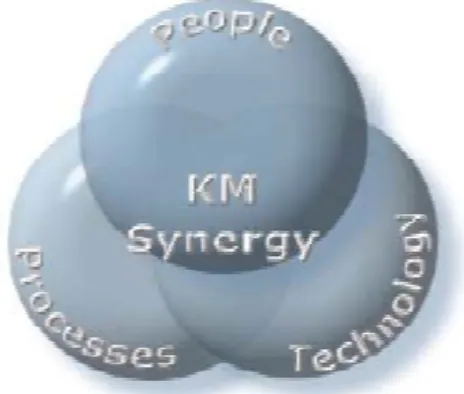
KM in organization is formed via unique patterns of interactions between people, technologies and process. People generate, share, apply knowledge and stimulate knowledge sharing. Process entails the methods to obtain, generate, arrange, share and transfer knowledge. Technology involves the mechanisms that store and provide access to data bases, and knowledge generated by people in different locations.
Figure 1- KM Three Major Components 2.3 People
However, all three variables are vital for a successful KM; people have an important role for knowledge management. The whole success in KM depends on the willingness of people in sharing their knowledge. In this regard, trust is a necessary element for the willingness to share knowledge. Lack of trust brings about failure in the effort of KM.
It is more difficult to handle and manage KM in large organizations where it becomes harder to keep trusted relationships (Serenko et al. 2007). Large organizations which have more than 150 employees make more efforts
adapting to KM comparing to smaller organizations. Contact in large organizations is rarely face to face which is more difficult and less frequent; thus, employees are not able to share knowledge easily. In large organization, there is a weak sense of trust and connection among employees; thus, knowledge sharing needs to be facilitated.
Process and technology have greater significance in large organizations compared to small organizations; in fact, it is critical to trust the source of information in these organizations. The source of information is a general term for a collection of documents, files, data, information, etc. It takes a lot of time and requires much efforts to collect, publish and renew source of information. If there is no trust among employees about the source of information then efforts made to KM is wasted (Renzl 2008).
Regardless trusting KM rarely happens among employees in organizations (Zand, 1997). Organizations seem to lose tacit knowledge in case of employees have no trust to share their knowledge (Figallo & Rhine, 2002).Organizations share histories of experiences and information based trust (Figallo, 1998). Effective implementation of KM stresses trust as a necessary factor (Lawson, 2004).
Managers must be adjusted to the organizational dynamics and act properly to ensure that negativity is minimized. Organizations are expected to make an environment that motivates knowledge sharing.
H1: There is a significant relationship between people and knowledge management. 2.4 Process
In this study, process is defined as organizational training in which organizations acquire, create, organize knowledge (Jan Pawlowski and Markus Bick, 2012). According to Goldstein (1986, p. 837), training is defined as “the systematic acquisition of skills, rules, concepts, or attitudes that result in improved performance”. Individuals rely on training to improve their current skills and learn new skills (Mathieu et al., 1992).
Zhang (1999) argued that training is combination of two major elements namely education and exercise. In this regard, education targets at enhancing the strengths and potentials associated with long-term and broad training; whereas, exercise is to help employees to follow changes and adjust with the content assosciated with short term professional learning. Thus, in organizations, training as a process is to sustain the quality of employees and attain the organizational objectives (Lu, 2003).
Organizations often invest in KM, if the employees are provided with training and emphasizing the value and necessity of KM for a greater fundation regarding their infranstructure (Srikantaiah & Koening, 2000). Organizations are expected to realize what people require to learn, how individual learn. In order to achieve success, it is necessary for organizations to determine what types of information and knowledge need to be improved (Rasmus, 2002).
H2: There is significant relationship between peocess and knowledge management. 2.5 Technology
Technology is about how organizations manage their information. Accordingly, it helps organizations for an easy access, alleviates time and effort, and requires less space. The role of information technology (IT) in KM is at the peak of attention among contributors. Some researchers believed that KM initiatives could be successful without using IT tools (McDermott and O’Dell, 2001; Hibbard and Carillo, 1998); however, many others insisted that IT is strategically vital for the purpose of global reach when organizations are geographically distributed (Duffy, 2000; Lang, 2001).
Borghoff and Pareschi (1998) stated that the Nonaka and Takeuchi model tackles issues positively support the infrastructure of IT. Knowledge is known as an integral part of technology as noted by Pe´rez-Bustamante (1999) who states that technology is any kind of knowledge fulfilling the requirements of market. Generally, technology is about to combine the technical expertise (technos) and knowledge bases (logos). There is a need of IT as a technology to facilitate KM. IT enables us to have easy and understandable access to knowledge (Beckman, 1998). KM occurs within databases and documents; in fact, explicit knowledge can be captured through rules and in documents (Srikantaiah & Koening, 2000).
H1: There is significant relationship between technology and knowledge management.
The main objective of KM is not to address all knowledge, but to manage the knowledge being critical for organization. It envelops using the collective knowledge and abilities of HR to achieve specific organizational objectives (Bose, 2002). The KM consists of three major components namely educated people, process and high technology (Bose 2002).
Figure 2- Conceptual Framework 3. Data Collection
Essential data was collected via non-probability sampling method; the probability of any particular member of the population being chosen is unknown. The selection of sampling units in non-probability sampling is quite arbitrary, as researchers rely heavily on personal judgment (Zikmund et al., 2009). A sample of 101 participants
Knowledge
Management
Process
People
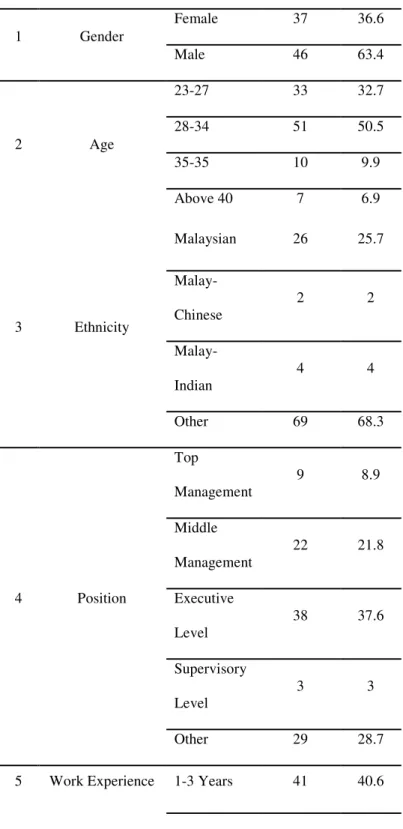
working in different airline companies was considered based on their skills and experiences. The below charts demonstrate the demographic of respondents.
Table 1- The Demographic of Respondents by Gender, Age, Ethnicity, Position and Work Experience
No. Demographic of Respondents Frequency Percent
1 Gender Female 37 36.6 Male 46 63.4 2 Age 23-27 33 32.7 28-34 51 50.5 35-35 10 9.9 Above 40 7 6.9 3 Ethnicity Malaysian 26 25.7 Malay-Chinese 2 2 Malay- Indian 4 4 Other 69 68.3 4 Position Top Management 9 8.9 Middle Management 22 21.8 Executive Level 38 37.6 Supervisory Level 3 3 Other 29 28.7
4-6 Years 26 25.7
7-10 Years 17 16.8
Above 10 Years
17 16.8
A 5 point Likert scale measurement was used to measure the impact of People, process and technology on KM breaking the questions into 3 parts. Cronbach-Alpha Value Test to test for validity and reliability were used for the questionnaire and the questions were all in English.
4. Data Analysis and Discussion
Data was loaded in order to obtain a reliability test. Principal components analysis (PCA) and exploratory factor analysis (EFA) were used to find a large number of relationships among interval-level variables.
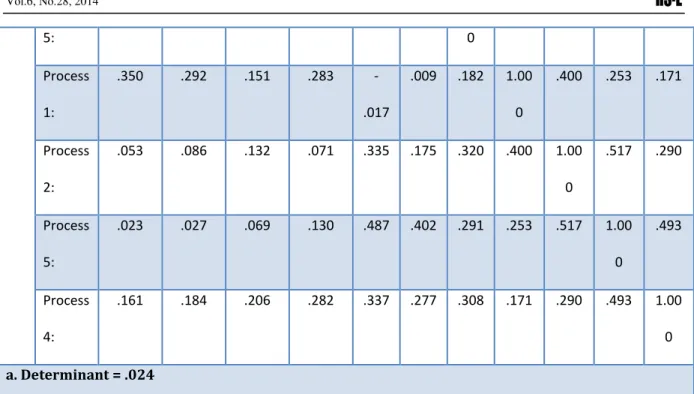
Table2- Correlation Matrix Correlation Matrix Techno logy2: Techno logy3: Techno logy4: Techno logy5: Peop le1: Peop le2: Peop le5: Proc ess1: Proc ess2: Proc ess5: Proc ess4: C o r r e la ti o n Techno logy2: 1.000 .625 .467 .514 .015 .068 .148 .350 .053 .023 .161 Techno logy3: .625 1.000 .585 .535 -.038 .169 .128 .292 .086 .027 .184 Techno logy4: .467 .585 1.000 .426 .131 .211 .363 .151 .132 .069 .206 Techno logy5: .514 .535 .426 1.000 .094 .182 .227 .283 .071 .130 .282 People 1: .015 -.038 .131 .094 1.00 0 .574 .391 -.017 .335 .487 .337 People 2: .068 .169 .211 .182 .574 1.00 0 .338 .009 .175 .402 .277 People .148 .128 .363 .227 .391 .338 1.00 .182 .320 .291 .308
5: 0 Process 1: .350 .292 .151 .283 -.017 .009 .182 1.00 0 .400 .253 .171 Process 2: .053 .086 .132 .071 .335 .175 .320 .400 1.00 0 .517 .290 Process 5: .023 .027 .069 .130 .487 .402 .291 .253 .517 1.00 0 .493 Process 4: .161 .184 .206 .282 .337 .277 .308 .171 .290 .493 1.00 0 a. Determinant = .024
Principle Component Analysis 4.1 Reliability Test
A correlation test was conducted for all variables. There are some different approaches about the rate in Cronbach’s Alpha in the correlation test.
Table Total-Statistics
Table3- Item-Total Statistics
Scale Mean if Item Deleted Scale Variance if Item Deleted Corrected Item-Total Correlation Squared Multiple Correlation Cronbach's Alpha if Item Deleted Conclusion KM2 7.6 2.802 0.503 0.259 0.772
All items are internally consistent
KM3 7.33 1.902 0.68 0.482 0.578
KM4 7.33 2.602 0.622 0.427 0.653
People 1 8.1 1.61 0.563 0.373 0.478
All items are internally consistent
People 2 8.06 1.896 0.529 0.345 0.552
People 3 8.2 1.44 0.413 0.172 0.723
Process1 15.48 6.712 0.355 0.165 0.755 All items are internally consistent
Process3 15.11 6.618 0.536 0.326 0.678
Process4 15.21 7.046 0.428 0.261 0.716
Process5 15.27 6.378 0.6 0.417 0.654
Technology2 11.05 4.988 0.654 0.444 0.76
All items are internally consistent
Technology3 10.96 4.778 0.723 0.531 0.726
Technology4 10.78 5.692 0.587 0.37 0.791
Technology5 10.84 5.295 0.588 0.35 0.792
The above table shows that the items provide appropriate components of a summated rating scale because the correlation is moderately high to high.
4.2 Correlations of Regression Analysis
Correlation matrix indicates positive significance level of correlations via math achievement among people, process, technology, and knowledge management.
Table4- Correlation Regression
Variables
Correlation Coefficient
Conclusion Pearson Spearman
KM, People .268* .246*
Not Sig. Low Correlated
Sig. 0.003 -0.013 KM, Process .508** .500** Significantly Correlated Sig. 0 0 KM, Technology .308** .334** Significantly Correlated Sig. 0.001 0.001 Note:
- All are significantly correlated.
- Process has higher correlation with KM compared with the people. However both are positively correlated.
4.3 Model summary of standard regression analysis
According to variables model, standard regression analysis was conducted in determining the relationship among dependent variable (KM) and the whole set of independent variables based on the research model.
Table5- Standard Regression Analysis Model Summary
Model R R Square Adjusted R Square Std. Error of
the Estimate
Durbin-Watson
1 .545 .297 .275 .62776 2.397
a. Predictors: (Constant), People1.2.5, Tech.2.3.4.5, PROCESS b. Dependent Variable: KM.2.3.4
The above table shows that multiple correlation coefficient is .545, and indicates that 29% of the variance can be predicted from the independent variables.
5. CONCLUSION
Over the past decade, KM was introduced to assist organizations to use knowledge more properly. In organizations resources can be managed in a better approach by knowledge management. From this paper, our contribution was to consider the relationship between KM and the people, process and technology. Eight companies from the aviation industry namely Malaysian Airlines and Firefly from Malaysia, Iran Air, Delta, Continental, Boeing, Eastern from US Airline and Comair were investigated for the purpose of revealing the challenges regarding knowledge management. In organizations KM is combined through special pattern which is a result of interactions between people, technology and processes. The process is about the procedures in arranging and knowledge. Technology includes the mechanisms to store and access the database, and the knowledge generated by people in different places. The whole success in KM depends on the willingness of people in sharing their knowledge because there is a need of trust for the willingness to share knowledge. A reliability, principal components analysis (PCA) and exploratory factor analysis (EFA) were conducted and test was conducted to have a large number of relationships among interval-level variables and a correlation test was also conducted. The result of this study proved that there is a positive significance level of correlations via math achievement among people, process, technology, and knowledge management; therefore, all variables are significantly correlated. However, it was found that process has higher correlation with KM compared with the people.
Recommendation for Future Research
Based on the findings of this study, there are three suggestions for future researchers. Firstly, future scholars are advised to focus on the factors that can affect on trust which will lead to KM. Secondly, as it was proved that there is a positive relationship between training and KM; therefore, future researchers are suggested to study the factors that influence on training contributing to KM. Finally, future researchers might concentrate on the factors that can be effective to technology that eventually influence on KM.
the connection between perception of equity and job fulfillment under the control effect of gender. Many studies REFERENCES:
Beckman, T. (1998, March). Designing innovative business systems through reengineering. Tutorial, Cambridge, MA: Cambridge University Press.
Birasnav, M., Albufalasa, M., and Bader, Y. (2013). The role of transformational leadership and knowledge management processes on predicting product and process innovation: An empirical study developed in Kingdom of Bahrain. Tékhne, 11(2), 64-75.
Borghoff, U. and Pareschi, R. (1998), Information Technology for Knowledge Management, Springer, Berlin. Bose, R. (2002). Customer relationship ma nagement: key components for IT success, Industrial Management & data systems, 102(2), 89-97.
Carney, M., and Farashahi, M. (2006). Transnational institutions in developing countries: the case of Iranian civil aviation. Organization Studies. 27(1), 53-77.
Christensen, K. P. (1996). Continental Airlines: Outsourcing IT to Support Business Transformation. University of Texas at Austin Graduate School of Business, page (1-12). "New Straits Times Online " http://www.nst.com.my/latest/union-s-support-vital-for-mas-turnaround-plan-1.94866.
Company, S. q. (n.d.). JetBlue Bridges Leadership Gap with Comprehensive Development Program for Crewleaders. C A S E S T U DY / j et blu e.
Coogan, J. (2008). Boeing knowledge management.
Duffy, J. (2000), ‘‘Knowledge management: what every information professional should know’’, Information Management Journal, Vol. 34 No. 3, pp. 10-16
Edvinnson L (1997) Developing intellectual capital at Skandia. Long Range Plan 30(3), pp.366 373.
Eurn, L. S., and Foon, R. L. S. APPLICATION OF KNOWLEDGEMENT MANAGEMENT IN THE MALAYSIAN AIRLINE INDUSTRY: A CRITICAL REVIEW. AFBE 2008 CONFERENCE PAPERS. 429. Figallo, C. (1998). Hosting web communities: Building relationships, increasing customerloyalty, and maintaining a competitive edge. New York: John Wiley & Sons.
Figallo, C., & Rhine, N. (2002). Building the knowledge management network. New York: John Wiley & Sons. Goldstein, I.L. (1986), Training in Organizations: Needs Assessment, Development, and Evaluation, Brooks/Cole Publishing Company, Monterey, CA.
Hibbard, J. and Carillo, K. (1998), ‘‘Knowledge revolution, news on review’’, available at: www.informationweek.com
Kangas, L. M., and Adviser-Butler, C. (2006). An assessment of the relationship between organizational culture and continuous knowledge management initiatives.
Lang, J.C. (2001), ‘‘Managerial concerns in knowledge management’’, Journal of Knowledge Management, Vol. 5 No. 1, pp. 43-59.
Lawson, S. (2004, February). Examining the relationship between organizational culture and knowledge management. (Doctoral dissertation, Nova Southeastern University, 2003). Dissertations Abstracts International, 64/08, 2975.
Leech, N. L., Barrett, K. C., and Morgan, G. A. (2005). SPSS for intermediate statistics: Use and interpretation. Psychology Press.
Lu, Z.-Y. (2003). Study on enterprise promotion knowledge management and training: A case of China Motor Corporation. Master Thesis of National Taipei University of Technology. Institute of Technological and Vocational Education, Taipei.
Mathieu. (1992), “Influences of individual and situational characteristics on measures of training effectiveness”, Academy of Management Journal, Vol. 35 No. 4, pp. 828-847.
McDermott, R. and O’Dell, C. (2001), ‘‘Overcoming cultural barriers to sharing knowledge’’, Journal of Knowledge Management, Vol. 5 No. 1, pp. 76-85.
Mohamed, M., Stankosky, M., and Murray, A. (2006). Knowledge management and information technology: can they work in perfect harmony? Journal of knowledge management. 10(3), 103-116.
Nelson, P. S. (2008). A STAMP analysis of the LEX COMAIR 5191 accident. Lund University, Sweden. Nonaka, I. (1991), “Knowledge-creating company”, Harvard Business Review, 69(6), 96-104.
Nonaka, I .(1994), “A dynamic theory of organizational knowledge creation”, Organization Science, 5(1), 14-36.
Nonaka, I and Takeuchi, H. (1995) the knowledge creating company: how Japanese companies create the dynamics of innovation. New York: Oxford University Press.
Pe´rez-Bustamante, G. (1999), ‘‘Knowledge management in agile innovative organisations’’, Journal of Knowledge Management, Vol. 3 No. 1, pp. 6-17.
Piorkowski, B. A., Gao, J. X., Evans, R. D., and Martin, N. (2013). A dynamic knowledge management framework for the high value manufacturing industry. International Journal of Production Research. 51(7),
2176-2185.
Rahman, A. A., Ng, S. I., Sambasivan, M., and Wong, F. (2013). Training and organizational effectiveness: moderating role of knowledge management process. European Journal of Training and Development. 37(5), 472-488.
Rasmus, D. (2002). Organizing for e-business: The data, information, and knowledge perspective (CD No. 20001107). WatchIT.com Program.
Rasooli, P. (2006). Knowledge management in call centers. MASTER'S THESIS., Page(1-98).
Renzl, B., 2008. Trust in management and knowledge sharing: The mediating effects of fear and knowledge documentation.Omega, 36 (2), 206–220.
Stevens, R. H. (03/01/2010, 01 03). FPO. Retrieved from Knowledge management in a multigenerational workforce: challenges and opportunities presented by older workers.: http://www.freepatentsonline.com/article/Indian-Journal-Economics-Business/225073261.html
Stonehouse, J.D. and Pemberton, G.H. (1999), “Organizational learning and knowledge assets”, The Learning Organization, 7(4), 184-193.
Shepard, S. (2000), Telecommunications convergence, McGraw-Hill, New York.
Serenko, A., Bontis, N., and Hardie, T., 2007. Organizational size and knowledge flow: A proposed theoretical link. Journal of Intellectual Capital, 8 (4), 610–627.
Srikantaiah, T. & Koening, M. (2000). Knowledge management for the information professional. Medford, NJ: Information Today, Inc.
Webb, S. P. (1998). Knowledge Management: Linchpin of Change, The Association for Information Management (ASLIB), London.
Yang, D. (2011) The Effect of Knowledge Management on Product Innovation - Evidence from the Chinese Software Outsourcing Vendors, iBusiness, 2011, 3, pp. 16-22.
Yusof, M. N., and Bakar, A. H. A. (2012). Knowledge management and growth performance in construction companies: a framework. Procedia-Social and Behavioral Sciences. 62, 128-134.
Yu, G., M. Argüello, et al. (2003). "A new era for crew recovery at Continental Airlines." Interfaces 33(1): 5-22. "MAKTUBAT. Domestic Airlines Data Management System in Malaysia." http://maktubat.wordpress.com/. Zand, D. (1997). The leadership triad: Knowledge, trust, and power. New Brunswick: NJ: Oxford University Press.
Zhao, J., Qi, Z., and De Pablos, P. O. (2014). Enhancing enterprise training performance: Perspectives from knowledge transfer and integration. Computers in Human Behavior. 30, 567-573.