INFORMATION INTEGRATION IN A DIGITAL LIBRARY OF
THESES AND DISSERTATIONS
ROBERTO C. S. PACHECO
1, 2; VINÍCIUS M. KERN
1, 3; NIKOLAI DIMITRII B.
ALBUQUERQUE
1; PAULO HENRIQUE S. BERMEJO
1, 31 Grupo Stela, Universidade Federal de Santa Catarina (UFSC) Rua Lauro Linhares, Bloco B, 2o andar 88036-002, Florianópolis-SC, Brazil
e-mail: {pacheco, kern, nikolai, bermejo}@eps.ufsc.br 2 Instituto de Informática e Estatística (INE/UFSC)
Campus universitário, caixa postal 476 88040-900, Florianópolis-SC, Brazil 3 Ciência da Computação, Universidade do Vale do Itajaí (UNIVALI) Campus de São José, Rodovia SC 407, Km 4 88122-000, São José-SC, Brazil
Information interchange among library and other academic applications is often hindered by the lack of application interoperability. The reasons include software and hardware incompatibility and also the conception of systems that serve only to very specific users without offering access to important information stakeholders. This hindrance may be overcome through the conception of systems that satisfy a broad array of users, and through the development of standards that allow for digital libraries to exchange and share information with other applications. The Graduate Program in Production Engineering of the Federal University of Santa Catarina launched, in 1995, its Theses and Dissertations Bank. From a digital document repository, BTD evolved into a system that combines search and statistics features and integration with online curriculum and other applications. BTD is used by students and faculty in their research activities, but also by decision makers from industry and the academy. They use it, respectively, to search for specialists and to measure interest and knowledge interchange among PPGEP research areas. This paper presents the conception of information systems architecture starting from the consideration of the interests of all users. The history, features, and development prospects for the BTD project are discussed. The integration of BTD with other academic applications, especially those of Lattes, the Brazilian national science and technology platform, is emphasized.
Keywords: digital libraries; virtual libraries; theses and dissertations; information integration; information systems
architecture; information management; Lattes Platform; SCienTI Network; science and technology management; e-government
INTRODUCTION
Cooperative organization has been proposed as a means to improve the usefulness of virtual libraries. Information interchange among library and other academic applications is often stalled by the lack of application interoperability. Mason et al. [1] suggest the increment of cooperative organization and the combination of efforts as directions for the development of virtual libraries. The technical approach for the achievement of this aim might be the interoperability of several applications or the collaboration over a unified, agreed-upon tool.
The collaboration over a single tool is usually unfeasible because of economic, technical, or political reasons. The collaboration through several tools is often hindered by differences of software and hardware platforms. The hindrance may be overcome through the development of standards that allow for virtual libraries to exchange and share information among themselves and with other applications. However, Caplan [2] observes that the development of standards for digital libraries is hard because of the lack of leadership for a collaboration effort.
An important issue in the development of cooperative environments is the consideration of interests and needs of all stakeholders involved. Virtual library projects should take into account the interests of several stakeholders such as readers, librarians, and decision makers at various levels. In the graduate school setting, a digital library should be useful not only to students and advisors, but also to managers of the knowledge development process. They are area coordinators, deans, research group leaders, and others.
BTD (http://www.teses.eps.ufsc.br), the Theses and Dissertations Bank of the Graduate Program in Production Engineering of the Federal University of Santa Catarina, Brazil, was conceived taking these considerations into account. BTD is possibly the first digital library of its kind over the web [3]. From the time of its first release, in 1995, more than 4,200 theses and dissertations approved at PPGEP since 1970 have been made available, nearly 1,800 in full text. A new web interface was released in December of 2000. Several options of access statistics are offered in addition to access to content and catalog information.
This paper reports the evolution and current features of BTD in the wider context of academic and public information systems. A vision for the integration of public information systems is presented and its realization, based on the fulfillment of requirements of all stakeholders involved in the wider system, is
An architecture derived from that vision is outlined, with examples of information interchange between BTD and other science and technology applications. Current and future development in the BTD project is discussed.
A VISION FOR THE INTEGRATION OF SCIENCE AND TECHNOLOGY INFORMATION
SYSTEMS
Libraries of theses and dissertations are part of a wider system, with several applications and stakeholders. The next sections discuss the integration of these applications based on the consideration of all stakeholders’ interests. An architecture for the building of integrated science and technology information systems is drafted, with examples of applications linked over the web.
INCLUDING STAKEHOLDERS
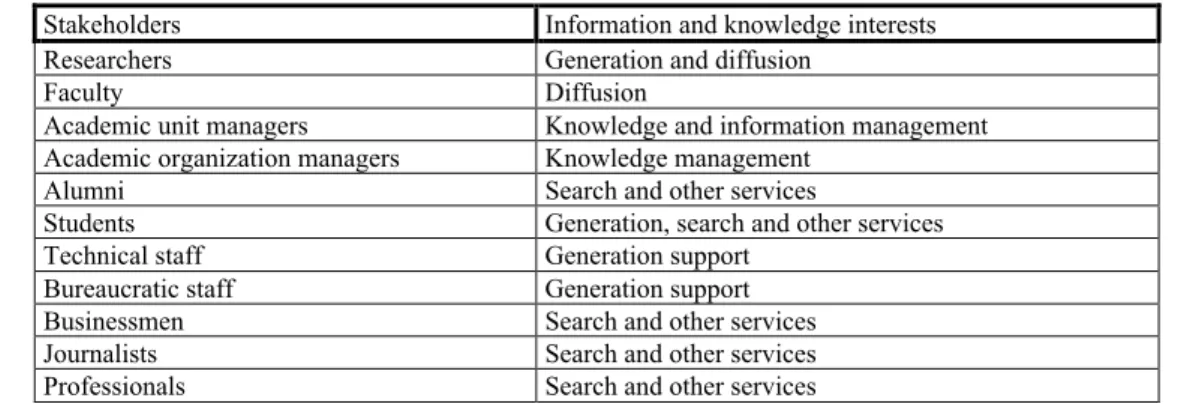
A system’s design is usually directed to a few specific kinds of user. For an academic digital library, for instance, the main information stakeholders are researchers, students, and librarians. Applications usually neglect stakeholders who are not their main users but might be privileged if their interests were contemplated. Frequently major and minor users of a system exchange roles in a second system. This is the case with digital libraries and funding management systems. Researchers and policy makers could benefit from both, but usually researchers are not considered in the design of management information systems of funding agencies. Likewise, policy makers do not receive attention in the design of academic digital libraries. TABLE 1 delineates an association between stakeholders of the science and technology setting and the activities that generate their interests in information.
It is interesting to note that the comprehensive approach to users’ requirements is a widely accepted notion since the 1970s [4]. However, the concern by that time was to integrate applications of a single organization to avoid redundancy, lack of information, and duplication of efforts. The decision to integrate applications could be made by an authority in the organization. In a retail business, for instance, the owner or president could demand that sales and inventory systems be integrated, thus salesmen and inventory staff would not have to redo the work of one another to fill in the information they needed.
The present integration problem is a bit more complex. There is hardly a common authority in charge of information systems of different organizations. Funding management systems and digital libraries, even if they have users and information in common, cannot be integrated by the decision of a single authority. There is need for a vision that propels the compromise of different organizations in favor of the fulfillment of all stakeholders’ requirements, even the ones who are not direct clients.
TABLE 1 - SCIENCE AND TECHNOLOGY STAKEHOLDERS’ INTERESTS
Stakeholders Information and knowledge interests
Researchers Generation and diffusion
Faculty Diffusion
Academic unit managers Knowledge and information management Academic organization managers Knowledge management
Alumni Search and other services
Students Generation, search and other services
Technical staff Generation support
Bureaucratic staff Generation support
Businessmen Search and other services
Journalists Search and other services
Professionals Search and other services
FOUNDATION OF A SCIENCE AND TECHNOLOGY GOVERNMENTAL PLATFORM
Who are the stakeholders of science and technology management information systems? Why asking – isn’t it obvious that they are researchers and funding agencies managers and staff? Awareness of the context can lead us to recognize that there are other stakeholders, for instance the ones in TABLE 1. Having recognized the existence of several stakeholders, some questions arise:
• What is the information that these stakeholders need?
• Where does the information come from? • Where have this information been sought?
These questions lay the foundation for an architectural framework for government information systems described by Pacheco [5]. The architecture is the basis of the Lattes Platform, promoted by CNPq, the Brazilian National Research Council. Lattes includes information systems, databases, web portals and management and knowledge systems for information on science, technology, and innovation.
CNPq agreed to take up the role of one of the stakeholders in the national science and technology system, allowing for the inclusion of other stakeholders’ requirements in the platform whose development it funded. Before Lattes, the agency offered to the scientific community electronic forms designed to furnish the data used in funding evaluation and management. With Lattes, the community was offered a wide range of functionalities, from the automatic generation of a web page for each researcher’s curriculum to the possibility of tracking all alumni in the country using a variety of filters and groupings. One of the effects was the increment in the number of curricula held by the agency, from 40,000 in 1999, when the platform was launched, to 290,000 in May, 2003.
The Lattes Platform is presently being adopted as the fundamental technology of the SCienTI Network (http://www.scienti.info), an international network of information and knowledge sources for the management of science, technology, and innovation. One of the most prominent characteristics of the Platform is the integration of curriculum and many other applications through the World Wide Web, discussed next.
WEB INTEGRATION OF SCIENCE AND TECHNOLOGY INFORMATION SYSTEMS
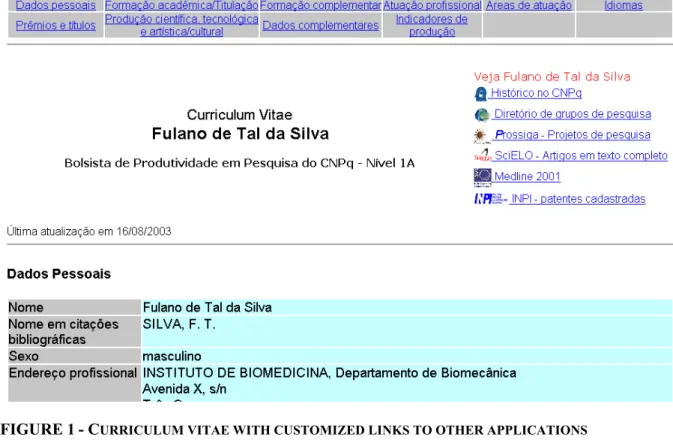
FIGURE 1 displays an illustration of a curriculum maintained at CNPq, accessible through the web. In this illustration there are links in the curriculum to several other applications related to the researcher. The first three links to the right of the figure refer to applications at CNPq: the historic record of funding received from the agency, the presence in the national Directory of Research Groups, and the record of research projects conducted. The other links are customized searches to a free digital library of well-ranked journals (SciELO,
http://www.scielo.br), to the Medline digital library, and to patents in the Brazilian National Institute of Industrial Property.
FIGURE 1 - CURRICULUM VITAE WITH CUSTOMIZED LINKS TO OTHER APPLICATIONS
(FRAGMENT)
Each researcher has in the curriculum a number of links to other applications. The other applications link back the curriculum, thus forming a network of information and knowledge resources. This is one of the main strengths of the Platform. This scheme is presently being applied at the international level [6].
ROLE OF DIGITAL LIBRARIES
In the graduate school setting, a digital library – especially of theses and dissertations – should be useful not only to students and advisors, but also to managers of the knowledge development process. They are area coordinators, graduate school managers, deans, research group leaders, and others. While students and
patterns of interaction among authors or to measure access frequencies ordered by subject, keyword, advisor, doctoral or dissertation level, and publication year. This kind of information is important in their decision making process.
Still, there are other stakeholders with interests in a digital library of theses and dissertations. Applicants to graduate school want to know about the work that has been developed lately. Journalists and businessmen want to search for experts in the solution of specific problems, and so on. The integration of digital libraries and curricula, therefore, is an important step to increase the impact of both applications.
Public-funded digital libraries have an important role regarding the investment of public funds. Offering good digital libraries is a strategy for the improvement of graduate students’ productivity. They offer ubiquity, flexibility, and advanced search facilities in a way that traditional libraries don’t. It seems advisable, therefore, to offer free access to the theses and dissertations produced.
Moreover, it has been demonstrated that online articles tend to have more citations [7]. It is plausible to think that free, online theses and dissertations have an increased impact, propagating the result of the investment of public funds. BTD, the free, public, online Theses and Dissertations Bank of the Graduate Program in Production Engineering (PPGEP) of the Federal University of Santa Catarina (UFSC), Brazil, integrated with the Lattes Platform, is described next.
THE THESES AND DISSERTATIONS BANK (BTD)
BTD: BEGINNING AND EVOLUTION
The PPGEP strategic planning established in 1985 a ten-year goal: the launch of a distance education program. In July, 1995, PPGEP’s Distance Education Laboratory (LED) installed its videoconference infrastructure, the same year in which BTD was implemented.
The need for digital libraries and integration of academic and administrative platforms was recognized since LED’s inception. The Stela Group (a development laboratory at PPGEP) produced the first HTML versions of theses and dissertations. The first digital dissertation was uploaded in May 11, 1996. Other 357 works were uploaded until 1999. By that time several dissertation libraries had gone online – by the Massachusetts Institute of Technology [8], ProQuest UMI [9], and Virginia Tech [10].
BTD was integrated with the PPGEP academic management platform. A new BTD website was designed, released by the end of November of 2000. The hit counting reached 23,000 after the first six months online, 60,000 within a year, 100,000 in 18 months in service, and 150,000 after two years. These are expressive numbers if we consider that the content is in Portuguese. The next section describes the features of BTD that triggered such interest.
BTD'S FEATURES
The BTD website is organized in six areas. They are General Information, Recent and Announced Defenses, Access to Theses and Dissertations, BTD Statistics, Related Links, and Access Rankings.
General Information describes the objectives of BTD and presents its information sources. The main features are briefly commented, together with some historical background.
Recent and Announced Defenses reports the scheduling of defenses to occur shortly and lists defenses occurred in the previous four months, with search facilities by area or graduate level and links to authors, advisors, and internal (PPGEP’s) committee members.
Access to Theses and Dissertations allows for searching theses and dissertations with filters. For each document, it is possible to see the hit counting, and to access the advisor’s curriculum and statistics of defenses with counting by year and average completion time.
Most BTD users are students and faculty. However, since BTD is free and available over the web, it has been useful to strengthen PPGEP’s connection with industry. A search for “centrais de frete” (freight centers), for instance, points to 6 monographs defended between 1993 and 1998. This search allowed PPGEP to demonstrate, online and in real time, its documented know-how in the subject. The demonstration was made during a visit from the president of a telecommunications company who was interested in academic works related to freight center customer service. This illustrates the role of knowledge management tool played by BTD.
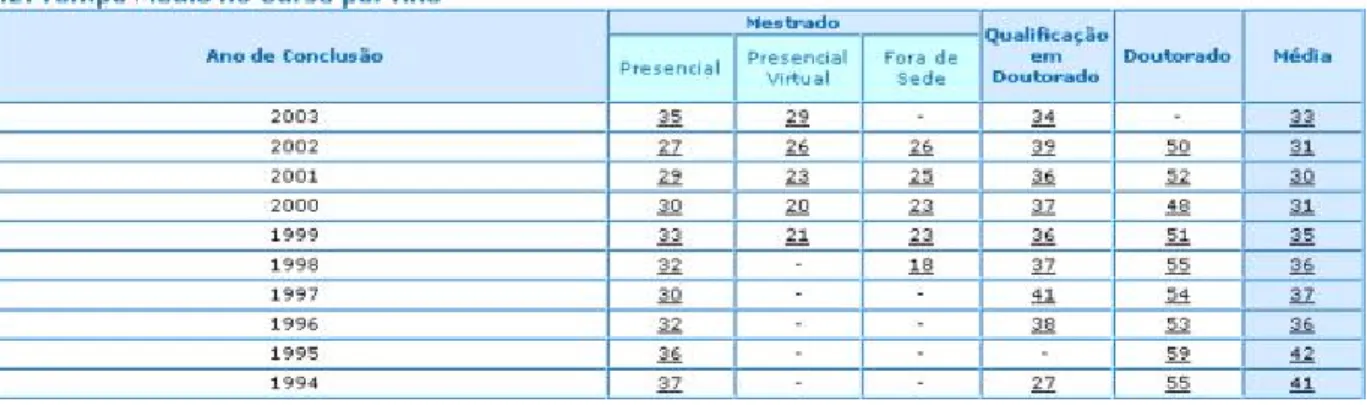
The BTD Statistics link show mean completion time of graduates according to type of degree and program category (presence, distance, or out-of-campus program). It is possible to custom-fit statistics using filters for program area, advisor, entry year, and graduation year.
The generation of statistics is an important contribution to graduate education management. The detection of a tendency to reduce mean completion time and, especially, the comparison of mean completion times among the three categories of mastering programs (presence, distance, and out-of-campus) allows for an appraisal of the results of advising efforts, as illustrated in FIGURE 2. It shows the average time in months until defense of mastering dissertation or doctoral qualification and thesis, organized by year.
FIGURE 2 - BTD STATISTICS
Related Links leads the user to other digital libraries, as well as to articles and news. In addition, the Brazilian copyright law is linked.
Access Rankings are displayed by author, advisor, and area. It allows for the measurement of interest levels. It also links each advisor with his curriculum vitae in the Lattes Platform, and Statistics.
INTEGRATION OF BTD TO OTHER APPLICATIONS, SYSTEMS, AND NETWORKS
BTD is linked to other systems, especially the Lattes Platform and the Brazilian national Digital Library of Theses and Dissertations (BDTD), described by [11].
LINKS BETWEEN BTD AND THE LATTES PLATFORM
FIGURE 3 displays the result of a search for theses and dissertations about “bibliotecas” (libraries). The records found have links to each author’s curriculum in the Lattes Platform, where available. The user can, also, follow the link with the name of the advisor (arrow in FIGURE 3) and access all works defended by his advisees. The result is in FIGURE 4.
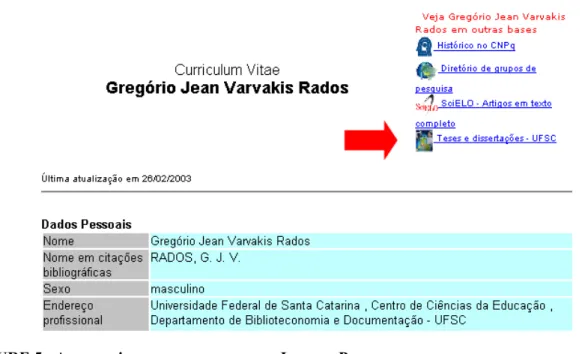
In the advisees’ theses and dissertations page, the user may want to know statistics about the advisor, or the advisor’s curriculum, following the link shown by the arrow in FIGURE 4. This leads to the curriculum in FIGURE 5.
FIGURE 3 - RESULTS OF A SEARCH FOR THESES AND DISSERTATIONS ON "BIBLIOTECAS"
(LIBRARIES)
The advisor’s curriculum reveals all information he may have in applications integrated to the curriculum. This includes the theses and dissertations advised, as indicated by the arrow in FIGURE 5.
FIGURE 5 - ADVISOR'S CURRICULUM IN THE LATTES PLATFORM
CONTINUED INTEGRATION WITH THE LATTES PLATFORM AND SCIENTI NETWORK
The most popular application of the Lattes Platform, holding presently about 290,000 curricula, is Curriculum Lattes, used by individual Brazilian researchers to maintain their curricula. Each researcher submits his curriculum to CNPq in order to qualify for scholarships, to be accounted for in accreditation cycles, etc.The Lattes Platform supporting technology is now part of the SCienTI Network, an international initiative to integrate science and technology information sources. Comprised initially by 10 countries from Latin America, the Caribbean and Europe in December, 2002, SCienTI gives BTD the prospect of integration of every thesis, dissertation, and curriculum of graduate or faculty to digital libraries and other applications throughout the Network.
Most countries in the SCienTI Network are Spanish-speaking. This poses a small problem for integration developers. The translation of XML tags from a grammar of the Lattes Platform, in order to overcome this problem, is one of the developments addressed next.
PRESENT AND NEXT FUTURE DEVELOPMENTS
The Stela Group is developer of both BTD and the Lattes Platform. The multilingual curriculum and the Lattes Platform Markup Language (LMPL) are development initiatives at the Stela Group that deal with systems integration, with potential impact on BTD. An initial difficulty for spreading application development throughout Spanish-speaking countries was the fact that the language for specification in the Lattes Platform is Portuguese. For Spanish-speaking developers to understand data models and other documents, they must be translated into Spanish, overcoming tricky problems such as false cognates.
LMPL is an XML-based ontology designed for the integration of science and technology information systems. Its first versions are limited to specify curricular information. A similar collaboration in the digital library arena is advisable. A recent Brazilian initiative deals with a national definition for dissertation metadata, based on Dublin Core [12]. Such definition can be used as instrument for harvesting mechanisms.
An initial approach to this problem has been to build a translation system for XML curricular specifications, using the LMPL specification as starting point. A translation specification defines source and target languages and a detailed translation of all tags in the curriculum markup from the source to the target language. Further development initiatives should focus on the translation of content, a problem at a deeper level of difficulty.
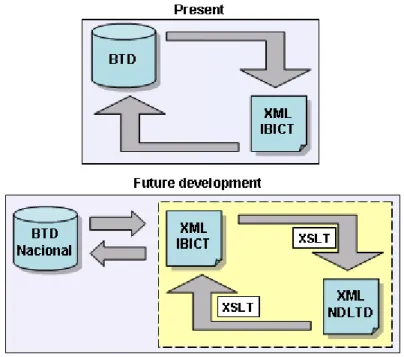
FIGURE 6 presents the current grammar translation between metadata in BTD and in BDTD, promoted by IBICT, the Brazilian Institute of Information in Science and Technology. A new initiative is underway to translate between the Brazilian standard for theses and dissertations and that of NDLTD (http://www.ndltd.org/), the Networked Digital Library of Theses and Dissertations, a consortium of nearly 200 organizations, mostly
universities. This would give BTD the possibility of information interchange with international applications that adhere to the NDLTD specification.
FIGURE 6 - INFORMATION INTERCHANGE BETWEEN BTD AND BDTD
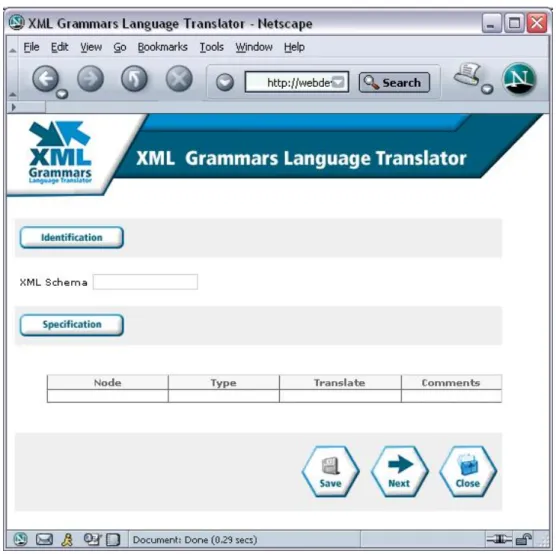
FIGURE 7 shows two fragments of the same curriculum with markups in Portuguese and English. The different markups allow developers to work with terms that are significant in their own mother languages, avoiding problems such as false cognates that could be misleading. FIGURE 8 introduces the interface of an XML language translator that makes the translation automatic, after a translating scheme is defined. This facilitates developers of different countries to teamwork in the development of XML-based solutions to the Lattes Platform.
New developments are planned for BTD, especially regarding scientific journalism and knowledge management. BTD is planned to offer interviews with graduates and their advisors and committee, and alumni track-keeping.
The next developments include also the verification of methodology of submitted theses and dissertations, advanced search features (full text), the building of informetric indexes, an organizational knowledge management module (dealing with the building of a profile of each advisor’s areas of interest and frequent topics), artificial intelligence tools in theses and dissertations auditing (for instance, to analyze style and for plagiarism detection), and the application of intelligent auditing systems for content comparison. Both methodology verification and the application of intelligent auditing systems are current research topics at PPGEP.
<?xml version="1.0" encoding="ISO-8859-1" ?>
-<CURRICULO-VITAE SISTEMA-ORIGEM-XML="LATTES_OFFLINE">
- <DADOS-GERAIS NOME-COMPLETO="Roberto Carlos dos Santos Pacheco" NOME-EM-CITACOES-BIBLIOGRAFICAS="PACHECO, R. C. S." NACIONALIDADE="B"
<?xml version="1.0" encoding="UTF-16" ?>
-<CURRICULUM-VITAE SYSTEM-ORIGIN-XML="LATTES_OFFLINE">
-<GENERAL-DATA FULL-NAME="Roberto Carlos dos Santos Pacheco" NAME-PUBLISH="PACHECO, R. C. S." NATIONALITY="B"
FIGURE 8 - XML GRAMMAR TRANSLATOR INTERFACE
CONCLUDING REMARKS
This paper discussed information integration in science and technology information systems, with focus on BTD, a digital library of theses and dissertations. A conception of information systems integration based on the fulfillment of requirements of a wide range of stakeholders was presented, with examples of integration over the web. BTD’s history, features, integration and next developments were summarized.
The technology and the methodology for the building of BTD have been part of the continued effort for the building of the Lattes Platform. It was conceived and operated to support funding, planning, and evaluation of science and technology. Several agencies have worked to integrate science and technology applications into the Lattes Platform, and BTD also has this aim.
One of the results of these efforts is the standardization of metadata, allowing for the establishment of links among several institutional web portals. In the future, we expect to have access to documents from within a researcher’s curriculum, and from those to the author’s curriculum, with advanced tools for search and analysis.
BTD has already made an impact on how PPGEP’s candidates research, and on the visibility of graduate monographs. Indeed, improvements in access to scientific literature have already changed the entire scientific process [13]. Bollacker et al. [14] maintain that automatic tools to support research will be increasingly important in the future. BTD’s hit counting suggests the vigor of the introduction of new technologies and their effect on researchers’ working style. The statistics and rankings endow the system with valuable tools for decision support.
The university is changing, with evident impact on libraries. However, we consider that the achievements are faint if we think of the potential of technology usage in libraries. Digital libraries still stumble on inadequate integration of information and software. This article has shown evidence of great impact of a conception of information systems that meet the needs of a broad variety of users.
NOTES AND REFERENCES
1 MASON, J; MITCHELL, S; MOONEY, M; REASONER, L; RODRIGUEZ, C. Infomine: Promising Directions in Virtual Library Development. First Monday, v. 5, n. 6, 2000. Retrieved May 31, 2002, from http://firstmonday.org/issues/issue5_6/mason/index.html.
2 CAPLAN, P. Oh What a Tangled Web We Weave: Opportunities and Challenges for Stan-dards Development in the Digital Library Arena. First Monday, v. 5, n. 6, 2000. Retrieved May 31, 2002, from
http://firstmonday.org/issues/issue5_6/caplan/index.html.
3 PACHECO, RCS; KERN, VM; BERMEJO, PHS. Interoperability and information integration in an early online academic digital library of theses and dissertations: the case of BTD. Intl. Inform. & Libr. Rev. To appear (2003).
4 TSICHRITZIS, D; KLUG, A. The ANSI/X3/SPARC DBMS framework report of the study group on database management systems. Information Systems v. 3, 1978, p. 173-191.
5 PACHECO, RCS. Uma metodologia de desenvolvimento de plataformas de governo para geração e divulgação de informações e de conhecimento. Article presented as a partial fulfillment of documental requirements for a position as a professor at INE/UFSC. Florianópolis-SC, Brazil, January 2003, 35 p. 6 DE LOS RÍOS, R; SANTANA, PHA. El espacio virtual de intercambio de información sobre recursos humanos en Ciencia y Tecnología de América Latina y el Caribe: Del CV Lattes al CvLAC. Ci. Inf., v. 30, n. 3, 2001, pp. 42-47.
7 LAWRENCE, S. Online or Invisible? Nature, v. 411, n. 6837., 2001, p. 521.
8 Massachusetts Institute of Technology. Digital Library of MIT Theses. Retrieved May 3, 2002, from http://theses.mit.edu/.
9 UMI. ProQuest Digital Dissertations. Retrieved June 21, 2002, from http://wwwlib.umi.com/dissertations/. 10 VIRGINIA TECH. Digital Library and Archives. Retrieved May 3, 2002, from
http://scholar.lib.vt.edu/theses/.
11 MARCONDES, CH; SAYÃO, LF. Integração e interoperabilidade no acesso a recursos informacionais eletrônicos em C&T: a proposta da Biblioteca Digital Brasileira. Ci. Inf. v. 30, n. 3, 2001, p. 24-33.
12 DUBLIN CORE METADATA INITIATIVE. Retrieved May 3, 2002, from http://www.dublincore.org/. 13 LAWRENCE, S. Access to Scientific Literature, The Nature Yearbook of Science and Technology, edited by Declan Butler, Macmillan, London, England, 2001, p. 86–88.
14 BOLLACKER, KD; LAWRENCE, S; GILES, CL. Discovering Relevant Scientific Literature on The Web. IEEE Intelligent Systems, v. 15, n. 2, 2000, p. 42–47.